Muslims believe that Allah revealed the Torah to Moses and the Injil (Gospel) to Jesus, peace be upon them both. Believing in these earlier scriptures is part of our faith. Yet we also believe that the Bible people hold today is not preserved in the form in which it was revealed. Christian friends often ask: is this just a Muslim claim, or is there evidence for it?
In this article we first look at what the Qur’an actually says, and then at the evidence. Almost all of the evidence comes from Christian scholars and Christian publishers themselves. Scans of the key statements are given at the end of the article.
What the Qur’an says
1. The earlier books were revealed by Allah. The Qur’an says Allah “sent down the Torah and the Gospel” before it, as guidance for mankind (Qur’an 3:3–4). So a Muslim never mocks the Torah or the Injil. Our criticism is of what people did to them, not of what Allah revealed.
2. Their protection was entrusted to people. About the Torah, the Qur’an says the rabbis and scholars judged by it “because they were entrusted with the protection of the Book of Allah” (Qur’an 5:44). Its preservation was a duty placed on human beings. About the Qur’an, Allah says something very different:
“Indeed, it is We who sent down the Reminder, and indeed, We will be its guardian.”
3. How the change happened. The Qur’an describes several ways in which the earlier scriptures were changed:
- Writing with their own hands and calling it scripture: “So woe to those who write the Book with their own hands, then say, ‘This is from Allah,’ in order to sell it for a small price” (Qur’an 2:79).
- Twisting the words while reading: “There is a group among them who twist their tongues with the Book, so that you think it is from the Book, but it is not from the Book. And they say, ‘It is from Allah,’ but it is not from Allah” (Qur’an 3:78).
- Moving words from their places: “They distort words from their proper places” (Qur’an 5:13; see also 4:46).
- Losing part of it: “They forgot a portion of what they were reminded of.” The Qur’an says this about the Jews (5:13) and about the Christians (5:14).
- Hiding part of it: The Prophet ﷺ came “making clear to you much of what you used to hide of the Book” (Qur’an 5:15).
The Companion Ibn Abbas (may Allah be pleased with him) explained it like this: “Why do you ask the People of the Book about anything, while your Book, which was revealed to Allah’s Messenger, is the most recent? You read it pure and undistorted, and Allah has told you that the People of the Book changed their scripture and distorted it, and wrote the scripture with their own hands and said, ‘It is from Allah,’ to sell it for a small price” (Sahih al-Bukhari 7363).
4. But not everything in it is false. Islam’s position is balanced. The Prophet ﷺ said: “Do not believe the People of the Book, and do not disbelieve them, but say: We believe in Allah and in what has been revealed to us” (Sahih al-Bukhari 4485). Truth and human additions are now mixed together in these books. Where the Qur’an confirms something, we accept it. Where it denies something, we reject it. Where it is silent, we neither confirm nor deny. This is also why traces of the truth, such as the description of the Prophet ﷺ, can still be found in them (Qur’an 7:157).
5. The Gospels are not the Injil. The Injil is the revelation Allah gave to Jesus. The four Gospels in the New Testament are accounts written about Jesus by other people. Even Christians do not claim that Jesus wrote them or dictated them. So even a perfectly copied Gospel would still not be the Injil that the Qur’an speaks about.
Now let us look at the evidence.
The evidence from Christian scholarship
① The original manuscripts no longer exist
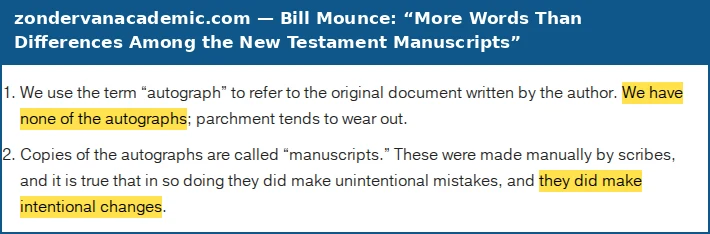
Not a single original copy of any New Testament book survives. Bill Mounce, a well-known evangelical Greek scholar, writes: “We use the term ‘autograph’ to refer to the original document written by the author. We have none of the autographs.” He then adds something even more important about the copyists: “it is true that in so doing they did make unintentional mistakes, and they did make intentional changes” (Zondervan Academic; scan 1).
Daniel B. Wallace, one of the best-known Christian defenders of the New Testament text, says the originals “all disappeared within a century by copying and copying and copying, frequent handling” (Zondervan Academic; scan 2).
② The surviving copies differ in about 400,000 places
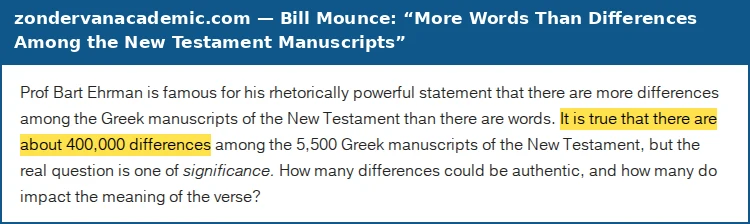
Mounce again: “It is true that there are about 400,000 differences among the 5,500 Greek manuscripts of the New Testament” (scan 3). As he notes, the scholar Bart Ehrman puts it this way: there are more differences among the manuscripts than there are words in the New Testament.
③ The Gospels are anonymous
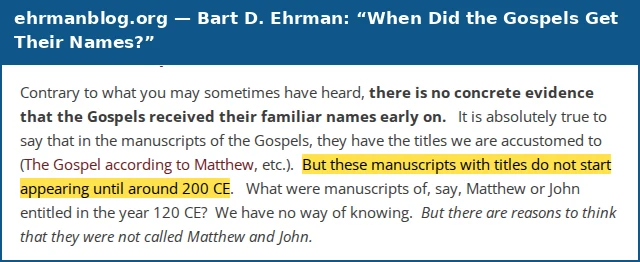
None of the four Gospels names its author inside its text. Bart Ehrman, Professor of Religious Studies at the University of North Carolina, writes that the texts “are completely anonymous”, and that manuscripts carrying the familiar titles (“The Gospel according to Matthew”, and so on) “do not start appearing until around 200 CE“, roughly a century after the books were written (The Bart Ehrman Blog; scan 4).
④ The clearest Trinity verse was added later
The King James Version reads:
“For there are three that bear record in heaven, the Father, the Word, and the Holy Ghost: and these three are one.”
— 1 John 5:7 (KJV)
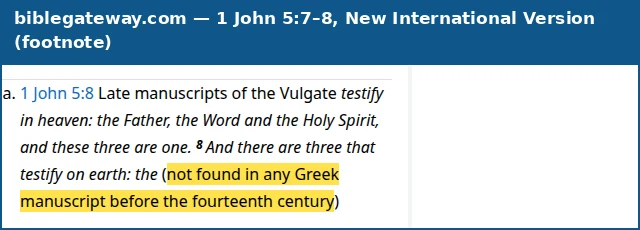
For centuries this was the clearest statement of the Trinity in the whole Bible. Yet modern Bibles have removed these words from the text. The New International Version explains why in its own footnote: the words are “not found in any Greek manuscript before the fourteenth century” (1 John 5:7–8, NIV; scan 5). In other words, someone added them to the “word of God” more than a thousand years after John.
⑤ Whole passages are later additions
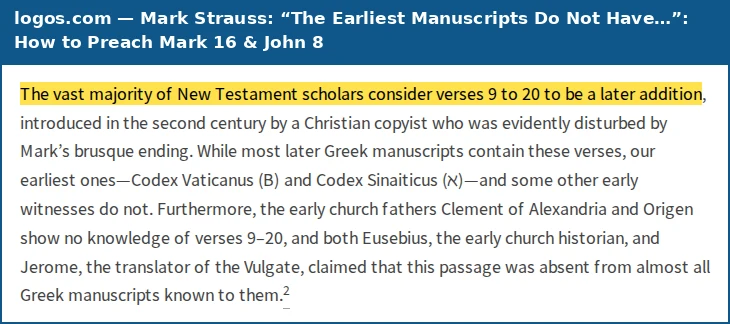
- The ending of Mark (Mark 16:9–20): Writing for Logos, a Christian Bible-software company, Mark Strauss says: “The vast majority of New Testament scholars consider verses 9 to 20 to be a later addition, introduced in the second century by a Christian copyist.” He adds that the debate among scholars “is not whether verses 9–20 were original to Mark’s Gospel (they clearly were not)” (Logos; scan 6). These twelve verses contain the appearances of Jesus after the crucifixion and his ascension.
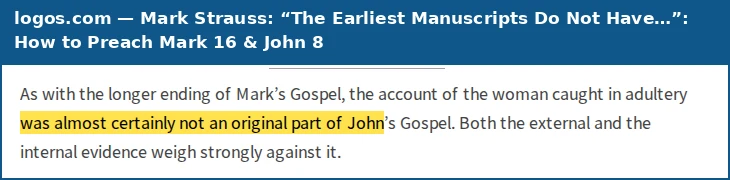
- The woman caught in adultery (John 7:53–8:11): The same article says this famous story “was almost certainly not an original part of John’s Gospel”, and that it is missing from the earliest Greek manuscripts (scan 7).
⑥ Verses in the King James Bible are missing from modern Bibles
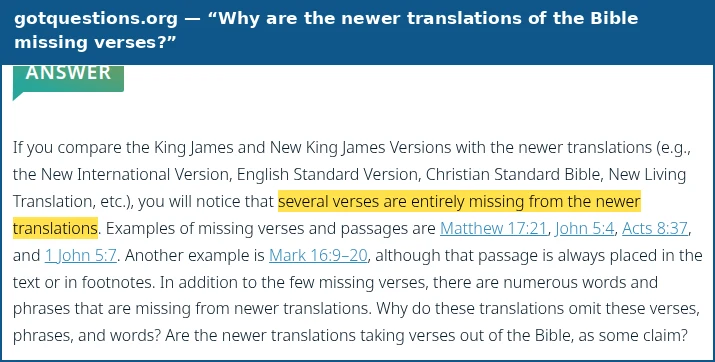
The Christian website GotQuestions explains: “If you compare the King James and New King James Versions with the newer translations … you will notice that several verses are entirely missing from the newer translations. Examples of missing verses and passages are Matthew 17:21, John 5:4, Acts 8:37, and 1 John 5:7” (GotQuestions.org; scan 8). Either these verses were added by copyists, or they were taken out of God’s word. Either way, the text has changed.
⑦ Jesus’ own words survive only in translation
Jesus spoke Aramaic, but the Gospels were written in Greek. The Gospels themselves show this. In a few places they keep his original Aramaic words and then translate them for the reader: “Talitha cumi; which is, being interpreted, Damsel, I say unto thee, arise” (Mark 5:41), and “Eloi, Eloi, lama sabachthani? which is, being interpreted, My God, my God, why hast thou forsaken me?” (Mark 15:34). Apart from such rare phrases, not one complete sermon of Jesus survives in the language he actually spoke.
⑧ The list of books was not settled for over three centuries
The earliest known document that lists exactly the 27 books of today’s New Testament is the Easter (Festal) Letter of Athanasius, bishop of Alexandria, written in 367 CE. Christianity Today calls it “the earliest authoritative statement to fix the New Testament as we know it today” (Christianity Today; text of the letter).
Before that, the lists differed. Two of the oldest complete Bibles in the world include books that are not in the Bible today. The 4th-century Codex Sinaiticus contains the Epistle of Barnabas and the Shepherd of Hermas (Codex Sinaiticus). The 5th-century Codex Alexandrinus contains 1 and 2 Clement (Codex Alexandrinus).
⑨ Christians still do not agree on which books are in the Bible
Even today, the Bible is not the same book in every church. The Protestant Bible has 66 books. The Catholic Bible has 73, fixed by the Council of Trent in the 16th century (Biblical canon). The Eastern Orthodox churches accept further books. The Ethiopian Orthodox Bible has 81 books (Ethiopian Biblical canon). Think about this: Christians cannot agree on what the Bible is, let alone whether every word of it is preserved.
⑩ Some letters were not written by the person named
Thirteen letters in the New Testament carry the name of Paul. The majority of scholars believe Paul actually wrote only seven of them. Three (1 Timothy, 2 Timothy and Titus) are widely seen as written by someone else in his name (Pauline epistles).
And the Old Testament?
The same problem is found in the Hebrew Bible. Three examples from the text itself:
- The Torah describes the death of Moses. The five books are traditionally said to be written by Moses, yet they say: “So Moses the servant of the LORD died there in the land of Moab … and he buried him in a valley … but no man knoweth of his sepulchre unto this day” (Deuteronomy 34:5–6). Someone else wrote these words, long after Moses.
- Books that are quoted but lost. The Bible quotes from “the book of the wars of the LORD” (Numbers 21:14) and “the book of Jasher” (Joshua 10:13). Neither book exists today.
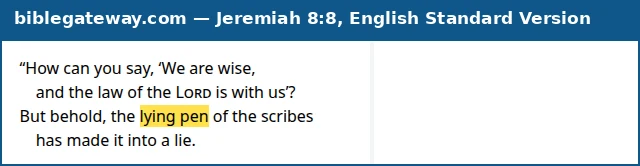
- A prophet’s complaint about the scribes. In the Book of Jeremiah, the prophet says to the people of his time: “How can you say, ‘We are wise, and the law of the LORD is with us’? But behold, the lying pen of the scribes has made it into a lie” (Jeremiah 8:8, ESV; scan 9). To be fair, many Christians read this as false interpretation of the law rather than a rewritten text. Even so, the Bible itself records that the scribes who handled God’s law were not trustworthy.
What Christians reply, and our answer
“The number of variants does not matter, only their significance.” This is Mounce’s own reply: most of the 400,000 differences are spelling, word order and small slips (scan 3). We agree that most of them are minor. But the Qur’an never claimed that every verse was rewritten. Our point is narrower, and the evidence above supports it. The originals are gone, so no one can check the text against them. Copyists made “intentional changes”, by Mounce’s own admission. A verse on the Trinity was added more than a thousand years later. Whole stories were added to the Gospels. A book that has been changed in such ways cannot be called preserved, word for word, as it was revealed.
“The Gospel titles are older than you think.” Some scholars, such as Martin Hengel, argue that titles like “According to Mark” were in use before the end of the first century (Zondervan Academic). Even if that were true, the names are still not in the texts themselves. And a title written by a later church does not turn a biography of Jesus into the Injil revealed to Jesus.
The Qur’an: a different story
Compare this with the Qur’an. It was revealed in Arabic, and it is still read in Arabic. It was memorised by the Companions during the Prophet’s ﷺ lifetime and written down as it was revealed. Shortly after his death it was gathered into one book under Abu Bakr (may Allah be pleased with him) (Sahih al-Bukhari 4986). Uthman (may Allah be pleased with him) then sent copies to every region (Sahih al-Bukhari 4987). Millions of Muslims memorise it word for word to this day.
Early manuscripts confirm this. In 2015, the University of Birmingham announced that radiocarbon tests on its Qur’an leaves dated the parchment to between 568 and 645 CE, “close to the time of the Prophet Muhammad” (University of Birmingham). Allah promised to protect the Qur’an Himself (15:9), and that promise can be seen in history.
Conclusion
- The Qur’an teaches that the Torah and the Injil were true revelations, but that people wrote, twisted, forgot and hid parts of them.
- Christian scholars themselves admit that the originals of the New Testament are lost, that the copies differ in about 400,000 places, and that copyists made intentional changes.
- A Trinity verse (1 John 5:7) and whole passages (Mark 16:9–20, John 7:53–8:11) were added later. Modern Bibles now mark or remove them.
- The Gospels are anonymous accounts in Greek, not the Injil revealed to Jesus in his own language.
- Christians took over three centuries to agree on a list of books, and still do not fully agree today.
Muslims do not say this to insult Christians or their love for Jesus. We say it because Allah, out of His mercy, sent a final revelation that He Himself protected: the Qur’an. We invite every sincere Christian to read it and judge for themselves.
Scans of Important References
1. Bill Mounce: “We have none of the autographs … they did make intentional changes”
2. Daniel B. Wallace: the originals “all disappeared within a century”

3. Bill Mounce: about 400,000 differences among 5,500 Greek manuscripts
4. Bart Ehrman: Gospel titles appear only around 200 CE
5. NIV footnote on 1 John 5:7–8
6. Logos: Mark 16:9–20 a later addition
7. Logos: John 7:53–8:11 not an original part of John
8. GotQuestions: verses missing from newer translations
9. Jeremiah 8:8 (English Standard Version)