
Effects of the Tabi‘een and the Abandonment of Raising the Hands
After this, Anwar Khurshid Sahib has presented the effects of the Tabi‘een. A brief review is presented here:
Statement Number ➊ :

I say: Among the companions of Abdullah and the companions of Ali (may Allah be pleased with them both), no specific name has been mentioned, so all these persons are unknown. If trustworthy persons were meant by them, then what is the reason for not revealing their names?
Secondly, if this effect is authentic, then why do the Hanafi, Barelvi, and Deobandi groups oppose it?
Those who raise their hands in Qunoot of Witr and the two Eids cannot present this effect because their two instances of raising hands also fall under its criticism. فما هو جوابكم فهو جوابنا
Statement Number ➋ :
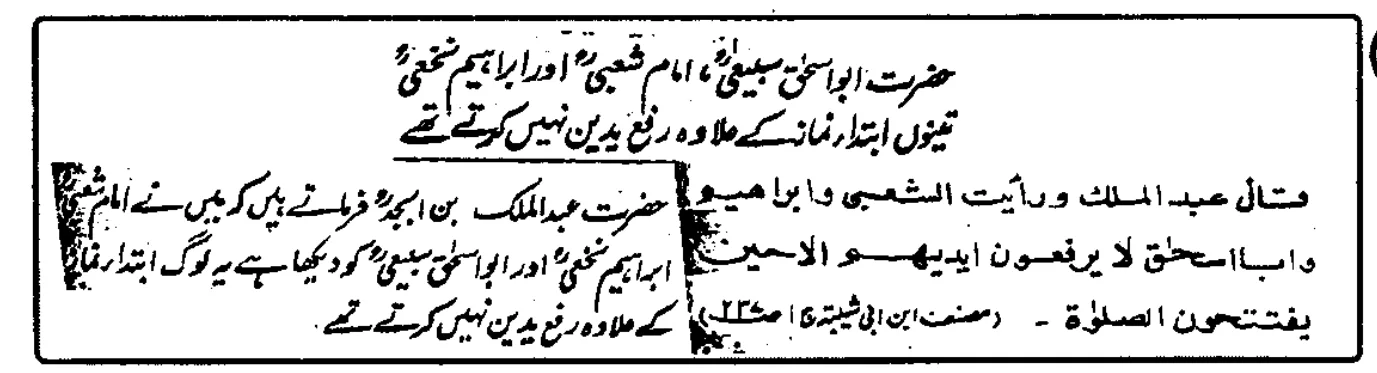
I say: A detailed answer is coming ahead, InshaAllah.
Statement Number ➌ :

Statement: Ashath refers to Ashath ibn Suwar al-Kindi.
The majority of scholars have declared him weak. His narrations are in Mutaba’at in Sahih Muslim. Imam Ahmad ibn Mu’in, Nasai, Darqutni, and others have said: weak
Therefore, this chain is weak.
Statement No. ➍ :

Statement: A detailed answer to this is coming later.
Statement No. ➎ :

Statement: Its chain is Hasan (good).
Statement No. ➏ :

Statement: Jabir al-Ju’fi is a weak Rafidhi and a mudallis (one who practices tadlis).
Imam Abu Hanifa said: “I have not seen anyone more lying than Jabir al-Ju’fi.”
Statement No. ➐ :

Statement: Isma’il ibn Abi Khalid is a mudallis.
He did not specify hearing in this narration, therefore this narration is weak.
Statement No. ➑ :

Statement: Sufyan ibn Muslim, if there is no distortion, then I have not found his conditions.
Statement No. ➒ :

I say: Hajjaj bin Artaatah is weak as well as a fabricator.
وقال السيوطي فى أسماء المدلسين
مشهور بالتدليس Allama Zailai Hanafi said: والحجاج بن أرطاة ضعيف
Commentary on the Tabi’in narrations has ended.
Dear readers! Among the Tabi’in narrations presented by Anwar Khurshid Sahib, only three narrations (Ibrahim Nakha’i, Amir al-Sha’bi, and Abu Ishaq) are authentic in terms of chain of transmission. All other narrations are weak and not reliable according to the principles of hadith scholars. These three narrations also do not explicitly state the lifting of hands before and after Ruku’. The Hanafi, Barelvi, and Deobandi scholars raise their hands in Witr and Eid prayers, which apparently contradicts these two narrations. If they say that the specification of Witr and Eid prayers is proven by other evidence, then respectfully it is stated that the specification of raising hands before and after Ruku’ is proven by mutawatir hadiths.
Therefore, it is not correct to argue against Ahl al-Hadith using these two narrations.
Secondly, when it is proven by authentic hadiths that the Prophet Muhammad (peace be upon him) and the Companions raised their hands, then who is the believer who will descend and observe the practice of one or two Tabi’in!!
For the satisfaction of Anwar Khurshid Sahib and his group, here are some authentic narrations from the Tabi’in who believed in and practiced raising hands:
Affirmation of Raising the Hands and the Followers
① Muhammad (Ibn Sirin, may Allah have mercy on him) used to raise his hands before and after bowing.
② Abu Qilabah al-Basri
③ Wahb ibn Munabbih
④ Salim ibn Abdullah al-Madani
⑤ Al-Qasim ibn Muhammad al-Madani
⑥ ‘Ata ibn Abi Rabah al-Makki
⑦ Makhul al-Shami
⑧ Nu’man ibn Abi ‘Ayyash
⑨ Tawus
⑩ Sa’id ibn Jubayr
⑪ Qasim ibn Mukhayrah was an advocate of raising the hands at the time of bowing.
⑫ Al-Hasan al-Basri