
Abandoning Raising the Hands and the Scholars
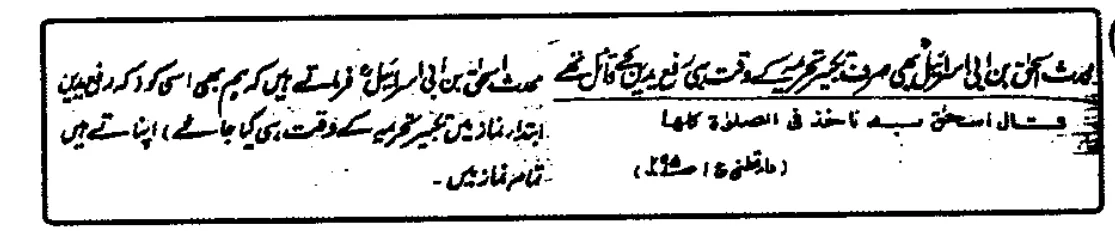
Finally, Anwar Khurshid Sahib has presented references from some scholars from whom abandoning raising the hands is narrated:
➊ Sufyan al-Thawri ➋ Ishaq ibn Abi Isra’il ➌ Imam Abu Hanifa ➍ Imam Malik ➎ Imam Nawawi ➏ People of Madinah ➐ People of Kufa ➑ Consensus of the jurists, although none of these opinions is proven except possibly Ishaq ibn Abi Isra’il or Sufyan al-Thawri.

① Imam Tirmidhi (who was born long after the death of Sufyan al-Thawri) did not mention the chain of narration here. If the wording of the book Al-‘Ilal is considered, then the statement of Sufyan al-Thawri, may Allah have mercy on him, is rejected in comparison to the raised hadiths and the reports of the Companions.
② Ishaq bin Abi Israil, although a truthful narrator, is not among the great Imams of the Muslims. Imam Baghawi says: كان ثقة مامونا إلا أنه كان قليل العقل Imam Abu Zur’ah said: عندي أنه لا يكذب وحدث بحديث منكر Imam Ahmad said واقفي مشئوم إلا أنه صاحب حديث كيس
What weight does the action or inaction of a person of little intellect (simple-minded) hold in Islam?
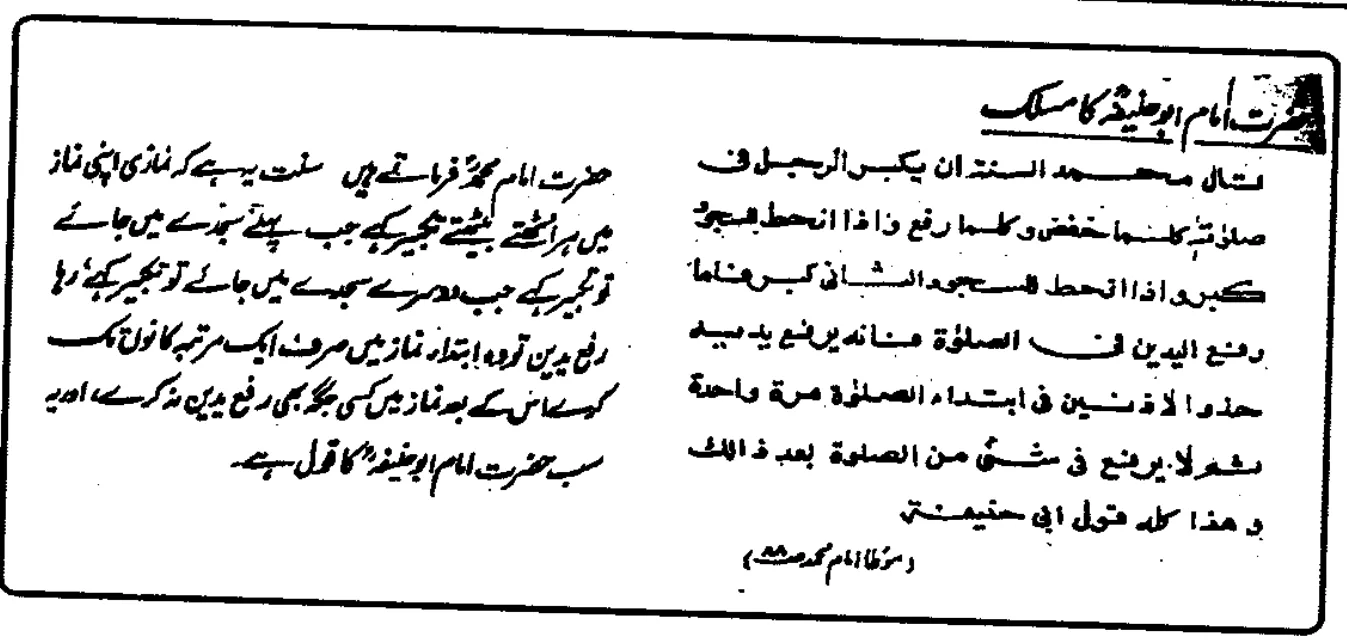
③ The narrator of Imam Abu Hanifa’s statement is Muhammad bin al-Hasan al-Shaybani. Regarding him, Imam Yahya bin Ma’in said in his history
ليس بشئ, and in fact, he has another statement that جهمي كذاب
(So what status can such a person’s narration have according to the Muhaddithin?) And even if this narration is accepted as authentic, it is not beneficial for the Deobandi. Because it does not specify Witr and the two Eids. When Imam Abu Hanifa (conditionally authentic) was of the opinion and practice of not raising the hands at any point in prayer, then why do those who follow him raise their hands in Witr and the two Eids?
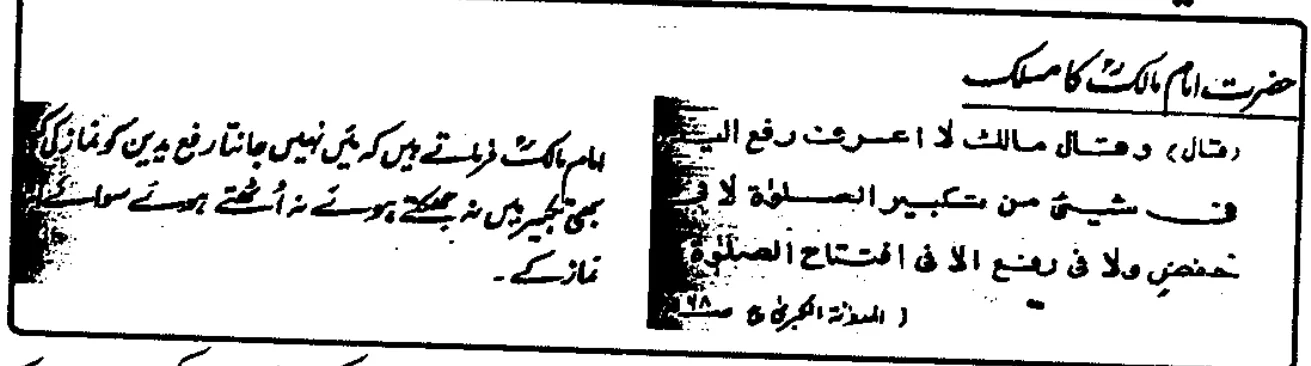
④ The reference to Imam Malik is not from Muwatta but rather from Sahnun’s book Al-Mudawwana Al-Kubra
, cited in opposition to raising the hands. Whereas in Imam Malik’s Muwatta, Imam Malik has narrated a hadith about raising the hands.
When the proof of raising the hands is present in Imam Malik’s own book, then what is the need for Sahnun’s weak reference?
Although many Imams have praised and authenticated Sahnun and he is a truthful narrator, Imam Abu Ali Al-Khalili says:
لم يرض أهل الحديث حفظه
Meaning, the hadith scholars were not pleased with his memory.
Note: The book Al-Mudawwana by Sahnun is not proven to be authentic with a sound chain.
The following trustworthy narrators have transmitted the raising of hands before and after bowing from Imam Malik:
➊ Ashhab ➋ Waleed bin Muslim ➌ Saeed bin Abi Maryam ➍ Abu Mus’ab ➎ Ibn Abdul Hakim ➏ Ibn Wahb, may Allah have mercy on them
In fact, Imam Ashhab states that Imam Malik continued to raise his hands until his death.
Imam Abu Al-Abbas Al-Qurtubi, Imam Khattabi, and Imam Al-Baghawi have explicitly stated that Imam Malik’s last practice was raising the hands.
For further details see Noor Al-Aynain
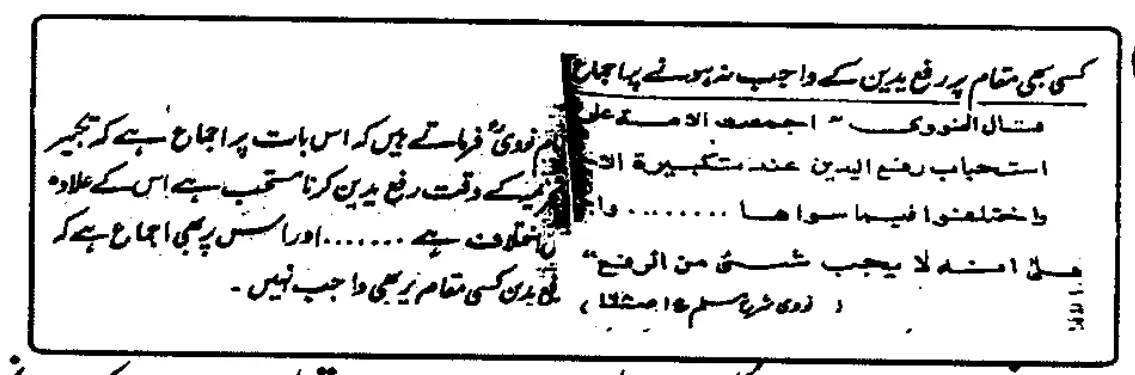
➎ Imam Nawawi supports and practices raising the hands (Raf’ al-Yadain), therefore his statement is not beneficial for Deobandis. Secondly, if a person deliberately omits raising the hands at the time of Takbeer-e-Tahreema, is there any sin on that person for abandoning this “recommended” act or not? Just say Bismillah, perform Takbeer-e-Tahreema, Witr, and Eidain’s raising of hands in your own home, then write against the jurists of the Muhaddithin! Advising others, but himself a disgrace!!

⑥ This claim is based on an unsourced narration of Sahnun, whose anomaly and weakness we have already explained, so this claim is dismissed.
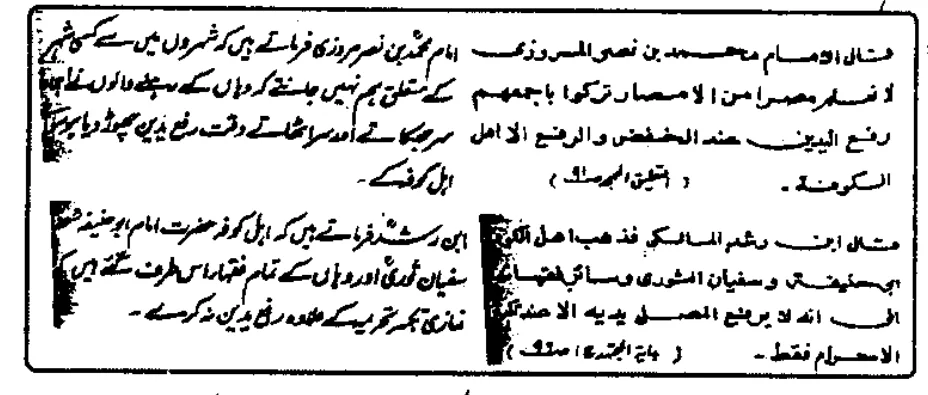
⑦ Present the original book of Muhammad bin Nasr Al-Marwazi, may Allah have mercy on him, as evidence of the consensus of the people of Kufa, which he wrote on the proof of raising the hands. There is no need for unsupported references here and there. Imam Tirmidhi did not claim consensus but considered the hadith affirming the raising of hands as authentic and regarded it as the practice of many companions, may Allah be pleased with them, the followers, and the Muslim imams, may Allah have mercy on them.
Secondly, prove that the consensus of the people of Kufa is a legal proof in the presence of the hadith of the Messenger of Allah, peace and blessings be upon him! ودونه خرط القتاد
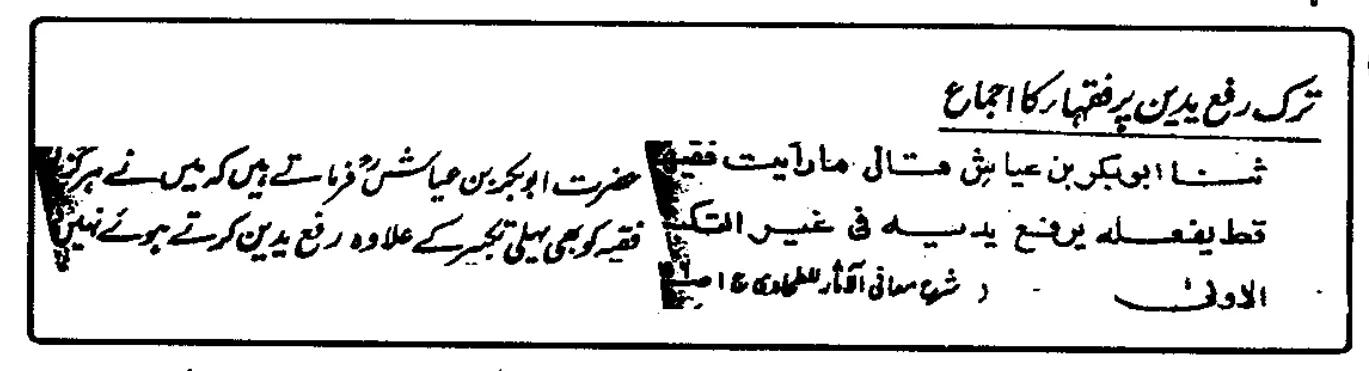
⑧ Anwar Khurshid Sahib has also tried to establish the consensus of some jurists based on the narration of Abu Bakr bin Ayyash.
It is submitted that if this false consensus of some jurists is a proof, then why do the Deobandi scholars raise their hands during Witr and the two Eids?
Many companions such as Abu Bakr, Umar, Ibn Umar, Ibn Zubair, Abu Hurairah, and others, may Allah be pleased with them, and many Tabi‘in such as Muhammad bin Sirin, Salim, Abu Bakr, Wahb, Ata, and Saeed bin Jubair, may Allah have mercy on them, were proponents and practitioners of raising the hands.
Are all these excluded from the list of jurists?
What kind of fabricated consensus is this from which great companions and venerable Tabi‘in and others are excluded? إنا لله وإنا إليه راجعون
Now, references from some Imams of the Muslims who were proponents and practitioners of raising the hands are presented:
Imams of the Muslims and Raising the Hands
➊ Imam Malik
➋ Imam Shafi’i
➌ Imam Ahmad
➍ Imam Ali ibn Abdullah al-Madini
➎ Imam Ishaq ibn Rahwayh
➏ Imam Awza’i
➐ Imam Ibn al-Mubarak
➑ Muhammad ibn Yahya al-Dhuhli
➒ Abdul Rahman ibn Mahdi
➓ Abu al-Walid al-Tayalisi
⓫ Abdullah ibn al-Zubayr al-Humaydi
⓬ Yahya ibn Ma’in
⓭ Ali ibn al-Hasan
⓮ Abdullah ibn Uthman
⓯ Yahya ibn Yahya
⓰ Isa ibn Musa
⓱ Ka’b ibn Sa’id
⓲ Muhammad ibn Salam
⓳ Abdullah ibn Muhammad al-Musandi
(20) Muhammad ibn Nasr al-Marwazi
(21) Abu Ahmad al-Hakim
(22) Imam Bukhari and others, may Allah have mercy on them all.
In summary, even among the counted Imams of the Muslims, the people of opinion (Ahl al-Ra’y) are far behind. The fact that one or two Imams (not explicitly) abandoned raising the hands cannot be taken as evidence for the abrogation of raising the hands.
Strange Conditions:
After being empty-handed in the field of arguments, Anwar Khurshid Sahib writes:
It is not proven from any authentic and explicit hadith that the Prophet ordered the raising of hands during ruku.
Respectfully, to Khurshid Sahib and his party, it is sufficient for Ahl-e-Hadith that the raising of hands before and after ruku is proven from the Prophet Muhammad ﷺ with mutawatir chains in Sahih Bukhari, Sahih Muslim, Sahih Ibn Khuzaymah, Sahih Ibn Hibban, Sahih Ibn al-Jarud, and others, and in no single narration with an authentic chain is its abandonment or abrogation proven. As for proving the command, this is nothing but a dialectical fallacy. It is the habit of Deobandi and Barelvi scholars that if the action is proven, they demand the statement, as in the issue of raising hands, and if the statement is proven, they demand the action, as in the issue of Witr (see Rasul Akram ﷺ ka Tareeqa Namaz
). If both statement and action are proven (such as مسئلة إذا أقيمت الصلوة فلا صلاة إلا المكتوبة), they try to present the practices of the Companions, and if Ahl-e-Hadith present the book, Sunnah, and practices of the Companions as well, as in the issue of Witr, they reject it by saying that the Companions had their own ijtihad, which is not a proof against numerous mursal hadiths (Rasul Kareem ﷺ ka Tareeqa Namaz
). If this is not manipulation of religion, then what is it?
Based on such self-made demands and false conditions, Deobandi and Barelvi scholars think that they will divert the general Muslim public away from the invitation of Ahl-e-Hadith to the book and Sunnah, whereas the matter is quite the opposite. Just three or four days ago, a Deobandi cleric gave some youths the book “Hadith aur Ahl-e-Hadith” by Anwar Khurshid Sahib. These Deobandi youths brought this book to the Ahl-e-Hadith scholar of their village, Janab Rahmatullah Muhammadi Sahib. This village is near GT Road Gondal Stop, District Attock, and its name is “Landi” (Awanabad). When Rahmatullah Muhammadi Sahib proved the betrayals of Anwar Khurshid Sahib in the references presented inside “Hadith aur Ahl-e-Hadith,” three youths became Ahl-e-Hadith and openly started practicing the Sunnah of raising hands. اللهم ثبت أقداهم ، آمين
One Deception and That Fallacy:
Anwar Khurshid Sahib has presented weak, fabricated, or unrelated or authentic but irrelevant arguments:
But contrary to the above hadiths, reports, sayings of Mujtahid Imams, and the consensus of the Ummah, the non-Muqallideen say that the raising of the hands during Ruku is a Sunnah Muakkadah, a Sunnah Mutawatirah, indeed obligatory and even fard; not performing it makes the prayer incomplete and even invalid.
Dear readers!
You have seen that Anwar Khurshid Sahib has presented weak, fabricated, or unrelated hadiths and similarly weak chains of narration reports and unestablished (except a few) sayings and actions of scholars. Whereas we have presented authentic and mutawatir marfu hadiths, authentic reports of the Sahabah, authentic reports of the Tabi‘in, and authentic and established sayings and actions of scholars. You decide for yourself which side the truth lies on.
① The proof of raising the hands is presented from the Prophet ﷺ through mutawatir hadiths, and there is no evidence of its abrogation or abandonment in the entire life of the Prophet ﷺ, not even on a single day, in a single prayer, or in a single rak‘ah. Therefore, if the Ahl-e-Hadith scholars have written it as Sunnah Muakkadah and Sunnah Mutawatirah, what is there to be upset about?
The fact that raising the hands is Sunnah Mutawatirah has also been accepted by Deobandi scholars.
For example, Anwar Shah Kashmiri Deobandi states:
وليعلم أن الرفع متواتر إسنادا وعملا لا يشك فيه ولم ينسخ ولا حرف منه
Meaning, it should be known that raising the hands is mutawatir in terms of chain and practice, there is no doubt in it, and raising the hands has not been abrogated (rather) not even a single letter of it has been abrogated. Approximately the same wording is also present in the footnotes of Faiz al-Bari
and Ma‘arif al-Sunan by al-Banuri
.
Anwar Shah Sahib’s testimony is not a trivial testimony but a decisive proof and great evidence forever for the Deobandi sect. Because in their view, the mentioned “Maulvi” Sahib holds a very high status. This Maulvi Sahib is the same person who, after accepting the hadith about Witr as “strong,” spent fourteen (14) years thinking about its response.
Imam Humaydi (may Allah have mercy on him) and others say that raising the hands is obligatory, as has been mentioned earlier.
It is narrated from Imam Shafi‘i (may Allah have mercy on him) that it is not permissible for a person to abandon raising the hands.
Allama Subki writes a footnote on this: هذا صريح فى أنه يوجب ذلك This statement is explicit evidence that Imam Shafi‘i considered raising the hands obligatory (remember that according to the Muhaddithin, fard and wajib are two names for the same thing).
This is the same Subki about whom the author of “Da Peyghambar Khuda ﷺ Munh” (Pashto) writes “Sheikh al-Islam.”
Imam Ahmad (may Allah have mercy on him) also considers the prayer of the person who does not raise the hands to be incomplete.
Considering such references and the authentic mutawatir Sunnah and based on the ruling of صلوا كما رأيتموني أصلي, if any Ahl-e-Hadith scholar has written raising the hands as wajib, fard, and its abandonment as damaging the prayer, then what is there to be upset about?
Some non-Ahl-e-Hadith scholars have also declared the prayer of the one who raises the hands to be invalid without any evidence.
Why does Anwar Khurshid Sahib not vent his anger on those so-called muftis?
Secondly, Anwar Sahib’s statement “the non-Muqallideen say” etc. is a great trick and fallacy because the Sunnah of raising the hands is accepted by all Shafi‘is and Hanbalis and they practically maintain this Sunnah Mutawatirah continuously. In fact, Anwar Khurshid Sahib wants to mislead that the affirmation of raising the hands is only the doctrine of Ahl-e-Hadith “non-Muqallideen” and nothing else!
We ask, are Shafi‘is and Hanbalis also included among the “non-Muqallideen”? These are the same Shafi‘is with whom the Hanafis fought long wars in Ray and Isfahan and finally accepted defeat.