Raising the hands (lifting hands before and after bowing) is a great Sunnah, supported by dozens of authentic hadiths and the continuous practice of the Companions, including in Sahih Bukhari and Sahih Muslim available here. However, some biased Hanafi jurists and their followers have used the hadith of Jabir bin Samurah (رضي الله عنه) in Sahih Muslim («مالي أراكم رافعي أيديكم كأنها أذناب خيل شمس») as evidence against this Sunnah and claimed that it negates the practice of raising hands.
In this article, we will step-by-step examine the references they present and clarify that this narration concerns waving the hands at the time of salam, not raising hands during bowing.
✦ Raising Hands and the Hadith of “أذناب خيل شمس” ✦
«مَا لِي أَرَاكُمْ رَافِعِي أَيْدِيكُمْ كَأَنَّهَا أَذْنَابُ خَيْلٍ شُمْسٍ؟ اسْكُنُوا فِي الصَّلَاةِ.»
The Messenger of Allah ﷺ said: “Why is it that I see you raising your hands as if they were the tails of restive horses? Be calm in prayer.”
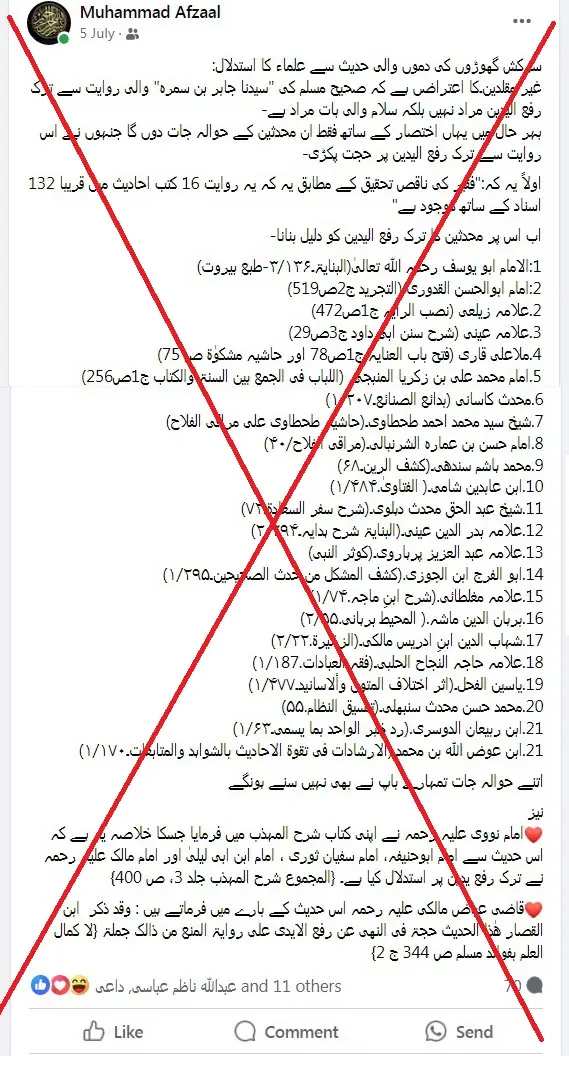
Arguments Presented by the Hanafis (Opposing Party) Regarding This Hadith and Their Critical Examination
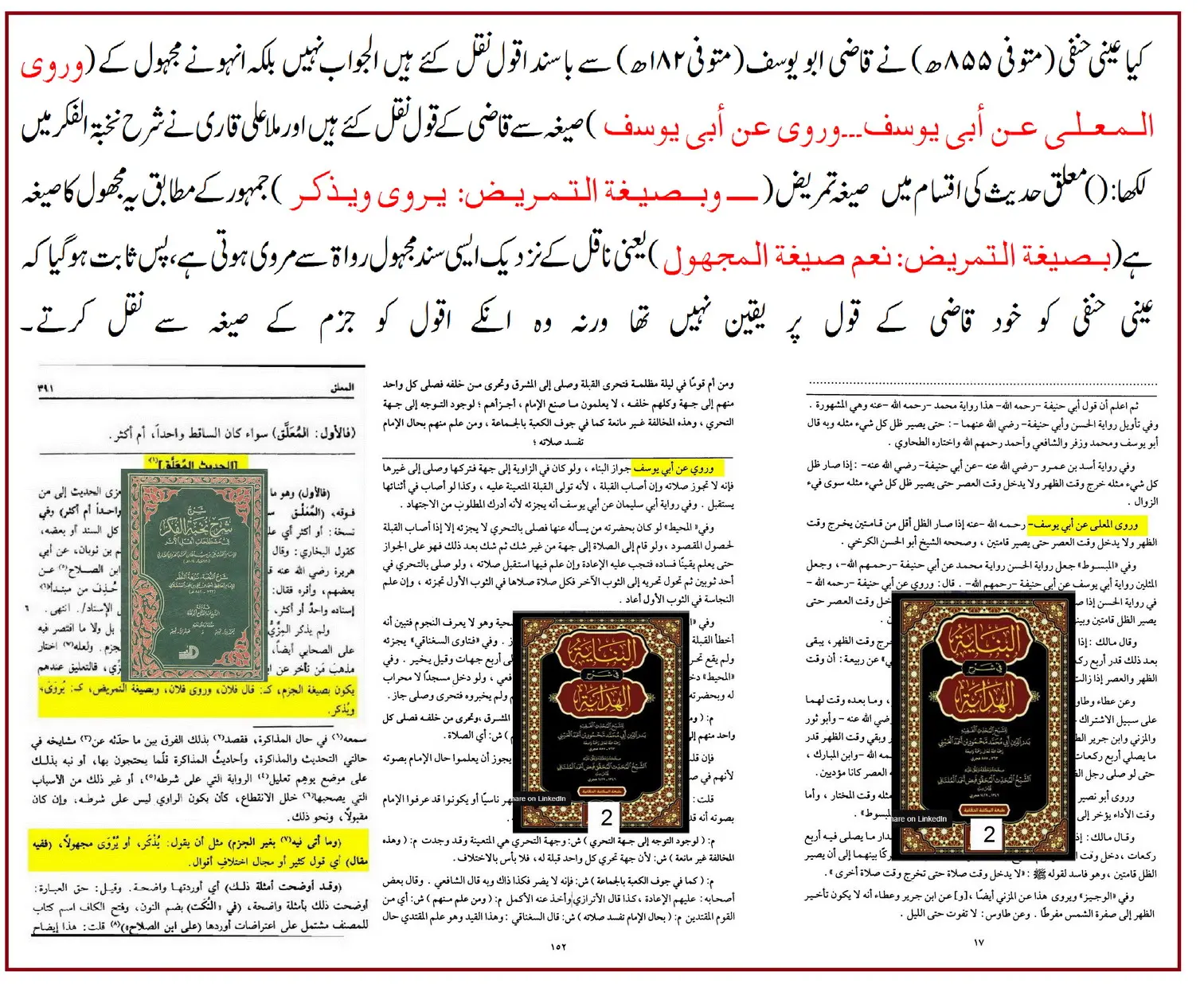
① Opposing Argument: Imam Abu Yusuf, may Allah have mercy on him
Text: وروى المعلى عن أبي يوسف عن أبي حنيفة
وروي عن أبي يوسف أنها فرض
◈ The Answer
① Fundamental Explanation: Al-Ayni al-Hanafi mentioned this statement with the form of tamreed (i.e., words like “ruwi” or “yurwa” etc.), which among the hadith scholars is considered weak and unestablished narration. It is clear in the principles of hadith science that when a statement is in the passive (majhul) form, it is not a reliable proof.
As Qari writes in Sharh Nukhbat al-Fikr:
التعليق بصيغة التمريض كـ: يُروى، ويُذكر… يدل على الضعف.
Meaning: When the statement is in the form of “yurwa” or “yudhkar,” it only amounts to a weak narration and does not serve as evidence.
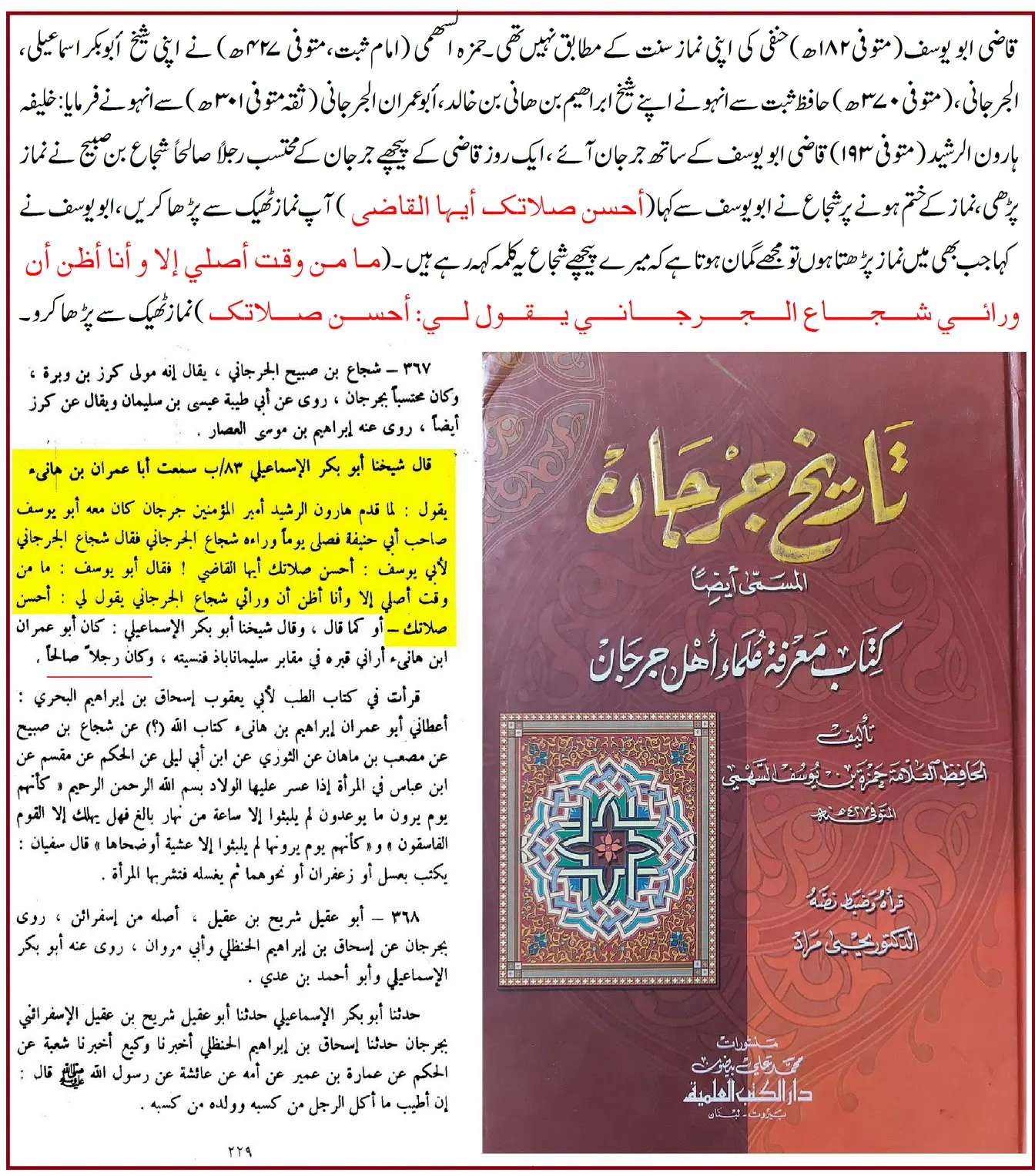
② Transmitted Testimony: In Tarikh Jurjan, an incident related to Abu Yusuf’s prayer is narrated where Shuja Jurjani said to him during prayer:
“أحسن صلاتك أيها القاضي” “O Judge! Perform your prayer properly.”
This admonition indicates that there was also a defect in the quality of his prayer.
Status of the narrators:
-
Hamzah ibn Yusuf al-Sahmi (Reliable Imam)
-
Abu Bakr al-Isma’ili (Hafiz, Reliable)
-
Ibrahim ibn Hani (Trustworthy)
-
Shuja ibn Subaih (Righteous personality)
This chain of narration is strong and indicates that Abu Yusuf’s reasoning or practice is not, in any case, conclusive.
📌 Conclusion: The argument presented regarding Abu Yusuf is unproven and weak. Therefore, using “أَذْنَابُ خَيْلٍ شُمْسٍ” as evidence for abandoning the raising of hands is academically weak.
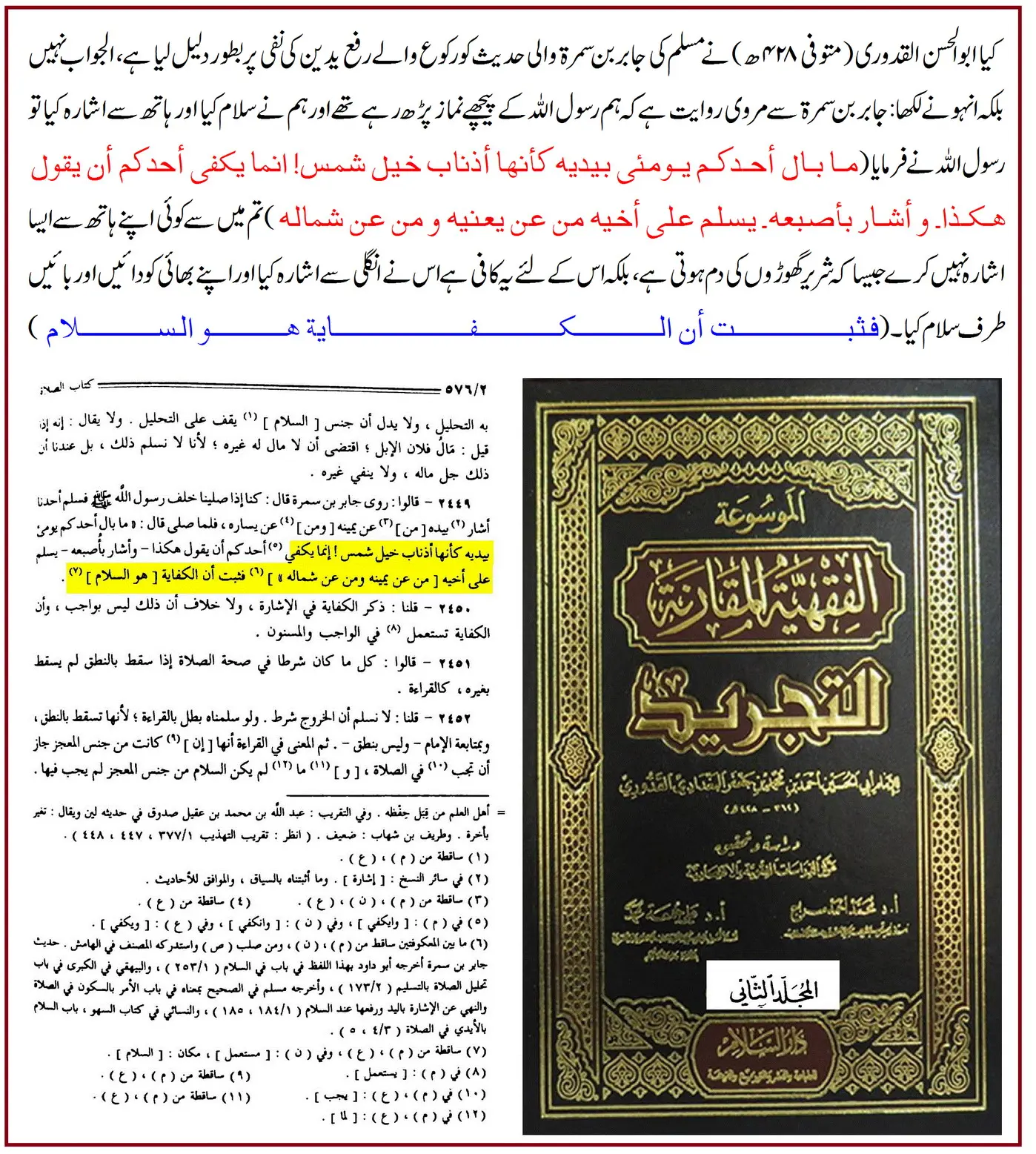
② Opposing Evidence: Imam Abu al-Hasan al-Quduri
Text: ٢٤٤٩ – قالوا: روى جابر بن سمرة قال: كان إذا صلينا خلف رسول الله ﷺ فسلم أحدنا أشار بيده عن يمينه وعن يساره، فلما صلى قال: (ما بال أحدكم يومئ بيديه كأنها أذناب خيل شمس! إنما يكفي أحدكم أن يقول هكذا ـ وأشار بأصبعه ـ يسلم على أخيه من عن يمينه ومن عن شماله) فثبت أن الكفاية هو السلام.
◈ Response
Al-Quduri mentioned this hadith in the chapter on Salam (salutation), not in the raising of hands during Ruku or Qawmah. That is, according to his own understanding, this hadith only indicates that saying “As-Salamu Alaikum” verbally at Salam is sufficient; unnecessary hand waving is not correct.
📌 Clarification: If this hadith truly negated raising hands during Ruku and Qawmah, al-Quduri would have mentioned it in that chapter. But he placed it under “waving hands during Salam,” which is clear evidence that the context of the hadith is “Salam,” not “raising hands.”
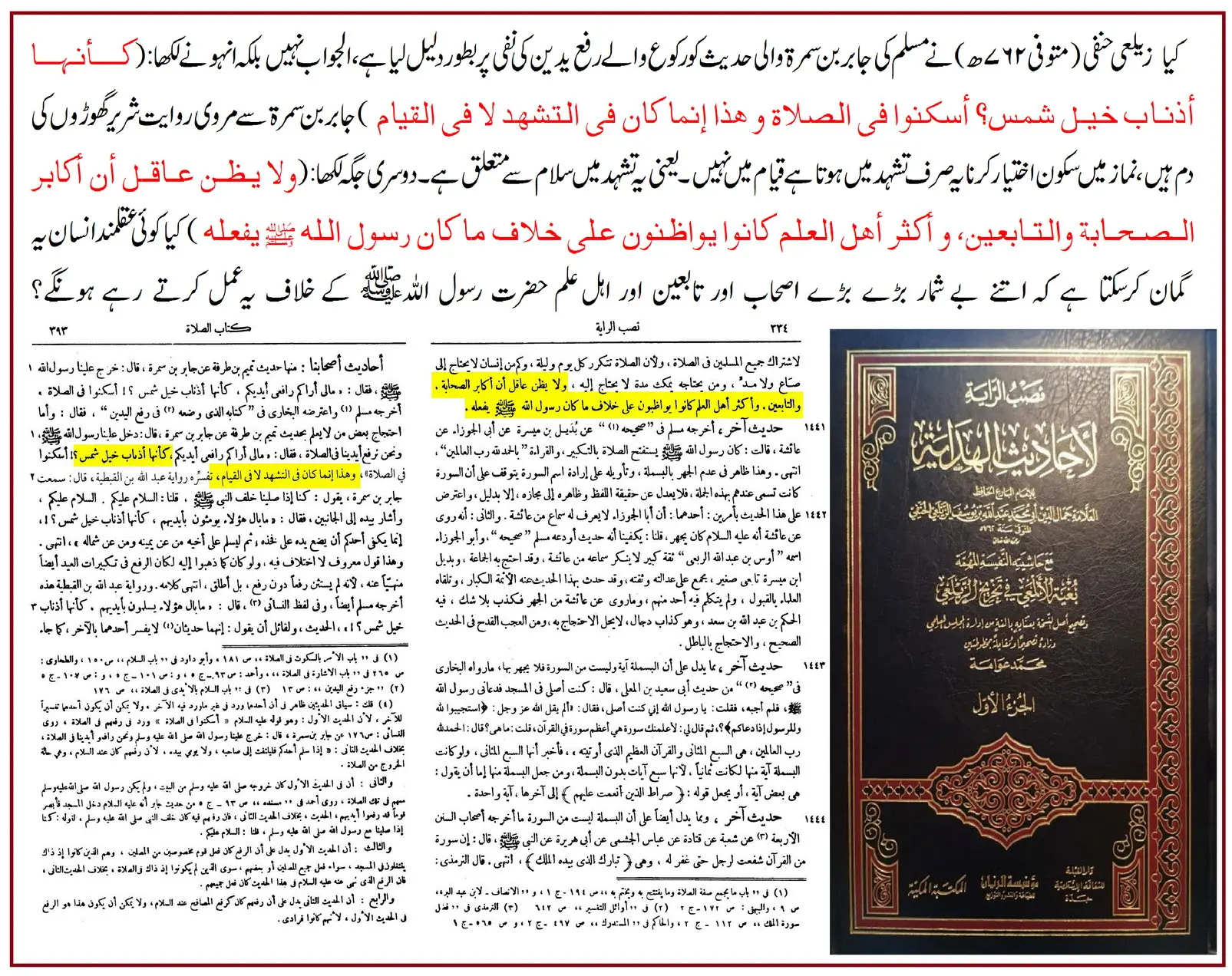
③ Opposing Evidence: Allama Zaili
Text: «…أسكُنوا في الصلاة، وهذا إنما كان في التشهد لا في القيام.» — نصب الراية لأحاديث الهداية
◈ The Answer
Zil’i Hanafi has clearly written about this narration that this incident is related to the time of Tashahhud and Salam, not Qiyam or Ruku.
📌 Explanation: That is, even Hanafi researchers admit that the hadith containing “أَذْنَابُ خَيْلٍ شُمْسٍ” has no connection with Ruku or Qawmah. Rather, it is related to the manner of Salam at the time of Tashahhud.
✅ Brief Conclusion:
- Qaduri placed this narration under the chapter “Waving the hand at the time of Salam.”
- Zil’i also clarified that the place is “Tashahhud,” not “Qiyam or Ruku.”
Therefore, the statements of these two scholars also strengthen the point that it is incorrect to use this hadith as evidence for abandoning the raising of hands.
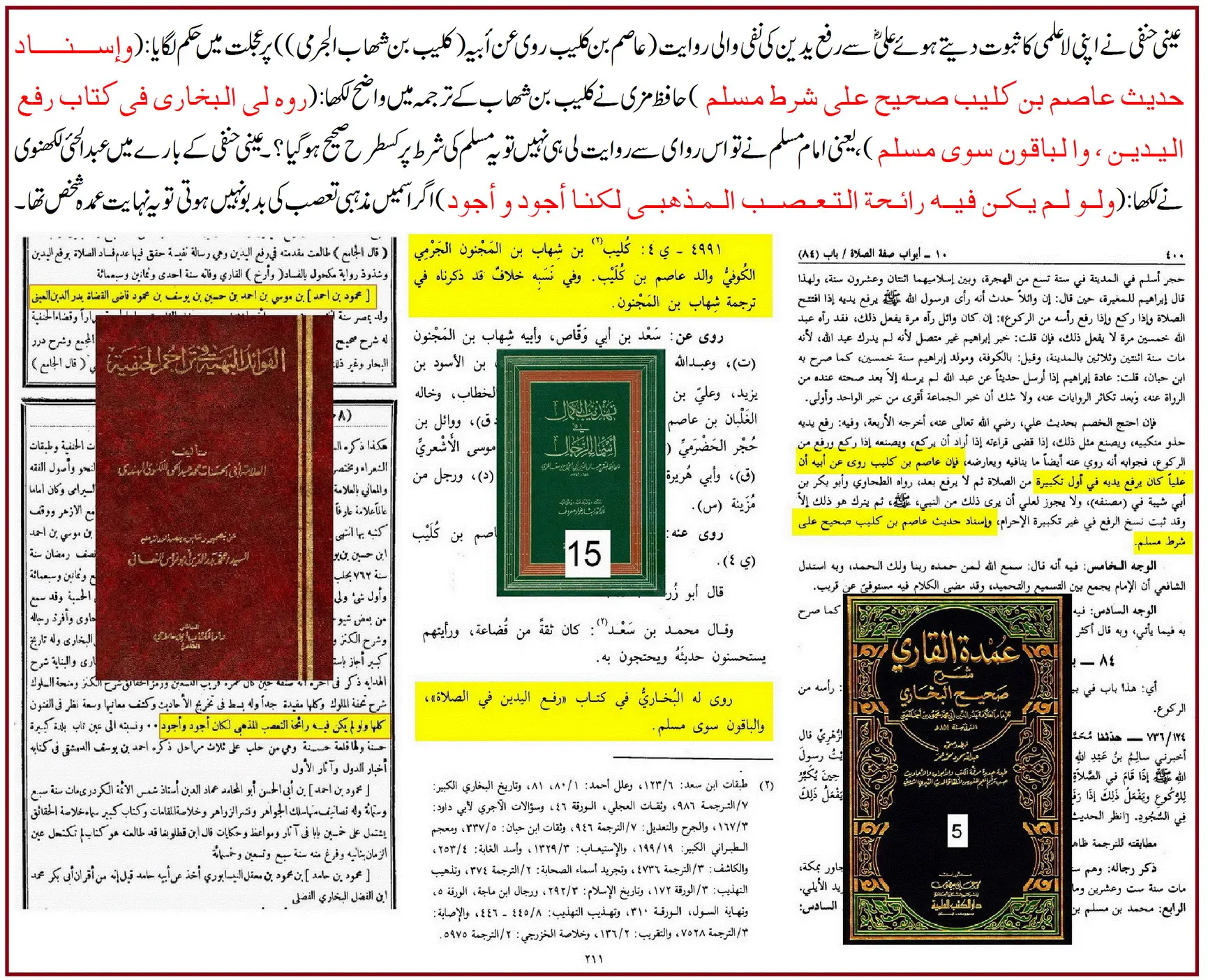
④ Opposing Evidence: Allama Ayni (Sharh Sunan Abi Dawood, Vol. 3, p. 29)
◈ The Answer
The opposing party presented ④ and ⑫ as two separate references, whereas both are books by the same author, Badr al-Din Ayni.
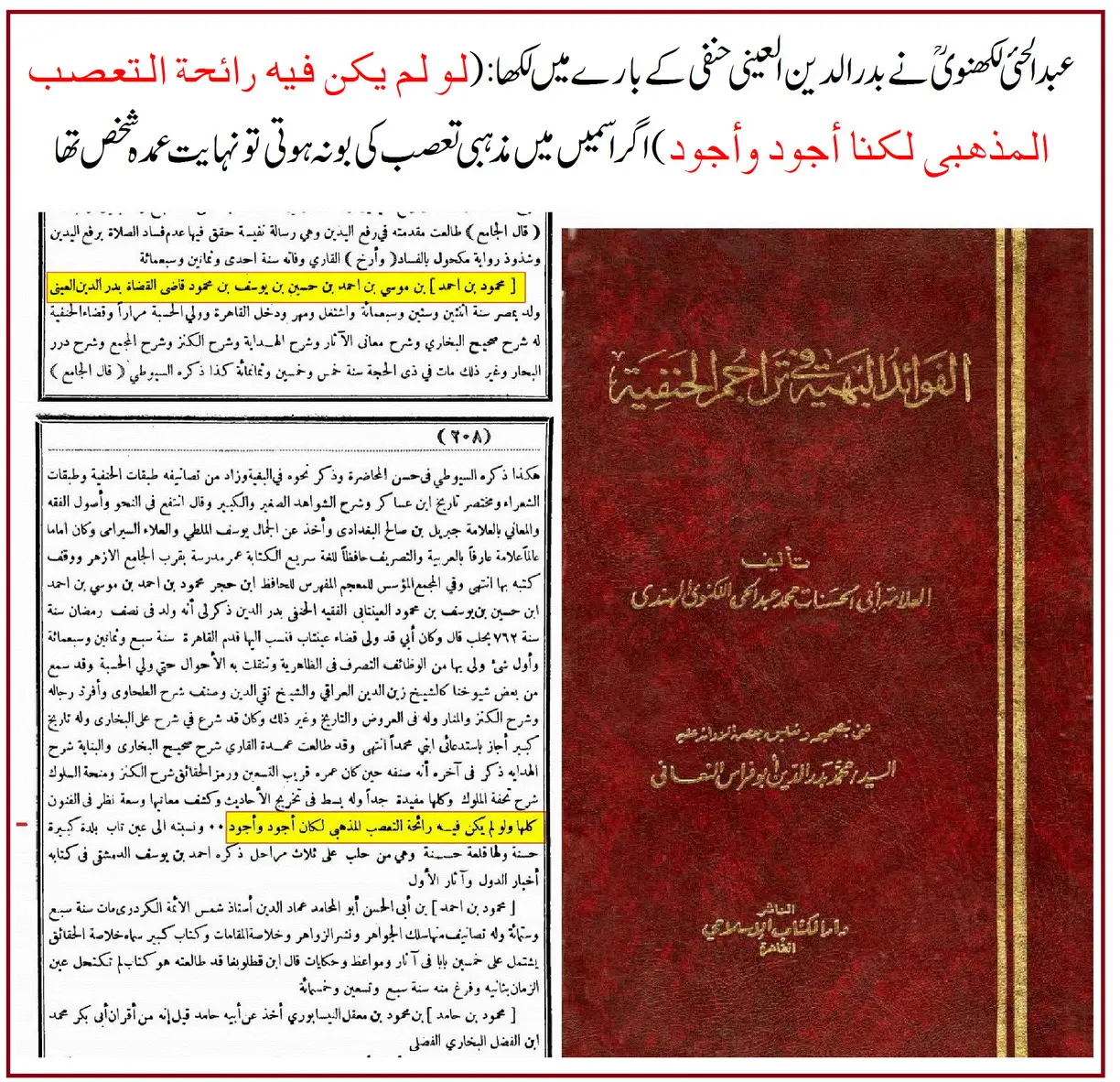
- Abdul Hayy Lakhnawi (died 1304 AH) said about Ayni:
«…بدر الدين العيني — ولو لم يكن فيه رائحة التعصب المذهبي لكان أجود…»
Reference: — Al-Fawaid al-Bahiyah fi Tarajim al-Hanafiyah
Meaning: If there was no sign of bias in Aini, then his book would have been considered even better.
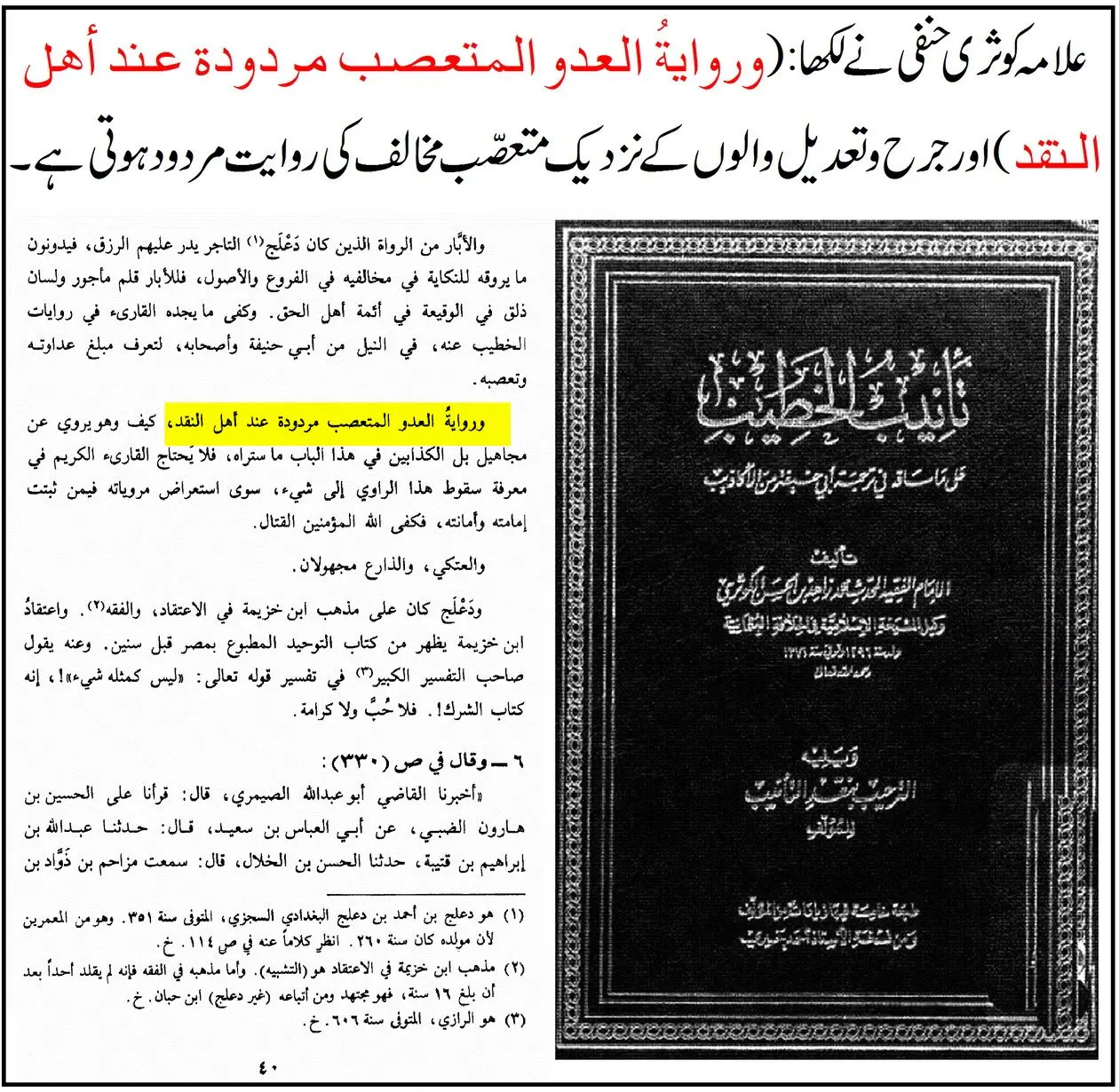
- Even the Hanafi scholar Kausari has stated this principle that the testimony of a biased person in Jarh and Ta’dil (criticism and accreditation) is rejected.
📌 Explanation: Therefore, presenting Aini’s statement as evidence is not a strong argument, because he himself speaks on the basis of bias.
⑤ Opposing Argument: Mulla Ali Qari
◈ The Response
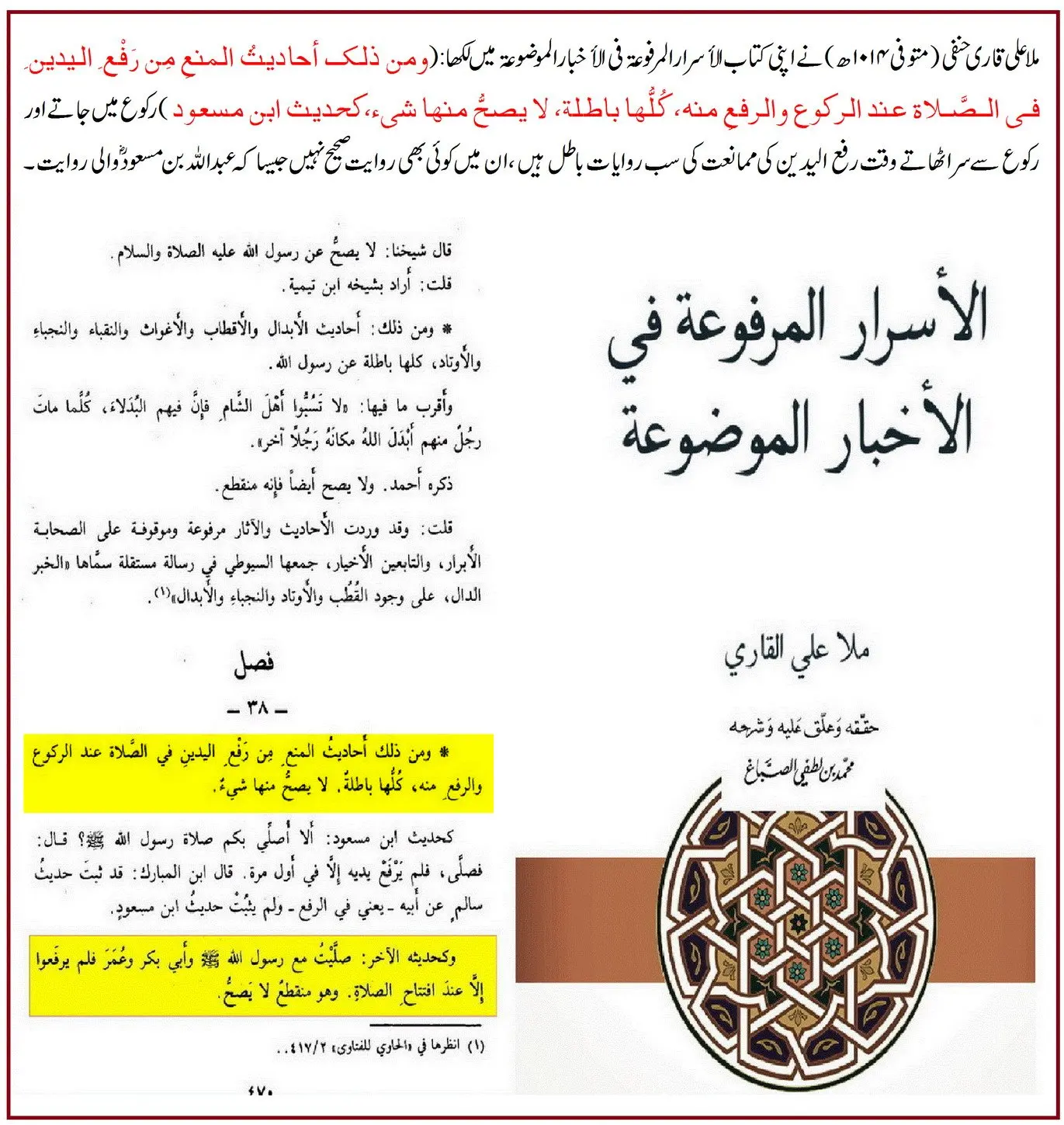
Mulla Ali Qari (died 1014 AH) explicitly states in his book Al-Asrar al-Marfoo’ah (Al-Mawdu’at al-Kubra):
«أحاديثُ المنع من رفع اليدين… كلها باطلة لا يصح منها شيء.»
Translation: “All the hadiths that prohibit raising the hands (in prayer) are false, and none of them are authentic.”
📌 Explanation: When Mulla Ali Qari himself admits that there is no authentic hadith prohibiting raising the hands, then logically it becomes baseless to argue for abandoning raising the hands based on his references.
✅ Brief Conclusion:
- Aini’s argument is based on bias, which cannot be considered reliable.
- Mulla Ali Qari has clearly declared that “all narrations based on the prohibition of raising hands are invalid.”
Therefore, there remains no room to use “أَذْنَابُ خَيْلٍ شُمْسٍ” as evidence for abandoning raising hands.
⑥ Opposing Argument: Imam Muhammad Ali bin Zakariya al-Manbiji
◈ Response
He is the only Hanafi whose reference can be presented within his own context; otherwise, among the Muhaddithin, it holds no significant status. According to the original text:
“He is the only Hanafi whose reference can be kept within his own home.”
📌 Explanation: That is, even if this reference is presented as evidence, it only holds some weight within the Hanafi circle; among the general scholars, it is not considered valid evidence for abandoning the raising of hands.
⑦-a Opposing Argument: Muhaddith Kasani
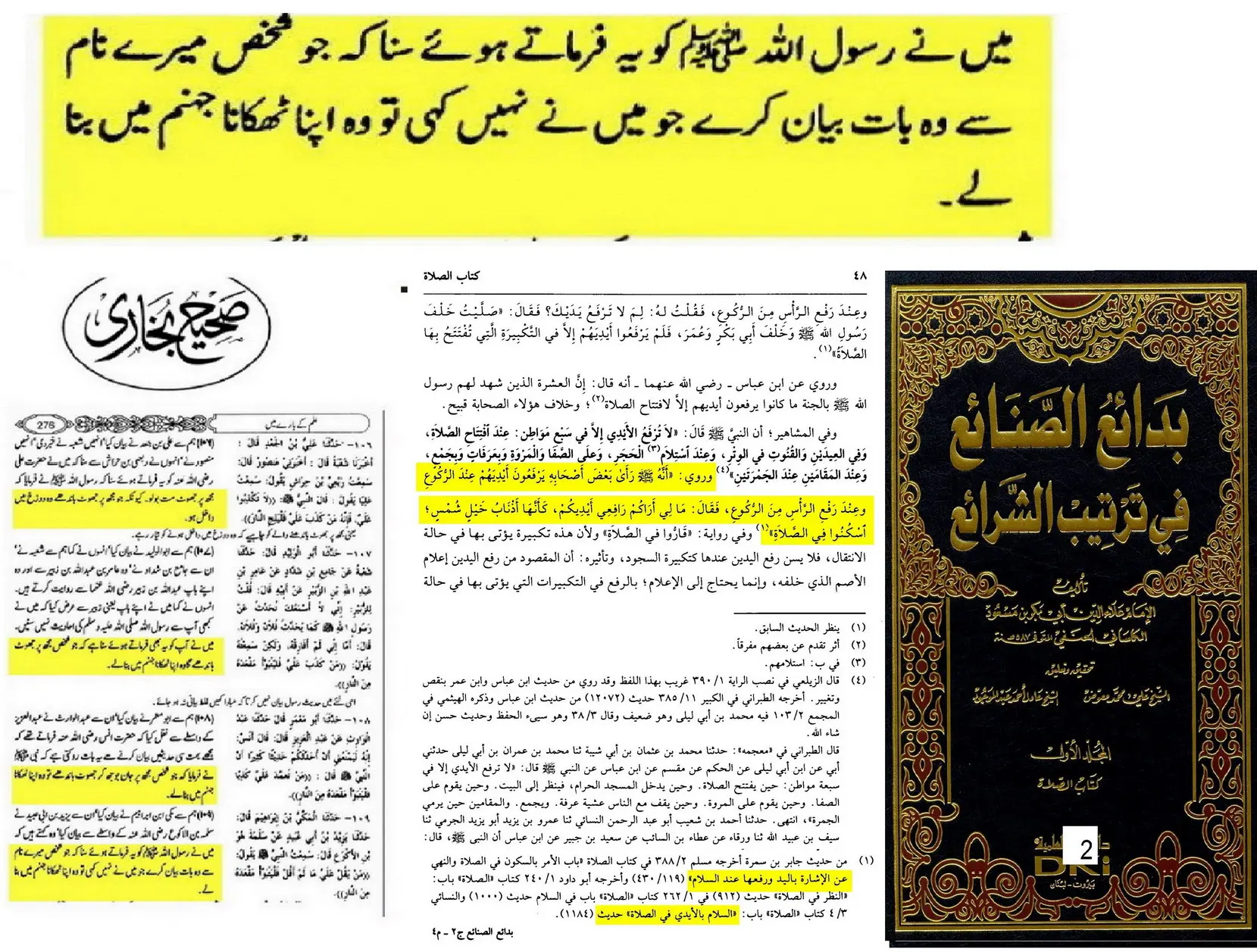
Text: «…رأى بعضَ أصحابه يرفعون أيديهم عند الركوع وعند الرفع منه فقال: ما لي أراكم رافعي أيديكم كأنها أذنابُ خيلٍ شمسٍ أسكنوا في الصلاة.» — بدائع الصنائع
◈ Response
A large group of Muhaddithin have attributed this narration to the time of Salam/Tashahhud, such as:
- Imam Quduri
- Allama Zailai
- Imam Bukhari
- Imam Nawawi
All of them have clarified that this narration is not related to raising the hands during Ruku or Qawmah, but rather it pertains to the movement of the hand during the Salam.
✿ Hadith of Warning
The Messenger of Allah ﷺ said:
«مَنْ كَذَبَ عَلَيَّ فليتبوأ مقعده من النار.»
📌 Explanation: Meaning, whoever lies about me, let him prepare his place in Hell. Therefore, fitting a narration that originally concerns the movement of the hand during Salam to the raising of hands in Ruku or Qawmah is a very dangerous matter.
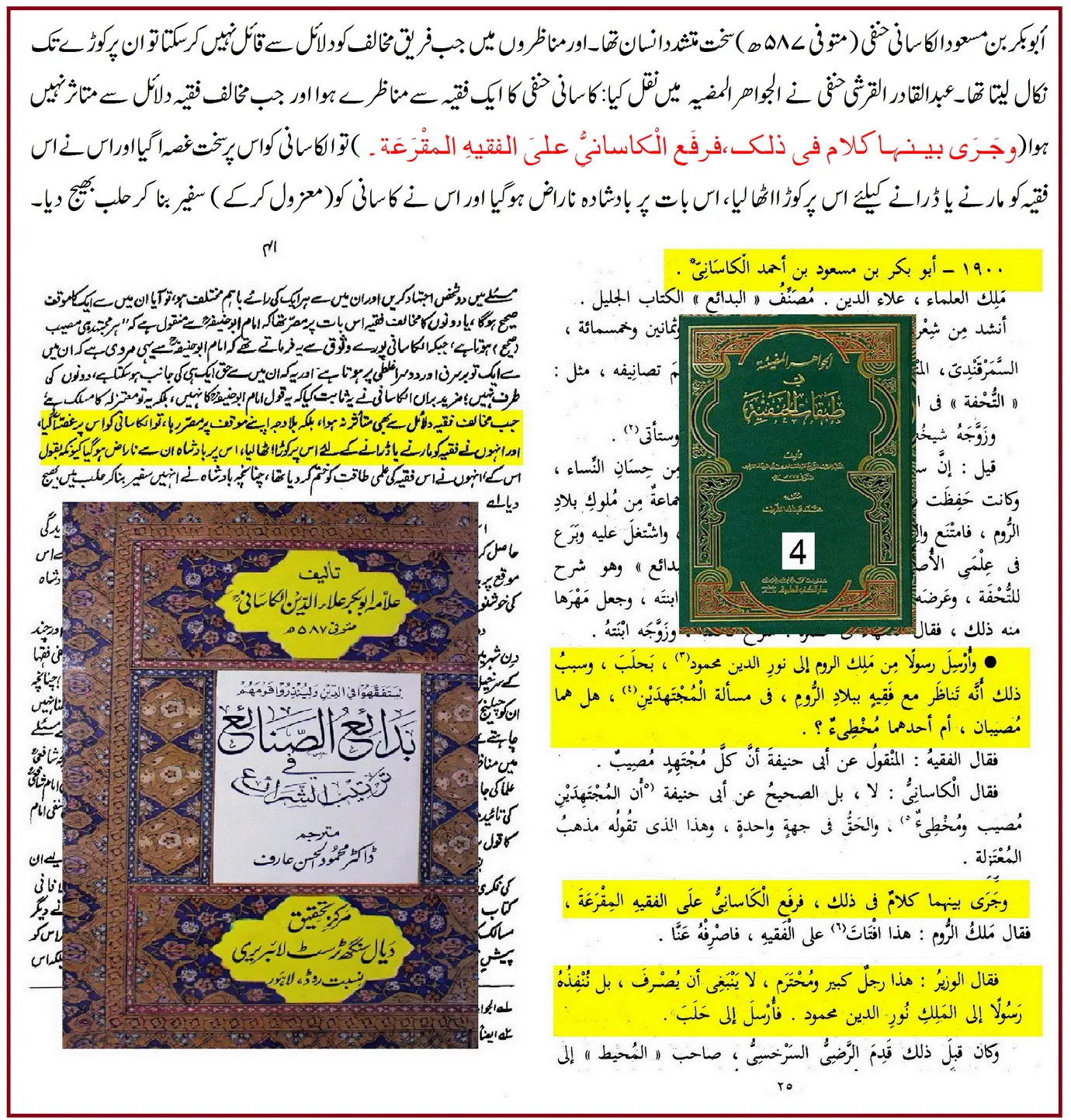
◈ Answer 2 (Testimony on Kasani’s Severity)
Abdul Qadir al-Qurashi (Hanafi) writes in his book:
«…جرى بينهما كلام… فرفع الكاساني على الفقيه المقرعة… فأُرسل إلى حلب» — الجواهر المضية في طبقات الحنفية
📌 Urdu Explanation: Meaning Kasani used a harsh tone in debates and sometimes even a violent manner appeared. This indicates that caution is necessary when using his statements as evidence.
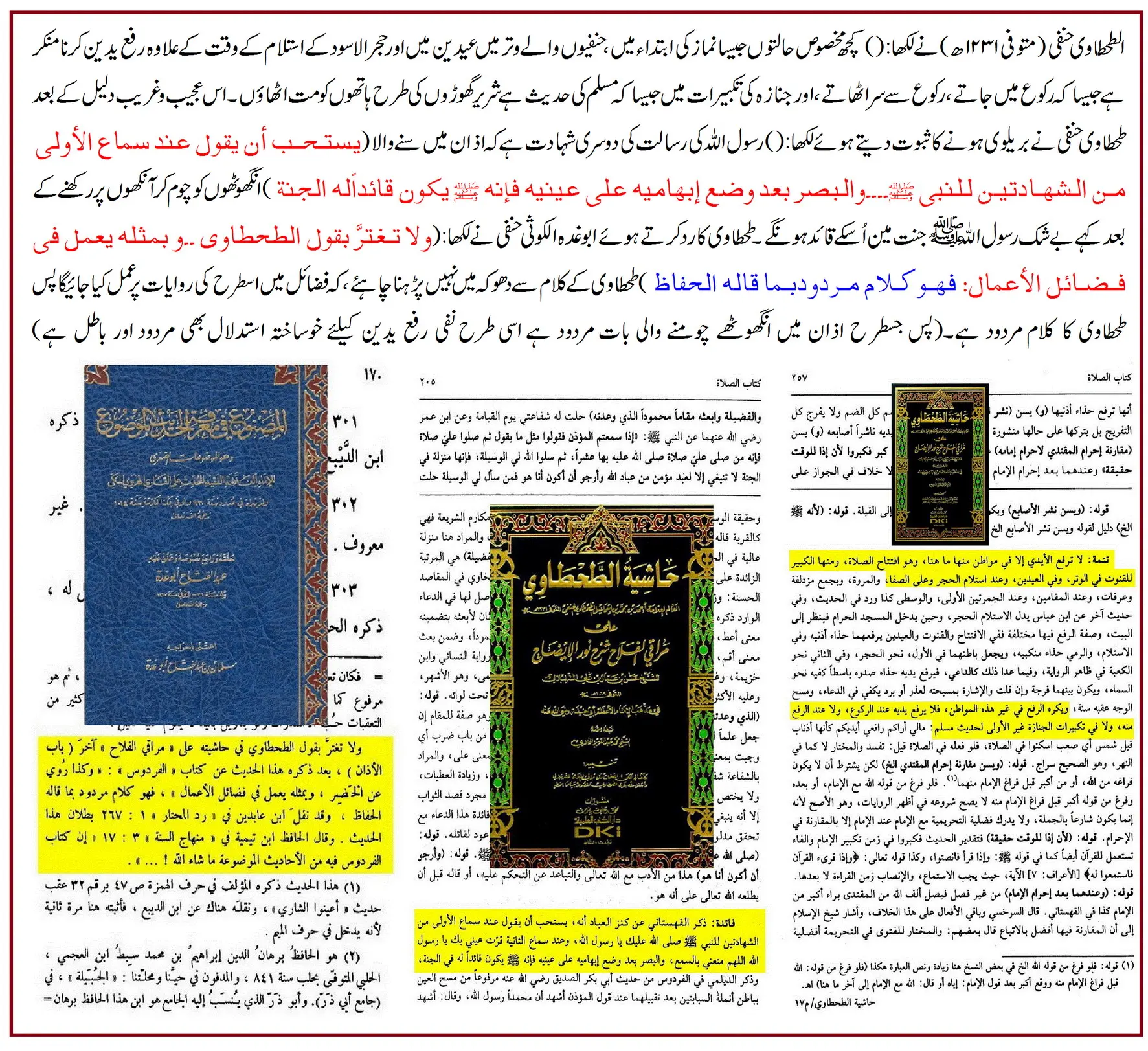
⑦-b Opposing Argument: Sheikh Syed Muhammad Ahmad Tahtawi
The text: «…ويُكره الرفع في غير هذه المواطن… فلا يرفع يديه عند الركوع ولا عند الرفع منه… لحديث مسلم: مالي أراكم رافعي أيديكم كأنها أذناب خيل شمس…» — حاشیہ الطحطاوی
Further transmitted (about kissing the thumbs in Adhan): «…فإنه ﷺ يكون قائداً له في الجنة» — حاشیہ الطحطاوی
◈ Answer
- Tahtawi applied this narration by analogy to bowing and Qawmah (standing after bowing), whereas the actual place was the salam, as other hadith scholars have clarified.
- Furthermore, he relied on some other munkar (denounced) narrations, such as the narration about kissing the thumb at the time of the call to prayer.
✿ Criticism by Hadith Scholars
- Researchers like Kauthari and Abu Ghuddah said:
«ولا تغتر بقول الطحطاوي… فهو كلام مردود… كتاب الفردوس فيه أحاديث موضوعة…» — المصنوع في معرفة الحديث الموضوع، ص170
📌 Clarification: That is, do not be deceived by Tahtawi’s statements, because they are based on weak or even fabricated hadiths.
✅ Conclusion: Tahtawi’s analogy of the place of salam to bowing is a mistake, and his reliance on other weak narrations also weakens his argument.
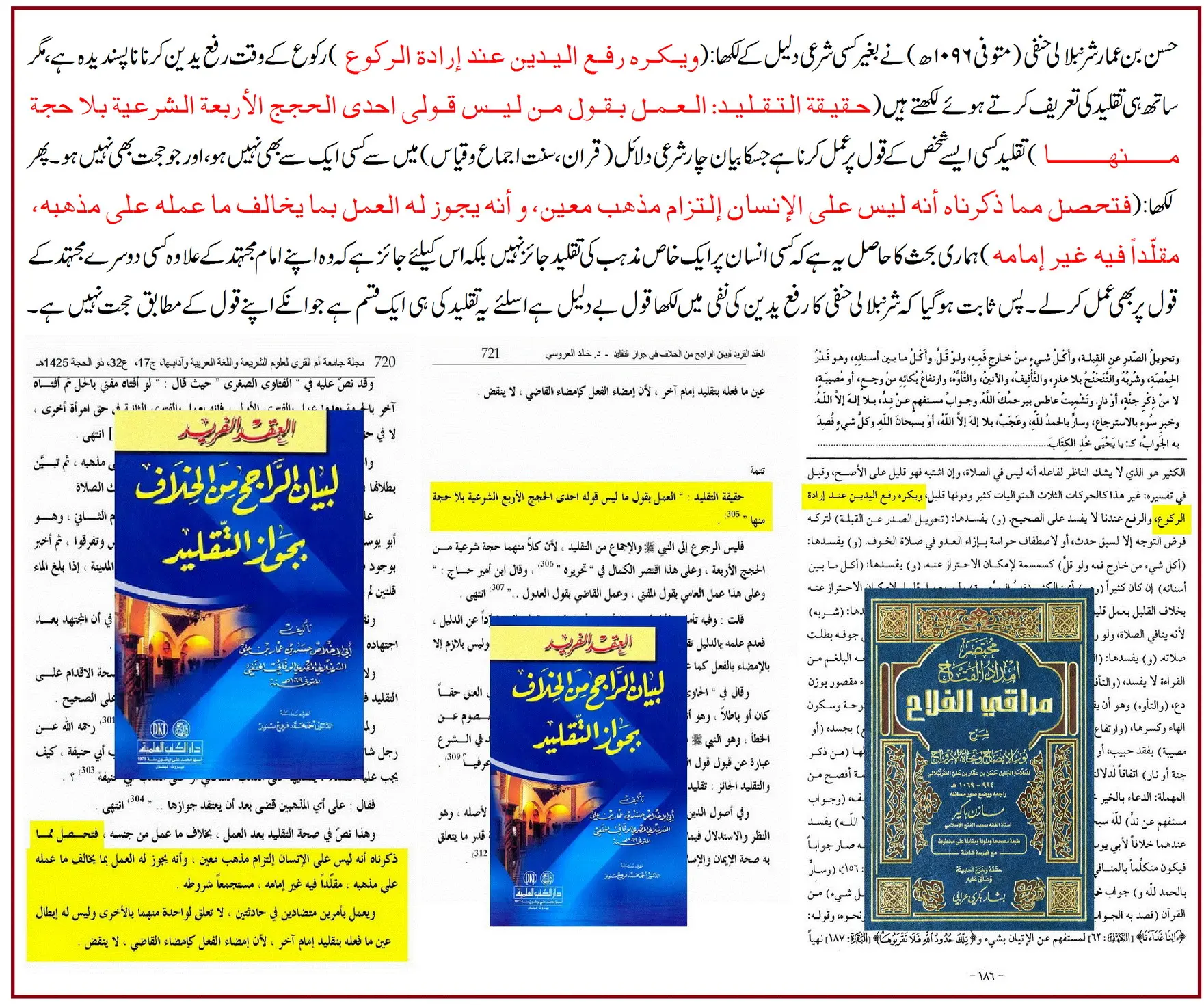
⑧ Opposing Evidence: Imam Hasan bin Ammar Al-Sharnbali
Text: «ويُكره رفعُ اليدين عند إرادة الركوع والرفع…» — مراقي الفلاح
◈ The Response
Al-Sharnbali merely stated that raising hands during bowing and Qawmah (standing after bowing) is disliked, but he could not present any authentic and explicit evidence.
✿ Further Clarification:
In his own book Al-‘Aqd al-Farid, the reality of imitation is explained as follows:
«حقيقةُ التقليد: العمل بقول من ليس قوله إحدى الحجج الأربعة الشرعية بلا حجة منها.»
Translation: The reality of Taqlid (imitation) is to follow the words of a person who does not establish his argument on Shariah evidences (Quran, Hadith, Ijma, valid Qiyas).
Rather, they further write:
«ليس على الإنسان التزام مذهب معين… ويجوز له العمل بما يخالف… مقلداً فيه غير إمامه…»
Meaning, it is not necessary for a person to always adhere to one single school of thought. He is permitted to follow the opinion of another Imam if there is evidence there.
📌 Conclusion: When Sharambali himself defines Taqlid as “following a person without evidence,” then his own statement (that raising hands is disliked) cannot be considered proof due to lack of evidence.
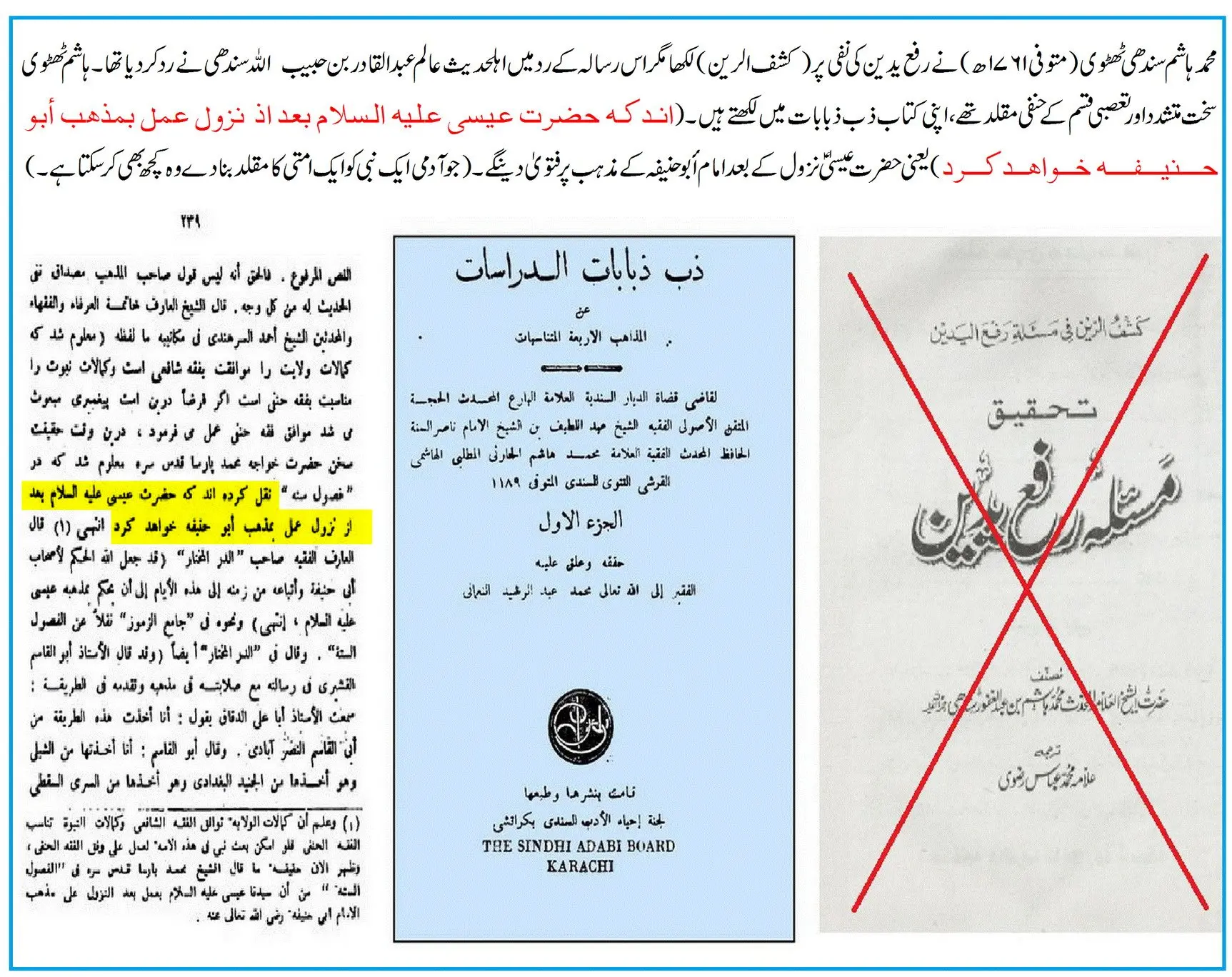
⑨ Opposing Evidence: Muhammad Hashim Sindhi
◈ The Response
Scholars have written about Muhammad Hashim Sindhi that he was afflicted with bias and extremism.
To the extent that in one of his books Dhabb Dhubabat al-Dirasat, he wrote this strange statement:
«…حضرت عیسیٰ علیہ السلام بعد از نزول عمل بمذھب ابو حنیفہ خواہد کرد.»
Translation: “When Prophet Jesus (peace be upon him) descends to earth, he will follow the school of Imam Abu Hanifa!”
📌 Explanation: Such exaggerated attributions are far from scholarly standards. Neither the Quran nor Hadith provide any basis for them, nor have the Muhaddithin accepted them.
✅ Conclusion: When a person writes such baseless and extreme statements, it is by no means valid to argue from them in favor of abandoning the raising of hands (raf‘ al-yadayn).
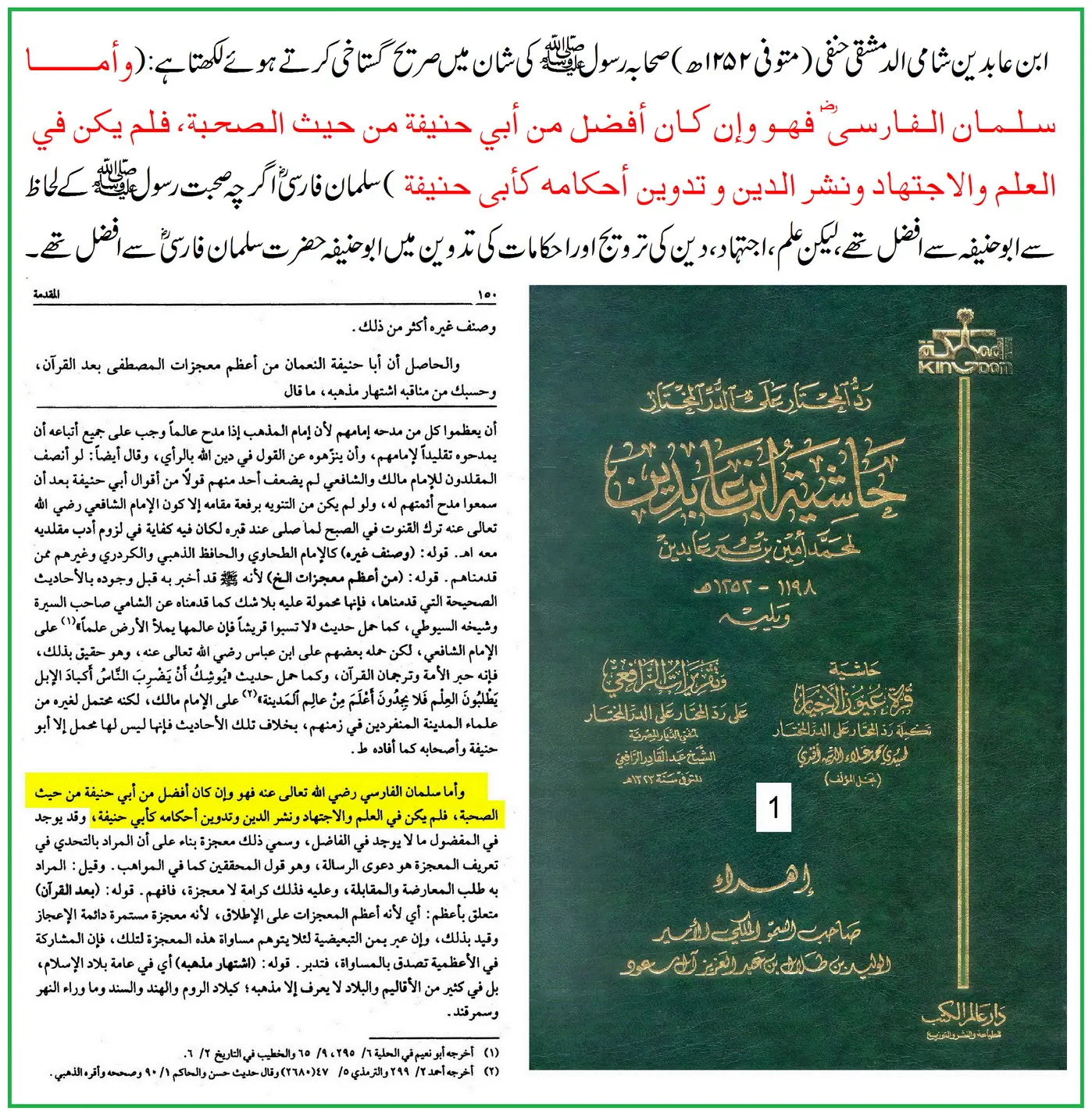
⑩ Opposing Argument: Ibn Abidin Shami
Text: «وأما سلمان الفارسي رضي الله… فلم يكن في العلم والاجتهاد… كأبي حنيفة… وقد يوجد في المفضول ما لا يوجد في الفاضل.»
◈ Response
Ibn Abidin Shami here makes a comparative mention of the knowledge and ijtihad of Hazrat Salman al-Farsi (RA) and Imam Abu Hanifa. He says: Although Hazrat Salman (RA) has the honor of being a companion, from the perspective of scholarly ijtihad, Imam Abu Hanifa is preferred.
📌 Explanation: This discussion is purely within the scope of preference and superiority; it has no relation to raising hands during bowing (ruku‘) or Qawmah (standing after bowing). Therefore, presenting this statement as evidence for abandoning the raising of hands is completely irrelevant to the matter under dispute.
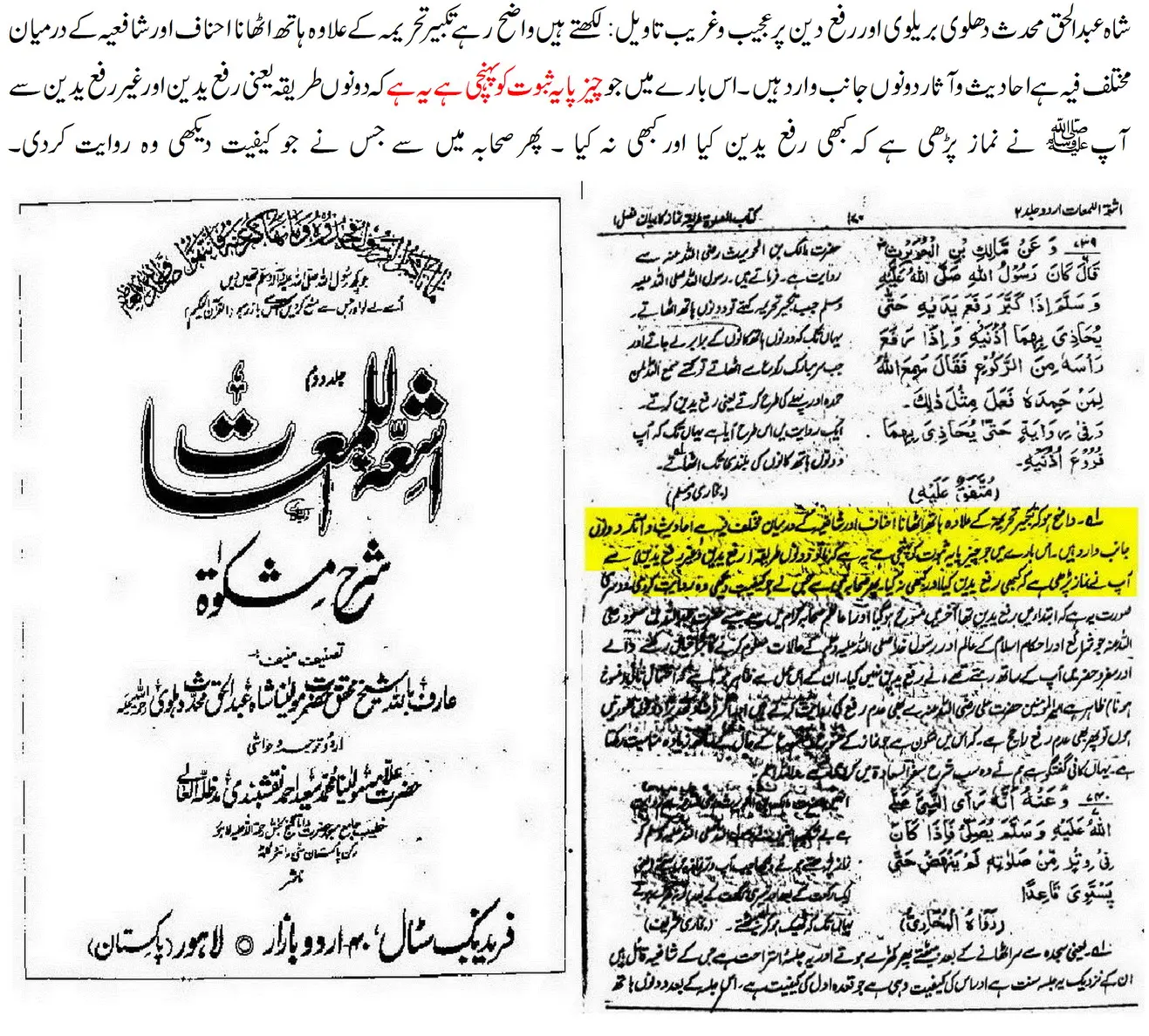
⑪ Opposing Argument: Sheikh Abdul Haq Muhaddith Dehlawi
Text (Ash‘at al-Lama‘at 2/170): «…Apart from the Takbir al-Tahrimah, raising the hands is a matter of difference… Both raising and not raising have been transmitted…»
◈ Response
Muhaddith Dehlavi clearly states:
- Apart from Takbeer-e-Tahreema, the matter of raising the hands (Raf’ al-Yadain) is disputed.
- Both raising the hands and refraining from raising the hands are reported.
📌 Explanation: This admission itself is evidence that the occurrence of raising the hands is established. If raising the hands had never occurred, Muhaddith Dehlavi would not have said, “Raising is also reported.”
✅ Conclusion: Since Muhaddith Dehlavi himself has acknowledged the evidence of raising the hands, insisting on refraining from raising the hands based on the hadith «أَذْنَابُ خَيْلٍ شُمْسٍ» is against the actual reality.
⑫ (Repeated) Opposing Argument: Allama Badruddin Ayni
◈ Response
This reference has already appeared earlier (④). Ayni’s argument is based on bias, and the testimony of a biased person in Jarh wa Ta’dil (criticism and accreditation) is not reliable. Therefore, using it again as an argument is mere repetition.
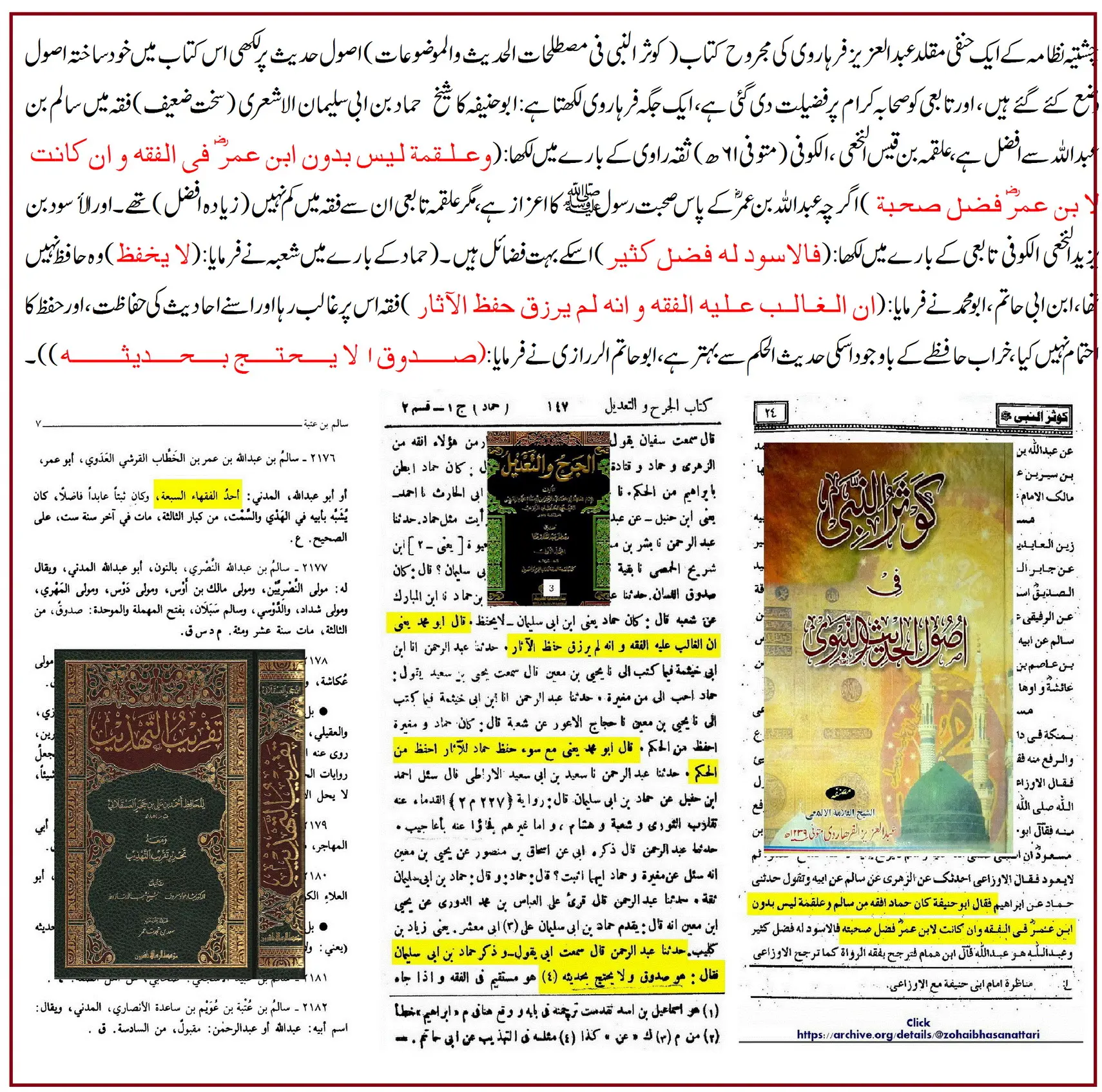
⑬ Opposing Argument: Allama Abdul Aziz Parharvi
◈ Response
In Parharvi’s book, “أَذْنَابُ خَيْلٍ شُمْسٍ” is not mentioned at all as evidence for refraining from raising the hands. However, he has discussed in the fundamental debates the jurisprudential preference of some Tabi‘een over some Sahabah, such as:
«قال أبو حنيفة: كان حماد أفقه من سالم… وعلقمة ليس بدون من ابن عمر في الفقه… وإن كانت لابن عمر فضل صحبة…» — كوثر النبي
📌 Explanation: This entire discussion is about “preference” and “jurisprudential priority,” and has no relation to raising the hands during bowing (ruku) or Qawmah (standing after bowing).
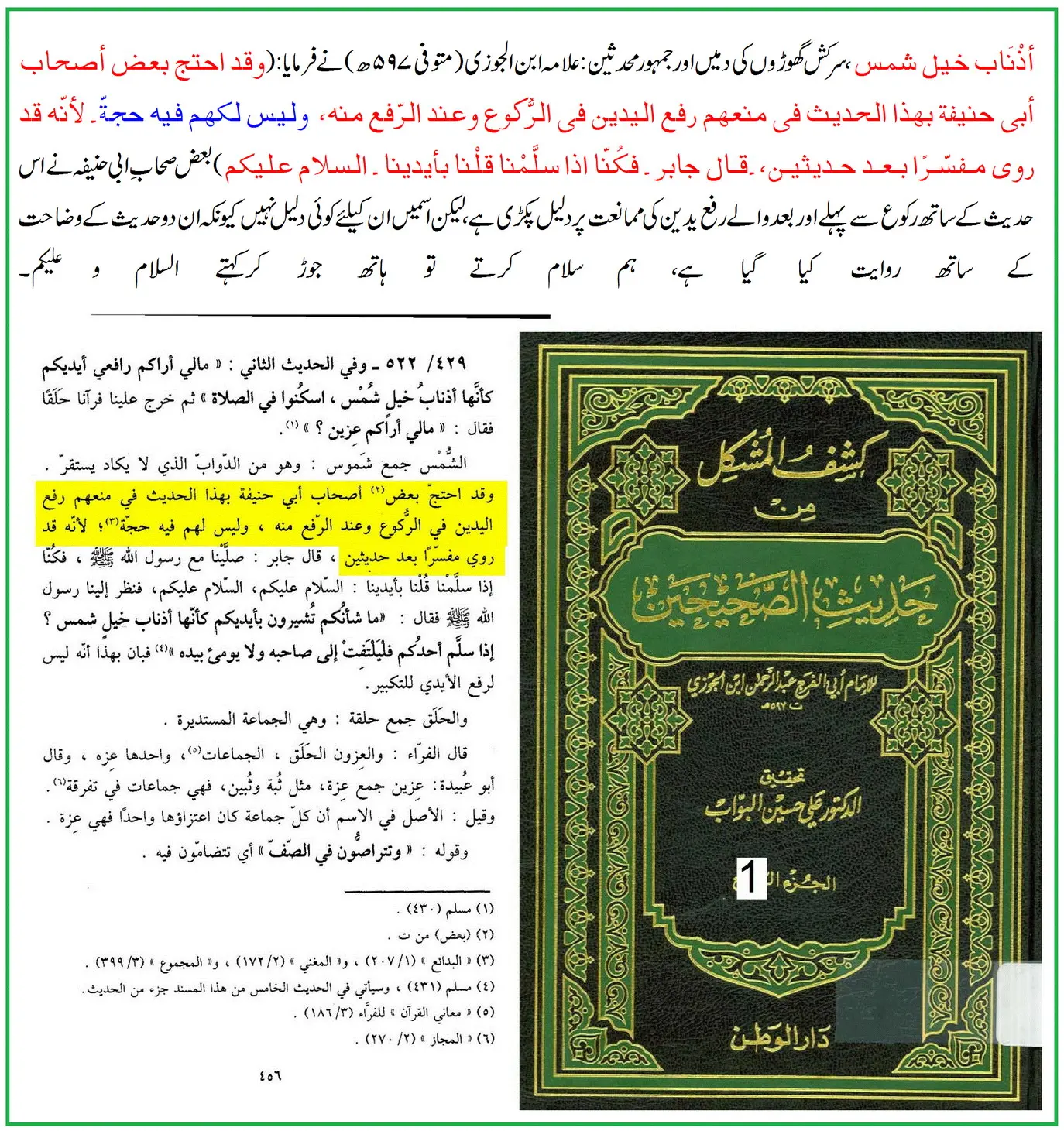
⑭ Opposing Argument: Abu al-Faraj Ibn al-Jawzi
◈ Response
Ibn al-Jawzi writes:
«…ليس لهم فيه حجة؛ لأنه قد روي مفسَّراً بعد حديثين…» — كشف المشكل
📌 Explanation: According to Ibn al-Jawzi, this hadith is about “waving the hands at the time of salam,” and other detailed narrations clarify this. Therefore, applying it to bowing or Qawmah is a misinterpretation against the hadith.
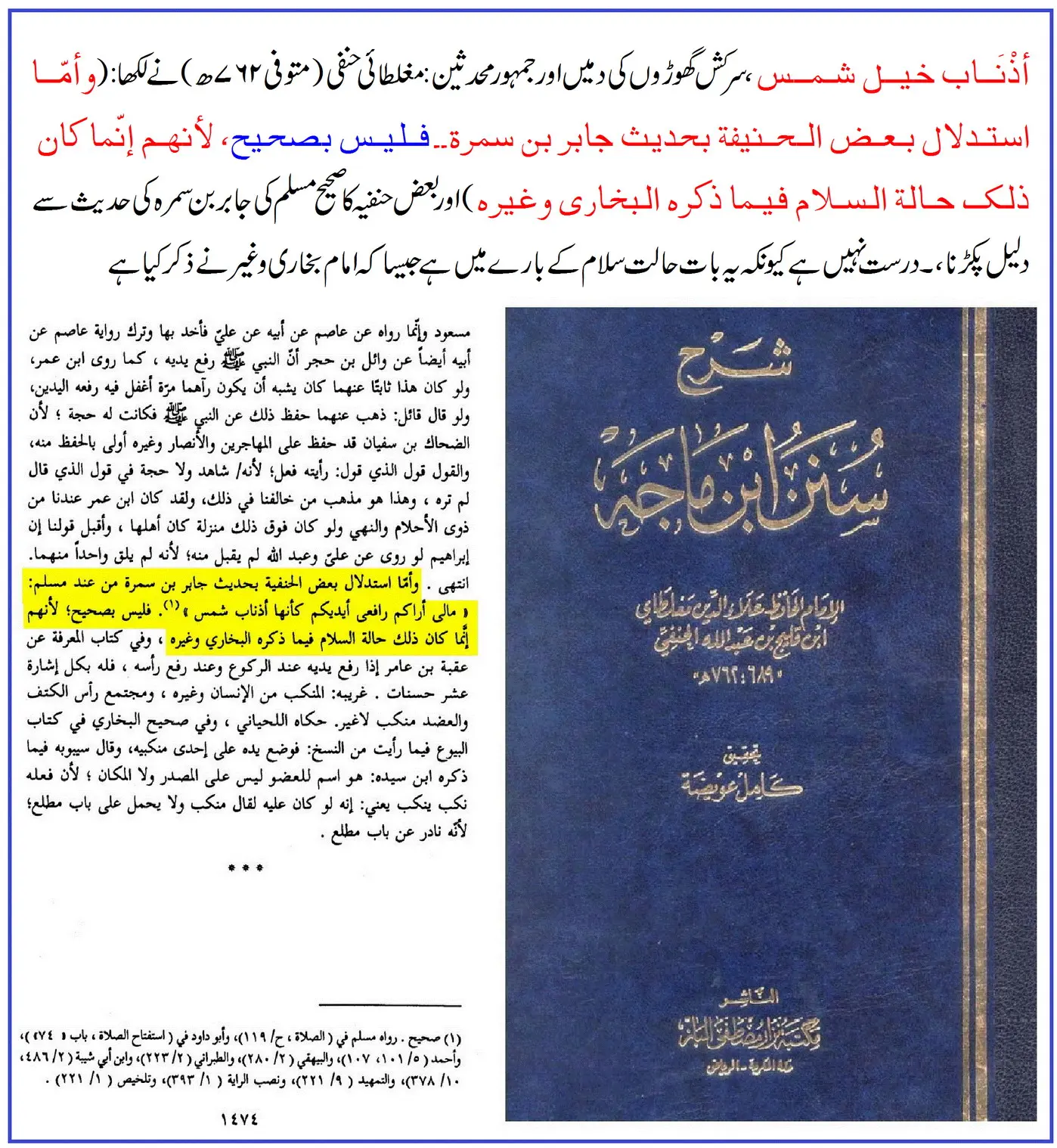
⑮ Opposing Argument: Allama Mughaltai
◈ Response
Mughaltai states:
«…استدلال بعض الحنفية… فليس بصحيح؛ لأنهم إنما كان ذلك حالة السلام فيما ذكره البخاري وغيره.» — شرح سنن ابن ماجه
📌 Explanation: That is, it is not correct for some Hanafis to use this hadith as evidence against raising the hands, because the original incident was at the time of salam, as Imam Bukhari and other muhaddithin have clarified.
✅ Brief Conclusion:
- Ayni’s argument has already been refuted.
- Parharwi’s discussion is unrelated to the original context.
- Both Ibn al-Jawzi and Mughaltai have clearly stated that the hadith pertains only to salam, not to bowing or Qawmah.
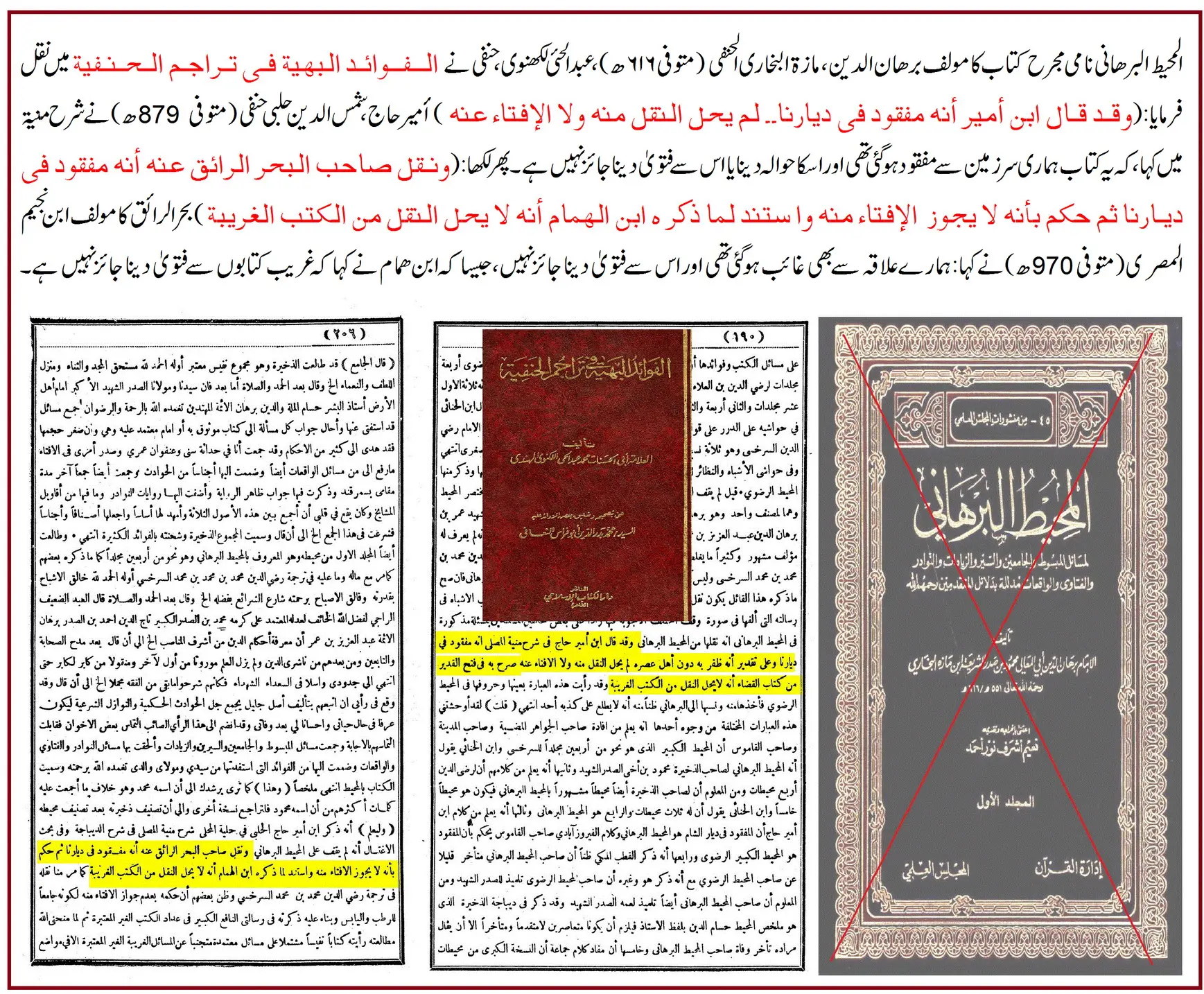
⑯ Opposing Argument: Burhan al-Din Mazah
◈ Response
Some Hanafi scholars themselves have stated that this book is not reliable.
- Abdul Hayy Lakhnawi says:
«…مفقود في ديارنا… لا يحل النقل منه ولا الإفتاء عنه…» — الفوائد البهية
- Ibn Najim (author of Bahr al-Ra’iq) also writes:
«…لا يجوز الإفتاء منه… لا يحل النقل من الكتب الغريبة.» — الفوائد البهية
📌 Explanation: That is, how can it be correct to use a book as evidence for abandoning raising the hands in prayer when even Hanafi scholars consider it impermissible to cite or issue fatwas from it?
⑰ Opposing Evidence: Shahab al-Din Ibn Idris al-Maliki
◈ Response
There was no detailed response on this reference in the original text. But fundamentally, it is sufficient to know that the great Imams of the Maliki school (such as Imam Malik, may Allah have mercy on him) believed in raising the hands, so this partial opinion can in no way be considered proof for abandoning raising the hands.
⑱ Opposing Evidence: Allama Hajja al-Najah al-Halabi
◈ Response
This author is majhul al-hal (of unknown status). That is, nothing is known about his circumstances or scholarly status.
According to the principles of Hadith:
- The report of an unknown or concealed person is not evidence.
- Imam Husam al-Din Khusikti (known as al-Husami) wrote:
“The report of a concealed person is not evidence just like that of a sinner (fasiq), until his probity (‘adalah) becomes apparent.”
📌 Explanation: When the current status of a narrator or author is unknown, using their statement as evidence in Shariah is against the principle.
✅ Brief Conclusion:
- Burhani’s book is considered unreliable by Hanafi scholars.
- Ibn Idris Maliki’s statement is partial and ineffective.
- Since Halabi’s phrase is from an unknown person, it cannot be used as evidence.
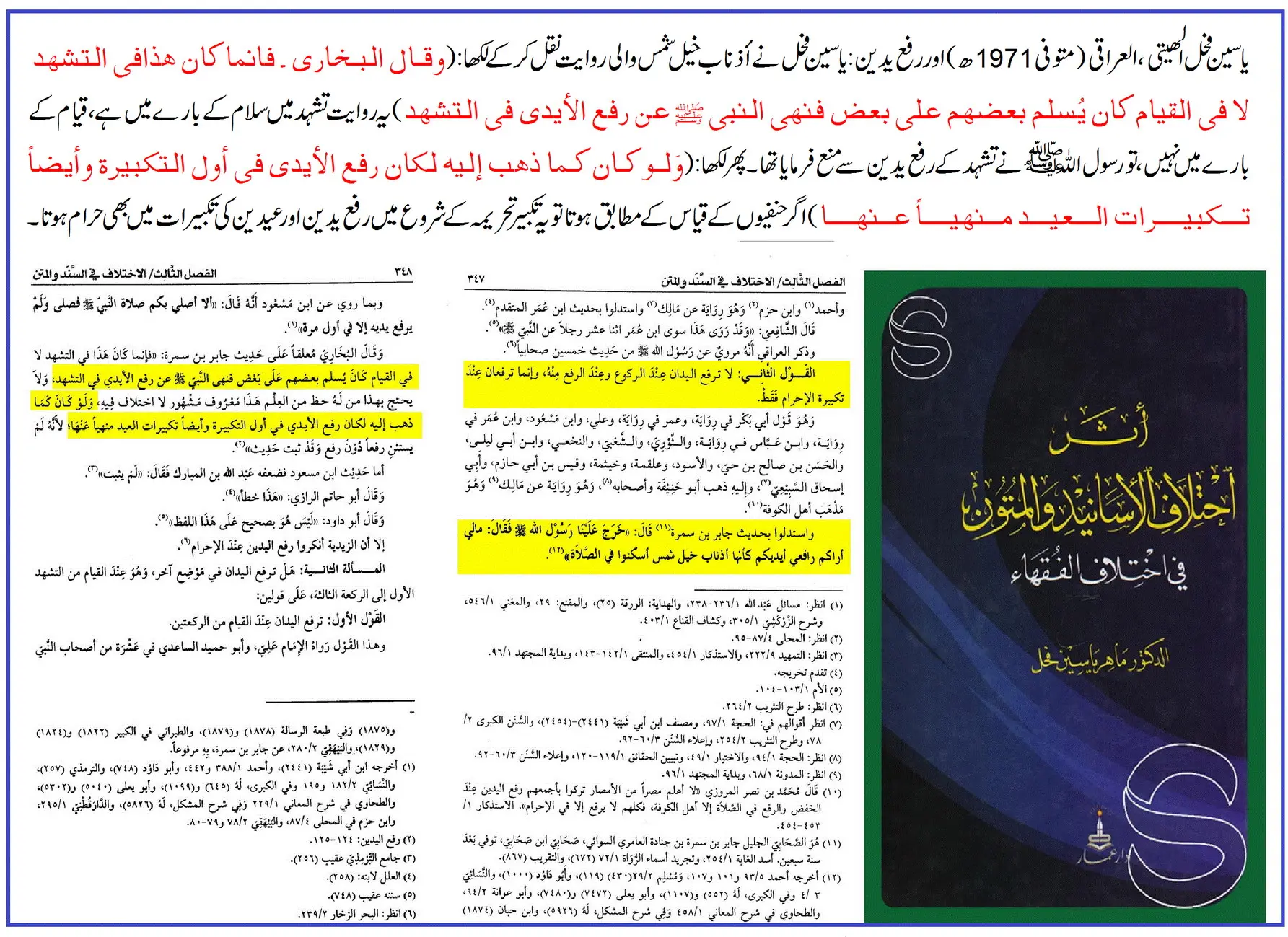
⑲ Opposing Evidence: Yaseen Al-Fahl
◈ Response
Yaseen Al-Fahl has quoted Imam Bukhari’s suspended statement:
«فإنما كان هذا في التشهد لا في القيام… ولا يحتج به من له حظ من العلم… ولَو كان كما ذهب إليه… لكان رفع الأيدي في أول التكبيرة وتكبيرات العيد منهياً عنها.» — أثر اختلاف الأسانيد والمتون
📌 Explanation:
- Imam Bukhari clearly stated that this incident is about Tashahhud, not Qiyam (standing).
- If someone interprets it as referring to Qiyam or Ruku (bowing), the conclusion would be that raising the hands during Takbir al-Ula and the Takbirs of Eid is also prohibited, which is absolutely not the case.
✅ Conclusion: That is, the reasoning leads to an invalid conclusion, so the evidence is also invalid.
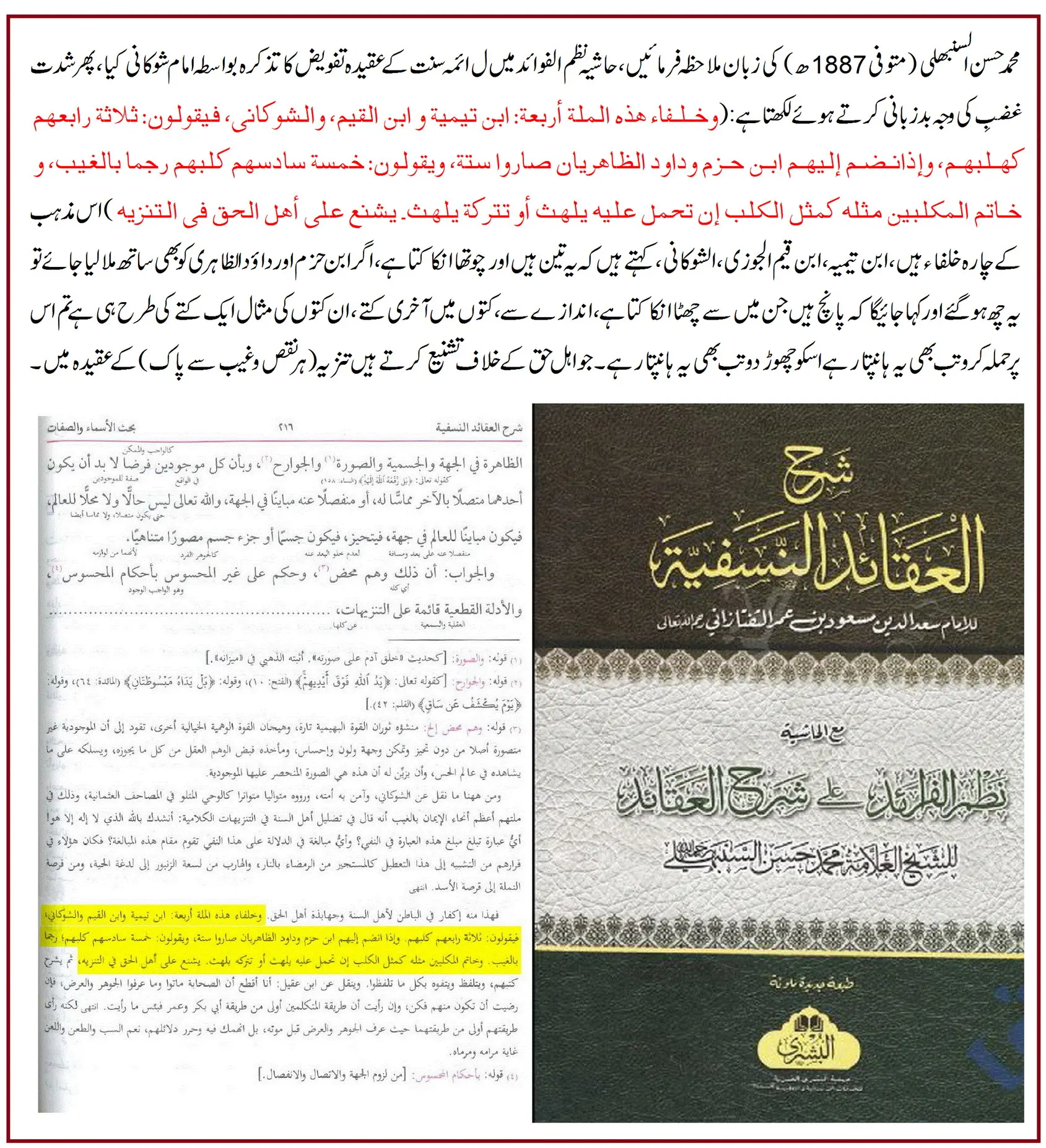
⑳ Opposing Evidence: Muhammad Hasan Muhaddith Sambhali
◈ Response
The original text severely criticizes his style of writing. We will only say this out of respect for etiquette:
📌 Explanation:
- The Hadith «أَذْنَابُ خَيْلٍ شُمْسٍ» pertains to the place of Salam.
- Using it as evidence for abandoning the raising of hands at Ruku or Qawmah is against scholarly integrity.
(In the original text, there were also harsh words about their writings, but here we limit ourselves to the scholarly point.)
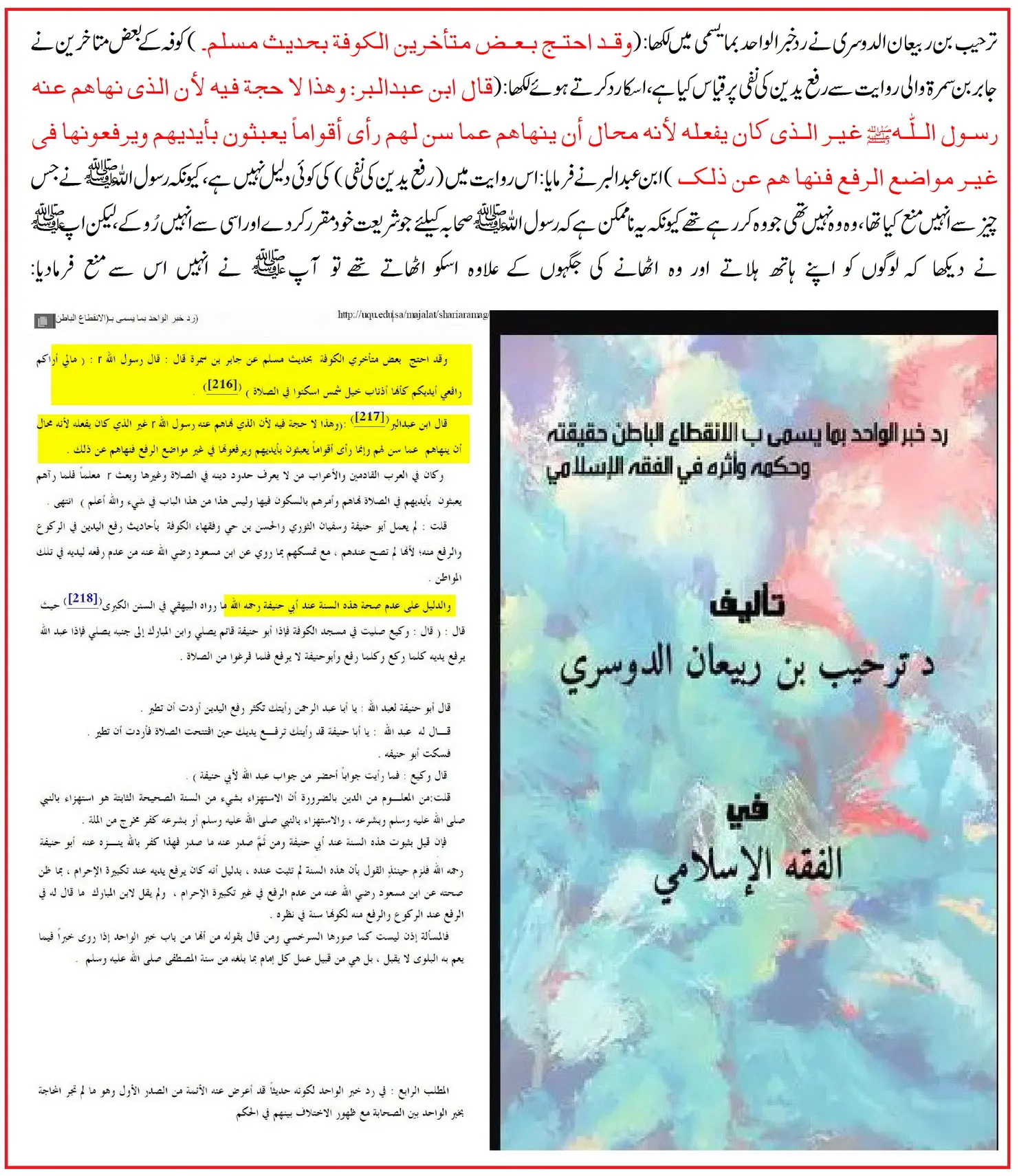
㉑ Opponent’s Evidence: Ibn Rabiaan al-Dawsari
◈ Response
Ibn Rabiaan al-Dawsari writes:
«…وهذا لا حجة فيه لأن الذي نهاهم عنه رسول الله ﷺ غير الذي كان يفعلُه… محال أن ينهاهم عما سَنَّ لهم… وإنما رأى أقواماً يعبثون بأيديهم ويرفعونها في غير مواضع الرفع فنهى عن ذلك.» —
📌 Explanation:
- What the Prophet ﷺ forbade was actually “waving hands in an inappropriate place.”
- And the act that the Prophet ﷺ taught as Sunnah (raising hands in Ruku) is not forbidden.
✅ Conclusion: Therefore, this Hadith is not against raising hands but against unnecessary movements.
㉒ Opponent’s Evidence: Ibn Awad Allah bin Muhammad
◈ Response
Ibn Awad Allah writes:
«…احتج بها بعض الكوفيين لمذهبهم في المنع من رفع اليدين… فقال: “مالي أراكم…” فهذه رواية مختصرة، فينبغي حملها على الرواية الأولى المفصلة… أن هذا الرفع كان في التشهد والتسليم، وليس في الركوع أو الرفع منه.» —
📌 Explanation: Here a fundamental principle is stated that a brief narration is always interpreted in light of a detailed narration. Since the detailed narrations clearly show that this matter relates to Salam and Tashahhud, it is necessary to understand the brief narration in the same context.
✅ Brief Conclusion:
- According to Yaseen Al-Fahl, interpreting it as referring to Qiyam (standing) leads to a false necessary consequence.
- Sanbali’s style was harsh but the conclusion was incorrect.
- Ibn Rabiaan clarified that the prohibition was on “waving the hands outside their proper place.”
- Ibn Awadullah applied the principle rule to interpret the brief narration in light of the detailed one.
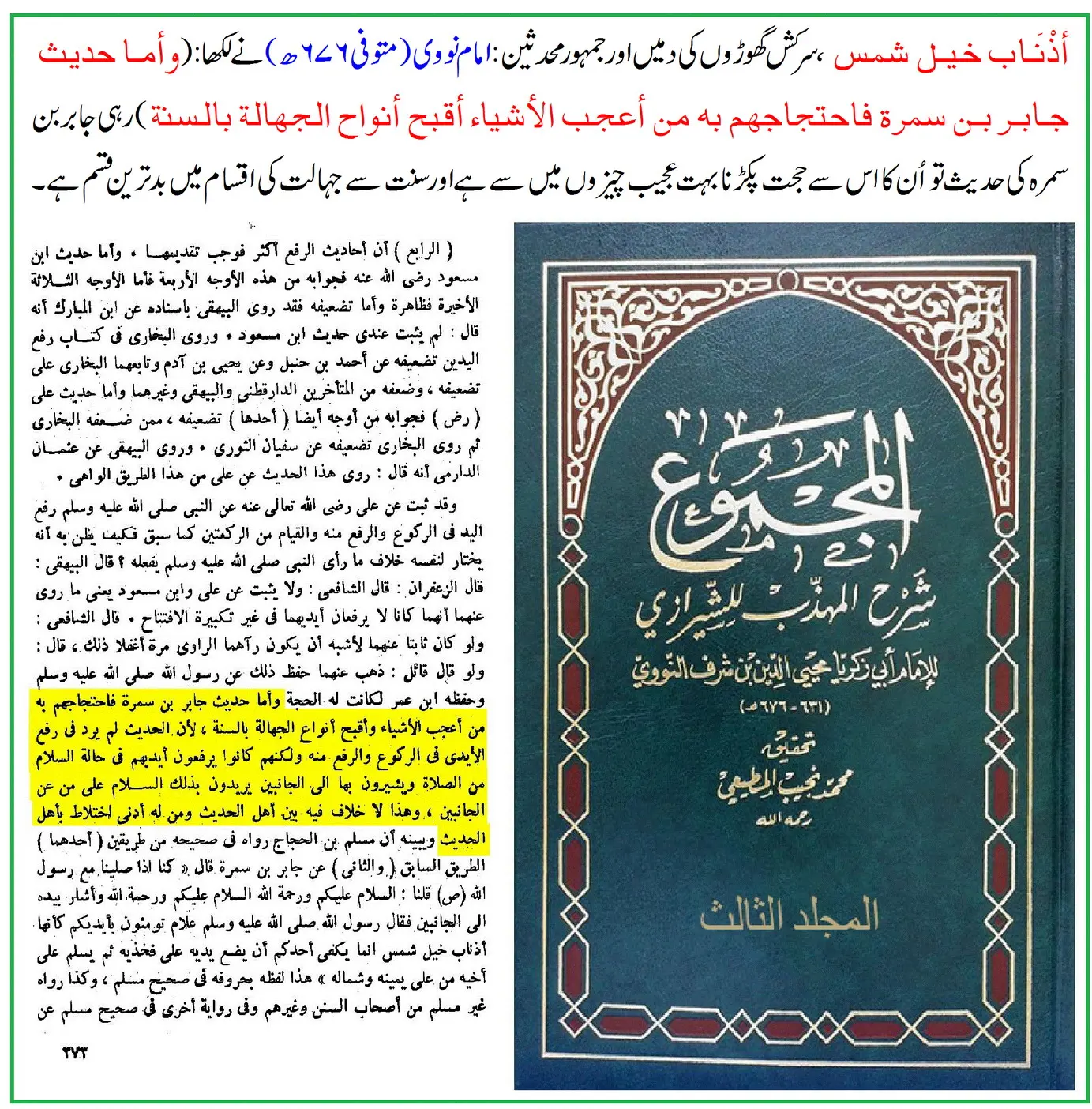
㉓ Opposing Evidence: Imam Nawawi (Al-Majmoo 3/400)
Text: «وأما حديث جابر بن سمرة فاحتجاجهم به من أعجب الأشياء وأقبح أنواع الجهالة بالسنة؛ لأنه لم يرد في رفع الأيدي في الركوع والرفع منه، ولكن كانوا يرفعون أيديهم في حالة السلام… ولا خلاف فيه بين أهل الحديث ومن له أدنى اختلاطٍ بأهل الحديث.» —
◈ Response
Imam Nawawi (may Allah have mercy on him) clearly states:
- Using this hadith as evidence to abandon raising the hands is ignorance.
- This narration is not about raising hands during bowing or standing after bowing, but about waving hands at the time of salam.
- And there is no disagreement among the Ahl al-Hadith on this matter.
📌 Clarification: It is unanimously agreed that the hadith mentioning “the tails of restive horses” is about salam, not about bowing or standing after bowing.
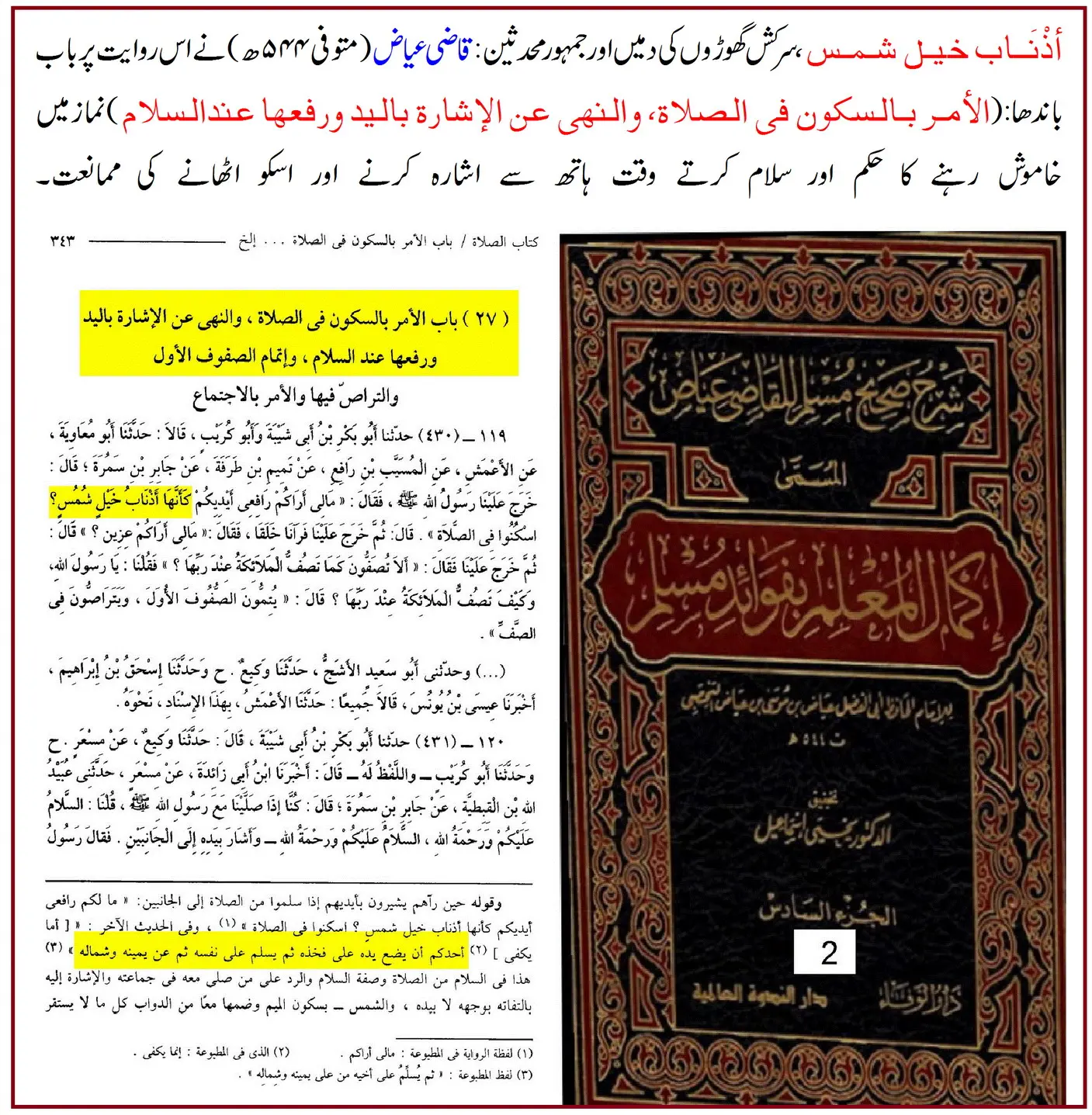
㉔ Opposing Evidence: Qadi Iyad Maliki
Text: «(٢٧) بابُ الأمر بالسكون في الصلاة، والنهي عن الإشارة باليد ورفعها عند السلام…» —
◈ Response
Qazi Iyaz himself created a chapter and clarified that this hadith is related to “waving the hand at the time of salam.” 📌 Clarification: When the hadith scholars themselves have clearly specified the context in the chapter heading, then taking it to mean raising hands during ruku or Qawmah is a completely incorrect interpretation.
❀ Summary of the entire article
The conclusion of the entire research is:
- Presenting hadith «أَذْنَابُ خَيْلٍ شُمْسٍ» as a negation of raising hands during ruku or Qawmah is scholarly betrayal.
- According to the clarifications of the hadith scholars, this hadith only prohibits moving the hand during tashahhud and salam.
- All references presented against raising hands were either unrelated to the context of the hadith or their authors themselves admitted that this hadith is about salam.
✅ Conclusion: It has become absolutely clear that the Hanafi school does not have any explicit and authentic evidence negating the raising of hands. Rather, most of the references they present are based on bias or unfounded statements.
Scans of important references