According to the fifth book of the Torah, Deuteronomy, God made a promise to Moses about a prophet who would come after him. Christians and Jews have read this promise for more than three thousand years. In this article we look closely at its words, compare them with the Bible’s own usage, and ask a simple question: who fits this description best?
A note on the Bible: As Muslims, we believe that the Torah and the Gospel were originally revealed by Allah, but that the books people have today are not preserved in their original form; they were changed over time (Qur’an 2:79; 5:13). So when we quote the Bible, we are not saying that every word of it is the word of Allah. We quote it because it is the book that Jews and Christians themselves accept. Even so, traces of the original truth remain in it, which is why the Qur’an says that the Prophet ﷺ is found “written in the Torah and the Gospel” (Qur’an 7:157).
The Prophecy
According to the Book of Deuteronomy, God said to Moses:
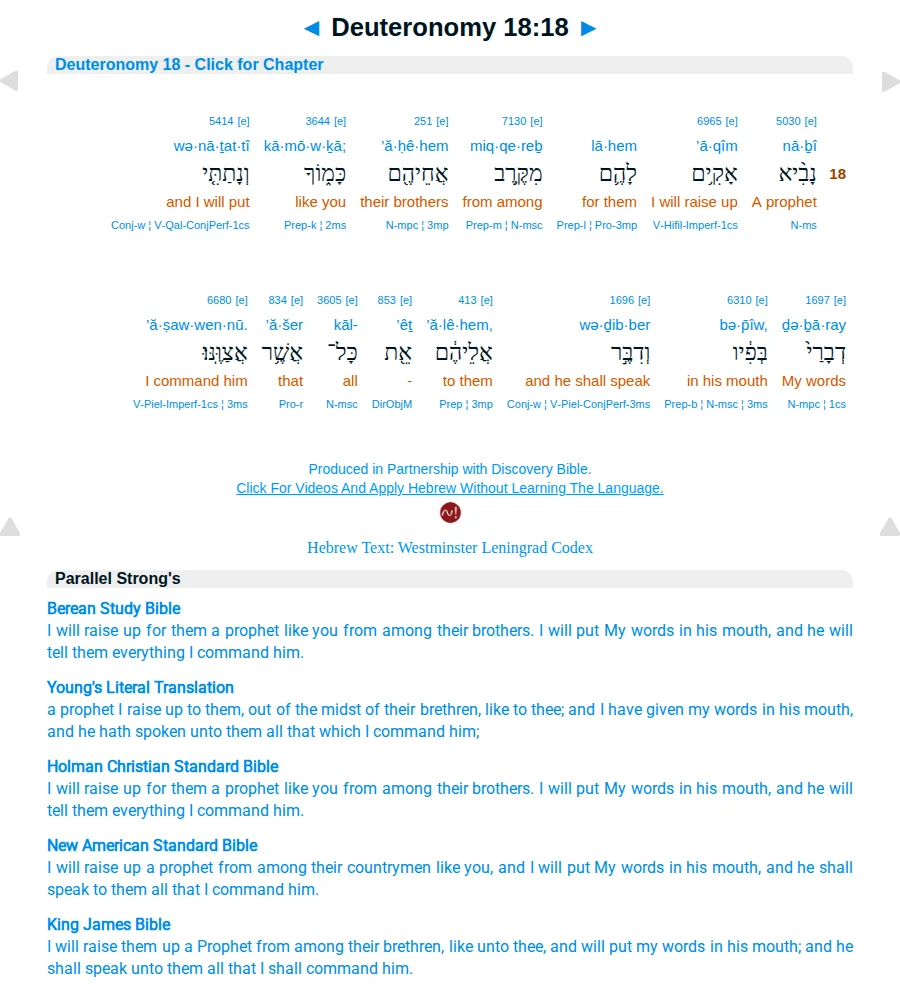
“I will raise them up a Prophet from among their brethren, like unto thee, and will put my words in his mouth; and he shall speak unto them all that I shall command him. And it shall come to pass, that whosoever will not hearken unto my words which he shall speak in my name, I will require it of him.”
— Deuteronomy 18:18–19 (King James Version)
Modern translations say the same thing in simpler English: “I will raise up for them a prophet like you from among their brothers. I will put My words in his mouth, and he will tell them everything I command him” (Berean Standard Bible).
Three phrases in this promise tell us who the prophet is. Let us take them one by one.
1. “From among their brethren”
In this passage, Moses is being addressed about the Israelites. The text does not say “from among yourselves” or “from among the children of Israel.” It says “from among their brethren“ — in Hebrew mi-qerev aḥêhem, “from among their brothers.”
Who are the brothers of the Israelites? Abraham (peace be upon him) had two sons: Ishmael and Isaac. The Israelites descend from Isaac, through his son Jacob (Israel). The Arabs descend from Ishmael. The two nations are, quite literally, brothers.
The Bible itself speaks this way:
- About Ishmael: “he shall dwell in the presence of all his brethren” — Genesis 16:12, and again “he died in the presence of all his brethren” — Genesis 25:18.
- About the Edomites, a neighbouring nation descended from Isaac’s other son Esau, the Torah reports God telling Moses: “Ye are to pass through the coast of your brethren the children of Esau” — Deuteronomy 2:4.
- According to Genesis, God also promised a great nation through Ishmael: “I have blessed him … and I will make him a great nation” — Genesis 17:20.
So in the language of the Torah, “brethren” of Israel can mean the related nations around them — not only Israelites. And the greatest nation that came from Ishmael is the Arabs. Muhammad ﷺ was an Arab, a descendant of Ishmael.
There is one more clue. At the very end of the Torah, after Moses died, the Bible says:
“And there arose not a prophet since in Israel like unto Moses, whom the LORD knew face to face.”
If no prophet like Moses arose in Israel, then where should we look for him? Among Israel’s brothers.
A note on verse 15: A few verses earlier, Moses tells the people that God will raise up a prophet “from the midst of thee, of thy brethren” (Deuteronomy 18:15). But verse 18 is presented as God’s own words, and there the text says “from among their brethren” — speaking of the Israelites in the third person. The Prophet ﷺ was sent to all of mankind, including the Israelites, and he came from the family of their brother Ishmael.
2. “Like unto thee” — a prophet like Moses
The coming prophet must be like Moses. Every prophet was a messenger of God, so the likeness must be something special. Let us compare the lives of Moses, Jesus and Muhammad (peace be upon them all):
- Birth: Moses and Muhammad ﷺ — Born naturally, to a father and a mother. Jesus — Born miraculously, without a father.
- Family: Moses and Muhammad ﷺ — Married and had children. Jesus — Never married.
- Law: Moses and Muhammad ﷺ — Each brought a new, complete law. Jesus — Came to fulfil the law already given (Matthew 5:17).
- Leadership: Moses and Muhammad ﷺ — Each was both a prophet and the ruler of his nation. Jesus — Did not rule a state.
- Migration: Moses and Muhammad ﷺ — Each fled his home city when his life was sought — Moses from Egypt to Midian (Exodus 2:15), Muhammad ﷺ from Makkah to Madinah. Jesus — No such migration.
- Enemies: Moses and Muhammad ﷺ — Each faced his enemies and was given victory over them. Jesus — Did not lead his people in battle.
- End of life: Moses and Muhammad ﷺ — Each died a natural death and was buried. Jesus — Raised up by God (Qur’an 4:158); Christians believe he was crucified.
- Nature: Moses and Muhammad ﷺ — Each was a human prophet. Jesus — Christians believe he is God, or the Son of God.
The last row matters most for a Christian reader. If Jesus is God, as the Church teaches, then he cannot be “like Moses,” because Moses was only a man. The prophet of Deuteronomy 18 is a human being who receives God’s words — just as Moses did.
So honestly ask yourself: who is more “like Moses”?
3. “I will put my words in his mouth”
According to the prophecy, this prophet will not compose a book from his own mind. God’s words will be placed in his mouth, and he will repeat them exactly as he receives them.
That is exactly how the Qur’an came. The Prophet ﷺ could not read or write. The angel Jibril (Gabriel) recited God’s words to him, and he recited those same words to the people. The Qur’an describes him:
“Nor does he speak from his own desire. It is only a revelation revealed.”
The very next verse of Deuteronomy says this prophet will speak “in my name” (Deuteronomy 18:19). Every surah of the Qur’an except one (Surah al-Tawbah) begins with: “In the name of Allah, the Most Gracious, the Most Merciful.”
“But the New Testament says this prophet is Jesus”
Some Christians point to Acts 3:22, where Peter quotes this prophecy in a sermon. But the Gospels show that the Jews of Jesus’ own time were waiting for three different figures: the Christ (Messiah), Elijah, and “that Prophet.” When priests came to question John the Baptist, they asked him:
“Why baptizest thou then, if thou be not that Christ, nor Elias, neither that prophet?”
— John 1:25 (see also verses 20–21)
And when people heard Jesus speak, “some said, Of a truth this is the Prophet. Others said, This is the Christ” (John 7:40–41). In their minds, “the Christ” and “the Prophet” were two different people. Christians believe Jesus is the Christ — and the Qur’an agrees that Jesus is the Messiah (al-Masih). That leaves “the Prophet like Moses” still to come.
What the Qur’an says
The Qur’an tells us that the coming of the Prophet ﷺ was already written in the earlier scriptures:
“Those who follow the Messenger, the unlettered Prophet, whom they find written in what they have of the Torah and the Gospel…”
Conclusion
- A prophet from the brothers of Israel — the descendants of Ishmael.
- A prophet like Moses — born naturally, married, a lawgiver, a leader, who migrated, overcame his enemies and died a natural death.
- A prophet who speaks God’s words exactly as he receives them, in God’s name.
Only one man in history fits all three. We believe that prophet is Muhammad ﷺ.
To our Christian friends: we invite you to open your own Bible, read Deuteronomy chapter 18 for yourself, and then read the Qur’an with an open heart.
Scans of Important References
Deuteronomy 18:15–19, King James Version (Bible Gateway)
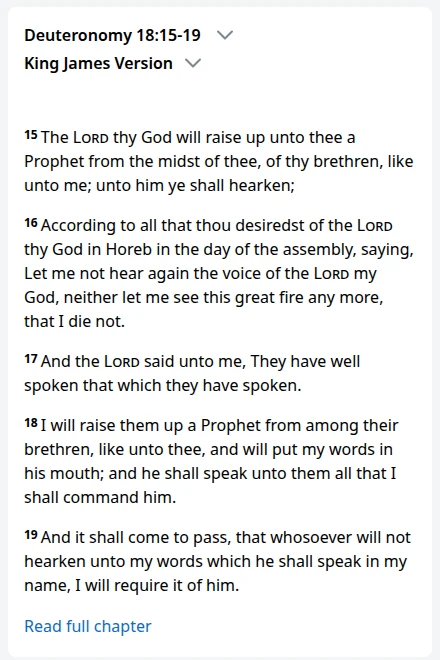
Deuteronomy 18:18 in the original Hebrew (Westminster Leningrad Codex) with word-by-word English, and five standard Bible translations (Bible Hub)