
بسم الله الرحمن الرحيم الحَمْدُ لِلهِ وَسَلَامٌ عَلَى عِبَادِهِ الَّذِينَ اصْطَفَى خُصُوصًا عَلَى سَيّدِ الْأَنْیبَاءِ مُحَمَّدٍ الْمُصْطَفَى وَعَلَى الهِ الْمُجْتَبى وَصَحَابَتِهِ الْأَتقِيَاءِ إِلَى يَوْمِ اللقَاء أَمَّا بَعْدُ:
The five pillars on which Islam is founded. One of these pillars is Hajj, which Allah Almighty has made spacious, and the expense of travel and the household expenses should be easily available, according to the divine command:
وَلِلَّهِ عَلَى النَّاسِ حِجُّ الْبَيْتِ مَنِ اسْتَطَاعَ إِلَيْهِ سَبِيلًا
“It is a duty to travel to the House of Allah, striving is necessary, and the results depend on Allah Almighty.”
A person who is capable tries but does not succeed is not to be blamed; the blame is on those who have the ability but fear the reduction of wealth.
Sincerity of Intention
Before going, one should make the intention correct that I am going for the divine obligation, neither for show nor to be called Hajji, only the pleasure of Allah is sought. May Allah accept the efforts of such people. (Ameen Thumma Ameen)
✔ Also see this article: The Sunnah Method of Hajj Tamattu in the Light of Authentic Ahadith
✔ Also watch this video: Video: Hajj Training Workshop – Under the Supervision of Scholars from Madinah University
Accepted Hajj
It is in Sahihain: ((عَنْ أَبِي هُرَيْرَةَ، قَالَ سُنلَ رَسُولُ الله ﷺ ایى الأعْمَالِ أَفْضَلُ قَالَ إِيْمَانُ بِاللَّهِ وَرَسُولِهِ قَیلَ ثُمَّ مَاذَا قَالَ جِهَادٌ فِي سَبِيلِ اللَّهِ قَیلَ ثُمَّ مَاذَا قَالَ حَج مَبْرُورٌ( وَفِي رَوَايَةِ الْبيَهقي وَالْحَاكِم مُخْتَصَرًا) قَالَ الْحَج الْمَبْرُورُ لَيْسَ لَهُ جَزَاءُ إِلَّا الْجَنَّةَ قَیلَ وَمَا برةَ قَالَ إِطْعَامُ الطَّعَامِ وَطِيِّبُ الْكَلَامِ))
Hazrat Abu Huraira (RA) narrates that the Prophet ﷺ was asked which deeds are the best and most virtuous? He said, the best is to believe in Allah Almighty and His Messenger. The questioner asked, then which one? He ﷺ said, Jihad. The questioner asked again, then which deed? He ﷺ said: an accepted Hajj. You yourself explain the meaning of accepted Hajj as the Hajj in which kindness and benevolence are practiced. People are fed, disputes and quarrels are abandoned, and matters are settled with good speech.
Satanic Attacks on the Honorable Pilgrims
In Hajj, especially, Satan incites the pilgrim with his army to engage in un-Islamic matters, causing disputes over minor things like a piece of meat, bread, or water, stirring greed and temptation. Allah Almighty has specifically commanded:
وَلَا فُسُوقَ وَلَا جِدَالَ فِي الْحَجِّ
“That in Hajj, one should avoid quarrels, riots, and corruption; otherwise, the Hajj will not be ‘Hajj Mabrur’ (accepted).”
(2) It is narrated in Ibn Majah, Ibn Khuzaymah, and Ibn Hibban:
( عَنْ أَبِي هُرَيرَةَ قَالَ قَالَ رَسُولُ اللَّهِ مَعَ الْحُجَّاج وَالْعُمَّارُ وَفدُ اللَّهِ إِنْ دَعَوْهُ أَجَابَهُمْ وَإِنْ اسْتَغْفَرُوهُ غفَرَلَهُمْ)
The Messenger of Allah ﷺ said: Those who perform Hajj and Umrah are the congregation of Allah Almighty. Their distinguishing mark is that if they pray to their Lord for anything, it is honored with acceptance; if they seek forgiveness, He forgives them.
Virtue of Hajj
The Prophet ﷺ said: Whoever performs Hajj and avoids all kinds of disputes and sinful acts will return as if he has just been born by his mother. That is, completely pure and free from sins.
Need for Pure Wealth
(إِنَّ اللَّهَ طَيِّبٌ لَا يَقْبَلُ إِلَّا طيبا)
Allah Almighty is Himself pure and accepts only what is pure.
Tabarani narrated from Abu Hurairah (may Allah be pleased with him) that the Messenger of Allah ﷺ said: “When a person sets out for Hajj with pure provisions and places his foot in the stirrup of the mount while saying Labbaik, a caller from the heavens responds, ‘Your Labbaik is accepted, and mercy descends upon you, your provisions are lawful, your mount is lawful, and your Hajj is accepted, and you are free from sins.’ But when a person sets out for Hajj with unlawful earnings and places his foot in the stirrup while saying Labbaik, a caller from the heavens responds, ‘Your Labbaik is not accepted, nor is Allah’s mercy upon you, your provisions are unlawful, your earnings are unlawful, and your Hajj is not accepted.’
Before departing, one should choose to travel with good and pure wealth. May Allah grant us the ability to perform righteous deeds.
When Leaving the House
When the pilgrim prepares for the journey and packs his travel belongings, he should pray two rak’ahs before leaving the house. This will protect him from the hardships of travel by the grace of Allah Almighty. It is narrated in Al-Bayhaqi, Ibn Asakir, and Al-Daylami from Hazrat Zaid bin Arqam (may Allah be pleased with him) that the Prophet ﷺ said: When one intends to go for Hajj, he should bid farewell to his brothers who remain behind and pray for them. Allah Almighty will bless his prayer, and the brothers will pray for the pilgrim traveler.
The prescribed supplication is:
(زوَّدَكَ اللهُ التَّقْوى وَعَفَرَلَكَ ذَنبكَ وَبَشَرَلَكَ الْخَيْرَ حَيْثُ مَا كُنتَ.)
“O brother! May Allah make piety your provision for the journey, forgive your sins, and provide you with all goodness and ease wherever you may be.”
And Haji Sahib himself would say to his Lord with great humility and submission:
(اللهم انتَ الصَّاحِبُ فِي السَّفَرِ وَالْخَلیفةُ فِي الأهلِ وَالْمَالِ اللَّهُمَّ اصْحَبُنَا فِي سَفَرِنَا هَذَا وَاخْلُفْنَا فِي أهْلِنَا اللهُم إلى أعُوذُ بِكَ مِنْ وَعْتَاءِ السَّفَرِ وَكَابَةِ الْمُنقَلبِ وَمِنْ سُوءِ الْمُنظَرِ وفِي الْأَهْلِ وَالْمَالِ)
“O my Lord, You are my companion in my journey and You are the guardian and trustee over my family and wealth. So accompany us in the journey and be the guardian and trustee over our family. O my Lord! I seek refuge in Your presence from the hardships of travel. I seek refuge from loss after gain, and I seek refuge from evil sights concerning my family and wealth.”
If one makes this prayer, God willing, the journey will be good. No unpleasant incident will occur by the grace of Allah.
Another short prayer is also narrated.
(اللَّهُمَّ إِنَّا نَسْأَلُكَ فِي سَفَرِنَا هَذَا الْبِرَّ وَالتَّقْوَى، وَمِنَ الْعَمَلِ مَا تَرْضَى، اللَّهُمَّ هَوِّنْ عَلَيْنَا سَفَرَنَا هَذَا، وَاطْوِ عَنْا بُعْدَهُ).
“O my Lord, I ask You for goodness and piety in this blessed journey and seek from You the ability to perform deeds You love. O my Lord, make all the hardships of the journey easy for me and shorten the distance of the journey by wrapping it up.”
All these supplications are transmitted from the Prophet ﷺ. Reciting them will make the journey blessed.
When mounting a vehicle, whether it is a train or an airplane, this supplication is Sunnah
سُبْحَانَ الَّذِي سَخَّرَ لَنَا هَٰذَا وَمَا كُنَّا لَهُ مُقْرِنِينَ
بِسْمِ اللَّهِ مَجْرَاهَا وَمُرْسَاهَا ۚ إِنَّ رَبِّي لَغَفُورٌ رَّحِيمٌ
After this Sunnah supplication, God willing, one will remain safe from harm.
Assistance from Companions
When the journey begins, treat your companions with kindness and good behavior, be gentle when a companion stumbles, and treat the poor, elderly, and women with kindness and assistance. Just as this group of God is going towards the House of Allah, similarly, the eternal evil eye sends its followers with them who are intensely striving for discord, mischief, and polytheism among themselves. They incline towards evil and obstruct good deeds. The fortunate one is the one whom Allah keeps safe and who continues to strive so as to avoid discord and mischief.
Shortening of Prayer
Shortening the prayer during travel is more rewarding. Regarding shortening the prayer, you ﷺ said:
(صَدَقَةٌ مِنَ اللهِ فَاقْتِلُوا صَدَقَتَهُ)
“Allah has bestowed a great favor upon you; accept His favor. Less effort, more reward, Allah’s pleasure is in obedience to the Prophet.”
If one intends to stay in a place for more than three days, then upon arrival, one should pray the full prayer.
In shortening the prayer, where four rak’ahs are obligatory, two rak’ahs should be prayed. For example, Dhuhr, Asr, Isha. However, if praying behind an Imam, following the Imam is necessary. One must pray as many rak’ahs as the Imam prays; obedience to the Imam is obligatory. During travel, the emphasized Sunnah prayers are excused, but the Witr and Fajr Sunnah were not abandoned by the Prophet ﷺ whether traveling or stationary.
Types of Hajj
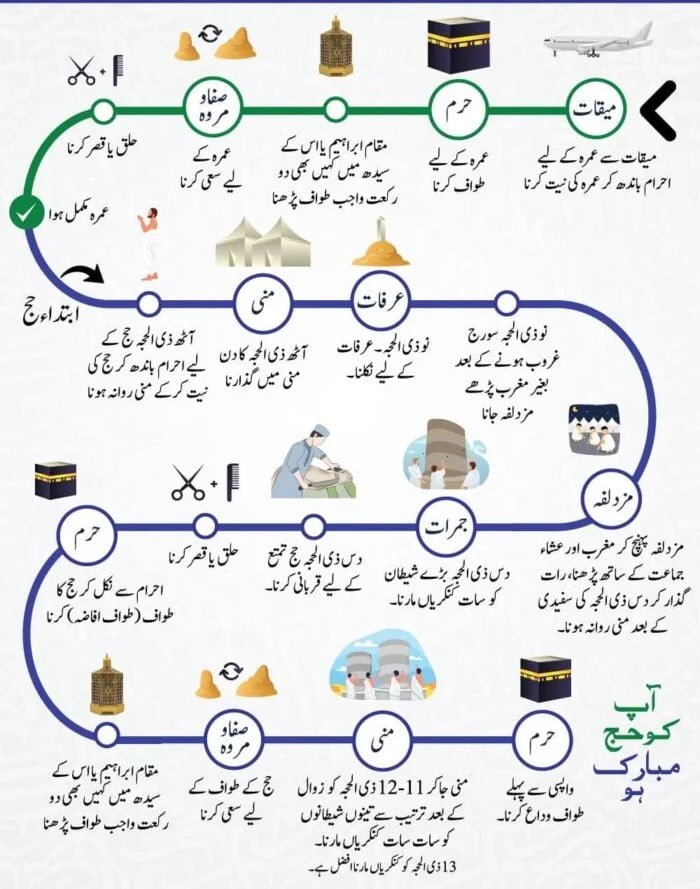
Hajj is transmitted in three ways: Qiran, Tamattu’, and Mufrid Hajj.
Qiran
When passing the Miqat, assuming Ihram for both Hajj and Umrah together, and becoming lawful on the tenth of Dhu al-Hijjah, this is called Qiran, and the one who performs it is called “Qarin.”
Tamattu’
When passing the Miqat, only the Ihram for Umrah is worn, and after performing Umrah, one becomes permissible (halal). Then on the 8th of Dhu al-Hijjah, only the Ihram for Hajj is worn again, and on the 10th of Dhu al-Hijjah, one becomes permissible at the place of Mina. This is called Hajj al-Tamattu‘, and the person performing it is called a Mutamatti‘.
Note: It is necessary to wear the Ihram before passing the Miqat.
Hajj al-Mufrid
Wearing only the Ihram for Hajj when passing the Miqat and removing the Ihram after the sacrifice on the 10th of Dhu al-Hijjah at Mina is called simply Hajj, and the person performing it is called Mufrid bil-Hajj or Haji. Not only Pakistanis and Indians but people all over the world find ease in Tamattu‘ because after Ihram, by performing Umrah, all things that were forbidden due to Ihram become permissible. A person can easily apply perfume, wear clothes, and there is no prohibition. Generally, the scholars believe that Tamattu‘ is superior to Qiran and Mufrid Hajj. Since they brought a sacrifice, it was necessary for them to be Qarin; otherwise, it was possible that you would also perform Tamattu‘ as follows:
( لَوِ اسْتَقْبَلْتُ مِنْ أَمْرِى مَا اسْتَدْبَرْتُ مَا أَهْدِيتُ )
(If I had known earlier what I came to know later, I would not have brought the sacrifice) requires وَالْعِلْمُ عِندَ اللهِ
Method of Ihram
For our Pakistani and Indian brothers, the Miqat is the “Yalamlam” mountain. Miqat is the place beyond which a pilgrim should not proceed without Ihram. Those traveling by plane are informed in advance that the plane will pass near the Yalamlam mountain at a certain time. Therefore, it is necessary for them to take a bath beforehand, apply perfume, and wear two sheets: one wrapped around the waist and the other draped over the shoulders, keeping the head uncovered. Wearing socks, gloves, kurta, pajama, etc., is not correct. There is no restriction in the Shariah of Muhammad regarding these sewn sheets. Those boarding the plane should wear Ihram from Karachi because it is difficult for them to know the Miqat.
✔ Also see this article: Complete Method of Umrah in the Light of Quran and Hadith
Ihram for Women
Remove good clothes and perform ghusl (ritual bath), then wear ordinary clothes, shalwar, kurta, and dupatta, and wear the ihram clothes (for men and women). If there is time, perform any obligatory prayer and then say:
لبيك اللهم لبيكَ لَا شَرِيكَ لَكَ لَبَّيْكَ إِنَّ الْحَمْدَ والنِّعْمَةَ لَكَ وَالْمُلْكَ لَا شَرِيكَ لَكَ لَبَّيْكَ إِلهَ الحَقِّ لَبَّيْكَ.
O my Lord! The servant is present (for the visitation of Your house). O my Lord, the servant is present and acknowledges that You are unique and singular in Your kingdom, in Your essence and attributes, without any partner. All praises and blessings are for You alone. The sovereignty is Yours, the kingdom is Yours, You have no equal. The servant is present, and O my true God! The servant is present. (Grant him the honor of acceptance.) Whoever intends Tamattu’ (performing Umrah followed by Hajj) should wear the ihram for Umrah only, and when saying the Talbiyah (i.e., Labbaik), say it for the first time:
(لبیك عُمْرَةٌ لبیكَ عُمْرَةً حَجا)
As mentioned above, and when he reaches the House of Allah, the Talbiyah will end. On the way, sometimes say اللہ اکبر and sometimes لا الهَ إِلَّا اللہ. There is no harm. The Prophet ﷺ used to recite it in this manner in his presence.
Prohibitions of Ihram
In the state of Ihram, wearing a kurta, shirt, shalwar, coat, cap, etc. is prohibited, while gloves, socks, and perfume are also forbidden. Saffron-colored cloth, applying saffron, and musk are included in the prohibitions. One should neither pluck hair nor kill lice, but it is permissible to throw them on the ground. One can perform ghusl (ritual bath), but hair should not be broken; avoid applying oil, do not shave hair, and do not comb it. If husband and wife are together, they should abstain from sexual relations and its preliminaries. For women, it is permissible to keep the face uncovered during Ihram. Keep the face uncovered, but when it is known that non-mahram men are coming, then observe hijab (veil).
Purdah (veil) is obligatory for women
The issue that is famous about a woman tying a basket or fan on her head so that the cloth does not cover the face is not proven anywhere. Hazrat Aisha Siddiqah (RA) went for Hajj with the Prophet ﷺ and said that when we knew that non-mahrams were coming, we would cover our faces, and when they left, we would uncover our faces.
Keeping a cloth always on the face and covering it continuously is against the Sunnah. Immodesty is not liked by Allah Almighty anywhere. Especially in such a journey, no un-Islamic acts should be done. It is commonly known among people that Haji brothers and sisters are related, so there is no need for hijab; this is also an un-Islamic statement and action. May Allah protect us.
Killing of Harmful Animals
Prohibited harmful animals, such as snakes, scorpions, rats, crows, kites, mad dogs, sheep, etc., which are harmful, can be killed so that people can be safe from their harm. Similarly, an attacking animal or person can be defended against. This is not considered a sin in Shariah.
No prescribed supplication upon entering the sacred precinct of Makkah has come to my notice; this is evident from the examination of commonly circulated books.
Before entering Makkah, at the place where the settlement begins, there is a well called “Bir Zat-Tuwa,” nowadays known as Zahir, located on the left side coming from Jeddah. It is a recommended act to perform ghusl (ritual bath) there. The Messenger of Allah ﷺ performed ghusl before entering Makkah.
Then from there, one should enter the Sacred Mosque through the Bab al-Salam gate from the direction of Ma’la and proceed straight to the Ka’bah. When one first sights the Ka’bah, one should recite this supplication as narrated by Ibn Jarir:
(كَانَ إِذْ راى الْبَيْتَ رَفَعَ يَدَيْهِ فَقَالَ اللَّهُمَّ زِدْهَدًا البيت الشرِيقًا وَتَعْظِيمًا وَتَكْرِيمًا وَمَهَابَةٌ وَبِرًّا وَّرَدْ مَنْ شرقة وكَرَّمَهُ مِمَّنْ حَجَّهُ أَوِ اعْتَمَرَهُ تَشْرِيقًا وَتَعْظِيمًا.)
When the Prophet ﷺ saw the Ka’bah, he would raise both hands and recite this supplication: O my Lord, increase the honor, dignity, greatness, and awe of this magnificent House, and increase the honor and greatness of whoever is fortunate enough to perform Hajj or Umrah while maintaining the dignity and greatness of this blessed House.
Tahiyyat al-Masjid in the House of Allah
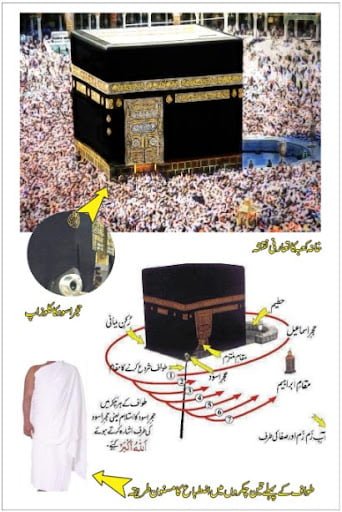
It is not established to pray two rak’ahs of Tahiyyat al-Masjid upon entering the Sacred Mosque. The very first act is the Tawaf of the House of Allah. Proceed directly towards the Black Stone, and if it is easy to kiss it, then kiss it; or touch it, or if possible, just touch it (and kiss the hand).
Otherwise, pushing and shoving to get closer in the crowd is sinful.
قَالَ ابْنُ عَوْفٍ سَمِعْتُ رَجُلًا يَقُولُ قَالَ رَسُولُ الله و العمر يا أَبَا حَفْصٍ إِنَّ فِيْكَ فَضْلُ قُوَّةٍ فَلَا نُودِ الضَّعِيفَ إِذَا رَأَيْتَ الرُّكْنَ حَلْدًا فَاسْتَلِمُ وَإِلَّا كَبِرُ فَامُضِ قَالَ سَمِعْتُ عُمَرَ يَقُولُ لِرَجُلٍ لَا تُوْدِ الرَّجُلَ بِفَضْلٍ فونك
The Messenger of Allah ﷺ said to Hazrat Umar رضي الله عنه: O Abu Hafs! Allah Almighty has endowed you with great strength; do not cause harm to the weak person. If there is no crowd at the place of the Black Stone and it is empty, then you may kiss it or do so, otherwise say Allahu Akbar and pass by (in some places, a gesture is also indicated). Hazrat Umar رضي الله عنه was also advising a strong-built person not to push people with his strength (this is the reward) pushing and shoving towards the Black Stone is not a good deed.
Distress
How should the Ihram be during Tawaf?
Fold the Ihram cloth that is on your shoulder under your armpit on one side, leaving the right shoulder bare, and throw the cloth on that side to the left side; this is called “Iztiba.”
This is Sunnah during the first Tawaf; after that, it is not Sunnah to do so in subsequent Tawafs. When kissing or touching the Black Stone, recite:
بسم الله الله اكبر
If you add this supplication along with it, it is very good:
اللهُمَّ إِيمَاناً بكَ وَتَصْدِيقًا بِكِتَابِكَ وَوَقَاهُ بِعَهْدِكَ وَالْبَاعًا لِسُنَّةِ نَبِيَّكَ مُحَمَّدٍ ﷺ
O my true Master, I believe in Your Being, affirm Your revealed Book, fulfill Your covenant, and perform all actions following the Sunnah of the Prophet. (That is, accept it.) If kissing or touching is not possible due to the crowd, stand in front of the Black Stone, gesture towards it, say بسم الله اللہ اکبر, and then proceed.
Keep the Kaaba on your left
After kissing, from the Hajr-e-Aswad towards the door, run slowly for the first three circuits around the Kaaba and complete the remaining four circuits by walking slowly, and touch the Rukn-e-Yamani only by saying Allahu Akbar.
Kissing the Rukn-e-Yamani is not proven
Kissing the Rukn-e-Yamani is not Sunnah; it is a place for supplication. Between the Rukn-e-Yamani and the Hajr-e-Aswad, this supplication is Sunnah.
ربَّنَا آتِنَا فِي الدُّنْيَا حَسَنَةٌ وَفِي الْآخِرَةِ حَسَنَةً وَقِنَا عَذَابَ النَّارِ
This slow running is Sunnah in the first three circuits from the Hajr-e-Aswad to the Hajr-e-Aswad. It is not Sunnah in the remaining four circuits. Seven circuits complete one Tawaf.
Women should not run
Running between Safa and Marwah during Tawaf and Sa’i is not correct for women, because it is narrated from Hazrat Ibn Umar (may Allah be pleased with him) that running around the Kaaba and between Safa and Marwah is not correct for women. A similar narration is reported from Hazrat Aisha (may Allah be pleased with her).
There is no authentic narration from the Sunnah about any specific supplication during Tawaf; it is merely a fabrication by some teachers which has no relation to being Sunnah. During the interval of Tawaf, one can recite Tasbih, Tahleel, or other remembrances. However, there is a narration from a ruler in which a supplication is transmitted:
اللهم قبعنِي بِمَا رَزَقْتَنِي وَبَارِكْ لِي فِيهِ وَاخْلُفْ على كل غائبة بخير.
(O my Lord, You have granted me the ability to be content with this; grant me the doors of blessings in it and be my true successor.)
The author Ibn Abi Shaybah, citing Al-Rawdah Al-Nadiyah, also confirms that لَا إِلَهَ إِلَّا اللهُ وَحْدَهُ لَا شَرِيكَ لَهُ لَهُ الْمُلْكُ وَلَهُ الْحَمْدُ وَهُوَ عَلَى كُلَّ شَيءٍ قدير is recited during Tawaf. If one recites the Quran or Tasbih and Tahleel, that is also correct.
Tawaf should be performed in a state of Wudu (ablution)
Performing Tawaf of the Kaaba without ablution is not correct, or one should perform ablution. If a woman is menstruating or experiencing postpartum bleeding called “Nifas,” she cannot enter the Kaaba and should postpone her Umrah Tawaf until she is free from it.
If a woman is menstruating at the time of Ihram, she should still enter Ihram, but if it is time for a mandatory prayer, she should not perform it; however, continuing to say the Talbiyah and other remembrances like Labbaik is not objectionable.
What to say after Tawaf
When the seven circuits around the Kaaba are completed, perform two rak’ahs at Maqam Ibrahim. This is the prescribed Sunnah; if there is a crowd, then after some interval, the time will be available.
After completing the two rak’ahs of Nafl, engage in supplication, because this is the place where prayers are accepted. In these two rak’ahs, after Surah Al-Fatiha, it is Sunnah to recite Surah Al-Kafirun in the first rak’ah and Surah Al-Ikhlas in the second rak’ah.
According to the rituals of Muhammad bin Ismail Sahib, after completing the two rak’ahs, turn towards the Black Stone (Hajr al-Aswad). If possible, touch it with your hand or a stick or something similar, and kiss the hand or the stick; otherwise, just saying Takbir or making a gesture is sufficient.
Sa’i between Safa and Marwah
Then exit from Bab al-Safa, in front is the Safa hill, but nowadays both the Safa and Marwah hills have been cleared and a path for Sa’i has been made between them, and at the end there is a slight mark of the hill. Try to climb on top of Safa and stand where the Kaaba is visible and recite the following supplication, then make any other supplication you wish, then repeat the mentioned supplications, afterwards supplicate as you desire. Repeat the supplications a third time and then finally make a supplication. This process of repeating the supplications should be done three times.
لا إله إلا الله الله اكبرُ لَا إِلَهَ إِلَّا اللهُ وَحْدَهُ لَا شَرِيكَ لَهُ لَهُ الْمُلْكُ وَلَهُ الْحَمْدُ وَهُوَ عَلَى كُلِّ شَيْءٍ قَدِيرٌ. لَا إِلَهَ إِلَّا اللهُ وَحْدَهُ أَنْجَرَ وَعَدَهُ وَنَصَرَ عَبْدَهُ وَهَزَمَ الأحزاب وحده.
These words should be said three times, then make any supplication you wish; this is the place of acceptance.
عن نافع انَّهُ سَمِعَ عَبْدَاللَّهِ ابْنِ عُمَرَ وَهُوَ عَلَى الصَّفَا يَدْعُو يَقُولُ: اللَّهُمَّ إِنَّكَ قُلْتَ ادْعُونِي أَسْتَجِبْ لَكُمْ وَإِنَّكَ لَا تُخْلِفُ الْمِيعَادَ، وَإِلَى اسْتَلْكَ كَمَا هَدَيْتَنِي الإسلام الا تنزعَهُ مِنِى حَتَّى تَتَوَفَّانِي وَأَنَا مُسْلِمٌ.
(عَنْ جَابِرِ بْنِ عَبْدِ اللَّهِ أَنَّ رَسُولَ اللَّهِ اعَةِ كَانَ إِذْ وَقَفَ عَلَى الصَّفَا يكبر ثلاثا وَيَقُولُ لَا إِلَهَ إِلَّا اللَّهُ وَحْدَهُ لَا شَرِيكَ لَهُ. فَمُلْكُ ولهُ الْحَمْدُ وَهُوَ عَلَى كُلِّ شَيْءٍ قَدِيرٌ، يَصْنَعُ ذَلِكَ ثلاث مَرَّاتٍ وَيَدْعُو وَيَصْنَعُ عَلَى الْمَرْوَةِ مِثْلَ ذَالِكَ).
Hazrat Nafi’ (may Allah be pleased with him) narrates that he heard Abdullah bin Umar (may Allah be pleased with him) climbing the Safa hill and reciting this supplication:
O my Allah! You have said that if you pray, I will accept. All Your promises are true, You do not break promises. I ask You that since You have blessed me with the favor of Islam, keep me in this state until death, and let me die upon Islam.”
Hazrat Jabir bin Abdullah (may Allah be pleased with him) narrates that when the Messenger of Allah ﷺ stood on Safa, he said Allahu Akbar three times and recited لَا إِلهَ إِلَّا اللهُ وَحْدَهُ لَا شَرِيكَ لَهُ لَهُ الْمُلْكُ وَلَهُ الْحَمْدُ وَهُوَ عَلَى كُلَّ شَيْءٍ قَدِيرٌ, he did this three times and made supplications, and similarly made supplications on Marwah.
Also, it is not obligatory to be in a state of wudu (ablution) during Sa’i, but it is preferable.
Running Between the Green Markers
Then descending from there, both hills, Safa and Marwah, have green-colored markers. Running at a moderate pace between these markers is a Sunnah act. These two markers are included within the boundaries of Safa and Marwah, and one should run between them.
It is the Sunnah of Hazrat Hajar رضي الله عنه that if one is unable, they may walk at their usual pace. Upon climbing the Marwah hill, face the Qiblah, recite Takbeer and Tahleel, and make supplications just as on the Safa hill. This completes one circuit. Then proceed from Marwah towards Safa, run at a moderate pace between the green markers, walk beyond the marker, climb Safa in this manner, and make supplications. These are two circuits completed.
When is the Circuit of Safa and Marwah Completed
Similarly, after completing seven circuits, it is considered complete. The last circuit will be on Marwah, and now after completing the Tawaf al-Wida, the Umrah is complete.
Avoid Barbers with Scissors at Marwah
After completing the Sa’i between Safa and Marwah, it is often seen that people stand with scissors, and pilgrims, out of ignorance and for their convenience, take scissors from them and get a few hairs cut from the front of the head, sides, or near the crown to become halal. This method is not correct. The Sunnah is to cut the hair from the entire head (Qasr) in such a way that there is no part left where hair is not cut. Then shave the head for Hajj. However, for Umrah only, it is preferable to shave the head.
This is the Sunnah method. Some who perform Hajj Tamattu also shave their heads during Umrah, thinking it is preferable, but it is not preferable for them. Rather, the mentioned method is preferable. A woman can become halal by cutting a few hairs from the tuft of her hair
Seven or Fourteen Circuits
It appears that some people count starting from Safa to Marwah and then back to Safa as one circuit, while in reality, these are two circuits. Some scholars also mistakenly count fourteen circuits instead of seven. The correct way is to count one circuit from Safa to Marwah, then a second from Marwah to Safa, and so on, making seven circuits (shawt) in total, with the last circuit ending at Marwah.
How to Cut Hair
Now the one performing Tamattu‘ should get a haircut and wear clothes. A woman should cut a small portion of her hair from the end. With this, Umrah is complete. All things that were prohibited for the one in Ihram due to Ihram are now permitted. It is allowed to use perfume. The one who has combined Hajj and Umrah with Qiran Ihram has completed Umrah, but will remain a Muharrim (in Ihram). The day of becoming lawful for him will be the tenth of Dhu al-Hijjah after the sacrifice. For the one performing Hajj, this will be the Tawaf al-Qudum (arrival Tawaf), and his day of departure will also be after the sacrifice on the tenth of Dhu al-Hijjah.
Hajj and the Method of Hajj
On the eighth of Dhu al-Hijjah, as usual, perform ghusl and offer two rak’ahs of prayer; there is no need to come to the Haram for this. From the house where you are residing, wear two sheets of Ihram and proceed to Mina for Hajj. Mina is a place three miles east of Makkah. During the time of the Prophet ﷺ, it was just a forest, there was no settlement.
That is why it was said:
مِلَى مُنَاعٌ مَنْ سَبَقَ
Whoever reaches Mina first and occupies a place there, that place becomes their lodging, and no one has the right to remove them from there. After donning Ihram, say these words:
لبیك بالحج لَبَّيْكَ اللَّهُمَّ لَبَّيْكَ لَا شَرِيكَ لَكَ لَبَّيْكَ إِنَّ الْحَمْدَ وَالنِّعْمَةَ لَكَ وَالْمُلْكَ لَا شَرِيكَ لَكَ لَبَّيْكَ إِنَّ الحمد والنعمة لك والْمُلْكَ لا شريك لك.
Saying “Labbaik” five times once is sufficient; the rest of the Talbiyah should be recited softly while walking and after prayers. Besides these words, there are additional phrases as well. لَبيْكَ وَسَعْدَیكَ وَالْخَيْرُ كُلُّهُ بِيَدَيْكَ وَالْرَغْبَاءُ وَالْعَمَلُ إِلَيْكَ لَيْكَ اللَّهُم ليك الله اكبر
Sometimes recite these.
And sometimes لا إله إلا الله or سبحان اللہ; there is no harm in reciting these.
When to depart from Mina?
One should try to perform all five prayers in Mina; if some delay occurs due to necessity, there is no harm. On the 9th of Dhu al-Hijjah, one should go to Arafat after sunrise. Near the plain of Arafat, there is a mosque built by the Abbasid family. The Prophet ﷺ first performed ablution there and then delivered a sermon at that place, which was a perfect example of ethics and deeds. After that, the Mu’adhdhin called the Adhan, and both Dhuhr and Asr prayers were performed together and shortened at their prescribed time, and everyone prayed shortened behind him. Whether residents of Mecca or those coming from outside, during Hajj, prayers in Mina, Muzdalifah, and Arafat should be performed shortened. This was the practice of the Prophet ﷺ and the method of the Khulafa, may Allah be pleased with them.
Some people say that when the Prophet ﷺ led prayers in Makkah, he instructed the people to pray their prayers fully, and that he himself was shortening because he was a traveler.
Firstly, this incident is from the conquest of Makkah, and when he came for Hajj, he did not give this instruction, as is clear in the books of Hadith.
Secondly, even if the incident of Hajj is accepted, it does not negate the shortening of prayers in Mina and Arafat because the people of Makkah were residents of Makkah, therefore
It was said that when they went to Arafat during the Hajj, although the Bedouin companions of the nearby areas were also gathered, this moment was more important to say that we are travelers. You should perform the full prayer. However, the Prophet ﷺ never said this at any time; rather, all the companions continued to perform the shortened prayer. No one objected! It is narrated from Hazrat Uthman (may Allah be pleased with him) that he used to perform the full prayer; he was not a proponent of shortening but accepted its permissibility. The method of shortening the prayer is better and superior, and there is reward in it. This mosque is called by two names: “Ibrahim” and “Masjid Nimrah.” It is a very beautiful mosque, about one-third of which (the part with the mihrab) is in the valley of Nimrah and the valley of Arna, while the remaining two-thirds is in Arafat.
When to enter Arafat?
One should enter the plain of Arafat immediately after the prayer.
His Hajj is not valid
If a person, out of ignorance, stays in this mosque and does not go to the plain of Arafat, then his Hajj will not be valid. This is a matter worthy of consideration. The Prophet ﷺ said:
الْحَج عَرَفَةُ الْحَج غرفة
Hajj is defined by standing at Arafat. Generally, pilgrims remain entrenched in their tents and do not try to pray in the mosque. They miss out on great blessings. They should remain engaged in supplications until evening and with humility, beseech their Lord to erase their past sins. On this day, Satan is very lowly and humiliated because Allah’s mercy descends and the True Owner forgives the great sins of His servants. Just as if one was born today from the mother’s womb without any sin, such was the humiliation of that accursed one at the place of Badr. There is also extreme humiliation for him at Arafat. In a state of helplessness, he throws dust on his head and utters words of regret.
A woman who is menstruating can go to Mina and Muzdalifah, make supplications, and perform all the rituals with the pilgrims except she should not pray nor enter the Kaaba. When she becomes pure, she can pray and enter the Kaaba and all mosques.
The Prophet ﷺ stood by the stones near Jabal al-Rahmah, facing the Qiblah, and began to pray with humility and supplication. He raised his hands up to his chest as if a poor person was asking for food and said:
اللهم لَكَ الْحَمْدُ كَالَّذِي تَقُولُ وَخَيْرًا مِمَّا يَقُولُ اللَّهُمَّ لَكَ صَلَاتِي وَنُسُكِي وَمَحْيَايَ وَمَمَاتِي وَإِلَيْكَ مَانِي وَلَكَ رَنِي ترَانِي اللَّهُمَّ إِنِّي أَعُوذُ بِكَ مِنْ عَذَابِ الْقَبْرِ وَسْوَسَةِ القير وسوسة الصَّدْرِ وَشَعَاتِ الْأَمْرِ اللَّهُمَّ إِنِى أَعُوذُ بِكَ من شر ما تحبى بِهِ الرِّيَاحُ اللَّهُمَّ أَنتَ تَسْمَعُ كَلَامِي وَتَرَى مَكَانِى وَتَعْلَمُ سِرَى وَعَلانیتي لَا يَخْفَى عَلَيْكَ شَيْءٌ مِنْ أَمْرِى وَأَنَا الْبَائِسَ الْفَقِيرُ الْخَائِفُ الْمُسْتَجِيرُ الرجل المنينُ الْمُعْتَرِف بِذَنِي اسْتَلْكَ مَسْتَلَة الْمِسْكِينِ وَابْتَهِلْ إِلَيْكَ إِنْتِهَالَ الْمُذَيبِ الدَّلِيلِ وَادْعُوكَ دعاء الخالفِ الضرِيرِ مَنْ خَضَعَتْ لَكَ رَقَبَلُهُ وَفَاضَتْ لكَ عَيْنَاهُ وَذَلَّ لَكَ جَسَدُهُ وَرَغِمَ لَكَ أنقَهُ اللهم لا تَجْعَلْنِي بِدُعَاءِ كَ شَقِيًّا وَكُنْ بِي رَوفًا رَّحِيمًا يَا خَيْرَ الْمَسْولِينَ يَا خَيْرَ المُعْطِينَاللهم لَكَ الْحَمْدُ كَالَّذِي تَقُولُ وَخَيْرًا مِمَّا يَقُولُ اللَّهُمَّ لَكَ صَلَاتِي وَنُسُكِي وَمَحْيَايَ وَمَمَاتِي وَإِلَيْكَ مَانِي وَلَكَ رَنِي نُرَانِي اللَّهُمَّ إِنِّي أَعُوذُ بِكَ مِنْ عَذَابِ الْقَبْرِ وَسْوَسَةِ القير وسوسة الصَّدْرِ وَشَعَاتِ الْأَمْرِ اللَّهُمَّ إِنِى أَعُوذُ بِكَ من شر ما تجى بِهِ الرِّيَاحُ اللَّهُمَّ أَنتَ تَسْمَعُ كَلَامِي وَتَرَى مَكَانِى وَتَعْلَمُ سِرَى وَعَلانِيَّنِي لَا يَخْفَى عَلَيْكَ شَيْءٌ مِنْ أَمْرِى وَأَنَا الْبَائِسَ الْفَقِيرُ الْخَائِفُ الْمُسْتَجِيرُ الرجل المنينُ الْمُعْتَرِف بِذَنِي اسْتَلْكَ مَسْتَلَة الْمِسْكِينِ وَابْتَهِلْ إِلَيْكَ إِنْتِهَالَ الْمُذَيبِ الدَّلِيلِ وَادْعُوكَ دعاء الخالفِ الطَّرِيرِ مَنْ خَضَعَتْ لَكَ رَقَبَلُهُ وَفَاضَتْ لكَ عَيْنَاهُ وَذَلَّ لَكَ جَسَدُهُ وَرَغِمَ لَكَ أنقَهُ اللهم لا تَجْعَلْنِي بِدُعَاءِ كَ شَقِيًّا وَكُنْ بِي رَوفًا رَّحِيمًا يَا خَيْرَالْمَسْولِينَ يَا خَيْرَ المُعْطِينَ
“Meaning: O my True Lord, all praise is as You say and better than the praise we offer is for You; O my Lord, my prayer, worship, life, and death are all for You. You are my return and my meeting place. O my Master, I seek refuge in Your Being from the torment of the grave and the whisperings of the chest. My Lord, You hear my words and are aware of all secrets and open matters. Nothing of mine is hidden from You. I am needy, poor, fearful, and trembling, confessing my sins. Like the poor, I ask You. My whole body, my neck, all are humble before You. My eyes are tearful, my nose dusty. O my True Lord! Do not make me wretched because of my supplications and treat me with Your compassion and mercy. You are the best of all givers.”
Another supplication narrated by Imam Baihaqi is as follows. He says:
My supplication and that of the Prophets before me in the plain of Arafat is:
لا إله إلَّا اللهُ وَحْدَةَ لَا شَرِيكَ لَهُ لَهُ الْمُلْكُ وَلَهُ الْحَمْدُ وَهُوَ عَلَى كُلِّ شَيْءٍ قَدِيرٌ اللَّهُمَّ اجْعَلْ فِي قَلْبِي نورًا وَفِي سَبمعي نُورًا وَفِي بَصْرِى نُورًا اللَّهُمَّ اشْرَحْ لِي صَدْرِى وَيَسسرلى أمرِى أَعُوذُبِكَ مِنْ وَسْوَاسِ الصَّدْرِ وَشَتَاتِ الأمْرِ وَفِتْنَةِ الْقَبْرِ اللَّهُمَّ إِنِّي أَعُوذُبِكَ مِنْ شَرِّ مَا ينج فِي اللَّيْلِ وَشَرِّ مَا يَلِجُ فِي النَّهَارِ وَمِنْ شَرِّ مَا تَهُبُّ الرِّيَاحُ وَمِنْ شَرِّ بَوَانِقِ الدَّهْرِ.
Meaning: Allah is One, without partner, His is the kingdom and all praise is for Him. He has power over all things. O Allah, illuminate my heart, fill my eyes and ears with light. My Lord, open my chest and make my affairs easy. My Lord, I seek refuge in Your Being from the whisperings of the chest and from the distress of matters. O Allah, I seek refuge from the trials of the grave. O Creator, protect me by Your presence day and night from all evils and save me from the winds and calamities of time.
And various supplications that come to the heart should be asked from the Creator and Owner. This is the time of the outpouring of Divine mercy; ask and receive. One must stay here until the sun sets.
When to leave Arafat?
It is Sunnah to leave from here after sunset, but there is no command to pray Maghrib prayer here. Both Maghrib and Isha prayers should be performed in Muzdalifah. This is the ruling. The distance from the place of Arafat to Muzdalifah is approximately 6-7 kilometers. Upon reaching Muzdalifah, Maghrib and Isha prayers should be performed with shortening (Qasr). After performing both prayers, one should rest.
However, women, children, the sick, and the weak should reach Mina early in the morning and perform the stoning of the pebbles. The Prophet ﷺ permitted this.
Witr in Muzdalifah
The Sunnah prayers of the morning and Witr have not been proven to be left anywhere during the travel and presence of the Prophet ﷺ. However, it is not proven that the Prophet ﷺ prayed Witr on the night of Muzdalifah; rather, it is mentioned regarding your Farewell Pilgrimage that the Prophet ﷺ performed Maghrib and Isha prayers in Muzdalifah with one Adhan and separate Iqamah for each, and did not pray anything in between. Then he slept, and when Fajr dawned, he got up and performed the morning prayer
.
After performing the Fajr prayer at its earliest time, he proceeded to the sacred hill of Mash’ar al-Haram when the Divine command came:
فَاذْكُرُوا اللهَ عِندَ الْمَشْعَرِ الْحَرَامِ
Remembrance and supplications should be made. Nowadays, the hill has been cleared, only the marker remains. Inside the enclosure, there is a minaret-like structure; one should go there and humbly make supplications. Generally, pilgrims are unaware of this.
Therefore, only a few people are seen there, although the Prophet ﷺ made supplications there.
When to leave Muzdalifah
They set out from there near sunrise and reached Mina.
Which Jamarah to Stone on the First Day
Generally, pilgrims pick stones for the Jamarat from this place. There is no evidence from anywhere for this; they can take the stones from Mina. Hazrat Abdullah bin Abbas (may Allah be pleased with him) says:
قَالَ رَسُولُ اللهِ ما غدَاةَ الْمُعَقِّبَةِ وَهُوَ عَلَى نَاقَتِهِ الْقِطْ لِى حَصى فَلَقَطْتُ لَهُ سَبْعَ حَصَيَاتٍ مِنْ حَصى الْخَذْفِ فَجَعَلَ يَقْبِضُهُنَّ فِي كَلِّهِ وَيَقُولُ أَمْثَالَ هَؤُلَاءِ فَارُمُوا ثُمَّ قَالَ أَيُّهَا النَّاسُ إِيَّاكُمْ وَالْعُلُو فِي الدِّينِ فَإِنَّمَا أهْلَكَ مَنْ كَانَ قَبْلَكُمُ الْعُلُو فِي الدِّينِ، رَوَاهُ ابْنُ مَاجَةَ وَكَانَ ذالك بمنى
The Prophet ﷺ was riding his she-camel on the 10th of Dhu al-Hijjah and said to me, “Bring stones for me.” I collected seven small stones (like pebbles, meaning those that can be held between two fingers) from Mina and gave them into his hand. He held them in his hand and said, “Throw with such stones.” Then he said, “O people! Avoid excessiveness; excessiveness destroyed the previous peoples” (meaning the Prophet ﷺ intended that throwing with larger stones is excessiveness).
Actions to Perform on the Tenth of Dhu al-Hijjah
Now, upon reaching Mina, throw seven small pebbles one by one at the Jamrah Aqabah, which people commonly call the Big Satan, the first one encountered when coming from Makkah Mukarramah. The Kaaba is on the left side from below. Say Allahu Akbar with each pebble. The Talbiyah ends here. The pebbles should be small; there is no need for large ones. Women, the weak, the elderly, and children have been permitted by the Prophet ﷺ to perform the stoning of the Jamrah before the prescribed time to avoid crowding. After the stoning, sacrifice is obligatory for those performing Hajj Tamattu’ and Qiran. Sacrifice is Sunnah for others, except for those performing Hajj Ifrad, who have no sacrifice obligation.
After the sacrifice, get a haircut, remove the Ihram clothes, and wear your regular clothes. You may use perfume. However, marital relations are permitted only after the Tawaf al-Ziyarah.
لَا حَرَجَ، لَا حَرَج
On the tenth of Dhu al-Hijjah, it is Sunnah that upon reaching Mina, one should first throw pebbles at the Jamrah Kubra, then offer the sacrifice, and then shave the head. However, if there is any delay or precedence among these acts, there is no harm. Hazrat Abdullah bin Abbas (RA) reported that a question was asked to the Prophet ﷺ about precedence and delay between sacrifice, shaving the head, and throwing pebbles, and he ﷺ said: There is no harm.
Throwing Pebbles on Behalf of a Patient or Incapacitated Person
If a person is unable to throw pebbles, then another person can throw pebbles on their behalf.
As narrated from Hazrat Jabir (may Allah be pleased with him), he says:
حَجَجْنَا مَعَ رَسُولِ اللَّهِ ﷺ وَمَعَنَا النساء والصبيانُ فَلَبيْنَا عَنِ العِبَانِ وَرَمَيْنَا عنهم
That we performed Hajj with the Messenger of Allah ﷺ, and women and children were with us. We performed Talbiyah and threw pebbles on behalf of the children as well. When it is known that the representative has reached there, the pilgrim should say اللہ اکبر etc. in his tent. And if the patient recovers during these days, he should throw the pebbles himself.
Now after the sacrifice, one should turn towards the Kaaba for Tawaf al-Ifadah. It is called ’’طواف زیات” and also “طواف صدر‘‘“.
After the Tawaf of the Kaaba, if Sa’i between Safa and Marwah was not performed during the first Tawaf, it is necessary to perform Sa’i between Safa and Marwah after Tawaf al-Ifadah as well. This is established from various reports. The Prophet ﷺ came to Zamzam after Tawaf and said:
Should Zamzam water be drunk while standing?
لَوْ كَانَ أَنْ يَغْلِبكُمُ النَّاسُ نَزَلْتُ فَسَقَيْتُ مَعَكُمْ
“If there was no fear that people would consider it Sunnah and try to scoop water with a container and not let you scoop it, then surely I would scoop water with you and make you drink.”
After that, you held the container and drank water while standing. Allama Subki writes: “This indicates that drinking while standing is no longer prescribed.”
Entering the Kaaba is not one of the pillars of Hajj. It is not established that you ﷺ entered the Kaaba during Hajj or Umrah. However, you did enter it at the time of the conquest of Makkah.
After Tawaf, one should return to Mina. The Prophet ﷺ returned to Mina after finishing the Zuhr prayer. One should stay in Mina until the 12th or 13th of Dhu al-Hijjah.
If one returns on the 12th instead of the 13th, there is no harm.
On the 11th of Dhu al-Hijjah, after noon, throw seven pebbles at the first Jamrah near Masjid Khayf, which is called Jamrah Ula or Dunia. Say Allahu Akbar with each pebble. After finishing, engage in supplication on one side. After completing the supplication, throw seven pebbles at the middle Jamrah. After finishing, engage in supplication on one side. After completing at the middle Jamrah, throw seven pebbles at the last Jamrah (Jamrah Aqabah), but now supplication here is not Sunnah; supplication at Jamrah Aqabah is Sunnah only on the first day (i.e., 10th of Dhu al-Hijjah).
On the 12th of Dhu al-Hijjah, perform the same ritual; on the 13th of Dhu al-Hijjah, the same ritual is repeated. If one intends to return on the 12th, according to the school of Imam Malik, it is sufficient to throw pebbles only on the 13th.
Now return to Makkah Sharif; the Hajj is complete. When intending to return to your homeland, perform the Tawaf of the Ka’bah one last time, called “Tawaf al-Wida” (Farewell Tawaf). This Tawaf is obligatory. However, if a woman is menstruating or in postnatal bleeding and has already performed Tawaf al-Ifadah on the 10th of Dhu al-Hijjah, she may leave with her group.
No one else is permitted to omit Tawaf al-Wida. After Tawaf, there is a place between the Black Stone and the door of the Ka’bah called “Multazam.” Place your body there and humbly supplicate to Allah Almighty. One can supplicate at any time at this place, i.e., Multazam. Lean your body and ask the True Owner for your needs. Giving with one hand and receiving with the other is a matter of belief and certainty. By the grace of Allah, the rulings of Hajj and Umrah have been completed.
Tawaf of the House of Allah
Tawaf can only be performed around the House of Allah; performing tawaf around any mosque or grave is not correct. Pilgrims should perform Tawaf of the House of Allah frequently. There is a narration from Ibn Abbas (may Allah be pleased with him) which Tirmidhi has reported: قال رَسُولُ اللهِ ﷺ مَنْ طَاف بِالْبَيْتِ خَمْسِينَ مَرَّةٌ خَرَجَ مِنْ ذُنُوبِهِ كَيَوْمٍ وَلَدَتْهُ أُمُّهُ
“Whoever is fortunate enough to perform fifty circumambulations of the House of Allah becomes purified from sins just as a newborn is pure from sin, having just been born from the mother’s womb and having committed no sin.”
Prayer in the House of Allah during prohibited times
There is no prohibition on performing Tawaf at any time. After every Tawaf, it is necessary to pray two Rak’ahs at Maqam Ibrahim. Performing several Tawafs together and then praying two Rak’ahs for all of them collectively is against the Sunnah. There is no forbidden time in the Holy Kaaba, whether it is after the Fajr prayer or after the Asr prayer. The Prophet ﷺ said to Bani Abdul Manaf, who held the keys to the Holy Kaaba:
يا بني عبد منافٍ لَا تَمْنَعُوا أَحَدًا أَنْ يُصَلِّي فِي أَي سَاعَةٍ شَاءَ مِنْ ليل أو نهار
O Bani Abdul Manaf, let anyone pray whenever he wishes; do not prevent him. This Hadith clearly indicates that there is no forbidden time in the Holy Kaaba.
Entering inside the Kaaba
Hazrat Aisha (may Allah be pleased with her) narrates: The Prophet ﷺ entered the Holy Kaaba, and after that, the following was said:
وَدِدْتُ أني لم أكُنُ فَعَلْتُ إِنِّي أَخَافُ أَنْ أَكُونَ الْعَبْتُ أُمَّنِي مِنْ بَعْدِى
If I had not entered inside, it would have been better; I have burdened my Ummah. Although the Hatim and the Holy Kaaba are of the same rank, people will try to enter inside thinking it is Sunnah. However, if a fortunate person gets the opportunity to enter, it is Sunnah to pray two rak’ahs at the door in front. When the Prophet ﷺ entered, Hazrat Bilal (may Allah be pleased with him) said that the Prophet ﷺ prayed two rak’ahs and made whatever supplications came to his heart. This is the Kaaba, and it is a place where prayers are accepted.
Performing Umrah in the blessed month of Ramadan
The Prophet ﷺ performed four Umrahs that are established: one was the Treaty of Hudaybiyyah, the second was Umrah Qadha, the third was Umrah of Jirana, and the fourth was with the Farewell Pilgrimage. All these Umrahs were performed outside of Ramadan.
عن انسرضی اللہ عنہ انَّهُ سَمِعَ رَسُولَ اللَّهِ صلى الله عليه وسلم يَقُولُ عُمْرَةٌ فِي رَمَضَانَ كَحَجَةٍ مَعِى
Hazrat Anas رضي الله عنه says that I heard the Prophet ﷺ say that performing Umrah in the blessed month of Ramadan is like performing Hajj with me, which carries the greatest reward. Similarly, performing Umrah in the blessed month of Ramadan is a cause of abundant goodness.
اللَّهُمَّ وَقُفْنَا لِمَرْضِیاتِكَ
May Allah Almighty grant everyone the ability to do so; what could be better than that?
Umrah of Taneem
Most teachers take pilgrims to Tan’eem to perform Umrah, and people eagerly consider going to Tan’eem, donning Ihram, and performing Umrah as a virtuous deed. The proof of this Umrah is to the extent that when Hazrat Aisha Siddiqah (may Allah be pleased with her) came with the Prophet ﷺ for Hajj, they coincidentally reached Makkah on the 4th of Dhu al-Hijjah. She was in a state of menstruation and could not enter the House of Allah. She had not yet become pure when the 8th of Dhu al-Hijjah arrived. The Prophet ﷺ said to Hazrat Aisha Siddiqah (may Allah be pleased with her), “Now put on the Ihram for Hajj.” After completing Hajj, she intended to return. Hazrat Aisha (may Allah be pleased with her) said: يُرجع النَّاسُ بحَج وَعُمرة وارجع بحج “People will return after completing both Hajj and Umrah, but I have only performed Hajj; I have not performed Umrah.” At that time, the Prophet ﷺ told Hazrat Aisha’s brother, Abdul Rahman (may Allah be pleased with him), to have his sister perform Umrah from Tan’eem.
Because Tan’eem is outside the Haram, and this direction is closer than other directions. Neither the Prophet ﷺ nor the other companions performed Umrah this way. It was done solely to please Hazrat Aisha (may Allah be pleased with her). In such a case, this Umrah is permissible; otherwise, it is not Sunnah. Hafiz Ibn Hajar wrote in Fath al-Bari, Sharh Bukhari, Volume 3, page 606:
وَلَمْ يَعْتَمِرُ قَط خَارِجًا مِنْ مَكَّةَ إِلَى الْحِلُ ثُمَّ يَدْخُلُ مَكَةَ بِعُمْرَةٍ كَمَا يَفْعَلُ النَّاسُ الْيَوْمَ وَلَاثبتَ مِنْ أَحَدٍ مِّنَ الصَّحَابَةِ اللَّهُ فَعَلَ فِي حِيَاتِهِ إِلَّاعَائِشَةُ وَحْدَهَا
That the Prophet ﷺ never exited Makkah to put on Ihram from Tan’eem or Ja’ranah to enter Makkah for Umrah as people do nowadays (pilgrims), and this act is not proven from any companion except it was done to please Hazrat Aisha (may Allah be pleased with her), as mentioned above.
Hafiz Ibn Taymiyyah, who is considered a Mujaddid, writes in Fatwa al-Ikhtiyarat al-Fiqhiyyah, page 211 (and this issue is agreed upon):
وكذا يكره الخروجُ مَكَّةَ لِعُمْرَةِ تَطَوُّع و ذلك بِدْعَةٌ لَمْ يَفْعَلُهُ النَّبِيُّ ﷺ وَلَا أَصحَابَهُ عَلَى عَهْدِهِ لَا فِي رَمْضَانَ وَلَا فِي غَيْرِهِ وَلَمْ يَأْمُرُ عَائِشَةَ بِهَا، بَلْ أَذِنَ لَهَا بَعْدَ المُراجعة تطيبيبا لِقَلْبِهَا وَ طَوَافَةَ بِالْبَيْتِ أَفْضَلُ مِنَ الْخُرُوحِ الْفَاقًا… الخ
That going outside the Haram of Makkah to put on Ihram for voluntary Umrah is an innovation (Bid’ah). Neither the Prophet ﷺ nor the companions (may Allah be pleased with them) did this, neither in Ramadan nor outside Ramadan.
Hazrat Aisha (may Allah be pleased with her) was permitted only to please her heart. Performing Tawaf of the Ka’bah Sharif is better than performing Umrah this way, and this issue is agreed upon.
Months of Hajj
They are from Shawwal, Dhu al-Qi’dah, to Dhu al-Hijjah.
Mutamatti’ or Qarin should perform only one Umrah. After Hajj, if one happens to leave the Haram area and intends to return, then multiple Umrahs are possible. For example, if one intends to return from Madinah Munawwarah to Makkah Mukarramah, then from Dhu al-Hijjah, to what is nowadays called “Abar Ali,” which is only six miles from Madinah Munawwarah, one should assume Ihram there. This is the Miqat for the people of Madinah, and whoever passes through this route with the intention of Hajj or Umrah, this is their Miqat.
Zamzam
The Messenger of Allah ﷺ used to drink Zamzam water frequently and said that a hypocrite does not drink Zamzam to quench his thirst.
The Prophet ﷺ said: مَاءُ زَم زَمَ لِمَا شُرِبَ لَهُ
The water of Zamzam, whatever intention it is used for, Allah fulfills that intention. Experience is witness to this. The Prophet ﷺ took the gift of Zamzam water to Madinah Munawwarah; indeed, this is the real gift.
Hazrat Aisha (RA) used to carry Zamzam water and said that the Prophet ﷺ used to carry it himself.
Occasions for Acceptance of Dua (Supplication)
Maqam Ibrahim, Hajr al-Aswad, Rukn al-Yamani, Multazam, Hatim (Zamzam)
Hatim is the part that is a northern boundary wall; it is part of the Kaaba. Performing Nawafil (extra prayers) in this place and performing them inside the Kaaba hold the same status. When the disbelievers of Mecca built the Kaaba, they left this part out due to the money not being halal and pure. It has remained in this condition until now, and this part is called Hatim, meaning the left-out part.
The Kaaba Sharif alone is the reference point for creation. (فیدایت بینت )
) Other mosques like Masjid Bilal, or any other house, are not places of visitation, nor do they carry reward. Spend as much time as needed in the Tawaf of the Kaaba; this blessing is not found anywhere else. May Allah grant the ability to seek His pleasure.
Explanation of Hajj Badal
Hajj can be performed on behalf of someone only if that person has already performed their own obligatory Hajj; otherwise, performing Hajj on behalf of someone else is not valid. During the time of the Prophet ﷺ, a man entered into Ihram and said لبيك عَنْ شبرَمَة O Lord of the worlds, I have come on behalf of Shabramah for Hajj. The Prophet ﷺ asked, احججت عَنْ نَفْسِكَ؟ Have you performed your own Hajj? He replied that he had not performed his Hajj. The Prophet ﷺ said, حج عن نفسك Perform your own Hajj first, then perform on behalf of Shabramah. This is the correct practice.
Child’s Hajj
If a child who is not yet of age goes along, the Hajj will count for the child, but the reward will go to the parents. After reaching puberty, the child should perform Hajj again. This is not considered an obligatory Hajj. The essential rulings of visiting the House of Allah have been mentioned.
Hajj on behalf of deceased persons
If someone on whom Hajj has become obligatory passes away without performing Hajj, then it is necessary that his heir or someone else performs Hajj on his behalf. Hazrat Abdullah bin Abbas (may Allah be pleased with him) narrated that his mother had vowed to perform Hajj but she passed away before performing it. He asked, “Should I perform Hajj on her behalf?” The Prophet (ﷺ) said, “If she had any debt, would you have paid it off?” He said, “Yes, certainly!” The Prophet (ﷺ) said, “The debt to Allah is even greater that it should be fulfilled.” It is a condition for the one performing Hajj on behalf of another that he must have performed his own Hajj first.
Towards the Prophet’s Mosque
Now, if the opportunity and provisions are available for visiting the land of the Beloved ﷺ and the Prophet’s Mosque, then it is a very excellent journey; do go. Offering one prayer in the Prophet’s Mosque ﷺ grants the reward of a thousand prayers offered in other mosques. This hadith is written in the Prophet’s Mosque:
صَلوةٌ فِي مَسْجِدِى هَذَا خَيْرٌ مِّنْ أَلْفِ صَلوةِ فِيمَا سوَاهُ إِلا الْمَسْجِدِ الْحَرَام
This is the very mosque where revelation used to descend; this is the very mosque whose foundation was laid by the Prophet ﷺ himself and لَمَسْجِدٌ أسس على التقویٰ which is called so. The Prophet ﷺ said that Prophet Ibrahim (peace be upon him) prayed for Makkah Mukarramah. Its result is before us, and I ask Allah Almighty for double blessings. Visiting Madinah will bring tranquility and peace. Enter wearing good clothes. Then offer two rak’ahs of Tahiyyat al-Masjid.
Riyadh al-Jannah
روضة من رياض الجنةWhich the Prophet ﷺ described as a piece of Paradise. Nowadays, white marble is installed on the lower part of the pillars, by which the Rawdah from the Gardens of Paradise is recognized. One should try to perform voluntary or obligatory prayers there. Pray and recite abundant salutations upon the Prophet ﷺ with love and sincerity in the Prophet’s Mosque; Allah Almighty conveys them to the Prophet ﷺ. It is not possible to go to the Pure Tomb. There are three walls; calling out to the Prophet ﷺ there is not permissible. One should not become an example of this verse.
إِنَّ الَّذِينَ يُنَادُونَكَ مِن وَرَاءِ الْحُجُرَاتِ أَكْثَرُهُمْ لَا يَعْقِلُونَ
“That is, those who call you from outside the chambers are not wise.”
The respect for the Prophet ﷺ is as it was during his life and remains so after his passing.
إِنَّ الَّذِينَ يَغُضُّونَ أَصْوَاتَهُمْ عِندَ رَسُولِ اللَّهِ أُولَٰئِكَ الَّذِينَ امْتَحَنَ اللَّهُ قُلُوبَهُمْ لِلتَّقْوَىٰ ۚ لَهُم مَّغْفِرَةٌ وَأَجْرٌ عَظِيمٌ
“Allah Almighty says: Those who lower their voices in the presence of Our Messenger ﷺ are the ones whose hearts have been tested and are filled with love for the Prophet ﷺ, and out of respect, they lower their voices; for them is forgiveness and a great reward.”
Allah Almighty will convey your salutations and peace to the Messenger of Allah ﷺ. The Prophet’s Mosque underwent changes after the time of the Prophet ﷺ. The first alteration and addition occurred during the time of Hazrat Umar (may Allah be pleased with him), then during the era of Sayyiduna Uthman (may Allah be pleased with him), marble pillars and others were constructed. In total, it was altered 18 times. Nowadays, the Saudi government has rebuilt the Prophet’s Mosque with new innovations and a new style, making it a place of radiant light. It possesses both external and internal qualities and excellence. Prepare for travel with the intention of visiting the Prophet’s Mosque.
According to a Prophetic hadith:
لا تُشَدُّ الرَّجَالُ إِلَّا إِلَى ثَلَثَةِ مَسَاجِدَ، مَسْجِدٍ الحَرَامِ وَمَسْجِدِ الرَّسُولِ وَمَسْجِدِ الْأَقْصَى
This is a deed of reward. There you will see many captivating historical scenes—the sacred land where the Prophet ﷺ used to walk, the places where he used to go, and you will see his resting place. Where the living embodiment of the world’s light is resting. اللَّهُمَّ صَلِّ عَلَى مُحَمَّدِ وَ عَلَى آلِ مُحَمَّدٍ In short, this city brings tranquility and peace, and as the poet says:
وَمَا حُبُّ الدَّبَارِ شَعَفْنَ قَلْبِي
وَلَكِنْ حُبُّ مَنْ سَكَنَ الدُّيَارا
Meaning, the love of places has not settled in my heart, but the real cause of love is the owner of the dwelling. اللَّهُمَّ رِدْفَرِدُ
Kissing the Mesh is Not a Correct Practice
The Prophet’s Mosque as it was during the time of the Prophet ﷺ has a golden mark in thick lines, indicating that this much part existed during the time of the Prophet ﷺ. Now, it has been considerably expanded, so all parts will have the ruling of the Prophet’s Mosque, and there will be no reduction in reward. Similarly, the courtyard of the Kaaba was very small during the time of the Prophet ﷺ, but now it has become quite vast; all of it will have the ruling of the Sacred Mosque. When the Prophet’s Mosque was expanded during the time of Hazrat Umar رضي الله عنه, he said the same. ( فایم )
Supplication at the Pure Shrine
Praying while facing the Holy Shrine during supplication or using you ﷺ as an intermediary or means is not proven by any evidence. Rather, the Imams, especially Imam Abu Hanifa, used to face the Prophet’s Shrine during prayers, but at the time of supplication, they would face the Qibla (even if their back was towards the Holy Shrine). They did not consider it problematic. Neither can the Prophet ﷺ fulfill anyone’s needs, nor is it correct to ask from you ﷺ. These are all matters of ignorance, which Islam has not permitted. However, in the Prophet’s Mosque ” روضتہ من ریاض الجنہ‘‘, face the Qibla and ask your true Master. Before supplicating, recite Durood Sharif upon the Prophet ﷺ, and then make your supplication. InshaAllah, the prayer will be accepted.
Al-Baqi
This is the burial place of the Sahabah in which approximately ten thousand Sahabah are buried. The pure wives of the Prophet, Hazrat Fatimah al-Zahra رضي الله عنها, are buried there. May Allah send thousands of blessings and peace upon them. Imam Dar al-Hijrah, who is also the teacher of the three Imams, that is Malik bin Anas, his teacher Hazrat Nafi رضي الله عنه, and his teacher Hazrat Abdullah bin Umar رضي الله عنه, their graves are together. When you see their resting places, you will immediately remember Malik from Nafi from Ibn Umar. In front is the pure shrine; this is the same Madinah Munawwarah about which the Messenger of Allah ﷺ said: مَنِ اسْتَطَاعَ أَنْ يَمُوتُ بالمدينة قليمتُ بِهَا فَإِنِّي اشْفَعُ لِمَنْ يَمُوتُ بها – I will be a intercessor on the Day of Judgment for those who die in Madinah.
Is it correct to call it Jannat al-Baqi?
Most people call the cemetery of Medina “Jannat al-Baqi,” although this name is not proven by any Hadith that the Prophet declared it as Paradise. Therefore, it should be called Baqi’ al-Gharqad, which is established by Hadith.
اللهُمَّ ارْزُقْنَا شَهَادَةٌ فِي سَبِيْلِكَ وَاجْعَلُ مَوْتَنَا فِي بلد رسولك
If Allah Almighty grants me or you this opportunity, it is possible that, together with others, perhaps as Saad said, “the neck will smell of musk” and so on, the matter will appear as it was. It was saying this with its tongue.
بگفت من گل ناچیز بودم
ولیکن مدتے باگل نشستم
جمال ھم نشین درمن اثر کرد
وگرنہ من ھمہ خاکم کہ ھستم
Masjid Quba
There is a 32-mile land distance southwest of Madinah Munawwarah, known as Old Madinah. The Prophet ﷺ first arrived here after Hijrah and laid the foundation of this mosque. This mosque is called لمسجد أسس على التقوى. According to a narration in Muslim, whoever performs ablution and enters Masjid Quba and prays two rak’ahs, he receives the reward of one Umrah.
In a narration of Nasa’i, the reward is for freeing a slave; it depends on intentions—some may receive the reward of Umrah, and others the reward of freeing a slave. The Prophet ﷺ used to frequently visit this mosque.
Jabal Uhud
To the north of Madinah Munawwarah is Mount Uhud. The Prophet ﷺ used to say that this mountain is a friend to us, and we love it. A famous battle also took place here.
Masjid Dhi Qiblatayn
To the west of Mount Uhud, there was initially the mosque of Dhi Qiblatayn located in the fields, which is now considerably populated. This is the mosque where the Asr prayer was being offered facing Bayt al-Maqdis, with the Imam facing north. All rows were oriented in that direction. A companion, after praying Zuhr behind the Prophet ﷺ facing the Kaaba, came and, unaware of the change of Qibla, saw people praying facing Bayt al-Maqdis at the door and loudly called out:
الا إِنَّ القِبْلَةَ قَدْ حُوِّلت
“O people! Be informed, the Qibla has changed.”
When the people heard this, driven by the spirit of obedience, the Imam immediately moved from the northern direction to the southern direction, and the people also turned their faces that way. That is why this mosque is called Dhi Qiblatayn. O Allah, fill us with this spirit of obedience as well. (Ameen)
Trench
The trench is towards the southwest, where the Companions dug the trench upon the arrival of the disbelievers. The Companions were lifting soil in the company of the Prophet ﷺ, some in their shirts, some in whatever way they could manage, and they were saying:
نَحْنُ الَّذِينَ بَايَعُوا مُحَمَّدَا عَلَى الْجِهَادِ مَا بَقِينَا أَبَدَا
We are the fortunate ones who have pledged allegiance to Prophet Muhammad ﷺ that as long as there is life in us, we will remain in Islamic war and jihad under your command ﷺ. The Prophet ﷺ replied: اللَّهُمَّ لَا عَيشَ إِلَّا عَيْشَ الْآخِرَةَ فَاغْفِرُ لِلأَنْصَارِ والمهاجرة
“O Allah, life is only the life of the Hereafter. O Allah! Forgive the Ansar and the Muhajirun.”
Jabal Sala‘
It is adjacent to this, which is commonly mentioned in the books of Hadith.
The issue of forty prayers in the Prophet’s Mosque ﷺ
Pilgrims and visitors consider performing forty prayers in the Prophet’s Mosque as Sunnah. No matter how many prayers are performed in the Prophet’s Mosque, they are insufficient, but all the hadiths that mention liberation from Hell, salvation from punishment, and disassociation from hypocrisy for those who do so are weak.
Whereas the hadith is general that whoever prays with the first takbir for forty days at any place (not forty prayers) will receive the mentioned reward; it is not correct to restrict this to the Prophet’s Mosque.
Going to Madinah Munawwarah is a cause of reward and comfort, but it has no role in the rulings of Hajj. Hajj is performed in Makkah Mukarramah; some people say
مَنْ حَجَّ وَلَمْ يَزُرْنِي فَقَدْ جَفَانِي
meaning, “Whoever performed Hajj and did not visit my grave has wronged me.” This is not authentic.
وَمَنْ وَارَ قَبْرِي حَلَّتْ لَهُ شَفَاعَنِي
“Whoever visits my grave, my intercession will be obligatory for him.”
All such narrations are fabricated and have no original proof found in the books of hadith. The authentic narrations for virtues are sufficient and ample. Narrating fabricated hadiths is a cause of sin. Not even a speck of reward will be gained. May Allah Almighty grant us all the ability to perform righteous deeds.
Return from Madinah Munawwarah
On the return from Madinah Munawwarah, for the last time, one should pray for forgiveness from Allah Almighty between the pulpit and the sacred shrine, which is called Rawdah Mun Riyadh al-Jannah. One should send the prescribed salutations and blessings (Salawat and Salam) upon the Prophet ﷺ with respect and reverence. May Allah Almighty grant us the ability to do good deeds. If you think that upon reaching Jeddah you will have to stay for 2 or 3 days, then put on the Ihram for Umrah from Dhi al-Hulayfah. If you have not received full information there and after arriving in Jeddah you learn that you will stay there for a few days, then put on the Ihram for Umrah from Jeddah and proceed to Makkah Mukarramah. The taxi fare will only be 30 to 35 Riyals. Even if it costs more, consider the opportunity of performing Umrah, visiting the House of Allah, and seeing the sacred places as an unexpected blessing. Praying in Jeddah and praying in your own home carry the same ruling. Performing one prayer in the Sacred House of Allah will earn a reward equivalent to one hundred thousand, as decreed by the Judge of Judges. Perform Tawaf. Drink Zamzam water to your fill. What is the price and value of these divine blessings? On the return, do not cause any disturbance or unrest. Inform your people before coming to your city or village so that they may be pleased to meet you. There is a narration mentioned by Imam Ahmad.
Welcoming the Pilgrims
قال ﷺ إِذَا لَقِيتَ الْحَاجَّ فَسَلَّمْ عَلَيْهِ وَصَافِحة ومره أن يَسْتَغْفِرْلَكَ قَبْلَ أَنْ يَدْخُلَ بَيْنَهُ فَإِنَّهُ مَغْفُورٌ
The Prophet ﷺ said: When you meet a pilgrim, shake hands with him and before entering the house, pray for forgiveness. Because he is forgiven (it is hoped that his prayer will be accepted). A narration mentioned by Sahib Sabil Salam in Manasik al-Hajj states that when they reached the city, the Prophet ﷺ said:
أنْ يَأْتِيَ الْمَسْجِدَ فَيُصَلِّي فِيهِ رَكَعَتَيْنِ
“First come to the mosque, perform two rak’ahs of Nafl prayer, then enter the house and meet them.”
Give thanks to Allah. Another narration quoted by Sahib Sabil Salam in Manasik al-Hajj is:
لَمَّا قَدِمَ الْمَدِينَةَ نَحْرَ جَزُورًا أَوْ بَقَرَةٌ
When the Prophet ﷺ came to Madinah Munawwarah, he sacrificed a camel or a cow as a form of gratitude to Allah and fed the people. When the pilgrim reaches home, he should hold a feast as a form of thanks.
Now, having completed Hajj and returned home, the past sins have been forgiven by Allah Almighty. Henceforth, be cautious and try to preserve your Hajj. Avoid quarrels, discord, polytheism, innovations, deceit, and fraud.
May Allah Almighty grant us the ability to do good.
وآخر دعوانا أن الْحَمْدُ لِلَّهِ رَبِّ الْعَلَمِينَ وَالصَّلوة وَالسَّلَامُ عَلَى خَيْرِ الْمُرْسَلِينَ إِلَى يَوْمِ الدِّيْنِ