
The Virtue of Umrah
Allah the Exalted says:
وَأَتِمُّوا الْحَجَّ وَالْعُمْرَةَ لِلَّـهِ
“And complete the Hajj and the Umrah for Allah.”
Umrah Is an Expiation for Sins:
While describing the reward of Umrah, the Prophet ﷺ said:
الْعُمْرَةُ إِلَى الْعُمْرَةِ كَفَّارَةٌ لِمَا بَيْنَهُمَا، وَالْحَجُّ الْمَبْرُورُ لَيْسَ لَهُ جَزَاءٌ إِلَّا الْجَنَّةُ
“One Umrah to the next is an expiation for what lies between them, and for the accepted Hajj (the Hajj with righteousness) the reward is nothing but Paradise.”
Umrah Removes Poverty and Sins:
It is narrated from Sayyiduna Ibn Mas’ud (may Allah be pleased with him) that the Messenger of Allah ﷺ said:
تَابِعُوا بَيْنَ الْحَجِّ وَالْعُمْرَةِ فَإِنَّهُمَا يَنْفِيَانِ الْفَقْرَ وَالذُّنُوبَ كَمَا يَنْفِي الْكِيرُ خَبَثَ الْحَدِيدِ وَالذَّهَبِ وَالْفِضَّةِ
Perform Hajj and Umrah in succession, for indeed Hajj and Umrah remove poverty and sins just as the furnace removes the impurities of iron, gold and silver.
Umrah in Ramadan Equals Hajj:
The Prophet ﷺ said:
إِنَّ عُمْرَةً فِي رَمَضَانَ تَقْضِي حَجَّةً، أَوْ حَجَّةً مَعِي
“Performing Umrah in Ramadan is equal to performing Hajj with me.”
Conditions of Umrah
According to most scholars, performing Umrah alone is neither obligatory nor compulsory; however, it is recommended. But once one has entered the state of ihram for it, then, like Hajj, completing it becomes obligatory. The necessary conditions for performing Umrah are:
➊ The person is Muslim.
➋ The person is sane.
➌ The person has reached puberty.
➍ The route is safe.
➎ Means: provision for travel, a vehicle, and arrangements for the expenses of the family for the duration of the Hajj or Umrah journey.
➏ A woman must be accompanied by a mahram or her husband.
Conditions of Acceptance:
➊ Faith (one must be a monotheist, not a polytheist)
➋ Sincerity (the intention is for the pleasure of Allah)
➌ Conformity to the Sunnah (the method is in accordance with the Sunnah)
➎ Lawful sustenance (Allah accepts only what is pure)
➏ For a woman, having a mahram, and a woman in ‘iddah should refrain from going for Hajj or Umrah
Pillars of Umrah
➊ Entering into ihram from the miqat.
➋ Performing tawaf of the House of Allah.
➌ Kissing the Black Stone.
➍ Offering two rak’ahs at Maqam Ibrahim.
➎ Drinking Zamzam water.
➏ Performing sa’i between Safa and Marwah.
➐ Shaving or trimming the hair of the head.
Brief Method of Umrah
There is no fixed time or month for Umrah. It may be performed at any time one wishes, both together with Hajj and separately.

Brief Method of Umrah:
Enter ihram from the miqat and then perform tawaf of the House of Allah. (Ihram may also be put on at home or at the airport, but the intention should be made at the miqat.) In the first tawaf, keep the right shoulder uncovered (this is called idtiba’). At the end of the tawaf, cover the shoulder. The tawaf begins by kissing or touching the Black Stone; if that is not possible, then by pointing with the hand toward it (this is called istilam). Seven circuits are performed; each circuit begins at the Black Stone and ends there. In each circuit, touch the Yemeni Corner if possible, but do not kiss it. Then, between the Yemeni Corner and the Black Stone, recite this supplication (the supplications to be recited on each occasion are listed below). In the first three circuits, perform ramal (walk briskly with short quick steps), and in the four remaining circuits walk at a normal pace. After the tawaf, cover the shoulder and offer two rak’ahs of prayer at Maqam Ibrahim. In the first rak’ah recite Surah al-Kafirun, and in the second rak’ah Surah al-Ikhlas. After the two rak’ahs, Zamzam water is available in many places; drink Zamzam. Then again perform istilam of the Black Stone. Then perform sa’i between Safa and Marwah. Recite the sunnah supplications on Safa and Marwah. Remember that going from Safa to Marwah is one circuit and from Marwah to Safa is the second circuit. Keep the shoulder covered during sa’i. The last circuit ends at Marwah. Then have the head shaved or trimmed. However, women should cut a portion of their hair themselves, i.e., by taqsir, and thereby exit ihram. That completes the Umrah.

The Sunnah Umrah in Detail in Light of Sahih Hadiths
① The supplication to recite when leaving home:
بسم الله توكلت على الله، لا حول ولا قوة إلا بالله
“I begin (the journey) with the name of Allah. I place my trust in Him. There is no power and no strength except with Allah. He is the one who grants the ability to avoid sins and to do good.”
② The supplication to recite when mounted on a conveyance
When boarding the car to go from home to the airport, say Bismillah and then recite this supplication:
اللٰه اكبر، اللٰه اكبر، اللٰه اكبر، سبحان الذى سخر لنا هذا، وما كنا له مقرنين، وإنا إلى ربنا لمنقلبون، اللٰهم إنا نسالك فى سفرنا هذا البر والتقوى، ومن العمل ما ترضى، اللٰهم هون علينا سفرنا هذا، واطو عنا بعده، اللٰهم انت الصاحب فى السفر، والخليفة فى الاهل، اللٰهم إني اعوذ بك من وعثاء السفر، وكآبة المنظر، وسوء المنقلب فى المال والاهل
“Allah is the Greatest. Allah is the Greatest. Allah is the Greatest. Glory be to Him who has subjected this to us, though we could not have controlled it ourselves, and to our Lord we are returning. O Allah, we ask You on this journey of ours for righteousness and piety, and for deeds that please You. O Allah, make this journey easy for us and fold up its distance for us. O Allah, You are the companion on the journey and the successor over the family. O Allah, I seek refuge in You from the hardship of travel, from a distressing sight, and from a bad return regarding wealth and family.”
Airport
Either at home or at the airport, perform ghusl, put on ihram, and make the intention of Umrah at the miqat. Also, the conditions of ihram begin at the miqat.
Rulings Concerning Ihram
➊ Before entering ihram, perform ghusl in accordance with the Sunnah of the Messenger.
➋ Apply oil and comb the hair.
➌ Before entering ihram, men may use perfume; women should not.
➍ Women who are in the state of menstruation or postpartum bleeding should also perform ghusl and then put on ihram.
Fatwa of Shaykh Salih al-Munajjid
➎ For men, ihram consists of two clean sheets of cloth; it is better if they are white, and it is also permissible if their edges are stitched. Wrap one sheet around the lower body as a waist-wrap and put the other over the upper body; keep the head and face uncovered. Wear any type of footwear, but the ankles must be left uncovered.
➏ A woman’s ihram is her regular clothing, provided it is clean; there is no restriction on colour. She should use a large, thick sheet covering her whole body, lower her gaze, and if she encounters non-mahram men she should cover her face. As Umm al-Mu’minin ‘Aisha (may Allah be pleased with her) says: “We were travelling for Hajj, and when men came near us we would draw our sheets over our faces, and when they had passed we would uncover them.”
, Full details in this article
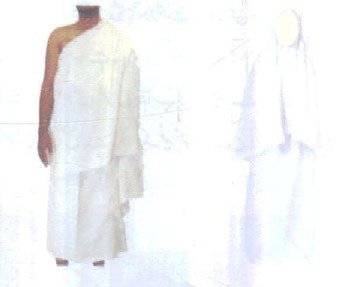
Prohibited Things in the State of Ihram
➊ The muhrim may not wear a shirt, jubba, shalwar, turban, cap, socks, stockings or waistcoat.
➋ Applying perfume after putting on ihram is prohibited.
➌ Using gloves is not permissible.
➍ Contracting marriage or engagement is also prohibited.
➎ Every kind of quarrel, sexual talk with one’s wife, or kissing and embracing are also not permissible, as stated in verse 197 of Surah al-Baqarah 197. Within the sacred precincts of the Haram, hunting game and cutting trees or grass is prohibited, whether one is in ihram or not, except that one may cut idhkhir grass.
➏ Using the special Arabic niqab (which is tied over the face) is prohibited for women (while covering from non-mahram men is necessary).
, Full details in this article

Du’a for Boarding an Aircraft
بِسْمِ اللَّـهِ مَجْرَاهَا وَمُرْسَاهَا ۚ إِنَّ رَبِّي لَغَفُورٌ رَّحِيمٌ
“By the name of Allah is its sailing and its anchoring; indeed my Lord is All-Forgiving, Most Merciful.”
Miqat
The Messenger of Allah ﷺ designated five miqats for people of different countries and for those who come from those countries:
➊ Dhul-Hulayfah:
This is the miqat for the people of Madinah, and also for those who wish to enter Makkah Mukarramah by that route. This place is about nine kilometres from Madinah Munawwarah on the way to Makkah Mukarramah. This miqat is the farthest from Makkah compared with all the other miqats. Today it is called “Bi’r ‘Ali” and the Masjid al-Miqat, and the place where it is located is called “Wadi al-‘Aqiq”.
➋ Rabigh:
This is the miqat for the people of Sham, Egypt and the Maghrib region.
➌ Qarn al-Manazil:
This is the miqat for the people of Najd and for those who pass by that route.
➍ Yalamlam:
It is also called Sa’diyah. It is one of the mountains of Tihamah, rising two thousand feet above sea level, and it is only 54 kilometres from Makkah. It is the nearest miqat to Makkah. It is the miqat for Pakistan, India, China, Yemen, and all those people who pass through it or its line of alignment (i.e., opposite it).
➎ Dhat ‘Irq:
This is the miqat for those coming from Iraq, Iran, and the north-east by way of Baghdad.
Note: Those who first go to Madinah should, on returning to Makkah, put on ihram from Dhul-Hulayfah; and those who first go to Makkah will put on ihram from Yalamlam and recite the talbiyah with the intention of ‘Umrah or Hajj.
Pilgrims should keep checking on their aircraft when their miqat will begin, so that every action may be sunnah and timely.

The Prescribed Talbiyah
About half an hour before reaching Jeddah, when the announcement of the miqat is made, make the intention for ‘Umrah and recite:
اللَّهُمَّ لَبَّيْكَ عُمْرَةً
“O Allah, I am present for ‘Umrah.”
Then continue reciting the talbiyah without interruption until you reach the House of Allah.
لَبَّيْكَ اللَّهُمَّ لَبَّيْكَ ، لَبَّيْكَ لَا شَرِيكَ لَكَ لَبَّيْكَ ، إِنَّ الْحَمْدَ وَالنِّعْمَةَ لَكَ وَالْمُلْكَ ، لَا شَرِيكَ لَكَ
“O Allah, I am present, I am present, I am present. You have no partner, I am present. Indeed all praise, thanks and blessings are Yours, and so is the sovereignty. You have no partner.”
Du’a for Ascents and Descents
During travel, when you come to a high place, say “Allahu Akbar”, and when you go down into a low place, say “Subhan Allah”.

Du’a on Reaching Jeddah
When you stop during your journey, or when you settle in your hotel, on arrival recite this du’a:
اعوذ بكلمات الله التامات من شر ما خلق
“I seek refuge in the perfect words of Allah from the evil of what He has created.”
Note: Performing ghusl before entering Makkah is sunnah; if possible, perform ghusl before reaching Makkah.
Du’a for Entering al-Masjid al-Haram
There is no specific du’a for entering al-Masjid al-Haram. Recite the same du’a that is recited when entering any mosque, which is:
الله افتح لي أبواب رحمتك
“O Allah, open for me the doors of Your mercy.”
Every Du’a of One Who Performs Hajj or ‘Umrah Is Accepted
It is well known among the common people that whatever du’a is made at the first sight of the Ka’bah will be accepted; but this is not correct. Rather, every du’a asked for in the House of Allah, Baitullah, is accepted. The Messenger of Allah ﷺ said:
الغازي فى سبيل الله والحاج والمعتمروفد الله دعاهم فاجابوه وسالوه فاعطاهم
“The one who strives in the way of Allah, the pilgrim, and the one who performs ‘Umrah are the guests of Allah. Allah called them and they responded to the call; then they asked Allah, and He gave them.”
Sunnah Tawaf
Allah Almighty says:
ثُمَّ لۡیَقۡضُوۡا تَفَثَہُمۡ وَ لۡیُوۡفُوۡا نُذُوۡرَہُمۡ وَ لۡیَطَّوَّفُوۡا بِالۡبَیۡتِ الۡعَتِیۡقِ
“Then let them remove their dirt, fulfil their vows, and circumambulate the ancient House.”
The Messenger of Allah ﷺ said: “Whoever performs tawaf of the House of Allah and then prays two rak’ahs will receive the reward of freeing a slave.”
In the first tawaf, keep your right shoulder bared; at the end of the tawaf, cover the shoulder. The tawaf begins by kissing the Black Stone, or touching it, or, if that is not possible, by merely gesturing towards it with the hand; the reward for all of these is equal. Seven circuits are performed, and each circuit begins at the Black Stone and ends there. Furthermore, pushing and shoving to kiss the Black Stone is haram.

Supplication to be recited near the Black Stone in each circuit
بسم الله الله اكبر
“In the name of Allah, the Greatest.”
The Messenger of Allah ﷺ said: “The Black Stone is a stone from Paradise. It was white at first, but the sins of people have made it black. Whoever kisses it, on the Day of Resurrection this stone will testify for him that he had faith.”
Furthermore, in the first three circuits perform ramal (a slightly quickened gait), and walk at a normal pace in the other four circuits. Also, women do not perform ramal.

Touching the Yemeni Corner (istilam)
The Prophet ﷺ said:
“Touching the Yemeni Corner and the Black Stone causes sins to fall away.”
In every circuit of the tawaf, touch the Yemeni Corner with the hand if possible, but do not kiss it. If it is crowded, gesturing towards it, or gesturing and then kissing the hand, is not sunnah. Then, between the Yemeni Corner and the Black Stone, frequently recite this supplication:
ربنا آتنا فى الدنيا حسنة وفي الآخرة حسنة، وقنا عذاب النار
“Our Lord, grant us good in this world and good in the Hereafter, and protect us from the punishment of the Fire.”

Some Issues Concerning Tawaf
➊ While circumambulating the House of Allah, any authentic supplications may be recited, but during the tawaf one should engage in the remembrance of Allah: tasbih, tahmid, takbir, tahlil, sending blessings upon the Prophet, and recitation of the Qur’an. However, a specific supplication for each circuit of the tawaf is not established from the Sunnah.
➋ Wheelchairs (cycle-rickshaws) are available in the Haram; a patient or disabled person may perform tawaf while seated in one.
➌ Wudu is necessary for tawaf. The Prophet ﷺ said: “Tawaf is like prayer.”
Since tawaf is like prayer, if wudu is broken during the tawaf, one should perform wudu again.
➍ If a legitimate excuse arises during the tawaf, or the prayer time comes, then resume from the point where you stopped.
➎ Women in menstruation should not perform tawaf of the House of Allah.
➏ Every circuit of the tawaf should go around the outside of the Hateem.
➐ If doubt arises regarding the count of the circuits, then take the lesser number as the basis and continue from there.
➑ On completion of the tawaf, cover the shoulder.
Maqam Ibrahim
After the tawaf, come to the Maqam Ibrahim and recite
وَاتَّخِذُوا مِنْ مَقَامِ إِبْرَاهِيمَ مُصَلًّى
and pray two rak’ahs. If no place is found near the Maqam Ibrahim, pray two rak’ahs wherever a place is found in the Masjid al-Haram.
Remember that there is no prohibited time in the Haram, meaning prayer can be performed there at any time.
Recitation in the Two Rak’ahs at Maqam Ibrahim after the Tawaf:
In the first rak’ah, after Surah al-Fatihah, it is sunnah to recite Surah “al-Kafirun”, and in the second rak’ah, after Surah al-Fatihah, to recite Surah al-Ikhlas.

Drinking Zamzam Water
After praying the two rak’ahs of tawaf, it is sunnah to drink plenty of Zamzam water and to pour it over the head.
Zamzam coolers are placed throughout the Haram, and you may drink water from any of them.
When drinking Zamzam water, one may make any supplication that is desired and intended; no specific supplication from the Prophet ﷺ has been transmitted for this. However, the Prophet ﷺ said: “Whatever (good) purpose Zamzam water is drunk for, it is fulfilled.”
Repeated istilam of the Black Stone
Before the sa’i, touch the Black Stone again.

Sa’i between Safa and Marwah
Performing seven circuits between Safa and Marwah is called sa’i. The Messenger of Allah ﷺ said:
كتب عليكم السعي فاسعو
“Sa’i has been prescribed for you, so perform sa’i.”
While ascending Safa, recite the following words:
ان الصفا والمروة من شعائرالله، ابدا بما بدا الله به
“Safa and Marwah are among the signs of Allah. I begin with the one with which Allah began.”
Then, turning towards the House of Allah, raise both hands and say “Allahu Akbar” three times, and then recite this supplication:
لا اله الا الله وحده لا شريك له له الملك وله الحمد وهو على كل شئي قدير،لا اله الا الله وحده انجز وعده ونصر عبده وهزم الاحزاب وحده
“There is no deity except Allah alone; He has no partner. Sovereignty belongs to Him, praise belongs to Him, and He is over all things capable. There is no deity except Allah alone; He fulfilled His promise, supported His servant, and alone defeated the confederate factions.”
Note: While standing on Safa, raise your hands and make further supplications.
From Safa to Marwah
While going from Safa to Marwa, walk along the right-hand path. Between the green markers (tubes) on the path from Safa and Marwa, men should jog lightly; it is not necessary for women.
حدثنا أبو بكر قال: ثنا ابن فضيل عن ليث عن مجاهد عن عائشة أنها سئلت على النساء رمل، فقالت: أليس (لكن) (١) بنا (أسوة) (٢)، ليس (عليكن) (٣) رمل بالبيت ولا بين الصفا والمروة (٤).
Hazrat Aisha (may Allah be pleased with her) was asked whether women should perform ramal during tawaf. She said: “Is the way of us not a good example for you?” There is no ramal for you during tawaf or during the sa’i between Safa and Marwa.
حدثنا أبو بكر قال: ثنا أبو معاوية عن عبيد الله عن نافع عن ابن عمر قال: ليس على النساء رمل (بالبيت) ولا بين الصفا والمروة
Hazrat Ibn Umar (may Allah be pleased with them both) said: There is no ramal for women during tawaf or during the sa’i between Safa and Marwa.
حدثنا أبو بكر قال: ثنا وكيع عن ابن أبي ليلى عن عطاء عن ابن عباس قال: ليس على النساء رمل
Hazrat Ibn Abbas (may Allah be pleased with them both) said: There is no ramal for women.
حدثنا أبو بكر قال: ثنا عبدة عن عبد الملك عن عطاء قال: ليس على النساء رمل (بالبيت) (١) ولا بين الصفا والمروة
Hazrat Ata said: There is no ramal for women during tawaf or during the sa’i between Safa and Marwa.
حدثنا أبو بكر قال: ثنا أبو أسامة عن هشام عن الحسن وعطاء (قالا) (١): ليس على النساء رمل ولا بين الصفا والمروة.
Hazrat Hasan and Hazrat Ata said: There is no ramal for women during tawaf or during sa’i.
Du’a to recite during sa’i
After this, descend from Safa and proceed towards Marwa, and while walking recite this du’a:
رب اغفر وارحم وأنت الأعز الأكرم
“O my Lord! Forgive me, have mercy on me, and You are the Mighty, the Most Honourable.”
Note: Dhikr and du’as should be recited during sa’i, because the Messenger of Allah ﷺ said:
“The sa’i between Safa and Marwa was instituted to establish the remembrance of Allah.”
Upon reaching Marwa
Upon reaching Marwa, make the same supplications that were made at Safa, and then return to Safa in the same manner.

Some rulings on Safa and Marwa
➊ Going from Safa to Marwa counts as one circuit, and going from Marwa to Safa counts as the second circuit; in this way, the last and seventh circuit ends at Marwa.
➋ Wudu is not a condition for sa’i, but performing sa’i with wudu is better.
➌ For a valid reason, sa’i may be performed on a vehicle (wheelchair), just as tawaf may.
➍ If sa’i is delayed after tawaf due to a valid reason, there is no harm.
➎ If one doubts the number of circuits in sa’i, the basis is certainty.
➏ Keep the shoulder covered during sa’i.
➐ During sa’i, the elderly, sick and weak need not jog, and there is no harm in this.
Shaving/Cutting the hair
The last circuit ends at Marwa; then, shaving the head or having the hair cut is permissible, though shaving is better. Women should cut a little of their own hair; for them, shaving (halq) is not permissible.
Thus the Umrah is complete.

Du’a for leaving Masjid al-Haram
اللهم اني اسئلك من فضلك
“O Allah! I ask You for Your bounty.”
Upon returning to your home or hotel, remove the ihram
Wear ordinary clothing, pray every prayer in congregation in the Haram, perform as much tawaf as you wish, engage in dhikr and supplication, and ask Allah for the good of this world and the Hereafter for yourself, your family and your friends and companions.
Visiting the sacred places
Apart from the prayer times in Makkah Mukarramah, spend some time visiting the sacred places, for example:
➊ Visit the various mosques of Makkah Mukarramah.
➋ Visit Arafat, Muzdalifah, Mina and so on.
➌ Visit Jabal al-Rahmah and the Jamarat.
Departure for Madinah Munawwarah
After staying a few days in Makkah Mukarramah, set out to visit the sacred places of Madinah Munawwarah and the Prophet’s Mosque.
Du’a upon entering the Prophet’s Mosque
When entering the Prophet’s Mosque, first put the right foot in and recite this du’a:
اللهم افتح لي أبواب رحمتك
“In the name of Allah I enter, and peace be upon the Messenger of Allah ﷺ. O Allah! Open for me the doors of Your mercy.”
Du’a upon leaving the Prophet’s Mosque:
When leaving the Prophet’s Mosque, the left foot should be put out first and this du’a recited:
اللهم اني أسئلك من فضلك
“In the name of Allah I leave, and blessings and peace be upon you ﷺ. O Allah, I ask You for Your bounty.”
The virtue of prayer in the Prophet’s Mosque
The places to which the Shariah has permitted travelling from afar for nearness to Allah and obtaining reward are only three. The Prophet ﷺ said:
لا تشهد الرحال الا الیٰ ثلاثة مساجد : المسجد الحرام، ومسجدالاقصي ومسجدي
“Travel should be undertaken only to three mosques: Masjid al-Haram (the House of Allah), Masjid al-Aqsa (Bayt al-Maqdis), and the Prophet’s Mosque.”
➊ One prayer in the Sacred House (Bayt Allah) is better than one hundred thousand prayers in other mosques.
➋ The reward of one prayer in the Prophet’s Mosque is multiplied a thousand times.
➌ The reward of one prayer in Masjid al-Aqsa equals five hundred prayers.
The Prophet ﷺ said:
ما بين بيتي ومنبري روضة من رياض الجنة
“Between my house and my pulpit is a garden from the gardens of Paradise.”

Recite the Durood Ibrahimi at the time of visiting the grave of the Messenger ﷺ:
اللهم صل على محمد وعلى آل محمد كما صليت على إبراهيم وعلى آل إبراهيم إنك حميد مجيد، اللهم بارك على محمد وعلى آل محمد كما باركت على إبراهيم وعلى آل إبراهيم إنك حميد مجيد
“O Allah, send Your blessings (salawat) upon Muhammad ﷺ and the family of Muhammad, as You sent blessings upon Ibrahim (peace be upon him) and the family of Ibrahim. Indeed You are Praiseworthy and Glorious. O Allah, send blessings upon Muhammad ﷺ and the family of Muhammad, as You blessed Ibrahim (peace be upon him) and the family of Ibrahim. Indeed You are Praiseworthy and Glorious.”
And recite this supplication:
السلام عليك ايها النبى ورحمة الله وبركاته
“O Prophet ﷺ, may peace, the mercy of Allah and His blessings be upon you.”
Visiting Baqi’ al-Gharqad
In Jannat al-Baqi’, recite this supplication:
السلام عليكم اهل الديار من المومنين ولمسلمين وانا ان شاء الله بكم لا حقون اسال الله لنا ولكم العافية
“O believing and Muslim people of the graves, peace be upon you. We too, if Allah wills, will be joining you. We ask Allah for well-being for us and for you (which we both are in need of).”
And recite this supplication:
اللهم اغفر لاهل البقيع الغرقد
“O Allah, forgive the people of Baqi’ al-Gharqad.”

Visiting the Other Sacred Places
Visit the other sacred places of Madinah Munawwarah.
For example, Masjid Quba’: praying two rak’ahs in it earns the reward of an Umrah.


Return to Makkah Mukarramah
On the return from Madinah Munawwarah, the vehicle stops at the place of Dhul-Hulayfah, which is about six to seven miles from Madinah. This is the Miqat, and it is also called Bir Ali. Here, perform ghusl and wudu, put on the ihram, and, reciting the Talbiyah, come to Makkah Mukarramah and perform Umrah.

Farewell Tawaf
The last act related to Hajj and Umrah is the Tawaf al-Wada’; it is, as it were, your farewell meeting with the House of Allah. It has been made obligatory for the one performing Hajj and Umrah.
For this Tawaf, there is no need for ihram. Nor is there any need for ramal and idtiba’ (uncovering the shoulder). Nor is there any need for Sa’i between Safa and Marwah with it.
Some Recommended Supplications
Those going for Hajj and Umrah must keep themselves engaged in supplication at all times, whether they are in Tawaf, in Sa’i, after the prayers, or in Mina, Muzdalifah or Arafat; make supplication your practice everywhere. A few recommended supplications are these.
➊ رَبَّنَا آتِنَا مِن لَّدُنكَ رَحْمَةً وَهَيِّئْ لَنَا مِنْ أَمْرِنَا رَشَدًا
“Our Lord, grant us mercy from Yourself and prepare for us right guidance in our affair.”
➋ رَبَّنَا آمَنَّا فَاغْفِرْ لَنَا وَارْحَمْنَا وَأَنتَ خَيْرُ الرَّاحِمِينَ
“Our Lord, we have believed, so forgive us and have mercy upon us, and You are the best of the merciful.”
➌ رَبَّنَا اصْرِفْ عَنَّا عَذَابَ جَهَنَّمَ ۖ إِنَّ عَذَابَهَا كَانَ غَرَامًا إِنَّهَا سَاءَتْ مُسْتَقَرًّا وَمُقَامًا
“Our Lord, avert from us the punishment of Hell; indeed its punishment is ever adhering. Indeed it is evil as a settlement and residence.”
➍ رَبَّنَا هَبْ لَنَا مِنْ أَزْوَاجِنَا وَذُرِّيَّاتِنَا قُرَّةَ أَعْيُنٍ وَاجْعَلْنَا لِلْمُتَّقِينَ إِمَامًا
“Our Lord, grant us from our spouses and offspring comfort to our eyes, and make us an example for the righteous.”
➎ رَبَّنَا لَا تُزِغْ قُلُوبَنَا بَعْدَ إِذْ هَدَيْتَنَا وَهَبْ لَنَا مِن لَّدُنكَ رَحْمَةً ۚ إِنَّكَ أَنتَ الْوَهَّابُ
“Our Lord, do not let our hearts deviate after You have guided us, and grant us from Yourself mercy. Indeed, You are the Bestower.”
➏ رَبَّنَا لَا تُؤَاخِذْنَا إِن نَّسِينَا أَوْ أَخْطَأْنَا ۚ رَبَّنَا وَلَا تَحْمِلْ عَلَيْنَا إِصْرًا كَمَا حَمَلْتَهُ عَلَى الَّذِينَ مِن قَبْلِنَا ۚ رَبَّنَا وَلَا تُحَمِّلْنَا مَا لَا طَاقَةَ لَنَا بِهِ ۖ وَاعْفُ عَنَّا وَاغْفِرْ لَنَا وَارْحَمْنَا ۚ أَنتَ مَوْلَانَا فَانصُرْنَا عَلَى الْقَوْمِ الْكَافِرِينَ
“Our Lord, do not impose blame upon us if we forget or make errors. Our Lord, and do not place upon us a burden like that which You placed upon those before us. Our Lord, and do not burden us with that which we have no ability to bear. And pardon us, forgive us, and have mercy upon us. You are our Protector, so give us victory over the disbelieving people.”
➐ اللهم إني أعوذ بك من الهم والحزن، والعجز والكسل، والجبن والبخل، وضلع الدين، وغلبة الرجال
“O Allah, we seek refuge in You from worry and grief, from incapacity and laziness, from cowardice and miserliness, from the burden of debt and from being overpowered by men.”
➑ اللهم إنا اعوذ بك من زوال نعمتك وتحول عافيتك وفجاءة نقمتك وجميع سخطك
“O Allah, we seek refuge in You from the decline of Your blessing, from the reversal of Your well-being, from the sudden arrival of Your punishment, and from all Your displeasure.”
➒ اللهم اني اسئلك العفو والعافية والمعافاة فى الدنيا والاخرة
“O Allah, I ask You for pardon, well-being and protection from every affliction, in this world and in the Hereafter.”
➓ اللهم احسن عاقبتنا فى الامور كلها واجرنا من خزي الدنيا وعذاب الاخرة
“O Allah, make the end of our affairs good in all matters, and protect us from the disgrace of this world and the punishment of the Hereafter.”
The Messenger of Allah ﷺ said: “Whoever makes this supplication will die before falling into any great calamity.”
⓫ اللهم اكفني بحلالك عن حرامك، واغنني بفضلك عمن سواك
“O Allah, suffice me with Your lawful against Your unlawful, and enrich me by Your bounty above all others besides You.”
⓬ اللهم رحمتك ارجو، فلا تكلني إلى نفسي طرفة عين، واصلح لي شاني كله، لا إله إلا انت
“O Allah, I hope for Your mercy, so do not entrust me to myself even for the blink of an eye, set right all my affairs for me. There is no deity worthy of worship except You.”
Shaykh al-Albani (may Allah have mercy on him) and Abd al-Qadir al-Arna’ut declared it sahih.
