
Question:
Write the principle for determining the original problem?
Answer:
Original problem: The smallest number from which the obligatory shares can be extracted without fractions. It is called أصل المسألة or رأس المسألة or مخرج.
In the Book of Allah, there are six (6) fixed shares which, with reduction and multiplication, consist of the following groups.
(By reduction is meant doubling something, and by multiplication is meant halving something. That is, doubling ثمن will be a quarter, and twice a quarter will be a half. And halving a half will be a quarter, and halving a quarter will be an eighth. Similarly, the entire group will be subject to reduction and multiplication.)
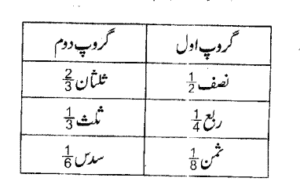
Principles of the Original Problem: Any problem will consist of one of the following seven numbers: 2, 3, 4, 6, 8, 12, 24.
The following five rules are for determining the original problem:
● If there is only one individual from the mentioned parts, the problem will be based on the number corresponding to it, except for the half because its problem is based on 2.
Original problem of half = 2
Original problem of two-thirds = 3
Original problem of quarter = 4
Original problem of one-third = 3
Original problem of one-eighth = 8
Original problem of one-sixth = 6
● If two or three individuals belonging to the same group combine, the problem will be based on the larger number from which the corresponding part, twice the part, and twice twice the part can be derived. For example, if those taking half, quarter, and one-eighth combine, the problem will be based on 8.
● If half of the first group combines with some or all of the second group, the problem will be based on 6. For example, if those taking half, two-thirds, and one-sixth combine, the problem will be based on 6.
● If a quarter of the first group combines with some or all of the second group, the problem will be based on 12. For example, if those taking quarter, two-thirds, and one-sixth combine, the problem will be based on 12.
● If one-eighth of the first group combines with some or all of the second group, the problem will be based on 24. For example, if those taking one-eighth, two-thirds, and one-sixth combine, the problem will be based on 24.
Types of problems:
➊ Adalah: When the specified parts are equal to the original problem, it is called “Adalah Problem”. For example:
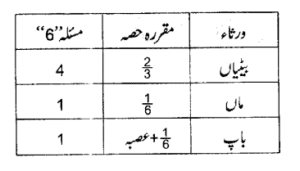
So the original problem is 6 and the sum of the heirs’ shares is also 6.
➋ Aaila (Excess): When the fixed shares exceed the original problem, it is called “Aaila problem.” For example:
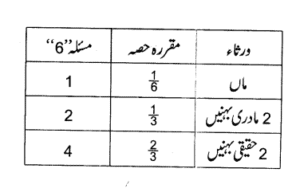
So the original problem is 6 and the sum of the fixed shares is 7.
➌ Radiyah (Deficiency): When the fixed shares are less than the original problem and there is no Asaba, it is called “Radiyah problem.” For example:
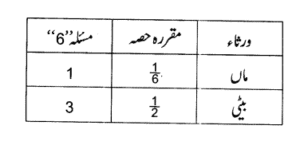
The original problem is 6 and the sum of the heirs’ shares is 4.
Note: There are the following four cases of heirs:
● Heirs are only Ashab al-Faraid (fixed share heirs)
● Ashab al-Faraid along with Asaba
● Only male Asaba
● Both male and female Asaba
The principles for the first and second types will be according to the above rules.
For the third and fourth types, the original problem will be made according to the number of individuals.
However, in the fourth type, the original problem will be made considering a male equal to two females because a male receives a share equal to two females. For example, if the deceased leaves behind a daughter and a son, the problem will be based on 3.