
Radd (Return)
Question:
Explain the literal and technical meanings of Radd and its types?
Answer:
Literal meaning: To return, to give back.
Definition: After the shares of the As’hab al-Fara’id (those entitled to fixed shares) are distributed, the remaining residue is returned to them; this is called “Radd.”
Types of shares in terms of Radd: The shares of As’hab al-Fara’id are of two types in terms of Radd:
① Those to whom Radd is not applied are called “من لا يرد” and they are the husband and wife.
② Those to whom Radd is applied are called “من يرد” and they are the heirs other than the husband and wife.
Combining both results in four cases of Radd, and each case has a separate rule as follows:
① If there is only one gender of “من يرد” in the case and no “من لا يرد” are present, then the case will be based on the number of heads. For example:
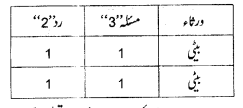
The original problem is “3” and the heirs are two individuals belonging to the same category, so the problem is based on the heads “2”.
② If the problem contains different categories of “من يرد” and there is no “من لا يرد” along with them, then the problem will be based on the total shares. For example:
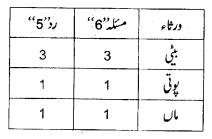
The original problem is “6”, “من يرد” are different categories whose total shares are “5”, therefore the problem is based on this.
③ If the problem contains only one category of “من يرد” and there is also “من لا يرد” along with it, then the problem will be based on the number from which the obligatory share of the spouses can be derived. If the remaining heirs can be fully distributed, it is better; otherwise, the principle of return will be applied. For example:
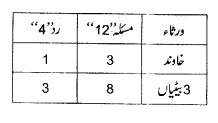
The original problem is “12” and the sum of the heirs’ fixed shares is “11”, so it became a problem of returning. Since the husband’s fixed share could come out of “4”, the problem of returning was made “4”. After the husband’s share, “3” remained, which was fully divided among the daughters.
④ If the genders of “من يرد” in the problem are multiple and “من لا يرد” are also present, then the problem will be based on the number from which the husband’s or wife’s fixed share can be derived. After giving their share, the remainder will be divided among “مَن يُرَدُّ“. If the division is correct, no further action will be necessary. For example:
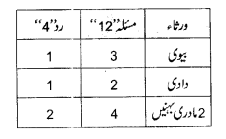
The original problem is “12”. If the wife’s fixed share could be taken out of “4”, then the problem was made “4” and after the wife’s share, the remaining “3” was divided according to the problem of “من يرد“, then the correct division occurred.
If the division is not correct, then a separate problem of “من يرد” individuals should be made, then their original problem should be multiplied by the original problem of “من لا يرد“. The product obtained will be the original for both parties. Then the method to find each party’s share will be that the husband’s or wife’s share is multiplied by the problem of “من يرد“, then their share will come out, and the share of “من يرد” is multiplied by the remainder of the problem of “من لا يرد“, then the share of “من يرد” will come out.
If there is a fraction in any party’s shares, then correction should be made according to the rules of correction. For example:
Problem with “من لا يرد”
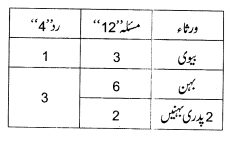
Problem with “من يرد”
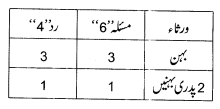
Joint problem
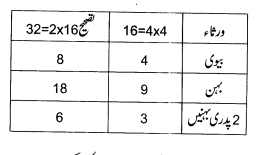
The original problem is “12”. The wife’s hypothetical share could have been taken out of “4”, so the problem of rejection was made “4”. After the wife’s share, the remainder did not divide fully into “من يرد“, so a separate problem was made for them, which became the original problem “6” and rejection “4”. Then multiplying the problem “4” of “من يرد” by the problem “4” of “من لا يرد” gave “16”, which is the share of both parties. Now, multiplying the share of “من لا يرد” by the problem “4” of “من يرد” gave their share as “4”. And multiplying the share “3+1=4” of “من يرد” by the remainder “3” of the problem of “من لا يرد” gave “12”, of which “9” was for the real sister and “3” for the paternal sisters. Then, due to the fraction occurring in the share of the paternal sisters, for correction, the part “2” of Al-Humm was multiplied by “16” to get “32”.