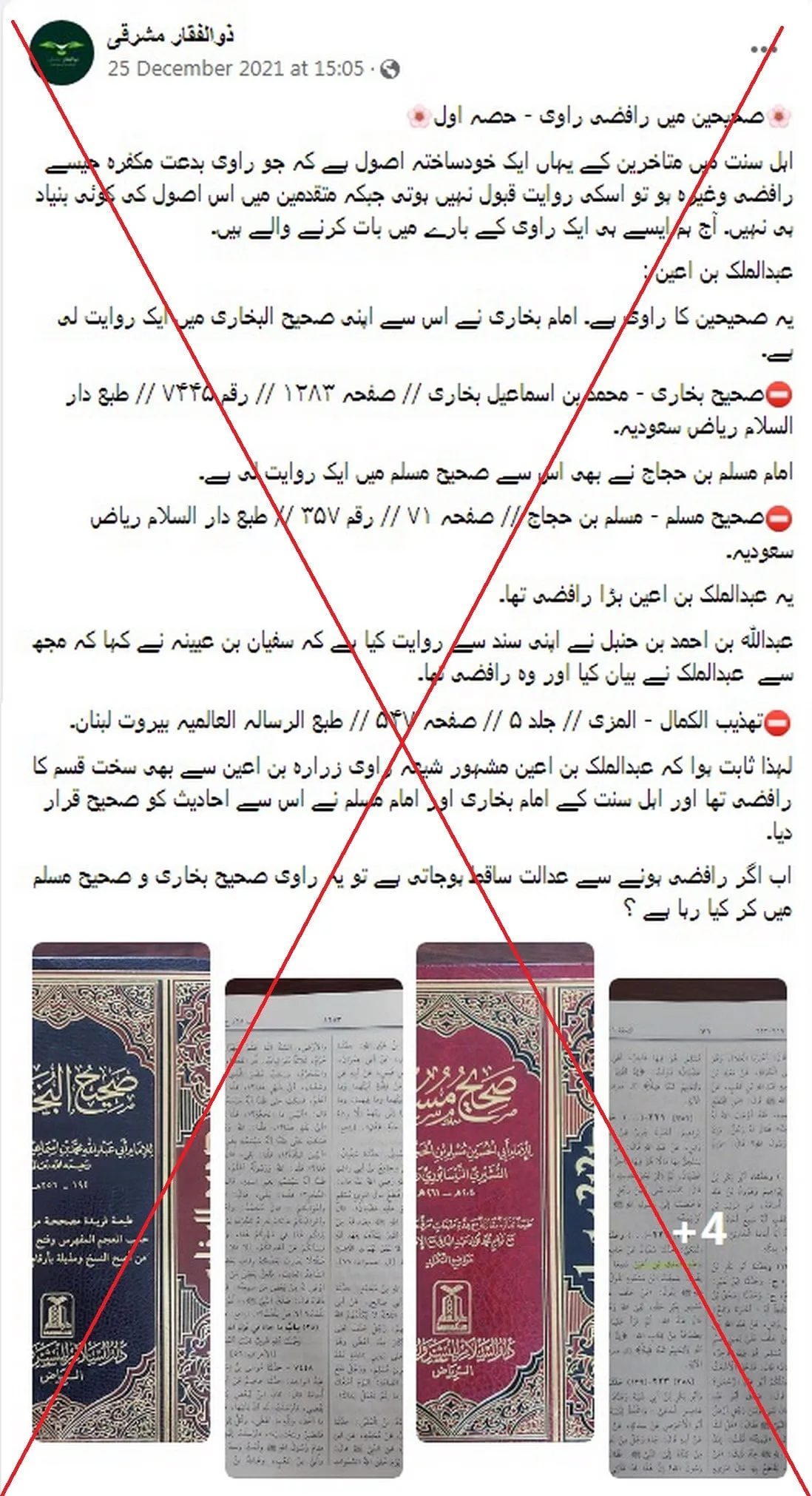
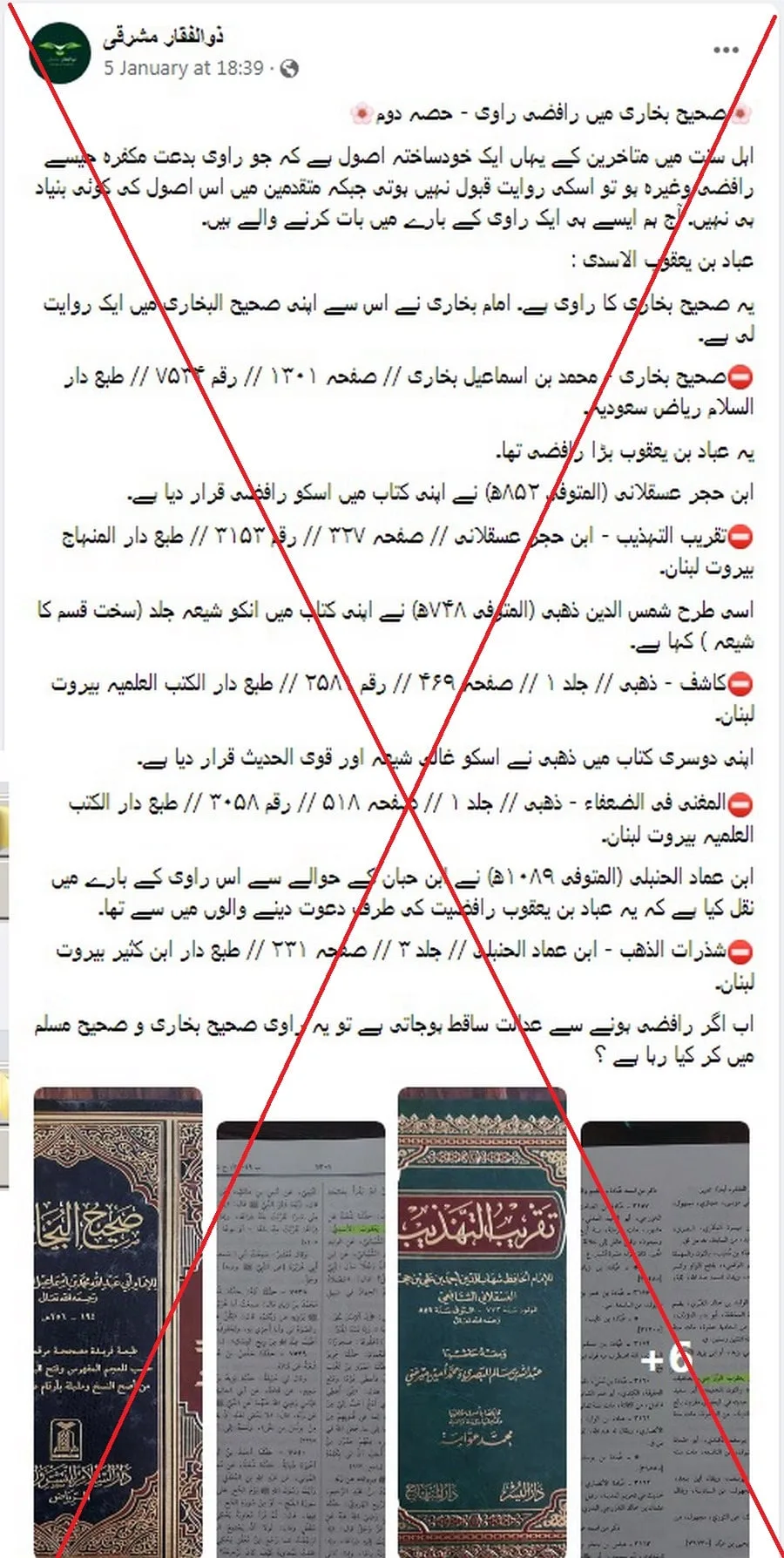
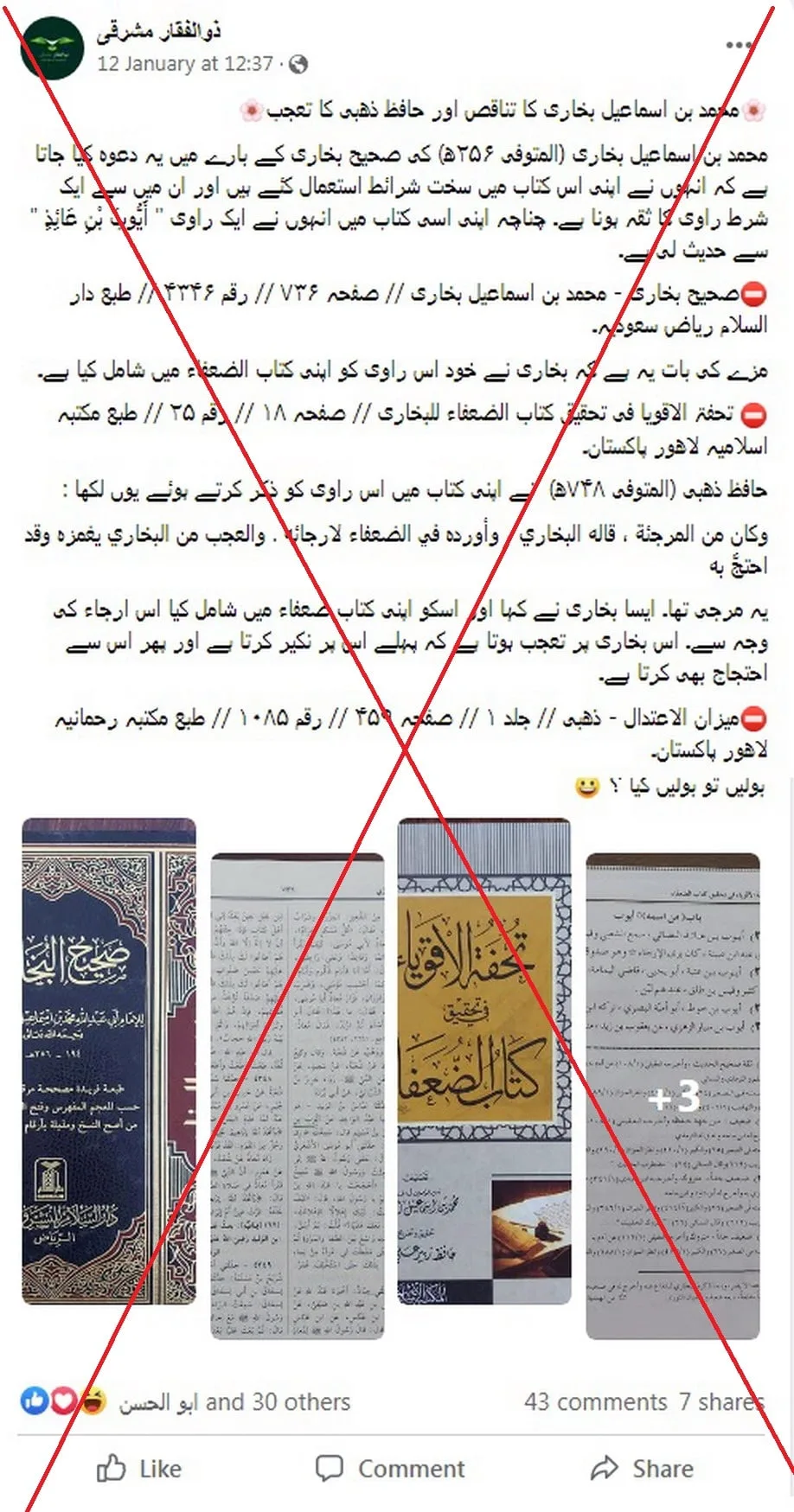
The purpose of this article is to present a scholarly clarification on the objection that Ṣaḥīḥ al-Bukhārī contains narrations from some bidʿatī (innovator) narrators. Certain individuals claim that Imām al-Bukhārī narrated from two Shiʿah/Rāfiḍī narrators (ʿAbd al-Malik ibn Aʿyan and ʿAbbād ibn Yaʿqūb) and one Murjiʾī narrator (Ayyūb ibn ʿĀʾiḍ), and that he used the latter as proof (iḥtijāj) despite listing him in his book al-Ḍuʿafāʾ. Based on this, it is alleged (we seek refuge with Allah) that there is a contradiction in the conditions (shurūṭ) of Ṣaḥīḥ al-Bukhārī.
This article aims to demonstrate:
◈ From the narrators to whom innovation (bidʿah) is attributed, Imām al-Bukhārī (may Allah have mercy on him) generally did not make primary iḥtijāj; rather he narrated from them by way of mutābaʿāt / iqtirān (maqrūnān bi-ghayrih, combined with others).
◈ It is a well-established practice in ḥadīth sciences to include lesser-grade narrators in supporting chains. This does not necessarily invalidate the book’s condition of authenticity.
◈ Hence, this matter is not resolved by emotional slogans, but through technical understanding of terms like iḥtijāj, mutābaʿah, and maqrūnān, supported by explicit statements from the scholars.
✦ Key Terms: What Are “Iḥtijāj” and “Mutābaʿah / Maqrūnān”?
① Iḥtijāj (Principal Proof):
Iḥtijāj means that the muḥaddith brings a narrator’s narration as the principal evidence and makes it the basic chain.
② Mutābaʿah / Maqrūnān bi-ghayrih (Supporting Route):
Mutābaʿah is that after bringing a ḥadīth through a reliable (thiqah/thabt) route, another route is also mentioned in support of the same content; or that a narrator’s narration is brought “joined” to another thiqah narrator (maqrūnān bi-ghayrih), so that it is clear this route is not the original foundation but has a supporting status.
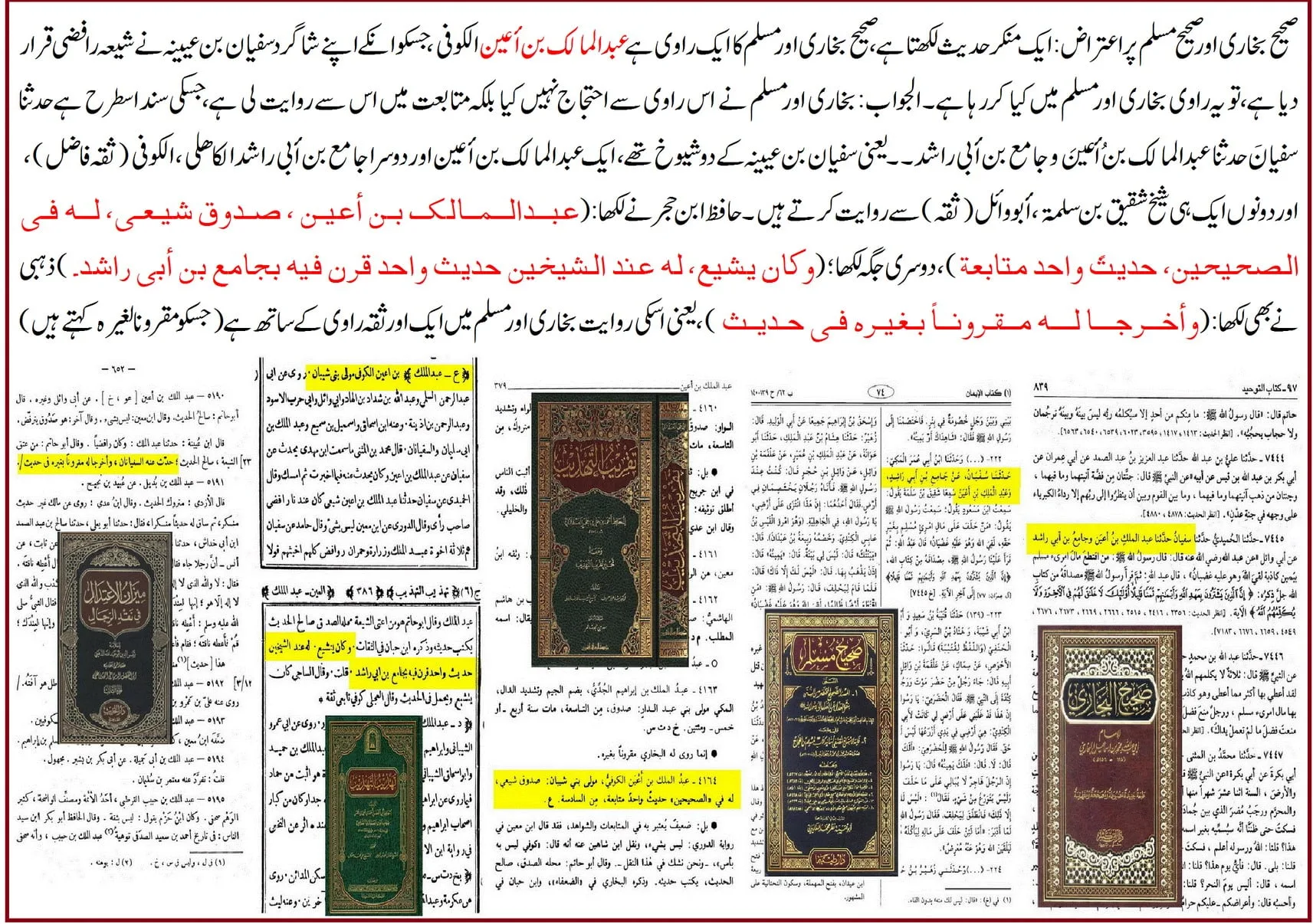
❖ First Objection: Narration from ʿAbd al-Malik ibn Aʿyan
The objector claims that ʿAbd al-Malik ibn Aʿyan was a “Rāfiḍī” and that al-Bukhārī and Muslim narrated from him; hence (he says) this became proof that an innovator’s narration is accepted.
① Ḥāfiẓ Ibn Ḥajar (may Allah have mercy on him): Only “One Ḥadīth” in the Ṣaḥīḥayn, and That Too in “Mutābaʿah”
Arabic:
4164- عبد الملك ابن أعين الكوفي مولى بني شيبان صدوق شيعي له في الصحيحين حديث واحد متابعة من السادسة ع
Translation:
ʿAbd al-Malik ibn Aʿyan al-Kūfī, the mawlā of Banū Shaybān, is ṣadūq (truthful), a Shīʿī, and he has only one ḥadīth in the Ṣaḥīḥayn, which is in mutābaʿah (and he is from the sixth ṭabaqah).
Source: Taqrīb al-Tahdhīb – Ibn Ḥajar
✔ This clearly proves that al-Bukhārī did not use him as a primary source, but only in a supporting role.
② Ibn Ḥajar (may Allah have mercy on him): Coupled with Jāmiʿ ibn Abī Rāshid
Arabic:
… وكان يتشيع له عند الشيخين حديث واحد قرن فيه بجامع بن أبي راشد
Translation:
He had Shīʿī leanings, and with the two Shaykhs (al-Bukhārī and Muslim) he has only one ḥadīth, in which he was mentioned joined (maqrūnān) with Jāmiʿ ibn Abī Rāshid.
Source: Tahdhīb al-Tahdhīb – Ibn Ḥajar
✔ “Qurina fīhi bi-Jāmiʿ ibn Abī Rāshid” means that the narration was brought joined with a thiqah narrator. This itself negates the claim that Imām al-Bukhārī took him as principal evidence.
③ Ḥāfiẓ al-Dhahabī (may Allah have mercy on him): Explicit Statement of “Maqrūnān bi-ghayrih”
Arabic:
5190 – عبد الملك بن أعين … وأخرجا له مقرونا بغيره في حديث
Translation:
ʿAbd al-Malik ibn Aʿyan… both of them (al-Bukhārī and Muslim) narrated from him joined with another in one ḥadīth.
Source: Mīzān al-Iʿtidāl – al-Dhahabī
✔ This too is a clear text that what is intended here is not “iḥtijāj” but iqtirān / mutābaʿah.
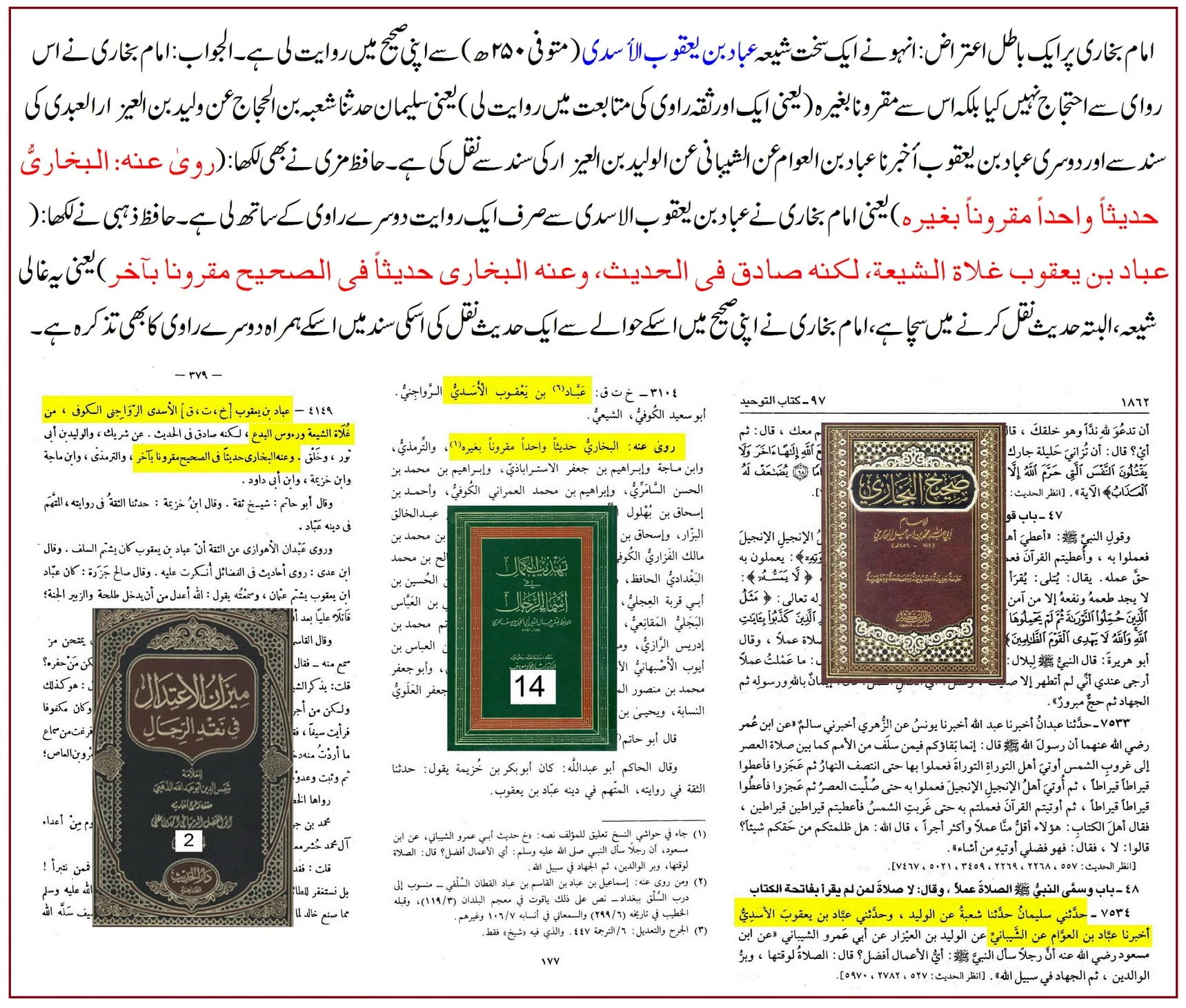
❖ Second Objection: Narration from ʿAbbād ibn Yaʿqūb
The objector says that ʿAbbād ibn Yaʿqūb was an “extremist Shīʿī” (ghālī Shīʿah), yet Imām al-Bukhārī took a ḥadīth from him in Ṣaḥīḥ al-Bukhārī.
① Ṣaḥīḥ al-Bukhārī: The Chain of ʿAbbād ibn Yaʿqūb Came Together with Another Chain
Arabic:
7534- حَدَّثَنِي سُلَيْمَانُ، حَدَّثَنَا شُعْبَةُ، عَنِ الوَلِيدِ بْنِ العَيْزَارِ، ح وَحَدَّثَنِي عَبَّادُ بْنُ يَعْقُوبَ الأَسَدِيُّ، أَخْبَرَنَا عَبَّادُ بْنُ العَوَّامِ، عَنِ الشَّيْبَانِيِّ، عَنِ الوَلِيدِ بْنِ العَيْزَارِ، عَنْ أَبِي عَمْرٍو الشَّيْبَانِيِّ، عَنِ ابْنِ مَسْعُودٍ …
Translation (summary):
Imām al-Bukhārī mentioned this same ḥadīth through two routes:
Narration 1:
Sulaimān → Shuʿbah → al-Walīd ibn al-ʿAyzār …
Narration 2:
ʿAbbād ibn Yaʿqūb → ʿAbbād ibn al-ʿAwwām → al-Shaybānī → al-Walīd ibn al-ʿAyzār …
Then Ibn Masʿūd (may Allah be pleased with him) narrates that a man asked the Prophet ﷺ: “Which deed is best?” He ﷺ said: “Prayer at its time, kindness to parents, then jihad in the path of Allah.”
Source: Ṣaḥīḥ al-Bukhārī, Ḥadīth: 7534
✔ Here al-Bukhārī mentioned the ḥadīth through two independent chains — in one is Shuʿbah (a thiqah imam), and the other is the route of ʿAbbād ibn Yaʿqūb. This style shows that ʿAbbād ibn Yaʿqūb’s route is not the original foundation, but has a supporting status alongside the other, strong route.
② Ḥāfiẓ al-Mizzī (may Allah have mercy on him): Al-Bukhārī Took “One Ḥadīth”, and That Too Maqrūnān
Arabic:
… رَوَى عَنه: البخاري حديثا واحدا مقرونا بغيره
Translation:
Al-Bukhārī narrated only one ḥadīth from him, and that too paired with another.
Source: Tahdhīb al-Kamāl fī Asmāʾ al-Rijāl – al-Ḥāfiẓ al-Mizzī
✔ This explicit statement goes against the objection that al-Bukhārī made unrestricted iḥtijāj with ʿAbbād ibn Yaʿqūb. The reality is that with al-Bukhārī he is maqrūn (joined with another).
③ al-Dhahabī: Despite Innovation, Truthful in Ḥadīth
Arabic:
4149 – عباد بن يعقوب الأسدي … من غلاة الشيعة ورؤوس البدع، لكنه صادق في الحديث. وعنه البخاري حديثاً في الصحيح مقرونا بآخر
Translation:
ʿAbbād ibn Yaʿqūb al-Asadī… was among the extremist Shīʿah and among the heads of innovation, but he was truthful in ḥadīth. And Imām al-Bukhārī narrated one ḥadīth from him in the Ṣaḥīḥ, joined with another.
Source: Mīzān al-Iʿtidāl – al-Dhahabī
✔ Here several points come together: (1) the ruling of innovation on him, (2) yet calling him “ṣādiq fī al-ḥadīth” (truthful in ḥadīth) — and (3) al-Bukhārī bringing him maqrūnān. That is, the methodology of the muḥaddithūn looks at “innovation” and “truthfulness/precision (ṣidq/ḍabṭ)” as separate aspects, and then the form of taking his narration is mutābaʿah / iqtirān.
❖ Third Objection: Ayyūb ibn ʿĀʾiḍ (Irjāʾ) and al-Bukhārī’s Mention of Him in al-Ḍuʿafāʾ
The objector says that al-Bukhārī mentioned Ayyūb ibn ʿĀʾiḍ in al-Ḍuʿafāʾ, then made “iḥtijāj” with him in Ṣaḥīḥ al-Bukhārī, and that al-Dhahabī (may Allah have mercy on him) also expressed “astonishment” at this.
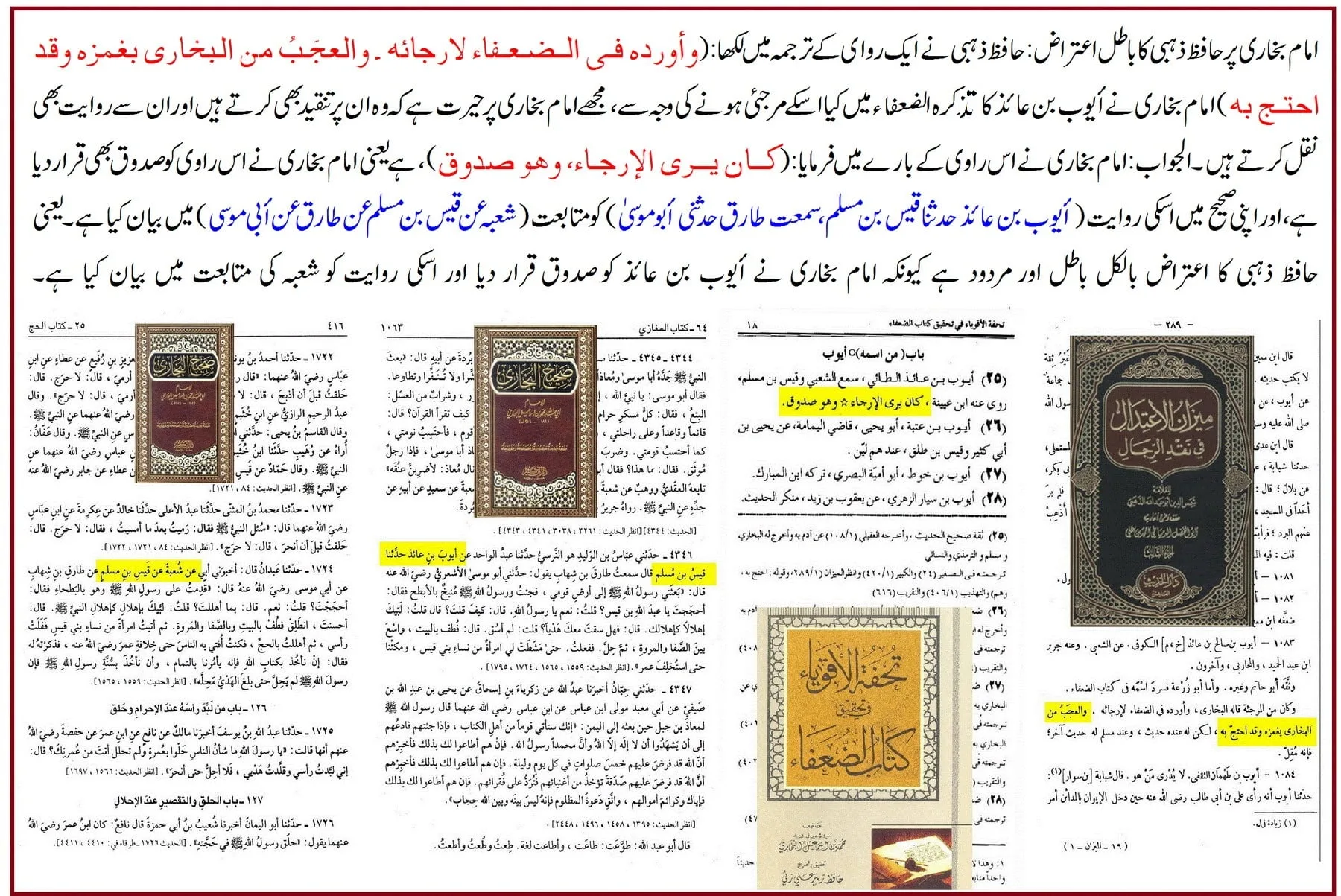
① Two Chains in Bukhārī: One with Shuʿbah, One with Ayyūb
Arabic:
1724- … عَنْ شُعْبَةَ، عَنْ قَيْسِ بْنِ مُسْلِمٍ، عَنْ طَارِقِ بْنِ شِهَابٍ، عَنْ أَبِي مُوسَى …
Chain 1 (summary):
This ḥadīth comes from Abū Mūsā al-Ashʿarī (may Allah be pleased with him) through the route Shuʿbah → Qays ibn Muslim → Ṭāriq ibn Shihāb … (details concerning Hajj / ihlāl).
Ḥadīth: Ṣaḥīḥ al-Bukhārī, Ḥadīth: 1724
Arabic:
4346- … عَنْ أَيُّوبَ بْنِ عَائِذٍ، … عَنْ قَيْسِ بْنِ مُسْلِمٍ، … عَنْ طَارِقِ بْنِ شِهَابٍ، … عَنْ أَبِي مُوسَى …
Chain 2 (summary):
The same incident was also brought through another route: ʿAbbās ibn al-Walīd → ʿAbd al-Wāḥid → Ayyūb ibn ʿĀʾiḍ → Qays ibn Muslim → Ṭāriq ibn Shihāb → Abū Mūsā (may Allah be pleased with him) …
Ḥadīth: Ṣaḥīḥ al-Bukhārī, Ḥadīth: 4346
✔ The main point here is that the route of Shuʿbah (an imam, thiqah, ḥujjah) is already present, and the route of Ayyūb ibn ʿĀʾiḍ comes alongside it as a mutābaʿah. With this style, the claim that al-Bukhārī made him the sole foundation and did “iḥtijāj” with him does not hold.
② Mention in al-Ḍuʿafāʾ and Narrating from Him: Not an Absolute Contradiction
In ḥadīth methodology, including a narrator in al-Ḍuʿafāʾ does not always prohibit narration from him, especially when:
✔ The narration is mutābaʿah or shawāhid
✔ The main chain is strong
✔ The weaker narrator is used only as support
This is why, in the answer you have provided, the narration of Ayyūb ibn ʿĀʾiḍ has been treated as a mutābaʿah of Shuʿbah.
✦ Summary of Findings
From the above examples of ʿAbd al-Malik ibn Aʿyan, ʿAbbād ibn Yaʿqūb, and Ayyūb ibn ʿĀʾiḍ, we conclude:
① From the narrators about whom there is criticism of innovation / irjāʾ etc., Imām al-Bukhārī generally narrated in a limited quantity, and in most places adopted the form of mutābaʿah or maqrūnān.
② The explicit statements of “maqrūnān bi-ghayrih” and “mutābaʿah” exist in the words of the imams themselves (Ibn Ḥajar, al-Dhahabī, al-Mizzī); therefore, saying that al-Bukhārī made unrestricted iḥtijāj with them is not correct.
③ Using weaker narrators in mutābaʿah or shawāhid is a recognized practice according to the principles of the muḥaddithūn; it cannot be made a “necessary” proof against the “condition of authenticity” of Ṣaḥīḥ al-Bukhārī.
❖ Conclusion
That some narrators in Ṣaḥīḥ al-Bukhārī are mentioned with innovation or irjāʾ, and that narrations from them then appear — this subject is understood not through emotional slogans but through ḥadīth terminology and the explicit statements of the imams. In light of the material you provided, the preponderant (rājiḥ) view that emerges is that Imām al-Bukhārī did not rely on these narrators as principal authorities, but used them as supporting routes, which fully aligns with the methodology of the ḥadīth scholars.
❖ Scans of Important References