Scholarly integrity demands that differences in beliefs be viewed in a historical context and their arguments be conveyed honestly. In the present article, we present a research-based and detailed analysis regarding the attribution of Murji’ah to Imam Abu Hanifa, including authentic references from classical and contemporary hadith scholars, jurists, and books on creed.
🔹 The Murji’ah Sect and Imam Abu Hanifa’s Connection
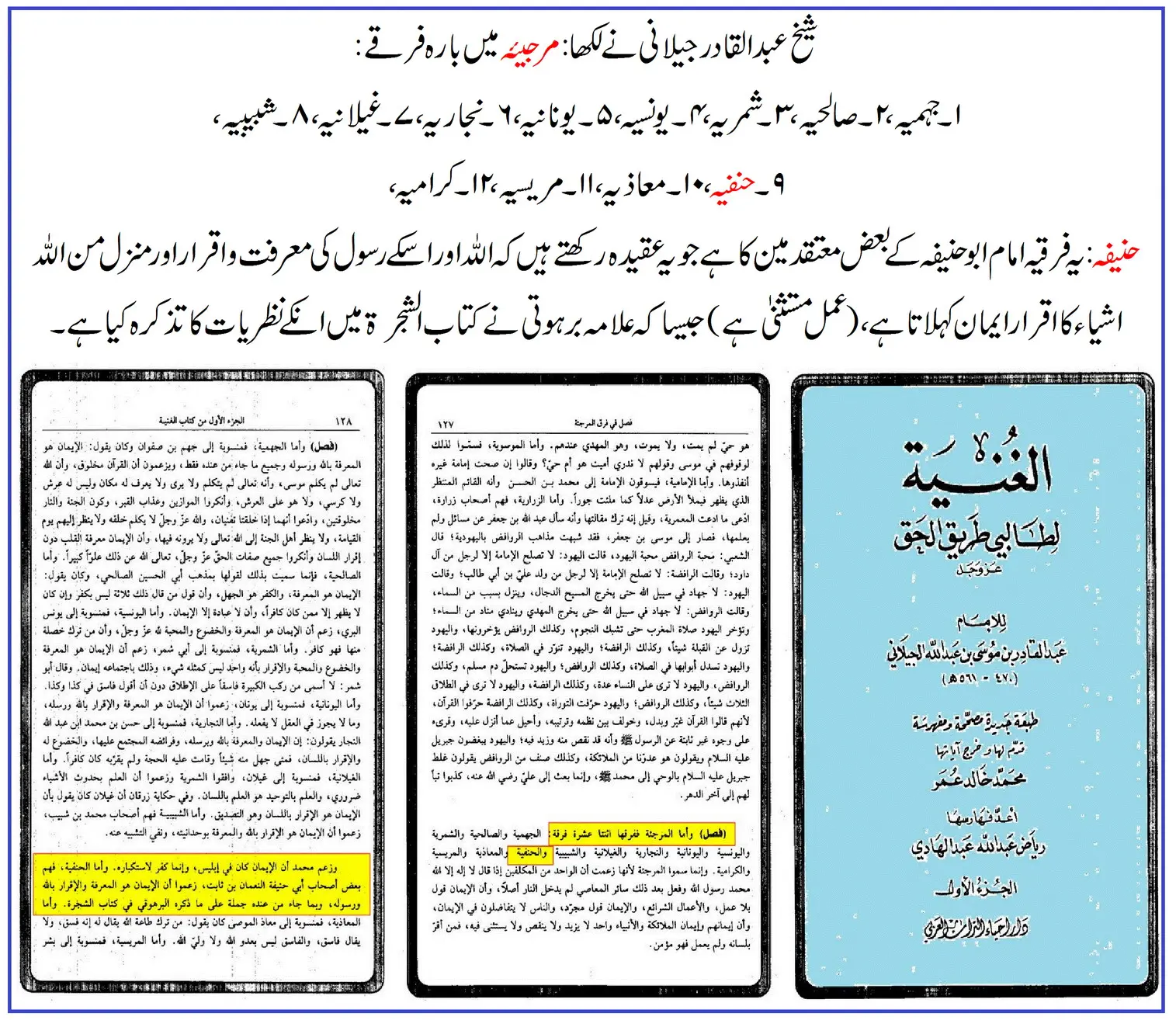
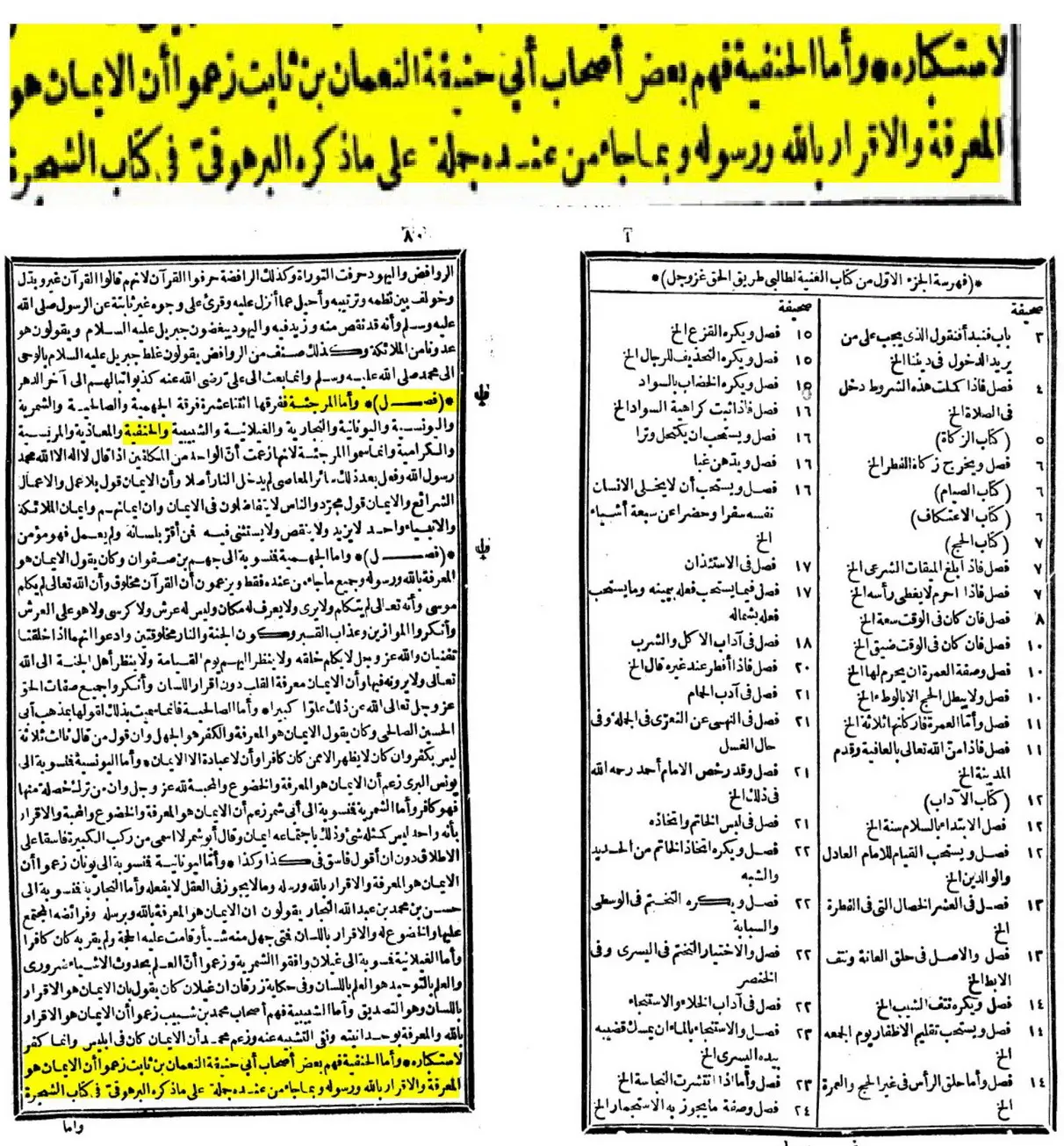
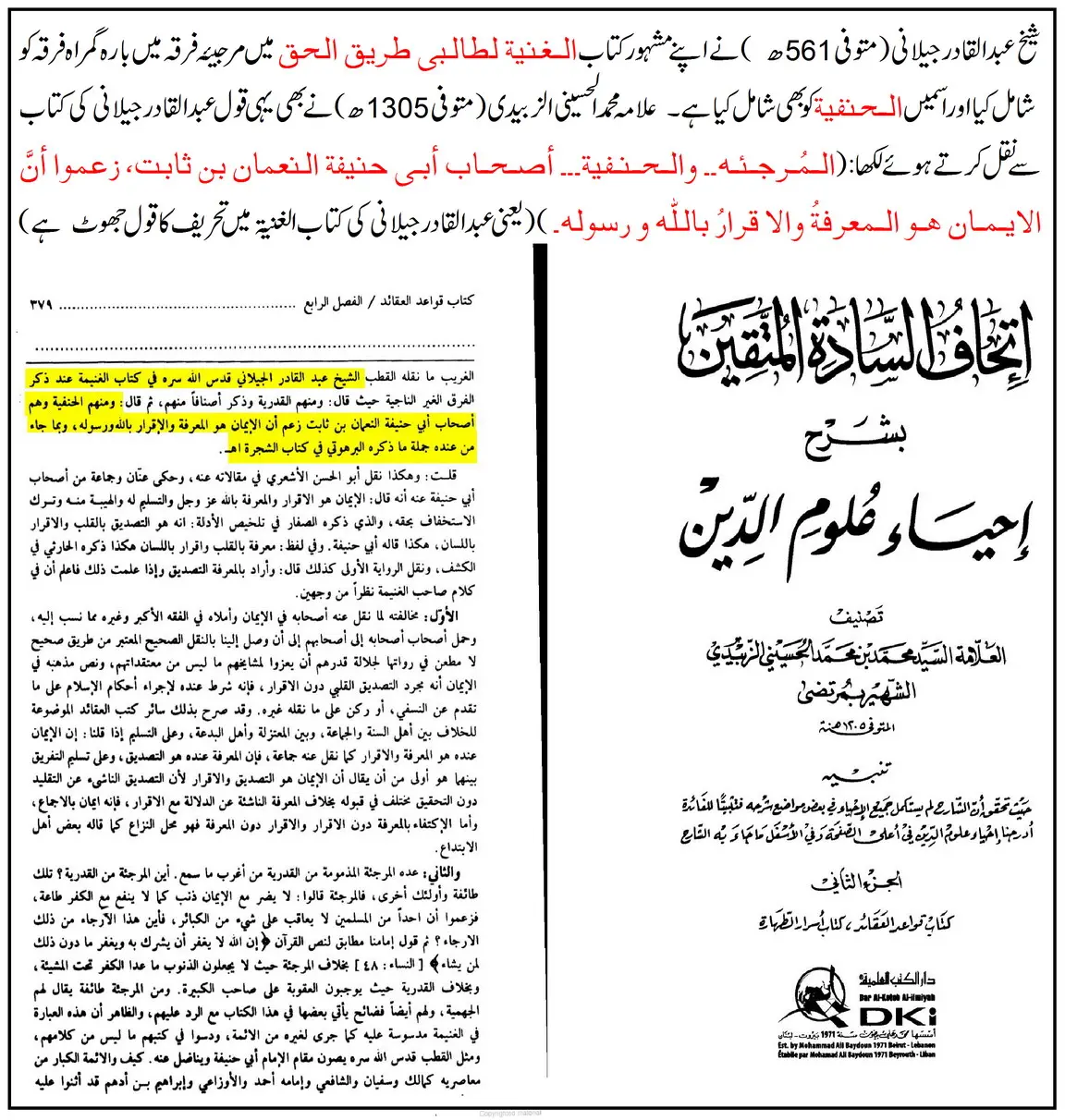
🔴 Sheikh Abdul Qadir Jilani (may Allah have mercy on him), in his famous book
, mentions twelve sects of the Murji’ah and writes:
وأما المرجئة ففرقها اثنتا عشرة فرقة:
الجهمية، الصالحية، الشمرية، اليونسية، اليونانية، النجارية، الغيلانية، الشبيبية، الحنفية، المعاذية، المريسية، الكرامية.
وأما الحنفية: فهم أصحاب أبي حنيفة النعمان بن ثابت، زعم أن الإيمان هو المعرفة والإقرار بالله ورسوله وبما جاء من عنده جملة، على ما ذكره البرهوتي في كتاب الشجرة.
As for the Murji’ah sect, they have twelve (12) sects:
- Jahmiyyah,
- Salihiyyah,
- Shammariyyah,
- Yunusiyyah,
- Yunaniyyah,
- Najariyyah,
- Ghilaniyyah,
- Shabibiyyah,
- Hanafiyyah,
- Mu’adhiyyah,
- Marisiyyah,
- Karamiyyah.
And as for the Hanafiyyah (a sect of the Murji’ah): they are the companions of Abu Hanifa Nu’man ibn Thabit, who hold the view that faith is knowledge (recognition) and the general acknowledgment of Allah, His Messenger, and the religion revealed by Him; as Burhuti stated in his book “Ash-Shajarah.”
📌 Note: This reference is not just the statement of a single individual; other scholars have also quoted the same text in the same manner.
🔹 Confirmation of the excerpt from “Al-Ghaniyah” by other Muhaddithin
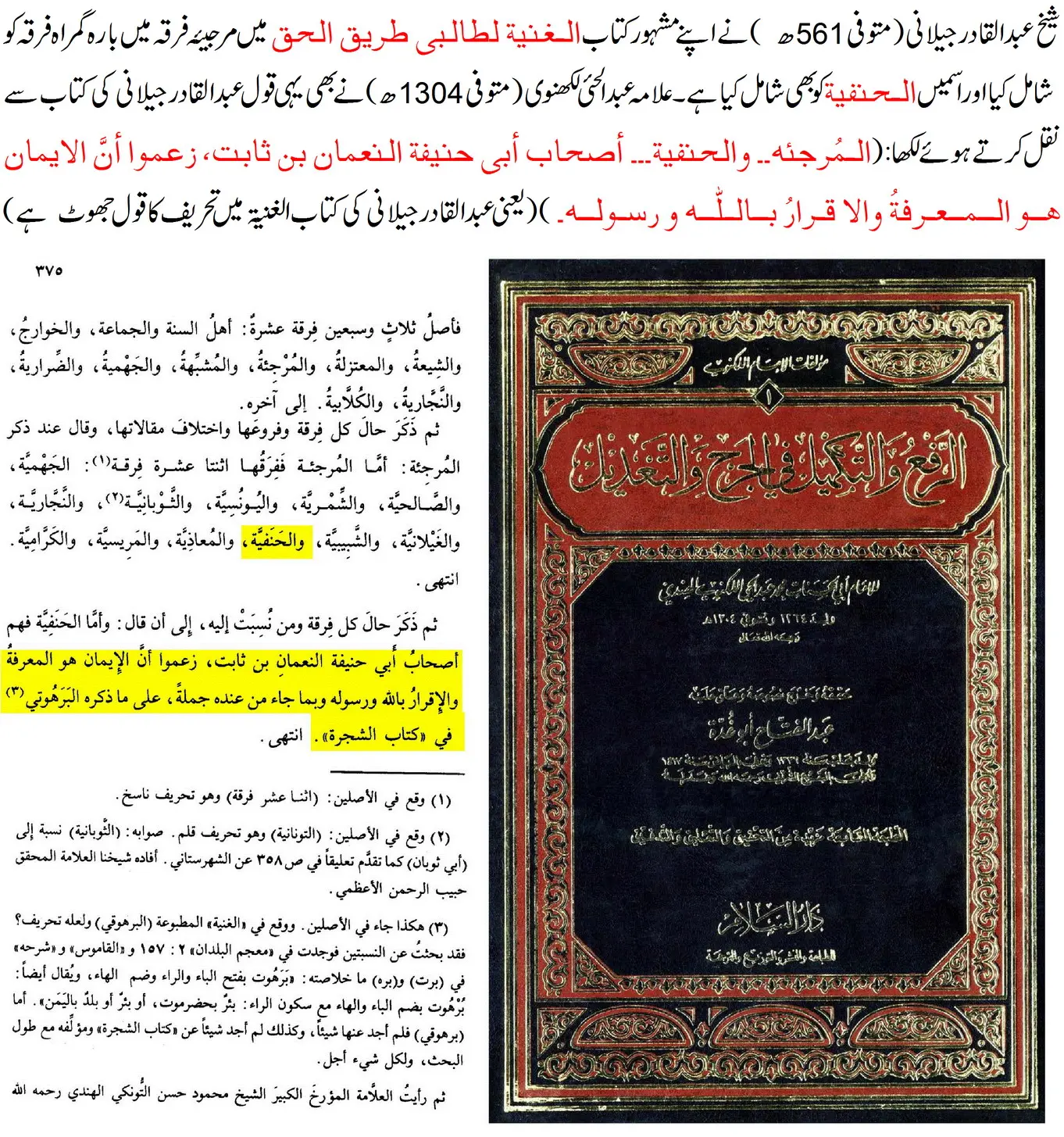
- Abdul Hayy Lakhnawi Hanafi (1304 AH) has quoted this exact text completely in “Al-Raf’ wa Al-Takmil”:
وأما الحنفية فهم أصحاب أبي حنيفة… الخ
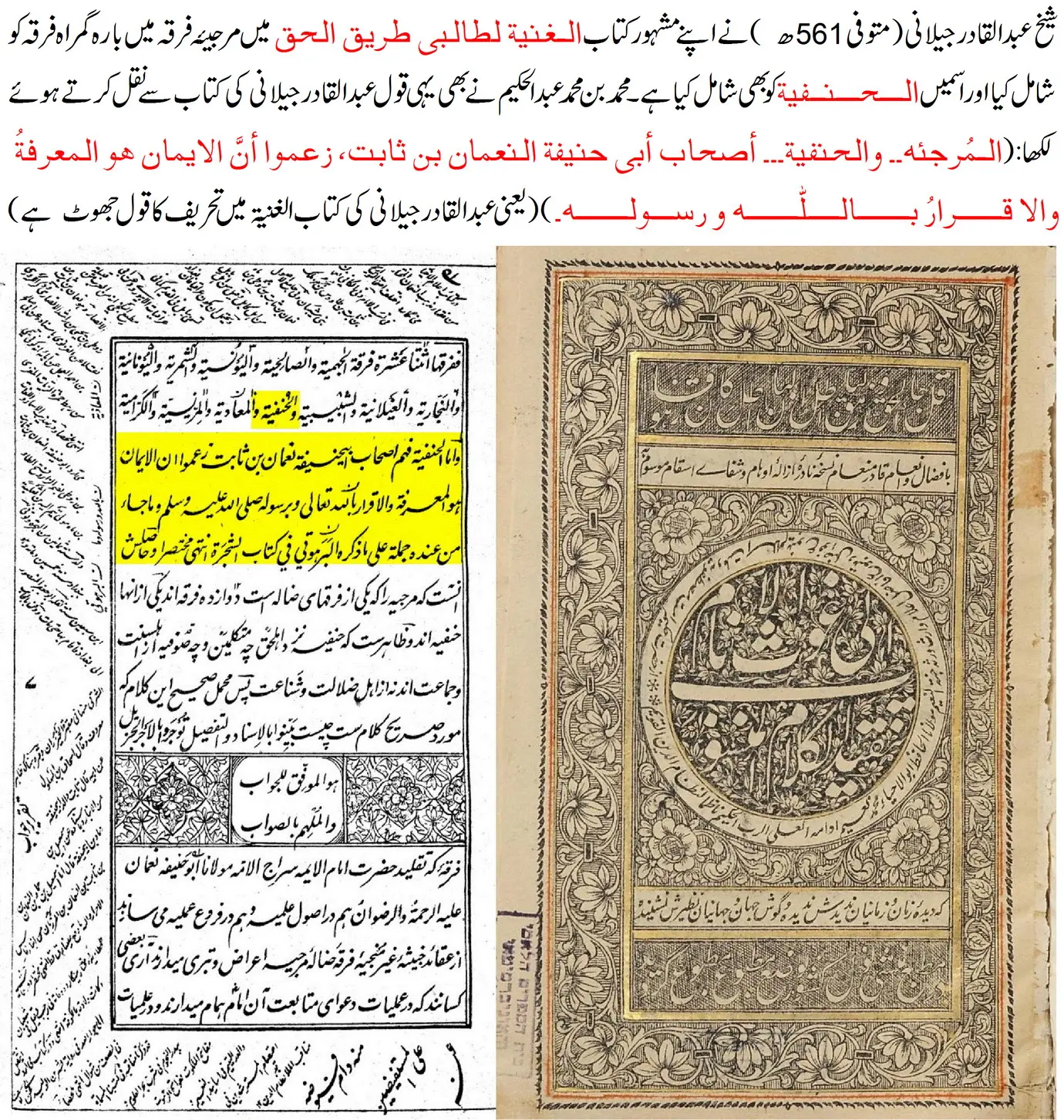
- Muhammad bin Muhammad Abdul Hakim Al-Hanafi and
- Allama Muhammad Al-Husseini Al-Zabidi (1205 AH) have also quoted the same statement from Al-Ghaniyah.
🔹 Clarification in Abu Al-Hasan Al-Ash’ari’s “Maqalat Al-Islamiyyin”
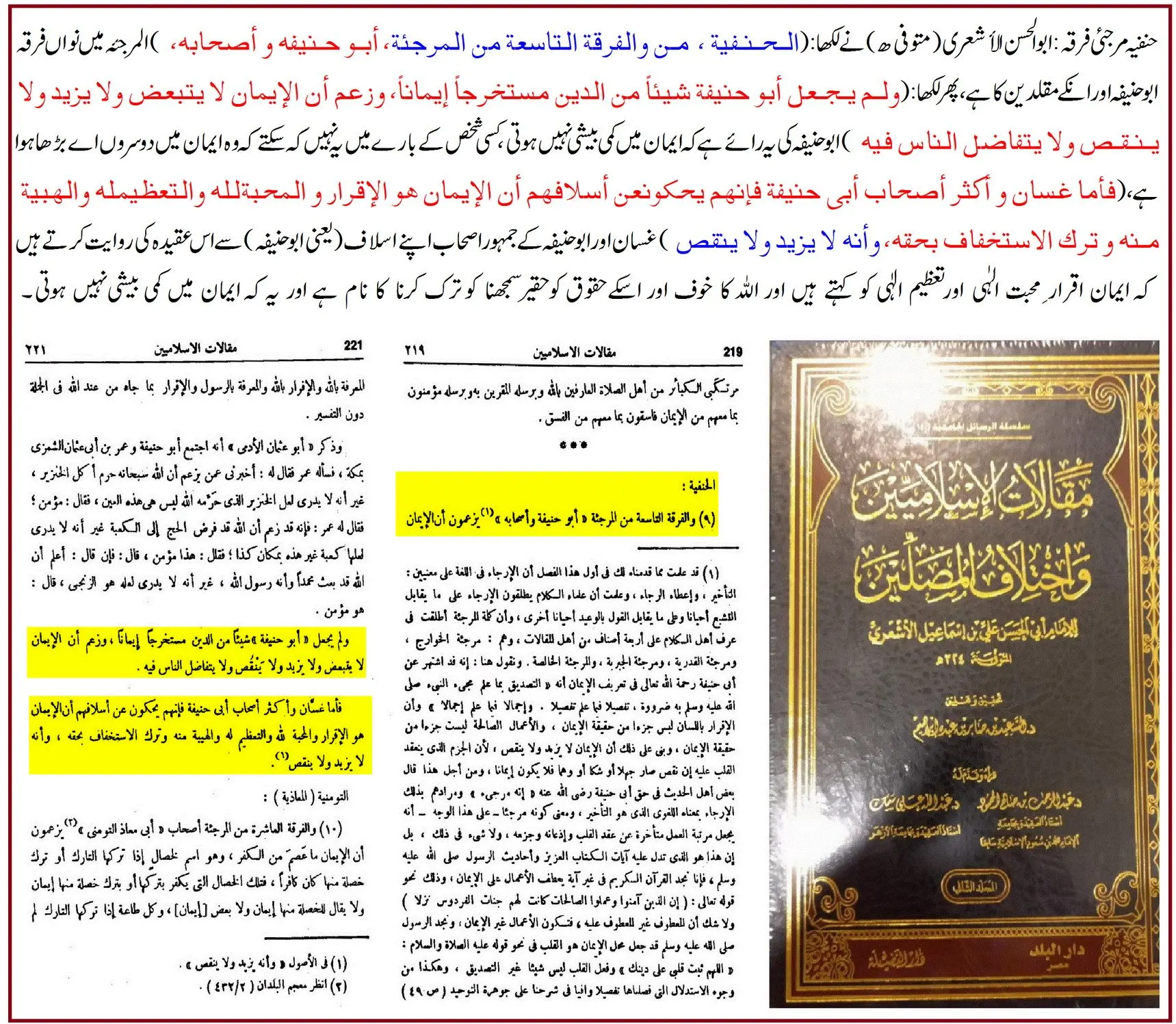
🔴 Imam Abu Al-Hasan Al-Ash’ari (324 AH) in his famous book “Maqalat Al-Islamiyyin” classified Imam Abu Hanifa and his companions as the ninth sect of the Murji’ah:
والفرقة التاسعة من المرجئة أبو حنيفة وأصحابه، يزعمون أن الإيمان المعرفة بالله، والإقرار بما جاء من عند الله في الجملة دون التفسير، ولم يجعل أبو حنيفة شيئاً من الدين مستخرجاً إيماناً، وزعم أن الإيمان لا يتبعض ولا يزيد ولا ينقص.
The ninth group of the Murji’ah is Abu Hanifa and his companions. Their belief is that faith is merely knowledge and a general acknowledgment, and it neither increases nor decreases, nor is there any differentiation (ranking) in it.
📌 Summary: From the clear statements given above, it is evident that some sayings of Imam Abu Hanifa (may Allah have mercy on him) and the beliefs of his followers are connected to the Murji’ah sect. This has been explicitly stated not only by Abdul Qadir Jilani (may Allah have mercy on him) but also by other authentic scholars.
🔴 Ghassan bin Aban, the Ghassaniyah sect, and the background of Murji’ah
🔹 Introduction to the Ghassaniyah sect
Some individuals have tried to make the Ghassaniyah sect the referent of the statements of Sheikh Abdul Qadir Jilani (may Allah have mercy on him), but when the historical and doctrinal background of Ghassaniyah is examined, it becomes clear that their methodology closely resembles some sayings of Imam Abu Hanifa (may Allah have mercy on him).
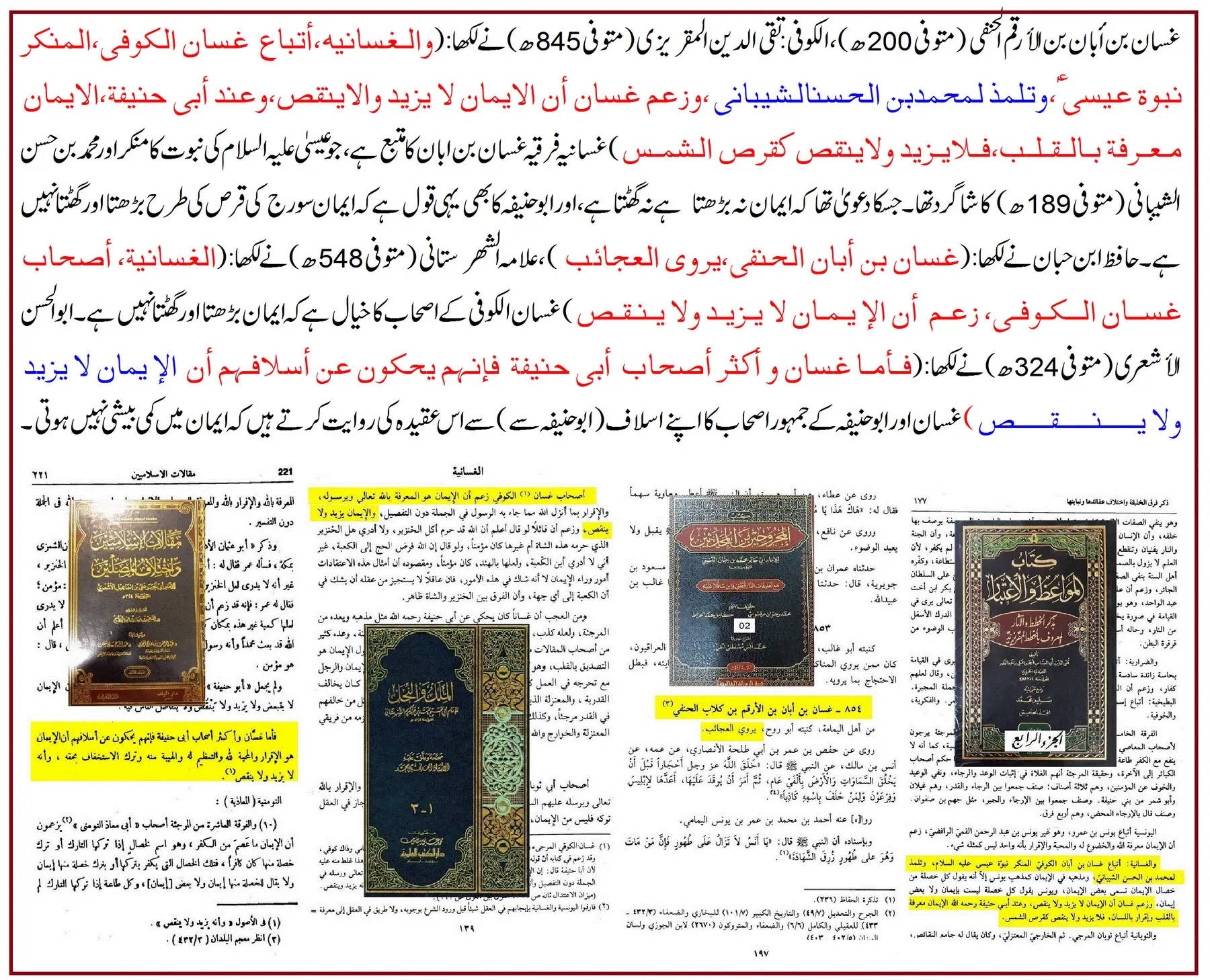
🔹 Statement of Taqi al-Din al-Maqrizi (845 AH)
والغسانية: أتباع غسان بن أبان الكوفيّ، المنكر نبوّة عيسى عليه السّلام، وتلمذ لمحمد بن الحسن الشيباني، وزعم غسان أن الإيمان لا يزيد ولا ينقص، وعند أبي حنيفة رحمه الله الإيمان معرفة بالقلب وإقرار باللسان، فلا يزيد ولا ينقص كقرص الشمس.
Ghassaniyyah are the people who followed Ghassan ibn Aban. He denied the prophethood of Prophet Jesus (peace be upon him) and was a disciple of Muhammad ibn Hasan al-Shaybani. His belief was that faith neither increases nor decreases. Imam Abu Hanifa (may Allah have mercy on him) also held the same view that faith is recognition in the heart and declaration by the tongue, and it is like the disk of the sun, neither less nor more.
🔹 Further Explanation by Abu al-Hasan al-Ash’ari (may Allah have mercy on him)
فَأَمَّا غسان وأكثر أصحاب أبي حنيفة فإنهم يحكون عن أسلافهم أن الإيمان هو الإقرار والمحبة لله والتعظيم له والهيبة منه وترك الاستخفاف بحقه، وأنه لا يزيد ولا ينقص.
Ghassan and most of the companions of Imam Abu Hanifa narrate from their predecessors that faith is only acknowledgment, love of Allah, reverence, and fear of Allah, and it neither increases nor decreases.
🔹 Statement of Imam Shahrastani (548 AH)
الغسانية: أصحاب غسان الكوفي. زعم أن الإيمان هو المعرفة بالله تعالى وبرسوله، والإقرار بما أنزل الله، وبما جاء به الرسول في الجملة دون التفصيل، والإيمان لا يزيد ولا ينقص.
Ghassaniyyah are the followers of Ghassan al-Kufi. Their belief is that faith is only knowledge and general acknowledgment, and it neither increases nor decreases.
🔹 Conclusion
🔸 There is a remarkable similarity between the thoughts of the Ghassaniyyah sect and some sayings of Imam Abu Hanifa. 🔸 Ghassan was a student of Imam Muhammad bin Hasan al-Shaybani. 🔸 Most hadith scholars have attributed him to Imam Abu Hanifa, such as Abu al-Hasan al-Ash’ari, al-Shahrastani, and al-Maqrizi.
📌 Therefore, the accusation of Murji’ah against Imam Abu Hanifa is not fabricated or based on malice, but its proof exists in authentic historical and doctrinal sources.
🔴 Statements of Abdul Qahir al-Baghdadi, Ibn Abd al-Barr, and other hadith scholars
🔹 Writing of Abdul Qahir al-Baghdadi (429 AH)
Abdul Qahir bin Tahir al-Tamimi al-Baghdadi was Ash’ari in creed. While mentioning the Murji’ah sect in “Al-Farq Bayn al-Firaq,” he clarified Imam Abu Hanifa’s view:
غسان المرجئ قال: الإيمان يزيد ولا ينقص.
وأبو حنيفة قال: الإيمان هو المعرفة، ولا يزيد ولا ينقص، ولا يتفاضل الناس فيه.
Ghassan, the Murji’i, believed that faith increases and does not decrease. Whereas Imam Abu Hanifa’s belief was that faith is merely knowledge; it neither increases nor decreases, and all people are equal in faith.
🔴 Abdul Qahir was an Ash’ari, and while trying to explain away the Murji’ah, he tried to portray Ghassan as an opponent in order to “establish” Imam Abu Hanifa’s view, but he also agrees that Imam Abu Hanifa did not believe in excess or deficiency in faith.
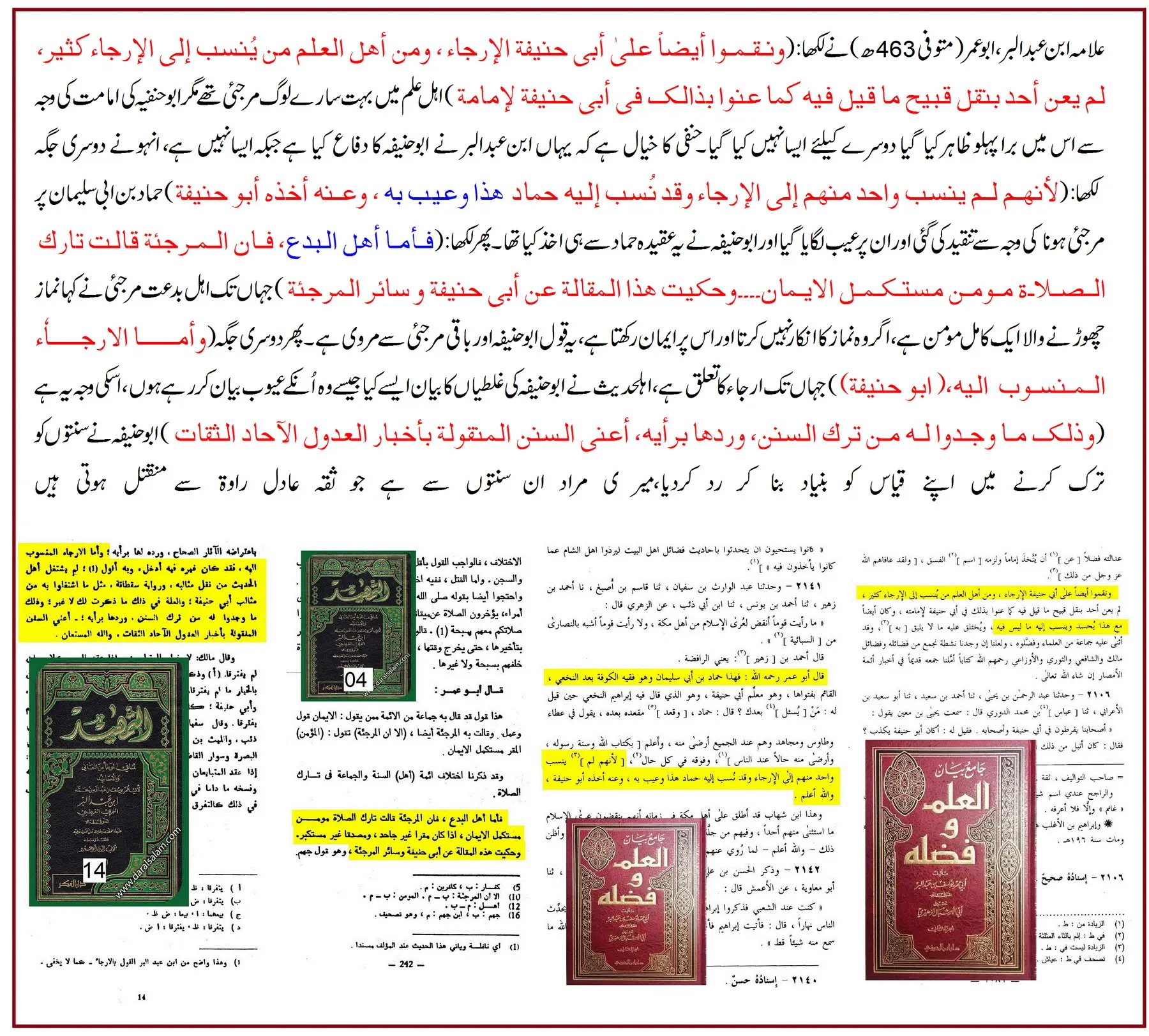
🔹 Position of Ibn Abd al-Barr al-Andalusi (463 AH)
Ibn Abd al-Barr has discussed Imam Abu Hanifa’s relation to Murji’ah at various places in books like “Al-Tamhid” and “Jami’ Bayan al-‘Ilm”.
وَنُسِبَ إِلَى أَبِي حَنِيفَةَ الْإِرْجَاءُ، وَقَدْ أَخَذَهُ عَنْ حَمَّادٍ، وَحَمَّادٌ عُيِّبَ بِهِ.
Imam Abu Hanifa is attributed with Arja’ (Murji’ism), and this belief he acquired from his teacher Hammad ibn Abi Sulayman, who was also criticised for (Murji’ism).
🔹 Ibn Abd al-Barr further wrote in “Al-Tamhid”:
وَحُكِيَتْ هَذِهِ الْمَقَالَةُ عَنْ أَبِي حَنِيفَةَ وَسَائِرِ الْمُرْجِئَةِ.
أن تارك الصلاة مؤمن مستكمل الإيمان إذا كان مقراً غير جاحد.
This statement is attributed to Imam Abu Hanifa and other Murji’ah that a person who abandons prayer but admits it and does not deny it is a complete believer.
🔴 This is an explicit Murji’ view, according to which action is not a part of faith.
🔹 Criticism of Imam Ibn Hibbanؒ
Ibn Hibban mentioned a famous Murji’i narrator “Ghassan bin Al-Arqam” in “Al-Du’afa wal Matrukin” and wrote:
غسان بن الأرقم بن كلاب الحنفي من أهل اليمامة، كنيته أبو روح، يروي العجائب.
🔴 Ibn Hibban declared this narrator weak and one who narrated strange hadiths, associated with the Murji’ah ideology and was also “Hanafi.”
📌 Summary:
- The concept of Murji’ah is clearly visible in the sayings of Imam Abu Hanifa.
- His teachers, students, and later followers also adhered to the same ideology.
- Historians like Ibn Abdul Barr and Abdul Qahir Baghdadi attributed this ideology to him and explicitly stated that the Imam was not a believer in excess or deficiency in faith.
🔴 Comments of the Noble Muhaddithin on Imam Abu Hanifa’s Murji’ah Ideology
🔹 Position of Imam Muhammad bin Ismail Al-Bukhari (may Allah have mercy on him)
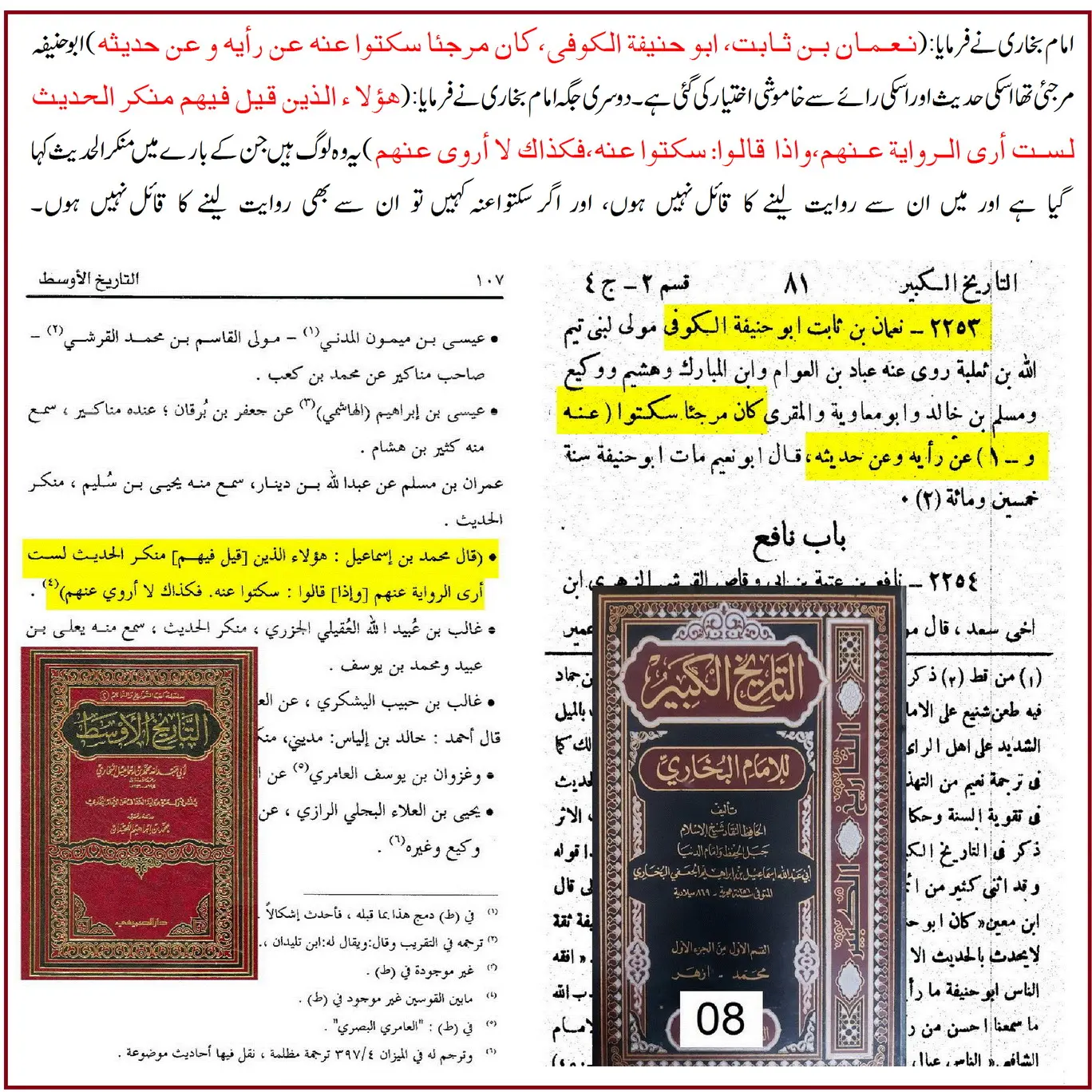
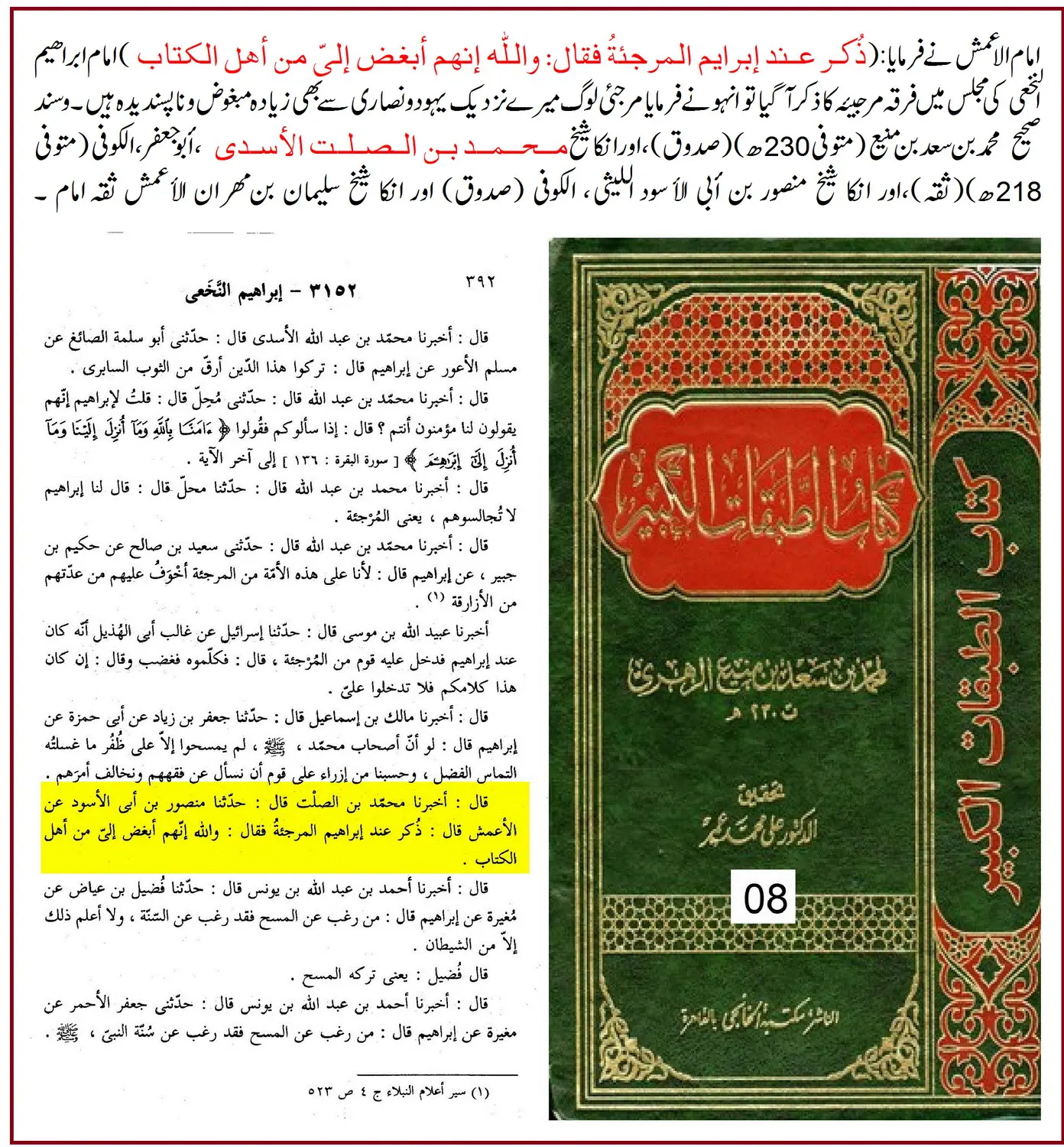
نعمان بن ثابت أبو حنيفة الكوفي… كان مرجئًا، سكتوا عن رأيه وحديثه.
Imam Abu Hanifa was a Murji’i. The Muhaddithin remained silent regarding his opinion and hadith.
📌 According to Imam Bukhari (may Allah have mercy on him), “silence about his hadith” means the Muhaddithin did not narrate from him because he was a believer in Murji’ah.
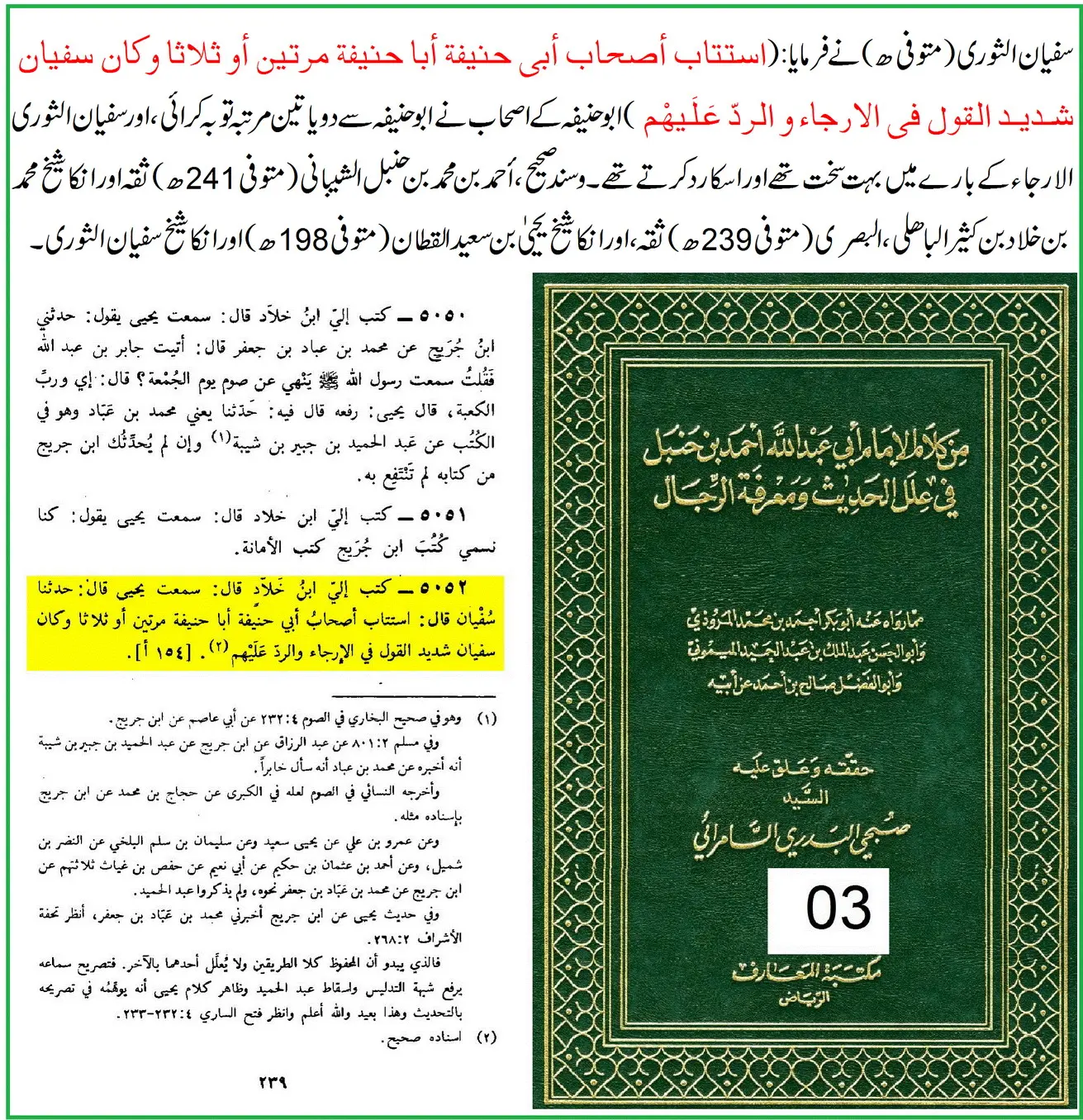
🔹 Position of Imam Ahmad bin Hanbal (may Allah have mercy on him)
استتاب أصحاب أبي حنيفة أبا حنيفة مرتين أو ثلاثًا، وكان سفيان شديد القول في الإرجاء والرد عليهم.
Imam Abu Hanifa was made to repent two or three times by his companions, and Imam Sufyan Thawri was very strict in rejecting Arja’.
🔹 Clear Position of Imam Yahya bin Ma’in (may Allah have mercy on him)
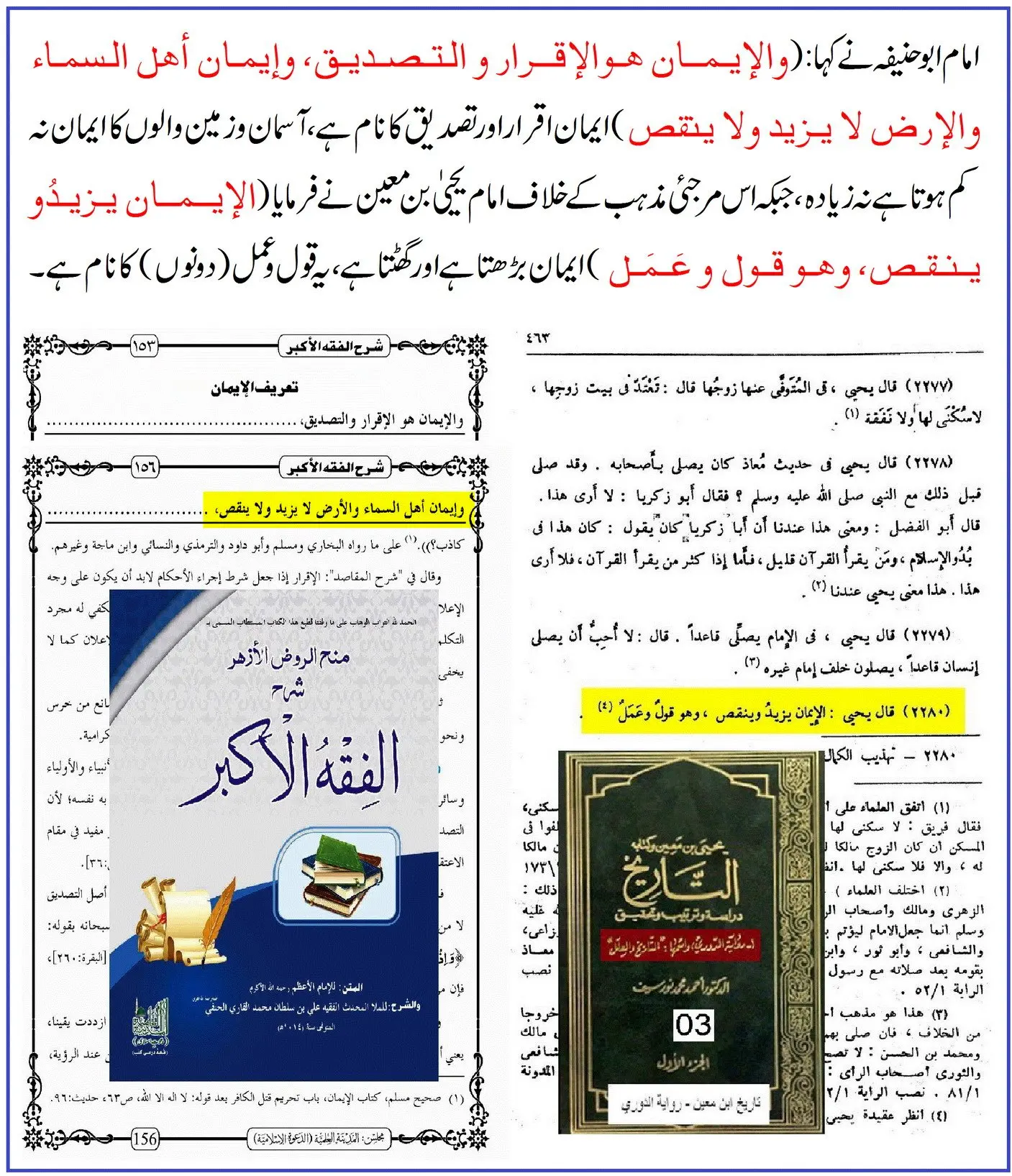
الإيمان يزيد وينقص، وهو قول وعمل.
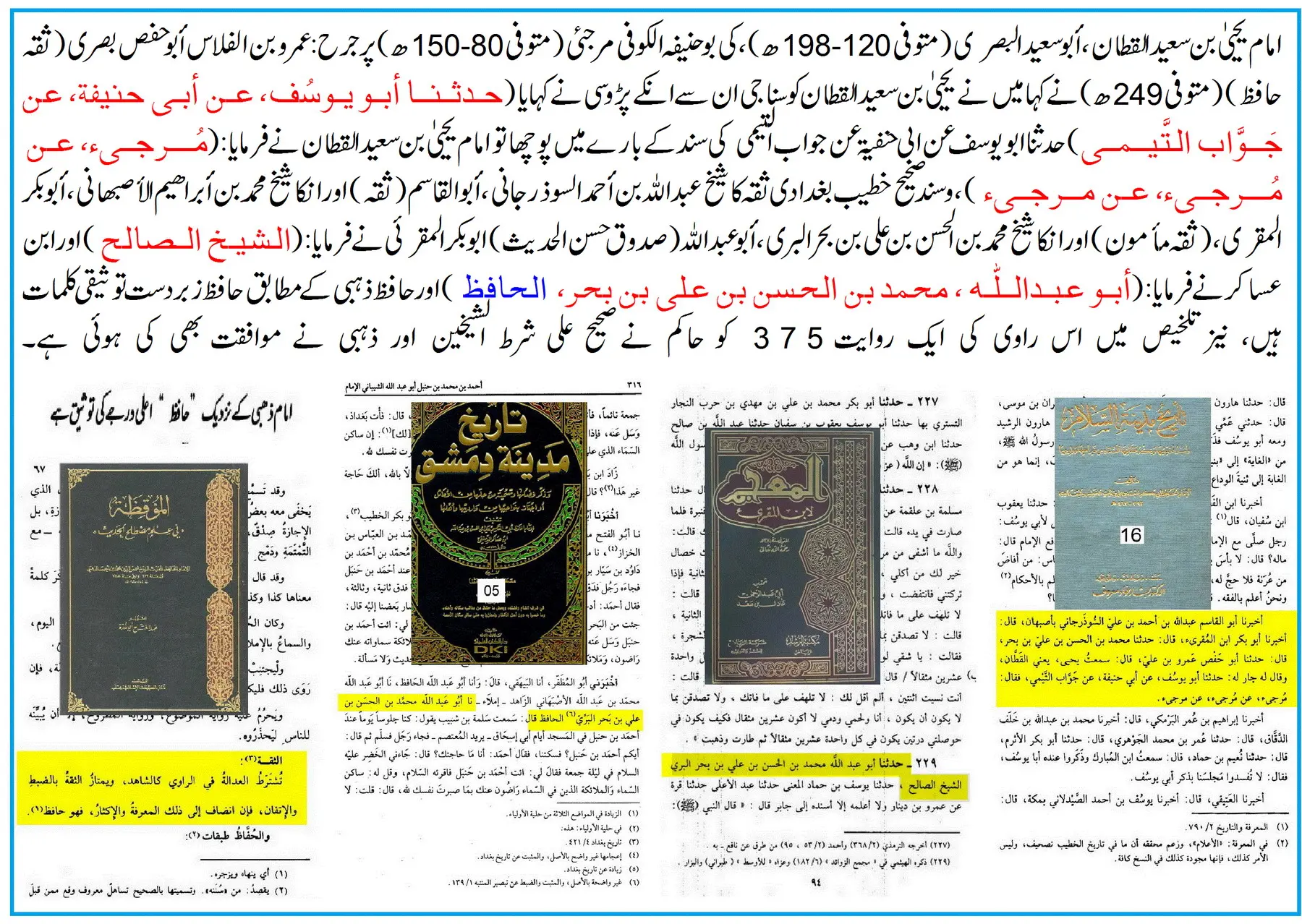
سَمِعتُ يحيى يقول: الإيمان قول وعمل، يزيد وينقص.
Faith increases and decreases, and this refers to both speech and action.
🔴 Whereas Imam Abu Hanifa’s view was the opposite, that faith neither increases nor decreases.
🔹 Testimony of Imam Yahya bin Saeed al-Qattan (may Allah have mercy on him)
قال يحيى: ما أدركتُ أحدًا من أصحابنا إلا على الاستثناء، وقال: الإيمان قول وعمل.
I did not find any of our companions except that they held to istithna’ (saying “I am a believer, if Allah wills” about faith), and he said: Faith is the name of both speech and action.
🔹 Commentary of Imam Ibn al-Mubarak (may Allah have mercy on him)
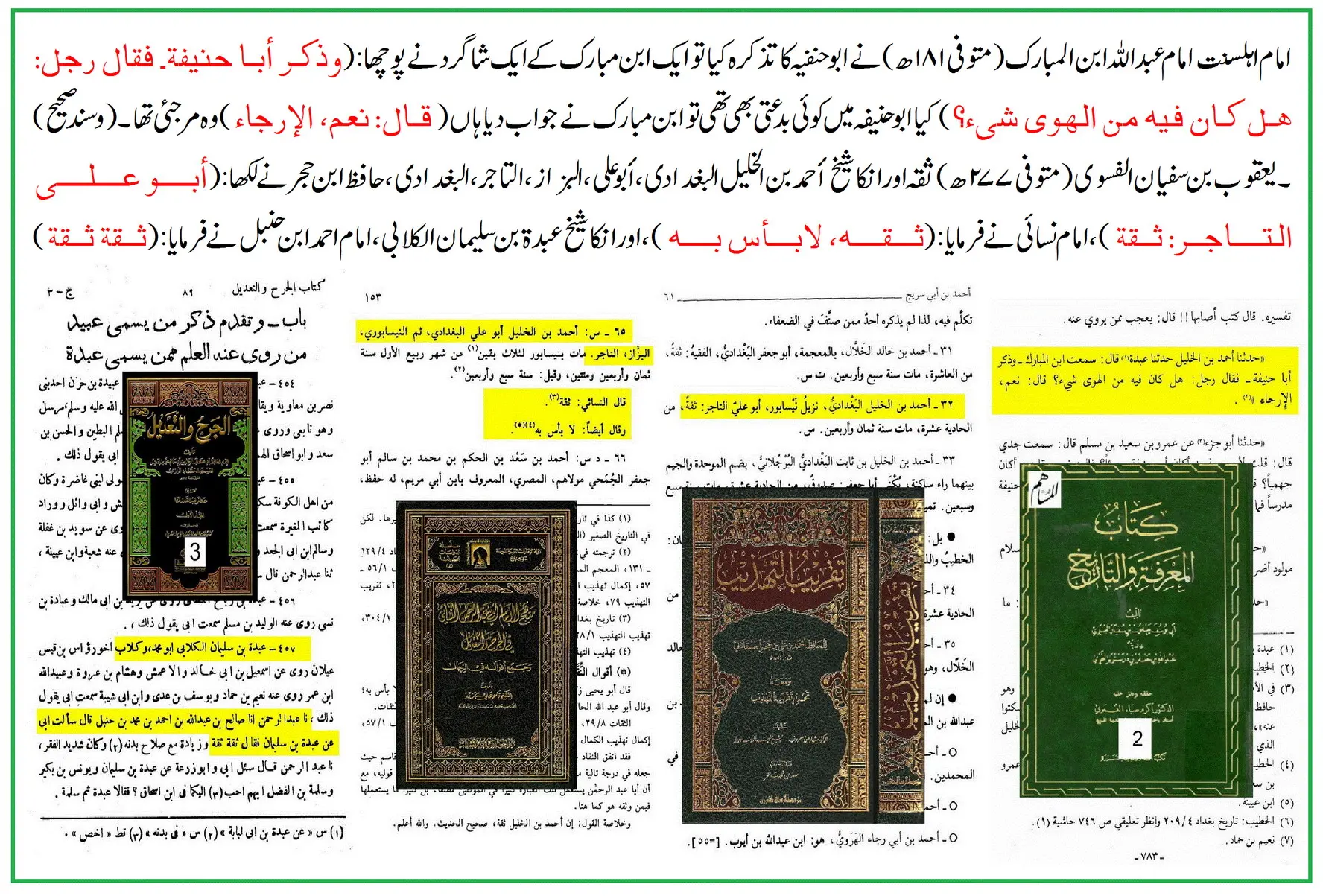
سأل رجل: هل كان في أبي حنيفة من الهوى شيء؟ قال: نعم، الإرجاء.
Someone asked: Was Abu Hanifa involved in any innovation? Imam Ibn al-Mubarak replied: Yes, he was Murji’ah.
📌 Imam Abdullah bin al-Mubarak (may Allah have mercy on him) is counted among the Imams of Ahl al-Sunnah; his commentary is a very strong testimony.
🔹 Attitude of Sufyan al-Thawri (may Allah have mercy on him)
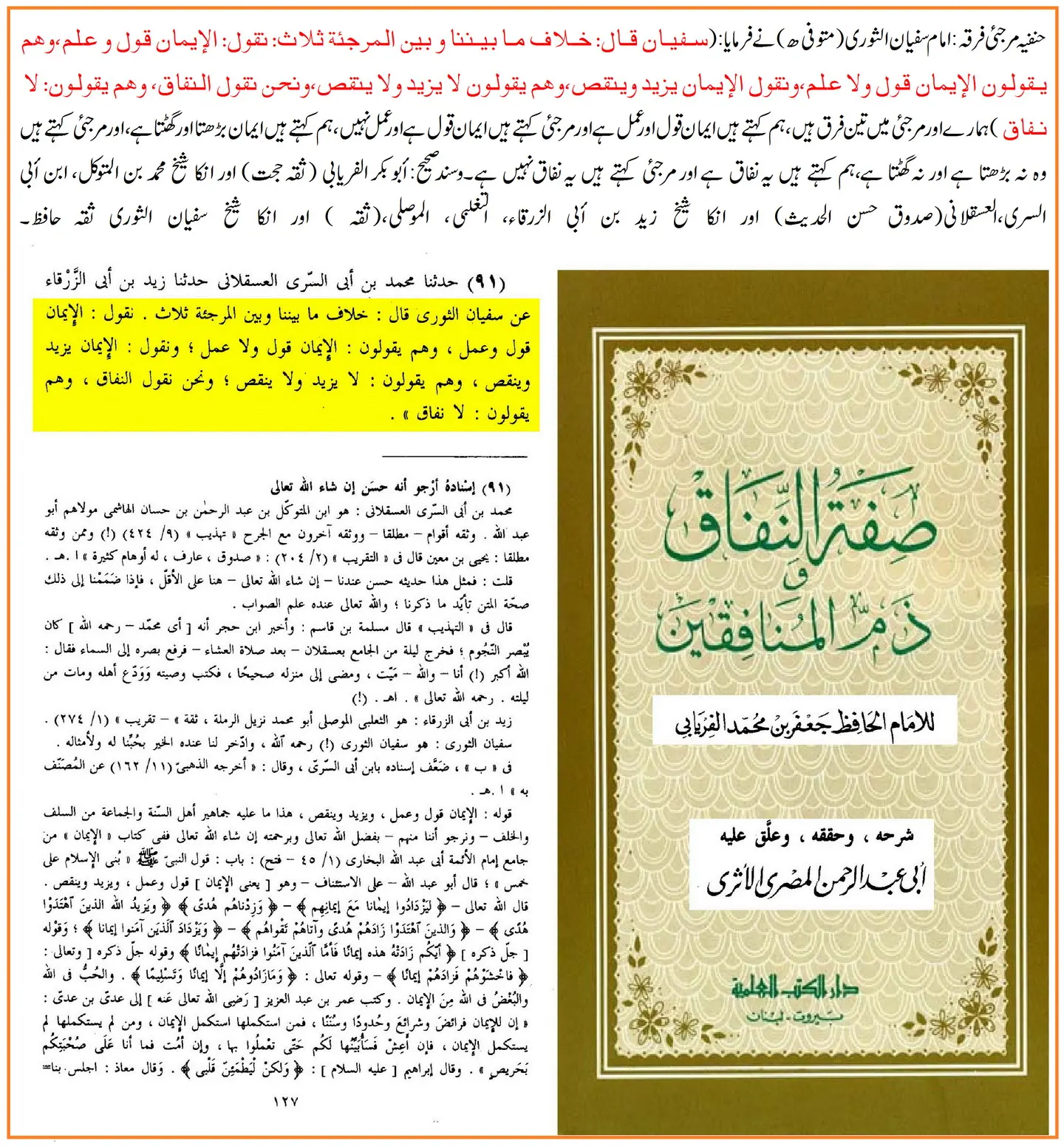
Imam Sufyan al-Thawri, who was a contemporary of Imam Abu Hanifa, states:
خلاف ما بيننا وبين المرجئة ثلاث: نقول: الإيمان قول وعمل وهم يقولون: الإيمان قول ولا عمل.
There are three differences between us and the Murji’ah: We say faith is both speech and action, and they say it is only speech, not action.
🔴 Imam Sufyan al-Thawri stopped even greeting those who held the Murji’ah belief.
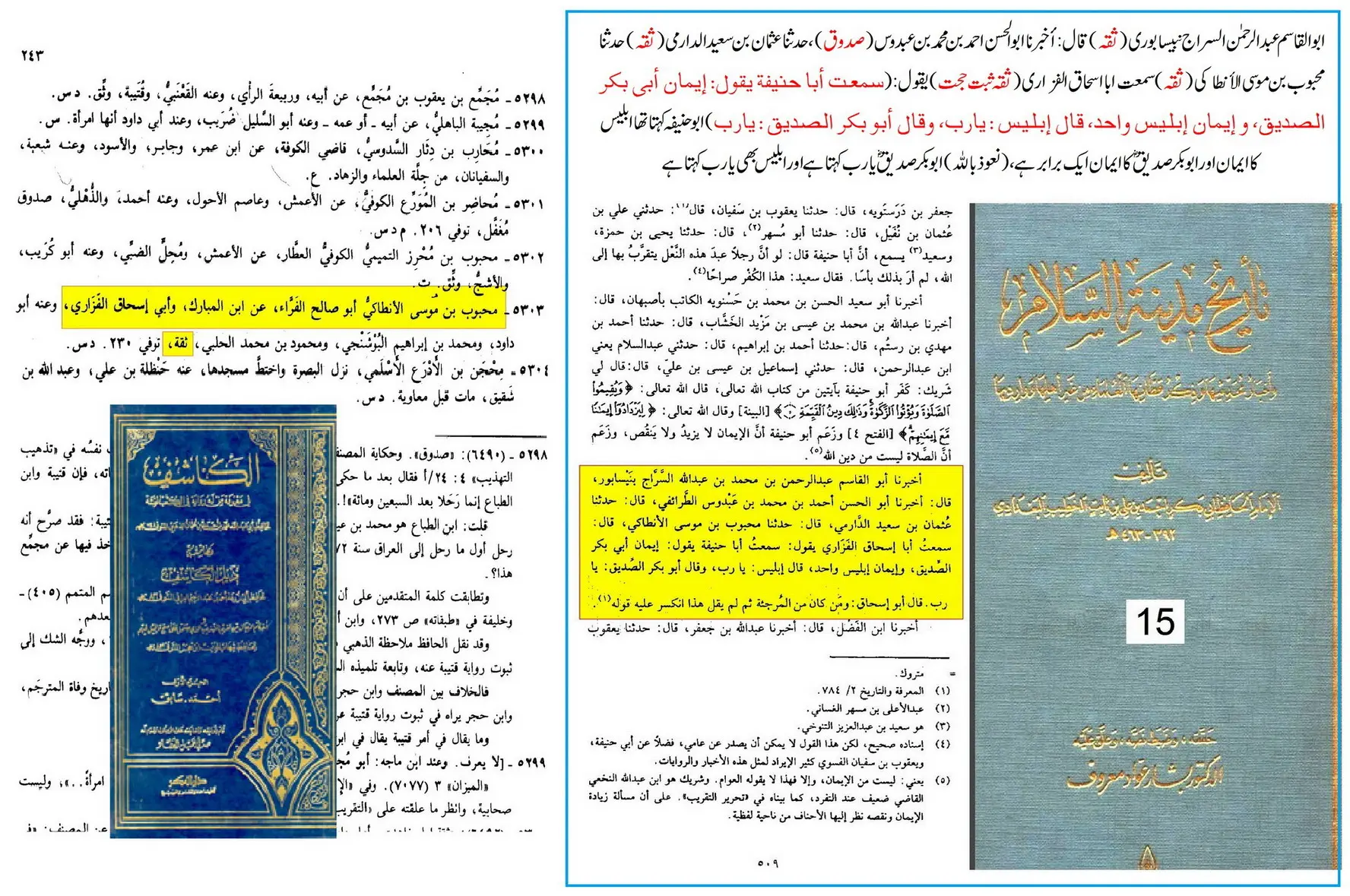
🔹 The harsh speech of Imam Abu Ishaq al-Fazari (may Allah have mercy on him)
سمعت أبا حنيفة يقول: إيمان أبي بكر الصديق وإيمان إبليس واحد.
I heard Abu Hanifa say that the faith of Abu Bakr Siddiq (may Allah be pleased with him) and Iblis is the same (i.e., knowledge and acknowledgment).
📌 This statement shows the extreme position of the Murji’ah that deeds have no role in faith.
📌 Summary:
- The sayings of the Muhaddithin clearly refute Imam Abu Hanifa’s Murji’ah belief.
- Great Muhaddithin like Imam Bukhari, Ibn Ma’in, Ahmad ibn Hanbal, Sufyan al-Thawri, and Ibn al-Mubarak objected to his belief.
- Some stopped narrating from him, some called him “Murji’i,” and some made him repent.
🔴 The belief of Ahl al-Sunnah and the stance of the scholars against the Murji’ah
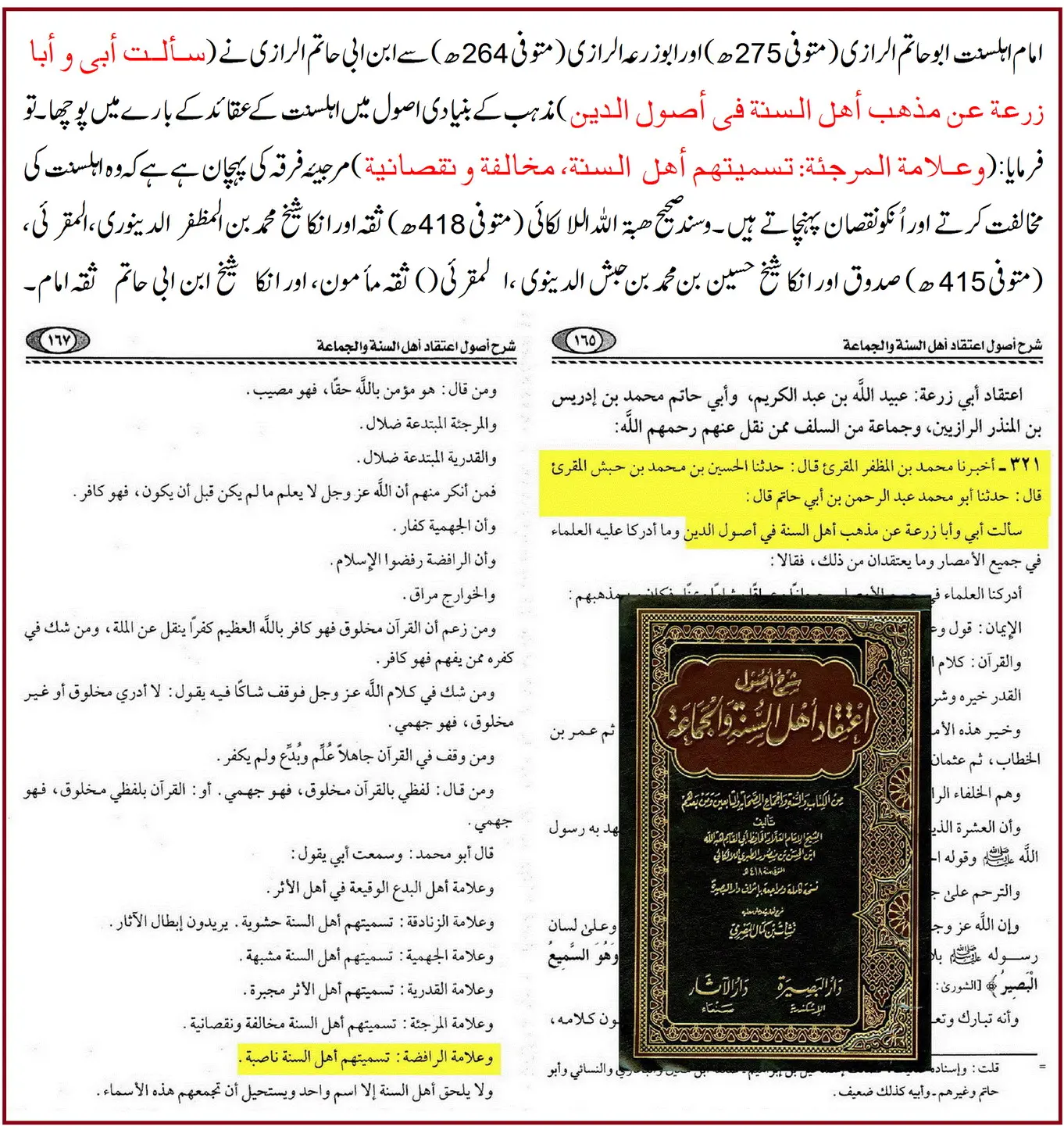
🔹 The definition of faith according to Ahl al-Sunnah wal-Jama’ah
The belief of Ahl al-Sunnah is that:
الإيمان قول وعمل، يزيد بالطاعة، وينقص بالمعصية.
Faith is a combination of speech and action; it increases with obedience and decreases with disobedience.
This has been the stance of the hadith scholars, jurists, and pious predecessors.
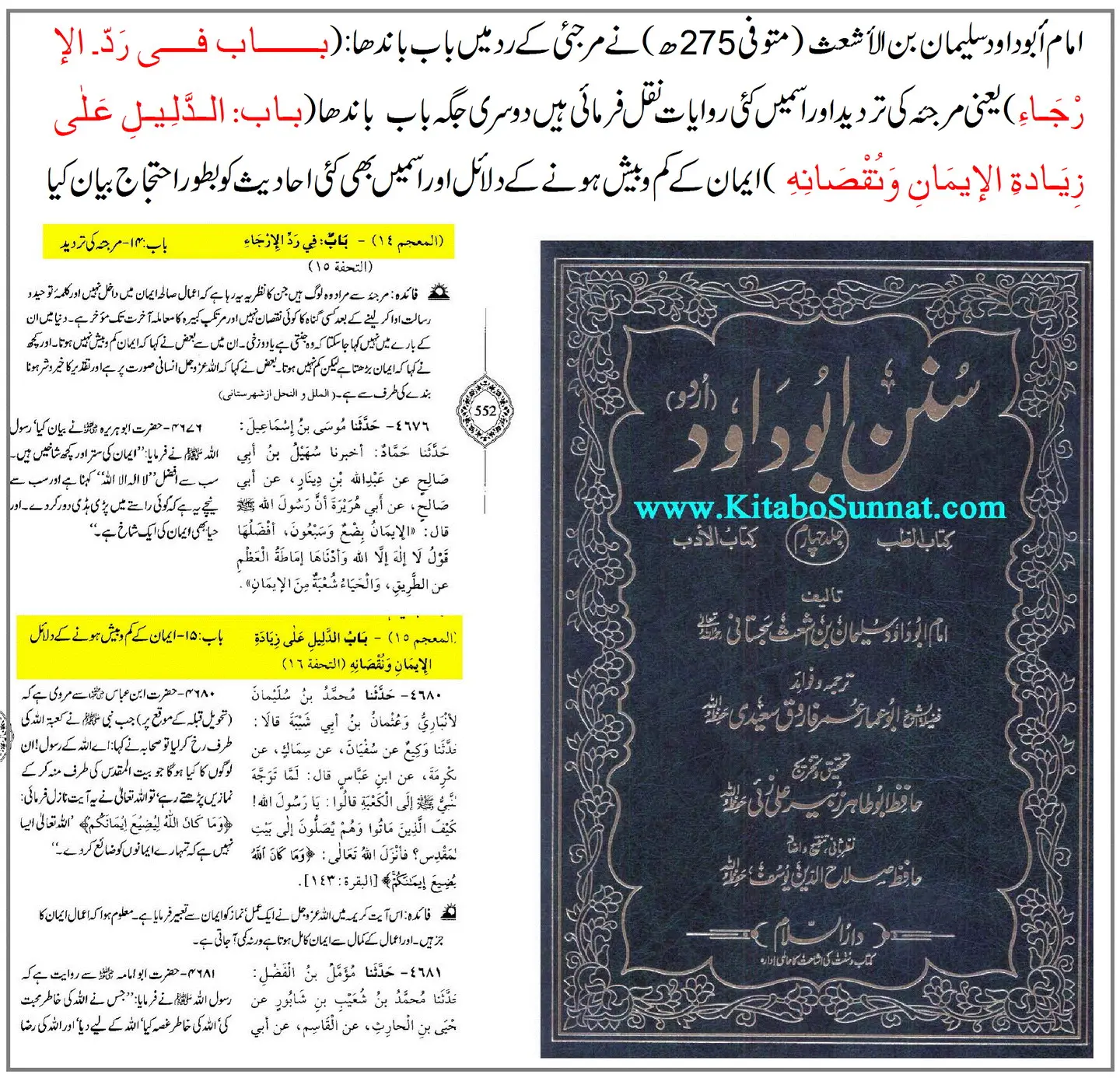
🔹 Imam Abu Dawood Sijistani’s (may Allah have mercy on him) “Chapter on Refuting Al-Irjaa”
In Sunan Abu Dawood, Imam Abu Dawood established a formal chapter:
📗 Chapter on Refuting Al-Irjaa
And in it, he narrated the hadith:
الإيمان بضع وسبعون شعبة، أفضلها قول: لا إله إلا الله، وأدناها إماطة الأذى عن الطريق، والحياء شعبة من الإيمان.
Faith consists of more than seventy branches, the best of which is to say “لا الٰہ الا اللہ”, and the lowest is to remove something harmful from the path, and modesty is also a branch of faith.
🔸 This hadith clearly refutes the Murji’ah because they consider faith to be only “speech,” whereas the hadith includes action as part of faith.
🔹 Abu Dawood established a chapter:
📗 Chapter on the Evidence of the Increase and Decrease of Faith
In it, he narrated the hadith:
ما رأيت من ناقصات عقل ولا دين أغلب لذى لب منكن…
ونقصان الدين فَإِنَّ إِحْدَاكُنَّ تُفْطِرُ رَمَضَانَ وَتُقِيمُ أَيَّامًا لَا تُصَلِّي.
📘 Translation: The Prophet ﷺ said: I have not found anyone more deficient in intellect and religion than women. The deficiency in their religion is that they leave their fasting during Ramadan and do not pray during their menstruation.
🔸 The hadith clarifies that faith and religion can increase and decrease, which contradicts the belief of the Murji’ah.
🔹 Testimony of Imam Abu Ubaid Qasim bin Salamؒ
ما ابتُدِعت في الإسلام بدعة أعزّ على أهلها من هذا الإرجاء.
There is no innovation in Islam that is as dear to the hearts of its followers as Arja’ (Murji’ah).
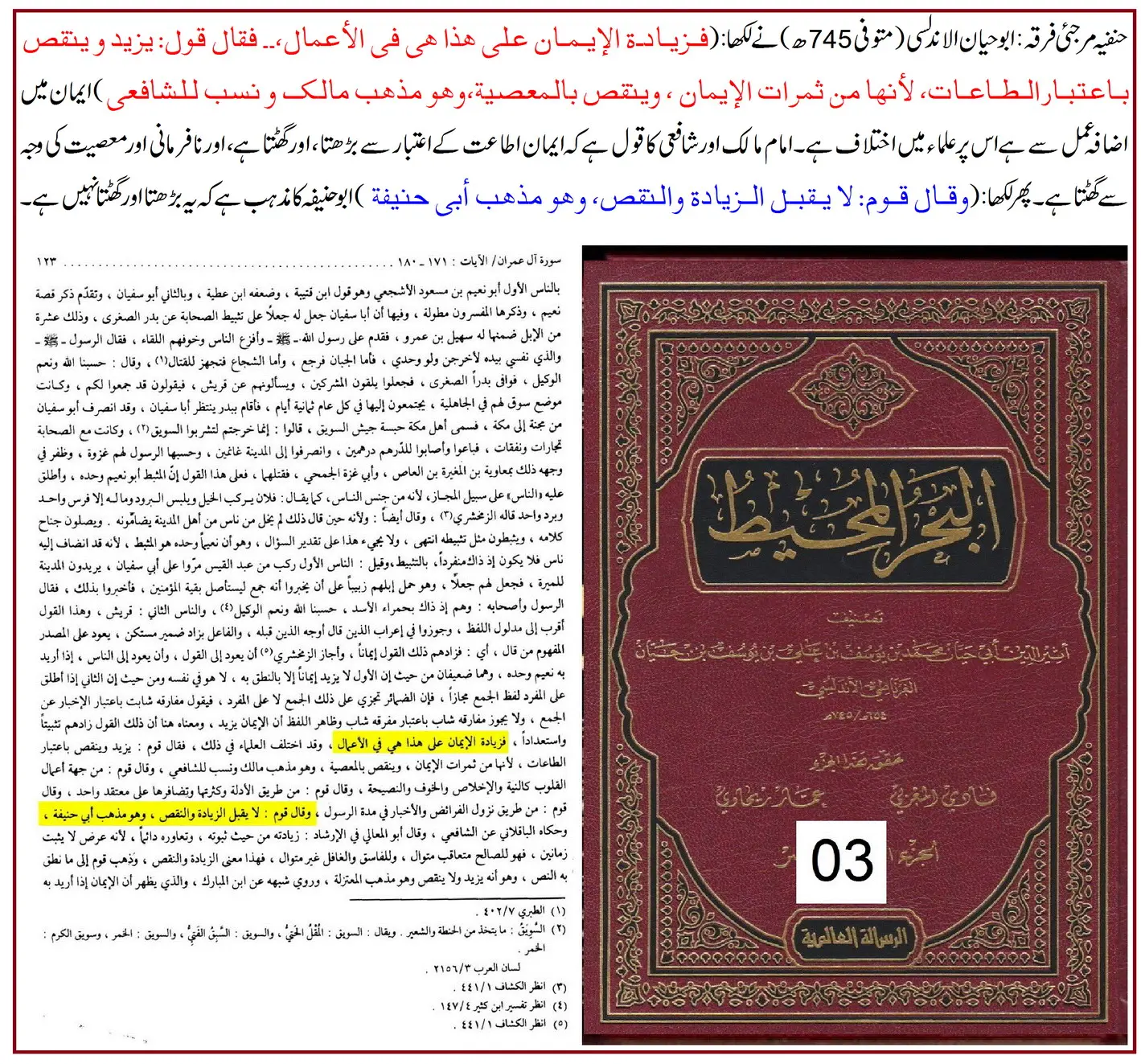
🔹 Belief of Imam Abu Hayyan al-Andalusiؒ (745 AH)
مذهب مالك والشافعي أن الإيمان يزيد وينقص، وأما أبو حنيفة فذهب إلى أنه لا يزيد ولا ينقص.
According to Imam Malik and Imam Shafi’i, faith increases and decreases, whereas according to Abu Hanifa, faith neither increases nor decreases.
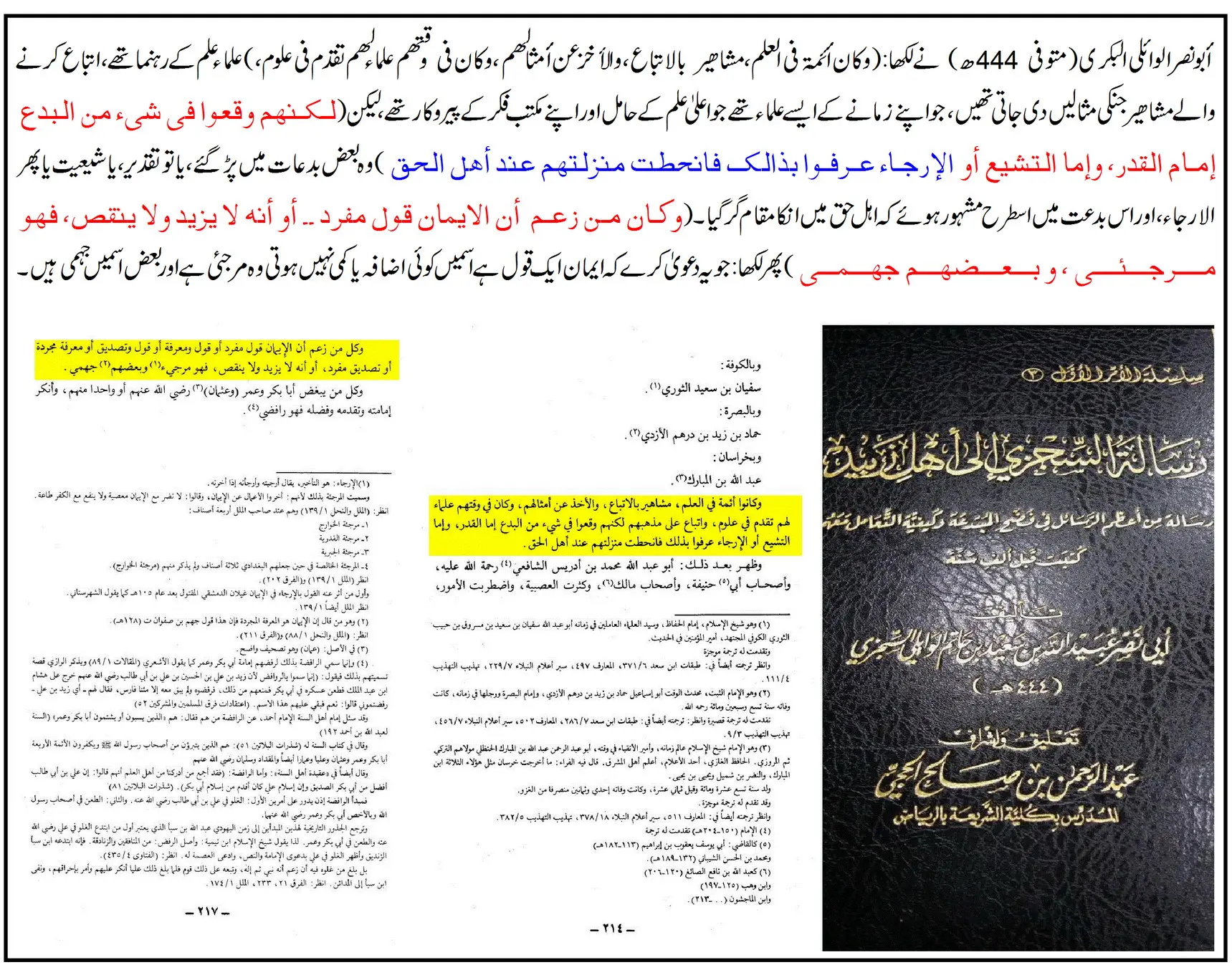
🔹 Belief of Imam Abu Nasr al-Sijziؒ (444 AH)
وكل من زعم أن الإيمان لا يزيد ولا ينقص، فهو مرجيء، وبعضهم جهمي.
Whoever says that faith neither increases nor decreases is a Murji’i, and some of them are Jahmis as well.
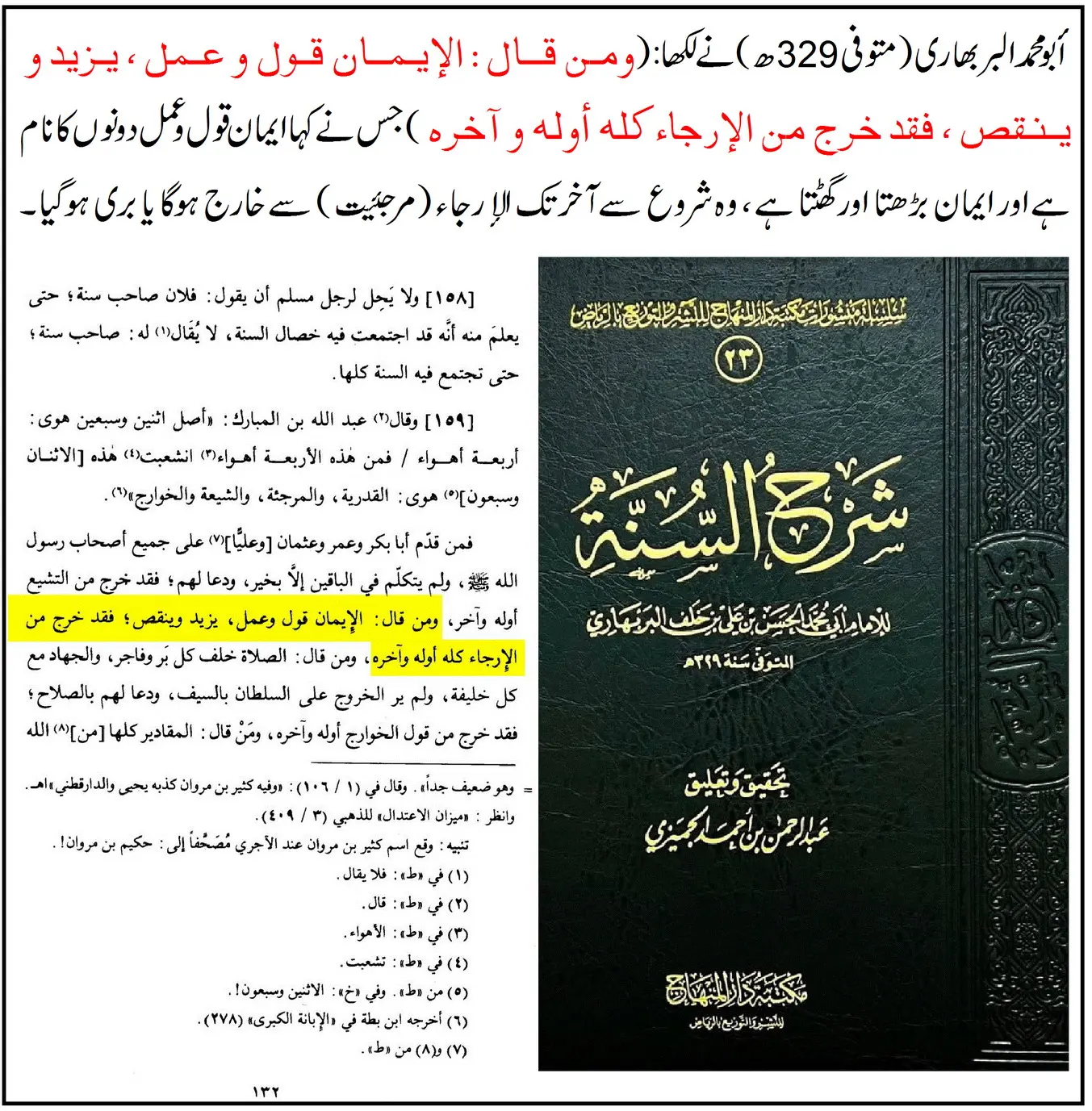
🔹 Decisive statement of Allama Barbahariؒ (329 AH)
من قال: الإيمان قول وعمل، يزيد وينقص، فقد خرج من الإرجاء كله أوله وآخره.
Whoever says that faith is a combination of speech and action and that it increases and decreases, then he has left both the beginning and the end of Arja’ (Murji’ah).
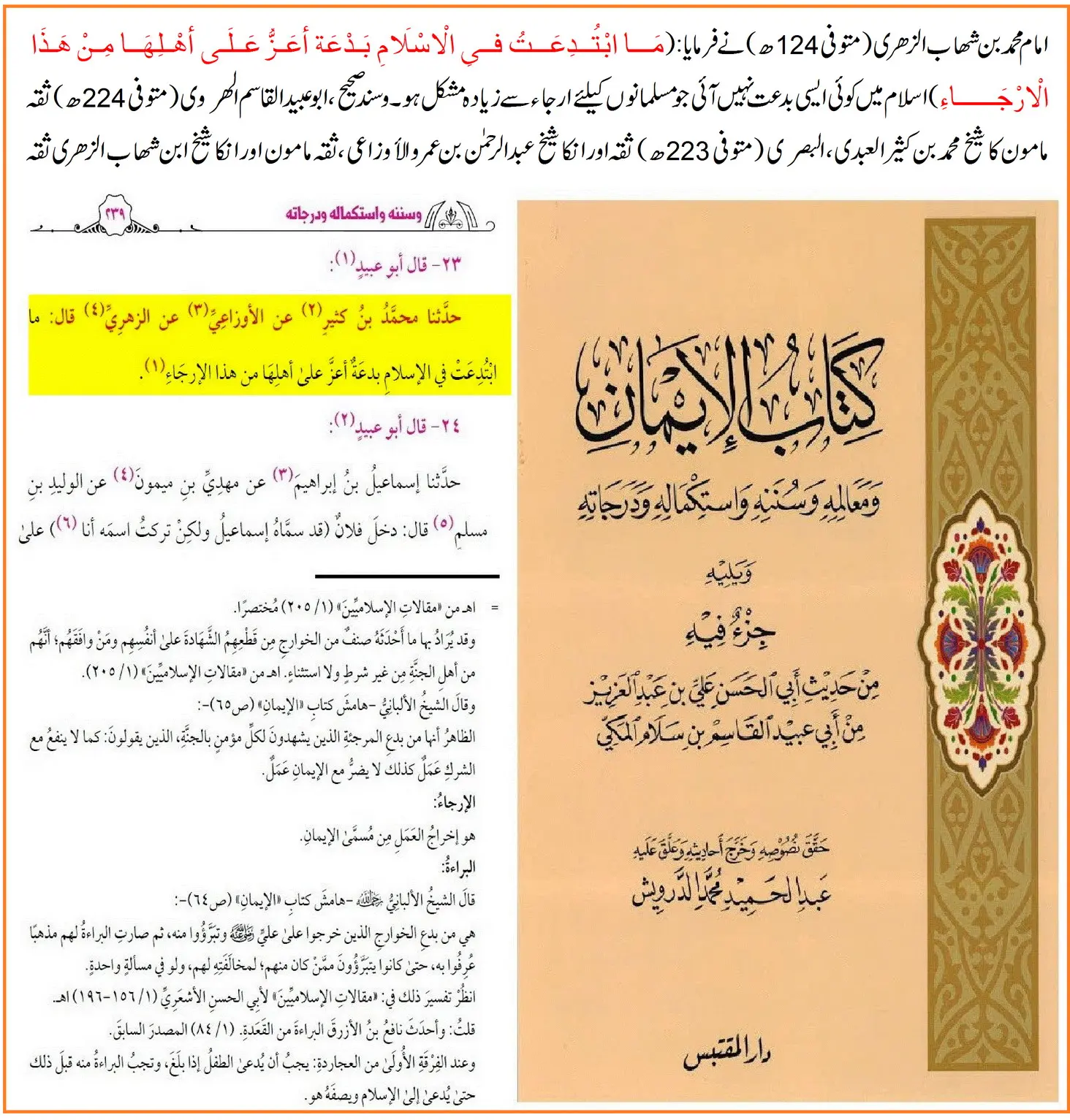
🔹 Commentary of Imam Zuhriؒ (124 AH)
ما ابتُدعت في الإسلام بدعة أعزّ على أهلها من هذا الإرجاء.
The most beloved and misleading innovation in Islam is Arja’.
📌 Summary:
- According to Ahl al-Sunnah, faith is a combination of speech and action, and it can increase or decrease.
- According to the Murji’ah, faith is only the declaration or knowledge, and it neither increases nor decreases.
- Against this innovation, the Muhaddithin wrote chapters, authored books, and even issued fatwas declaring the invalidity of prayer.
🔴 Imam Abu Hanifa’s Students, the Promotion of Murji’ah, and the Refutation by the Imams
🔹 Imam Abu Hanifa’s Students and the Murji’ah Belief
Many students of Imam Abu Hanifa held the Murji’ah belief, who were criticized by the Muhaddithin, and some were declared weak or abandoned.
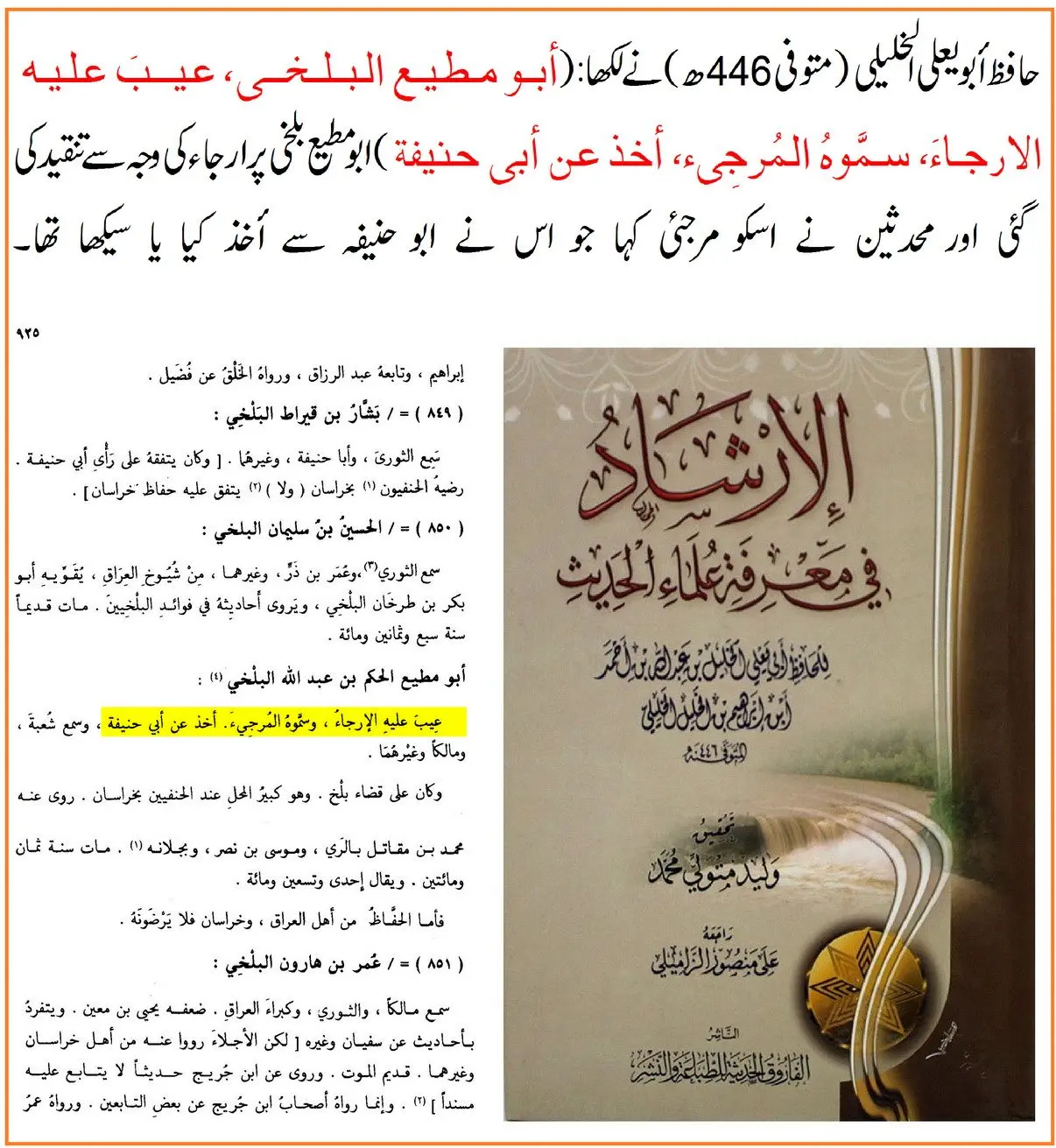
🔹 Abu Muti’ Balkhi – Student of Imam Abu Hanifa
أبو مطيع الحكم بن عبد الله البلخي عيب عليه الإرجاء، وسموه المرجئ، أخذ عن أبي حنيفة.
Objection was raised against Abu Muti’ Balkhi due to his Murji’ah belief, and he was called a Murji’i. He had acquired knowledge from Abu Hanifa.
📌 This chain of Murji’ah attributed to Imam Abu Hanifa also spread through his students.
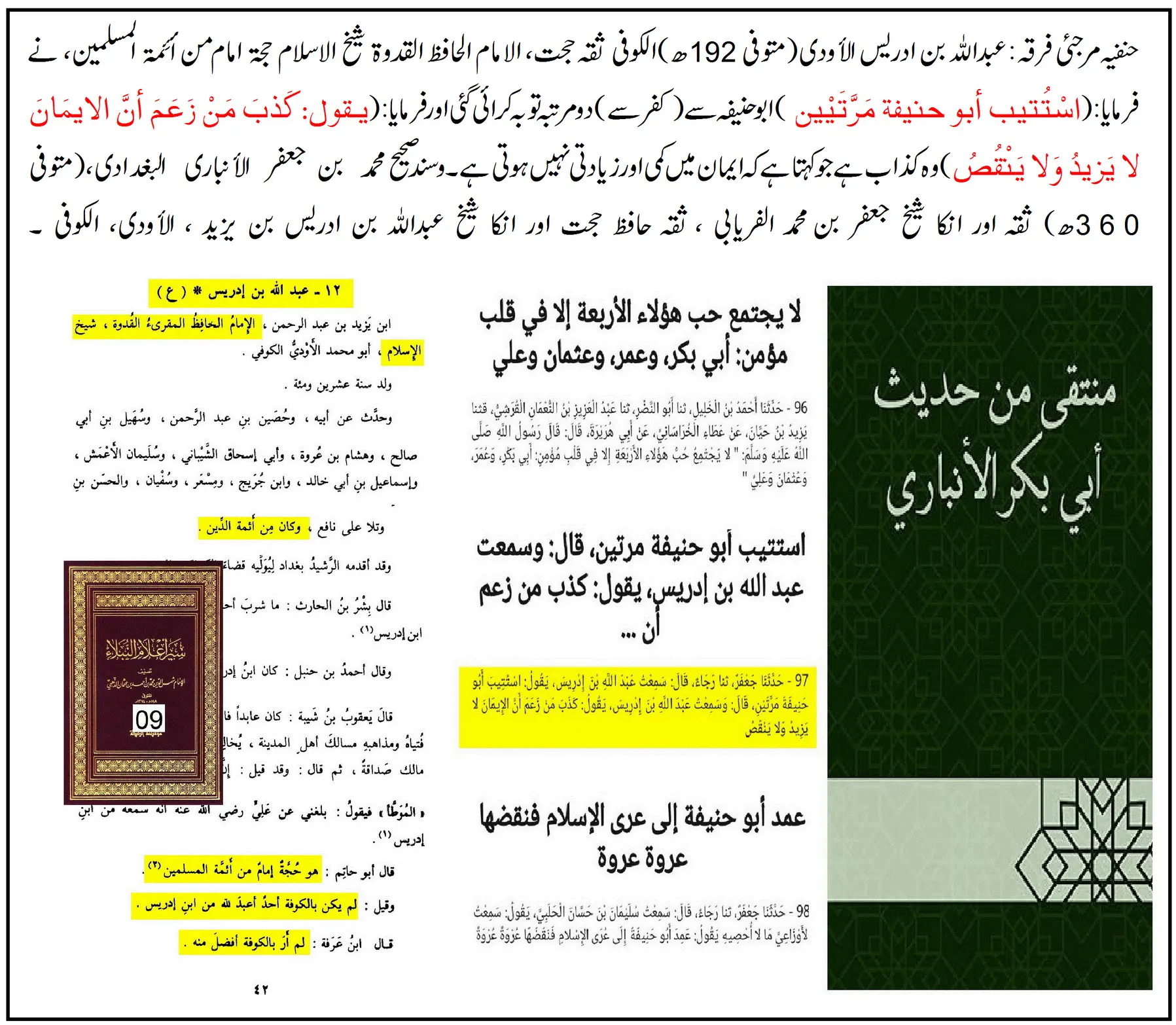
🔹 Commentary of Imam Ibn Idris al-Awdi (192 AH)
استتيب أبو حنيفة مرتين، وقال: كذب من زعم أن الإيمان لا يزيد ولا ينقص.
Abu Hanifa was made to repent twice, and (Ibn Idris said): He is a liar who says that there is no increase or decrease in faith.
📌 This makes it clear that the Murji’ah belief was attributed to Imam Abu Hanifa and he was made to repent for it.
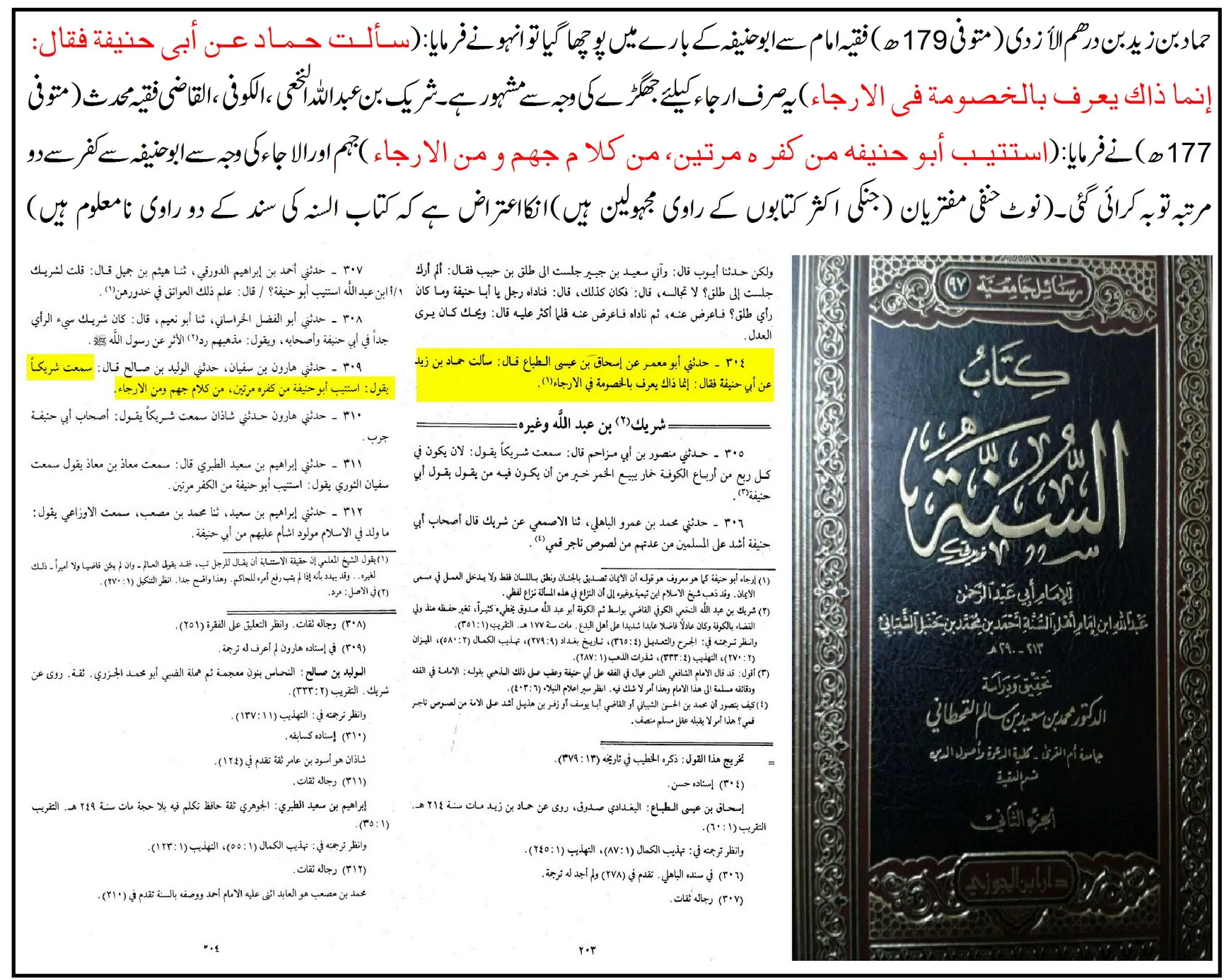
🔹 Statement of Shareek bin Abdullah Al-Nakha’i (177 AH)
استتيب أبو حنيفة من كفره مرتين، من كلام جهم ومن الإرجاء.
Abu Hanifa was made to repent from disbelief twice; once because of the Jahmiyyah doctrine (Jahmi belief) and the second time because of Murji’ah.
🔹 Position of Hammad bin Zaid (179 AH)
سألتُ حماد بن زيد عن أبي حنيفة، فقال: إنما ذاك يُعرف بالخصومة في الإرجاء.
I asked Hammad bin Zaid about Abu Hanifa, and he said: He is only known because of his disputes regarding the issue of Arja’.
📌 Meaning, Abu Hanifa’s fame was due to his debates in defense of Arja’.
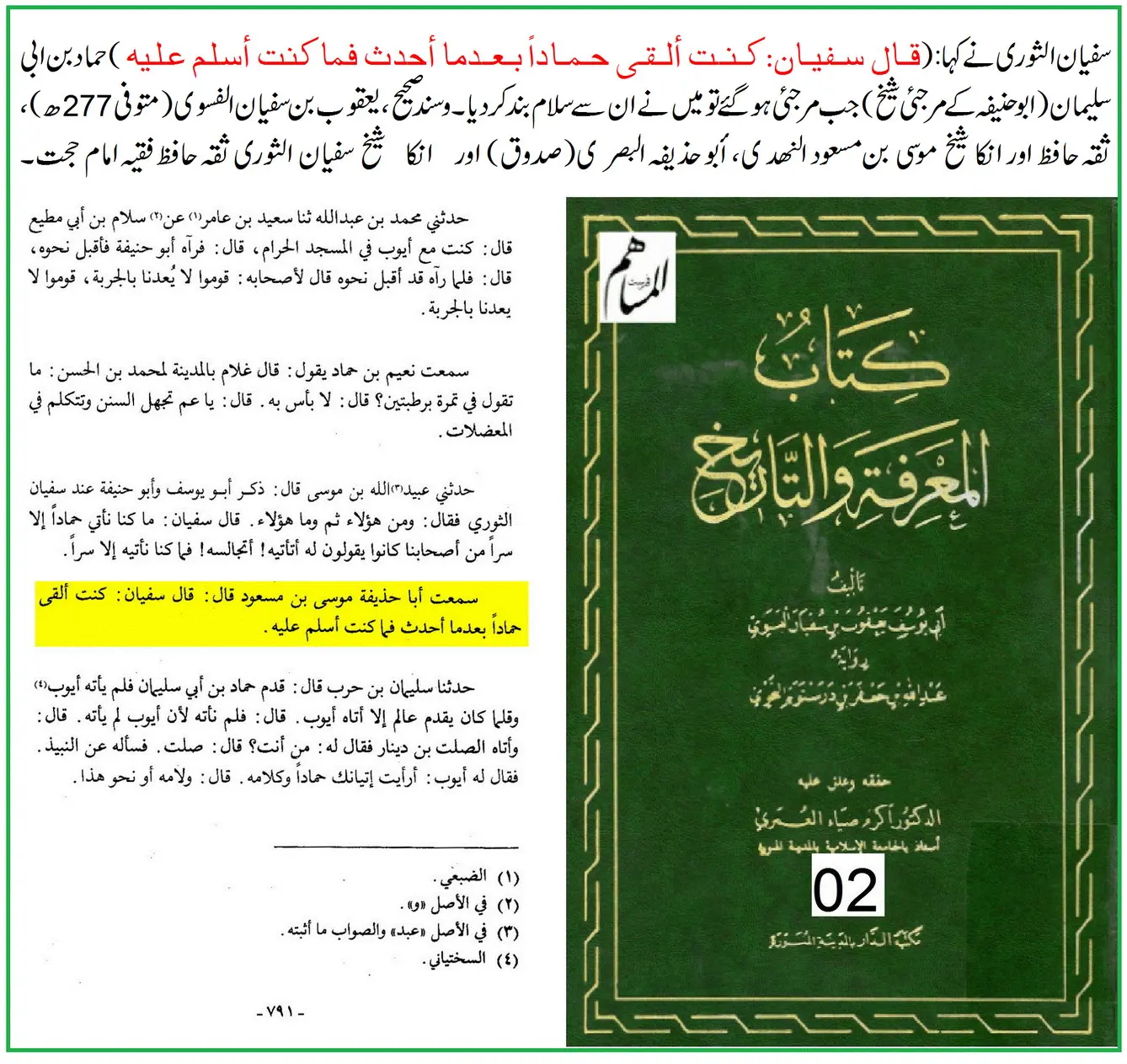
🔹 Severe Rejection by Sufyan Al-Thawri
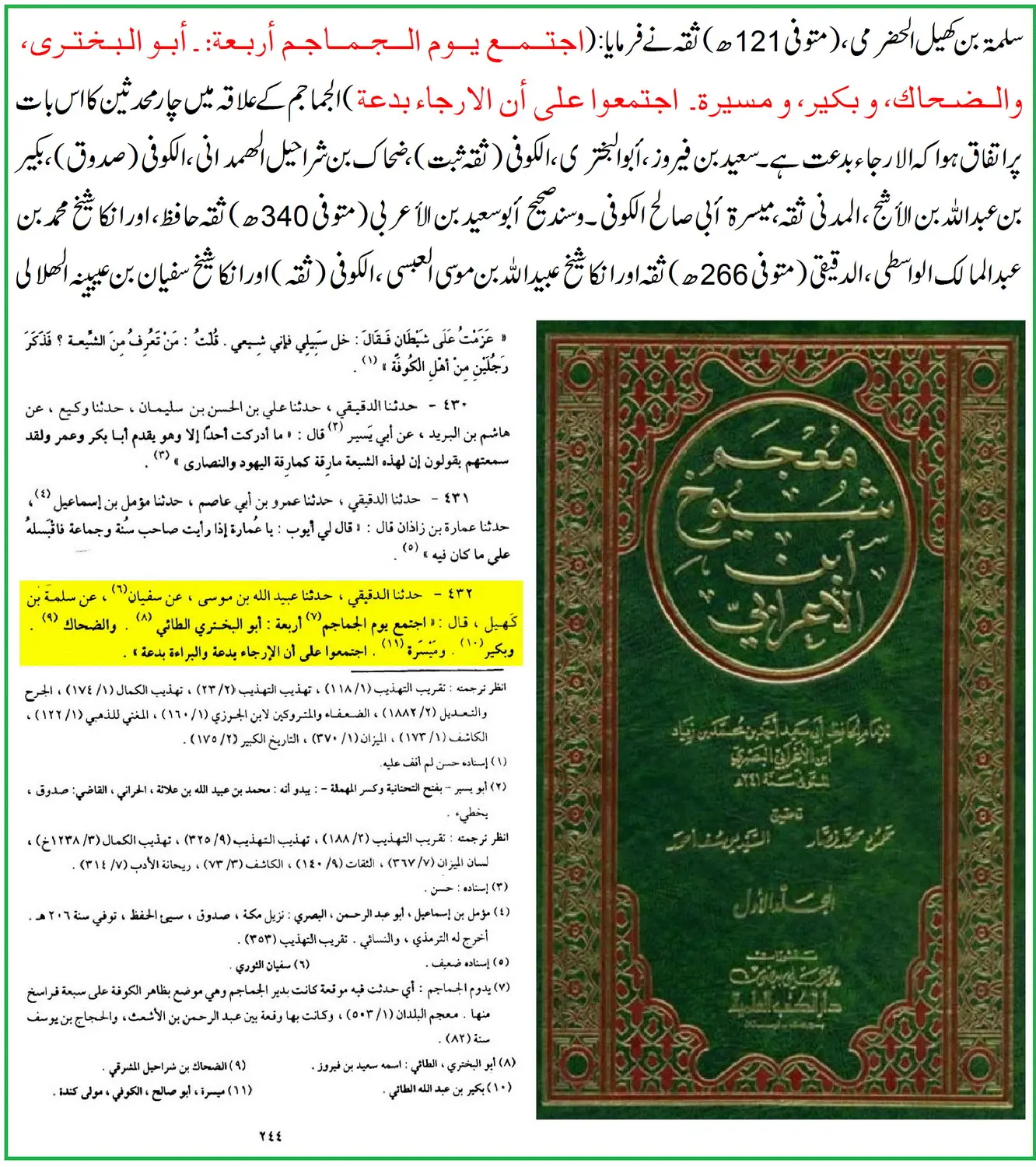
كان سفيان شديد القول في الإرجاء، وكان لا يسلم على حماد بن أبي سليمان لما صار مرجئًا.
Sufyan Al-Thawri was very strict in rejecting Arja’, to the extent that when Hammad bin Abi Sulayman became a Murji’i, he stopped greeting him.
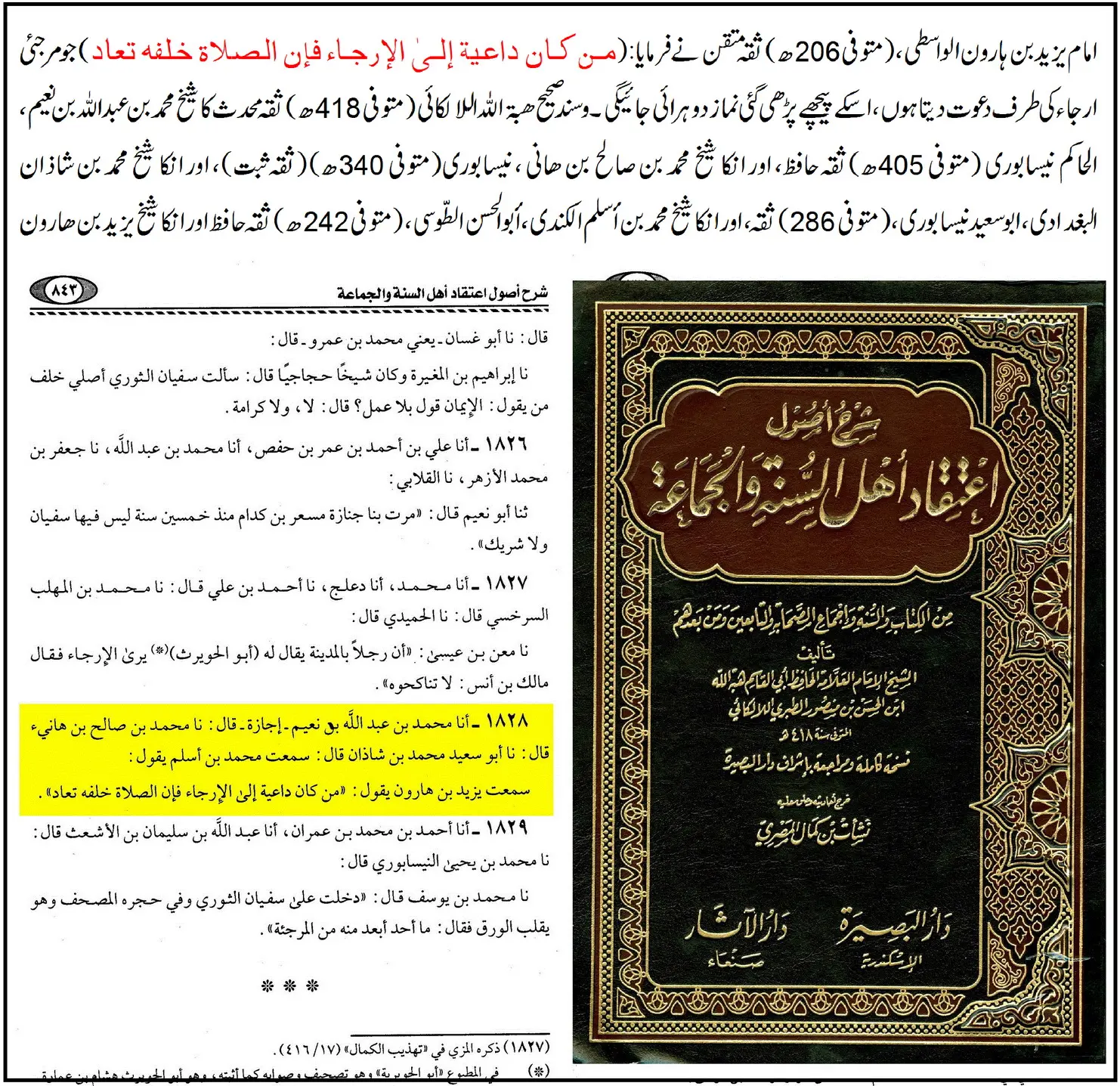
🔹 Fatwa of Imam Yazid bin Harun (206 AH)
من كان داعية إلى الإرجاء فإن الصلاة خلفه تُعاد.
Whoever invites to Murji’ah, the prayer offered behind him should be repeated.
📌 This severe fatwa proves that Murji’ah is the worst innovation in religion.
📌 Summary:
- Some sayings of Imam Abu Hanifa and his students were proponents of Murji’ah.
- Muhaddithin strongly refuted their Murji’ah beliefs and made some of them repent.
- Imams of Ahl al-Sunnah such as Sufyan al-Thawri, Yazid ibn Harun, Ibn Idris, and others forbade praying behind Murji’ah.
🔴 The Concept of Faith in the Fundamental Hanafi Jurisprudence Books – Excerpts from Al-Fiqh al-Akbar, Al-Nasafi, Al-Zubaidi, etc.
🔹 The Concept of Faith in “Al-Fiqh al-Akbar”
The book “Al-Fiqh al-Akbar,” attributed to Imam Abu Hanifa, contains this clarification regarding faith:
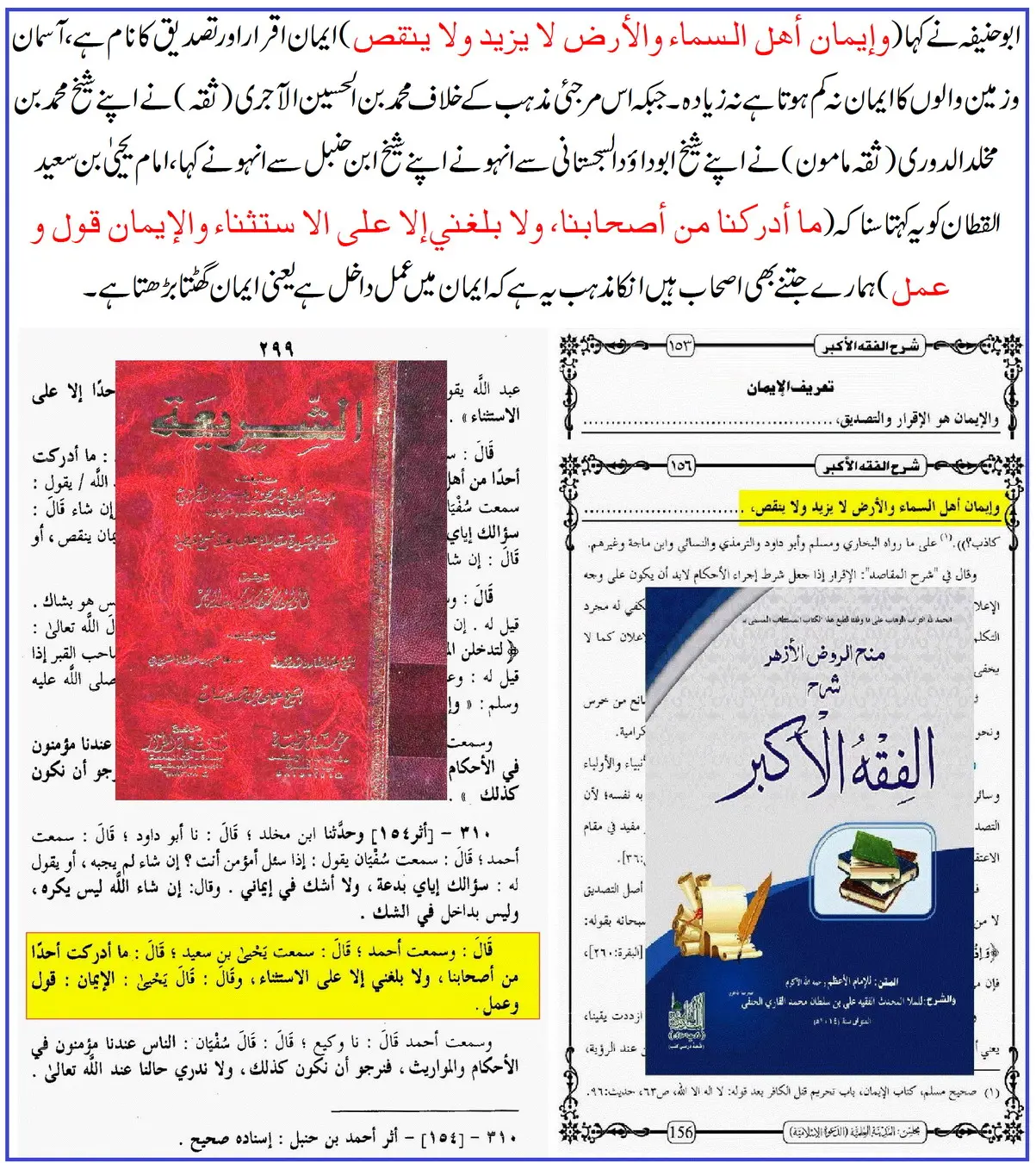
الإيمان هو الإقرار والتصديق، وإيمان أهل السماء والأرض لا يزيد ولا ينقص.
Faith is the name of verbal confession and affirmation, and the faith of all believers in the heavens and the earth neither increases nor decreases.
📌 This statement clearly represents the Murji’ah belief, in which faith is limited only to “confession and affirmation” and excludes deeds.
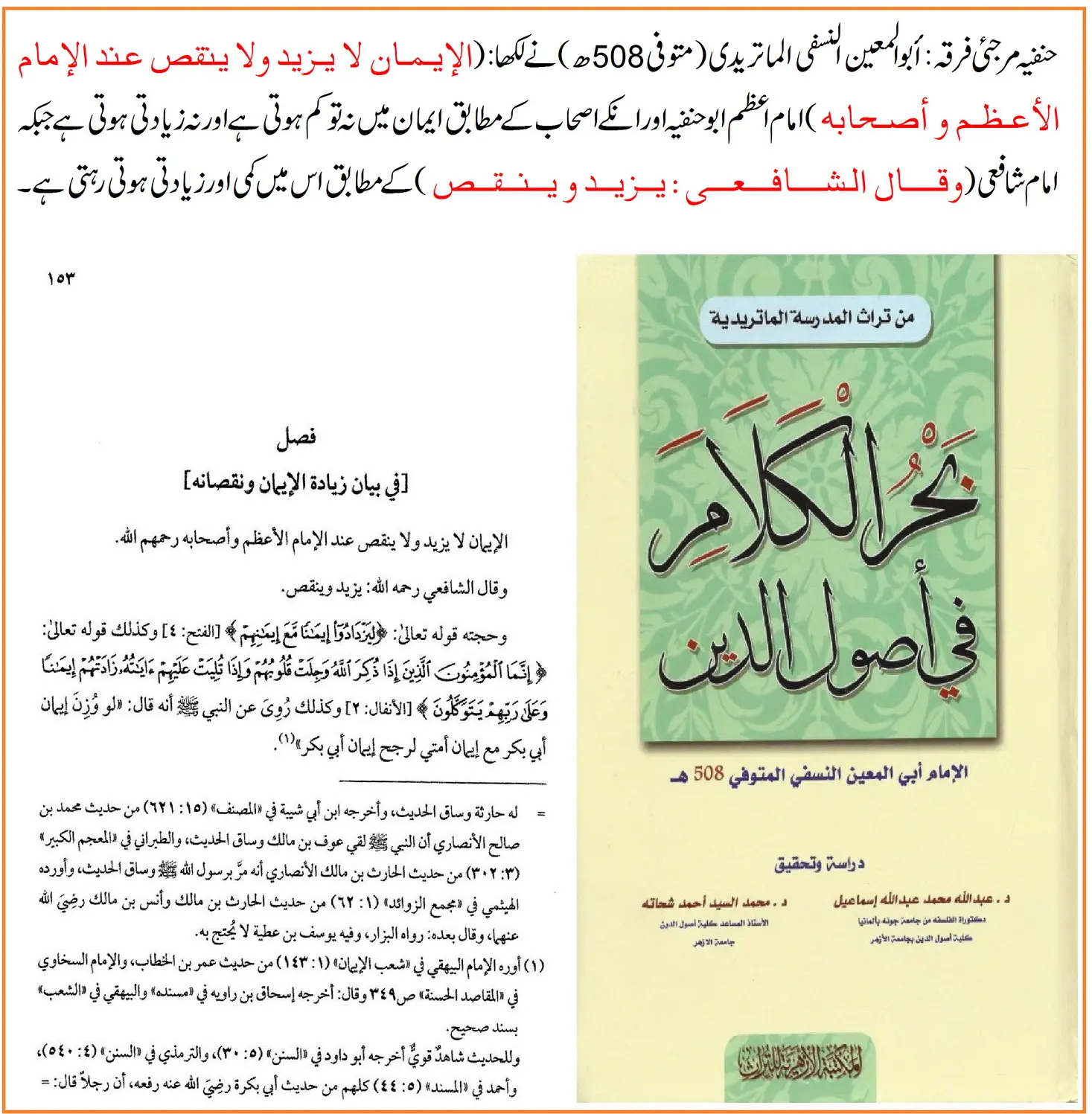
🔹 Abu al-Ma’in al-Nasafi al-Maturidi (508 AH)
An important representative of Hanafi theology, Abu al-Ma’in al-Nasafi writes:
قال الإمام أبو حنيفة رحمه الله تعالى: الإيمان لا يزيد ولا ينقص.
Imam Abu Hanifa, may Allah have mercy on him, said: Faith neither increases nor decreases.
📌 This theory is against the consensus belief of Ahl al-Sunnah according to which faith can increase and decrease.
🔹 Imam Abu Hayyan al-Andalusi (745 AH)
Imam Abu Hayyan, while explaining Imam Abu Hanifa’s theory, writes:
وقيل: لا يقبل الزيادة والنقصان، وهو مذهب أبي حنيفة.
Some say that faith neither increases nor decreases, and this is the belief of Imam Abu Hanifa.
🔹 Clarification by Imam al-Zabidi (1205 AH)
Imam al-Zabidi, the author of “تاج العروس”, clarified in “إتحاف السادة المتقين”:
وذهب أبو حنيفة وأصحابه إلى أن الإيمان لا يزيد ولا ينقص.
The position of Imam Abu Hanifa and his companions was that faith neither decreases nor increases.
🔹 Application in the belief of Ghassan bin Aban
As mentioned earlier, Ghassan, who was a student of Imam Muhammad bin Hasan al-Shaybani, also said the same:
الإيمان لا يزيد ولا ينقص… كقرص الشمس.
Faith neither increases nor decreases; it is like the disk of the sun.
📌 Thus, this belief of Murji’ah was prevalent in many circles within Hanafi jurisprudence.
🔹 Refutation by Imam Abu Dawood al-Sijistani
As mentioned earlier, Imam Abu Dawood established a chapter:
باب الدليل على زيادة الإيمان ونقصانه.
📘 It contains numerous authentic hadiths which prove that faith increases and decreases, and this is the belief of Ahl al-Sunnah.
📌 Summary:
- In fundamental Hanafi jurisprudence books such as “Al-Fiqh Al-Akbar,” “Bahr al-Kalam,” “Ithaf al-Sadah,” etc., the belief that faith neither increases nor decreases is clearly present.
- This is a clear deviation from the consensus belief of Ahl al-Sunnah.
- This belief was not only attributed to Imam Abu Hanifa but was also propagated by his followers.
🔴 The beliefs of the Murji’ah regarding prayer and deeds and the refutation by the Imams
🔹 The belief of the Murji’ah: Deeds are not part of faith
The fundamental belief of the Murji’ah was that faith is only “knowledge” or “acknowledgment,” and deeds have no relation to faith. According to them:
One who abandons deeds, if he has knowledge and acknowledgment, is a perfect believer.
📌 According to this theory:
- Prayer, fasting, zakat, Hajj — none of these are part of faith
- Whoever abandons these deeds but has affirmation in the heart is also a perfect believer
🔹 Explanation by Ibn Abd al-Barr (may Allah have mercy on him)
وأما أهل البدع فإن المرجئة قالت: تارك الصلاة مؤمن مستكمل الإيمان إذا كان مقراً غير جاحد ومصدقاً غير مستكبر، وحُكيت هذه المقالة عن أبي حنيفة وسائر المرجئة.
As far as the people of innovation (Ahl-e-Bid’ah) are concerned, the Murji’ah believe that a person who abandons prayer but does not deny it has complete faith. This statement is attributed to Imam Abu Hanifa and all Murji’ah.
🔹 Ibn Rajab Hanbali’s Indication
المرجئة يخرجون العمل من مسمى الإيمان، ويجعلونه شرطاً في الكمال لا في الحقيقة.
The Murji’ah exclude deeds from the meaning of faith and consider them a degree of perfection, not the reality of faith.
🔹 Sufyan Al-Thawri’s Explanation
نحن نقول: الإيمان قول وعمل، وهم يقولون: الإيمان قول ولا عمل.
We say faith is the name of both speech and action, while the Murji’ah say faith is only speech, not action.
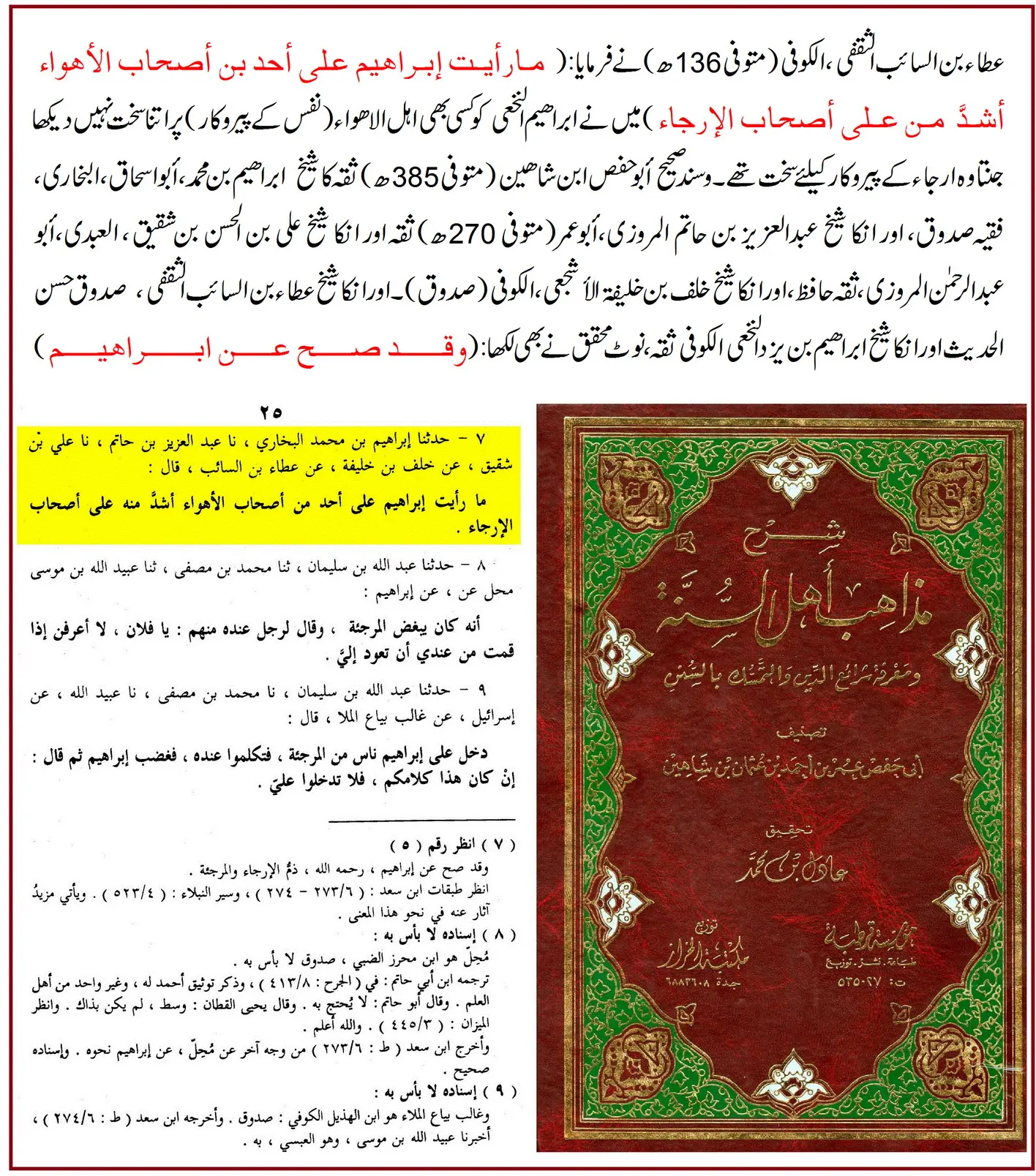
🔹 Ata bin Al-Sa’ib and the Anger of the Salaf
ما رأيت إبراهيم على أحد من أصحاب الأهواء أشدّ منه على أصحاب الإرجاء.
I never found Ibrahim Al-Nakha’i as harsh on any sect of innovation as he was on the Murji’ah.
🔹 Imam Barbahari’s Statement
من قال: الإيمان قول وعمل، يزيد وينقص، فقد خرج من الإرجاء كله أوله وآخره.
Whoever says faith is the name of speech and action and that it increases and decreases, he is completely free from the fitnah of the Murji’ah.
🔹 Imam Zuhri: The Worst Fitnah of the Murji’ah
ما ابتُدعت في الإسلام بدعة أعزّ على أهلها من هذا الإرجاء.
The most beloved and dangerous innovation in Islam, which is dear to its followers, is “Irja” (Murji’ism).
📌 Summary:
- The Murji’ah separated actions from faith.
- The result of this belief was that even those who abandoned prayer, zakat, Hajj, and fasting came to be considered “perfect believers.”
- All the Imams of religion, Muhaddithin, and jurists of Ahl al-Sunnah strongly refuted this.
🔴 Testimonies of Imam Dhahabiؒ, Ibn Kathirؒ, and other historians – Research opinions on Murji’ah
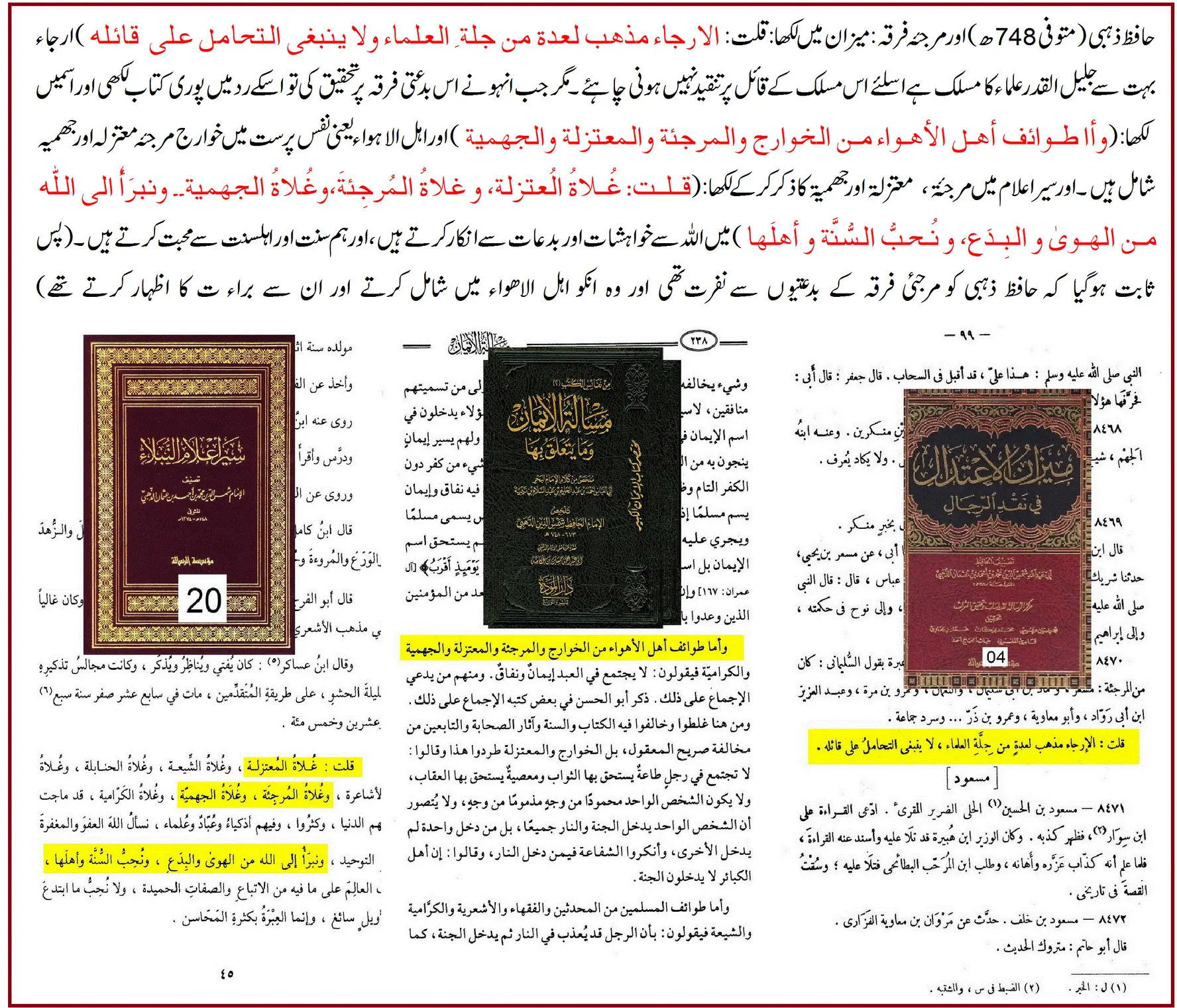
🔹 Position of Imam Shams al-Din al-Dhahabiؒ (748 AH)
قلت: الإرجاء مذهب لعدة من جلة العلماء، لا ينبغي التحامل على قائله.
I (Dhahabi) say: The Murji’ah is a sect adopted by many eminent scholars, therefore one should not be harsh on its adherents.
🔴 But this statement is from his early period.
🔹 Imam Dhahabi’s position after research
After further research on the Murji’ah belief, Imam Dhahabi counted it among the people of innovation:
وأما طوائف من أهل الأهواء من الخوارج والمرجئة والمعتزلة والجهمية…
And all those groups that are counted among the people of desires, such as the Kharijites, Murji’ah, Mu’tazilah, and Jahmiyyah…
🔸 In the end, Imam Dhahabi expressed disassociation by saying:
نبرأ إلى الله من الهوى والبدع، ونحب السنة وأهلها.
We declare disassociation before Allah from following desires and innovation, and we love the Sunnah and Ahl al-Sunnah.
📌 Summary: Imam Dhahabi counted Murji’ah among the “people of innovations” and “people of desires.”
🔹 Explanation by Hafiz Ibn Kathir (774 AH)
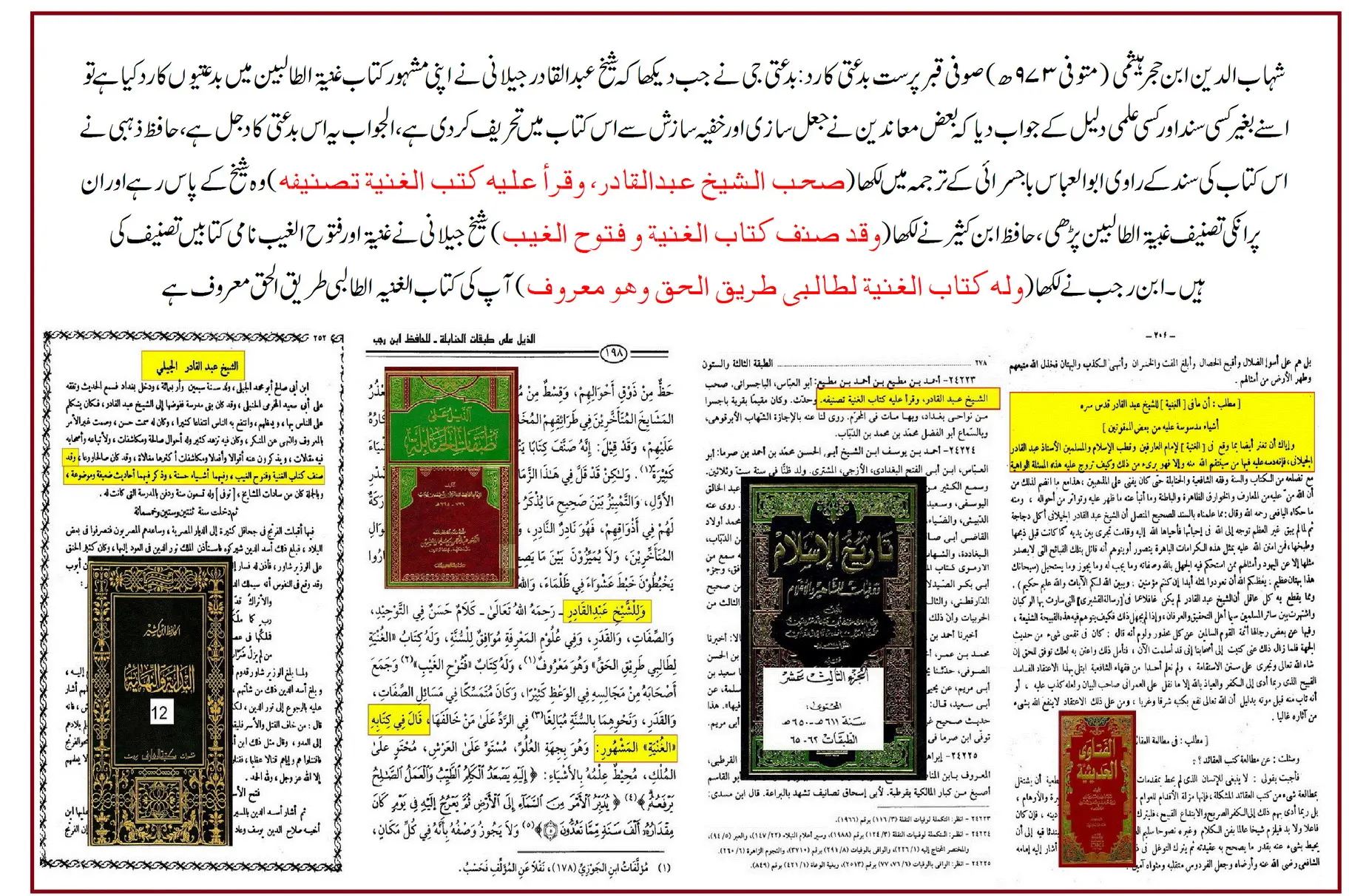
الشيخ عبد القادر الجيلي… وقد صنف كتاب الغنية وفتوح الغيب، وفيهما أشياء حسنة، وذكر فيهما أحاديث ضعيفة وموضوعة.
Sheikh Abdul Qadir Jilani authored “Al-Ghaniyyah” and “Futuh al-Ghaib,” which contain many good points as well as some weak and fabricated hadiths.
📌 Imam Ibn Kathir considered “Al-Ghaniyyah” to be a work of Sheikh Abdul Qadir and affirmed its attribution as correct.
🔹 Zain al-Din Ibn Rajab (795 AH)
Ibn Rajab, in his entire book “Jami’ al-‘Ulum wa al-Hikam,” clarified the beliefs of Ahl al-Sunnah against Murji’ah and declared Murji’ah as innovators.
المرجئة لا يدخلون العمل في مسمى الإيمان.
Murji’ah do not include deeds within the meaning of faith.
🔹 Imam Hafiz al-‘Iraqi (795 AH)
وله (عبد القادر الجيلاني) كتاب “الغنية” المشهور، قال فيه: وهو بجهة العلو مستوٍ على العرش.
In Sheikh Abdul Qadir Jilani’s famous book “Al-Ghaniyyah,” he states: Allah Almighty is established on the Throne with elevation.
🔸 This clarification proves that the accusation of distortion against “Al-Ghaniyyah” is false.
🔹 Hafiz Ahmad bin Ali al-Khatib al-Baghdadi (463 AH)
He also detailed in “Tarikh Baghdad” the objections of hadith scholars against Abu Hanifa and his students, such as:
سمعْتُ أبا إسحاق الفزاري يقول: سمعتُ أبا حنيفة يقول: إيمان أبي بكر وإبليس واحد…
I heard Imam Abu Ishaq Al-Fazari say: I heard Imam Abu Hanifa say that the faith of Abu Bakr Siddiq (RA) and Iblis is the same.
📌 Summary:
- Imam Dhahabi, Ibn Kathir, Ibn Rajab, and other prominent hadith scholars and historians declared Murji’ah beliefs as an innovation.
- Due to some sayings of Imam Abu Hanifa, his students, and followers, the theory of Murji’ah remained present in the early layers of Hanafi jurisprudence.
- “Al-Ghaniyyah” was not only declared authentic in chain of narration but also the accusation of its distortion was invalidated.
🔴 Complete Summary on Murji’ah, Imam Abu Hanifa’s Position, and the Consensus Belief of Ahl al-Sunnah wal-Jama’ah
🔹 Consensus Summary: Imam Abu Hanifa and Murji’ah
☑ Imam Abu Hanifa’s (may Allah have mercy on him) belief was:
- Faith is only the recognition and verbal declaration.
- Faith neither increases nor decreases.
- Actions are outside of faith.
📌 This is the fundamental belief of the Murji’ah.
📚 In the light of evidences:
- Imam Abdul Qadir Jilani (may Allah have mercy on him) counted the Hanafiyyah among the Murji’ah sects in “Al-Ghaniyah.”
- Abu al-Hasan al-Ash’ari, Shahrastani, Maqrizi, Ibn Abdul Barr, and other hadith scholars have given the same clarification.
- Hadith scholars like Imam Bukhari, Ibn Ma’in, Ibn al-Mubarak, Ahmad ibn Hanbal, Sufyan al-Thawri, Ibn Idris, Abu Ishaq al-Fazari severely criticized Imam Abu Hanifa’s beliefs.
- He was made to repent twice for Murji’ah beliefs.
- Some of his students were declared Murji’ah callers.
- A fatwa was issued that prayers offered behind some students, such as Abu Muti’ Balkhi, must be repeated.
🔹 Position of Ahl al-Sunnah wa al-Jama’ah
The unanimous belief of Ahl al-Sunnah wa al-Jama’ah is:
📌 Belief:
الإيمان قولٌ وعمل، يزيد بالطاعة، وينقص بالمعصية.
Faith is the name of both speech and action; it increases with obedience and decreases with sin.
📚 Consensus on this:
- Sufyan al-Thawri
- Imam Malik
- Imam Shafi’i
- Imam Ahmad ibn Hanbal
- Yahya ibn Ma’in
- Yazid ibn Harun
- Abdullah ibn Idris
- Abu Ubaid Qasim ibn Salam
- Ibn Rajab
- Ibn Taymiyyah
- Ibn al-Qayyim
- Imam Dhahabi
🔹 Consensus on Murji’ah being a misguided sect
✅ Agreed upon:
- The Murji’ah exclude deeds from faith
- The Murji’ah do not believe in increase or decrease in faith
- The Murji’ah also call those who abandon deeds “perfect believers”
- This ideology is a deviation from Ahl al-Sunnah
- The Imams severely criticized this
- Praying behind a Murji’ah is also considered disliked or invalid
🔴 Conclusion and Ending
📌 Murji’ism is not a minor jurisprudential disagreement, rather it is a distortion in the fundamental meaning of faith.
📌 Imam Abu Hanifa, may Allah have mercy on him, was a great Imam in jurisprudence, but his view regarding faith was against the consensus of Ahl al-Sunnah.
📌 Therefore, the pious predecessors did not remain silent about his Murji’ah view, but tried to correct it through refutation, fatwa, abandoning narration, abandoning greeting, and advice.
✅ Our Methodology
- We are Ahl al-Sunnah, and consider faith to be a combination of speech and deeds
- Whoever considers the Murji’ah belief as religion, we disassociate from him
- Whoever contradicts the consensus beliefs, despite his knowledge and jurisprudential greatness, we do not cover up his error
📎 This article is based on research, references, and the principles of academic integrity. If anyone criticizes it, the response should be given in an academic manner, not emotionally.
📌 All references, original Arabic excerpts, and sources have been fully included so that the reader can verify the research themselves.
📘 May Allah keep us steadfast on the truth, protect us from falsehood, and grant us the correct understanding of faith.
Screenshots of Important References