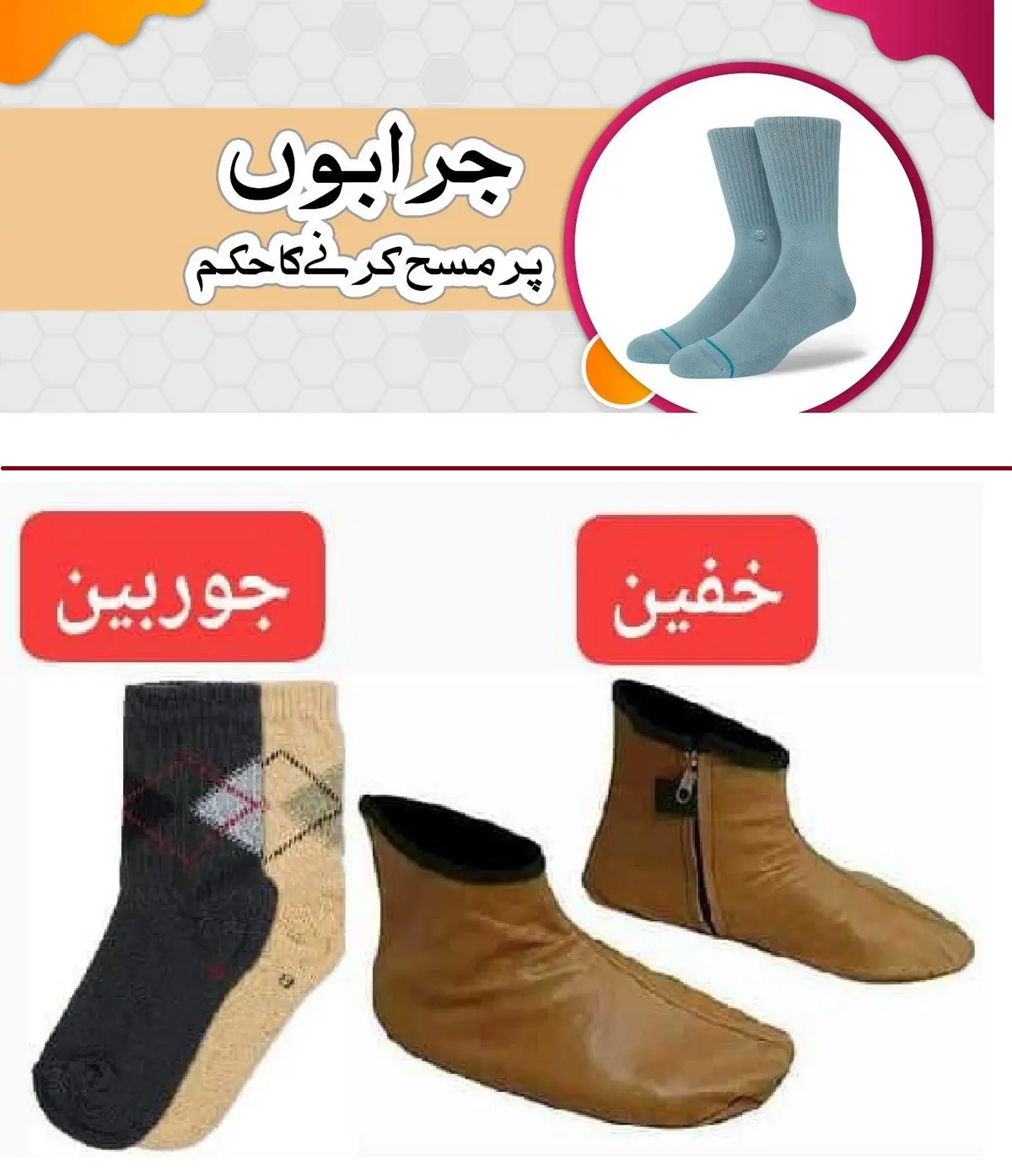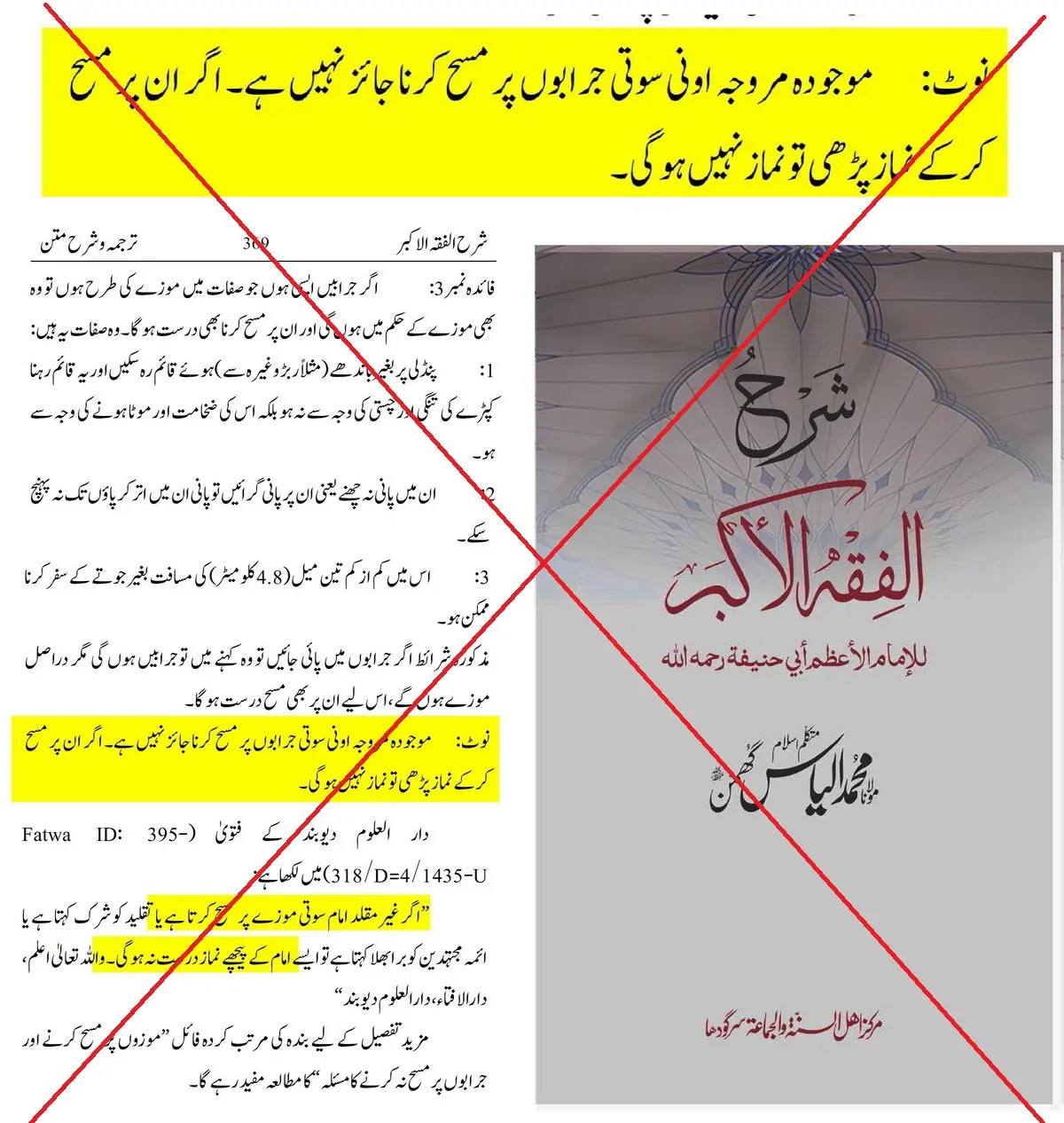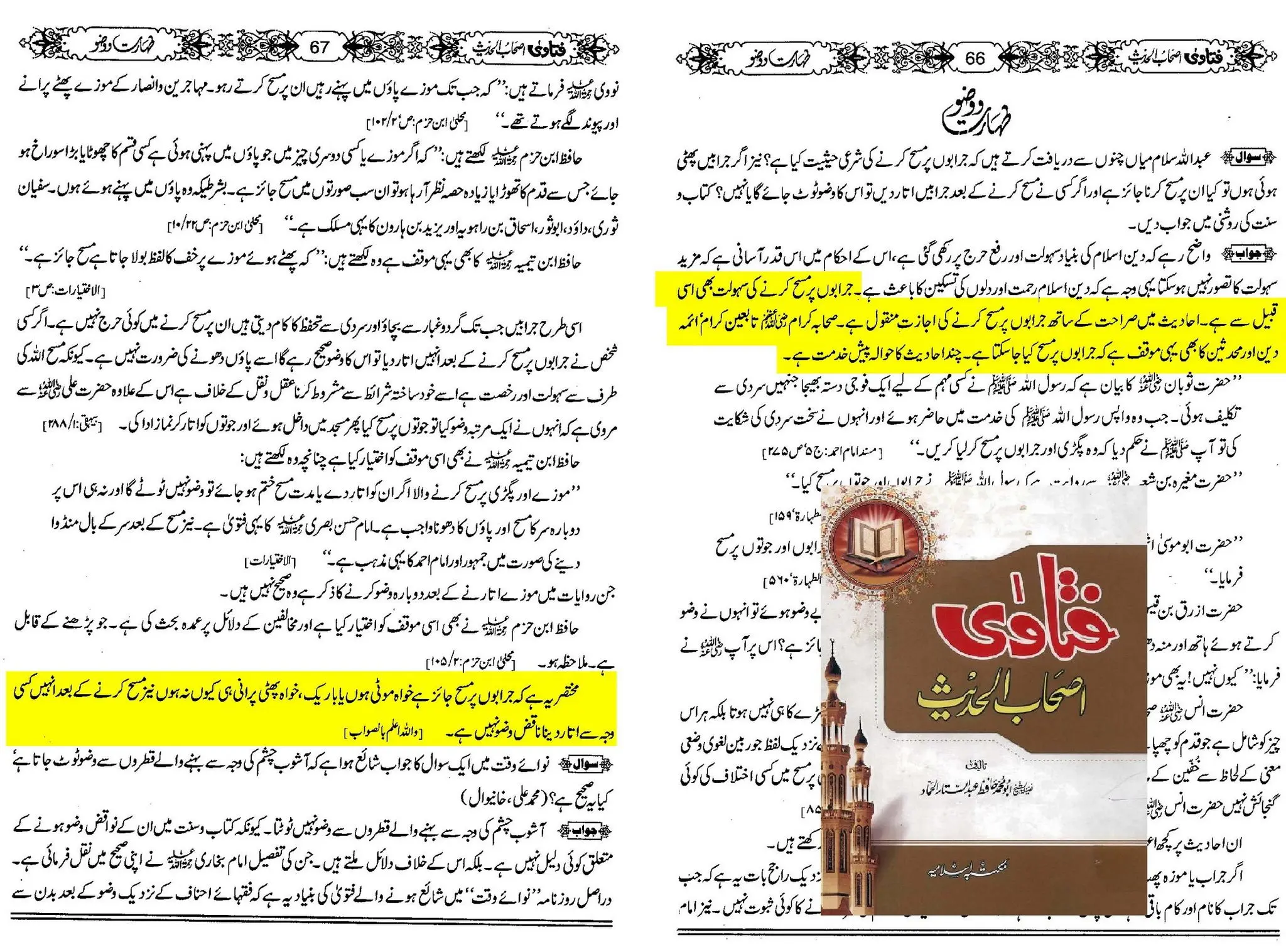
الجوربین (al-jawrabayn) refers to socks made of wool or cotton fabric, which are called “juraab” in Urdu, while الخُفَّیْن refers to socks made of leather. The only difference between the two is the material; otherwise, there is no fundamental difference in terms of ruling. Wiping over khuffain (leather socks) is authentically established with correct chains in Sahih Bukhari. However, the issue of wiping over al-jawrabayn, i.e., cloth socks, will be discussed in detail in this article with its evidences: first, the marfu‘ ahadith, then the practice and consensus approach of the Companions (may Allah be pleased with them), followed by the narrations (athar) of the Tabi‘in, then the fatwas of Ahl al-Hadith and the Hanafis, especially the retraction of Imam Abu Hanifa (may Allah have mercy on him), and finally a reasoned response to the anomalous (shadh) opinion attributed to Syed Nazir Hussain (may Allah have mercy on him).
Evidence from Marfu‘ Ahadith
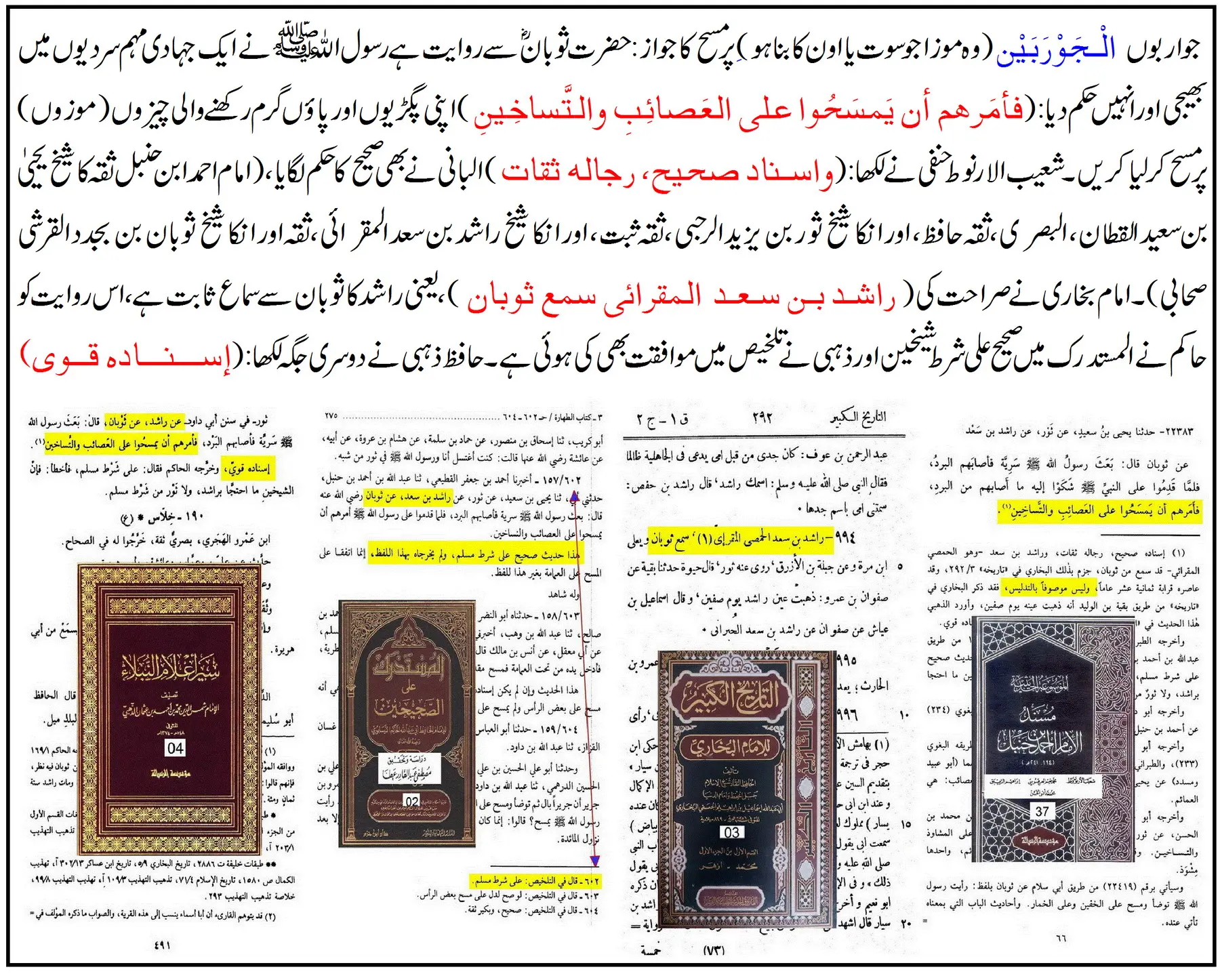
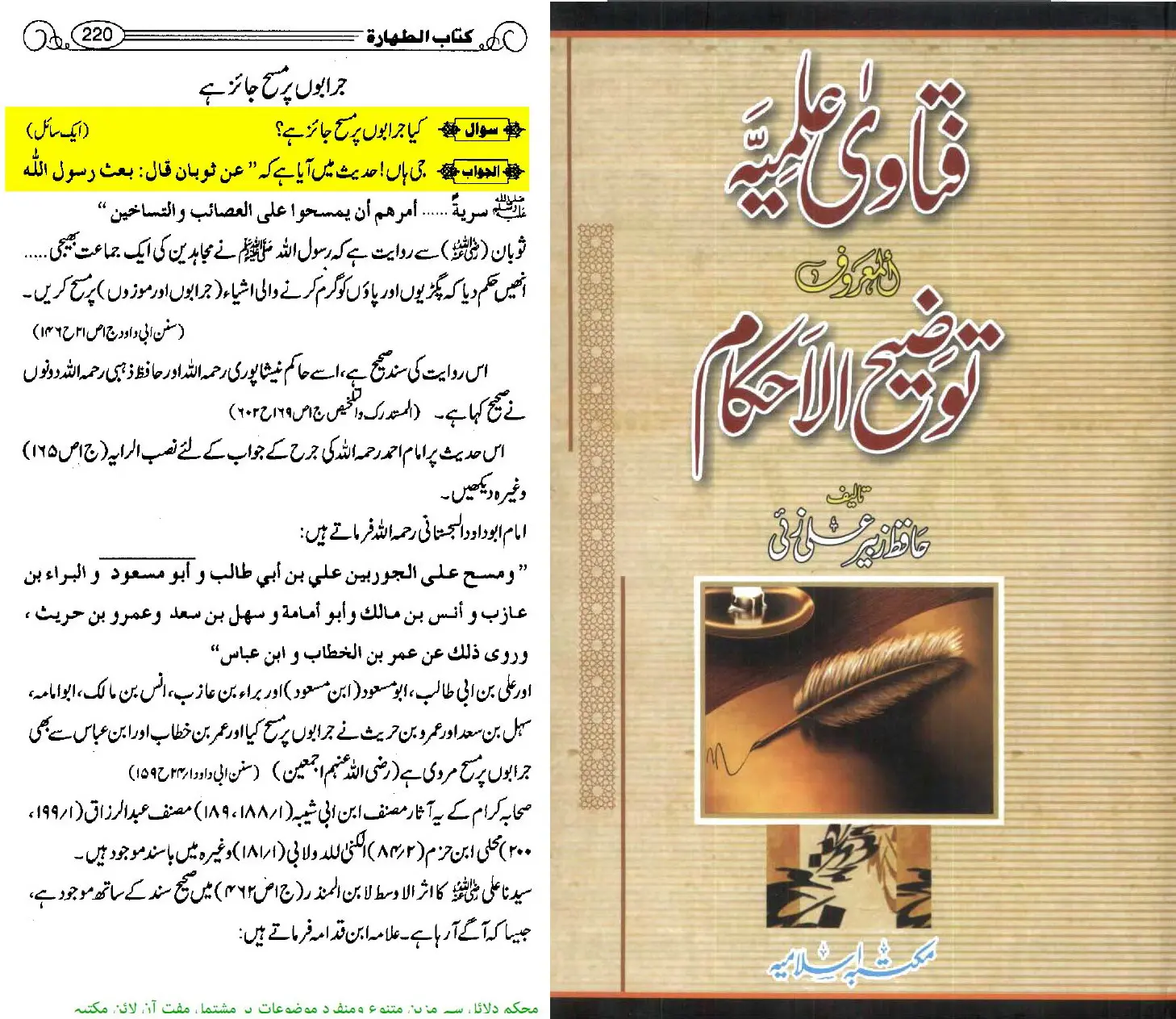
➊ Hadith of Thawban (RA) — “al-‘asa’ib wa al-tasakhin”
Arabic text:
بَابُ الْمَسْحِ عَلَى الْجَوْرَبَيْنِ
146 – حَدَّثَنَا أَحْمَدُ بْنُ مُحَمَّدِ بْنِ حَنْبَلٍ، حَدَّثَنَا يَحْيَى بْنُ سَعِيدٍ، عَنْ ثَوْرٍ، عَنْ رَاشِدِ بْنِ سَعْدٍ، عَنْ ثَوْبَانَ، قَالَ:
«بَعَثَ رَسُولُ اللَّهِ ﷺ سَرِيَّةً، فَأَصَابَهُمُ الْبَرْدُ، فَلَمَّا قَدِمُوا عَلَى رَسُولِ اللَّهِ ﷺ أَمَرَهُمْ أَنْ يَمْسَحُوا عَلَى الْعَصَائِبِ وَالتَّسَاخِينِ»
Translation: Hazrat Thawban (رضی اللہ عنہ) narrates that the Messenger of Allah ﷺ sent a group. They encountered severe cold. When they returned to the Messenger of Allah ﷺ, he ﷺ instructed them to wipe over their turbans (العصائب) and the items used to keep their feet warm (التساخین).
Ruling of the Hadith:
- Allama Albani: Authentic
- Shuaib Al-Arnaout: Chains authentic
- Imam Hakim: In Al-Mustadrak said “صحیح علی شرط مسلم”
- Hafiz Zahabi: Verified in Talkhees and Seer A’lam An-Nubala
Chain narrators:
- Imam Ahmad bin Hanbal
Reference: (Trustworthy, Hafiz, Jurist, Proof)
- Yahya bin Saeed Al-Qattan
Reference: (Imam, Hafiz, Role Model)
- Thawr bin Yazid Al-Rahbi
Reference: (Trustworthy, Reliable)
- Rashid bin Saad Al-Himsi
Reference: (Trustworthy, as mentioned by Bukhari in Al-Tarikh Al-Kabir)
- Companion of the Prophet, Hazrat Thawban (رضی اللہ عنہ)
➋ Narration from Al-Mustadrak of Al-Hakim
602 – أَخْبَرَنَا أَحْمَدُ بْنُ جَعْفَرٍ الْقَطِيعِيُّ، ثنا عَبْدُ اللَّهِ بْنُ أَحْمَدَ بْنِ حَنْبَلٍ، حَدَّثَنِي أَبِي، ثنا يَحْيَى بْنُ سَعِيدٍ، عَنْ ثَوْرٍ، عَنْ رَاشِدِ بْنِ سَعْدٍ، عَنْ ثَوْبَانَ، …«هذا حديث صحيح على شرط مسلم، ولم يخرجاه بهذا اللفظ… وله شاهد»
Translation: This hadith is authentic and meets Imam Muslim’s condition, however, he did not narrate it with these exact words; in his narration, only wiping over the turban is mentioned. This hadith also has another supporting narration.
➌ Narration from Seer A’lam An-Nubala
Thawr narrated: Rashid → Thawban (رضی اللہ عنہ): «بَعَثَ رَسُولُ اللَّهِ ﷺ سَرِيَّةً فَأَصَابَهُمُ الْبَرْدُ، فَأَمَرَهُم أَنْ يَمْسَحُوا عَلَى العَصَائِبِ وَالتَّسَاخِينِ»
Ruling: Its chain is strong.
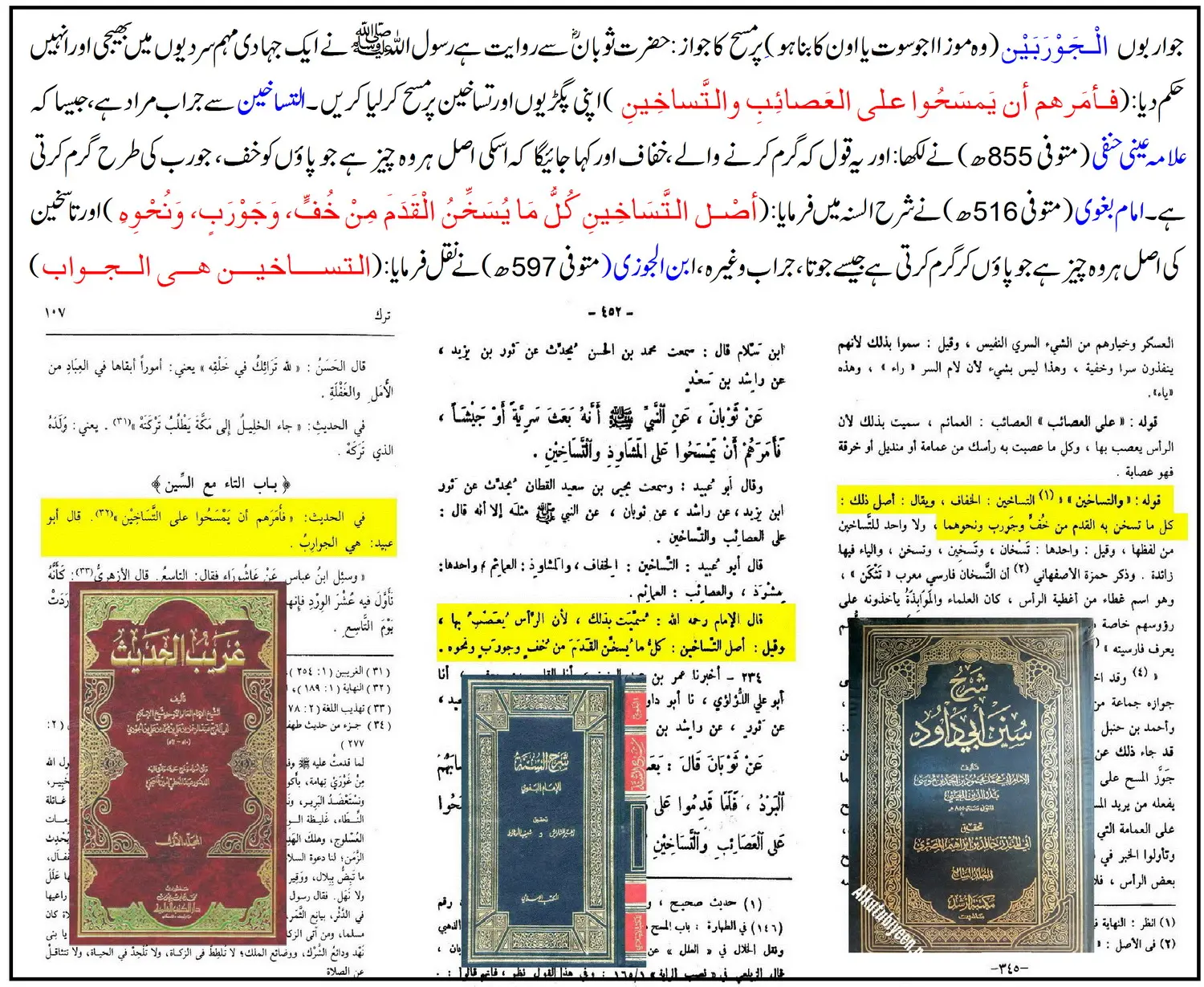
Explanation of “التساخین” from the sayings of the Muhaddithin
- Allama Ayni Hanafi (Sharh Sunan Abi Dawood): “التساخين: الخفاف، ويقال: أصل ذلك كل ما تسخن به القدم من خف وجورب ونحوهما”
Reference: (Sharh Sunan Abi Dawood, by Ayni)
Tasakhin: They are khuff (leather socks), and its original meaning is anything from which the feet receive warmth, whether khuff or socks.
- Imam Baghawi (Sharh al-Sunnah): “أصل التساخين كل ما يسخن القدم من خف وجورب ونحوه.”
Reference: (Sharh al-Sunnah by Baghawi 1/430)
The origin of tasakhin is anything that gives warmth to the feet, such as khuff or socks.
- Ibn al-Jawzi (Gharib al-Hadith): “في الحديث: فأمرهم أن يمسحوا على التساخين، قال أبو عبيد: هي الجوارب.”
Reference: (Gharib al-Hadith by Ibn al-Jawzi 2/207)
This hadith mentions that the Prophet ﷺ commanded them to wipe over the tasakhin. Abu Ubaid said: The meaning of this is socks.
📍 Summary: From this hadith of Thawban رضي الله عنه, it is understood that the Messenger of Allah ﷺ commanded wiping not only over the turban but also over the tasakhin (socks and stockings). The lexicographers and hadith scholars have clarified that tasakhin includes cloth socks as well, therefore this hadith is a clear basis for the permissibility of wiping over socks.
➊ Hadith of Mughirah bin Shu’bah رضي الله عنه — Wiping over socks and shoes
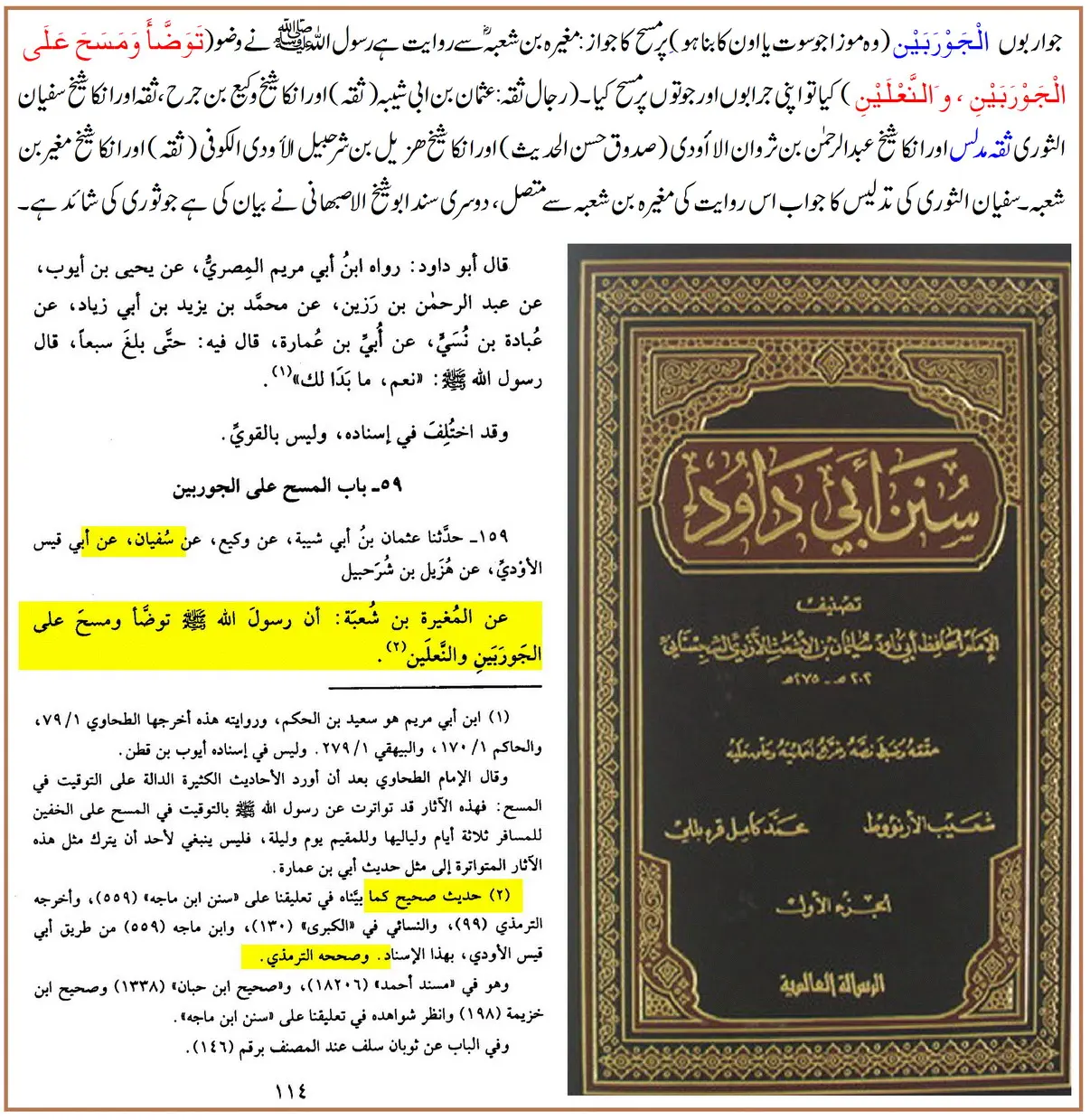
Arabic text: 159 – حَدَّثَنَا عُثْمَانُ بْنُ أَبِي شَيْبَةَ، عَنْ وَكِيعٍ، عَنْ سُفْيَانَ الثَّوْرِيِّ، عَنْ أَبِي قَيْسٍ الْأَوْدِيِّ (عبد الرحمن بن ثروان)، عَنْ هُزَيْلِ بْنِ شُرَحْبِيلَ، عَنِ الْمُغِيرَةِ بْنِ شُعْبَةَ،
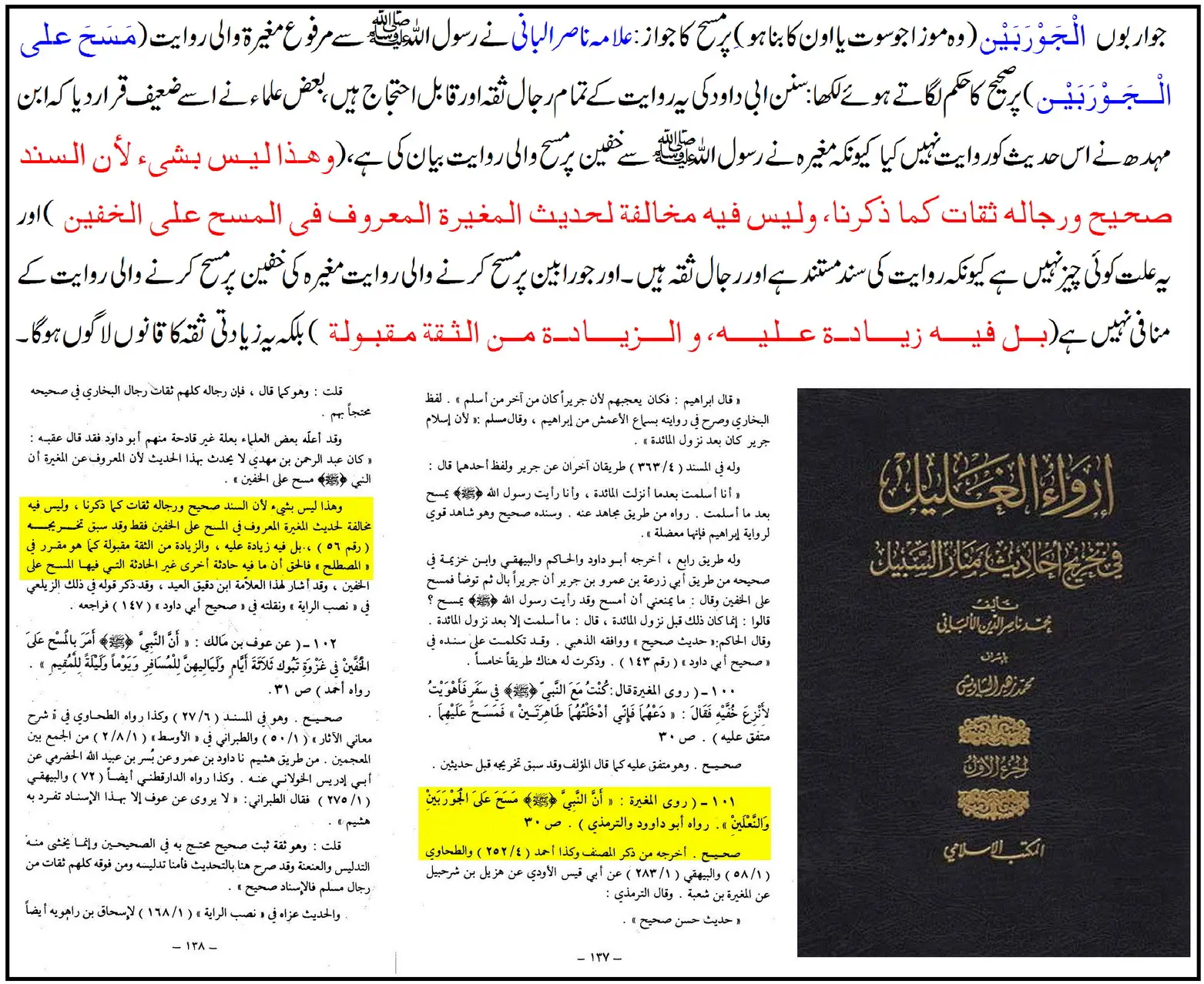
Translation: Mughirah bin Shu’bah رضي الله عنه narrates that the Messenger of Allah ﷺ performed ablution and wiped over his socks (al-jawribayn) and shoes (al-nalayn).
«أَنَّ رَسُولَ اللَّهِ ﷺ تَوَضَّأَ وَمَسَحَ عَلَى الْجَوْرَبَيْنِ وَالنَّعْلَيْنِ»
Hadith Ruling:
- Allama Albani: Sahih
- Reliable narrators are: Uthman bin Abi Shaybah (Thiqah Hafiz), Waki’ (Thiqah Hafiz), Sufyan Thawri (Thiqah Hafiz), Abu Qais (Saduq Hasan al-Hadith), Huzayl bin Shurahbil (Thiqah)
Note: Sufyan Thawri is a mudallis and the narration is mu‘an‘an, but this narration is strengthened by other chains.
➋ Narration of Abi al-Sheikh al-Asbahani
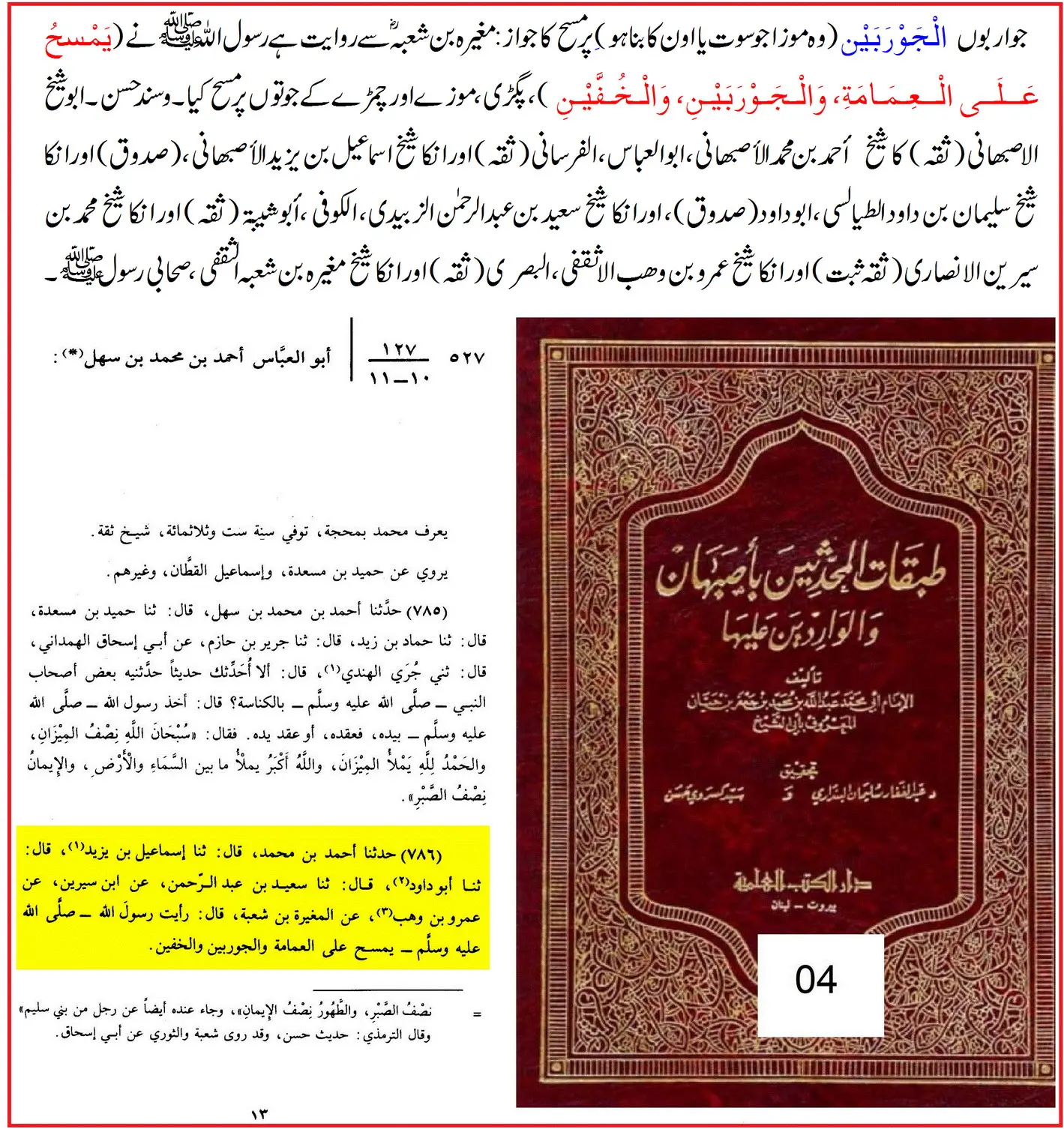
Arabic text: «رَأَيْتُ رَسُولَ اللَّهِ ﷺ يَمْسَحُ عَلَى الْعِمَامَةِ، وَالْجَوْرَبَيْنِ، وَالْخُفَّيْنِ»
Translation: Hazrat Mughirah bin Shu’bah (RA) says: I saw the Messenger of Allah ﷺ performing wudu and wiping over the turban, socks, and khuffs.
Ruling: The chain is Hasan. (Among the narrators, Muhammad bin Sirin, Amr bin Wahb, all are trustworthy)
📍 This narration supports the first narration and also removes the objection regarding Sufyan Thawri’s tadlis.
➌ Statements of the Muhaddithin
- Imam Tirmidhi (may Allah have mercy on him) narrated Mughirah’s (RA) narration and said:
“حدیث حسن صحیح”
- Allama Albani (may Allah have mercy on him) said:
“This narration is Sahih, and all its narrators are trustworthy.”
- Allama Mubarakpuri (may Allah have mercy on him) (Sharh Mishkat):
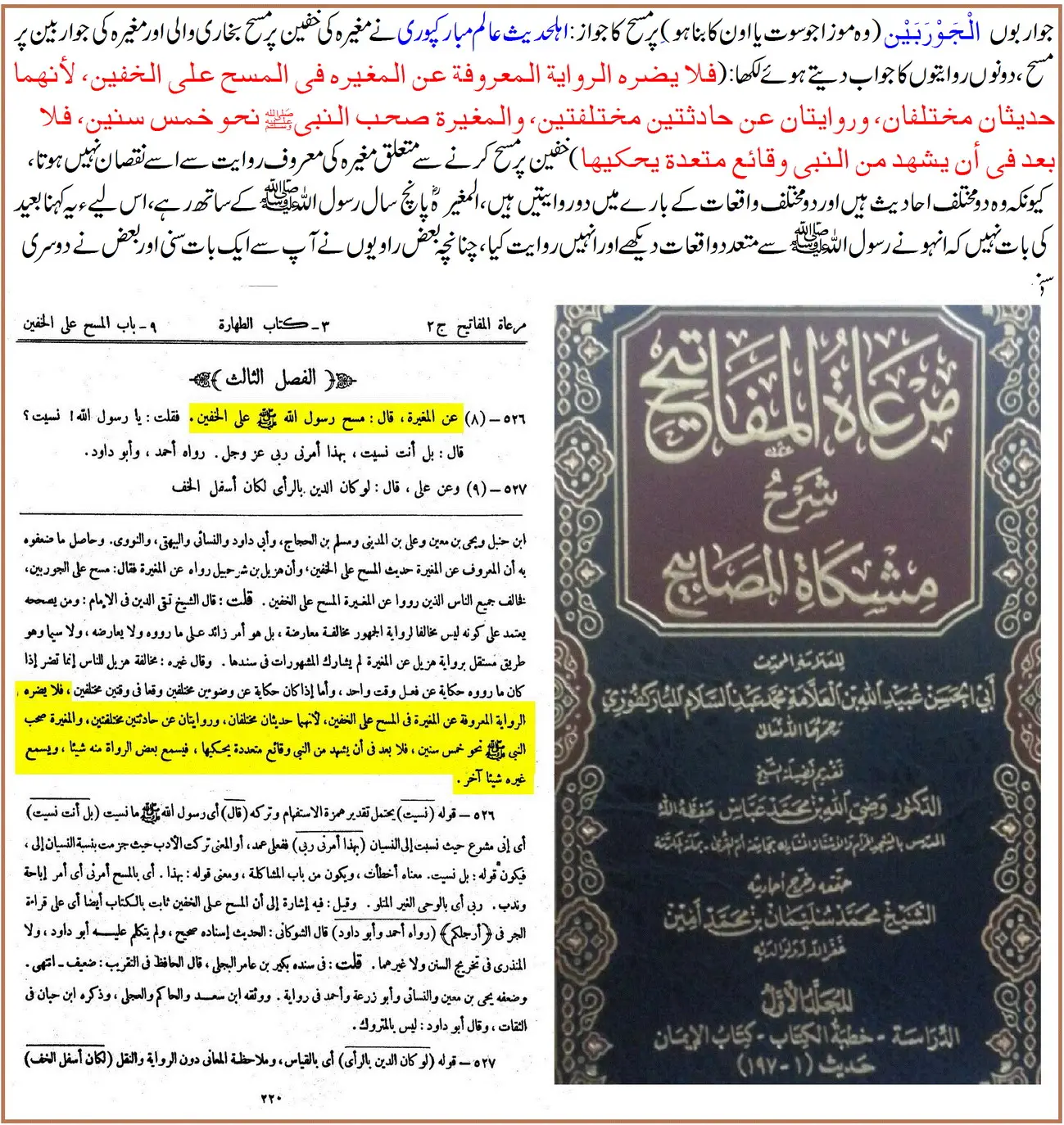
There are two types of narrations from Mughirah (RA): sometimes wiping over khuffs is mentioned, sometimes over socks. These are two separate incidents, and there is no contradiction in this.
📍 Summary: There is an explicit narration from Hazrat Mughirah bin Shu’bah (RA) that the Prophet Muhammad ﷺ wiped over the socks. This narration is established through multiple chains of transmission, and the hadith scholars have classified it as Hasan and Sahih. This makes it clear that wiping over the socks is a Marfoo’ Sunnah, not just a practice of the Companions or the Followers.
The Practices of the Companions (RA) and the Consensus Approach
Wiping over the socks (al-jurabayn) is not only proven by Marfoo’ hadiths but also abundantly supported by the practices of the Companions (RA) themselves. Many Companions not only practiced it but also gave fatwas to their students based on it. This shows that wiping over the socks is a unanimously agreed upon issue among Ahl al-Sunnah.
➊ Hazrat Ali bin Abi Talib (RA)
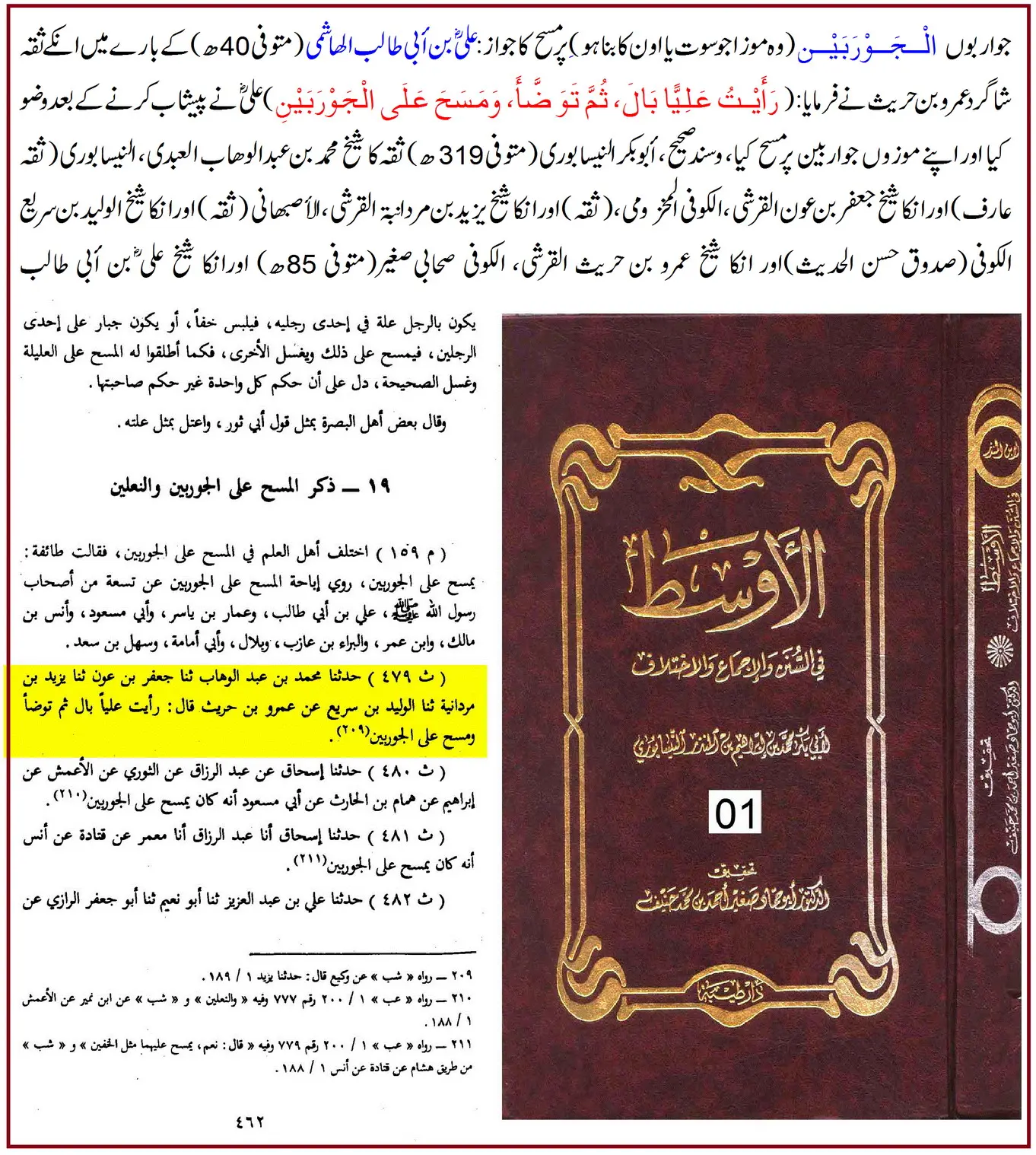
Arabic text: «رَأَيْتُ عَلِيًّا بَالَ، ثُمَّ تَوَضَّأَ، وَمَسَحَ عَلَى الْجَوْرَبَيْنِ»
Translation: Amr bin Huraith says: I saw Hazrat Ali (RA) urinate, then perform ablution, and wipe over his socks.
Ruling: The chain of narration is authentic.
➋ Hazrat Anas bin Malik (RA)
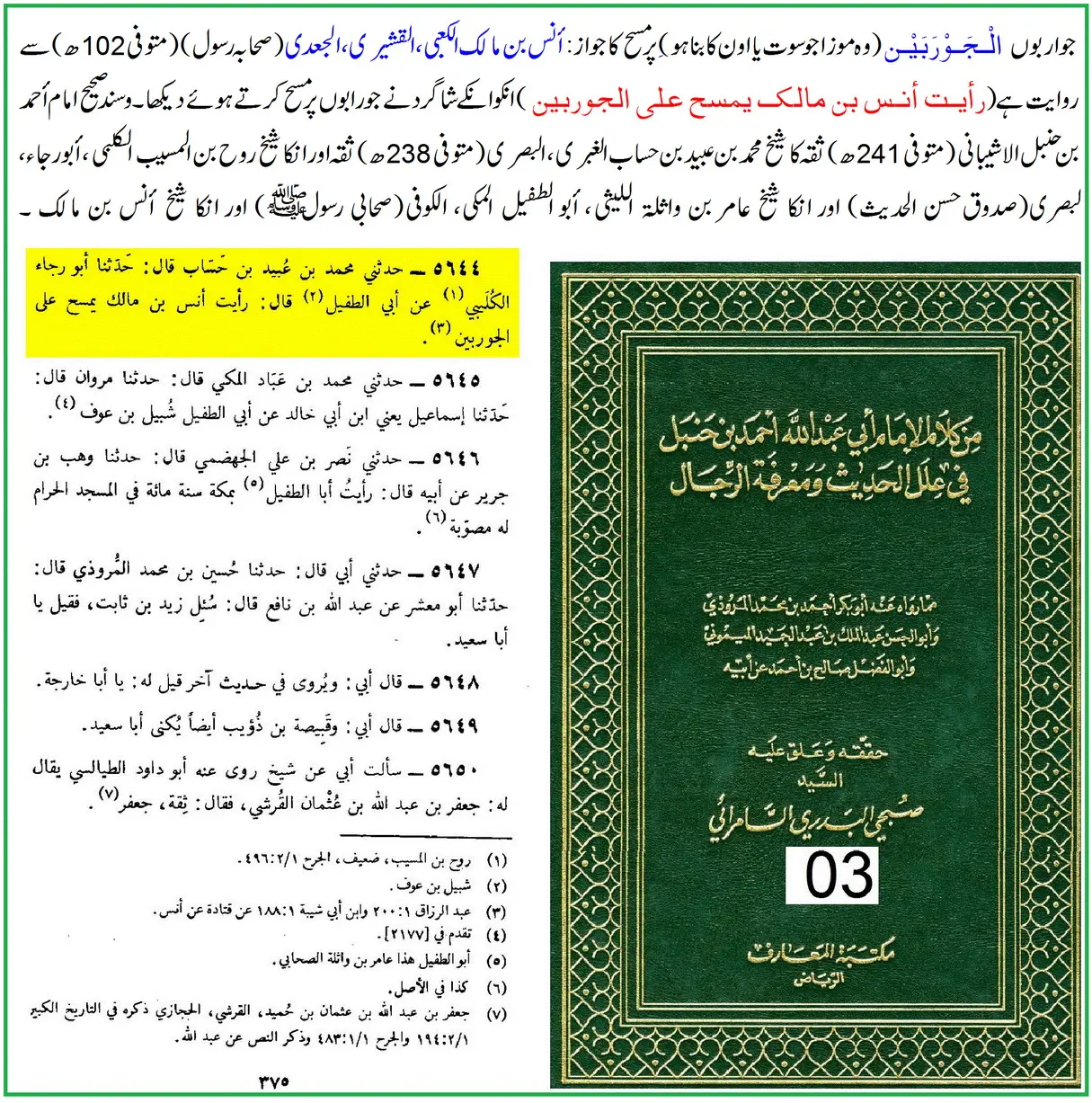
Arabic text: «رَأَيْتُ أَنَسَ بْنَ مَالِكٍ يَمْسَحُ عَلَى الْجَوْرَبَيْنِ»
Translation: Abu Tufail says: I saw Hazrat Anas bin Malik (RA) wiping over his socks.
Ruling: The chain of narration is authentic.
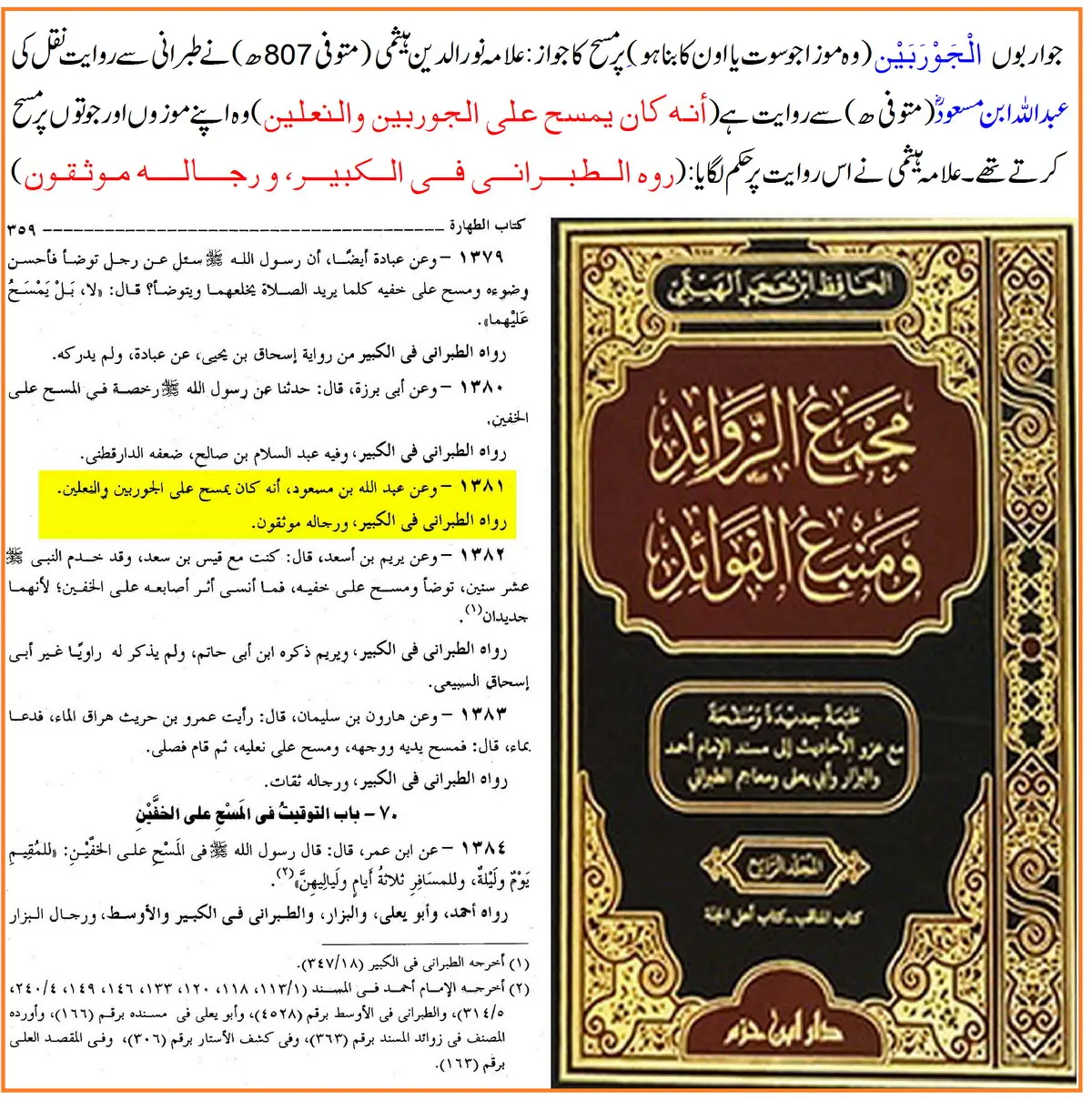
➌ Hazrat Abdullah bin Masood (RA)
Arabic text: «أَنَّهُ كَانَ يَمْسَحُ عَلَى الْجَوْرَبَيْنِ وَالنَّعْلَيْنِ»
Translation: Hazrat Abdullah bin Masood (RA) used to wipe over his socks and shoes.
Ruling: Allama Haithami said: His narrators are trustworthy (all his narrators are reliable).
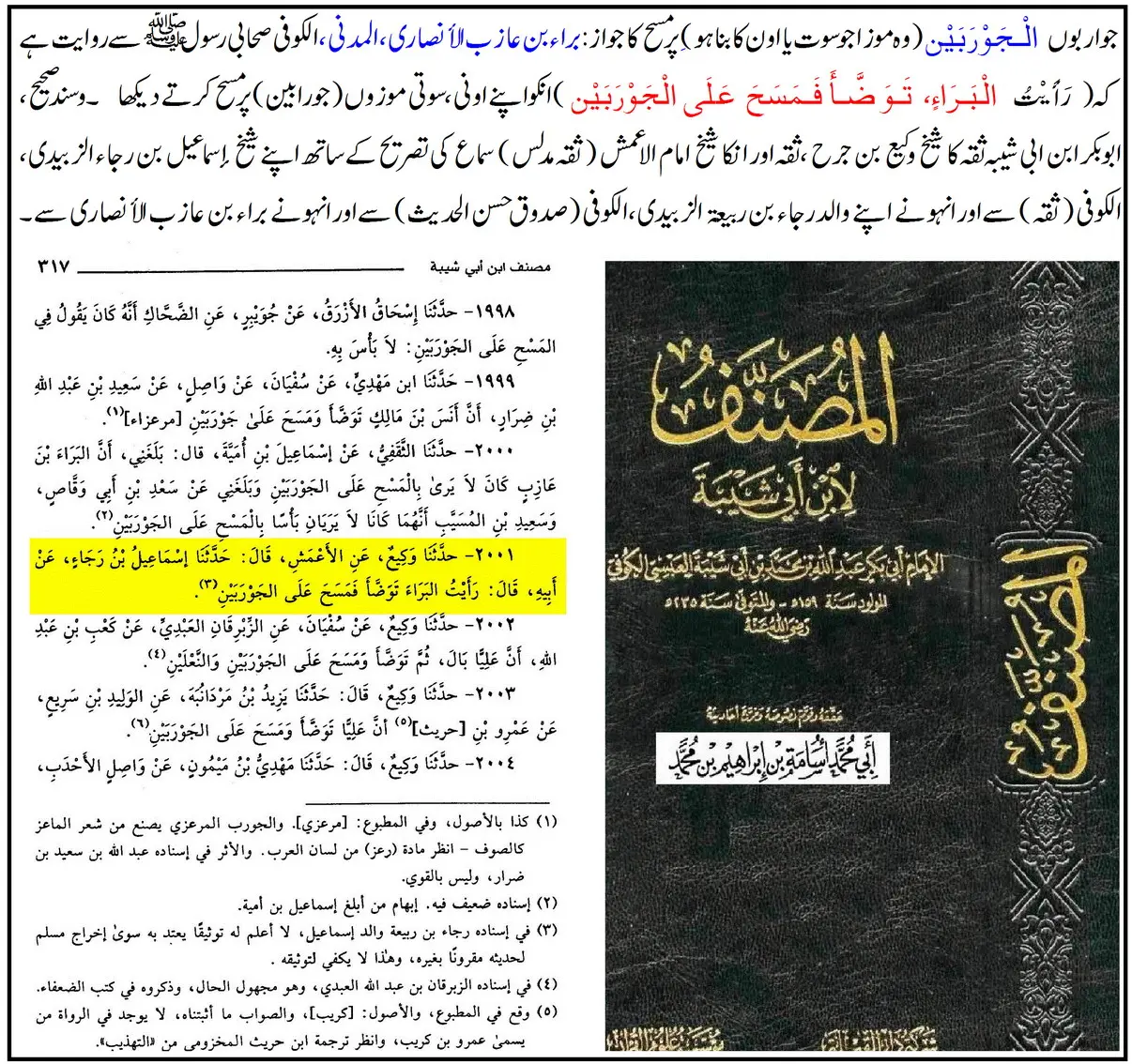
➍ Hazrat Bara’ bin Azib (RA) and Hazrat Saad bin Abi Waqqas (RA)
Arabic text: «أَنَّ الْبَرَاءَ بْنَ عَازِبٍ كَانَ لَا يَرَى بَأْسًا بِالْمَسْحِ عَلَى الْجَوْرَبَيْنِ، وَبَلَغَنِي عَنْ سَعْدِ بْنِ أَبِي وَقَّاصٍ وَسَعِيدِ بْنِ الْمُسَيِّبِ أَنَّهُمَا كَانَا لَا يَرَيَانِ بَأْسًا بِالْمَسْحِ عَلَى الْجَوْرَبَيْنِ»
Translation: Hazrat Bara’ bin Azib (RA) considered wiping over socks permissible. It is also reported about Hazrat Saad bin Abi Waqqas (RA) and Hazrat Saeed bin Al-Musayyib (may Allah have mercy on him) that they too considered wiping over socks permissible.
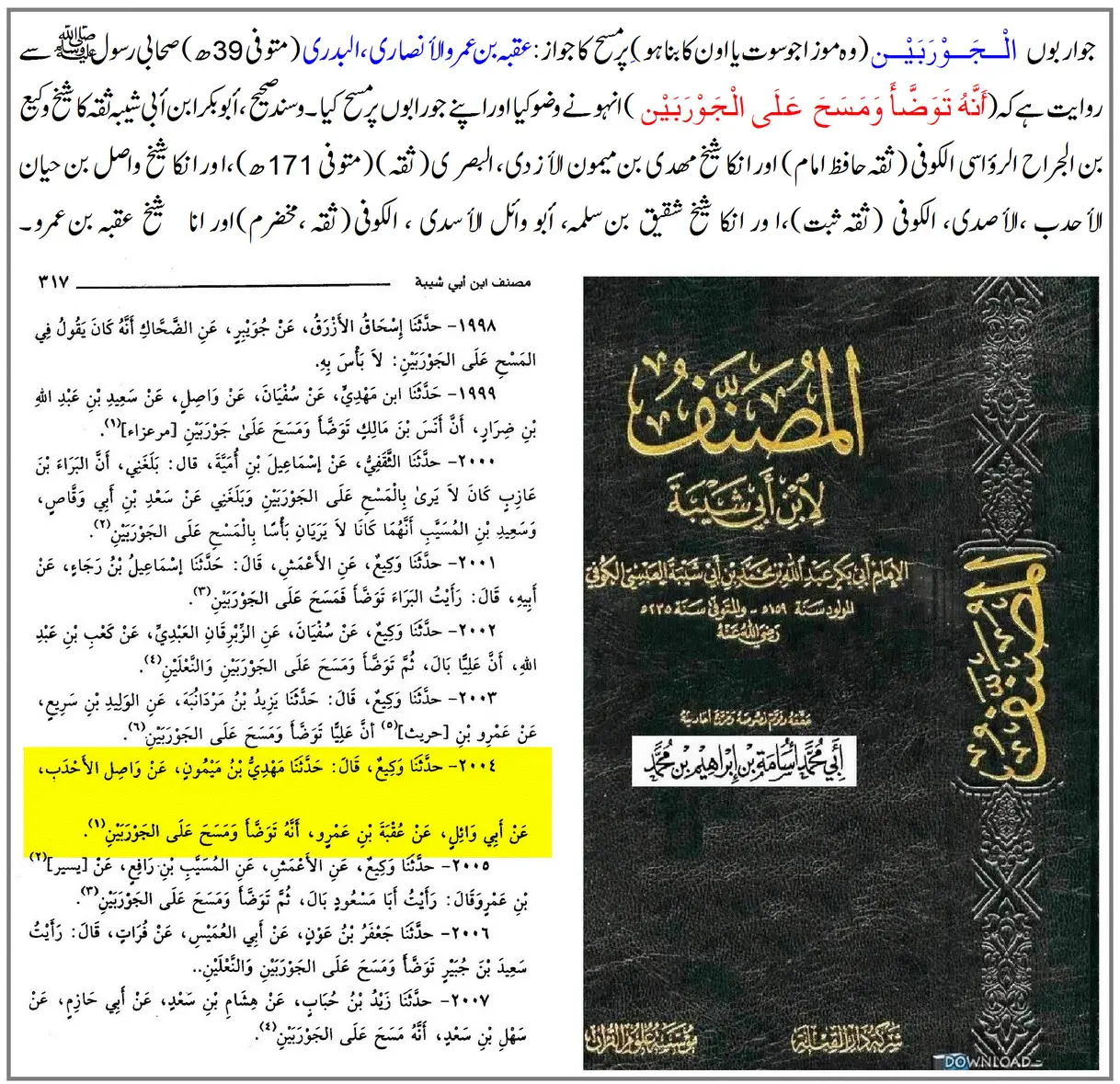
➎ Hazrat Uqbah bin Amr (RA) (Abu Masood Ansari)
Arabic text: «أَنَّهُ تَوَضَّأَ وَمَسَحَ عَلَى الْجَوْرَبَيْنِ»
Translation: Hazrat Uqbah bin Amr (RA) performed ablution and wiped over his socks.
Ruling: The chain of narration is authentic.
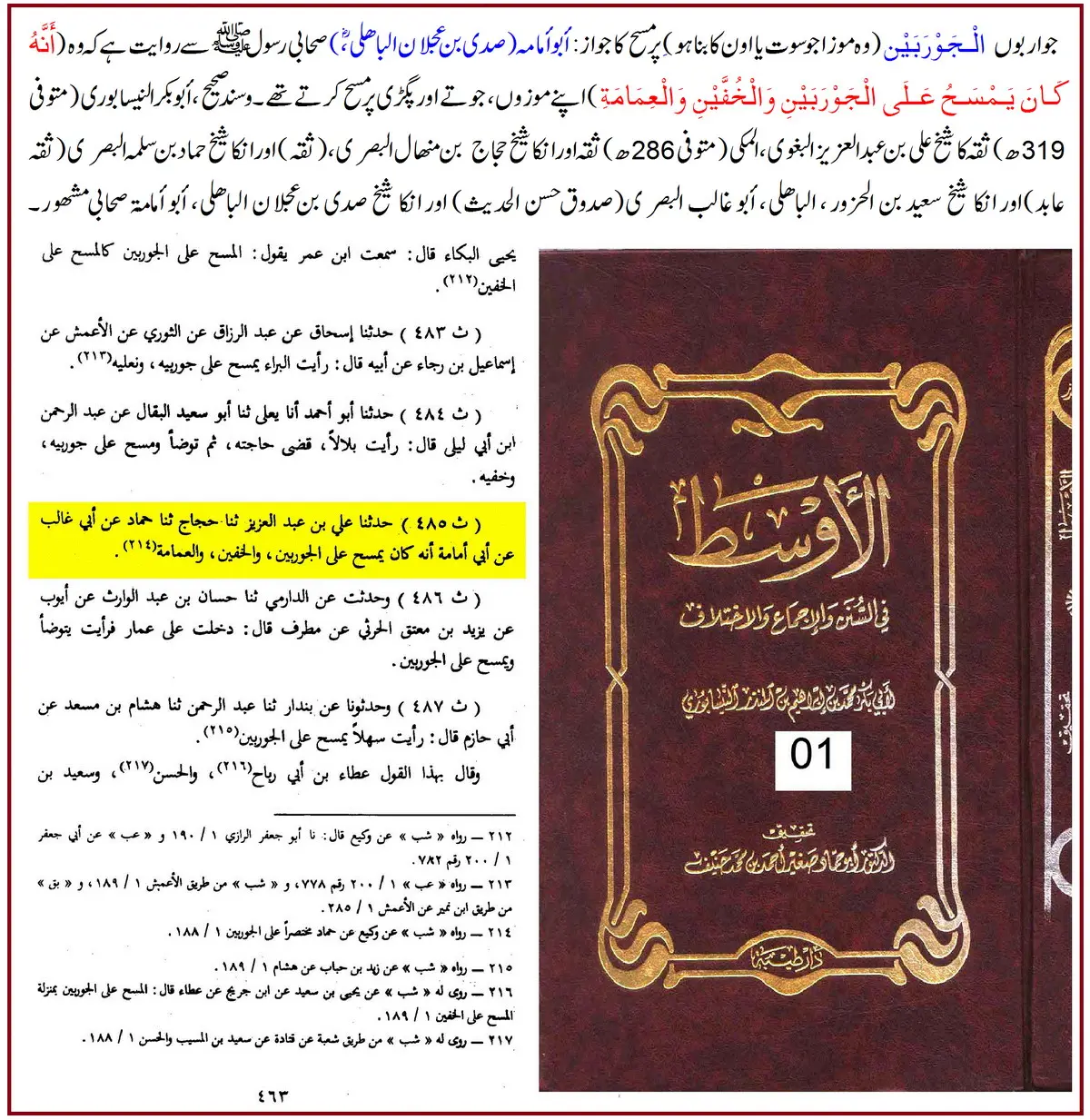
➏ Hazrat Abu Umamah Bahili (RA)
Arabic text: «أَنَّهُ كَانَ يَمْسَحُ عَلَى الْجَوْرَبَيْنِ وَالْخُفَّيْنِ وَالْعِمَامَةِ»
Translation: Hazrat Abu Umamah (RA) used to wipe over his socks, khuffain (leather socks), and turban.
Ruling: The chain of narration is authentic.
📍 Summary: From all these evidences, it is clear that Hazrat Aliؓ, Anasؓ, Ibn Mas’udؓ, Bara’ؓ, Sa’dؓ, Uqbahؓ, and Abu Umamahؓ, along with many other companions, used to perform wiping over socks. There is no narration from any companion opposing this. Therefore, it can be said that there was a practical consensus (Ijma‘) among the companions regarding the permissibility of wiping over socks.
Statements of the Tabi‘in and Imams of the Salaf
After the Marfu‘ Ahadith and the unanimous practice of the companions, the narrations of the Tabi‘in and the Imams of the Salaf also clarify the permissibility of wiping over socks (al-jawrabayn). The senior jurists and muhaddithun of this group declared it permissible and interpreted it under the ruling of wiping over khuffain (leather socks).
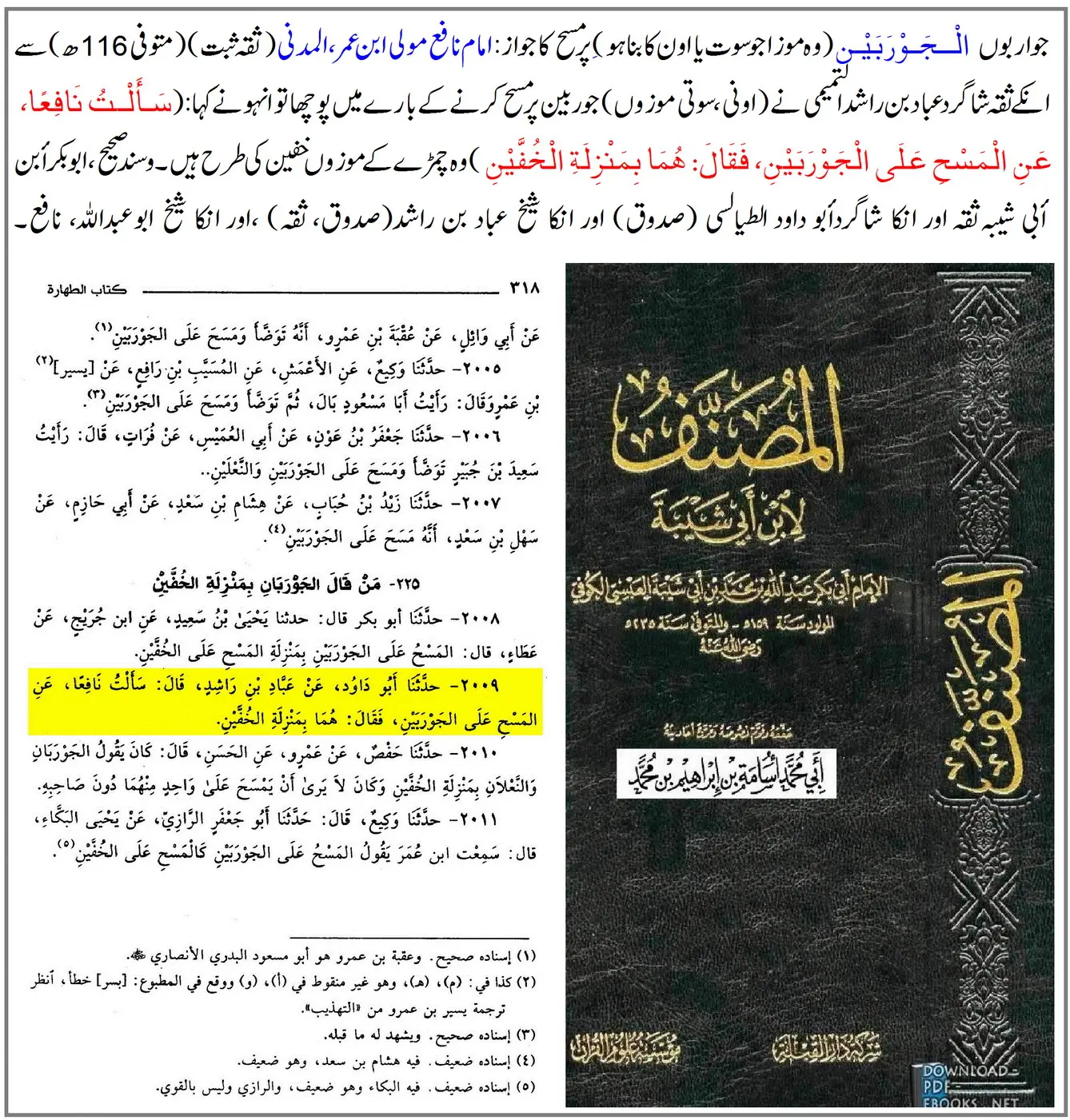
➊ Nafi‘ Mawla Ibn Umarؓ
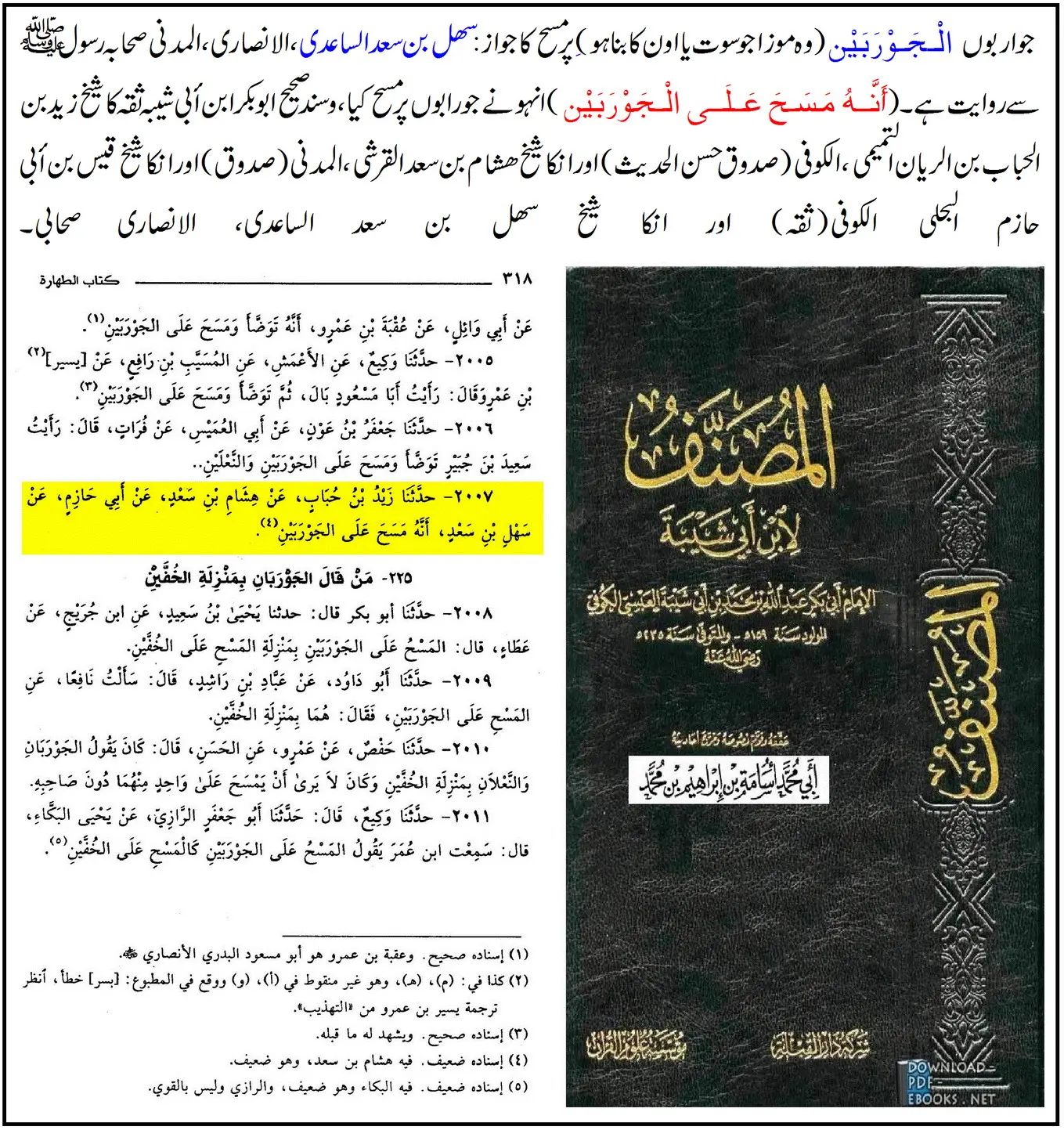
Arabic text: «سَأَلْتُ نَافِعًا، عَنِ الْمَسْحِ عَلَى الْجَوْرَبَيْنِ، فَقَالَ: هُمَا بِمَنْزِلَةِ الْخُفَّيْنِ»
Translation: ‘Abbad ibn Rashid says: I asked Nafi‘ (the student of Ibn Umarؓ) about wiping over socks, and he said: Socks are included in the ruling of khuffain.’
Ruling: The chain of narration is authentic.
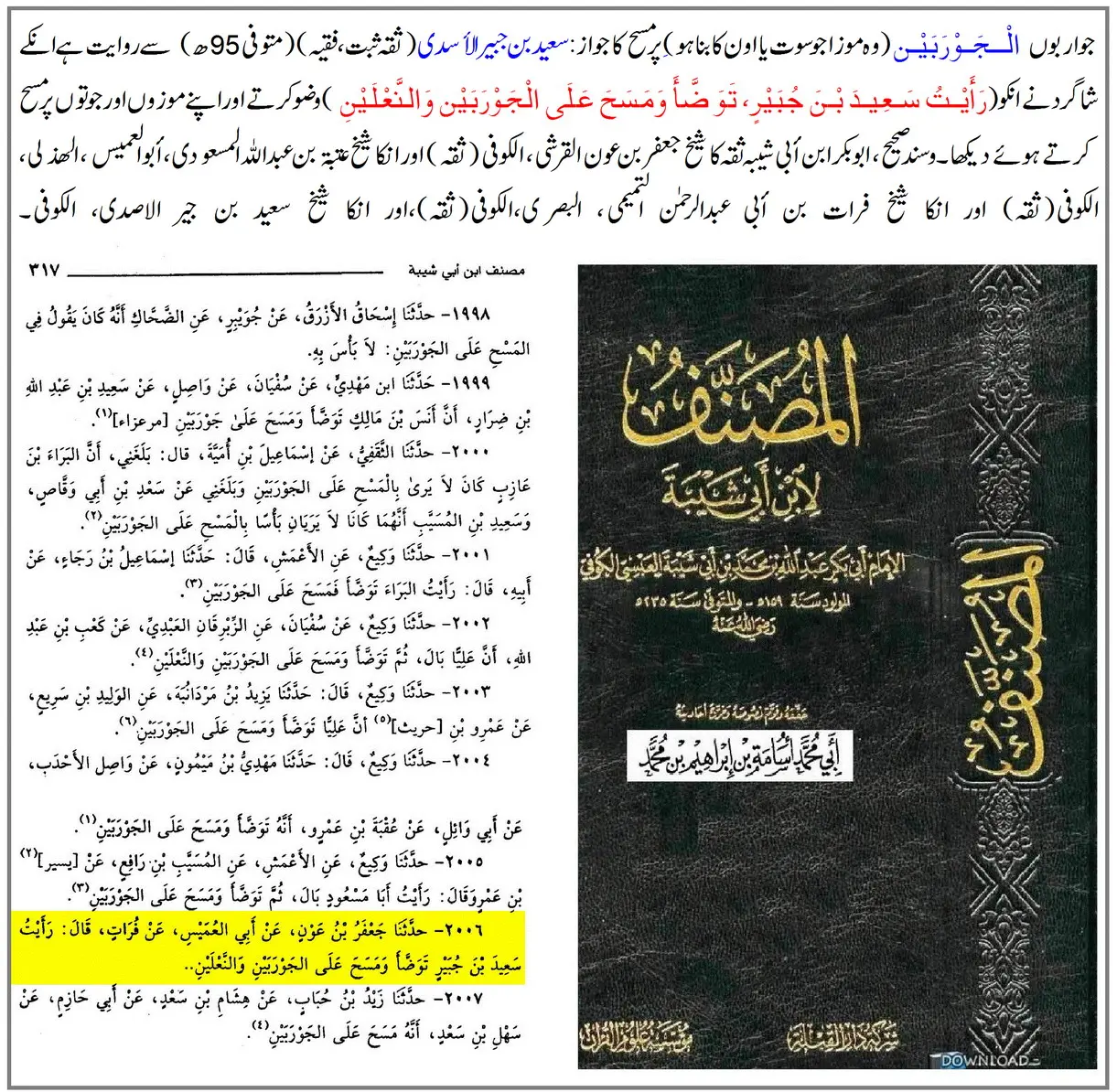
➋ Sa‘id ibn Jubayrؒ (Senior Tabi‘i)
Arabic text: «رَأَيْتُ سَعِيدَ بْنَ جُبَيْرٍ، تَوَضَّأَ وَمَسَحَ عَلَى الْجَوْرَبَيْنِ وَالنَّعْلَيْنِ»
Translation: Al-Furat says: I saw Sa‘id ibn Jubayrؒ performing wudu and wiping over his socks and shoes.
Ruling: The chain of narration is authentic.
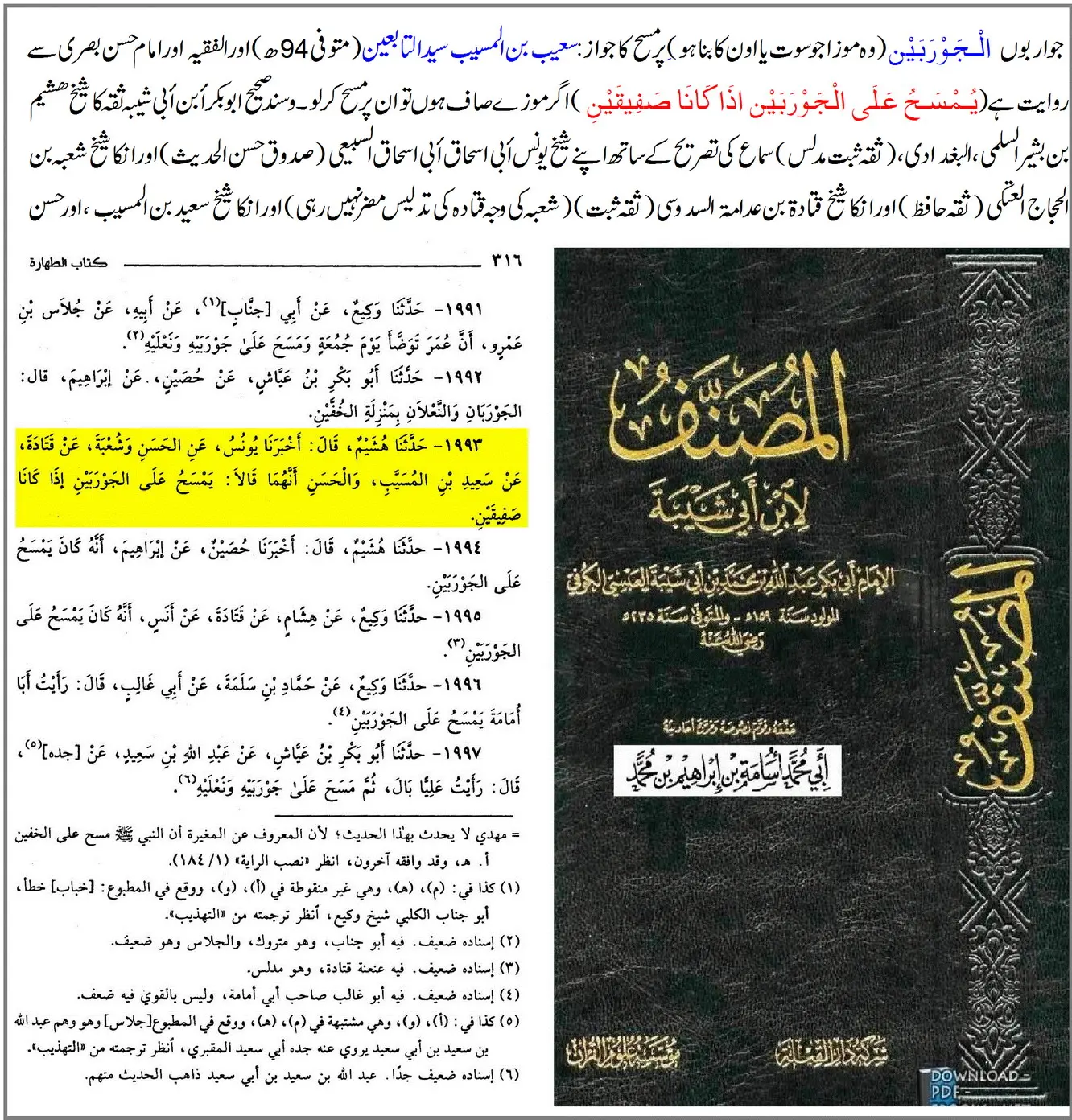
➌ Saeed bin Al-Musayyib (may Allah have mercy on him) and Hasan Basri (may Allah have mercy on him)
Arabic text: «عَن سَعِيدِ بْنِ الْمُسَيِّبِ، وَالْحَسَنِ أَنَّهُمَا قَالَا: يُمْسَحُ عَلَى الْجَوْرَبَيْنِ إِذَا كَانَا صَفِيقَيْنِ»
Translation: Saeed bin Al-Musayyib (may Allah have mercy on him) and Hasan Basri (may Allah have mercy on him) both said: If the socks are thick, wiping over them is permissible.
Ruling: The chain of narration is authentic.
➍ Statement of Imam Hasan Basri (may Allah have mercy on him)
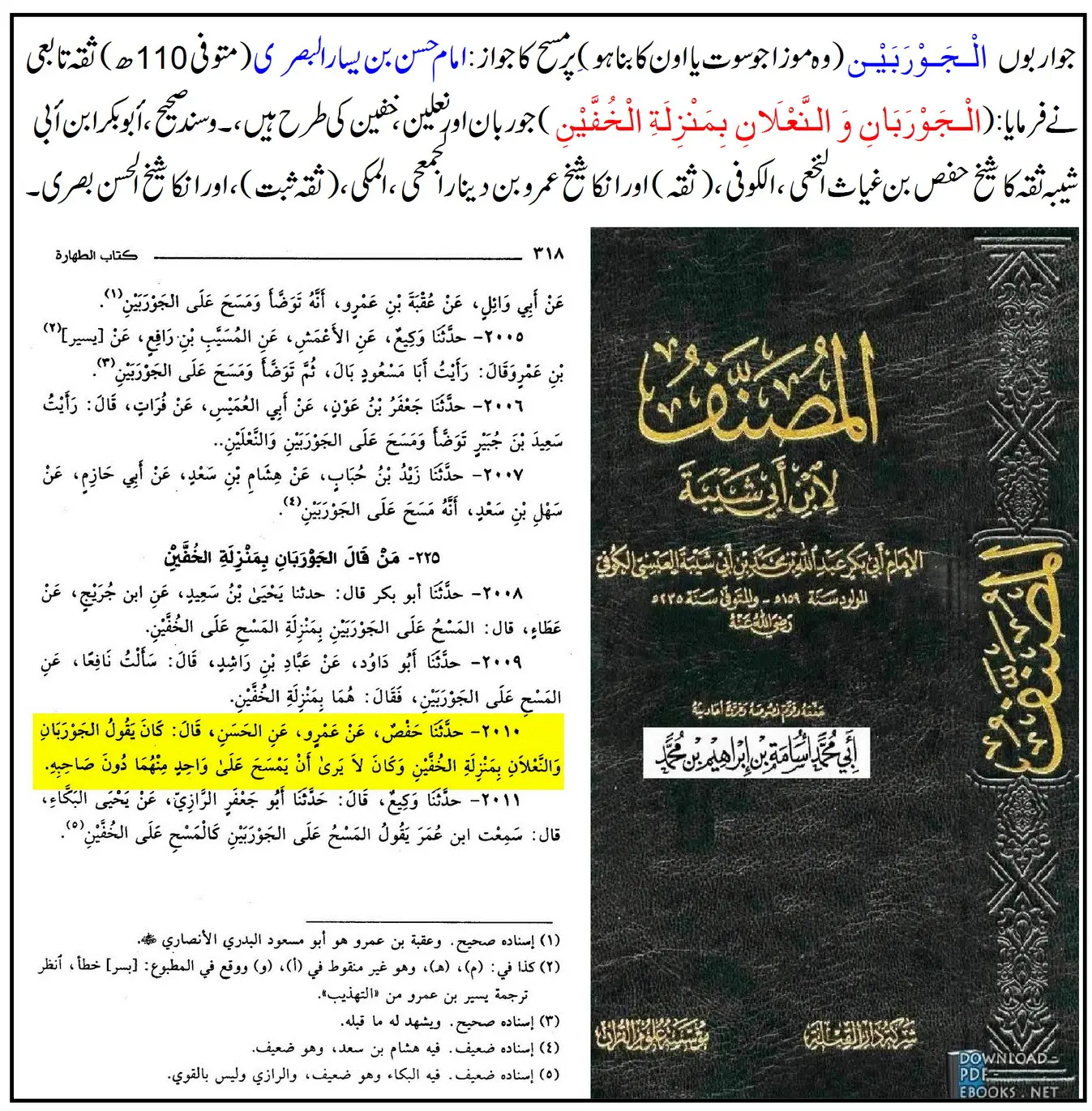
Arabic text: «الْجَوْرَبَانِ وَالنَّعْلَانِ بِمَنْزِلَةِ الْخُفَّيْنِ»
Translation: Imam Hasan Basri (may Allah have mercy on him) used to say: Socks and shoes are like Khuff (leather socks) in ruling.
Ruling: The chain of narration is authentic.
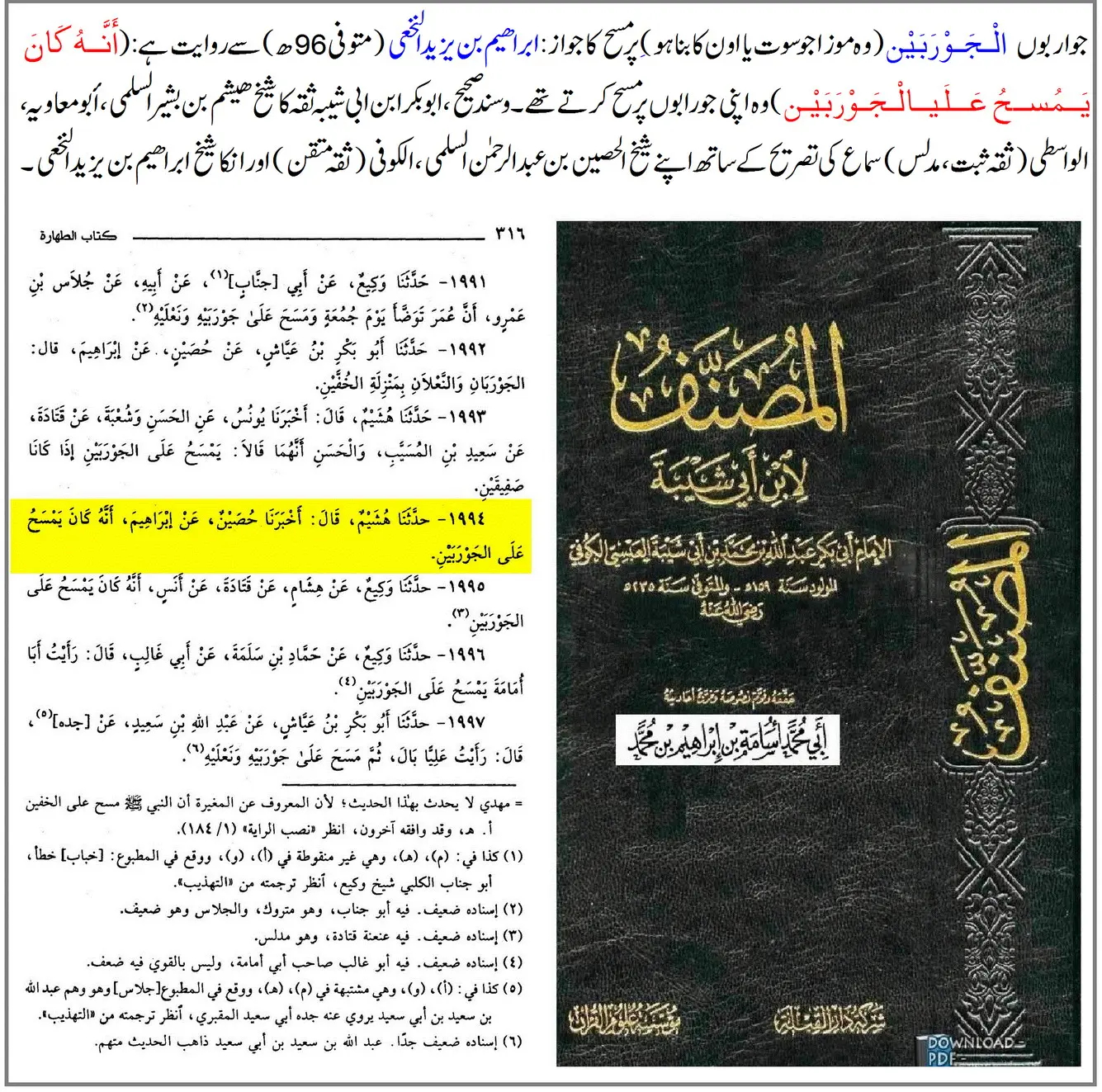
➎ Ibrahim Nakha’i (may Allah have mercy on him)
Arabic text: «أَنَّهُ كَانَ يَمْسَحُ عَلَى الْجَوْرَبَيْنِ»
Translation: Ibrahim Nakha’i (may Allah have mercy on him) used to wipe over his socks.
Ruling: The chain of narration is authentic.
➏ Other Statements among the Tabi‘in
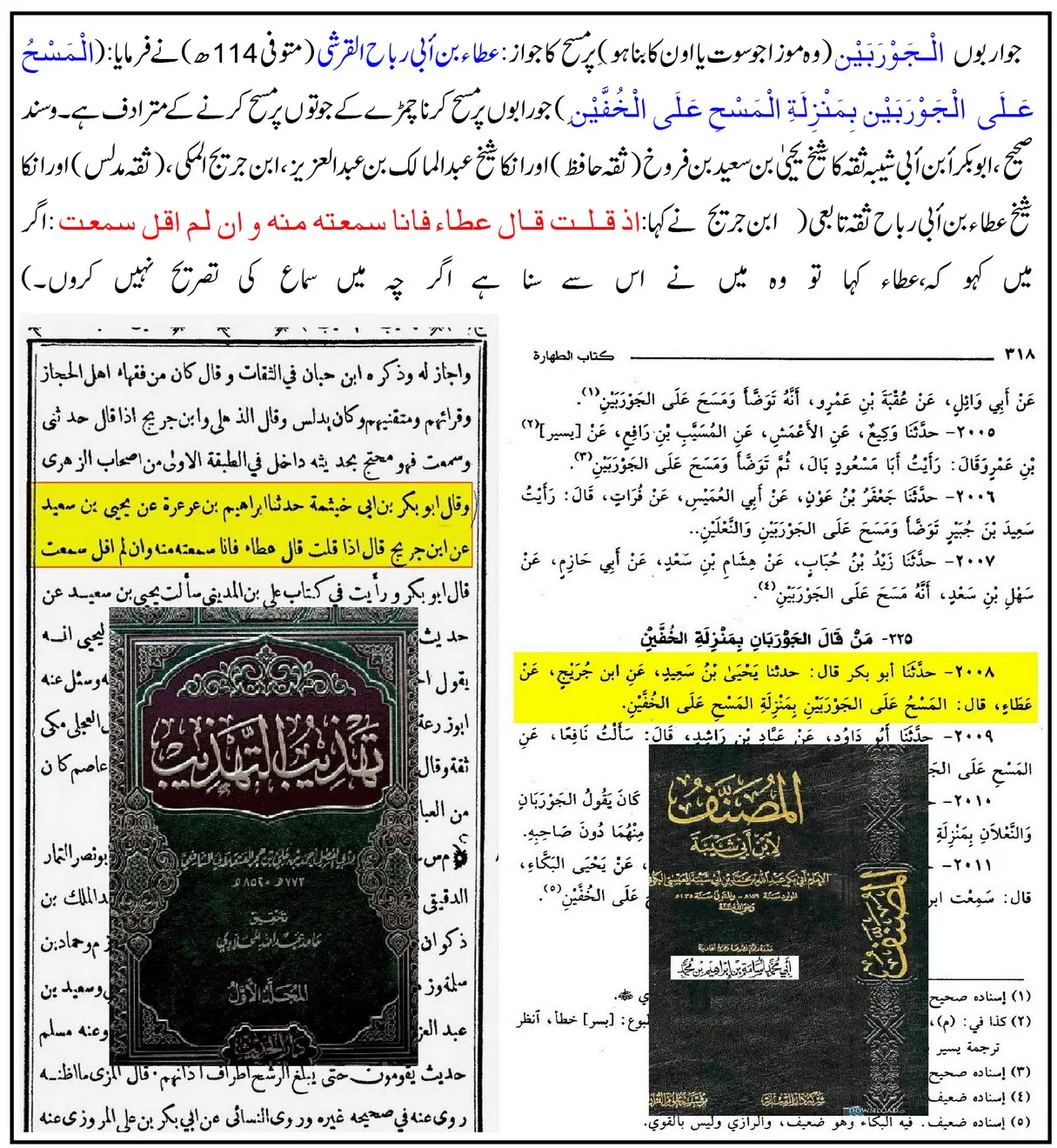
- Hazrat Ata bin Abi Rabah (may Allah have mercy on him): “Wiping over the socks is equivalent to wiping over the Khuff.”
Reference: (Musannaf Ibn Abi Shaybah 1/1991)
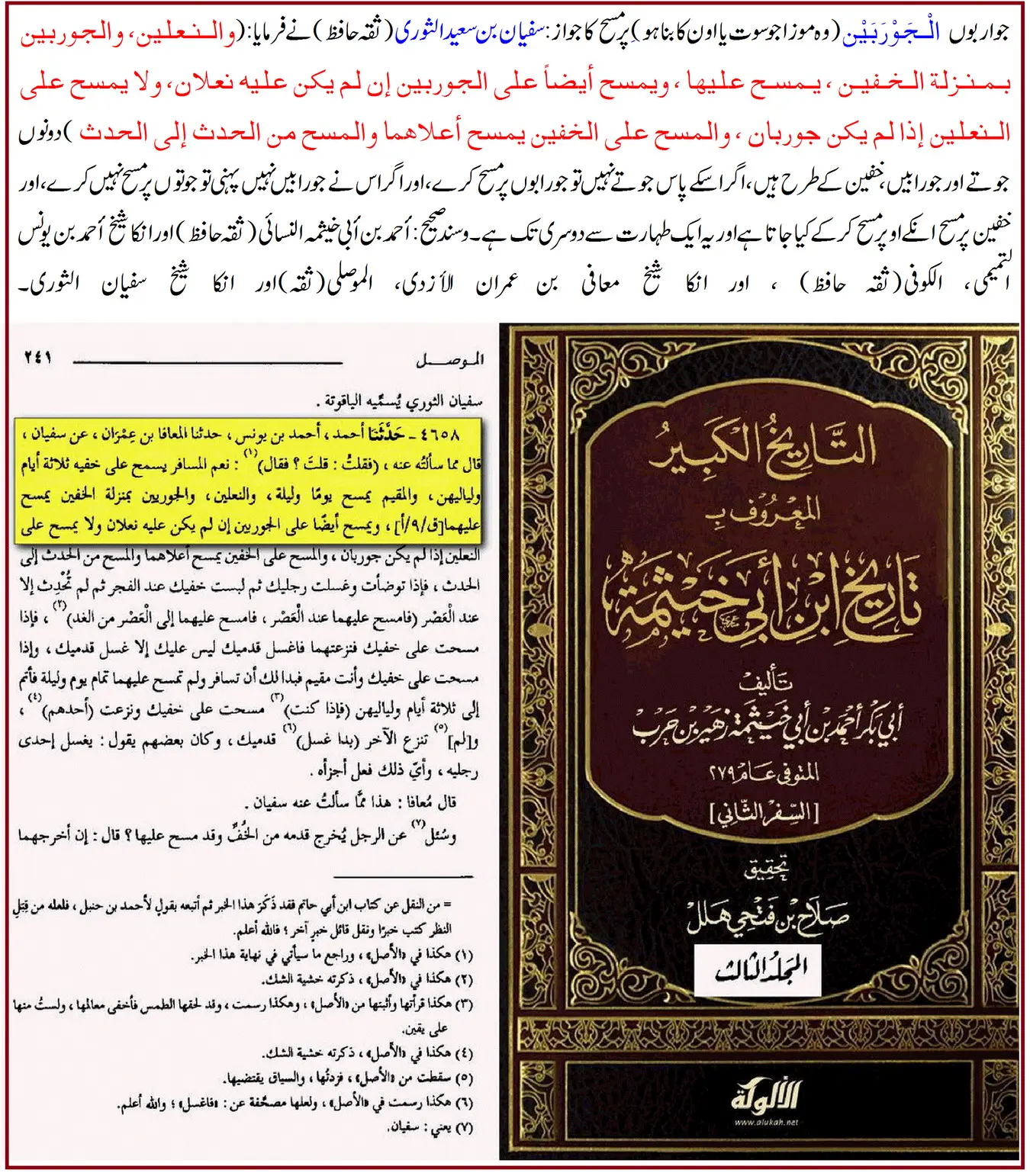
- Imam Sufyan Thawri (may Allah have mercy on him): “Socks and shoes are like Khuff; wiping over them is permissible.”
Reference: (Tarikh Ibn Abi Khaythamah)
📍 Summary: Eminent jurists among the Tabi‘in such as Nafi‘, Saeed bin Jubair, Saeed bin Al-Musayyib, Hasan Basri, Ibrahim Nakha’i, and Ata bin Abi Rabah all issued fatwas permitting wiping over socks. Thus, this issue is established not only through Marfoo‘ Ahadith and the practices of the Sahabah but also through the statements of the Tabi‘in in a mutawatir manner.
Position of the Imams of Ahl al-Hadith and the Jurists
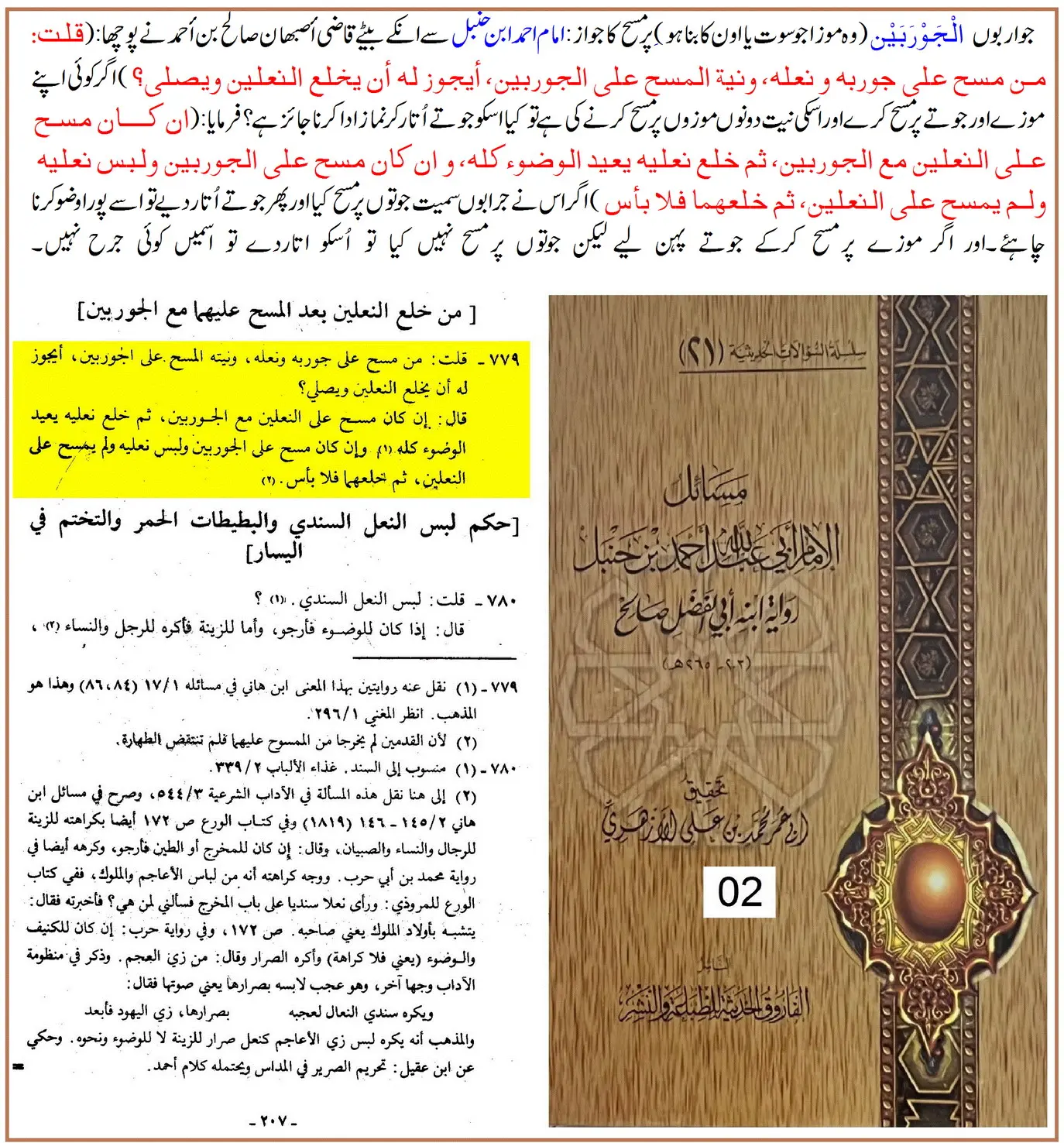
- Imam Ahmad ibn Hanbal: Salih ibn Ahmad says: Arabic text: قُلْتُ: مَنْ مَسَحَ عَلَى جَوْرَبَيْهِ وَنَعْلَيْهِ، وَنِيَّتُهُ الْمَسْحُ عَلَى الْجَوْرَبَيْنِ، أَيَجُوزُ لَهُ أَنْ يَخْلَعَ النَّعْلَيْنِ وَيُصَلِّي؟قَالَ: إِنْ كَانَ مَسَحَ عَلَى النَّعْلَيْنِ مَعَ الْجَوْرَبَيْنِ، ثُمَّ خَلَعَ نَعْلَيْهِ، يُعِيدُ الْوُضُوءَ كُلَّهُ، وَإِنْ كَانَ مَسَحَ عَلَى الْجَوْرَبَيْنِ، وَلَبِسَ نَعْلَيْهِ، وَلَمْ يَمْسَحْ عَلَى النَّعْلَيْنِ، ثُمَّ خَلَعَهُمَا، فَلَا بَأْسَ.
Reference: (Masa’il al-Imam Ahmad narrated by Salih ibn Ahmad, No. 779)
Translation: I asked my father (Imam Ahmad): If someone wipes over socks and shoes with the intention of wiping over the socks, can he remove the shoes and pray? Imam Ahmad said: If he wiped over the shoes along with the socks and then removed the shoes, he must perform the entire ablution again. But if he only wiped over the socks and then wore the shoes, and later removed the shoes, there is no harm.
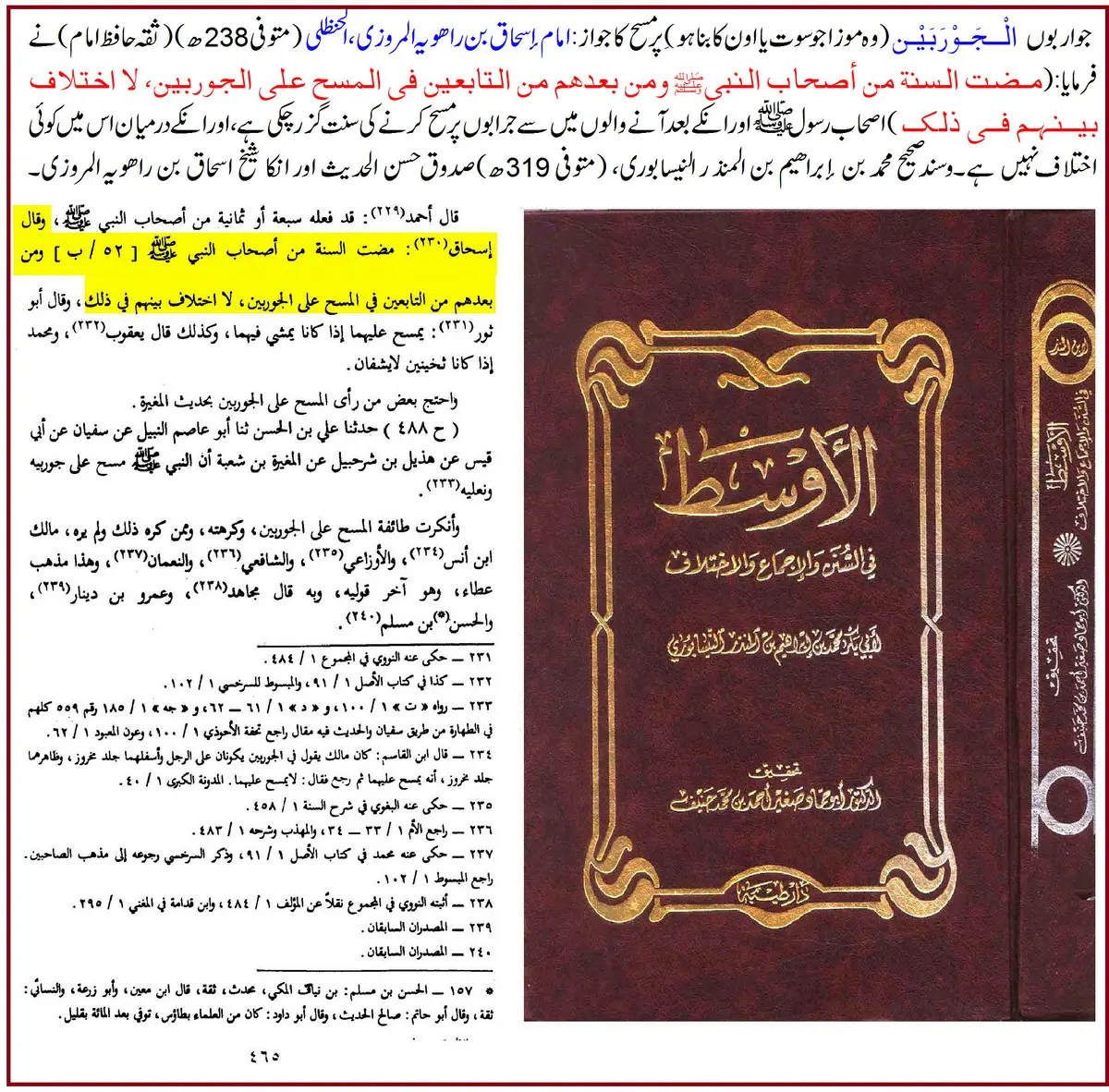
- Imam Ishaq ibn Rahwayh (238 AH): Arabic text: قَالَ إِسْحَاقُ: مَضَتِ السُّنَّةُ مِنْ أَصْحَابِ النَّبِيِّ ﷺ، وَمَنْ بَعْدَهُمْ مِنَ التَّابِعِينَ فِي الْمَسْحِ عَلَى الْجَوْرَبَيْنِ، لَا اخْتِلَافَ بَيْنَهُمْ فِي ذَلِكَ.
Reference: (Al-Awsat fi al-Sunan wal-Ijma’ wal-Ikhtilaf 1/302)
Translation: Imam Ishaq ibn Rahwayh said: It has been the Sunnah from the Companions of the Prophet ﷺ and the Tabi‘in after them to wipe over the socks, and there is no disagreement among them regarding this.
- Imam Sufyan al-Thawri: Arabic text: وَالنَّعْلَيْنِ، وَالْجَوْرَبَيْنِ بِمَنْزِلَةِ الْخُفَّيْنِ، يُمْسَحُ عَلَيْهِمَا.
Reference: (Tarikh Ibn Abi Khaythamah, Volume 3)
Translation: Imam Sufyan al-Thawri said: Shoes and socks are ruled like khuffs (leather socks), and wiping over them is permissible.
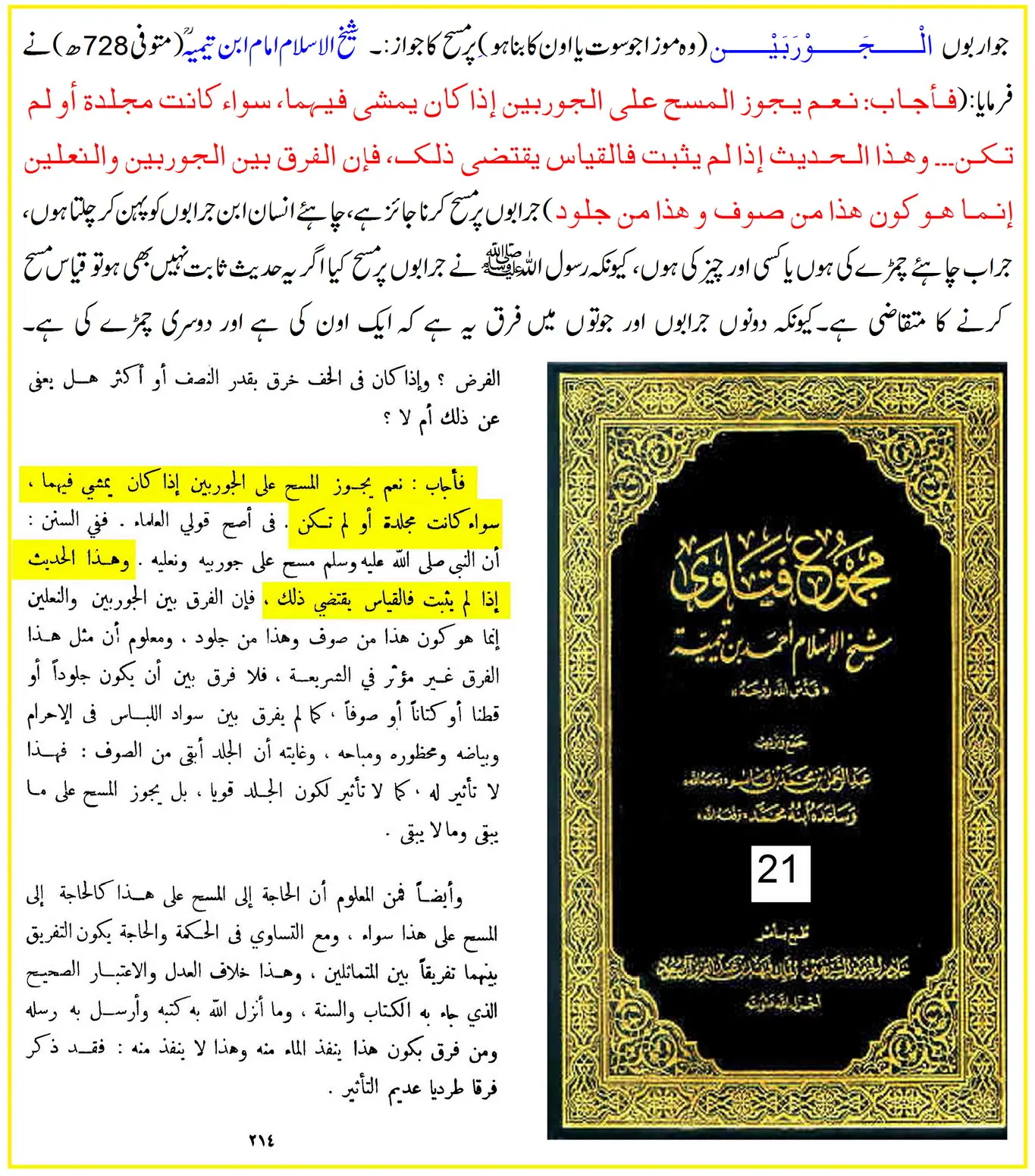
- Shaykh al-Islam Ibn Taymiyyah (728 AH): Arabic text: نَعَمْ يَجُوزُ الْمَسْحُ عَلَى الْجَوْرَبَيْنِ إِذَا كَانَ يَمْشِي فِيهِمَا، سَوَاءٌ كَانَتْ مُجَلَّدَةً أَوْ لَمْ تَكُنْ، فِي أَصَحِّ قَوْلَيْ الْعُلَمَاءِ.
Reference: (Majmu‘ al-Fatawa 21/174)
Translation: Yes, wiping over socks is permissible, provided that walking in them is possible, whether they are leather or not. Of the two opinions of the scholars, this opinion is more correct.
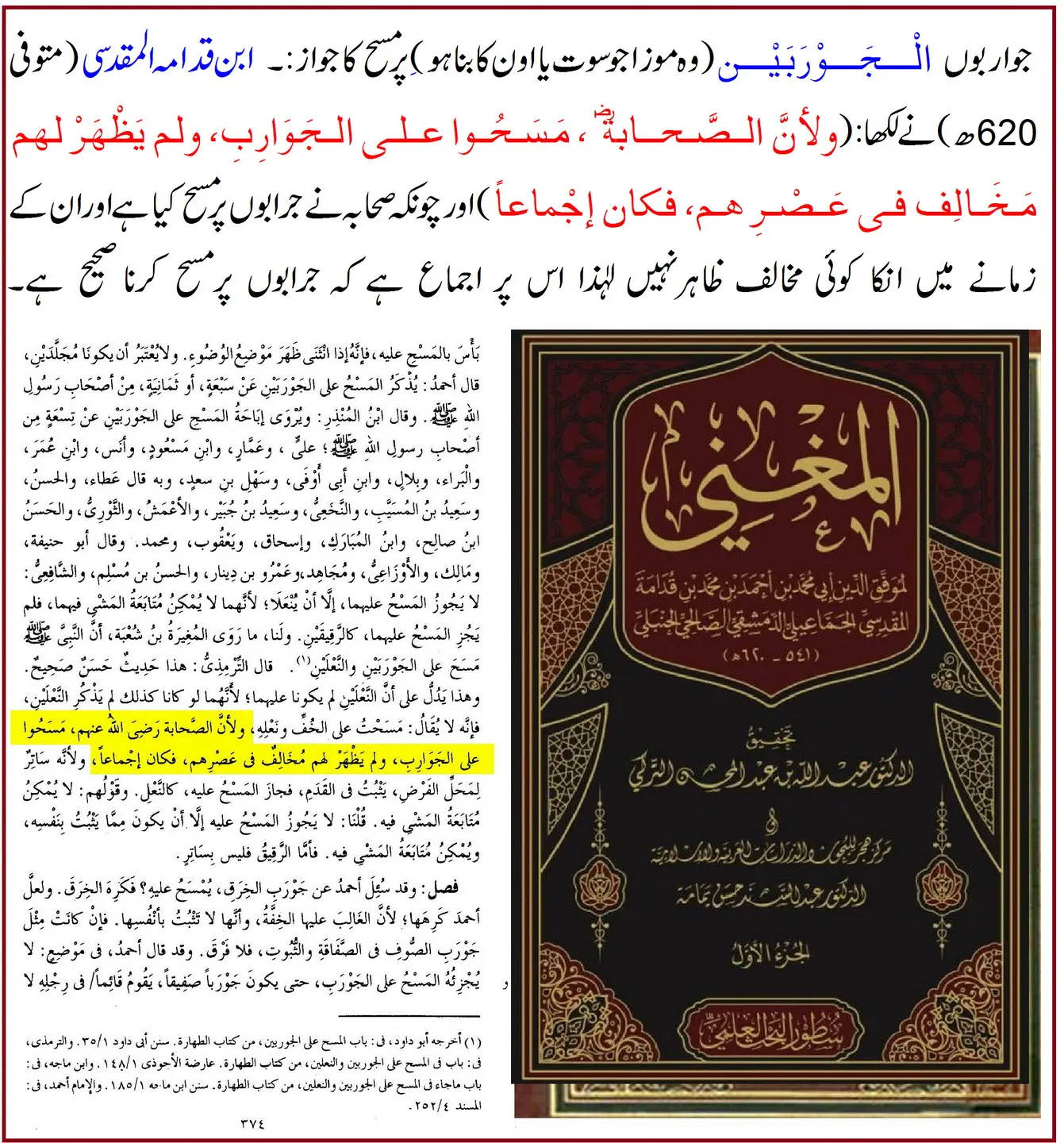
- Imam Ibn Qudamah Al-Maqdisi (620 AH): Arabic text: وَلِأَنَّ الصَّحَابَةَ رَضِيَ اللَّهُ عَنْهُمْ، مَسَحُوا عَلَى الْجَوَارِبِ، وَلَمْ يَظْهَرْ لَهُمْ مُخَالِفٌ فِي عَصْرِهِمْ، فَكَانَ إِجْمَاعًا.
Reference: (Al-Mughni 1/215)
Translation: The Companions of the Prophet (may Allah be pleased with them) wiped over their socks, and no opposition appeared during their time, therefore this is consensus.
Position of the Hanafis
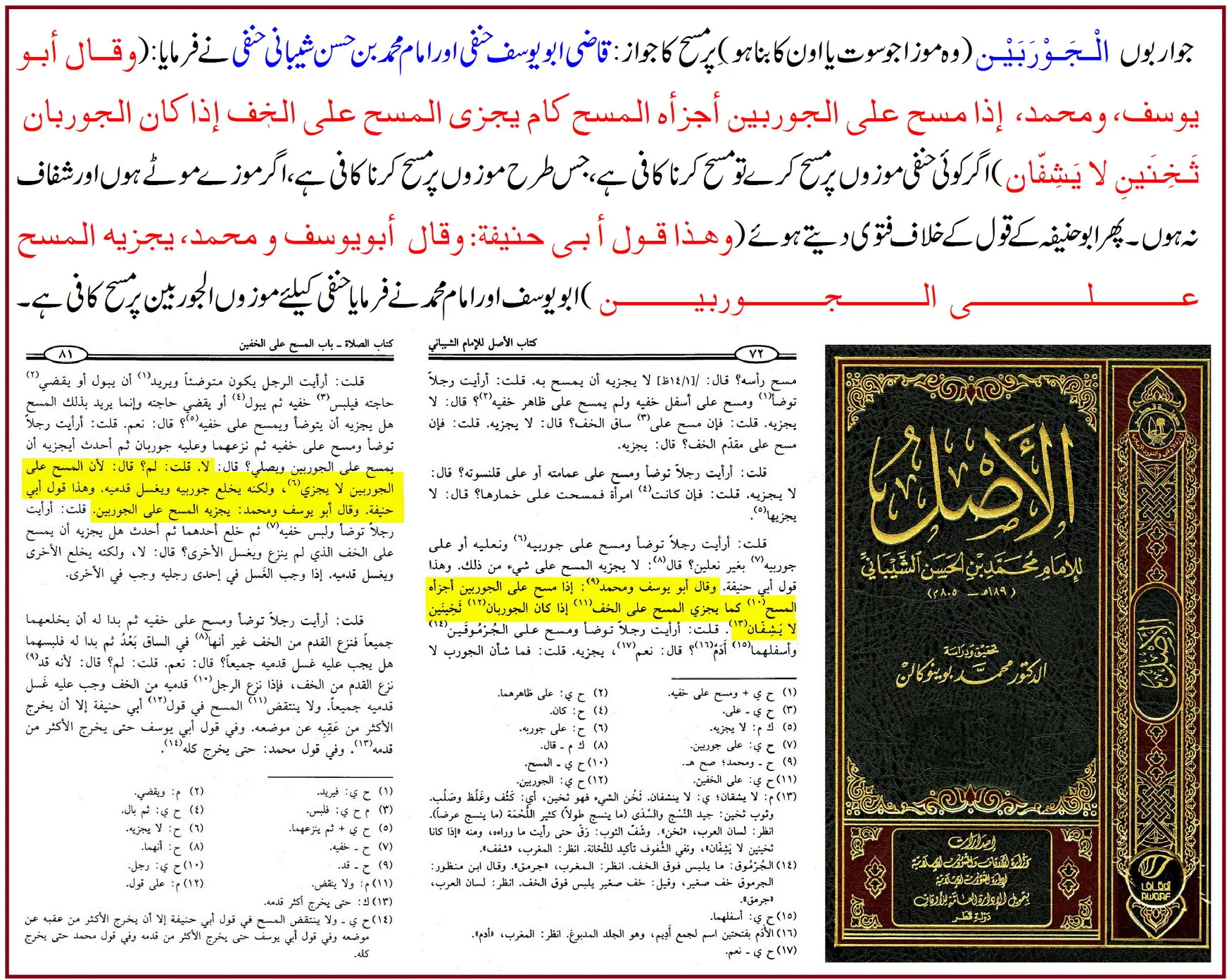
- Qadi Abu Yusuf and Imam Muhammad: Arabic text: وَقَالَ أَبُو يُوسُفَ وَمُحَمَّدٌ: إِذَا مَسَحَ عَلَى الْجَوْرَبَيْنِ أَجْزَأَهُ الْمَسْحُ، كَمَا يَجْزِي الْمَسْحُ عَلَى الْخُفِّ، إِذَا كَانَ الْجَوْرَبَانِ ثَخِينَيْنِ لَا يَشِفَّانِ.
Reference: (Al-Asl Al-Ma’ruf bil-Mabsut, 1/104)
Translation: Abu Yusuf and Muhammad said: If the socks are thick and the feet are not visible, then wiping over them is permissible, exactly in the same way as wiping over the khuffs (leather socks) is permissible.
Imam Abu Hanifa’s Retraction
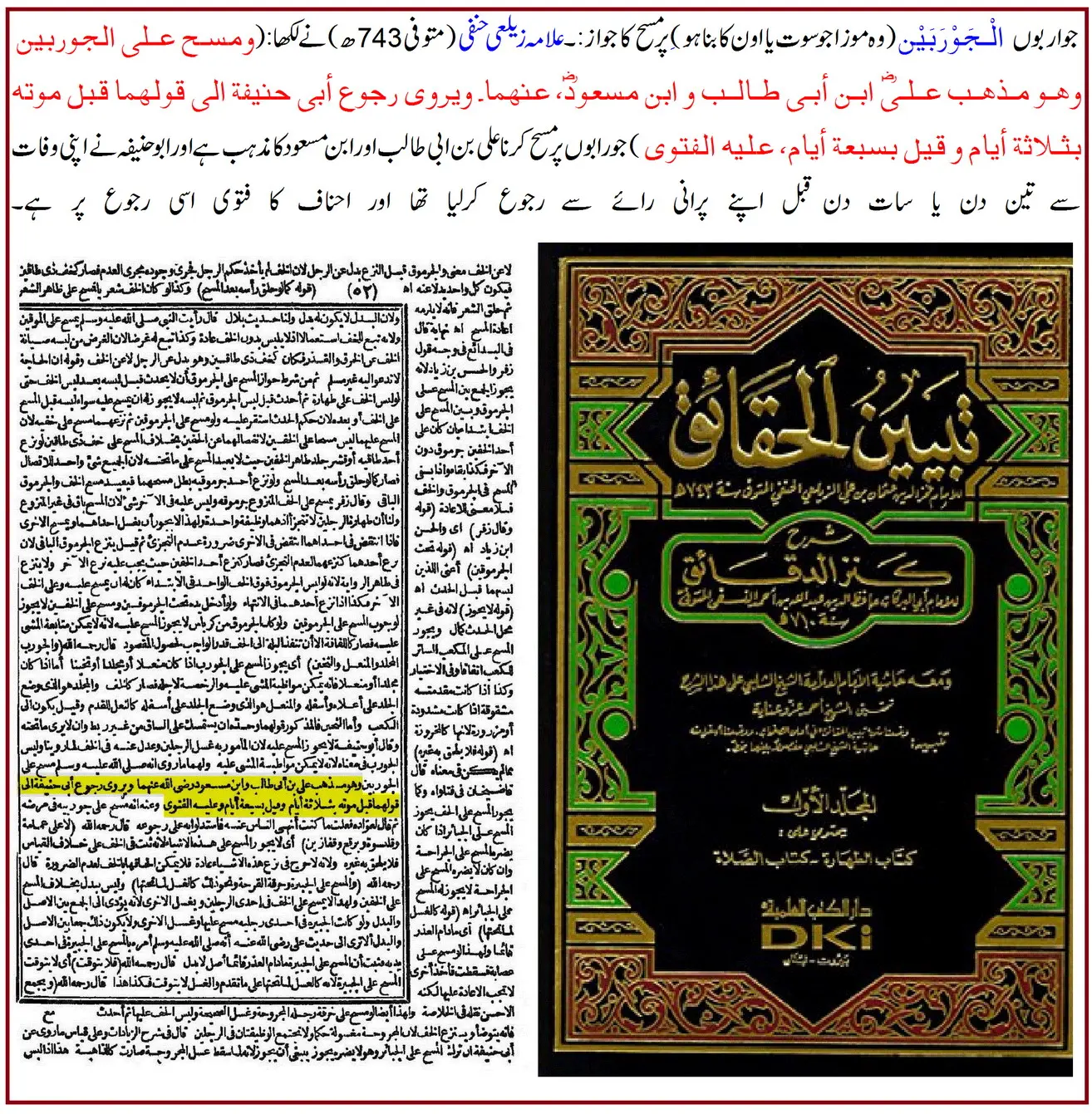
- Allama Zailai Hanafi (743 AH): Arabic text: وَيُرْوَى رُجُوعُ أَبِي حَنِيفَةَ إِلَى قَوْلِهِمَا قَبْلَ مَوْتِهِ بِثَلَاثَةِ أَيَّامٍ، وَقِيلَ بِسَبْعَةِ أَيَّامٍ، وَعَلَيْهِ الْفَتْوَى.
Reference: (Tabyin al-Haqa’iq Sharh Kanz al-Daqa’iq 1/217)
Translation: It is narrated that Abu Hanifa retracted from his earlier opinion three days before his death (and according to some, seven days) and adopted the opinion of his students (Abu Yusuf and Muhammad). The fatwa is also based on this retraction.
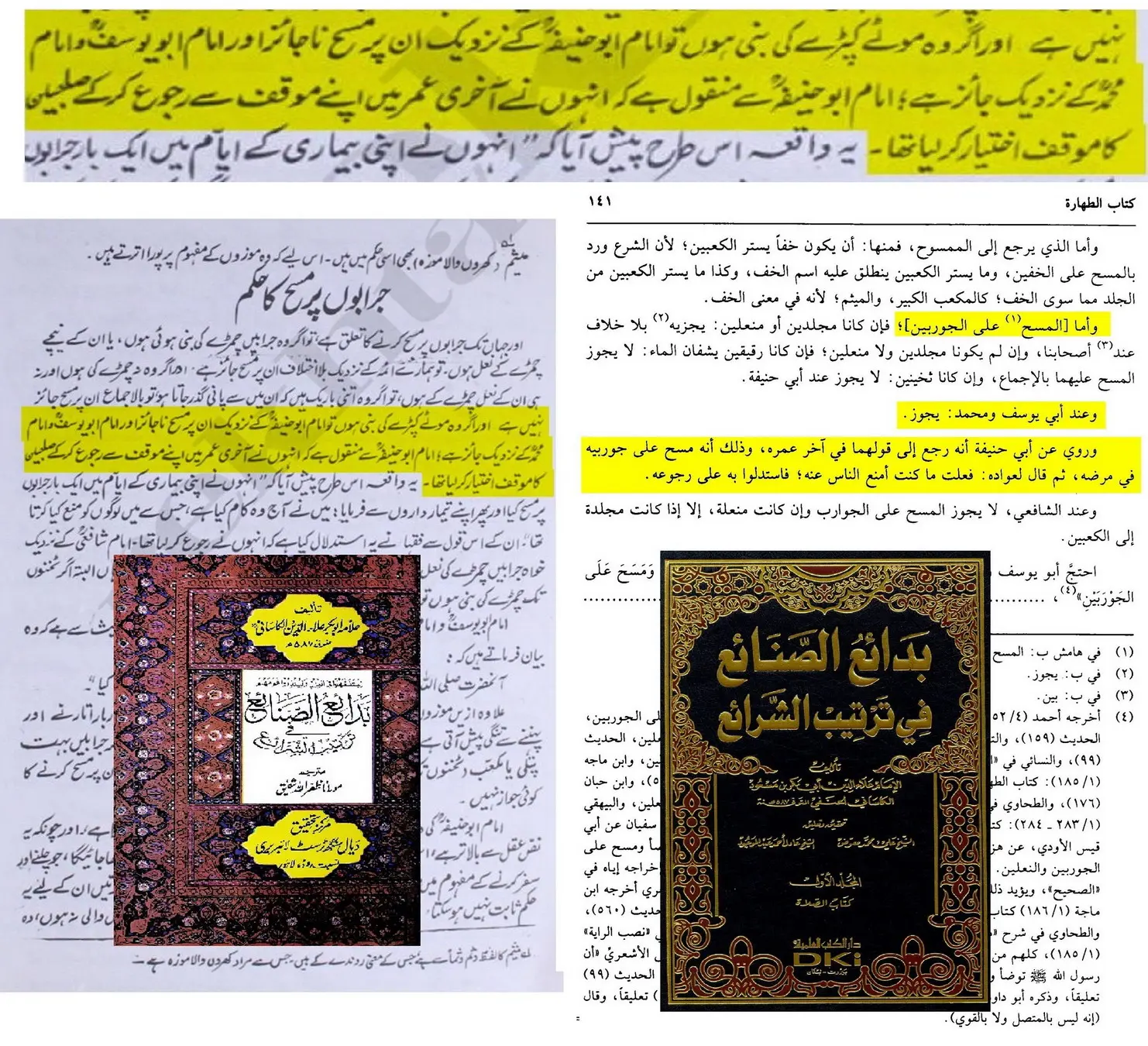
- Imam Kasani Hanafi (587 AH): Arabic text: وَرُوِيَ عَنْ أَبِي حَنِيفَةَ أَنَّهُ رَجَعَ إِلَى قَوْلِهِمَا فِي آخِرِ عُمُرِهِ، وَذَلِكَ أَنَّهُ مَسَحَ عَلَى جَوْرَبَيْهِ فِي مَرَضِهِ، ثُمَّ قَالَ لِعُوَّادِهِ: فَعَلْتُ مَا كُنْتُ أَمْنَعُ النَّاسَ عَنْهُ.
Reference: (Bada’i’ al-Sana’i’ 1/10)
Translation: It is narrated from Abu Hanifa (may Allah have mercy on him) that towards the end of his life, he withdrew from his earlier opinion. During his illness, he used to perform wiping over socks and used to say: “I did what I used to forbid people from doing.”
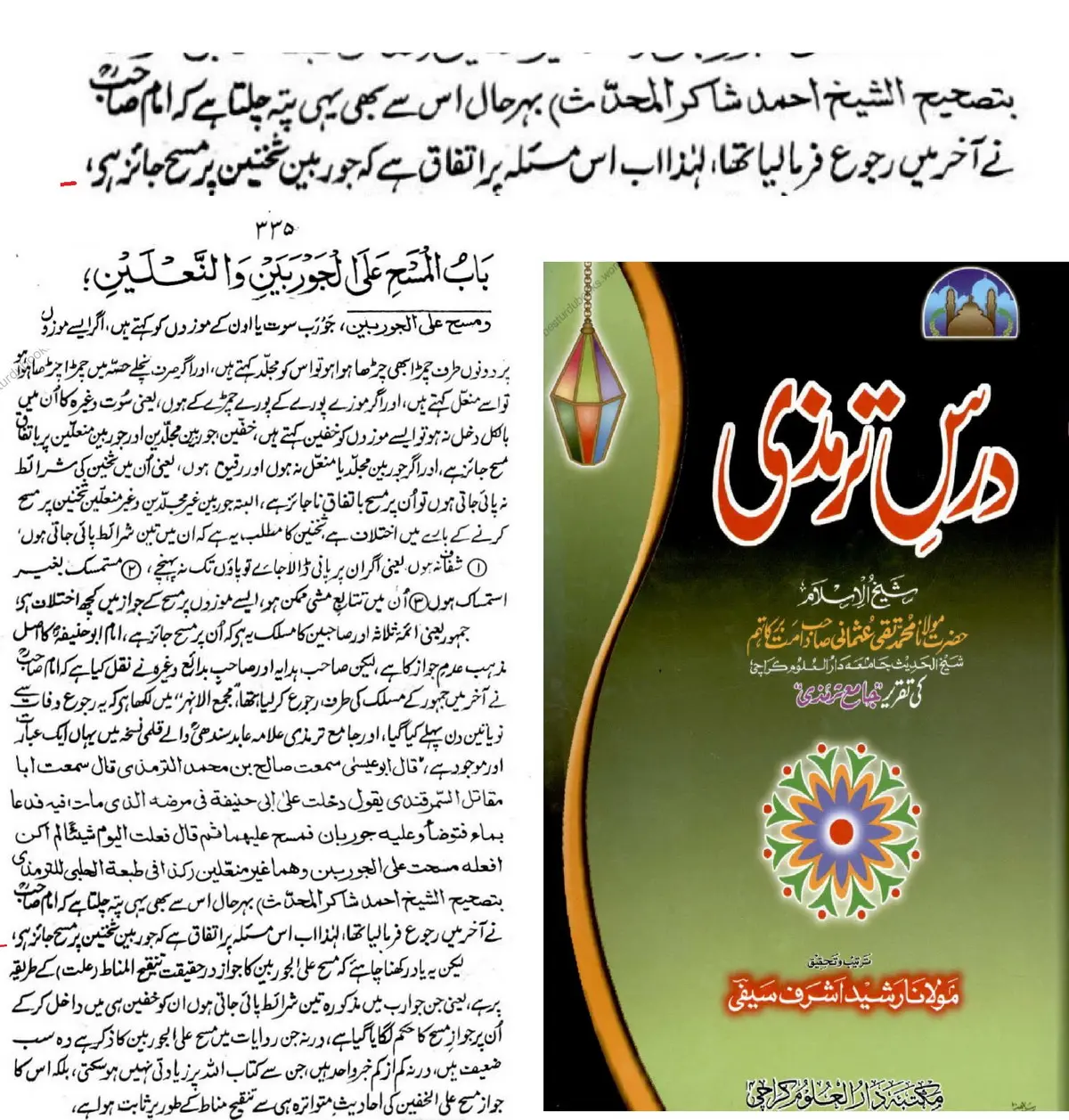
- Mufti Taqi Usmani Sahib: “The Imam had withdrawn at the end, and now there is consensus that wiping over socks is permissible.”
Reference: (Fatawa Usmani 1/212)
📍 Summary:
- According to the Imams of Hadith (Imam Ahmad, Ishaq bin Rahwayh, Sufyan Thawri, Ibn Taymiyyah, Ibn Qudamah, etc.), wiping over socks is permissible.
- Imam Abu Yusuf and Imam Muhammad Hanafi were supporters of this from the beginning.
- Imam Abu Hanifa (may Allah have mercy on him) also withdrew a few days before his death and adopted this opinion.
Fatwas of Ahl al-Hadith Scholars and the Response to Syed Nazir Hussain Dehlvi’s Rare Opinion
- Sheikh Zubair Ali Zaee, may Allah have mercy on him: “Yes, wiping over socks is permissible.”
Reference: (Fatawa Zubair Ali Zaee, p. 112)
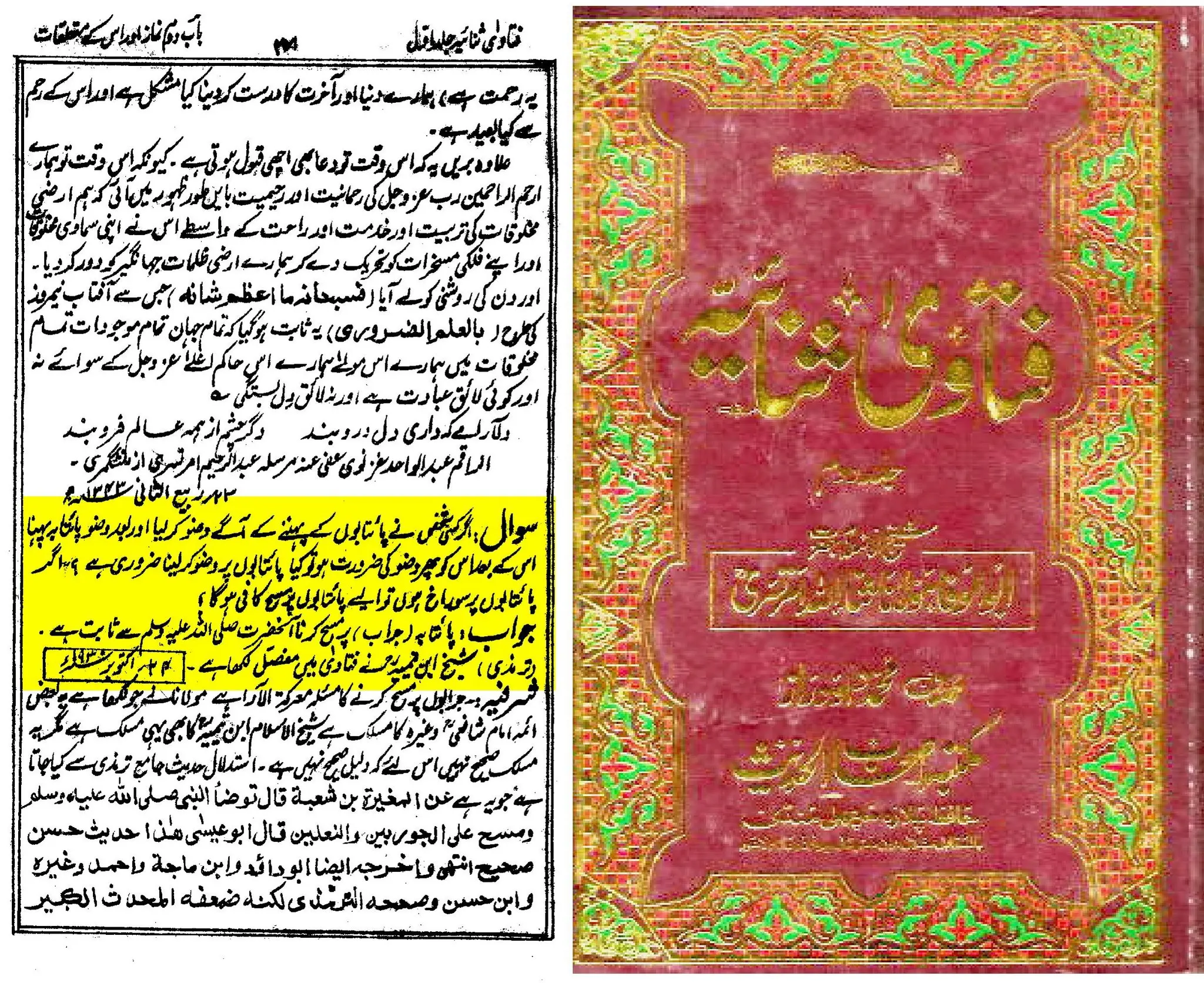
- Imam Sanaullah Amritsari, may Allah have mercy on him: He was asked: If a person wears socks after ablution and then performs ablution again, is wiping only over the socks sufficient? He replied: “Yes, wiping over socks is proven from the Prophet ﷺ, Sheikh Ibn Taymiyyah has written a detailed explanation in his fatawa.”
Reference: (Fatawa Sanaiyah 1/87)
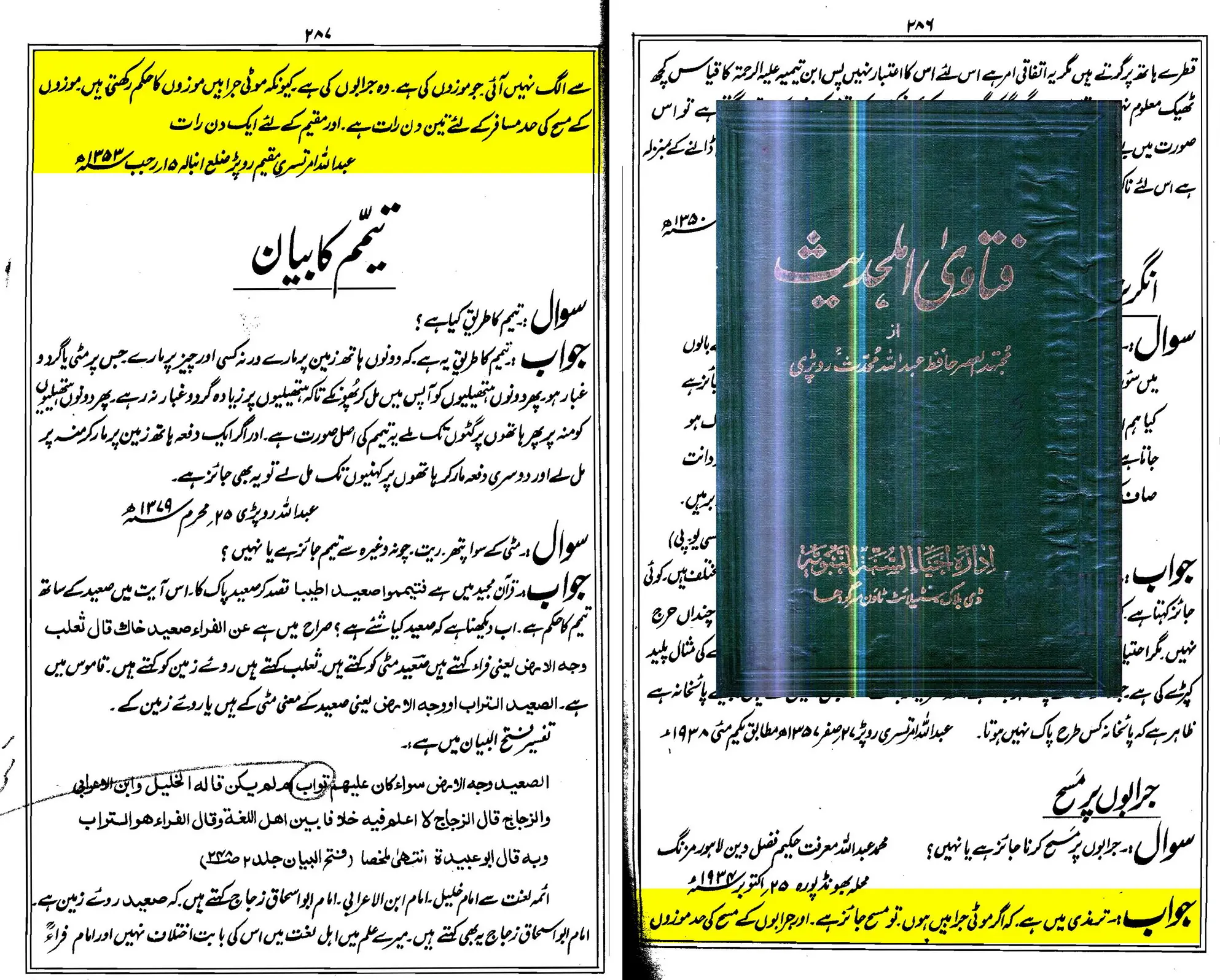
- Allama Abdullah Ropari, may Allah have mercy on him: “It is mentioned in Tirmidhi that if the socks are thick, wiping over them is permissible. The limit for wiping over socks is the same as for leather socks; for a resident one day and one night, and for a traveler three days and three nights.”
Reference: (Fatawa Ahl al-Hadith 1/115)
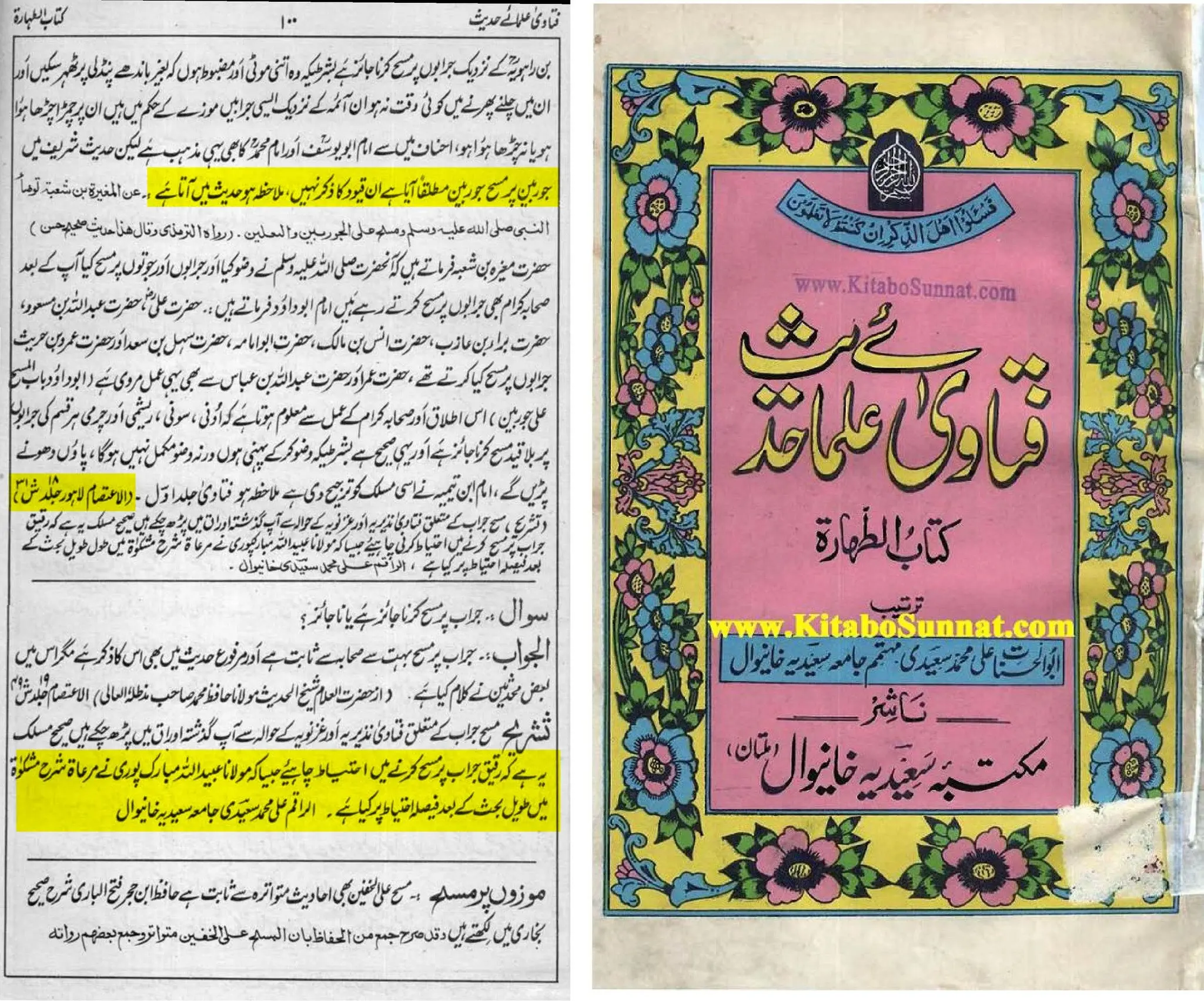
- Hafiz Abdul Sattar Al-Hammad, may Allah have mercy on him: “In short, wiping over socks is permissible, whether thick or thin, new or old. And if they are removed after wiping, the ablution is not invalidated.”
Reference: (Fatawa Ahl al-Hadith 2/78)
- Allama Mubarakpuri, may Allah have mercy on him (Marā’at al-Mafātīḥ): He combined the narration of Mughira (wiping over leather socks) and Mughira’s other narration (wiping over socks) and said: “These are two different incidents. Mughira bin Shu’bah stayed with the Prophet ﷺ for five years; it is not unlikely that he saw the Prophet ﷺ wiping over different items in different circumstances multiple times.”
Reference: (Marā’at al-Mafātīḥ 1/472)
- Allama Nasiruddin al-Albani, may Allah have mercy on him: “The narration of Mughira that the Prophet ﷺ wiped over socks and shoes is authentic. All its narrators are trustworthy. Although some have objected to it, this objection is rejected because this narration does not contradict other narrations but should be accepted under the principle of ‘the addition of a trustworthy narrator’ (ziyadat al-thiqah).”
Reference: (Irwa’ al-Ghalil 1/182)
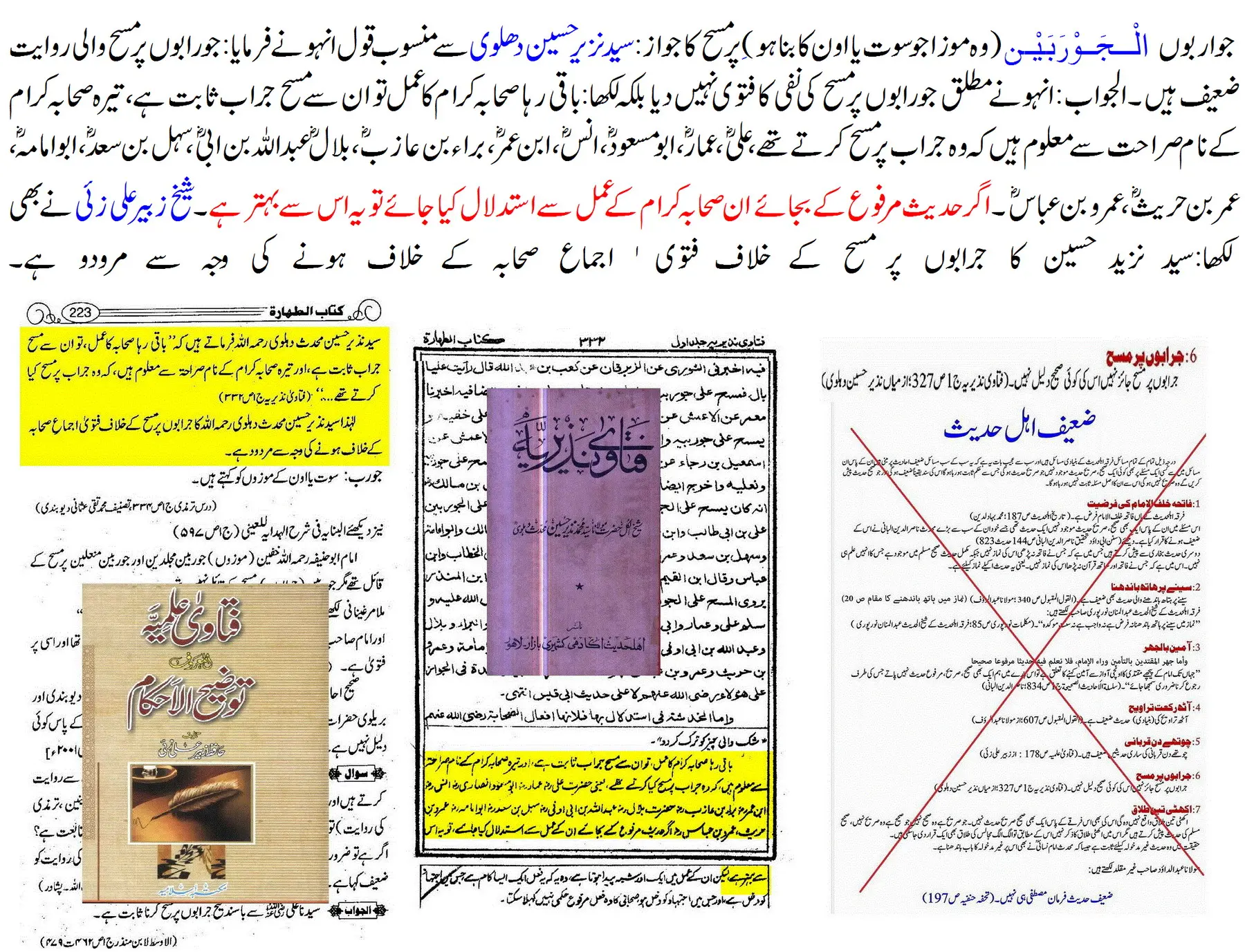
➋ The Attributed Statement of Syed Nazir Hussain Dehlviؒ
Some individuals have attributed to Syed Nazir Hussain Dehlviؒ (known as Sheikh-ul-Kul fil-Kul) the statement that he did not accept wiping over socks.
However, this attribution is false and baseless.
Evidence:
- Syed Nazir Hussain Dehlviؒ follows the methodology of the Quran and Hadith, and since there is abundant evidence for wiping over socks, it is impossible for a muhaddith like him to deny it.
- His students and followers (Imam Abdullah Ghazi Puri, Maulana Muhammad Hussain Batalvi, etc.) all issued fatwas permitting wiping over socks.
- In fact, some people took a partial discussion of his out of context and turned it into a denial of wiping over socks, whereas his point was that wiping over thin, transparent stockings is not permissible, not over thick socks.
📍 Summary:
- It is the unanimous fatwa of all Ahl al-Hadith elders that wiping over socks is permissible.
- The attribution of “Denial of wiping over socks” to Syed Nazir Hussain Dehlvi (may Allah have mercy on him) is a misunderstanding and a distorted attribution.
- There is consensus among Ahl al-Hadith on the original issue, and this is clear from the marfu‘ texts, the practices of the Companions, the sayings of the Tabi‘in, and the consensus of the Mujtahid Imams.
🔴 Final Conclusion:
Wiping over socks (cloth footwear) and khuffain (leather footwear) is both permissible. This is supported by marfu‘ hadiths, the consensus of the Companions (may Allah be pleased with them), the sayings of the Tabi‘in and the Salaf Imams, the fatwas of Ahl al-Hadith scholars, and even the return of Imam Abu Hanifa (may Allah have mercy on him) to this ruling. Therefore, any opposing view is anomalous and rejected.
Scans of Important References