
Second Doubt: Hadith of Ibn Mas’ud, may Allah be pleased with him
سفيان (الثوري) عن عاصم بن كليب عن عبد الرحمن بن الأسود عن علقمة قال قال عبد الله بن مسعود: ألا أصلي بكم صلوة رسول الله صلى الله عليه وسلم فصلى فلم يرفع يديه إلا فى أول مرة
(It is said that) Sayyiduna Abdullah bin Mas’ud, may Allah be pleased with them, said: Shall I not lead you in the prayer of the Messenger of Allah صلى الله عليه وسلم? Then he prayed and did not raise his hands except the first time.
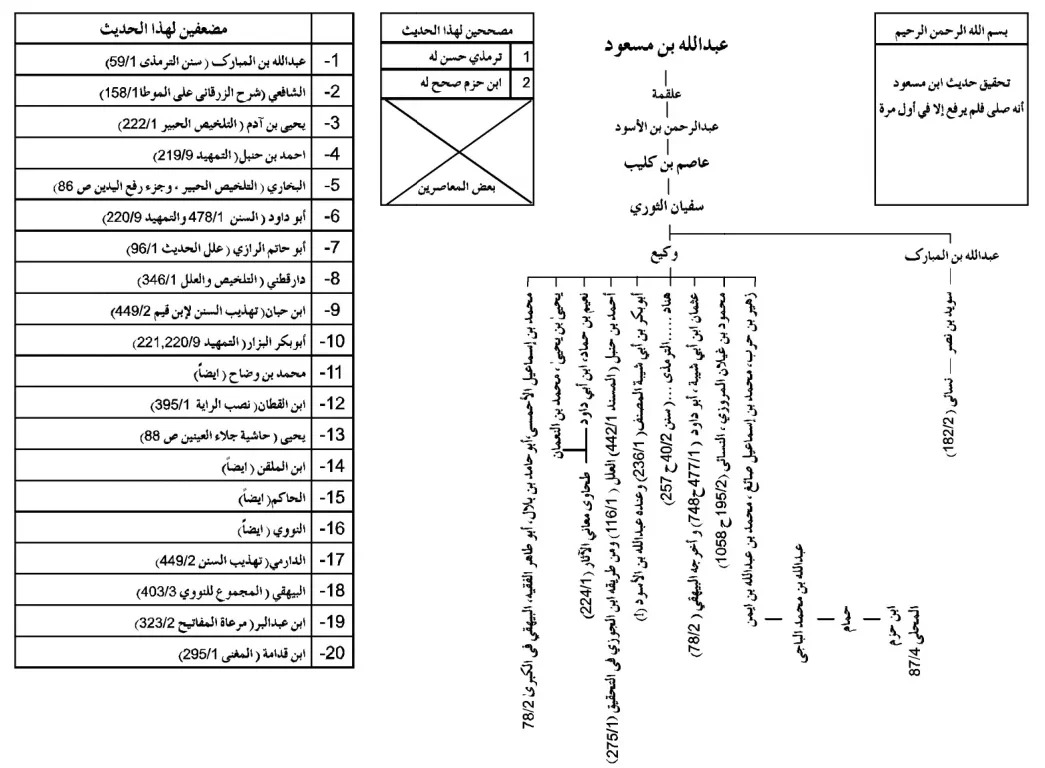
Investigation: This hadith is connected with a defective cause and is weak both in chain and text. The following Imams (and scholars of hadith) have declared it weak and defective:
First answer:
The majority of Muhaddithin have declared this narration weak and defective:
① Sheikh al-Islam al-Mujahid al-Shaqi Abdullah bin al-Mubarak (d. 181 AH) said:
لم يثبت حديث… ابن مسعود
This hadith attributed to Ibn Mas’ud, may Allah be pleased with him, is not established.
Some people have tried in modern times to remove Ibn al-Mubarak’s criticism from this hadith, but the following hadith scholars and noble scholars have attributed Ibn al-Mubarak’s criticism to this disputed narration attributed to Ibn Mas’ud, may Allah be pleased with him.
➊ Tirmidhi
➋ Ibn al-Jawzi said: وقال فيه عبدالله بن المبارك: لا يثبت هذا الحديث
➌ Ibn Abd al-Hadi
➍ Nawawi
➎ Ibn Qudamah
➏ Ibn Hajar
➐ Al-Shawkani
➑ Al-Baghawi
➒ Al-Bayhaqi
No Imam of hadith has said that Ibn al-Mubarak’s criticism is not related to the hadith attributed to Ibn Mas’ud.
② Imam al-Shafi’i (d. 204 AH) rejected the hadiths about abandoning the raising of hands as they are not established.
③ Ahmad bin Hanbal (d. 241 AH) commented on this narration.
④ Abu Hatim al-Razi (277 AH) said:
هذا خطأ يقال: وهم الثوري فقد رواه جماعة عن عاصم وقالوا كلهم: أن النبى صلى الله عليه وسلم افتتح فرفع يديه ثم ركع فطبق وجعلهما بين الركبتين ولم يقل أحد ما روى الثوري
This hadith is erroneous; it is said that (Sufyan) Thawri was mistaken in its abbreviation. Because a group narrated it from Asim bin Kulaib with these words that the Prophet صلى الله عليه وسلم started the prayer, then raised his hands, then bowed and closed his hands and placed them between his knees. No one else narrated the version of Thawri.
⑤ Imam al-Dar Qutni (d. 385 AH) declared it unreliable.
⑥ Hafiz Ibn Hibban (d. 354 AH) said in (Kitab) al-Salat:
هو فى الحقيقة أضعف شي يعول عليه لأن له عللا تبطله
This narration is actually the weakest because it has causes that render it invalid.
⑦ Imam Abu Dawud al-Sijistani (d. 275 AH) said:
هذا حديث مختصر من حديث طويل وليس هو بصحيح على هذا اللفظ
Imam Abu Dawood and the Hadith of Ibn Mas’ud, may Allah be pleased with them
In the fourteenth century, some people denied the criticism of Imam Abu Dawood’s hadith and, by collecting some misconceptions from the author of Mishkat, decided that attributing this statement to Abu Dawood was also their illusion. However, the following scholars have attributed this statement to Imam Abu Dawood:
① Ibn al-Jawzi (d. 597 AH)
وقال أبو داود: ليس بصحيح
② Ibn Abd al-Barr al-Andalusi (d. 463 AH)
وقال أبو داود فى حديث عاصم بن كليب عن عبدالرحمن بن الأسود عن علقمة عن ابن مسعود قال: ألا أصلي بكم صلوة رسول الله صلى الله عليه وسلم؟ فصلى فلم يرفع يديه إلا مرة واحدة، هذا حديث يختصر من حديث طويل وليس بصحيح على هذا اللفظ
③ Ibn Abd al-Hadi (d. 744 AH)
④ Ibn Hajar al-Asqalani (d. 852 AH)
⑤ Ibn al-Mulqan
⑥ Ibn al-Qattan al-Fasi
⑦ Shams al-Haq Azimabadi (d. 1329 AH) said:
واعلم أن هذه العبارة موجودة فى نسختين عتيقتين عندي وليست فى عامة نسخ أبى داود الموجودة عندي
It is clear that this phrase is indeed from Imam Abu Dawood and pertains to this hadith.
⑧ Yahya ibn Adam (d. 203 AH)
⑨ Abu Bakr Ahmad ibn Umar (al-Bazzar) (d. 292 AH) criticized this hadith.
⑩ Muhammad ibn Waddah (d. 289 AH) declared all hadiths about abandoning raising hands as weak.
⑪ Imam Bukhari (d. 256 AH)
⑫ Ibn al-Qattan al-Fasi (d. 628 AH) was quoted by Zaili Hanafi that he considered this addition (not repeating) as an error.
I did not find this statement in “Bayan al-Wahm wa al-Iham”
but there is certainly an indication.
⑬ Abd al-Haqq al-Ishbili said: لا يصح
⑭ Ibn al-Mulqan (d. 804 AH) called it weak.
⑮ Al-Hakim (d. 405 AH)
⑯ An-Nawawi (d. 676 AH) said: اتفقوا على تضعيفه
meaning all predecessors except Imam Tirmidhi agreed on the weakness of this hadith.
⑰ Ad-Darimi (d. 280 AH)
(I did not find this reference with a sound chain!)
⑱ Al-Bayhaqi (d. 458 AH)
(This reference also not found with a sound chain)
⑲ Muhammad ibn Nasr al-Marwazi (d. 294 AH)
⑳ Ibn Qudamah al-Maqdisi (d. 620 AH) said: ”ضعيف“
(21) Qurtubi also declared the hadith of Ibn Mas’ud and the hadith of Bara’ as not authentic.
All these were famous scholars of the Muslim Ummah. Their unanimous declaration of this narration as weak and defective takes precedence over the authentication by Tirmidhi and Ibn Hazm in every respect; therefore, this hadith is undoubtedly weak. If experts in the causes of hadith declare the narration of trustworthy narrators as weak, their research will be accepted because they are experts in this field and their research is authoritative in the science of hadith.
Second answer:
The basis of this narration depends on Imam Sufyan al-Thawri, may Allah have mercy on him, as is evident from its classification. Sufyan al-Thawri was a trustworthy hafiz and worshipper but also a mudallis (one who conceals defects in the chain).
The following hadith scholars declared him a mudallis:
➊ Yahya ibn Sa’id al-Qattan
➋ Bukhari
➌ Yahya ibn Ma’in
➍ Abu Mahmoud al-Maqdisi
➎ Ibn al-Turkmani Hanafi
➏ Ibn Hajar al-Asqalani
➐ Al-Dhahabi
وقال: إنه كان يدلس عن الضعفاء ولكن له نقد وذوق ولا عبرة لقول من قال يدلس ويكتب عن الكذابين
and said: وربما دلس عن الضعفاء
and said: لأنه كان يحدث عن الضعفاء
From Hafiz Dhahabi’s testimony, it is clear that Sufyan, may Allah have mercy on him, concealed defects from weak narrators. Remember, one who conceals defects from weak narrators has a weak ‘an’ (chain without explicit hearing). Abu Bakr al-Sirafi (d. 330 AH) said in Kitab al-Dala’il:
كل من ظهر تدليسه عن غير الثقات، لم يقبل خبره حتى يقول: حدثني أو سمعت
Any narrator whose concealment from non-trustworthy narrators becomes apparent, his narration is not accepted until he says “hadathani” or “sami’tu,” meaning only after explicit hearing is his narration accepted.
➑ Salah al-Din al-‘Alai
وقال:من يدلس عن أقوام مجهولين لا يدرى من هم كسفيان الثوري
Meaning Sufyan al-Thawri concealed defects from unknown people whose identity is not even known.
➒ Hafiz Ibn Rajab
وقال: وقد كان الثوري وغيره يدلسون عمن لم يسمعوا منه أيضا meaning Sufyan al-Thawri and others concealed defects even from those from whom they did not have explicit hearing.
➓ Abu Nu’aym al-Fadl ibn Dukayn al-Kufi
⓫ Abu ‘Asim al-Dhahak ibn Mukhlad al-Nabil
⓬ Ali ibn Abdullah al-Madini
⓭ Abu Zur’ah Ibn al-Iraqi قال: مشهور بالتدليس
⓮ Al-Hakim, author of Al-Mustadrak
⓯ Al-‘Ayni قال: وسفيان من المدلسين والمدلس لا يحتج بعنعنته إلا أن يثبت سماعه من طريق آخر
⓰ Al-Kurmani
⓱ Ibn Hibban
⓲ Al-Suyuti
⓳ Al-Halabi
20: Qastalani: سفيان مدلس وعنعنة المدلس لا يحتج بها إلا أن يثبت سماعه بطريق آخر Sufyan is a mudallis narrator and the ‘an’an’ of a mudallis is not acceptable unless his explicit hearing or following is proven.
Sarfaraz Safdar Sahib Deobandi, in his book “Ahsan al-Kalam,” writes:
Abu Qalabah was a Tabi’i but a mudallis of Ghadhab (anger). Abu Qalabah concealed defects from everyone he met and also from those he did not meet.
If based on Hafiz Dhahabi’s statement Abu Qalabah, the Tabi’i, can be declared a mudallis of Ghadhab, then why is Sufyan al-Thawri not declared a mudallis of Ghadhab based on Hafiz Ibn Rajab’s statement?
؎ If a hunter falls into your trap
Although Abu Qalabah was not a mudallis. Imam Abu Hatim al-Razi denied the accusation of tadlis against him.
The correction of Abu Qalabah’s ‘an’an’ narrations has been done by many great muhaddithin such as Bukhari, Muslim, Tirmidhi, Dhahabi, and others.
When can the statements of later scholars be accepted over the earlier ones? Has any muhaddith or faqih said that Abu Qalabah concealed defects from weak narrators? Abu Qalabah, who was not a mudallis, rejecting his ‘an’an’ and accepting the ‘an’an’ of Thawri, who concealed defects from weak narrators, is equivalent to injustice. Allah Almighty will surely hold the oppressors accountable. On that day, no one will be able to escape His grasp.
Warning: Allama Sheikh Muhammad Nasiruddin al-Albani, may Allah have mercy on him, declared a chain weak due to Abu Qalabah’s ‘an’an.’
قال: إسناده ضعيف لعنعنة أبى قلابة وهو مذكور بالتدليس
Although Abu Qalabah being a mudallis is not correct. Those who called him a mudallis centuries later counted him among the first category (whose ‘an’an’ narrations are considered authentic by those people). His concealment from weak narrators is also not proven. His narrations were declared weak by Allama al-Albani, but (departing from principles) he corrected the ‘an’an’ narration of Sufyan al-Thawri, who concealed defects from weak narrators (who according to Al-Hakim are third category mudallis), in the comments of Tark Raf’ al-Yadain in Mishkat.
We have proven by evidence that Allama al-Albani’s correction is wrong and against the rules of muhaddithin; therefore, it is rejected.
Dhahabi, the era’s Hakim Sheikh Abdul Rahman al-Ma’alimi al-Yamani, also declared this narration defective due to Sufyan al-Thawri’s ‘an’an.’
In summary, Sufyan al-Thawri was a mudallis, and indeed this research shows Sarfaraz Khan Safdar was a mudallis of Ghadhab; therefore, his ‘an’an’ narration is weak in the absence of explicit following.
◈The Tradition of the Modallis
Hafiz Ibn al-Salah (643 AH) says:
والحكم بأنه لا يقبل من المدلس حتى يبين قد أجراه الشافعي رضى الله عنه فيمن عرفناه دلس مرة، والله أعلم
The ruling is that only those narrations of the Modallis will be accepted in which he explicitly mentions hearing (sama’). This was declared by Imam Shafi’i, may Allah be pleased with him, for every person who commits tadlis even once.
Imam Yahya ibn Ma’in (d. 233 AH) said: A Modallis is not considered a proof in his tadlis (muan’an narration).
Therefore, the mu’an’an (with ‘an’) narration of Sufyan al-Thawri, may Allah have mercy on him (who used to commit tadlis from weak and unknown narrators), is weak, and in comparison to authentic hadiths, the existence or non-existence of a weak narration is equal.
◈Discussion on the Second Category
From the above details, it is understood that Sufyan al-Thawri, may Allah have mercy on him, was a mudallis (one who practices tadlis), therefore mentioning him in the second category is incorrect, but Hafiz Ibn Hajar, may Allah have mercy on him, mentioned him in the second category.
Hakim Nishapuri mentioned him in the third category before Hafiz Ibn Hajar.
Hakim Nishapuri was more knowledgeable and earlier than Hafiz Ibn Hajar, and in light of the following evidences, Hakim’s statement is correct and Hafiz Ibn Hajar’s statement is incorrect.
Benefit Number 1:
Sufyan al-Thawri did not practice tadlis from the following sheikhs:
Habib ibn Abi Thabit, Salamah ibn Kuhail, and Mansur (and others)
Benefit Number 2:
The narration from Yahya ibn Sa’id al-Qattan from Sufyan al-Thawri is considered a hearing (sama’). For research, please see Kitab al-‘Ilal wa Ma’rifat al-Rijal
, Al-Kifayah
, and Tahdhib al-Tahdhib (
translation of Yahya ibn Sa’id al-Qattan)
Benefit Number 3:
If the reliable transmission of Mudallis is established, then his narration becomes strong. Sufyan Thawri is unique in this narration from Asim bin Kulayb and he has no reliable transmission; therefore, this chain is weak.
Third answer:
Sufyan Thawri’s hadith does not mention raising the hands before and after the bowing (ruku), so this narration is ambiguous. If it is considered general, then those who abandon raising the hands are not following this narration themselves.
➊ They raise their hands after the Takbir al-Tahrima in Witr before bowing.
➋ They raise their hands after the Takbir al-Tahrima in the two Eids.
If the specification of Witr and the two Eids is established from other narrations, then the specification of before and after bowing is also established from the narrations of the Sahihayn.
For those who argue from this hadith, it is necessary to try to preserve the raising of hands in Witr and the two Eids from the generality of this hadith, which is the answer to those people and also our answer.
Note: The prohibition or abandonment of raising the hands before and after bowing is not established from any authentic hadith. All the hadiths presented by the abandoners are false, weak, and rejected. (For further research, refer to Hafiz Ibn al-Qayyim’s Al-Manar al-Munif
.)
Fourth answer:
As mentioned above, this hadith does not mention raising the hands before and after bowing. Imam Faqih Muhaddith Abu Dawood, may Allah have mercy on him, dedicated a chapter to this weak hadith: “Chapter on the one who did not mention raising the hands at bowing,” i.e., the chapter on the one who did not mention raising the hands before bowing.
And it is known even to common students that (after establishing mention) the absence of mention does not necessarily imply negation of mention.
Ibn al-Turkumani Hanafi (d. 745 AH) said: ومن لم يذكر الشي ليس بحجة على من ذكره Whoever does not mention something is not proof against the one who does mention it.
The famous Muhaddith Hafiz Ibn Hajar al-Asqalani (d. 852 AH) said: ولا يلزم من عدم ذكر الشي عدم وقوعه The absence of mention of something does not necessarily imply its non-occurrence.
Therefore, from this weak hadith of Imam Sufyan al-Thawri, which lacks mention, the abandonment of raising the hands at and after bowing cannot be established.
Fifth answer: Sufyan’s hadith negates, while the mutawatir hadiths of Sahihayn and others affirm.
It is known even to common students that affirmation takes precedence over negation.
Allama Nawawi said:
إن أحاديث الرفع أولى لأنها اثبات وهذا نفي فيقدم الإثبات لزيادة العلم
It is preferable to act upon the (authentic) hadiths of raising the hands because they are affirmations, and this (weak hadith of Sufyan Thawri) is a negation. Therefore, affirmation will be preferred over negation due to the abundance of knowledge.
Hanafis say that Karkhi Hanafi (d. 317 AH) also considered affirmation preferable over negation in practice.
For further research, see Nasb al-Rayah
and Fath al-Bari
.
Sixth answer:
Some scholars have said that this hadith means that with Takbir al-Tahrima, raising the hands was done only once, not repeatedly.
Nawawi (d. 676 AH) said:
ذكره أصحابنا قالوا: لو صح وجب تأويله على أن معناه لا يعود إلى الرفع فى ابتداء استفتاحه ولا فى أوائل باقي ركعات الصلاة الواحدة ويتعين تأويله جمعا بين الأحاديث
Our companions mentioned that if this hadith were authentic, its meaning would be that at the beginning of the prayer and at the beginning of the remaining rak’ahs, the hands were not raised again. (This has no relation to raising the hands at bowing.) With this interpretation, all hadiths (in terms of collection and application) are acted upon.
Seventh answer:
Even if this hadith were hypothetically authentic (1), it would still be abrogated.
Imam Ahmad ibn al-Husayn al-Bayhaqi said:
وقد يكون ذلك فى الإبتداء قبل أن يشرع رفع اليدين فى الركوع ثم صار التطبيق منسوخا وصار الأمر فى السنة إلى رفع اليدين عند الركوع ورفع الرأس منه و خفيا جميعا على عبدالله بن مسعود
It is possible that initially raising the hands was abandoned when the legitimacy of raising the hands was not established. Afterwards, (the application of Ibn Mas’ud, may Allah be pleased with him) was abrogated, and the Sunnah of raising the hands before and after bowing began, and both these matters (the application and the beginning of raising the hands after bowing) remained hidden from Sayyiduna Ibn Mas’ud, may Allah be pleased with him.
Note: This is a compulsory answer; otherwise, the reality is that this narration is not established from Sayyiduna Ibn Mas’ud, may Allah be pleased with him.
The confirmation of Imam Bayhaqi’s claim is also that Imam Hafiz Abdullah ibn Idris (a highly trustworthy scholar) narrated this hadith with the same chain from Asim bin Kulayb.
It mentions the application at bowing, which is unanimously abrogated.
◈Final Word
Hafiz Ibn Hazm, may Allah have mercy on him, writes about the hadith of Abdullah bin Mas’ud, may Allah be pleased with them both:
ولو لا هذا الخبر لكان رفع اليدين عند كل رفع وخفض وتكبير و تحميد فى الصلاة فرضا
If this hadith did not exist, then raising the hands during every bowing and standing for Takbeer and Tahmeed would be obligatory.
According to the above research, the hadith presented by Ibn Hazm is weak and not reliable due to multiple reasons.
Therefore, readers should decide what status raising the hands holds according to Ibn Hazm. Does it not become obligatory according to him?
Also see this research article related to this topic., and also this second article from the same book in which another research on the effect of abandoning raising the hands from Ibn Mas’ud’s perspective is presented.
