According to scholars, the authenticity and weakness of a hadith is determined based on the verification and criticism of its narrators. For some time, an objection has been raised by certain people that a trustworthy Tabi’i narrator, نافع بن محمود بن الربیع الانصاری, is “unknown” (majhul). In this article, our aim is to clearly present the authentications given by reliable hadith scholars about نافع بن محمود بن الربیع and to academically and research-wise refute the objection of this narrator being “unknown.”
Our research will prove that Nafi’ ibn Mahmood is not only trustworthy and reliable but calling him unknown is a complete scholarly error.
In the first phase of this article, we will present the authentications of Nafi’ ibn Mahmood ibn al-Rabi’ with clear references and then provide an academic and research-based response to the claim of him being “unknown.”
Mention of the authentications of Nafi’ ibn Mahmood ibn al-Rabi’ by hadith scholars
① Authentication by Imam al-Daraqutni (d. 385 AH):
Imam Darqutni, after mentioning a narration from Nafi’ bin Mahmood in his famous book
, has passed a clear ruling of authentication (tawthiq) on it. He states:
Text of the narration: The Messenger of Allah ﷺ said: «فلا تقرؤوا بشیء من القرآن إذا جهرتُ إلا بأم القرآن» “When I am reciting the Qur’an aloud, do not recite anything except Surah Al-Fatiha.”
Regarding this narration, Imam Darqutni said: «هذا إسناد حسن ورجاله ثقات كلهم»
The same narration has been transmitted from Nafi’ bin Mahmood by his three trustworthy students:
-
Reference: Haram bin Hakeem Al-Ansari (Trustworthy)
-
Reference: Makhool bin Abi Muslim Al-Shami (Trustworthy)
-
Reference: Uthman bin Abi Suda Al-Maqdisi (Trustworthy)
From Imam Darqutni’s ruling, it is clear that he considers Nafi’ bin Mahmood a trustworthy narrator.
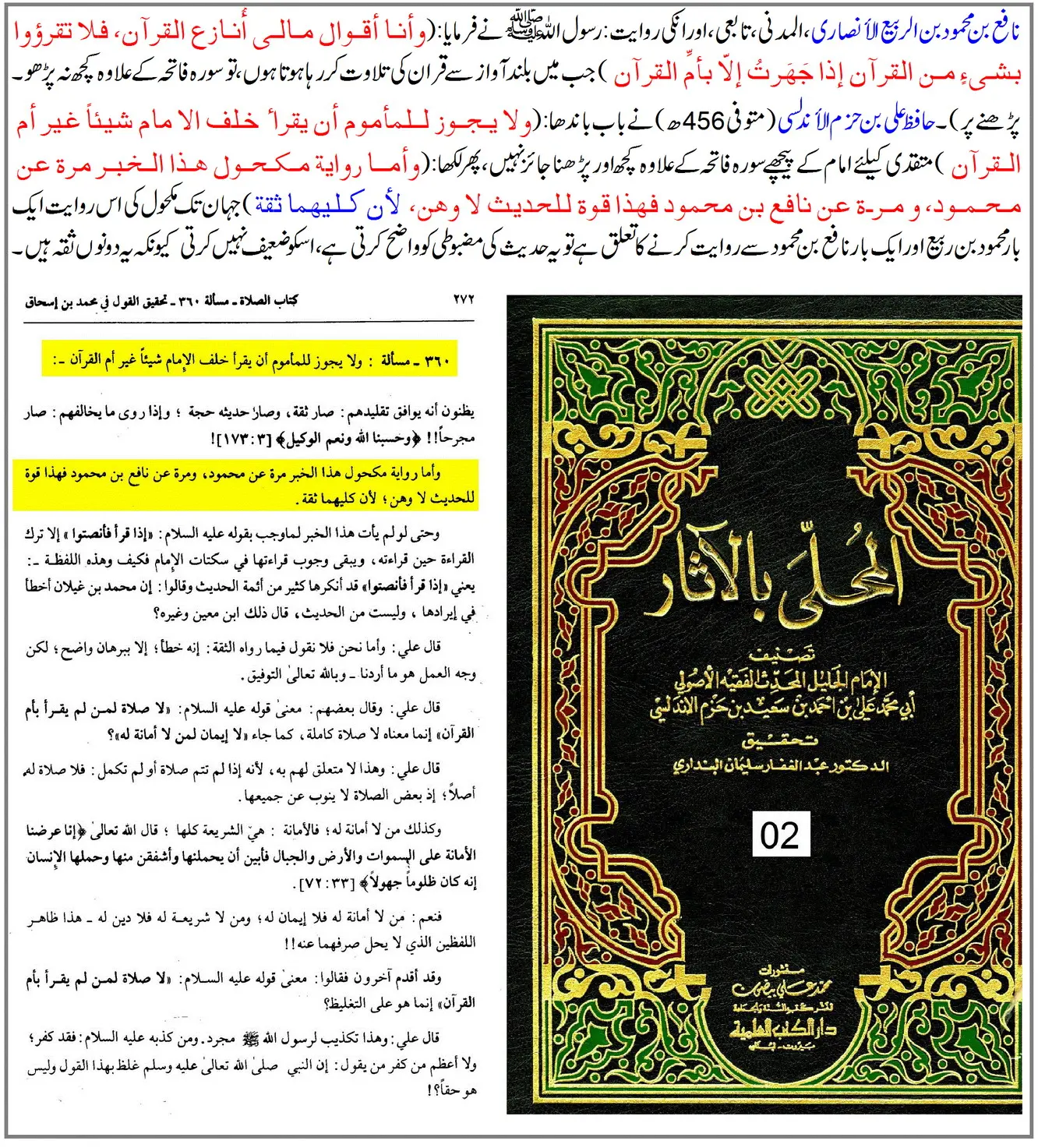
② Authentication by Hafiz Ibn Hazm Al-Andalusi (d. 456 AH):
Hafiz Ibn Hazm wrote in his famous book
that the follower should not recite anything behind the Imam except Surah Al-Fatiha. Then, mentioning the narration of Nafi’ bin Mahmood, he authenticated it:
Arabic text:
وَأَمَّا رِوَايَةُ مَكْحُولٍ هَذَا الْخَبَرَ مَرَّةً عَنْ مَحْمُودٍ وَمَرَّةً عَنْ نَافِعِ بْنِ مَحْمُودٍ فَهَذَا قُوَّةٌ لِلْحَدِيثِ لَا وَهْنٌ؛ لِأَنَّ كِلَيْهِمَا ثِقَةٌ.
Translation: “Makhool narrating this hadith once from Mahmood bin Rabee’ and another time from Nafi’ bin Mahmood is a strengthening of the hadith, not a weakness; because both narrators are trustworthy.”
From this clear ruling, it is understood that according to Hafiz Ibn Hazm, Nafi’ bin Mahmood bin Al-Rabee’ is a trustworthy narrator.
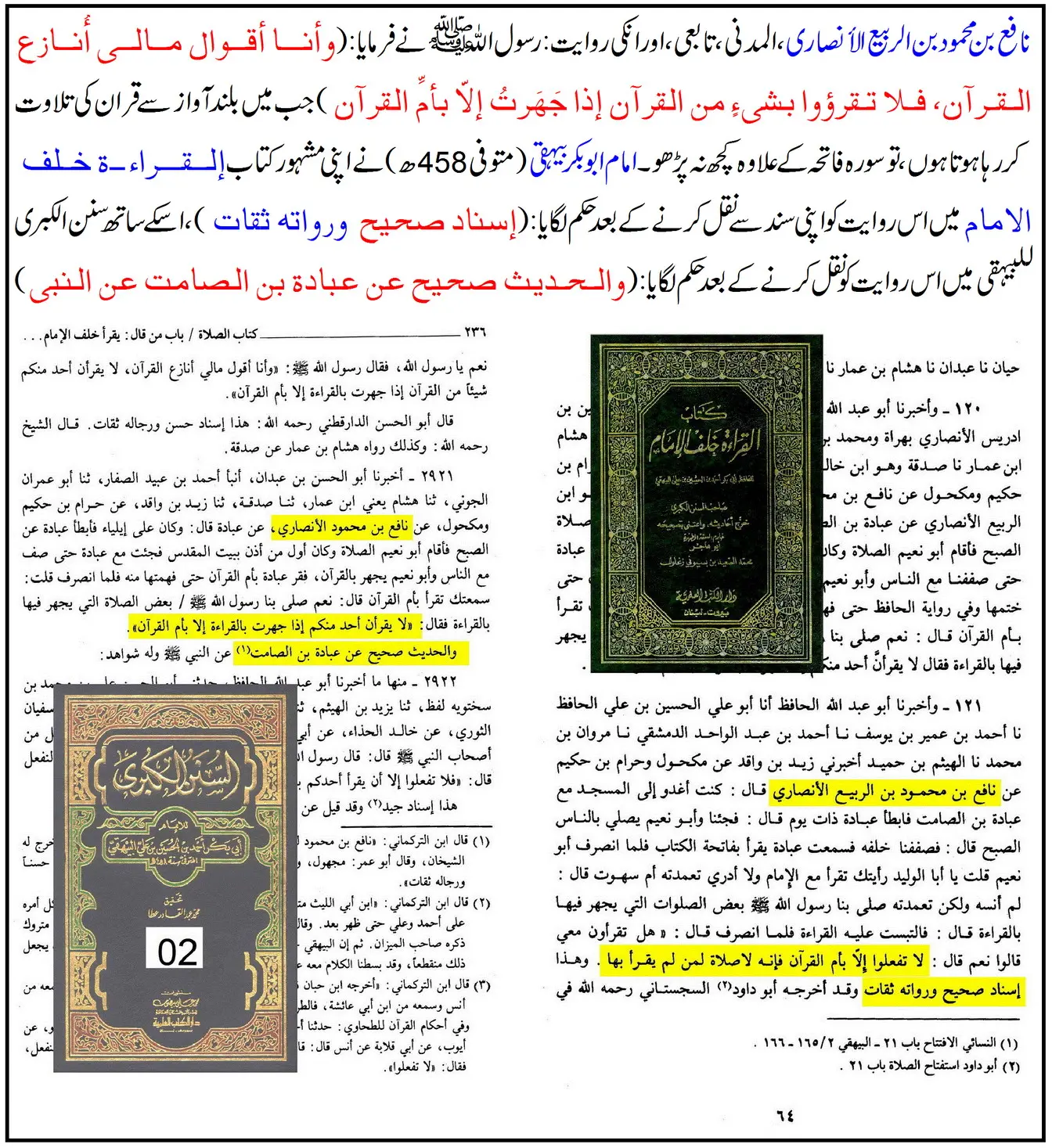
③ Imam Abu Bakr Al-Bayhaqi (d. 458 AH) Authentication:
Imam Bayhaqi, after narrating from Nafi’ bin Mahmood in his famous work
, said:
Arabic text: وَهَذَا إِسْنَادٌ صَحِيحٌ وَرُوَاتُهُ ثِقَاتٌ
Similarly, after mentioning the narration of Nafi’ bin Mahmood in Sunan Al-Kubra, he writes:
Arabic text: وَالْحَدِيثُ صَحِيحٌ، عَنْ عُبَادَةَ بْنِ الصَّامِتِ، عَنِ النَّبِيِّ صَلَّى اللهُ عَلَيْهِ وَسَلَّمَ
This clear authentication indicates that in the view of Imam Bayhaqi, may Allah have mercy on him, Nafi’ bin Mahmood is a trustworthy narrator.
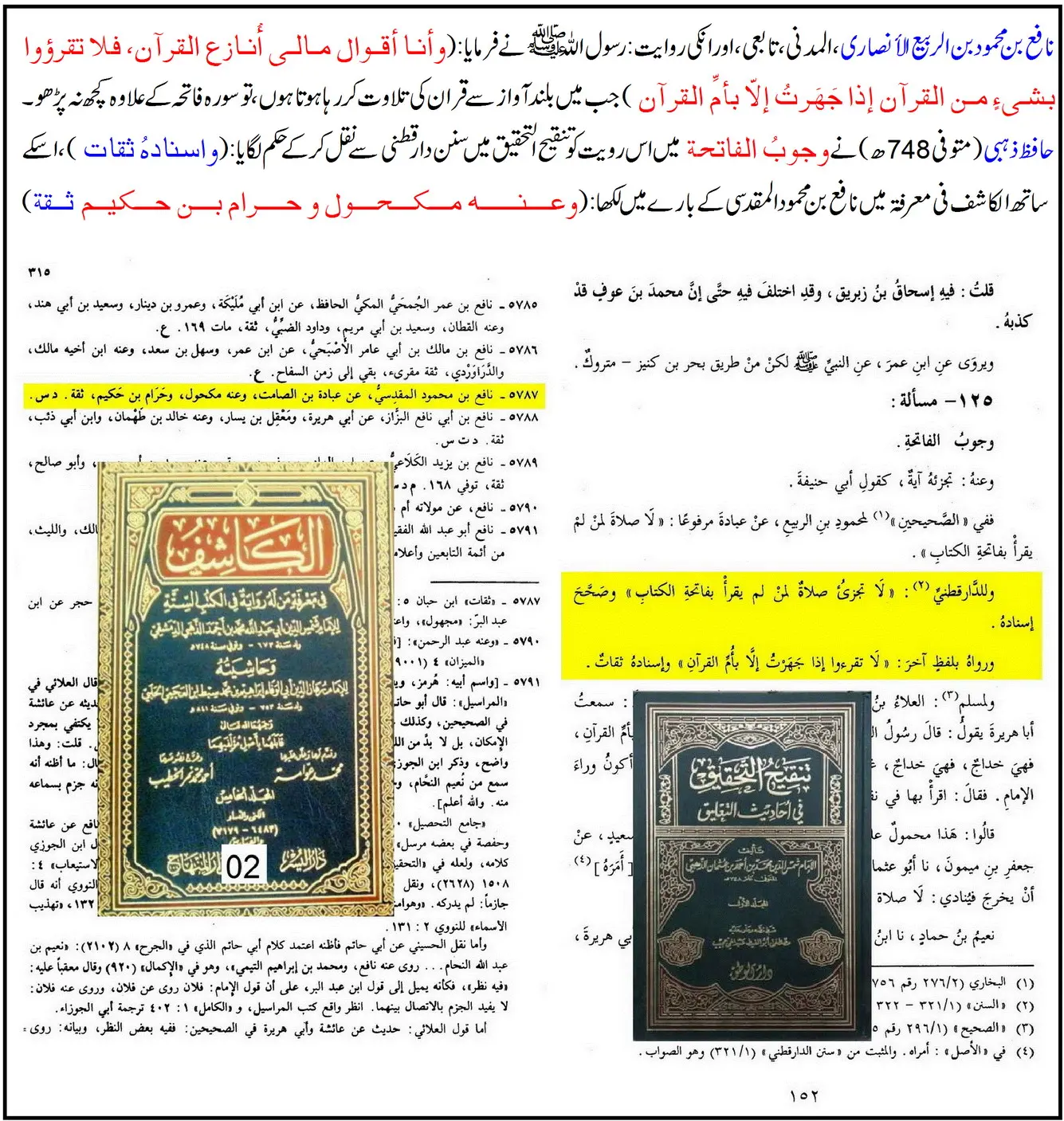
④ Hafiz Al-Dhahabi (d. 748 AH) Authentication:
Hafiz Al-Dhahabi wrote in his book
regarding the narration of Nafi’ bin Mahmood:
Arabic text:
وصَحّحَ إسنادهُ. ورواهُ بلفظٍ آخرَ: «لا تقرءوا إذا جهرتُ إلا بأمِّ القرآن» وإسنادهُ ثقاتٌ.
Translation: “Darqutni has declared the chain of this narration as authentic, and the words of the other narration are: (When I recite aloud, do not recite anything except Surah Al-Fatiha), its narrators are also trustworthy.”
Also, Hafiz Dhahabi has directly called Nafi’ bin Mahmood bin Al-Rabee’ trustworthy in his other famous book “الکاشف فی معرفة من لہ روایة فی الکتب الستة”:
Arabic text: نافع بن محمود المقدسي عن عبادة بن الصامت وعنه مكحول وحرام بن حكيم ثقة
This text clearly shows Hafiz Dhahabi’s explicit authentication of Nafi’ bin Mahmood.
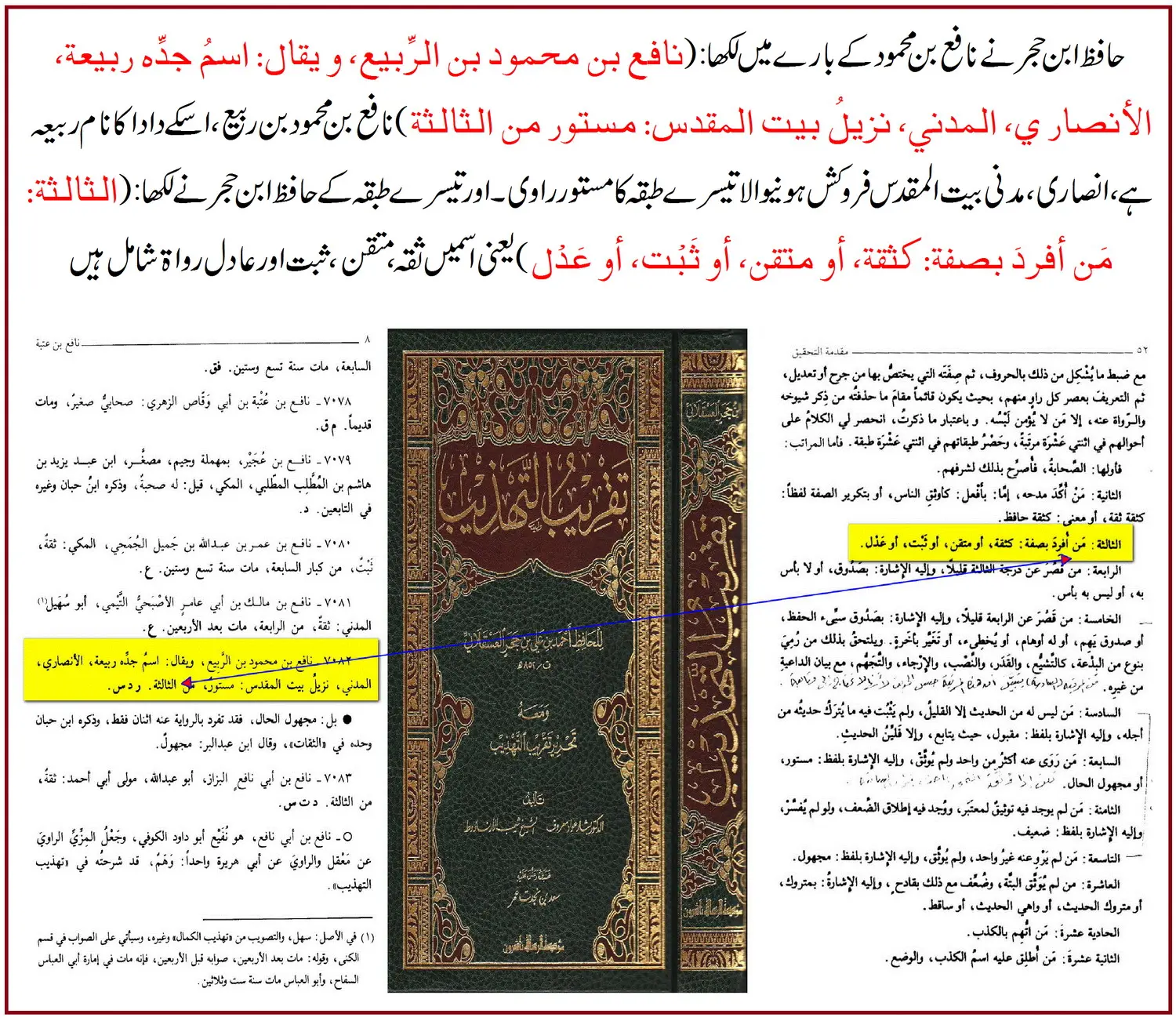
⑤ The opinion of Hafiz Ibn Hajar Asqalani (d. 852 AH) and its explanation:
Hafiz Ibn Hajar counted Nafi’ bin Mahmood among the mastur (of unestablished status) narrators of the third category in his book
:
Arabic text: نافع بن محمود بن الربيع الأنصاري المقدسي: مستور، من الثالثة۔
Here, “mastur” does not mean majhul al-hal (of unknown status); rather, Hafiz Ibn Hajar himself explained the third category as follows:
Arabic text: الثالثة: من أُفرِدَ بصفة كثقة، أو متقن، أو ثبت، أو عدل.
Translation: The third category consists of those narrators whom the muhaddithin have specifically described with words like “trustworthy,” “reliable,” or “just.”
From this clarification, it becomes clear that according to Hafiz Ibn Hajar, Nafi’ bin Mahmood is at least a “just and trustworthy” narrator.
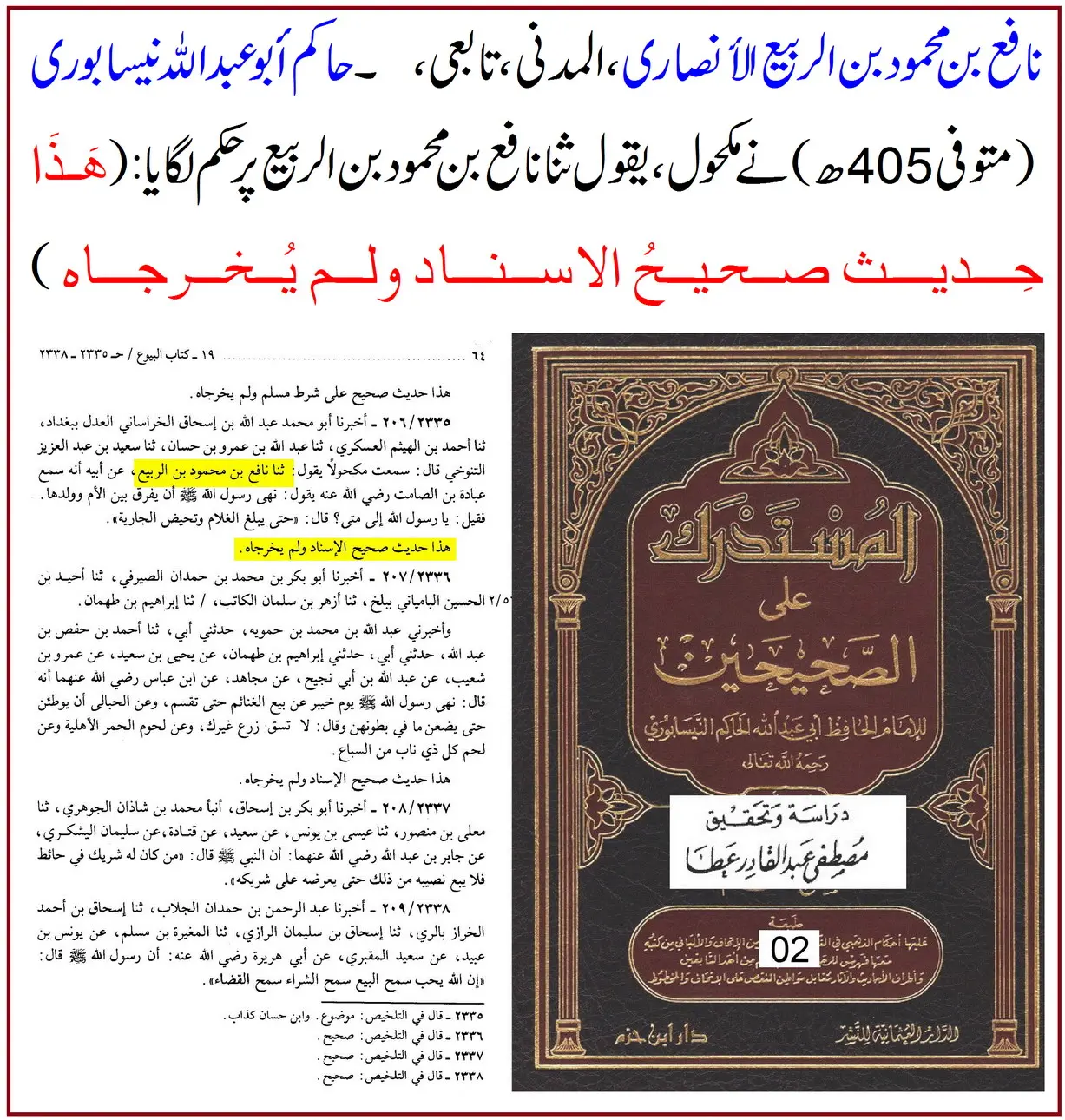
⑥ Authentication by Imam Hakim Abu Abdullah Nisaburi (d. 405 AH):
Imam Hakim, after narrating a tradition of Nafi’ bin Mahmood in his famous book
, has clearly declared it authentic.
Arabic text:
هَذَا حَدِيثٌ صَحِيحُ الْإِسْنَادِ وَلَمْ يُخَرِّجَاهُ۔
Translation: This hadith has an authentic chain of narration and it was not narrated by (Bukhari and Muslim).
Imam Hakim’s declaration of the chain of narration of this tradition as authentic is evidence that he considered Nafi’ bin Mahmood trustworthy and reliable because according to the scholars of hadith, declaring a chain authentic is only possible when all its narrators are trustworthy.
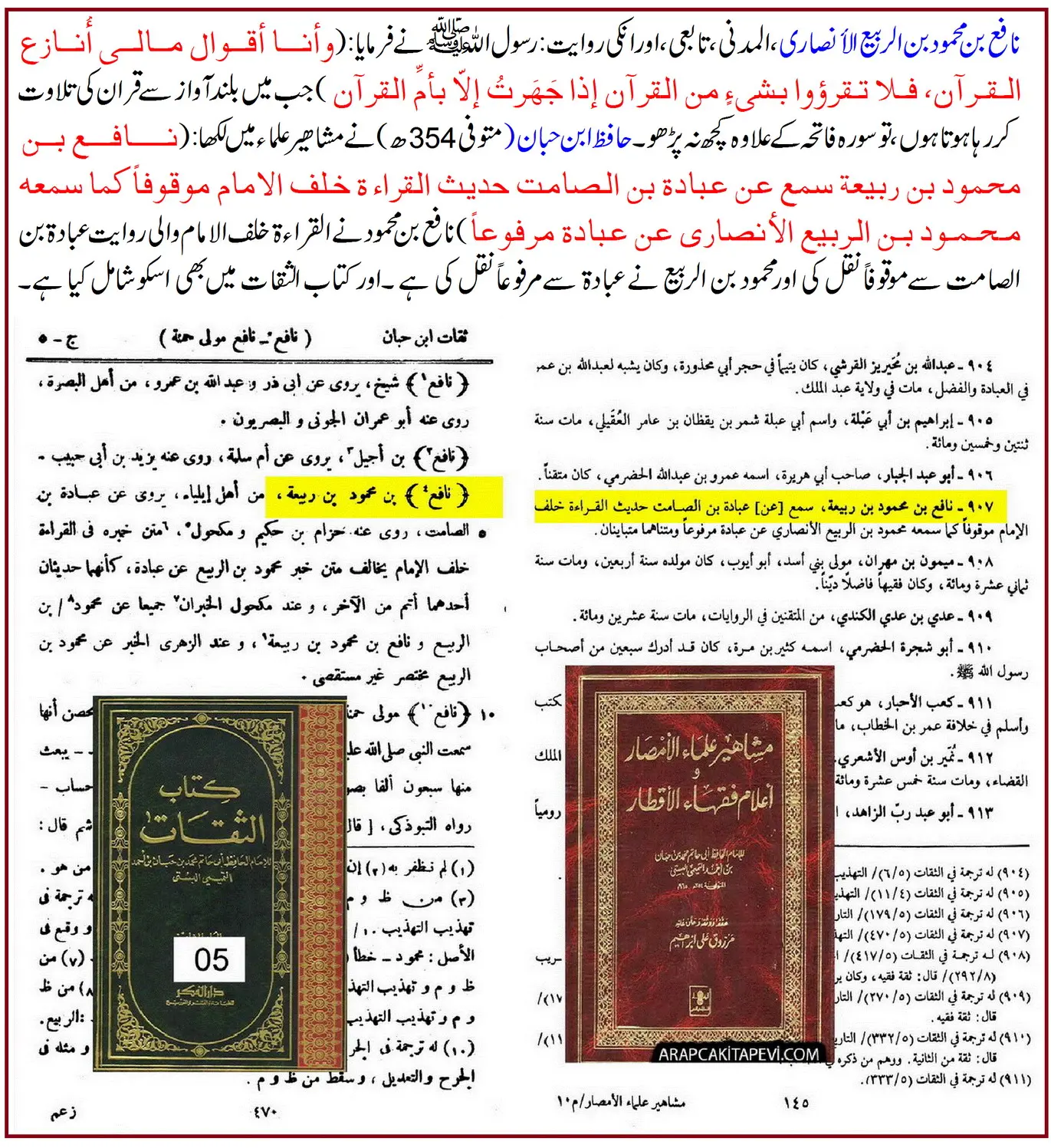
⑦ Explicit Authentication by Hafiz Ibn Hibban (d. 354 AH):
Hafiz Ibn Hibban also mentioned Nafi’ bin Mahmood in his famous book
and explicitly authenticated him:
Arabic text:
نافع بن محمود بن ربيعة، من أهل إيلياء، يروي عن عبادة بن الصامت، روى عنه حزام بن حكيم ومكحول۔
Translation: Nafi’ bin Mahmood bin Rabi’ah, resident of Aelia (Jerusalem), narrates from Ubada bin al-Samit, from whom Hizam bin Hakim and Imam Makhool narrated.
Mentioning a narrator in Kitab al-Thiqat by Hafiz Ibn Hibban is an explicit authentication of that narrator.
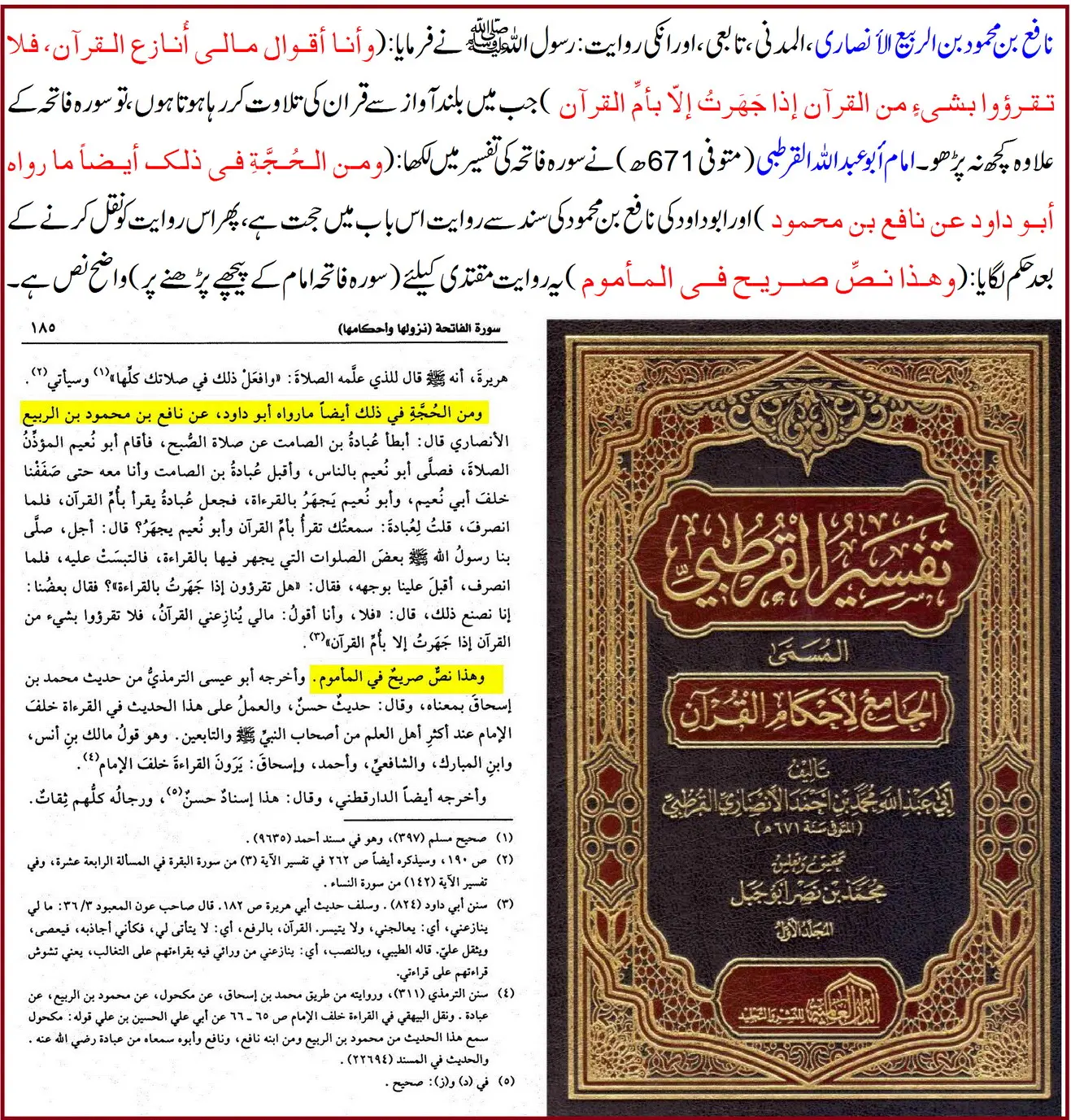
⑧ Authentication by Imam Abu Abdullah Al-Qurtubi (d. 671 AH):
Imam Abu Abdullah Al-Qurtubi, in his famous Tafsir
, has cited the narration of Nafi’ bin Mahmood regarding the recitation of Surah Al-Fatiha by the follower behind the Imam as evidence under Surah Al-Fatiha and has declared it a clear text.
Arabic text:
وَمِنَ الْحُجَّةِ فِي ذَلِكَ أَيْضًا مَا رَوَاهُ أَبُو دَاوُدَ عَنْ نَافِعِ بْنِ مَحْمُودِ بْنِ الرَّبِيعِ الْأَنْصَارِيِّ… فَلَا تَقْرَءُوا بِشَيْءٍ مِنَ الْقُرْآنِ إِذَا جَهَرْتُ إِلَّا بِأُمِّ الْقُرْآنِ، وَهَذَا نَصٌّ صَرِيحٌ فِي الْمَأْمُومِ۔
Translation:
In this matter, this narration is also evidence which Abu Dawood narrated from Nafi’ bin Mahmood bin Al-Rabee’ Al-Ansari… When I (the Imam) recite aloud, do not recite anything except Surah Al-Fatiha, and this narration is a clear text for the follower.
Imam Al-Qurtubi’s use of this narration as evidence indicates that he considers Nafi’ bin Mahmood trustworthy, because according to the scholars of hadith, the narration of a weak narrator is not acceptable as proof.
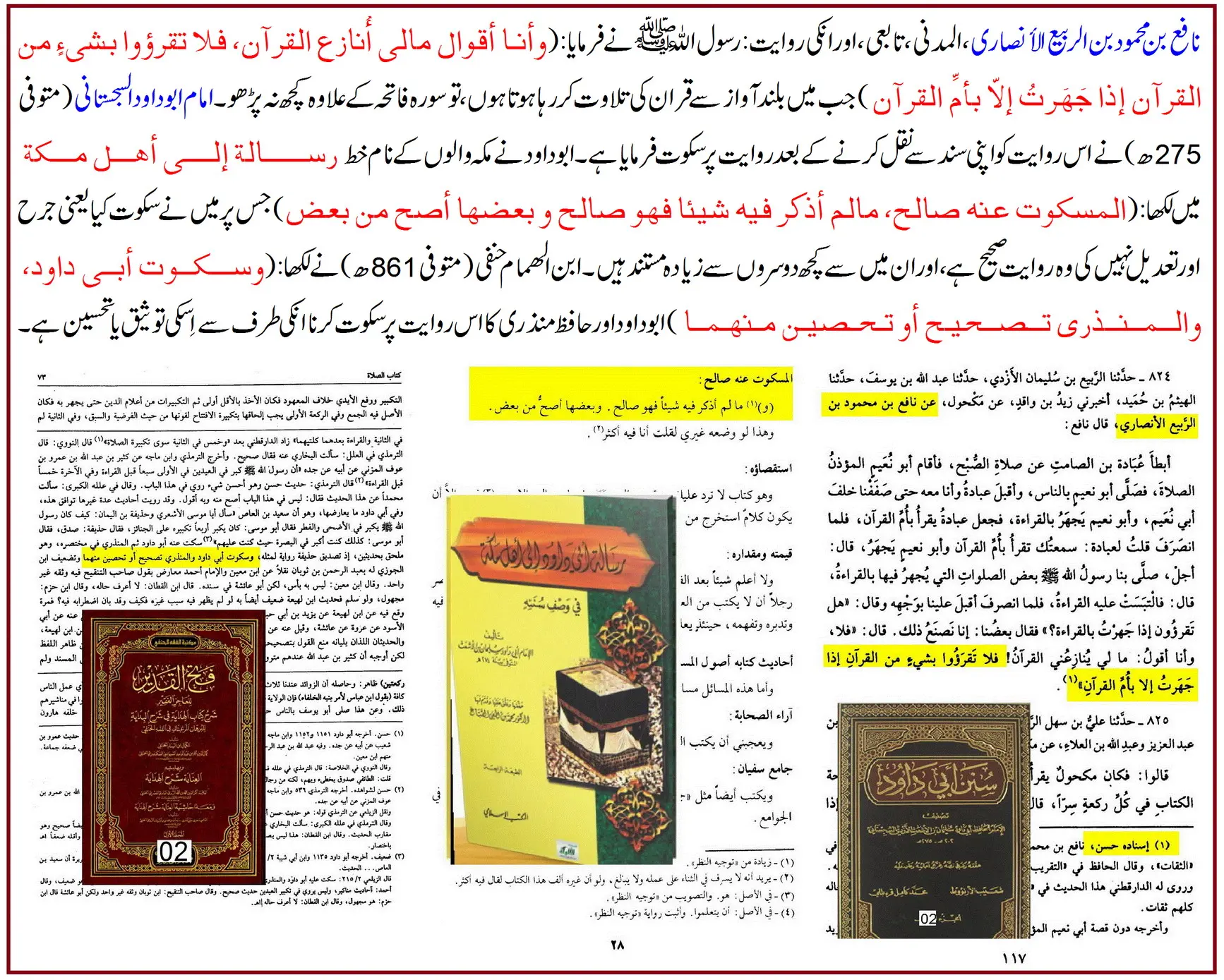
⑨ Authentication by Imam Abu Dawood Sijistani (d. 275 AH):
Imam Abu Dawood has narrated the report of Nafi’ bin Mahmood in his Sunan with his chain of narration and has not criticized it, rather he remained silent. Imam Abu Dawood’s silence is evidence of the authenticity and verification of the narration.
Arabic text:
حَدَّثَنَا الرَّبِيعُ بْنُ سُلَيْمَانَ الْأَزْدِيُّ،… عَنْ نَافِعِ بْنِ مَحْمُودِ بْنِ الرَّبِيعِ الْأَنْصَارِيِّ، قَالَ نَافِعٌ: أَبْطَأَ عُبَادَةُ بْنُ الصَّامِتِ… فَلَا تَقْرَءُوا بِشَيْءٍ مِنَ الْقُرْآنِ إِذَا جَهَرْتُ إِلَّا بِأُمِّ الْقُرْآنِ۔
Imam Abu Dawood’s own principle (according to him):
الْمَسْكُوتُ عَنْهُ صَالِحٌ۔
Translation:
The narration on which I have remained silent is authentic (or at least good).
Ibn al-Hummam Hanafi (died 861 AH) explains this principle as follows: وَسُكُوتُ أَبِي دَاوُدَ تَصْحِيحٌ أَوْ تَحْسِينٌ مِنْهُ۔
Translation:
Imam Abu Dawood’s silence on a narration is his authentication of that narration, or at least his grading of it as hasan (good).
From this, it is clear that Imam Abu Dawood’s silence regarding the narration of Nafi’ bin Mahmood is to be understood as his verification of this narrator.
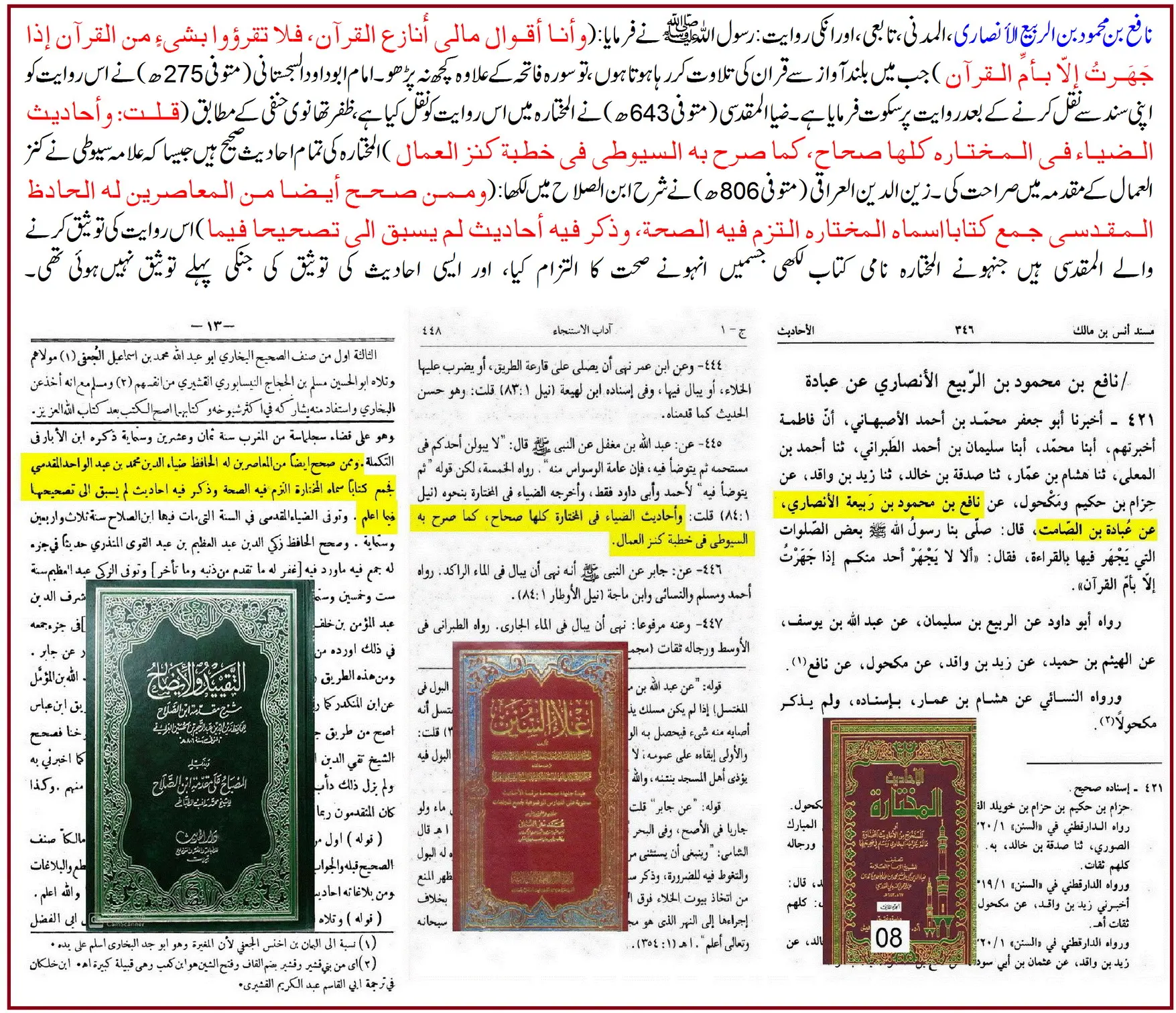
⑩ Endorsement by Imam Ziya al-Din al-Maqdisi (died 643 AH):
Imam Ziauddin Al-Maqdisi has included the narration of Nafi bin Mahmood in his book
. It should be noted that only those narrations which he considers “authentic” are included in Imam Maqdisi’s book. The inclusion of a narrator’s narration in this book is clear evidence of the narrator’s trustworthiness.
Arabic text:
نَافِعُ بْنُ مَحْمُودِ بْنِ الرَّبِيعِ الأَنْصَارِيُّ عَنْ عُبَادَة إِسْنَادُهُ صَحِيحٌ…
Translation:
The chain of narration of Nafi bin Mahmood bin Al-Rabee Ansari from Ubada bin Samit is authentic.
Furthermore, Allama Zafar Ahmad Usmani Thanvi (Hanafi Deobandi) states about all the hadiths in this book:
“وأحاديث الضياء في المختارة كلها صحاح، كما صرح به السيوطي في خطبة كنز العمال”
Translation:
All the narrations of Imam Ziauddin Al-Maqdisi in Al-Mukhtarah are authentic, as Allama Suyuti explicitly stated in the introduction of Kanz Al-Ummal.
Similarly, Imam Zainuddin Al-Iraqi (died 806 AH) states in Sharh Ibn Al-Salah:
“جمع الضياء المقدسي كتابا سماه المختارة التزم فيه الصحة، وذكر فيه أحاديث لم يُسبق إلى تصحيحها فيما أعلم.”
Translation:
Imam Zia Al-Maqdisi compiled a book named Al-Mukhtarah in which he adhered to authenticity and declared authentic those hadiths which no one before him had declared authentic.
Imam Zia al-Maqdisi’s inclusion of the narration of Nafi’ ibn Mahmood in “Al-Mukhtarah” is, in his view, a strong proof of the narrator’s reliability and acceptance.
Summary of the Discussion (Brief mention of all the verifying Imams):
So far, the reliability of Nafi’ ibn Mahmood ibn al-Rabi’ has been established by the following scholars:
-
Reference: Imam Darqutni (explicitly mentioned in Sunan Darqutni)
-
Reference: Hafiz Ibn Hazm (clearly declared trustworthy in Al-Muhalla)
-
Reference: Imam Bayhaqi (explicitly mentioned in Sunan al-Kubra and Al-Qira’ah Khalf al-Imam)
-
Reference: Hafiz Dhahabi (explicitly mentioned in Al-Kashif wa Tanqih al-Tahqiq)
-
Reference: Imam Hakim (considered to have authentic chain in Al-Mustadrak)
-
Reference: Imam Ibn Hibban (included in Al-Thiqat)
-
Reference: Imam Abu Abdullah al-Qurtubi (considered authoritative in Tafsir al-Qurtubi)
-
Reference: Imam Abu Dawood al-Sijistani (remained silent in Sunan Abi Dawood, which is a sign of authenticity)
-
Reference: Imam Zia al-Din al-Maqdisi (declared authentic in Al-Ahadith al-Mukhtarah)
-
Reference: Ibn Muflih Hanbali also expressed verification.
In light of the clear and explicit verifications of these ten esteemed hadith scholars, calling Nafi’ ibn Mahmood ibn al-Rabi’ “unknown” or labeling his narration as weak is absolutely baseless and contrary to scholarly principles.
Scholarly Review and Refutation of the Objections Regarding Nafi‘ ibn Mahmud ibn al-Rabi‘ Being “Unknown”
After the aforementioned research, the reality of the objections in which Nafi‘ ibn Mahmud has been called “unknown” will now be clarified. Three objections have been raised in this regard:
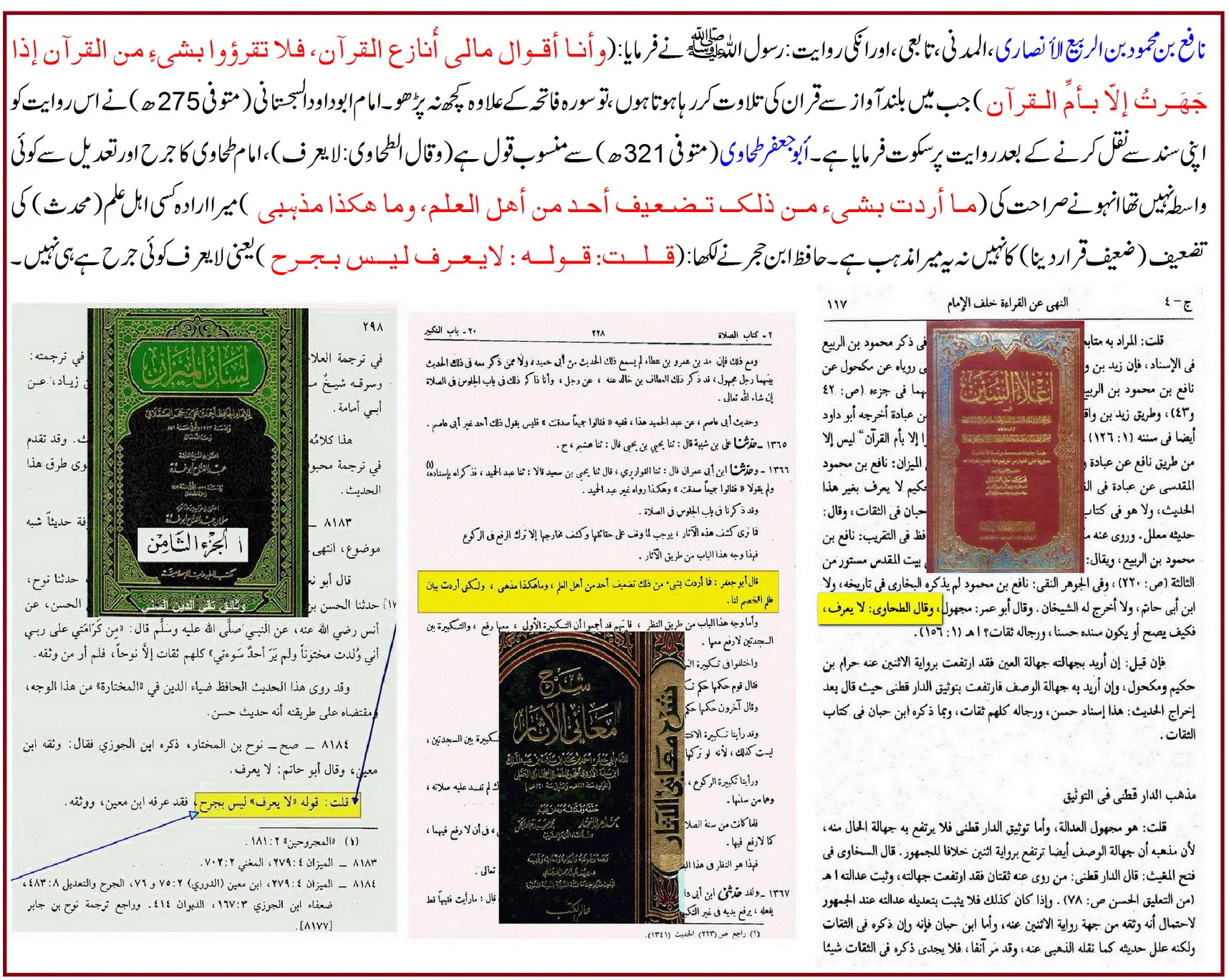
First Objection: (Review of the Statement Attributed to Imam Tahawi)
Some individuals have quoted this statement from the book of Imam Abu Ja‘far al-Tahawi (d. 321 AH)
:
Arabic text:
وَلَيْسَ نَافِعُ بْنُ مَحْمُودٍ بِمَعْرُوفٍ
Translation: Nafi‘ ibn Mahmud is not well-known.
Refutation of this Objection:
This book (Ahkam al-Qur’an by al-Tahawi) is attributed to Imam Tahawi and there is no chain of transmission or authentic manuscript available; therefore, this statement is doubtful and unreliable.
Furthermore, Imam Tahawi was not an authority in criticism and accreditation (jarh wa ta‘dil), rather he himself clearly stated:
“فما أردتُ بشيء من ذلك تضعيفَ أحدٍ من أهل العلم، وما هكذا مذهبي.”
Translation:
I do not intend to declare any scholar (muhaddith) weak, and this is not my method.
Hence, attributing this statement to Imam Tahawi is completely baseless and rejected.
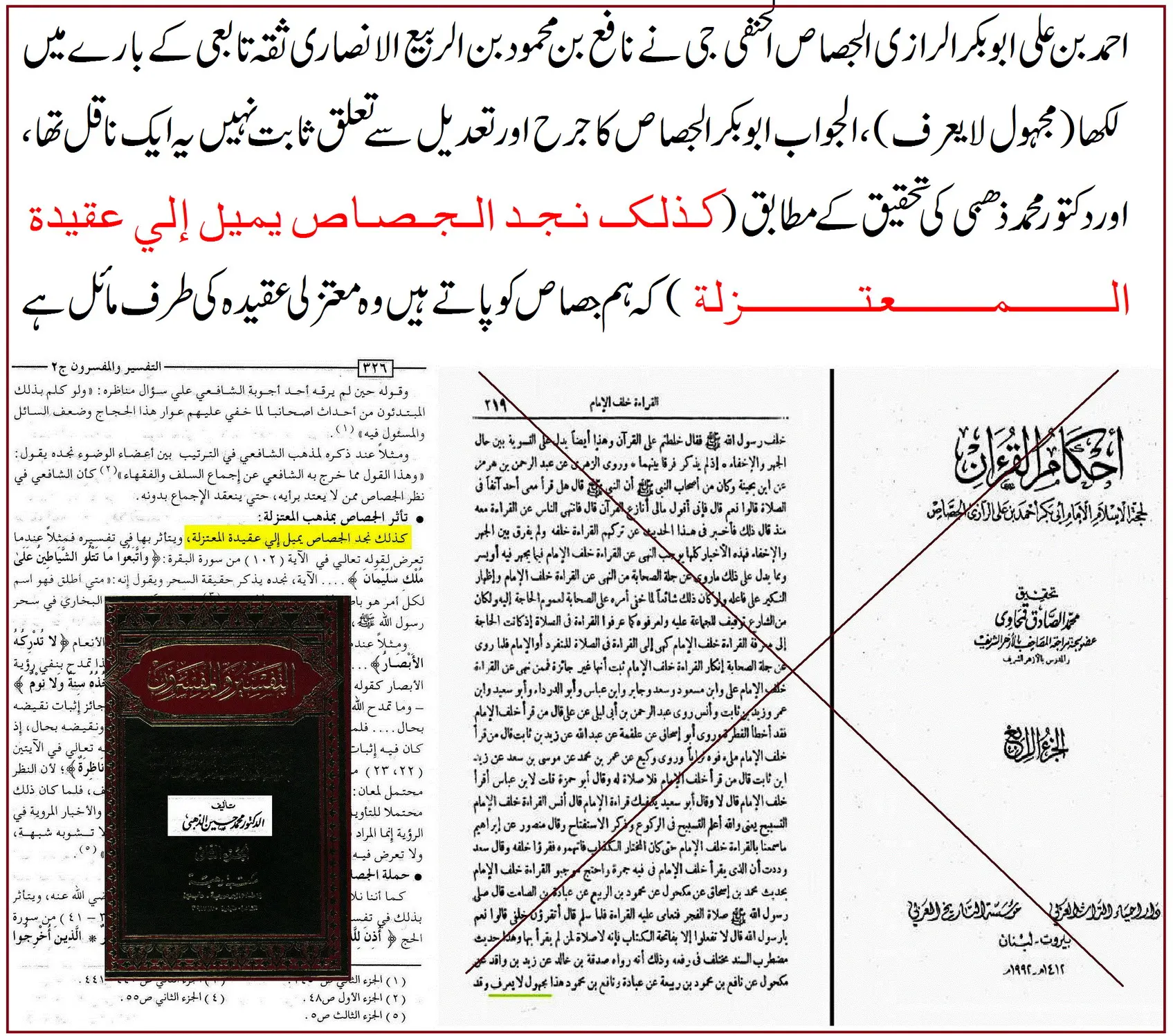
Second Objection: (Statement of Abu Bakr al-Jassas, the Mu‘tazili)
Influenced by Mu’tazili thought, Abu Bakr al-Jassas (d. 370 AH) also wrote:
Arabic text:
نَافِعُ بْنُ مَحْمُودٍ هَذَا مَجْهُولٌ لَا يُعْرَفُ
Response to this objection:
- Al-Jassas held Mu’tazili beliefs, which is why hadith scholars did not consider him reliable.
- Imam al-Dhahabi also clarified al-Jassas’s Mu’tazili tendencies:
“كَانَ يَمِيلُ إِلَى الِاعْتِزَالِ، نَسْأَلُ اللهَ السَّلَامَةَ”
Reference: (Siyar A’lam al-Nubala)
The criticism of such a Mu’tazili and weak-in-faith person, especially against such a trustworthy and well-known narrator, is absolutely unacceptable.
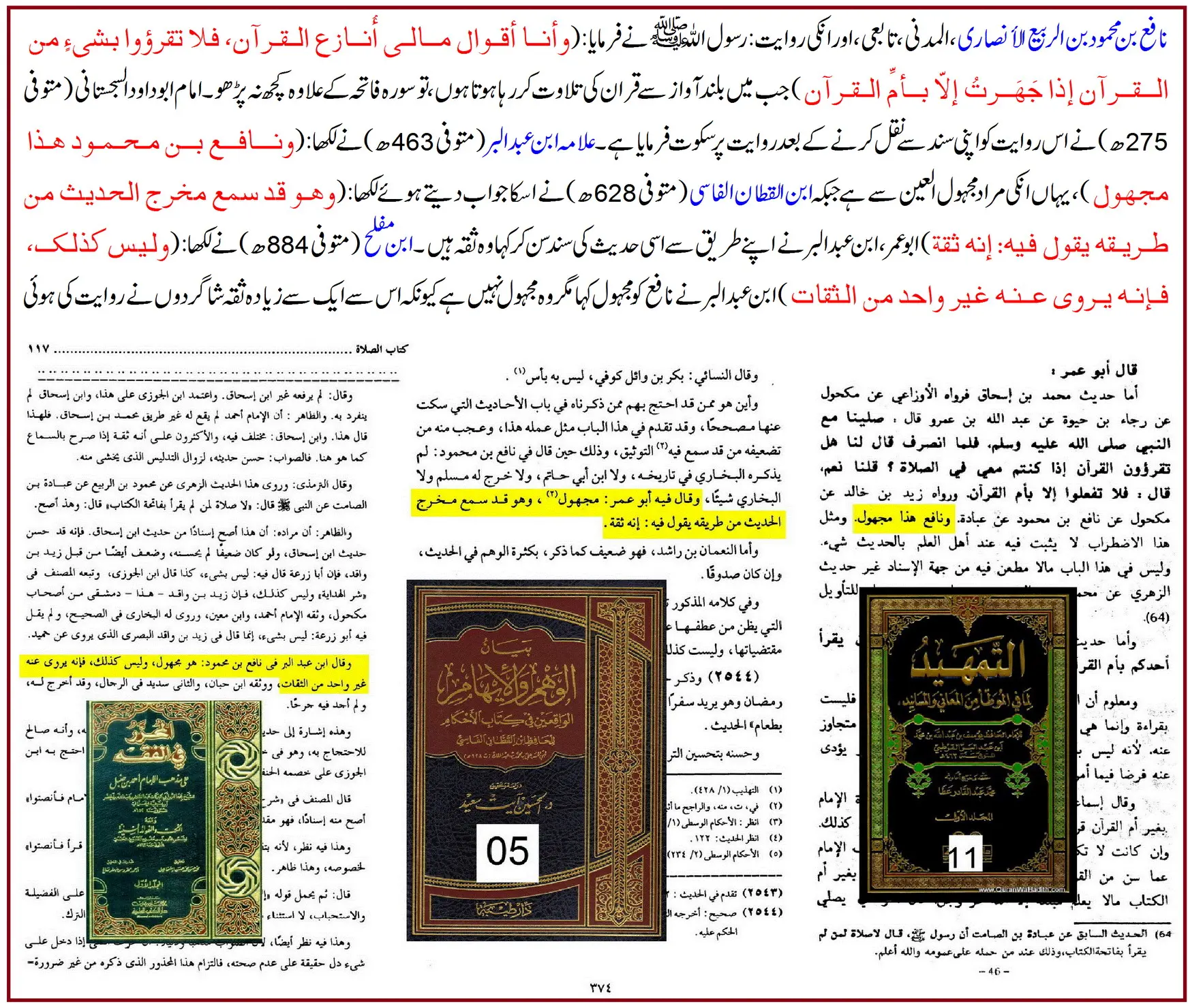
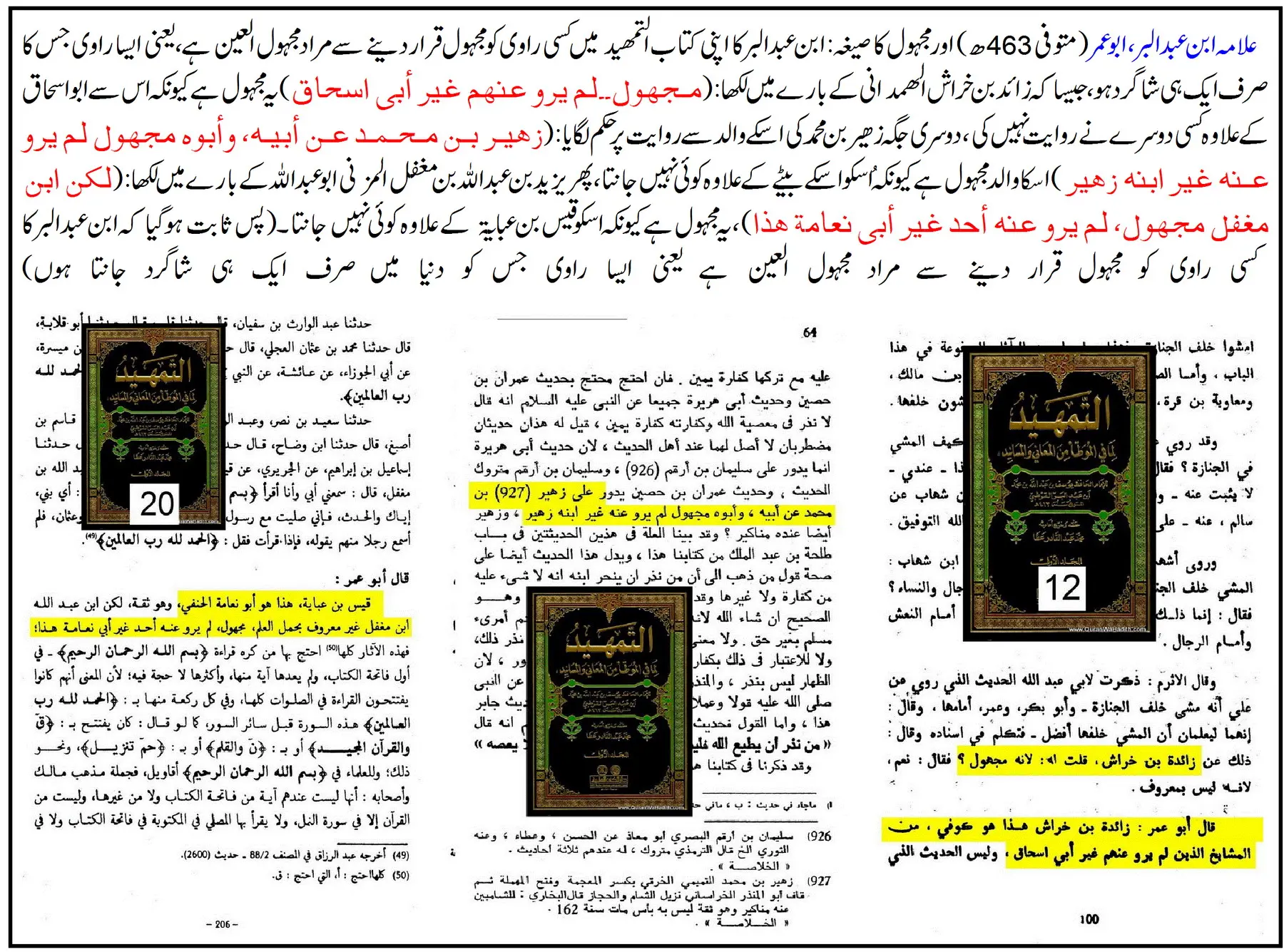
Third objection: (Statement of Ibn Abd al-Barr)
Ibn Abd al-Barr (d. 463 AH) also called Nafi’ ibn Mahmood “unknown”:
Arabic text:
نَافِعُ بْنُ مَحْمُودٍ هَذَا مَجْهُولٌ
Response to this objection:
This objection is based on misunderstanding or lack of research. The answers are as follows:
First answer:
Ibn al-Qattan al-Fasi (d. 628 AH) himself narrated from Ibn Abd al-Barr that he later accepted Nafi’ ibn Mahmood as trustworthy:
“وقال فيه أبو عمر: مجهول، وهو قد سمع مخرج الحديث من طريقه يقول فيه: إنه ثقة.”
Translation:
Abu Umar (Ibn Abd al-Barr) initially called him unknown but later accepted the same narrator as trustworthy.
This is a clear retraction.
Second answer:
Ibn Muflih Hanbali (d. 884 AH) declared Ibn Abdul Barr’s criticism incorrect and wrote:
“وَقَالَ ابْنُ عَبْدِ الْبَرِّ: نَافِعُ بْنُ مَحْمُودٍ مَجْهُولٌ وَلَيْسَ كَذَلِكَ فَإِنَّهُ يَرْوِي عَنْهُ غَيْرُ وَاحِدٍ مِنَ الثِّقَاتِ وَوَثَّقَهُ ابْنُ حِبَّانَ وَلَمْ أَجِدْ فِيهِ جَرْحًا.”
Translation:
Ibn Abdul Barr called Nafi’ ibn Mahmood unknown (majhool), but this is incorrect because many trustworthy narrators have narrated from him, and Ibn Hibban also authenticated him.
Third Response:
According to Ibn Abdul Barr’s terminology, majhool means “مجہول العین” from whom only one student narrates.
Whereas three trustworthy students (Haram ibn Hakim, Makhool, Uthman ibn Abi Suda) narrated from Nafi’ ibn Mahmood. Therefore, the accusation of being “majhool al-‘ayn” is also proven false.
Conclusion and Summary of Research:
- The objections of those who called Nafi’ ibn Mahmood ibn al-Rabi’ “majhool” have been academically refuted.
- More than ten prominent hadith scholars have confirmed the trustworthiness of Nafi’ ibn Mahmood, including Al-Daraqutni, Al-Dhahabi, Ibn Hibban, Al-Hakim, Abu Dawood, Ibn Hazm, Al-Bayhaqi, and Imam Al-Maqdisi.
- Ibn Abdul Barr himself later retracted his criticism.
- Nafi’ ibn Mahmood ibn al-Rabi’ is a trustworthy narrator, and his narration is not less than authentic (sahih) or good (hasan) in grade.
Therefore, the objection of “unknown” regarding this narrator is academically invalid.
واللہ اعلم بالصواب
Screenshots of Important References