
إن الحمد لله نحمده ونستعينه ونستغفره ونعوذ بالله من شرور أنفسنا ومن سيئات أعمالنا، من يهده الله فلا مضل له ومن يضلله فلا هادى له وأشهد ان لا إله إلا الله وحده لا شريك له وأشهد أن محمدا عبده ورسوله وصلى الله على إمام الأنبياء والمرسلين وعلى أله وصحبه أجمعين وعلى من تبعهم بإحسان ودعا بدعوتهم إلى يوم الدين. أما بعد، فقد قال الله تعالى فى كتابه الكريم : اتَّبِعُوا مَا أُنْزِلَ إِلَيْكُمُ مِنْ رَّبِّكُمْ وَلَا تَتَّبِعُوا مِنْ دُونِهِ أَوْلِيَاءَ قَلِيلاً مَّا تَذكَّرُونَ
وقال رسول الله صلى الله عليه وسلم : تركتكم على بيضاء ليلها كنهارها لا يزيغ عنها بعدى الا هالك
وقال رسول الله صلى الله عليه وسلم تركت فيكم أمرين لن تضلو ما تمسكتم بهما كتاب الله و سنتة نبيه
Some time ago, I came across a book named ترويحات خمسه, authored by Hakim Mir Muhammad Rabbani Sahib, and similarly another book أغراض الجلالين, whose author is Abdul Ghani Jajrawi Sahib. The authors of both these books have made unsuccessful attempts to prove Taqlid (imitation) in their respective extremist and biased manners. They have even written that the first person to appear as a non-follower (non-muqallid) was Satan. This is the same claim made by Mufti Muhammad Wali Darwish Sahib (Professor at Jamia Al-Uloom Al-Islamia Banuri Town Karachi) in his book (Is it Sunnah to recite Surah Al-Fatiha in the funeral prayer?). Moreover, even more amusingly, Mir Muhammad Sahib has proven that Musa (Moses), peace be upon him, was a follower of Khidr, peace be upon him. Before I proceed further with this discussion, I consider it necessary to inform the esteemed readers what Taqlid means, its definition, whether Allah Almighty has permitted Taqlid in the Holy Quran or not, and similarly, what was the status of Taqlid according to the Hanafi scholars and non-Hanafi Salaf scholars and what their opinions were regarding it.
Taqlid According to the Scholars of the Hanafi School:.
➊ فإن التقليد هو الأخذ بقول الغير بغير معرفة دليله.
Taking someone else’s statement without any evidence is called taqlid.
➋ التقليد العمل بقول الغير من غير حجة.
Taqlid is the act of following someone else’s statement without any evidence.
➌ التقليد اتباع الانسان غيره فيما يقول أو يفعل معتقدا الحقيقة فيه من غير نظر و تأمل فى الدليل كأن هذا المتبع جعل قول الغير أو فعله قلادة فى عنقه من غير مطالبة الدليل
Taqlid is to follow the statement or action of another person without any reasoning, with the belief that whatever he says or does is the truth. It is as if the follower has put the collar of that person’s statement and action around his neck and now cannot demand any evidence.
➍ Ibn al-Hummam said: “Taqlid is to act upon the statement of someone whose statement is not among the proofs, without any proof.”
Ibn al-Hummam, a Hanafi scholar, says that taqlid is to act upon someone’s statement which has no kind of proof, rather it is without proof.
Qur’anic Evidence for the Nullification of Taqlid:.
Now let us examine this matter in the light of the Holy Quran: Is it permissible for us to follow someone without any evidence or not?
Allah Almighty says:
قُلْ هَاتُوا بُرْهَانَكُمْ إِنْ كُنْتُمْ صَادِقِينَ
Say, “If you are truthful, then bring a proof.”
But in every era, the custom has been that whenever a follower is asked for evidence regarding his actions, instead of providing proof, he shows the actions of his ancestors and elders, saying: Are all those elders who do these deeds misguided? We will follow only them.
Hear the same from the Holy Quran:
وَإِذَا قِيلَ لَهُمُ اتَّبِعُوا مَا أَنْزَلَ اللَّهِ قَالُوا بَلْ نَتَّبِعُ مَا وَجَدْنَا عَلَيهِ آبائنا
And when it is said to them, “Obey Allah’s revealed Book,” they reply, “We will follow the way of our forefathers.”
Similarly, even today, when a Hanafi is told that the Quran and the Hadith of the Messenger of Allah (peace be upon him) say such and such, he replies that he found his forefathers following guidance, and that is sufficient for him. Hear the Quranic statement:
وَإِذَا قِيلَ لَهُمْ تَعَالَوْا إِلَى مَا أَنْزَلَ اللَّهُ وَإِلَى الرَّسُولِ قَالُو حَسْبُنَا مَا وَجَدْنَا عَلَيْهِ أَبَاءَنَا
And when it is said to them, “Come to what Allah has revealed and to the Messenger,” they say, “Enough for us is that upon which we found our forefathers.”
Now, the followers may say anything, but Allah Almighty’s judgment is:
فَلا وَرَبِّكَ لَا يُؤْمِنُونَ حَتَّى يُحَكِّمُوكَ فِيْمَا شَجَرَ بَيْنَهُمْ ثُمَّ لَا يَجِدُوا فِي أَنْفُسِهِمْ حَرَجًا مِمَّا قَضَيْتَ وَيُسَلَّمُوا تَسْلِيمًا
By your Lord, they will never become believers until they make you (O Prophet) judge in all their disputes and then find no resistance in their hearts against your judgment but accept it with full submission.
This verse indicates that those who are not satisfied with the judgment of Allah’s Messenger (peace be upon him) can never become true believers.
In the light of these verses, decide for yourself whether there is any doubt about the impermissibility of blind imitation. Does Allah Almighty command acting on religion without evidence or with evidence?
Allah Almighty says:
وَلَا تَقْفُ مَا لَيْسَ لَكَ بِهِ عِلْمٌ
Do not follow that of which you have no knowledge.
Do these verses command imitation or forbid it? Now perhaps someone might say, “Brother, we follow our scholars; only scholars know.”
And Allah Almighty also commands:
فَاسْئَلُوا أَهْلَ الذِّكْرِ إِنْ كُنْتُمْ لَا تَعْلَمُونَ
Ask the people of knowledge if you do not know.
And the common people of Ahl al-Hadith also ask them and follow their guidance; what blame is on us?
So the answer is:
If asking someone something is called imitation, then no Hanafi exists in the world today because Imam Abu Hanifa (may Allah have mercy on him) is no longer alive, and every Hanafi asks his local Mufti or mosque Imam about issues, so he becomes a follower of that Mufti or mosque Imam, not of Imam Abu Hanifa (may Allah have mercy on him).
If someone says, “Brother, our Mufti or Imam will only tell us the issues of Imam Abu Hanifa, so he will not be a follower of that Mufti or mosque Imam but will remain a follower of Imam Abu Hanifa,” then I say that similarly, when someone asks us an issue, we tell him the Hadith of the Messenger of Allah (peace be upon him), so he will not be our follower but a follower of the Messenger of Allah (peace be upon him).
Secondly, this verse itself is evidence for us, not for the followers, because if someone does not have knowledge, he asks, and after asking, he gains knowledge, because the verse says إِن كُنتُمْ لا تَعْلَمُونَ “If you do not know, ask,” and this is so that actions may be according to knowledge and this knowledge serves as evidence for the action. Whereas imitation means acting without any evidence or proof, as has been defined earlier with references. Similarly, Imam Shafi’i (may Allah have mercy on him) defines imitation in
as:
ومعني التقليد قبول قول من لا يدرى ما قال من أين قال وذلك لا يكون علما
Imitation means accepting the statement of a person without knowing what he said and from where he said it, and this is not knowledge.
Thirdly, Allah Almighty did not command asking the scholars for their opinions but commanded asking Allah and His Messenger (peace be upon him). Nowadays, no Hanafi scholar issues fatwas based on the Quran and Hadith; rather, fatwas are given from Al-Hidayah, Deobandi fatwas, and others, even though the questioner writes, “Please answer in the light of the Quran and Hadith.” How can those people answer in the light of the Quran and Hadith who consider any book other than the Quran as equal to the Quran? The Hanafis say:
إن الهداية كالقرآن قد نسخت من قبلها فى الشرع من كتب
Indeed, Al-Hidayah is like the Holy Quran, and all other Shariah books besides it have been abrogated.
That is, the Hanafis say that just as all books before the Quran have been abrogated and whoever acts upon them is misguided and outside the Muslim community, similarly, all books compiled before Al-Hidayah are abrogated, whether Sahih Bukhari, Sahih Muslim, Imam Malik’s Muwatta, Imam Shafi’i’s Al-Umm, or Imam Ahmad’s Musnad Ahmad. Whoever acts upon these books is like one acting upon abrogated books and is outside Islam. Hear this from Shah Waliullah Muhaddith Dehlawi (may Allah have mercy on him):
وترى العامة سيما اليوم فى كل قطر يتقيدون بمذهب من مذاهب المتقدمين يرون خروج الانسان من مذهب من قلده ولو فى مسألة كالخروج من الملة كأنه نبي بعث اليه وافترضت طاعته عليه وكان أوائل الأمة قبل المائة الرابعة غير متقيدين بمذهب واحد.
Common people, especially nowadays, are seen everywhere bound to one of the earlier sects. They think that leaving the religion of the person they follow, even in one issue, means leaving Islam. They consider their Imam as a sent prophet and obedience to this Imam as obligatory. Whereas the early Ummah before the fourth century was not bound to any one sect.
What could be worse than this? The Hanafis curse anyone who rejects the sayings of Imam Abu Hanifa (may Allah have mercy on him).
فلعنة ربنا أعداد رمل على من رد قول أبى حنيفة رحمه الله
May the curse of our Lord be upon the one who rejects the sayings of Imam Abu Hanifa (may Allah have mercy on him) as small as grains of sand.
Now let me tell you who have rejected the sayings of Imam Abu Hanifa (may Allah have mercy on him), upon whom the Hanafis are eager to send curses day and night: Imam Malik (179 AH), Imam Muhammad (189 AH), Imam Shafi’i (204 AH), Imam Abu Yusuf (208 AH), Imam Ahmad ibn Hanbal (241 AH), Imam Bukhari (256 AH), Imam Nasai (303 AH), Imam Tahawi (321 AH), Imam Ibn Hazm (456 AH), Imam Ibn Abd al-Barr (463 AH), Imam Nawawi (676 AH), Imam Ibn Taymiyyah (728 AH).
Many others have also rejected many sayings of Imam Abu Hanifa (may Allah have mercy on him). Dear readers, cursing the pious predecessors is the greatness and religiosity of the Hanafis.
Whereas the Prophet Muhammad (peace be upon him) said that when fifteen traits appear in my Ummah, Allah’s punishment will descend upon them, and one of them is:
اذا لعن آخر هذه الأمة أولها
When the people of the latter days of this Ummah begin to curse the predecessors.
In another place, the Prophet (peace be upon him) said:
ومن لعن مؤمنا فهو كقتله
Whoever curses a Muslim has, in fact, killed him.
Indeed, the most unfortunate people in the world are those upon whom Allah has sent curses through the mouths of the Prophets. As Allah cursed the Children of Israel through Dawud (David) and Isa (Jesus), as mentioned in the Quran:
لُعِنَ الَّذِينَ كَفَرُوا مِنْ بَنِي إِسْرَائِيلَ عَلَى لِسَانِ دَاوُدَ وَعِيسَى بْنِ مَرْيَمَ
And this honor is exclusively for the Hanafis because among the four madhhabs, only the Hanafis believe in Halala (the practice of temporary marriage to permit remarriage), upon whom the Prophet (peace be upon him) sent curses on both the doer and the one who causes it.
عن ابن مسعود رضى الله عنه قال لعن رسول الله صلى الله عليه وسلم المحلل والمحلل له
Abdullah bin Mas’ud (may Allah be pleased with him) said that the Messenger of Allah (peace be upon him) cursed both the one who performs Halala and the one who causes it.
The curses of the Hanafis have probably never affected anyone, but the curse of the Prophet (peace be upon him) will remain forever.
Dear readers! This is the way the followers honor and respect their Imams. Let us move forward. Even if for a moment it is accepted that:
فَاسْئَلُوا أَهْلَ الذِّكْرِ إِنْ كُنْتُمْ لَا تَعْلَمُونَ
Imitation is proven, then let us see what the Hanafis think about this verse:
فَإِنْ كُنْتَ فِي شَكٍّ مِمَّا أَنْزَلْنَا إِلَيْكَ فَاسْئَلِ الَّذِيْنَ يَقُرَأَوْنَ الْكِتَابَ مِنْ قَبْلِكَ
O Muhammad (peace be upon him), if you are in doubt about what We have revealed to you, then ask those who read the Scripture (Torah and Gospel).
Will the Hanafis also say here that the Prophet (peace be upon him) was commanded by Allah to imitate the Jews and Christians? If not, and certainly not, then فاسئل cannot mean imitation as the Hanafis and other followers claim.
القرآن : يفسر بعضه بعضا The Quranic verses explain each other, so it is clear that here فَاسْئَلُوا means investigation, not imitation, as claimed by the Hanafis and other followers. And this meaning is not fabricated by us; the preceding verse explains it:
وَمَا أَرْسَلْنَا مِنْ قَبْلِكَ إِلَّا رِجَالا نُوحِي إِلَيْهِمُ فَاسْئَلُوا أَهْلَ الذِّكْرِ إِنْ كُنْتُمْ لَا تَعْلَمُونَ
Before you, We did not send any messenger except men to whom We revealed. So if you do not know, ask the people of knowledge, meaning investigate.
And if here فَاسْئَلُوا is taken to mean imitation, then the meaning would be that if you doubt the prophethood of Muhammad (peace be upon him), then imitate the people of knowledge, i.e., the People of the Book, Jews and Christians. However, no commentator has taken this meaning, while Musa (Moses) (peace be upon him) is not even allowed to act at night in the presence of the Quran.
اللـهـم اهـــد قومي فانهم لا يعلمون.
Statements of the Companions for the Refutation (Rejection) of Taqlid (Blind Following):
Now let us see what the Companions of the Prophet, may Allah be pleased with them, thought about Taqlid (imitation).
وعن ابن مسعود رضى الله عنه قال لا يقلد احدكم دينه رجلا ان آمن آمن وإن كفر كفر.
It is narrated from Abdullah bin Mas’ud, may Allah be pleased with him, that he said: None of you should imitate anyone in matters of religion; when he believes in something, you also believe in it, and when he denies something, you also deny it.
وقال ابن عباس رضى الله عنه يوشك ان تنزل عليكم حجارة من السماء أقول! قال رسول الله صلى الله عليه وسلم وتقولون قال ابو بكر و عمر
Abdullah bin Abbas, may Allah be pleased with him, said: It is as if stones are about to rain down from the sky upon you. I tell you that the Messenger of Allah, peace be upon him, said so, and you say to me that Abu Bakr, may Allah be pleased with him, and Umar, may Allah be pleased with him, said so.
Even today, the situation of the followers who imitate is exactly the same: when something is not transmitted from the Imam, they are not ready to accept it; similarly, if something is transmitted from the Imam that contradicts a hadith, they are not ready to abandon it. Instead, they say, “Did our Imam not receive this hadith? If he did not accept this hadith, then why should we?” In other words, no hadith of the Prophet, peace be upon him, was missed by our Imam. Now, if someone asks them, “Did your Imam meet all the approximately 124,000 Companions, may Allah be pleased with them?” If they say yes, then this is a lie as clear as daylight; and if they say no, and certainly he did not, then it must be accepted that he did not receive all the hadiths. Then the question arises: the hadiths that are against your sect and are with Imam Malik, may Allah have mercy on him, or Imam Shafi’i, may Allah have mercy on him, or Imam Ahmad ibn Hanbal, may Allah have mercy on him, or Imam Bukhari, may Allah have mercy on him, and Imam Muslim, may Allah have mercy on him, and other muhaddithin (hadith scholars), did they fabricate them on their own, or did they have enmity against Imam Abu Hanifa, may Allah have mercy on him, or was their intention to establish their own religion and group? Whereas, in comparison to authentic hadith, the action of any Companion is not a proof.
We are not saying this from our side, but listen to the words of a noble Companion.
Abdullah bin Umar, may Allah be pleased with him, while answering someone’s question, said:
قال عبد الله بن عمر: أرأيت ان كان أبى نهى عنها وصنعها رسول الله صلى الله عليه وسلم أأمر أبى يتبع أم أمر رسول الله صلى الله عليه وسلم فقال الرجل بل أمر رسول الله صلى الله عليه وسلم فقال : لقد صنعها رسول الله صلى الله عليه وسلم
So tell me, if my father forbade this action and the Messenger of Allah, peace be upon him, permitted it, tell me whose obedience should be followed? My father’s or the Messenger of Allah’s? He said, “Certainly the obedience of the Messenger of Allah should be followed.” Abdullah bin Umar, may Allah be pleased with him, said, “Then listen, the Messenger of Allah has permitted this action.”
From this, it is clear that even according to the Companions, may Allah be pleased with them, the statement or action of any Companion was not a proof in front of the hadith of the Prophet, peace be upon him.
Statements of the Hanafis in Refutation of Taqlid:
Sahib Muslim al-Thuboot writes:
إذلا واجب إلا ما أوجبه الله ولم يوجب على أحد أن يتمذهب بمذهب رجل من الائمة
أجمع المحققون على منع العوام من تقليد الصحابة
The obligatory act is only that which Allah has made obligatory, and Allah Almighty has not made it obligatory on anyone to follow the sect of any Imam.
Scholars have consensus that it is not permissible for the general public to imitate the Companions (may Allah be pleased with them). Their division is strange; they consider following the Imam obligatory upon themselves, yet they forbid the public from following the Companions who are many times superior to the Imam in knowledge and piety. تِلْكَ إِذًا قِسْمَةٌ ضِيزَىٰ تقسيم This division is very unjust.
Mulla Ali Qari Hanafi writes:
ان الله لم يكلف أحدا أن يكون حنفيا أو مالكيا أو شافعيا أو حنبليا بل كلفهم أن يعملوا بالسنة
Allah Almighty has not made anyone obligated to become Hanafi, Shafi’i, Maliki, or Hanbali, rather Allah has obligated everyone to follow the Sunnah of the Messenger of Allah, peace be upon him.
Now let us see whether Imam Abu Hanifa, may Allah have mercy on him, himself ordered his followers to imitate him or not.
سئل أبو حنيفة إذا قلت قولا وكتاب الله يخالفه قال أتركوا قولى بكتاب الله قال إذا قلت قولا وحديث رسول الله صلى الله عليه وسلم يخالفه قال اتركوا قولى بخبر الرسول
Imam Abu Hanifa, may Allah have mercy on him, was asked: If one of your statements contradicts the Book of Allah, what should be done? He replied: Leave my statement and take the Book of Allah. Then he was asked: If your statement contradicts a Hadith of the Messenger of Allah, peace be upon him? He said: Similarly, leave my statement and take the command of the Messenger of Allah, peace be upon him.
Now let us see whether Imam Abu Hanifa, may Allah have mercy on him, himself followed anyone or not.
اني لا اقلد التابعى لأنهم رجال ونحن رجال ولا يصح تقليدهم
Imam Abu Hanifa, may Allah have mercy on him, said: I do not follow any Tabi’i because they are also human like us, and their imitation is not correct.
Similarly, Allama Shami Hanafi writes:
إذا صح الحديث وكان على خلاف المذهب عمل بالحديث ويكون ذلك مذهبه ولا يخرج مقلده عن كونه حنفيا بالعمل به فقد صح عن ابي حنيفة أنه قال اذا صح الحديث فهو مذهبي
When an authentic Hadith is found and it contradicts our madhhab, then the Hadith should be followed, and that will be the madhhab of Imam Abu Hanifa, may Allah have mercy on him. No one will leave the Hanafi madhhab by following that authentic Hadith because the Imam said that when the Hadith is authentic, that will be my madhhab.
Furthermore, he writes:
فاذا ظهر له صحة مذهب غير إمامه فى واقعة لم يجزله أن يقلد إمامه
If it becomes clear to someone that the madhhab of another Imam is correct besides their own Imam, even in any particular matter, then it is not permissible for them to follow their own Imam.
After reading all these points with evidence, if any follower is still not satisfied and does not repent from this imitation, then we will say about him what Allama Abdul Hay Lakhnawi Hanafi, may Allah have mercy on him, said:
قد تعصبوا فى الحنفية تعصبا شديدا والتزموا بما فى الفتاوى التزاما شديدا وان وجدوا حديثا صحيحا أو أثرا صريحا على خلافه وزعموا أنه لو كان هذا الحديث صحيحا لأخذ صاحب المذهب ولم يحكم بخلافه وهذا جهل منهم
A group of Hanafis are deeply entrenched in fanaticism and strictly cling to the books of fatwas, and if they come across any authentic Hadith or clear evidence that contradicts their madhhab, they say: If this Hadith were authentic, the Imam would have definitely issued a fatwa according to it and would not have ruled against it. This is the ignorance of these people.
The Religion of the Imams of the Salaf :.
Perhaps even now someone might object that if these great personalities held such views and issued such fatwas about taqlid (imitation), then why did they themselves practice taqlid? So let us tell you whether they practiced taqlid or not. Remember, when it is said that someone was Hanafi, Maliki, Shafi’i, or Hanbali, it does not mean that they practiced taqlid. Rather, everyone followed their own reasoning and ijtihad (independent reasoning). If someone asks why then they are called Hanafi, the answer is that their method of reasoning and deduction was exactly the same as that of their elders and teachers, so they were called Hanafi. This does not mean that they imitated them in every matter. For example, the greatest students of Imam Abu Hanifa, may Allah have mercy on him, were Imam Abu Yusuf, may Allah have mercy on him, and Imam Muhammad, may Allah have mercy on him. They were Hanafi in the sense that they studied in the school founded and headed by Imam Abu Hanifa, may Allah have mercy on him. They were not Hanafi in the sense that they imitated him, because for a muqallid (imitator), it is never correct to reject the words of their Imam. However, Imam Muhammad, may Allah have mercy on him, and Imam Abu Yusuf, may Allah have mercy on him, differed with their teacher Imam Abu Hanifa, may Allah have mercy on him, on two-thirds of the issues. Similarly, the followers of Imam Malik, may Allah have mercy on him, Imam Shafi’i, may Allah have mercy on him, and Imam Ahmad ibn Hanbal, may Allah have mercy on them all, are attributed to their respective Imams and schools.
But the muqallids have forgiven no one and have continued to impose the yoke of taqlid on everyone. Even students have been made imitators of their teachers. Although none of them wrote themselves as Hanafi, Shafi’i, Maliki, or Hanbali, and if the differences between these students and their teachers are compiled, many thick volumes would be produced. You can see for yourself what those whom these muqallids call Hanafi or Shafi’i write about themselves.
Allama Shami writes:
الأئمة الشافعية كالقفال والشيخ ابن على والقاضي حسين رحمه الله أنهم كانوا يقولون لسنا مقلدين للشافعي رحمه الله بل وافق رأينا رأيه ويقال مثله فى أصحاب أبى حنيفة مثل أبى يوسف رحمه الله ومحمد رحمه الله بالأولى وقد خالفوه فى كثير من الفروع
The scholars of the Shafi’i school, for example Qafal, Sheikh Ibn Ali, and Qadi Husayn, may Allah have mercy on them, all say that we are not muqallids of Imam Shafi’i, may Allah have mercy on him, but our opinion coincides with his opinion. Similarly, it is said about the students of Imam Abu Hanifa, may Allah have mercy on him, for example Abu Yusuf, may Allah have mercy on him, and Muhammad, may Allah have mercy on him, because they opposed Imam Abu Hanifa, may Allah have mercy on him, on many issues.
Likewise, Imam Tahawi, may Allah have mercy on him, rejected numerous issues of Imam Abu Hanifa, may Allah have mercy on him, in his book Sharh Ma’ani al-Athar.
قال الطحاوى لا بن حربويه لا يقلد الا عصبي أو غبي
Imam Tahawi, may Allah have mercy on him, said to Imam Ibn Harbawiyah: Only a bigot or a fool practices taqlid.
Similarly, Allama al-Wasi Hanafi, the author of Ruh al-Ma’ani, writes:
ان كان للضلالة أب فالتقليد أبوها
If there is a father of misguidance, then taqlid is its father.
Likewise, Imam Nawawi al-Shafi’i, may Allah have mercy on him (who was a model of moderation), left aside many issues of Imam Shafi’i, may Allah have mercy on him, which were against authentic hadiths, and adopted the authentic hadiths as his madhhab. See
. He writes that this is the madhhab of Imam Shafi’i, may Allah have mercy on him, because Imam Shafi’i said: اذا صح الحديث فهو مذهبي “When an authentic hadith is found, that is my madhhab.” Whereas nowadays, according to many Hanafis, if a person abandons the Imam’s statement and follows an authentic hadith, he is considered to have deviated from the right path and deserves cursing and abuse, which is well known.
Even more than this, they distort authentic hadiths to conform to their madhhab. The requirement of faith is that the madhhab should be subject to authentic hadiths, while the Prophet Muhammad, peace be upon him, said:
لا يؤمن أحدكم حتى يكون هواه تبعا لما جئت به
None of you can be a true believer until all his desires are subject to the religion I have brought.
And this great sin has been acknowledged by the great Hanafi scholars, including Maulana Ashraf Ali Thanwi, who writes:
Some muqallids have imagined their Imams to be infallible from error and calamity, and have assumed obligatory obedience, and have firmly resolved that no matter how authentic a hadith opposing the Imam’s statement may be, and even if the Imam’s authentic statement is based only on analogy, they will reject the hadith by creating many defects and flaws or by far-fetched interpretation, and will not abandon the Imam’s statement. Such taqlid is forbidden and is in accordance with the words of Allah:
اتَّخَذُوا أَحْبَارَهُمْ وَرُهْبَانَهُمْ أَرْبَابًا مِنْ دُونِ اللَّهِ
and is contrary to the will of the deceased Imams.
Allama Karkhi Hanafi’s Principle of Formulating Rules in Comparison to Quran and Hadith:
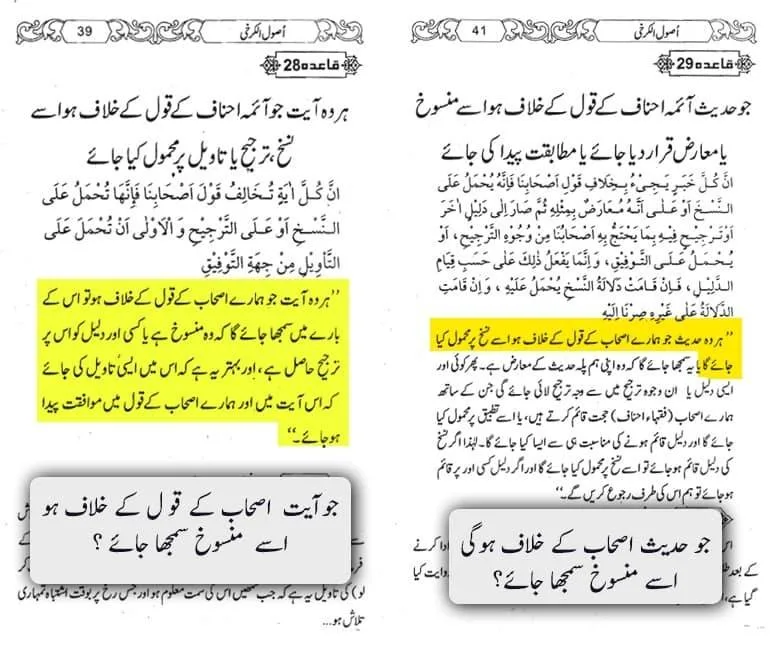
Interpreting Quranic verses and hadiths to conform to their own sect is the fundamental principle of the Hanafis. Beyond this, Hanafi scholars have even stated that any verse or hadith that contradicts their sect is also abrogated. See what they write:
إن كل آية تخالف قول أصحابنا فانها تحمل على النسخ أو على الترجيح والأولى ان تحمل على التأويل من جهة التوفيق
Every verse that contradicts the opinion of our jurists will either be considered abrogated or interpreted with preference, and it is better that this verse be interpreted allegorically so that harmony is apparent.
Similarly, they write:
ان كل خبر يجيء بخلاف قول أصحابنا فانه يحمل على النسخ أو أنه معارض بمثله
Indeed, every hadith that contradicts our companions (i.e., Hanafi jurists) will be considered abrogated or it will be understood that this hadith contradicts another hadith of similar nature.
Exactly the same principle was presented by the disbelievers of Quraish before the Prophet Muhammad (peace be upon him) that whatever in the Quran is against our beliefs, cancel it, that is, erase it, then we will accept your words and believe in you. اعاذنا الله من مثل هذا التحريف.
Mir Muhammad Sahib’s declaration of angels as imitators of Adam (peace be upon him):
Now let us return to our discussion in which Mir Muhammad Rabbani Sahib has proven that the accursed Iblis is a non-follower. He writes:
When Adam (peace be upon him) was established as the Caliph of his time, meaning the Supreme Imam, those who followed and obeyed him were angels, and they were called the followers of Adam (peace be upon him) and were considered the first followers. The one who fled from his following and obedience was Iblis, who appeared as the first non-follower. Similarly, those who flee from the following and obedience of the Supreme Imam of the Muhammadan Ummah, Hazrat Abu Hanifa (may Allah have mercy on him), are called non-followers, who gladly and deliberately adopt the following of the accursed Iblis but fear the following of the Supreme Imam. The honorable Hanafis are followers of the Supreme Imam and, like angels, adopt the following of their Supreme Imam. Now the conclusion and summary of the matter is that the denier of the Supreme Imam is either Iblis or a friend of Iblis, and his follower is either an angel or a follower of angels.
Answer:
First of all, you have accepted Adam (peace be upon him) as Khalifa, that is, the Supreme Imam. So see, what is meant by Khalifa?
الخليفة: الامام الذى ليس فوقه إمام
Khalifa is called the Imam over whom there is no other Imam.
Then how did you accept Abu Hanifa, may Allah have mercy on him, as the Supreme Imam? Has any Quranic verse been revealed in his favor stating that Abu Hanifa is the Supreme Imam, just as Allah Almighty said to Prophet Ibrahim (peace be upon him):
إِنِّي جَاعِلُكَ لِلنَّاسِ إِمَامًا
That I will make you an Imam for the people.
So when you made Abu Hanifa, may Allah have mercy on him, the Supreme Imam, it proves that you did not accept the Imamate of Adam (peace be upon him). Then you also became a companion of Iblis and appeared as a non-muqallid (non-follower).
Then you wrote that those who followed and obeyed him (i.e., Adam peace be upon him) were angels and were called followers of Adam (peace be upon him). It is strange; you claim to be a scholar and wise, yet you have made such a big mistake that you have buried knowledge and wisdom. You do not even know that Allah Almighty sent Adam (peace be upon him) as a Khalifa for the people of the earth, not for the inhabitants of the heavens, so that angels would be obliged to follow and obey him. It seems that you are unfamiliar even with the interpretation of the Holy Quran, so see:
وَإِذْ قَالَ رَبُّكَ لِلْمَلَائِكَةِ إِنِّي جَاعِلٌ فِي الْأَرْضِ خَلِيفَةً
And when your Lord said to the angels, “Indeed, I will make upon the earth a vicegerent.”
The author of Jalalayn in the interpretation of this verse says:
يخلفني فى تنفيذ أحكامي فيها وهو آدم
The one who will be my deputy in enforcing my commands on earth is Adam (peace be upon him).
Secondly, you declared the angels as followers of Adam (peace be upon him), whereas Adam (peace be upon him) was not the Imam of the angels, as has been proven from the above verse. The prostration that the angels made to Adam (peace be upon him) was by the command of Allah Almighty, not by the command of Adam (peace be upon him).
In the intoxication of imitation, you have become so dazed that you have put the noose of imitation even around the necks of the angels. Furthermore, you have made Musa (Moses, peace be upon him) a follower of Khidr (peace be upon him), meaning angels also became followers, the noble Prophets also became followers, and the only Imam is Abu Hanifa, may Allah have mercy on him. The surprising thing is that when someone calls Abu Hanifa, may Allah have mercy on him, a follower, you feel bad, yet from here you have made everyone from angels to Prophets followers. We are afraid that you might even declare Allah, the Lord of Glory, a follower of someone. نعوذ بالله من همزاتكم
And then you wrote that (these angels were first declared followers). So the question to you is: who declared them followers of Adam (peace be upon him), Allah and His Messenger (peace be upon him) or you? If it is you, then your statement is not binding on anyone. Therefore, our demand from you is the same which Allah Almighty has commanded us:
قُلْ هَاتُوا بُرْهَانَكُمْ إِنْ كُنْتُمْ صَادِقِينَ
If you are truthful in your claim, then bring a proof.
Then you said that (the one who fled from his following and obedience was Iblis). So know that Adam (peace be upon him) did not give any command to Iblis which he followed and obeyed. And it is your boastfulness or scholarly betrayal that Iblis fled from the obedience and following of Adam (peace be upon him). Rather, Iblis fled from the obedience of Allah Almighty. If you look into the Quran, you will find where your statement stands correct. قال تعالیٰ : فَفَسَقَ عَنْ أَمْرِ رَبِّهِ So (Iblis) disobeyed his Lord. And if your claim is that to prostrate to someone means to obey and follow him, then this claim is also wrong because it is mentioned about Yusuf (Joseph, peace be upon him): وَخَرُّوا لَهُ سُجَّدًا meaning Yusuf’s parents and all his brothers prostrated to him. And no one claims that Yaqub (Jacob, peace be upon him) and his sons were followers of Yusuf (peace be upon him). فافهم ولا تكن من الغافلين
Mir Muhammad Rabbani Sahib declaring Iblis as the first nonconformist :۔
The author writes that “Iblis appeared first as a non-follower.”
So you should know that the reality is that Iblis was actually the very first follower because he disobeyed Allah Almighty’s command and followed his own desires. So let us ask the Holy Quran whether he truly obeyed Allah Almighty or followed his own desires.
The first evidence is the command of Allah Almighty:
فَفَسَقَ عَنْ أَمْرِ رَبِّهِ
Iblis disobeyed his Lord’s command.
So it is clear that Iblis did not obey his Lord and was misguided, in fact, he was the greatest misled.
The second evidence is the command of Allah Almighty:
وَمَنْ أَضَلُّ مِمَّنِ اتَّبَعَ هَوَاهُ بِغَيْرِ هُدًى مِنَ اللَّهِ
Who can be more misguided than the one who follows his own desires and obedience without Allah Almighty’s guidance.
The third evidence is the command of Allah Almighty:
أَفَرَأَيْتَ مَنِ اتَّخَذَ إِلَٰهَهُ هَوَاهُ وَأَضَلَّهُ اللَّهُ عَلَىٰ عِلْمٍ
Have you seen the one who made his desire his Lord, and Allah Almighty led him astray despite having knowledge.
So this matter has become as clear to us as daylight from these evidences that Iblis was the first person who made his own desires his Lord and then followed them, thus becoming the first follower. So our advice to the Hanafis is the same advice that Allah, the Lord of Glory, has given to all humanity:
اتَّبِعُوا مَا أُنْزِلَ إِلَيْكُمْ مِنْ رَبِّكُمْ وَلَا تَتَّبِعُوا مِنْ دُونِهِ أَوْلِيَاءَ قَلِيلًا مَا تَذَكَّرُونَ
You people follow the one who has come from your Lord and do not follow other companions besides Allah; you are very reluctant to take advice.
وَمَا اخْتَلَفْتُمْ فِيهِ مِنْ شَيْءٍ فَحُكْمُهُ إِلَى اللَّهِ
And if there is a dispute among you, then refer the decision to Allah.
وقال تعاليٰ: وَلَا تَتَّبِعُوا أَهْوَاءَ قَوْمٍ قَدْ ضَلُّوا مِنْ قَبْلُ وَأَضَلُّوا كَثِيرًا وَضَلُّوا عَنْ سَوَاءِ السَّبِيلِ
And do not follow the desires of those who have gone astray before and have led many others astray and have deviated from the straight path.
وقال تعالىٰ : وَلَئِنِ اتَّبَعْتَ أَهْوَاءَهُمْ بَعْدَ الَّذِي جَاءَكَ مِنَ الْعِلْمِ مَا لَكَ مِنَ اللَّهِ مِنْ وَلِيٍّ وَلَا نَصِيرٍ
If you follow their desires despite having knowledge, then there will be no helper or supporter from Allah.
And it is as clear as daylight that Iblis knew that this was Allah Almighty’s command (to prostrate to Adam, peace be upon him), yet he still followed his own desires and was misguided.
Mir Muhammad Sahib says that followers are like angels and non-followers are like Iblis. Now it is clear whether the followers are like angels or like the accursed Iblis who was the first to follow his own self.
Mir Muhammad Sahib further writes that non-followers gladly and deliberately adopt the imitation and following of the accursed Iblis but fear the imitation of the Great Imam.
I say that the followers gladly and deliberately adopt the imitation and following of the accursed Iblis but flee from following and obeying the one whom the Lord of the universe has made the Great Imam of the entire Ummah, indeed the Imam of the Prophets, and whose following has been commanded, as testified by the Holy Quran itself:
وَإِذَا قِيلَ لَهُمُ اتَّبِعُوا مَا أَنْزَلَ اللَّهُ قَالُوا بَلْ نَتَّبِعُ مَا وَجَدْنَا عَلَيْهِ آبَاءَنَا
When they are told to follow what Allah has revealed, they say, “We will follow only what we found our forefathers upon.”
Similarly, Allah Almighty’s command is:
وَإِذَا قِيلَ لَهُمْ تَعَالَوْا إِلَىٰ مَا أَنْزَلَ اللَّهُ وَإِلَى الرَّسُولِ قَالُوا حَسْبُنَا مَا وَجَدْنَا عَلَيْهِ آبَاءَنَا
And when it is said to them, “Come to what Allah has revealed (the Quran) and to the Messenger (Hadith),” they say, “Sufficient for us is what we found our forefathers upon.”
So let us ask Allah Almighty this question: those who do not accept the decision of your beloved Prophet Muhammad, peace be upon him, cling to the words of the Imam, and do not respond to your call, do not act upon your Hadiths until there is a certificate of confirmation from Imam Abu Hanifa, and only act according to his opinion—are these people following the Noble Prophet, peace be upon him, or are they following Satan?
Allah Almighty’s answer:
فَإِنْ لَمْ يَسْتَجِيبُوا لَكَ فَاعْلَمْ أَنَّمَا يَتَّبِعُونَ أَهْوَاءَهُمْ
If these people do not obey your words, then be certain that they are only following their own desires.
So it is clear that this is the old disease of the followers that whenever they are called towards the Book and Sunnah, they turn away and present their forefathers as evidence for their actions. Allah Almighty has also informed us about such opponents that if they do not obey Muhammad, the Messenger of Allah, then be certain that they are merely wandering in following their own desires.
Maulana Abdul Ghani Jajrawi and Mufti Muhammad Wali Darwish Sahib’s Doubt and Its Resolution:
Maulana Abdul Ghani Jajrawi Sahib, while explaining خَلَقْتَنِي مِنْ نَارٍ وَخَلَقْتَهُ مِنْ طِينٍ in his book Aghraz al-Jalalain, writes that Iblis was the first person who was a non-follower (ghair muqallid), and he raises the question that if you say he was not a non-follower, then tell us whose follower was he? So when you cannot prove Iblis to be a follower, it becomes clear that Iblis was a non-follower. This same claim was made by Mufti Muhammad Wali Darwish Sahib in his book “Is it Sunnah to Recite Surah Fatiha in Janazah Prayer?”
Answer:
Although we have already elaborated on the answer to both gentlemen’s questions in response to Mir Muhammad Rabbani Sahib’s objection, still I find it necessary to respond to him in his own manner.
So the answer is that just as you claim that the first non-follower was Iblis, our claim is that the first non-followers were the angels. If you say that they were not non-followers but followers, then tell us, followers of whom were they? So when you cannot prove the angels to be followers and absolutely cannot, then accept and believe that the angels are non-followers, and the proof of this is Allah Almighty’s command: إِنِّي جَاعِلٌ فِي الْأَرْضِ خَلِيفَةً “I will make a vicegerent on earth (Adam)” — it does not say that He will make a vicegerent in the heavens. والله الحمد
Difference between Following and Imitation:.
Before answering another doubt of Mir Muhammad Sahib in which he has tried to prove that Musa (peace be upon him) was a follower of Khidr (peace be upon him), it is necessary to explain the difference between “ittiba” (following) and “taqlid” (imitation). We have already defined taqlid in detail from the books of the Hanafi school on previous pages, that taqlid means accepting someone’s statement without any evidence.
However, respected teacher Mufti New Town Karachi Mufti Wali Darwish insists that there is no difference between ittiba and taqlid; rather, both are the same thing because the Holy Quran uses the word ittiba for taqlid as well, such as:
فَاتَّبَعُوا أَمْرَ فِرْعَوْنَ
That they followed the command of Pharaoh.
And similarly, in another place it is said:
قَالُوا بَلْ نَتَّبِعُ مَا وَجَدْنَا عَلَيْهِ آبَاءَنَا
We will follow that which we found our forefathers upon.
So it is understood that taqlid includes ittiba, and there is no difference between ittiba and taqlid.
Answer:
First of all, Mufti Wali Sahib has rejected all the scholars of the Ummah, both Hanafi and non-Hanafi, who have defined Taqlid (imitation) and distinguished it from Ittiba (following), and have refuted it. Please refer again to page number
and then continue reading.
Our claim is that Taqlid is outright ignorance and misguidance, yet for your reminder, I will quote some references.
In the book Al-Tawdhih wal Talwih, it is stated:
فالمعرفة ادراك الجزئيات عن دليل فخرج التقليد
Grasping details with evidence is called knowledge, so Taqlid is excluded from this.
Similarly, Imam Shafi’i (may Allah have mercy on him) also declared Taqlid as ignorance and said:
وبالظن والتقليد لا يحصل العلم والمعرفة
Knowledge and understanding are not attained through conjecture and Taqlid.
Then he further states:
وذلك لا يكون علما
Taqlid is ignorance, not knowledge.
Likewise, Imam Ahmad ibn Hanbal (may Allah have mercy on him) said:
لا تقلدني ولا تقلد مالكا ولا الشافعي ولا الأوزاعي ولا الثوري وخذ من حيث اخذوا
Do not imitate me, nor Malik, nor Shafi’i, nor Awza’i, nor Thawri; take rulings from where they took them.
Similarly, Allama Al-Wasi Hanafi also declared Taqlid as misguidance and wrote:
إن كان للضلالة أب فالتقليد أبوها
If misguidance has a father, then Taqlid is its father.
Likewise, Allama Tahawi (may Allah have mercy on him), a Hanafi, said:
لا يقلد إلا عصبي أو غبي
Only a bigot or a fool does Taqlid.
It seems Mufti Wali Sahib has advanced two steps ahead of our Imams in understanding the Holy Quran, or perhaps those Imams had friendship with non-followers, due to which he has spoken incorrectly about Taqlid.
Anyway, this is your internal matter; we do not know who is truthful and who is false. Now, let us come to the researched answer:
I would say that perhaps the gentleman is unfamiliar with Arabic lexicon and could not distinguish between Ittiba and Taqlid, or he is either being ignorant or misleading the common people.
Indeed, the Holy Quran uses the word Ittiba for Taqlid; does this necessarily mean that Ittiba and Taqlid are the same thing?
Now see, in the Holy Quran, the word سمك (fish) is used for لحم (meat), and similarly, the word قرية (city) is used for village. Does this mean fish becomes meat and city becomes village? Certainly not.
So now let me inform you of some Arabic words that have multiple meanings; sometimes the same word is even used for its opposite. For example, the word قرء in Arabic is used for both menstruation and purity. Will you now say that menstruation and purity are the same and there is no difference between them? Similarly, the word موليٰ in Arabic means both master and slave. Likewise, the word جارية is used for both boat and maidservant, and the word عين means eye, spring (water source), and gold.
In my opinion, these few words are sufficient examples for Mufti Wali Sahib to understand. Will Mufti Wali Sahib still say that master and slave are the same, boat and maidservant are the same, eye, spring, and gold are the same?
The truth is that when the context changes, the translation and meaning of the word also change. Just as using the word موليٰ for slave does not make the slave a master, nor the master a slave, similarly, using the word اتباع for Taqlid does not make Taqlid obedience to the Messenger; it remains Taqlid.
Yes, it is true that the outward form of Ittiba and Taqlid is the same, but in reality, there is a world of difference, just as water and urine look the same outwardly but one is pure and the other impure.
Therefore, all the Imams have strictly forbidden this impurity.
Let us show you that we are not alone in this claim; many Salafi scholars have distinguished between Taqlid and Ittiba.
See, in the book التقليد وأحكامه, Saad bin Abdul Aziz Al-Shashri writes:
التقليد التزام المكلف مذهب غيره بلا حجة اما الإتباع فهو ما ثبت عليه حجة وممن قال بذلك ابن خويز منداد وابن عبد البر وابن القيم والشاطبي وغيرهم
Taqlid is the name for a person adhering to someone else’s religion without any evidence, and Ittiba is that which is established by evidence. This definition has been given by Imam Ibn Khawiz, Ibn Abd al-Barr, Ibn al-Qayyim, Shatibi (may Allah have mercy on them) and many other scholars.
Similarly, Abu Umar Ibn Abd al-Barr (may Allah have mercy on him) has narrated the consensus of all scholars on this matter and said:
أجمع الناس على أن المقلد ليس معدودا من اهل العلم وأن العلم معرفة الحق بدليله فإن الناس لا يختلفون أن العلم هو المعرفة الحاصلة عن الدليل وأما بدون الدليل فانما هو تقليد
People have consensus that a person who does Taqlid is not counted among the knowledgeable, and knowledge of truth is to know it through evidence. People do not differ that knowledge is understanding attained through evidence, and without evidence, it is Taqlid.
Remember, the practice of Taqlid began unanimously among scholars after the fourth century Hijri. If Mufti Wali Sahib cannot see the difference between Taqlid and Ittiba, then what was it that started after the fourth century? We have heard that jaundice appears in the eyes; here it seems to have affected minds as well, causing Taqlid to appear as Ittiba.
This is why to this day no scholar has defined following the Messenger of Allah (peace be upon him) as Taqlid. If you do not believe, pick up any Tafsir, whether of a follower or non-follower, Arabic or Urdu, nowhere will you find the word Ittiba with the Messenger and its translation or Tafsir given as Taqlid. Because Ittiba is only and only of the Messenger, and Taqlid is of others. فافهم وتدبر ولا تكن من الغافلين.
Mir Sahib’s Statement on Prophet Musa (peace be upon him) Being a Follower of Khidr (peace be upon him):
The author writes that when Prophet Musa (peace be upon him), by the command of Allah, reached the presence of Hazrat Khidr (peace be upon him), he observed the etiquette of a follower and said:
هَلْ أَتَّبِعُكَ عَلَىٰ أَنْ تُعَلِّمَنِي مِمَّا عُلِّمْتَ رُشْدًا
“May I follow you on the condition that you teach me from the guidance you have been taught?”
Answer:
Respected Mir Muhammad Sahib, the first part of your statement contradicts the second part. You said that when Musa (peace be upon him) reached the service of Khidr (peace be upon him) by the command of Allah, it was proven that going to his service was by Allah’s order. You should know that whatever work is done by the command of Allah is following (ittiba), not imitation (taqlid). So, your saying in this statement that observing the etiquettes of imitation is completely stubbornness and arrogance is incorrect.
Then, further on, in the translation of this verse, you have used both the words “mukallid” (imitator) and “mutabi” (follower) because you know that a Prophet is never an imitator, so you mentioned the word “mutabi” so that no one could object to you.
Moreover, this verse proves the etiquettes of the learner, not the etiquettes of the imitator, as the verse itself indicates.
هَلْ أَتَّبِعُكَ عَلَىٰ أَنْ تُعَلِّمَنِي مِمَّا عُلِّمْتَ رُشْدًا
And regarding this verse, the majority of commentators say that Musa’s (peace be upon him) journey was for acquiring knowledge, not for imitation, and you have just now realized that knowledge and imitation are two contradictory things.
The surprising thing is that the verse which Allah mentioned in the Holy Quran to explain the importance of knowledge, Mir Muhammad Sahib has unsuccessfully tried to prove imitation in an exaggerated manner from this verse. The real fact is that when Mir Muhammad Sahib could not distort the Quran, he distorted its interpretation, and about such people Allah says:
وَقَدْ كَانَ فَرِيقٌ مِنْهُمْ يَسْمَعُونَ كَلَامَ اللَّهِ ثُمَّ يُحَرِّفُونَهُ مِنْ بَعْدِ مَا عَقَلُوهُ وَهُمْ يَعْلَمُونَ
Among them is a group who listen to Allah’s words and then change it, although they understand it well and know it.
Then further, Mir Muhammad Sahib says that Khidr (peace be upon him) told Musa (peace be upon him) that the path of imitation and following is a difficult path, you will not be able to walk on it, and you will give up and respond to the etiquettes of imitation:
إِنَّكَ لَنْ تَسْتَطِيعَ مَعِيَ صَبْرًا
Answer:
Dear readers! You have seen the clear distortion of the Quran by Mir Muhammad Sahib. We ask Mir Muhammad Sahib, in which verse of the Quran or which hadith do you find this statement attributed to Khidr (peace be upon him), or did Khidr (peace be upon him) come in a dream and tell you this? We thought that you people only lie about Imam Abu Hanifa (may Allah have mercy on him), but it was not known that a follower, out of bias, also lies about the Prophets and the noble saints. فلعنة الله على الكاذبين
Whereas the reason for Khidr (peace be upon him) saying to Musa (peace be upon him): إِنَّكَ لَنْ تَسْتَطِيعَ مَعِيَ صَبْرًا is itself present in the Quran, that the actions which will be carried out by Khidr (peace be upon him) later are all against the apparent Shariah. How can a prophet tolerate actions that are against the Shariah? Therefore, Khidr (peace be upon him) warned Musa (peace be upon him) beforehand that he would not be able to be patient with him regarding actions that would be contrary to the Shariah. This is the reality of this story which Mir Muhammad Sahib has disguised as imitation. See for yourself.
And further he writes:
فَلَا تَسْأَلْنِي عَنْ شَيْءٍ حَتَّىٰ أُحْدِثَ لَكَ مِنْهُ ذِكْرًا
That is, you will not ask me about anything until I myself tell you.
Thus, the meaning of following an Imam is also that the follower cannot demand any proof from his Imam.
Answer:
Sir! Where does this verse prove that one cannot demand evidence? Yes, it certainly proves that one should not be hasty in demanding evidence, which is evident from the word حتى أحدث. It seems that the blindfold of blind imitation is tied over your eyes. To the extent that everywhere in the Quran, you only see imitation and nothing else.
Sir Mir Muhammad, the incident of Musa (peace be upon him) is against your religion and in support of ours. You should look at the Quran carefully, and it is not hidden from any scholar that Musa (peace be upon him) demanded evidence from Khidr (peace be upon him) everywhere, asking why he did that action. Read Surah Al-Kahf carefully, and from this incident, we learn the lesson that whenever you see something against the Shariah happening, demand evidence. In fact, the Quran teaches us this:
وَلَا تَقْفُ مَا لَيْسَ لَكَ بِهِ عِلْمٌ
Do not follow that of which you have no knowledge.
قُلْ هَٰذِهِ سَبِيلِي أَدْعُو إِلَى اللَّهِ عَلَىٰ بَصِيرَةٍ أَنَا وَمَنِ اتَّبَعَنِي
Say, “This is my way; I invite to Allah with insight and clear evidence.” This is my task and that of my followers as well.
Now tell me, Mir Muhammad, the teaching of the Holy Quran is that whenever you do any religious act, do it with evidence, and this act is not only for the Prophet or only for the Mujtahid but for every person who claims to be a follower of the Holy Prophet (peace be upon him), because the Quran says:
من اتبعني
Whoever follows me.
Rather, whoever in the world speaks about religion, demanding evidence from him is the command of the Holy Quran:
قُلْ هَاتُوا بُرْهَانَكُمْ إِنْ كُنْتُمْ صَادِقِينَ
Say, “Bring your proof if you should be truthful.”
Dear readers! Now you decide whether to obey the command of Allah Almighty or Mir Muhammad Sahib. Mir Muhammad Sahib says do not demand evidence while following blindly, and Allah Almighty’s command is not to act without evidence. It seems that Mir Muhammad Sahib is disputing with Allah Almighty, bent on rejecting Allah’s laws and enforcing his own blameworthy laws. الله يهديه إلى صراط مستقيم.
To consider the word “Ahnaf” as an analogy in terms of meaning:.
ووجوب الاعتبار أى القياس حكم مع انه ليس من افعال الجوارح
The obligation of consideration, meaning qiyas (analogy), is the command of Allah Almighty, despite the fact that this command is not among the actions of the limbs.
That is, the Hanafi say that Allah Almighty’s command: فَاعْتَبِرُوا يَا أُولِي الْأَبْصَارِ
means “make qiyas, O intelligent ones,” so it is understood that making qiyas is the command of Allah Almighty. See:
Now let us see how far this claim of the Hanafis is correct. In Surah Al-Mu’minun, Allah Almighty says:
وَإِنَّ لَكُمْ فِي الْأَنْعَامِ لَعِبْرَةٌ
There is a lesson for you in these animals.
If according to the Hanafi school, the meaning here is qiyas, then it would mean “you have to make qiyas in these animals,” which would imply that just as animals behave, you should do the same—no restrictions in eating and drinking, eat and drink whatever you wish, and marry whomever you want. Just as animals have no accounting, you too would have no accounting. In my opinion, no Hanafi acts upon this qiyas.
Similarly, in Surah An-Nur, it is stated:
يُقَلِّبُ اللَّهُ اللَّيْلَ وَالنَّهَارَ إِنَّ فِي ذَٰلِكَ لَعِبْرَةً لِأُولِي الْأَبْصَارِ
Allah Almighty, describing His power in the clouds, says: He is the One who turns the night and the day. Indeed, there is a lesson for the intelligent in this.
Now on what will the Hanafis make qiyas? And they certainly cannot, because there is nothing here for qiyas. If they do, they would be lying against Allah Almighty. اعاذنا الله من الافتراء عليه.
Similarly, in Surah Yusuf, Allah Almighty says:
لَقَدْ كَانَ فِي قَصَصِهِمْ عِبْرَةٌ لِأُولِي الْأَلْبَابِ
Indeed, in the story of Yusuf (Joseph) and his brothers, there is a lesson for those who have insight.
If the meaning of qiyas is taken here, it would mean that just as Yusuf’s brothers threw their younger brother Yusuf into a well, you should treat your younger brothers the same way, and just as they sold Yusuf, you should sell your brothers.
And perhaps no Hanafi acts upon this qiyas either.
Allama Ibn Hazm, may Allah have mercy on him, writes:
فلم يستح هؤلاء القوم أن يسموا القياس اعتبارا
That these people are not even ashamed to call qiyas “consideration”:
إن تعجب فعجب قولهم
More astonishing is their statement that:
لوعمل بالحديث لانسد باب الرأى
If the hadith is acted upon, the door of qiyas is closed.
Allama Ibn Hazm, may Allah have mercy on him, writes:
Till today, no one has known in the language in which the Quran was revealed that consideration means qiyas.
Rather, Allah Almighty has commanded us to ponder His great power in creating the heavens and the earth and what He has done with His enemies, so that we may know that Allah Almighty is capable of everything and is the sole controller.
Anyone with even a little intellect and understanding can clearly comprehend that the meaning of ‘lesson’ (ibrah) is not qiyas, because that would be a denial of the Quran, while Allah Almighty has never used it to mean qiyas.
Who Laid the Foundation of Qiyas?
Our claim is that Qiyas (analogical reasoning) is not Shariah; rather, it is a stain on the pure Shariah revealed by Allah Almighty because neither prohibition nor permissibility can be established through Qiyas. The Hanafis say that we do not consider Qiyas as مثبت للحكم but rather as مظهر للحكم, meaning Qiyas does not impose a ruling on something but reveals the hidden ruling. The response is that this is merely a false claim—like the elephant’s teeth, one for eating and one for showing. If this were مظهر للحكم, then there would never be disagreement among Qiyas scholars because the ruling would be one, not two. Here, four different rulings are applied to the same thing, which shows that Qiyas is neither مثبت للحكم nor مظهر للحكم.
And keep this well in mind that declaring something forbidden or permissible is solely the work of Allah Almighty. Neither any close angel nor any Messenger has the right to declare anything forbidden or permissible on their own, let alone a Mujtahid (jurist). Neither does any Prophet have this right, as Allah Almighty says:
يَا أَيُّهَا النَّبِيُّ لِمَ تُحَرِّمُ مَا أَحَلَّ اللَّهُ لَكَ
O Prophet, why do you prohibit what Allah has made lawful for you?
Nor does any Mujtahid have this right, as Allah Almighty says:
وَلَا تَقُولُوا لِمَا تَصِفُ أَلْسِنَتُكُمُ الْكَذِبَ هَٰذَا حَلَالٌ وَهَٰذَا حَرَامٌ لِتَفْتَرُوا عَلَى اللَّهِ الْكَذِبَ
Do not say with your tongues what is false: “This is lawful and this is forbidden,” to invent a lie against Allah.
Whoever declares something forbidden or permissible through Qiyas has, in effect, lied against Allah because Qiyas means that Allah Almighty did not reveal the ruling, so we imposed it ourselves, whereas Allah Almighty says:
الْيَوْمَ أَكْمَلْتُ لَكُمْ دِينَكُمْ
Today I have perfected for you your religion.
Indeed, Allah Almighty did not even permit His beloved Prophet Muhammad (peace be upon him) to perform Qiyas but said:
وَأَنِ احْكُمْ بَيْنَهُمْ بِمَا أَنْزَلَ اللَّهُ
Judge between them by what Allah has revealed.
Similarly, Allah Almighty says:
وَمَنْ لَمْ يَحْكُمْ بِمَا أَنْزَلَ اللَّهُ فَأُولَٰئِكَ هُمُ الْكَافِرُونَ
And those who do not judge by what Allah has revealed are the disbelievers.
In another verse:
فَأُولَٰئِكَ هُمُ الظَّالِمُونَ
They are the wrongdoers.
In a third verse:
فَأُولَٰئِكَ هُمُ الْفَاسِقُونَ
They are the rebellious.
These verses repeatedly draw attention to the fact that those who declare things lawful or forbidden on their own or by erroneous fatwas of Mujtahids are either disbelievers, wrongdoers, or rebellious. To prove the invalidity of Qiyas, it is sufficient that the people of Qiyas themselves differ in their Qiyas, which Allah Almighty has strictly forbidden:
وَلَا تَكُونُوا كَالَّذِينَ تَفَرَّقُوا وَاخْتَلَفُوا مِنْ بَعْدِ مَا جَاءَهُمُ الْبَيِّنَاتُ
And do not be like those who split and differed after clear proofs had come to them.
Their disagreement in Qiyas is proof that Qiyas is not Shariah because disagreement in Shariah is impossible, as Allah Almighty says:
وَلَوْ كَانَ مِنْ عِنْدِ غَيْرِ اللَّهِ لَوَجَدُوا فِيهِ اخْتِلَافًا كَثِيرًا
If this [Quran] had been from other than Allah, they would surely have found therein much contradiction.
Here, it is not just about disagreements but also about division into sects, which Shariah forbids. For example, the Shafi’is say that wiping three hairs is sufficient for Wudu (ablution), while the Hanafis say that unless one wipes a quarter of the head, Wudu is not valid. The Malikis say neither of these is correct; rather, unless the entire head is wiped, Wudu is invalid.
The Hanafis say that if someone makes the intention by saying الله أجل or الله أعظم, their prayer will be valid, but according to the Shafi’is, this counts as non-prayer unless الله أكبر is said.
The Hanafis say that the words هبه or تمليك suffice to contract a marriage, and the man and woman will be considered husband and wife; any child born will be lawful, and if one dies, the other inherits.
But the Shafi’is say that without the words “Nikah” or “Tazwij,” marriage is not contracted; if they cohabit, it is considered fornication, and any child born from this union is illegitimate, and if one dies, the other does not inherit.
Dear readers! You have seen how vast the difference and disagreement is among the people of Qiyas. In other words, they want to say that Allah Almighty and His Prophet Muhammad (peace be upon him) did not teach us the method of Wudu, prayer, or marriage, which forced us to resort to Qiyas, whereas Allah Almighty says:
الْيَوْمَ أَكْمَلْتُ لَكُمْ دِينَكُمْ
Today I have perfected for you your religion.
وَأَطِيعُوا اللَّهَ وَرَسُولَهُ وَلَا تَنَازَعُوا فَتَفْشَلُوا وَتَذْهَبَ رِيحُكُمْ
And obey Allah and His Messenger and do not dispute, lest you lose courage and your strength depart.
Similarly, the Prophet Muhammad (peace be upon him) said:
لا تختلفوا فتختلف قلوبكم
Do not dispute among yourselves, lest a fissure appear in your hearts.
Thus, it is established that Qiyas is absolutely not Shariah because Qiyas is neither the Quran of Allah Almighty nor the command of the Prophet Muhammad (peace be upon him), whereas Allah says:
فَإِنْ تَنَازَعْتُمْ فِي شَيْءٍ فَرُدُّوهُ إِلَى اللَّهِ وَالرَّسُولِ
If you differ in anything, refer it to Allah and His Messenger.
And it is as clear as daylight that referring to Qiyas is neither referring to Allah nor to the Messenger. Allah Almighty has also instructed not to go beyond Allah and His Messenger in word or deed:
يَا أَيُّهَا الَّذِينَ آمَنُوا لَا تُقَدِّمُوا بَيْنَ يَدَيِ اللَّهِ وَرَسُولِهِ
Secondly, the Prophet Muhammad (peace be upon him) neither performed Qiyas himself nor taught it to the Companions (may Allah be pleased with them).
Allah Almighty says:
وَمَا يَنْطِقُ عَنِ الْهَوَىٰ إِنْ هُوَ إِلَّا وَحْيٌ يُوحَىٰ
Nor does he speak from his own desire. It is only a revelation revealed.
Those who say that the Prophet Muhammad (peace be upon him) also performed Qiyas are refuted by this verse.
Thirdly, this is against the command of the Prophet Muhammad (peace be upon him):
عن مالك بن انس رحمه الله يقول: ألزم ماقاله رسول الله صلى الله عليه وسلم فى حجة الوداع أمر ان تركتهما فيكم لن تضلوا ما تمسكتم بهما كتاب الله وسنة نبيه
Imam Malik (may Allah have mercy on him) said: Hold firmly to what the Prophet Muhammad (peace be upon him) said at the Farewell Pilgrimage: “I leave among you two things; as long as you hold fast to them, you will never go astray: the Book of Allah and the Sunnah of His Prophet.”
Similarly, Allama Ibn Abd al-Barr (may Allah have mercy on him) narrates in his book جامع بيان العلم that the Prophet Muhammad (peace be upon him) said:
لا تهلك أمتى حتى تقع فى المقاييس فاذا وقعت فى المقاييس فقد هلكت
My Ummah will not perish as long as they do not fall into Qiyas, and when they fall into Qiyas, they will perish.
Thus, it is clear as daylight that the reference for Muslims is only the Glorious Quran and the Sunnah of the Messenger (peace be upon him), as Allah the Almighty says:
فَإِنْ تَنَازَعْتُمْ فِي شَيْءٍ فَرُدُّوهُ إِلَى اللَّهِ وَالرَّسُولِ إِنْ كُنْتُمْ تُؤْمِنُونَ بِاللَّهِ وَالْيَوْمِ الْآخِرِ
If you differ in anything, refer it to Allah and His Messenger if you believe in Allah and the Last Day.
And the entire Ummah agrees that in case of disagreement, it is obligatory to refer to the Book of Allah and the Sunnah of the Messenger (peace be upon him) because this is the command of Allah Almighty, and all the commentators of the Ummah have understood from this verse that during the life of the Messenger, reference is made to the Messenger, and in his absence, to his Sunnah.
Now let us introduce you to a personality who is the reference for the Hanafis in Usul and Furu’ (principles and branches), without whose books no Hanafi Mufti or Qazi can become a Mujtahid unless they have memorized his book المبسوط.
He is known as Allama Sarkhasi (may Allah have mercy on him). See how he distorts the meaning of this verse just to prove Qiyas. In his book, famous as Usul al-Sarkhasi, he writes that Allah Almighty’s command is:
فان تنازعتم فى شيء فردوه الي الله والرسول ان كنتم تؤمنون بالله واليوم الآخر أن المراد به القياس الصحيح والرجوع اليه عند المنازعة وفيه بيان أن الرجوع اليه يكون بأمر الله وأمر الرسول ولا يجوز ان يقال المراد هو الرجوع الي الكتاب والسنة
Indeed, this refers to valid Qiyas, and in times of dispute, referring to this Qiyas is meant, and it is stated that referring to Qiyas is by the command of Allah and His Messenger, and it is not permissible to say that this verse refers to the Book of Allah and the Sunnah of the Messenger.
Dear readers! This is a matter heavier than the breaking of the sky that the Book and Sunnah are interpreted as Qiyas. This is their religiosity and their divinity, who do not hesitate to distort the Quran to prove their religion. But these people have forgotten that by distorting the Quran, they are imitating the Jews and Christians, not Imam Abu Hanifa (may Allah have mercy on him), about whom Allah Almighty says:
يُحَرِّفُونَ الْكَلِمَ عَنْ مَوَاضِعِهِ وَنَسُوا حَظًّا مِمَّا ذُكِّرُوا بِهِ
They change the words from their places and forget a large part of the admonition that was given to them.
The author of Tafsir Nasafi says that distortion means: يفسرونه على غير ما أنزل, i.e., interpreting contrary to the intended meaning.
Let me inform you of some more dangerous distortions. Maulana Mahmood al-Hasan Deobandi, known as Sheikh al-Hind, in his book ايضاح الأدلة
explicitly distorts this verse. The original verse is:
فَإِنْ تَنَازَعْتُمْ فِي شَيْءٍ فَرُدُّوهُ إِلَى اللَّهِ وَالرَّسُولِ إِنْ كُنْتُمْ تُؤْمِنُونَ بِاللَّهِ وَالْيَوْمِ الْآخِرِ
But Hazrat A’la only increases the word أُولِي الأمْرِ مِنْكُمْ to prove Taqlid (imitation), saying that is why Allah Almighty said:
فَإِن تَنَازَعْتُمْ فِي شَيْءٍ فَرُدُّوهُ إِلى اللهِ وَالرَّسُولِ وَأُولِي الأمْرِ مِنْكُمْ
But surprisingly, no Hanafi scholar has ever objected to this.
Similarly, Maulana Mahmood al-Hasan Deobandi also distorted Sunan Abi Dawood. Imam Abu Dawood (may Allah have mercy on him) made a chapter in the Book of Prayer titled باب من رأى القراءة اذا لم يجهر, but Maulana changed this chapter and said: باب من كره القراءة بفاتحة الكتاب اذا جهر الامام. To prove this distortion, he was forced to another distortion, saying this chapter is also proven in another way: باب من ترك القراءة فيما جهر الامام. Whereas in all other copies worldwide, this chapter is not found except in the copy مجتبائيه.
Similarly, Maulvi Shibli Nomani uses the letter (ف) instead of the word (واؤ) in a verse to prove Hanafi practice separate from faith, saying this (ف) means following which is obtained after faith.
The original verse is:
وَمَن يُؤْمِن بِاللَّهِ وَيَعْمَلْ صَالِحًا
Distorted verse:
وَمَن يُؤْمِن بِاللَّهِ فَيَعْمَلْ صَالِحًا
Similarly, the Idara al-Quran wal-Uloom al-Islamia Karachi added the word تحت السرة in a hadith in Musannaf Ibn Abi Shaybah to prove that hands should be tied below the navel.
Whereas before the existence of this institution, no copy in the world had this word in this hadith.
Similarly, Maulana Mahmood al-Hasan Deobandi distorted another hadith in Sunan Abi Dawood containing the word عشرين ليلة by adding عشرين ركعة in the margin to prove twenty rak’ahs of Taraweeh, whereas in all previous copies, the word عشرين ليلة was established.
This is the religiosity and piety of these elders, and about those who distort religion, Allah Almighty says:
لَهُمْ فِي الدُّنْيَا خِزْيٌ وَلَهُمْ فِي الْآخِرَةِ عَذَابٌ عَظِيمٌ
For such people is disgrace in this world and a great punishment in the Hereafter.
May Allah Almighty protect us all from distorting the Quran and Hadith. Ameen.
Now let us see who invented Qiyas and who laid its foundation. Allah Almighty’s command about the accursed Iblis is:
قَالَ مَا مَنَعَكَ أَلَّا تَسْجُدَ إِذْ أَمَرْتُكَ قَالَ أَنَا خَيْرٌ مِنْهُ خَلَقْتَنِي مِنْ نَارٍ وَخَلَقْتَهُ مِنْ طِينٍ
Allah said, “What prevented you from prostrating to Adam when I commanded you?” Iblis said, “I am better than him; You created me from fire and him from clay.”
In the exegesis of this verse, Abdullah ibn Abbas (may Allah be pleased with him), Hasan al-Basri (may Allah have mercy on him), and Muhammad ibn Sirin (may Allah have mercy on him) say:
أول من قاس إبليس فأخطأ القياس فمن قاس الدين برأيه قرنه مع إبليس
The first to perform Qiyas was Iblis, and then whoever errs in Qiyas in religion with his own opinion, Allah will associate him with Iblis.
Thus, the accursed Iblis performed Qiyas, went astray, and earned the honor of being the leader of those who perform Qiyas. (For more details, see
and Tafsir Kabir by Imam Fakhr al-Din al-Razi).
There is only one Islam:.
ورة آل عمران : 105إِنَّ الدِّينَ عِنْدَ اللَّهِ الْإِسْلَامُ
In another place, Allah Almighty says:
وَمَنْ يَبْتَغِ غَيْرَ الْإِسْلَامِ دِينًا فَلَنْ يُقْبَلَ مِنْهُ
Similarly, Allah Almighty’s command is:
شَهْرُ رَمَضَانَ الَّذِي أُنْزِلَ فِيهِ الْقُرْآنُ هُدًى لِلنَّاسِ
Similarly, Allah Almighty’s statement is:
وَمَا أَرْسَلْنَاكَ إِلَّا كَافَّةً لِلنَّاسِ
Dear readers! From the above verses, it is established that Islam is only one which is acceptable to Allah Almighty, and whoever seeks any other religion besides it, his religion is rejected.
And from the third verse, it is established that Allah Almighty revealed only one Quran for the guidance of all mankind, not two.
And from the fourth verse, it is established that Allah Almighty sent the last Prophet Muhammad, peace be upon him, for the guidance of all the people of the world, and there is no other prophet. There is no disagreement among any Muslim on these three principles.
Dear readers! Remember that just as the Prophet is one for all, the Quran is one for all, and the religion of Islam is one for all, and whoever believes in two Islams is unanimously considered a disbeliever in the light of the Quran and Hadith by all.
Similarly, the command that Allah Almighty revealed for the people of the East is also for the people of the West, and the command for the Arabs is also for the non-Arabs. Whoever says that there is a separate ruling for Indians, a separate ruling for Arabs, a separate ruling for Pakistanis, and a separate ruling for Saudis, then he is effectively saying that Allah Almighty revealed two Islams, that He revealed a strict ruling for some and leniency for others, that He declared something lawful for some and unlawful for others, permissible for some and impermissible for others, just as Master Amin Okaraavi, a Hanafi bigot, believes that it is correct to differ in halal, haram, permissible, or impermissible according to the region.
نعوذ بالله This can never come from Allah Almighty because this implies differences in Allah Almighty’s pure Shariah, whereas Allah Almighty’s Shariah is free from differences, as the Quran itself testifies:
وَلَوْ كَانَ مِنْ عِنْدِ غَيْرِ اللَّهِ لَوَجَدُوا فِيهِ اخْتِلَافًا كَثِيرًا
If it had been from anyone other than Allah, they would surely have found many contradictions in it.
And similarly, Allah Almighty says:
وَلَا تَكُونُوا كَالَّذِينَ تَفَرَّقُوا وَاخْتَلَفُوا مِنْ بَعْدِ مَا جَاءَتْهُمُ الْبَيِّنَاتُ
Do not be like those who split and differed after clear proofs had come to them.
No one should object here that such differences were also among the Companions, may Allah be pleased with them, so are they included in this warning?
We say that no Companion was so bigoted that after presenting the Quran and Hadith before them, they stubbornly held on to their opinion; rather, they abandoned their opinion and clung to the Quran and Hadith, whereas the followers (Muqallideen) are the opposite; they even distort the Quran and Hadith to prove their opinion, as examples have already been given.
Therefore, the Companions, may Allah be pleased with them, are not included in this warning.
Now let us see how far the claim of the followers is correct that there is no difference in halal and haram, permissible and impermissible among our schools of thought, but only a difference in preferable and less preferable. Then you decide for yourself whether these differences are in halal and haram or in preferable and less preferable. Remember, unanimously among all scholars in Islam, something is either halal or haram, permissible or impermissible, pure or impure; it is impossible and inconceivable for both rulings to be combined in one thing, as Imam Shafi’i, may Allah have mercy on him, said: الأقوال كثيرة والحق فى واحد There are many opinions, but the truth is only in one.
Let’s look at some examples within purification:
Hanafi School:
1. Intention is not necessary in wudu.
2. Wudu is valid without order.
3. Wudu is broken by bleeding or vomiting.
4. Ghusl is not valid without putting water in the mouth and nose.
5. Touching the private parts or a woman does not break wudu.
Shafi’i School:
1. Without intention, wudu will not be valid.
2. Without proper sequence, wudu will not be valid.
3. Wudu is not broken by bleeding or vomiting.
4. Ghusl will be valid without putting water in the mouth and nose.
5. Touching the private parts or a woman breaks wudu.
Dear readers, you have seen whether these differences are about better or worse, or permissible or impermissible. The same person, if he performs wudu according to the Hanafi method, his wudu will be valid, but the same person according to the Shafi’i school is considered without wudu. That is, if this person prays, according to Hanafi, his prayer will be valid, but according to Shafi’i, it will not be valid because this person is considered without wudu in their view. In summary, the Shafi’i prayer will not be behind the Hanafi prayer, and the Hanafi prayer will not be behind the Shafi’i prayer.
Now let’s come to the issues of Salah (prayer):
Hanafi School:
1. Salah can also be started with الله أعظم or الله أجل or الله الرحمن or لا إله إلا الله.
2. Salah will be valid even without reciting Surah Fatiha.
3. Laughing loudly during Salah breaks both wudu and the prayer.
4. Proper adjustment of the pillars (i.e., performing them with calmness and tranquility) is not obligatory within Salah.
5. The prayer will be complete by merely sitting for Tashahhud even if Tashahhud and Durood are not recited.
6. Instead of Salam, eating or drinking or laughing or passing wind will still make the prayer valid.
Shafi’i School:
1. Prayer will not begin with any word other than الله أكبر; otherwise, that prayer is invalid.
2. There will be no prayer without Surah Al-Fatiha.
3. Only loud laughter breaks the prayer, not ablution.
4. There will be no prayer without the proper performance of the pillars.
5. Until one recites Tashahhud and Durood, the prayer is not complete.
6. Prayer is not completed with anything other than Salaam; otherwise, the prayer is invalid.
Now you can decide for yourself whether the differences among these sects are about permissibility and impermissibility, haram or halal, rather than about better or less good. Is this one Islam or two?
Now let us look at some examples within Nikah (marriage) as well:
Hanafi School:
1. Marriage will be contracted by the word “sale” or the word “gift.”
2. Marriage will be contracted without a guardian.
3. Divorce will occur if it is forced upon someone.
4. Marriage with the sister of the fourth wife during her ‘iddah period is not permissible.
5. By touching a woman with desire, both her mother and sister become forbidden for him.
Shafi’i School:
1. Nikah will not be contracted except by the word Nikah or the word Zawaj.
2. Nikah without a guardian is invalid.
3. Divorce does not occur by force; rather, the Nikah remains.
4. During the ‘iddah of the fourth wife, marriage with her sister is permissible.
5. None of these is forbidden to him; rather, he can marry either of the two.
Dear readers! Are these two Islams? Do all these things invite the Muslim Ummah to unity or to division? Do they invite mutual love and affection or hatred? This is precisely why today the Muslim Ummah is entangled among itself and lives by contradicting one another. Therefore, our request to all the followers worldwide is the same as what Allah Almighty commanded the Muslims fourteen hundred years ago:
فَإِنْ تَنَازَعْتُمْ فِي شَيْءٍ فَرُدُّوهُ إِلَى اللَّهِ وَالرَّسُولِ
If you differ in anything, refer it to Allah and His Messenger.
Some examples regarding food and drink items:
Hanafi School:
1. Among sea creatures, everything except fish is forbidden.
2. Eating or drinking any intoxicating substance other than wine will not incur a hadd punishment.
3. If after slaughtering a cow or goat, a lifeless fetus comes out of the stomach, eating that fetus is forbidden.
4. If the slaughterer deliberately stops reciting بسم الله, the slaughtered animal will be considered dead meat and should not be eaten.
5. Eating Sana (which resembles a gecko) is forbidden.
Shafi’i School:
1. Everything inside the sea is permissible to eat.
2. Every intoxicating substance is forbidden, and the one who eats or drinks it will be subject to punishment.
3. The food of the fetus in the womb is permissible because the slaughtering of the mother suffices for it.
4. Whether the slaughterer intentionally leaves بسم الله or forgetfully leaves it, in both cases the animal is permissible.
5. Eating Sana (which resembles Goha) is permissible.
This is the situation of these sects; for brevity, only the differences between two sects have been explained, otherwise the fire of disagreement is very large. The purpose was only to show that the differences among these sects are about permissibility and impermissibility, halal and haram, truth and falsehood, not about superiority and inferiority. فافهم واهتد ولا تكن من الغافلين
May Allah Almighty grant us all the ability to follow the Quran and Hadith.
وَمَنْ يُطِعِ اللَّهَ وَرَسُولَهُ فَقَدْ فَازَ فَوْزًا عَظِيمًا
Whoever obeys Allah and His Messenger has certainly attained a great success.
✿Will you also give some answers?
➊ Prove the validity of following (taqlid) based on the Holy Quran or an authentic explicit Hadith or the sayings of any of the four Imams. Remember that your claim is about personal taqlid, so bring evidence accordingly.
➋ According to you, the door of Ijtihad is closed because now no one can become a Mujtahid, nor is there any need for a Mujtahid. Now tell us, when Jesus (peace be upon him) returns to the world, which school of thought will he follow? Will he be Hanafi, Shafi’i, Maliki, or Hanbali?
➌ Tell us, before becoming a Mujtahid, was Imam Abu Hanifa (may Allah have mercy on him) a follower (Muqallid) or not? If he was a follower, then of whom? And if he was not a follower of anyone, then it is clear that he was a non-follower (Ghair Muqallid).
➍ Before the religion of Imam Abu Hanifa (may Allah have mercy on him) became widespread, whom did people follow? If they did not follow anyone, then they would be proven to be non-followers. Similarly, before the Maliki, Shafi’i, and Hanbali schools became widespread, tell us the religion of their followers—whom did they follow?
فَإِنْ لَمْ تَفْعَلُوا وَلَنْ تَفْعَلُوا فَاتَّقُوا النَّارَ الَّتِي وَقُودُهَا النَّاسُ وَالْحِجَارَةُ أُعِدَّتْ لِلْكَافِرِينَ
If you cannot do this—and you will never be able to—then beware of the fire whose fuel is men and stones, prepared for the disbelievers.
In summary, taqlid is a newly introduced matter which gradually settled in people’s hearts to the extent that they were forced to contradict and distort the Quran and Hadith. اعاذ الله جميع المسلمين منه