Some contemporaries and later scholars have raised the following objections against Sheikh al-Islam Imam Ibn Taymiyyah (d. 728 AH):
- He called himself an Ash’ari.
- He considered the Qur’an to be eternal and denied the letters and sounds.
- He practiced Tafwidh (delegation, meaning we do not know the exact meaning) regarding the issue of Istiwa (rising or settling).
Based on these objections, the impression is given that Imam Ibn Taymiyyah had renounced his original creed or had deviated from the methodology of Ahl al-Sunnah. However, these claims do not meet the standards of research and contain severe distortion and negligence.
✿ Source of the Objection
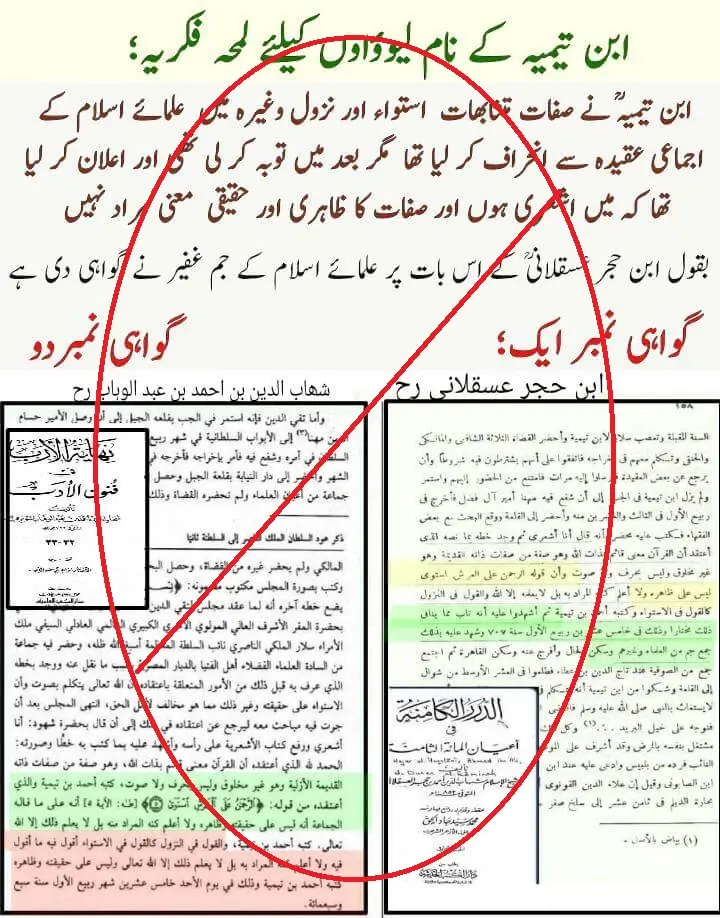
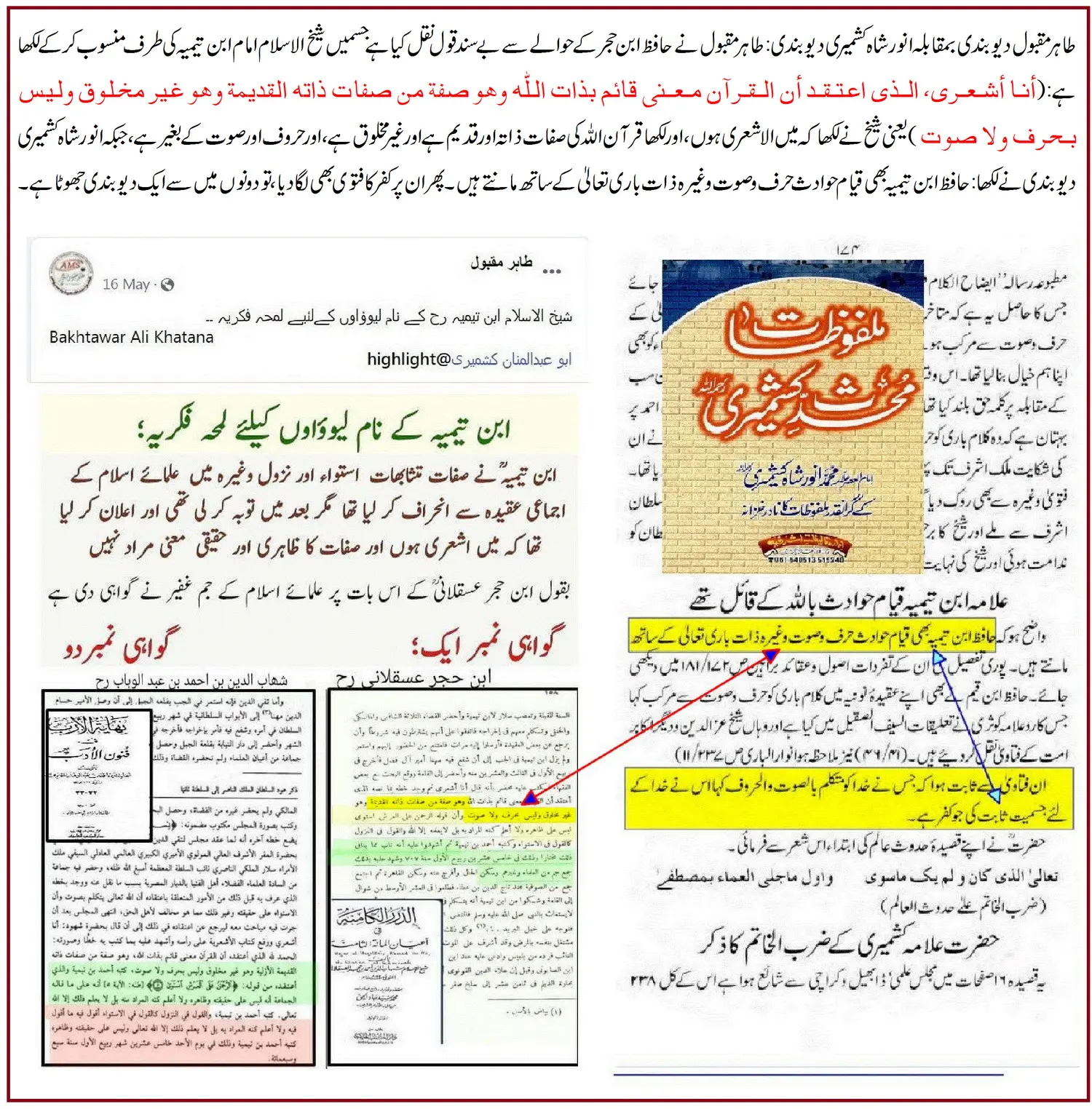
Tahir Maqbool Deobandi, in one of his Facebook posts, quoted a passage from Hafiz Ibn Hajar al-Asqalani’s
, in which the following words about Imam Ibn Taymiyyah are recorded:
Text:
فَكتب عليه محضر بأنه قال أنا أشعري، ثم وجد خطه بما نصه: الذي اعتقد أن القرآن معنى قائم بذات الله وهو صفة من صفات ذاته القديمة، وهو غير مخلوق وليس بحرف ولا صوت، وأن قوله {الرحمن على العرش استوى} ليس على ظاهره، ولا أعلم كنه المراد به، بل لا يعلمه إلا الله.
📌 Translation:
“A mahdar (attestation) was drawn up against Ibn Taymiyyah stating that he said: I am an Ash’ari. Then in his own writing it was found that: I hold the belief that the Qur’an is a meaning that exists with the Essence of Allah, and this is one of His eternal attributes; it is not created, and it is without letters and sounds. And Allah Almighty’s statement: {The Most Merciful established Himself upon the Throne} is not to be taken in its apparent meaning, and I do not know its intended meaning, rather only Allah knows it.”
✿ Brief Answer
This passage is apparently attributed to Imam Ibn Taymiyyah and gives the impression that he:
- Affiliated himself with the Ash’aris.
- Declared the Qur’an to be only an eternal meaning, without letters and sounds.
- Said regarding istiwa (establishment) that its apparent meaning is not intended and only Allah knows its knowledge.
But research shows that this passage:
- The chain of narration is not authentic.
- It is not present in Al-Barzali’s history.
- And it is completely contrary to the statements of Imam Ibn Taymiyyah himself and the testimonies of his students (Ibn Abdulhadi, Ibn al-Qayyim, etc.).
✿ Objection 1: Imam Ibn Taymiyyah said “أنا أشعري“
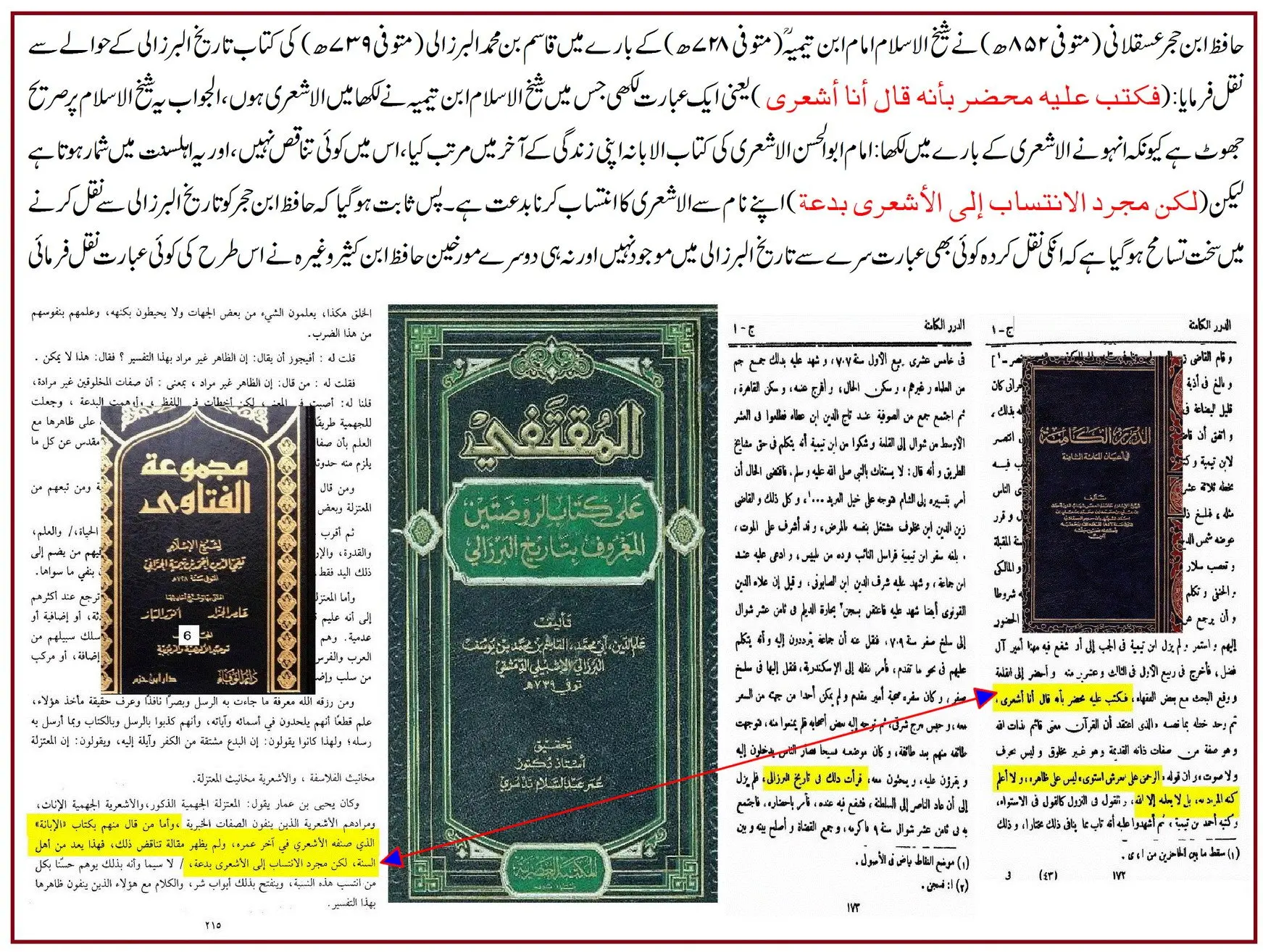
According to Tahir Maqbool Deobandi, Hafiz Ibn Hajar has narrated in
that Imam Ibn Taymiyyah, upon his release from imprisonment, had a statement written on his behalf in which he said: “أنا أشعري” (I am Ash’ari).
◈ The Answer
- This attribution is baseless and disconnected:
As mentioned earlier, this phrase does not exist in the original source (Tarikh al-Barzali).
- Therefore, there is no proof that Imam Ibn Taymiyyah actually said these words.
- Clear Fatwa of Imam Ibn Taymiyyah:
Imam Ibn Taymiyyah clearly wrote in his fatawa:النص:فهذا يعد من أهل السنة؛ لكن مجرد الانتساب إلى الأشعري بدعة.
Reference: (Majmoo’ al-Fatawa 6/359)📌 Translation:
“The Ash’aris can be counted among Ahl al-Sunnah, but merely attributing oneself to Ash’ariyyah is an innovation.”➡️ From this, it is understood that Ibn Taymiyyah never called himself Ash’ari, rather he clearly stated that merely being called Ash’ari is an innovation.
- Important Clarification:
Imam Ibn Taymiyyah did mention some Ash’aris who fall within the fold of Ahl al-Sunnah, but this was only because many of their correct beliefs agreed with Ahl al-Sunnah.
- However, he always rejected the major principles of Ash’ari creed (such as the speech of Allah without letters and sounds, allegorical interpretation of attributes, etc.).
✿ Conclusion
The attribution of “أنا أشعري” to Imam Ibn Taymiyyah is incorrect; rather, from his own pen we find that being called Ash’ari is an innovation. Therefore, this accusation is baseless.
✿ Objection 2: Imam Ibn Taymiyyah considered the Quran to be eternal and denied letters and sounds
According to opponents, Hafiz Ibn Hajar narrated in Ad-Durar Al-Kamina that Ibn Taymiyyah wrote in his writing:
“الذي اعتقد أن القرآن معنى قائم بذات الله وهو صفة من صفات ذاته القديمة، وهو غير مخلوق وليس بحرف ولا صوت.”
📌 Translation: “I hold the belief that the Quran is a meaning established in the essence of Allah, which is one of His eternal attributes; it is uncreated but it has neither letters nor sound.”
◈ The Response
- This statement is against Ibn Taymiyyah’s methodology:
Imam Ibn Taymiyyah spent his entire life refuting the Jahmiyyah and Ash’ariyyah view which considered the Quran only as an eternal meaning, without letters and sounds. - Ibn Taymiyyah’s clear statement:The text:
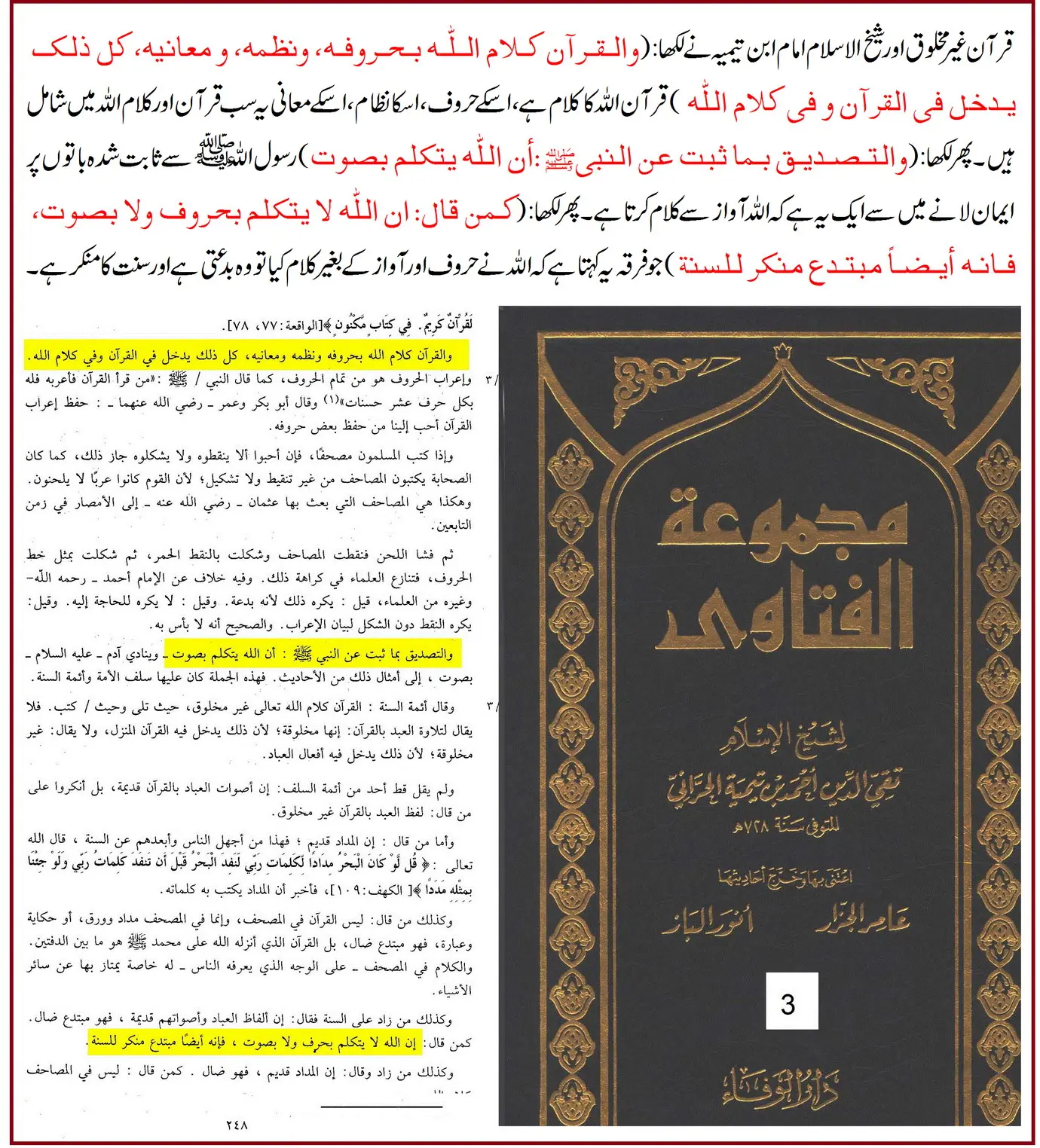
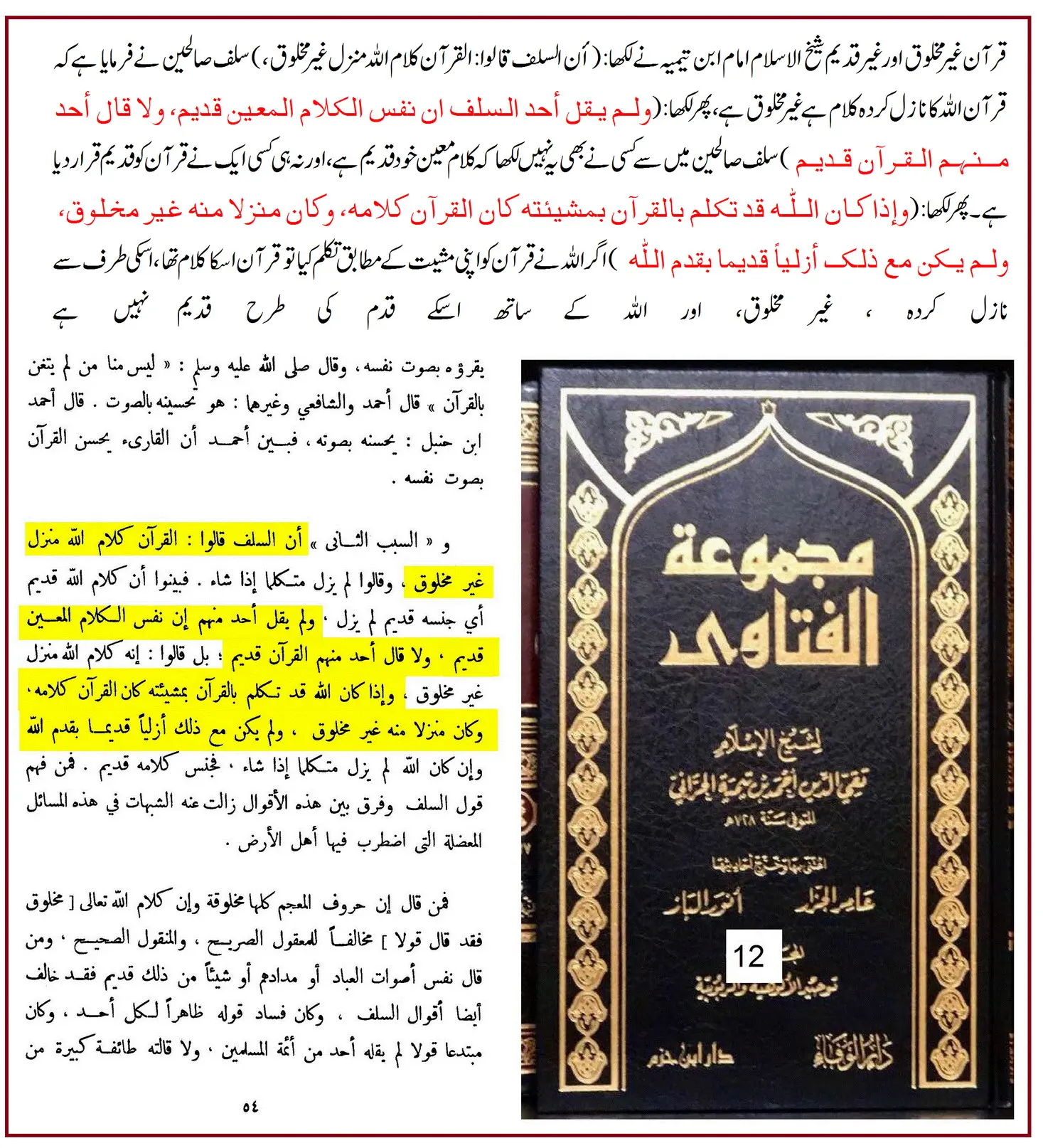
والقرآن كلام الله بحروفه ونظمه ومعانيه، كل ذلك يدخل في القرآن وفي كلام الله.
Reference: (Majmoo’ al-Fatawa 12/559)📌 Translation: “The Quran is the speech of Allah; its letters, its arrangement, and its meanings are all included in the Quran and the speech of Allah.”
The text:
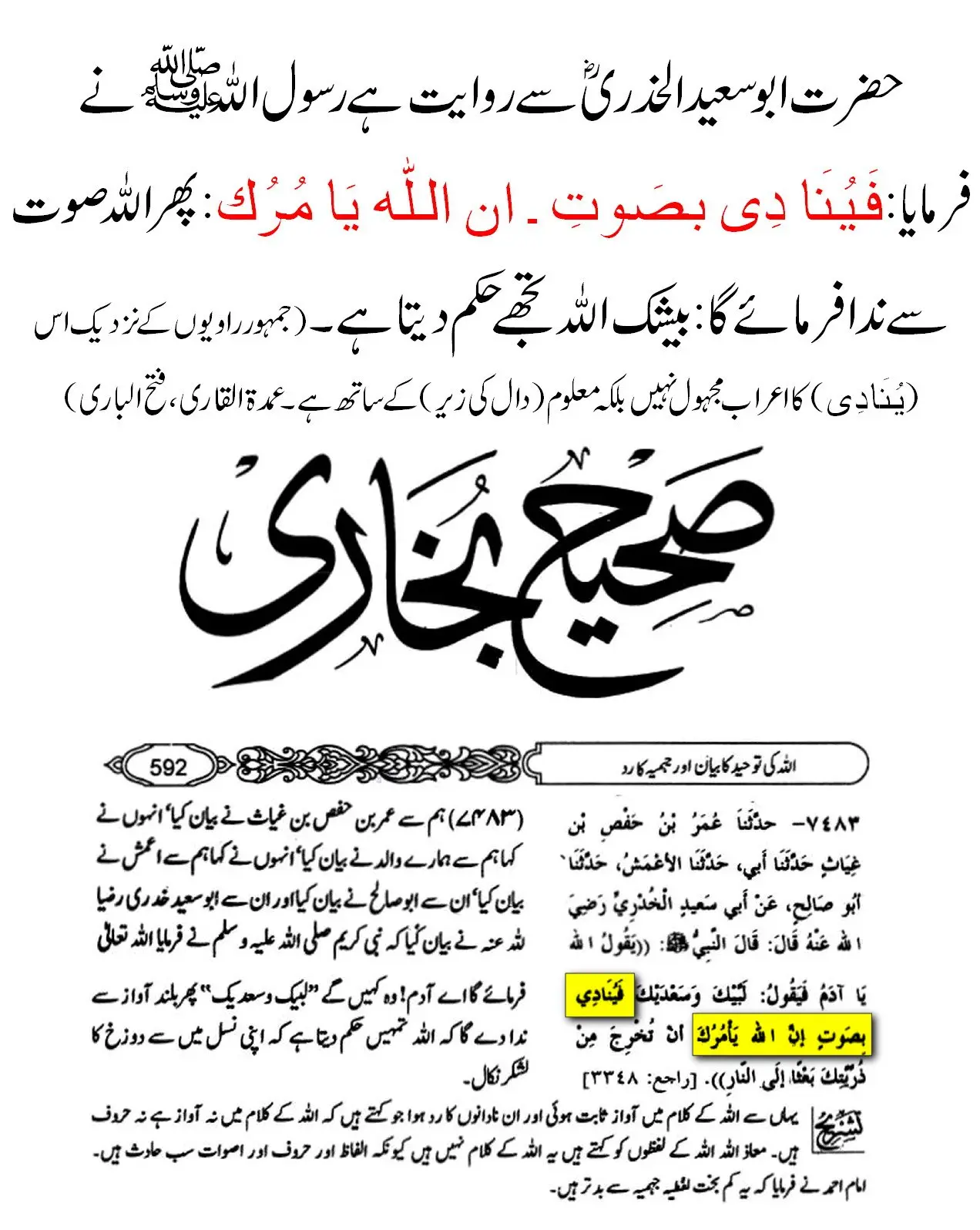
والتصديق بما ثبت عن النبي ﷺ أن الله يتكلم بصوت، وينادي آدم بصوت.
📌 Translation: “We affirm what has been established from the Prophet ﷺ that Allah speaks with a voice and called Adam with a voice.”
Text:
كمن قال: إن الله لا يتكلم بحرف ولا بصوت، فإنه مبتدع منكر للسنة.
📌 Translation: “Whoever says that Allah speaks without letters and sounds, then he is an innovator and a denier of the Sunnah.”
- Refutation of the claim that the Quran is eternal (qadim):Text:
ولم يقل أحد من السلف إن القرآن قديم، وإنما قالوا: القرآن كلام الله منزل غير مخلوق.
Reference: (Majmoo al-Fatawa 12/566)📌 Translation: “None of the Salaf said that the Quran is eternal (qadim). Rather, they said that the Quran is the speech of Allah, revealed, and uncreated.”
✿ Conclusion
- Imam Ibn Taymiyyah always maintained the position that the Quran is the speech of Allah, with letters and sounds.
- He called the Jahmiyyah and Ash’ari view of “the Quran is eternal without letters and sounds” an innovation and falsehood.
- Therefore, the accusation that Ibn Taymiyyah considered the Quran eternal or denied letters and sounds is outright falsehood and slander.
✿ Objection 3: Imam Ibn Taymiyyah practised tafwid (of the meaning, al-ma’na) in the issue of istiwa (establishment)
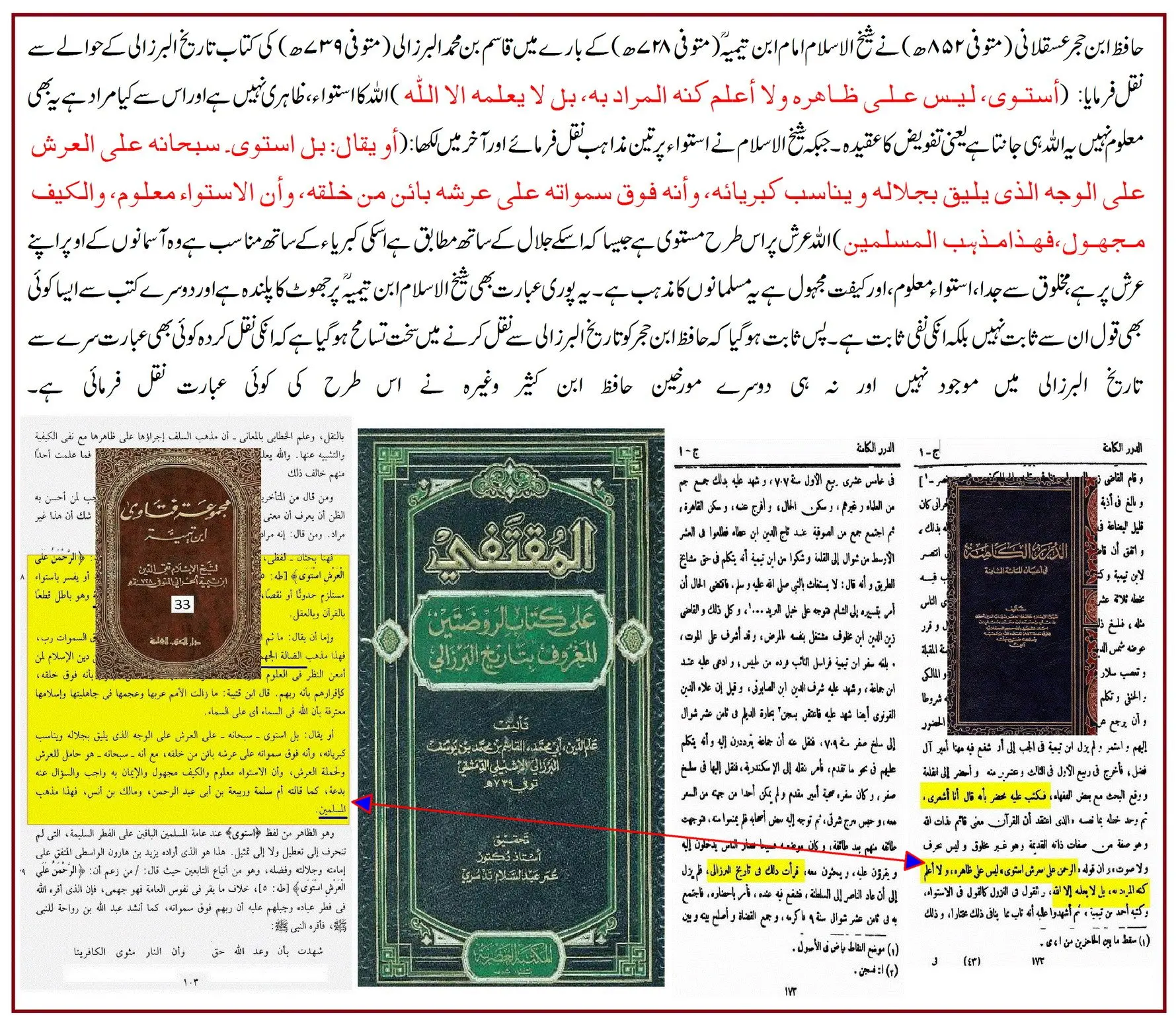
According to opponents, Hafiz Ibn Hajar quoted this phrase in Ad-Durar al-Kamina:
وأن قوله {الرَّحْمَنُ عَلَى الْعَرْشِ اسْتَوَى} ليس على ظاهره ولا أعلم كنه المراد به بل لا يعلمه إلا الله.
📌 Translation: “The verse {الرَّحْمَنُ عَلَى الْعَرْشِ اسْتَوَى} is not according to its apparent meaning. I do not know its true meaning; rather, only Allah knows it.”
This statement gives the impression that Imam Ibn Taymiyyah adopted tafwid al-ma’na (delegation of meaning) regarding istiwa (establishment) and said that we do not know what is meant by it.
◈ The Answer
- This attribution is unfounded and baseless:
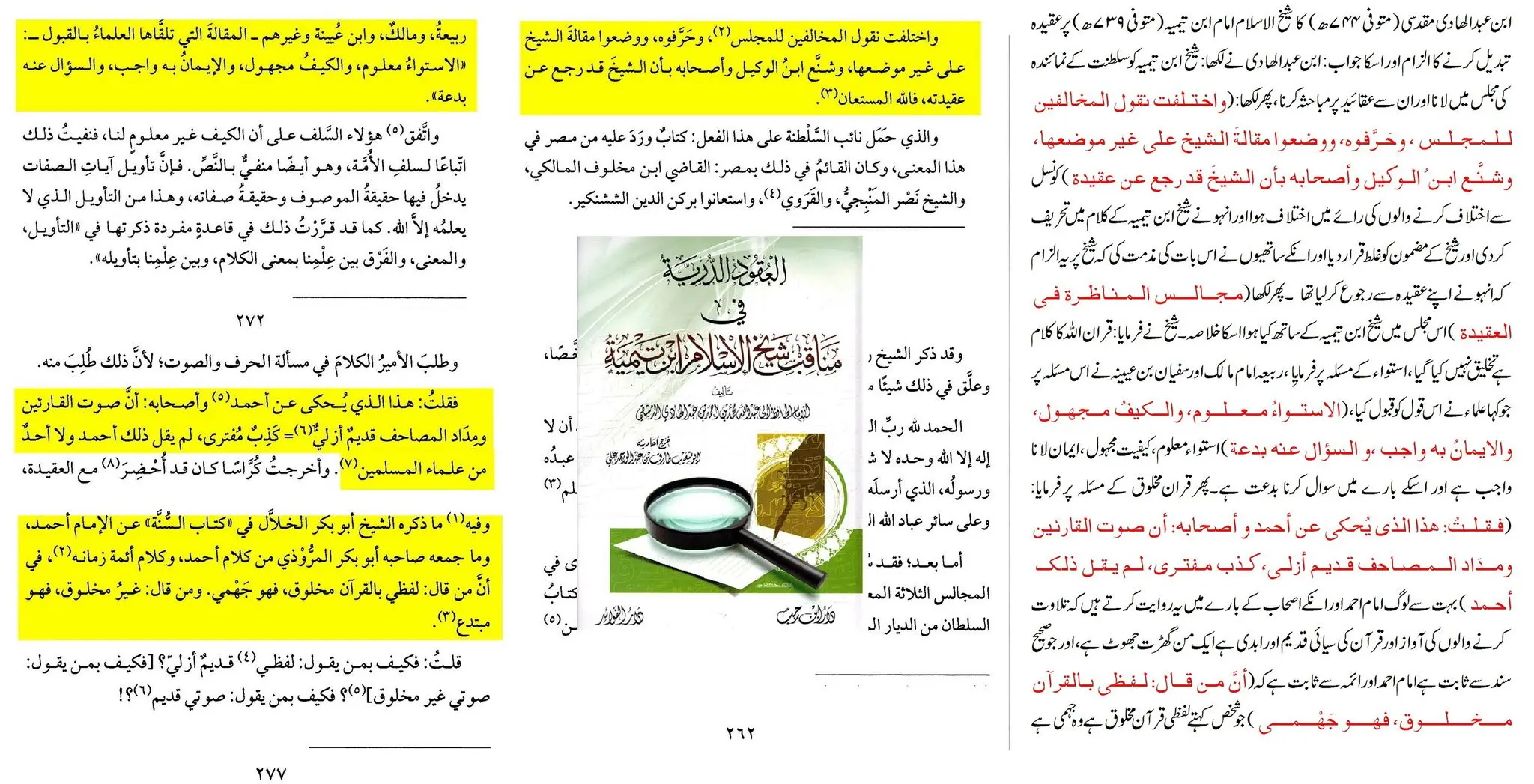
As Ibn Abdulhadi (d. 744 AH) clarified, some opponents distorted Ibn Taymiyyah’s words and misrepresented his statements.
Text:
واختلفت نقول المخالفين للمجلس، وحرفوا مقالة الشيخ على غير موضعها، وشنعوا بأنه رجع عن عقيدته، فالله المستعان.
Reference: (Al-‘Uqud ad-Durriyah by Ibn Abdulhadi)📌 Translation: “The opponents reported the discussion of the gathering in different ways, removed the Sheikh’s words from their proper place, and spread the claim that the Sheikh had renounced his creed. Allah is the One whose help is sought.”
- Ibn Taymiyyah’s clear position (the methodology of Imam Malik):
Ibn Taymiyyah said exactly what Imam Malik, Imam Rabi’ah, and Sufyan ibn ‘Uyaynah and others said regarding istiwa: The text:الاستواء معلوم، والكيف مجهول، والإيمان به واجب، والسؤال عنه بدعة.
Reference: (Al-‘Uqud ad-Durriyah by Ibn Abdulhadi)📌 Translation: “Istiwa is known, its modality is unknown, belief in it is obligatory, and questioning about it is an innovation.”
➡️ That is, the meaning of istiwa (according to Arabic linguistics) is known, but how Allah established istiwa is beyond our intellect.
- Ibn Taymiyyah’s Further Explanation:
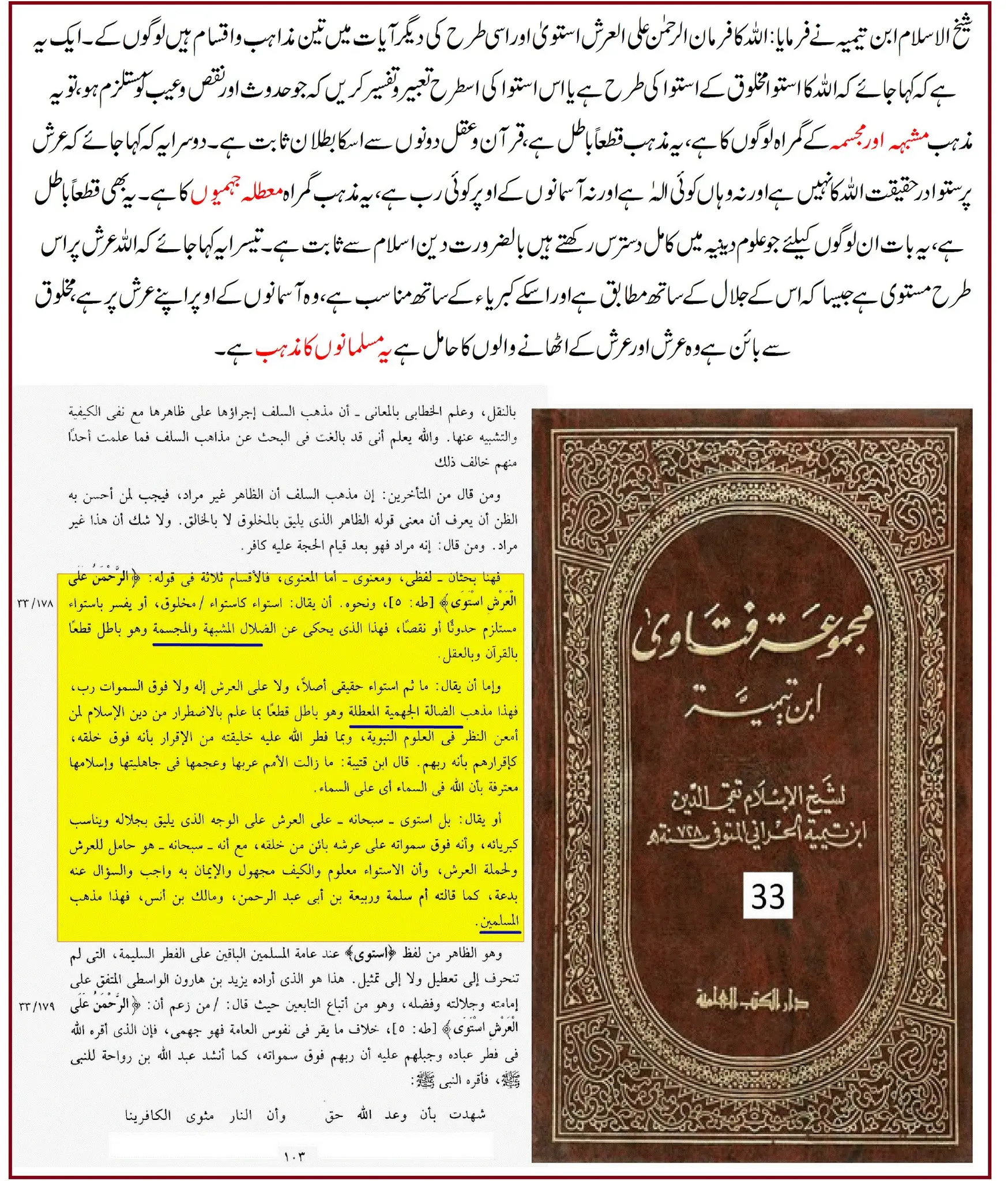
He stated that there are three types of statements regarding Istiwa (establishment):To consider Istiwa like a created being: this is the false doctrine of the Mushabbihah.
- To completely reject and deny Istiwa: this is the false doctrine of the Jahmiyyah.
- To accept Istiwa as it appears, but leave the modality to Allah: this is the doctrine of Ahl al-Sunnah wal-Jama’ah.
Reference: (Majmoo’ al-Fatawa 5/199)
✿ Conclusion
- Imam Ibn Taymiyyah never said that the meaning of Istiwa is unknown (Tafweedh al-Ma’na).
- His methodology was exactly the same as that of Imam Malik (may Allah have mercy on him) and other Salaf: Istiwa is known, the modality is unknown.
- Opponents distorted his words and lied about him.
Ibn Abdulhadi al-Maqdisi’s Explanation
Imam Ibn Abdulhadi al-Maqdisi (d. 744 AH), who was a student of Imam Ibn Taymiyyah, mentioned in detail in his book Al-‘Uqud ad-Durriyah the sessions in which accusations were made against Ibn Taymiyyah.
إحضار الشيخ بمجلس نائب السلطنة ومناقشته في العقيدة… واختلفت نقول المخالفين للمجلس وحرفوا مقالة الشيخ على غير موضعها، وشنع ابن الوكيل وأصحابه بأن الشيخ قد رجع عن عقيدته، فالله المستعان… واعتقاد أهل السنة والجماعة الإيمان بما وصف به نفسه، وما وصفه به رسوله من غير تحريف ولا تعطيل، ولا تكييف ولا تمثيل. وأن القرآن كلام الله غير مخلوق. وقال ربيعة ومالك وابن عيينة وغيرهم: الاستواء معلوم، والكيف مجهول، والإيمان به واجب، والسؤال عنه بدعة.
📌 Translation:
“Sheikh (Ibn Taymiyyah) was summoned to the deputy sultan’s council and was questioned about his creed. Opponents distorted his words and spread the rumor that the Sheikh had renounced his creed. Allah is the Helper. The belief of Ahl al-Sunnah wa al-Jama’ah is that they believe in those attributes of Allah which Allah has described for Himself or which the Messenger of Allah ﷺ has described for Allah, without distortion, negation, asking how, or likening. And the Qur’an is the speech of Allah, uncreated. Rabi’ah, Imam Malik, Ibn ‘Uyaynah, and others said: The istiwa’ (establishment) is known, the modality is unknown, belief in it is obligatory, and questioning about it is an innovation.”
✿ Important Points
- It is proven from the testimony of Ibn Abdulhadi that Ibn Taymiyyah clearly stated his belief exactly according to the creed of Ahl al-Sunnah.
- He said about the Quran: It is the Word of Allah, uncreated.
- Regarding Istiwa, he said what Imam Malik and the pious predecessors said: Istiwa is known, the modality is unknown, faith is obligatory, questioning is innovation.
✿ Conclusion
The propaganda of the opponents that Ibn Taymiyyah renounced his belief to get out of imprisonment or adopted Tafwidh al-Ma’na regarding Istiwa is completely false. A trustworthy student like Ibn Abdulhadi made it clear that these accusations were based on lies and distortion.
Imam Ibn Taymiyyah’s Explanation: Three Types of Istiwa
Imam Ibn Taymiyyah (may Allah have mercy on him) explained the issue of Istiwa in detail by describing three different types, so that the difference between the correct and incorrect methodologies could be distinguished.
The Text:
فالأقسام ثلاثة في قوله: {الرَّحْمَنُ عَلَى الْعَرْشِ اسْتَوَى} ونحوه. أن يُقال: استواء كاستواء المخلوق، أو يُفسَّر باستواء مستلزم حدوثًا أو نقصًا، فهذا الذي يحكي عن الضلال المشبهة والمجسمة، وهو باطل قطعًا بالقرآن والعقل.
📌 Translation:
There are three types regarding “{الرَّحْمَنُ عَلَى الْعَرْشِ اسْتَوَى}:
- To say that istiwa (establishment) is like the istiwa of creation, or to interpret it in a way that necessarily implies createdness (huduth) or deficiency; this is the doctrine of the misguided anthropomorphists and corporealists, and it is false according to both the Quran and reason.”
Text:
وأما أن يقال: ما ثم استواء حقيقي أصلًا، ولا على العرش إله، ولا فوق السماوات رب، فهذا مذهب الضالة الجهمية المعطلة، وهو باطل قطعًا بما عُلم بالاضطرار من دين الإسلام…
📌 Translation:
“To say that there is no real istiwa at all, neither any God on the Throne, nor any Lord above the heavens; this is the doctrine of the Jahmiyyah Mu’attilah, which is contrary to the obvious teachings of Islam. This too is absolutely false.”
Text:
بل استوى سبحانه على العرش على الوجه الذي يليق بجلاله ويناسب كبرياءه، وأنه فوق سمواته على عرشه، بائن من خلقه… والاستواء معلوم، والكيف مجهول، والإيمان به واجب، والسؤال عنه بدعة.
📌 Translation:
“Rather, the correct statement is that Allah, in a manner befitting His Majesty and Greatness, is established on the Throne. He is distinct from His creation, He is on His Throne above the heavens. The istiwa is known, the modality is unknown, belief in it is obligatory, and questioning it is an innovation.”
✿ Conclusion
- The belief of the Mushabbihah and Mujassimah: To attribute Allah’s istiwa (establishment) as similar to creation — false.
- The belief of the Jahmiyyah: Denying istiwa and saying that there is no Lord above — false.
- The belief of Ahl al-Sunnah: To accept istiwa as it appears, but to leave the modality to Allah — this is the truth.
Ibn Taymiyyah’s Clarification on the Issue of the Eternity of the Qur’an
Opponents claim that Imam Ibn Taymiyyah considered the Qur’an eternal. However, the reality is that he always rejected the view presented by the Jahmiyyah and some theologians.
Text:
أن السلف قالوا: القرآن كلام الله منزل غير مخلوق. ولم يقل أحد منهم إن نفس الكلام المعيَّن قديم، ولا قال أحد منهم: القرآن قديم.
📌 Translation:
“The Salaf said that the Qur’an is the speech of Allah, revealed and uncreated. But none of them said that the specific speech itself is eternal, nor did they say that the Qur’an is eternal.”
Text:
وإذا كان الله قد تكلم بالقرآن بمشيئته، كان القرآن كلامه، وكان منزّلًا منه غير مخلوق، ولم يكن مع ذلك أزليًّا قديمًا بقدم الله.
📌 Translation:
“Allah spoke the Qur’an by His will, so the Qur’an is His speech, revealed from Him and uncreated, but it is not eternal and everlasting like the essence of Allah.”
Text:
كمن قال: إن الله لا يتكلم بحرف ولا صوت، فإنه مبتدع منكر للسنة.
📌 Translation:
“Whoever says that Allah speaks without letters and sounds, he is an innovator and a denier of the Sunnah.”
✿ Summary
- Ibn Taymiyyah always said: The Quran is the speech of Allah, uncreated.
- But calling the Quran eternal and everlasting like the essence of Allah is a false Jahmi philosophy.
- Ibn Taymiyyah clarified that Allah spoke the Quran by His will, therefore it is uncreated but not eternal by essence.
Distortions by the Innovators and Testimony of Ibn Abdulhadi
Imam Ibn Abdulhadi al-Maqdisi (d. 744 AH) explained in his book Al-‘Uqud ad-Durriyah how the innovators distorted Imam Ibn Taymiyyah’s words and falsely accused him.
Text:
اختلفت نقول المخالفين للمجلس، وحرفوا مقالة الشيخ على غير موضعها، وشنع ابن الوكيل وأصحابه بأن الشيخ قد رجع عن عقيدته، فالله المستعان.
📌 Translation:
“The opponents narrated the discussion of the gathering in various ways, removed the Sheikh’s words from their context, and Ibn al-Wakeel and his companions spread the rumor that the Sheikh had renounced his creed. Allah is the Helper.”
◈ Explanation
- From the testimony of Ibn Abdulhadi, it is proven that:
Opponents distorted the words of Ibn Taymiyyah and derived incorrect meanings.
- They propagated among the public that Ibn Taymiyyah had renounced his creed.
- The reality is that Ibn Taymiyyah always explained the methodology of Ahl al-Sunnah wa al-Jama’ah and never renounced it.
- This is why:
It was sometimes said that Ibn Taymiyyah called himself Ash’ari.
- Sometimes it was said that he considered the Qur’an to be eternal and denied the letters and sounds.
- And sometimes it was said that he delegated (tafweedh) regarding the issue of istiwa (rising/establishment).
✿ Conclusion
The innovators (Ahl al-Bid’ah) distorted the words of Imam Ibn Taymiyyah and leveled accusations against him. But from the testimony of a trustworthy student like Ibn Abdulhadi, it became clear that all these were fabrications and contrary to the truth.
Mutual Contradiction of the Opponents
Among the innovators, especially within the Deobandi and Ash’ari schools of thought, there is clear contradiction in the accusations against Imam Ibn Taymiyyah.
- An accusation:
Some opponents propagate that Imam Ibn Taymiyyah considered the Quran without letters and sounds and, like the Jahmiyyah and Ash’ariyyah, said that it is only an eternal meaning. - Second accusation (Anwar Shah Kashmiri):
The great scholar of the Deobandi school, Maulana Anwar Shah Kashmiri (d. 1352 AH), accused Ibn Taymiyyah of believing that Allah’s speech is with sound and letters, and said that this belief is disbelief!Al-Nass:
“Be clear that Hafiz Ibn Taymiyyah also believed in the subsistence of originated things (qiyam al-hawadith), letters, sounds etc. in the Divine Essence. And whoever says that Allah is a speaker with sound and letters, he has ascribed corporeality to God, which is disbelief.”Reference: (Malfoozat Muhaddith Kashmiri)
◈ Explanation of the contradiction
- On one hand, opponents spread the lie that Ibn Taymiyyah denied letters and sounds.
- On the other hand, their own elders (Anwar Shah Kashmiri) clearly say that Ibn Taymiyyah accepted letters and sounds and on this basis declared him a disbeliever.
➡️ This clear contradiction is proof that the accusations against Ibn Taymiyyah are actually lies, propaganda, and based on mutual disagreements.
✿ Conclusion
- If Tahir Maqbool Deobandi’s accusation is accepted as true (that Ibn Taymiyyah denied letters and sounds), then Anwar Shah Kashmiri is proven to be lying.
- And if Anwar Shah Kashmiri’s statement is accepted as true (that Ibn Taymiyyah accepted letters and sounds), then Tahir Maqbool Deobandi’s accusation becomes invalid.
- In any case, neither accusation harms the true reality of Imam Ibn Taymiyyah, because his stance has always been clear and in accordance with the Salaf.
✿ Summary and Final Conclusion
After thorough research, it becomes absolutely clear that the objections and accusations against Imam Ibn Taymiyyah are baseless and fabricated.
1. Objection: “أنا أشعري“
- There is no chain of narration for this.
- Imam Ibn Taymiyyah clearly stated in his fatwas: Being called Ash’ari is an innovation.
2. Objection: The Quran is eternal and denial of letters and sounds
- Imam Ibn Taymiyyah always refuted the Jahmiyyah and Ash’ariyyah’s viewpoint.
- He said: The Quran is the speech of Allah, with letters and sounds, uncreated.
- None of the Salaf said that the Quran is eternal.
3. Objection: Delegation in Istiwa (meaning)
- This is also a false attribution.
- Ibn Taymiyyah quoted Imam Malik and Rabi’ah’s statement: Istiwa is known, the modality is unknown, faith is obligatory, questioning is innovation.
4. Distortions by the Innovators
- Ibn Abdul Hadi clarified that the opponents distorted Ibn Taymiyyah’s words and made false accusations.
- The reality is that Ibn Taymiyyah always adhered to the methodology of Ahl al-Sunnah.
5. Contradictions among the Opponents
- Some say: Ibn Taymiyyah denied letters and sounds.
- Anwar Shah Kashmiri says: Ibn Taymiyyah accepted letters and sounds and this is disbelief.
- This contradiction is proof that the accusations are false and based on propaganda.
✿ Final Conclusion
- Imam Ibn Taymiyyah’s belief was the same as that of the majority of the righteous Salaf.
- He always said: The Quran is the speech of Allah, uncreated, with letters and sounds. The attribute of istiwa (establishment) is known, its modality is unknown.
- Accusing him of recanting, resorting to allegorical interpretation, or Ash’arite beliefs is only distortions by the innovators.
📌 Therefore, these objections raised against Imam Ibn Taymiyyah are false and baseless. His methodology is exactly the reflection of the methodology of Ahl al-Sunnah wa al-Jama’ah and the righteous Salaf.
Scans of Important References