Usama ibn Zayd al-Laythi, Abu Zayd al-Madani (died 153 AH) is a narrator who narrated many hadiths, and some hadith scholars have also declared him trustworthy. However, according to the explicit statements of the majority of the imams of criticism and praise of narrators, he is weak, and his solitary narration is not valid as proof. The purpose of this article is to make clear that there is criticism of Usama ibn Zayd al-Laythi from 22 imams of hadith (Imam Ahmad, Yahya ibn Sa’id al-Qattan, Abu Hatim, al-Nasa’i, Ibn Sa’d, Ibn Hazm, al-Haythami, Ibn Hibban, Ibn al-Qattan, Ibn al-Mulaqqin, al-Dhahabi, Ibn Hajar, al-Busiri, Ibn Shahin, Ibn al-Jawzi, Abu al-Arab, al-Uqayli, Abu al-Qasim al-Balkhi, Ibn al-Jarud, Yahya ibn Ma’in, Ibn Muflih and al-Sakhawi); Imam Muslim (may Allah have mercy on him) took his narrations only as corroborating reports, and Imam al-Bukhari (may Allah have mercy on him) did not use him as proof but only cited him as supporting evidence. The practical importance of this discussion is that the narration “O servants of Allah, help me”, which is presented as evidence for the permissibility of seeking help from other than Allah, is narrated through this very narrator. In these lines, for each imam, his original Arabic statement, its Urdu translation, the reference to the book and a brief explanation are presented, and at the end the conclusion of the discussion is stated.
Background: A Rejected Athar Narrated by Usama ibn Zayd al-Laythi
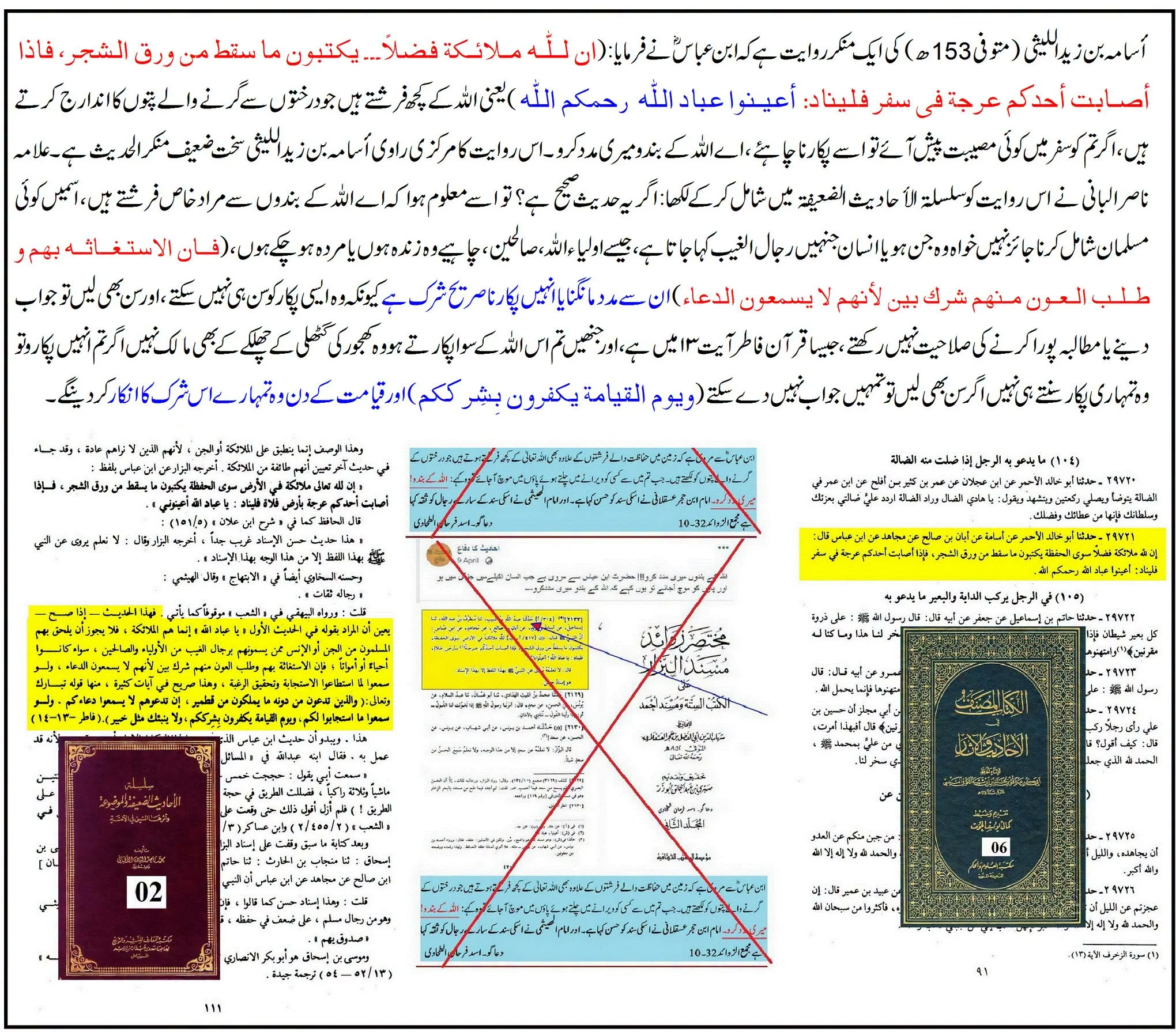
This athar, attributed to Sayyiduna Abdullah ibn Abbas (may Allah be pleased with him), is narrated in Musannaf Ibn Abi Shaybah through the route of Usama ibn Zayd al-Laythi:
29721 – حَدَّثَنَا أَبُو خَالِدٍ الْأَحْمَرُ، عَنْ أُسَامَةَ، عَنْ أَبَانَ بْنِ صَالِحٍ، عَنْ مُجَاهِدٍ، عَنِ ابْنِ عَبَّاسٍ، قَالَ: ” إِنَّ لِلَّهِ مَلَائِكَةً فَضْلًا سِوَى الْحَفَظَةِ يَكْتُبُونَ مَا سَقَطَ مِنْ وَرَقِ الشَّجَرِ، فَإِذَا أَصَابَتْ أَحَدَكُمْ عَرْجَةٌ فِي سَفَرٍ فَلِيُنَادِ: أَعِينُوا عِبَادَ اللَّهِ رَحِمَكُمُ اللَّهُ “
Translation:
Sayyiduna Ibn Abbas (may Allah be pleased with him) said: Allah has some angels, other than the guardian angels (who record deeds), who write even the leaves that fall from the trees. So when any of you suffers some difficulty on a journey (such as his mount going lame), let him call out: “O servants of Allah! Help me, may Allah have mercy on you.”
Allama Muhammad Nasir al-Din al-Albani (may Allah have mercy on him) wrote about this athar:
فهذا الحديث – إذا صح – يعين أن المراد بقوله في الحديث الأول ” يا عباد الله ” إنما هم الملائكة، فلا يجوز أن يلحق بهم المسلمون من الجن أو الإنس ممن يسمونهم برجال الغيب من الأولياء والصالحين، سواء كانوا أحياء أو أمواتا، فإن الاستغاثة بهم وطلب العون منهم شرك بين لأنهم لا يسمعون الدعاء، ولو سمعوا لما استطاعوا الاستجابة وتحقيق الرغبة، وهذا صريح في آيات كثيرة، منها قوله تبارك وتعالى: (والذين تدعون من دونه ما يملكون من قطمير، إن تدعوهم لا يسمعوا دعائكم، ولو سمعوا ما استجابوا لكم، ويوم القيامة يكفرون بشرككم، ولا ينبئك مثل خبير) (فاطر 13 – 14) .
Translation:
If this hadith is authentic, it determines that what is meant by the words “Ya ibad Allah” (O servants of Allah) in the first hadith is only the angels. Therefore, it is not permissible to include with them those Muslims among the jinn or humans whom people call “rijal al-ghayb” (men of the unseen), that is, the saints and the righteous, whether living or dead; because to cry out to them for help and to ask them for assistance is clear shirk, since they do not hear the call at all, and even if they were to hear it, they do not have the power to respond and to fulfil the wish. This is stated explicitly in many verses, among them the saying of Allah, Blessed and Exalted is He:
“And those whom you call upon besides Him do not own even the thin skin of a date-stone. If you call upon them, they do not hear your call, and even if they were to hear, they could not respond to you, and on the Day of Resurrection they will deny your shirk, and none can inform you like One who is All-Aware.” (Surah Fatir: 13-14)
Explanation:
Allama al-Albani (may Allah have mercy on him) spoke with the condition “if this is authentic”, meaning that even if this athar is accepted as authentic, those being called upon in it are only angels, not deceased saints or absent people. But the chain of this athar revolves around Usama ibn Zayd al-Laythi, so it is necessary to see below what rank this narrator holds according to the imams of hadith.
The Statements of 22 Imams of Hadith about Usama ibn Zayd al-Laythi
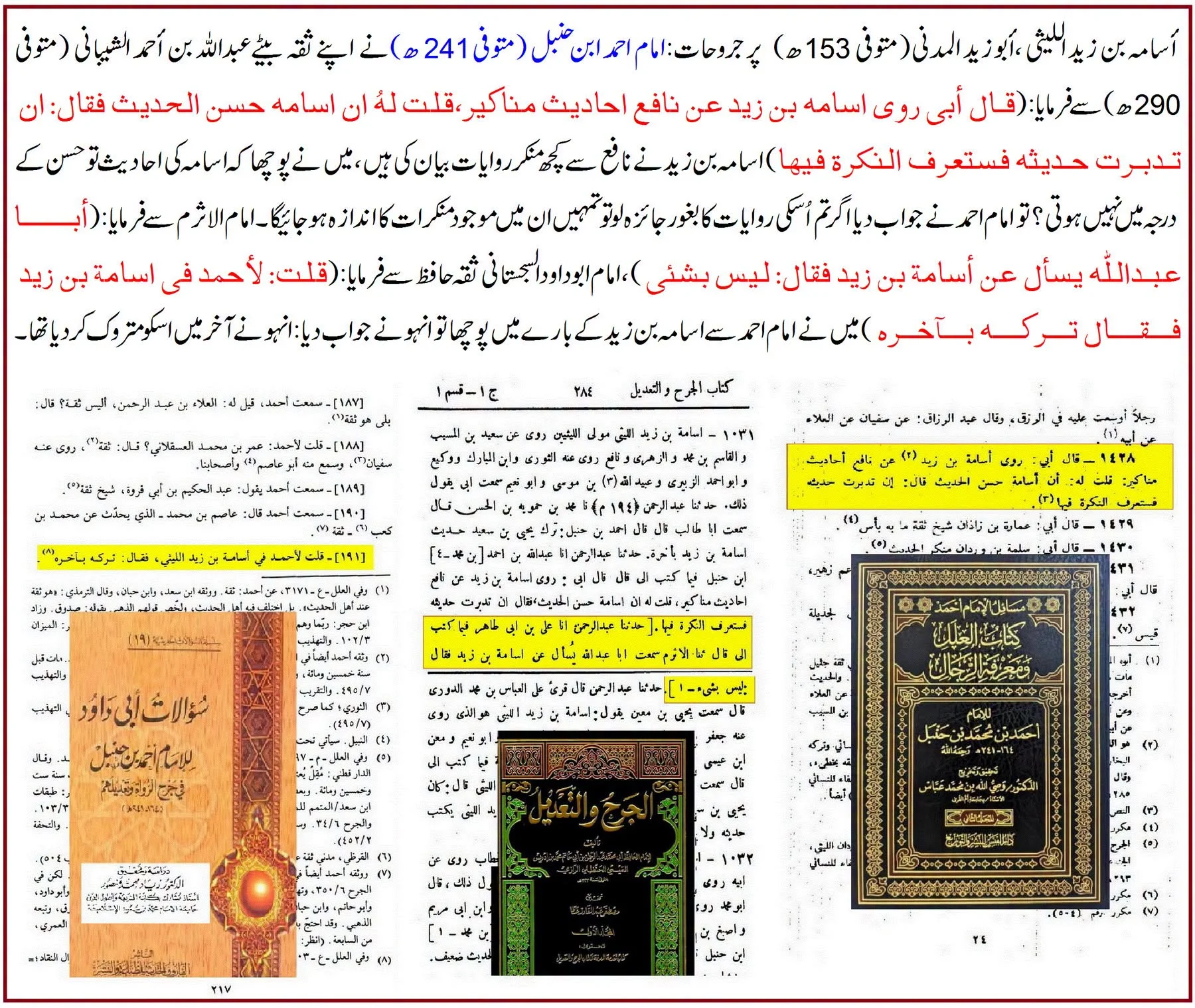
① Imam Ahmad ibn Hanbal (may Allah have mercy on him) (died 241 AH)
Imam Ahmad (may Allah have mercy on him) said to his son Abdullah ibn Ahmad (died 290 AH):
1428 – قَالَ أبي روى أُسَامَة بن زيد عَن نَافِع أَحَادِيث مَنَاكِير قلت لَهُ إِن أُسَامَة حسن الحَدِيث قَالَ إِن تدبرت حَدِيثه فستعرف النكرَة فِيهَا
Translation:
My father said: Usama ibn Zayd narrated munkar (rejected) hadiths from Nafi’. I said to him: Usama is hasan al-hadith (good in hadith)? He said: If you study his hadiths carefully, you will recognise the nukarah (rejected quality) in them.
In another place, al-Athram transmitted from Imam Ahmad (may Allah have mercy on him):
حدثنا عبد الرحمن أنا علي بن طاهر فيما كتب إلي قال ثنا الأثرم سمعت أبا عبد الله يسأل عن أسامة بن زيد فقال : ليس بشئ
Translation:
Al-Athram says: I heard Abu Abdullah (Imam Ahmad) being asked about Usama ibn Zayd, and he said: “He is nothing.”
And Imam Abu Dawud al-Sijistani (may Allah have mercy on him) (a trustworthy hafiz) asked Imam Ahmad (may Allah have mercy on him):
[191] قلت لِأَحْمَد فِي اسامة بن زيد اللَّيْثِيّ فَقَالَ تَركه بِآخِرهِ
Translation:
I asked Imam Ahmad about Usama ibn Zayd al-Laythi, and he said: (Yahya al-Qattan) abandoned him in the end.
Explanation:
Imam Ahmad (may Allah have mercy on him) criticised Usama in three statements: his narrations from Nafi’ are munkar, he is “laysa bi shay'” (nothing), and (Imam Yahya al-Qattan) abandoned him in the end. When his son said that Usama is hasan al-hadith, Imam Ahmad (may Allah have mercy on him) rejected this and pointed out the nukarah.
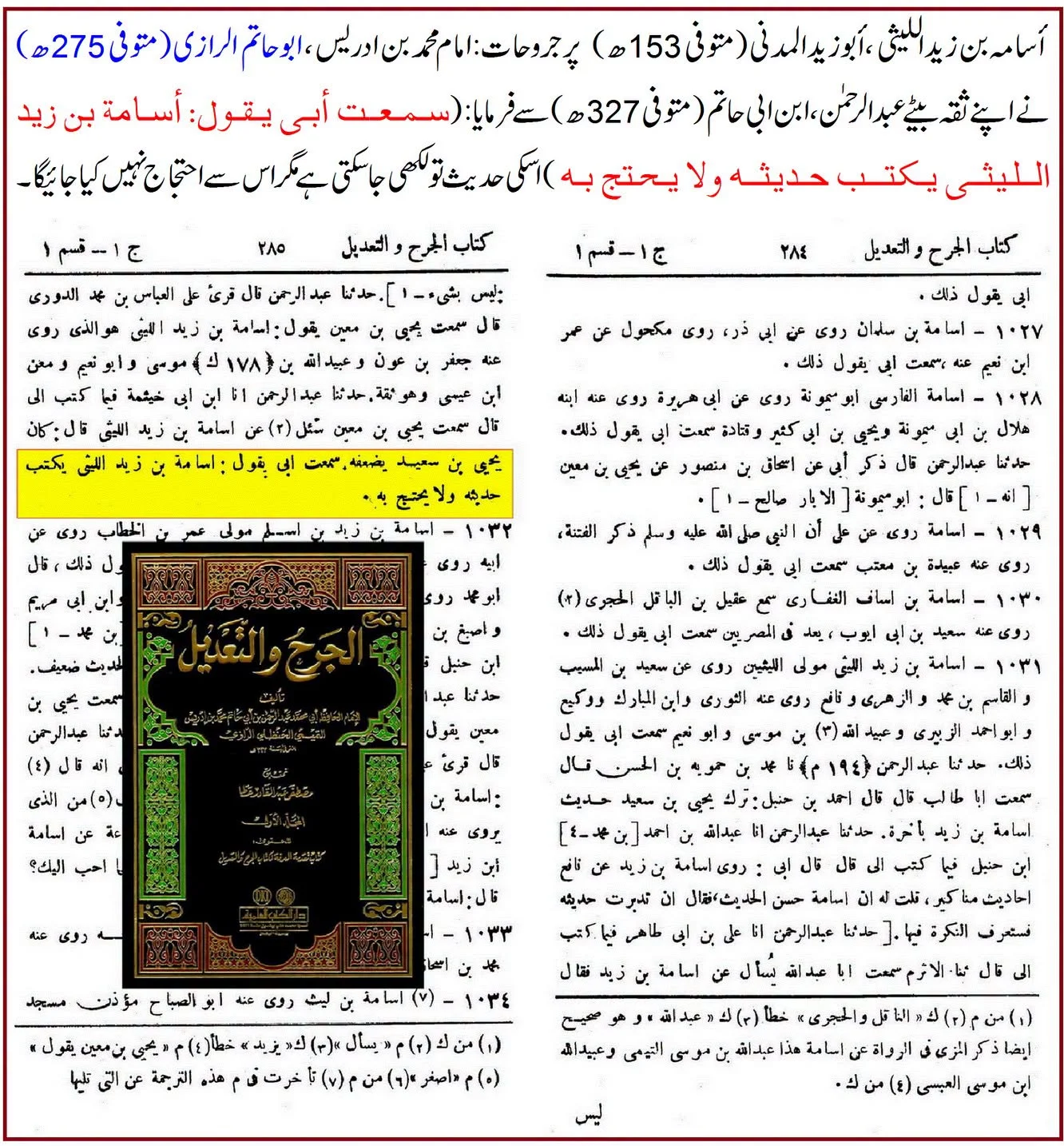
② Imam Abu Hatim al-Razi (may Allah have mercy on him) (died 275 AH)
Imam Abu Hatim (may Allah have mercy on him) said to his trustworthy son Abd al-Rahman ibn Abi Hatim (died 327 AH):
1031 – أسامة بن زيد الليثي مولى الليثيين … سمعت أبي يقول: أسامة بن زيد الليثي يكتب حديثه ولا يحتج به.
Translation:
I heard my father say: The hadith of Usama ibn Zayd al-Laythi is written down but is not taken as proof.
Explanation:
“Yuktab hadithuhu wa la yuhtajju bih” is said in the terminology of the imams about a narrator whose narration can be taken among corroborating reports and supporting evidence, but on whose narration alone no ruling can be based.
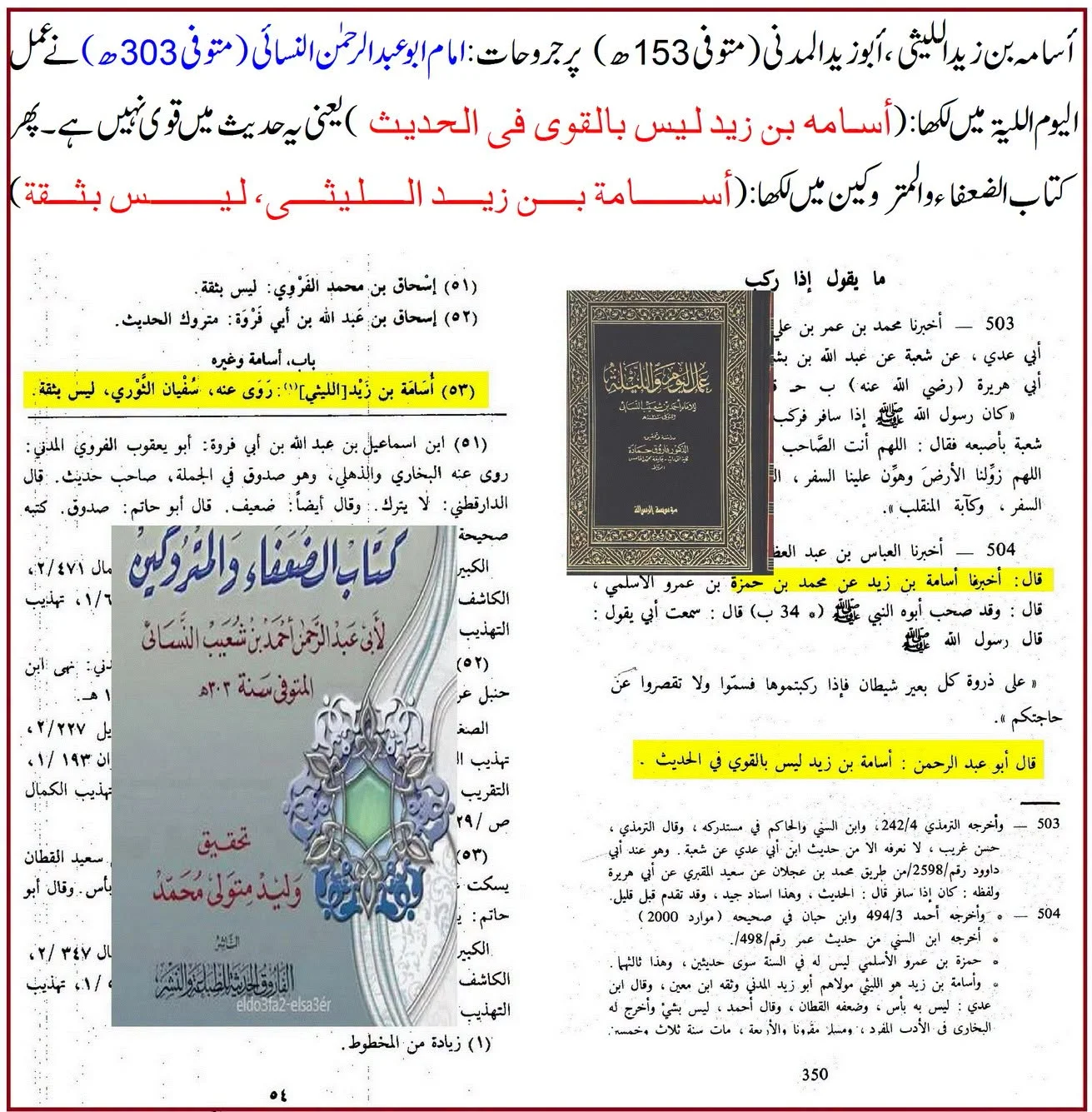
③ Imam Abu Abd al-Rahman al-Nasa’i (may Allah have mercy on him) (died 303 AH)
Imam al-Nasa’i (may Allah have mercy on him) mentioned a narration in “Amal al-Yawm wa al-Laylah” and said:
504 – أخبرنَا الْعَبَّاس بن عبد الْعَظِيم عَن عبيد الله بن مُوسَى قَالَ أخبرنَا أُسَامَة بن زيد عَن مُحَمَّد بن حَمْزَة بن عَمْرو الْأَسْلَمِيّ قَالَ وَقد صحب أَبوهُ النَّبِي صلى الله عَلَيْهِ وَسلم قَالَ سَمِعت أبي يَقُول قَالَ رَسُول الله صلى الله عَلَيْهِ وَسلم على ذرْوَة كل بعير شَيْطَان فإِذا ركبتموها فسموا وَلَا تقصرُوا عَن حَاجَتكُمْ قَالَ أَبُو عبد الرَّحْمَن أُسَامَة بن زيد لَيْسَ بِالْقَوِيّ فِي الحَدِيث
Translation:
Muhammad ibn Hamza ibn Amr al-Aslami (whose father was a Companion of the Prophet ﷺ) says: I heard my father say that the Messenger of Allah ﷺ said: “On the hump of every camel there is a devil, so when you ride them, mention the name of Allah, and do not fall short in (fulfilling) your need.” Abu Abd al-Rahman (al-Nasa’i) says: Usama ibn Zayd is not strong in hadith.
Then Imam al-Nasa’i (may Allah have mercy on him) wrote in “al-Du’afa wa al-Matrukin”:
(بَاب أُسَامَة وَغَيره) 51 – أُسَامَة بن زيد روى عَنهُ سُفْيَان الثَّوْريّ لَيْسَ بِثِقَة
Translation:
(Chapter: Usama and others) Usama ibn Zayd, from whom Sufyan al-Thawri narrated: he is not reliable.
Explanation:
Imam al-Nasa’i (may Allah have mercy on him) said “not strong” in one place and “not reliable” in another, and he included him in his book al-Du’afa wa al-Matrukin, which is clear evidence that in his view this narrator is weak.
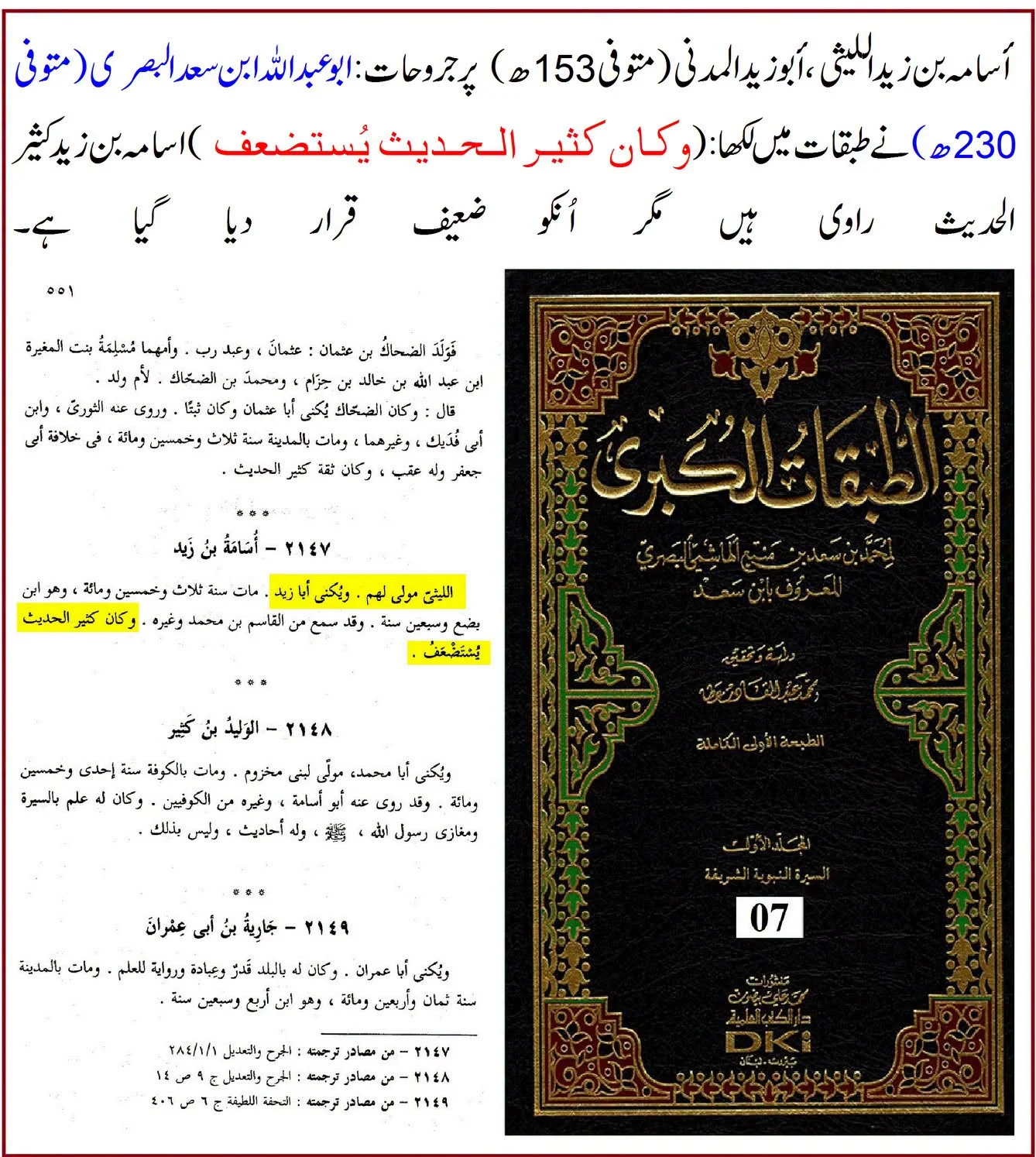
④ Abu Abdullah Muhammad ibn Sa’d al-Basri (may Allah have mercy on him) (died 230 AH)
Ibn Sa’d (may Allah have mercy on him) wrote in “al-Tabaqat”:
326- أُسَامَةُ بنُ زَيْدِ اللَّيْثِيُّ مَوْلًى لَهُمْ. وَيُكَنَّى أَبَا زَيْدٍ. مَاتَ سَنَةَ ثَلَاثٍ وَخَمْسِينَ وَمِائَةٍ، وَهُوَ ابْنُ بِضْعٍ وَسَبْعِينَ سَنَةً. وَقَدْ سَمِعَ مِنَ الْقَاسِمِ بْنِ مُحَمَّدٍ وَغَيْرِهِ. وَكَانَ كَثِيرَ الْحَدِيثِ يُستضعف.
Translation:
Usama ibn Zayd al-Laythi, a freed slave of the Banu Layth, with the kunya Abu Zayd. He died in 153 AH, at the age of a little over seventy. He had heard from al-Qasim ibn Muhammad and others. He narrated many hadiths, (but) he was considered weak.
Explanation:
While acknowledging that he narrated a great deal, Ibn Sa’d (may Allah have mercy on him) made clear by saying “yustad’af” that this narrator was counted weak among the people of knowledge; narrating many hadiths is not proof of reliability.
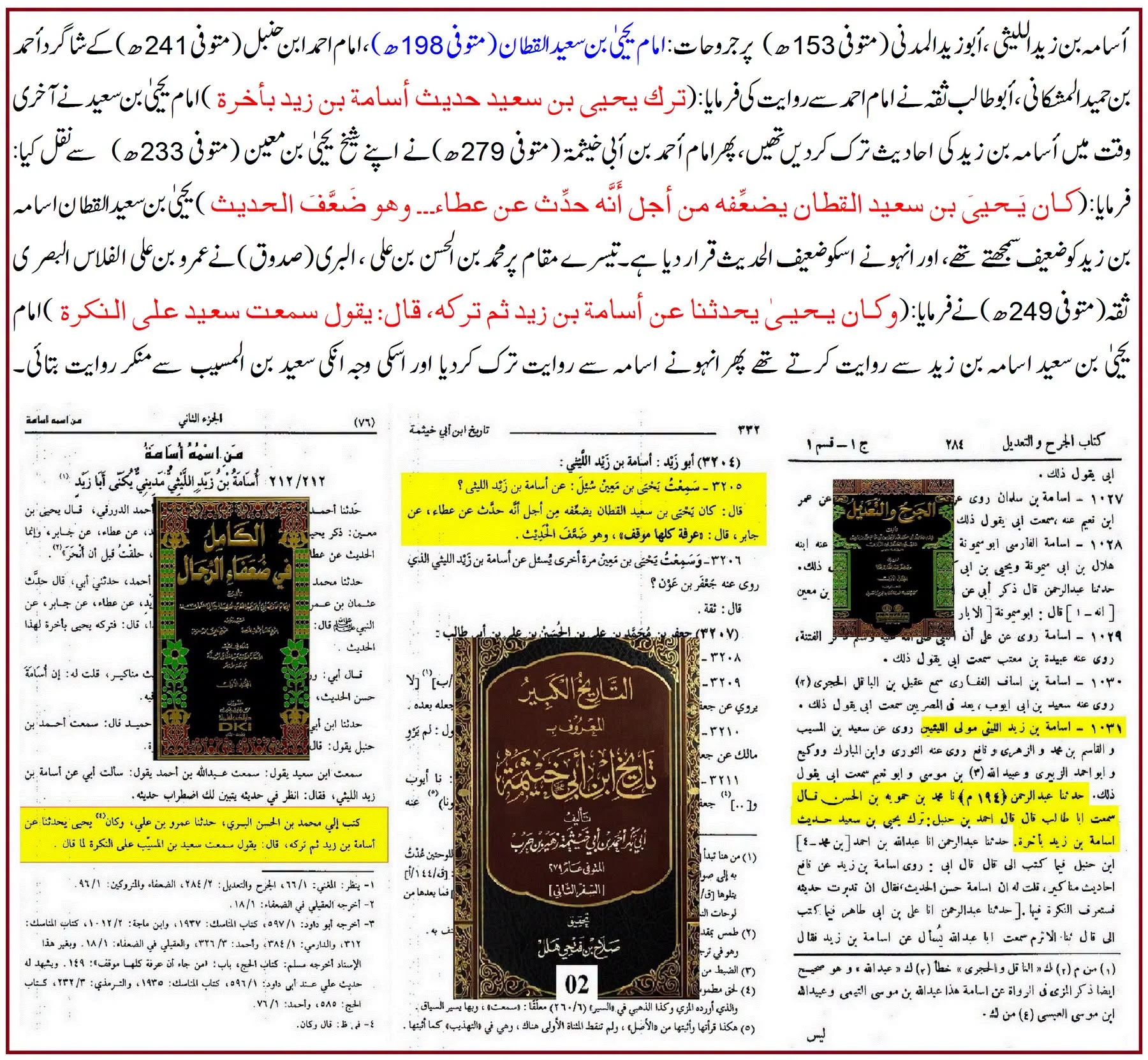
⑤ Imam Yahya ibn Sa’id al-Qattan (may Allah have mercy on him) (died 198 AH)
Abu Talib Ahmad ibn Humayd al-Mushkani, a reliable student of Imam Ahmad (may Allah have mercy on him), reported from Imam Ahmad:
حدثنا عبد الرحمن نا محمد بن حمويه بن الحسن قال سمعت أبا طالب قال قال أحمد بن حنبل: ترك يحيى بن سعيد حديث أسامة بن زيد بأخرة.
Translation:
Imam Ahmad ibn Hanbal said: Yahya ibn Sa’id (al-Qattan) abandoned the hadith of Usama ibn Zayd in the end.
Imam Abu Bakr Ahmad ibn Abi Khaythama (may Allah have mercy on him) (died 279 AH) reported from his teacher Imam Yahya ibn Ma’in (may Allah have mercy on him) (died 233 AH):
(3204) أبو زَيْد: أسامة بن زَيْد اللَّيْثي: 3205- سَمِعْتُ يَحْيَى بن مَعِيْن سُئِلَ: عن أسامة بن زَيْد الليثي؟ قَالَ: كان يَحْيَى بن سعيد القطان يضعِّفه مِن أجل أنَّه حدَّث عن عطاء، عن جابر، قَالَ: عرفة كلها موقف”، وهو ضَعَّفَ الْحَدِيْث.
Translation:
I heard Yahya ibn Ma’in being asked about Usama ibn Zayd al-Laythi, and he said: Yahya ibn Sa’id al-Qattan used to declare him weak because he narrated through the chain Ata from Jabir: “All of Arafa is a place of standing”, and (Yahya al-Qattan) declared this hadith weak.
In a third place, Imam Ibn Adi (may Allah have mercy on him) reported, through Muhammad ibn al-Hasan al-Burri, from Amr ibn Ali al-Fallas (may Allah have mercy on him) (died 249 AH):
كتب إِلَيَّ مُحَمد بْنُ الْحَسَنِ الْبُرِّيُّ، حَدَّثَنا عَمْرو بْن عَلِيّ وَكَانَ يَحْيى يحدثنا عَن أسامة بْن زيد ثم تركه، قَالَ: سَمِعْتُ سَعِيد بْن المُسَيَّب عَلَى النكرة لما قَالَ
Translation:
Amr ibn Ali (al-Fallas) says: Yahya (al-Qattan) used to narrate to us from Usama ibn Zayd, then he abandoned him; (the reason was that) Usama said “I heard Sa’id ibn al-Musayyab”, and (Yahya) considered this statement of his to be rejected.
The narrators of this chain:
🔹 Abu Ahmad Ibn Adi al-Jurjani
🔹 Muhammad ibn al-Hasan al-Burri, Abu Abdullah (saduq, hasan al-hadith)
🔹 Amr ibn Ali al-Fallas, Abu Hafs (reliable, hafiz)
🔹 Yahya ibn Sa’id al-Qattan, Abu Sa’id (reliable, precise, hafiz, imam, exemplar)
Explanation:
A critic of hadith like Imam Yahya ibn Sa’id al-Qattan (may Allah have mercy on him) used to narrate from Usama at first, then abandoned him because of his rejected narrations and declared him weak. This is established through the chains of Imam Ahmad, Yahya ibn Ma’in and Amr ibn Ali al-Fallas, all three.
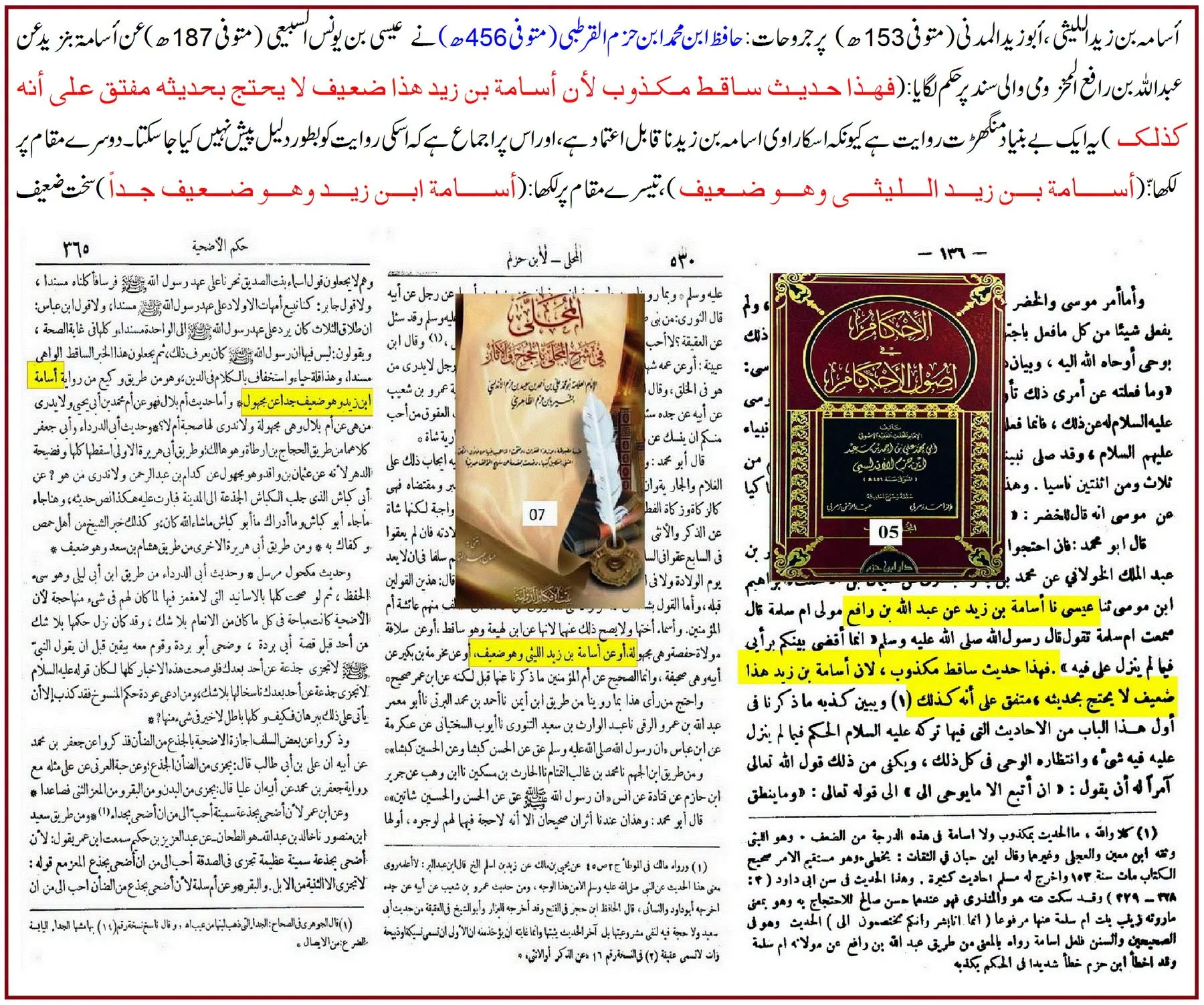
⑥ Hafiz Ibn Hazm al-Qurtubi (may Allah have mercy on him) (died 456 AH)
Hafiz Ibn Hazm (may Allah have mercy on him) passed judgement on the chain Isa ibn Yunus al-Sabi’i (died 187 AH) from Usama ibn Zayd from Abdullah ibn Rafi’:
إبراهيم بن موسى ثنا عيسى نا أسامة بن زيد عن عبد الله بن رافع مولى أم سلمة تقول قال رسول الله صلى الله عليه وسلم إنما أقضي بينكم برأيي فيما لم ينزل علي فيه … فهذا حديث ساقط مكذوب لأن أسامة بن زيد هذا ضعيف لا يحتج بحديثه متفق على أنه كذلك
Translation:
(Sayyida Umm Salama, may Allah be pleased with her) says that the Messenger of Allah ﷺ said: “In a matter about which no revelation has come down to me, I judge between you by my own opinion”… (Ibn Hazm says:) This hadith is rejected and false, because this Usama ibn Zayd is weak, his hadith is not taken as proof, and there is agreement that he is such.
In another place he wrote:
عَنْ أُسَامَةَ بْنِ زَيْدٍ اللَّيْثِيِّ عَنْ الزُّهْرِيِّ عَنْ أَبِي سَلَمَةَ … قَالَ أَبُو مُحَمَّدٍ: وَأَمَّا نَحْنُ فَلَا نَحْتَجُّ بِأُسَامَةَ بْنِ زَيْدٍ اللَّيْثِيِّ وَلَا نَرَاهُ حُجَّةً لَنَا وَلَا عَلَيْنَا وَفِي الْقُرْآنِ وَصَحِيحِ السُّنَنِ كِفَايَةٌ، وَلِلَّهِ الْحَمْدُ.
Translation:
Abu Muhammad (Ibn Hazm) says: As for us, we do not take Usama ibn Zayd al-Laythi as proof, nor do we consider him a proof for us or against us; in the Qur’an and the authentic Sunnah there is sufficiency (for us), and all praise is for Allah.
And in a third place he explicitly declared him weak:
أَوْ عَنْ أُسَامَةَ بْنِ زَيْدٍ اللَّيْثِيِّ – وَهُوَ ضَعِيفٌ – أَوْ عَنْ مَخْرَمَةَ بْنِ بُكَيْرٍ عَنْ أَبِيهِ
Translation:
Or from Usama ibn Zayd al-Laythi, and he is weak, or from Makhrama ibn Bukayr from his father.
Explanation:
Hafiz Ibn Hazm (may Allah have mercy on him) not only called Usama weak but also reported agreement on his being “la yuhtajju bih” (not taken as proof), and he refused to use his narration as evidence even in his own favour; this is his fundamental position regarding this narrator.
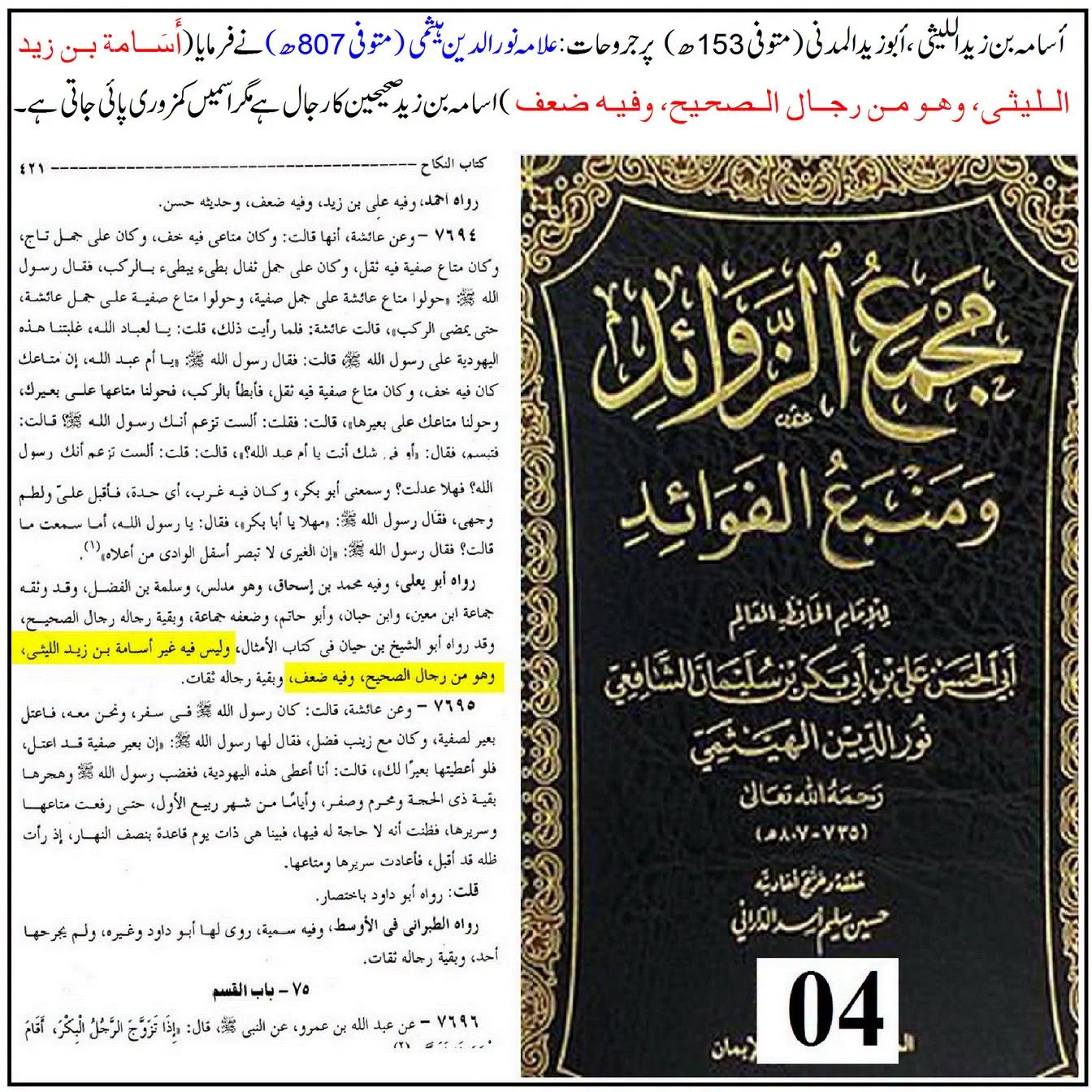
⑦ Hafiz Nur al-Din al-Haythami (may Allah have mercy on him) (died 807 AH)
After giving the takhrij of a narration, Hafiz al-Haythami (may Allah have mercy on him) said:
7694 – «- وَعَنْ عَائِشَةَ أَنَّهَا قَالَتْ: وَكَانَ مَتَاعِي فِيهِ خِفٌّ، وَكَانَ عَلَى جَمَلٍ نَاجٍ، وَكَانَ مَتَاعُ صَفِيَّةَ فِيهِ ثِقَلٌ، … رَوَاهُ أَبُو يَعْلَى، وَفِيهِ مُحَمَّدُ بْنُ إِسْحَاقَ، وَهُوَ مُدَلِّسٌ، وَسَلَمَةُ بْنُ الْفَضْلِ، وَقَدْ وَثَّقَهُ جَمَاعَةُ ابْنِ مَعِينٍ وَابْنُ حِبَّانَ، وَأَبُو حَاتِمٍ، وَضَعَّفَهُ جَمَاعَةٌ، وَبَقِيَّةُ رِجَالِهِ رِجَالُ الصَّحِيحِ، وَقَدْ رَوَاهُ أَبُو الشَّيْخِ بْنُ حِبَّانَ فِي كِتَابِ الْأَمْثَالِ وَلَيْسَ فِيهِ غَيْرُ أُسَامَةَ بْنِ زَيْدٍ اللَّيْثِيِّ، وَهُوَ مِنْ رِجَالِ الصَّحِيحِ، وَفِيهِ ضَعْفٌ، وَبَقِيَّةُ رِجَالِهِ ثِقَاتٌ.
Translation:
It is narrated from Lady Aisha (may Allah be pleased with her) that she said: My luggage was light and it was on a swift camel, and the luggage of Safiyya (may Allah be pleased with her) was heavy … Abu Ya’la narrated it. In it are Muhammad ibn Ishaq, who is a mudallis (one who practises tadlis), and Salama ibn al-Fadl, whom a group (Ibn Ma’in, Ibn Hibban and Abu Hatim) declared reliable and a group declared weak. The rest of its men are men of the Sahih. Abu al-Shaykh ibn Hibban also narrated it in Kitab al-Amthal; in it (the cause of weakness) is only Usama ibn Zayd al-Laythi. He is among the men of the Sahih, but there is weakness in him, and the rest of its men are thiqah (reliable).
Explanation:
Hafiz al-Haythami (may Allah have mercy on him) stated clearly that although Usama is among the “men of the Sahih”, there is weakness in him. That is, appearing in some chain in Sahih Muslim (which is in supporting narrations) is not proof of a narrator’s absolute reliability.
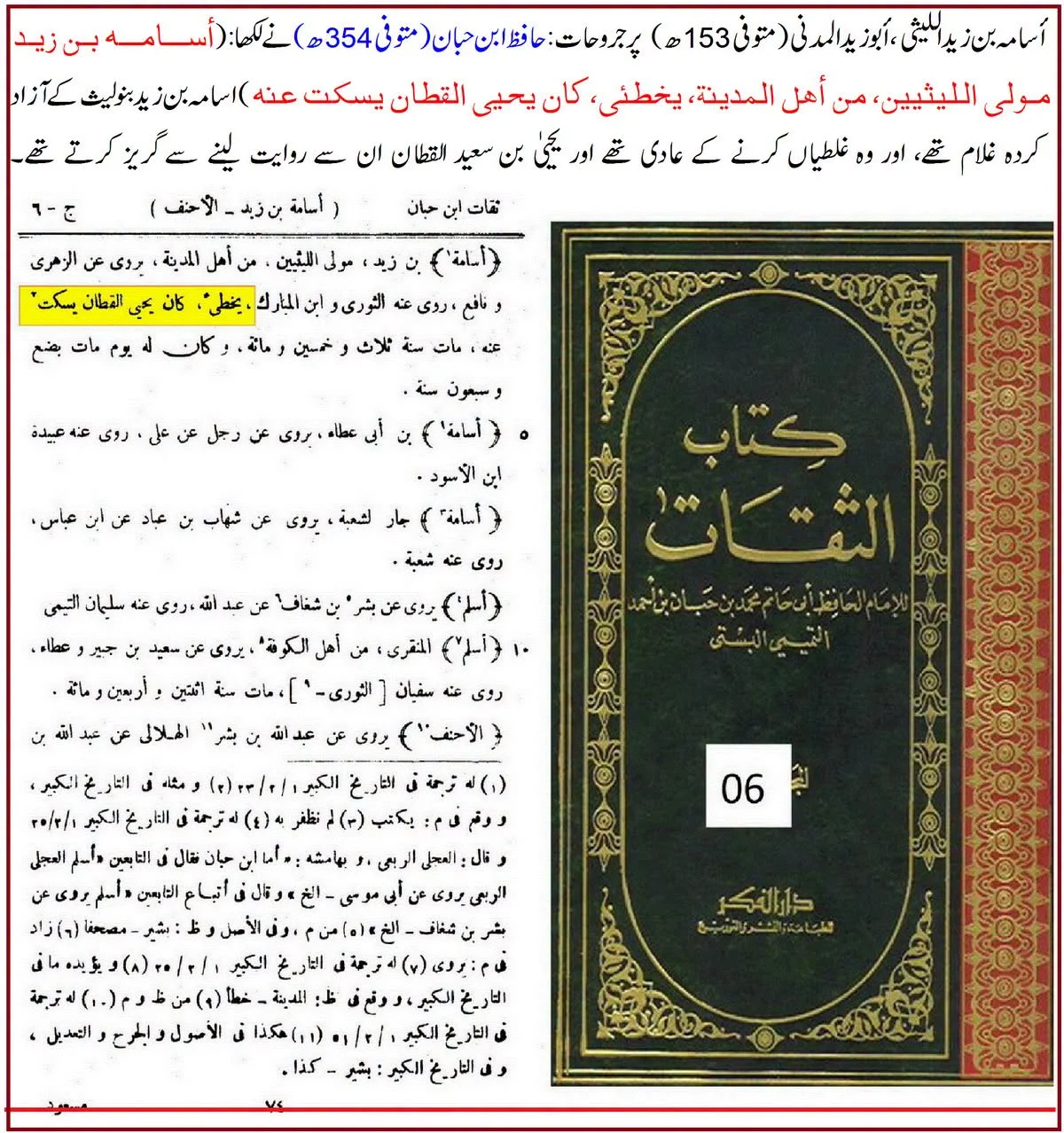
⑧ Hafiz Ibn Hibban (may Allah have mercy on him) (died 354 AH)
Hafiz Ibn Hibban (may Allah have mercy on him) wrote:
6786 – أُسَامَة بن زيد مولى الليثيين من أهل الْمَدِينَة يروي عَن الزُّهْرِيّ وَنَافِع روى عَنهُ الثَّوْريّ وَابْن الْمُبَارك يخطىء كَانَ يحيى الْقطَّان يسكت عَنهُ مَاتَ سنة ثَلَاث وَخمسين وَمِائَة وَكَانَ لَهُ يَوْم مَاتَ بضع وَسَبْعُونَ سنة
Translation:
Usama ibn Zayd, freed slave of the Banu Layth, is from the people of Madina. He narrates from al-Zuhri and Nafi’, and al-Thawri and Ibn al-Mubarak narrated from him. He makes mistakes, and Yahya al-Qattan used to stay silent about (his narrations). He died in 153 AH, and at the time of his death he was a little over seventy years old.
Explanation:
Although Hafiz Ibn Hibban (may Allah have mercy on him) mentioned him in “al-Thiqat”, he at the same time pointed to his weakness by saying “يخطئ” (he makes mistakes), and he also mentioned that Yahya al-Qattan (may Allah have mercy on him) kept away from him.
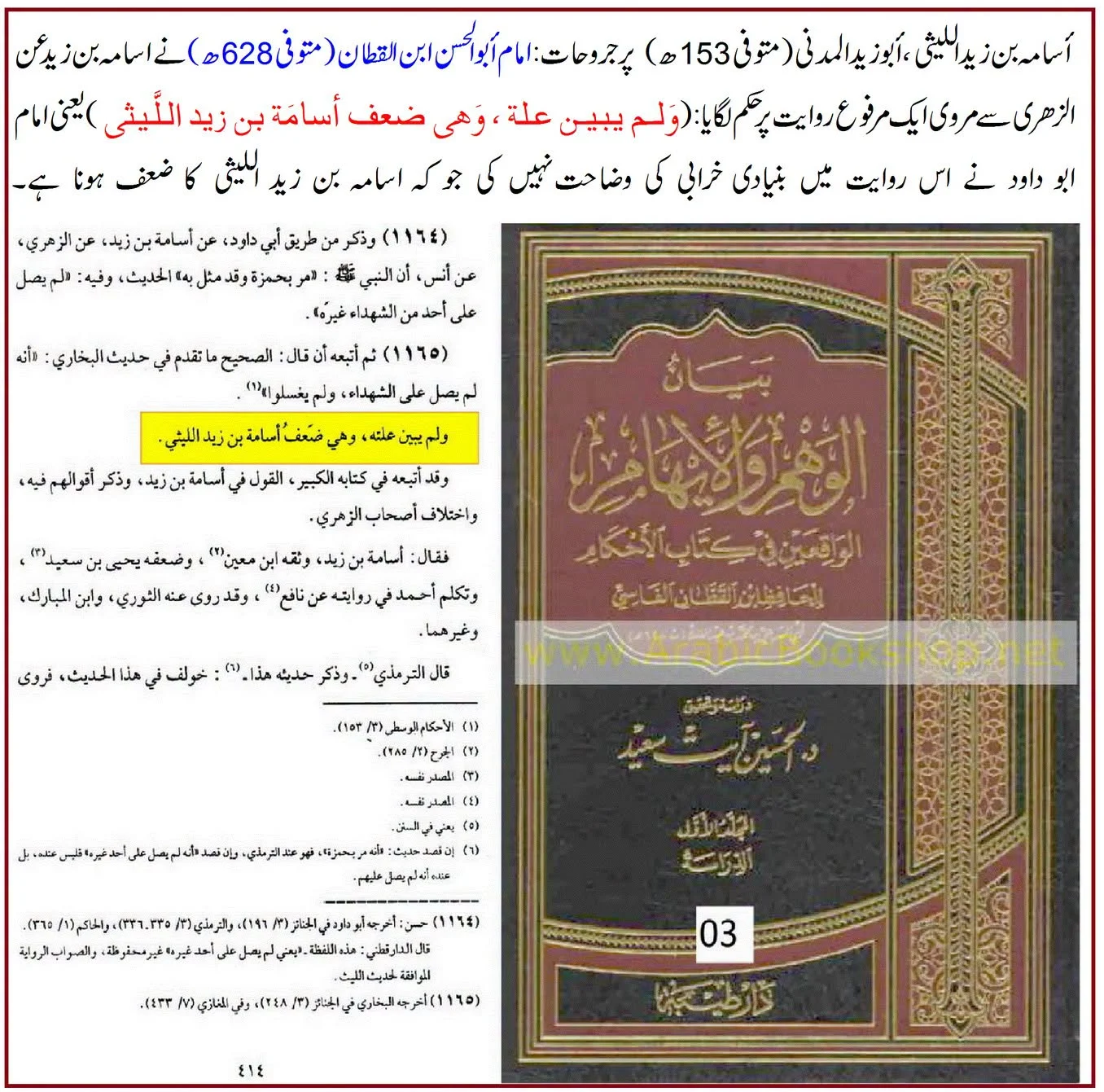
⑨ Imam Abu al-Hasan Ibn al-Qattan al-Fasi (may Allah have mercy on him) (died 628 AH)
Imam Ibn al-Qattan (may Allah have mercy on him) wrote, explaining the defect of a marfu’ narration reported from Usama ibn Zayd from al-Zuhri:
(1164) وَذكر من طَرِيق أبي دَاوُد، عَن أُسَامَة بن زيد، عَن الزُّهْرِيّ عَن أنس، أَن النَّبِي – صَلَّى اللَّهُ عَلَيْهِ وَسَلَّم َ -: ” مر بِحَمْزَة وَقد مثل بِهِ ” الحَدِيث، وَفِيه: ” لم يصل على أحد من الشُّهَدَاء غَيره “. (1165) ثمَّ أتبعه أَن قَالَ: الصَّحِيح مَا تقدم فِي حَدِيث البُخَارِيّ: ” أَنه لم يصل على الشُّهَدَاء، وَلم يغسلوا “. وَلم يبين علته، وَهِي ضعف أُسَامَة بن زيد اللَّيْثِيّ.
Translation:
(Abd al-Haqq al-Ishbili) mentioned this narration by way of Abu Dawud, from Usama ibn Zayd, from al-Zuhri, from Anas: that the Prophet ﷺ passed by Hamza (may Allah be pleased with him) when he had been mutilated … and in it is: “He ﷺ did not pray the funeral prayer over any of the martyrs other than him.” Then after it he said: The sahih (authentic) one is what preceded in the hadith of al-Bukhari: “that he ﷺ did not pray the funeral prayer over the martyrs, and they were not washed.” (Ibn al-Qattan says:) He did not explain its defect, and it is the weakness of Usama ibn Zayd al-Laythi.
Explanation:
Imam Ibn al-Qattan (may Allah have mercy on him) declared the real defect of this narration to be “the weakness of Usama ibn Zayd al-Laythi”; that is, in his view Usama’s solitary narration is not acceptable against the narration of Sahih al-Bukhari.
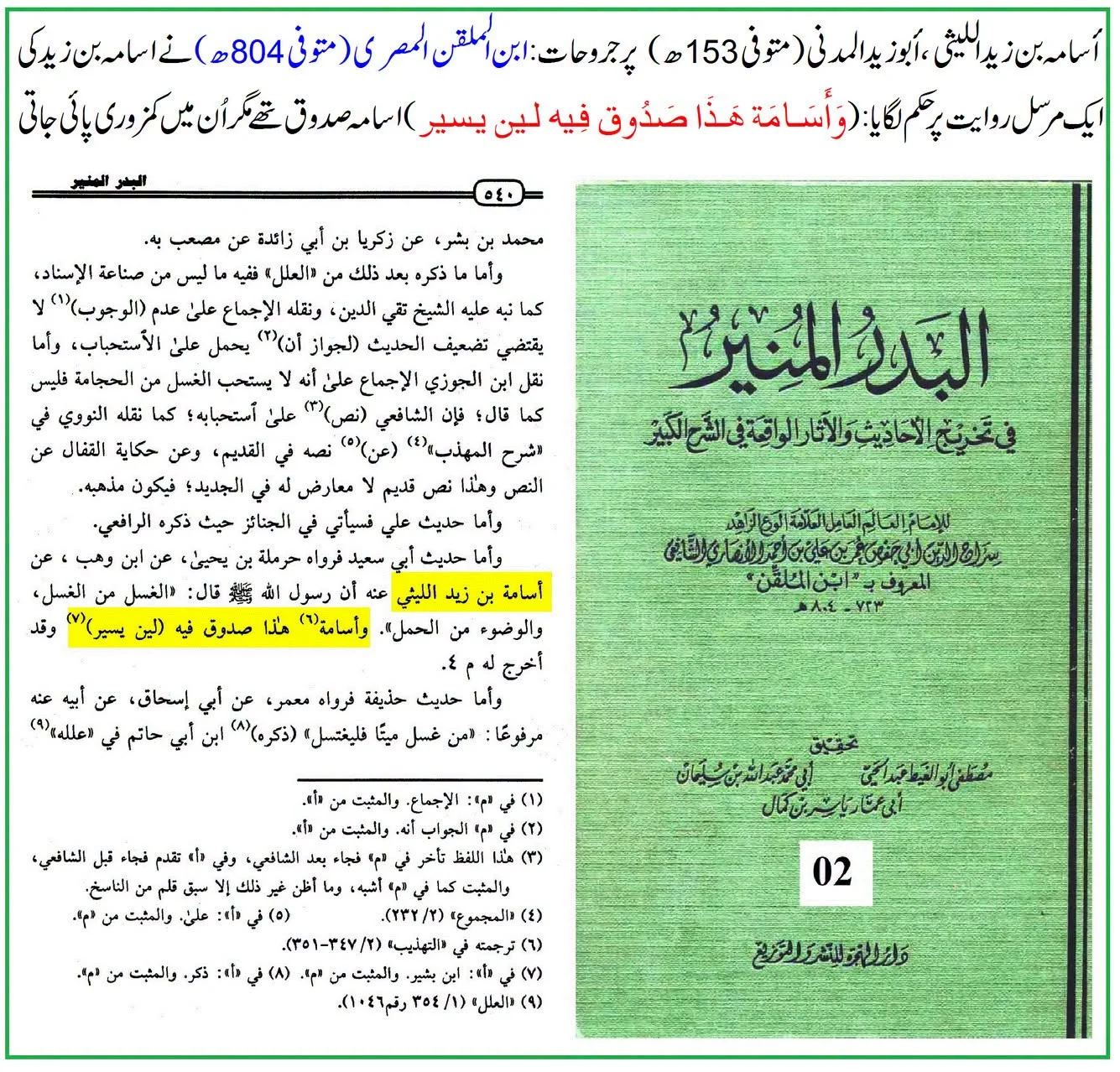
⑩ Hafiz Ibn al-Mulaqqin al-Misri (may Allah have mercy on him) (died 804 AH)
Hafiz Ibn al-Mulaqqin (may Allah have mercy on him) wrote, discussing the narration of Abu Sa’id (may Allah be pleased with him):
وَأما حَدِيث أبي سعيد فَرَوَاهُ حَرْمَلَة بن يَحْيَى، عَن ابْن وهب، عَن أُسَامَة بن زيد اللَّيْثِيّ عَنهُ أَن رَسُول الله – صَلَّى الله عَلَيْهِ وَسلم – قَالَ: «الْغسْل من الْغسْل، وَالْوُضُوء من الْحمل» . وَأُسَامَة هَذَا صَدُوق فِيهِ (لين يسير) وَقد أخرج لَهُ م 4
Translation:
As for the hadith of Abu Sa’id (may Allah be pleased with him), Harmala ibn Yahya narrated it from Ibn Wahb, from Usama ibn Zayd al-Laythi, from Abu Sa’id (may Allah be pleased with him), that the Messenger of Allah ﷺ said: “Washing is from washing (the dead), and wudu’ is from carrying (him).” And this Usama is saduq (truthful); there is slight weakness in him, and Muslim and the four (Sunan) have narrated from him.
Explanation:
By saying “saduq fihi layn yasir” (truthful, with slight weakness in him), Ibn al-Mulaqqin (may Allah have mercy on him) acknowledged weakness in Usama’s memory rather than accepting him as absolutely reliable.
⑪ Hafiz Shams al-Din al-Dhahabi (may Allah have mercy on him) (died 748 AH)
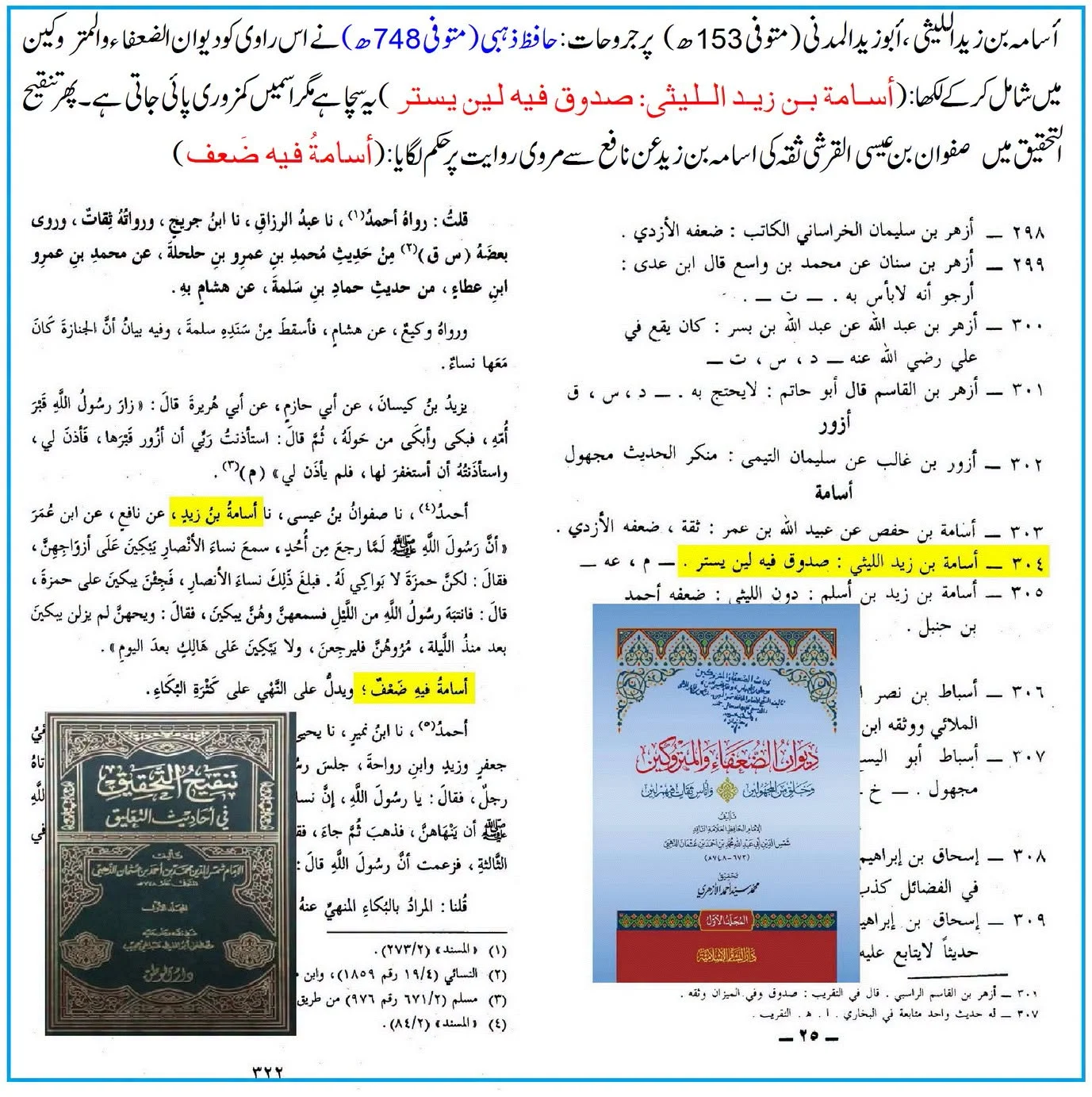
Hafiz al-Dhahabi (may Allah have mercy on him) included this narrator in “Diwan al-Du’afa’ wa al-Matrukin” and wrote:
304 – أسامة بن زيد الليثي: صدوق فيه لين يستر. -م، عه-
Translation:
Usama ibn Zayd al-Laythi: saduq (truthful); there is slight weakness in him. (A narrator of Muslim and the four Sunan)
Then in “Tanqih al-Tahqiq” he gave a ruling on the narration of Safwan ibn Isa al-Qurashi (thiqah) from Usama ibn Zayd, from Nafi’:
أحمدُ، نَا صَفْوَان بن عِيسَى، نَا أُسَامَة بن زيد، عَن نَافِع، عَن ابْن عمرَ ” … أسامةُ فِيهِ ضعف؛ وَيدل على النَّهْي على كثرةِ الْبكاء.
Translation:
(Imam) Ahmad narrated from Safwan ibn Isa, from Usama ibn Zayd, from Nafi’, from Ibn Umar (may Allah be pleased with him) … (al-Dhahabi says:) There is weakness in Usama; and (this narration) indicates the prohibition of excessive weeping.
Explanation:
On the one hand Hafiz al-Dhahabi (may Allah have mercy on him) recorded Usama in the Diwan of the weak, and on the other hand he ruled on his narration with “fihi da’f” (there is weakness in him).
⑫ Hafiz Ibn Hajar al-Asqalani (may Allah have mercy on him) (died 852 AH)
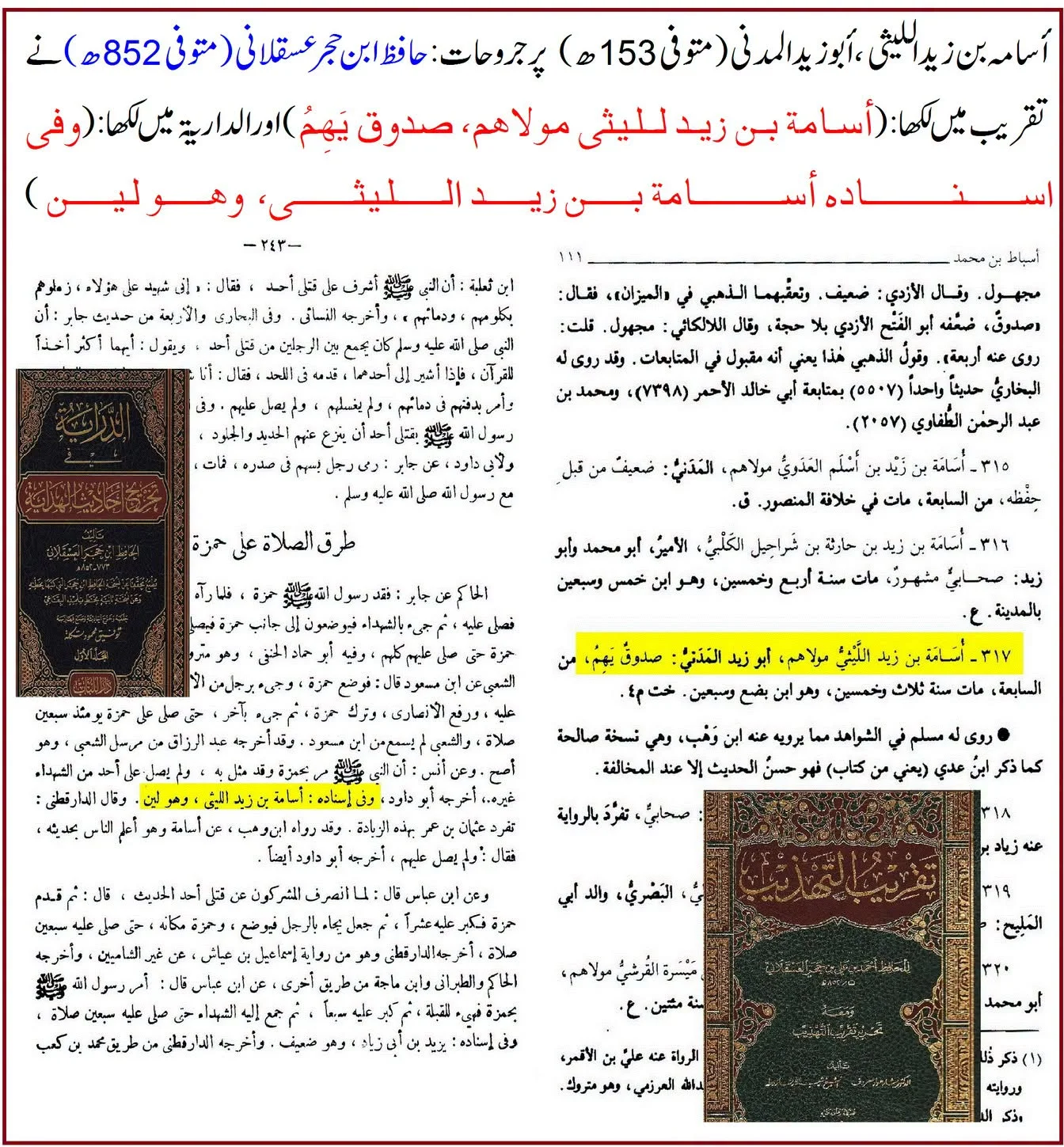
Hafiz Ibn Hajar (may Allah have mercy on him) wrote in “Taqrib al-Tahdhib”:
317 – أُسَامَة بن زيد اللَّيْثيُّ مولاهم، أبو زيد المَدَنيُّ: صدوقٌ يَهِمُ، من السابعة،
Translation:
Usama ibn Zayd al-Laythi, freed slave (of the Banu Layth), Abu Zayd al-Madani: saduq (truthful), prone to error, from the seventh tabaqa (generation).
And in “al-Diraya” he wrote about the narration of the funeral prayer for Hamza (may Allah be pleased with him):
الْأنْصَارِيّ وَترك حَمْزَة ثمَّ جىء بآخر حَتَّى صَلَّى عَلَى حَمْزَة يَوْمئِذٍ سبعين صَلَاة وَالشعْبِيّ لم يسمع من ابْن مَسْعُود وَقد أخرجه عبد الرَّزَّاق من مُرْسل الشّعبِيّ وَهُوَ أصح وَعَن أنس أَن النَّبِي صَلَّى اللَّهُ عَلَيْهِ وَسَلَّم َ مر بِحَمْزَة وَقد مثل بِهِ وَلم يصل عَلَى أحد من الشُّهَدَاء غَيره أخرجه أَبُو دَاوُد وَفِي إِسْنَاده أُسَامَة بن زيد اللَّيْثِيّ وَهُوَ لين
Translation:
… the Ansari (was brought) and Hamza (may Allah be pleased with him) was left, then another (martyr) was brought, until on that day seventy prayers were prayed over Hamza (may Allah be pleased with him); and al-Sha’bi did not hear from Ibn Mas’ud (may Allah be pleased with him), and Abd al-Razzaq reported it from the mursal narration of al-Sha’bi, and that is more authentic. And it is narrated from Anas (may Allah be pleased with him) that the Prophet ﷺ passed by Hamza (may Allah be pleased with him) when he had been mutilated, and he ﷺ did not pray the funeral prayer over any of the martyrs other than him; Abu Dawud reported it, and in its chain is Usama ibn Zayd al-Laythi, and he is weak (layyin).
Clarification:
Hafiz Ibn Hajar (may Allah have mercy on him) said “saduq yahim” (truthful, prone to error) in al-Taqrib and “layyin” (soft) in al-Diraya; that is, according to him too, there is weakness in Usama’s narration because of error, and for this reason he gave it as the cause of weakness in the chain.
⑬ Allama Abu al-Abbas al-Busiri (may Allah have mercy on him) (died 840 AH)
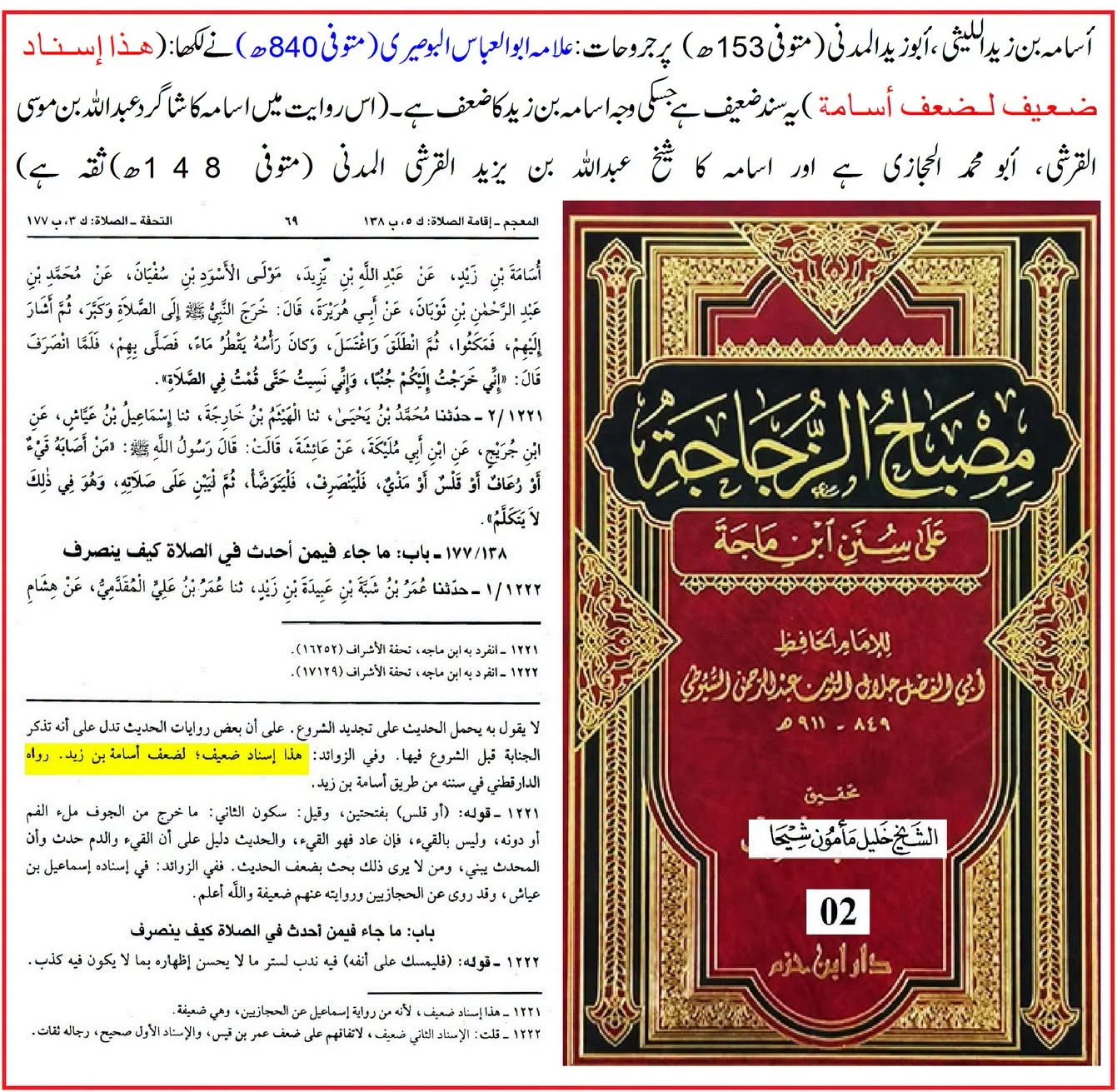
Allama Busiri (may Allah have mercy on him) wrote about a narration of Sunan Ibn Majah:
(432) حَدثنَا يَعْقُوب بن حميد بن كاسب حَدثنَا عبد الله بن مُوسَى التَّيْمِيّ حَدثنَا أُسَامَة بن زيد عَن عبد الله بن يزِيد مولى الْأسود بن سُفْيَان عَن مُحَمَّد بن عبد الرَّحْمَن بن ثَوْبَان عَن أبي هُرَيْرَة قَالَ … هَذَا إِسْنَاد ضَعِيف لضعف أُسَامَة رَوَاهُ الدَّارَقُطْنِيّ فِي سنَنه من طَرِيق أُسَامَة بن زيد بِهِ
Translation:
… This chain is da’if (weak) because of the weakness of Usama, and al-Daraqutni narrated it in his Sunan through the route of Usama bin Zayd himself, with the same (chain).
Clarification:
In this narration, Usama’s student is Abdullah bin Musa al-Taymi, and Usama’s teacher Abdullah bin Yazid (freed slave of al-Aswad bin Sufyan, died 148 AH) is thiqa (reliable); despite this, Allama Busiri (may Allah have mercy on him) gave “the weakness of Usama” as the only reason for the weakness of the chain.
⑭ Abu Hafs Ibn Shahin (may Allah have mercy on him) (died 385 AH)
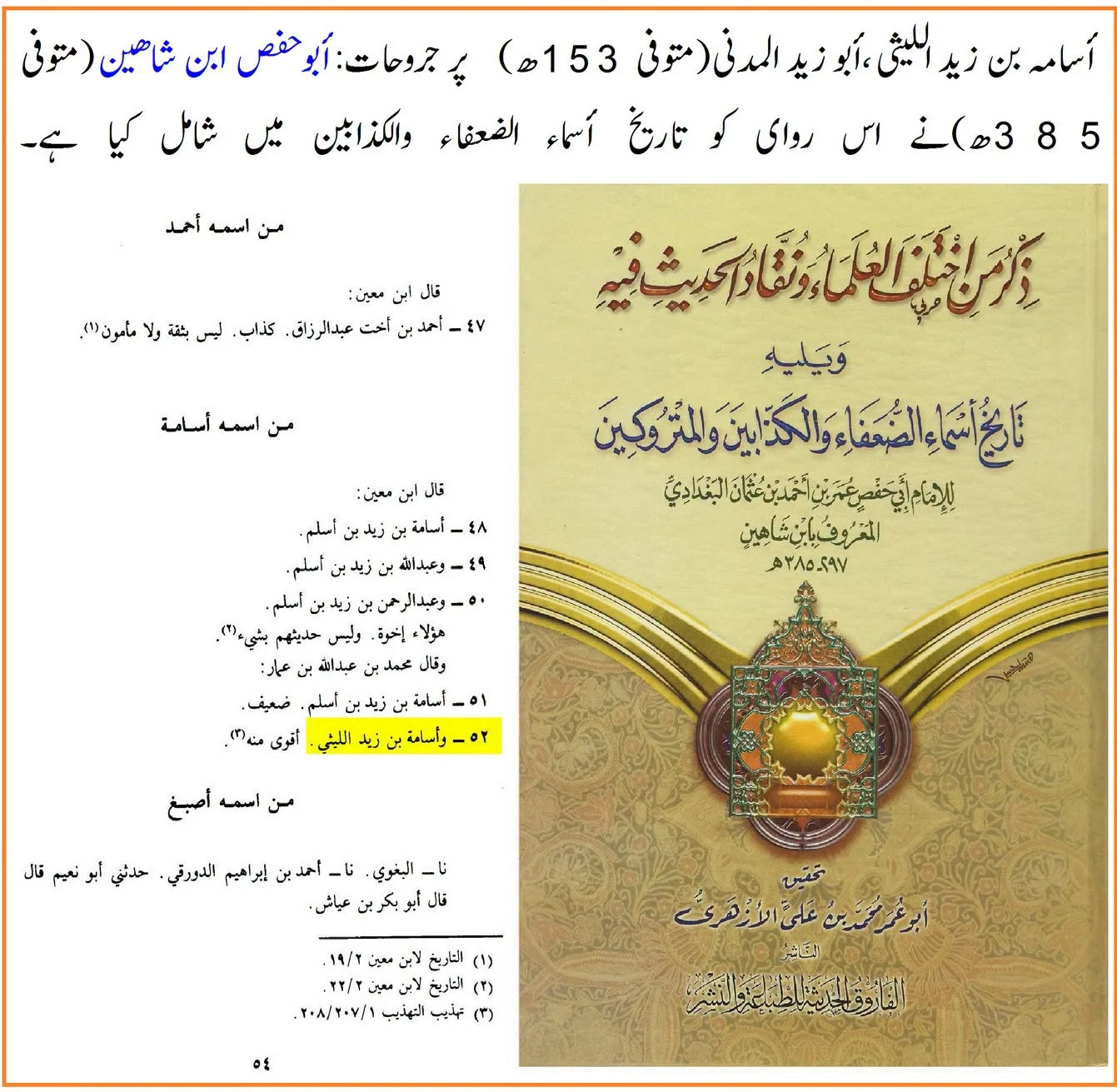
Ibn Shahin (may Allah have mercy on him) mentioned this narrator in “Tarikh Asma al-Du’afa wa al-Kadhhabin”:
51- أسامة بن زيد بن اسلم. ضعيف. 52- وأسامة ابن زيد الليثي. أقوى منه.
Translation:
Usama bin Zayd bin Aslam: da’if (weak). And Usama bin Zayd al-Laythi: stronger than him.
Clarification:
Ibn Shahin (may Allah have mercy on him) mentioned Usama al-Laythi in his book of al-Du’afa, but he also made clear that he is stronger than (his namesake) Usama bin Zayd bin Aslam; that is, his weakness is slight, not severe.
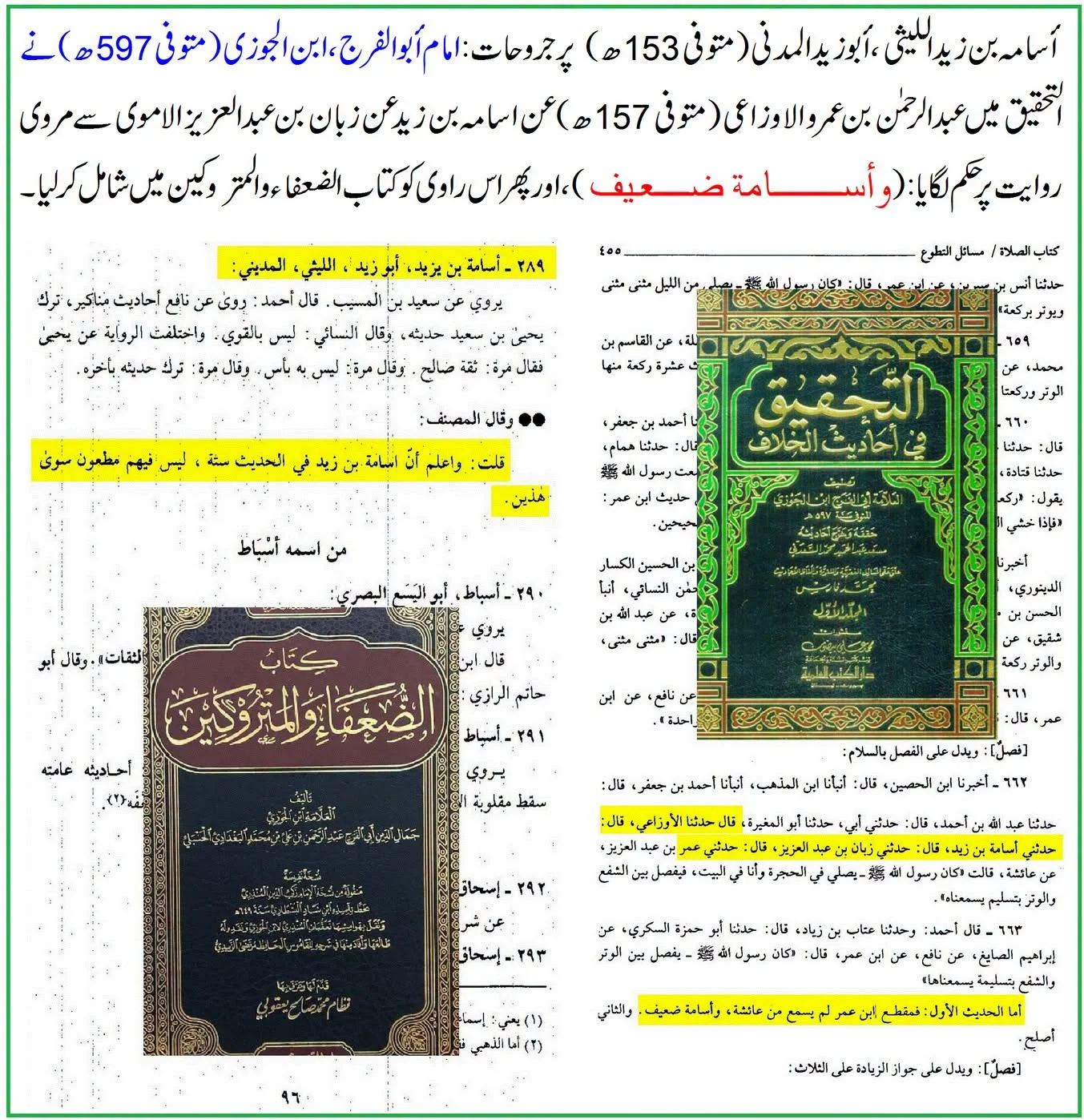
⑮ Imam Abu al-Faraj Ibn al-Jawzi (may Allah have mercy on him) (died 597 AH)
Imam Ibn al-Jawzi (may Allah have mercy on him) gave a ruling in “al-Tahqiq” on the narration of Imam al-Awza’i (may Allah have mercy on him) (died 157 AH) from Usama bin Zayd from Zabban bin Abd al-Aziz:
حَدَّثَنَا عَبْدُ اللَّهِ بْنُ أَحْمَدَ قَالَ حَدَّثَنِي أَبِي حَدَّثَنَا أَبُو الْمُغِيرَةَ قَالَ حَدَّثَنَا الْأَوْزَاعِيُّ قَالَ حَدثنِي أُسَامَةُ بْنُ زَيْدٍ قَالَ حَدَّثَنِي زبان بْنُ عَبْدِ الْعَزِيزِ قَالَ حَدَّثَنِي عُمَرَ بْنِ عَبْدِ الْعَزِيزِ عَنْ عَائِشَةَ قَالَتْ كَانَ رَسُولُ اللَّهِ صَلَّى اللَّهُ عَلَيْهِ وَسَلَّمَ يُصَلِّي فِي الْحُجْرَة وأَنا فِي الْبَيْتِ فَيَفْصِلُ بَيْنَ الشَّفْعِ وَالْوِتْرِ بِتَسْلِيمٍ يُسْمِعُنَاهُ 663 – قَالَ أَحْمَدُ وَحدثنَا عَتَّابُ بْنُ زِيَادٍ قَالَ حَدَّثَنَا أَبُو حَمْزَةَ السُّكَّرِيُّ عَنْ إِبْرَاهِيمَ الصايغ عَنْ نَافِعٍ عَنِ ابْنِ عُمَرَ قَالَ كَانَ رَسُولُ اللَّهِ صَلَّى اللَّهُ عَلَيْهِ وَسَلَّمَ يَفْصِلُ بَيْنَ الْوِتْرِ وَالشَّفْعِ بِتَسْلِيمَةٍ يُسْمِعْنَاهَا أَمَّا الحَدِيث الأول فمقطع ابْنُ عُمَرَ لَمْ يَسْمَعْ مِنْ عَائِشَة وأُسَامَة ضَعِيفٌ وَالثَّانِي أَصْلَحُ
Translation:
Aisha (may Allah be pleased with her) said: The Messenger of Allah ﷺ used to pray in the room while I was in the house, and he ﷺ would separate the even (rak’ahs) from the witr with a salam that he let us hear. (Another narration:) Ibn Umar (may Allah be pleased with them both) said: The Messenger of Allah ﷺ used to separate witr from the even (rak’ahs) with a salam that he let us hear. (Ibn al-Jawzi says:) The first hadith is munqati’ (broken chain); (its narrator’s) hearing from Aisha (may Allah be pleased with her) is not established, and Usama is da’if (weak); and the second (hadith) is better.
And then he also included him in “al-Du’afa wa al-Matrukun”:
289 – أُسَامَة بن يزِيد أَبُو زيد اللَّيْثِيّ الْمَدِينِيّ يروي عَن سعيد بن الْمسيب قَالَ أَحْمد روى عَن نَافِع أَحَادِيث مَنَاكِير ترك يحيى بن سعيد حَدِيثه وَقَالَ النَّسَائِيّ لَيْسَ بِالْقَوِيّ وَاخْتلفت الرِّوَايَة عَن يحيى فَقَالَ مرّة ثِقَة صَالح وَقَالَ مرّة لَيْسَ بِهِ بَأْس وَقَالَ مرّة ترك حَدِيثه بأخره وَقَالَ المُصَنّف قلت وَاعْلَم أَن أُسَامَة بن زيد فِي الحَدِيث سِتَّة لَيْسَ فيهم مطعو سوى هذَيْن
Translation:
Usama bin Zayd, Abu Zayd al-Laythi al-Madini, narrates from Sa’id bin al-Musayyab. Ahmad said: He narrated munkar (rejected) hadiths from Nafi’; Yahya bin Sa’id abandoned his hadith. al-Nasa’i said: Not strong. And the report from Yahya (bin Ma’in) differs: once he said “thiqa (reliable), salih”, once he said “there is no harm in him”, and once he said “his hadith was abandoned at the end”. The author (Ibn al-Jawzi) says: Know that there are six narrators named Usama bin Zayd in hadith; among them none is criticised (majruh) except these two.
Clarification:
Imam Ibn al-Jawzi (may Allah have mercy on him) called Usama’s narration da’if (weak), recorded him in his book al-Du’afa, and along with it quoted the criticism of Imam Ahmad, Yahya al-Qattan and al-Nasa’i.
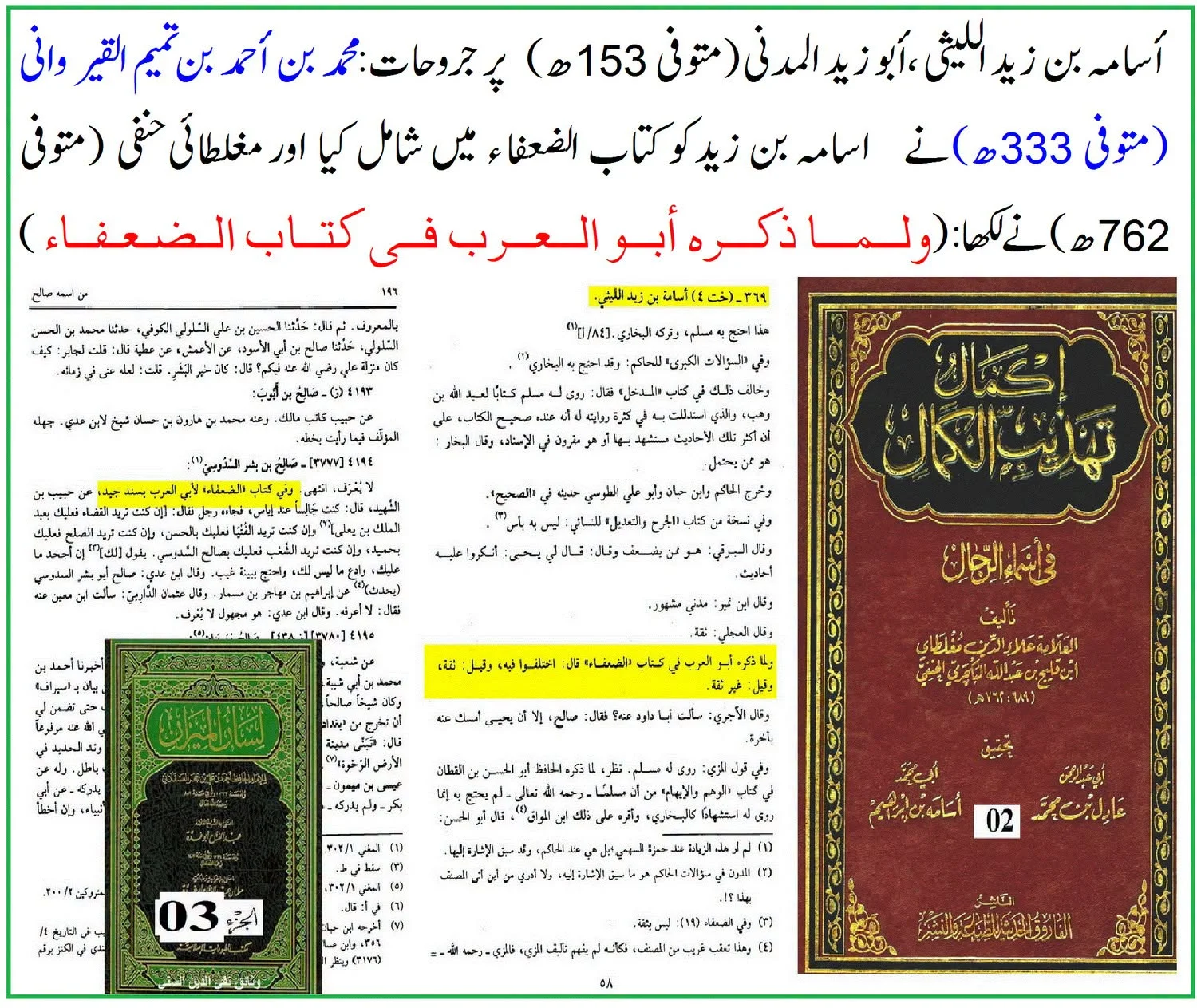
⑯ Abu al-Arab Muhammad bin Ahmad bin Tamim al-Qayrawani (may Allah have mercy on him) (died 333 AH)
Abu al-Arab (may Allah have mercy on him) included Usama bin Zayd in “Kitab al-Du’afa”, as Hafiz Mughultay al-Hanafi (may Allah have mercy on him) (died 762 AH) mentioned:
369 – (خت 4) أسامة بن زيد الليثي. … ولما ذكره أبو العرب في كتاب «الضعفاء» قال: اختلفوا فيه، وقيل: ثقة، وقيل: غير ثقة.
Translation:
Usama bin Zayd al-Laythi … and when Abu al-Arab mentioned him in the book “al-Du’afa” he said: They differed about him; it was said that he is thiqa (reliable), and it was said that he is not thiqa.
Clarification:
Although Abu al-Arab (may Allah have mercy on him) mentioned the difference of opinion, he recorded him in the book of the du’afa, which is a sign that, in his view, the aspect of criticism prevails.
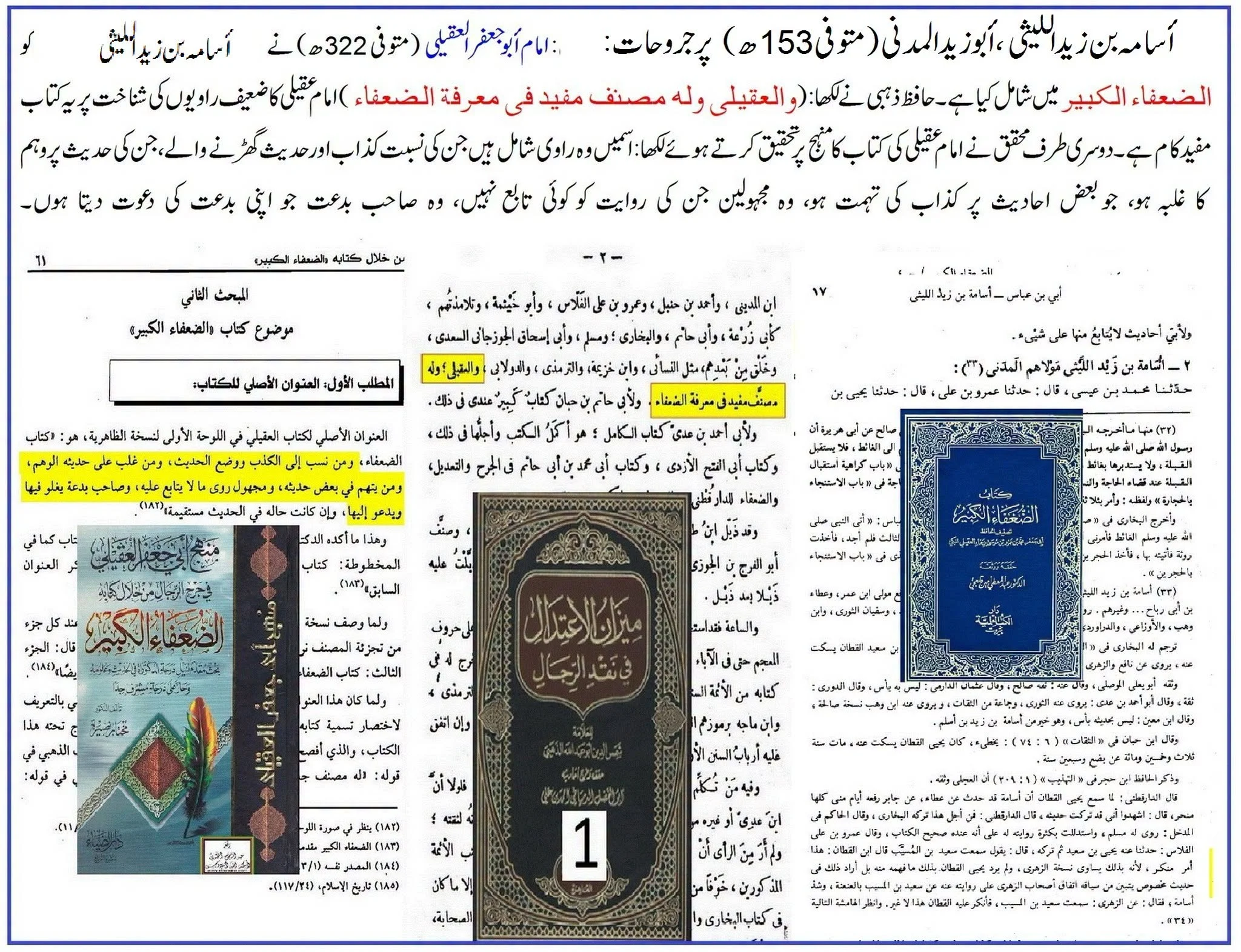
⑰ Imam Abu Ja’far al-Uqayli (may Allah have mercy on him) (died 322 AH)
Imam Uqayli (may Allah have mercy on him) included Usama bin Zayd al-Laythi in “al-Du’afa al-Kabir”:
2 – أُسَامَةُ بْنُ زَيْدٍ اللَّيْثِيُّ مَوْلًى لَهُمْ، مَدَنِيٌّ حَدَّثَنَا مُحَمَّدُ بْنُ عِيسَى قَالَ: حَدَّثَنَا عَمْرُو بْنُ عَلِيٍّ قَالَ: حَدَّثَنَا يَحْيَى بْنُ سَعِيدٍ بِأَحَادِيثِ أُسَامَةَ بْنِ زَيْدٍ ثُمَّ تَرَكَهُ ,
Translation:
Usama bin Zayd al-Laythi, freed slave (of Banu Layth), Madani. Amr bin Ali says: Yahya bin Sa’id narrated to us the hadiths of Usama bin Zayd, then abandoned him.
Clarification:
According to Hafiz Dhahabi (may Allah have mercy on him), this book of Imam Uqayli (may Allah have mercy on him) is useful for identifying weak narrators. And the book’s editor, describing Imam Uqayli’s (may Allah have mercy on him) methodology, wrote that it includes narrators to whom lying or fabricating hadith has been attributed, those whose hadith is dominated by error, those accused of lying in some hadiths, unknown narrators whose narrations have not been corroborated, and people of innovation. Usama’s mention in this book is evidence that he is criticised (majruh).
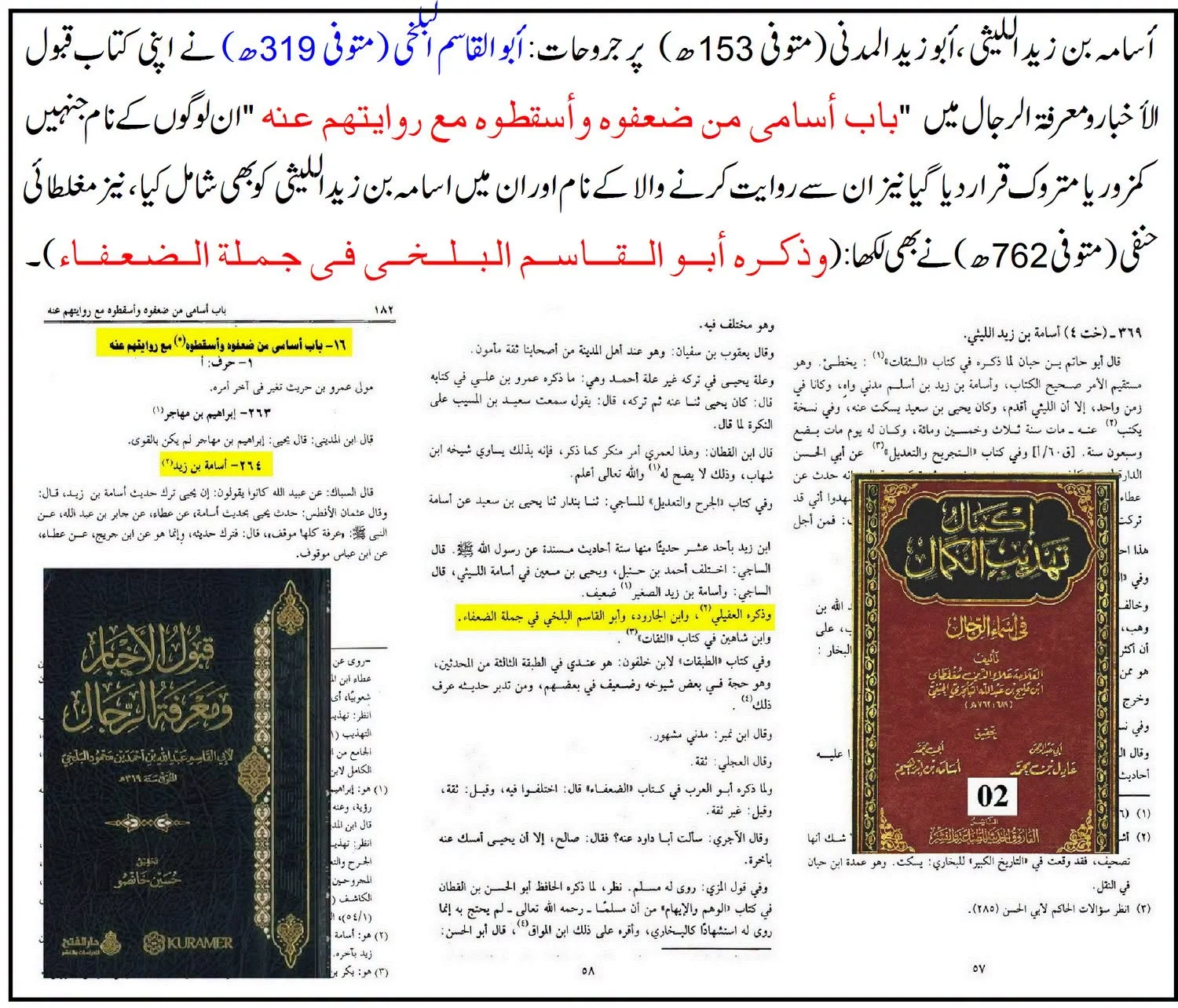
⑱ Abu al-Qasim al-Ka’bi al-Balkhi (may Allah have mercy on him) (died 319 AH)
Abu al-Qasim al-Balkhi (may Allah have mercy on him) set up this chapter in his book “Qabul al-Akhbar wa Ma’rifat al-Rijal”:
١٦ – باب أسامى من ضعفوه وأسقطوه مع روايتهم عنه
Translation:
Chapter: The names of those whom (the hadith scholars) declared weak and discarded, even though they also narrated from them.
And he included Usama bin Zayd al-Laythi in this list, as Hafiz Mughultay al-Hanafi (may Allah have mercy on him) wrote:
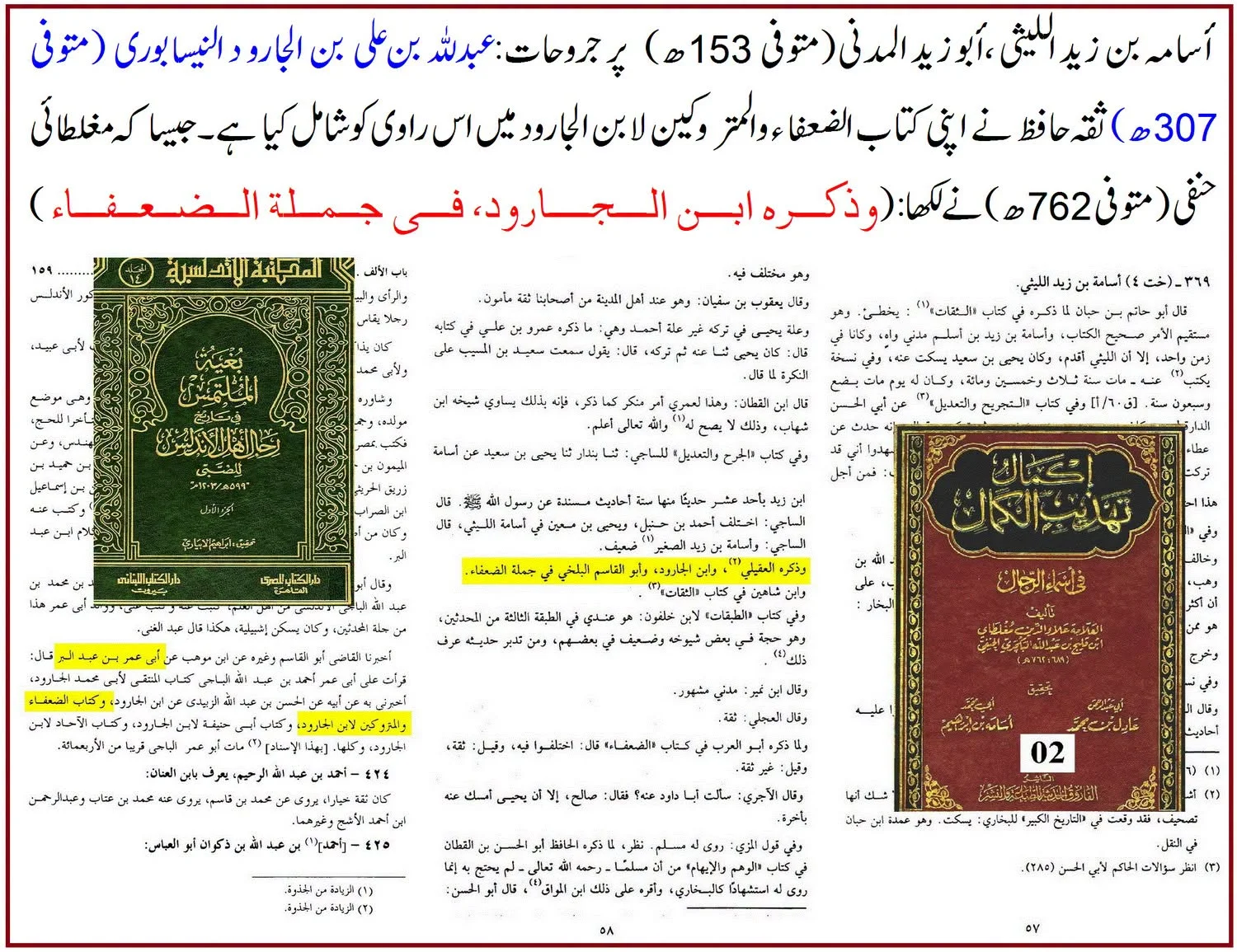
369 – (خت 4) أسامة بن زيد الليثي. … وذكره العقيلي، وابن الجارود، وأبو القاسم البلخي في جملة الضعفاء.
Translation:
Usama bin Zayd al-Laythi … and al-Uqayli, Ibn al-Jarud and Abu al-Qasim al-Balkhi mentioned him among the du’afa (weak narrators).
⑲ Hafiz Abdullah bin Ali bin al-Jarud al-Naysaburi (may Allah have mercy on him) (died 307 AH)
The trustworthy hafiz Ibn al-Jarud (may Allah have mercy on him) included this narrator in his book “Al-Du’afa wa al-Matrukin”, as Hafiz Mughultay al-Hanafi (may Allah have mercy on him) stated explicitly:
369 – (خت 4) أسامة بن زيد الليثي. … وذكره العقيلي، وابن الجارود، وأبو القاسم البلخي في جملة الضعفاء.
Translation:
Usama ibn Zayd al-Laythi … and al-Uqayli, Ibn al-Jarud and Abu al-Qasim al-Balkhi mentioned him among the weak narrators (du’afa).
Clarification:
Both Ibn al-Jarud and Abu al-Qasim al-Balkhi counted Usama among the weak narrators; and a Hanafi imam like Hafiz Mughultay (may Allah have mercy on him) has also reported this confirmation.
⑳ Imam Yahya ibn Ma’in (may Allah have mercy on him) (died 233 AH)
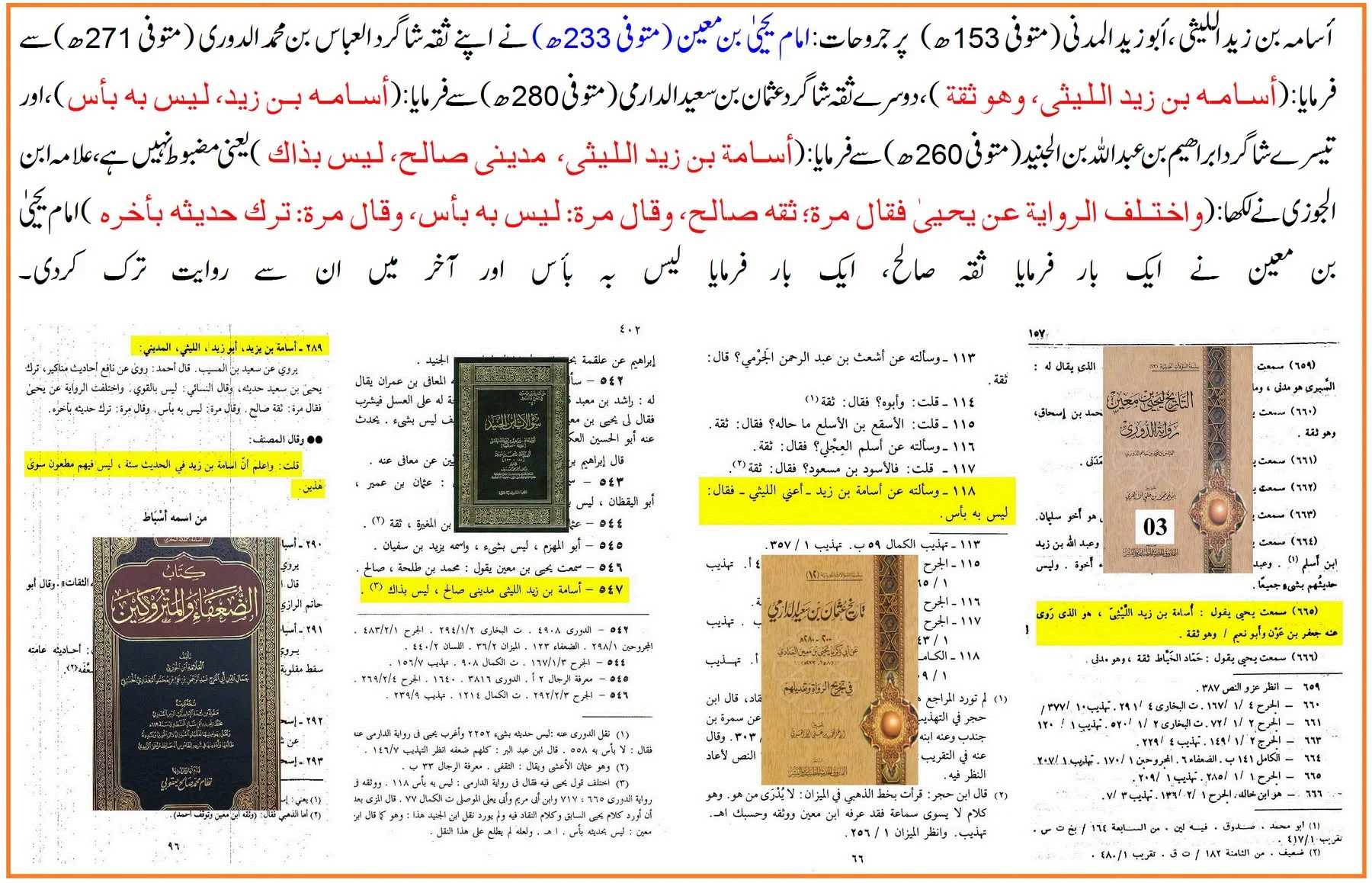
Three statements are reported from Imam Yahya ibn Ma’in (may Allah have mercy on him) about this narrator. First, he said to his trustworthy student Abbas ibn Muhammad al-Duri (may Allah have mercy on him) (died 271 AH):
1654 – سَمِعت يحيى يَقُول كَانَ يحدث عبيد الله بن مُوسَى وجعفر بن عون عَن أُسَامَة بن زيد اللَّيْثِيّ وَهُوَ ثِقَة
Translation:
I heard Yahya say: Ubaydullah ibn Musa and Ja’far ibn Awn used to narrate from Usama ibn Zayd al-Laythi, and he is trustworthy (thiqa).
To another student, Uthman ibn Sa’id al-Darimi (may Allah have mercy on him) (died 280 AH), he said:
118 – وَسَأَلته عَن أُسَامَة بن زيد أَعنِي اللَّيْثِيّ فَقَالَ لَيْسَ بِهِ بَأْس
Translation:
I asked him about Usama ibn Zayd, meaning al-Laythi, and he said: There is no harm in him.
To a third student, Ibrahim ibn Abdullah ibn al-Junayd (may Allah have mercy on him) (died 260 AH), he said:
(547) أسامة بن زيد الليثي مديني صالح ليس بذاك،
Translation:
Usama ibn Zayd al-Laythi is from Medina, he is righteous (salih), (but) not of that (high) level.
Allama Ibn al-Jawzi (may Allah have mercy on him), explaining these differing statements of Imam Ibn Ma’in (may Allah have mercy on him), wrote:
289 – أُسَامَة بن يزِيد أَبُو زيد اللَّيْثِيّ الْمَدِينِيّ … وَاخْتلفت الرِّوَايَة عَن يحيى فَقَالَ مرّة ثِقَة صَالح وَقَالَ مرّة لَيْسَ بِهِ بَأْس وَقَالَ مرّة ترك حَدِيثه بأخره
Translation:
The narration from Yahya (ibn Ma’in) differs: once he said “trustworthy, righteous”, once he said “there is no harm in him”, and once he said “his hadith was abandoned at the end”.
Clarification:
The statements of Imam Ibn Ma’in (may Allah have mercy on him) begin with “thiqa”, then come to “laysa bihi ba’s”, and then “salih laysa bi dhaak”; and according to the account of Ibn al-Jawzi (may Allah have mercy on him), one statement also mentions abandoning his hadith. The statement that Ibn al-Junayd reported from him is the preponderant one, namely “laysa bi dhaak” (not of that level), because it limits his declaration of reliability and so agrees with the criticism of the majority.
㉑ Shams al-Din Muhammad ibn Muflih al-Maqdisi (may Allah have mercy on him) (died 763 AH)
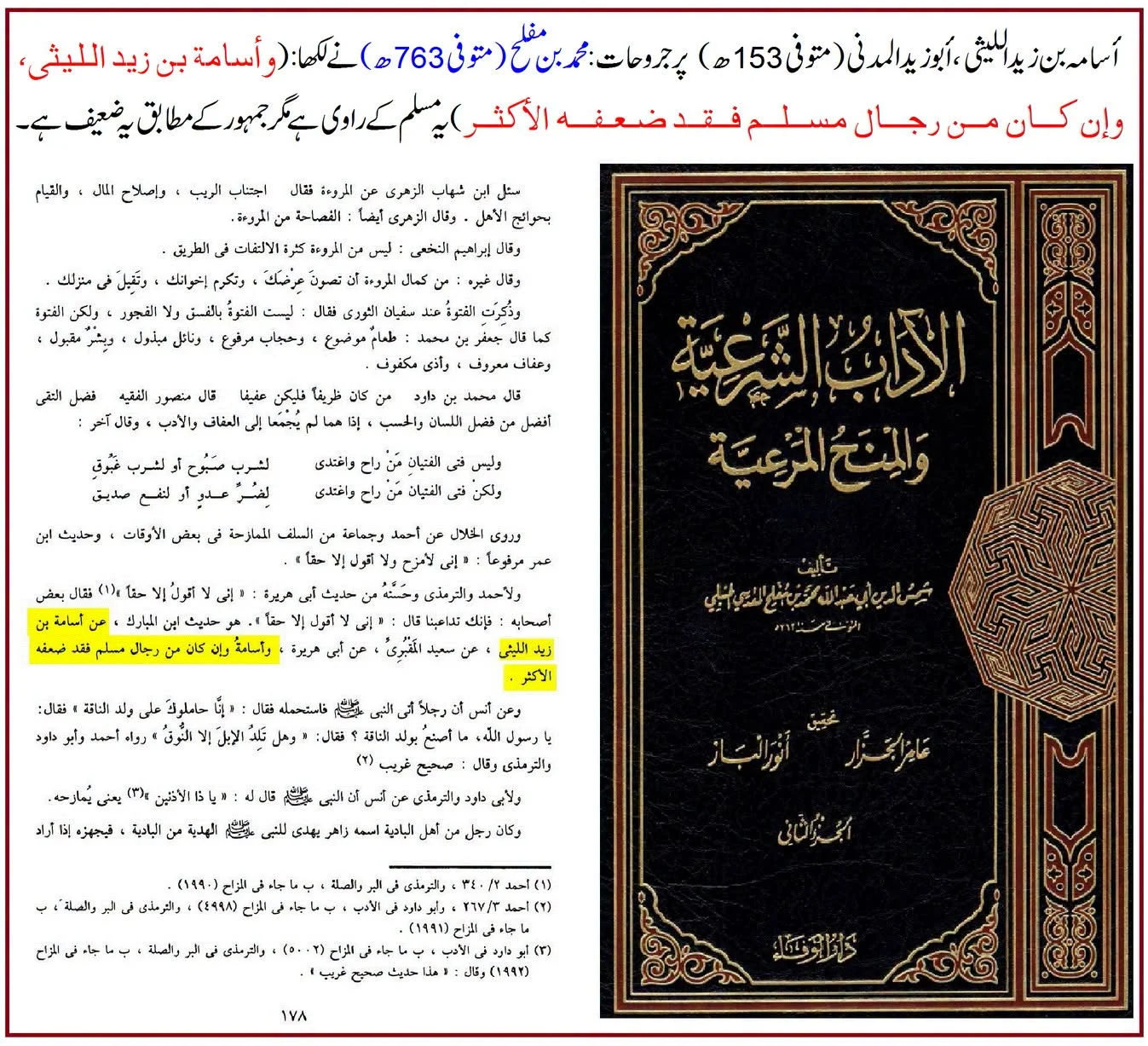
Ibn Muflih (may Allah have mercy on him) wrote about a hadith:
هُوَ حَدِيثُ ابْنِ الْمُبَارَكِ عَنْ أُسَامَةَ بْنِ زَيْدٍ اللَّيْثِيِّ عَنْ سَعِيدٍ الْمَقْبُرِيِّ عَنْ أَبِي هُرَيْرَةَ وَأُسَامَةُ وَإِنْ كَانَ مِنْ رِجَالِ مُسْلِمٍ فَقَدْ ضَعَّفَهُ الْأَكْثَرُ.
Translation:
This is the hadith of Ibn al-Mubarak, from Usama ibn Zayd al-Laythi, from Sa’id al-Maqburi, from Abu Hurayra (may Allah be pleased with him); and although Usama is among the narrators of Muslim, most (of the hadith scholars) have declared him weak.
Clarification:
Ibn Muflih (may Allah have mercy on him) stated explicitly that despite being a narrator in Sahih Muslim, “most” hadith scholars called Usama weak; this is the central point of this topic.
㉒ Hafiz Shams al-Din al-Sakhawi (may Allah have mercy on him) (died 902 AH)
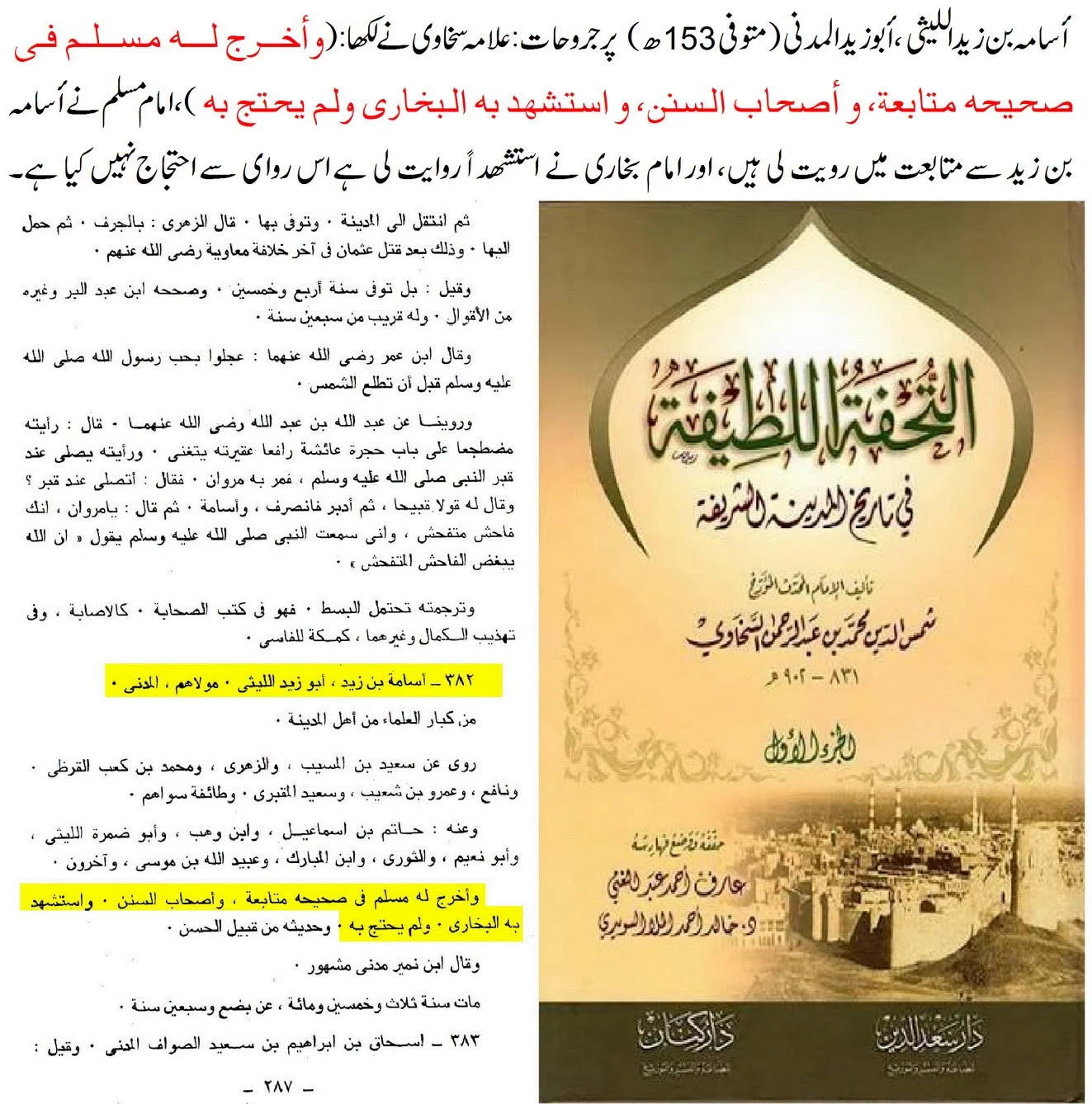
Hafiz al-Sakhawi (may Allah have mercy on him) wrote:
381 – أسامة بن زيد أبو زيد الليثي مولاهم المدني … وأخرج له مسلم في صحيحه متابعة وأصحاب السنن واستشهد به البخاري ولم يحتج به
Translation:
Usama ibn Zayd, Abu Zayd al-Laythi, their freed slave (mawla), from Medina … Muslim narrated from him in his Sahih as a corroboration (mutaba’a), and the authors of the Sunan also (narrated from him); and al-Bukhari used him as supporting evidence (istishhad), but did not take him as proof (ihtijaj).
Clarification:
This explicit statement of Hafiz al-Sakhawi (may Allah have mercy on him) answers the objection that Usama is a “narrator of the two Sahihs”: Imam Muslim (may Allah have mercy on him) took him only in corroborations (mutaba’at), and Imam al-Bukhari (may Allah have mercy on him) only used him as supporting evidence (istishhad); neither presented his solitary narration as proof.
Conclusion of the Discussion
The following points become clear from the explicit statements of the above 22 imams of hadith:
✦ Usama ibn Zayd, Abu Zayd al-Laythi al-Madani (died 153 AH) is weak (da’if) according to the majority of hadith scholars; Imam Ahmad said “laysa bi shay'” and “rejected hadiths from Nafi'”, Abu Hatim said “yuktab hadithuhu wa la yuhtajju bih”, al-Nasa’i said “laysa bi al-qawi” and “laysa bi thiqa”, and Ibn Hazm said “da’if la yuhtajju bi hadithih”.
✦ Imam Yahya ibn Sa’id al-Qattan (may Allah have mercy on him) used to narrate from him at first, then abandoned him; this is established from Imam Ahmad, Yahya ibn Ma’in and Amr ibn Ali al-Fallas, all three.
✦ The imams who used softer words about him (such as Ibn Ma’in’s “thiqa” or “laysa bihi ba’s”, and Ibn Hajar’s “saduq yahim”) also attached the qualification of error, mistake or “laysa bi dhaak”; and in the words of Ibn Muflih (may Allah have mercy on him): “Most have called him weak”.
✦ His narrations in Sahih Muslim are only in corroborations, and Imam al-Bukhari (may Allah have mercy on him) did not take him as proof; therefore being “a narrator of the Sahih” does not make his solitary narration a proof.
✦ The conclusion is that the narration of Usama ibn Zayd al-Laythi can be taken in corroborations and supporting reports, but proof cannot be taken from it; and where he contradicts trustworthy narrators, his narration will be rejected. Therefore the athar of “A’inu ibad Allah”, whose chain depends on him alone, cannot be evidence for seeking help from other than Allah; and according to the explanation of Allama al-Albani (may Allah have mercy on him), even if it were accepted as authentic, those being called upon in it are only angels, not deceased saints or absent beings.
Scans of Important References