
Deobandi Taraweeh Prayer Named Deobandi
In this article, a complete response is presented according to the Deobandi principle to Anwar Khurshid Deobandi’s book “Hadith and Ahl-e-Hadith” chapter “Chapters of Taraweeh”. First, the “argument” of Hadith and Ahl-e-Hadith is quoted, and then commentary on it is provided. والحمد لله
Starting Point: .
الحمد لله رب العالمين والصلوة والسلام على رسوله الامين، اما بعد :
Presented here is the complete response to Anwar Khurshid Deobandi’s book “Hadith aur Ahl-e-Hadith” in the chapter “Abwab al-Taraweeh.” In this response, for the sake of final argument, an exact excerpt from “Hadith aur Ahl-e-Hadith” has been included.
A few noteworthy points are as follows:
➊ The followers of Taqlid claim: “The prescribed Taraweeh consists of twenty rak’ahs,” but they fail to present a single authentic hadith as evidence.
➋ The followers of Taqlid claim: “It is established from the Companions (may Allah be pleased with them) that twenty Taraweeh are prayed,” yet they are unable to cite a single authentic, well-supported narration from any Companion as proof.
➌ They claim consensus on “twenty rak’ahs Taraweeh,” but appear confused even within this claim.
➍ Ultimately, as proof, they rely on a few Tabi‘in (may Allah have mercy on them) and some Imams. It is noted that while these figures are presented as proof in Taraweeh matters, when their interests are challenged, why are they then disregarded?
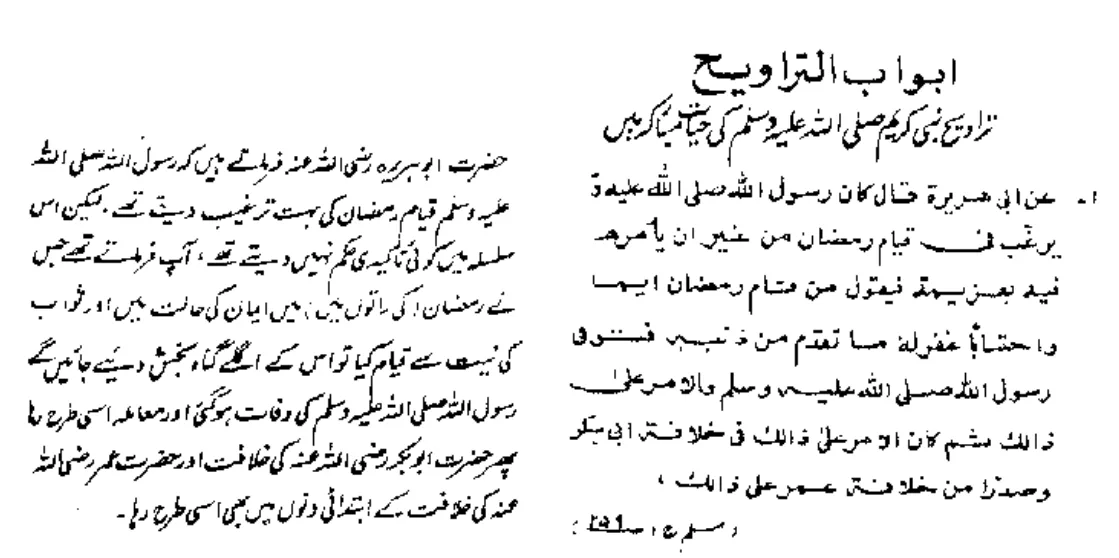
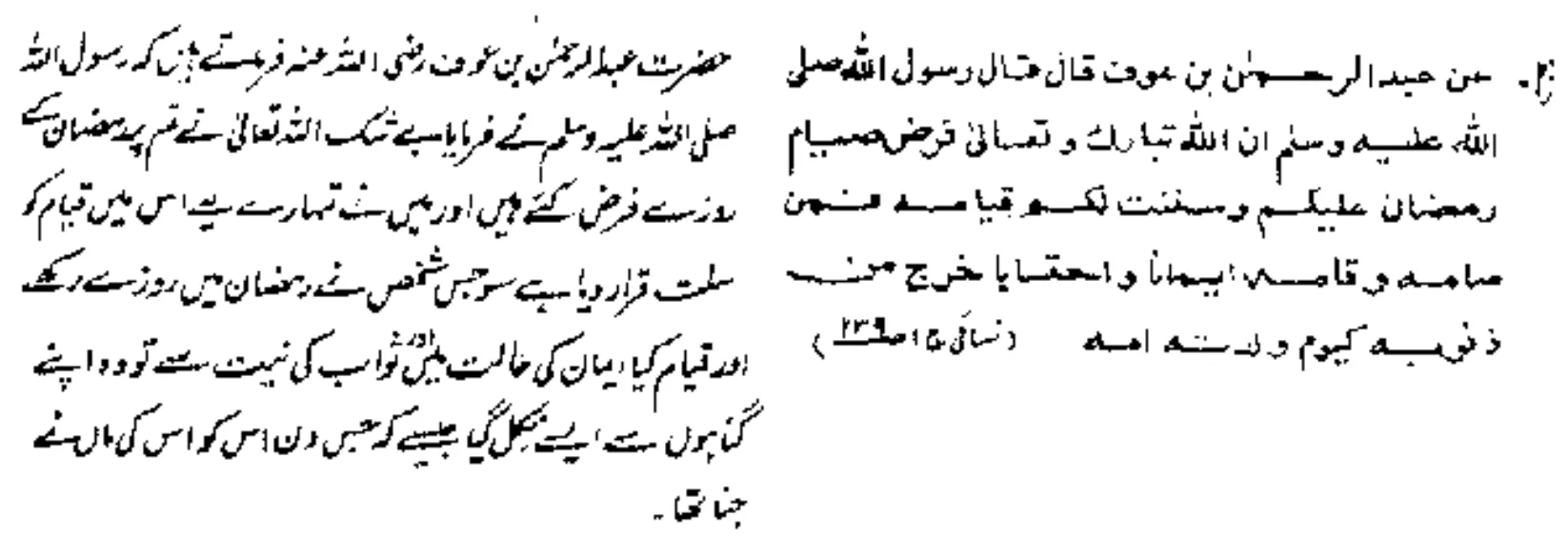
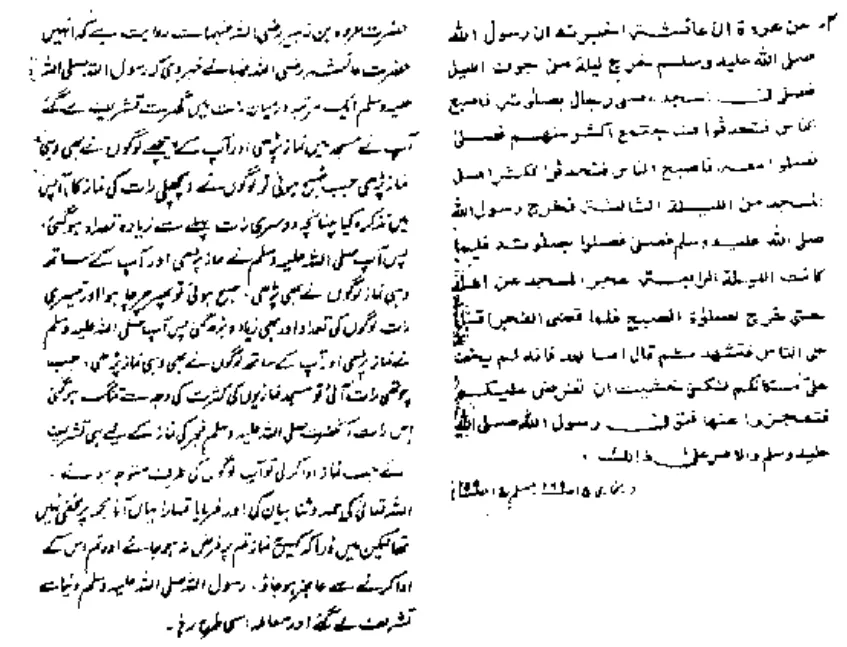
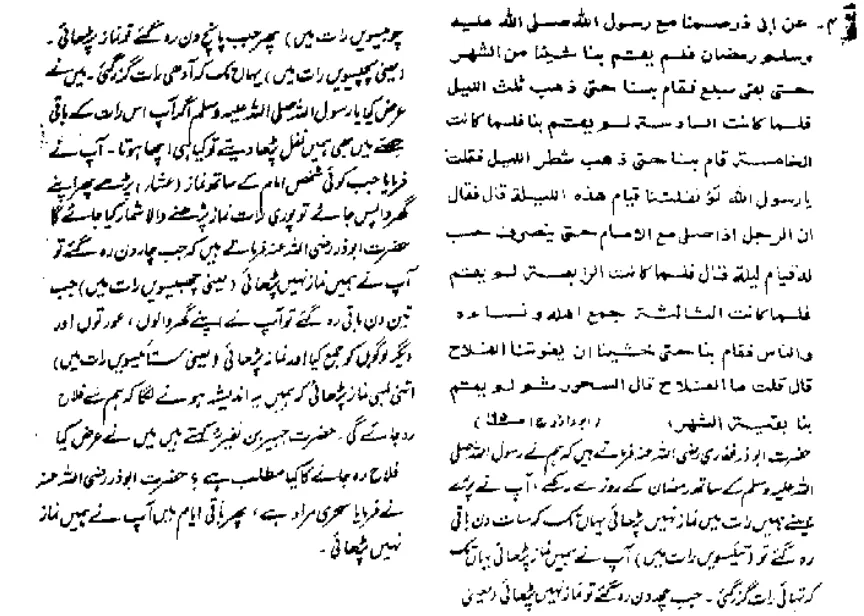
➎ The box contains a scanned excerpt from the book “Hadith aur Ahl-e-Hadith,” and below it is the response given in the light of Deobandi principles.
Answer:.
This hadith is evidence that Qiyam Ramadan and Taraweeh are two names for the same prayer; otherwise, Anwar Khurshid Deobandi Sahib would never have mentioned the hadith about “Qiyam Ramadan” under the chapter “Chapters of Taraweeh.”
Answer:.
This narration is present in our version
, one of its narrators is Nazar bin Shayban. Imam Yahya bin Ma’in, may Allah have mercy on him, said about him: ليس حديثه بشيء His hadith is worthless.
Ibn Hibban, may Allah have mercy on him, mentioned this narrator in “Kitab Ath-Thiqat” and wrote: كان ممن يخطئ This authentication is rejected compared to the consensus.
Hafiz Ibn Hajar, may Allah have mercy on him, said: لين الحديث meaning this hadith is weak.
Imam Nasa’i, may Allah have mercy on him, said about the above hadith: هذا غلط This hadith is false.
This is written in السنن الصغريٰ للنسائي : 2210 as هذا خطا, the meaning is the same.
Answer:.
From this hadith, it is understood that the Taraweeh prayer (Qiyam Ramadan) is neither obligatory nor compulsory.
Answer:.
Two issues are established from this hadith:
First: Taraweeh and Tahajjud are the same prayer; it is not proven that the Prophet Muhammad (peace be upon him) prayed Taraweeh and Tahajjud separately.
Second: Praying Taraweeh behind the Imam is a highly virtuous act; therefore, praying Taraweeh in congregation throughout the month is preferable.
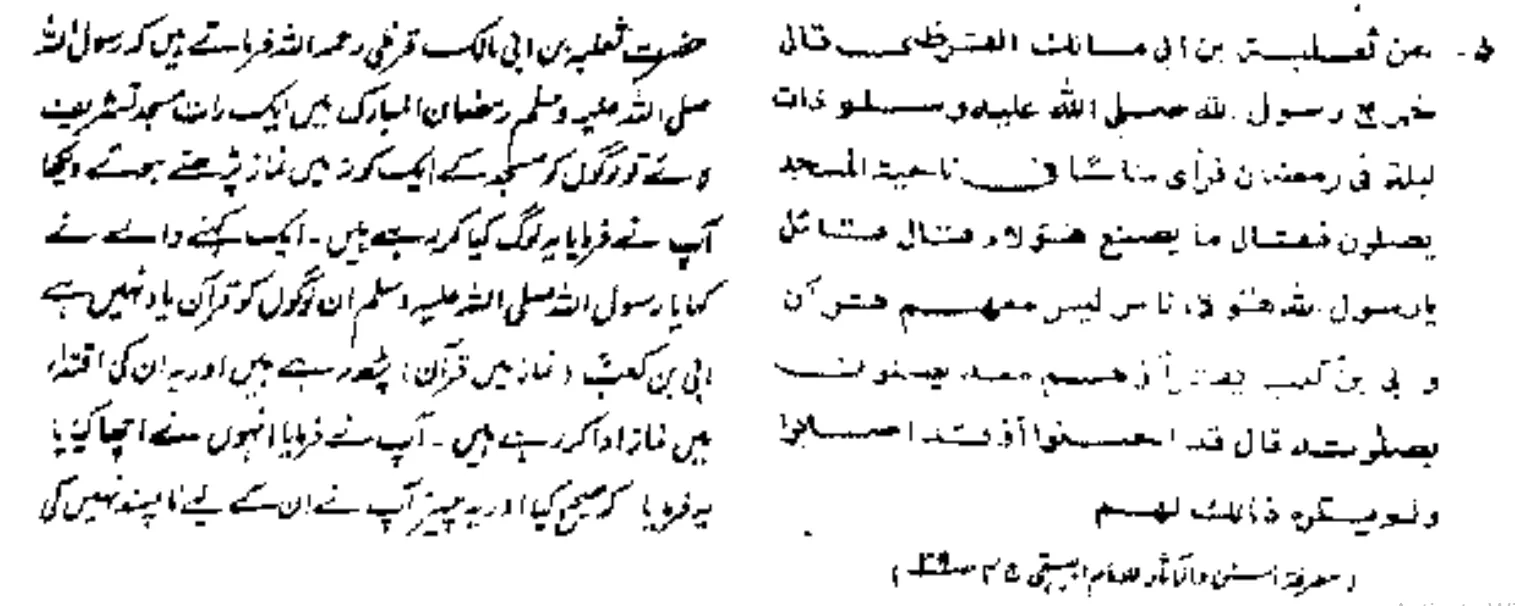
Answer:.
This narration is present in our collection; from this hadith, it is established that congregational Taraweeh is Sunnah. Therefore, the Deobandi scholars who object that the Prophet (peace be upon him) led the congregation for only three nights and thus Ahl al-Hadith should also pray in congregation for only three nights, this objection is incorrect. Verbal, practical, and tacit approvals of every authentic hadith are authoritative.
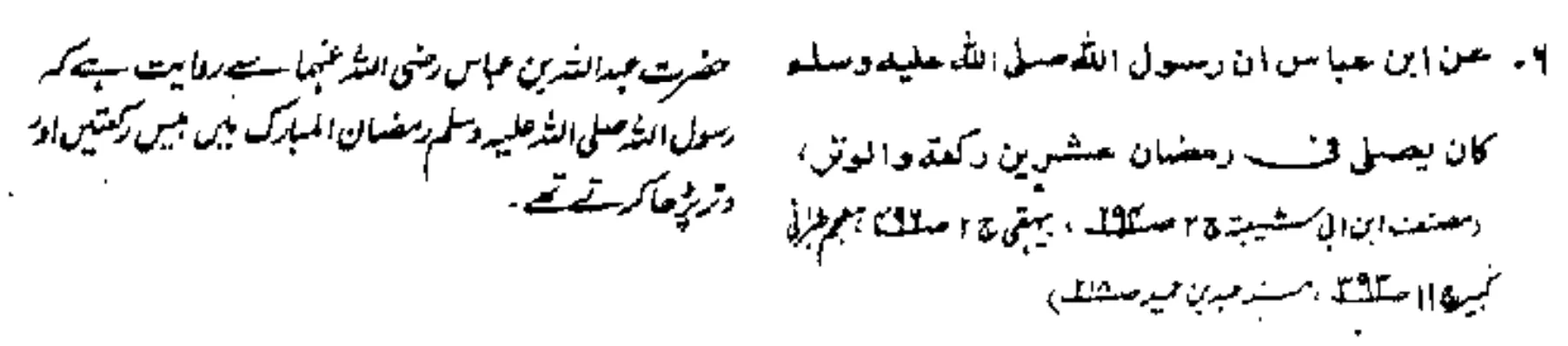
Answer:.
Anwar Shah Kashmiri Deobandi states about this narration:
بسند ضعيف وعليٰ ضعفه اتفاق It is from a weak chain of narration and its weakness is agreed upon.
The beloved Abu al-Qasim Rafiq Dalawari of the Deobandis declares:
“There is no mention of the number of rak’ahs in any authentic narration. And all the narrations regarding twenty or eight rak’ahs are weak.”
Dalawari Sahib, while responding to an Ahl-e-Hadith, wrote:
“There is no mention of either twenty or eight in any authentic hadith, therefore neither you nor I can present the practice of the Master of the Two Worlds, peace be upon him…”
In this statement, Dalawari Sahib openly admits the weakness of the narration about twenty rak’ahs. As for his denial of eight rak’ahs of Taraweeh, here are four (near reliable) statements from the Deobandis in rebuttal:
➊ Khalil Ahmad Saharanpuri Deobandi said:
“And it is unanimously agreed that eight rak’ahs of Taraweeh is Sunnah.”
➋ Abdul Shakoor Lakhnawi said:
“Although eight rak’ahs of Taraweeh from the Prophet, peace be upon him, is Sunnah and there is also a weak narration from Ibn Abbas about twenty rak’ahs but…”
➌ Anwar Shah Kashmiri Deobandi writes: ولا مناص من تسليم أن تراويحه عليه السلام كانت ثمانية ركعات وأما النبى صلی اللہ علیہ وسلم فصح عنه ثمان ركعات “And there is no escape from accepting that the Taraweeh of the Prophet, peace be upon him, was eight rak’ahs and eight rak’ahs from the Prophet, peace be upon him, are proven with an authentic chain.”
➍ Muhammad Ahsan Nanotvi wrote: لأن النبى لم يصلها عشرين بل ثمانيا “Indeed, the Prophet, peace be upon him, did not pray twenty rak’ahs but rather he prayed eight.”
According to Anwar Shah Kashmiri, Rafiq Dalawari, and Abdul Shakoor Lakhnawi, the hadith about twenty rak’ahs is weak. Ghulam Habib Deobandi, a senior scholar of the Panjpiri Deobandis, after quoting the narration about twenty Taraweeh rak’ahs from two books, writes: ولكنهما ضعيفان “Both these narrations are weak.”
The summary of the research is that the narration presented by Anwar Khurshid is weak, i.e., rejected according to his own preferred clerics. والحمد لله
Warning :.
For criticism of the narrator of this hadith, Ibrahim bin Uthman Abu Shaibah, see
Regarding one narration, Muhammad Taqi Usmani Deobandi Sahib states:
But it is weak due to Ibrahim bin Uthman.
For severe criticism of Ibrahim bin Uthman, see

Answer :.
In our copy, this narration is on pages 316, 317. One of its narrators is Muhammad bin Humaid al-Razi, about whom severe criticisms have been reported, and Khan Badshah bin Chandi Gul Deobandi writes: “Because he is a liar and a denier of hadith.”
The second narrator, Umar bin Harun, is also criticized.
There are also issues in the rest of the chain.
Warning :.
Presenting such fabricated narrations is the work of the Deobandis themselves.
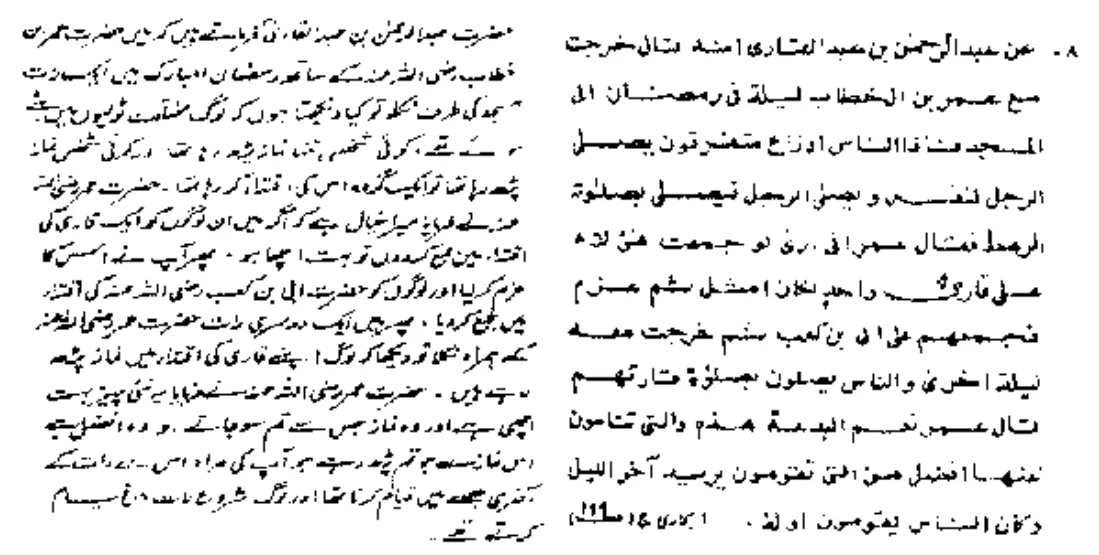
Answer :.
Five issues are established from this hadith:
➊ Congregational Taraweeh is permissible and commendable.
➋ The number of rak’ahs in it is not specified.
➌ Taraweeh and Tahajjud are the same prayer. Anwar Shah Kashmiri Deobandi Sahib proved this by reasoning from the action of Umar (may Allah be pleased with him) that Taraweeh and Tahajjud are the same prayer.
➍ Innovation (Bid’ah) here means linguistic innovation, not technical.
➎ This hadith is in Sahih Bukhari in the Book of Taraweeh Prayer, Chapter on the Virtue of Standing in Ramadan. In the same chapter, Imam Bukhari (may Allah have mercy on him) also brought the hadith mentioning that “whether it is Ramadan or not, the Prophet (peace be upon him) did not pray more than eleven rak’ahs.”
Anwar Khurshid Sahib has concealed this hadith. Common Deobandi scholars interpret this hadith as relating only to Tahajjud and having no connection with Taraweeh at all. They consider it a great mistake by Imam Bukhari (may Allah have mercy on him) to mention an unrelated hadith in the chapter on Taraweeh. This entire interpretation is false. والحمد لله
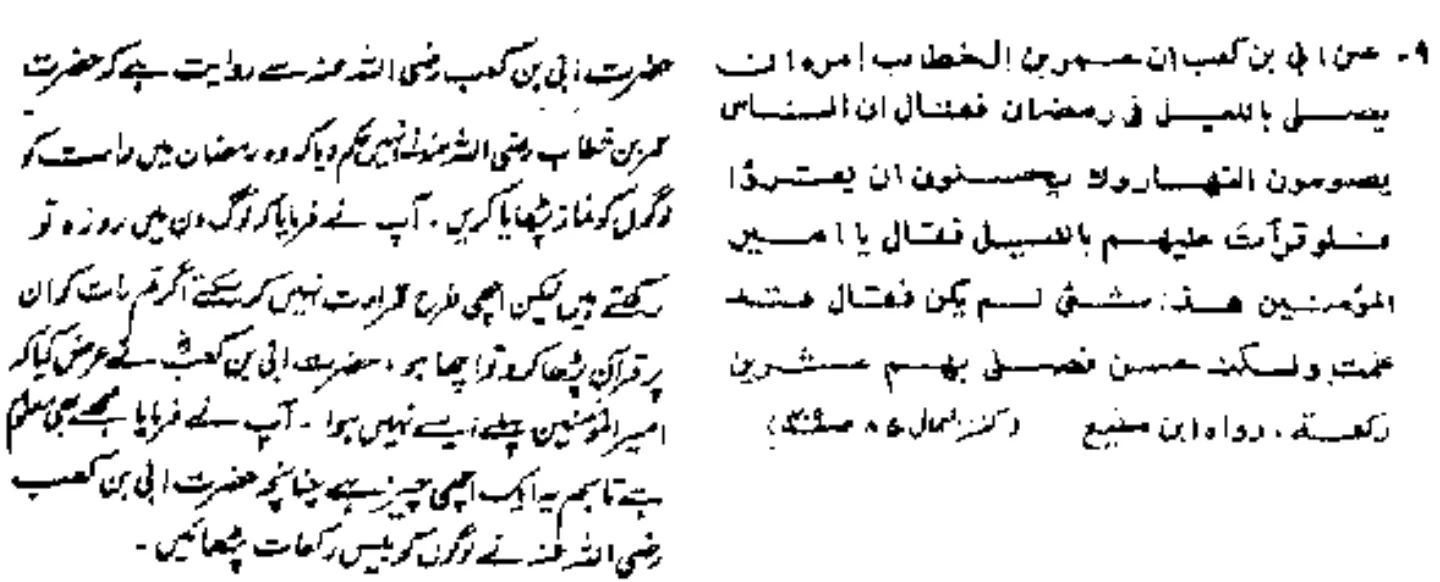
Answer:
This narration is mentioned without any chain of transmission in
and Itḥāf al-Khayrah al-Muhrah by al-Busiri. Sarfaraz Safdar Deobandi writes that “a statement without a chain of transmission cannot be a proof.”
A respectful request to the Deobandis: if they have any chain of transmission for this narration from Ahmad bin Mani’ to Ubayy bin Ka’b (may Allah be pleased with him), then why do they not present it?
By the efforts of my student and brother Nasir Ahmad Kashif, the chain of transmission of this narration was found in Mukhtarah al-Maqdisi
. This chain is weak.
Hafiz Ibn Hibban (may Allah have mercy on him) states that there is a great deal of confusion in the narration of Abu Ja’far al-Razi from Rabi’ bin Anas.

Answer:
This narration is weak due to being disconnected (munqati’). The Hanafi Imam ‘Ayni (may Allah have mercy on him) states: إن فيه انقطاعا فإن الحسن لم يدرك عمر بن الخطاب “There is a break in this narration because Hasan al-Basri (may Allah have mercy on him) did not meet Umar bin Khattab (may Allah be pleased with him).”
Warning:
In many manuscripts of Sunan Abi Dawood, this narration is present with the words عشرين ليلة (twenty nights), and it has been recorded similarly by the following scholars:
◈ Ibn Kathir in Rumsand al-Farooq
◈ Al-Dhahabi in Al-Muhadhdhab fi Ikhtisar al-Sufun al-Kabir
◈ Sahib Mishkat
◈ Zailai and others
In the manuscript of Sunan Abi Dawood by Ayni Hanafi, it is also عشرين ليلة.
Khalil Ahmad Saharanpuri Deobandi Sahib explained the principle that if some manuscripts contain a phrase and others do not, then that phrase is doubtful.
According to this Deobandi principle, it is incorrect for Anwar Khurshid Sahib to present this weak narration.

Answer:.
Regarding this hadith, Naimwi Hanafi wrote: يحيي بن سعيد الانصاري لم يدرك عمر “Yahya bin Saeed, may Allah have mercy on him, did not meet Umar, may Allah be pleased with him.”
Imam Ibn Hazm, may Allah have mercy on him, stated that Yahya bin Saeed, may Allah have mercy on him, was born twenty-five years after the death of Sayyiduna Umar, may Allah be pleased with him.
It is the work of those who constantly try to prove black as white and white as black to circulate such a disconnected narration by calling it Mursal, Mu’tamad, etc.
Hafiz Ibn Kathir, may Allah have mercy on him, says:
يكفي فى المناظرة تضعيف الطريق التى أبداها المناظر وينقطع إذا الأصل عدم ما سواها حتى يثبت بطريق أخرى والله أعلم In debates, it is sufficient to prove the narration presented by the opponent as weak; he will be left without a response because the reality is that all other evidences are nonexistent unless that narration is proven through another chain. والله اعلم

Answer:.
Regarding this narration, Naimvi Sahib writes: عبد العزيز بن رفيع لم يدرك ابي بن كعب “Abdul Aziz bin Rafi did not meet Ubayy bin Ka’b, may Allah be pleased with him.”
Meaning this narration is disconnected. It is written in the book Usool al-Hadith: المنقطع ضعيف بالإتفاق بين العلماء “Scholars agree that a disconnected narration is weak.”

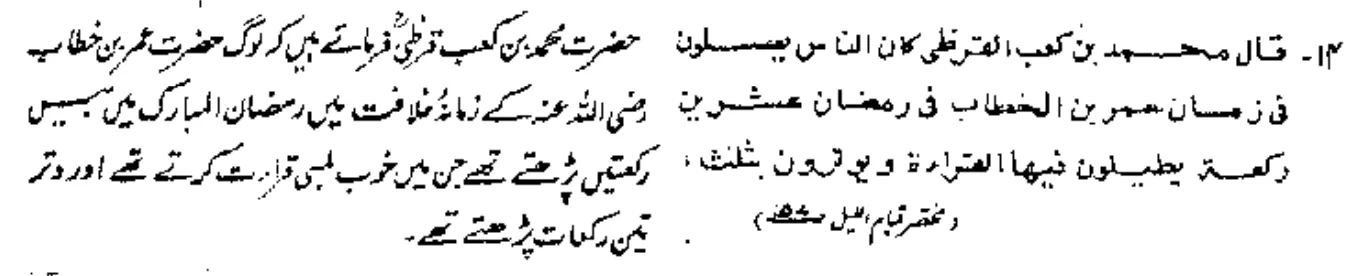
Answer:
Regarding this narration, Ayni Hanafi says: باسناد منقطع “This is from a disconnected chain.”
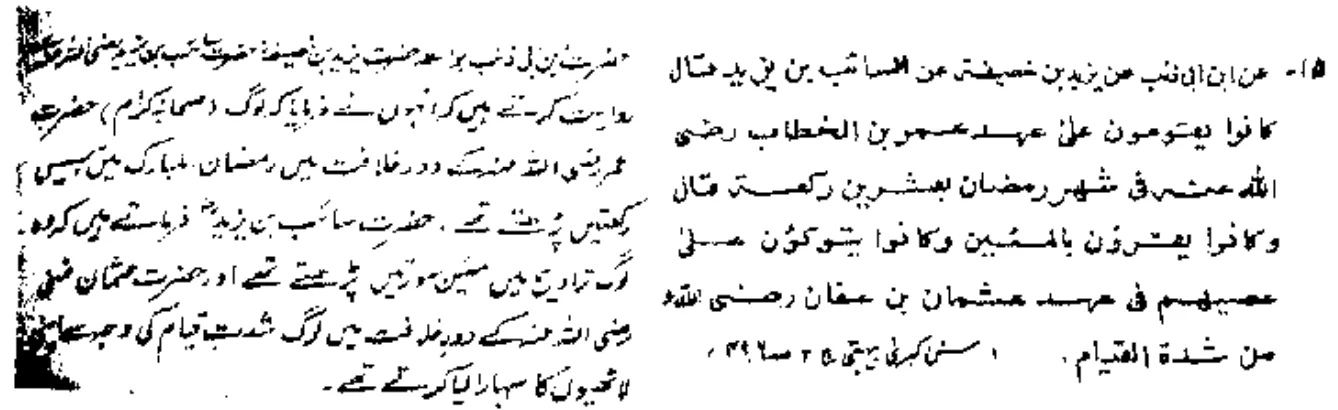
Answer:
This narration is present without a chain in Mukhtasar Qiyam al-Layl (p. 200), therefore it is rejected.
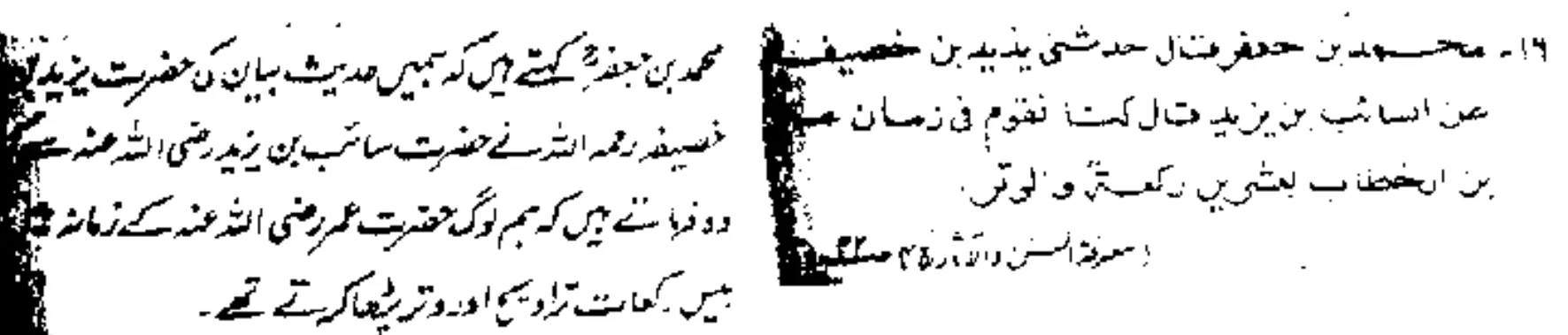
Answer:
This narration is also present in the Musnad of Ali bin al-Ja’d
, however, Ali bin al-Ja’d (trustworthy according to the preferred view) himself has been criticized. Ali bin al-Ja’d used to severely criticize our master Uthman, may Allah be pleased with him. He used to say: “I do not mind if Allah punishes Muawiyah, may Allah be pleased with him.”
There are fourteen hadiths of his in Sahih al-Bukhari which are in the form of follow-ups.
Warning:
The identity of those who established the practice in this narration is unknown. If these unknown people used to pray twenty rak’ahs as Nafl in their homes, then what relation does it have with Sayyiduna Umar رضي الله عنه?
The Deobandis claim: “Twenty rak’ahs of Taraweeh are Sunnah Mu’akkadah.”
That is, according to the Deobandis, “Only twenty rak’ahs of Taraweeh with congregation are Sunnah Mu’akkadah; less or more is not permissible. Therefore, Rashid Ahmad Gangohi Sahib states: If there is doubt about the number of rak’ahs in Taraweeh, whether eighteen or twenty, then pray two rak’ahs individually, not in congregation. Due to the general application of the Hadith, praying more is not forbidden regardless of the number, but congregation of more than twenty is not established.”
According to the above Deobandi position, it is incumbent upon the Deobandis to prove the following conditions in their presented narration:
➊ Name the people who prayed twenty rak’ahs in the era of Farooq (Umar رضي الله عنه).
➋ Prove that these people considered these twenty rak’ahs as Sunnah Mu’akkadah.
➌ Prove that they prayed these rak’ahs in congregation in Masjid al-Nabawi.
➍ Prove that Sayyiduna Umar رضي الله عنه was aware of this.
➎ Prove that these people considered less or more than twenty rak’ahs as forbidden or impermissible.
➏ Prove that Imam Abu Hanifa رحمه الله deduced from this narration that only twenty rak’ahs of Taraweeh in congregation are Sunnah and less or more is not permissible.
If they fail to prove this, then the Deobandis’ inference from these unknown narrations is rejected.
Answer:.
This narration is rare. Against the narration of Khalid bin Mukhlad (Shi’a Saduq), there is the narration of Imam Saeed bin Mansoor, may Allah have mercy on him:
Saib bin Yazid, may Allah be pleased with him, said that during the time of our master Umar, may Allah be pleased with him, we used to pray eleven rak’ahs.
Regarding this narration, Allama Suyuti, may Allah have mercy on him, writes: “This narration has a very authentic chain.”

Answer:.
This narration is disconnected in two ways:
➊ Imam Ahmad, may Allah have mercy on him, passed away centuries before the birth of Ibn Qudamah, may Allah have mercy on him.
➋ Imam Ahmad, may Allah have mercy on him, was born long after the martyrdom of our master Umar, may Allah be pleased with him.
From the hadith in Sahih Bukhari, it is understood that our master Umar, may Allah be pleased with him, did not pray Taraweeh in congregation but preferred to pray it at the time of Suhoor.
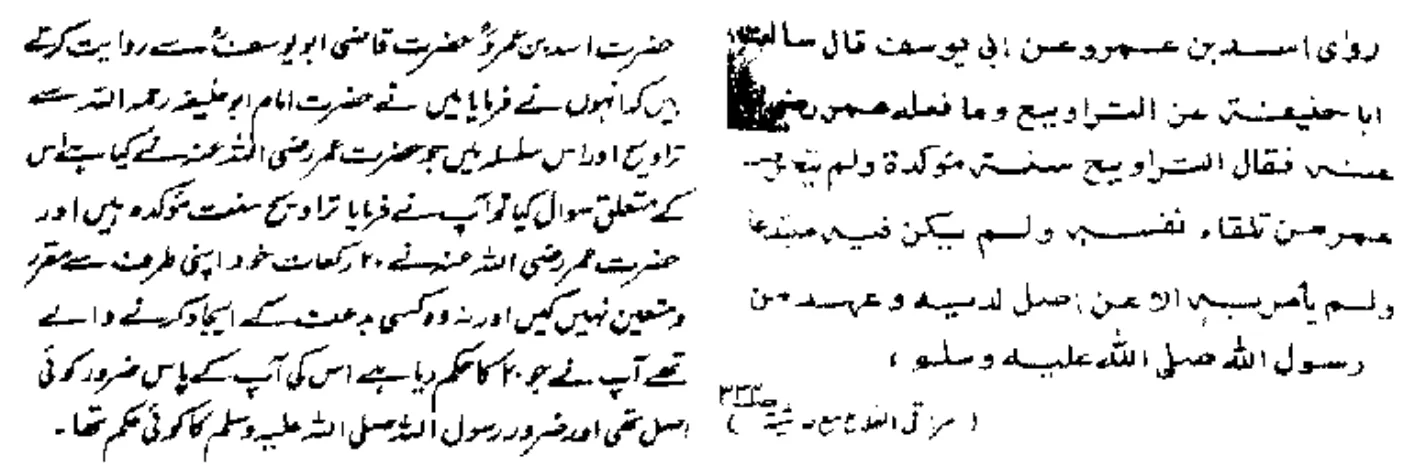
Answer:.
This narration is rejected for three reasons:
➊ The chain from Sahib al-Maraqi al-Falah to Asad bin Amr is unknown.
➋ Asad bin Amr himself is weak; the majority of hadith scholars have criticized him.
Imam Bukhari, may Allah have mercy on him, testified about him: ضعيف “He is weak.”
➌ Qadi Abu Yusuf, may Allah have mercy on him, is also considered weak by the majority of hadith scholars. Imam Abu Hanifa, may Allah have mercy on him, said to Abu Yusuf: إنكم تكتبون فى كتابنا مالا نقوله “You write in our book things that we do not say.”
Meaning Imam Abu Hanifa, may Allah have mercy on him, considered him a liar. It is clear that even if this narration is proven up to Abu Yusuf, it is still rejected because Abu Yusuf used to write things on his own and attribute them to Imam Abu Hanifa, may Allah have mercy on him.
Warning:.
This narration does not mention any specific number for Taraweeh, but Anwar Khurshid Deobandi Sahib, following in the footsteps of Qazi Abu Yusuf, has written the number twenty (20) twice in his translation on his own. It appears that these people are trying to outdo each other in fabrications.
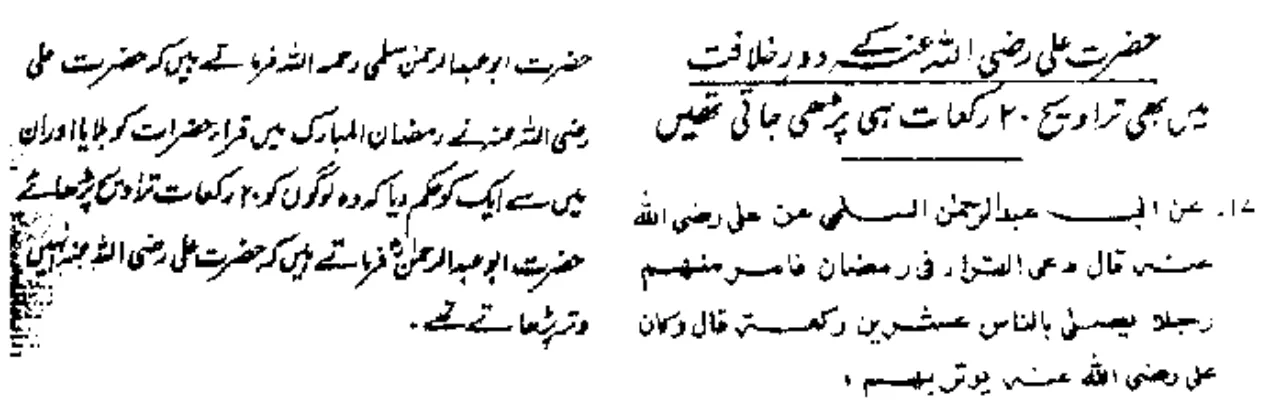
Answer:.
In this narration, there is a narrator named Hammad bin Shu’aib, whom the majority of hadith scholars have declared weak. Imam Bukhari, may Allah have mercy on him, says: فيه نظر “That is, he is abandoned and accused.”
Naimawi Hanafi wrote: قلت : حماد بن شعيب ضعيف “I say that Hammad bin Shu’aib is weak.”

Answer:.
Regarding the narrator Abu al-Hasna, Naimawi Sahib writes: قلت : مدار هذا الاثر على ابي الحسناء وهو لا يعرف “I say that the authenticity of this narration depends on Abu al-Hasna, and he is unknown, that is, Majhool.”
In the present era, some people have unsuccessfully tried to prove Abu al-Hasna as trustworthy through trickery and showmanship, which is rejected according to Naimawi’s research.

Answer:.
This reference is rejected for two reasons:
➊ The chain of narration is missing up to Imam Ahmad, may Allah have mercy on him.
➋ Imam Ahmad, may Allah have mercy on him, was born long after the deaths of Sayyiduna Jabir, may Allah be pleased with him, Sayyiduna Ali, may Allah be pleased with him, and Sayyiduna Abdullah, may Allah be pleased with him.
Warning:
This statement does not pertain to twenty rak’ahs of Taraweeh.
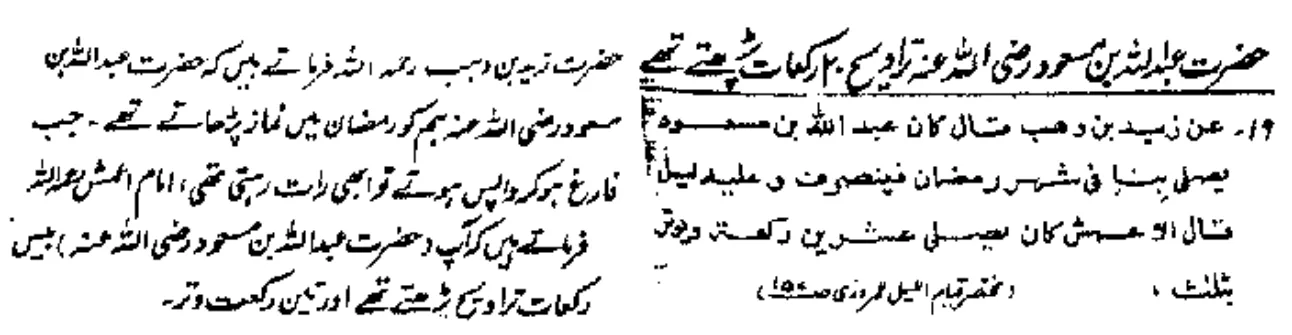
Answer:
This narration is rejected for several reasons:
➊ It is an unsound narration in Mukhtasar Qiyam al-Layl by al-Marwazi
.
➋ In Umdat al-Qari by al-Ayni
, this narration is reported through the chain of Hafs ibn Ghiyath from al-A’mash; Hafs ibn Ghiyath is a muddallis (one who practices tadlis).
➌ Al-A’mash is a muddallis.
➍ Al-A’mash, may Allah have mercy on him, was born in 61 AH, long after the death of Sayyiduna Ibn Mas’ud, may Allah be pleased with him; therefore, this chain is disconnected and rejected.
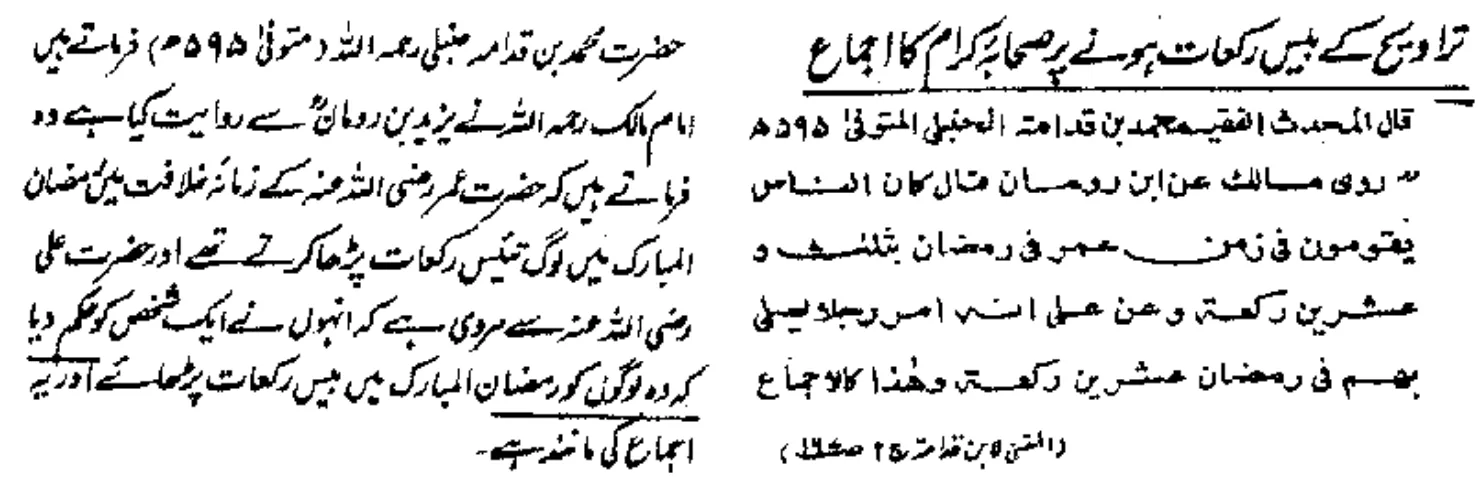
Answer:
The claim of Ibn Qudamah, may Allah have mercy on him, is based on two narrations:
➊ The narration of Yazid bin Roman, may Allah have mercy on him, which Ayni Hanafi has declared broken. (See answer, narration number 13)
➋ The narration attributed to Sayyiduna Ali, may Allah be pleased with him, which is weak in terms of chain of transmission. (See narration number 17)
Due to these two weak narrations, Ibn Qudamah, may Allah have mercy on him, wrote كالإجماع (like consensus), upon which Anwar Khurshid Sahib has drawn a black line and expressed happiness. Ibn Qudamah, may Allah have mercy on him, clearly wrote about wiping over socks that فكان اجماعا “meaning there is consensus of the Companions, may Allah be pleased with them, on the permissibility of wiping over socks.”
Both Deobandi and Barelvi scholars deny and oppose this consensus.
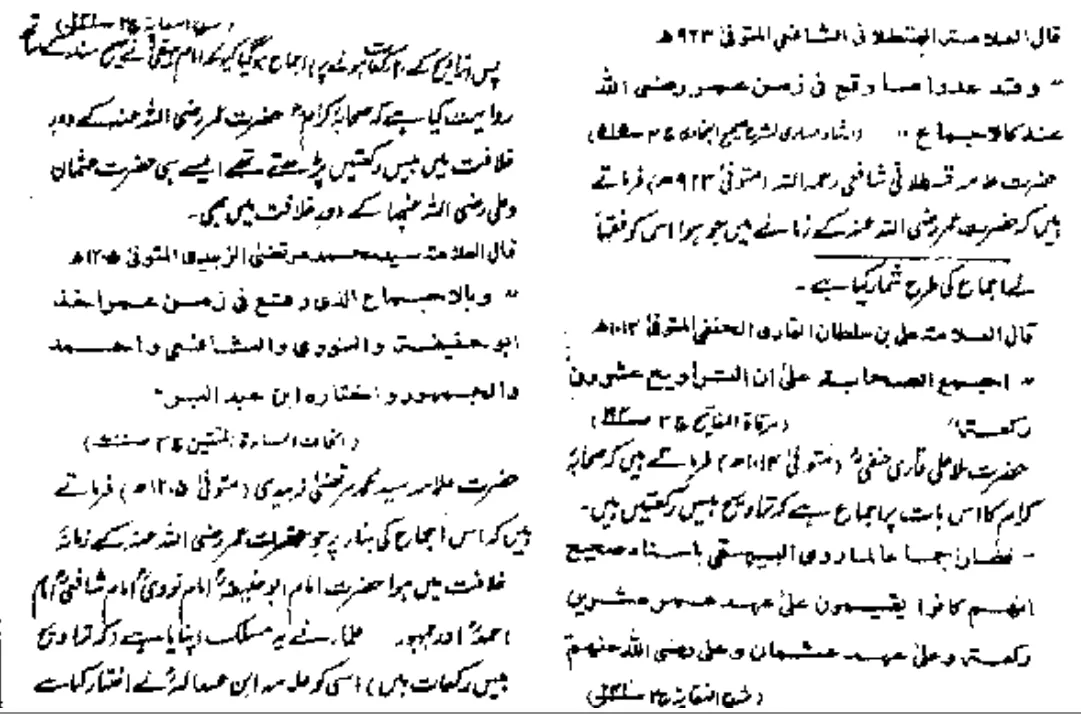
Answer:.
The claim of consensus is refuted on several grounds:
➊ The basis of this claim is weak and rejected narrations, as has been explained in the commentary on the statement of Ibn Qudamah, may Allah have mercy on him.
➋ Eleven rak’ahs with authentic chains are proven from Sayyiduna Umar, may Allah be pleased with him.
وإسناده صحيح
What kind of consensus is this from which Sayyiduna Umar, may Allah be pleased with him, has been excluded?
➌ Many scholars have stated that there is great disagreement regarding the number of Taraweeh prayers. Ayni Hanafi said: وقد اختلف العلماء فى العدد المستحب فى قيام رمضان على اقوال كثيرة “There is disagreement among scholars regarding the recommended number of Taraweeh prayers, and there are many opinions.”
Allama Suyuti, may Allah have mercy on him, testified that: ان العلماء اختلفوا فى عددها “Indeed, scholars differ regarding the number of Taraweeh prayers.”
When there is such severe disagreement among scholars, where did the claim of consensus come from?
Although Ibn Abd al-Barr, may Allah have mercy on him, adopted the number twenty rak’ahs, he did not claim any consensus on it but rather considered it the opinion of the majority of scholars. Secondly, he does not claim that these twenty rak’ahs are a confirmed Sunnah. Thirdly, other scholars have opposed Ibn Abd al-Barr, may Allah have mercy on him.
Abu Bakr ibn al-Arabi al-Maliki, may Allah have mercy on him, said: والصحيح أن يصلى إحدى عشرة ركعة صلاة النبى عليه السلام فأما غير ذلك من الأعداد فلا أصل له “And the correct view is that eleven rak’ahs should be prayed; this is the prayer of the Prophet, peace be upon him. Other numbers have no basis.”
Imam Abu al-Abbas Ahmad ibn Ibrahim al-Qurtubi (d. 256 AH) mentioned the disagreement regarding the number of Taraweeh prayers and wrote:
وقال كثير من أهل العلم : إحدى عشرة ركعة ، أخذا بحديث عائشة المتقدم
“And most scholars have said that eleven rak’ahs should be prayed; they have used the hadith of Hazrat Aisha, may Allah be pleased with her, as evidence in this matter.”
Two points are established from this statement:
➊ The majority of scholars hold the view of eleven rak’ahs; therefore, it is incorrect to consider Imam Ibn Abd al-Barr, may Allah have mercy on him, as representing the majority with twenty rak’ahs.
➋ Imam Qurtubi, may Allah have mercy on him, supported eleven rak’ahs.
The claim of consensus on twenty Tarawih prayers is false:.
Now, I present to you some references, in the light of each of which the claim of consensus is false.
➊ Imam Malik, may Allah have mercy on him (died 179 AH), says:
الذى آخذ به لنفسي فى قيام رمضان هو الذى جمع به عمر بن الخطاب الناس إحدى عشرة ركعة وهى صلاة رسول الله صلى الله عليه وسلم ولا أدريمن أحدث هذا الركوع الكثير، ذكره ابن مغيث
“I adopt eleven rak’ahs for my Ramadan standing (Tarawih), Umar ibn al-Khattab, may Allah be pleased with him, gathered the people on this, and this is the prayer of the Messenger of Allah, peace be upon him. I do not know from where people have taken so many rak’ahs?” This was mentioned by Ibn Mughith al-Maliki.
Warning: 1
The narration of Ibn al-Qasim from Imam Malik, may Allah have mercy on him, is rejected. See:
Warning: 2
The book “Al-Mutahajjideen” by Yunus bin Abdullah bin Muhammad bin Mughith Al-Malik is also mentioned
.
Ayni Hanafi states:
وقيل إحدى عشرة ركعة وهو اختيار مالك لنفسه و اختاره أبوبكر العربي
“And it is said that Taraweeh consists of eleven rak’ahs, which Imam Malik, may Allah have mercy on him, and Abu Bakr Al-Arabi adopted for themselves.”
➋ It is not authentically proven with a sound chain from Imam Abu Hanifa, may Allah have mercy on him, that Taraweeh consists of twenty rak’ahs. On the contrary, from the Muwatta of Muhammad bin Al-Hasan Al-Shaybani, who is praised among the Hanafis, it appears that Imam Abu Hanifa, may Allah have mercy on him, believed in eleven rak’ahs.
➌ Imam Shafi’i, may Allah have mercy on him, after preferring twenty rak’ahs of Taraweeh, said:
وليس فى شيء من هذا ضيق ولا حد ينتهي إليه لأنه نافلة فإن أطالوا القيام وأقلوا السجود فحسن وهو أحب إلى و إن أكثر والركوع و السجود فحسن
“There is neither the slightest hardship nor any limit in this matter (Taraweeh), because it is a voluntary prayer. If the rak’ahs are fewer and the standing longer, it is better and I prefer it more; and if the rak’ahs are more, that is also better.”
It is understood that Imam Shafi’i, may Allah have mercy on him, withdrew from preferring twenty and liked both eight and twenty, considering eight better. والله اعلم
➍ Ishaq bin Mansur asked Imam Ahmad, may Allah have mercy on him, how many rak’ahs should be prayed in Ramadan? He replied:
قد قيل فيه ألوان نحوا من أربعين، إنما هو تطوع
“Up to forty rak’ahs have been narrated for it; it is only a voluntary prayer.”
The narrator says: ولم يقض فيه بشيء “Imam Ahmad did not make any decision on it.” (Regarding how many rak’ahs should be prayed?)
It is understood that from any one of the four Imams it is not established that twenty rak’ahs of Taraweeh are a confirmed Sunnah and that fewer or more than that is not permissible.
➎ Imam Qurtubi (died 656 AH) said:
ثم اختلف فى المختار من عدد القيام فعند مالك : أن المختار من ذلك ست و ثلاثون… وقال كثير من أهل العلم : إحدى عشرة ركعة أخذا بحديث عائشة المتقدم
There is a difference of opinion among scholars regarding the number of Taraweeh rak’ahs. Imam Malik adopted thirty-six rak’ahs (in one narration). Many scholars say it is eleven rak’ahs, and they have deduced this from the earlier hadith of Sayyida Aisha, may Allah be pleased with her.
Warning:
Hadith of Aisha (may Allah be pleased with her): In Al-Mufhim by Al-Qurtubi
ماكان يزيد فى رمضان ولا فى غير على إحدى عشرة ركعة it is mentioned, from Imam Al-Qurtubi’s (may Allah have mercy on him) statement it is understood that the majority of scholars are of the view that eleven rak’ahs are to be performed.
➏ Qadi Abu Bakr Al-Arabi Al-Maliki (died 543 AH) said:
والصحيح أن يصلي احد عشر ركعة صلوة النبى صلى الله عليه وسلم وقيامه فأما غير ذلك من الأعداد، فلا أصل له ولا حدفيه
And the correct view is that eleven rak’ahs should be prayed; this is the prayer of the Prophet (peace be upon him) and this is the standing (Qiyam) of Taraweeh. Apart from this, the other rak’ahs narrated have no basis in the Sunnah. (And since it is a voluntary prayer) there is no fixed limit for it.
➐ Ayni Hanafi (died 855 AH) said:
وقد اختلف العلماء فى العدد المستحب فى قيام رمضان على أقوال كثيرة، وقيل إحدى عشرة ركعة
“There is a difference of opinion among scholars regarding the recommended number of Taraweeh rak’ahs; they have many views. And it is said that Taraweeh consists of eleven rak’ahs.”
➑ Allama Suyuti (may Allah have mercy on him) (died 911 AH) said:
أن العلماء اختلفوا فى عددها
“Indeed, there is a difference of opinion among scholars regarding the number of Taraweeh rak’ahs.”
➒ Ibn Hummam (died 681 AH) said:
فتحصل من هذا كله أن قيام رمضان سنة إحدى عشرة ركعة بالوتر فى جماعة فعله صلى الله عليه وسلم
“From this entire discussion, the conclusion is that with Witr, Taraweeh consists of eleven rak’ahs, which the Prophet (peace be upon him) prayed in congregation.”
➓ Imam Tirmidhi (may Allah have mercy on him) states:
واختلف أهل العلم فى قيام رمضان
“And scholars differ regarding the number of rak’ahs for Ramadan Qiyam.”
From these references, it is understood that the claim of the Deobandis and Barelvis that “twenty rak’ahs are the only Sunnah Mu’akkadah, and no more or less is permissible” is incorrect and false.
All these references are from “before the British era,” therefore it is established that the claim of consensus on twenty rak’ahs is false. When there is such a great difference, where is the consensus?

Answer:
There is no explicit statement in the narration of Suwaid bin Ghaflah, may Allah have mercy on him (a Tabi’i), that he considered those twenty rak’ahs as Sunnah Mu’akkadah and that he was not in favor of or did not perform more or less than that. Therefore, this narration is not evidence for the Deobandi claim.
Stern Warning:
Suwaid bin Ghaflah, may Allah have mercy on him, used to perform the Zuhr prayer at its earliest time and was even ready to fight and die for it.
Whereas Deobandi and Barelvi people generally pray Zuhr very late; in summers, the question of praying Zuhr before 2:30 pm does not even arise among them, and they even delay the Friday prayer until Asr.

Answer:
There are two discussions regarding this narration:
1. The identification of Rabi’ and Khalaf is unknown, therefore this chain is weak.
2. This narration does not explicitly state that Abu al-Bakhtari Sa’id bin Firoz al-Tai considered these twenty rak’ahs as Sunnah Mu’akkadah and was in favor of performing them; therefore, there is no consistency between the evidence and the claim.

Answer:
There is no consistency between the claim and the evidence.

Answer:
This narration is weak for two reasons:
➊ Sufyan Thawri is a mudallis (one who conceals defects in the chain) and the narration is mu‘annán (interrupted).
➋ Abu Ishaq al-Subai‘i is a mudallis and the narration is mu‘annán.
Warning:
This weak narration also does not align with the Deobandis’ claim of Sunnah Mu’akkadah (emphasized Sunnah).
In “Musannaf Ibn Abi Shaybah”
, there is a narration that Sa‘id ibn Jubayr, may Allah have mercy on him, used to pray twenty-four (24) and twenty-eight (28) rak‘ahs.
In this narration, Waqa’ ibn Ayas is a different narrator, who according to the principles of Zafar Ahmad Thanvi Deobandi Sahib, is Hasan al-Hadith (good in hadith). Dawud ibn Qais, may Allah have mercy on him, states that he found people praying thirty-six (36) rak‘ahs in Medina.
Imam Ishaq ibn Rahwayh, may Allah have mercy on him, says: نختار أربعين ركعة “We adopt forty rak‘ahs.”
Did these scholars consider these rak‘ahs as Sunnah Mu’akkadah and pray them? If these are not Sunnah Mu’akkadah, then how did twenty rak‘ahs become Sunnah Mu’akkadah?
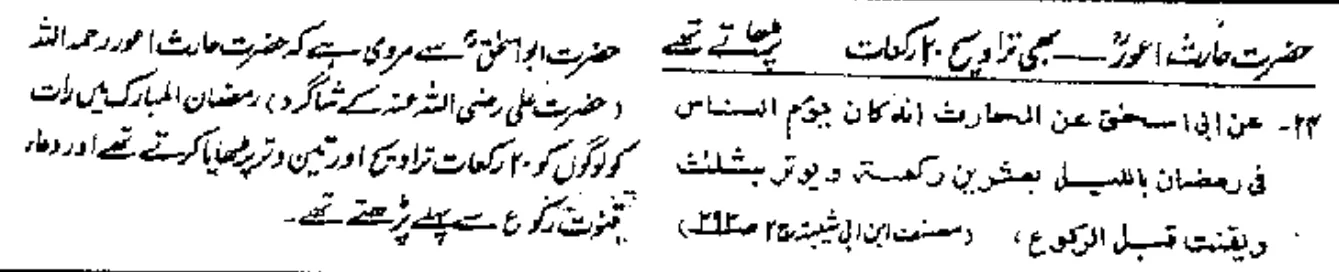
Answer:
This narration is rejected for several reasons:
➊ Abu Ishaq al-Sabii is a fabricator and the narration is mursal.
➋ Hajjaj ibn Artaah, may Allah have mercy on him, is weak and a fabricator, and the narration is mursal.
➌ Abu Muawiyah al-Dareer is a fabricator and the narration is mursal.
➍ Harith al-A’war, may Allah have mercy on him, is a liar and has been criticized. Imam Shu’bi, may Allah have mercy on him (a Tabi’i), said: حدثني الحارث (و أنا أشهد) أنه أحد الكذابين “Harith narrated a hadith to me and I testify that he is among the liars.”
Abu Khaithamah, may Allah have mercy on him, said: Harith al-A’war is a liar.
➎ It is not explicitly proven that Harith al-A’war considered the twenty rak’ahs as a confirmed Sunnah; the main disagreement is that Deobandi and Barelvi groups claim that only and only twenty rak’ahs of Taraweeh are the confirmed Sunnah and that congregations with more or fewer rak’ahs are not permissible. There is no evidence for their claim. والحمد لله

Answer:.
The reference in Mukhtasar Qiyam al-Layl by al-Marwazi (p. 202) is without a chain of narration and is therefore rejected. If the Deobandis have found any chain for it from somewhere, they should present it. Secondly, what is the opinion about the 24+3 = 27 rak’ahs? Are these also emphasized Sunnah?

Answer:.
This narration is rejected for several reasons:
➊ The authentication of Yusuf bin Abi Yusuf Al-Qadi is unknown.
➋ Imam Abu Hanifa, may Allah have mercy on him, severely criticized Qadi Abu Yusuf and declared him a liar.
➌ Hammad bin Abi Sulayman, may Allah have mercy on him, is mixed (in his narrations). Hafiz Haithami, may Allah have mercy on him, writes:
ولا يقبل من حديث حماد إلا مارواه عنه القدماء : شعبة وسفيان و الدستوائي من عدا هؤلاء رووا عنه بعد الإختلاط
Only those narrations of Hammad are accepted which were narrated by his early students: Shu’bah, may Allah have mercy on him, Sufyan Thawri, may Allah have mercy on him, and Hisham al-Dastawai, may Allah have mercy on him. Everyone else heard from him after his mixing (in narrations).
Meaning, Imam Abu Hanifa’s narration from Hammad is after his mixing.
➍ Hammad bin Abi Sulayman, may Allah have mercy on him, is a mudallis (one who conceals defects in narration).
and the narration is mu’anna (with a break).
➎ The book Al-Athar itself is not established from Yusuf bin Abi Yusuf.
➏ It does not explicitly state that the twenty are Sunnah Mu’akkadah (confirmed Sunnah), therefore the argument and claim do not correspond.

Answer:.
A few points are noteworthy regarding this effect:
➊ There is no conformity between the claim and the evidence because this effect does not explicitly state that it is a confirmed Sunnah.
➋ الناس does not clarify who these people are meant to be. Sayyiduna Abu Hurairah رضي الله عنه says that three things تركهن الناس “people have abandoned.” Among these three things is that the Prophet Muhammad صلی اللہ علیہ وسلم used to say Takbeer when going into prostration and say Takbeer when rising from prostration. (
Should الناس here be understood to mean the Companions and the Successors, and should prostration be done without Takbeer and considered a confirmed Sunnah?
➌ Ata ibn Abi Rabah رحمه الله used to raise his hands before and after Ruku in prayer.
Ata رحمه الله was an advocate of saying Ameen aloud.
Ata رحمه الله was also an advocate of wiping over socks.
There are many such issues; Deobandi and Barelvi scholars oppose Imam Ata رحمه الله on these issues, but they remember Imam Ata رحمه الله only in the matter of Taraweeh.
Master Amin Okaraavi, a Deobandi, writes on the issue of saying Ameen aloud: I said: It is not even proven that Ata met two hundred Companions.
And elsewhere, on an effect supporting his point, Okaraavi Sahib writes: Hazrat Ata ibn Abi Rabah رحمه الله is the Mufti of this place, and he had the honor of meeting two hundred noble Companions رضي الله عنهم.
The work of the Deobandis runs on such contradictory statements.

Answer:.
This effect also does not correspond to the Deobandi claim “Twenty Rak’ahs of Taraweeh is a confirmed Sunnah,” because it is not written here that Ibn Abi Mulaikah, may Allah have mercy on him, used to consider twenty Rak’ahs as a confirmed Sunnah and pray accordingly.
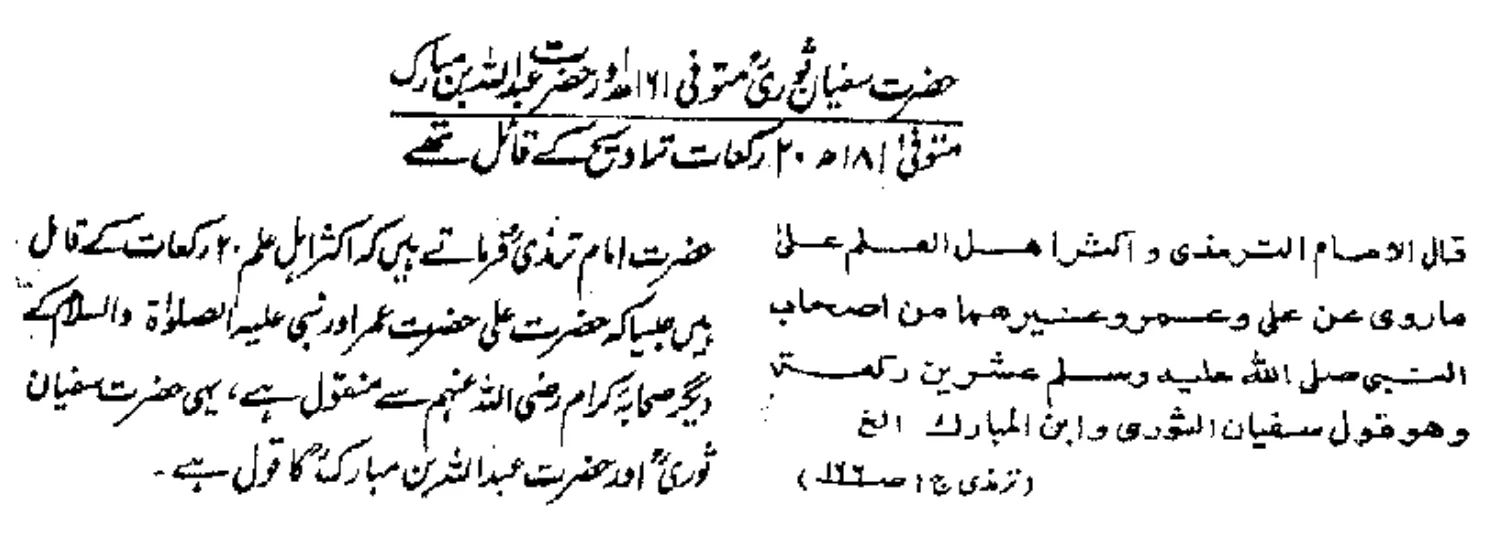
Answer:.
These statements are also not according to the claim. It is incumbent upon the Deobandis to prove that Sufyan Thawri, may Allah have mercy on him, and Ibn al-Mubarak, may Allah have mercy on him, considered twenty rak’ahs as Sunnah Mu’akkadah and did not accept any variation, and if they cannot prove this, then they should not present irrelevant arguments against their claim.
Secondly, Anwar Khurshid Sahib has cut and edited the statement of Imam Tirmidhi, may Allah have mercy on him, to write what suits his purpose and has hidden the rest. The following points are also written in Imam Tirmidhi’s statement:
➊ Scholars differ regarding the number of rak’ahs for Qiyam al-Ramadan.
➋ The people of Madinah believe in forty-one (41) rak’ahs; this is the belief of Imam Ishaq ibn Rahwayh, may Allah have mercy on him.
➌ Imam Ahmad, may Allah have mercy on him, said: روى فى هذا ألوان ، ولم يقض فيه بشيء Many variations (different narrations) have been reported on this issue; Imam Ahmad, may Allah have mercy on him, did not make a decision on whether twenty or forty-one rak’ahs should be prayed.
Imam Tirmidhi, may Allah have mercy on him, says:
وبه يقول سفيان الثوري وابن المبارك والشافعي وأحمد وإسحاق قالوا : يمسح على الجوربين وإن لم يكن نعلين ، إذا كانا ثخنين
Sufyan Thawri, may Allah have mercy on him, Ibn al-Mubarak, may Allah have mercy on him, Shafi’i, may Allah have mercy on him, Ahmad ibn Hanbal, may Allah have mercy on him, and Ishaq, may Allah have mercy on him, hold that if the socks are thick, wiping over them is permissible even if they are not made of leather.
Deobandi and Barelvi scholars, in complete opposition to these statements, claim that wiping over socks is not permissible.
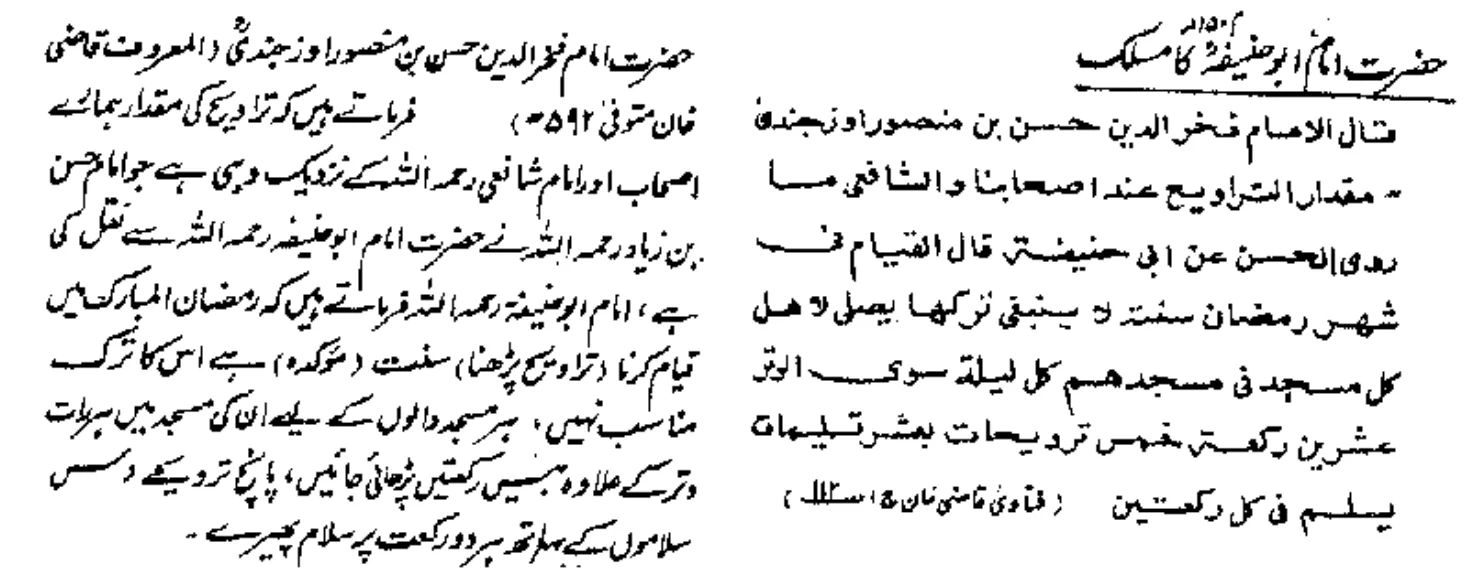
Answer:.
This reference is unsourced; Imam Abu Hanifa, may Allah have mercy on him, passed away centuries before Qazi Khan was born.
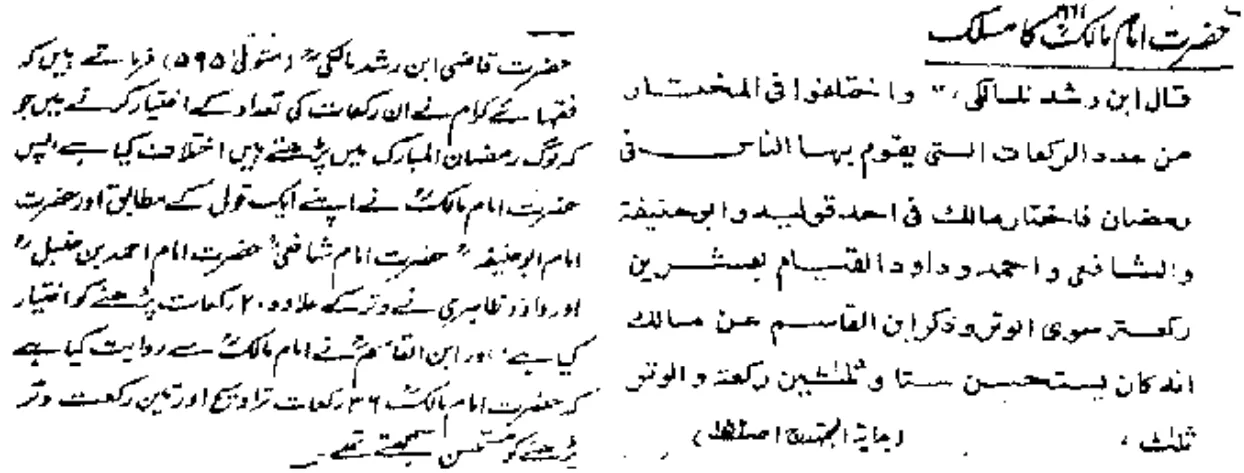
Answer:.
This reference is unsourced and therefore rejected. Imam Malik, may Allah have mercy on him, passed away long before the birth of Ibn Rushd. On the contrary, it is narrated from Imam Malik, may Allah have mercy on him, that he was in favor of eleven rak’ahs of Taraweeh.
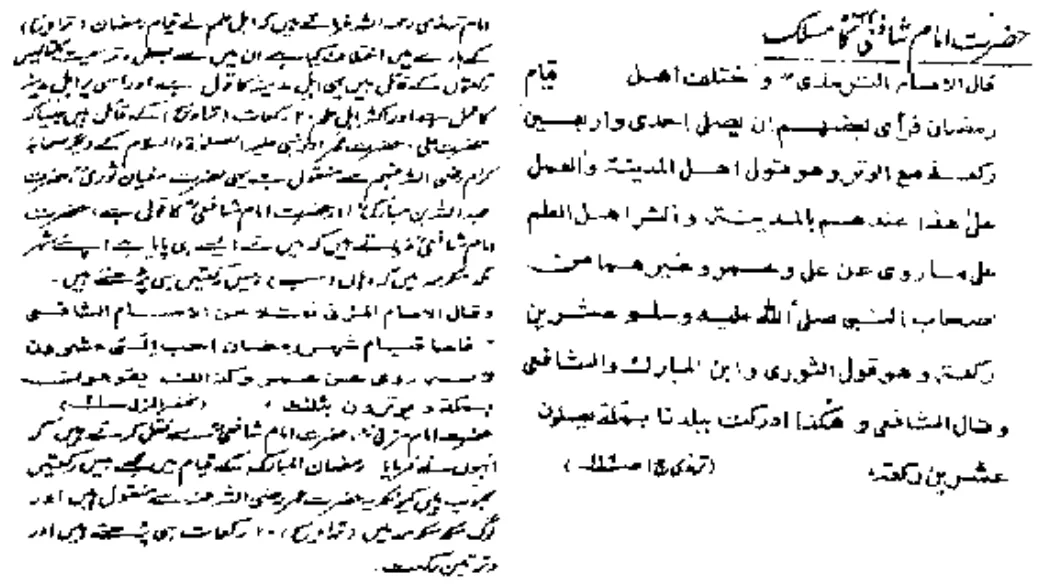
Answer:.
Imam Shafi’i, may Allah have mercy on him, preferred twenty rak’ahs of Taraweeh for two reasons:
➊ It is narrated from Ali, may Allah be pleased with him, and Umar, may Allah be pleased with him.
➋ The people of Makkah used to pray twenty rak’ahs during the time of Imam Shafi’i, may Allah have mercy on him.
Regarding the first point, it should be noted that it is never authentically established with a sound chain of narration that twenty rak’ahs of Taraweeh were practiced or stated by Ali, may Allah be pleased with him, or Umar, may Allah be pleased with him.
Secondly, the practice of the people of Makkah is not proof of an emphasized Sunnah, nor is it established that Imam Shafi’i, may Allah have mercy on him, considered these twenty rak’ahs as an emphasized Sunnah. Therefore, the statement of Imam Shafi’i, may Allah have mercy on him, is not beneficial for the Hanafis and Deobandis.
Imam Shafi’i, may Allah have mercy on him, says that this is a voluntary prayer and there is no limit or restriction in it; if the standing is long and the rak’ahs are few, in my view, it is more preferable.
Mahmood Hasan Deobandi writes: But it is far from reason to establish proof upon us except from the statement of an Imam.
Muhammad Qasim Nanotvi Deobandi said to Muhammad Hussain Batalvi: I am a follower of Imam Abu Hanifa, so any opposing statement you present against me must be from an Imam; it will not be proof upon me if a Syrian wrote this or the author of Dur Mukhtar said that, as I am not their follower.
According to this Deobandi principle, it is obligatory upon Deobandis to present the Quran, Hadith, consensus, and ijtihad only through Imam Abu Hanifa, may Allah have mercy on him, and there is no need to cite references from here and there.
There are many issues of Imam Shafi’i, may Allah have mercy on him, which Deobandi and Barelvi scholars do not accept, for example:
➊ Imam Shafi’i, may Allah have mercy on him, used to raise his hands before and after Ruku’.
➋ He was a proponent of saying Ameen aloud.
➌ According to his final opinion, he believed in reciting Al-Fatiha behind the Imam both in audible and silent prayers.
➍ He was in favor of placing the hands on the chest.
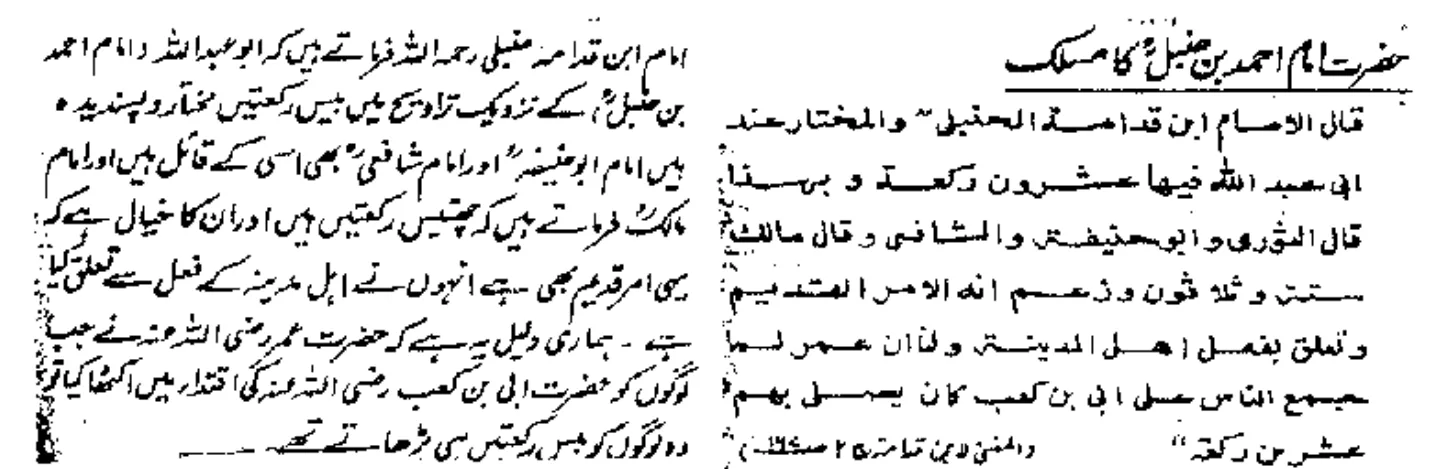
Answer:
This reference is rejected due to being unsourced. On the contrary, Imam Ahmad, may Allah have mercy on him, ruled that no definite decision should be made regarding Taraweeh, as various narrations exist on the matter.
Imam Ahmad, may Allah have mercy on him, said: إنما هو تطوع “This is only a voluntary prayer.”
It is understood that Imam Ahmad, may Allah have mercy on him, did not consider twenty Rak’ahs of Taraweeh as a confirmed Sunnah.
Imam Ahmad, may Allah have mercy on him, also believed in raising the hands (Raf’ al-Yadain) and saying Ameen aloud, etc., matters which Deobandi and Barelvi scholars do not accept.
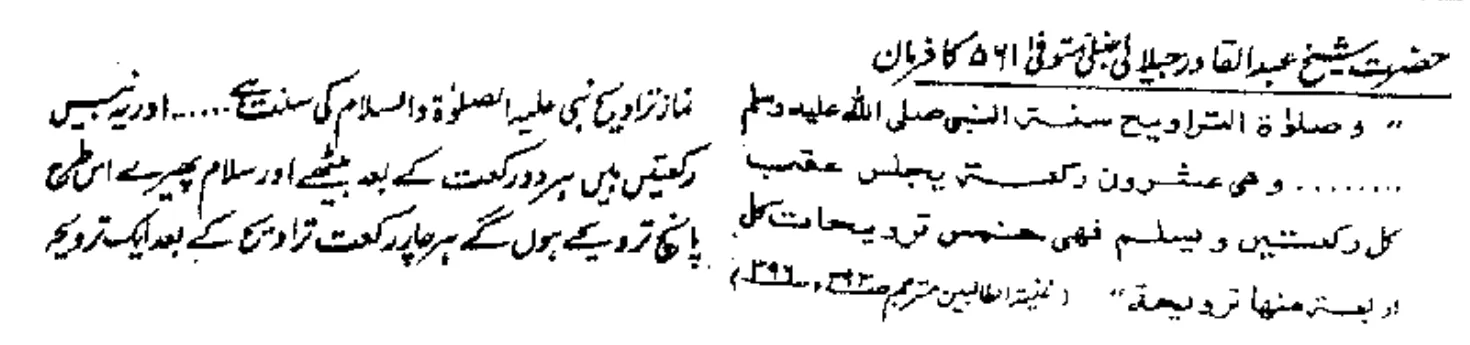
Answer:
This statement calls general Taraweeh a Sunnah, not the twenty Rak’ahs. Secondly, presenting this statement against the opinions of Imam Malik, may Allah have mercy on him, Imam Ahmad, may Allah have mercy on him, Imam Abu Bakr ibn al-Arabi, may Allah have mercy on him, and Imam Qurtubi, may Allah have mercy on him, is the work of the Deobandis. Sheikh Abdul Qadir Jilani, may Allah have mercy on him, believed in raising the hands and saying Ameen aloud, etc., which neither Deobandi nor Barelvi scholars accept.
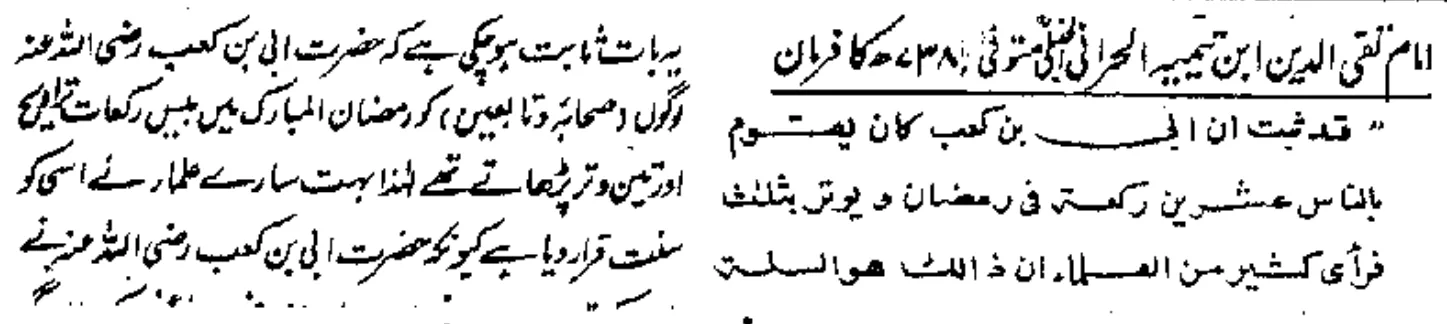
Answer:.
The answer to this statement is the same as the statement of Sheikh Abdul Qadir Jilani.
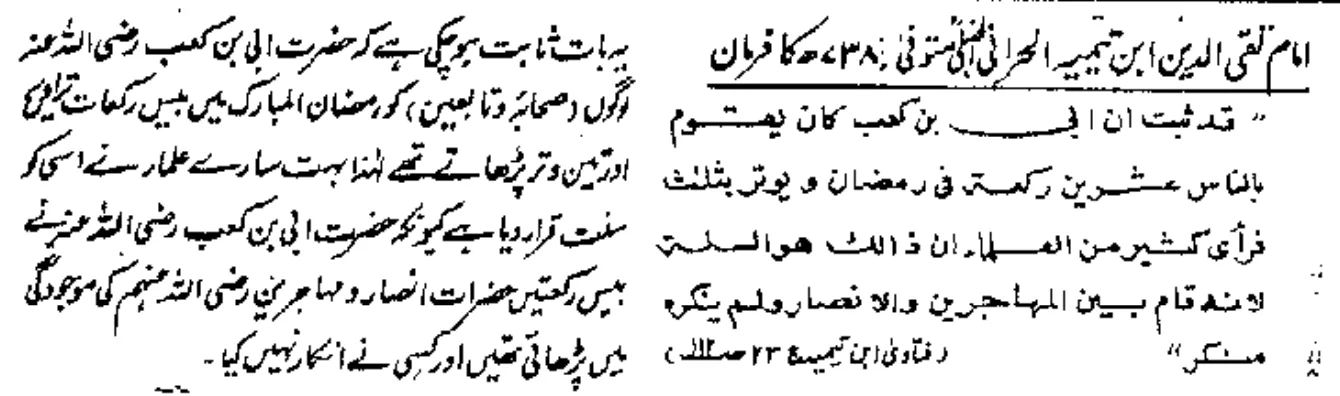
Answer:.
Imam Ibn Taymiyyah, may Allah have mercy on him, mentions the numbers twenty (20), thirty-nine (39), and eleven (11) regarding Taraweeh and says: والصواب أن ذلك جميعه حسن “The correct view is that all these opinions are good.” (فتاويٰ ابن تيميه : 23/ 113)
But this statement has been concealed by Anwar Khurshid Sahib.
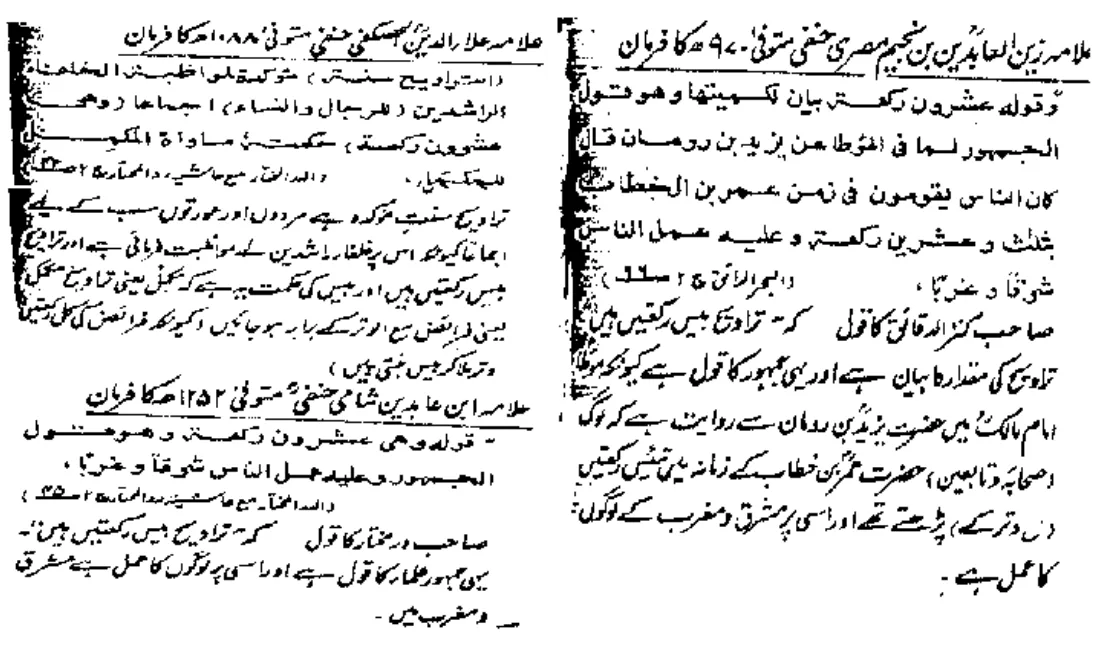
Answer:.
All these are statements of later Hanafi scholars which are being presented as proof by breaking principles; all these statements are rejected even when compared to the sole statement of Imam Abu Bakr bin Al-Arabi, may Allah have mercy on him.

Answer:.
This statement is not only baseless but also rejected because it opposes Imam Malik, may Allah have mercy on him, Imam Shafi’i, may Allah have mercy on him, Imam Ahmad, may Allah have mercy on him, and Imam Abu Bakr bin Al-Arabi, may Allah have mercy on him, among others.
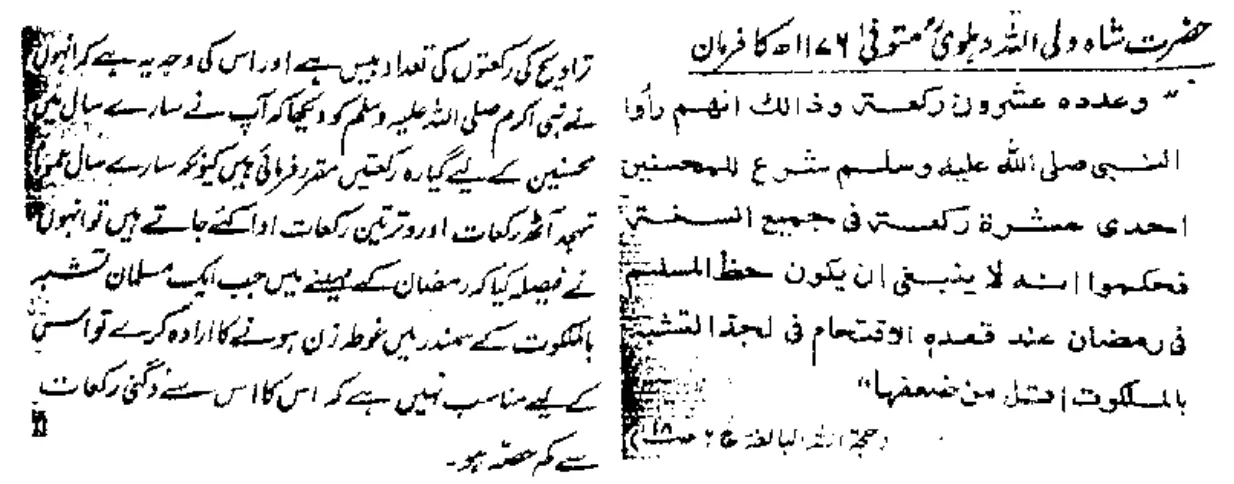
Answer:.
The statement of Shah Waliullah, may Allah have mercy on him, is also baseless.
Warning:.
Shah Waliullah Dehlawi, may Allah have mercy on him, says about raising the hands in prayer: “And the person who raises his hands is better in my view than the person who does not raise his hands.”
What is your opinion regarding this fatwa?
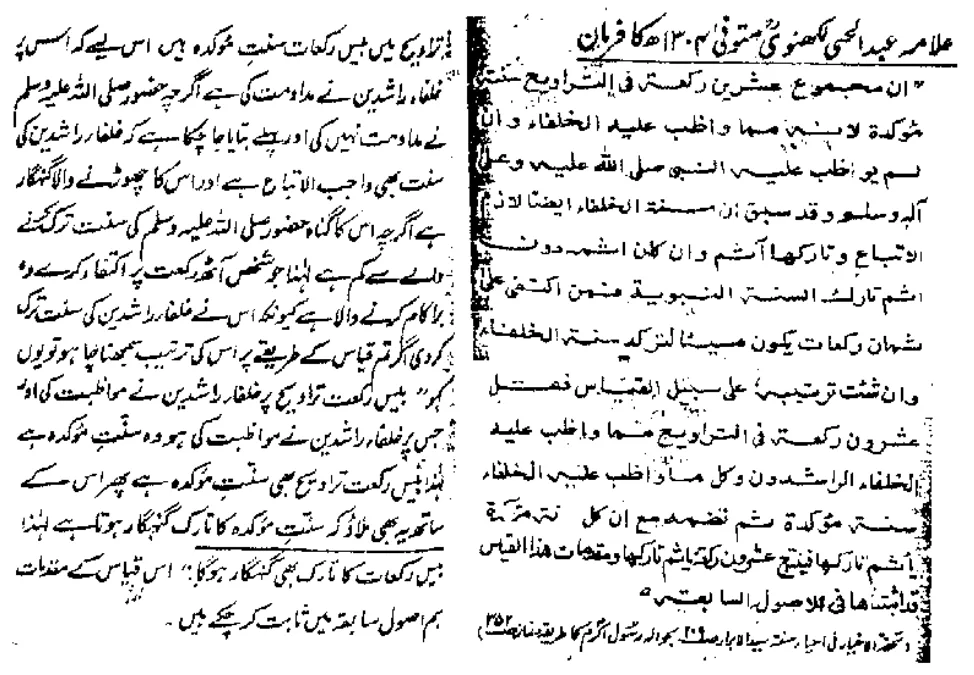
Dear readers!
Anwar Khurshid Deobandi has presented the statements of Hanafis from Ibn Najim Hanafi to Abdul Hai Lakhnawi against Ahl al-Hadith, as if these statements are, in his view, equal to the Quran, Hadith, consensus, and the ijtihad of Abu Hanifa. However, presenting Hanafi statements against Ahl al-Hadith is fundamentally rejected.
Anwar Khurshid made the mistake of not presenting many statements of Hayati Mamati Deobandis against Ahl al-Hadith. According to his methodology, he should have also presented the statements of Moong Phali Ustad and Piyali Mulla, etc., in opposition to Ahl al-Hadith so that the volume of the book would have been somewhat larger.
Summary of the answer:
Anwar Khurshid Deobandi Sahib claims: “Therefore, twenty rak’ahs of Taraweeh are the emphasized Sunnah.”
And this is the claim of the general Deobandis. According to Deobandis, the only proof is the Adillah Arba’ah (the four evidences: Quran, Hadith, Ijma, and Ijtihad). Mufti Rashid Ahmad Ludhianvi Deobandi states: “In short, this issue is still in need of research; therefore, our fatwa and practice will remain according to the statement of the Imam, may Allah have mercy on him, because we are followers of the Imam, and for a follower, the statement of the Imam is a proof, not the Adillah Arba’ah, as reasoning from them is the duty of a Mujtahid.”
It is understood that according to Deobandis, reasoning from the accepted Adillah Arba’ah (the four evidences) is only the work of a Mujtahid (Imam Abu Hanifa, may Allah have mercy on him). Therefore, in every issue, it is incumbent upon Deobandis to first present the statement of Imam Abu Hanifa, may Allah have mercy on him, and then through Imam Abu Hanifa: reason from the Quran, Hadith, and Ijma.
Anwar Khurshid Deobandi Sahib did not keep his principle in mind while presenting the narrations about the emphasized Sunnah status of the rak’ahs of Taraweeh. The narrations he presented consist of three types:
➊ Weak and rejected in terms of chain of narration, for example Hadith: 6 etc.
➋ Irrelevant to the claim, for example Hadith: 1, 2, 3 etc.
➌ Outside the Adillah Arba’ah, for example the statement of Ibn Najim Hanafi etc.
Therefore, it is proven that Anwar Khurshid Deobandi Sahib failed to prove his claim. Despite this clear failure, he writes that “whoever writes a reply, if he criticizes the hadiths mentioned in the book, he should explain the criticism and state a reason for the criticism that is agreed upon, and the critic should be sincere, not biased. Special care should be taken that no criticism is made which has already been made on the narrators of Bukhari and Muslim.”
Commentary :.
In the response I wrote to Anwar Khurshid, I have kept in mind the Deobandi and Hanafi principles everywhere. For example, Sarfaraz Khan Safdar Deobandi writes: “Despite all this, we have always supported the majority of the Imams of Jarh and Ta’dil and most of the Imams of Hadith in authentication and criticism. It is well known that the language of the people should be considered the drum of God.”
I have only declared those narrators weak and defective who are considered weak and defective by the majority of Muhaddithin. In some places, I have also given obligatory answers accepted by the opposing party. والحمد لله
When the majority criticize the narrators of the Deobandis, they remember “Jarh Mufassir” (explaining criticism), but when they themselves sit to criticize those narrators whom the majority have declared trustworthy and truthful, such as Makhool (may Allah have mercy on him), Alaa bin Abdul Rahman (may Allah have mercy on him), Muhammad bin Ishaq (may Allah have mercy on him), Ubaidullah bin Amr al-Raqi (may Allah have mercy on him), Mu’mil bin Ismail (may Allah have mercy on him), and Abdul Hamid bin Jafar (may Allah have mercy on him), etc., then they forget all about “Jarh Mufassir” and “Jarh Nasih” (advisory criticism) and so on. We have a great complaint against the Deobandis that they call a narrator trustworthy when the hadith narrated by him suits their purpose, and call him weak when the hadith narrated by him is against their purpose. For example, Ali Muhammad Haqqani Deobandi Sindhi writes about the narrator Yazid bin Abi Ziyad of a hadith about raising the hands during prayer: اهو ثقۃ آهي He is trustworthy.
The same Yazid bin Abi Ziyad is also a narrator of a narration about wiping over socks, where Haqqani writes: زيلعي فرمائيد و…. اھو ضعيف آهي “That is, Zaili says he is weak.”
Expecting any justice from such contradictory and conflicting people is futile!
From Anwar Khurshid Sahib’s mentioned statement, it is understood that criticism of the narrators of Bukhari and Muslim is rejected, whereas on the other hand, the Deobandi gentlemen continuously criticize the narrators of Sahih Bukhari and Sahih Muslim. For example: Makhool (may Allah have mercy on him), Muhammad bin Ishaq (may Allah have mercy on him), Ubaidullah bin Amr (may Allah have mercy on him), Alaa bin Abdul Rahman (may Allah have mercy on him), and Samak bin Harb (may Allah have mercy on him), etc., are narrators of Sahih Muslim or Sahih Bukhari, and their criticism is openly present in Deobandi books. These people have embraced the principles of the people of Shu’ayb (peace be upon him) and then demand that only “Jarh Mufassir” be applied to their narrators! Respectfully, present three narrators whom the majority have declared trustworthy and truthful, yet they have “Jarh Mufassir” on them, and due to this “Jarh Mufassir,” they have been declared weak and rejected. Also present such examples of “Jarh Mufassir” which the Deobandi gentlemen accept as proof.
We prefer and adhere to the research and testimony of the majority of Muhaddithin. والحمد لله
Anwar Khurshid Sahib further states that “Whoever writes a response should not use criticisms like tadlis (concealment), isal (transmission without meeting the original narrator), ignorance, or concealment, because such criticisms are nullified by mutaba’at (following) and evidence, and mutaba’at and evidence have already been mentioned abundantly in this book.”
Commentary :.
In the principles of Hadith, it is established that due to tadlees (concealment), irsal (sending), ignorance, and being hidden (mastoor), a hadith becomes weak. Now, why is it that we do not even call a weak hadith weak? The Deobandi scholars themselves reject many narrations by applying the same criticism. For example: Sarfaraz Khan Safdar declared Nafi’ bin Mahmood, may Allah have mercy on him (a famous Tabi’i), as unknown and rejected the hadith narrated by him.
He declared Abu Qalabah as a tadlees practitioner of ghadab (anger) and rejected his narration.
If by mutaba’at (following) and shawahid (supporting evidences), Anwar Khurshid Deobandi means that the narrations with mutaba’at and shawahid are authentic or hasan by themselves in terms of chain, then fine; but if he thinks that the weak and rejected narrations with mutaba’at and shawahid are not much harmful, then his principle is false. Imam Ibn Kathir, may Allah have mercy on him, explained in the principles of Hadith that proving the opponent’s hadith weak is sufficient.
Pulling a weak narration unnecessarily up to the level of hasan laghairah cannot be a proof against the opposing party. Hafiz Ibn Hajar, may Allah have mercy on him, and Hafiz Ibn al-Qattan al-Fasi, may Allah have mercy on him, and others have researched that a hasan laghairah narration is not a proof; it can only be presented in virtues of deeds and not acted upon in rulings.
Here, as a warning, it is stated that in most of the narrations presented by Anwar Khurshid Sahib, neither mutaba’at is established nor shawahid. For example, he claims that twenty rak’ahs of Taraweeh prayer from the Prophet, peace be upon him, is proven.
Whereas in the first narration presented by Anwar Khurshid Sahib, Ibrahim bin Uthman is a liar and abandoned narrator, and in the second, Muhammad bin Humayd al-Razi is a liar.
Anwar Khurshid has written this great lie that these narrations have “the acceptance of the Ummah by tacit approval (talaqqi bil-qubool).”
Talaqqi bil-qubool means that the entire Ummah accepts this narration. There is a great difference of opinion among the Muslim Ummah regarding Taraweeh. If these fabricated narrations had the acceptance of the Ummah by tacit approval, then this difference should not exist. Yes, it is possible that Anwar Khurshid Sahib means that the Deobandi Ummah has the acceptance of the Ummah by tacit approval, and it is also known to the general public that only the Deobandis’ acceptance of a narration is not proof of its authenticity or hasan status.
Finally, Anwar Khurshid Sahib threatens by writing: “Keeping these matters in mind, the response given will certainly be considered worthy of attention; otherwise, we have no concern with unnecessary and futile matters.”
Commentary :.
All the arguments of Anwar Khurshid Deobandi have been answered by the grace of Allah and the conclusive evidence of the four proofs, thus blowing away these Deobandi doubts هَبَآءً مَّنْثُوْرًا into the air.
➊ Deobandi narrations, principles of Hadith, and the majority of Muhaddithin consider them weak, rejected, and fabricated.
➋ Some narrations are authentic but unrelated to the original subject and contrary to the Deobandi claim.
➌ Some narrations and statements are references outside the four conclusive proofs, for example, the actions of some Tabi‘in and the sayings and actions of Hanafi scholars are neither from the Quran, nor Hadith, nor Ijma‘.
Even according to Hanafi scholars themselves, the sayings and actions of the Tabi‘in are not authoritative. For example:
◈ Muhammad bin Sirin (may Allah have mercy on him), Abu Qulaba (may Allah have mercy on him), Wahb bin Munabbih (may Allah have mercy on him), Tawus (may Allah have mercy on him), and Sa‘id bin Jubayr (may Allah have mercy on him) and others used to raise their hands before and after Ruku‘.
◈ Sa‘id bin Jubayr (may Allah have mercy on him), Hasan al-Basri (may Allah have mercy on him), and Ubayd Allah bin ‘Utbah (may Allah have mercy on him) and others were proponents of reciting Al-Fatiha behind the Imam and recitation behind the Imam.
◈ ‘Akramah (may Allah have mercy on him) (a Tabi‘i) said: أدركت الناس ولهم زجة فى مساجدهم بآمين إذا قال الإمام غَيرِ المَغضُوبِ عَلَيْهِمْ وَلَا الضَّالِينَ I found people in their mosques in such a state that when the Imam غَيرِ المَغضُوبِ عَلَيْهِمْ وَلَا الضَّالِينَ said, the mosques would echo with the people saying Ameen.
All such statements are completely opposed by Deobandi, Barelvi, and Hanafi gentlemen. Also see my book “Al-Qawl al-Mateen fi al-Jahr bi al-Ta’min.”
Anwar Khurshid Deobandi has written false, unreferenced, and irrelevant things from page 658 to page 293, which have been refuted and investigated in the mentioned narrations.
Some important responses to these pages are as follows:
◈ Taqallī bil-Qabūl means the acceptance of the entire Ummah, i.e., Ijma‘, which is authoritative according to Ahl al-Hadith.
◈ It is not proven with authentic chains from the Rightly Guided Caliphs (may Allah be pleased with them) and the Companions (may Allah be pleased with them) that twenty Rak‘ahs of Taraweeh were established.
◈ It is not proven from any Tabi‘i (may Allah have mercy on him), Tabi‘ al-Tabi‘ (may Allah have mercy on him), or authentic Imam that twenty Rak‘ahs are the only emphasized Sunnah; fewer or more are not permissible.
◈ Imam Malik (may Allah have mercy on him), Imam Qurtubi (may Allah have mercy on him), Imam Abu Bakr bin al-Arabi (may Allah have mercy on him), and most scholars were proponents of eight Rak‘ahs of Taraweeh; Ibn Hammam Hanafi, Anwar Shah Kashmiri, and Abdul Shakoor Lakhnawi and others have also accepted eight Rak‘ahs of Taraweeh as Sunnah.
◈ Deobandi gentlemen keep repeating the tune that “Tahajjud and Taraweeh are two separate prayers; considering them as one prayer is the belief of non-followers,” whereas Anwar Shah Kashmiri Deobandi says that Tahajjud and Taraweeh are the same prayer and considering them separately is wrong.
What do the Deobandis think about Kashmiri Sahib? Was he also a “non-follower”?
◈ The narration omitted either unintentionally or deliberately in Ghaniyat al-Talibin, we are free from that mistake; what do they think about the distortion in “Hujjat Allah al-Baligha” by the Deobandis?
◈ Among the Mujtahid Imams, Imam Bukhari (may Allah have mercy on him) mentioned the Hadith of ‘A’ishah (may Allah be pleased with her) in the book of Taraweeh, proving that the Hadith of ‘A’ishah (may Allah be pleased with her) is certainly related to Taraweeh; therefore, the Deobandi propaganda that this Hadith has no relation to Taraweeh is ineffective.
Imam Bayhaqi (may Allah have mercy on him) narrated the Hadith of ‘A’ishah (may Allah be pleased with her) in “Al-Sunan al-Kubra” by writing باب ما روى فى عدد ركعات القيام فى شهر رمضان and later narrated the weak and fabricated narration of twenty Rak‘ahs and criticized its narrator.
If this Hadith was unrelated to Taraweeh, then why did Imam Mujtahid Imam Bukhari (may Allah have mercy on him) and Imam Bayhaqi (may Allah have mercy on him) include it in the chapter on Taraweeh?
◈ It is authentically narrated in Sahih Muslim that the Messenger of Allah (peace be upon him) used to pray eleven Rak‘ahs at night, greeting after every two Rak‘ahs, and then (finally) one Witr.
◈ It is proven from general evidence that Taraweeh with congregation is preferable and it is also permissible to pray alone.
◈ In “Shu‘ab al-Iman” by Bayhaqi
and “Sahih Ibn Khuzaymah” (342/3 hadith 2211), it is narrated that the Messenger of Allah (peace be upon him) did not lie on his bed during Ramadan until Ramadan passed.
The chain of this narration is very weak. Its narrator ‘Abd al-Muttalib bin ‘Abdullah is a mudallis, and the narration is mu‘ann‘an (with a break in the chain). In Shu‘ab al-Iman, by mistake, “al-Muttalib ‘an ‘Abdullah ‘an ‘A’ishah (may Allah be pleased with her)” was printed, whereas the correct phrase is only: المطلب بن عبد الله عن عائشة رضي الله عنها
◈ In the narration of “Shu‘ab al-Iman” by Bayhaqi
, ‘Abd al-Baqi bin Qani‘ is weak, and there is also a defect in the other chain. All four narrations presented by Anwar Khurshid are unrelated to the original subject.
◈ The statement of Anas (may Allah be pleased with him), “There you prayed the prayer which you did not pray with us,” only means that the Prophet (peace be upon him) prayed a very long recitation and prolonged standing at home; this narration has no relation to the number of Rak‘ahs.
◈ Talq bin ‘Ali (may Allah be pleased with him) led night prayers in two mosques; if he prayed Taraweeh first, then who prayed the Tahajjud congregation later? If both places were Taraweeh or both were Tahajjud, then Deobandis have no practice on this. The second prayer he led was written by Anwar Khurshid as “he prayed,” which is a distortion in meaning.
◈ The reference of Muhammad bin Muhammad al-Abdari al-Fasi al-Maliki regarding Imam Malik’s (may Allah have mercy on him) Tahajjud and Taraweeh is without chain and rejected.
◈ It is not proven with authentic chains from Imam Bukhari (may Allah have mercy on him) that Taraweeh and Tahajjud are prayed separately. The reference of Hadi al-Sari is rejected due to lack of chain.
◈ The sayings of Shah Abdul Aziz and others are rejected compared to the sayings of Imam Malik (may Allah have mercy on him) and others.
◈ It is not proven from the Messenger of Allah (peace be upon him) that Tahajjud was prayed after Taraweeh, and this is the research of Anwar Shah Kashmiri Deobandi. (Hafiz Zubair Ali Zai)