
Nasrat al-Rahman fi Tahqiq Qiyam Ramadan :
Muhammad Shoaib Qureshi Sahib (Deobandi) wrote an article titled “Izhar al-Haqq al-Sahih fi ‘Adad al-Taraweeh” in response to Samiullah Sahib. A brief critical review of this article is presented here from “Nasrat al-Rahman.” Shoaib Sahib’s statement is from قوله and the response to it is written under “Aqool.”
1: His Statement: p. 1:
Seven individuals have criticized him, namely Isa bin Jariya…
Aqool:
The criticism of Abu Dawood, may Allah have mercy on him, is not established. The remaining five (Ibn Ma’in, may Allah have mercy on him; An-Nasa’i, may Allah have mercy on him; As-Saji, may Allah have mercy on him; Al-Aqili, may Allah have mercy on him; and Ibn ‘Adi, may Allah have mercy on him) are supported by authentication from the following scholars: Abu Zur’ah, may Allah have mercy on him; Ibn Hibban, may Allah have mercy on him; Ibn Khuzaymah, may Allah have mercy on him; Al-Haythami, may Allah have mercy on him; Adh-Dhahabi, may Allah have mercy on him; Al-Busiri, may Allah have mercy on him; and Ibn Hajar, may Allah have mercy on him. Therefore, this narrator is considered truthful or has good hadith by the consensus of the majority.
2: His Statement: p. 2:
ومن المعلوم أن صحة السند لا تستلزم صحة المتن
Aqool:
If Maulana Mubarakpuri and others mean by their statement that if a narration with an apparently authentic chain is rare or defective, it does not necessarily mean that the hadith itself is authentic, then this is correct. But if they mean anything else, then we declare that Maulana Mubarakpuri’s statement is not correct. Rather, the correct view is that if the chain is authentic, then its text is also authentic.
3 : His Statement : p. 2 :.
“And the heart is not satisfied with Haithami’s praise.”
My Statement :.
If Mubarkpuri Sahib’s heart is not satisfied, so what, Sarfaraz Safdar Sahib’s heart is satisfied. Sarfaraz Safdar Sahib writes: If in his time, Allama Haithami (may Allah have mercy on him) did not have the ability to discern authenticity and weakness, then who else did?
According to us, Hafiz Haithami’s (may Allah have mercy on him) authentication and correction is neither absolutely acceptable nor absolutely rejected. Rather, it can be decided in the light of evidence. The consensus of the majority is a strong evidence, and since the majority have agreed with the authentication of the narrator mentioned by Sami Sahib, therefore this authentication is acceptable.
4 : His Statement : p. 3 :.
لا بأس به
I say :.
These words are from authentication.
5 : His Statement : p. 3 :.
“Criticism precedes explanation over authentication.”
I say :.
Provided that the criticism is explanatory and the modification is ambiguous, if both are explanatory, then the opinion of the majority will prevail. It should be noted that explanatory criticism means that the narrator is called mudallis, mixed, and weak in such and such a way. Simply calling someone weak, abandoned, or a denier of hadith is not explanatory criticism. Quraishi himself wrote on page 25 about Ibrahim bin Uthman Al-Absi: “Those scholars who have declared him abandoned and weak based on justice have all given ambiguous and non-explanatory criticisms…” Whereas Abu Shuaybah and many scholars have written about the mentioned Ibrahim bin Uthman as abandoned and denier of hadith, etc. If the same criticisms were on Isa bin Jariya (may Allah have mercy on him), then they would become explanatory, but if they are on Abu Shuaybah, then they are non-explanatory. What kind of justice is this?
6: Statement: page 4:
“This narration is also not reliable because of Isa bin Jariya (may Allah have mercy on him) since the majority of the experts in the science of criticism and modification have given very explanatory criticism on this narrator.”
Statements:
This is a claim; evidence is required. Sami Sahib has quoted the authentication of eight Muhaddithin, while Qureshi Sahib has criticized six (one of which is not proven, so the remaining are five). Now, the third parties should decide which side has the majority. In fact, if further research is done, the number of authenticators may even exceed nine. The claim of criticism by the mufassir is rejected.
7 : Statement : p. 4 :.
“Because the word Taraweeh is not present in this narration at all.”
Response :.
Is the word “Taraweeh” present in the hadith of Ibn Abbas (may Allah be pleased with him), which according to our research is fabricated, or in the practice of Farooq (may Allah be pleased with him), which Qureshi Sahib has presented and which we do not consider authentic? Kindly show us this word.
8 : Statement : p. 4 :.
“This narration is also present in Musnad Ahmad: 115/5 (Ziyadat Abdullah).”
Response :.
I believe that Quraishi Sahib has written this statement by quoting from Habib ur Rehman Azmi’s book “Rukaat Taraweeh”
. والله اعلم
Anyway, whether it is quoted from there or from the original book, this passage provides us proof of the knowledge level of its scribe—how deep he is in the matter?
The version of Musnad Ahmad that we have contains this hadith at
. Abdullah bin Ahmad bin Hanbal, may Allah have mercy on him, says: حدثني أبى ثنا أبو بكر بن أبى شيبة Here, “Abi” refers to Ahmad bin Hanbal, may Allah have mercy on him, as is clear. Therefore, it is understood that this narration is from the Musnad of Ahmad, may Allah have mercy on him, and not from the Ziyadat. The narrations from Ziyadat are those which Abdullah bin Ahmad, may Allah have mercy on him, narrated from someone other than his honorable father.
Warning:.
Later research revealed that the addition of حدثني أبي in the published copies of Musnad Ahmad is incorrect. The correct version is that this narration is from Ziyadat Abdullah bin Ahmad, may Allah have mercy on him.
9 : His Statement : p. 5
“We challenged the Ahl al-Hadith people on this hadith to show at least ten people in 1200 years who pray 8 rak’ahs.”
My Statement :
This challenge is futile. The real judgment will be made in the light of the Book, Sunnah, and consensus, not based on the actions of ten individuals. This challenge is evidence that Quraishi Sahib and others want to escape from the Book and Sunnah and divert from the main issue by involving people’s actions. Hadith does not depend on people’s actions; rather, people’s actions depend on hadith.
Imam Bukhari, may Allah have mercy on him, has narrated a beautiful statement from Sayyidina Ali, may Allah be pleased with him, who said:
ما كنت لأدع سنة النبى صلى الله عليه وسلم لقول أحد
I cannot abandon the Sunnah of the Prophet, peace be upon him, because of anyone’s statement.
If there is a desire for challenge, then I ask to prove from one trustworthy person among the best generations or from one trustworthy expert narrator or scholar among the predecessors that he said that praying twenty rak’ahs is an emphasized Sunnah and that less or more is not permissible. Or at least prove these words from your own Imam! So that it can be decided who is truthful in the claim of Sunnah and who is lying?
10 : Statement : p. 6 :.
“But alas, both erred.”
My statement :.
You should regret this for your Allama Ayni Hanafi and Allama Suyuti, may Allah have mercy on them, who have transmitted this statement.
11 : Statement : p. 6 :.
“Juzi, who was born hundreds of years after Imam Malik, may Allah have mercy on him.”
My statement :.
First, introduce Juzi—who he is—and then write about his date of birth, etc.
The research of Imam Malik, may Allah have mercy on him, shows that Taraweeh is eleven rak’ahs; Ayni Hanafi
and Abdul Haq al-Ashbili have also transmitted this.
12 : Statement : p. 6 :.
وذكر ابن القاسم عن مالك
My statement :.
Ibn al-Qasim, may Allah have mercy on him, although trustworthy, لا شك فيه, but there is scrutiny in the issues he transmitted from Imam Malik, may Allah have mercy on him. Imam Abu Zur’ah, may Allah have mercy on him, states in his book “Al-Du’afa”: فالناس يتكلمون فى هذه المسائل Therefore, people debate these issues of Ibn al-Qasim.
والله اعلم
13 : Statement : p. 6, 7 :.
“Because it is a principle that when a narrator acts contrary to the hadith he has narrated, that hadith will not be acceptable.”
Statements:
Firstly, this principle itself is disputed. Among the muhaddithin, there is a group that opposes this principle and says that the lesson is in the narration, not in the opinion.
Secondly, it is not established here that Imam Malik, may Allah have mercy on him, acted contrary to his own hadith.
Thirdly, in Hidayah Awwalin, page 312, margin number 29, it is written: وعادته أن لا يروي حديثا فى الموطأ إلا وهو يذهب إليه ويعمل به
Meaning, it is Imam Malik’s habit that he acts upon whatever hadith he narrates in Al-Muwatta. (I say that from this statement it is proven that Imam Malik, may Allah have mercy on him, was an advocate and practitioner of eleven rak’ahs, therefore the objection based on the narrator’s action is also invalid, and the statements of Ayni, Suyuti, Ashbili, and Ibn Mughith are also confirmed.)
Note:
It is an established fact that the narrator knows his narration best.
14: Statement: page 7:
“And the statements of these five do not coincide; each gives a separate statement.”
Statements:
A brief investigation of this narration is as follows:
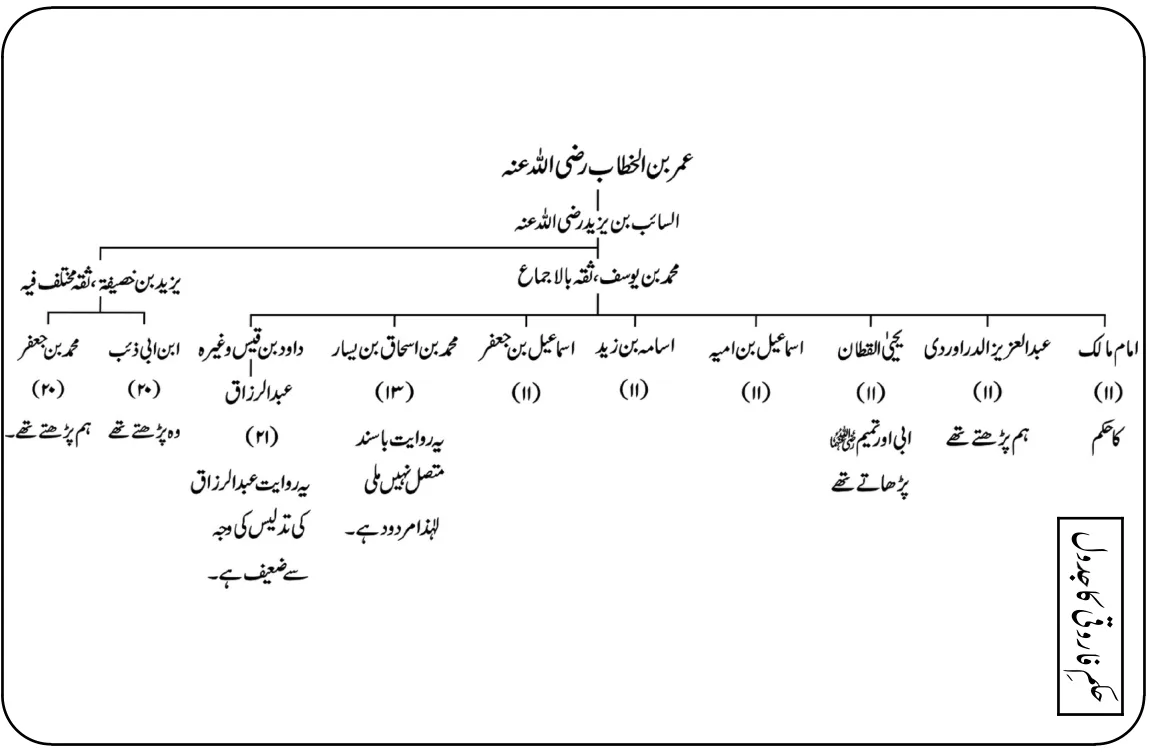
See the table on page 63; from this table, it is clear that six narrators agree on the number eleven. Some have transmitted the Caliph’s order, some have complied with it, and some have followed the people’s practice. Therefore, there is no contradiction in their statements. Muhammad ibn Ishaq, may Allah have mercy on him (who is considered weak or even lower by the Deobandi sect), in his narration (if authentic) the number thirteen refers to eleven rak’ahs of Qiyam in Ramadan and two rak’ahs of Isha.
. Only in the narration of al-Dubari from Abd al-Razzaq from Dawood is the number twenty-one, which is rejected for several reasons:
1. It contradicts the trustworthy narrators, so it is anomalous.
2. There is a discrepancy in the original manuscript of the author; Allama Suyuti, may Allah have mercy on him, transmitted the number (11) from the author Abd al-Razzaq.
3. The Hanafi, Deobandi, and Barelvi schools do not act upon this narration.
4. The narrator al-Dubari of the author is weak and a mushhaf (one who alters the text), as Sami Sahib has briefly mentioned in his letter. For further details, see
and the introduction of Ibn al-Salah. It is extremely surprising that Qureshi Sahib wrote on page 9 and then Sami Sahib’s objections number 2 and 5 regarding al-Dubari have no relation to our matter, while he is arguing from a narration of Abd al-Razzaq (which contradicts trustworthy narrators). Therefore, it is incumbent upon him to establish the reliability and integrity of the author’s primary narrator; mere baseless claims will not suffice. To the honorable third parties, we say: please pick up the author and search for the name of his narrator. Is he not al-Dubari? And has he not undergone corrections? How old was he when he heard from the author?
5. The author Abd al-Razzaq wrote:
عن داود بن قيس وغيره عن محمد بن يوسف
The narrator of this narration, Abd al-Razzaq ibn Hammam, may Allah have mercy on him, is a mudallis (one who practices tadlis).
.
In the principles of hadith, it is established and agreed upon that a narration from a mudallis is weak; therefore, this chain is weak.
In short, based on these reasons, the narration attributed to Dawood ibn Qais is invalid. Hence, it is proven that there is no disagreement among the students of Muhammad ibn Yusuf, may Allah have mercy on him, and since they are unanimously trustworthy, this chain is completely authentic. That is why Zia al-Maqdisi Sahib al-Mukhtara and others have declared it authentic, and indeed the Hanafi Imam Tahawi, may Allah have mercy on him, took proof from it, and Naimwi called it اسناد صحيح. For details, see Sami Sahib’s letter.
Our challenge is to present even one hadith scholar among the predecessors who declared Imam Malik’s narration weak, and similarly rejected the narrations of Yahya al-Qattan, may Allah have mercy on him, by calling them contradictory or otherwise!
عن
15 : Qawlah : Page 7 :.
“While on the other hand, two of Yazid bin Khusaifah’s students unanimously report 20 Rak’ahs.”
Statements :.
According to Quraishi Sahib, in the narration of Muhammad bin Yusuf, everyone narrates separately. That is, Malik, may Allah have mercy on him, stated the ruling, and Yahya al-Qattan, may Allah have mercy on him, narrated the practice. So, according to Quraishi Sahib, this narration became contradictory. Similarly, there is a difference among the students of Yazid bin Khusifah.
➊ Ibn Abi Zaib: The practice of those (unknown) people
➋ Muhammad bin Ja’far: The practice of us (known) people
Therefore, they should also consider this narration as rejected. It should be noted that the narration of Muhammad bin Ja’far is rare due to Khalid bin Mukhlad, and against it is the narration of Mahfuz Ibn Abi Zaib. But this narration is also rare due to Yazid bin Khusifah, and Muhammad bin Yusuf is more trustworthy compared to Ibn Khusifah. Neither of these narrations is related at all to the ruling or practice of the Rightly Guided Caliph. Ibn Abi Zaib’s narration is completely devoid of the ruling of Faruq, so it is irrelevant to the topic.
16 : Qawlah : p. 7 :.
“Abdul Aziz (he is a weak narrator)”
My statements :.
Abdul Aziz al-Darawardi is a narrator of the six books and is considered trustworthy and truthful by the majority. There is criticism on his narration from Ubaidullah al-Umari, but the narration we have presented is not from Ubaidullah. For this reason, Allama Suyuti, may Allah have mercy on him, called this narration بسند فى غاية الصحة in
.
17 : His statement: p. 7 :.
“So it is clear that this narration is abrogated.”
My statement:.
This is evidence that according to Quraishi Sahib, this narration is authentic; otherwise, what is the point of claiming abrogation? It should be noted that there is no evidence to support the claim of abrogation, therefore it is rejected.
18 : His statement: p. 8 :.
“Muhammad ibn Ja’far, during the time of Hazrat Umar, may Allah be pleased with him, people used to pray twenty rak’ahs.”
My statement:.
If Quraishi Sahib can show this narration extracted from “Ma’rifat al-Sunan wal-Athar” with these words, it would be very kind of him. I have a handwritten illuminated manuscript of “Ma’rifat al-Sunan wal-Athar” and these words are not present in it. I have also seen two printed editions of “Ma’rifat al-Sunan” and these words are not present in them either. والله اعلم
19 : Statement : p. 10 :.
وروى مالك …… وفي موطأ من طريق يزيد بن خصيفة
I say :.
Quraishi Sahib has mentioned a narration from Muwatta through Hafiz Ibn Hajar (may Allah have mercy on him) and Shawkani (may Allah have mercy on him). Kindly extract it from Muwatta and show it to us. Trying to impress us with names is futile; present the quoted text from the original book, and if you cannot do so…!
20 : Statement : p. 12 :.
في رواة الصحيحين عدد كثير ما علمنا أن أحدا نص على توثيقهم
I say :.
The companions of Sahih consider the exclusion of a narrator from Sahih as a form of authentication of that narrator in their view.
21 : Statement : p. 13 :.
“Please also tell us the names of some Tabi‘een who were corrupt and wicked.”
I say :.
1: Hajjaj ibn Yusuf
2: Mukhtar ibn Abi Ubaid al-Thaqafi
3: Abu Harun al-Abdi
4: Abu Dawood al-A‘mi and others
22 : Statement : p. 13 :.
“And the Ahl al-Hadith agree that all the narrations in it are authentic according to Imam Malik (may Allah have mercy on him) and those who agree with him.”
I say :.
Here, what kind of principle has been established for the correction of a disconnected narration, and from pages 5 to 8, an attempt has been made to prove a connected narration of Muwatta Imam Malik, may Allah have mercy on him, as weak or doubtful. Is this called justice?
Anwar Shah Kashmiri has made such a powerful statement against such people in
. He says:
وقد بلوتهم أنهم يسوون القواعد للنقيضين ف أى رجاء منها بعده فإذا رأى أحدهم حديثا ضعيفا وافق مذهبه يسوي له ضابطة ويقول إن الضعف ينجبر بتعدد الطرق وإن رأى حديثا صحيحا خالف مذهبه يسوي له ضابطة أيضا ويقول إنه شاذ
Meaning: I have tested these people; they make contradictory principles. After that, what else can be expected from them? When any one of them finds a weak hadith in accordance with his sect, he makes a rule that due to multiple chains the weakness is removed, and when he finds an authentic hadith against his sect, he immediately makes a rule that it is anomalous, etc.
The statement of Kashmiri Sahib is sufficient to refute Qureshi Sahib and people like him.
23 : His statement: p. 14 :.
“And also the chain became connected.”
I say:.
Prove the meeting of Yahya bin Saeed Al-Ansari, may Allah have mercy on him, with Sayyiduna Umar, may Allah be pleased with him, and then write the response to the accusation of tampering. What is your response to Naimwi’s statement: لكن يحيى بن سعيد الأنصاري لم يدرك عمر meaning Yahya bin Saeed Al-Ansari did not meet Sayyiduna Umar, may Allah be pleased with him.
24: His Statement: p. 14:
Sheikh Muhammad Ali Sabuni’s narration of Abu Dawood
عشرين ركعة
I say:
Firstly, Sabooni Sahib is extremely biased and not an Ahl al-Hadith scholar, so how can his statement be used as proof for following the Muhadditheen? Several Ahl al-Hadith scholars have written refutations against the mentioned Sabooni.
Secondly: Sabooni has cited this narration from Al-Mughni, so Qureshi Sahib should extract this narration from Al-Mughni.
Thirdly: The copy of Al-Mughni that we have contains this narration referenced from Abu Dawood
, and it includes the words of عشرين ليلة but not those of عشرين ركعة, therefore Qureshi Sahib’s argument is invalid.
Fourthly: For further investigation, I invite the group of Thalitheen to come to me so that I can prove to them the alteration by Mahmood Hasan Deobandi through multiple manuscripts and evidences.
25: Statement: p. 15:
“Abu Dawood has various manuscripts; in one or most of them, only 20 Rak’ahs are mentioned.”
My statement:
Present photocopies of only three or four of these manuscripts, or rather, present a photocopy of only one manuscript besides Mahmood Hasan Deobandi’s manuscript. Remember that the manuscripts printed by the Deobandis after Mahmood Hasan, such as Akasi, etc., are copied from the same manuscript. We have numerous arguments against this distortion by the Deobandis, for example, see: Tuhfat al-Ashraf by Al-Mizzi, Al-Mishkat, Sunan al-Kubra by Al-Bayhaqi, Ikhtisar al-Muhadhdhab, Nasb al-Rayah, Ma’rifat al-Sunan wal-Athar, Hashiyah Hidayah, Al-Dirayah, Al-Mughni, and Sheikh Abi Dawood, etc.
26 : His statement: p. 15 :.
حدثنا حميد بن عبد الرحمن عن الحسن البصري عن عبد العزيز بن رفيع قال كان أبى بن كعب يصلي بالناس بالمدينة عشرين ركعة
I say:.
Quraishi Sahib should extract this narration with this chain from the above page and present it, and if he cannot extract it…!
27 : His statement: p. 15 :.
“And all its narrators are trustworthy and it is acceptable according to the principles of Hadith.”
I say:.
Nimwi mentioned in
that Abdul Aziz bin Rafi’ (may Allah have mercy on him) did not meet Ubayy bin Ka’b (may Allah be pleased with him), so how then did this chain become acceptable? Is it a condition for Maqbool (accepted) that it be Munqati (disconnected)?
And if by Hasan (provided that after it in the manuscript there is ‘an’) it means Basri, then what about their Tadlis (concealment)?
28 : Statement : p 15 :.
“The status of the chains of this narration is unknown.”
My statement :.
Then why was it presented?
29 : Statement : p 16 :.
“Abu al-Hasna’”
My statement :.
Which Muhaddith has declared Abu al-Hasna’ trustworthy? Prove it, and after that prove his meeting with Sayyiduna Ali (may Allah be pleased with him).
30 : Statement : p 16 :.
“They have no text from the Qur’an or Hadith that a weak Hadith or a narrator of unknown status is unacceptable in every case.”
My statement :.
Firstly: See Surah Al-Hujurat: 4, and its explanation in Tafsir and common books of Usul al-Hadith.
Secondly: There is no disagreement about its rejection عند المعارضہ (upon opposition).
Thirdly: Do you consider a weak hadith or a hadith from an unknown-status narrator acceptable in every case? Present proof from your Imam.
31: His statement: pp. 16, 17:
“Imam Bayhaqi, may Allah have mercy on him, accepts the narration of Abdul Rahman strongly; therefore, according to Ibn Taymiyyah, may Allah have mercy on him, this narration is also authentic.”
I say:
Introduce Hamad bin Shu’aib (weak) and Ata bin Al-Saib (mixed).
32: His statement: p. 19:
“The practice of the Tabi‘in”
I say:
The practice of the Tabi‘in does not become Sunnah. A request to Quraishi Sahib: please prove with an authentic chain from any one Tabi‘i among the Tabi‘in that twenty Rak‘ahs of Taraweeh or Qiyam Ramadan is the Sunnah of the Prophet ﷺ, or the Sunnah of the Rightly Guided Caliphs (may Allah be pleased with them), or an emphasized Sunnah.
33: His statement: p. 20:
“Our claim is that there was consensus on twenty Rak‘ahs during the era of Faruq.”
I say:
Present evidence, or at least show a single trustworthy Imam stating that there was consensus on twenty rak’ahs during the era of Farooq. Remember, there is no need to present references from followers centuries later. What is to be made of the severe disagreement mentioned by Aini Hanafi in
?
34 : Statement : p. 20 :
“For twelve hundred years, the scholars of the entire Ummah have been narrating consensus on twenty.”
Response :
From the first, second, third, fourth, and fifth centuries AH, present the correct proof of this claim of consensus from even one scholar, and if you cannot, then …!
35 : Statement : p. 21 :
“After every four rak’ahs, salam was given.”
Response :
If these words are removed from this hadith, a well-deserved reward will be given; otherwise, the matter will be the opposite.
36 : Statement : p. 21 :
“It was not prayed in the mosque.”
Response :
Which word of the hadith is this a translation of?
37 : Statement : p. 21 :
“And he prayed three witr for a whole year.”
Response :
Which word of the hadith is this the translation of?
Warning:.
The hadith narrated by Aisha (may Allah be pleased with her) is authentic both in its chain of narration and text, and the Ahl al-Hadith, praise be to Allah, act upon it. According to us, the hadith explains the hadith
, in which Umm al-Mu’minin Aisha (may Allah be pleased with her) narrates that: The Messenger of Allah (peace and blessings be upon him) used to pray eleven rak’ahs from after Isha prayer until morning, and he would give salam after every two rak’ahs, and he would pray one Witr. Etc.
This hadith is a clear text and decisive proof on this issue, and it completely refutes the objections of Quraishi Sahib. That is, the four rak’ahs were prayed two by two. والحمد لله
38: Statement: p. 23:.
كان رسول الله صلى الله عليه وسلم يصلي من الليل ست عشرة ركعة سوى المكتوبة
I say:.
Authenticate this narration, prove the reliability of its narrators, and whether Quraishi Sahib acts upon this narration?
Warning:.
The narration presented by Quraishi Sahib
is present, its narrator Abu Ishaq Al-Subai’i is a fabricator and the narration is from ‘An’ (indirect), therefore this chain is weak.
39 : Statement : p. 23 :.
“This hadith is about the Tahajjud prayer.”
My statement :.
This claim is baseless and Anwar Shah Kashmiri has strongly refuted those who make such claims in
.
40 : Statement : p. 23 :.
“Non-followers say that Tahajjud, Taraweeh, and Witr are three names for the same prayer.”
My statement :.
Anwar Shah Kashmiri states: There is no escape from accepting that the prayer of Taraweeh of the Prophet Muhammad ﷺ was eight rak’ahs, and in no narration is it proven that he prayed Tahajjud and Taraweeh separately.
And he says: والمختار عندي أنهما واحد meaning, in my opinion, the preferable view is that these two prayers are actually one prayer. End
I ask, was Anwar Shah Kashmiri not a non-muqallid (non-follower of a particular madhhab)?
Hafiz Abdul Mateen Maiman Junagadhi has quoted from Muhammad Qasim Nanotvi, the founder of Darul Uloom Deoband, in his book “Faydh al-Qasmiya” p. 13 in Hadith Khair wa Shar (pp. 114, 115):
“It is not hidden from the scholars that Qiyam Ramadan and Qiyam al-Layl are in reality one prayer.”
It is not hidden from the scholars that Qiyam Ramadan (Taraweeh) and Qiyam al-Layl (Tahajjud) are indeed one and the same prayer. End
Was Nanotvi also a non-muqallid? What do you think about these witnesses from your own household?
Can Qureshi Sahib prove from a single trustworthy muhaddith that Taraweeh and Tahajjud are separate prayers?
41 : Statement : p. 23 :.
“We say that these three prayers are separate from each other.”
Response :.
What do we mean by “we”? Are Kashmiri Sahib and Nanotvi Sahib not included in this “we”?
42 : Statement : p. 23 :.
الانتباه بعد النوم
Response :.
Provide evidence. In Sharh Ma’ani al-Athar, Volume 1, Chapter on Standing in the Month of Ramadan, there is a statement by Ibrahim Nakha’i, in which he called those who prayed Taraweeh separately المتهجدون.
43 : Statement : p. 23 :.
“Taking a short rest after performing four rak’ahs is called Tarwiyah.”
Response :.
Provide evidence.
44 : Statement : p. 23 :.
“And Witr and Taraweeh began in Medina after five prayers became obligatory.”
Response :.
Please show us where this is mentioned in Sunan Dar Qutni or Sunan Abi Dawood and also prove its authenticity.
45 : Statement : p. 23 :.
“Whereas there is disagreement about the obligation of Witr.”
Response :.
Between whom is this disagreement, and who has called it Sunnah? What is the meaning of the statement of Sayyiduna Ali (may Allah be pleased with him)
and others? (Sayyiduna Ali (may Allah be pleased with him) considered Witr to be Sunnah)
46 : His Statement : p. 23 :.
جعل الله صيامه فريضة وقيام ليله تطوعا
My Statement :.
Prove the authenticity of this narration.
47 : His Statement : p. 23 :.
“There is consensus in the chapter of Tahajjud that it is in the last part of the night.”
My Statement :.
Who claimed this consensus? Present evidence.
48 : His Statement : p. 24 :.
“Then that consensus is false.”
My Statement :.
All claims of consensus are baseless. They have no foundation; otherwise, present evidence.
49 : His Statement : p. 24 :.
“Then this is against consensus.”
My Statement :.
All claims of consensus are baseless. They have no foundation; otherwise, present evidence.
50 : His Statement : p. 24 :.
“There is no repetition of Witr in one night.”
My Statement :.
Hanafis, Deobandis, and Barelvis pray 23 rak’ahs of Taraweeh (20 + 3 Witr), and in the Hadith of Aisha (may Allah be pleased with her), there are (11) rak’ahs, which the modern Hanafis, Deobandis, and Barelvis call Tahajjud (8+3=11). Therefore, it is understood that according to Deobandis and Barelvis, in Ramadan there are (20+3=23) rak’ahs of Taraweeh and (8+3=11) rak’ahs of Tahajjud.
Hence, according to this calculation, praying Witr twice is established, which is explicitly against the Hadith narrated by Quraishi Sahib. Therefore, Quraishi Sahib’s objection is invalid.
51 : Statement : p. 24 :.
“And in Ramadan, Qiyam al-Layl is called Taraweeh.”
Response :.
Tahajjud is also called Qiyam al-Layl, so it is established that Tahajjud in Ramadan and Taraweeh are the same prayer.
بحمد الله From Quraishi Sahib’s own pen, evidence for our claim has been obtained. وهو المطلوب
52 : Statement : p. 24 :.
“Shu’bah’s denial is absolutely unacceptable.”
Response :.
Why? Was Imam Shu’bah, may Allah have mercy on him, not trustworthy? Was he not among the scholars of Jarh and Ta’dil? Abu Shaybah narrated from Al-Hakam bin Utaybah, may Allah have mercy on him, a tradition involving seventy Badri companions. Can you name ten or twenty of those Badri companions? The presence of Ali, may Allah be pleased with him, and Ammar, may Allah be pleased with him, at Siffin was absolutely clear, as you wrote on page 25. If you know such a simple matter, then did Imam Shu’bah, may Allah have mercy on him, and Imam Al-Hakam, may Allah have mercy on him, not know it? Their intention is the participation of other companions, may Allah be pleased with them, besides Sayyiduna Ali, may Allah be pleased with him, and Sayyiduna Ammar, may Allah be pleased with him. Among them, Al-Hakam, may Allah have mercy on him, only accepts the participation of Khuzaymah, may Allah be pleased with him. Quraishi Sahib, kindly present evidence of one or two companions, may Allah be pleased with them, besides Sayyiduna Khuzaymah, may Allah be pleased with him; otherwise, it is his responsibility to present evidence for all seventy companions, may Allah be pleased with them, so that Abu Shaybah can be acquitted of the charge of falsehood!
53 : Statement : p. 25 :.
“Those criticisms are also weak and ineffective, so all those criticisms are vague and unexplained.”
My Statement :.
They want to declare the severe criticisms on Abu Shaibah as “unexplained” and “vague,” but they consider lesser criticisms on Isa bin Jariya as “explained” سبحان الله. What kind of justice is this? Quraishi Sahib has committed disrespect towards Imam Shu’bah, may Allah have mercy on him, etc. We leave the response to this to Allah.
54 : Statement : p. 25 :.
And the mistake of Hakam bin Utaybah is severe because during those days the Badri companions, may Allah be pleased with them, were very much alive, for example: Abdullah bin Mas’ud, may Allah be pleased with him, Abu Mas’ud al-Badri, may Allah be pleased with him…
My Statement :.
If Quraishi Sahib can provide proof that Sayyiduna Abdullah bin Mas’ud, may Allah be pleased with him, was alive during the days of Siffin, then we will gift him fifty sets of the Kutub al-Sittah, and if he cannot, then he should repent from his lie publicly on the pulpit in front of people. Abdullah bin Mas’ud, may Allah be pleased with him, passed away long before the Battle of Siffin.
55 : Statement : p. 25 :.
“And in terms of piety, Abu Shaybah was also correct.”
My statement :.
What kind of piety is this, that he lies and narrates fabricated hadiths and yet is considered a true pious person? Yazid bin Haroon, may Allah have mercy on him, praised him in the matter of judiciary, but that has no relation to justice and trustworthiness. There are many non-Muslims who, while holding judicial positions, are extremely just. How did the Indian court rule against Indira Gandhi!
56 : Statement : p. 25 :.
“Hafiz”
My statement :.
Prove that Hafiz is among the words of authentication. And present the correct reference of Fath al-Bari!
57 : Statement : p. 26 :.
And Ibn ‘Adi, may Allah have mercy on him, said: له أحاديث صالحة وهو خير من إبراهيم بن أبى حية
My statement :.
The full statement of Ibn Adi, may Allah have mercy on him, is in
:
ولأبي شيبة أحاديث صالحة غير ما ذكرت عن الحكم وعن غيره وهو ضعيف على ما بينت وهو إن كان نسب إلى الضعف فإنه خير من إبراهيم ابن أبى حية الذى تقدم ذكره
Therefore, it is understood that according to Ibn Adi, may Allah have mercy on him, he is weak, who has been preferred over Ibrahim bin Abi Hayyah. Regarding him, Ibn Adi, may Allah have mercy on him, writes in
:
وضعف إبراهيم بن أبى حية بين على أحاديثه ورواياته وأحاديث هشام ابن عروة التى ذكرتها كلها مناكير
It is understood that Ibn Adi’s preference of Abu Shaybah over Ibn Abi Hayyah is not a validation, but rather a preference of one weak narrator over another weak narrator.
Secondly, to call Ibrahim bin Abi Hayyah a Hasan (good) narrator is equivalent to injustice. If Ibn Ma’in, may Allah have mercy on him, called the mentioned Ibrahim شيخ ثقه كبير, then in comparison, Al-Bukhari, may Allah have mercy on him, said: منكر الحديث, An-Nasa’i, may Allah have mercy on him, said: ضعيف, Ad-Daraqutni, may Allah have mercy on him, said: متروك, Abu Hatim, may Allah have mercy on him, said: منكر الحديث, Ibn Al-Madini, may Allah have mercy on him, said: ليس بشئ, and Ibn Hibban, may Allah have mercy on him, criticized him.
Therefore, his weakness is more correct. If this person is Hasan (good), then what fault does ‘Isa bin Jariyah have?
58 : Statement : p. 26 :.
“Whereas the practice of twenty rak’ahs by the Ummah for twelve hundred years is a sign of its authenticity.”
Statements :.
This is false; there is great disagreement among the Ummah on this issue. Some have said: forty-one rak’ahs, some said forty-nine, some thirty-eight, some thirty-six plus Witr, some thirty-four, some twenty-eight, some twenty-four, some twenty, some sixteen, some thirteen, and some eleven are the opinions held.
Indeed, some scholars such as Imam Ahmad (may Allah have mercy on him) and Imam Ibn Taymiyyah (may Allah have mercy on him) do not accept any fixed number at all.
59 : Statement : p. 28 :.
تلقي بالقبول
Statements :.
This refers to consensus; Qureshi Sahib himself wrote: But the entire Ummah acts upon it, therefore it is established that this is consensus. If Qureshi Sahib proves that there is consensus of the entire Ummah on the Sunnah being twenty rak’ahs, then we will accept this issue. We consider consensus as proof; remember that what is needed is not empty cartridges but clear, decisive, and authentic evidence.
60 : His statement: p. 29 :.
“This objection is completely wrong in our view.”
My statement:.
Those who raise this objection are Hafiz Ibn Hajar (may Allah have mercy on him), Al-Ayni (may Allah have mercy on him), Al-Zaili (may Allah have mercy on him), and others. Therefore, Qureshi Sahib should clearly declare that Ibn Hajar (may Allah have mercy on him), Al-Ayni (may Allah have mercy on him), and Al-Zaili (may Allah have mercy on him), and others were wrong in this issue, they could not understand it, but Qureshi Sahib has understood it.
61 : His statement: p. 29 :.
“The hadith about eleven rak’ahs is contradictory.”
My statement:.
All the connected Marfoo’ ahadith of the Sahihain are authentic, and calling them contradictory is false. Shah Waliullah Dehlawi, may Allah have mercy on him, has called those who criticize the ahadith of the Sahihain as innovators and those who do not follow the path of the believers in Hujjatullah al-Baligha.
Such a person calls a hadith of Sahih Bukhari contradictory, which in itself is contradictory; in one place, he accepts all the narrations of Muwatta as authentic, according to Shah Waliullah, may Allah have mercy on him, and in another place, he criticizes the narration of Muwatta itself. What right does such a person have to criticize the Sahihain, when there is consensus on the authenticity of the Sahihain, and this claim of consensus has been made by many trustworthy Imams?
62 : Qawlah : p. 29 :.
“The second is that it is in the chapter of Tahajjud.”
I say :.
This hadith has been narrated by Imam Bukhari, may Allah have mercy on him, in the chapter of Taraweeh (154/1, chapter number 14, hadith 1147; 269/1, hadith 2013) in the Book of Fasting. Similarly, Imam Bayhaqi, may Allah have mercy on him, has also narrated it in Al-Sunan Al-Kubra (6/3) in the chapter of Rak’ahs of Ramadan prayer. Muhammad ibn al-Hasan al-Shaybani, may Allah have mercy on him, and Naimawi, may Allah have mercy on him (Athar al-Sunan, p. 248, hadith 773), also consider it related to Taraweeh. So, is the classification of all these scholars incorrect? If Muhammad ibn Nasr, may Allah have mercy on him, did not classify it under a chapter, then Imam Bukhari, may Allah have mercy on him, and others did. Does the absence of mention imply the negation of mention? What are your principles after all?
63 : His statement: p. 31:.
“The last act of Hazrat Umar, may Allah be pleased with him, was twenty rak’ahs only.”
My statement:.
Present evidence.
64 : His statement: p. 33:.
كان إذا دخل رمضان تغير لونه و كثرت صلاته
My statement:.
This narration is present in Imam Bayhaqi’s Shu’ab al-Iman (310/3, hadith 3625, 3626). I request Brother Quraishi to establish the authenticity of its chain; after that, its text will be discussed.
65 : His statement: p. 35:.
“But all together they attain the status of Hasan Laghirah.”
Statements:
See continuation number: 22
66: Statement: p. 36:
“There was consensus on twenty Rak’ahs.”
Statements:
The claim of this consensus is rejected; rather, it is proven against by the Imams.
67: Statement: p. 36:
“They are very weak.”
Statements:
The narration which Ibn Khuzaymah (may Allah have mercy on him) and Ibn Hibban (may Allah have mercy on him) and others consider authentic, according to Quraishi Sahib is very weak, and the narration which all consider weak or rejected is accepted or Hasan Laghirah; what kind of justice is this?
68: Statement: p. 36:
“Ibn Jawzi’s (may Allah have mercy on him) statement about them is completely unreliable.”
Statements:
Where is this statement? And are the statements of Ayni (may Allah have mercy on him) and Sayyuti (may Allah have mercy on him) also unreliable? And is the statement in Muhshi Hidayah also unreliable?
69: Statement: p. 38:
“I did not have information about these three men.”
Statements:
If you do not have it, then come to us; we will inform you. ان شاء الله
Warning:
Those about whom Qureshi Sahib has claimed knowledge are also present in the writing. God willing, details will be given to third parties, provided they come.
70 : Statement : p. 39 :.
“Challenge”
Statements :.
It appears that Qureshi Sahib has a great fondness for issuing challenges. والله اعلم
Now listen to our challenges:
➊ Prove from a single trustworthy narrator in the last fourteen hundred years that the hadith of Aisha (may Allah be pleased with her) is not related to Taraweeh prayer.
➋ Prove from a single trustworthy narrator in the last fourteen hundred years that Taraweeh and Tahajjud من حيث كل الوجوه are separate prayers.
➌ Prove from a single trustworthy narrator in the last fourteen hundred years that there is consensus on twenty rak’ahs of Taraweeh being Sunnah.
➍ Prove from a single trustworthy narrator in the last fourteen hundred years that eight rak’ahs are not Sunnah of the Prophet (peace be upon him).
Note :.
There is no need to present references from followers (for example, Mulla Ali Qari, etc.); present references from Abu Hanifa, may Allah have mercy on him, Malik, may Allah have mercy on him, Shafi’i, may Allah have mercy on him, Ahmad, may Allah have mercy on him, Bukhari, may Allah have mercy on him, Muslim, may Allah have mercy on him, or scholars like them.
➎ Prove from your alleged Imam Abu Hanifa, may Allah have mercy on him, with an authentic chain that the twenty rak’ahs are an emphasized Sunnah.
➏ Prove from any one Tabi’i with an authentic chain that the twenty rak’ahs are an emphasized Sunnah.
➐ Prove from any one Sahabi with an authentic chain that the twenty rak’ahs are a Sunnah.
➑ Prove from any one trustworthy Muhaddith in the last fourteen hundred years that Abu Shaybah al-Absi, may Allah have mercy on him, was better than ‘Isa ibn Jariyah, may Allah have mercy on him.
➒ Prove from any one trustworthy Muhaddith in the last fourteen hundred years that Abdullah ibn Mas’ud, may Allah be pleased with him, was alive at the time of the Battle of Siffin.
➓ Prove from Sahih Bukhari or Sahih Muslim or any authentic hadith that the Prophet, peace be upon him, turned the salam after four rak’ahs in Qiyam al-Layl or Qiyam Ramadan or (Taraweeh), and not after two rak’ahs.
If you answer these challenges one by one, then we must accept that the opposing party’s position is correct and strong, and if you cannot provide correct answers then…….. Al-Khal.
Further Discussion on the Hadith of Aisha (May Allah be pleased with her):
The opposing side continuously raises the following objections against the hadith scholars and their followers:
➊ Why do you pray two rak’ahs at a time when in the hadith of Aisha (may Allah be pleased with her) it is four rak’ahs?
➋ Why do you pray the entire Ramadan in congregation when the Prophet (peace be upon him) only led congregation for three days?
The response is that nowhere in Sahih Bukhari is it mentioned that the Prophet (peace be upon him) prayed these four rak’ahs with one salam or that he used to pray them that way. Therefore, this narration is concise. In Sahih Muslim, the hadith of Aisha (may Allah be pleased with her) clearly states that the Prophet (peace be upon him) would give salam after every two rak’ahs. Since the narration in Sahih Muslim is explanatory and clear, we have understood the hadith of Aisha (may Allah be pleased with her) in Sahih Bukhari in the same way as in Sahih Muslim. In our view, a hadith explains another hadith, and there is no contradiction in authentic hadiths. Also, remember that the specific takes precedence over the general, the apparent meaning over the implied, and the explicit over the ambiguous.
As for the issue of congregational prayer, we have several evidences in this regard, for example:
➊ The Messenger of Allah (peace be upon him) greatly encouraged praying the Qiyam of Ramadan (Taraweeh) in congregation.
He (peace be upon him) said:
إن الرجل إذا صلى مع الإمام حتى ينصرف حسب له قيام ليلة
Indeed, whoever prays with the Imam and then remains seated, it is as if he spent the whole night in prayer.
It is present with specification to Ramadan. Muhammad bin Ali Naimwi said about this narration in Athar al-Sunan (p. 387, Hadith 768): اسناده صحيح
Many hadith scholars before him have declared it authentic. This single hadith is sufficient to refute the objections of the objectors.
➋ If the Messenger of Allah (peace be upon him) performed an act once, it is a strong proof for us regarding the permissibility of that act.
Sayyiduna Qarah (may Allah be pleased with him) came to the Prophet (peace be upon him) and saw that the buttons of his shirt were open. After that, Muawiyah bin Qarah (may Allah have mercy on him) and his son were always seen with their buttons open.
Now, to demand that we only do what the Prophet (peace be upon him) did repeatedly or daily, we do not consider this demand correct. For us, even a single act of the Messenger of Allah (peace be upon him) is proof, provided there is no evidence of abrogation or specification.
➌ The Messenger of Allah (peace be upon him) explained the reason for not leading congregation for more than three days, saying that he feared it would become obligatory upon him. Anwar Shah Kashmiri
comments on the hadith: لكني خشيت أن تفرض عليكم
saying أى جماعة, meaning this hadith refers to congregational prayer, etc. Now that this reason has been removed, there is proof for establishing this congregation permanently.
➍ The Commander of the Faithful, Umar (may Allah be pleased with him), led the congregation for Qiyam Ramadan (according to the acknowledgment of the Ahl al-Taqleed, Taraweeh was eleven rak’ahs), and no one objected to him, thus proving its permissibility. Also remember that the Prophet (peace be upon him) commanded to follow the Sunnah of the Rightly Guided Caliphs with his blessed tongue. Therefore, all objections of the objectors have been proven false. الحمدلله
Finally, to the service of the third parties, it is requested that before making a decision, the following books should also be read:
➊ Anwar Masabeeh (Nazeer Ahmad Azmi)
➋ Hadith Khair wa Shar (Hafiz Abdul Mateen Maiman Jonagadhi)
➌ Tadaad Taraweeh (Author Hafiz Abdul Mannan Noorpuri)
➍ Articles of the writer (which have been published in this book, Alhamdulillah)
وما علينا إلا البلاغ