
First Hadith
Imam Bukhari, may Allah have mercy on him, says: Abdullah bin Yusuf narrated to me, he says Malik informed me, he narrates from Imam Ibn Shihab, and he narrates from Saeed bin Musayyib and Abu Salamah bin Abdur Rahman, both of whom narrated from Hazrat Abu Hurairah, may Allah be pleased with him, that:
أن النبى صلى الله عليه وسلم قال: إذا أمن الإمام فآمنوا فإنه من وافق تأمينه تأمين الملائكة غفر له ما تقدم من ذنبه
وقال ابن شهاب: وكان رسول الله صلى الله عليه وسلم يقول: آمين
“Indeed, the Messenger of Allah, peace and blessings be upon him, said: When the Imam says Ameen, you should also say Ameen, because whoever’s Ameen coincides with the Ameen of the angels, all his previous sins will be forgiven.
And Imam Ibn Shihab, may Allah have mercy on him, said: The Messenger of Allah, peace and blessings be upon him, used to say Ameen.”
Brief Introduction of the Narrators of the Hadith:
(1) Abdullah bin Yusuf Tanisi, his name, and Abu Muhammad Al-Kilayi Al-Masri, his kunyah and nisbah. Originally, he was a resident of Damascus and served the religion of Hanif in the thirtieth generation. He is trustworthy, precise, and the most established among all the narrators of Muwatta, and he is counted among the prominent people of the tenth generation.
(2) Malik bin Anas bin Abi Amir bin Umar Al-Asbahi is his name, and Abu Abdullah is his kunyah. He was a Medinan, jurist, Imam of Dar al-Hijrah, the head of the two truths, and characterized by the great attributes of the senior affirmers. He is a narrator of the seventh generation, a person of religious school, and died in 179 AH.
(3) Muhammad bin Muslim bin Ubaidullah bin Abdullah bin Shahab is his name, Al-Qurashi, Al-Zuhri is his nisbah, and Abu Bakr is his kunyah. He was a great jurist and memorizer of hadith of his time, and his grandeur and precision were widely discussed. He is counted among the founders of the narrators of the fourth generation.
There are two opinions about his death:
① He died in 125 AH.
② Some say he died one or two years before that.
(4) Saeed bin Musayyib bin Hazn bin Abi Wahb bin Amr is his name and lineage, Al-Qurashi, Al-Makhzumi is his nisbah. He was one of the great jurists and steadfast scholars of his time. He is counted among the prominent narrators of the second generation, and about him, Imam Ali bin Madini said: لا أعلم فى التابعين أوسع علما منه that among the Tabi‘in, no one is known to have broader knowledge than Saeed bin Musayyib.
He died after the year 90 AH.
(5) Abu Salamah bin Abdur Rahman bin Awf, Al-Zuhri, Al-Madani. Some say his name was Abdullah, others say his name was Ismail. He is a trustworthy narrator, a respected narrator of the third generation. He died in 94 AH or 104 AH, and his birth date is above 20 AH.
(6) Abu Hurairah رضي الله عنه Al-Dusi, a venerable companion of the Prophet, was the memorizer of 5374 Prophetic hadiths. There is disagreement about his and his father’s names; historians have various opinions:
① Abdur Rahman bin Sakhr ② Ibn Ghanam ③ Abdullah bin A’id ④ Ibn Amr ⑤ Ibn Amir ⑥ Amr bin Amir.
Many people have preferred the first name, and a group of scholars expert in genealogy have decided that the name of Hazrat Abu Hurairah رضي الله عنه was Amr bin Amir.
There are two opinions about his death:
① 58 AH ② 59 AH, and at the time of his death, his total age was 78 years.
Isnad (Chain of Narration) of the First Hadith:
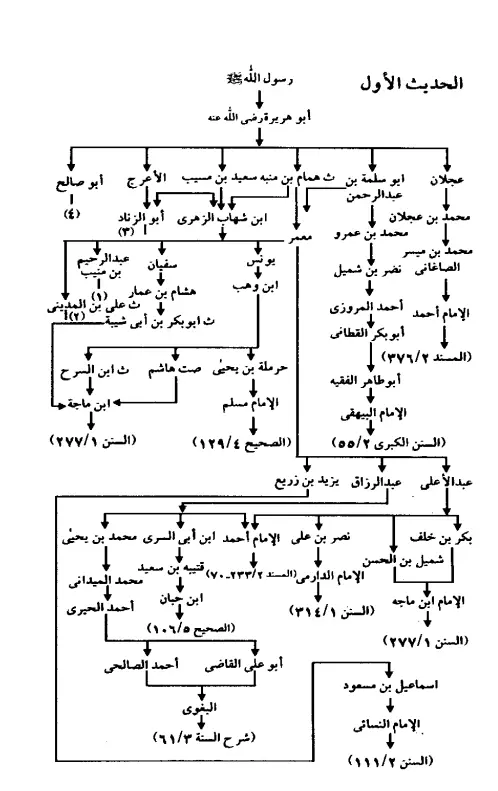
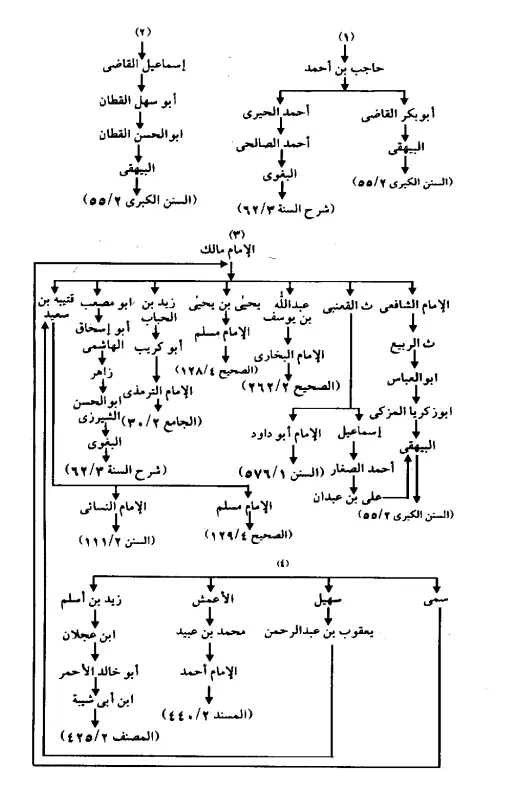
Each of the narrators of the above hadith reports from Imam Ibn Shihab with their chain, and he reports from Saeed bin Musayyib and Abu Salamah bin Abdur Rahman, both of whom narrated it from Hazrat Abu Hurairah (may Allah be pleased with him):
أن النبى صلى الله عليه وسلم قال: إذا أمن الإمام فآمنوا فإنه من وافق تأمينه تأمين الملائكة غفر له ما تقدم من ذنبه
“Indeed, the Prophet (peace be upon him) said: When the Imam says Amin, you should also say Amin, for whoever’s Amin coincides with the Amin of the angels, all his previous sins will be forgiven.”
The authentication of this hadith is as follows:
All these narrators with their chains report from Abu Salih, who reports from Hazrat Abu Hurairah (may Allah be pleased with him):
أن رسول الله صلى الله عليه وسلم قال: إذا قال الإمام غير المغضوب عليهم ولا الضالين فقولوا آمين
“Indeed, the Messenger of Allah (peace be upon him) said: When the Imam غَيْرِ الْمَغْضُوبِ عَلَيْهِمْ وَلَا الضَّالِّينَ says, you should say Amin.”
All the above narrators with their respective chains report from Hazrat Abu Hurairah (may Allah be pleased with him):
“Indeed, the Messenger of Allah (peace be upon him) said: When the Imam غَيْرِ الْمَغْضُوبِ عَلَيْهِمْ وَلَا الضَّالِّينَ says, you should say Amin.”
Ruling of the First Hadith:
The first hadith narrated through Hazrat Abu Huraira (may Allah be pleased with him) is agreed upon in terms of authenticity, as is evident from the fact that Imam Bukhari and Muslim have included this hadith in their books.
Second Hadith
Imam Tirmidhi says: We were informed by (1) Bandar Muhammad bin Bashar, who said that (2) Yahya bin Saeed and (3) Abdur Rahman bin Mahdi narrated to us; both of them said that (4) Sufyan narrated to us, who narrated from (5) Salmah bin Kahil, who narrated from (6) Hujr bin Anbas, who narrated from (7) Hazrat Wa’il bin Hujr (may Allah be pleased with him), who said:
سمعت النبى صلى الله عليه وسلم قرأ غير المغضوب عليهم ولا الضالين فقال: آمين ومد بها صوته
“I heard the Prophet (peace be upon him) reciting غَيْرِ الْمَغْضُوبِ عَلَيْهِمْ وَلَا الضَّالِّينَ, then the Prophet (peace be upon him) said Ameen and raised his voice while saying Ameen.”
Brief Introduction of the Narrators of the Above Hadith:
(1) Muhammad bin Bashar bin Uthman, his name, Abdi, Basri is his nisbah, and Abu Bakr Bandar is his kunyah and title. He is a trustworthy narrator, belongs to the tenth generation, and lived over 80 years. He is a narrator of Bukhari and Muslim.
(2) Yahya bin Saeed bin Faroukh, his name, Istimi is his nisbah, and Abu Saeed al-Qattan is his kunyah and title. He is trustworthy, precise, memorizer, imam, and role model, belongs to the ninth generation, lived 89 years, and is a narrator of the six authentic books (Sihah Sitta).
(3) Abdur Rahman bin Mahdi, his name, al-Anbari al-Basri is his nisbah, and Abu Saeed is his kunyah. He is trustworthy, reliable, memorizer, knowledgeable in men and hadith, possessing praiseworthy qualities, belongs to the ninth generation narrators, lived a total of 73 years, and is a narrator of the six authentic books.
(4) Sufyan bin Saeed bin Masruq, his honorable name, al-Thawri, al-Kufi is his nisbah, and Abu Abdullah is his kunyah. He is trustworthy, memorizer, jurist, worshipper, imam, and honored with the great titles of proof (Hujjah). He is counted among the great narrators of the seventh generation and sometimes he also practiced tadlis (concealment). His total age was 64 years. He is a narrator of the six authentic books.
(5) Salmah bin Kuhail, his name, al-Hadrami, Kufi is his nisbah, and Abu Yahya is his kunyah. He is trustworthy and counted among the narrators of the fourth generation. He is a narrator of the six authentic books.
(6) Hujr bin Anbas, his name, al-Hadrami, al-Kufi is his nisbah. Some say his kunyah is Abu al-Anbas, others say Abu Askan. He is a Mudharram (transmitter who lived in the time of the Prophet and the successors) and counted among the second generation. Various statements of the Imams of Jarh wa Ta’dil (criticism and accreditation) about him are as follows:
1- Among the strict Imams, Imam Ibn Ma’in says: A Kufan Sheikh, well-known trustworthy.
2- Among the comparers, Imam Ibn Hibban mentioned him among the trustworthy.
3- Opinions of some other Imams:
Khatib Baghdadi says: He is trustworthy and he narrated a hadith from him about Jahr Amin. Imam Dar Qutni and some others have declared his hadith authentic. Among the later Imams, Hafiz Ibn Hajar said: He is truthful and Mudharram. Hafiz Dhahabi declared him trustworthy.
And Allah knows best the truth. From the statements of the Imams of Hadith, it appears that Hujr bin Anbas is a trustworthy narrator because Imam Ibn Ma’in has declared his trustworthiness even though he is counted among the strict ones, and Imam Ibn Hibban mentioned him among the trustworthy although he is lenient in accreditation matters, but he did not oppose anyone in accrediting Hujr bin Anbas. Similarly, Khatib Baghdadi also declared his trustworthiness, which agrees with Ibn Ma’in’s accreditation, and Imam Dhahabi also declared him trustworthy. Hafiz Ibn Hajar’s calling him “truthful” will be considered contrary to the statements of the mentioned Imams.
(7) Hazrat Wa’il bin Hujr, may Allah be pleased with him, son of Rabi’ah bin Wa’il bin Ya’mur, is his honorable name and Hadrami is his nisbah. He is a great and venerable companion of the Prophet, belonged to the kings of Yemen, resided in Kufa, and died during the reign of Hazrat Amir Muawiyah, may Allah be pleased with him.
Hadith Authentication:
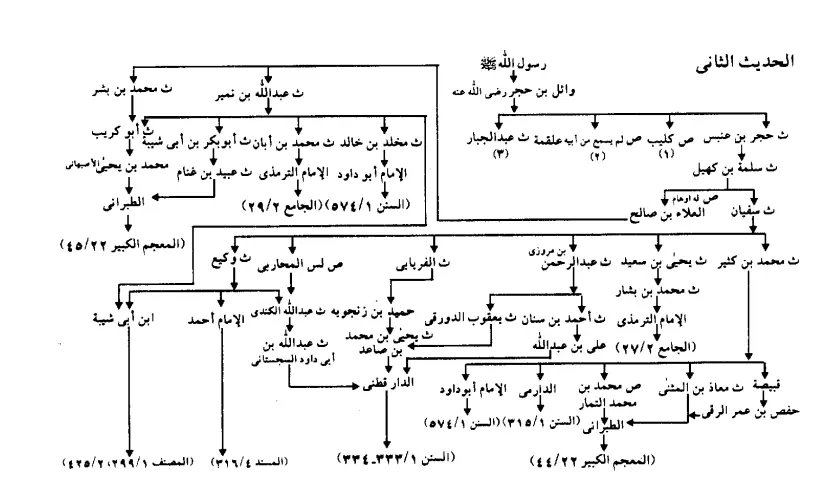
All the above narrators, with their respective chains, narrate from Sufyan, who narrates from Sulaymah bin Kahil, who narrates from Hujr bin Anbas, and he narrates from Hazrat Wail bin Hujr (may Allah be pleased with him) with these words:
سمعت النبى صلى الله عليه وسلم قرأ غير المغضوب عليهم ولا الضالين فقال: آمين ومد بها صوته
“I heard the Prophet (peace be upon him) recite غَيْرِ الْمَغْضُوبِ عَلَيْهِمْ وَلَا الضَّالِّينَ, then the Prophet (peace be upon him) said Ameen and raised his voice.”
And some narrations state that the Prophet (peace be upon him) used to raise his voice.
But Imam Abu Dawood, in the narration he brought from his teacher Muhammad bin Kathir, the words are:
كان رسول الله صلى الله عليه وسلم إذا قرأ ولا الضالين قال: آمين ورفع بها صوته
“When the Messenger of Allah (peace be upon him) recited وَلَا الضَّالِّينَ, he would say Ameen and raise his voice with it.”
And in one narration which he reports from his Sheikh Mukhlad bin Khalid Al-Sha’ri, the words are:
أنه صلى خلف رسول الله صلى الله عليه وسلم فجهر بآمين
“Indeed, when they prayed behind the Messenger of Allah (peace be upon him), they said Ameen aloud.”
And in Imam Darimi’s narration, which he reports from his Sheikh Muhammad bin Kathir, the words are:
إذا قرأ ولا الضالين قال: آمين ويرفع بها صوته
“When he (peace be upon him) recited وَلَا الضَّالِّينَ, he would say Ameen and he used to raise his voice while saying Ameen.”
In Imam Dar Qutni’s narration, which he reports from his teacher Aqeel bin Muhammad bin Sa’id, and similarly in Imam Bayhaqi’s narration, which he reports from his teacher Abu Tahir Al-Faqih, the words are that the Prophet (peace be upon him) said Ameen and raised his voice.
And in Imam Sulaymah bin Shubayb’s narration, the words are that he said:
سمعت النبى صلى الله عليه وسلم إذا قال: ولا الضالين قال: آمين ورفع بها صوته فى الصلاة
“I heard the Prophet (peace be upon him) when he said وَلَا الضَّالِّينَ, he would say Ameen along with it and raise his voice in the prayer.”
And Abdullah Al-Hafiz added these words in his narration:
وطول بها
“Meaning he prolonged the Ameen.”
This hadith has also appeared in the following books:
All the above narrators narrate from Alaa bin Saleh Al-Asadi, from Sulaymah bin Kahil, from Hujr bin Anbas, from Hazrat Wail bin Hujr (may Allah be pleased with him) with these words:
أنه صلى خلف رسول الله صلى الله عليه وسلم فجهر بآمين وسلم عن يمينه وعن شماله حتى رأيت بياض خده
“That he (Hazrat Wail bin Hujr, may Allah be pleased with him) prayed behind the Messenger of Allah (peace be upon him), and in it the Messenger of Allah (peace be upon him) said Ameen aloud and then turned his salam to the right and then to the left until I saw the whiteness of his cheek.”
This narration has been transmitted by the following Imams in their books:
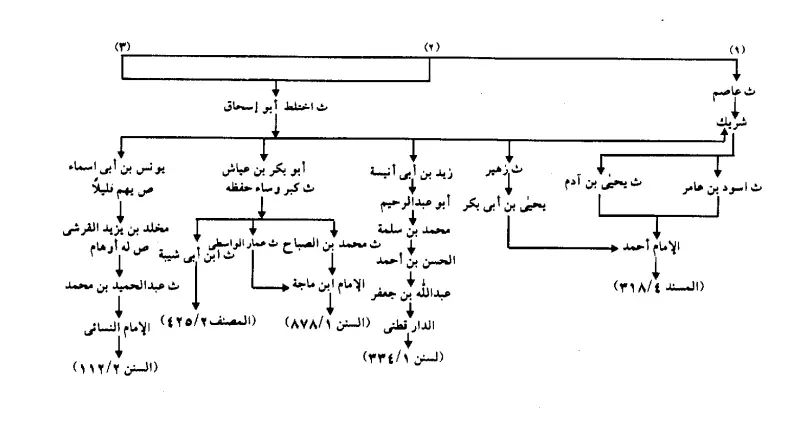
All the above narrators narrate from Ishaq, from Abd al-Jabbar bin Wail, from his father, who says:
صليت خلف رسول الله صلى الله عليه وسلم فلما قرأ غير المغضوب عليهم ولا الضالين قال: آمين فسمعته وأنا خلفه
“I prayed behind the Messenger of Allah (peace be upon him), so when he recited غير المغضوب عليهم ولا الضالين, the Prophet (peace be upon him) said Ameen. I heard him while I was behind him.”
And Ibn Majah’s wording is فَسَمِعْنَاهَا so we heard the Prophet (peace be upon him) saying Ameen.
And in Imam Ahmad’s narration, which he reports from his teacher Yahya bin Abi Bakr, the words are:
فقال: آمين يجهر
“So the Prophet (peace be upon him) said Ameen aloud.”
And Imam Ahmad also narrated this hadith in his Musnad with his chain from Hazrat Wail bin Hujr (may Allah be pleased with him):
أنه سمع النبى صلى الله عليه وسلم يقول فى الصلاة: آمين
“That he heard the Prophet (peace be upon him) saying Ameen in the prayer.”
These words are from Yahya bin Adam, and the words of Aswad bin Amir’s narration are:
يجهر بآمين
“That the Prophet (peace be upon him) used to raise his voice while saying Ameen.”
Ruling of the Second Hadith:
❀ Regarding the second mentioned hadith, Imam Tirmidhi says:
“Wail bin Hujr رضي الله عنه‘s narration is Hasan.”
And Sheikh Albani رحمه الله says:
“The chain of this hadith is good, and except for Hujr bin Anbas, all other narrators are narrators of Bukhari and Muslim, and Hujr bin Anbas is a truthful narrator as mentioned in Taqreeb.”
Fadhilat al-Sheikh Ustadh al-Mukarram Muhammad Muzafar al-Shirazi حفظه الله says:
“By the grace of Allah, I say that according to Imam Tirmidhi, the chain of this hadith is authentic because all narrators in its chain are Huffaz, Athbat, and Imams except Hujr bin Anbas. After presenting the statements of scholars of Jarh wa Ta’dil, what has become clear to me is that Hujr bin Anbas is trustworthy because Imam Ibn Ma’in says about him: Sheikh, Kufiyy, trustworthy, famous, despite Imam Ibn Ma’in being strict, yet he authenticates him.”
And Imam Ibn Hibban has mentioned him among the trustworthy narrators.
And Khateeb Baghdadi says: He is trustworthy and in the chapter of “Ameen bil-Jahr” he has also authenticated a hadith from him.
Imam Dar Qutni and other Imams have declared his hadith authentic.
Imam Dhahabi also gave him authentication, so it is as clear as daylight that Hujr bin Anbas is trustworthy. However, it is not known why Hafiz Ibn Hajar called him “Saduq,” despite no scholar downgrading him from Thiqah to Saduq. If this is the case, then he is trustworthy and the hadith, InshaAllah, is authentic.
Even if it is hypothetically accepted that he is Saduq, then his following was by Abd al-Jabbar bin Wail bin Hujr رضي الله عنه who is trustworthy.
And similarly, Kalib did so who is Saduq.
Still, the hadith reaches the level of Hasan to Sahih. And Allah knows best the truth.
Third Hadith
Imam Ibn Khuzaymah says: Muhammad bin Yahya narrated to us, he says Saeed bin Abi Maryam narrated to us, he says Laith informed us, he says Khalid bin Yazid narrated to me, he narrates from Saeed bin Abi Hilal, who narrates from Naeem Al-Mujmir.
عن نعيم المجمر قال: صليت وراء أبى هريرة رضى الله عنه فقرأ بسم الله الرحمن الرحيم ثم قرأ بأم القرآن حتى إذا بلغ غير المغضوب عليهم ولا الضالين فقال: آمين فقال الناس: آمين ويقول كلما سجد: الله أكبر وإذا قام من الجلوس فى الاثنتين قال: الله أكبر وإذا سلم قال: والذي نفسي بيده إني لأشبهكم صلاة برسول الله صلى الله عليه وسلم
“Naeem Al-Mujmir says: I prayed behind Hazrat Abu Hurairah (may Allah be pleased with him), he recited Bismillah al-Rahman al-Rahim, then recited Surah Al-Fatiha, when he reached غير المغضوب عليهم ولا الضالين he said Ameen and the people also said Ameen, and when going into prostration he said Allahu Akbar, and when completing two rak’ahs and standing up, he again said Allahu Akbar, and when giving salam he said: I swear by the One in whose hand is my soul! My prayer resembles and is more similar to the prayer of the Messenger of Allah (peace be upon him) than your prayer.”
Brief Introduction of the Narrators of the Hadith:
(1) Muhammad bin Yahya bin Abdullah bin Khalid bin Fares bin Dhuaib al-Dihlī, al-Naysābūrī is his name and lineage. He is trustworthy and a Hafiz, a narrator of the eleventh generation, his total age is 86 years, and he is a narrator of Sahih al-Bukhari.
(2) Saeed bin Hikam bin Muhammad bin Salim bin Abi Maryam is his name, al-Jumahi is his lineage, and Abu Muhammad al-Masri is his kunyah. He is trustworthy, reliable, and a jurist, among the senior narrators of the tenth generation, and he lived for 80 years in total.
(3) Laith bin Saad bin Abdul Rahman is his name, al-Nabi al-Masri is his lineage, and Abu al-Harith is his kunyah. He is trustworthy, reliable, a jurist, and a famous Imam, a narrator of the seventh generation, and he passed away in Sha’ban.
(4) Khalid bin Yazid is his name, according to one opinion he is from Taymi, according to another opinion from Siksiki, and Abu Abdul Rahim is his kunyah. He is trustworthy and a jurist, belonging to the sixth generation.
(5) Saeed bin Abi Hilal is his name, al-Laithi al-Masri is his lineage, and Abu al-Alaa is his kunyah. According to one opinion, he was originally from Madinah. He is a narrator of the sixth generation. According to one opinion, he died after 30 AH, another opinion says he died before 30 AH, and a third opinion says he died before 50 AH. The statements of scholars of Jarh and Ta’dil about him are as follows:
1- Strict Imams:
Imam Abu Hatim says: لا بأس به، There is no harm in this.
2- Moderate Imams:
Imam Ahmad says: I do not know which thing among the hadiths is mixed up regarding him.
Imam Dar Qutni (may Allah have mercy on him) says: He is trustworthy.
3- Lenient Imams:
Imam Ali says: He is trustworthy.
Imam Ibn Hibban has recorded him among the trustworthy.
4- Other Imams:
Imam Ibn Saad, Ibn Khuzaymah, Khateeb Baghdadi, Ibn Abdul Barr, Bayhaqi have declared him trustworthy.
Imam Nasai says: He is truthful, and Ibn Hazm says: He is not strong.
5- Later Imams:
Hafiz Ibn Hajar says: He is trustworthy, Imam Al-Dhahabi says: He is trustworthy.
And Allah knows best the truth. What appears from the mentioned statements is that the saying of Abu Hatim should be taken as strictness, and Saeed bin Abi Hilal is a trustworthy narrator as Imam Dar Qutni and other Imams have explicitly stated.
And regarding Ibn Hazm’s declaring him weak, Hafiz Ibn Hajar says that he has not seen anyone among the Salaf agreeing with Ibn Hazm’s weakening, and he also said that except for Nasai, they narrated from Imam Ahmad that Saeed bin Abi Hilal became mixed up, for this reason Ibn al-Qais mentioned him in the first appendix of his book الكواكب النيرات.
(6) Naeem bin Abdullah is his name, Mawla Ahl Umar, Madani is his lineage, and he became more famous with the title Mujammar. He is a trustworthy narrator of the third generation.
Authentication of the Hadith:
All the narrators mentioned above, with their respective chains, narrate from Khalid, who narrates from Saeed bin Abi Hilal, who narrates from Naeem al-Mujammar, who says:
صليت وراء أبى هريرة رضى الله عنه ……. إليٰ آخر الحديث
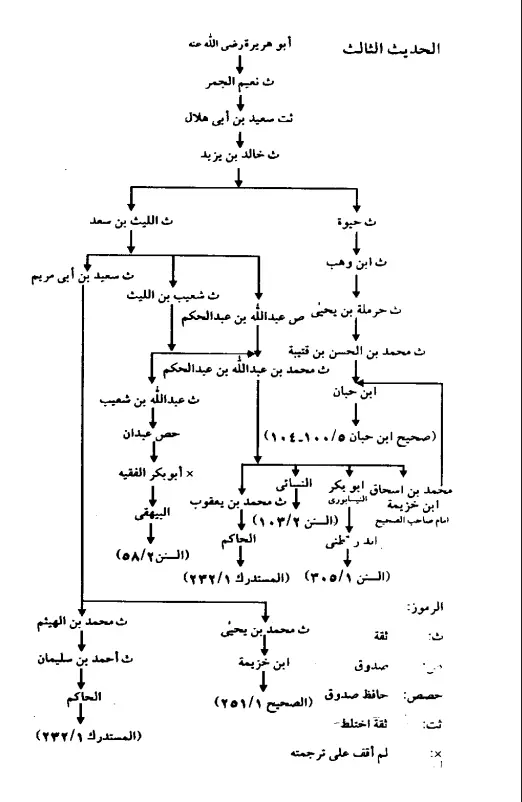
Ruling of the Third Hadith:
Imam Dar Qutni, after verifying this hadith in his Sunan, states: This hadith is authentic and all its narrators are trustworthy.
Imam al-Hakim, after mentioning it in Al-Mustadrak, says: This narration meets the conditions of the two Shaykhs (Bukhari and Muslim), but they did not include it in their collections.
Imam Bayhaqi states in Al-Khilafiyyat: All the narrators of this hadith are trustworthy, their uprightness is unanimously agreed upon, and their hadith is taken as proof and evidence in Sahih collections.
Imam Bayhaqi, may Allah have mercy on him, says in his Sunan: Abu Bakr bin al-Harith informed us, he said Ali bin Umar al-Hafiz said: This chain is Hasan (good), referring to the chain of this very hadith.
Imam Dhahabi, may Allah have mercy on him, agreeing with Imam al-Hakim, said: This narration meets the conditions of the two Shaykhs.
Sheikh Shuayb al-Arna’ut says: Its chain is authentic.
Furthermore, Sheikh Shuayb al-Arna’ut says: The chain of this hadith in Ibn Hibban meets Muslim’s conditions and is authentic.
Sheikh Albani mentioned this hadith in Da‘if Sunan al-Nasa’i and stated that its chain is weak.
Fadhilat al-Sheikh Muhammad Muzafar al-Shirazi, may Allah preserve him, says:
All the narrators of this hadith are trustworthy, as I have explained in the genealogy and table of the chains of this hadith. However, in Dar Qutni’s narration, one narrator is Siddiq (truthful) and that is Abdullah bin Abdul Hakim, who is the respected father of Muhammad bin Abdullah bin Hakim.
And in Imam Bayhaqi’s chain, two narrators are Hafiz and Siddiq, while all the others are trustworthy and reliable.
And Sheikh Hammad al-Ansari, following Sheikh Albani, says that Sheikh Albani followed Hafiz Ibn Hazm regarding the weakness of Saeed bin Abi Hilal, whereas he is not correct in this stance.
الكواكب النيرات فى معرفة من اختلط من الرواة الثقات، صفحه: 468، الملحق الأول
And Saeed bin Abi Hilal is mentioned in the first appendix of الكواكب النيرات, but it is not clear to me whether Khalid bin Yazid took narration from him before or after the mixing.
Fourth Hadith
Imam Ibn Majah, may Allah have mercy on him, says: Ishaq bin Mansoor narrated to us, he says: Abdul Samad bin Abdul Warith informed us, he says: Hammad bin Salmah narrated to us, he says: Suhail bin Abi Saleh narrated to us, he narrates from his father, who narrates from Hazrat Aisha, may Allah be pleased with her, who narrates from the Prophet, peace be upon him, that the Noble Prophet, peace be upon him, said:
ما حسدتكم اليهود ما حسدتكم على السلام والتأمين
“Indeed, the Jews do not envy you for anything as much as they envy you for your greeting (saying Salaam to one another) and saying Ameen.”
Brief Introduction of the Narrators of the Hadith:
(1) Ishaq bin Mansur bin Bahram, his name, Abu Yaqub is his kunyah and Istimi is his nisbah. He is a narrator of Bukhari, Muslim, Tirmidhi, and Ibn Majah, trustworthy and reliable, belonging to the eleventh generation of narrators.
(2) Abdul Samad bin Abdul Warith bin Saeed bin Zakwan, his lineage and Istimi, Al-Anbari, Al-Takhthuri are his nisbahs and Abu Suhail Al-Basri is his kunyah. He is truthful and reliable, and the companions of the six authentic books have also narrated from him. He belongs to the ninth generation of narrators.
(3) Hammad bin Salmah bin Dinar Al-Basri, his name and Abu Salmah is his kunyah. He is trustworthy, devout, and the most reliable of people. In his later years, his memory became variable. He is a narrator of Bukhari Muallaq, Muslim, and the four Sunan, and is among the prominent narrators of the eighth generation.
(4) Suhail bin Abi Salih Zakwan Al-Samman, his name, Abu Yazid Al-Madani is his kunyah. He is truthful, and in his later years his memory became variable. He is a narrator of the six authentic books, belongs to the sixth generation, and died during the caliphate of Khalifa Mansur.
(5) Zakwan is his name, Abu Salih Al-Samman Al-Zayyat is his kunyah and Al-Madani is his nisbah. He is a trustworthy and reliable narrator and used to trade oil and other goods towards Kufa. He belongs to the third generation and is a narrator of the six authentic books. He died in 101 AH.
(6) Aisha bint Abi Bakr Al-Siddiq (may Allah be pleased with her) is her name. She is Umm al-Mu’minin (Mother of the Believers). She is known with the title of Faqih of the Ummah and held a superior status among all the pure wives after Hazrat Khadijah (may Allah be pleased with her). She died in 57 AH.
Hadith Authentication:
Imam Ibn Majah and Imam Ibn Khuzaymah both narrate with their respective chains from Suhail bin Abi Salih, who narrates from his father, who narrates from Hazrat Aisha (may Allah be pleased with her), who narrates from the Prophet Muhammad (peace be upon him), who said:
ما حسدتكم اليهود ما حسدتكم على السلام والتأمين
“Indeed, the Jews do not envy you for anything as much as they envy you for your saying Salaam and Ameen.”
These words are from Sunan Ibn Majah.
And the words of Ibn Khuzaymah are as follows:
عن عائشة رضي الله عنها قالت دخل يهودي على رسول الله صلى الله عليه وسلم فقال: السام عليك يا محمد! فقال النبى صلى الله عليه وسلم وعليك ـ فى حديث طويل وفيه: إن اليهود قوم حسد وهم لا يحسدوننا على شيء كما يحسدوننا على السلام وعلى آمين
“Hazrat Aisha (may Allah be pleased with her) says: A Jew came to the Messenger of Allah (peace be upon him) and said, ‘O Muhammad! May death come upon you.’ The Prophet (peace be upon him) replied, ‘Upon you.’ And there is a long hadith in which these words appear that the Prophet (peace be upon him) said: The Jews are an envious people, and they do not envy us for anything as much as they envy us for our saying Salaam and Ameen.”
This hadith has been recorded by Imam Ahmad
and Imam Bayhaqi
.
The above two narrators, with their respective chains, narrate from Muhammad bin al-Ash’ath, who narrates from Hazrat Aisha (may Allah be pleased with her), who says:
بينا أنا عند النبى صلى الله عليه وسلم إذا استأذن رجل من اليهود فأذن له فقال: السام عليك، فقال النبى صلى الله عليه وسلم وعليك وفيه إنهم لا يحسدوننا على شيء كما يحسدوننا على يوم الجمعة التى هدانا الله لها وضلوا عنها وعلى قولنا خلف الإمام: آمين
“Once I was with the Messenger of Allah (peace be upon him) when a man from the Jews asked for permission. The Prophet (peace be upon him) granted him permission (to enter upon the Prophet). Then he said: ‘May death come upon you.’ The Prophet (peace be upon him) replied: عليك meaning ‘May it come upon you.'”
And in the same hadith, these words also appear that the Prophet (peace be upon him) said:
“The Jews do not envy you for anything as much as they envy you for your Friday, the day towards which Allah has guided us, and from which He has led the Jews astray and deprived them, and for our Qiblah, towards which Allah has guided us and from which the Jews have gone astray, and for our saying Ameen behind the Imam.”
And in Musnad Ahmad, these words and the narration of Imam Bayhaqi, which he narrates from his Sheikh Abi al-Hasan Ali bin Muhammad bin Ali al-Maqri, are similar.
And the words of the narration of Abi Zakariya bin Abi Ishaq al-Muzakki are as follows:
لم يحسدونا اليهود بشيء ما حسدونا بثلاث، التسليم، والتأمين واللهم ربنا لك الحمد
The Jews do not envy us for anything as much as they envy us for three things: saying Salaam, saying Ameen, and اللهُم رَبَّنَا لَكَ الْحَمْدُ.
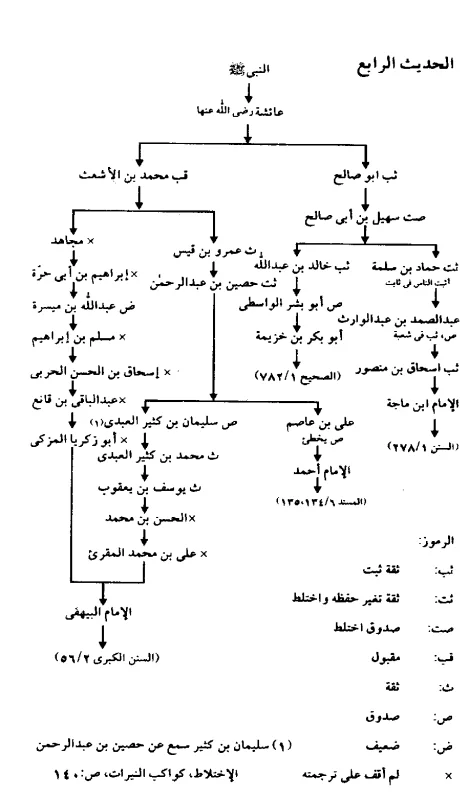
Ruling of the Fourth Hadith:
Sheikh Al-Albani has mentioned this hadith in Sahih Sunan Ibn Majah and has declared it authentic.
Similarly, this hadith has also been mentioned in Silsilat al-Sahihah.
And Dr. Muhammad Mustafa Al-A’zami states: The chain of narration of this hadith is authentic.
When Sheikh Al-Albani, may Allah have mercy on him, discussed the chain of narration of this hadith in Ibn Khuzaymah’s version, he said:
I say that the chain of narration of this hadith is authentic; all its narrators are trustworthy and narrators of authentic hadith.
And Abu Bishr Al-Wasiti, whose name is Ishaq bin Shaheen, is among the teachers of Imam Bukhari.
And Imam Al-Busiri states in “Zawa’id”: This chain is authentic and Imam Muslim has taken it as evidence and proof with all its narrators.
And Sheikh Al-Albani says: This hadith has various other chains of narration as well.
Hussain bin Abdul Rahman narrates from Umar bin Qais, who narrates from Muhammad bin Al-Ash’ath, who narrates from Umm al-Mu’minin Aisha, may Allah be pleased with her, with a marfu’ (elevated) narration, and he said that this chain is good; all its narrators are trustworthy except Muhammad bin Al-Ash’ath, the rest are narrators of Muslim and Imam Ibn Hibban has declared them trustworthy. A large group narrates from them and they are among the prominent Tabi‘in. He said that for the translation of this, the hadith of Hazrat Anas, may Allah be pleased with him, is a witness with these words:
إن اليهود ليحسدونكم على السلام والتأمين وھو الصحیح
Indeed, the Jews envy you for your saying the salam and saying Ameen.
And that hadith is authentic.
Fadhilat al-Sheikh Ustadh Muhammad Muzafar Al-Shirazi, may Allah preserve him, says:
“This hadith is authentic with all its routes and all its chains of narration, as you have observed from the genealogy and table of the chains of this hadith.”
Fifth Hadith
Imam Tabarani says: We were narrated by (1) Mu’adh bin Al-Muthanna, who says: We were narrated by (2) Abu Al-Aaliyah, who says: We were narrated by (3) Shu’bah, who narrates from (4) Salmah bin Kaheel, who says: I heard from (5) Hujr bin Anbas, who narrates from (6) Hazrat Wail bin Hujr رضي الله عنه:
أنه صلى خلف النبى صلى الله عليه وسلم فلما قال: ولا الضالين قال: آمين فأخفى بها صوته، ووضع يده اليمنى على اليسرى ويسلم عن يمينه وعن يساره
“He (i.e., Hazrat Wail bin Hujr رضي الله عنه) prayed behind the Prophet Muhammad صلى الله عليه وسلم. When the Prophet صلى الله عليه وسلم said وَلَا الضَّالِّينَ, he said ‘Ameen’ quietly, lowering his voice, and placed his right hand over his left hand. The Prophet صلى الله عليه وسلم then turned his face to the right and left to give salaam.”
Brief Introduction of the Narrators of the Hadith:
(1) Mu’adh ibn al-Muthanna ibn Mu’adh ibn Mu’adh ibn Nasr ibn Hassan. His name, Abu al-Muthanna is his kunyah, and al-Anbari is his nisbah. He was a resident of Baghdad, narrated from Muhammad ibn Kathir al-Abdi and others, and is trustworthy. He was born in 208 AH and passed away in 286 AH on a Monday, two days before Rabi’ al-Awwal. He was buried in the cemetery of Bab al-Kufa beside Karimi. Tabarani and Khateeb Baghdadi narrated from him.
(2) Hisham ibn Abd al-Malik. His name, Abu al-Walid is his kunyah, and al-Tayalisi al-Basri is his nisbah. He is a ninth-grade trustworthy and reliable narrator. He died in 227 AH, and his total age was 94 years. He is a narrator of the six authentic books (Sihah Sitta).
(3) Shu’bah ibn al-Hajjaj ibn Ward al-‘Ataki. His name, Abu Bastam is his kunyah, and al-Wasiti al-Basri is his nisbah. He is trustworthy, a hafiz, and precise. Sufyan al-Thawri said: Shu’bah is the Amir al-Mu’minin in hadith and he is the first person who investigated narrators in Iraq and defended the Sunnah of the Prophet ﷺ. He was a worshipper of the seventh class. He died in 160 AH and is a narrator of the six authentic books (Sihah Sitta).
(4) Salmah ibn Kahil, his translation has already passed.
(5) Hujr ibn Anbas, his translation has also passed.
(6) Wa’il ibn Hujr رضي الله عنه al-Hadrami, his translation has also passed.
Hadith Authentication:
The above five Imams narrate from their respective chains from Shu’bah from Salmah bin Kaheel from Hujr bin Abi al-Anbas, who says: I heard Alqamah narrating from Hazrat Wail bin Hujr (may Allah be pleased with him) or Hujr heard it from Hazrat Wail bin Hujr (may Allah be pleased with him), who says: The Messenger of Allah (peace be upon him) led us in prayer, and when he recited غَيْرِ الْمَغْضُوبِ عَلَيْهِمْ وَلَا الضَّالِّينَ, he said Ameen, and while saying Ameen, he lowered his voice and placed his right hand over his left hand and turned his salutation to the right and left sides.
However, Imam Bayhaqi did not mention this additional phrase:
وضع يده اليمنى على يده اليسرى وسلم عن يمينه وعن يساره
“Placed his right hand over his left hand and turned his salutation to the right and left sides.”
And Hujr Abu al-Anbas narrates in the chains of the mentioned Imams from Hazrat Wail bin Hujr (may Allah be pleased with him) through Alqamah, and in the narration of al-Tabarani, which he narrates from his Sheikh Mu’adh bin al-Muthanna and Abi Muslim al-Hujami, it is without the intermediary of Alqamah as you have observed in the table.
And Imam al-Tabarani also narrated in his
from Mu’adh bin al-Muthanna, who says: Abu al-Walid narrated to us and Abi Muslim al-Hujami says: Hajjaj bin Nasir narrated to us, both from Shu’bah from Salmah bin Kaheel who says: I heard Hujr Abu al-Anbas narrating from Hazrat Wail bin Hujr (may Allah be pleased with him) that:
أنه صلى مع رسول الله صلى الله عليه وسلم حين قال ولا الضالين قال: آمين، وأخفى بها صوته ووضع يده اليمنى على اليسرى وجعلهما على بطنه وكان إذا قال سمع الله لمن حمده قال اللهم ربنا لك الحمد ويسلم عن يمينه وعن يساره تسليمتين
“They prayed with the Noble Prophet (peace be upon him), and when he said وَلَا الضَّالِّينَ, he said Ameen and lowered his voice while saying Ameen, placing his right hand over his left hand and both hands on his stomach, and when he said سَمِعَ اللَّهُ لِمَنْ حَمِدَهُ, they said along with him: اللَّهُمَّ رَبَّنَا لَكَ الْحَمْدُ and turned their salutation to the right and left sides. And these words are from Abi Muslim al-Kahbi.”
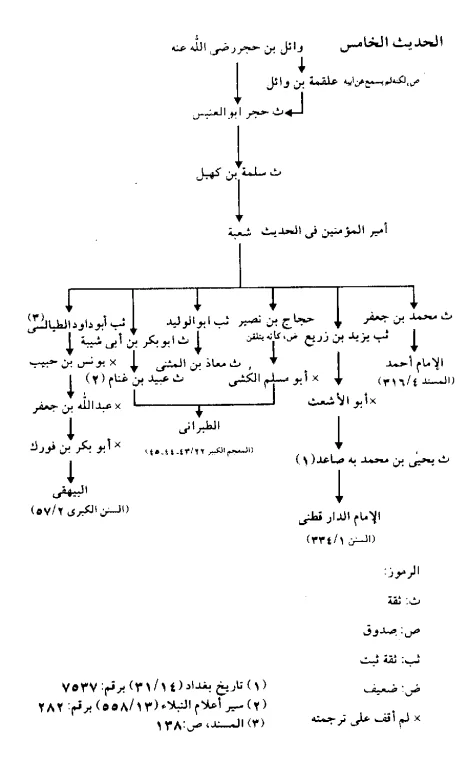
Ruling of the Fifth Hadith:
Imam Tirmidhi, may Allah have mercy on him, states in Jami’ Tirmidhi:
Shu’bah narrated this hadith of Ibn Wa’il, may Allah be pleased with him, from Salmah bin Kuhail, who narrated from Hujr bin Anbas, who narrated from Alqamah, who narrated from his father Wa’il, may Allah be pleased with him:
أن النبى صلى الله عليه وسلم قرأ غير المغضوب عليهم ولا الضالين فقال: آمين وخفض بها صوته
Indeed, when the Prophet صلى الله عليه وسلم recited غَيْرِ الْمَغْضُوبِ عَلَيْهِمْ وَلَا الضَّالِّينَ, he said Ameen, and while saying Ameen, he lowered his voice.
Imam Abu Isa Tirmidhi, may Allah have mercy on him, says: I heard Muhammad bin Ismail Bukhari, may Allah have mercy on him, saying that regarding Ameen, Shu’bah’s hadith is less authentic and correct than Sufyan’s hadith.
Shu’bah made several mistakes in narrating this hadith:
1. Shu’bah said: ‘from Hujr Abi al-Anis,’ which is incorrect because his correct name is Hujr bin Anbas and his kunya is Abu Sakan.
2. Shu’bah added extra words in this hadith: ‘from Alqamah bin Wa’il,’ whereas it is not narrated from Alqamah but from Hujr bin Anbas, who narrated from Wa’il bin Hujr, may Allah be pleased with him.
3. Shu’bah said: خفض بها صوته that while saying Ameen, the Prophet صلى الله عليه وسلم lowered his voice.
These words are incorrect; the correct words are: مد بها صوته that while saying Ameen, the Prophet صلى الله عليه وسلم raised his voice. Imam Tirmidhi, may Allah have mercy on him, says: I asked Abu Zur’ah, may Allah be pleased with him, about this hadith, and he said that Sufyan’s hadith regarding Ameen is more authentic than Shu’bah’s hadith.
He also said: This hadith was narrated by ‘Alaa bin Salih al-Asadi from Salmah bin Kuhail in the same manner as Sufyan’s narration.
Imam Bayhaqi, may Allah have mercy on him, said the same thing that Imam Tirmidhi said about this hadith, then narrated the hadith with his chain from Shu’bah, who narrated from Salmah bin Kuhail. He says: I heard Hujr bin Anbas, who narrated from Wa’il bin Hujr, may Allah be pleased with him, that he prayed behind the Messenger of Allah صلى الله عليه وسلم, and when the Prophet صلى الله عليه وسلم said وَلَا الضَّالِّينَ, at that time he said Ameen raising his voice.
This hadith has been narrated from Wa’il bin Hujr, may Allah be pleased with him, through two other different chains similar to Thawri’s narration.
Mubarakpuri, may Allah have mercy on him, says:
If it is said that Imam ‘Ayni, may Allah have mercy on him, also responded to the matter which Imam Tirmidhi attributed to Shu’bah as his second mistake and said: Imam Shu’bah’s statement: زاد فيه علقمة (in which Alqamah added some words) is not harmful because an addition by a trustworthy narrator is acceptable, especially when it is someone like Shu’bah, then it is even more acceptable.
And Fadhilat al-Sheikh Muzaffar al-Shirazi, may Allah preserve him, says:
We say that you have just read that Shu’bah, may Allah have mercy on him, makes many mistakes regarding narrators, and it is also clear that here Shu’bah is unique in mentioning this addition; no trustworthy or weak narrator has followed or agreed with this addition. Rather, Sufyan, ‘Alaa bin Salih, and Muhammad bin Salmah opposed Shu’bah in mentioning this addition; they did not mention this addition in their narrations.
And remember this especially that Sufyan is more memorizing than Shu’bah, and it is agreed that when Sufyan opposes, then Sufyan’s statement takes precedence. Despite all this, the master of hadith scholars, Imam Bukhari, may Allah have mercy on him, has established the ruling that Shu’bah erred in this addition.
All these evidences show that Shu’bah erred in mentioning this addition, and Allah Almighty knows best.
وقال خفض بها صوته وإنما هو مد بها صوته
“Shu’bah said that while saying Ameen, he lowered his voice, whereas the correct words are that while saying Ameen, he raised his voice.”
This is the third place among those where Shu’bah made a mistake and error. So Shu’bah’s statement خفض بها صوته is this error and mistake, whereas the correct is مد بها صوته as Sufyan, may Allah have mercy on him, narrated.
And if it is said that both Sufyan, may Allah have mercy on him, and Shu’bah, may Allah have mercy on him, are trustworthy, reliable, and commanders of the faithful in hadith, and neither of them is more prone to error than the other.
And if someone says that Sufyan, may Allah have mercy on him, erred in his statement مد بها صوته, then what evidence indicates that Shu’bah, may Allah have mercy on him, is the one who erred here?
Then Fadhilat al-Sheikh Muhammad Muzaffar al-Shirazi, may Allah preserve him, says:
We say that there are many evidences indicating Shu’bah’s error, among which are the following:
1. Sufyan al-Thawri, may Allah have mercy on him, and Shu’bah, may Allah have mercy on him, are both trustworthy and memorizing, but they are not equal in memorization; rather, Sufyan is more memorizing, and Shu’bah himself admitted and established this. Imam Dhahabi, may Allah have mercy on him, states in Tadhkirat al-Huffaz: كان شعبه يقول: سفيان أحفظ مني that Shu’bah used to say that Sufyan is ahead of me in memorization and precision.
And Imam Dhahabi, may Allah have mercy on him, elsewhere in Tadhkirat al-Huffaz says: Salih bin Juzah, may Allah have mercy on him, said: Sufyan is more memorizing than Shu’bah.
And Hafiz Ibn Hajar, may Allah have mercy on him, while compiling Tahdhib al-Tahdhib, says about Sufyan, may Allah have mercy on him: قال أبو حاتم وأبو زرعة وابن معين هو أحفظ من شعبة Imam Abu Hatim, Imam Abu Zur’ah, may Allah be pleased with them, and Ibn Mu’in said that Sufyan is more memorizing than Shu’bah.
2. It is as clear as daylight that when Shu’bah opposes Sufyan, then Sufyan’s statement takes precedence.
3. The third evidence is that Shu’bah’s statement خفض بها صوته has not been followed or agreed upon by any trustworthy or weak person. Whereas Sufyan’s statement: مد بها صوته has been followed by two narrators: one is ‘Alaa bin Salih, who narrated this hadith from Salmah bin Kuhail exactly like Sufyan’s hadith, and ‘Alaa bin Salih is a trustworthy narrator.
The other narrator is Muhammad bin Muslimah. After narrating Shu’bah’s narration, Imam Darqutni, may Allah have mercy on him, says that the words of this hadith are not as Shu’bah said: وأخفى بها صوته. It is said that this was a mistake by Shu’bah because Sufyan al-Thawri, Muhammad bin Muslimah, and other narrators narrated this hadith from Salmah bin Kuhail and said: رفع بها صوته that the Prophet صلى الله عليه وسلم said Ameen raising his voice. Muhammad bin Muslimah is weak, and from this, it becomes clear that both the trustworthy and weak narrators followed Sufyan, whereas no trustworthy or weak narrator followed Shu’bah.
Fadhilat al-Sheikh Muhammad Muzaffar al-Shirazi, may Allah preserve him, says: I say that when it is established that the words of Sufyan’s hadith مد بها صوته are the correct words and the words of Shu’bah’s narration وخفض بها صوته are a mistake and not correct, then it becomes clearer than the sun and as obvious as daylight that saying Ameen aloud and loudly is the preferred and customary practice.