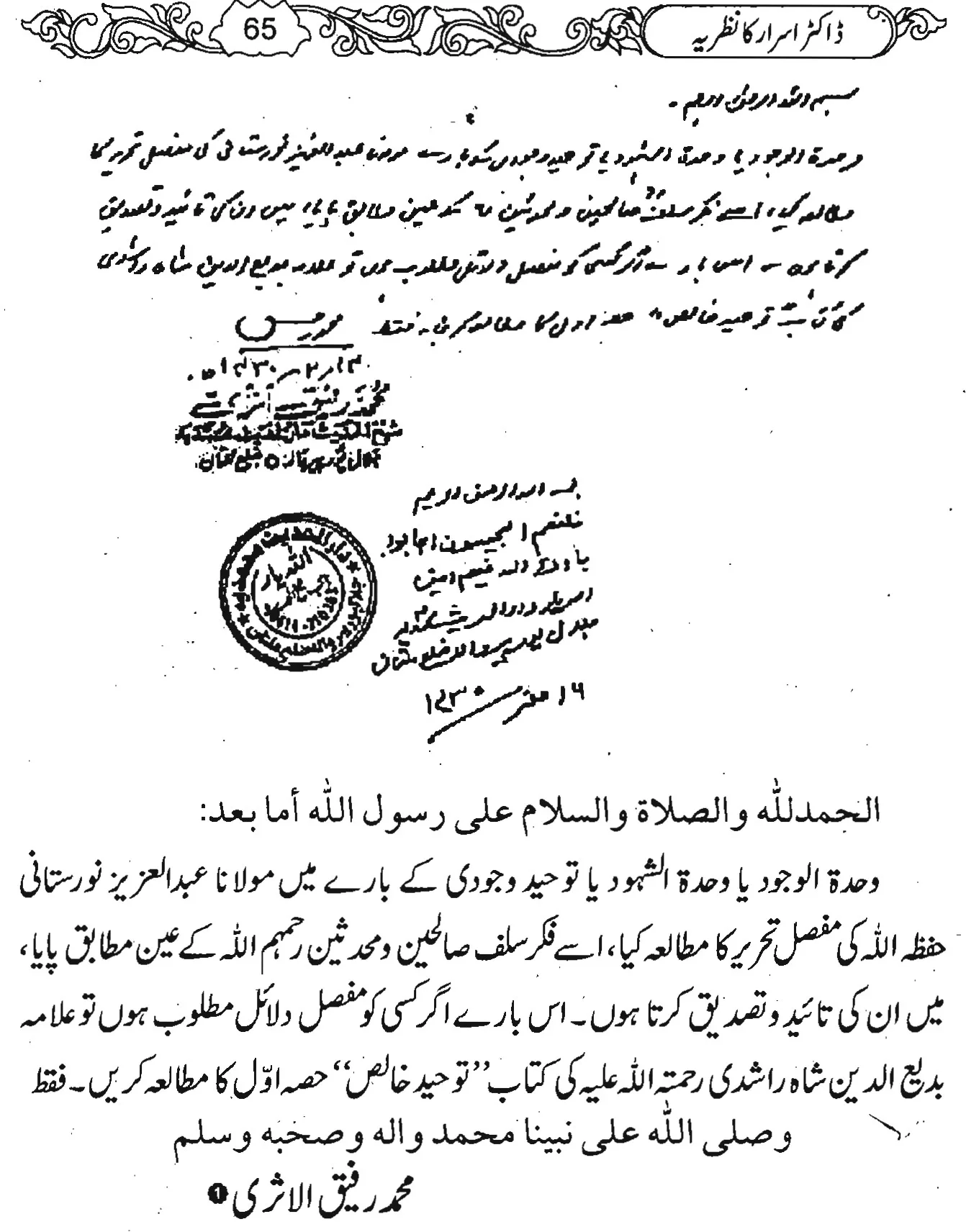
This excerpt is taken from the treatise compiled by Sheikh Abu Umar Abdul Aziz Al-Nuristani and other Ahl al-Hadith scholars, "Dr. Israr Sahib's Theory of Wahdat al-Wujud and Its Shariah Ruling" .
بسم الله الرحمن الرحيم
الحمد لله الذي استوى على عرشه بائن عن خلقه و مع عباده بعلمه
[یُدَبِّرُ الۡاَمۡرَ مِنَ السَّمَآءِ اِلَی الۡاَرۡضِ] [السجده:5]
[ لَیۡسَ کَمِثۡلِہٖ شَیۡءٌ ۚ وَ ہُوَ السَّمِیۡعُ الۡبَصِیۡرُ]
Reference: Ash-Shura:11
والصلاة والسلام على من دعا ربه [اللهم انت الأول فليس قبلك شیئى وانت الآخر فليس بعدك شيئى وانت الظاهر فليس فوقك شيئي وانت الباطن فليس دونك شيئى اقض عنى الدين و اغنني من الفقر]
Reference: Sahih Muslim: Book of Remembrance and Supplication, Chapter: Supplication at Sleep: Hadith: 6889
وعلى اله وصحبه الذين اجمعوا على معنى [وَهُوَ مَعَكُمْ أَيْنَ مَا كُنتُمْ۔۔۔۔
Reference: Surah Al-Hadid:4
]ونحوه من الآيات القرآنية ان ذلك علمه وان الله فوق السموت بذاته مستو على عرشه كيف شاء اما بعد:Allah Almighty has granted the Muslims the terminology of the Qur'an and Sunnah, freeing them from the terminology of the theologians, philosophers, and atheists, etc. Therefore, the pious predecessors and Imams are not among those who create their own terminology and make the Qur'anic texts and Hadiths subject to these innovative terms. Rather, by acting upon the Qur'an and Sunnah, they understood the Qur'an and Sunnah to be in accordance with clear intellect. Hence, they adopted every word that was mentioned in the Book and Sunnah regarding Allah's names, attributes, actions, and existence, whether in affirmation or negation, and they considered the method [brought by the Qur'an and Sunnah] as the clear intellect and authentic transmission, and this is the method of the Prophets and Messengers.
Therefore, the terminologies, expressions, beliefs, and theories that contradict the Qur'an and the Prophetic Sunnah are, step by step, misguidance, error, polytheism, and disbelief.
Wahdat al-Wujud or the interpretation of existential monotheism, however, whoever expresses it, in whatever way, and in the most beautiful and best manner, it is still disbelief and heresy, falsehood is falsehood, no matter how much it is expressed in a better and different style, whether the theory, belief, and interpretation are of Dr. Israr Ahmed, or Manazir Ahsan Gilani, or Sheikh Ahmad Sirhindi and Shah Waliullah Dehlvi, or Ibn Arabi, Ibn Sab'een, and Tlemsani, because the source and purpose of all is the same: [عبارتنا شتى و حسنك واحد]
Our forms are different but the purpose is your own expression.
After mentioning the agreement on Wahdat al-Wujud among all those who affirm it and the differences in its interpretation, Dr. Khalil says:
[ومهما يكن من فرق بين هذه الاقوال الثلاثة فهي متقاربة جدا لان جوهرها و احد]
No matter how much difference is made among these three statements, they are still very close to each other because their essential reality is the same.
Reference: Sharh al-Nuniyya lil-Haras:63/1
Three types of Tawheed are known from the Quran and Sunnah:
And the scholars اہل السنۃ والجماعۃ also describe these same three, which are:
① Tawheed al-Rububiyyah
② Tawheed al-Uluhiyyah
③ Tawheed fi al-Asma wa al-Sifat.
The concept of Wahdat al-Wujud (Unity of Existence) is neither explicitly mentioned nor hinted at in the Quran and Sunnah. None of the Companions, Followers, Followers of the Followers, or the Imams اہل السنۃ والجماعۃ have mentioned Wahdat al-Wujud.
Whether you call it Wahdat al-Wujud, Kufri Tawhid, or Shirk, whatever name you give it, it is false and not true Tawhid. Because true Tawhid is that which was explained by the Prophets and Messengers. Allah Almighty mentions some Prophets in Surah Ash-Shu'ara, and regarding each of them, He says that they said to their respective nations:
[اِنِّیۡ لَکُمۡ رَسُوۡلٌ اَمِیۡنٌ]،[فَاتَّقُوا اللّٰہَ وَ اَطِیۡعُوۡنِ]
[Indeed, I am to you a trustworthy messenger], [So fear Allah and obey me]
Reference: Ash-Shu'ara:108,107
The commentators explain this as follows:
[فاتقو الله بطاعته وعبادته، واطيعون، فيما أمر كم به من الايمان والتوحيد]
Fear Allah along with worship and obedience to Him, and obey me in what I command you regarding faith and Tawhid.
Reference: Ma'alim at-Tanzeel:121/6, Abu al-Saud:254/6
It has been understood that Tawheed is exactly what Allah taught through the Prophets and Messengers. And whoever creates a theory or belief on their own and calls it Tawheed or considers it Tawheed, Allah does not accept it. In any case, the belief of Wahdat al-Wujud, whether you call it Existential Tawheed, Existential Shirk, or Existential Kufr, this theory is pure disbelief and heresy.
Dr. Israr Sahib says:
I have already stated regarding Sheikh Ibn Arabi that as far as his opinion about the reality and essence of existence is concerned, I agree with it; my path is the same.
Reference: Brief Commentary on Surah Al-Hadid, page: 91
We have no objection if you adopt the belief and path of Ibn Arabi, or if as a Muslim, you prefer the belief, theory, and path of the Prophets for yourself. If you agree with Ibn Arabi and your path is the same as his, then may you be granted that path.
Now read the belief and theory of Ibn Arabi: He says that the existence of the universe is the very existence of Allah. The existence of the universe is not separate from the existence of Allah, and absolutely nothing exists except Allah [even jinn, devils, disbelievers, sinners, dogs, pigs, impurities, disbelief, sin, and disobedience] all their existence is the very existence of the Lord. These things are not separate from the essence of Allah, although they have become His creation and are dependent on Him.
Reference: Durr al-Ta'arud al-'Aql wal-Naql:118/6], [Al-Tabsirah fi al-Din:116], [Al-Farq Bayn al-Firaq:275,273/3]
Ibn Arabi writes:
[من عرف ما قررناه علم ان الحق المنزه هو الخلق المشبه]
Whoever understands what we have established will realize that the Truth, which is free from all defects and deficiencies, has been likened to the form of creation.
Reference: Fusus al-Hikam:78
He also writes:
[واذا اعطاه الله المعرفة بالتجلي كملت معرفته بالله]
[رأى سريان الحق في الصور الطبعية العنصرية، و ما بقيت له صورة الأويرى عين الحق عينها]
When Allah Almighty gave man complete knowledge of Himself through manifestation, [whereas Allah gave the Prophets knowledge of Himself through proofs and evidences, not through manifestation] then this person will see the Truth Almighty manifesting in the forms of elemental nature, and no form remains for Allah except that He sees the essence of Allah as exactly that elemental nature.
Reference: Al-Fusus:328
Then he writes:
[فان شهد النفس كان مع التمام كاملا فلا يرى الا الله في عين كل ما يرى فيرى الرائي عين المرئ]
When the self is present in full perfection, it sees nothing except Allah; whatever it sees appears as the very essence of the seer within itself.
Reference: Fusus:349
He also writes:
[فالعالم يعلم من عبدو فى اى صورة ظهر حتى عبدوان التفريق والكثرة كالاعضاء في الصورة المحسوسة وكالقوى المعنوية في الصورة الروحانية ، فما عبد غير الله في كل معبود]
Reference: Al-Fusus
Thus, the world knows its Lord in whatever form that Lord appears; in any case, worship is only for Him. [Whether in the form of a dog, or a donkey, or a pig, because in his view these beings are Allah Himself exactly and essentially. Without one existence, there is no other existence.] These various and multiple forms that appear are all limbs in the sensory form and a spiritual power in the spiritual form. Therefore, whichever Lord is worshiped, it is the worship of Allah alone. Whether it is an idol, a jinn, a dog, or a pig. If Doctor Sahib prefers Ibn Arabi’s doctrine over the Quran and Sunnah’s viewpoint and the path of the Prophets and Messengers, then so be it!
Doctor Sahib states that [regarding attributes] the unanimous decision of the theologians is that there is neither an attribute in the essence of Allah nor outside it,
Reference: A concise commentary on Surah Al-Hadid, p. 69
The doctor claimed it was a unanimous decision but did not specify the theologians, meaning whether the theologians were Islamic theologians or atheist theologians. Let me explain that neither "La 'Ayn wa la Ghair" is a unanimous decision of the theologians, nor is "La 'Ayn wa la Ghair" the view of Islamic theologians. Rather, the philosophers held the doctrine of La Ghair and the Karamiyyah held the doctrine of La 'Ayn. Ramadan Afandi states in Sharh Aqaaid Taftazani:
[ليست عين الذات كما ذهب اليه المعتزلة والفلاسفة، ولا غير الذات، كما زعمت الكراميه]
Meaning, Allah's attributes are neither identical with the essence, as the Mu'tazilah and philosophers say—that the attributes are identical with the essence—nor are they other than the essence, as the Karamiyyah say—that the attributes are other than the essence.
Reference: Al-Hashiyah li Ramadan Afandi 'ala Sharh al-Aqaaid li Taftazani:221
Islamic theologians and scholars [Ahl al-Sunnah] do not get caught up in this dilemma; they simply say that Allah's essence is characterized by all attributes of perfection, and these attributes of perfection are not separate [distinct] from that majestic essence.
It is strange that on one hand, the doctor clings to the creed and sect of Ibn Arabi, admitting: I agree with it and my sect is the same.
Reference: Brief Commentary on Surah Al-Hadid, p. 91
On the other hand, giving the example of ice and water to explain the connection and relationship between the Creator and the creation is declared as polytheism, stating:
It is as if everything is God and everything possesses divinity; what could be a greater form of polytheism than this? This is the theory of Wahm-e-Ost.
Reference: A Brief Explanation of Surah Al-Hadid, p.52
Then it is said: If it is claimed that all the relationships between the Creator and the creation that come to our mind are unacceptable, then one must accept only one existence, which is the existence of the Creator. This theory is called Wahdat al-Wujud (Unity of Existence).
Reference: p.52
For this, Maulana Manazir Ahsan Gilani, Sheikh Ahmad Sirhindi, Shah Waliullah Dehlawi, and Ibn Arabi Andalusi’s interpretations have been mentioned. Then it is stated that my own school of thought is the same. Strange!!! The Wahm-e-Ost view is great polytheism, and the theory of Wahdat al-Wujud is great Islam! The only difference is that in Wahm-e-Ost the word Tawhid is not used, and with Wahdat al-Wujud the word Tawhid is added, calling it Tawhid al-Wujud.Dear readers: Just think, __Hamah Oast__, and one existence must be accepted. Which is the existence of the Creator. What is the difference? __Hamah Oast__ also means that whatever is seen in the universe has no reality, but everything is Allah. And accepting only one existence, which is the existence of the Creator, also means that the beings in the universe have no real existence, but every being is Allah. How is the theory of __Hamah Oast__ shirk? And how is the theory of accepting only one existence [__Wahdat al-Wujud__] monotheism? May Allah protect us, this is like two winds under one roof.
It appears that the term __Hamah Oast__ was used by those atheists who did not adopt the cloak of Islam, and the term __Wahdat al-Wujud__ was used by those atheists who wore the cloak of Islam and undermined Islam and Islamic belief, such as Ibn Arabi, Ibn Sab'een, Afif Tlemsani, and others.
The doctor says: This is the theory of __Wahdat al-Wujud__ and __Wahdat al-Shuhud__, which Shah Waliullah described as __Tawheed al-Wujudi__. Its expression is لا معبود الا الله.
Reference: Brief commentary on Surah Al-Hadid, p. 55
This interpretation is actually a manifestation of hatred towards the word of Tawheed لا اله الا الله because Ibn Arabi and those of his sect mean لا معبود الا اللہ, which is: [فما عبد غير الله في كل معبود]
That is, whichever deity is worshipped, it is not the worship of anyone other than Allah, but it is the worship of Allah Himself.
Reference: Sharh al-Nuniyya p.62, with reference to Fusus al-Hikam
Imam Burhan al-Din al-Biqa'i, may Allah have mercy on him, explains the trick of using these words instead of ،،لا اله الا الله،،:
[ولعل في هذا ما يكشف لك عن علة مقت الصوفية لكلمة التقوى والتوحيد لا اله الا الله " وقولهم بدلا عنها ،،ليس الا الله،، او ،،لا هو الا هو،، و بهذا دان الغزالي وقرره في مشكاةالانوار ،،او،، ،هو الله، او ،،هو هو،، مصرع التصوف]
It may be that you learn the trick of the Sufis in considering the word of piety and Tawheed ،،لا اله الا اللہ،، as bad, that instead of ،،لا اله الا الله،، they say either Laysa ،،إلا الله،، or ،،لا هُوَ إِلَّا هُوَ،،, and Ghazali also considers this as religion; he has proven this in Mishkat al-Anwar. Similarly, ،،هو الله،، and ،،هُوَ هُو،، are also words of Sufism.
Reference: p.62
As I mentioned, the purpose of Ibn Arabi from لا معبود الا هو is that whoever is worshipped, that worship is of Allah alone. Because there is no difference between Allah and others, as one must accept only one existence, which is the existence of the Creator. According to Ibn Arabi and those of his sect, the difference between Creator and creation is shirk (polytheism). Accepting one existence is Tawhid (monotheism). Someone said to Ibn Arabi that in Fusus al-Hikam there is much opposition to the Quran. He replied: [القرآن كله شرك وانما التحقيق في كلامنا] meaning the Quran is full of shirk; the reality of Tawhid is in our statement [that we consider everything as the very essence of Allah and believe in the Unity of Existence].
Reference: Tawdhih al-Kafiyah al-Shafiyah, p.176
Imam Abdul Rahman bin Nasir al-Sa'di, may Allah have mercy on him, says:
[قاتل الله من عد هو الطائفة من امة محمد ﷺ وهم براء من جميع الانبياء ولا اظن احد يعرف قولهم وفي قلبه مثقال ذرة من ايمان فيستريب في أمرهم و يعرف انهم مباينون الدين كل المباينة]۔
May Allah destroy the person who counts this group [Ibn Arabi] among the Ummah of Muhammad. Whereas this group is free from the religion of all the Prophets. I do not think that anyone who knows their statement and has even a particle of faith in his heart would doubt their [disbelief], rather he will recognize that these people are completely separated from the religion.
Reference: Tawdhih al-Nuniyyah, p.177
Also, Dr. Israr Sahib says: "And at a high level," لا مقصود الا الله، لا مطلوب الا الله اور لا محبوب الا الله،
Dr. Sahib called it a high level because these words deny the Quran. Because Allah Almighty has repeatedly mentioned three benefits of worship in the Holy Quran: the pleasure of Allah, entering Paradise, and salvation from Hell, whereas ،،لا مقصود الا الله،، لا مطلوب الا اللہ،، states that neither salvation from Hell is the purpose, nor Paradise is desired. Rather, ،،لا محبوب الا الله،، if there is a purpose and desire, it is only the Beloved, who is Allah.
See: This meaning has been clarified by Shirani and Makki, who say, ،،لا نعبد الا الله ، لا لأجل الجنة،، "We worship Allah but not to attain Paradise."
Reference: Qut al-Qulub:56], [Al-Anwar al-Qudsiyyah:34/2]
Whereas اہل السنۃ والجماعة the agreed belief is that ،،ألا يمان بين الرجاء وَالْخَوْفِ،، faith is the hope for Allah's mercy and fear of Allah's punishment, Paradise is the manifestation of Allah's mercy, and Hell is His wrath, while Ibn Arabi and his group say that ،،لا مقصود ولا مطلوب إلا الله،، meaning neither salvation from Hell is the purpose nor Paradise is desired. However, it is also a famous issue of اہل السنۃ والجماعۃ that:
[ من عبد الله بالحب وحده فهو ،،زنديق،، و من عبد بالرجاء وحده فهو ،،مرجئى،، ومن عبده بالخوف وحده فهو ،،حروري،، ومن عبده بدون الاخلاص فهو ،،المرائي المنافق،، ومن عبده بدون اتباع السنة فهو ،،مبتدع راهب ضال،، ومن عبده بالحب والخوف والرجاء فهو ،،مؤمن موحد،،]
That is, the one who worships Allah solely out of love is a "Zindiq." And the one who worships only out of hope is a "Murji." And the one who worships only out of fear is a "Haruri Khawariji." And the one who worships without sincerity is a "Hypocritical Riyaakar." And the one who worships without following the Prophetic Sunnah is an "Innovative Misguided Sufi." And the one who worships out of love, fear, and hope is a true believing monotheist.
Reference: Al-Maturidi by Dr. Shams, may Allah have mercy on him: 189/3 with slight variation
Look, they call the Ahl al-Sunnah ،،لا مقصود الا الله ، لا مطلوب الا الله اور لا محبوب الا اللہ،، "Zindiq."
Then the doctor says that further on, its interpretation is made from ،،لا موجود الا اللہ،،.
Reference: Brief Commentary on Surah Al-Hadid, p. 55
This means that a person reaches the peak of disbelief (Zulwat al-Kufr) with the belief of ،،لا موجود الا اللہ،،. Because this degree is more false in the sight of Shariah than "La Maqsood," "La Matloob," and "La Mahbub," since it explicitly states that the entire universe is Allah.
Dr. Shams al-Din Salafi, may Allah have mercy on him, says:
[لان هذا صريح في ان السماء والأرض و ما فيهما من الأجسام العظام كالجبال والأجرام والأشجار والأحجار والبحار والأنهار بل الدواب والكلاب والقردة والخنازير وآنية الخمور و آلات المزامير، وغيرها هو الله بعينه، نعوذ بالله من هذا الكفر البواح والحاد الصراح]
The theory and belief of ،،لا موجود الا اللہ،، is false because, according to this theory, the sky and the earth and everything in them, including the great mountains, celestial bodies, trees, stones, seas, rivers, and even cattle, dogs, monkeys, pigs, vessels of wine, and musical instruments, etc., are all exactly Allah. We seek refuge in Allah from this blatant disbelief and clear atheism.
Reference: Al-Maturidi:192,191/3
Dr. Israr Sahib says: Whenever you feel like it, pick up this theory and throw it away. If it appears unacceptable to you, then completely reject it.
Reference: Brief Commentary on Surah Al-Hadid, p.55
While the doctor himself is permitting to reject and throw away this theory, it becomes clear that this theory is not correct. If it were true, then as a Muslim, how could you permit rejecting and discarding a true belief and doctrine proven by the Quran and Sunnah? Then what is the need to spread this theory and waste time by overthinking it for yourself and others?
Oh Allah!! Please reflect on your ideology and sect.
Then it says: And those who have believed in this ideology should not be insulted nor should there be suspicion about them.
Reference: Brief Explanation of Surah Al-Hadid, p:55
When we know that this ideology of Wahdat al-Wujud is one hundred percent wrong, and Allah's Book, the Hadiths of the Messenger of Allah ﷺ, and the consensus of the Ummah bear witness to this, then legally it is permissible for us to insult those who hold this ideology and to have suspicion about them; in fact, it is obligatory upon us. Because a person says that there is no difference between Allah and a dog, no distinction between Allah and a pig. [May Allah protect us] So how can we not insult such a person and have suspicion about him?
The doctor says: In one respect, they are the same, and in another respect, they are different. The essence is unity in existence, etc. (That is) Allah and the universe are two aspects of the existence of the universe's individuals: one is absolute existence, the second is with regard to the manifestation of absolute existence. In terms of manifestation, Allah is Allah, the man is also Allah, the wife is also Allah, the dog is also Allah, the pig is also Allah, but there is a difference in manifestation. Ibn Arabi says in Fusus al-Hikam: [فالعالم يعلم من عبدو فى اى صورت ظهر حتى عبد وان التفريق والكثرة كا لأعضاء المحسوسة والقوى المعنوية في الصورة المعنوية فما عبد غير الله في كل معبود ]
The world knows its beloved in whatever form that beloved appears, and worship is performed accordingly. There is no doubt that the limbs of the body are not separate from the body, and the psychic power is not separate from the soul; similarly, if this multiplicity and plurality appear in multiplicity, they are not other than Allah.
The existence of Allah, the existence of the man, the existence of his wife, and the existence of the intercourse that the husband and wife engage in, all are one existence. There is no otherness in it, therefore all are the same God. Whether it manifests in the form of the man, it is still God; whether it manifests in the form of the wife, it is still God; whether it manifests in the form of intercourse, it is still God. ،،فما عبد غير الله فی کل معبود،، All are the existence of the same entity. This is the meaning of Wahdat al-Wujud (Unity of Existence). Although some say that it does not mean "Hum-o-Wast" (Pantheism) or some say there is a subtle difference between Wahdat al-Wujud and Hum-o-Wast, this subtle difference was erased by Ibn Arabi by saying [فما عبد غير الله في كل معبود]. If Hum-o-Wast is disbelief and polytheism, then Wahdat al-Wujud is even more so disbelief and polytheism. [فَاعْتَبِرُوا يَا أُولِي الْأَبْصَارِ]
The doctor says: So, in this regard, a baseless conception arises... etc.
Reference: Brief Commentary on Surah Al-Hadid, p. 57
This baseless conception is satanic and should be abandoned. The Messenger of Allah ﷺ said: [یأتی الشيطان أحد كم، فيقول من خلق كذا؟ من خلق كذا؟ حتى يقول: من خلق ربك؟ فاذا بلغه، فليستعذ بالله ولينته]
Satan comes to one of you and whispers in your heart and says, "Who created such and such thing? Who created such and such thing?" Until he says, "Who created your Lord?" When a person is afflicted with such whispers, it is obligatory upon him to seek refuge in Allah and abandon that satanic thought.
Reference: Bukhari:3276
There is no need to create unnecessary imaginations; when such a thought comes, say [اعوذ بالله من الشيطان الرجیم] and abandon that thought, otherwise you will fall into the pit of Wahdat al-Wujud.
Doctor Sahib says: The simple and easily understandable words chosen by the Holy Prophet ﷺ will be the best for the interpretation of the truth.
Reference: A Brief Explanation of Surah Al-Hadid, p. 57
After acknowledging this truth, what was the need to seek additional attributions? Why not be content with these simple and easily understandable prophetic words and why spoil your faith by getting entangled in philosophical subtleties?
Sheikh al-Islam Imam Ibn Taymiyyah, may Allah have mercy on him, said:
[ اما السلف والائمة فلم يدخلوا طائفة من الطوائف فيما ابتدعوه من نفى أو اثبات، بل اعتصموا بالكتاب والسنة، ورأ وا ذلك هو الموافق، لصريح العقل فجعلوا كل لفظ جاء به الكتاب والسنة من اسمائه وصفاته حقا يجب الايمان به --- ورأ وا أن الطريقة التي جاء بها القرآن هي الطريقة الموافقة لصريح المعقول و صحيح المنقول وهي طريقة الانبياء والمرسلين]
The Salaf and the Imams did not belong to any group that fabricated a theory regarding the affirmation or negation of Allah Almighty's attributes. Rather, they adhered to the Book and Sunnah and believed that these are in accordance with clear intellect. They considered every word related to Allah Almighty's names and attributes mentioned in the Quran and Sunnah as true and obligatory to believe in. They regarded this method, which is found in the Quran and Sunnah, as consistent with clear intellect and authentic transmission; this is the way of the Prophets and Messengers.
Reference: Majmoo' al-Fatawa: 25/6
If we also considered what is mentioned in the Quran and Sunnah as true and believed in it as obligatory, then we would not fall into any logical philosophy or sophistry. [ولكن لله في عباده شئون]
The doctor admits that: Since the Holy Quran does not want to adopt a philosophical style, therefore words have been chosen that an ordinary person and even a Bedouin can read and understand without any difficulty. And if he takes more time, then with reference to the Prophetic Hadith, his difficulty will be resolved, and he will pass through this easily.
Reference: p.58
From the doctor's admission, it is understood that the non-philosophical style of the Quran is simple and better. Allah Almighty says:
[وَلَقَدْ يَسَّرْنَا الْقُرْآنَ لِلذِّكْرِ فَهَلْ مِن مُّدَّكِرِ]
And indeed We have made the Quran easy to understand; is there anyone who will take admonition?
[يُرِيدُ اللهُ بِكُمُ الْيُسْرَ وَلا يُرِيدُ بِكُمُ الْعُسْرَ]
Allah's intention with you is ease, not hardship.
It is also understood that the Prophetic Hadith is the explanation of the Quran; the difficulties of the Quran are resolved through the Prophetic Hadith, not through a philosophical style.
After this acknowledgment, the doctor says: But the connection of Allah Almighty's essence with this entire chain of creation of the universe is that He is not separate from it.
Reference: A Brief Explanation of Surah Al-Hadid, p.58
If only the doctor had stopped at the acknowledgment of the truth mentioned above and had not changed this acknowledgment into denial, the logical consequence and reflection of "He is not separate" is that He is identical to it. This means that separation between Allah and the universe is not possible because contradiction means that the existence of one is possible without the other and separation of one from the other is conceivable. When Allah Almighty is not separate from the universe, it means that Allah is identical to the universe. And the universe is identical to Allah; this is outright atheism, vile disbelief, and denial of the Lord. This disbelief is even worse than the disbelief of the Christians.
Dr. Muhammad Khalil Haras, may Allah have mercy on him, says:
[هل تقول بان وجود الله غير وجود هذه الأكوان أو تراه عينها فاذا نفى مغايرة وجوده سبحانه لوجود خلقه- وقال: بل هو عينها وليس هناك غيران، فقد اتشح بثوب الاتحاد وصرّح على نفسه بالكفر وجحد وجود الرب جل شأنه بل كان أشد كفرا من النصارى عبدة الصلبان لأنهم لم يقولوا باتحاده سبحانه بجميع خلقه، ولكنهم خصوا ذلك بالمسيح وأمه مريم العذراء واما هذا الاتحادي فقد زعم ان الله متحد بجميع خلقه بما فى ذالك الحيوانات المنحطة من القردة و الخنازير و نحوها فلم يصنه عن الاتحاد بهذا الحيوانات وغيرها من المستقذرات]
That is, to the one who holds this (La Ghair) view, it will be asked whether he means that the existence of Allah Almighty is separate from the existence of these beings, or is it your belief that the existence of Allah Almighty is the very existence of the universe? If he denies the distinction between the existence of Allah and the existence of His creation and instead says that Allah's existence is the very existence of the universe, then here there is no "otherness." He has acknowledged Wahdat al-Wujud (Unity of Existence) and has openly declared his disbelief and denied the existence of the Lord. In fact, he is a more severe disbeliever than the Christians who worship the cross because they say that Allah's unity is with all creation, whereas the Christians have limited this unity to Jesus (peace be upon him) and his mother Maryam (peace be upon her). This unitarian believes that Allah Almighty is united with all creation, even with lowly animals like monkeys, pigs, etc. They have not spared Allah from these animals, impurities, and filth.
Reference: Sharh al-Nuniyyah by Dr. Khalil Harras:196/1], [Tawdhih al-Maqasid:396,393/1], [Al-Sawa'iq al-Mursalah:131/4]
Dear readers! Consider how dangerous is the belief and doctrine of Wahdat al-Wujud that the doctor has adopted, which uproots religion and faith. God forbid, if the doctor's position is correct, that the universe is not other than Allah, then Allah Almighty would not have distinguished the universe in the Holy Quran by [،،من دون الله،،من دونه،،من دونك،،من دوني، ،غير الله،،اله غیرہ،،]. Study the Quran, for Allah has mentioned ،،من دون اللہ،، seventy-one times in the Holy Quran, and ،،من دونہ،، with pronouns thirty-nine times, and ،،من دونك،، with the kaf of address in two places, and ،،من دونی،، with the first-person singular pronoun in three places.
Similarly, the word ،،غیر اللہ،، is mentioned twenty times, and the word ،،مالکم من اله غيره،، is mentioned ten times. It is astonishing that the doctor, being a Quranic exegete, says that the universe is not other than Him. This universe is neither the very essence of Allah nor other than Him, and one must accept only one existence. [فالی الله المشتكى]
If the doctor's theory is correct and he is right in this advice, and the intention is goodwill, then what concern does the religion have with the Messenger of Allah ﷺ rejecting anything other than Allah, and why has Allah mentioned it in the Holy Quran?
While presenting the meaning of Divine Presence, the doctor says: Our common people have a general notion about the Being of the Exalted Creator that He is present in a specific place and His existence is not everywhere in the universe.
Reference: A Brief Explanation of Surah Al-Hadid, p. 59
This notion is not of the common people but is a belief taught by Allah Almighty. That Allah Almighty is not everywhere, but He is established on the Throne. This being established on the Throne has been taught to us by Allah Almighty. In the Holy Quran, it is stated in seven different places in various ways [الرَّحْمَنُ عَلَى الْعَرْشِ اسْتَوَى]. Therefore, this common notion is the notion taught by the Holy Quran. The notion and belief contrary to this is false and against the Quran and Sunnah.
Then the doctor says: [وَهُوَ مَعَكُمْ أَيْنَ مَا كُنتُمْ] is generally understood to mean that He is with us only in terms of His attributes. This is an interpretation, whereas the words are [وَهُوَ مَعَكُمْ أَيْنَ مَا كُنتُمْ]. This interpretation does not truly do justice to these words. How is He with us? We do not know, but He is with us everywhere and at every moment.
[وَهُوَ مَعَكُمْ أَيْنَ مَا كُنتُمْ] These words are very clear and leave no room for interpretation.
Reference: A brief commentary on Surah Al-Hadid, p.59
There are three points to consider in the doctor's statement:
① This is an interpretation.
② How is He with us? We do not know.
③ He is with us everywhere and at every moment.
There is no doubt that the meaning of companionship is support and assistance, and in terms of knowledge and comprehension, it is evidently established from the text and the reality of the text. The Arabic lexicon also confirms this. There is no room for any interpretation, nor should the word be diverted from its apparent and real meaning. Because when the word ،،مع،، is applied, it means absolute companionship and association, not mixing (confusion), touching, or being side by side. However, if it is restricted to a particular meaning among these, that is a different matter. The meanings we have explained are proven without interpretation from the Quranic text that this companionship is not mixing, touching, or being side by side, but rather attributes of knowledge, comprehension, support, and assistance. Accordingly, there are many examples of this in the Holy Quran.
① [وَكُنَّا نَخُوضُ مَعَ الْخَائِضِينَ] We used to engage in vain talk with those who indulge in idle disputes.
Reference: Al-Muddathir:45
Here, the preposition "with" does not mean mixing or touching, but rather that just as they engaged in idle talk, we also did so.
② [وَ بَنٰتِ خَالِکَ وَ بَنٰتِ خٰلٰتِکَ الّٰتِیۡ ہَاجَرۡنَ مَعَکَ] And the daughters of your maternal aunts who migrated with you. This verse clearly indicates that companionship here does not mean mixing or touching because none of the daughters of the Prophet’s ﷺ maternal aunts migrated with him.
Reference: Al-Ahzab:50
③ [فَتَرَبَّصُوۡۤا اِنَّا مَعَکُمۡ مُّتَرَبِّصُوۡنَ] So wait, indeed We are also with you waiting. Here, not everyone was sitting together waiting.
Reference: At-Tawbah:52
④ [فَانۡتَظِرُوۡا اِنِّیۡ مَعَکُمۡ مِّنَ الۡمُنۡتَظِرِیۡنَ] So wait, indeed I am also among those who wait with you.
Reference: Yunus:20
⑤ [وَ ارۡتَقِبُوۡۤا اِنِّیۡ مَعَکُمۡ رَقِیۡبٌ] Wait, I am also among those who wait with you.
Reference: Hud:93
In these and other similar verses, companionship only indicates association or company. Under no circumstances do they indicate touching, mixing, or being side by side. It is a common expression; for example, it is said [الامیر مع جندہ] The commander is with his army, although the commander is in his headquarters and the army is on the front lines. Similarly, the expression [مازلنا نسير والقمر معنا] We kept walking and the moon was with us, yet the moon was neither touching the walkers nor mixed with them.
When companionship with creation is permissible without physical contact, touch, or proximity, then it is all the more permissible for Allah. There is no question of interpretation in this.
[وَهُوَ مَعَكُمْ أَيْنَ مَا كُنتُمْ] And wherever you are, He is with you.
Reference: Al-Hadid:7
By companionship, I mean knowledge and encompassing without any interpretation. The verse itself indicates this meaning without interpretation; the beginning of the verse is also with knowledge: [يَعْلَمُ مَا يَلِجُ فِي الْأَرْضِ] He knows what is in the earth.
Reference: Al-Hadid:4
And at the end it says: [وَاللَّهُ بِمَا تَعْمَلُونَ بَصِيرٌ] And whatever you do, Allah is seeing it.
Reference: Al-Hadid:4
Similarly: [هُوَ مَعَهُمْ أَيْنَ مَا كَانُوا]
Reference: Al-Mujadila:7
By companionship, I mean knowledge and encompassing without any interpretation. The beginning of the verse is also with knowledge:
[أَلَمْ تَرَ أَنَّ اللَّهَ يَعْلَمُ مَا فِي السَّمَاوَاتِ وَمَا فِي الْأَرْضِ] Have you not seen that Allah is aware of whatever is in the heavens and the earth?
And the end is also with knowledge: [أَنَّ اللَّهَ بِكُلِّ شَيْءٍ عَلِيمٌ] Know that Allah is Knowing of all things.
And in the middle, there is also mention of knowledge: [ثُمَّ يُنَبِّئُهُم بِمَا عَمِلُوا] He will inform them of what they did.
Reference: Al-Mujadila:7
Similarly, in the verse of Surah Taha: [إِنَّنِي مَعَكُمَا أَسْمَعُ وَأَرَى] I am with you, and I hear and see.
Reference: Taha:46
Therefore, the meaning of Allah's companionship is not knowledge and encompassing, support and help as an interpretation, but it is the linguistic and idiomatic meaning.
It is the unanimous decision of اہل السنة والجماعۃ that the attributes of Allah as mentioned in the Quran and Sunnah must be accepted without asking how, without comparison, without metaphor, without corporealism, and without negation, and believing in them is obligatory. The knowledge of the modality is entrusted to Allah; asking the question how is He with us? is an innovation. As Imam Malik, who is famous for Allah's saying [الاستوا معلوم والكيف مجهول والسوال عنها بدعة], therefore, asking the question how is He with us? is an innovation. It is clear from the Quran and Sunnah that companionship means knowledge and encompassing, and belief in this is obligatory.
This belief and view is against the Quran, Sunnah, reason, transmission, and the consensus of اہل السنۃ والجماعۃ. There is consensus اہل السنتہ والجماعۃ that Allah is established on the Throne and due to His encompassing knowledge, He is present everywhere.
Abu Umar al-Talmanaki, may Allah have mercy on him, says:
[ واجمع المسلمون من اهل السنة على ان معنى قوله تعالى: هو معكم اين ماكنتم ونحو ذلك من القرآن: ان ذلك علمه وان الله فوق السموت بذاته مستو على عرشه كيف شاء].....
That is, there is a consensus among the Ahl al-Sunnah Muslims that the meaning of Allah's statement [وَهُوَ مَعَكُمْ] and other similar Quranic verses is that this companionship is in terms of knowledge, and He is established above the heavens on the Throne in terms of His essence, as befits His majesty.
Reference: Al-Uluw by Al-Dhahabi: p. 246 no. 566, Ijtima' al-Juyush al-Islamiyyah by Ibn al-Qayyim: 142, Al-Fatawa al-Hamawiyyah 175, Dar' Ta'arud al-'Aql wa al-Naql: 250/6
① From Ibn Abbas (may Allah be pleased with them) regarding the verse: [وَهُوَ مَعَكُمْ أَيْنَ ما كُنتُمْ، قال: عالم بكم اينما كنتم] He is Knower of whatever is with you wherever you are.
Reference: Tafsir Ibn Kathir: 67/8, Al-Tamhid by Ibn Abd al-Barr: 139,138/8, Al-Durr al-Manthur by Al-Suyuti: 49/8, Al-Fatawa al-Hamawiyyah: p.175
② From Malik ibn Anas he said: الله عز وجل في السماء وعلمه في كل مكان لا يخلو منه شئى وتلاهذه الآية [مَا يَكُونُ مِن نَّجْوَى ثَلَاثَةٍ إِلَّا هُوَ رَابِعُهُمْ وَلَا خَمْسَةٍ إِلَّا هُوَ سَادِسُهُمْ]
Reference: Al-Mujadalah: 7
Malik ibn Anas (may Allah have mercy on him) said: Allah, the Exalted, is in the heavens, and His knowledge is everywhere. There is no place devoid of Allah’s knowledge. Then he recited this verse: [مَا يَكُونُ مِن نَّجْوَى ثَلَاثَةٍ إِلَّا هُوَ رَابِعُهُمْ وَلَا خَمْسَةٍ إِلَّا هُوَ سَادِسُهُم]
Reference: Al-Sunnah by Abdullah ibn Ahmad: 106/1 no. 11
③ Imam Sufyan al-Thawri (may Allah have mercy on him): Someone asked him about the verse [وَهُوَ مَعَكُمْ أَيْنَ مَا كُنتُمْ], and he said: ،،علمہ،، This companionship is in His knowledge.
Reference: Al-Sunnah by Abdullah ibn Ahmad: 306/1 no. 597, Al-Bayhaqi in Al-Asma wa al-Sifat: 172/2, Al-Fatawa al-Hamawiyyah: p.175
④ Imam Ahmad (may Allah have mercy on him) was asked: [ما معنى قوله ،،هو معكم،، و ،،مايكون من نجوى ثلاثة الا هو رابعهم،، قال: علمه عالم الغيب والشهادة علمه محيط بكل شئى علام الغيوب، يعلم الغيب ربنا على العرش بلا حد و لاصفة]
What is the meaning of this verse: [وهو معكم او ما يكون من نجوى]...? The answer given is: Its knowledge (i.e., in these verses, the meaning of companionship and secret conversation is the knowledge of Allah) who is the Knower of the present and the absent. His knowledge encompasses everything, He is the Knower of all unseen matters. He knows the unseen, our Lord is on the Throne without limitation and without any attribute (meaning there is no limiting attribute to His being on the Throne).
Reference: Ijtima' al-Juyush by Ibn al-Qayyim: 200/2], [Usul I'tiqad Ahl al-Sunnah by al-Alkali: 402], [Al-Fatawa al-Hamawiyyah: 176
From the previous noble verses and the statements of اہل السنۃ والجماعة, it is understood that it is not correct to say that [هو معكم اینما کنتم] means He is present with us everywhere at all times, rather this is against the Quran and Sunnah. And success is from Allah.
⑨ The slander against Shaykh al-Islam Ibn Taymiyyah, may Allah have mercy on him, and its response:
The incident of Imam Ibn Taymiyyah, may Allah have mercy on him, that the doctor has narrated, is incorrect. Imam Ibn Taymiyyah, may Allah have mercy on him, never held this position. Neither Imam Ibn Taymiyyah, may Allah have mercy on him, nor his students have narrated this incident in any book. This is because the belief and viewpoint of Imam Ibn Taymiyyah, may Allah have mercy on him, and his students is the same as that presented by Imam Malik, may Allah have mercy on him, that descent (coming down) is a divine attribute, this is known. The manner of descent is unknown, and asking about the manner is an innovation. So how can Imam Ibn Taymiyyah, may Allah have mercy on him, describe the manner step by step? سبحانك هذا بهتان عظیم
Yes! Ibn Battuta has falsely attributed this lie to Imam Ibn Taymiyyah, may Allah have mercy on him. Ibn Battuta mentioned this in his
Reference: Rihla (110/1)
, where he says [ونزل درجة من درج المنبر] but this is merely a slander against Sheikh al-Islam, because historians agree on the fact that: [الامام ابن تیمیه اعتقل بقلعة دمشق الآخر مرة في اليوم السادس من شعبان سنة 726ھ ولم يخرج من السجن الاميتا]Imam Ibn Taymiyyah, may Allah have mercy on him, was imprisoned for the last time in the citadel of Damascus on the 6th of Sha'ban, 726 AH, and then his funeral was taken out from the prison itself.
Reference: Al-Ta'leeq 'ala Ibn Battuta:110/1
Ibn Battuta himself admits this fact: [فامر بسجن ابن تيميه بالقلعة فسجن بها حتى مات في السجن]
Sultan Al-Nasir ordered the unjust imprisonment of Imam Ibn Taymiyyah, so he was confined in this citadel. Until he passed away in the prison itself.
Reference: Rihlat Ibn Battuta:110/1
Ibn Battuta himself refutes this accusation, because a liar cannot be a reliable narrator. Ibn Battuta says that he entered Damascus on the 9th of Ramadan, 726 AH. [وصلت يوم الخميس التاسع من شهر رمضان المعظم عام ستة وعشرين الى مدينة دمشق الشام فنزلت منها بمدرسة المالكيه المعروفة بالشرابشية]
Meaning, I arrived in the city of Damascus on the evening of Thursday, 9th Ramadan, 726 AH. In the evening, I stayed at the Maliki madrasa which is famous as Shar Bishiyah.
Reference: Rihlat Ibn Battuta:102/1
After Ibn Battuta's admission that I arrived in Damascus on 9 Ramadan 726 AH, it means that he reached Damascus 27 days after Imam Ibn Taymiyyah, may Allah have mercy on him, was imprisoned, and during this period the Imam did not come out of prison, which Ibn Battuta himself acknowledges. When the Imam's body was taken out of prison, then what is the reality of Ibn Battuta's statement in which he says: [وكنت اذ ذاك بدمشق فحضرته يوم الجمعة وهو يعظ الناس على منبر الجامع ويذكرهم فكان من جملة كلامه ان قال: ان الله ينزل الى سماء الدنيا كنزولي هذا فنزل درجة من درج المنبر]
That is, at that time I was in Damascus and I attended them on Friday; he was preaching and advising people from the pulpit of the Grand Mosque of Damascus. He said, "May Allah descend upon this sky of the world as I have descended, and descend upon one step of the pulpit."
Reference: Rihla Ibn Battuta:110/1
[سُبْحَانَكَ هُذَا بُهْتَانٌ عَظِيمٌ]
Imam Sahib spent his entire life in the invitation that the meanings of Allah's attributes and their modalities are unknown. Asking questions related to this is an innovation. In any case, this is a slander by the contemporaries and opponents of Imam Sahib. Otherwise, Imam Sahib's books are available, especially [شرح حدیث النزول], which is a book on this very subject. Can anyone show a description of the modality of Allah's attributes in this book?
وصلى الله على نبينا محمد واله وصحبه وسلم