


This excerpt is taken from the treatise compiled by Sheikh Abu Umar Abdul Aziz Al-Nuristani and other Ahl al-Hadith scholars "Dr. Israr Sahib's Theory of Wahdat al-Wujud and Its Shariah Ruling" .
الحمد لله والصلاة والسلام على رسول الله أما بعد:
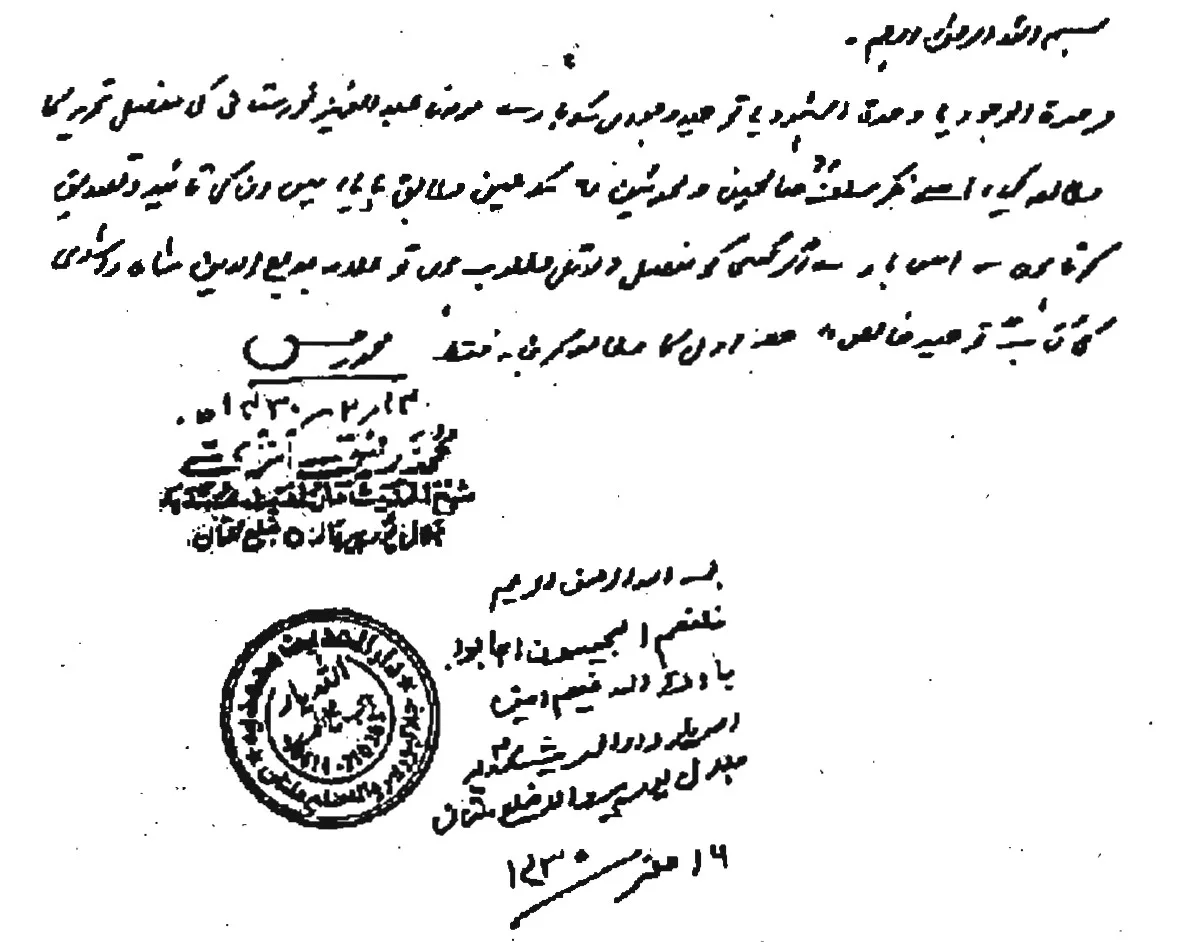
I have studied the detailed writing of Maulana Abdul Aziz Nuristani, may Allah preserve him, regarding Wahdat al-Wujud or Wahdat al-Shuhud or Tawhid al-Wujudi, and found it exactly in accordance with the thought of the pious predecessors and muhaddithin, may Allah have mercy on them. I endorse and confirm it. If anyone desires detailed evidence on this matter, they should study the book Tawhid Khalis, Part One, by Allama Badi' al-Din Shah Rashdi, may Allah have mercy on him.
وصلى الله على نبينا محمد واله وصحبه وسلم
Muhammad Rafiq Asri
الحمد لله والصلاة والسلام على رسول الله أما بعد
Whether it is the labyrinths of Wahdat al-Wujud or the intricacies of Wahdat ash-Shuhud, their pure Islam, which Allah the Exalted revealed to His beloved Prophet Muhammad ﷺ, has no connection with them. These terms and their details are not mentioned in the sayings of the Prophet ﷺ or the statements of the Companions, may Allah be pleased with them. For a Muslim, the teaching and understanding of these terms is absolutely unnecessary. In fact, Wahdat al-Wujud seems to blur the distinction between monotheism and polytheism. If a believing servant becomes so engrossed in the servitude, remembrance, and contemplation of Allah the Exalted that there is no room in his heart for anything other than Allah, this is the pinnacle of servitude. But the negation of the existence of anything other than Him is merely a trick of the minds of the existentialists.
The argument for Wahdat al-Wujud (Unity of Existence) based on the sea and its waves, as quoted in the inquiry regarding Dr. Israr Sahib, is not new but an old argument of the existentialists. However, the fundamental flaw in it is that here the relationship is between the whole and the part, but does the concept of Wahdat al-Wujud allow for Allah's shares and parts? And is this concept Islamic?
Shaykh al-Islam Ibn Taymiyyah, may Allah have mercy on him, has completely uprooted the fabric of this thought. In any case, the concept of Wahdat al-Wujud is a heresy of the Sufis and has no connection with the fundamental beliefs of Islam. Maulana Nuristani, may Allah have mercy on him, has effectively dispelled Dr. Sahib's doubts in this regard and has represented the Salafi school of thought. جزاء الله احسن الجزاء.
However, here I find it appropriate to point out one thing, which is that regarding [وَهُوَ مَعَكُمْ أَيْنَ مَا كُنتُمْ], while repeating the statements of the existentialists, Dr. Israr Sahib says that taking companionship in terms of attributes is an interpretation (ta’wil). In fact, this is the result of not understanding the application of "ta’wil." When the Imams of Hadith ،،اهل الاهواء،، speak about the false interpretations (ta’wilāt bāṭilah), they mean interpretations that are merely opinions and expressed to support their false ideas, unlike the Companions of the Prophet and the great Tabi‘in. The exegesis of this verse from the Companions proves the "knowledge-based companionship" (ma‘iyyat ‘ilmi), as Maulana Nuristani (may Allah have mercy on him) has narrated this interpretation from Sayyiduna Ibn Abbas (may Allah be pleased with him). Taking "existential companionship" (ma‘iyyat wujūdī) in opposition to the Salaf’s interpretation is actually an interpretation and exegesis based on personal opinion, which is wrong in every way.
وصلى الله على نبينا محمد واله وصحبه وسلم
Irshad-ul-Haq Asri
It is established from the Book, wisdom, and the Quran and Sunnah that the universe is created and sustained. And Allah Almighty is the Creator and Sustainer. From this alone, the denial arises of the mental images, reflective shadows, and other types of illusions and imaginations of the universe. The Messenger of Allah ﷺ said [كان الله ولم يكن شيء غيره]
Reference: Sahih Bukhari:7418
From this, the above-mentioned theory is also negated.Hafiz Ibn Taymiyyah has extensively commented on this belief in more than two hundred pages
Reference: Majmoo' al-Fatawa Vol:2 pp:111 to 350
, see the details there.The rest is like a slander on Hafiz Ibn Taymiyyah as if Allah descends as I descend. [سبحانك هذا بهتان عظيم] If in doubt, please study the respected Hafiz Sahib's
Reference: Risalah, "Sharh Hadith al-Nuzul"
واللہ اعلم۔[An excerpt from one of his letters titled Minbar al-Tawheed wal-Sunnah]
Al-Sheikh Hafiz Zubair Ali Zai Hafizahullah
Al-Sheikh Zubair Ali Zai states in the monthly Al-Hadith:
In the book Fusūs al-Hikam attributed to Ibn Arabi (Sufi), it is written:
[فأنت عبد وأنت رب] So you are the servant and you are the Lord.
Reference: p. 77, Sharh al-Jami' p. 202
Dr. Israr Ahmed said:
In my view, the real solution is the one given by Sheikh Ibn Arabi, which I have already explained: in terms of the reality and essence of existence, the existence of the Creator and the created is one; the same simple existence pervades the universe, but it becomes determinate where specification occurs.
So then it is other than Him; it is not His essence. Accordingly, their view is that the existence of this universe is, in one respect, the essence of Allah's existence, and in another respect, it is other than Him. This is the philosophy of Ibn Arabi. Ibn Arabi is the most controversial personality in our religious circles. Both his supporters and opponents have reached extremes. The vast majority of our Sufis know him by the title Sheikh al-Akbar. His books Fusus al-Hikam and Futuhat Makkiyah are very important books on Sufism. On the other hand, the disagreement is so intense that Imam Ibn Taymiyyah declared him an atheist and heretic, and gave him every possible religious insult. I want to make it clear that if I am endorsing any statement of Sheikh al-Akbar, it is only this theory of his; otherwise, I have neither studied Fusus al-Hikam nor Futuhat Makkiyah.
Reference: Umm al-Musabbihat, i.e., a brief commentary on Surah Al-Hadid, p. 88
It has been found that just as Ibn Arabi believed in the doctrine of Wahdat al-Wujud, Dr. Israr Ahmed holds exactly the same belief.
Reference: Al-Hadith, Issue No: 74, p: 50
Note: The doctrine of Wahdat al-Wujud is false.
Reference: See: My book Ilmi Maqalat Vol: 2 pp: 460 to 472
الحمد لله والصلاة والسلام على رسول الله أما بعد:
Regarding Wahdat al-Wujud, Wahdat al-Shuhud, or Tawheed al-Wujudi, a detailed study was made of the writings of Maulana Abdul Aziz Nuristani (may Allah have mercy on him) and Maulana Abdul Salam Rustami (may Allah have mercy on him). They were found to be in accordance with the thoughts of the pious predecessors and the Muhaddithin. We should adopt the method of the Prophets (peace be upon them) and the Salaf for inviting people to Tawheed. And we should avoid these new terminologies which involve confusion, deception, and belittlement.
والله تعالى هو الموافق للصواب
وصلى الله على نبينا محمد واله وصحبه وسلم
Hafiz Muhammad Sharif
الحمد لله والصلاة والسلام على من لا نبي بعده:
It was the 1990s. Some of our friends from Multan, associated with true pious elders, were impressed by Dr. Israr Sahib because of his Quranic, religious, and tafsir services. Coincidentally, Dr. Sahib came to Multan and delivered the Friday sermon at Muslim Ground. Later, we also met Dr. Sahib along with those who were impressed by him. I personally inquired, "What is your opinion about the belief of Wahdat al-Wujud?" He replied that this belief belongs to great Sufis and is correct. On this occasion, there was some debate based on arguments, which his followers considered disrespectful. But now, those who were impressed, Alhamdulillah, have come out of the spell of his personality and are attached only to the Book and Sunnah.
They considered this belief to be correct; this is not a hidden matter. Although the falsehood and kufr (disbelief) of this belief is as clear as daylight. Besides the transmitted (naqli) evidences, there are abundant rational evidences which declare this impure belief as kufri (disbelief). There is no doubt or hesitation about the kufr of a person holding such a belief (whoever he may be).
May Allah reward the respected Dr. Syed Shafiq ur Rehman, may Allah protect him, for his efforts in establishing the truth and expressing it, and for collecting the fatwas of the scholars. A detailed explanation of this issue is available in
Reference: ,,Al-Tawheed Al-Khalis,,
and
Reference: ,,Fatawa Ibn Taymiyyah,,
.Your brother in religion: Abdul Rahman Shaheen

