Compiled by: Abu Hamza Salafi
This article clarifies the principle regarding sitting (association/companionship) with an innovator and the ruling on praying behind an innovator—and how this ruling is established from the explicit texts of the pious predecessors (Salaf as-Salihin) and the methodology of the later Imams of Ahl al-Hadith. We will show step by step that:
(1) The Companions and Imams considered sitting with the people of innovation (Ahl al-Ahwaa) as a cause of heart disease and corruption of the religion;
(2) In the matter of leadership in prayer, they forbade the leadership of a disbelieving innovator/takfir innovator and an innovator caller, and explained the details in the case of a non-caller, non-takfir innovator;
(3) Later scholars of Ahl al-Hadith adopted the same balance; and
(4) Finally, a critical review of those statements/narrations which are weak in chain, mursal, or disconnected will be presented, so that the issue remains purely based on authentic texts.
① The Effect of Ibn Abbas (may Allah be pleased with him) — The gathering of the people of innovation is a disease for the hearts
Arabic text: «لا تُجالِسْ أهلَ الأهواءِ، فإنَّ مُجالستَهم مَمرَضةٌ للقلوب.» Reference:
Reference: Al-Shari'ah lil-Ajurri: 133 — Chain of narration: Al-Firyabi (trustworthy Hafiz), Abu Taqi Hisham bin Abdul Malik (reliable), Muhammad bin Harb (trustworthy), Abu Salamah Sulayman bin Sulaym (trustworthy), Abu Husayn Uthman bin Asim (trustworthy and established), Abu Salih Zakwan (trustworthy and established) → Ibn Abbas رضي الله عنهما.
Translation: "Do not sit with the people of innovations (heretics); for their gathering is a disease for the hearts."
Explanation: This narration is established from a Companion of the Prophet ﷺ and provides decisive evidence on the principle of religion: companionship (closeness/association) has an effect; the gathering of an innovator causes corruption of the heart. This very foundation helps in understanding the detailed caution in the chapter of Imamate: one must be more cautious in following someone whose gathering causes heart sickness—especially when he is a caller to innovation.
② Imam Malik رضي الله عنه: Prohibition from praying behind an innovator (Qadari)
Arabic text: سُئل مالكٌ عن الصلاة خلف أهل البدع القدرية فقال: «لا، ولا أرى أن يُصلّى خلفهم»، ونهى عنه. Reference:
Reference: Al-Ibanah by Ibn Battah (1862) — Chain of narration: Ibn Battah (trustworthy), Ja'far bin Muhammad al-Qafalani (trustworthy), Muhammad bin Ishaq al-Saghani (trustworthy and established), Asbagh bin al-Faraj (trustworthy), Ibn Wahb (trustworthy Hafiz), Imam Malik رضي الله عنه.
Translation: When Imam Malik (RA) was asked about praying behind Qadari innovators, he said: "No; I do not think that prayer should be performed behind them"—and he forbade it.
Explanation: This prohibition indicates the fundamental precaution regarding leading prayer for the people of misguidance; especially when the belief is a misleading innovation like Qadariyyah.
Imam Malik’s second statement: Do not even perform Jumu'ah behind them; if necessary, repeat it
Arabic text
قَالَ: وَسَأَلْتُ مَالِكًا عَنْ الصَّلَاةِ خَلْفَ الْإِمَامِ الْقَدَرِيِّ؟ قَالَ: إنْ اسْتَيْقَنْتَ أَنَّهُ قَدَرِيٌّ فَلَا تُصَلِّ خَلْفَهُ، قَالَ: قُلْتُ: وَلَا الْجُمُعَةَ؟
Ibn al-Qasim says: I asked Malik (RA) about praying behind a Qadari imam; he said: If you are certain that he is Qadari, then do not pray behind him. I asked: What about Jumu'ah? He said: No.
قَالَ: وَلَا الْجُمُعَةَ إنْ اسْتَيْقَنْتَ، قَالَ: وَأَرَى إنْ كُنْتَ تَتَّقِيهِ وَتَخَافَهُ عَلَى نَفْسِكَ أَنْ تُصَلِّيَ مَعَهُ وَتُعِيدَهَا ظُهْرًا قَالَ مَالِكٌ: فَأَهْلُ الْأَهْوَاءِ مِثْلُ أَهْلِ الْقَدَرِ.
قَالَ: وَرَأَيْتُ مَالِكًا إذَا قِيلَ لَهُ فِي إعَادَةِ الصَّلَاةِ خَلْفَ أَهْلِ الْبِدَعِ يَقِفُ وَلَا يُجِيبُ فِي ذَلِكَ،
If there is fear or taqiyya, then pray along with him and afterwards repeat Zuhr. Then he said: "The people of misguidance are like the people of Qadr... Do not marry them, do not greet them, do not pray behind them, do not attend their funerals..."
Reference:
Reference: Al-Mudawwana al-Kubra (Book of Prayer, Chapter on Following the Imam) — narration of Ibn al-Qasim from Malik (RA).
Points:
- Do not pray behind those who are innovators/heretics with certainty, not even on Friday.
- In a state of fear, pray behind them; repetition (of Zuhr) is obligatory afterward.
- Social boycott (marriage, greeting, funeral) is also for the purpose of actual deterrence.
Explanation: These texts indicate that according to Imam Malik (may Allah have mercy on him), the type and condition of innovation (certainty, incitement, corruption of belief) are significant: following is forbidden in cases of certain innovation and incitement, and repetition is required in cases of necessity.
③ The Position of Abdul Rahman ibn Mahdi al-Anbari (d. 198 AH)
Original text: «يُصَلَّى خَلْفَ أَصْحَابِ الأهواءِ ما لم يكن داعيةً إلى بدعته مُجادِلًا بها، إلا هذين الصنفين: الجهمية والرافضة…» Reference:
Reference: Hilyat al-Awliya by Abu Nu'aym (with chain: al-Asbahani → Ibn Muhammad al-Asbahani → al-Abhari → Abdul Rahman ibn Umar al-Zuhri → Abdul Rahman ibn Mahdi).
Translation: “Prayer is to be performed behind the innovators/heretics as long as they are not inciters of their innovation and disputatious about it. Two groups are exempted from this: the Jahmiyyah and the Rafidah (do not pray behind them)…”Explanation:
This text is a clear expression of the general rule of the majority: leniency in following a non-inciting innovator, prohibition behind inciting or apostate innovators.
④ Imam Ahmad ibn Hanbal (may Allah have mercy on him) — No prayer behind an inciter of innovation
«سُئل عن رجلٍ يقول: الإيمانُ قولٌ، أَيُصَلَّى خلفه؟ قال: إن كان داعيةً إليه لا يُصَلَّى خلفه، وإن كان لا علم لديه فأرجو أن لا يكون به بأس.»
Reference:
Reference: Masa'il al-Imam Ahmad narrated by Ibn Hani, numbers (301, 4309, 4316).
Translation:
A person who says "Faith is only verbal" (Murji'ah) — should one pray behind him? It was said: "If he is a caller (Da'i), do not pray behind him; and if he says this out of ignorance (not a caller), then it is hoped that there is no harm."
Explanation: Imam Ahmad (may Allah have mercy on him) distinguished between a caller/opponent and a non-caller/non-opponent; this is the disciplinary methodology established by Ahl al-Hadith.
⑤ Position of Imam Anas bin Iyad al-Laythi al-Madani (d. 200 AH)
سُئل عن الصلاة خلف الجهمية فقال: «لا تُصَلِّ خلفهم»، وتلا: ﴿وَمَنْ يَبْتَغِ غَيْرَ الإِسْلَامِ دِينًا فَلَنْ يُقْبَلَ مِنْهُ﴾.
Reference:
Reference: Al-Sunnah by al-Khallal (No. 1698) with chain: al-Marwazi → Ishaq bin Bahlul → Anas bin Iyad.
Translation:
"Do not pray behind the Jahmiyyah" and he recited the verse: "Whoever desires a religion other than Islam, it will never be accepted from him."
Explanation:
Following the Jahmiyyah (an innovation involving the essentials of disbelief) in prayer is forbidden—this is an example of the category of innovations that render one a disbeliever.
⑥ Position of Imam Yazid bin Harun al-Wasiti (d. 206 AH)
«سألتُ يزيدَ بنَ هارون عن الصلاة خلف الجهمية فقال: لا تُصَلِّ خلفهم.»
Reference:
Reference: Al-Sunnah by al-Khallal (No. 1699) with chain: al-Khallal → al-Ramadi → Yazid bin Harun.
Translation:
"I asked Yazid bin Harun about praying behind the Jahmiyyah and he said: Do not pray behind them."
Explanation:
Like Anas bin Iyad (RA), here too the ruling is an absolute prohibition — the severity of innovation is authoritative.
⑦ Imam Muhammad bin Ismail, Abu Abdullah Al-Bukhari (d. 256 AH) Position
قال أبو عبد الله: «ما أُبالي صليتُ خلف الجهميّ الرافضي أم صليتُ خلف اليهود والنصارى … ولا يُسلّم عليهم، ولا يُعادون…»
Reference:
Reference: Khalaq Af'al al-'Ibad by Al-Bukhari.
Translation:
“It is the same to me whether I pray behind a Jahmi/Rafidi or behind Jews and Christians…” (meaning the disgrace of their leadership) “… they should not be greeted, nor visited…”
Explanation:
This expression indicates a strong rejection of the leadership of Jahmi/Rafidi; due to their doctrinal corruption, their leadership is not to be accepted.
⑧ Imam Ismail, Abu al-Qasim, Baqwam al-Sunnah (d. 535 AH) Position
«وأصحابُ الحديث لا يرون الصلاة خلف أهل البدع لئلا يراه العامة فيفسدون بذلك.»
Reference:
Reference: Al-Hujjah fi Bayan al-Mihjah wa Sharh 'Aqidat Ahl al-Sunnah
Translation:
“The people of Hadith do not pray behind the innovators so that common people do not see it (as a Sunnah) and fall into corruption.”
Explanation:
This is the wisdom of blocking the means: to prevent the acceptance of innovation among the masses.
⑨ Abu Muhammad al-Barbahari (d. 329 AH) Position
«الصلوات الخمس جائزةٌ خلف من صليت خلفه إلا أن يكون جهميًا… فأعد صلاتَك. وإن كان إمام الجمعة جهميًا وهو سلطان فصلِّ خلفه وأعد صلاتك…»
Reference:
Reference: Sharh al-Sunnah by al-Barbahari.
Translation:
"All five prayers are valid behind the one behind whom you have prayed, except for the Jahmi; ... so repeat your prayer. If the Imam of Jumu'ah is a Jahmi and a ruler, then pray behind him and repeat ..."
Explanation:
This also strengthens the rule of repeating prayer behind an innovator who is a disbeliever.
⑩ Ibrahim bin Khalid, Abu Thawr al-Kalbi (d. 240 AH) position
«هؤلاء قدرية لا يُصلّى خلفهم، ولا يُعادُ مريضُهم، ولا تُشهدُ جنائزُهم… وسألتُ: الصلاة خلف من يقول: القرآن مخلوق؟ فهذا كافرٌ بقوله لا يُصلّى خلفه.»
Reference:
Reference: Sharh Usool I'tiqad Ahl al-Sunnah (Lalkai, 1/319) with chain: Ibn Rizq Allah → Ibn Hamdan → Idris al-Haddad → Abu Thawr.
Translation:
"These are Qadariyyah — do not pray behind them... and whoever says 'The Qur'an is created' is a disbeliever by his statement; do not pray behind him."
Explanation:
Explicit prohibition on the Qadari caller and the one who says the Qur'an is created—this is the methodology of the Salaf.
In this section, we see that not only the muhaddithin but also the early and later jurist Imams agreed on the principle that:
Prayer behind an innovator imam is either invalid or reprehensibly forbidden — this is based on the imam's belief and the type of innovation. If the innovation is kufr (disbelief), then the imamate is invalid, and if it is not kufr, then it is considered reprehensible and disliked.
 Burhan al-Din Ibn Farhun al-Ya'mari (799 AH)
Original text: «مَسْأَلَةٌ: وَلَا يُصَلَّى خَلْفَ أَهْلِ الْبِدَعِ رَدْعًا لَهُمْ، وَقِيلَ: لِفَسَادِ عَقِيدَتِهِمْ.»
Reference:  Tabsirat al-Hukkam fi Usul al-Aqdiyah wa Manahij al-Ahkam
Tabsirat al-Hukkam fi Usul al-Aqdiyah wa Manahij al-Ahkam
Translation: One should not pray behind innovators — either to discipline and admonish them, or because of the corruption of their belief.
Explanation: Ibn Farhun linked refraining from praying behind an innovator imam to both the correction of belief and the deterrence of innovation. This is the same methodology that Imam Qawam al-Sunnah considered necessary for the reform of the common people.
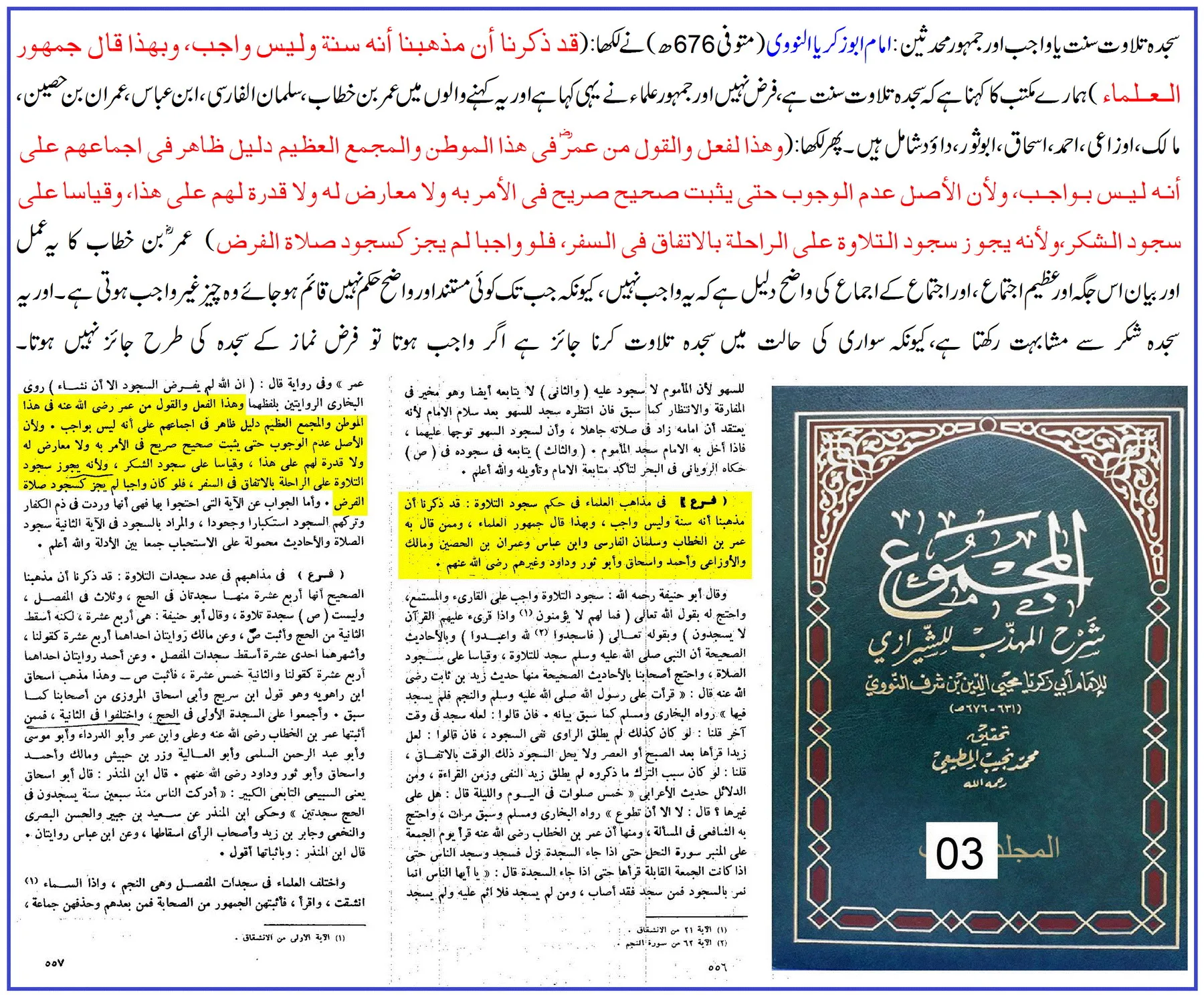
 Imam Nawawi (676 AH) — Prayer behind an imam with kufr innovation is invalid
Original text: «ولا تصح الصلاة خلف أحد من الكفار… وكذا المبتدع الذي يكفر ببدعته، فإن صلى خلفه جاهلًا بكفره، فإن كان متظاهرًا بكفره… لزمه إعادة الصلاة بلا خلاف عندنا.»
Reference: Al-Majmu' Sharh al-Muhadhdhab (with completion of al-Subki)
Al-Majmu' Sharh al-Muhadhdhab (with completion of al-Subki)
Translation: Prayer behind a disbeliever is not valid, regardless of the type of disbeliever. The same ruling applies to an innovator whose innovation has reached the level of disbelief. If someone prays behind him out of ignorance, and he openly expresses his disbelief, then repetition of the prayer is obligatory upon that person; there is no disagreement on this.
Explanation: Imam Nawawi (may Allah have mercy on him) equated the innovation that leads to disbelief (such as Jahmiyyah or Rafidah) with disbelief itself and declared such leadership in prayer invalid.
 Alaa al-Din al-Kasani (587 AH) — Explicit Distinction in Hanafi Jurisprudence
Original text: «إن الصلاة خلف المبتدع لا تجوز، وذكر في المنتقى رواية عن أبي حنيفة أنه كان لا يرى الصلاة خلف المبتدع، والصحيح أنه إن كان هوى يكفره لا تجوز، وإن كان لا يكفره تجوز مع الكراهة.»
Reference: Bada'i' al-Sana'i' fi Tartib al-Shara'i'
Bada'i' al-Sana'i' fi Tartib al-Shara'i'
Translation: Some Hanafi scholars have said that it is not permissible to pray behind an innovator. This narration is also from Imam Abu Hanifa. The correct opinion is that if his innovation leads to disbelief, then praying behind him is not permissible; but if it is a non-disbelief innovation, then praying behind him is permissible though disliked.
Explanation: Al-Kasani (may Allah have mercy on him) expressed the same balance in the Hanafi jurisprudential methodology that is well-known among the hadith scholars — major innovation (leading to disbelief) = invalid leadership in prayer, minor innovation (not leading to disbelief) = leadership in prayer is disliked.
 Burhan al-Din Abu al-Ma'ali al-Bukhari al-Hanafi (616 AH)
Original text: «وقال أبو يوسف: لا تجوز الصلاة خلف المتكلم وإن تكلم بحق، لأنه بدعة، فلا تجوز الصلاة خلف المبتدع.»
Reference: Al-Muheet al-Burhani fi al-Fiqh al-Na'mani
Al-Muheet al-Burhani fi al-Fiqh al-Na'mani
Translation: Qadi Abu Yusuf said: "It is not permissible to pray behind any theologian (Ahl al-Kalam), even if he is speaking the truth; because Ilm al-Kalam itself is an innovation, and it is not permissible to pray behind an innovator."
Explanation: This fatwa declares prayer behind an innovator impermissible due to their innovative thinking, despite the scholarly status of the innovation — even if they claim "truth," inviting to innovation is itself their crime.
 Badr al-Din al-Ayni al-Hanafi (855 AH)
Original text: «في المجتبى والمبسوط: يكره الاقتداء بصاحب البدعة…وروى محمد عن أبي حنيفة وأبي يوسف أن الصلاة خلف أهل الأهواء لا تجوز.»
Reference: Al-Binaya Sharh al-Hidaya
Al-Binaya Sharh al-Hidaya
Translation: It is mentioned in "Al-Mujtaba" and "Al-Mabsut" that following an innovator in prayer is disliked. Muhammad ibn Hasan narrated from Imam Abu Hanifa and Abu Yusuf that it is not permissible to pray behind the people of heresies (innovators).
Explanation: Al-Ayni transmitted both opinions in Hanafi fiqh regarding prayer behind an innovator — both dislike and invalidity — basing them on the type of innovation according to the Imam: prayer is invalid behind a major (kufr) innovation, and disliked behind a minor innovation.
After the pious predecessors, the Ahl al-Hadith Imams adopted the same cautious approach. According to them, the belief of the prayer leader must be correct, based on the Sunnah, and free from innovation. If the Imam is an innovator or a polytheist, then praying behind him is either invalid or makruh tahrimi (prohibitively disliked), especially when he is a caller to innovation or his innovation is kufr (disbelief).
Allama Badi' al-Din Shah al-Rashidiؒ
Quote: "The beliefs of the Hanafis are against the beliefs of Ahl al-Sunnah and the pious predecessors, therefore it cannot be said that praying behind someone holding such beliefs is valid."
Reference: (Book: The Imam Must Have a Correct Creed, p. 45)
(Book: The Imam Must Have a Correct Creed, p. 45)
Explanation: Badi' al-Din Shah al-Rashidiؒ clarified that the prayer leader must have a Sunnah-based belief; an Imam who holds innovation or polytheism causes the invalidity of the prayer. This is the same principle previously stated by Imam Malikؒ, Ibn Mahdiؒ, and Imam Ahmadؒ.
Sheikh Ubaidullah Mubarakpuriؒ
Quote: "It is not permissible to pray behind any Barelvi Hanafi because some of their beliefs and practices are polytheistic and kufr. And if a Deobandi imam innovates in ruku and sujood against the Sunnah, then it is also not permissible to pray behind him."
Reference: (Fatawa Sheikh-ul-Hadith Mubarakpuri, Vol. 1, p. 226)
(Fatawa Sheikh-ul-Hadith Mubarakpuri, Vol. 1, p. 226)
Explanation: This fatwa clarifies that both belief and practice must be correct. Following an imam whose beliefs are corrupt or whose style of worship is innovative is invalid.
Hafiz Zubair Ali Zaiؒ
Quote: "The Deobandis are people of innovation, and like the Jahmiyyah, their innovation is severe and dangerous; therefore, prayer behind them is not valid."
Reference: (Risala: The ruling on praying behind an innovator, p. 5)
(Risala: The ruling on praying behind an innovator, p. 5)
Explanation: Hafiz Zaiؒ declared prayer behind followers who hold innovations of the level of Jahmiyyah invalid. His reasoning is based on the same Salafi principles that the imamate of a Jahmi, Rafidi, Qadri, or one with major innovations is not valid.
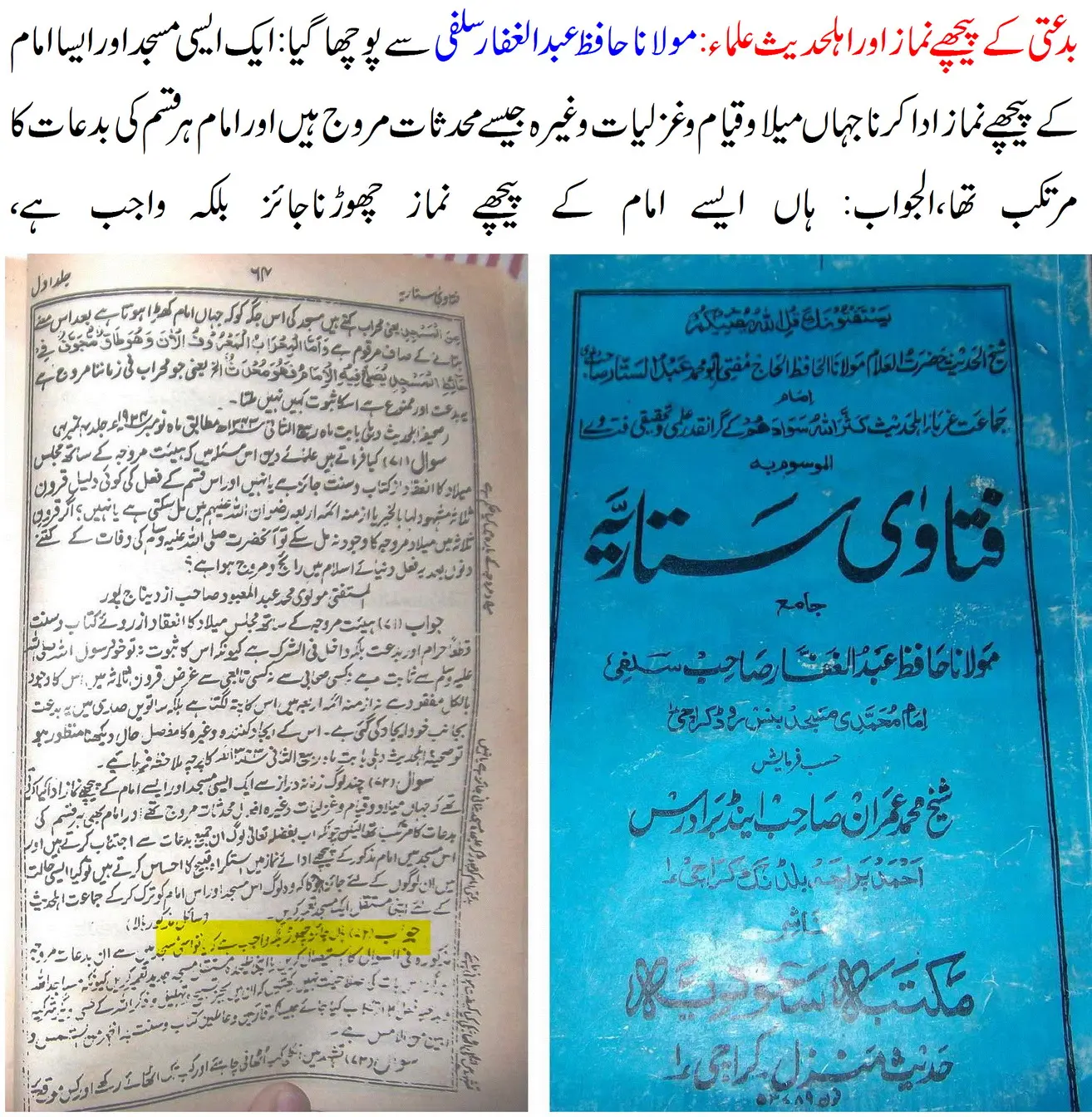
Hafiz Abdul Ghaffar Salafiؒ
Quote: "It is not permissible to pray behind an imam who is involved in innovations such as Milad, Qiyam, Ghazal recitation, and other innovations. Leaving prayer behind such an imam is not permissible but rather obligatory."
Reference: (Fatawa Sattariya, Hafiz Abdul Ghaffar Salafi, Vol. 2, p. 97)
(Fatawa Sattariya, Hafiz Abdul Ghaffar Salafi, Vol. 2, p. 97)
Explanation: This is the same principle that Imam Qawam al-Sunnah (may Allah have mercy on him) stated — to prevent the promotion of innovation among the common people, praying behind an innovator imam is prohibited.
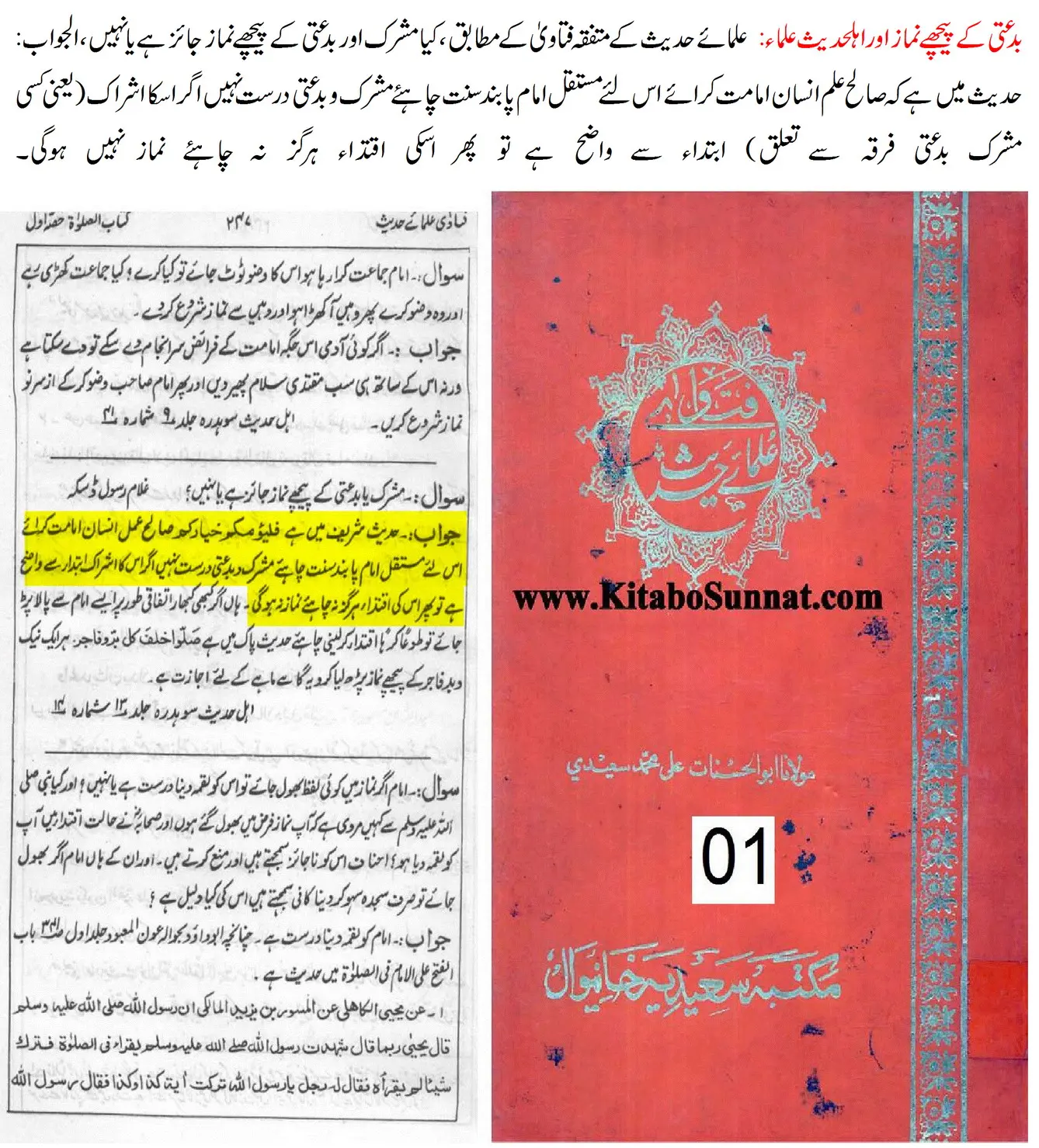
Scholars of Ahl al-Hadith (Fatwas of Ahl al-Hadith Scholars)
Excerpt: “Only a righteous, knowledgeable, and sound-in-creed person is qualified for imamate. Following a polytheist or an innovator is not correct, because the Prophet ﷺ said that among you, the one who leads the prayer should be the one who is more knowledgeable of the Qur’an and more pious.”
Reference: (Fatawa Ahl al-Hadith, Vol. 1, p. 247)
(Fatawa Ahl al-Hadith, Vol. 1, p. 247)
Explanation: This general fatwa is based on the principle that only an imam with sound creed makes the prayer valid; following innovators and polytheists invalidates the prayer, as stated by Imam Bukhari (may Allah have mercy on him) and Imam Malik (may Allah have mercy on him).
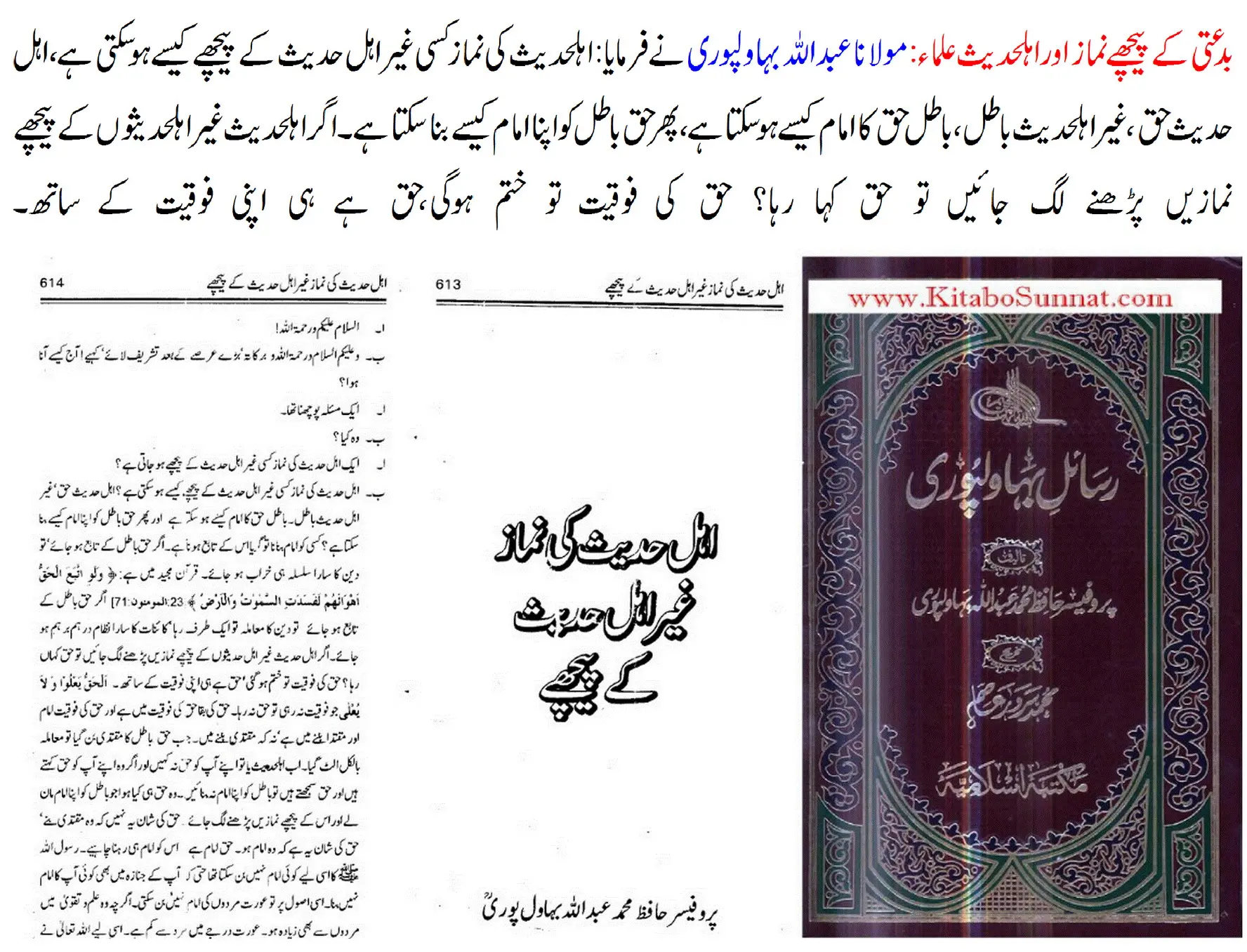
 Maulana Abdullah Bahawalpuri (may Allah have mercy on him)
Excerpt: “How can the prayer of Ahl al-Hadith be behind someone who is not from Ahl al-Hadith? Ahl al-Hadith are on the truth and non-Ahl al-Hadith are on falsehood; falsehood cannot be the imam of truth. If Ahl al-Hadith follow falsehood, then the superiority of truth will be nullified.”
Reference: (Rasa'il Bahawalpuri, p. 613)
(Rasa'il Bahawalpuri, p. 613)
Explanation: This statement is for the protection of the doctrinal methodology. According to Ahl al-Hadith, following falsehood (innovation and imitation) in opposition to the truth (Quran and Sunnah) is a false act, therefore imitation is also false.
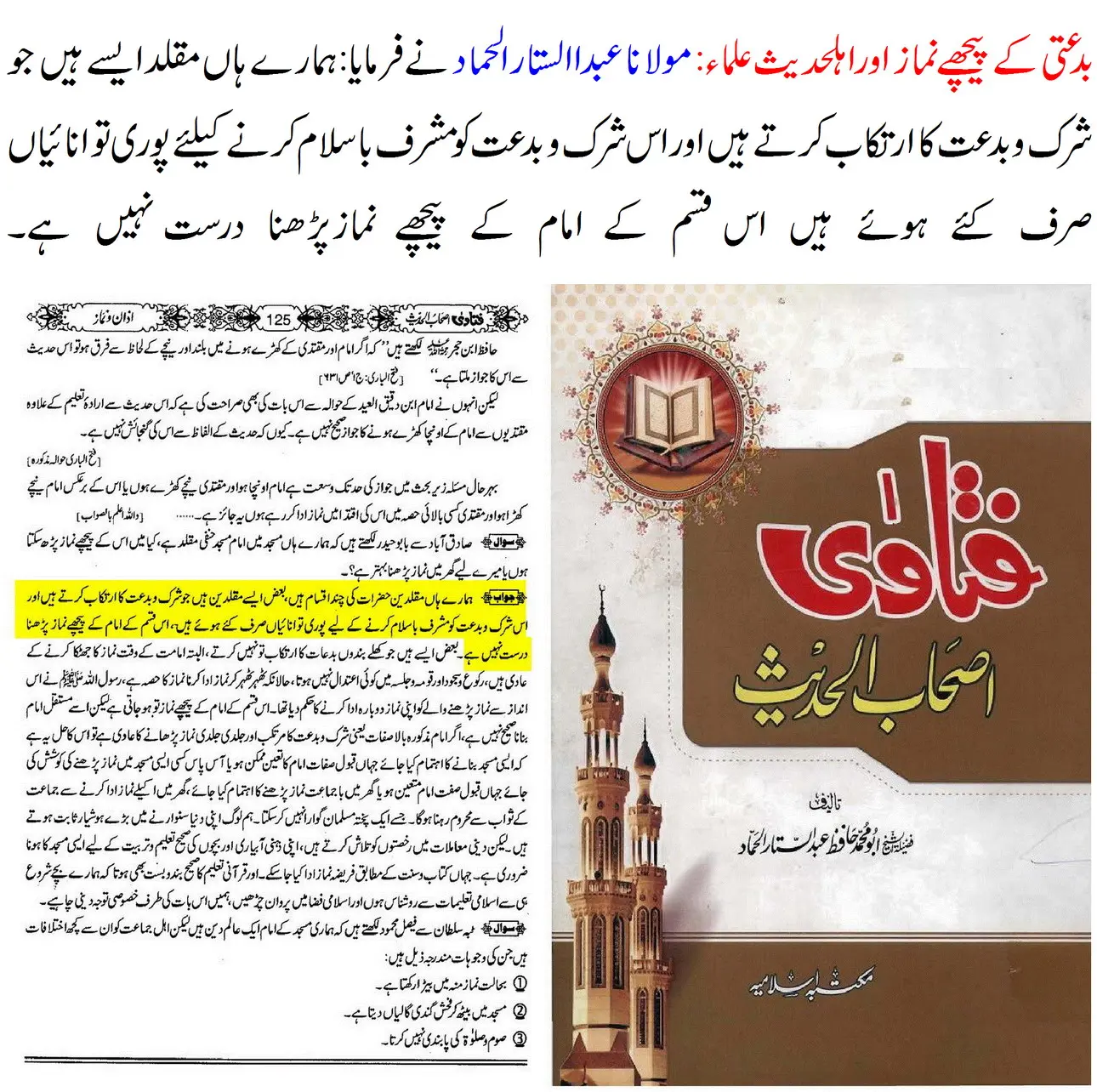
 Hafiz Abdul Sattar Al-Hammad (RA)
Quote: "Among us, there are imitators who commit shirk and innovation. It is not correct to pray behind them because they present innovation and shirk in the guise of Islam."
Reference: (Fatawa Ashaab al-Hadith, Hafiz Abdul Sattar Al-Hammad, Vol. 1, p. 333)
(Fatawa Ashaab al-Hadith, Hafiz Abdul Sattar Al-Hammad, Vol. 1, p. 333)
Explanation: Hafiz Abdul Sattar (RA) also followed the methodology of the Salaf — both apparent Sunnah and inner belief are conditions for valid leadership in prayer.
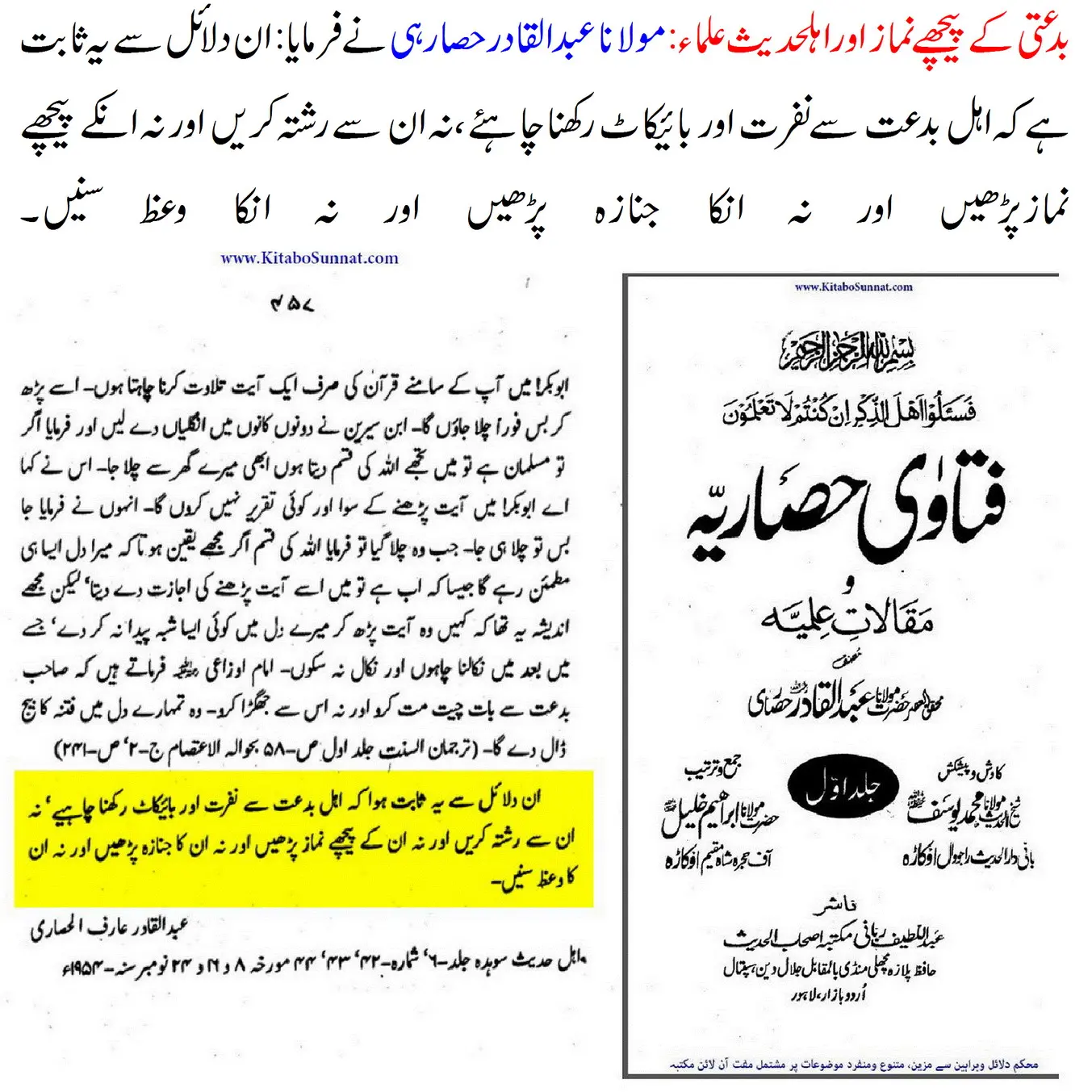
 Maulana Abdul Qadir Hisari (RA)
Quote: "It is necessary to hate the people of innovation and boycott them; neither marry into them, nor pray behind them, nor lead their funeral prayers, nor attend their gatherings."
Reference: (Fatawa Hisariyah wa Maqalat Ilmiyah, p. 122)
(Fatawa Hisariyah wa Maqalat Ilmiyah, p. 122)
Explanation: This stance is explicitly a continuation of the sayings of the Salaf — a practical example of the influence of Ibn Abbas (RA), Imam Malik (RA), Ibn Mahdi (RA), and Imam Ahmad (RA).
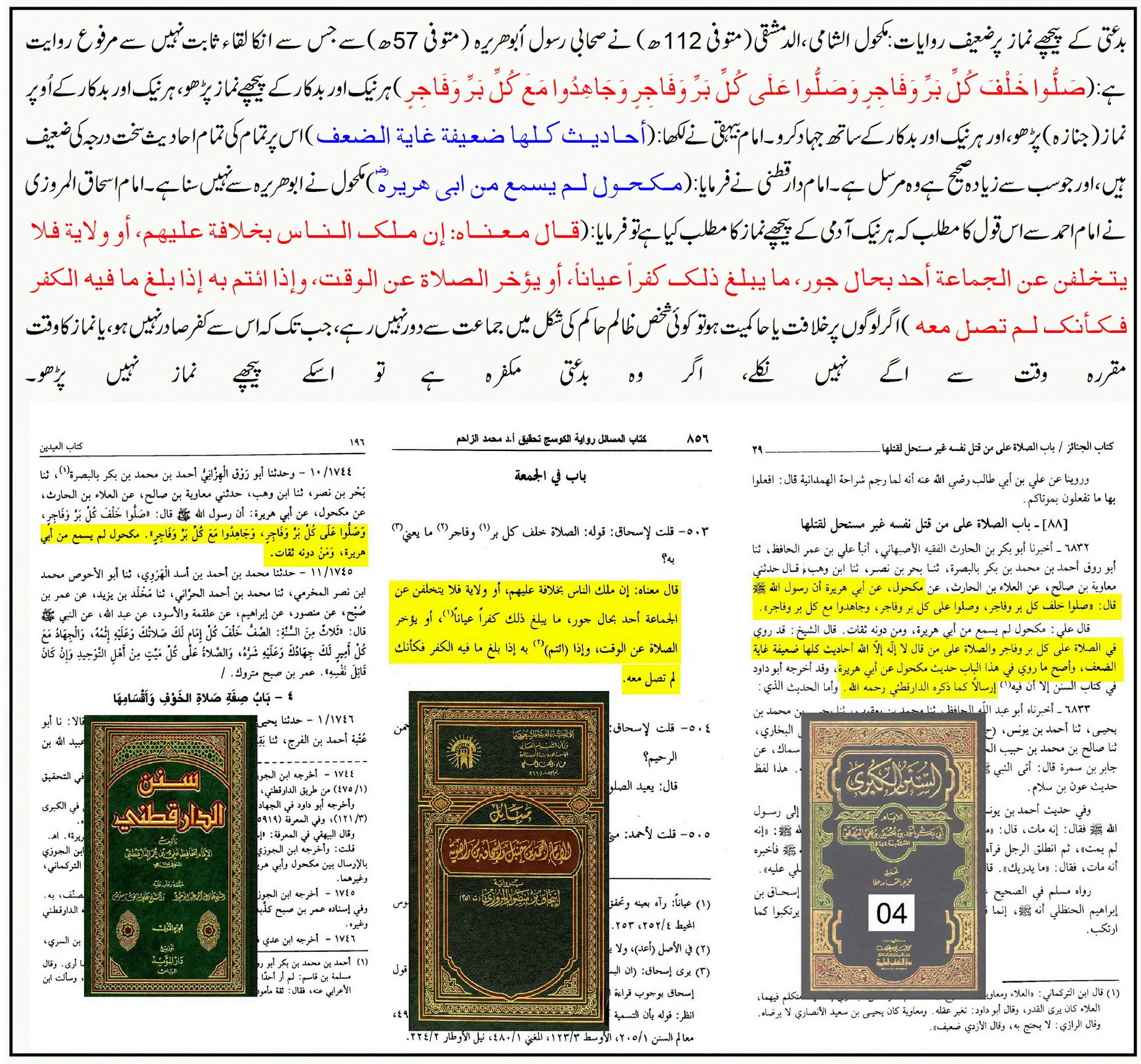
1) «صَلُّوا خَلْفَ كُلِّ بَرٍّ وَفَاجِرٍ…» — Very weak / Disconnected
Original text: «صَلُّوا خَلْفَ كُلِّ بَرٍّ وَفَاجِرٍ، وَصَلُّوا عَلَى كُلِّ بَرٍّ وَفَاجِرٍ، وَجَاهِدُوا مَعَ كُلِّ بَرٍّ وَفَاجِرٍ.» Reference:
Reference: Sunan al-Daraqutni, No. (1768): … from Makhool, from Abu Huraira… Makhool did not hear from Abu Huraira.
Translation: “Pray behind every righteous and wicked person, perform funeral prayer for every righteous and wicked person, and fight jihad alongside every righteous and wicked person.”
Chain defect and ruling:
- Discontinuity/Interruption: Makhool al-Shami (died 112 AH) did not have a confirmed hearing from Abu Huraira (died 57 AH); Daraqutni himself explicitly stated: “Makhool did not hear from Abu Huraira.”
- Al-Bayhaqi: All narrations in this chapter are extremely weak; even the relatively “stronger” one is mursal (missing a link). Reference: (Al-Sunan al-Kubra, 6832)Conclusion: The narration is very weak/disconnected, not reliable for proof; it cannot be used to establish the permissibility of praying behind an innovator absolutely.
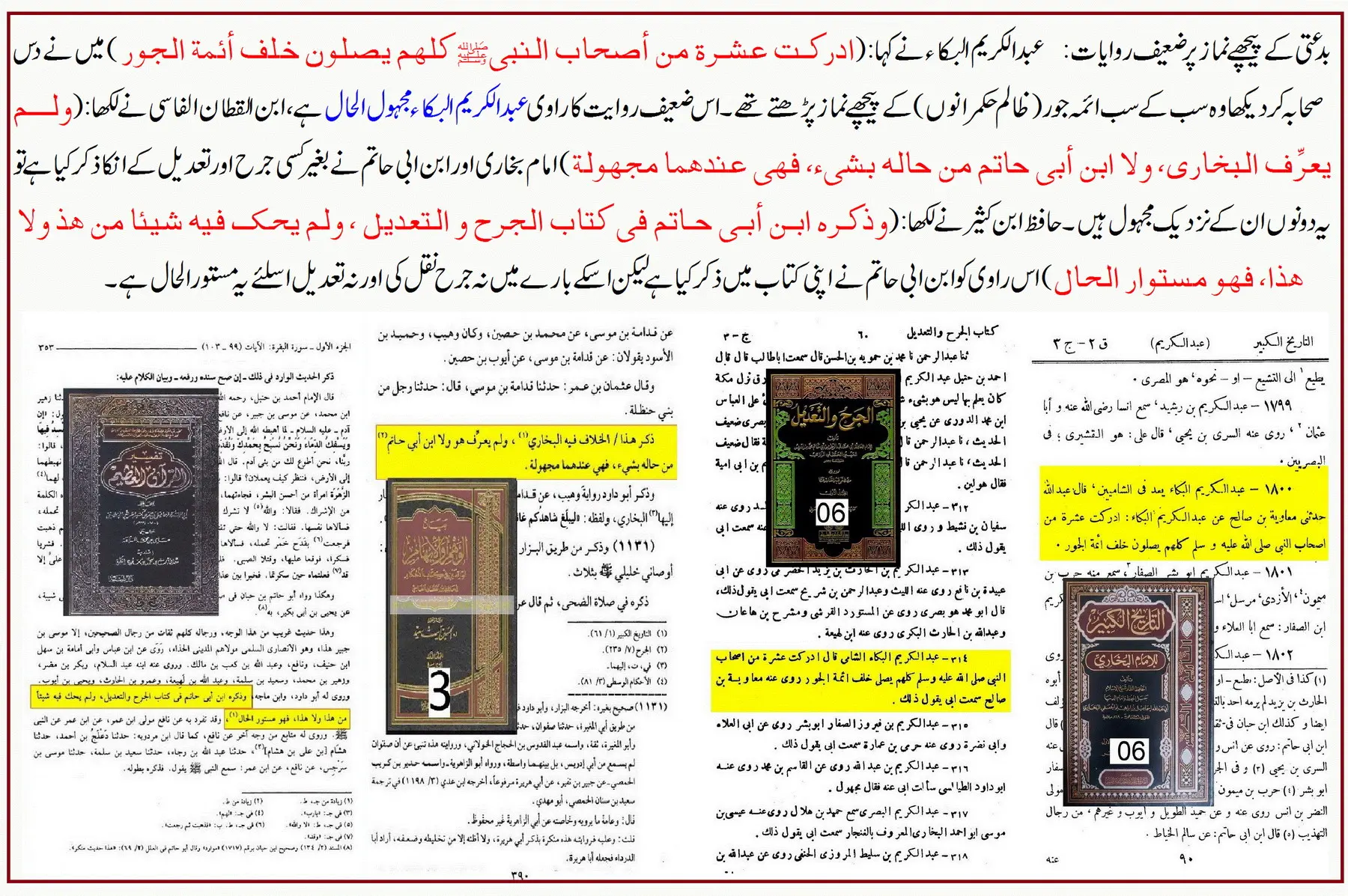
2) “Ten Companions used to pray behind unjust Imams” — Unknown narrator
Original text (source): «أدركتُ عشرة من أصحابِ النبي ﷺ كلّهم يُصلّون خلف أئمّة الجور.» Reference:
Reference: Al-Bukhari, Al-Tarikh al-Kabir (under Abdul Karim al-Bakka); chain: Abdul Karim al-Bakka.
Translation: “I found ten Companions of the Prophet ﷺ; they all prayed behind oppressive rulers.”
Chain defect and ruling:
- Abdul Karim al-Bakka: Unknown status — neither Bukhari nor Ibn Abi Hatim transmitted his authentication;
- Ibn al-Qattan al-Fasi: Unknown according to both Bukhari and Ibn Abi Hatim. Reference: (Bayan al-Wahm wal-Ihyam)
- Ibn Kathir: "Hidden status." Conclusion: The narration is not reliable; the general claim of "ten companions" is based on an unknown narrator and cannot be considered proof.
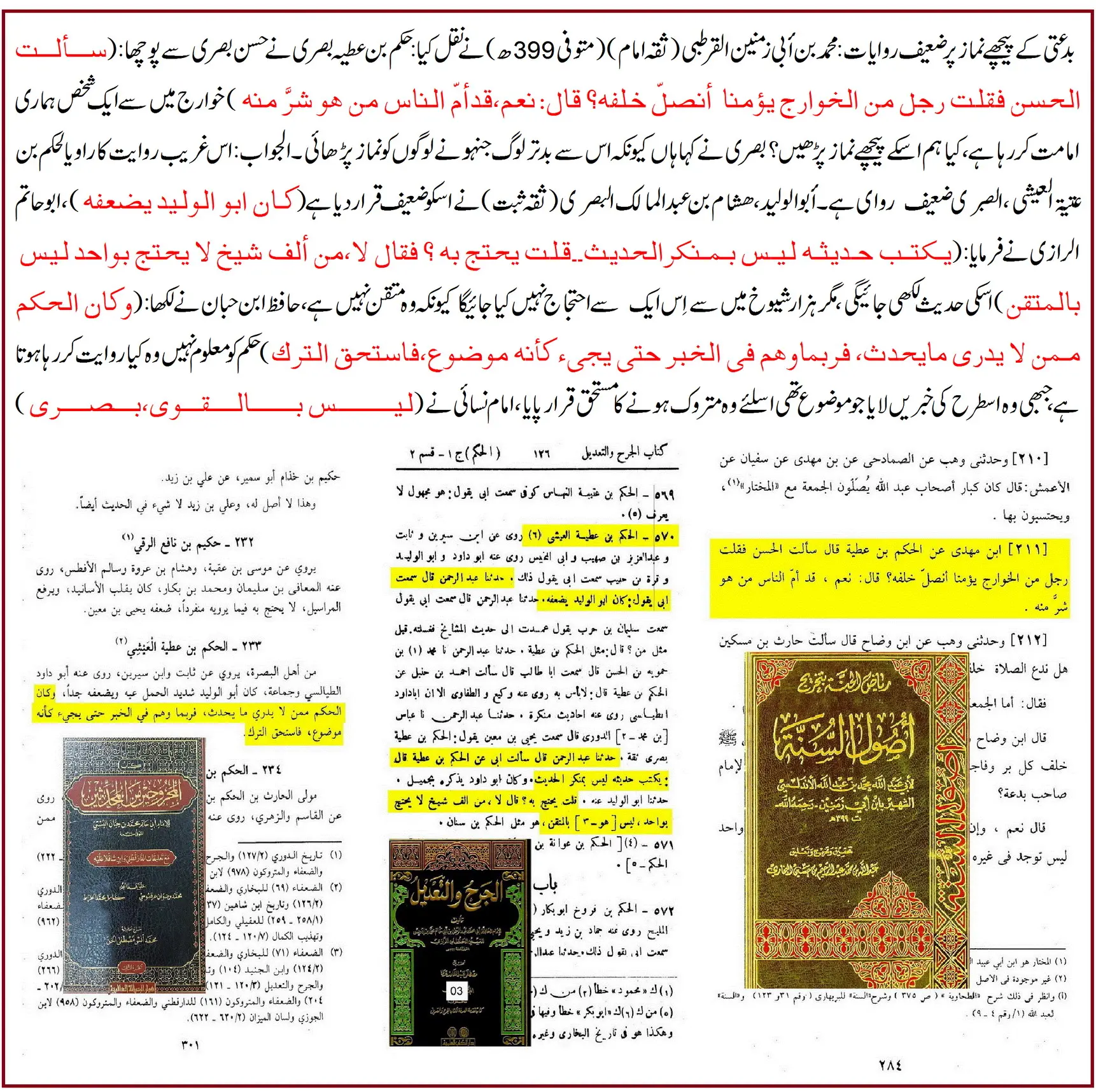
3) "Hasan Basri (RA) permitted praying behind the Kharijites" — Chain is very weak
Original text (narration): سُئِل الحسن البصري عن رجلٍ من الخوارج يؤمّنا: أنصلّي خلفه؟ قال: «نعم، قد أمّ الناسَ من هو شرٌّ منه.» Reference:
Reference: Usul al-Sunnah by Ibn Abi Zamanin (211) — via al-Hakam ibn Atiyyah al-Ayshi.
Translation: Hasan Basri (RA) was asked: A Khariji is leading our prayer, should we pray behind him? He said: "Yes; even worse people have led people in prayer."
Chain defects and ruling:
- Al-Hakam ibn Atiyyah: severely weak —
Abu al-Walid, Abu Hatim: "He weakens him / not to be used as proof"Reference: (Al-Jarh wa al-Ta'dil). - Ibn Hibban: "He does not know what he narrates... He brings the report as if it is fabricated; deserves to be abandoned." Reference: (Al-Majruhin)
- An-Nasa'i: Not strong; Al-Dhahabi: Weak. Conclusion: The narration is based on a very weak/abandoned narrator; not proof.
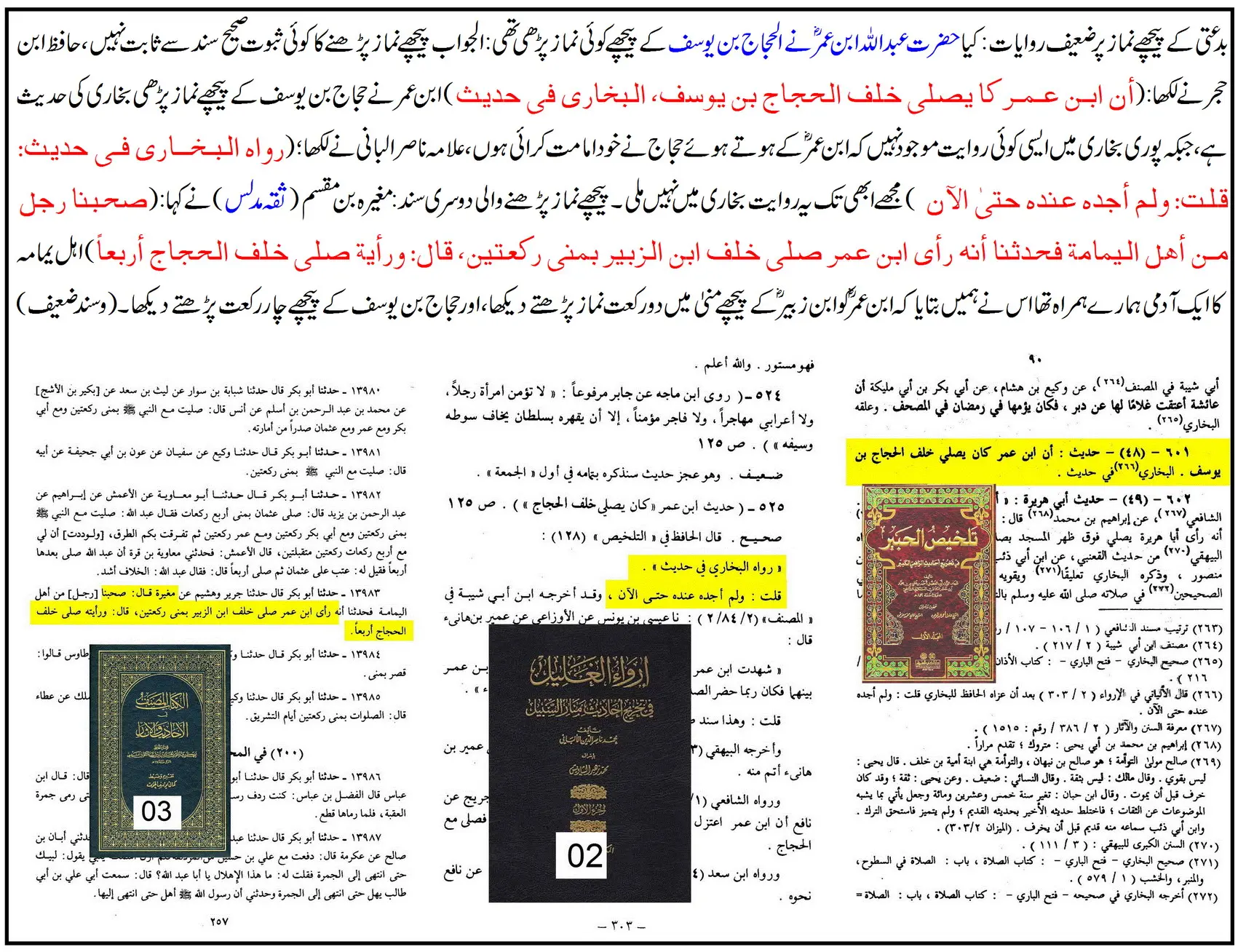
4) "Ibn Umar (RA) prayed behind Hajjaj" — Not authentically proven
Original claim: Hafiz Ibn Hajar mentioned in Al-Talkhees Al-Habeer a narration that "In Bukhari, it is mentioned that Ibn Umar رضي الله عنه prayed behind Hajjaj," but Albani said in Irwa' Al-Ghaleel: "It is not found in Bukhari."
Author Ibn Abi Shaybah’s chain: «… عن مُغيرة قال: صحبَنا رجلٌ من أهل اليمامة فحدّثنا أنّه رأى ابنَ عمر صلّى خلف ابن الزبير بمنى ركعتين، وقال: ورأيته صلّى خلف الحجاج أربعًا.» Reference:
Reference: Al-Musannaf (13983) — In it, Mughirah bin Muqsim is a mudallis, and it is narrated with ‘an’.
Translation: "A man from Yamamah narrated: I saw Ibn Umar رضي الله عنه praying two rak’ahs behind Ibn Zubair رضي الله عنه in Mina, and I saw him praying four rak’ahs behind Hajjaj."
Chain defect and ruling:
- Mughirah bin Muqsim: mudallis; here narrated with ‘an’ — not a direct hearing, so the possibility of discontinuity remains.
- The anonymity/unnamed status of "a man from Yamamah" is also problematic. Conclusion: This expression does not establish authentic proof; nor is there a valid place of citation in Bukhari.
5) “Prayer behind every good and bad person” — Imam Ahmad رضي الله عنه’s explanation (context of the Sultan)
Original text (explanation): سُئل أحمد وإسحاق عن قول الناس: “الصلاة خلف كل برٍّ وفاجرٍ”، فقال إسحاق ناقلًا عن أحمد:«معناه: إن ملك الناسَ بخلافةٍ أو ولايةٍ فلا يتخلّفنَّ عن الجماعة أحدٌ بحالِ جورٍ ما لم يبلغ كفرًا عيانًا، أو يؤخّر الصلاة عن الوقت… فإذا بلغ ما فيه الكفر فكأنّك لم تُصلِّ معه.» Reference:
Reference: Masa’il al-Imam Ahmad wa Ishaq al-Marwazi (Chapter on Friday, No. 503).
Translation: The meaning of this statement is that if someone becomes a ruler/governor, then despite oppression, one should not leave the congregation and separate — unless open disbelief is clearly manifested by him, or he starts to perform prayers outside their prescribed times. When he reaches the level of kufr (disbelief), then praying behind him is not valid.
Explanation: This is a jurisprudential explanation of political necessity and unity of the congregation; among the general Imams, an absolute justification behind an innovator is not sought.
Summary of the Discussion
In this detailed research, we have clarified in the light of the Quran, Sunnah, sayings of the Companions, statements of the pious predecessors, Imams of Hadith, and earlier and later jurists that the ruling regarding praying behind an innovator Imam and the company of innovation is based on a strong and balanced fundamental principle. This principle reflects the methodology of the righteous predecessors, zeal for the religion, and protection of the Sunnah.
Conclusion
Innovation / State of the Imam
Ruling on Following
Explanation
Innovations that are kufr (Jahmi, Rafidi, those who claim the Quran is created, deniers of divine decree, etc.)
 Invalid / Forbidden
 Imamate is legally rejected
Caller to non-kufr innovation
Not permissible Due to invitation and propagation, causes corruption of religion
Non-caller, non-kufr innovation
 Permissible but disliked
 Permissible in necessity, disliked according to Sunnah
Sunni True Believer Imam
 Correct and Best
 Obligatory precedence for Imamate
 Summary of the Article
- The pious predecessors considered the company of innovators a disease of the heart, and the Imamate of an innovator as religious corruption.
- Hadith scholars and jurists explained in detail according to the type of innovation:
Kaffarah (expiatory) innovation = invalidity,
Non-Kaffarah innovation = dislike. - The consensus of the majority: "Prayer behind an innovator is not valid if he is a caller (to innovation), and if he is not a caller, then it is valid with dislike."
- The researchers of Ahl al-Hadith adopted the same methodology — disassociation from innovation, adherence to Sunnah, and protection of the purity of religion.
This is the methodology of Ahl al-Sunnah wa al-Jama'ah — loyalty to the Sunnah, and disavowal of innovation.