


This excerpt is taken from Sheikh Irshad Ullah Maan's book In Search of Truth.
Definition of Taqlid:Accepting the words of a non-prophet without evidence is called Taqlid.
Beginning of Taqlid:Among the list of innovations we have presented, at the top is the Taqlid of the Four Imams. Remember that among the things that have caused the greatest harm to the unity of the Muslim Ummah, two things are foremost:
[1]The Shia sects separating themselves from the Muslim Ummah
[2]Taqlid of the Four Imams
The Taqlid of the Four Imams began in the fourth century Hijri. For reference, see:
Reference: Hujjatullah al-Baligha Shah Waliullah: Published by Siddiqi Bareilly p.157], [A'lam al-Muwaqqi'in: Published Ashraf al-Matabi' Delhi: 1/122 by Hafiz Ibn Qayyim], [Ikhtilaf-e-Ummah aur Sirat al-Mustaqim, Muhammad Yusuf Ludhianvi Hanafi Deobandi: from Maktaba Madaniyah 17 Urdu Bazaar Lahore, Part One: pp.20 to 25
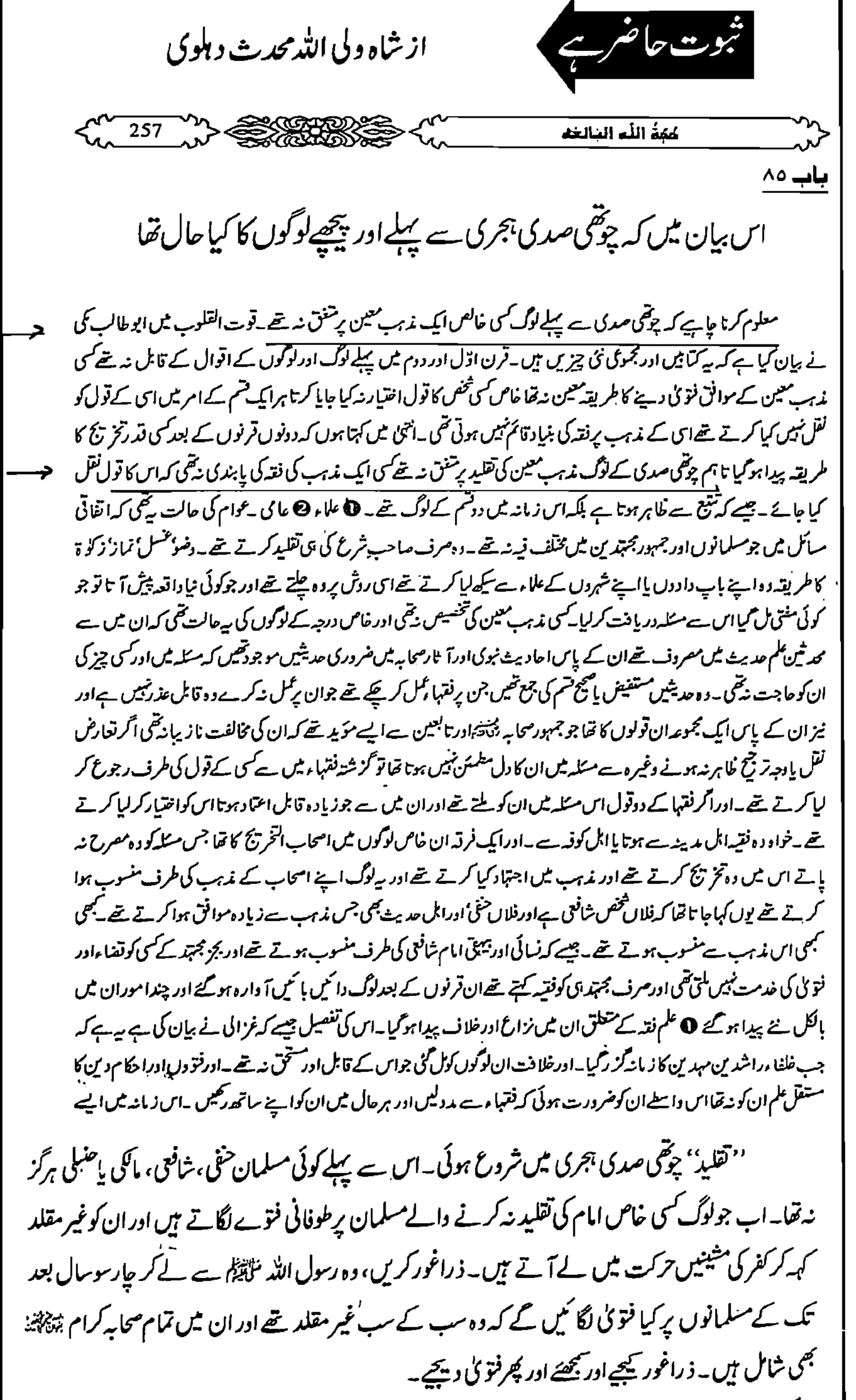
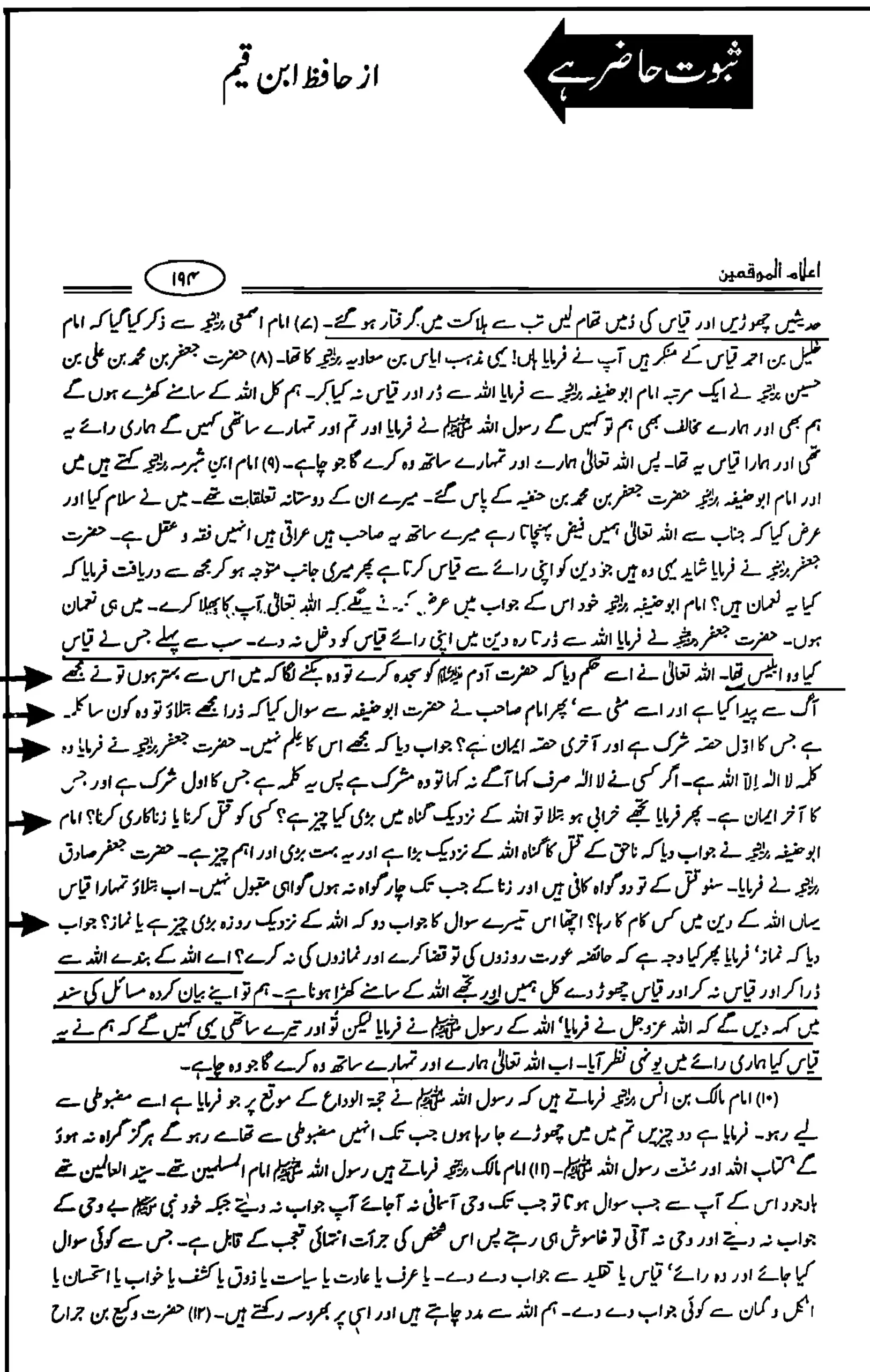
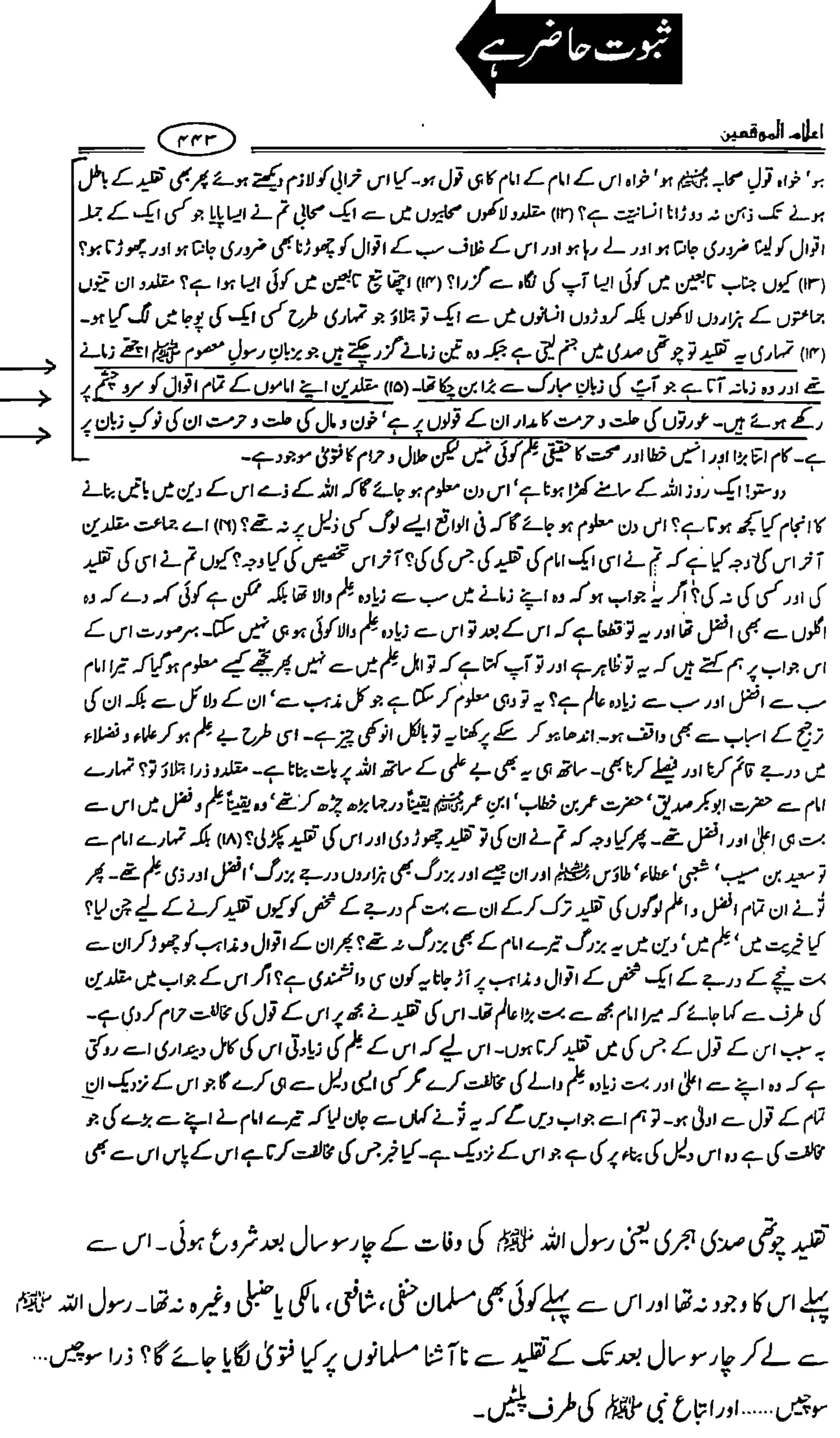
It is very commonly known that there are four rightful Imams and it is obligatory for the public to follow them. The four Imams refer to Malik ibn Anas, Abu Hanifa Nu'man ibn Thabit, Muhammad ibn Idris al-Shafi'i, and Ahmad ibn Hanbal, may Allah have mercy on them. All four have a very high scholarly status and their services in Islam are well known to everyone, but there is no evidence from the Quran and Hadith that they hold the rank of Imamate or that it is obligatory for the public to follow them. The Quran and Hadith are the original sources of religion; when we find proof of something from them, then there is no room for interpretation, and when we do not find any proof in the Quran and Hadith, then we have no grounds to accept it. This is because we are subject to the Shariah, not the makers of Shariah. Some ignorant types of followers derive justification from the Quranic verse: [فَسۡـَٔلُوۡۤا اَہۡلَ الذِّکۡرِ اِنۡ کُنۡتُمۡ لَا تَعۡلَمُوۡنَ]
Reference: An-Nahl:43
that this verse commands the public to follow them, whereas their claim is a slander against Allah Almighty and they are not even slightly ashamed of lying about Allah. The context before and after this verse in Surah An-Nahl clearly explains that the "people of knowledge" here refers to the people of the Gospel, not the scholars of the Ummah of Muhammad. Then these ignorant followers, who think they have proven their false claim through imitation, still our question firmly stands: from this verse, also provide proof for following your four so-called Imams, that only these four are meant by the people of knowledge. And here it would not be out of place to mention that the above-mentioned verse means to seek the command from the Quran and Hadith, not to accept the words of people.The Jews and Christians used to obey their clerics and dervishes, therefore Allah Almighty declared them polytheists: the believers were commanded not to ask about people's opinions but rather to ask what Allah Almighty and the Messenger of Allah ﷺ have commanded.
Reference: (Muqaddama Alamgiri:1/14)
The reality is that the innovation which has caused people to turn away the most from the true teachings of Islam is the blind following of the four Imams, because due to this, people have abandoned the sayings, hadiths, and blessed Sunnah of the Messenger of Allah ﷺ and have started following the words and actions of those whom neither Allah Almighty nor the Messenger of Allah ﷺ commanded to be followed, as they were not Prophets but followers.
Here the question also arises that when this Taqlid (imitation) started in the fourth century Hijri, what will happen to those Muslims who passed away before the beginning of this Taqlid without practicing it, and among them are the Companions of the Prophet ﷺ, the Tabi‘in, and the Taba‘ Tabi‘in, all of whom belong to the first three centuries, about whose times the Messenger of Allah ﷺ gave glad tidings, and this hadith is in
Reference: Bukhari 2651
. The conclusion is that Taqlid is entirely an innovation (bid‘ah). Here an objection is raised that most of the pure Shariah is that on which these four Imams are unanimous, and according to Shah Waliullah Muhaddith Dehlawi, may Allah have mercy on him, the agreement of these four elders on any issue is a sign of the consensus (Ijma‘) of the Ummah, meaning that on the issue on which the four Imams agree, it should be understood that the entire Ummah from the Companions of the Prophet ﷺ until today has been unanimous on it. Therefore, it is not permissible to go beyond the unanimous issues of the four Imams.In response, it is stated that if the four Imams agree on an issue and it is considered the consensus of the Ummah, then first of all, the followers of the Imams, especially the Hanafis, oppose it. For example, there are two issues on which the four Imams agree but their followers deny them. Except what Allah wills!
[1] Imam Abu Hanifa (may Allah have mercy on him) says:
[حرام على من لم يعرف دليلي أن يفتي بكلامي]
It is forbidden for anyone who does not know the evidence (from the Quran and Hadith) of my statement to issue a fatwa based on my words.
Reference: Mizan al-Sharani:38
In Dur al-Mukhtar it is stated:
[إذا صح الحديث فهو مذهبي أن توجه لكم دليل فقولوا به]
The issue that is established by authentic Hadith is my madhhab. If you find any evidence in the Quran and Hadith, then act upon it and issue fatwas accordingly.
Reference: Dur al-Mukhtar:1/50
[2] Imam Malik (may Allah have mercy on him) says:
[إنما أنا بشر أخطئ وأصيب فانظروا في رأیي فكل ما وافق الكتاب والسنة فخذوه وكل ما لم يوافق فاتركوه]
O people! I am a human being; sometimes my statement is correct and sometimes it is wrong. Take that which is according to the Book and Sunnah and leave that which is against it.
Reference: Iqaaz al-Tib Hind:102
Shah Waliullah Sahib narrates the statement of Imam Malik as follows:
[ما من أحد إلا وهو مأخوذ من كلامه ومردود عليه إلا رسول الله صلى الله عليه وسلم]
There is no person in the world whose every word is accepted except the Messenger of Allah ﷺ.
Reference: Al-Insaf:13], [Aqd al-Jayyid:80
(It means) it is possible for others to be mistaken, but the words of the Messenger of Allah ﷺ are one hundred percent true and right, therefore only his ﷺ words are worthy of acceptance.
[3] Imam Shafi'i, may Allah have mercy on him, says:
[إذا صح الحديث فهو مذهبي وإذا رأيتم كلامي يخالف الحديث فاعملوا بالحديث واضربوا كلامي الحائط]،
What is in the authentic hadith is my religion; when you find my speech contradicting the hadith, then act upon the hadith and throw my statement against the wall.
Reference: Aqd al-Jayyid:81
He also says that there is consensus among all Muslims that whenever the Sunnah of the Messenger ﷺ becomes apparent upon someone, it is forbidden for that person to abandon that Sunnah and follow the words of others.
Reference: I'lam:2/161], [Ayqaz:85
[4] Imam Ahmad ibn Hanbal, may Allah have mercy on him, says:
[ليس لا حد مع الله ورسوله كلام] No one's speech holds any truth in comparison to Allah and His Messenger.
Reference: Aqd al-Jayyid:81
Shah Waliullah Sahib further narrates that Imam Ahmad, may Allah have mercy on him, said:
Reference: Do not imitate me, nor imitate Malik, nor Al-Awza'i, nor Al-Thawri; take rulings from where they took them—from the Book and the Sunnah
Beware! Never, ever imitate me, nor Imam Malik, nor Awza'i, nor Thawri; rather, wherever these great scholars used to take rulings from, you should also take from there, that is, the Quran and Hadith.
Reference: Aqd al-Jayyid:81
These are the sayings of the Four Imams:
They reject personal imitation. It is as if the Four Imams are unanimous that imitation is forbidden, and according to Shah Wali, may Allah have mercy on him, this is a consensus of the Ummah. Now the imitators themselves should introspect and ask why they oppose this consensus. Especially the Hanafis, even though their religious books also prohibit imitation. For example, Sheikh Ibn al-Humam Hanafi
Reference: Fath al-Qadeer:3/247
states:[فلا دليل على وجوب اتباع المجتهد المعين بالزام نفسه ذلك قولا أو نية] There is absolutely no evidence to make every single statement of one single Mujtahid and Imam obligatory and binding upon oneself.
The second issue on which the four Imams are unanimous is Aqeedah (creed). All books of Aqeedah agree that the four Imams were Tafwidhi (delegators) in matters of Aqeedah. However, except for the followers of Imam Ahmad (may Allah have mercy on him), the followers of the three Imams abandoned this belief of their Imam and adopted the Ta'wili (interpretative) belief later presented by the later theologians (such as Ash'ari, Maturidi, etc.). Now, generally from the followers of these three Imams, and especially from the followers of Imam Abu Hanifa, the question arises: why was this consensus belief abandoned? And by abandoning it, did you all become deniers of Ijma (consensus) or not? After all, there were some differences among the Companions of the Prophet ﷺ as well. But among them, there was no such sectarianism and intensity of jurisprudential differences. The reason for this was that they were in search of the Hadith of the Messenger ﷺ. And after finding the Hadith of the Messenger ﷺ, they did not resort to far-fetched interpretations and distortions. Rather, they humbly submitted to it. Even today, if the followers sincerely accept the status and importance of the Ahadith as it was in the era of the Companions and the Tabi‘in, and as the Shariah has actually given it, then even today the intensity of differences can be moderated.
[1] The Holy Quran has stated that the Messenger came to guide the ignorant and the misguided.
[2] Allah has made the Holy Quran easy and understandable so that every person can benefit from it.
[3] The Messenger of Allah ﷺ said: I have come with an easy religion.
The true Sunni says: that whatever Allah and His Messenger ﷺ have stated is the truth. If someone says that understanding the Quran and Hadith is difficult, then it is as if he is challenging Allah and the Messenger ﷺ. He will be accountable for this on the Day of Judgment. The practical proof of what the true Sunni says is present in the lives of the Companions رضي الله عنهم اجمعين. They heard and understood the Quran and Hadith from the blessed tongue of the Messenger ﷺ and acted upon it. All these rulings regarding worship and transactions were implemented during the early period of the Prophet ﷺ. This was transmitted continuously from generation to generation until it reached us, and this chain will continue until the Day of Judgment. Thus, in both written form and practical application, these rulings are available to us exactly as they are. If ever there is a mistake or forgetfulness in practice, it can be clarified from the written texts.
The original Sunni also say: that the educated can directly correct this defect from the Quran and Hadith. And an illiterate person will go to a scholar and ask what is stated in the Quran and Hadith on this matter, and that scholar will tell the ruling from the Quran and Hadith, which will correct this defect and flaw. And no one person will be appointed for this question; rather, whoever is available at the time will be asked because this was the practice of the Companions. The Quran has [فسۡـٔلوۡۤا اہۡل الذکۡر انۡ کنۡتمۡ لا تعۡلموۡن] [النحل:43] stated, the meaning of which is to ask a living and present scholar face to face, and what to ask is not the ruling that so-and-so said and so-and-so said. Thus, the original Sunni illiterate will learn the issue of Quran and Hadith from an educated scholar, and this is research, not blind following. You see in Hanafi jurisprudence that the students of Imam Abu Hanifa rejected thousands of their teacher’s deductions, and the same is true for other Imams.
Hanafi says: May Allah protect us, the real Sunni consider the insult of Imam Abu Hanifa (may Allah have mercy on him) as a source of honor. Whereas for the real Sunni, this is a great slander just as the Barelvi accuse Ahl-e-Hadith of insulting saints and even blaspheming the Prophet (ﷺ). According to Ahl-e-Hadith, blasphemy against the Prophet ﷺ is disbelief. So what is the nature of this accusation? It is that Ahl-e-Hadith do not accept saints and prophets in the way the Barelvis do. Barelvis attribute divine attributes to saints and prophets (peace be upon them). For example, they consider them as the Knower of the unseen, ever-present and watchful, beneficial and harmful, controllers of affairs, and so on. Anyone who does not hold these exaggerated beliefs about saints and prophets is considered by them as an offender of saints and an offender of the Messenger.
We ask whether the Barelvis' accusation is correct? If it is correct, then declare it so that we may also admit that the true Sunnis are indeed blasphemers of Abu Hanifa. But avoiding excessive reverence is not blasphemy; rather, it is precisely what is required. Therefore, the Deobandis' repetitive claim, like that of the Barelvis, that the true Sunnis are blasphemers of the Imams, especially Imam Abu Hanifa, is nothing but nonsense.
If disagreement with their jurisprudential opinions is blasphemy, then this blasphemy was first committed by their senior students Qazi Abu Yusuf and Imam Muhammad, etc. Charge them first; the true Sunnis come later. Then, if disagreement with the sayings and ijtihads of the Imams is blasphemy, then all Hanafis are blasphemers. They have disagreed and continue to disagree with the sayings and ijtihads of Imam Malik (may Allah have mercy on him), Imam Ahmad (may Allah have mercy on him), Imam Shafi'i (may Allah have mercy on him), and other Imams.
In fact, the enemies of Imam Abu Hanifa are his own Hanafi followers, who have thrown so much mud on the luminous face of this great Imam in the name of fabricated issues that it has become difficult for anyone to see his true face. Despite this, I do not know of any true Sunni who has spoken ill of him or expressed enmity towards him. However, if the Hanafi scholars are aware of this, then the responsibility lies with their elders, that is, the Hanafi jurists. Regarding the other accusations, briefly:
[1] If the narration is proven authentic, then there is no need to deny his Tabi‘ah (being a follower of the Companions). In fact, some scholars of the Muhammadan community, trusting the Hanafis, have even written Imam Sahib as a Tabi‘i.
[2] Where has the book compiled by the Imam disappeared? Imam Malik’s Muwatta is still available.
[3] If these are the students of Hazrat Imam Humam, then this would be a treasure for them, but what have you gained from this, although it is difficult to present proof of this from history and biography. The people who have been called students of Imam Humam, all their narrations are present in the authentic books of Hadith and Musnads. Among them, those narrations which are reported from the Imam himself should be collected so that the public may know how much the students of the Imam benefited from him.
[4] If they could not make mistakes, then why did they make mistakes? If they did not make mistakes, their students would not have differed with them. It is a fact that Imam Abu Yusuf and Imam Muhammad differed with their teacher (Imam Abu Hanifa) not in one or two issues but in dozens of issues.
Imam Abu Yusuf is the most important student of Imam Abu Hanifa, and it has even been said here that if he had not existed, no one would have even known the name of Imam Abu Hanifa:
[ما كان في أصحاب أبي حنيفة مثل أبي يوسف لولا أبو يوسف ما ذكر أبو حنيفة]
Among Abu Hanifa's students, there is no one like Abu Yusuf; if Abu Yusuf had not existed, there would have been no mention of Abu Hanifa.
Reference: Wafayat al-A'yan:5/424 First Edition
To the extent that these two even opposed their teacher in principles and differed from their teacher Imam Abu Hanifa on numerous issues. [وخالفه في مواضع كثيرة] that they differed on many issues.
Reference: Wafayat al-A'yan:5/421 First Edition
Similarly, there is Imam Muhammad, who is also the most important student after Imam Abu Yusuf. In fact, his writings are the foundation of Hanafi jurisprudence, but he too differed from his teacher on countless issues, to the extent that it has been said that these two students (Imam Abu Yusuf and Imam Muhammad) even opposed their teacher in principles: [فإنهما يخالفان أصول صاحبهما]
Reference: Tabaqat al-Shafi'iyyah:2/102 New Edition
It is also said:
[استنكف محمد بن الحسن وأبويوسف عن متابعته في ثلثى مذهبه ووافقا الشافعي في أكثر المسائل]
These two students, Muhammad bin Hasan and Abu Yusuf, differed from their Imam in two-thirds of the religion and in many issues aligned with Imam Shafi'i.
Reference: Mughith al-Khalq fi Tarjih al-Qawl al-Haqq, by Imam al-Juwayni:44
And Maulana Abdul Hayy Lakhnawi Hanafi also acknowledges this and writes:
[فإن مخالفتهما لأبي حنيفة في الأصول غير قليلة حتى قال الإمام الغزالي في كتاب المنخول إنهما خالفا أبا حنيفة في ثلثى مذهبه]
The opposition of Muhammad and Abu Yusuf to Abu Hanifa's principles is not insignificant; even Imam Ghazali has explicitly stated in ،،مخول،، that Muhammad and Abu Yusuf opposed Abu Hanifa in two-thirds of the issues.
Reference: Muqaddimah Umdat al-Ri'ayah fi Hall Sharh al-Wiqayah:8 Majtaba'i Press Delhi
We respect every scholar according to the command of the Noble Prophet ﷺ, but we do not accept anyone as an unquestionable authority. Therefore, establishing proof on this basis is a sign of ignorance. Proof can only be established for us through the Quran and Hadith.
Remember that in comparison to the texts of the Quran and Hadith, no one's statement or analogy holds any importance, and in such a case, Taqlid (blind following) is absolutely forbidden.
Did the Prophet Muhammad ﷺ command those companions who were Bedouins that you are not capable of acting upon the Quran or my Sunnah, so act through an ijtihad companion? Seeking information from a knowledgeable person due to lack of knowledge is not called taqlid (blind imitation), rather it is true research. Calling it taqlid is the worst example of confusion of terms.
Exalting the Imams beyond their status is also disrespectful to them. There are two ways to demean a person,
[1]One is to attribute to them a status lower than what they actually have. For example, calling a king a minister or even lower.
[2]The other way to demean is to elevate them beyond their actual status. For example, calling a police officer a king.
There are also only these two levels of enmity towards elders; to demean an elder in their status is also disrespectful and against Shariah. For example, recalling the Imams of the religion and Mujtahids of the firm Shariah with disrespectful words. Similarly, one way of disrespecting them is to elevate them beyond their rank, for example, calling a Wali Allah (friend of Allah) as Allah, or calling an Imam the Messenger of Allah ﷺ. Just as disrespect occurs through these two ways, thoughts are also of these two types, and both are forms of irreligion. Likewise, the treatment meted out to them is also of these two kinds. So, just as it is an insult to an Imam of the religion not to consider him an Imam or elder at all, it is also an insult to place them on the level of divinity or prophethood. In personal imitation (taqlid), the Imam is essentially considered a Prophet.
Not all four religions are true, the Divine command is:
[وَ قُلِ الۡحَقُّ مِنۡ رَّبِّکُمۡ ۟ فَمَنۡ شَآءَ فَلۡیُؤۡمِنۡ وَّ مَنۡ شَآءَ فَلۡیَکۡفُرۡ]This is the truth from your Lord, so whoever wills may believe, and whoever wills may disbelieve.
Reference: (Al-Kahf:29)
Is there anyone who denies the fact that there is only one truth, and whatever is other than this truth is falsehood? Those who accept this reality and call all four religions true should think about what they are saying. If all the truth is in one religion, then obviously the other three religions are not true. If each of the four has truth, then at most each religion has only one-fourth of the truth, not the whole. When there is one-fourth truth, it is also certain that each religion has three-fourths falsehood. Divide one rupee into four parts, make four heaps of sand, and place that one rupee among these four heaps. Obviously, in each heap, you can place one-fourth of a rupee. Whichever group takes possession of a heap and sits on it can, after much effort, roll and extract one-fourth from that heap, not the whole rupee. So, if the truth is in these four, then at most each religion has one-fourth truth and three-fourths falsehood. Is there anyone who denies this clear reality?
Yes, the group that does not divide this one piece of truth into four parts, nor into four heaps, nor into four religions, can indeed possess the entire truth; the whole coin can remain in its possession. The above four groups belonged to the followers of four religions, and this one group is the true Ahl-e-Sunnat. You can also understand it this way that every follower of a religion can act upon the same verse and hadith that is in accordance with his religion, which has the seal of his Imam, which is declared actionable in the jurisprudence books of his religion, which belongs to his religion, which his founder accepted and declared actionable. So, for each one there is a restriction, but Jamaat-e-Muhammadi is completely free from this restriction. Therefore, it can hold a practical belief in every verse and hadith.
Why should anyone’s heart be saddened by giving to someone?
If the heart is not beside you, then why have a tongue in your mouth?
You can also understand it like this: there is a large house, which has been divided into four parts, and each part has been separated from the others by walls, and different people have started living in each of the four parts. Obviously, for each tribe, the space available is only a quarter of the original house's size. None of the four tribes has the full extent of the entire house, but the tribe that does not divide this large house into four parts is allowed to live in its original spaciousness and openness. Clearly, it has a very wide area. It can live and is living in the vast open air and clear light of nature. Those who have divided the divine religion into four parts have actually taken at most a quarter of the religion, not the complete religion. The complete religion is in the hands of those who are separate from this division, who are displeased with this partition.
You try this: present a Sahih hadith to a Hanafi. Their clear response will be that my sect does not follow it. In my sect, it is like this. And their proof is such and such another hadith. Whether that proof is valid or not, strong or weak, in any case, they do not act upon or believe in that Sahih hadith. You will find the same situation with the Shafi'is, and if you look at the Hanbalis, you will see the same pattern, and the same you will find among the Malikis. But by the grace of Allah, the Jamaat-e-Muhammad, when you present any Sahih hadith before them, they bow their heads and say that every command of the Prophet ﷺ is accepted with utmost respect. Just to prove this point, there are many clear, explicit, and Sahih hadiths which are not allowed to be acted upon or believed in under the pretext of sect or taqlid. Since we stand with the original Sunnis of the subcontinent, who are the Hanafi brothers, we have addressed these very neighbors, and in this book, Shama-e-Muhammadi (authored by Muhammad Junagadhi), we have quoted one hundred and fifty hadiths which are Sahih, explicit, but according to the Hanafi scholars, they are abandoned. Not a single one among millions of Hanafis acts upon them.
Friends! Either say that we do not follow the Hadith of the Prophet or come, start following them too. The Lord is indeed Wise and All-Knowing. My request is that Muslims should act upon the Hadith of the Messenger of Allah ﷺ.
Listen! O people who have believed in Allah and His Messenger (ﷺ)! Listen to me carefully.
That honorable Messenger (ﷺ) upon whom Allah sends down His mercy.
That honorable Messenger (ﷺ) for whom the angels pray for mercy.
That honorable Messenger (ﷺ) whose age Allah Almighty has sworn by in His Holy Book.
That honorable Messenger (ﷺ) whose life Allah Almighty has declared the best example.
That honorable Messenger (ﷺ) whose pledge of faith was taken from all the noble Prophets (peace be upon them) in the world of spirits.
That honorable Messenger (ﷺ) whom Allah Almighty honored with the dignity of the physical Mi'raj (Ascension).
That honorable Messenger (ﷺ) after whom no other prophet will come until the Day of Judgment.
That honorable Messenger (ﷺ) whose happiness pleases Allah.
That respected Messenger (ﷺ) whose displeasure causes Allah to be displeased.
That respected Messenger (ﷺ) whose obedience is obedience to Allah.
That respected Messenger (ﷺ) whose disobedience is disobedience to Allah.
That respected Messenger (ﷺ) whose any decision or command being disregarded ruins all good deeds.
That respected Messenger (ﷺ) beyond whom no one is permitted to go.
That respected Messenger (ﷺ) before whom speaking loudly is to ruin one’s worldly life and hereafter.
That respected Messenger (ﷺ) in whose obedience is Paradise and in whose disobedience is Hell.
We all belong to the same respected Messenger’s (ﷺ) Ummah. We all have recited the Kalima of the same respected Messenger (ﷺ). Our affiliation is with the same respected Messenger (ﷺ). So then what is this that we have established separate affiliations? We have formed separate sects and schools of thought. We have taken separate names, and then we feel happy and proud in boasting about our own affiliations, our own sects, our own schools of thought, and our own names.
O people who claim to believe in Allah and His Messenger (ﷺ)! Are our hearts more hardened than stones, fixed stubbornly on our own favorite countries and ways, that even after knowing the Sunnah of the Messenger ﷺ, we are not ready to leave them?
O believers in Allah and the Messenger ﷺ! Listen carefully to what I say. The companion of the Messenger, Sayyiduna Anas رضي الله عنه, says: The Messenger of Allah ﷺ said: [فمن رغب عن سنتي فليس مني] Whoever turns away from my way has no relation with me.
Reference: Bukhari, Book of Marriage, Chapter on Encouragement to Marriage: 5073], [Muslim, Book of Marriage, Chapter on the Recommendation of Marriage... etc.: 1401
O people who have believed! We have all heard the blessed command of our respected Messenger ﷺ. Come! Let us reflect on what our response to it is?
Jamaat Muhammad and Ahl-e-Sunnat are the followers of the Prophet Muhammad ﷺ. The Holy Quran is the true book, all Muslims believe in it. If any verse displeases you, understand that faith is lacking, and if someone tears any verse of the Holy Quran out of anger, understand that he is not a Muslim. By believing in the Holy Quran, respect its verses. Allah Almighty says: [اِنَّ الَّذِیۡنَ فَرَّقُوۡا دِیۡنَہُمۡ وَ کَانُوۡا شِیَعًا لَّسۡتَ مِنۡہُمۡ فِیۡ شَیۡءٍ]
Those who have divided the religion into sects and fragmented it, (O Messenger) you have no relation with them.
Reference: (Al-An'am:159)
Taqlid (blind imitation) began in the fourth century; before that, there were no Hanafi, Maliki, Shafi'i, or Hanbali sects. The Deoband Madrasa was established in 1867; before that, there was no Deobandi sect. Maulana Ahmad Raza Khan Barelvi died in 1911; before that, there was no Barelvi sect. All these sects are modern. Only Ahl-e-Sunnat...
Only the Jamaat is the true group; all others are sects. We have been commanded to follow only the Messenger of Allah ﷺ. The sayings of the Prophet ﷺ are called Hadith. Believe in the Hadith of the Messenger ﷺ and become Muhammadi. Then follow the way he showed and become Ahl al-Sunnah; this is the Jamaat that follows the Sunnah of the Prophet ﷺ.
The Messenger of Allah ﷺ said: [من خرج من الجماعة قيد شبر فقد خلع ربقة الإسلام من عنقه]
Whoever turns away even an arm's length from the Jamaat, he has removed the circle of faith from around his neck.
Reference: Musnad Ahmad:17170, Ibn Hibban:6233
Ahl al-Sunnah are the obedient followers of the Prophet ﷺ, and all sects are newly formed in the name of Ummah members. No member of the Ummah has any status compared to the Prophet ﷺ. Direct your affiliation towards ﷺ, not towards the Ummah, because no one’s being is like the being of the Messenger of Allah ﷺ, and no one’s words are like his words.
You have abandoned the path of the Sunnah and are engrossed
You are attached to your sects with passion
When Muhammad (ﷺ) has no affiliation with any sect
Why do you accept and not abandon the sects?

