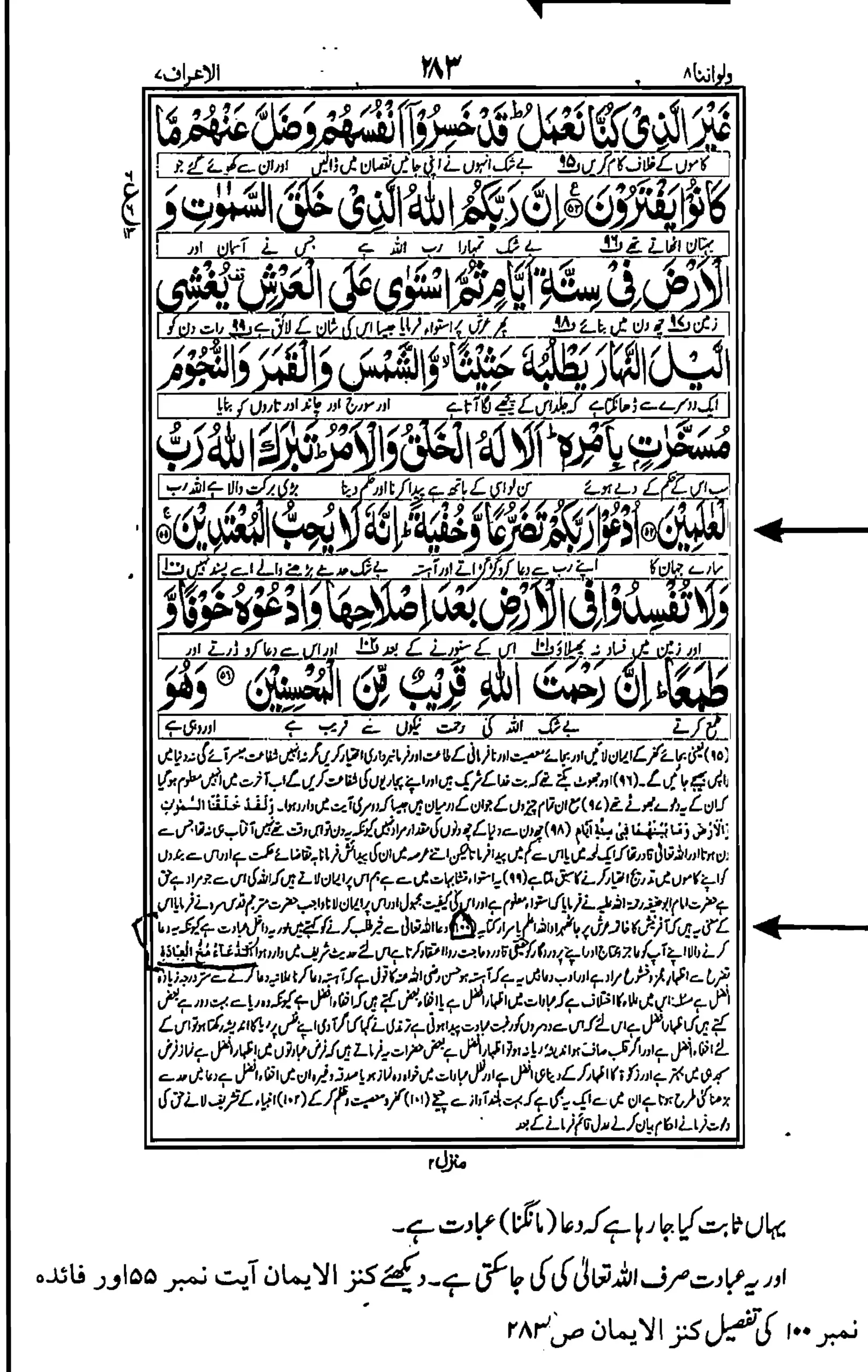
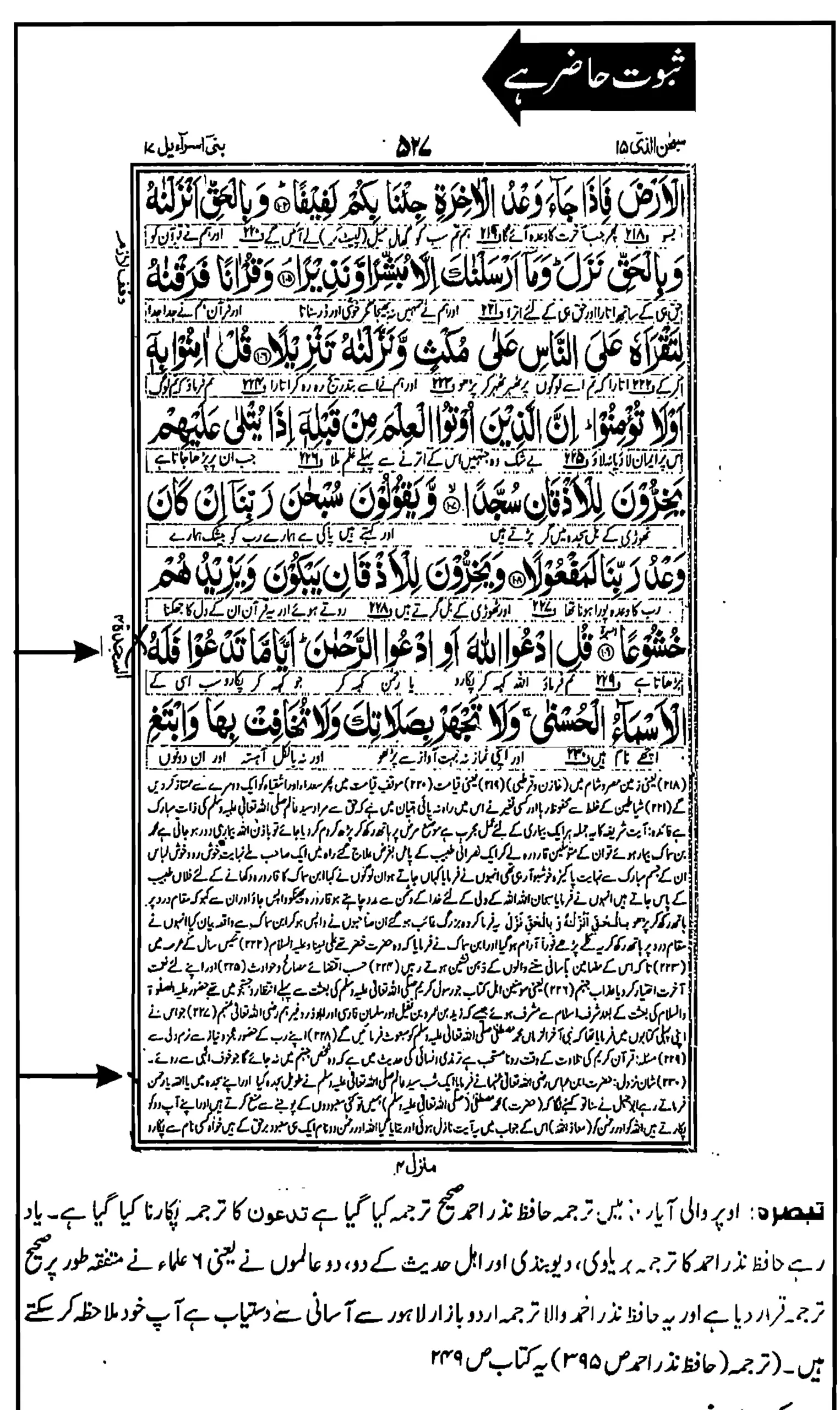
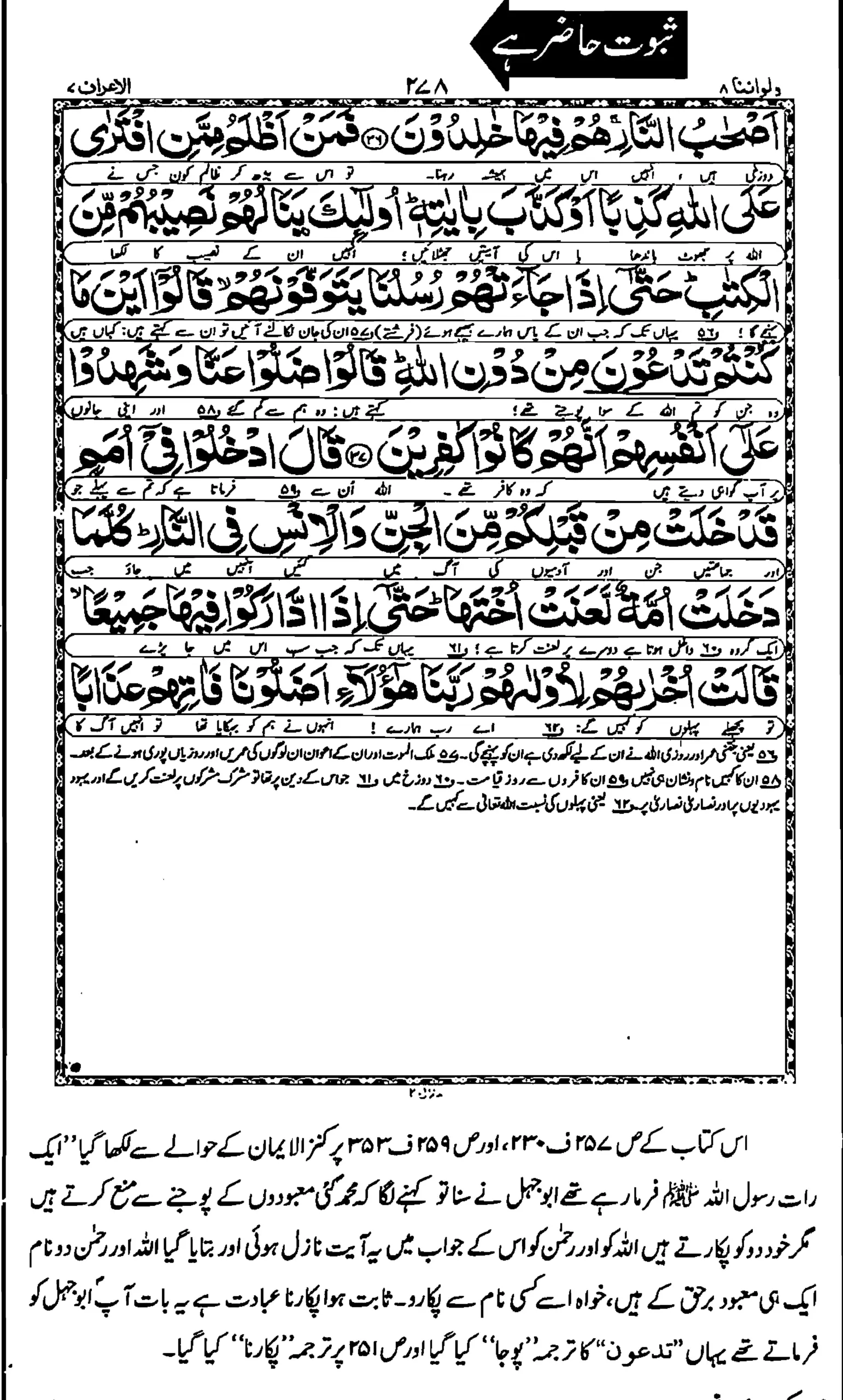
This excerpt is taken from Sheikh Irshad Ullah Maan's book The Search for Truth.
Now we want to explain this matter from another angle as well. A comparative review of Ahmad Raza Khan Sahib's Quranic translation is presented here:
[1] [قُلۡ اِنِّیۡ نُہِیۡتُ اَنۡ اَعۡبُدَ الَّذِیۡنَ تَدۡعُوۡنَ مِنۡ دُوۡنِ اللّٰہِ]
You say, I am forbidden to worship those whom you worship besides Allah.
Reference: Al-An'am:56
[2] [قَالُوۡۤا اَیۡنَ مَا کُنۡتُمۡ تَدۡعُوۡنَ مِنۡ دُوۡنِ اللّٰہِ]
So say to them, Where are those whom you used to worship besides Allah?
Reference: Al-A'raf:37
[3] [وَ اِذَا مَسَّکُمُ الضُّرُّ فِی الۡبَحۡرِ ضَلَّ مَنۡ تَدۡعُوۡنَ اِلَّاۤ اِیَّاہُ ۚ فَلَمَّا نَجّٰىکُمۡ اِلَی الۡبَرِّ اَعۡرَضۡتُمۡ ؕ وَ کَانَ الۡاِنۡسَانُ کَفُوۡرًا]
And when adversity strikes you at sea, those whom you worship besides Him vanish. Then when He delivers you to the land, you turn away.
Reference: Bani Isra'il:67
[4] [اَتَدۡعُوۡنَ بَعۡلًا وَّ تَذَرُوۡنَ اَحۡسَنَ الۡخَالِقِیۡنَ]
Do you worship Baal and leave the best Creator?
Reference: As-Saffat:125
[5] [اِنۡ یَّدۡعُوۡنَ مِنۡ دُوۡنِہٖۤ اِلَّاۤ اِنٰثًا ۚ وَ اِنۡ یَّدۡعُوۡنَ اِلَّا شَیۡطٰنًا مَّرِیۡدًا]
Those who commit shirk do not worship except some women and do not worship except a rebellious Satan.
Reference: An-Nisa:117
[6] [وَ لَا تَسُبُّوا الَّذِیۡنَ یَدۡعُوۡنَ مِنۡ دُوۡنِ اللّٰہِ فَیَسُبُّوا اللّٰہَ عَدۡوًۢا بِغَیۡرِ عِلۡمٍ]
And do not insult those whom they invoke besides Allah, lest they insult Allah out of ignorance and excess.
Reference: Al-An'am:108
[7] [فَمَاۤ اَغۡنَتۡ عَنۡہُمۡ اٰلِہَتُہُمُ الَّتِیۡ یَدۡعُوۡنَ مِنۡ دُوۡنِ اللّٰہِ مِنۡ شَیۡءٍ لَّمَّا جَآءَ اَمۡرُ رَبِّکَ]
So those gods whom they invoke besides Allah did not avail them when the command of your Lord came.
Reference: Hud:101
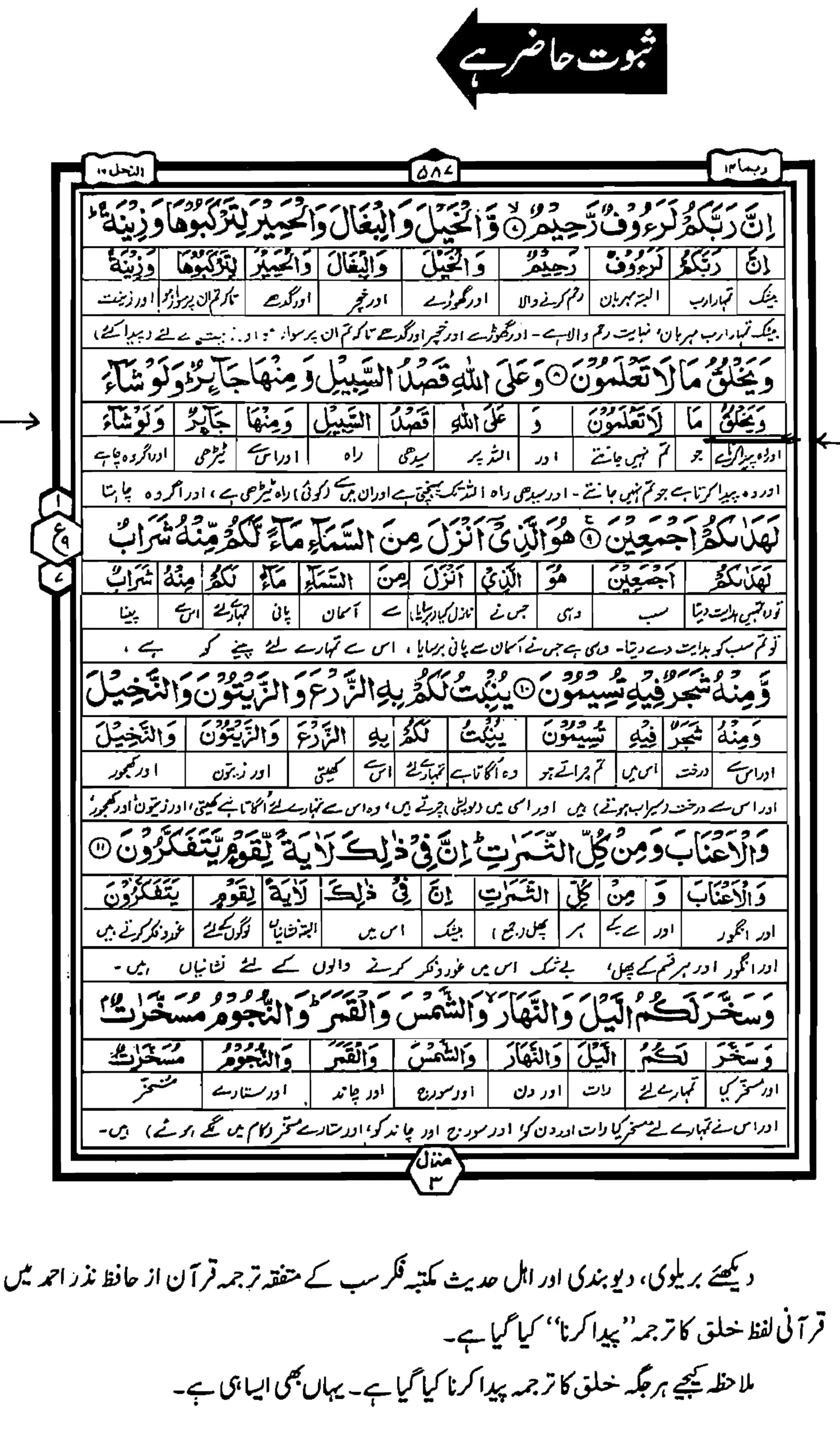
[8] [وَ الَّذِیۡنَ یَدۡعُوۡنَ مِنۡ دُوۡنِ اللّٰہِ لَا یَخۡلُقُوۡنَ شَیۡئًا وَّ ہُمۡ یُخۡلَقُوۡنَ ]
And Allah and those whom they invoke besides Him do not create anything, and they themselves are created.
Reference: An-Nahl:20
Please observe carefully: In the above eight verses, the word ،،یدعون،، اور ،،تدعون،، has been translated as "worship" instead of "call." Now we will present references of those verses before you, in which the same word ،،تدعون،، اور ،،یدعون،، has been translated by Ahmad Raza Khan Sahib repeatedly as "call," because translating it as "worship" is not possible:
[1] [قُلۡ اَرَءَیۡتَکُمۡ اِنۡ اَتٰىکُمۡ عَذَابُ اللّٰہِ اَوۡ اَتَتۡکُمُ السَّاعَۃُ اَغَیۡرَ اللّٰہِ تَدۡعُوۡنَ ۚ اِنۡ کُنۡتُمۡ صٰدِقِیۡنَ]،[ بَلۡ اِیَّاہُ تَدۡعُوۡنَ فَیَکۡشِفُ مَا تَدۡعُوۡنَ اِلَیۡہِ اِنۡ شَآءَ وَ تَنۡسَوۡنَ مَا تُشۡرِکُوۡنَ]
Say! Tell me, if the punishment of Allah comes upon you or the Hour is established, will you call upon anyone besides Allah, if you are truthful? Rather, call upon Him alone. Then if He wills, He will remove what you call upon and forget the partners.
Reference: Al-An'am:41,40
[2] [قَالَ ہَلۡ یَسۡمَعُوۡنَکُمۡ اِذۡ تَدۡعُوۡنَ]
He said, "Do they hear you when you call?"
Reference: Ash-Shu'ara:72
[3] [اَلَمۡ تَرَ اِلَی الَّذِیۡنَ اُوۡتُوۡا نَصِیۡبًا مِّنَ الۡکِتٰبِ یُدۡعَوۡنَ اِلٰی کِتٰبِ اللّٰہِ لِیَحۡکُمَ بَیۡنَہُمۡ]
Have you not seen those who were given a portion of the Book? They are invited to the Book of Allah that it may judge between them.
Reference: Al-Imran:23
[4] [اِذۡ تُصۡعِدُوۡنَ وَ لَا تَلۡوٗنَ عَلٰۤی اَحَدٍ وَّ الرَّسُوۡلُ یَدۡعُوۡکُمۡ فِیۡۤ اُخۡرٰىکُمۡ فَاَثَابَکُمۡ غَمًّۢا بِغَمٍّ]
When you used to turn your face away and not look in any direction, while another group among you was being called by Our Messenger (ﷺ), and you were given grief instead of grief.
Reference: Al-Imran:153
[5] [وَ لَا تَطۡرُدِ الَّذِیۡنَ یَدۡعُوۡنَ رَبَّہُمۡ بِالۡغَدٰوۃِ وَ الۡعَشِیِّ یُرِیۡدُوۡنَ وَجۡہَہٗ]
And do not turn away those who call upon their Lord morning and evening, seeking His pleasure.
Reference: Al-An'am:52
[6] [وَ اصۡبِرۡ نَفۡسَکَ مَعَ الَّذِیۡنَ یَدۡعُوۡنَ رَبَّہُمۡ بِالۡغَدٰوۃِ وَ الۡعَشِیِّ یُرِیۡدُوۡنَ وَجۡہَہٗ وَ لَا تَعۡدُ عَیۡنٰکَ عَنۡہُمۡ]
And keep yourself patient with those who call upon their Lord morning and evening, seeking His pleasure, and let not your eyes overlook them, desiring the adornments of the worldly life.
Reference: Al-Kahf:28
Thus, if we further examine the related words derived from the word ،،دعو،، in the Quran, they appear in many other places as well. If a deep comparative review is done, it will be found that wherever in the Holy Quran Allah has forbidden calling upon others besides Allah, or has declared those who call upon others besides Allah as disbelievers or polytheists, or has said that those who call upon others besides Allah are worshipping them, there Ahmed Raza Sahib has not translated the words derived from ،،دعو،،, meaning "to call," as "calling" at all. Rather, he has translated it as "worship" or "servitude." And in the tafsir, he has written the word "idol," meaning he has written that the worship of idols is forbidden. This has severely misled the common Muslim into thinking that calling upon others besides Allah is not forbidden, only the worship of idols is forbidden. This is why these people are fearlessly calling upon others besides Allah, committing shirk, and becoming fuel for Hellfire. If you want to do this comparative review yourself, keep Ahmed Raza Khan Sahib's
Reference: Qur'anic Translation and Tafsir Muradabadi
alongside
Reference: Hafiz Nazar Ahmad Sahib's Qur'anic Translation
, then extract and examine the places according to our indication in both Qur'anic translations, the difference will be clearly visible. Remember that Hafiz Nazar Ahmad Sahib's Qur'anic translation is the revised and agreed-upon translation of all three sects (i.e., Barelvi, Deobandi, and Ahl-e-Hadith), and this translation is easily available from Urdu Bazaar Lahore.It is remembered: that the words derived from Dua (meaning to call, to invoke, to ask) have been repeatedly translated this way by Ahmad Raza Sahib in his Quranic translation. And its translation is not worship or servitude. And the translation of Abd would be one who worships or serves. The translation of Abd would not be one who calls, invokes, or asks. Because the meaning of Abd is servant. ،،دعو،، that is, words derived from calling يدعو ، تدعو ، ندعو، يدعون، تدعون، دعاء دعوت، etc. and ،عبدت، derived words نعبد، تعبد، يعبد، تعبدون، يعبدون etc. will be.
This confusion in translation has been made by Ahmad Raza Sahib in his Quranic translation at the following places.
Reference: An-Nisa:117], [Al-An'am:108,71,56], [Al-A'raf:37,29 Q 189 to 198] (two places) [Hud:101], [Al-Kahf:14], [Maryam:48,47], [Al-Ankabut:42], [Fatir:14,13], [As-Saffat:135], [Az-Zumar:38], [Al-Mu’min:14 to 20, 60 to 66, 74], [Ha Mim As-Sajda:48], [Az-Zukhruf:86], [Al-Ahqaf:5,4], [At-Tur:28], [Al-Jinn:18 to 20], [Bani Isra'il:67,57], [Al-Hajj:73,62,13,12], [Yunus:106], [An-Nahl:86,20], [Al-Furqan:77,68], [Al-Mu’minun:117], [Al-Qasas:88], [Ash-Shu'ara:213], [Luqman:30]
And the anger is that Dua, which is a commonly understood word meaning to pray, call, or ask, has also been translated as worship.
Reference: Maryam:48], [Al-Furqan:77], [Al-Ahqaf:5]
This is a clear distortion (i.e., deriving a twisted meaning). Only to prove one's own belief correct, and the surprising thing is that at all the above places, the Shia have translated correctly.Apart from the above-mentioned places, in the rest of the places, the translation of these words is calling out, shouting, asking, or praying. Because there was compulsion there, the translation like that of Ahmed Raza Khan Sahib, i.e., servitude, was not possible.
Reference: Al-Baqarah: 282, 260, 186, 221, 171, 68, 69, 70, 61, 23
, [Hud: 62, 13], [Al-Mu’min: 50, 49, 43, 42, 41, 26, 12, 10], [Al-A’raf: 189 to 198, 180, 134, 56, 55, 5][/ref]
Reference: Yunus: 89, 38, 25, 22, 12, 10
, [Ibrahim: 44, 40, 33, 22, 10, 9], [Bani Isra’il: 110, 71, 56, 52], [Ha Mim Sajdah: 51, 49, 33, 31, 5][/ref] and countless other places are clear examples of this.In fact, Ahmed Raza Sahib first creates his own fabricated belief and then translates the Quran incorrectly according to his self-made belief. Whereas it should have been that he reads the Quran and forms his belief according to the commands of Allah Almighty, but here the opposite happened, as you have observed in the chapter of Dua, i.e., calling out.
Those verses in which ،،یدعون،،اور ،،يدعونه،، appears and the translation is incorrect:
Reference: An-Nisa: 117, 116
, [Al-An’am: 108], [Hud: 101], [An-Nahl: 17 to 23], [Bani Isra’il: 57, 56], [Al-Hajj: 61 to 66], [Al-Furqan: 18], [Al-Ankabut: 42, 41], [Luqman: 30 to 32], [Az-Zukhruf: 82 to 89], [Ha Mim Sajdah: 48][/ref]Now we list those verses in which Ahmed Raza Khan Sahib has translated ،،يدعون،، correctly:
Reference: Al-Baqarah: 221
, [Aal Imran: 104, 23], [Al-An’am: 71, 52], [Yunus: 66], [Yusuf: 33], [Al-Anbiya: 90], [Ar-Ra’d: 14], [Al-Kahf: 28], [Al-Qasas: 41], [As-Sajdah: 16], [Ya-Sin: 57], [Sad: 51], [Ad-Dukhan: 55], [Al-Qalam: 43, 42][/ref]Those verses in which ،،تدعون،، appears and the translation is incorrect:
Reference: Al-An’am: 56
, [Al-A’raf: 196, 194, 37], [Bani Isra’il: 67], [Maryam: 47 to 49], [Al-Hajj: 74, 73], [As-Saffat: 125 to 128], [Az-Zumar: 38 to 40], [Al-Ahqaf: 1 to 6][/ref]Now we list those verses in which the word ،،تدعون،، has been translated correctly:
Reference: Ibrahim:9], [Al-An'am:63,41,40], [Ash-Shu'ara:72], [Al-Mu'min:10, 41 to 43], [3 times], [Ha Mim As-Sajda:31], [Muhammad:38], [Al-Fath:16], [Al-Mulk:28]
Verses in which ،،تدع،، and ،،یدع،، appear, but the translation is incorrect:
Reference: Yunus:103 to 109], [Al-Mu'minun:117,116], [Ash-Shu'ara:213], [Al-Qasas:88]
Verses in which ،،تدع،، and ،،يدع،، etc. are correctly translated:
Reference: Fatir:18], [Al-Kahf:57], [Bani Isra'il:11], [Al-Mu'min:26], [Al-Qamar:6 to 8], [Al-'Alaq:17]
Verses in which (ادعو، تدعو، يدعو، ندعو) etc. appear but the translation is incorrect:
Reference: Al-A'raf:194], [An-Nahl:86], [Al-Kahf:14], [Maryam:47 to 49], [Al-Hajj:13,12], [Al-Jinn:18 to 23], [Al-Ahqaf:1 to 6], [At-Tur:28]
Reference: Al-A'raf:56,55, 189 to 198], [Yunus:38], [Hud:13], [Yusuf:108], [Ar-Ra'd:36], [Bani Isra'il:110,56], [Al-Mu'minun:73], [Al-Furqan:14,13], [Fatir:14,13], [Muhammad:35], [Yunus:25], [Hud:62], [Ibrahim:9], [Bani Isra'il:52], [Az-Zumar:8], [Fatir:6], [Bani Isra'il:71]
Verses in which the word ،،دعا،، appears but the translation is not correct:
Reference: Maryam:47 to 49], [Al-Furqan:77], [Al-Ahqaf:1 to 6]
Verses in which ،،دعا،، is correctly translated:
Reference: Al-Baqarah:171], [Aal Imran:38], [Yunus:89,12], [Ar-Ra'd:14], [Ibrahim:40,39], [Bani Isra'il:11], [Maryam:4], [Al-Anbiya:45], [An-Nur:63], [Az-Zumar:49]
In the Holy Quran, there are numerous references regarding calling out, but
Reference: Surah Fatir
and
Reference: Surah Al-Mu'min
are both entirely on the subject of calling out, so we will discuss these Surahs in detail here:In this Surah, in
Reference: verse:6
, the word (یدعوا) appears, which has been translated as "calls".In verses
Reference: 13 to 18
of this Surah, the word (تدعون) has been translated as "worship," and (تدعوهم) has been translated as "you call them," and (دعاء کم) as "your call," and (تدع) as "to call."In verses
Reference: 38 to 41
of this Surah, the word (تدعون) has been translated as "worship."By now you must have understood that from the above details it is clear that these words have been deliberately mistranslated.
In verse
Reference: 10
of this Surah, ،،تدعون،، has been translated as "to call."In verse
Reference: 12
of this Surah, [دُعِیَ اللّٰہُ وَحۡدَہٗ] has been translated as "to call upon Allah alone."In verse
Reference: 14
of this Surah, [فَادۡعُوا اللّٰہَ مُخۡلِصِیۡنَ لَہُ الدِّیۡنَ] has been translated as "worship Allah, become His servants."In verse
Reference: 20
of this Surah, ،،یدعون،، has been translated as "worship."In verse
Reference: 26
of this Surah, ،،یدع،، has been translated as "to call."In verses
Reference: 41 to 43
of this Surah, ،،أدعوكم،، appeared twice, ،،تدعوننی،، appeared three times, and ،،دعوۃ،، appeared once. All were translated correctly.In the verses
Reference: 40 to 74
of this Surah, the translation of ،،ادعونی،، was done correctly. And the translation of ،،فادعوہ،، اور،، تدعون،، اور ،،ندعوا،، was not done correctly.Regarding the above-mentioned verses of Surah Fatir and Surah Al-Mu’min, you can yourself judge that deliberate mistranslation has been done here. And wherever they wanted, they translated correctly. This is their double-facedness and clear distortion in the words of Allah Almighty.
An important point:
If the words formed from ،،دعو،، are accepted as worship, then the two hadiths mentioned in this Tafsir
Reference: Al-Mu’min:60, p:127
and [Al-A’raf 56, 55, p:100[/ref] will be translated and explained as follows:[الدعاء هو العبادة] [أبو داؤد:1479]،[ ترمذی:2969]
According to their statement, the translation will be [Worship is worship]
And the second hadith: [الدعاء مخ العبادة ]
Reference: Tirmidhi:3371
. According to their statement, the translation will be Worship is the essence of worship.Obviously, these meanings are meaningless, and the correct translation of these two hadiths will be: Calling out itself is worship. And the correct translation of the second hadith will be: Calling out is the essence of worship.
And
Reference: Muradabadi Sahib's Tafseer Al-Mu'min60, p:127],[Al-A'raf:56,55, p:100
also states that supplication is worship. This has been mentioned many times in the Quran.From the above explanation, it is conclusively proven that the one who calls upon anyone other than Allah is worshipping someone other than Allah. Thus, the one who calls upon others besides Allah is committing Shirk in Judgment. Because he neither accepted the command of Allah nor the command of the Messenger ﷺ in this regard. He is also committing Shirk in Essence, because worship can only be directed to that which originates from the Essence of Allah.
Reference: Az-Zukhruf:81
And no one besides Allah can be worshipped. He is also committing Shirk in Attributes, because he has attributed Allah’s attribute to someone other than Allah. He is also committing Shirk in Knowledge, because he believes that the being he is calling upon other than Allah is aware of his calling. Whereas Allah is Near, as stated in the Qur’an, and no one else is near.
Reference: Al-Baqarah:186, Hud:123, Saba:50
He is also committing Shirk in Worship, because calling upon is an act of worship, and thus the one who calls upon others besides Allah has denied [لا الہ الا اللہ]. And he has gone out of Islam, because he entered Islam by reciting the Kalima, and when he called upon others besides Allah, he worshipped others besides Allah, thus he...He became a denier of [لا الہ الا اللہ], because the meaning of the Kalima is that no one is to be worshiped except Allah.
The Quran invites the use of intellect. The deceased whom we wash, shroud, carry on our shoulders to the grave, lower into the grave, cover with handfuls of soil, perform the funeral prayer for, and supplicate for forgiveness on their behalf. Then we start calling upon that very person, calling them the provider of difficulties, considering them the greatest saint. Do these people not understand even such a simple matter? Whereas, according to Naeem Muradabadi Sahib, the deeds of the deceased come to an end. See:
Reference: Tafseer Muradabadi: Ash-Shu'ara: 89, F: 92
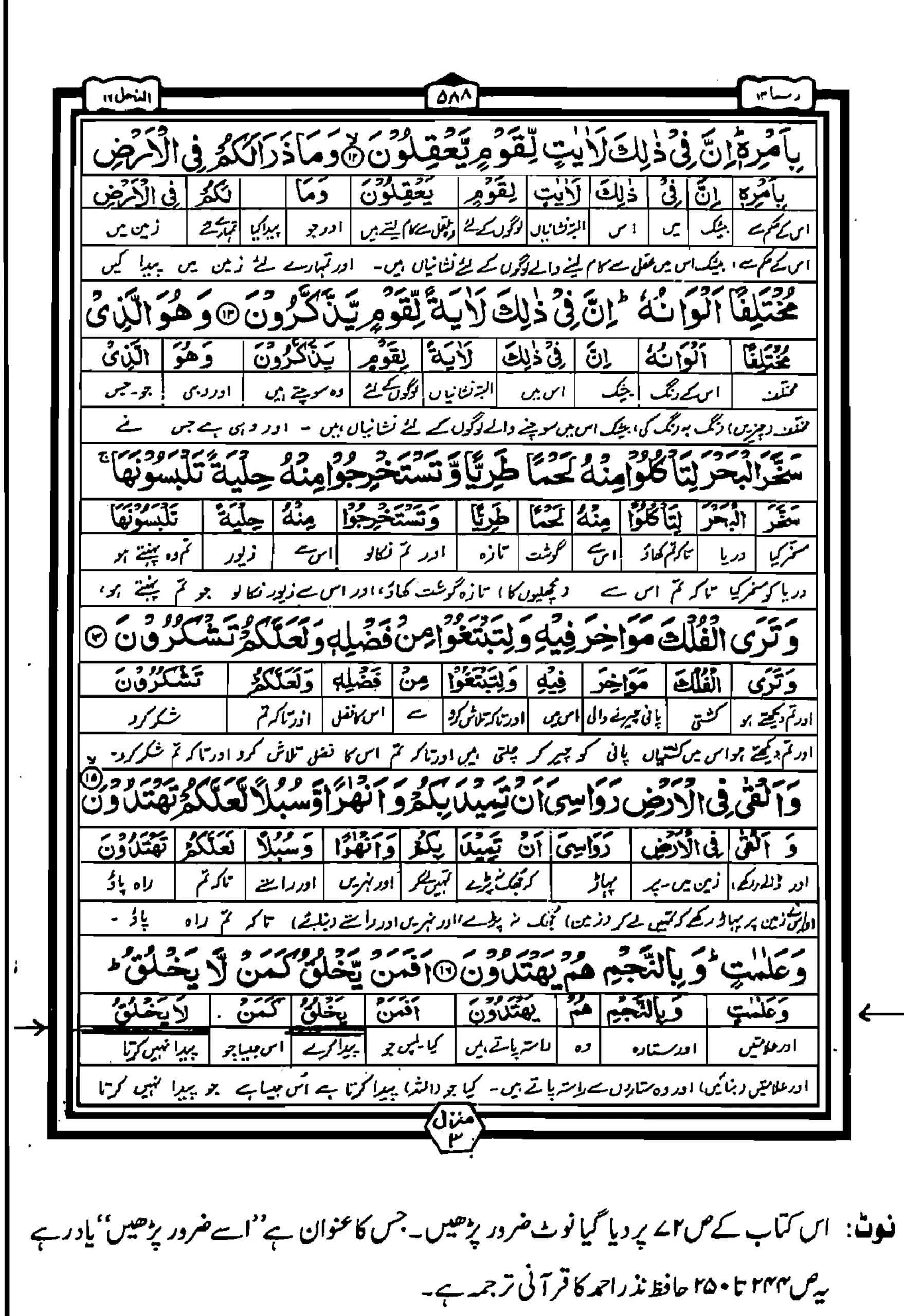
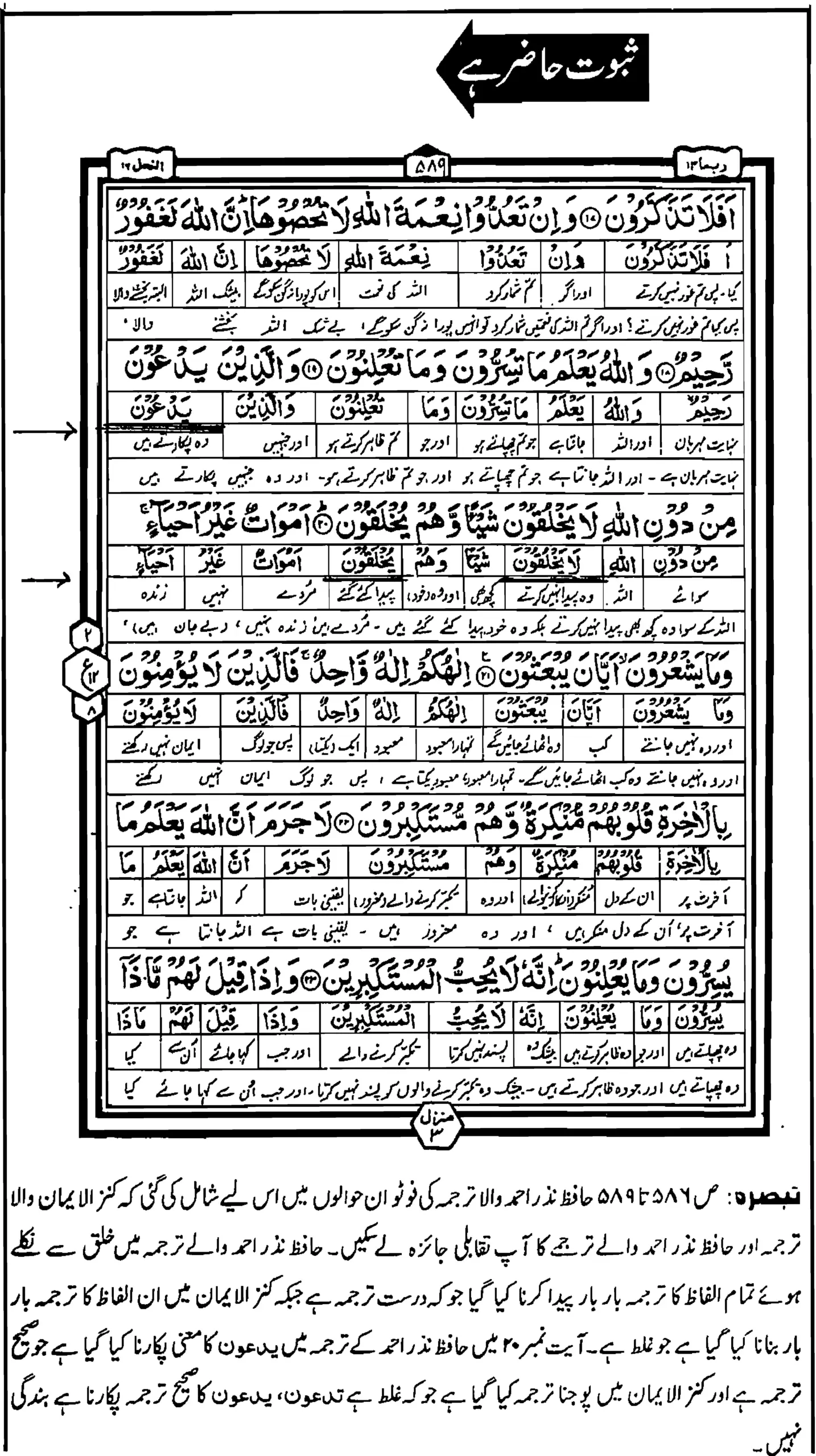
[وَ سَخَّرَ لَکُمُ الَّیۡلَ وَ النَّہَارَ ۙ وَ الشَّمۡسَ وَ الۡقَمَرَ ؕ وَ النُّجُوۡمُ مُسَخَّرٰتٌۢ بِاَمۡرِہٖ ؕ اِنَّ فِیۡ ذٰلِکَ لَاٰیٰتٍ لِّقَوۡمٍ یَّعۡقِلُوۡنَ]،[ وَ مَا ذَرَاَ لَکُمۡ فِی الۡاَرۡضِ مُخۡتَلِفًا اَلۡوَانُہٗ ؕ اِنَّ فِیۡ ذٰلِکَ لَاٰیَۃً لِّقَوۡمٍ یَّذَّکَّرُوۡنَ]،[ وَ ہُوَ الَّذِیۡ سَخَّرَ الۡبَحۡرَ لِتَاۡکُلُوۡا مِنۡہُ لَحۡمًا طَرِیًّا وَّ تَسۡتَخۡرِجُوۡا مِنۡہُ حِلۡیَۃً تَلۡبَسُوۡنَہَا ۚ وَ تَرَی الۡفُلۡکَ مَوَاخِرَ فِیۡہِ وَ لِتَبۡتَغُوۡا مِنۡ فَضۡلِہٖ وَ لَعَلَّکُمۡ تَشۡکُرُوۡنَ]،[ وَ اَلۡقٰی فِی الۡاَرۡضِ رَوَاسِیَ اَنۡ تَمِیۡدَ بِکُمۡ وَ اَنۡہٰرًا وَّ سُبُلًا لَّعَلَّکُمۡ تَہۡتَدُوۡنَ]،[ وَ عَلٰمٰتٍ ؕ وَ بِالنَّجۡمِ ہُمۡ یَہۡتَدُوۡنَ]،[ اَفَمَنۡ یَّخۡلُقُ کَمَنۡ لَّا یَخۡلُقُ ؕ اَفَلَا تَذَکَّرُوۡنَ]،[ وَ اِنۡ تَعُدُّوۡا نِعۡمَۃَ اللّٰہِ لَا تُحۡصُوۡہَا ؕ اِنَّ اللّٰہَ لَغَفُوۡرٌ رَّحِیۡمٌ]،[ وَ اللّٰہُ یَعۡلَمُ مَا تُسِرُّوۡنَ وَ مَا تُعۡلِنُوۡنَ]،[ وَ الَّذِیۡنَ یَدۡعُوۡنَ مِنۡ دُوۡنِ اللّٰہِ لَا یَخۡلُقُوۡنَ شَیۡئًا وَّ ہُمۡ یُخۡلَقُوۡنَ]،[ اَمۡوَاتٌ غَیۡرُ اَحۡیَآءٍ ۚ وَ مَا یَشۡعُرُوۡنَ ۙ اَیَّانَ یُبۡعَثُوۡنَ]،[ اِلٰـہُکُمۡ اِلٰہٌ وَّاحِدٌ ۚ فَالَّذِیۡنَ لَا یُؤۡمِنُوۡنَ بِالۡاٰخِرَۃِ قُلُوۡبُہُمۡ مُّنۡکِرَۃٌ وَّ ہُمۡ مُّسۡتَکۡبِرُوۡنَ]،[ لَاجَرَمَ اَنَّ اللّٰہَ یَعۡلَمُ مَا یُسِرُّوۡنَ وَ مَا یُعۡلِنُوۡنَ ؕ اِنَّہٗ لَا یُحِبُّ الۡمُسۡتَکۡبِرِیۡنَ]
And He has subjected for you the night and the day and the sun and the moon and the stars, all in His command. Indeed, in that are signs for a people who reason. And He it is who produced for you from the earth various colors. Indeed, in that is a sign for those who remember. And He it is who subjected the sea for you, that you may eat fresh meat from it, and you extract ornaments which you wear. And you see the ships plowing through it, that you may seek of His bounty, and that you may be grateful. And He has cast into the earth anchors lest it should shake with you, and rivers and paths that you may find your way. And [there are] signs, and by the stars they are guided. So is He who creates like one who does not create? Will you not then take heed? And if you should count the favors of Allah, you could not enumerate them. Indeed, Allah is Forgiving and Merciful. And Allah knows what you conceal and what you declare. And those whom you invoke besides Allah do not create [anything], while they themselves are created. They are dead, not alive, and they do not perceive when they will be resurrected. Your god is one God. So those who do not believe in the Hereafter, their hearts deny, and they are arrogant. Indeed, Allah knows what they conceal and what they declare. Indeed, He does not like the arrogant.
Reference: An-Nahl:12-23
Read the above verses and their translation carefully and repeatedly; there has been blatant distortion and tampering in the translation and interpretation of these verses.
These verses explain that Allah Almighty has bestowed these blessings upon mankind.
In these verses, Allah Almighty's power, wisdom, and oneness are described, and it is stated that Allah Almighty is the doer and the chooser, and He possesses all power and authority. Do not abandon the worship of such a Creator and Owner to call upon anyone else, for He alone is the true God. Call upon the Creator, not the creation, because the Creator has created all, and the creation cannot create anything.
Despite these clear verses, the distortions made in the Raza Khan translation with commentary are as follows:
[1] Here are four words derived from ،،خلق،،: [يَخْلُق: twice, and [يَخْلُقُونَ، يُخْلَقُونَ], their translation is "to create." But instead of translating it as "to create," it has been translated as "to make." Allah Almighty has said: that I have created everything; no other being can create anything. Therefore, call upon Me, worship Me. However, here "to make" has been written four times as the translation and in the tafsir, it has been explained as idols, implying that idols cannot make anything. And the meaning of these verses of Allah Almighty has been diverted from all creation to idols, stating that idols cannot do anything, whereas any sensible person can easily understand from these verses that the attributes of Allah described in these verses belong to none but Allah.
[2] Here the word [یدعون] has been mentioned. Its meaning is to call out, and its clear implication is that those who are called upon besides Allah do not create anything, and they themselves are created, dead, not alive, and they have no knowledge of when people will be raised. These verses clearly negate calling upon deceased creatures, but here there is no mention of this, and only idols have been mentioned, which is a complete distortion.
[3] The third point is that in these verses [يَدْعُونَ مِنْ دُونِ اللهِ] has appeared, meaning those who are called upon besides Allah. In the chapter of [مِنْ دُونِ اللهِ], it has been explained in great detail. Ahmad Raza Khan interprets [مِنْ دُونِ اللهِ] in the Quran as referring to all creation, including the prophets, but here in the interpretation of [مِنْ دُونِ اللهِ], it has been turned into idols. Allah Almighty is negating all creation in these verses, but this person is only negating idols. Which is a clear distortion.
Similar distortions:
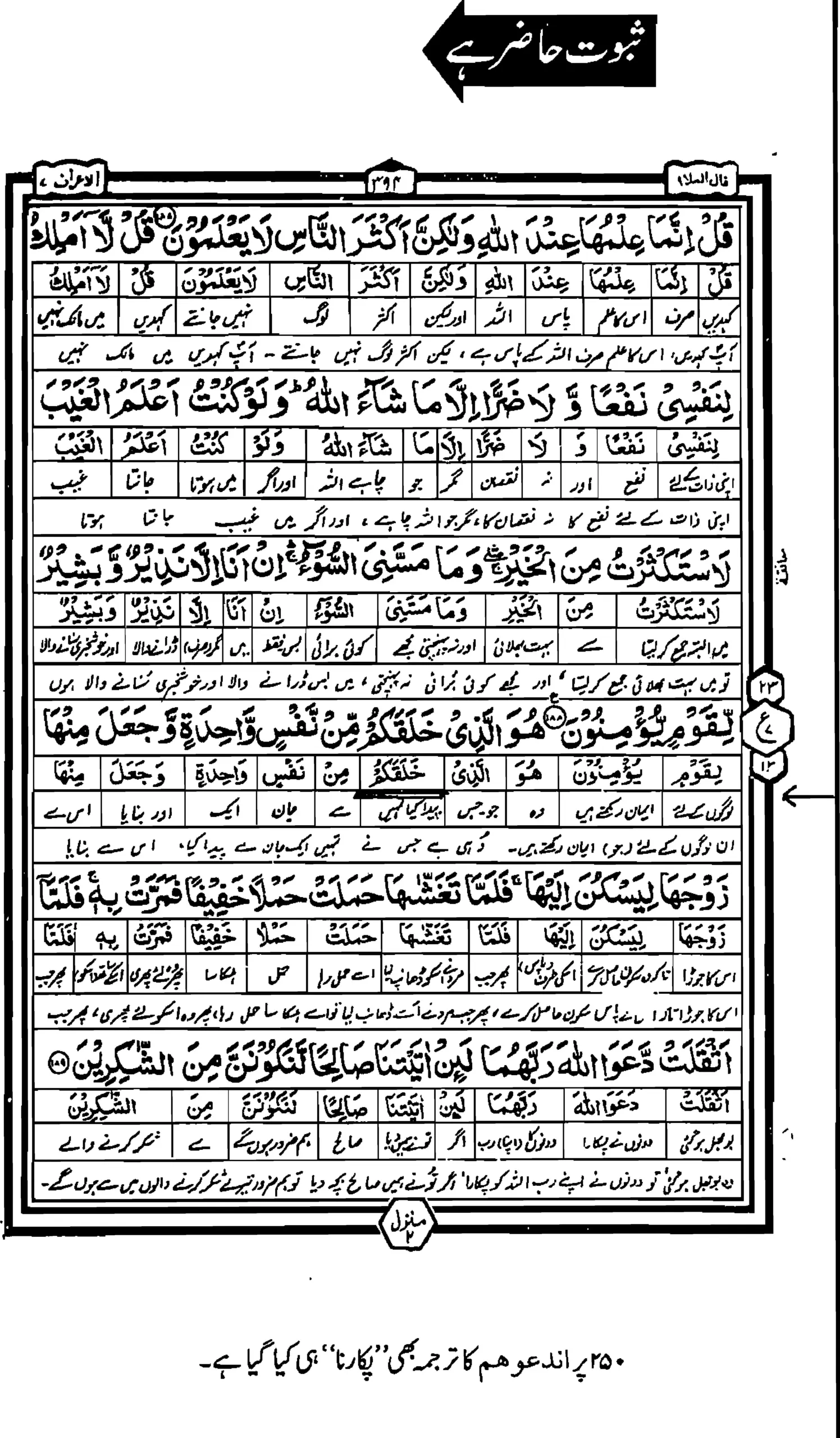
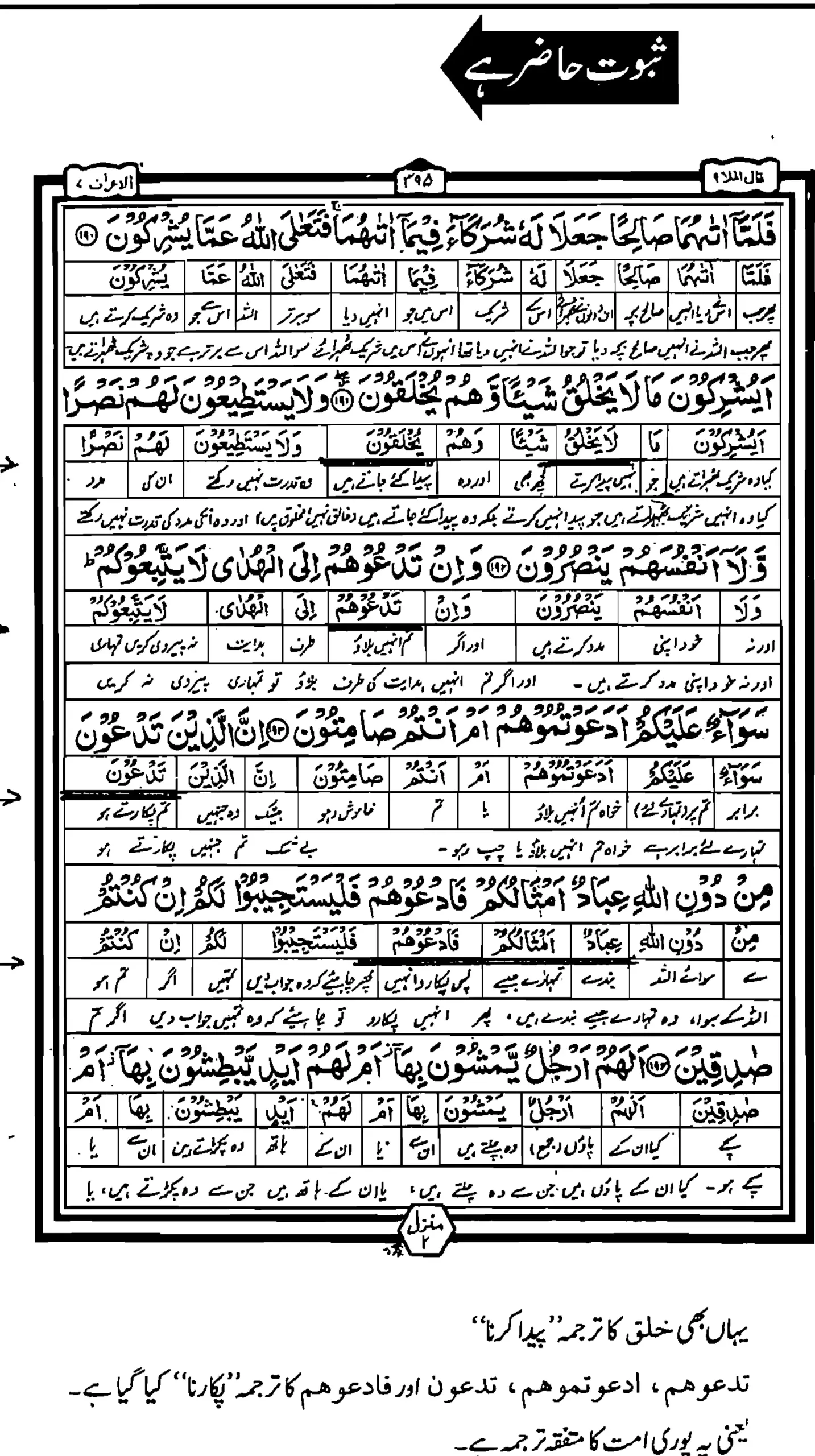
Reference: Fatir 38 to 41], [Al-Ahqaf: 1 to 6] and [Al-A'raf 189 to 198
have also been done. You can study them yourself. In
Reference: Surah Yunus 103 to 109
, the translation of ،،تدع،، is "worship," the rest of the translation and tafsir are completely correct. By reading these verses, the distortion mentioned above becomes clear.Remember that when you read the above four references in the Holy Quran with translation, it will become absolutely clear that Allah Almighty, after giving the proofs of His Oneness, said: worship only Me, call only Me, do not call the creation.
And distortion has also been done in the following places:
Reference: Ar-Rum: 28 to 40, Fa: 88, 87], [Saba: 22 to 27 with benefits], [Fatir: 1 to 41 benefits: 2 to 102], [Az-Zumar: 29 to 46], [Ash-Shura: 1 to 12 with benefits
Remember that in Ahmad Raza Khan's translation, in the following places (خلق), the words derived from "to create" have repeatedly been translated as "to produce." Some places identified are:
Reference: Al-Baqarah: 228, 164, 21], [Aal Imran: 191, 190, 47], [Al-An'am: 101, 94, 2], [Al-A'raf: 189, 54, 11], [Ar-Rum: 40, 22, 20, 8
and many other places as well.The interesting thing is that in their translation, in words derived from (خلق), in many places "to create" has also been translated. And "to make" has also been translated, but according to their own meaning and belief. For example: in [الاعراف :189تا198], both translations have been done, you can observe yourself.
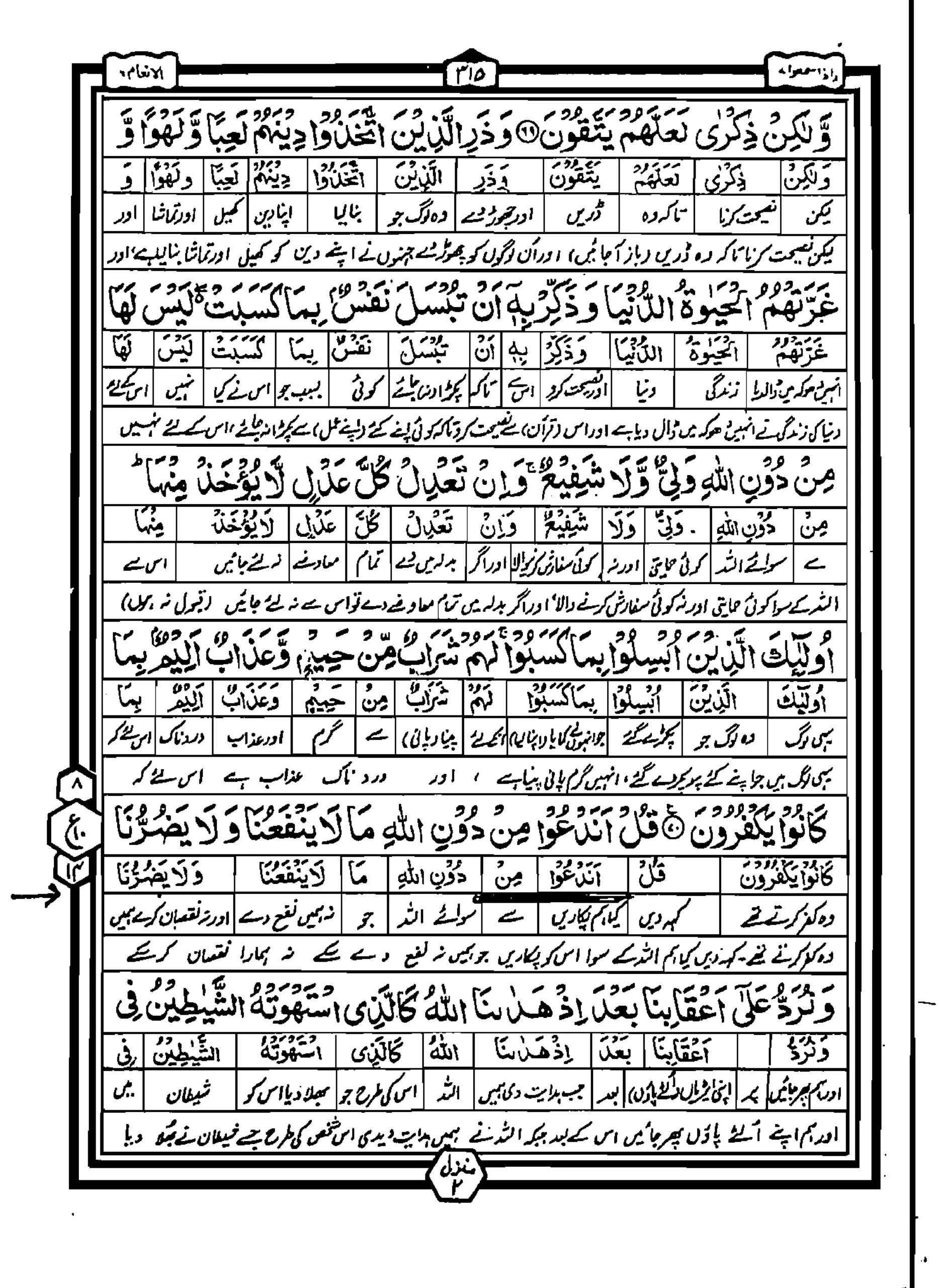
[1] The word "call out" appears, but the translation is also "call out":
Reference: Al-An'am:41,40], [Ar-Ra'd:14 to 16], [Bani Isra'il:110, F:230], [Ar-Rum:25 to 3], [Al-Baqarah:221,186], [Al-Qasas:64], [Al-Kahf:52], [Al-Mu'min:41 to 43], [Fatir:14], [Al-Qamar:6], [Ash-Shu'ara:72], [Al-Kahf:52,28], [Al-Ahqaf:32,31], [Az-Zumar:8], [Al-'Alaq:18,17], [Al-Furqan:14,13], [Al-Qalam:43,42]
[2] Both words "worship" and "call out" appear, but the translation is only "servitude":
Reference: Al-An'am:56], [Yunus:104 to 107], [Al-Kahf:14 to 16, F19], [Ash-Shu'ara:213], [Al-Qasas:88], [Al-Mu'min:66,65], [Al-Mu'minun:117,116], [Al-Furqan:68], [Hud:101], [Al-Furqan:68]
[3] Both words "call out" appear, but the translation for both is "servitude":
Reference: Al-Ahqaf:4 to 6], [Al-Jinn:18 to 20], [Maryam:48]
[4] Both words "worship" and "call out" appear, and the translation is both "worship" and "call out":
Reference: Ar-Ra'd:36], [An-Nahl:62], [Surah Yunus:62]
[5] Both words "call out" appear; one is translated as "servitude" and the other as "call out":
Reference: Al-An'am:71], [Bani Isra'il:57,56], [Bani Isra'il:67, F:148], [Luqman:25 to 32], [Al-Qasas:88,87], [Al-A'raf:189 to 198]
Do not call upon My servants; if you are truthful, call upon them and they will answer you.
Reference: Al-A'raf:189 to 198
Do not call upon your prophets; see:
Reference: Raza Khani translation with Tafsir: Bani Isra'il:57,56, F:118] and [Al-Jinn:18 to 20, F:38], [Al-A'raf:37 to 41, F61 to 69]
Here Allah Almighty said: Whoever calls upon anyone other than Allah admits his disbelief at the time of death. And their forgiveness is impossible unless a camel passes through the eye of a needle.