


This excerpt is taken from Sheikh Irshad Ullah Maan's book In Search of Truth.
By the grace of Allah Almighty, I investigate their correct meanings and refute the misunderstood meanings, so that Muslims do not stumble, brothers also ponder, and do not hesitate to accept the truth. O Lord of the Worlds! Guide us correctly towards Your Oneness and bring back those among us who have strayed from the straight path to Your door. Ameen. It is said that in the Holy Quran: When they wronged themselves, if they came to you and then sought forgiveness from Allah, and the Messenger sought forgiveness for them, they would find Allah to be Accepting of Repentance and Merciful. It is said that this verse was as it was during your ﷺ lifetime and remains so now. One should go to your shrine and say to you to seek forgiveness for us, etc.
[وَ مَاۤ اَرۡسَلۡنَا مِنۡ رَّسُوۡلٍ اِلَّا لِیُطَاعَ بِاِذۡنِ اللّٰہِ ؕ وَ لَوۡ اَنَّہُمۡ اِذۡ ظَّلَمُوۡۤا اَنۡفُسَہُمۡ جَآءُوۡکَ فَاسۡتَغۡفَرُوا اللّٰہَ وَ اسۡتَغۡفَرَ لَہُمُ الرَّسُوۡلُ لَوَجَدُوا اللّٰہَ تَوَّابًا رَّحِیۡمًا]
And We did not send any messenger except that he should be obeyed by Allah's command. And if those people, when they had wronged themselves, came to you, then asked forgiveness from Allah, and the Messenger asked forgiveness for them, they would find Allah Oft-Forgiving, Most Merciful.
Reference: An-Nisa:64
But this meaning is not correct, because
[1] In this verse, the word ،،جاؤوك،، is used (meaning) "they come to you," which clearly indicates that this verse is specific to the lifetime of the Prophet ﷺ, as it is not possible for anyone to come to you after your death, you are then in the highest realms.
[2] Secondly, there is an authentic saying of the Prophet ﷺ: [إذا مات الإنسان انقطع عنه عمله]
Reference: Muslim, Book of Wasiyyah, Chapter on the reward that reaches a person after death:1631
Every person's deeds cease with their death. Therefore, this verse was specific to your lifetime.
[3] After the passing of the Prophet ﷺ, the companions, may Allah be pleased with them, numbered in the thousands, and new people were accepting Islam, but you will not find anywhere that any of them came to the Prophet’s ﷺ grave and sought forgiveness from him ﷺ, even though this verse was before them, written in the Quran, which clearly shows that those companions considered this verse to be specifically related to the lifetime of the Prophet ﷺ.
[4] Even when during the caliphate of Umar Farooq there was a famine, at that time too the noble companions, may Allah be pleased with them, did not go to the Prophet’s ﷺ grave to seek forgiveness from him ﷺ, rather, following the prescribed method, they went to the wilderness to perform the prayer of Istisqa (prayer for rain) and appointed Sayyiduna Abbas, may Allah be pleased with him, to lead and supplicate; he sought forgiveness on behalf of the Muslims. Thus, it is established that seeking forgiveness from the Prophet ﷺ was specific to the lifetime of the Prophet ﷺ.
[5] Yes, it is another matter if someone claims that they understand the meaning of the Quranic verses better than the companions, may Allah be pleased with them.
[6] Either they neither understood this verse nor acted upon it, but instead issued a fatwa branding the Companions, may Allah be pleased with them, as non-followers and deniers of the Messenger (ﷺ). The reality is that this verse was for the life of the Prophet ﷺ; otherwise, the Companions, may Allah be pleased with them, would have come to the blessed grave, but they did not do so. Instead, they sent the uncle of the Messenger of Allah ﷺ ahead to seek forgiveness from him, and they themselves also did so, thereby practically clarifying the interpretation of this verse for the Muslims. فالحمدللہ
[7] The noble Companions, may Allah be pleased with them, not only demonstrated the interpretation of this verse through their actions but also expressed it verbally. Thus, it is found in Sahih Bukhari: [أن عمر بن الخطاب رضي الله عنه كان إذا قحطوا استسقى بالعباس بن عبد المطلب، فقال:اللهم إنا كنا نتوسل إليك بنبينا فتسقينا، وإنا نتوسل إليك بعم نبينا فاسقنا]
Reference: Bukhari, Book of Seeking Rain, Chapter: Asking the Imam for Rain when there is Drought: 1010
That is, during times of drought, Sayyiduna Umar Farooq رضي الله عنه would ask Abbas bin Abdul Muttalib رضي الله عنه for rain and in his prayer would say: O Allah! Earlier we used to ask You for rain through Your Prophet ﷺ (now that he ﷺ has passed away), so we ask You for rain through the uncle of our Prophet (ﷺ), so send down rain upon us. Listen to the words of the prayer that Ibn Abbas رضي الله عنهما made on this occasion:
(اللهم لم ينزل بلاء إلا بذنب ولم يكشف إلا بتوبة وهذه أيدينا إليك بالذنوب لواصيلنا إليك بالتوبة فاسقنا الغيث)
O Allah! Calamities are sent down because of sins and they are not removed except by repentance, therefore these sinful hands of ours are raised towards You seeking Your mercy and forgiveness, and these are our sinful foreheads bowed before You seeking repentance, so forgive our sins and send down rain upon us with Your mercy.
Reference: Fath al-Bari: 641/2
Thus, by the grace of Allah, rain was sent down.
[8] Listen! Indeed, the sacred existence of your Prophet ﷺ was a cause of peace for the Ummah. Addressing the disbelievers, the Lord ارحم الراحمین says:
[وَ مَا کَانَ اللّٰہُ لِیُعَذِّبَہُمۡ وَ اَنۡتَ فِیۡہِمۡ ؕ وَ مَا کَانَ اللّٰہُ مُعَذِّبَہُمۡ وَ ہُمۡ یَسۡتَغۡفِرُوۡنَ]
As long as you (ﷺ) are among them and as long as there are those among them who seek forgiveness from Allah, Allah will not punish them.
Reference: (Al-Anfal:33)
So, one of these two protections has been removed, now only one remains. This verse also serves as an explanation of that verse and clearly indicates that the Prophet’s ﷺ seeking forgiveness was during his lifetime, not after death. Now you are in the highest levels of Paradise, unaware of the deeds of the Ummah, and relieved from seeking forgiveness for the Ummah.
صلی اللہ علیٰ روحہ فی الارواح وعلی جسدہ فی الاجساد
[9] For someone to hold the belief that you ﷺ seek forgiveness from your purified grave can only be a correct and Islamic belief if there are clear and solid evidences with authentic and good chains of narration from the Quran, authentic Hadiths, and established consensus of the Ummah based on the understanding of the best generations of the righteous predecessors (i.e., the Companions, may Allah be pleased with them, the trustworthy and truthful Tabi‘in and great Muhaddithin), while there are numerous evidences against it, which indicate that you ﷺ have passed away and your noble and pure soul is in Jannat al-Firdaus
Reference: (Bukhari:1386)
and your pure and sacred body is in the grave in Medina.
Reference: (Bukhari:462), (Tirmidhi: 3618, and its chain is Hasan Lidhatihi)
Also, in the Hadiths of Bukhari and Muslim, the burial place is called a garden from the gardens of Paradise.
Reference: (Bukhari:1195), (Muslim:1390, 1391)
This proves that your ﷺ pure and sacred body is also in Paradise.Hafiz Ibn Hajar al-Asqalani, may Allah have mercy on him, says: [لأنه بعد موته و إن كان حيا فهي حياة أخروية لا تشبه الحياة الدنيا، والله أعلم] Indeed, after your ﷺ death, you are alive, but this is the life of the Hereafter, not similar to the worldly life. واللہ اعلم
Reference: (Fath al-Bari:7/349, under Hadith:4042)
It has been understood that the Holy Prophet ﷺ is alive, but this life of yours is in the hereafter and the intermediate world, not worldly, so that you ﷺ are aware of the conditions of the Ummah.
Accordingly, it is mentioned in authentic hadiths that when some of the Ummah are stopped by the angels at the Pond of Kawthar and you ﷺ say that these are my Ummah, let them come, the angels will say: (إنك لا تدري ما أحدثوا بعدك)
Do you (ﷺ) not know what innovations those people introduced after you (ﷺ)?
Reference: Bukhari, Kitab al-Riqaq, Bab fi al-Hawd: 6583, 6584], [Muslim, Kitab al-Fada'il, Bab Ithbat Hawd Nabina ﷺ wa Sifatuha: 2304
The command of Allah the Exalted is: [یَوۡمَ یَجۡمَعُ اللّٰہُ الرُّسُلَ فَیَقُوۡلُ مَا ذَاۤ اُجِبۡتُمۡ ؕ قَالُوۡا لَا عِلۡمَ لَنَا ؕ اِنَّکَ اَنۡتَ عَلَّامُ الۡغُیُوۡبِ]
(On the Day of Resurrection) Allah, the Blessed and Exalted, will gather the messengers and ask them what answer was given to you from your nations? They will all say: O my Lord! We have no knowledge of that; You are the Knower of the unseen.
Reference: (Al-Ma'idah:109)
If the prophets had knowledge of the deeds of their own nation, then, God forbid, their response that they have no knowledge would be false and incorrect. They have full knowledge; the sinful members of the nation come to them, they know that so-and-so said this, so-and-so said that, then how do they say that they have no knowledge? It is proven that this belief and this statement are wrong, indeed incorrect.
[10] Also remember that in reality this verse is about the hypocrites. The subject starts from the verse at the beginning of the bowing: [أَلَمْ تَرَ إِلَى الَّذِيْنَ يَزْعُمُوْنَ], as recorded in Tafsir Kabir and the Tafsirs of Ahl al-Sunnah, etc.: (نَزَلَتْ فِي الْمُنَافِقِيْنَ), meaning these verses were revealed about the hypocrites and
[11] even regarding this verse there are clear words: (ألم أدبه من تقدم ذكره من المنافقين) meaning the reference is to those same hypocrites who were mentioned earlier. So why do you count true Muslims among the hypocrites?
[12] The same words appear one verse earlier as well, it says: [ثُمَّ جَاءُوكَ يَحْلِفُونَ]
Reference: (An-Nisa:62)
Then they come to you swearing by Allah that their intention was only to do good, so turn away from them and admonish them, and speak to them words that penetrate their hearts effectively. Then the verse: [وَ لَوۡ اَنَّہُمۡ اِذۡ ظَّلَمُوۡۤا اَنۡفُسَہُمۡ جَآءُوۡکَ]
Reference: (An-Nisa:64)
O you who affix this to the Noble Grave of the Prophet ﷺ! Will you limit the Prophet’s ﷺ admonition, turning away from him ﷺ, and his effective counsel only to this? What will you say, that even now the Prophet ﷺ is busy in admonishing, turning away, and giving effective advice? (وَ هَلْ يَقُوْلُ هَذَا إِلَّا مَنْ سَفِهَ نَفْسَهُ)[13] Yes, should I also say that if it is necessary to go to the Prophet’s ﷺ shrine and seek forgiveness from him ﷺ, then what is the ruling of those Muftis regarding the millions of Muslims who have never even seen Madinah Sharif?
[14] For a sinner, it is sufficient to seek forgiveness from Allah Almighty alone, as mentioned in dozens of verses in the Holy Quran: [اسْتَغْفِرُوا رَبَّكُمْ إِنَّهُ كَانَ غَفَّارًا]
Reference: (Nuh: 10)
and so on. The reason those hypocrites were commanded to come to you ﷺ and seek forgiveness from you ﷺ was that they had also wronged you ﷺ; they had gone to others to settle their disputes instead of you, and they were not satisfied with your command and judgment. So they were told to face the consequences of their behavior, come to you, repent, and ask for forgiveness. Thus, in Tafsir Kabir and others, it is mentioned that you ﷺ admonished them, saying: (فَلْيَقُوْمُوْا وَ يَسْتَغْفِرُوْا اللهَ) Let these people stand up and seek forgiveness from Allah. But those hypocrites still persisted in their disobedience and did not stand up, so their behavior saddened the Messenger of Allah ﷺ. Their conduct deprived you ﷺ of your right, so they were commanded to apologize to you ﷺ themselves and please you ﷺ, so that you ﷺ would seek forgiveness for them.[15] None of the Muslims believe that a person's seeking forgiveness from Allah is insufficient; yes! This special ruling is specifically for those hypocrites due to their stubbornness, and in this respect, since the possibility of it continued even after your passing, it is specific. Now, to take this as evidence is no more valuable than a drowning person clutching at a straw.
[16] Suppose it is accepted, then it would be specific to the person of the Prophet ﷺ, but the reality is that today no raw or cooked mound, high or low grave, nor even paper, brick, or bamboo is left.
[17] Then it would be specific only for seeking forgiveness, but here children, sustenance, rain, blessings, and healing—in short, all matters—are requested.
[18] Then the request was actually meant for Allah, but here it is made directly to the owner of the grave. For these reasons, this argument is not consistent with the claim, and the statement is not consistent with the action.
[19] Muslims! Let a person from this fourteenth century explain an interpretation of the Quran, and let the interpretation of the Quran be explained by the cousin of the Messenger of Allah ﷺ, your companion for whom you ﷺ prayed, "O Allah! Teach him the knowledge of Your Book," whom you ﷺ embraced to your radiant chest and taught the knowledge of the Book of Allah and the interpretation of the Word of Allah. Tell with faith, whose explanation will be reliable? And whose explanation will be unreliable? Accordingly, the trustworthy and truthful hadith scholar Imam Abdul Rahman bin Amr Al-Awza'i (died 157 AH) says: [عليك بآثار من سلف و إن رفضك الناس و إياك و آراء الرجال و إن زخرفوا لك بالقول]
Hold firmly to the traces of the predecessors (pious predecessors), even if people abandon you, and avoid the opinions (and analogies) of people that go against the Quran, Sunnah, consensus, and the pious predecessors, even if they present their words with embellishment and spices.
Reference: Al-Shari'ah by Imam Al-Ajuri, p. 58, hadith 127, and its chain is authentic
The trustworthy and precise hadith scholar Imam Muhammad bin Sirin Al-Tabi'i (died 110 AH) says: [كانوا يرون أنه على الطريق ما كان على الأثر]
The later scholars (i.e., the Companions of the Prophet and the great senior Tabi‘in) understood that a person who follows the traces (i.e., adheres to the Quran, Sunnah, and the agreed-upon traces of the pious predecessors) is walking on the straight path.
Reference: Sunan al-Darimi: Hadith 142 and its chain is authentic
So, on one hand, there are people in your time who tell you to still go to the Prophet’s grave ﷺ and seek forgiveness, and on the other hand, there is a great elder whose honored name is Abdullah ibn Abbas, may Allah be pleased with them both. Listen to his statement, he says: [كان فيهم أمانان نبي الله و الإستغفار، فذهب النبي صلی الله عليه وسلم و بقی الإستغفار]
In this Ummah, there were two sources of peace: one was the Prophet ﷺ and the other was seeking forgiveness. The Prophet ﷺ has departed (so that peace is gone), now one peace remains and that is seeking forgiveness.
Reference: Tafsir al-Tabari: 6/233, Hadith 16014 and its chain is good by itself, [Sunan al-Kubra by al-Bayhaqi: 45/5, 46, Hadith 9037 and its chain is good by itself], [Shu‘ab al-Iman: 2/182, Hadith 1491]
And our master Abu Hurairah, may Allah be pleased with him, says: [كان فيكم أمانان مضت إحداهما و بقيت الأخرٰی]،[و ما کان اللٰہ لیعذبہمۡ و انۡت فیۡہمۡ ؕ و ما کان اللٰہ معذبہمۡ و ہمۡ یسۡتغۡفروۡن]
(Previously) You had two guarantees, one has passed, meaning (the blessed person of the Messenger of Allah ﷺ), and one remains, meaning to repent and seek forgiveness (then Sayyiduna Abu Huraira رضي الله عنه recited this verse) Allah will not punish them in your presence, nor will Allah punish while they are seeking forgiveness.
Reference: Mustadrak Hakim: 1/542, Al-Nuskha Al-Jadida: 1/726, Hadith: 1988 and its chain is authentic], [Shu'ab al-Iman by Al-Bayhaqi: 1/442, Hadith: 654 and its chain is authentic
It is possible that some people may get tired of a longer discussion than this, so I reluctantly end this discussion and present to the so-called researcher and debater of the opposing party, respected Abbas Rizvi, an argument after which the opposing party should have no words left on this issue. Accordingly, Abbas Rizvi writes after narrating a weak report from the author Ibn Abi Shaybah and from the history and tafsir of Tabari (because of Sufyan and Abu Ishaq, both are fabricators and unreliable):
The narration of Sayyiduna Ali رضي الله عنه appears to be mursal (stopped), but in reality, it is marfu‘ (elevated), because it is a principle that the interpretation of a Sahabi is considered under the ruling of a marfu‘ hadith.
Reference: Aap ﷺ Zinda Hain Wallah, p. 382, 305
Regarding the narration of Sayyiduna Abu Hurairah رضي الله عنه, Imam Hakim رحمه الله says: [و قد اتفقا علی أن تفسیر الصحابي حديث مسند] Indeed, Imam Bukhari and Imam Muslim are agreed upon the fact that the interpretation of a Sahabi is under the ruling of a musnad (marfu‘) hadith.
Reference: (Al-Mustadrak: 1/542)
That is, even according to the opponent debater and researcher Abbas Rizvi Sahib, the interpretation of a Sahabi is under the ruling of a marfu‘ hadith. From this, it is understood that Sayyiduna Abu Hurairah and Sayyiduna Ibn Abbas رضي الله عنهم did not interpret these verses merely by their own ijtihad, but it is under the ruling of a marfu‘ hadith.
Therefore, it is understood that seeking forgiveness from you was specific to your lifetime; when you are no longer present, that thing no longer remains. Now a person should seek forgiveness directly from Allah Ta‘ala.
Thus, the Messenger of Allah ﷺ says that it is the promise of the Exalted: [لا أزال أغفر لهم ما استغفروني] As long as My servants continue to ask Me for forgiveness, I will continue to forgive them.
Reference: Musnad Ahmad: Hadith 11237
Listen to another hadith, the Messenger of Allah ﷺ says: [العبد آمن من عذاب الله عز وجل ما استغفر الله عز وجل]
A servant is safe from the punishment of Allah as long as he seeks forgiveness from Allah.
Reference: Musnad Ahmad: Hadith 23953
After these answers, you have probably been reassured. May Allah remove us from all doors and incline us towards His door. Ameen!
[10] Vows, vows of offering, and charity are acts of worship.
Reference: (Ahmad Raza Khani translation with Tafsir Al-Baqarah: 270, 271, F:574 to 576)
But habitually with confusion.
Reference: (Ad-Dahr: 7, 8 F:15 to 18)
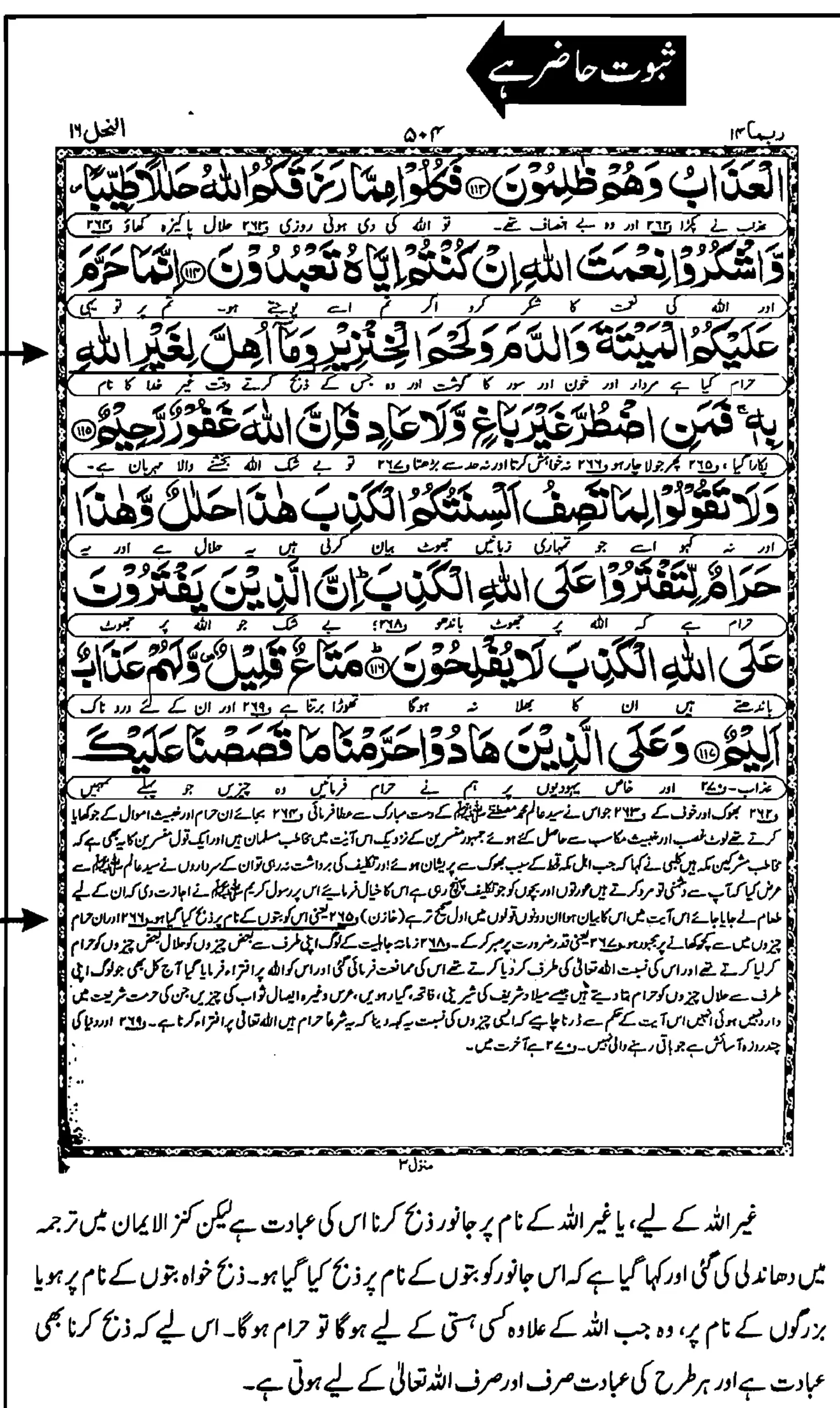
[11] Observe another alteration in the Holy Quran. It says: (That is) forbidden for you are carrion, blood, pork, and that which is slaughtered in the name of anyone other than Allah.
Reference: An-Nahl:115 and, p265
It is written, meaning that it was slaughtered in the name of idols. You will notice the manipulation; the words "other than Allah" have been inserted in the verse, meaning any entity other than Allah, but here only idols are mentioned.
Reference: For further clarification see the same Tafsir (Al-Kawthar:2, p3-4)
These verses prove that slaughtering is an act of worship and worship cannot be directed to anyone other than Allah, not just idols.
Reference: (See: the same Tafsir Al-A'raf: 59, 65, 73, 85), (Hud: 50, 61, 84)
Remember that every one who utters the Kalima has made three promises with Allah Almighty:
[1]Promise:
Allah Almighty is our Lord (that is, the Provider).
Reference: (Al-A'raf:172 to 174)
But now some people of the Muslim Ummah consider many other elders as their providers as well.(That is) they have broken this promise.
Reference: (See also Al-An'am:161 to 165), (Al-Kahf:37 to 44)
We have discussed this issue in detail in the debate on Tawheed in Control and Shirk in Control.[2] Promise:
،،لا الہ الا اللہ،، means there is no true deity except Allah, but now some people are seen worshipping others besides Allah, meaning they have also broken this promise. They call upon others besides Allah, even though calling upon is an act of worship.
[3] Promise:
[سَمِعْنَا وَأَطَعْنَا] means we have heard, we have promised obedience.
Reference: (Al-Baqarah:285)
But now they appear to deviate from obedience to the divine revelation. Remember that Allah Almighty has commanded following the divine revelation, but people have chosen imitation. Allah Almighty commanded monotheism, but people adopted polytheism. Allah Almighty commanded following the Sunnah of the Prophet ﷺ, but people deviated from the Sunnah and adopted innovations. Reflection and reform are necessary, otherwise there is only danger.
Reference: (Al-A'raf:102)
Another example in this regard is also necessary, as follows:The Holy Quran mentions the mother breastfeeding the child in three places.
Reference: (Al-Baqarah:233), (Luqman:14), (Al-Ahqaf:15)
From these blessed verses, it is established that the mother breastfeeds the child for a maximum of two years, and the minimum duration of pregnancy is six months. Observe their eloquence in comparison to this definitive text of the Holy Quran.Maulvi Naeemuddin Muradabadi Barelvi (who wrote the commentary on Ahmed Raza Sahib's Quranic translation)
Reference: (Tafseer of Surah Al-Ahqaf:15, footnote:37)
writes that the issue is proven from this very verse that the minimum duration of pregnancy is six months, because when the breastfeeding period is two years
Reference: (Al-Baqarah:233)
, then six months remain for the pregnancy. This is also the view of Imam Muhammad (may Allah have mercy on him) and Imam Abu Yusuf (may Allah have mercy on him), while according to Imam Abu Hanifa (may Allah have mercy on him), the breastfeeding period is proven to be two and a half years from this verse.Similarly, another scholar states: Imam Abu Hanifa, who often mentions the breastfeeding period as two and a half years, must have some other evidence; according to the majority, it is two years only.
Reference: (Tafseer Usmani:548)
These are all acts of imitation; in any case, we should adopt the attitude of [سَمِعْنَا وَأَطَعْنَا] in all these matters and must not at all ignore the commands of Allah Almighty which are in
Reference: (Surah Yunus:60)
and
Reference: (Surah Ha Mim As-Sajda:30)
. At these places, there is a severe warning for such people.
Last edited:

