


This excerpt is taken from Sheikh Irshad Ullah Maan's book In Search of Truth.
In the light of these evidences and texts, the following facts emerge:
[1] Wherever Allah Almighty has laid down commands, He has also prescribed the method of implementing those commands; He has not left it to people's own desires. Accordingly, He declared the Messenger of Allah ﷺ as a model for us, saying: [لَقَدۡ کَانَ لَکُمۡ فِیۡ رَسُوۡلِ اللّٰہِ اُسۡوَۃٌ حَسَنَۃٌ] Indeed in the Messenger of Allah (ﷺ) you have a good example to follow.
Reference: (Al-Ahzab:21)
And we have been commanded to adopt this model. The Divine command is:
[وَمَاۤ اٰتٰىکُمُ الرَّسُوۡلُ فَخُذُوۡہُ وَ مَا نَہٰىکُمۡ عَنۡہُ فَانۡتَہُوۡا] Whatever the Messenger (ﷺ) gives you, take it, and whatever he forbids you, abstain from it.
Reference: (Al-Hashr:7)
[2] The worship of Allah Almighty is not according to one's own desires but must be performed in the manner prescribed by Allah Almighty.
[3] Abandoning something proven by the Book and Sunnah out of piety is misguidance. For example, marriage, which is established by the Book and Sunnah, if someone abandons it thinking it to be asceticism and piety, then he is misguided. That is why the Prophet ﷺ strictly forbade those three men who wanted to advance in asceticism and piety.
Reference: Bukhari, Book of Marriage, Chapter on Encouragement to Marriage:5063
[4] An additional innovation (bid'ah) is also misguidance. An additional innovation is that which is authentic in essence but not proven in form and manner. For instance, those sitting in the Mosque of Kufa were counting on their rosaries while reciting tasbih, which is a legitimate act of remembrance, but since its form and manner were not proven from the Messenger of Allah ﷺ, therefore Sayyiduna Abdullah bin Mas'ud رضي الله عنه forbade them from it.
Reference: Sunan al-Darimi: Hadith 210, Tarikh Wasit: pp. 198-199
[5] Innovation abolishes the Sunnah. Thus, the method of remembrance adopted by those in the Mosque of Kufa violated the Sunnah of the Messenger of Allah ﷺ.
Reference: Sunan al-Darimi: Hadith 210
The pious predecessors clearly understood the reality that innovation (bid'ah) and Sunnah cannot coexist. Thus, the noble Tabi'i Hassan bin Atiyyah, may Allah have mercy on him, said: [ما ابتدع قوم بدعة في دينهم إلا نزع الله من سنتهم مثلها]
Whenever a people introduce an innovation in religion, a Sunnah similar to it is abandoned among them.
Reference: Sunan al-Darimi, Introduction, Chapter on Following the Sunnah: Hadith 98
[6] Innovation is a cause of destruction because it necessarily leads to abandoning the Sunnah, and what could be a greater misguidance than that? Thus, Sayyiduna Abdullah bin Mas'ud رضي الله عنه said: [ولو تركتم سنة نبيكم لضللتم] If you abandon the Sunnah of your Prophet, you will be misguided.
Reference: Muslim, Book of Mosques, Chapter on Congregational Prayer from the Sunnah of Guidance: 257/654, [Nasa'i: 850], [Ibn Majah: 777]
And innovation is the forerunner of misguidance and destruction. That is why Sayyiduna Abdullah bin Mas'ud رضي الله عنه said to those who gathered for remembrance in the Mosque of Kufa: O Ummah of Muhammad, how quickly has your destruction come.
Reference: Sunan al-Darimi: Hadith 210
[7] Innovation is the forerunner of disbelief, because the innovator places himself in the position of a legislator and partner.
[8] Innovation fully opens the door to disagreement, and this is the door to misguidance and error.
[9] Ignoring innovations leads a person to immorality and disobedience. Just as the people of the mosque in Kufa met their end by engaging in war alongside the Kharijites against the Companions of the Prophet, may Allah be pleased with them all.
Reference: Sunan al-Darimi: Hadith 210
[10] The validity of righteous deeds depends on a righteous intention, but a good intention cannot make an invalid act valid. This is because for an act to be valid, intention alone is not sufficient; following the Sunnah and adhering to Shariah are also necessary.
Reference: (Madarij al-Salikin by Ibn al-Qayyim al-Jawziyyah: 85/1)
[11] Excess in good deeds is not always good; often it turns into evil. For example, excess in bravery takes the form of recklessness, and lack of it is considered cowardice. Similarly, if generosity exceeds its limit, it becomes wastefulness and extravagance, and if it falls short, it is considered stinginess. Therefore, moderation is the best approach.
Below is a list of some famous innovations (bid'ah), so that our Muslim brothers may know which of their actions they consider as rewarding, but in reality, these have no connection to reward and instead distance us from following the Sunnah and make us innovators (bid'ati):
[1] Following the Four Imams (because this started after the fourth century Hijri) details will follow.
[2] Eid Milad-un-Nabi ﷺ
The first point regarding the celebration of Eid Milad-un-Nabi ﷺ is that it is not established from the Prophethood and the first three periods, i.e., the best of generations (Khair al-Qurun), as Tahir-ul-Qadri himself admitted in his book
Reference: ,,Eid Milad-un-Nabi,,
.The second point: It is proven in
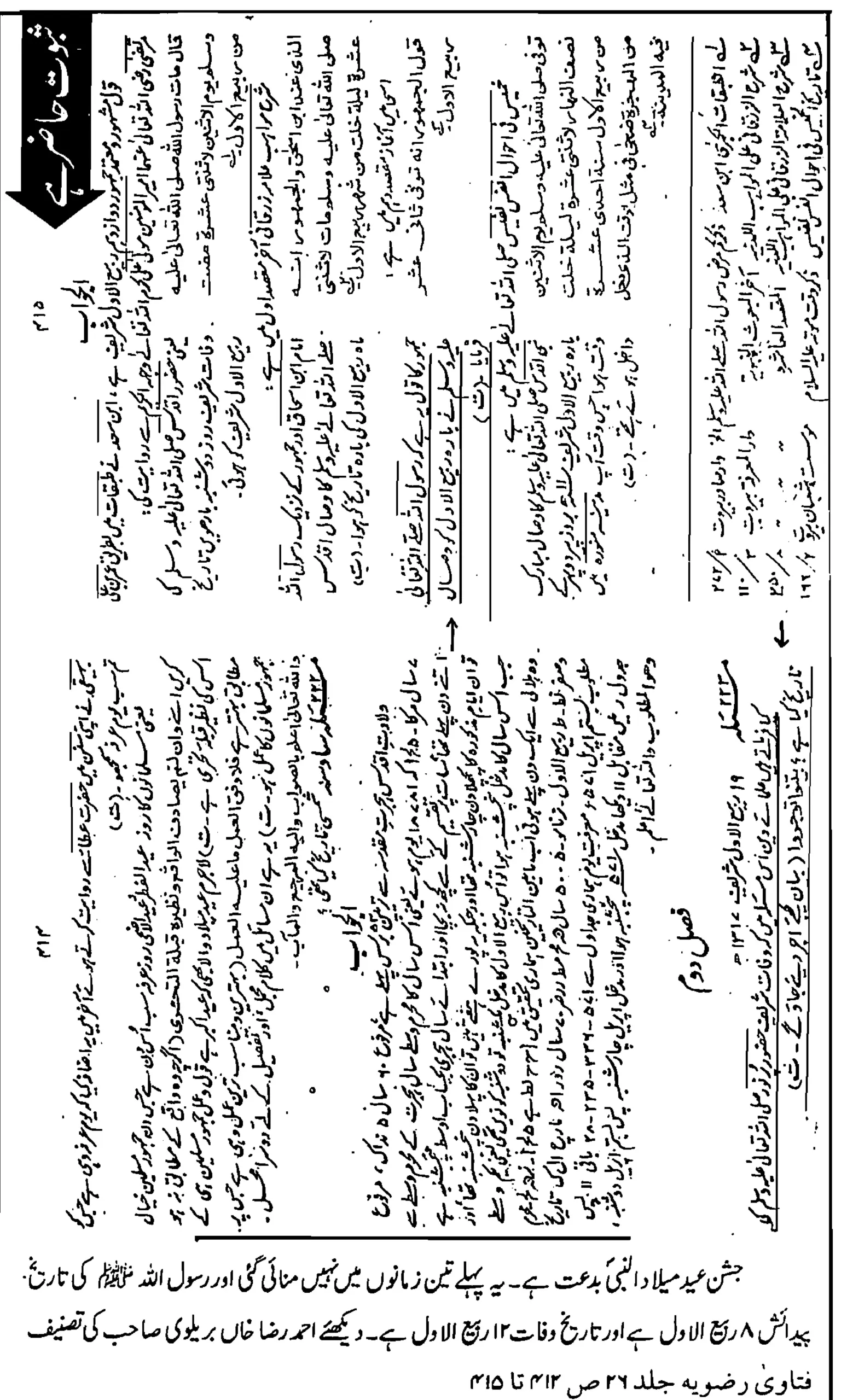
Reference: Fatawa Razawiyyah by Ahmad Raza Khan pages 412 to 415 volume 26
that the birth date of the Prophet ﷺ is 8th Rabi' al-Awwal. And his date of death is 12th Rabi' al-Awwal. The strange thing is that the Barelvi people celebrate on 12th Rabi' al-Awwal, which is the date of his death.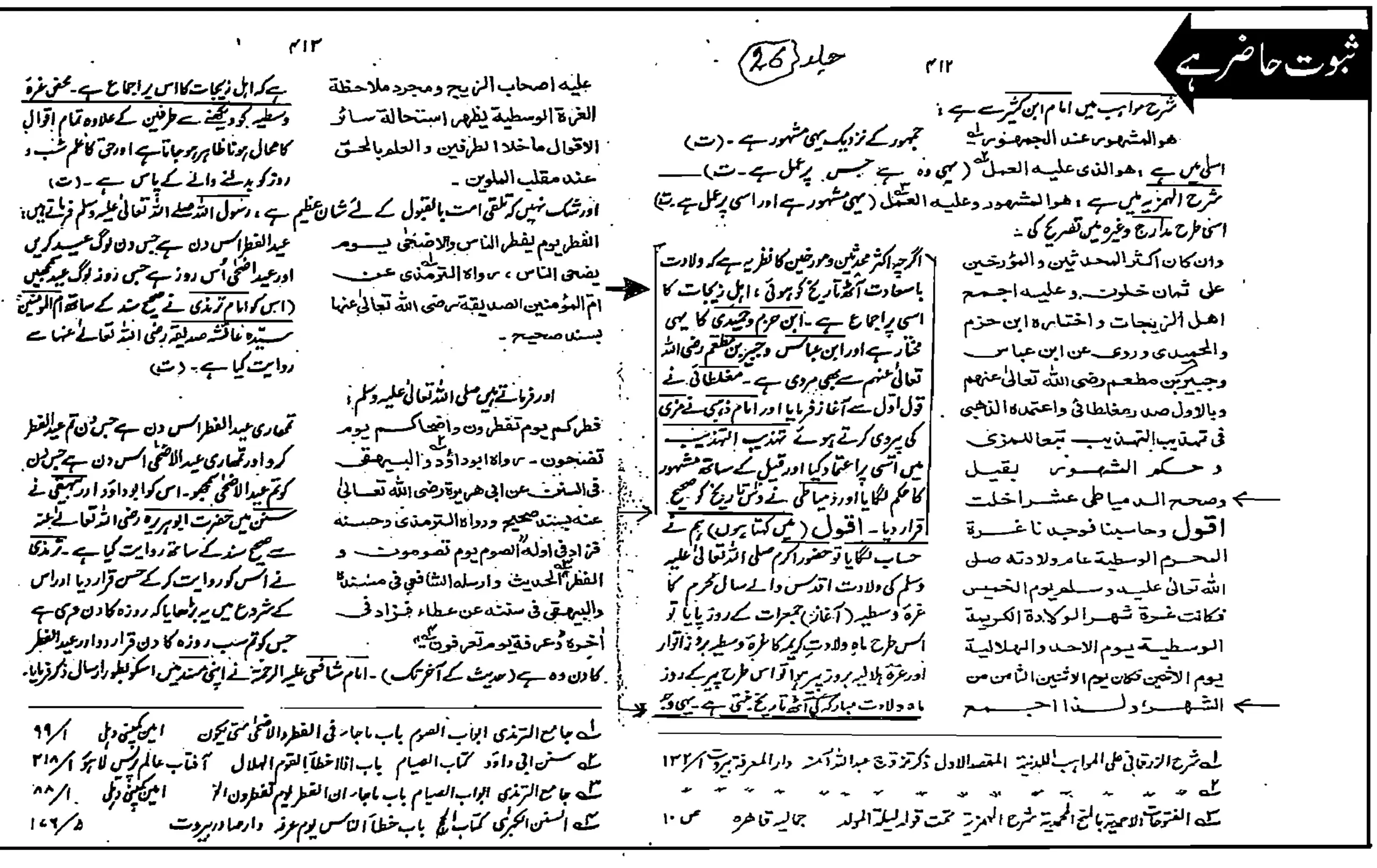
[3] Last Wednesday
[4] Night of Mi'raj
[5] Night of Bara'at
[6] Muharram rituals
[7] Konday
[8] Urs and fairs at shrines
[9] Gyarahwin Sharif
[10] Namaz-e-Wahshat
[11] Quran recitation (for the forgiveness of the deceased)
[12] Teejah, Daswan, Chaliswan (innovations related to the deceased)
[13] Ahd Nama
[14] Azan at the grave
[15] Arafah
[16] Blessed breads and marriage-related rituals and innovations
[17] Shariah Muhammadi Mehr
[18] Playing Chauthi
[19] Bibi's Fatiha
[20] Newlywed woman seeing Muharram and Sha'ban moon at her parental home
[21] Believing Bibi's story
[22] Bibi's Sahnak
[23] Twelve Imams' cups
[24] Tying Imam Zamin
[25] Promise's lock and wearing bangles
[26] Wearing the big Pir Sahib's Hansli
[27] Feeding married women
[28] Mehfil-e-Milad
[29] Salawat and Salam (self-invented)
[30] Writing Shirkiah Naat
[31] Reciting Shirkiah Naat
[32] Reciting self-invented Durood
[33] Kissing the thumb
[34] Self-invented prayers
[35] Self-invented Wazaif
[36] Additions in prayers
[37] Making intention verbally in prayer, fasting, and ablution
[38] Nida ،،لغيرالله،،
[39] Wearing green and brown colored turban
[40] Silsilahs of Tariqat
[41] Qawwalis
[42] Taweez Gunday
[43] Khatm-e-Khawajagan
[44] Shabeena
[45] ،،بسم اللہ،، karna
[46] Ameen
[47] Roza Kushaai
[48] Lighting lamps in mosques
[49] Keeping caps in mosques
[50] Building domes on shrines
[51] Lighting lamps on shrines
[52] Giving Ghusl to shrines
[53] Placing flowers on graves
[54] Lighting a lamp on the grave
[55] Khatm of elders
[56] Saying ،،صدق اللہ العظیم،، after recitation of the Holy Quran
[57]Common congregational supplication after obligatory prayer
[58]Constructing khanqahs (Sufi lodges)
[59]Burial of men in mosques, madrasas, and homes
[60]Wiping the neck during ablution
[61]Reciting the declaration of faith during ablution
[62]Tile work and decoration in mosques
[63]Hanging pictures on homes and shops, placing plaques on shrines
[64]Reciting and having the Quran recited at graves
[65]Giving the call to prayer (Adhan) to ward off calamities
[66]Giving the call to prayer (Adhan) to stop rain
[67]Folding hands while reciting the Quran in prayer
[68]Standing in reverence for anyone other than Allah
[69]Delivering a speech before Eid prayer
[70]Shaking hands with four hands and placing a hand on the chest
[71]Delivering three sermons during Friday prayer
[72]Giving a Sunnah pause before the Friday sermon for its delivery
[73]After prayer: performing the precautionary Zuhr prayer after Friday prayer
[74]Men and women praying separately in different manners
[75]Reciting and having others recite six kalimas
[76]After prayer, the imam sitting facing only the north
[77]Salat al-Ghawthiyya (Prayer of the Helper)
[78]Salat al-Raghaib or Salat al-Rajabiyya (Prayer of the Desires or Rajab Prayer)
[79]After prayer, raising palms towards the sky during prostration
[80]Observing spiritual retreats (Chilla) and seclusion
[81]Wearing an agate ring considering it effective
[82]Saying the intention (Niyyat) for Sunnah I'tikaf (spiritual retreat)
[83]Building mosques in cemeteries
[84]Asking forgiveness from the deceased and forgiving what was said and heard
[85] Wearing black clothes and tying black bands in mourning

