


This excerpt is taken from the book of Sheikh al-Islam Imam Ibn Taymiyyah, may Allah have mercy on him, Al-Jawab al-Bahir fi Zuwar al-Maqabir, translated by Sheikh Ataullah Saqib.
Genealogy:
Taqi al-Din Abu al-Abbas Ahmad bin Shihab al-Din Abu al-Muhasin Abdul Halim bin Muhammad al-Din Abu al-Barakat Abd al-Salam bin Abu Muhammad Abdullah bin al-Qasim al-Khidr bin Ali bin Abdullah. This family is famously known as the family of Ibn Taymiyyah.
Reason for the Name:
The Imam’s grandmother, may Allah have mercy on her, was a great preacher. Her name was Taymiyyah. Due to this, the family came to be known as the family of Taymiyyah.
Birth:
Imam Ibn Taymiyyah, may Allah have mercy on him, was born on the 10th of Rabi' al-Awwal in a village called Harran.
Early Circumstances:
Imam Sahib lived in this Haran settlement until the age of six. When he was just seven years old, the Tatars raided this settlement. Fed up with their cruelty and oppression, the residents began to abandon their homes and seek refuge elsewhere. Some members of the Ibn Taymiyyah family migrated towards Damascus, but the route was extremely dangerous. There was neither peace nor security. This mental distress, combined with the hardships of the journey, made the passage even more difficult. Traveling through the darkness of night, these people were members of a scholarly family. They were constantly fearful that the enemy might catch up with them, but Allah granted His support, and the caravan, escaping the oppressors and tyrants, finally reached its destination.
Education and Training:
Since Imam Taqi al-Din Ibn Taymiyyah, may Allah have mercy on him, belonged to a family that held a distinguished position in knowledge, and he opened his eyes in this very cradle of learning, he was inclined towards knowledge from childhood. He memorized the Holy Quran at a young age. His passion for recitation was such that during his time in prison, he completed the Quran more than 80 times. After memorizing the Quran, he turned his attention to Hadith and linguistics, acquired knowledge of jurisprudential rulings, and memorized a large portion of them. Imam's father held the position of Sheikh al-Hadith. Consequently, Imam repeatedly listened to Sahih Bukhari, Sahih Muslim, Musnad Imam Ahmad, Jami' at-Tirmidhi, Sunan Abi Dawood, Sunan an-Nasa'i, Sunan Ibn Majah, and Sunan ad-Daraqutni. The first Hadith book that Imam memorized was Imam Humaydi's book الجمع بين الصحيحين. Some contemporaries of Imam, may Allah have mercy on him, stated that the number of sheikhs from whom he heard Hadith exceeded 200. Alongside Hadith, he also devoted attention to acquiring other sciences and arts. Thus, he gained considerable proficiency in mathematical sciences. He paid special attention to the Arabic sciences. He acquired these sciences as if they were his sole aim and purpose. Consequently, he memorized a large amount of Arabic poetry and prose orally, mastered the history of wars and battles, thoroughly studied the conditions and chronicles of the golden era of Muslims, read the stories of rise and fall, and examined their causes and reasons with deep insight.
He also had special proficiency in the science of grammar. The book "Sibawayh" was memorized by him orally. Along with these sciences and arts, the study of Hanbali jurisprudence was also ongoing. On one hand, the condition was that Imam was extraordinarily engrossed in sciences and arts, and on the other hand, he was wholeheartedly engaged in unraveling the mysteries and secrets of Quranic exegesis. For understanding the Quran, he thoroughly examined all related sciences and books, studying every letter with full attention.
The All-Encompassing Personality of Imam Sahib:
In short, Imam Ibn Taymiyyah, may Allah have mercy on him, trained his mind and intellect very excellently. He acquired all the knowledge that was prevalent in his time; there was no center of knowledge whose door he did not knock on. A contemporary scholar of Imam, Kamal Zamalkani, said beautifully about him:
"Allah Almighty made knowledge easy for Imam Ibn Taymiyyah, may Allah have mercy on him, just as He made iron soft for our master Dawood (David), peace be upon him. When he was asked about any knowledge or art, those who saw and heard him felt as if Imam Sahib knew nothing else besides that art, and that there was no rival or competitor to Imam Sahib in that art. When the jurists of every school of thought came to his court of knowledge, they obtained such insights about their own sect from him that they themselves had been unaware of until then. And it never happened that he engaged in a debate with anyone and was left speechless. He spoke expertly on every knowledge, whether related to Shariah and religion or worldly arts. Whatever knowledge he discussed, he would astonish even the experts of that knowledge with his information."
Was Imam Ibn Taymiyyah Arab?
Historians have not mentioned any Arab tribe that can be considered the origin of the Ibn Taymiyyah family. They were residents of the city of Harran, and for this reason, the Imam was called Harani. Historians have not attributed Imam Sahib, may Allah have mercy on him, to any Arab tribe. This proves that the Imam was not Arab. The prevailing opinion is that he was Kurdish. The Kurdish people are a brave, courageous, and highly determined nation. The character and conduct of this nation reflect both strength and forbearance, and all these qualities were clearly and prominently present in the Imam, although he was raised among people who were men of knowledge and virtue, wisdom and insight, research and scrutiny, and contemplation and thought.
From the Sanctuary of Knowledge to the Field of Jihad:
Imam Ibn Taymiyyah, may Allah have mercy on him, was peacefully engaged in fulfilling his duties. He taught lessons in the madrasa and demonstrated the essence of research and scrutiny. In the mosque, during sermons and guidance sessions, his speech was pure and clear like the water of Al-Kawthar. He presented the same religion to the people that was revealed to the Noble Prophet, peace be upon him. Alongside this teaching and instruction, the spirit of jihad remained so strong that he stood firm for truth and righteousness. He opposed anything that appeared contrary to the truth, approached the authorities and officials, and fulfilled the duty of conveying the truth. The esteemed Imam was simultaneously a man of knowledge and pen, and a sword-wielding reviver.
The Spark of Love for the Prophet, peace be upon him:
In 693 AH, reliable sources informed Imam Sahib, may Allah have mercy on him, that a Christian had insulted the Prophet Muhammad, peace be upon him. Then, fearing the public's anger, he took refuge in the house of a Bedouin. The Bedouin protected him from the fury of the people. This was intolerable for Imam Sahib, and he could not remain silent about it in any way. Therefore, he went to the deputy sultan of Damascus and explained the matter. The deputy ordered the Christian to be brought forward. He appeared along with the Bedouin who had given him shelter. The Bedouin began to insult those who were demonstrating. The people were already enraged and started stoning the Christian, the Bedouin, and his companions. The governor of Damascus treated Imam Sahib harshly on the charge that he had incited the people and disrupted public order against the Christian. This incident shows that the restrictions on teaching and preaching had not made this noble man indifferent or unconcerned about the public issues of religion and faith. He did not hesitate to confront anyone in support and defense of religion. He would rise from the circle of teaching and enter the field, guiding the public against the criminals who insulted the Prophet, peace be upon him, and would bravely face any hardship, trouble, or calamity that came in this regard.
Works:
Sheikh al-Islam Imam Ibn Taymiyyah, may Allah have mercy on him, was 17 years old when he took up the pen. Until the age of 45, this pen continued to flow with full force. Allah Almighty had endowed him with an extraordinary memory, astonishing intelligence, and a unique understanding. His speed of writing was such that sometimes he would compile a scholarly and research treatise in a single day. People would come with difficult questions, and the Imam would write several pages in response. In such circumstances, how can one accurately estimate what you have written in your life? And if all your books were compiled, they would amount to thousands of pages. These and other such distinguished qualities made him the reference and scholarly authority of his era, and although more than nine centuries have passed since his death, the high status that every one of his writings holds today is unparalleled, neither before nor now. Hafiz al-Dhahabi, may Allah have mercy on him, once wrote during the Imam’s lifetime that the number of his compositions might have reached 500. Later, probably after his death, he wrote that "the number has exceeded a thousand."
If one wishes to see the names of his compositions, refer to حيات شيخ الاسلام ابن تيميه by the author Abu Zahra. Undoubtedly, it is a comprehensive book on his life. I have also extracted from it to present a few glimpses of the life of Imam Sahib, may Allah have mercy on him, to the readers.
Students
In the era of Imam Ibn Taymiyyah, may Allah have mercy on him, we do not find anyone who could match Sheikh Taqi al-Din Ibn Taymiyyah, may Allah have mercy on him, in the multitude of students. In Egypt and Syria, and then within Egypt between Alexandria and Cairo, the number of his students was beyond count, but the specific students who truly fulfilled the duties of his successors are named as follows:
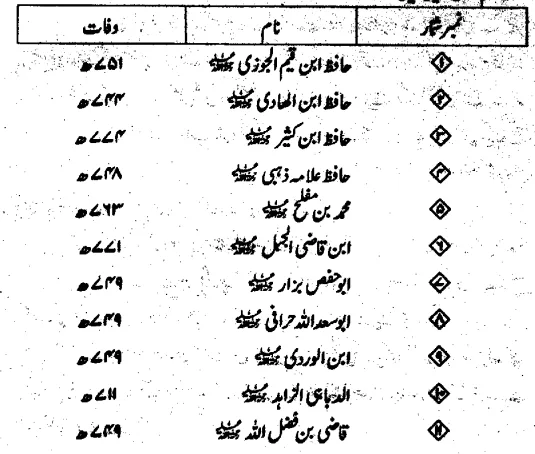
These are the senior students who gained the benefit of knowledge from Imam Ibn Taymiyyah, may Allah have mercy on him, and truly became his successors.
Journey to the Hereafter:
After leading a tumultuous life, the time finally came which is called the end for every living soul. Allah, Glorified and Exalted be He, called the soul of Imam Sahib, may Allah have mercy on him, to His presence and honored him with the blessing of His pleasure and satisfaction. (InshaAllah)
On 10th Dhu al-Qi'dah 728 AH / 1327 CE, Imam Sahib, may Allah have mercy on him, departed from this transient world. Imam Sahib’s brother, Zainuddin Abdul Rahim, says that within five months, the two of them completed 80 Qur'ans as distant completions. When they started the 81st time and were reciting the verse إِنَّ الْمُتَّقِينَ فِي جَنَّاتٍ وَنَهَرٍ ﴿٥٤﴾ فِي مَقْعَدِ صِدْقٍ عِندَ مَلِيكٍ مُّقْتَدِرٍ ﴿٥٥﴾ from Surah Al-Qamar, the soul flew from the cage of the body and joined the True Creator. إنا لله وإنا إليه راجعون.
He was ill for about 20 days, but generally, no news of illness came out of the prison. He passed away on the night of Monday, 20th Dhu al-Qi'dah, at the time of Sehri. The news of his death was announced early in the morning from the minaret of the fort (where he was imprisoned). This sudden news caused an uproar. The entire city was draped in mourning, markets were closed. Not even food was cooked in shops that day. A crowd of people came to visit near the fort. Eventually, the fort’s gate was opened and general access was allowed. Scholars, ministers, nobles, common people, relatives—all came to Imam Sahib, may Allah have mercy on him, and wept profusely. First, men came for visitation, then women arrived. When it was time for the ritual bath (ghusl), everyone left except a group of scholars and dignitaries who performed the ghusl, among whom was the famous, venerable hadith scholar and your special devotee Abu al-Hajjaj.
After the ghusl, the funeral procession was taken up, and the crowd became very large. The first funeral prayer in the fort was led by Sheikh Muhammad bin Tamam. After that, the funeral was brought to the Umayyad Mosque. After Zuhr prayer, the funeral prayer was performed a second time, led by the deputy preacher Sheikh Alaa al-Din bin al-Harrat. Then the funeral procession moved from there; the crowd was so immense that the entire city had come out. Eyewitnesses say that except for the disabled, all the people of the city participated in the funeral. Eyes were tearful, words of praise and supplication were on everyone’s lips. Everyone wanted to touch the funeral with utmost devotion. Due to the intensity of the crowd, the army had to surround the funeral to protect and manage it. The crowd kept increasing moment by moment. Outside Damascus, the funeral was placed in a vast field. The third funeral prayer was led by Allama Zainuddin Abdul Rahman, and near Asr prayer, this sun of knowledge and reviver of the nation was laid to rest beside his brother Sharafuddin Abdullah. Such a funeral is unparalleled in the history of Damascus.
أمطره الله غيث رحمته وأنزله منزلة الصديقين فى فسيح جته العربیة السعودية

