

Compiled by: Abu Hamza Salafi
The issue of reciting Surah Al-Fatiha behind the Imam in prayer is among the well-known jurisprudential differences among scholars. In this regard, some individuals give the impression that the companions of the Prophet, may Allah be pleased with them, their students, and the Tabi‘in did not recite behind the Imam. However, numerous clear statements from various Tabi‘in have been transmitted in the books of Hadith and historical records about reciting behind the Imam, reading Surah Al-Fatiha, and instructing the followers to do so. Among them, some scholars believed in reciting Al-Fatiha in both audible and silent prayers, while others explained recitation in silent prayers and listening to the Imam’s recitation in audible prayers. The purpose of this article is to present these statements and narrations of the Tabi‘in with the original Arabic text, Urdu translation, and book references, and to clarify that attributing an absolute abandonment of recitation to the Tabi‘in is incorrect. Additionally, the meaning of each narration and the point established by it will be separately clarified.
An Examination of a Narration Regarding Not Reciting Behind the Imam
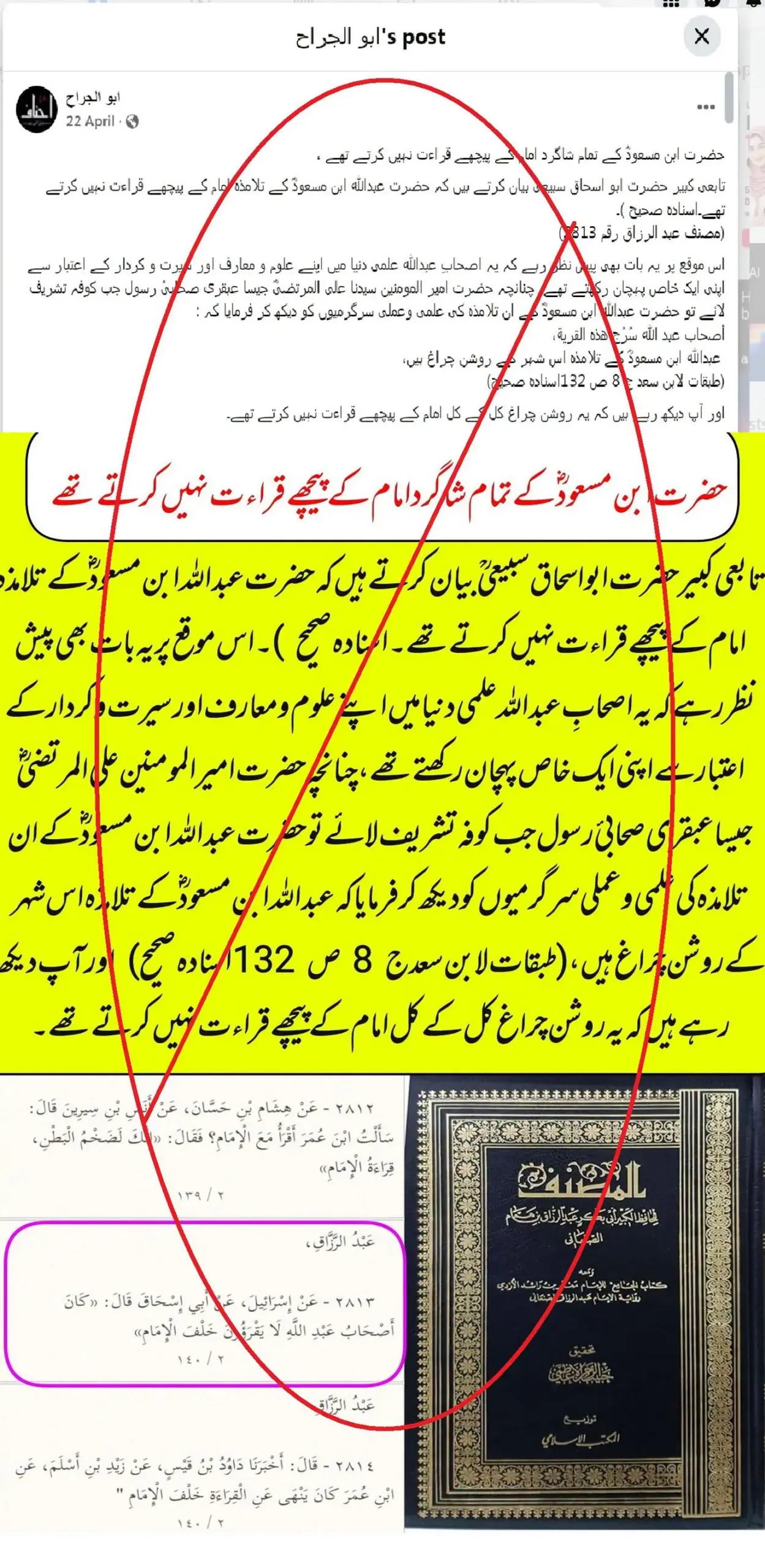
Some scholars present a narration of Abdul Razzaq regarding the companions of Hazrat Abdullah bin Masood رضي الله عنه.
Imam Abdul Razzaq San'ani رحمه الله (died 211 AH) has narrated:
2813 - عَنْ إِسْرَائِيلَ، عَنْ أَبِي إِسْحَاقَ قَالَ: «كَانَ أَصْحَابُ عَبْدِ اللَّهِ لَا يَقْرَؤُونَ خَلْفَ الْإِمَامِ»
Translation:
Abu Ishaq Sabi'i رحمه الله states that the companions of Hazrat Abdullah bin Masood رضي الله عنه did not recite behind the Imam.
Reference: Al-Kitab: Al-Musannaf
Reference: Author: Abu Bakr Abdul Razzaq bin Hammam bin Nafi' Al-Himyari Al-Yamani Al-San'ani (died 211 AH)
Reference: Hadith Number: 2813
Explanation:
This narration generally mentions the companions of Hazrat Abdullah bin Masood رضي الله عنه, but none of their names are explicitly stated. Furthermore, the chain includes Abu Ishaq Sabi'i رحمه الله, about whom the issue of tadlees (concealment) is well-known. Therefore, both the chain and the meaning of this narration require critical scholarly examination.
It is also noteworthy here that the word "all students" does not appear in the narration. Therefore, drawing the conclusion from this effect that all the students of Hazrat Abdullah bin Masood (may Allah be pleased with him) were opposed to reciting behind the Imam in every type of prayer is a claim beyond the actual words of the narration.
On the other hand, numerous sayings and reports from the Tabi‘in about reciting behind the Imam and reading Surah Al-Fatiha have been transmitted, the details of which are as follows.
① Imam Abu Salamah bin Abdul Rahman Zahri (may Allah have mercy on him) (died 94 AH)
Imam Abu Salamah bin Abdul Rahman Zahri (may Allah have mercy on him) was a venerable Tabi‘i and distinguished jurist of Madinah Munawwarah. He encouraged reciting Surah Al-Fatiha during the pauses of the Imam.
Imam Bukhari (may Allah have mercy on him) narrated:
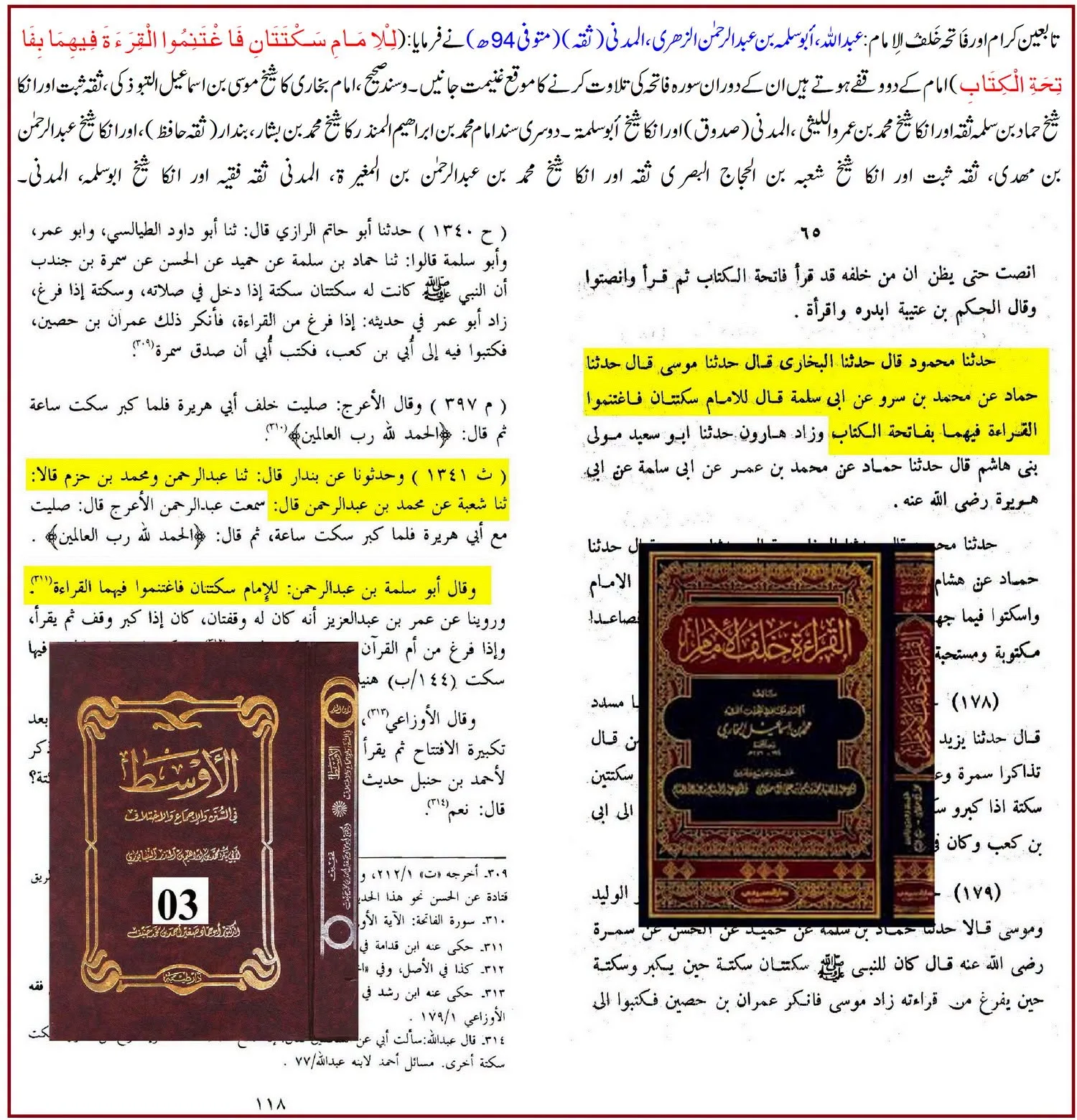
165 - حَدَّثَنَا مَحْمُودٌ قَالَ: حَدَّثَنَا الْبُخَارِيُّ قَالَ: حَدَّثَنَا مُوسَى، قَالَ: حَدَّثَنَا حَمَّادٌ، عَنْ مُحَمَّدِ بْنِ عَمْرٍو، عَنْ أَبِي سَلَمَةَ، قَالَ: «لِلْإِمَامِ سَكْتَتَانِ فَاغْتَنِمُوا الْقِرَاءَةَ فِيهِمَا بِفَاتِحَةِ الْكِتَابِ»
Translation:
Imam Abu Salamah bin Abdul Rahman (may Allah have mercy on him) says: The Imam has two pauses, so consider the opportunity to recite Surah Al-Fatiha during both pauses as a blessing.
Reference: Al-Kitab: Juz’ al-Qira’ah Khalf al-Imam
Reference: Author: Muhammad bin Ismail bin Ibrahim bin al-Mughirah al-Bukhari, Abu Abdullah (died: 256 AH)
Reference: Hadith Number: 165
Another narration on the same topic has been transmitted by Imam Ibn al-Mundhir, may Allah have mercy on him:
1341 - وَحَدَّثُونَا عَنْ بُنْدَارٍ، قَالَ: ثنا عَبْدُ الرَّحْمَنِ، وَمُحَمَّدُ بْنُ حَزْمٍ، قَالَا: ثنا شُعْبَةُ، عَنْ مُحَمَّدِ بْنِ عَبْدِ الرَّحْمَنِ، قَالَ: سَمِعْتُ عَبْدَ الرَّحْمَنِ الْأَعْرَجَ، قَالَ: «صَلَّيْتُ مَعَ أَبِي هُرَيْرَةَ فَلَمَّا كَبَّرَ سَكَتَ سَاعَةً، ثُمَّ قَالَ: ﴿الْحَمْدُ لِلَّهِ رَبِّ الْعَالَمِينَ﴾ [الفاتحة: 2]» وَقَالَ أَبُو سَلَمَةَ بْنُ عَبْدِ الرَّحْمَنِ: «لِلْإِمَامِ سَكْتَتَانِ فَاغْتَنِمُوا فِيهِمَا الْقِرَاءَةَ»
Translation:
Abdur-Rahman al-A'raj, may Allah have mercy on him, states: I prayed with Hazrat Abu Hurairah, may Allah be pleased with him. When he said the Takbir, he remained silent for a while, then recited «الْحَمْدُ لِلَّهِ رَبِّ الْعَالَمِينَ».
And Imam Abu Salamah ibn Abdur-Rahman, may Allah have mercy on him, says: The Imam has two pauses; consider it a blessing to recite during both of these pauses.
Reference: Book: Al-Awsat fi al-Sunan wal-Ijma wal-Ikhtilaf
Reference: Author: Abu Bakr Muhammad ibn Ibrahim ibn al-Mundhir al-Naysaburi (died 319 AH)
Reference: Hadith Number: 1341
Explanation:
From these narrations, it becomes clear that Imam Abu Salamah ibn Abdur-Rahman, may Allah have mercy on him, advocated for the follower to recite during the Imam’s pauses, and he even explicitly encouraged reciting Surah Al-Fatiha during these pauses.
② Imam Makhul al-Shami, may Allah have mercy on him (died 112 AH)
Imam Makhul ibn Abi Muslim al-Shami, may Allah have mercy on him, is counted among the famous Tabi'in jurists of Sham. From him, the practice and emphasis on reciting Surah Al-Fatiha even in loud prayers has been transmitted.
Imam Abu Dawood, may Allah have mercy on him, narrated:
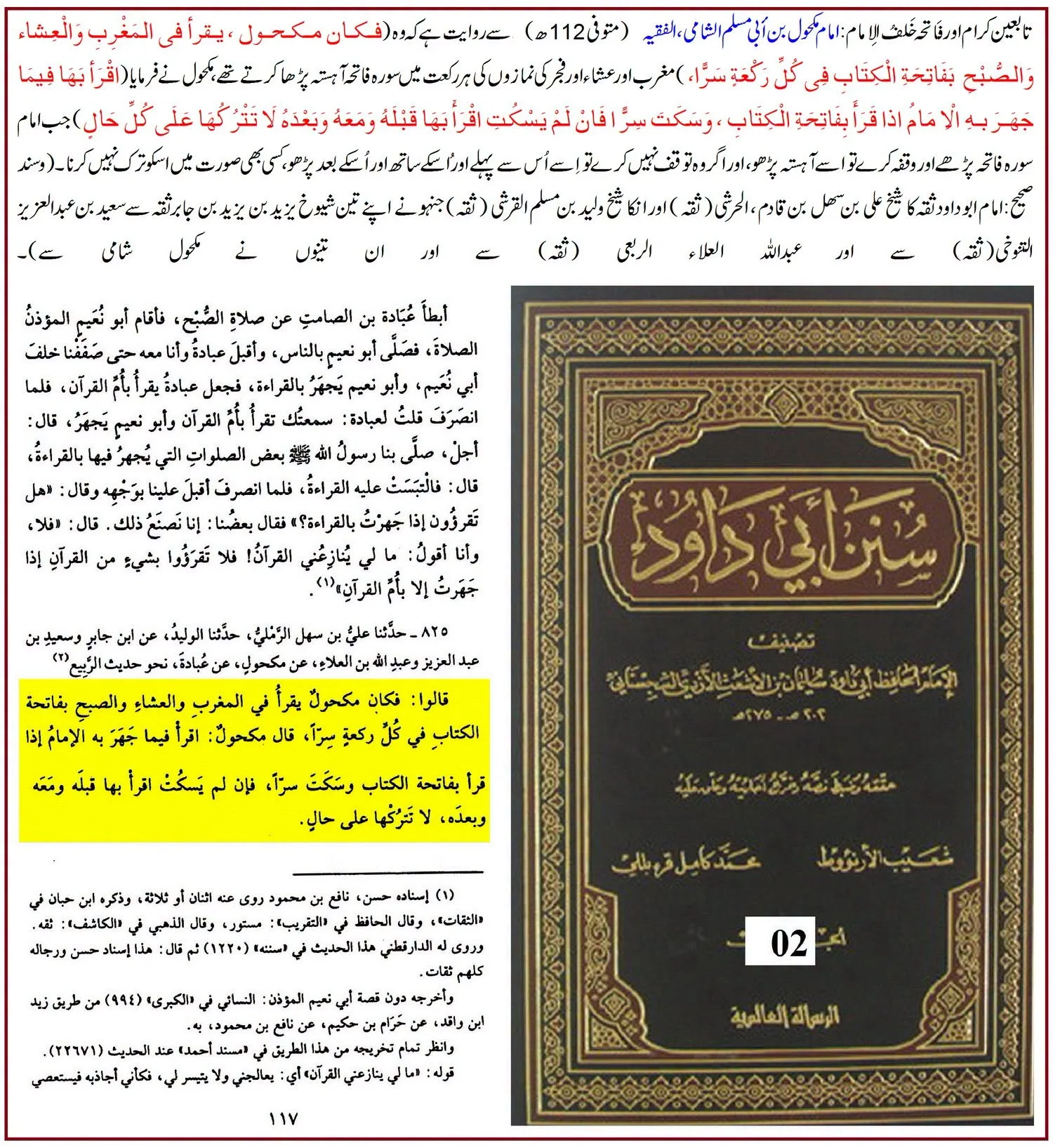
825 - حَدَّثَنَا عَلِيُّ بْنُ سَهْلٍ الرَّمْلِيُّ، حَدَّثَنَا الْوَلِيدُ، عَنِ ابْنِ جَابِرٍ، وَسَعِيدِ بْنِ عَبْدِ الْعَزِيزِ، وَعَبْدِ اللَّهِ بْنِ الْعَلَاءِ، عَنْ مَكْحُولٍ، عَنْ عُبَادَةَ، نَحْوَ حَدِيثِ الرَّبِيعِ بْنِ سُلَيْمَانَ، قَالُوا: فَكَانَ مَكْحُولٌ، يَقْرَأُ فِي الْمَغْرِبِ وَالْعِشَاءِ وَالصُّبْحِ بِفَاتِحَةِ الْكِتَابِ فِي كُلِّ رَكْعَةٍ سِرًّا،
Translation:
Narrators report that Imam Makhool, may Allah have mercy on him, used to recite Surah Al-Fatiha slowly in every rak'ah of Maghrib, Isha, and Fajr prayers.
Reference: Book: Sunan Abi Dawood
Reference: Author: Abu Dawood Sulaiman ibn Al-Ash'ath ibn Ishaq ibn Bashir ibn Shaddad ibn Amr Al-Azdi Al-Sijistani (died: 275 AH)
Reference: Hadith Number: 825
Consider another explicit statement of Imam Makhool, may Allah have mercy on him:
قَالَ مَكْحُولٌ: اقْرَأْ بِهَا فِيمَا جَهَرَ بِهِ الْإِمَامُ إِذَا قَرَأَ بِفَاتِحَةِ الْكِتَابِ، وَسَكَتَ سِرًّا فَإِنْ لَمْ يَسْكُتِ اقْرَأْ بِهَا قَبْلَهُ وَمَعَهُ وَبَعْدَهُ لَا تَتْرُكْهَا عَلَى كُلِّ حَالٍ
Translation:
Imam Makhool, may Allah have mercy on him, says: In the prayer where the Imam recites aloud, also recite Surah Al-Fatiha. When the Imam finishes reciting Surah Al-Fatiha and becomes silent, then recite it slowly; and if the Imam does not become silent, then recite it before him, with him, or after him, but under no circumstances abandon Surah Al-Fatiha.
Reference: Book: Sunan Abi Dawood
Reference: Author: Abu Dawood Sulaiman ibn Al-Ash'ath ibn Ishaq ibn Bashir ibn Shaddad ibn Amr Al-Azdi Al-Sijistani (died: 275 AH)
Reference: Related Hadith: 825
Explanation:
The statement of Imam Makhool, may Allah have mercy on him, is very clear on this issue. He commands the follower to recite Surah Al-Fatiha even in loud prayers and does not agree with abandoning its recitation even if the Imam remains silent.
③ Imam Hasan Basri, may Allah have mercy on him (died 110 AH)
It is narrated from Imam Hasan bin Yasar Basri, may Allah have mercy on him, that he advised reciting Surah Al-Fatiha slowly behind the Imam in every prayer.
Imam Bayhaqi, may Allah have mercy on him, narrated:
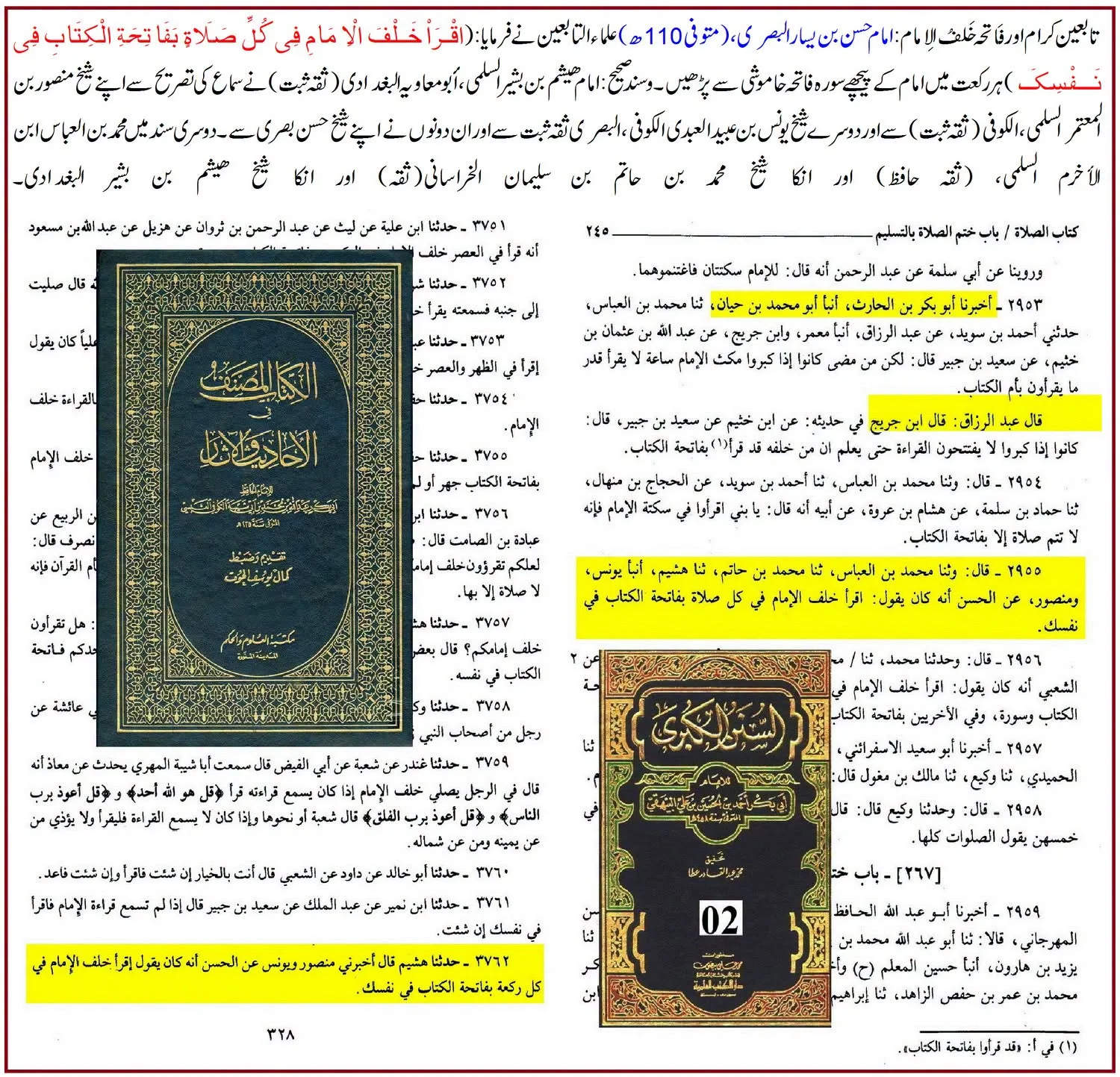
2955 - قَالَ: وَثنا مُحَمَّدُ بْنُ الْعَبَّاسِ، ثنا مُحَمَّدُ بْنُ حَاتِمٍ، ثنا هُشَيْمٌ، أنبأ يُونُسُ، وَمَنْصُورٌ، عَنِ الْحَسَنِ أَنَّهُ كَانَ يَقُولُ: «اقْرَأْ خَلْفَ الْإِمَامِ فِي كُلِّ صَلَاةٍ بِفَاتِحَةِ الْكِتَابِ فِي نَفْسِكَ»
Translation:
Imam Hasan Basri, may Allah have mercy on him, used to say: In every prayer, recite Surah Al-Fatiha behind the Imam in your heart, that is, in a low voice.
Reference: Al-Kitab: Al-Sunan Al-Kubra
Reference: Author: Ahmad ibn al-Husayn ibn Ali ibn Musa al-Khusrawjirdi al-Khurasani, Abu Bakr al-Bayhaqi (died 458 AH)
Reference: Hadith Number: 2955
Similarly, Imam Ibn Abi Shaybah, may Allah have mercy on him, has narrated:
3762 - حَدَّثَنَا هُشَيْمٌ قَالَ: أَخْبَرَنِي مَنْصُورٌ، وَيُونُسُ، عَنِ الْحَسَنِ أَنَّهُ كَانَ يَقُولُ: «اقْرَأْ خَلْفَ الْإِمَامِ فِي كُلِّ رَكْعَةٍ بِفَاتِحَةِ الْكِتَابِ فِي نَفْسِكَ»
Translation:
Imam Hasan Basri, may Allah have mercy on him, said: Recite Surah Al-Fatiha slowly behind the Imam in every Rak'ah.
Reference: Al-Kitab: Al-Kitab al-Musannaf fi al-Ahadith wa al-Athar
Reference: Author: Abu Bakr ibn Abi Shaybah, Abdullah ibn Muhammad ibn Ibrahim ibn Uthman ibn Khawasti al-Absi (died 235 AH)
Reference: Hadith Number: 3762
Explanation:
In both narrations of Imam Hasan Basri, may Allah have mercy on him, the follower is instructed to recite Surah Al-Fatiha behind the Imam. The first narration specifies this for every prayer, and the second explicitly for every unit (rak'ah), which clarifies his stance on this issue.
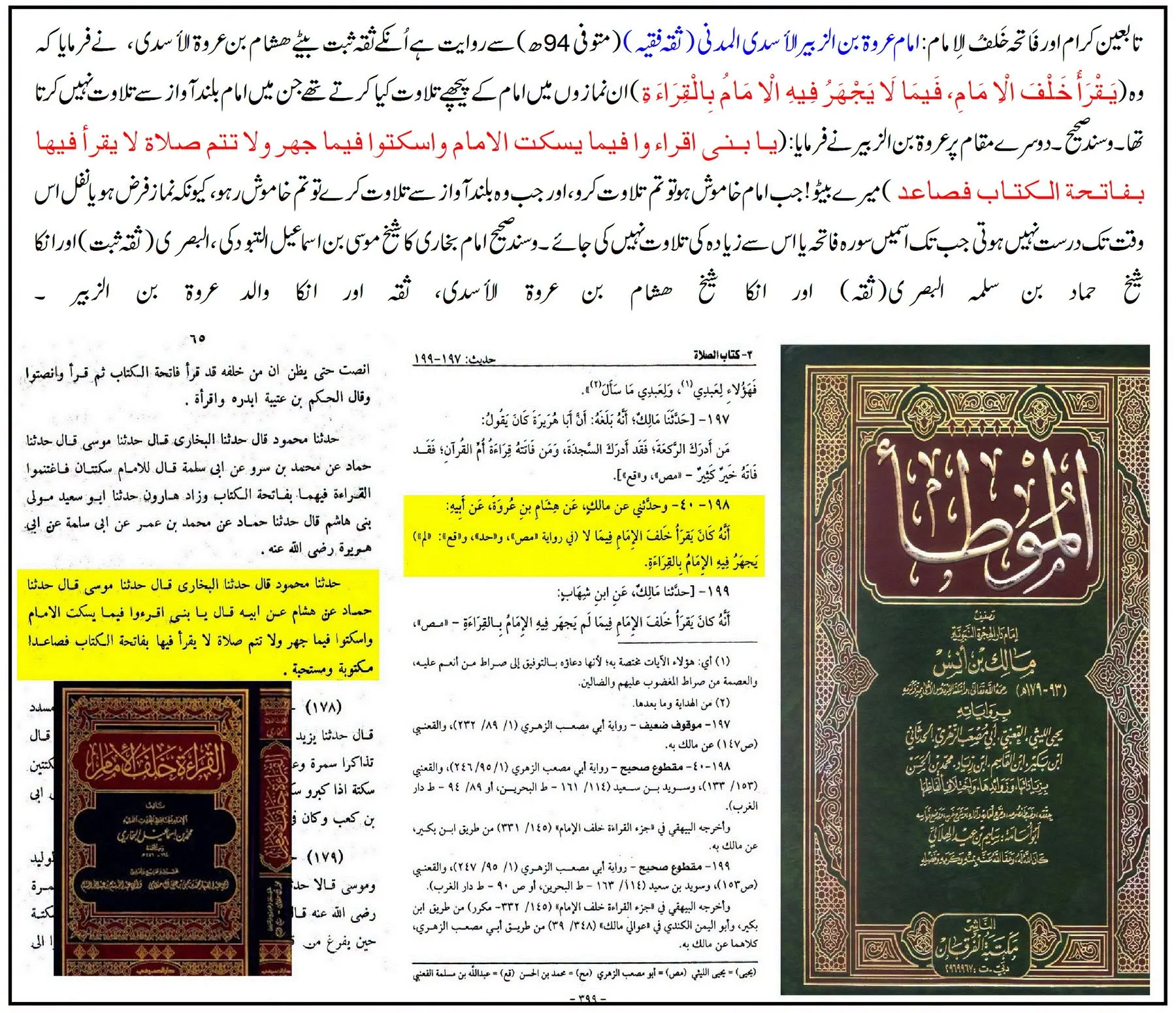
④ Imam Urwah bin Zubair, may Allah have mercy on him (died 94 AH)
Regarding the famous jurist and Tabi'i of Madinah Munawwarah, Imam Urwah bin Zubair, may Allah have mercy on him, his son Hisham bin Urwah, may Allah have mercy on him, narrates that he used to recite behind the Imam in silent prayers.
Imam Malik, may Allah have mercy on him, narrated:
40 - وَحَدَّثَنِي عَنْ مالِكٍ، عَنْ هِشَامِ بْنِ عُرْوَةَ، عَنْ أبِيهِ أَنَّهُ كَانَ «يَقْرَأُ خَلْفَ الْإِمَامِ، فِيمَا لَا يَجْهَرُ فِيهِ الْإِمَامُ بِالْقِرَاءَةِ»
Translation:
Hisham bin Urwah, may Allah have mercy on him, said about his father that he used to recite behind the Imam in those prayers in which the Imam did not recite aloud.
Reference: Al-Kitab: Muwatta Imam Malik
Reference: Author: Malik bin Anas bin Malik bin Amir Al-Asbahi Al-Madani (died 179 AH)
Reference: Narration number: 40
Imam Urwah bin Zubair, may Allah have mercy on him, used to advise his sons saying:
166 - حَدَّثَنَا مَحْمُودٌ قَالَ: حَدَّثَنَا الْبُخَارِيُّ قَالَ: حَدَّثَنَا مُوسَى، قَالَ: حَدَّثَنَا حَمَّادٌ، عَنْ هِشَامٍ، عَنْ أَبِيهِ، قَالَ: «يَا بَنِيَّ اقْرَءُوا فِيمَا يَسْكُتُ الْإِمَامُ وَاسْكُتُوا فِيمَا جَهَرَ وَلَا تَتِمُّ صَلَاةٌ لَا يُقْرَأُ فِيهَا بِفَاتِحَةِ الْكِتَابِ فَصَاعِدًا، مَكْتُوبَةٌ وَمُسْتَحَبَّةٌ»
Translation:
O my sons! When the Imam is silent, then you recite, and when he recites aloud, then you remain silent. And the prayer is not complete without reciting Surah Al-Fatiha or more, whether the prayer is obligatory or voluntary.
Reference: Al-Kitab: Juz' al-Qira'ah Khalf al-Imam
Reference: Author: Muhammad ibn Ismail ibn Ibrahim ibn al-Mughirah al-Bukhari, Abu Abdullah (died 256 AH)
Reference: Hadith Number: 166
Explanation:
From these two narrations, it is understood that Imam Urwah ibn Zubair, may Allah have mercy on him, was not absolutely opposed to recitation behind the Imam. He used to recite in silent prayers and advised to remain silent when the Imam recited aloud in loud prayers. According to him, there were distinct occasions for recitation and listening.
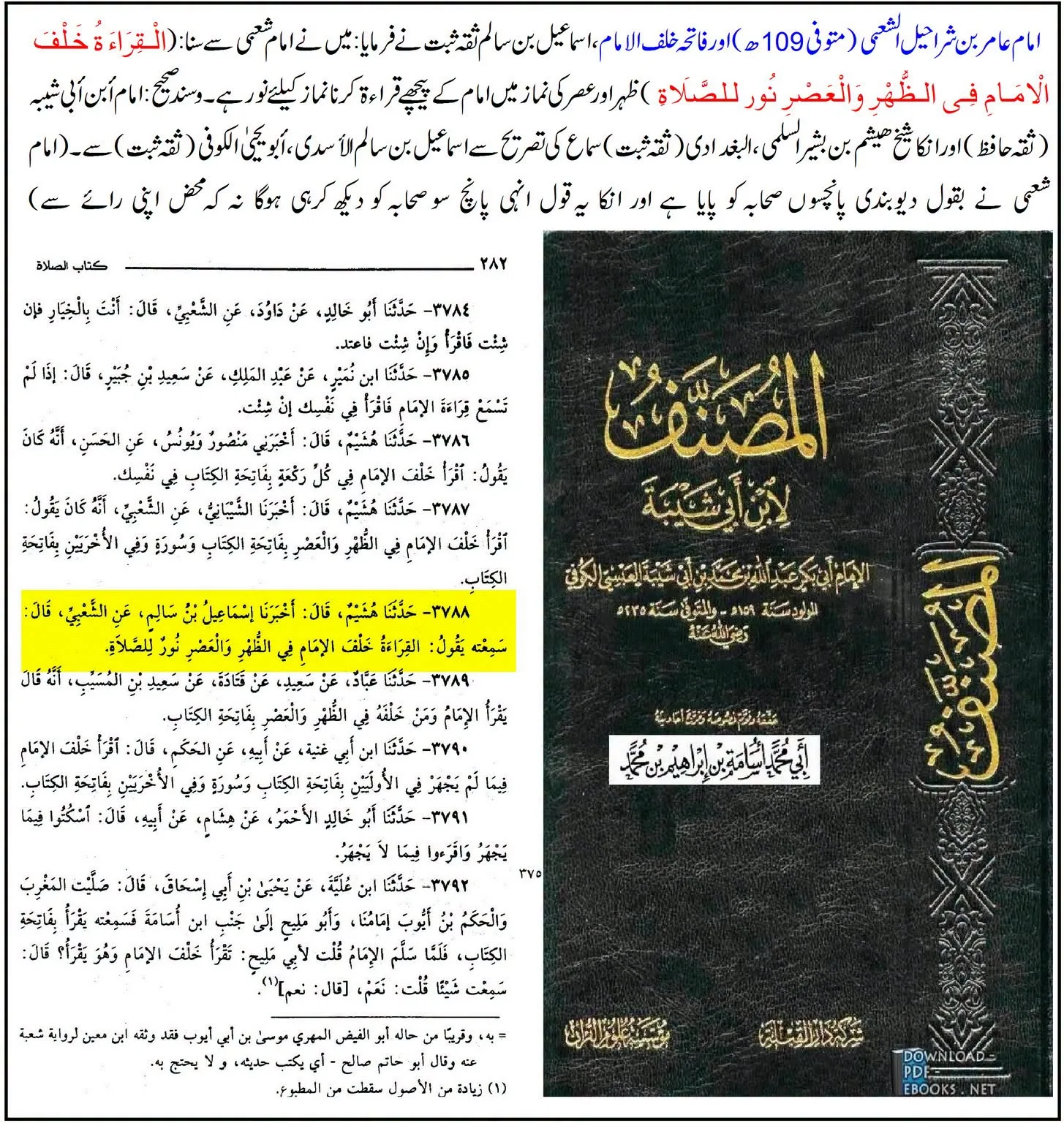
⑤ Imam Amir al-Sha'bi, may Allah have mercy on him (died 109 AH)
Imam Amir ibn Sharahil al-Sha'bi, may Allah have mercy on him, was a famous Muhaddith and Faqih of Kufa. Numerous narrations supporting recitation behind the Imam have been transmitted from him.
Imam Ibn Abi Shaybah, may Allah have mercy on him, narrated:
3764 - حَدَّثَنَا هُشَيْمٌ قَالَ: أَخْبَرَنَا إِسْمَاعِيلُ بْنُ سَالِمٍ، عَنِ الشَّعْبِيِّ قَالَ: سَمِعْتُهُ يَقُولُ: «الْقِرَاءَةُ خَلْفَ الْإِمَامِ فِي الظُّهْرِ وَالْعَصْرِ نُورٌ لِلصَّلَاةِ»
Imam Shu'bah, may Allah have mercy on him, used to say: Reciting behind the Imam in the Zuhr and Asr prayers is a light for the prayer.
Reference: Al-Kitab: Al-Kitab Al-Musannaf fi Al-Ahadith wal-Athar
Reference: Author: Abu Bakr ibn Abi Shaybah, Abdullah ibn Muhammad ibn Ibrahim ibn Uthman ibn Khawasti Al-Absi (died 235 AH)
Reference: Hadith Number: 3764
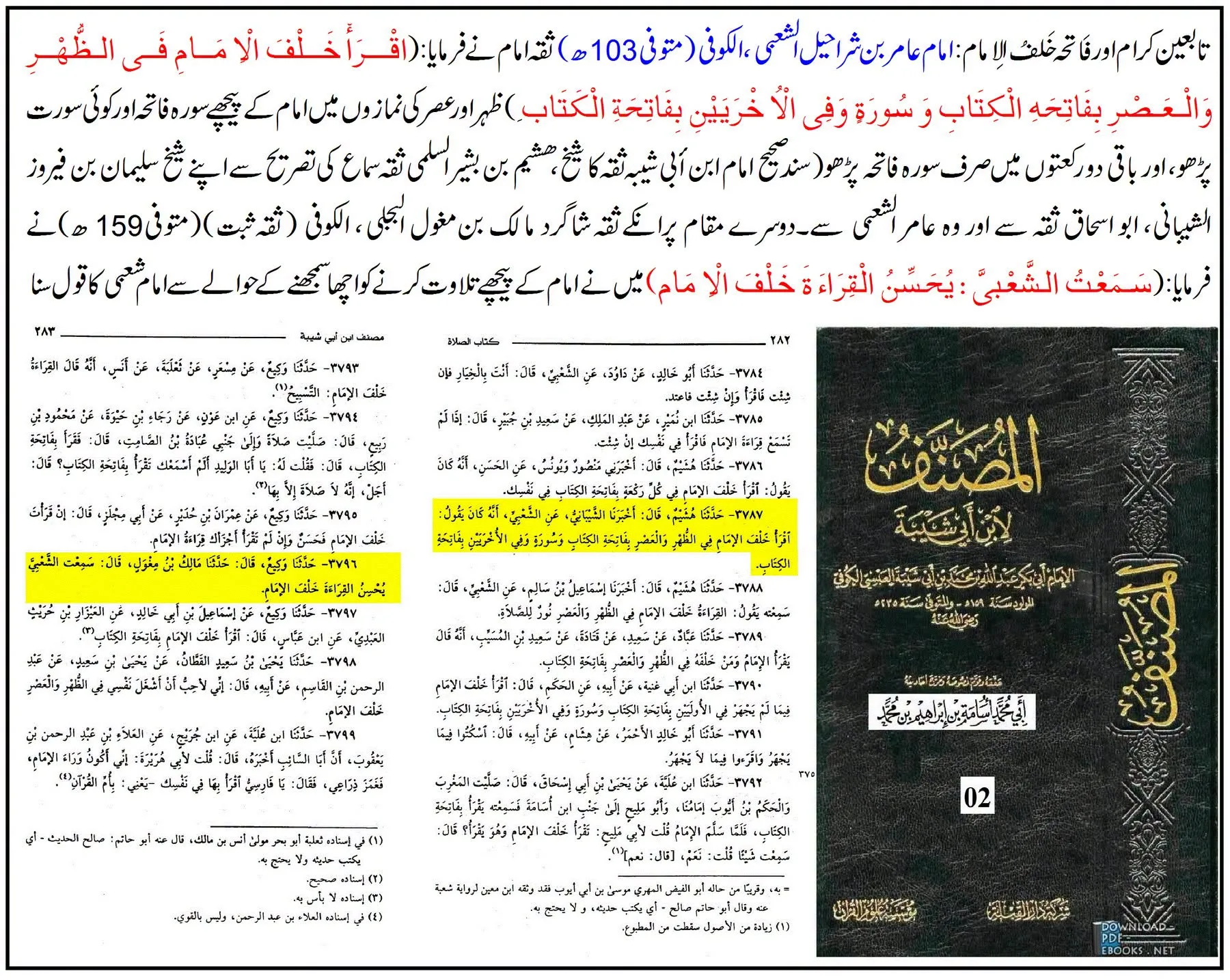
In another narration, Imam Shu'bah, may Allah have mercy on him, says:
3763 - حَدَّثَنَا هُشَيْمٌ قَالَ: أَخْبَرَنَا الشَّيْبَانِيُّ، عَنِ الشَّعْبِيِّ، أَنَّهُ كَانَ يَقُولُ: «اقْرَأْ خَلْفَ الْإِمَامِ فِي الظُّهْرِ وَالْعَصْرِ بِفَاتِحَةِ الْكِتَابِ وَسُورَةٍ، وَفِي الْأُخْرَيَيْنِ بِفَاتِحَةِ الْكِتَابِ»
Translation:
In the Zuhr and Asr prayers, recite Surah Al-Fatiha and another Surah behind the Imam in the first two Rak'ahs, while in the last two Rak'ahs recite only Surah Al-Fatiha.
Reference: Al-Kitab: Al-Kitab Al-Musannaf fi Al-Ahadith wal-Athar
Reference: Author: Abu Bakr ibn Abi Shaybah, Abdullah ibn Muhammad ibn Ibrahim ibn Uthman ibn Khawasti Al-Absi (died 235 AH)
Reference: Hadith Number: 3763
In a third narration, Malik ibn Maghool, may Allah have mercy on him, a student of Imam Shu'bah, may Allah have mercy on him, narrates:
3772 - حَدَّثَنَا وَكِيعٌ قَالَ: نا مَالِكُ بْنُ مِغْوَلٍ قَالَ: سَمِعْتُ الشَّعْبِيَّ «يُحَسِّنُ الْقِرَاءَةَ خَلْفَ الْإِمَامِ»
Translation:
Malik ibn Maghool, may Allah have mercy on him, says: I heard Imam Shu'bah, may Allah have mercy on him, approving recitation behind the Imam.
Reference: Al-Kitab: Al-Kitab Al-Musannaf fi Al-Ahadith wal-Athar
Reference: Author: Abu Bakr ibn Abi Shaybah, Abdullah ibn Muhammad ibn Ibrahim ibn Uthman ibn Khawasti Al-Absi (died 235 AH)
Reference: Hadith Number: 3772
Explanation:
In all three narrations, Imam Shu'bah, may Allah have mercy on him, has preferred recitation behind the Imam. His statements are specifically related to the Zuhr and Asr prayers. Therefore, from these, the endorsement of recitation in silent prayers is clearly established; however, these narrations do not fully determine his stance regarding loud prayers.
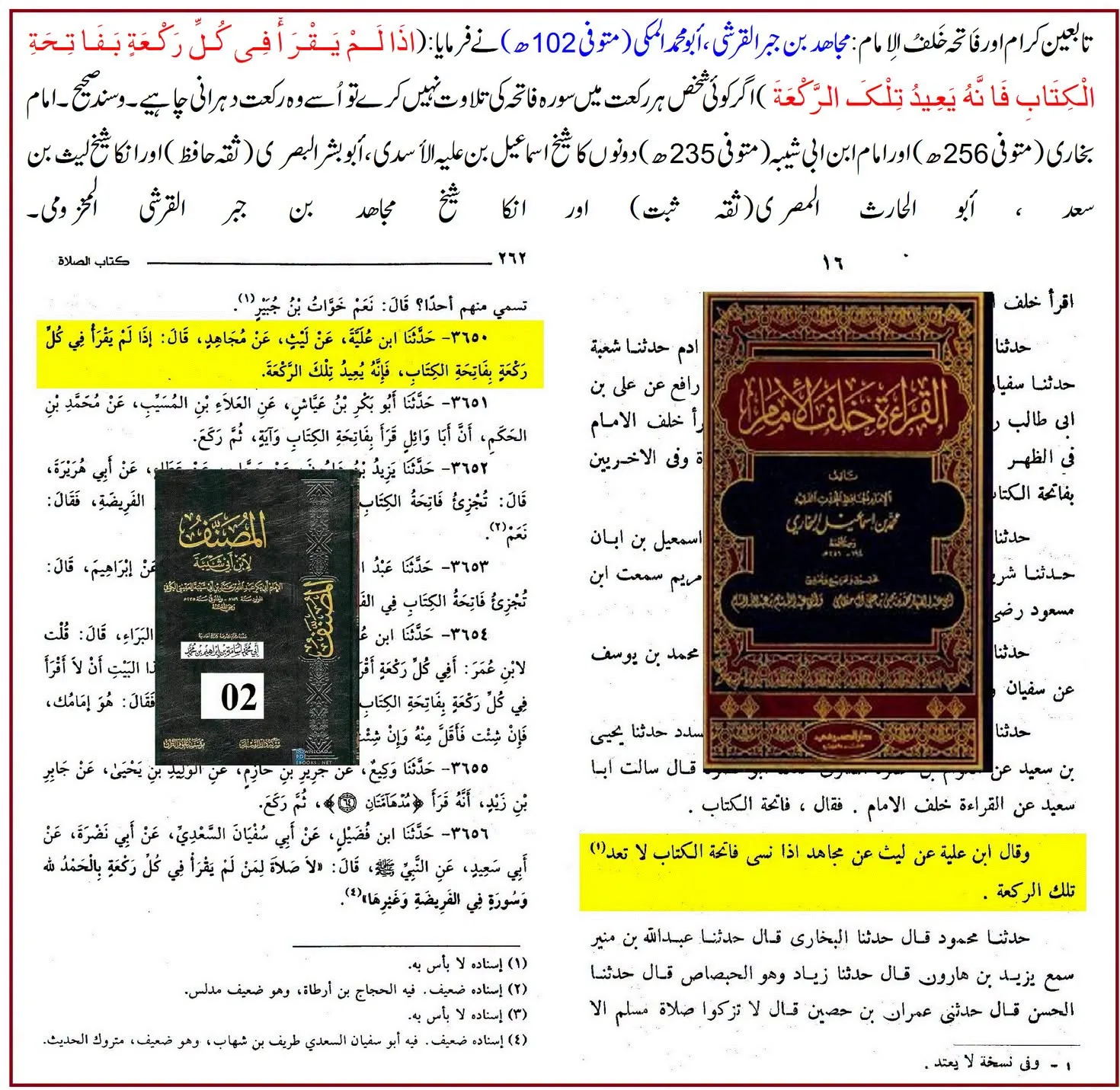
⑥ Imam Mujahid bin Jabr, may Allah have mercy on him (died 102 AH)
Imam Mujahid bin Jabr, may Allah have mercy on him, was a famous Tabi'i of Makkah, an exegete, and a distinguished student of Hazrat Abdullah bin Abbas, may Allah be pleased with them both.
From him, a statement has been transmitted regarding the importance of reciting Surah Al-Fatiha in every unit (rak'ah).
Imam Ibn Abi Shaybah, may Allah have mercy on him, narrated:
3626 - حَدَّثَنَا ابْنُ عُلَيَّةَ، عَنْ لَيْثٍ، عَنْ مُجَاهِدٍ قَالَ: «إِذَا لَمْ يَقْرَأْ فِي كُلِّ رَكْعَةٍ بِفَاتِحَةِ الْكِتَابِ فَإِنَّهُ يُعِيدُ تِلْكَ الرَّكْعَةَ»
Translation:
Imam Mujahid, may Allah have mercy on him, says: If a person does not recite Surah Al-Fatiha in every rak'ah, then he should repeat that rak'ah.
Reference: Book: Al-Kitab Al-Musannaf fi Al-Ahadith wal-Athar
Reference: Author: Abu Bakr Ibn Abi Shaybah, Abdullah Ibn Muhammad Ibn Ibrahim Ibn Uthman Ibn Khawasti Al-Absi (died 235 AH)
Reference: Hadith Number: 3626
Imam Bukhari, may Allah have mercy on him, also transmitted his statement:
28 - وَقَالَ ابْنُ عُلَيَّةَ عَنْ لَيْثٍ، عَنْ مُجَاهِدٍ: إِذَا نَسِيَ فَاتِحَةَ الْكِتَابِ لَا تُعَدُّ تِلْكَ الرَّكْعَةُ
Translation:
Imam Mujahid, may Allah have mercy on him, says: If a person forgets to recite Surah Al-Fatiha, then that Rak'ah will not be counted.
Reference: Al-Kitab: Juz' al-Qira'ah Khalf al-Imam
Reference: Author: Muhammad ibn Isma'il ibn Ibrahim ibn al-Mughira al-Bukhari, Abu Abdullah (died 256 AH)
Reference: Hadith Number: 28
Explanation:
These two narrations concern the importance of Surah Al-Fatiha in every Rak'ah. However, they do not explicitly mention recitation behind the Imam. Therefore, rather than presenting them as conclusive and definitive evidence in favor of the follower, it is more cautious to present them as Imam Mujahid's stance on the importance of Surah Al-Fatiha.
Moreover, the identification of "Layth" mentioned in the chain of these narrations and the authenticity of the narration require further detailed investigation.
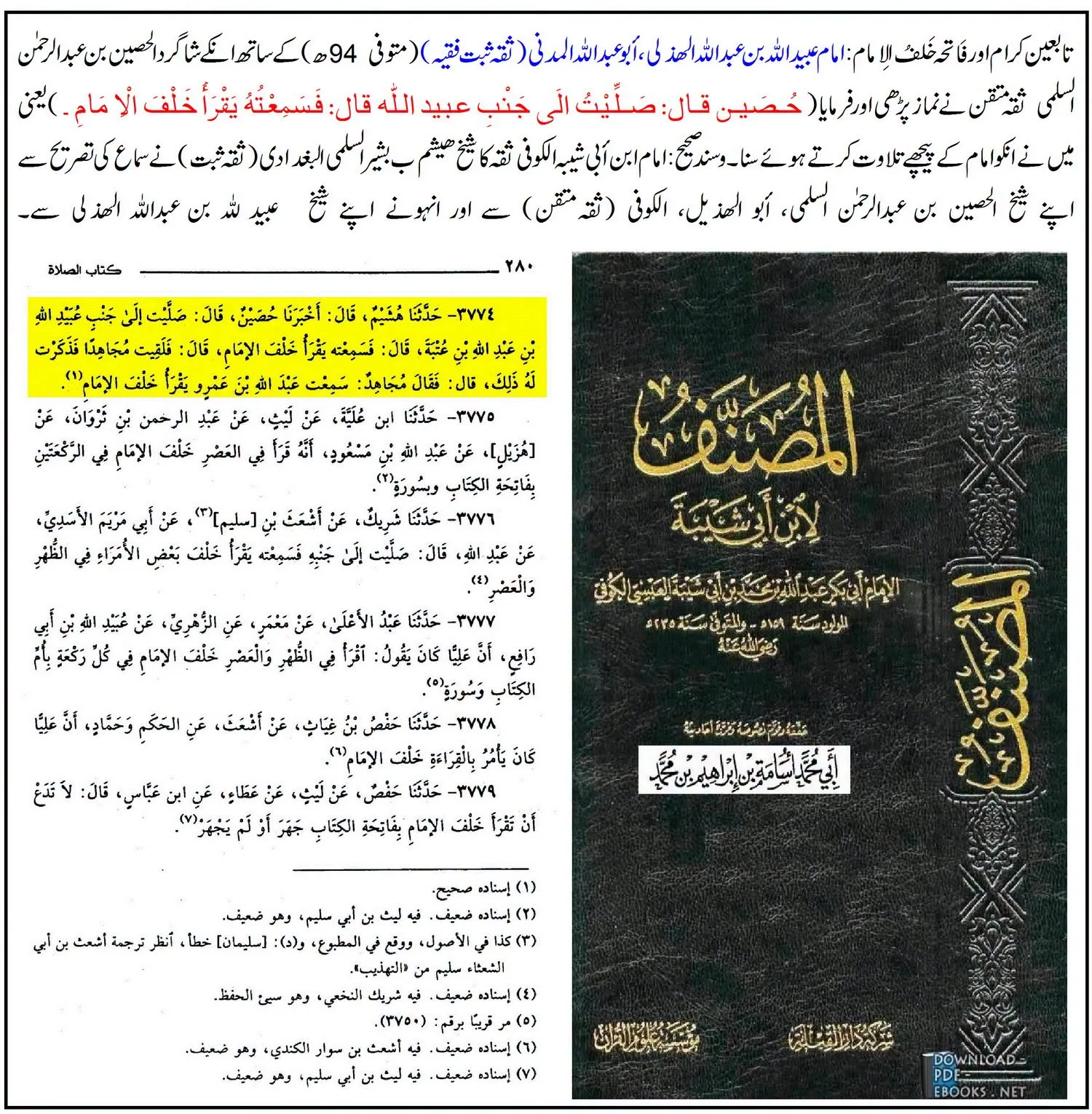
⑦ Imam Ubaydullah ibn Abdullah ibn Utbah, may Allah have mercy on him (died 94 AH)
Imam Ubaydullah ibn Abdullah ibn Utbah, may Allah have mercy on him, was among the distinguished jurists of the Tabi'in in Madinah.
His student Husayn ibn Abdul Rahman, may Allah have mercy on him, narrated an incident of praying with him.
Imam Ibn Abi Shaybah, may Allah have mercy on him, narrated:
3750 - حَدَّثَنَا هُشَيْمٌ قَالَ: أَخْبَرَنَا حُصَيْنٌ قَالَ: صَلَّيْتُ إِلَى جَنْبِ عُبَيْدِ اللَّهِ بْنِ عَبْدِ اللَّهِ بْنِ عُتْبَةَ قَالَ: فَسَمِعْتُهُ يَقْرَأُ خَلْفَ الْإِمَامِ.
Haseen bin Abdul Rahman, may Allah have mercy on him, narrates: I prayed beside Ubaidullah bin Abdullah bin Utbah, may Allah have mercy on him, and I heard him reciting behind the Imam.
Reference: Al-Kitab: Al-Kitab Al-Musannaf fi Al-Ahadith wal-Athar
Reference: Author: Abu Bakr bin Abi Shaybah, Abdullah bin Muhammad bin Ibrahim bin Uthman bin Khawasti Al-Absi (died 235 AH)
Reference: Hadith Number: 3750
Explanation:
This narration describes the practical method of a Tabi'i (successor). The narrator himself prayed with him and heard him reciting behind the Imam. Although the name of Surah Al-Fatiha is not explicitly mentioned in this narration, it is a clear practical testimony regarding the permissibility of general recitation behind the Imam.
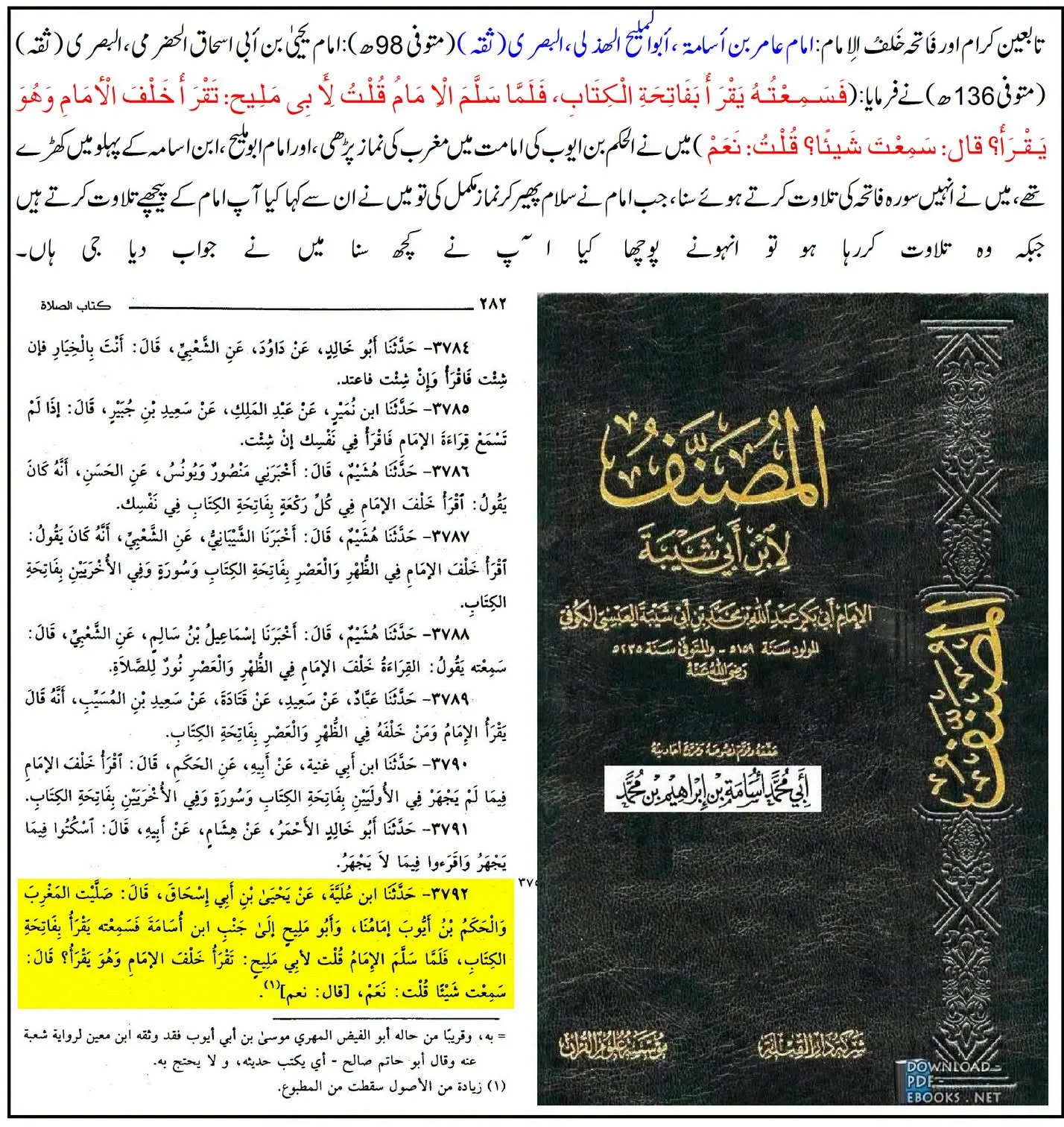
⑧ Imam Abu Al-Malih Al-Hadhli, may Allah have mercy on him (died 98 AH)
It is narrated from Imam Abu Al-Malih Al-Hadhli, may Allah have mercy on him, that he used to recite Surah Al-Fatiha behind the Imam in loud prayer.
Imam Ibn Abi Shaybah, may Allah have mercy on him, narrated:
3768 - حَدَّثَنَا ابْنُ عُلَيَّةَ، عَنْ يَحْيَى بْنِ أَبِي إِسْحَاقَ قَالَ: صَلَّيْتُ الْمَغْرِبَ وَالْحَكَمُ بْنُ أَيُّوبَ إِمَامُنَا، وَأَبُو مَلِيحٍ إِلَى جَنْبِ ابْنِ أُسَامَةَ، فَسَمِعْتُهُ يَقْرَأُ بِفَاتِحَةِ الْكِتَابِ، فَلَمَّا سَلَّمَ الْإِمَامُ قُلْتُ لِأَبِي مَلِيحٍ: تَقْرَأُ خَلْفَ الْإِمَامِ وَهُوَ يَقْرَأُ؟ قَالَ: «سَمِعْتَ شَيْئًا؟» قُلْتُ: نَعَمْ
Yahya bin Abi Ishaq, may Allah have mercy on him, narrates: I prayed Maghrib prayer, at that time Hukm bin Ayub was our Imam and Abu al-Malih (Amir) bin Usama was beside me. I heard him reciting Surah Al-Fatiha.
When the Imam concluded with the salam, I asked Abu al-Malih: Do you also recite behind the Imam while the Imam himself is reciting?
He asked: Did you hear something?
I replied: Yes.
Reference: Al-Kitab: Al-Kitab al-Musannaf fi al-Ahadith wa al-Athar
Reference: Author: Abu Bakr bin Abi Shaybah, Abdullah bin Muhammad bin Ibrahim bin Uthman bin Khawasti al-Absi (died 235 AH)
Reference: Hadith Number: 3768
Explanation:
In this narration, the act of reciting Surah Al-Fatiha by the follower during an audible prayer, i.e., Maghrib, is explicitly mentioned. This narration is important because it does not only present a ruling or statement but also provides testimony of the practical method of a Tabi'i.
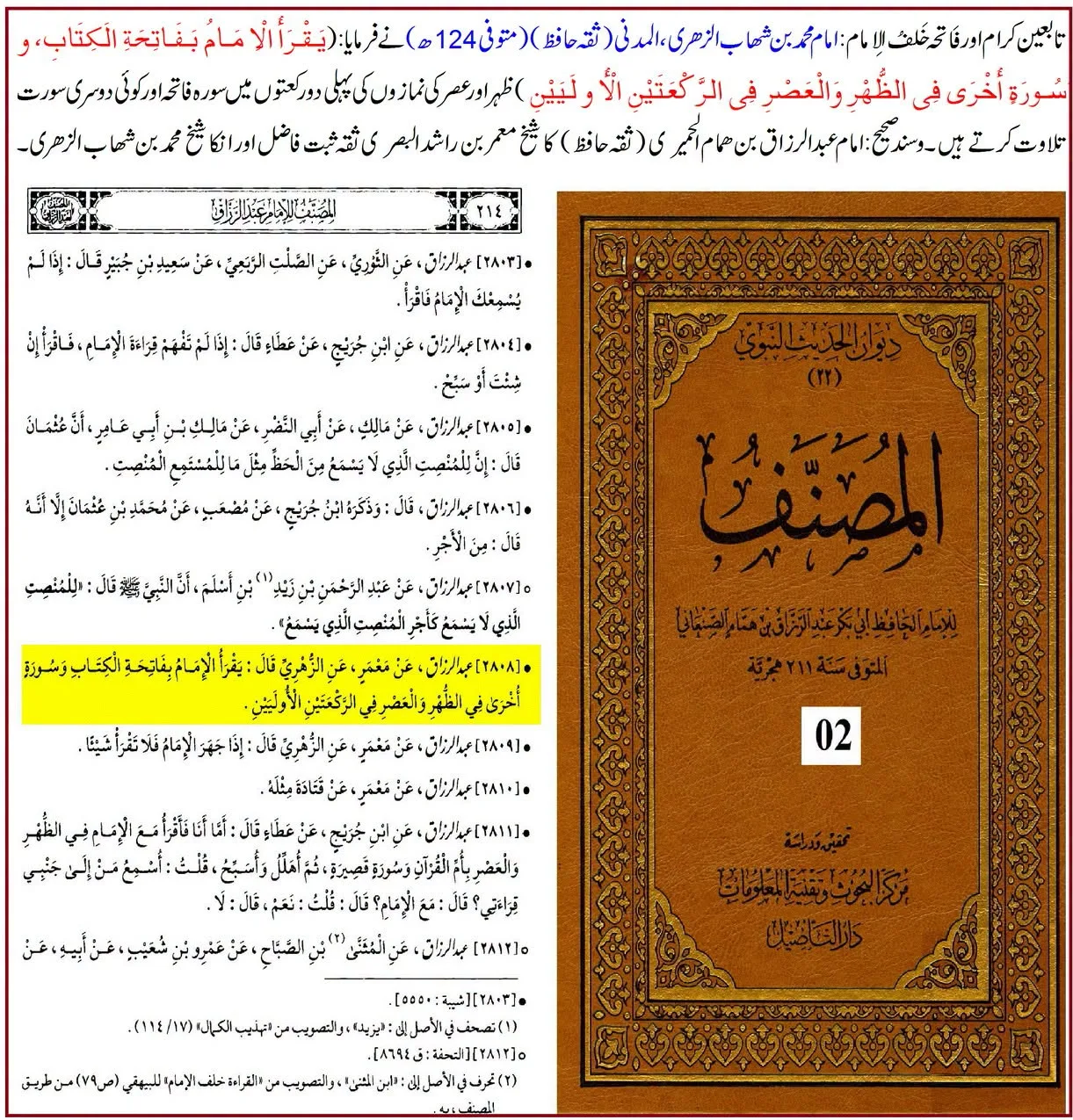
⑨ Imam Muhammad bin Shahab Zuhri, may Allah have mercy on him (died 124 AH)
A statement is transmitted from Imam Muhammad bin Shahab Zuhri, may Allah have mercy on him, regarding recitation in the Dhuhr and Asr prayers.
Imam Abdul Razzaq San'ani, may Allah have mercy on him, narrated:
2783 - عَنْ مَعْمَرٍ، عَنِ الزُّهْرِيِّ قَالَ: «يَقْرَأُ الْإِمَامُ بِفَاتِحَةِ الْكِتَابِ، وَسُورَةٍ أُخْرَى فِي الظُّهْرِ وَالْعَصْرِ فِي الرَّكْعَتَيْنِ الْأُولَيَيْنِ»
Translation:
Imam Zahri, may Allah have mercy on him, says: The Imam recites Surah Al-Fatiha and another Surah along with it in the first two Rak'ahs of Dhuhr and Asr.
Reference: Al-Kitab: Al-Musannaf
Reference: Author: Abu Bakr Abdul Razzaq bin Hammam bin Nafi' Al-Himyari Al-Yamani Al-San'ani (died 211 AH)
Reference: Hadith Number: 2783
Explanation:
In this narration, Imam Zahri, may Allah have mercy on him, has described the method of the Imam's recitation, not the ruling for the follower's recitation. Therefore, this narration pertains to the Imam's recitation in the first two Rak'ahs of Dhuhr and Asr and cannot be taken as direct evidence for reciting Al-Fatiha behind the Imam.
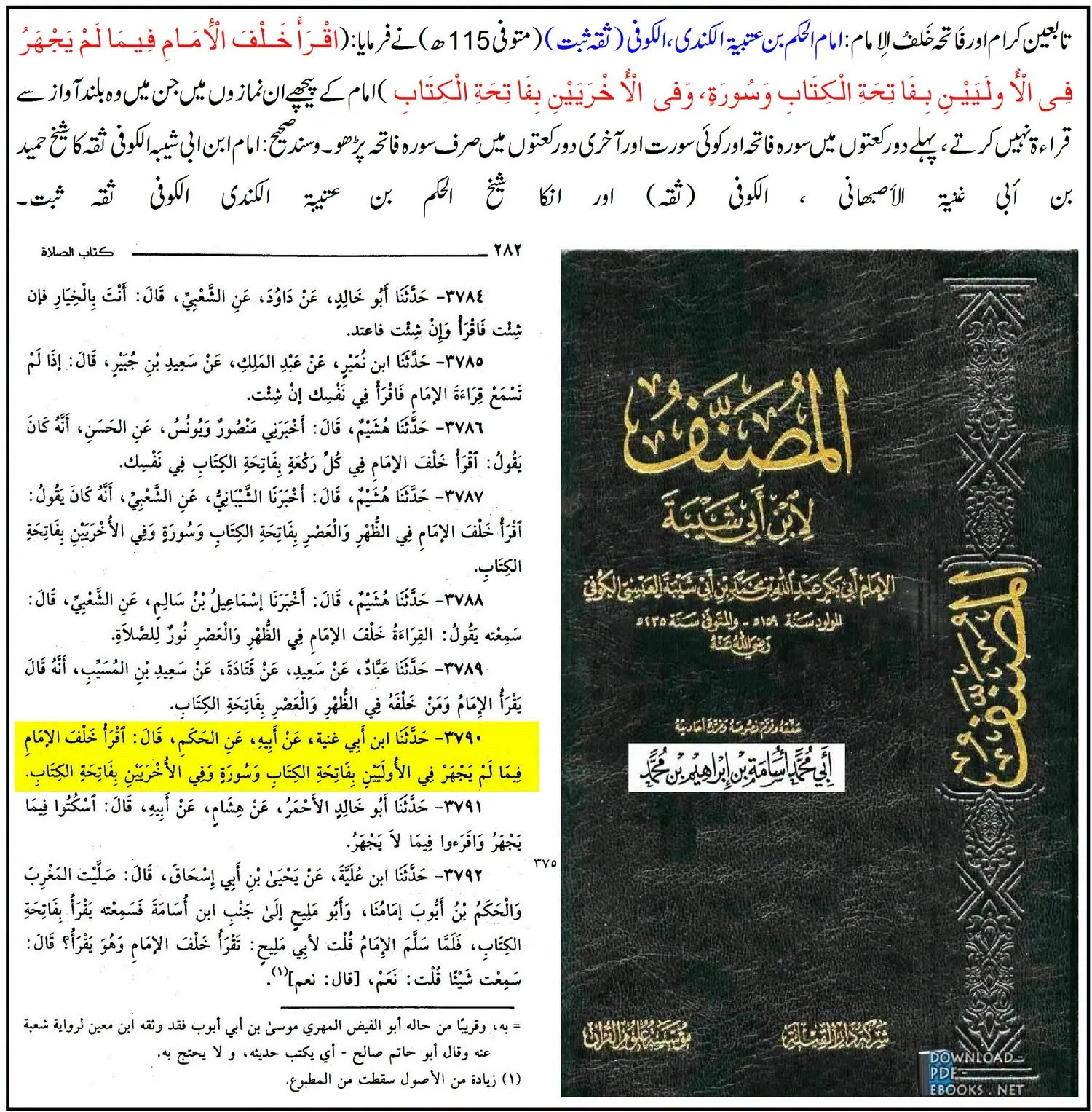
⑩ Imam Hukm bin Utaybah, may Allah have mercy on him (died 115 AH)
Imam Hukm bin Utaybah, may Allah have mercy on him, is counted among the distinguished jurists and hadith scholars of Kufa.
From him, there is a clear instruction transmitted regarding reciting behind the Imam in the secret (Sunnah) prayers.
Imam Ibn Abi Shaybah, may Allah have mercy on him, narrated:
3766 - حَدَّثَنَا ابْنُ أَبِي غَنِيَّةَ، عَنْ أَبِيهِ، عَنِ الْحَكَمِ قَالَ: «اقْرَأْ خَلْفَ الْإِمَامِ فِيمَا لَمْ يَجْهَرْ فِي الْأُولَيَيْنِ بِفَاتِحَةِ الْكِتَابِ وَسُورَةٍ، وَفِي الْأُخْرَيَيْنِ بِفَاتِحَةِ الْكِتَابِ».
Translation:
Imam Hukm bin Utaybah, may Allah have mercy on him, says: In the prayers where the Imam does not recite aloud, recite Surah Al-Fatiha and another Surah behind the Imam in the first two Rak'ahs, while in the last two Rak'ahs recite only Surah Al-Fatiha.
Reference: Al-Kitab: Al-Kitab Al-Musannaf fi Al-Ahadith wal-Athar
Reference: Author: Abu Bakr bin Abi Shaybah, Abdullah bin Muhammad bin Ibrahim bin Uthman bin Khawasti Al-Absi (died 235 AH)
Reference: Hadith Number: 3766
Explanation:
In this narration, Imam Hukm bin Utaybah, may Allah have mercy on him, instructs the follower to recite Surah Al-Fatiha and another Surah behind the Imam in the first two Rak'ahs of silent prayers, and only Surah Al-Fatiha in the last two Rak'ahs. Thus, his position regarding recitation behind the Imam in silent prayers is clearly presented.
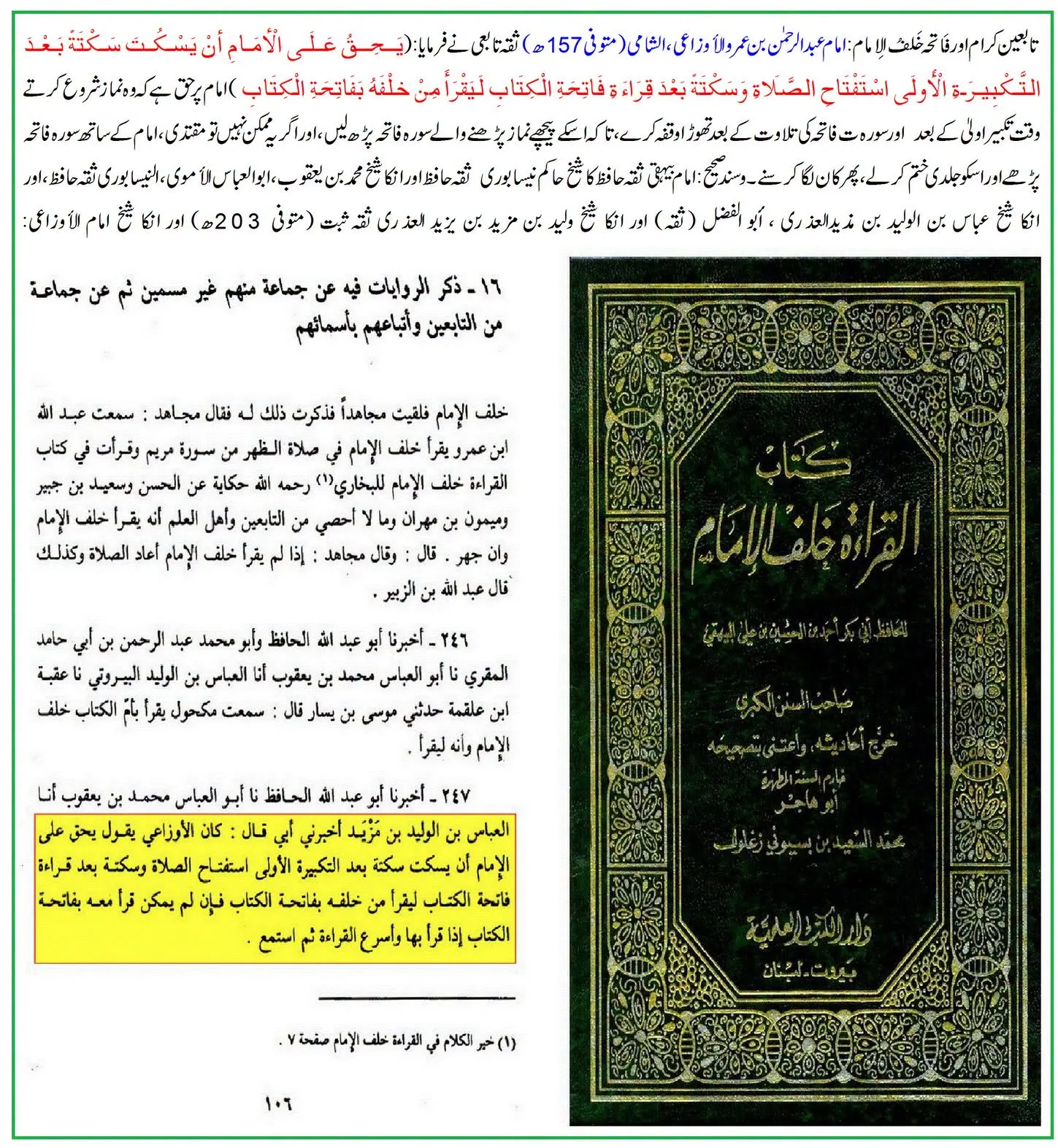
⑪ Imam Abdul Rahman bin Amr Awza'i, may Allah have mercy on him (died 157 AH)
Imam Awza'i, may Allah have mercy on him, was a famous jurist and Imam of Sham. He is counted among the Tabi' al-Tabi'in; however, he lived during the time of the Tabi'in and acquired knowledge from them, so his position is also mentioned here. A clear stance from him regarding the pauses of the Imam and the follower reciting Surah Al-Fatiha is narrated.
Hafiz Ibn Abdul Barr, may Allah have mercy on him, has narrated the position of Imam Awza'i, Imam Shafi'i, and Imam Abu Thawr, may Allah have mercy on them:
قال الأوزاعي والشافعي وأبو ثور: حق على الإمام أن يسكت سكتة بعد التكبيرة الأولى، وسكتة بعد فراغه بقراءة فاتحة الكتاب
Translation:
Imam Awza'i, Imam Shafi'i, and Imam Abu Thawr, may Allah have mercy on them, say: The Imam should pause after the initial Takbir and also pause after completing the recitation of Surah Al-Fatiha.
According to Hafiz Ibn Abdul Barr's narration, the purpose of this pause is to give the follower the opportunity to recite Surah Al-Fatiha. According to these Imams, if the Imam does not pause, then the follower should recite Surah Al-Fatiha along with the Imam.
Reference: Al-Kitab: Al-Istidhkar Al-Jami' limadhahib fuqaha' al-amsar wa 'ulama' al-aqtar
Reference: Author: Abu Umar Yusuf bin Abdullah bin Muhammad bin Abdul Barr Al-Qurtubi (died: 463 AH)
Reference: Volume: 4, Page: 238
Explanation:
This statement indicates that Imam Awza'i, may Allah have mercy on him, was in favor of providing the follower an opportunity to recite Surah Al-Fatiha. According to him, the Imam should make an appropriate pause so that the follower can recite Surah Al-Fatiha, and if the Imam does not pause, then the follower should recite along with him.
This position clarifies his jurisprudential opinion regarding the recitation of Surah Al-Fatiha in audible prayer.
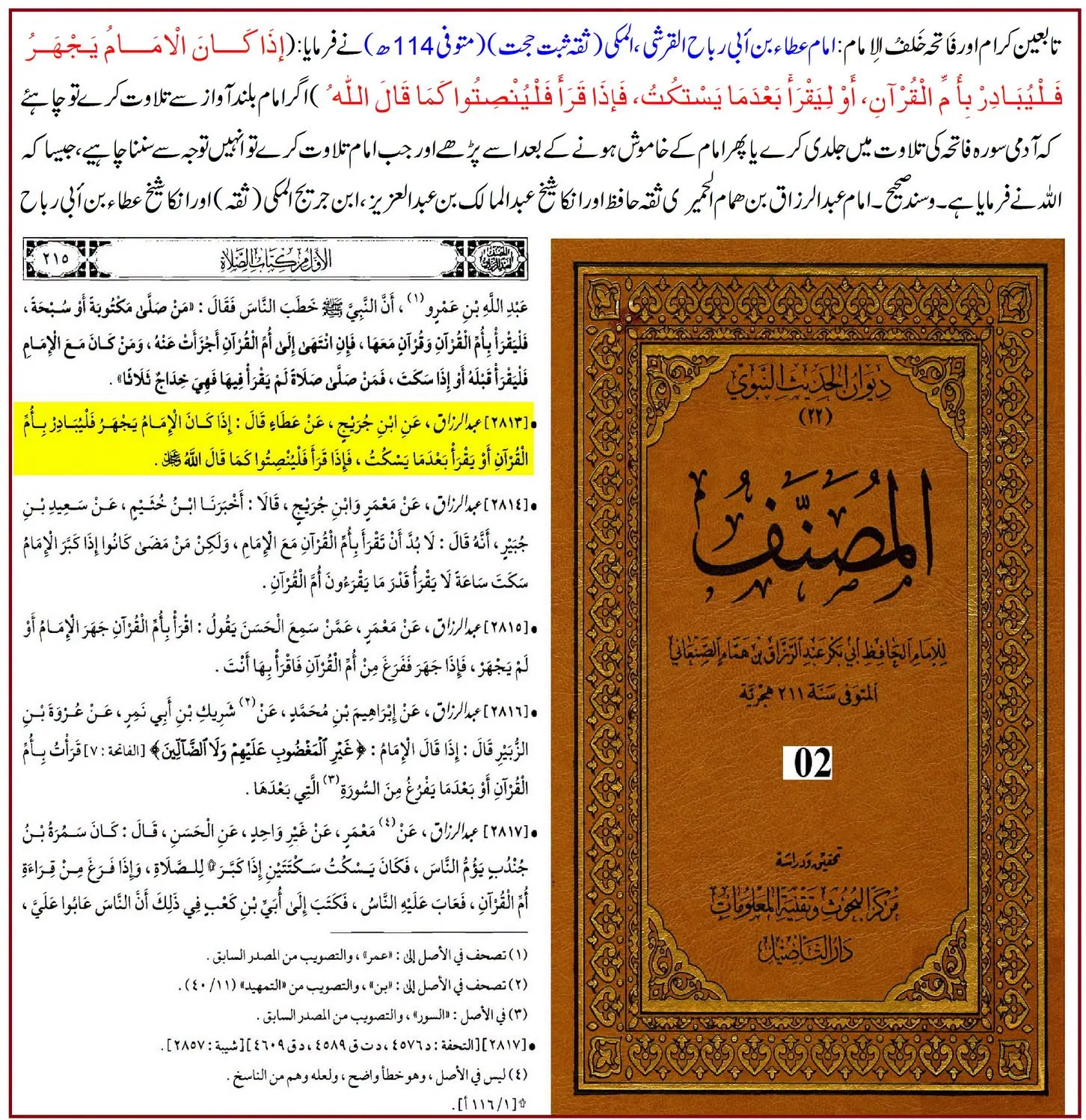
⑫ Imam Ata ibn Abi Rabah, may Allah have mercy on him (died 114 AH)
Imam Ata ibn Abi Rabah, may Allah have mercy on him, was a great jurist and a venerable Tabi'i of Makkah.
An important statement is transmitted from him regarding the follower's recitation in audible prayers.
Imam Abdul Razzaq San'ani, may Allah have mercy on him, narrated:
2788 - عَنِ ابْنِ جُرَيْجٍ، عَنْ عَطَاءٍ قَالَ: «إِذَا كَانَ الْإِمَامُ يَجْهَرُ فَلْيُبَادِرْ بِأُمِّ الْقُرْآنِ، أَوْ لِيَقْرَأْ بَعْدَمَا يَسْكُتُ، فَإِذَا قَرَأَ فَلْيُنْصِتُوا كَمَا قَالَ اللَّهُ عَزَّ وَجَلَّ»
Translation:
Imam Ata, may Allah have mercy on him, says: When the Imam is reciting aloud, the follower should hasten to recite Surah Al-Fatiha or recite it after the Imam has finished. Then, when the Imam recites, the follower should listen silently and attentively, as Allah Almighty has commanded.
Reference: Al-Kitab: Al-Musannaf
Reference: Author: Abu Bakr Abdul Razzaq bin Hammam bin Nafi Al-Himyari Al-Yamani Al-San'ani (died: 211 AH)
Reference: Hadith Number: 2788
Explanation:
In the statement of Imam Ata bin Abi Rabah, may Allah have mercy on him, two matters are combined: the recitation of Surah Al-Fatiha and remaining silent during the Imam's recitation.
According to him, the follower should take the opportunity to recite Surah Al-Fatiha, while during the rest of the Imam's recitation, one should listen silently.
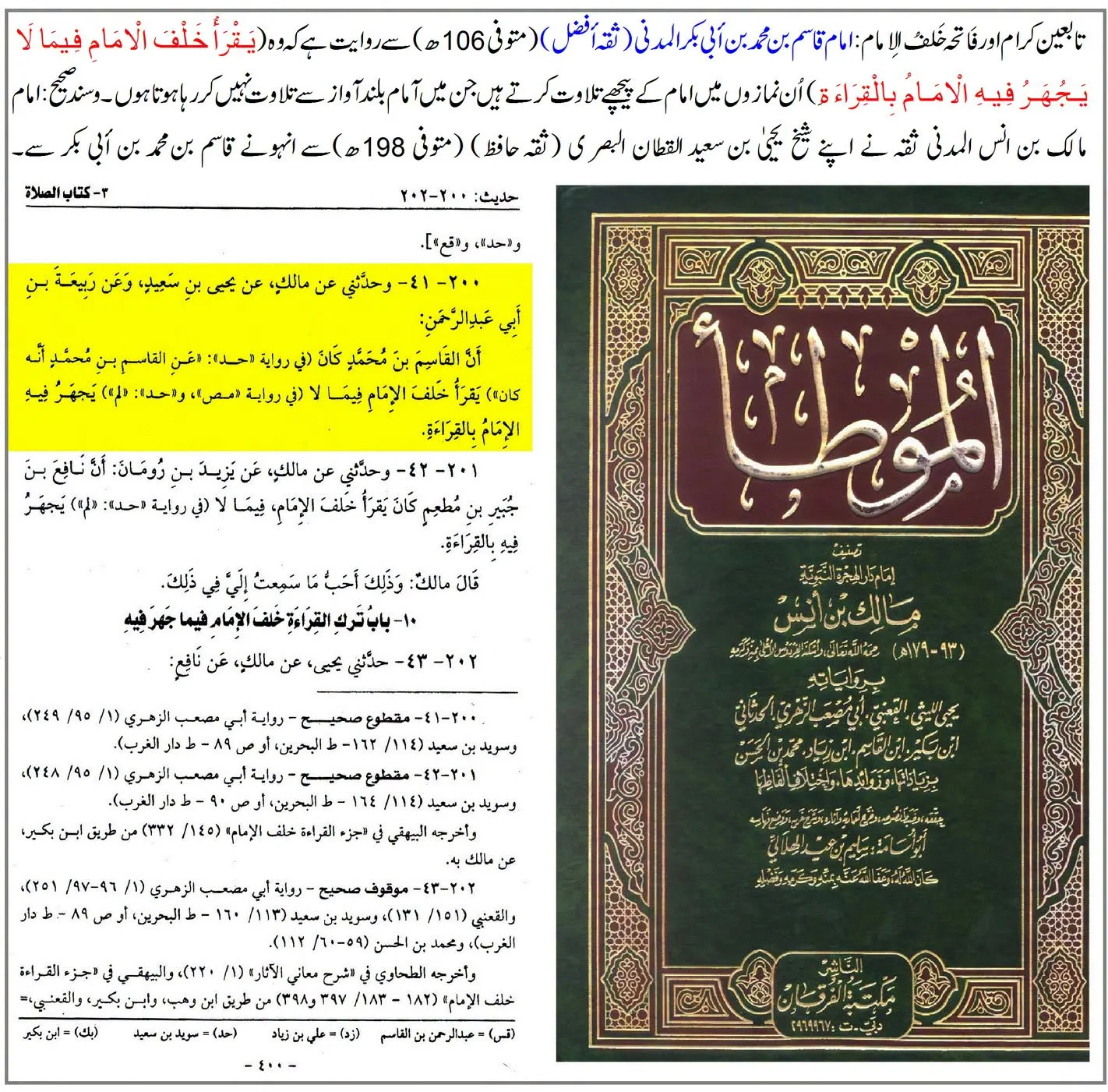
⑬ Imam Qasim bin Muhammad bin Abi Bakr, may Allah have mercy on him (died 106 AH)
Imam Qasim bin Muhammad bin Abi Bakr, may Allah have mercy on him, is counted among the famous jurists of the Tabi‘in in Madinah Munawwarah.
It is narrated from him that he used to recite behind the Imam in voluntary prayers.
Imam Malik, may Allah have mercy on him, narrated:
41 - وَحَدَّثَنِي عَنْ مالِكٍ، عَنْ يَحْيَى بْنِ سَعِيدٍ، وَعَنْ رَبِيعَةَ بْنِ أَبِي عَبْدِ الرَّحْمَنِ أَنَّ الْقَاسِمَ بْنَ مُحَمَّدٍ كَانَ «يَقْرَأُ خَلْفَ الْإِمَامِ فِيمَا لَا يَجْهَرُ فِيهِ الْإِمَامُ بِالْقِرَاءَةِ»
Translation:
Yahya bin Saeed and Rabee’ bin Abi Abdul Rahman, may Allah have mercy on them, report that Imam Qasim bin Muhammad, may Allah have mercy on him, used to recite behind the Imam in those prayers in which the Imam did not recite aloud.
Reference: Book: Muwatta Imam Malik
Reference: Author: Malik bin Anas bin Malik bin Amir Al-Asbahi Al-Madani (died: 179 AH)
Reference: Hadith Number: 41
Explanation:
From this narration, it is understood that Imam Qasim bin Muhammad, may Allah have mercy on him, used to recite behind the Imam in prayers. Therefore, his practical method supports the fact that the practice of reciting behind the Imam existed among the Tabi‘in.
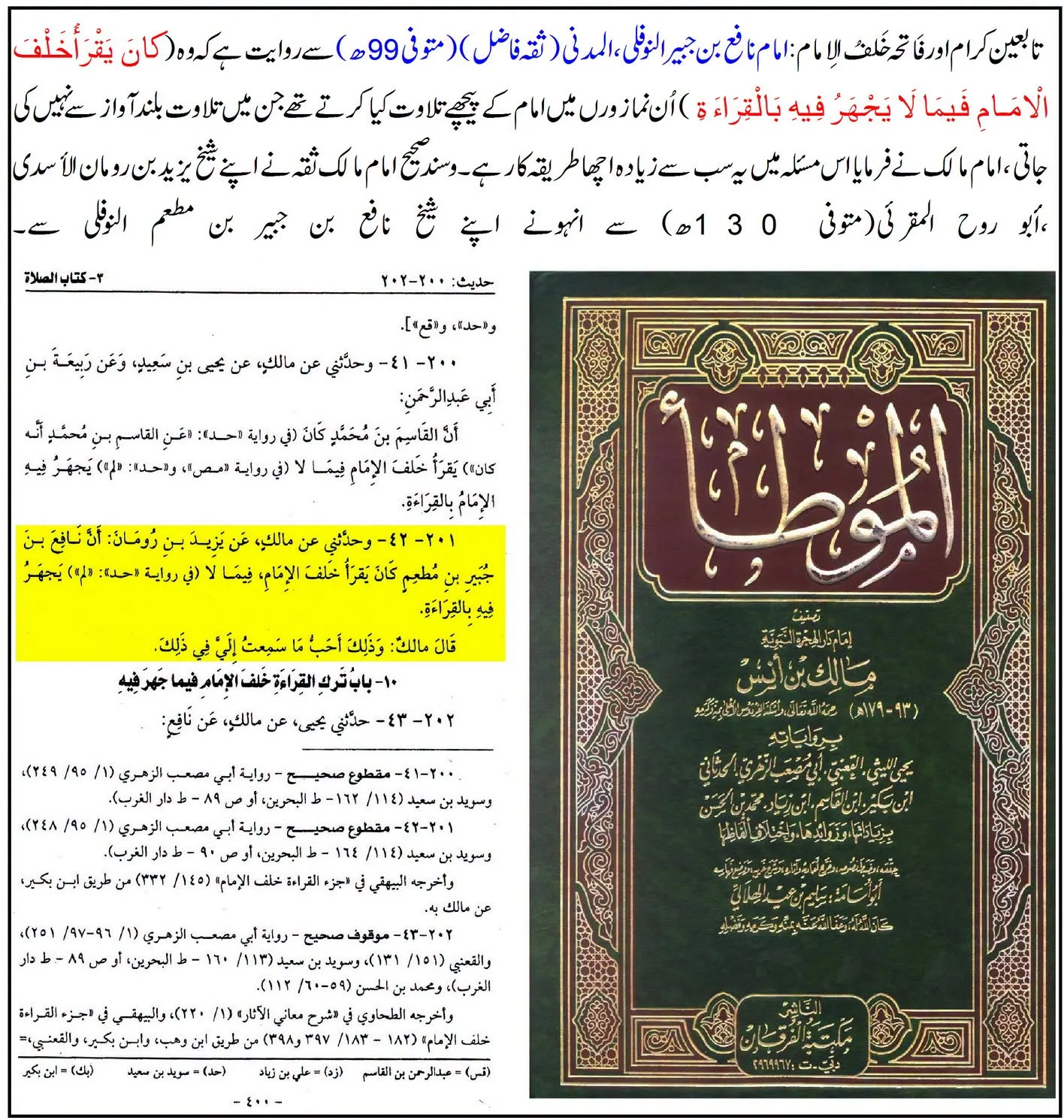
⑭ Imam Nafi‘ bin Jubayr bin Mut‘im, may Allah have mercy on him (died 99 AH)
Imam Nafi‘ bin Jubayr bin Mut‘im, may Allah have mercy on him, is also counted among the distinguished Tabi‘in of Madinah Munawwarah.
Imam Malik, may Allah have mercy on him, has narrated his practice:
42 - وَحَدَّثَنِي عَنْ مالِكٍ، عَنْ يَزِيدَ بْنِ رُومَانَ أَنَّ نَافِعَ بْنَ جُبَيْرِ بْنِ مُطْعِمٍ كَانَ «يَقْرَأُ خَلْفَ الْإِمَامِ فِيمَا لَا يَجْهَرُ فِيهِ بِالْقِرَاءَةِ» قَالَ مَالِكٌ: «وَذَلِكَ أَحَبُّ مَا سَمِعْتُ إِلَيَّ فِي ذَلِكَ»
Translation:
Yazid bin Ruman, may Allah have mercy on him, reports that Nafi‘ bin Jubayr bin Mut‘im, may Allah have mercy on him, used to recite behind the Imam in those prayers in which the Imam did not recite aloud.
Imam Malik, may Allah have mercy on him, says: Of what I have heard on this matter, this method is the one I prefer the most.
Reference: Al-Kitab: Muwatta Imam Malik
Reference: Author: Malik bin Anas bin Malik bin Amir Al-Asbahi Al-Madani (died: 179 AH)
Reference: Narration number: 42
Explanation:
This narration contains two important points: first, that Imam Nafi' ibn Jubayr, may Allah have mercy on him, used to recite behind the Imam in secret prayers, and second, that Imam Malik, may Allah have mercy on him, preferred this method.
From this, a practical method of a Tabi'i regarding the recitation of the follower in secret prayers and the endorsement of a great Imam on it emerges.
⑮ Imam Sa'id ibn Jubayr, may Allah have mercy on him (died 95 AH)
Imam Sa'id ibn Jubayr, may Allah have mercy on him, was a distinguished student of Abdullah ibn Abbas, may Allah be pleased with them both, a famous exegete, and a venerable Tabi'i.
From him, there is a clear emphasis on reciting Surah Al-Fatiha behind the Imam.
Imam Abdul Razzaq al-San'ani, may Allah have mercy on him, narrated:
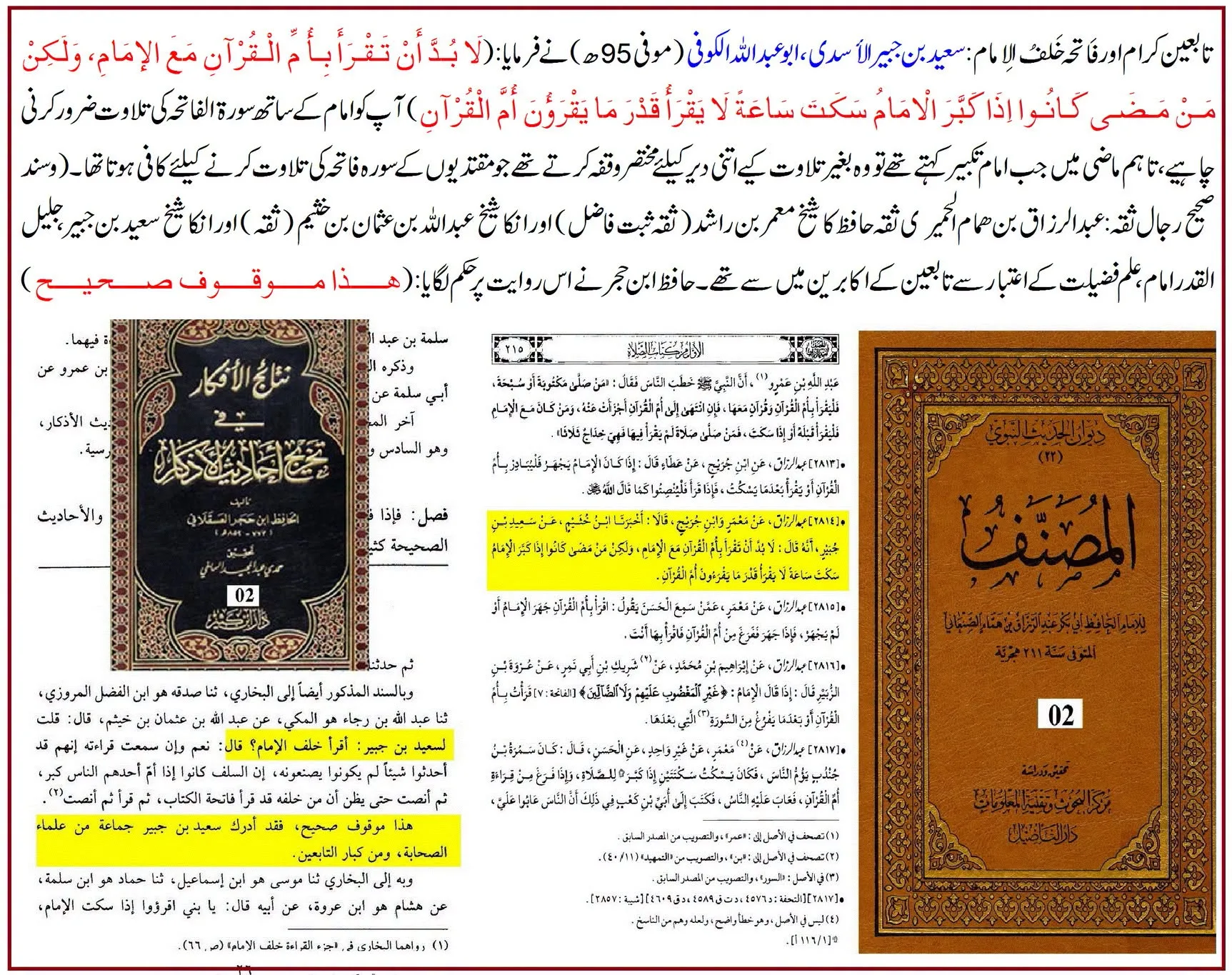
2789 - عَنْ مَعْمَرٍ، وَابْنِ جُرَيْجٍ، قَالَا: أَخْبَرَنَا ابْنُ خُثَيْمٍ، عَنْ سَعِيدِ بْنِ جُبَيْرٍ، أَنَّهُ قَالَ: «لَا بُدَّ أَنْ تَقْرَأَ بِأُمِّ الْقُرْآنِ مَعَ الْإِمَامِ، وَلَكِنْ مَنْ مَضَى كَانُوا إِذَا كَبَّرَ الْإِمَامُ سَكَتَ سَاعَةً لَا يَقْرَأُ قَدْرَ مَا يَقْرَؤُنَ أُمَّ الْقُرْآنِ»
Translation:
Imam Sa'id ibn Jubayr, may Allah have mercy on him, says: You must recite Surah Al-Fatiha along with the Imam. However, the method of the earlier people was that when the Imam said Takbir, they remained silent for a while without reciting, long enough for the follower to recite Surah Al-Fatiha.
Reference: Al-Kitab: Al-Musannaf
Reference: Author: Abu Bakr Abdul Razzaq ibn Hammam ibn Nafi' al-Himyari al-Yamani al-San'ani (died 211 AH)
Reference: Narration number: 2789
Explanation:
The statement of Imam Saeed bin Jubair, may Allah have mercy on him, is very important in the issue of recitation behind the Imam. He not only emphasized reciting Surah Al-Fatiha with the Imam but also mentioned the method of earlier scholars that the Imam would pause after Takbeer long enough for the followers to recite Surah Al-Fatiha.
This evidence supports the concept of reciting Surah Al-Fatiha behind the Imam and taking a pause for it.
Important conclusions derived from the sayings and practices of the pious successors (Tabi‘in)
A comprehensive review of the mentioned reports reveals some important facts.
First: It is not correct to declare the absolute abandonment of recitation behind the Imam as the unanimous position of all the Tabi‘in. There are transmitted reports from various regions of the Tabi‘in reciting behind the Imam and encouraging it.
Second: There is explicit emphasis on reciting Surah Al-Fatiha in the transmitted statements of Imam Abu Salamah bin Abdul Rahman, Imam Makhool, Imam Hasan Basri, Imam Ata bin Abi Rabah, and Imam Saeed bin Jubair, may Allah have mercy on them. Some have described the recitation with a pause by the Imam, while others have described it without a pause.
Third: From the works of Imam Urwah bin Zubair, Imam Shu’bi, Imam Hikm bin Utaybah, Imam Qasim bin Muhammad, and Imam Nafi’ bin Jubair, may Allah have mercy on them, it is established that recitation behind the Imam in secret prayers took place. However, based on these works, it cannot be claimed that these individuals necessarily held the same view regarding recitation in audible prayers.
Fourth: Regarding Imam Abu Al-Malih Hudhali, may Allah have mercy on him, there is a transmitted practical incident of reciting Surah Al-Fatiha behind the Imam in the Maghrib prayer, which holds special significance on the topic of reciting Al-Fatiha in audible prayers.
Fifth: The transmitted position of Imam Awza'i, may Allah have mercy on him, is that the Imam should pause appropriately so that the follower can recite Surah Al-Fatiha. In this way, according to him, there is a practical application of the recitation of the Imam and the follower.
Sixth: Not all narrations are equal in terms of evidence. Some explicitly emphasize Surah Al-Fatiha, some mention general recitation, and some relate only to secret prayers. Similarly, the narration transmitted from Imam Mujahid, may Allah have mercy on him, indicates the general importance of Surah Al-Fatiha, while the mentioned statement of Imam Zahri, may Allah have mercy on him, relates to the recitation of the Imam. Therefore, one should derive as much evidence from each narration as its wording permits.
Summary and Conclusion
From the mentioned statements and narrations of the pious followers (Tabi'in), it is clear that reciting behind the Imam was not an act unanimously prohibited by all Tabi'in; rather, there are transmitted statements and actions from many well-known Tabi'in regarding reciting behind the Imam, reciting Surah Al-Fatiha, and encouraging it.
Among these reports, some scholars have supported recitation in silent prayers, some have ordered the recitation of Surah Al-Fatiha even in audible prayers, and some have detailed remaining silent during the Imam's recitation and reciting Surah Al-Fatiha during his pauses.
Therefore, attributing an absolute abandonment of recitation to all followers of the Tabi‘in or to all students of any companion based on a single general report is against scholarly caution. The correct approach is to examine the chain of narration, wording, context, and implication of each report separately.
However, the existence of these reports by itself does not establish consensus on any one jurisprudential position in this matter, nor can the authenticity of all narrations be considered equal. The definitive ruling on reciting Surah Al-Fatiha behind the Imam should be determined in light of the evidence from the Qur’an and Sunnah, the practices of the Companions, and the overall reasoning of the Imams.
The conclusion is that the statement and practice of reciting Surah Al-Fatiha behind the Imam is transmitted from several Tabi‘in, so it is not correct to declare it entirely contrary to the method of the Tabi‘in.
And Allah Almighty knows best what is correct.