


This excerpt is taken from Sheikh Irshad Ullah Maan's book The Search for Truth.
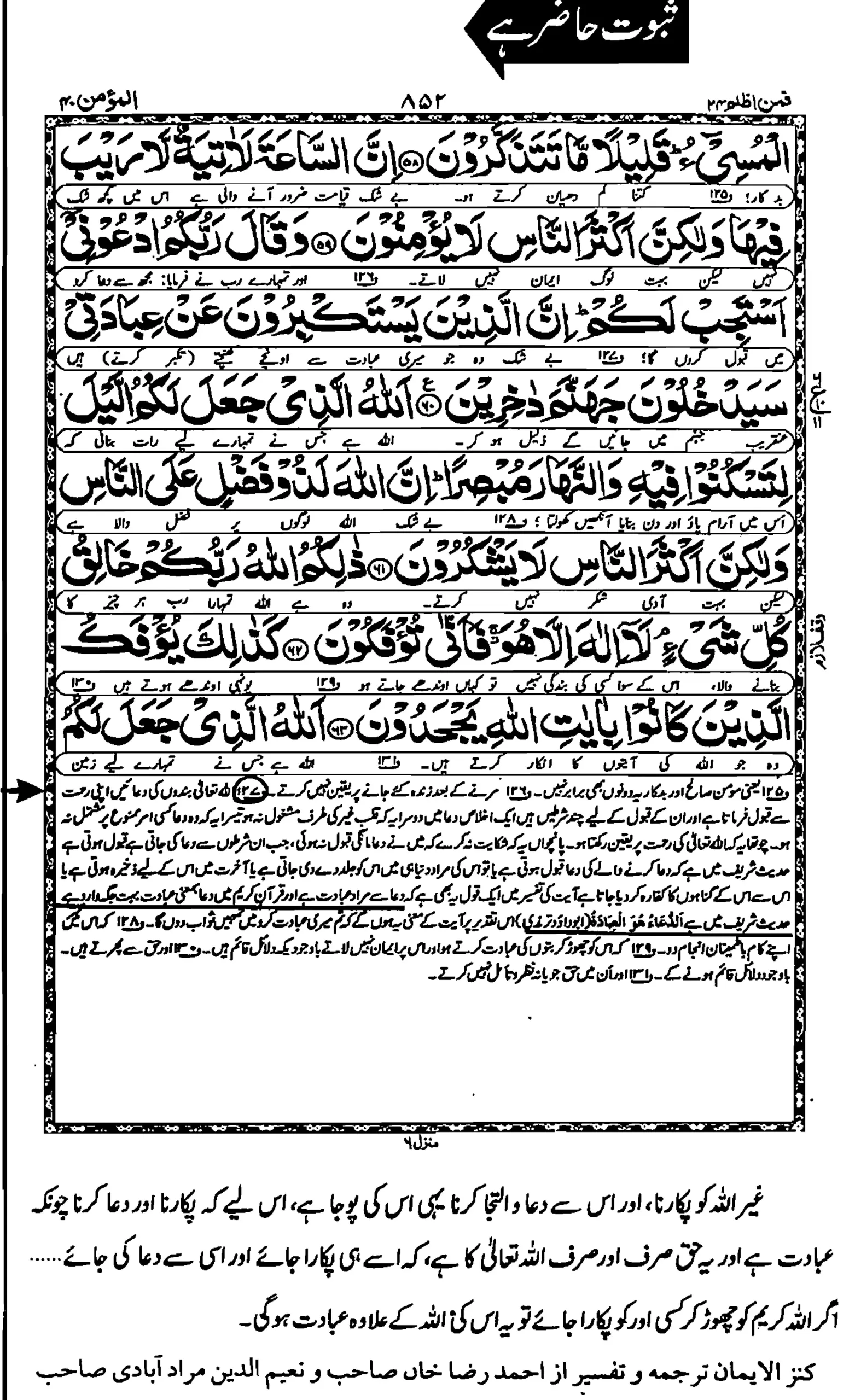
[وَ قَالَ رَبُّکُمُ ادۡعُوۡنِیۡۤ اَسۡتَجِبۡ لَکُمۡ ؕ اِنَّ الَّذِیۡنَ یَسۡتَکۡبِرُوۡنَ عَنۡ عِبَادَتِیۡ سَیَدۡخُلُوۡنَ جَہَنَّمَ دٰخِرِیۡنَ]
And your Lord has said, "Call upon Me; I will respond to you."
Reference: (F:127)
Indeed, those who disdain My worship will soon enter Hell in humiliation.
Reference: Al-Mu’min:60
Reference: (Benefit:127)
states that in the noble Hadith it is mentioned that the supplication of the one who prays is accepted. And in the Holy Quran, supplication meaning worship appears in many places. In the noble Hadith it is mentioned: [الدُّعَاءُ هُوَ الْعِبَادَةُ] دعا عبادت ہے۔
Reference: Abu Dawood:1479], [Tirmidhi:2969
The meaning of the verse regarding this decree will be that you worship Me, and I will reward you.
Reference: Translation by Ahmad Raza Khan Sahib and Tafseer Muradabadi
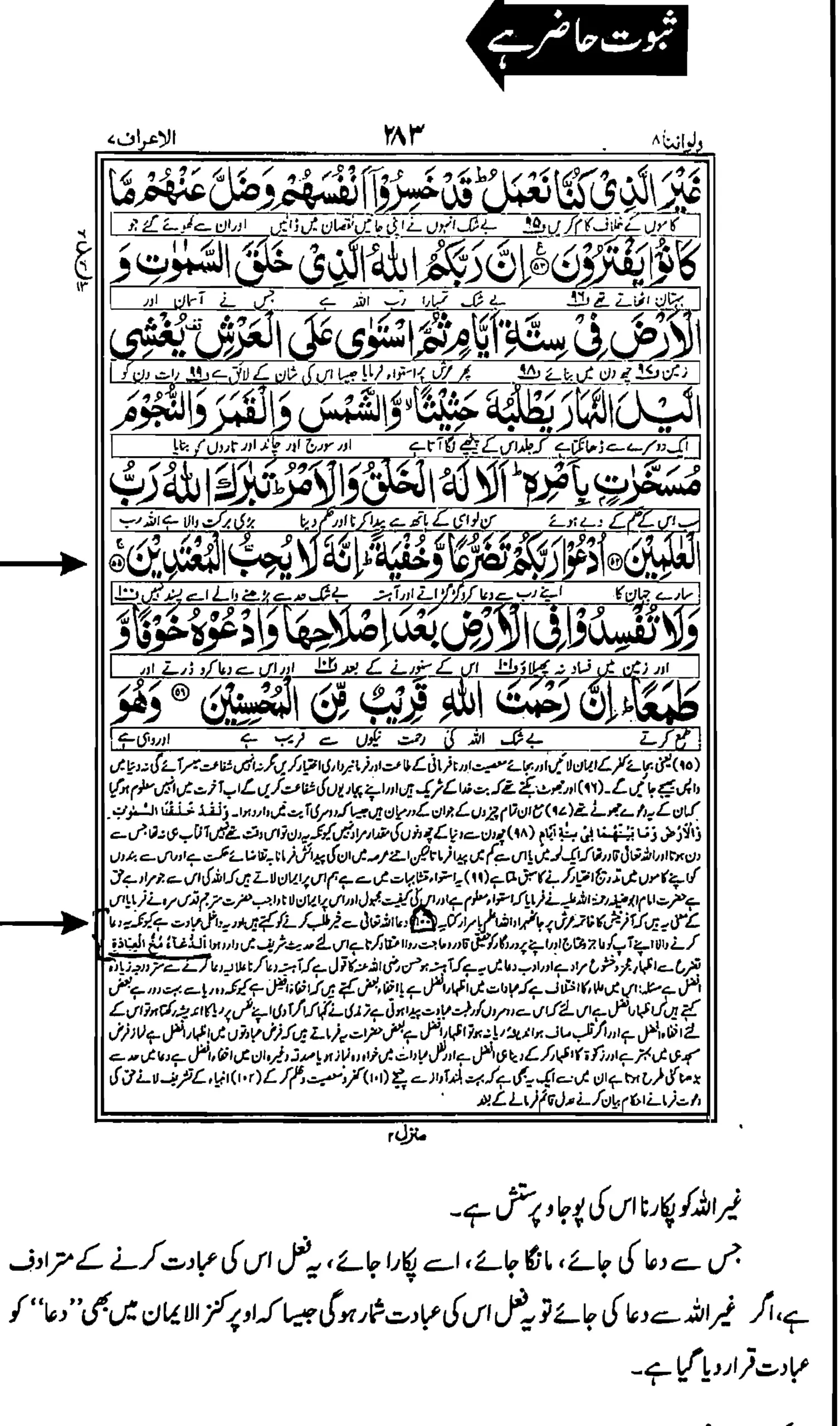
Here, both prayer and worship have been translated correctly. Also see:
Reference: Al-A'raf: 56, 55
by Ahmad Raza Khan Sahib.
Reference: Faida: 100
Here too, the correct translation is prayer. And at
Reference: Ar-Ra'd: 14 to 16][Page:1107
, it is written: Do not ask for prayer from anyone except Allah. And on
Reference: Page:1107
, it is further written: Allah alone is the deity. And twenty-one references from the Quran are cited. On the same page, it is written that every benefit and harm is under the control of Allah. Five references from the Quran are cited.Muradabadi Sahib wrote in his Tafseer that prayer means worship, and the Barelvi and Shia people are calling upon others besides Allah day and night inside and outside mosques. (That is) according to Muradabadi Sahib, they are worshipping others besides Allah, which is outright shirk and kufr.
For more references regarding prayer, see:
Reference: Al-Baqarah:186], [As-Sajdah:16], [An-Naml:62]
These verses indicate that supplication should be made only to Allah Almighty (and here Ahmed Raza Khan has translated "calling out" everywhere) and it is stated that I am closer to you than your jugular vein.
Reference: Qaf:16
And I know everything that is open or hidden in the earth and the heavens, and I also know the secrets of the hearts.
Reference: At-Taghabun:4], [Saba:3], [Fatir:38]
Calling upon Allah Almighty is worship of Allah Almighty,
As we have just proven from Ahmed Raza Khan Sahib’s
Reference: Qur'anic Translation and Muradabadi’s Tafsir
. And it is stated: Those whom you call besides Allah do not know your calling.
Reference: Fatir:14, [Al-Ahqaf:6,5]
Earlier, we have proven that even the Messenger of Allah ﷺ does not know what is happening in the world at that moment. Also, it is stated: Those whom you call besides Allah cannot help you.
Reference: Fatir:14
Calling others besides Allah is shirk (associating partners with Allah).
Reference: Al-An'am:41,40], [Al-Ankabut:61 to 66], [Al-Jinn:20], [Al-Mu’min:74,73]
Calling others besides Allah Almighty is kufr (disbelief).
Reference: Al-A'raf:37 to 41
Worship of others besides Allah is shirk.
Reference: Yunus:104 to 107], [Az-Zumar:64 to 67]
Calling others besides Allah Almighty is their worship.
Reference: Al-Mu’min:60 to 68], [Al-Ahqaf:4 to 6]
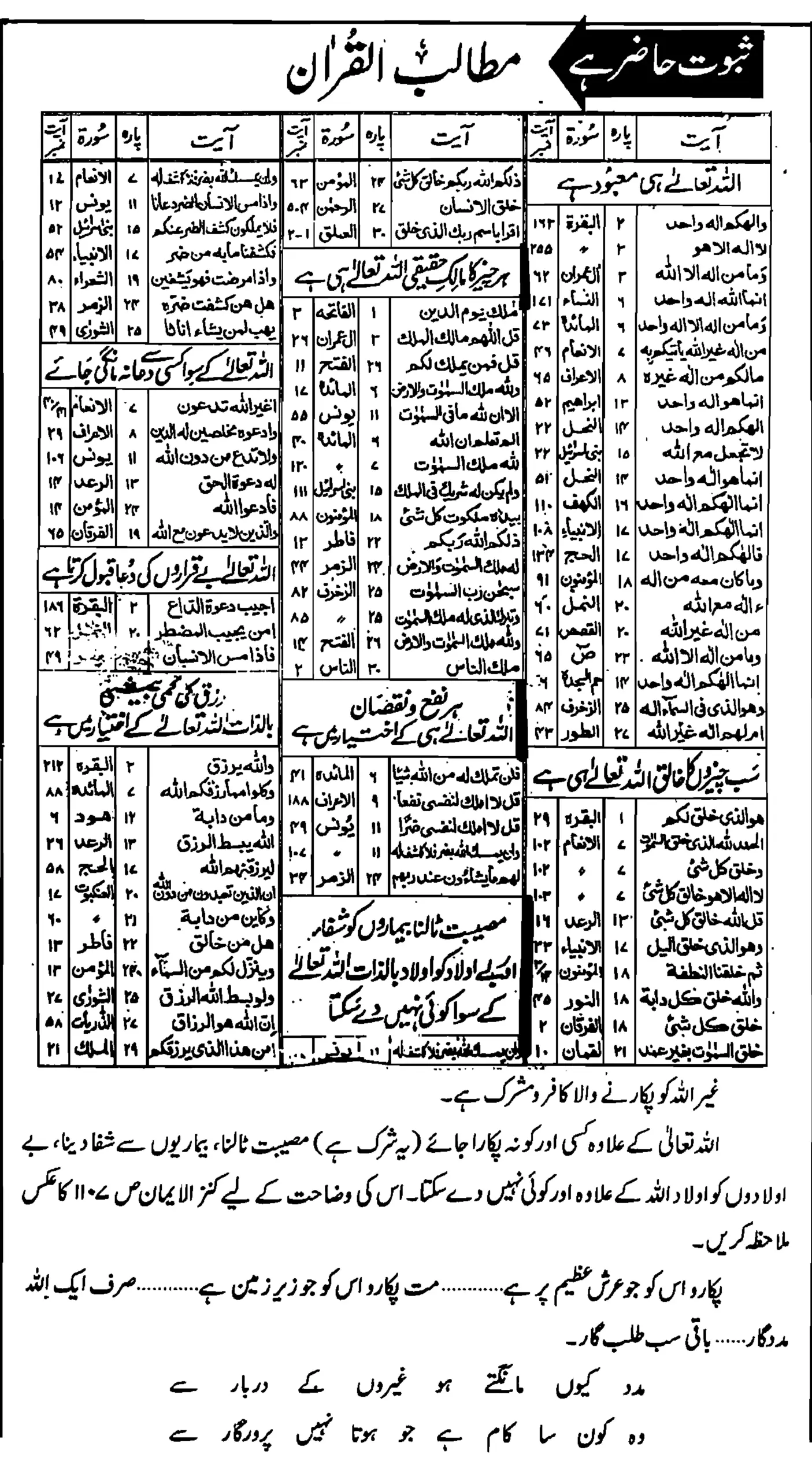
Calling upon others besides Allah is futile,
because they are not the owners of benefit and harm.
Reference: Al-An'am:71, Yunus:106
He said:Call upon Allah alone sincerely.
Reference: Al-A'raf:29, Al-Mu'min:66,65,14
And He said: Do not call upon anyone besides Allah.
Reference: Al-Jinn:18, Al-Mu'minun:117, Al-Qasas:88, An-Naml:62, Ash-Shu'ara:213, Al-Furqan:77,68
Do not call upon creation instead of the Creator.
Reference: An-Nahl:20, Al-A'raf:189 to 198
Remember that the dispute between the People of the Cave and their nation was also that the nation used to call upon others, and these friends of Allah denied calling upon anyone besides Allah.
Reference: Al-Kahf:14 to 16
[ہُوَ الَّذِیۡ یُسَیِّرُکُمۡ فِی الۡبَرِّ وَ الۡبَحۡرِ ؕ حَتّٰۤی اِذَا کُنۡتُمۡ فِی الۡفُلۡکِ ۚ وَ جَرَیۡنَ بِہِمۡ بِرِیۡحٍ طَیِّبَۃٍ وَّ فَرِحُوۡا بِہَا جَآءَتۡہَا رِیۡحٌ عَاصِفٌ وَّ جَآءَہُمُ الۡمَوۡجُ مِنۡ کُلِّ مَکَانٍ وَّ ظَنُّوۡۤا اَنَّہُمۡ اُحِیۡطَ بِہِمۡ ۙ دَعَوُا اللّٰہَ مُخۡلِصِیۡنَ لَہُ الدِّیۡنَ لَئِنۡ اَنۡجَیۡتَنَا مِنۡ ہٰذِہٖ لَنَکُوۡنَنَّ مِنَ الشّٰکِرِیۡنَ]
He is the One who propels you through land and sea until, when you are in the ships and they sail with a favorable wind and they rejoice therein, suddenly a violent wind comes upon them and waves come from every direction and they think that they are surrounded, then they call upon Allah, being sincere to Him in religion. Indeed, if You should save us from this, we will surely be among the thankful.
Reference: Yunus:22
That is, then they do not mix anyone other than Allah in their prayers, as they do in normal circumstances. In normal circumstances, they say that these elders are also servants of Allah, they have also been granted powers by Allah, and through them we seek closeness to Allah. But when they enter such hardships, they forget all these satanic philosophies, and only turn to Allah Almighty. And then they call upon only Him. From this
One point: it becomes clear that the human nature has been endowed with the instinct to turn to the One Allah; a person suppresses this instinct or nature under the influence of the environment, but in calamity this instinct emerges. And this nature returns, from which it is understood that monotheism is the voice and the essence of human nature, from which a person should not deviate. Because deviation from it is deviation from nature, which is outright misguidance.
Second point: It was observed that when the polytheists were overwhelmed by such calamities, they would call upon only one Allah instead of their self-made deities. It is narrated about Sayyiduna Ikramah (may Allah be pleased with him) that when Makkah was conquered, he fled from there and boarded a ship to go somewhere outside. The ship was caught in a storm. The sailor told the people on the ship, "Today, pray to Allah alone; there is no one else who can save you from this storm." Sayyiduna Ikramah (may Allah be pleased with him) said, "I thought if the only savior in the sea is Allah, then surely the only savior on land is also Him." This is exactly what Muhammad (ﷺ) says. So he decided that if he survived this, he would return to Makkah and accept Islam. Thus, he came to the Prophet ﷺ and embraced Islam.
Reference: Sunan an-Nasa'i, Book of Warfare (Prohibition of Bloodshed), Judgment on the Apostate: 4072
For the same meaning, see:
Reference: Translation with Tafseer by Ahmed Raza Khan Sahib, (Luqman: 25 to 32), (Al-Ankabut: 61 to 66), (Yunus: 18 to 23), (Al-An'am: 40, 41, 63 to 66), (An-Nahl: 20, 21, 53 to 56), (Ar-Rum: 30 to 35), (Az-Zumar: 1 to 8, 49)
In all these places, Ahmed Raza Khan Sahib has translated it as "calling out," but unfortunately, the common people of the Ummah of Muhammad ﷺ are so trapped in shirk that even in hardships and sufferings, instead of turning to Allah, they consider deceased elders as the ones who relieve difficulties and call upon them for help. إنالله وإنا إليه راجعونSince the issue of calling out is very important, a complete and detailed discussion on this matter is necessary.
In front of me right now is
Reference: Al-Mu'jam Al-Mufahras li Alfaz al-Quran al-Karim
, published by Dar Al-Ma'arif Beirut Lebanon, authored by Muhammad Fuad Abdul Baqi. This book is in Arabic and it shows how many times a particular word appears in the Holy Quran and in which Surah and Ayah it is found. On its
Reference: pages: 326 to 330
, there is a complete list of words derived from ،،دعو،،, detailed as follows. The number in brackets after the words indicates how many times this word appears in the Quran: دعا (5) دعاکم (2) دعانا (2) دعوا (6) أدعو (4) تدع (4) تدعوا (5) تدعون (17) تدعونا (2) تدعونني (3) تدعوهم (5) ندع (2) ندعوا (4) يدع (5) يدعوا (8) يدعوكم (4) يدعون (23) أدع (10) أدعوا (14) and others.And in this book, up to
Reference: pages 560 to 565
, there is a complete list of words derived from (عبد), detailed as follows: أعبد (13) تعبدوا (7) تعبدون (23) نعبد (7) يعبد (8) يعبدون (12) أعبدوا (21) العبد (10) العباد (20) عبادك (7) عبادنا (12) عباده (34) عبادی (17) عابدون (5) عبادته (4) and others.It is proven from this that words derived from ،،دعو،، (which mean to pray, to ask, to call) and words derived from ،،عبد،، (which mean worship, to become a servant) are completely different.

