Compiled by: Abu Hamza Salafi
The summary of the material under discussion regarding Muhammad bin Abdul Baqi Al-Zarqani (d. 1122 AH) and his criticism of Sheikh al-Islam Imam Ibn Taymiyyah (may Allah have mercy on him) is that Zarqani, in refuting Imam Ibn Taymiyyah’s position—where he declared a famous narration about supplicating facing the blessed chamber of the Prophet Muhammad (peace be upon him) as a lie attributed to Imam Malik (may Allah be pleased with him)—relied on a narration and story which later critics considered highly questionable. The purpose of this article is to clarify that according to the provided material, Zarqani’s criticism is not merely a jurisprudential disagreement but is based on defending a narration whose chain includes a narrator like Muhammad bin Humayd Al-Razi, who is considered weak, and therefore reliance on it is academically unreliable. In the following lines, we present each narration, its Urdu translation, reference, and a brief explanation to clarify the main point.
❶ Zarqani’s Explicit Criticism of Imam Ibn Taymiyyah
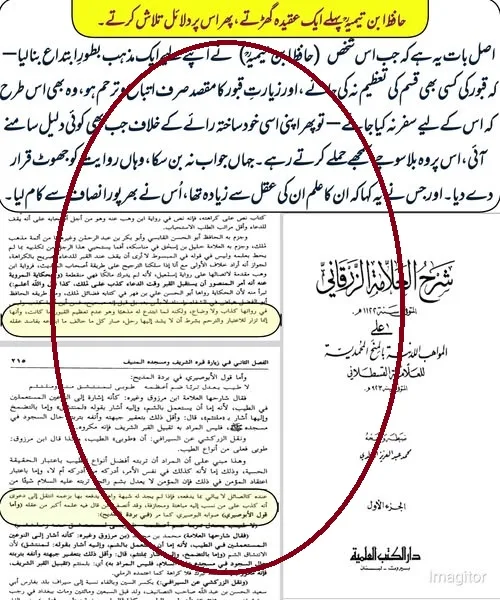
Muhammad bin Abdul Baqi Al-Zarqani wrote:
ولكنه لما ابتدع له مذهبًا وهو عدم تعظيم القبور ما كانت، وأنها إنما تزار للاعتبار والترحّم، بشرط أن لا يشد إليها رحل، صار كل ما خالف ما ابتدعه بفاسد عقله عنده كالصائل لا يبالي بما يدفعه، فإذا لم يجد له شبهة واهية يدفعه بها بزعمه، انتقل إلى دعوى أنه كذب على من نسب إليه مباهتة ومجازفة، وقد أنصف من قال فيه: علمه أكبر من عقله۔
Translation:
But when he invented for himself a religion in which no kind of veneration of graves was allowed, and their visitation was only for admonition and compassion, and that too on the condition that no journey be made towards them, then whatever contradicted his self-made religion became, in his view, like an invader that had to be repelled by any means. Then, when he could not find even a slight doubt according to his assumption to respond to it, he began to claim that this statement was falsely attributed to that person. And whoever said that his knowledge was greater than his intellect, was just.
Reference: Al-Kitab: Sharh Al-Zarqani 'ala Al-Mawahib Al-Ladunniyyah bil-Minh Al-Muhammadiyyah
Author: Abu Abdullah Muhammad bin Abdul Baqi bin Yusuf bin Ahmad bin Shihab al-Din bin Muhammad Al-Zarqani Al-Maliki (died: 1122 AH)
Author: Abu Abdullah Muhammad bin Abdul Baqi bin Yusuf bin Ahmad bin Shihab al-Din bin Muhammad Al-Zarqani Al-Maliki (died: 1122 AH)
Brief Explanation:
This passage is the foundation of the entire dispute. Zarqani here did not limit himself to a scholarly disagreement but also launched a direct attack on the methodology and intellect of Imam Ibn Taymiyyah (may Allah have mercy on him). Therefore, the main question arises whether the narration, in whose defense this harsh language was used, was actually reliable or not.
❷ Shams al-Din al-Afghani’s Severe Criticism of Zarqani
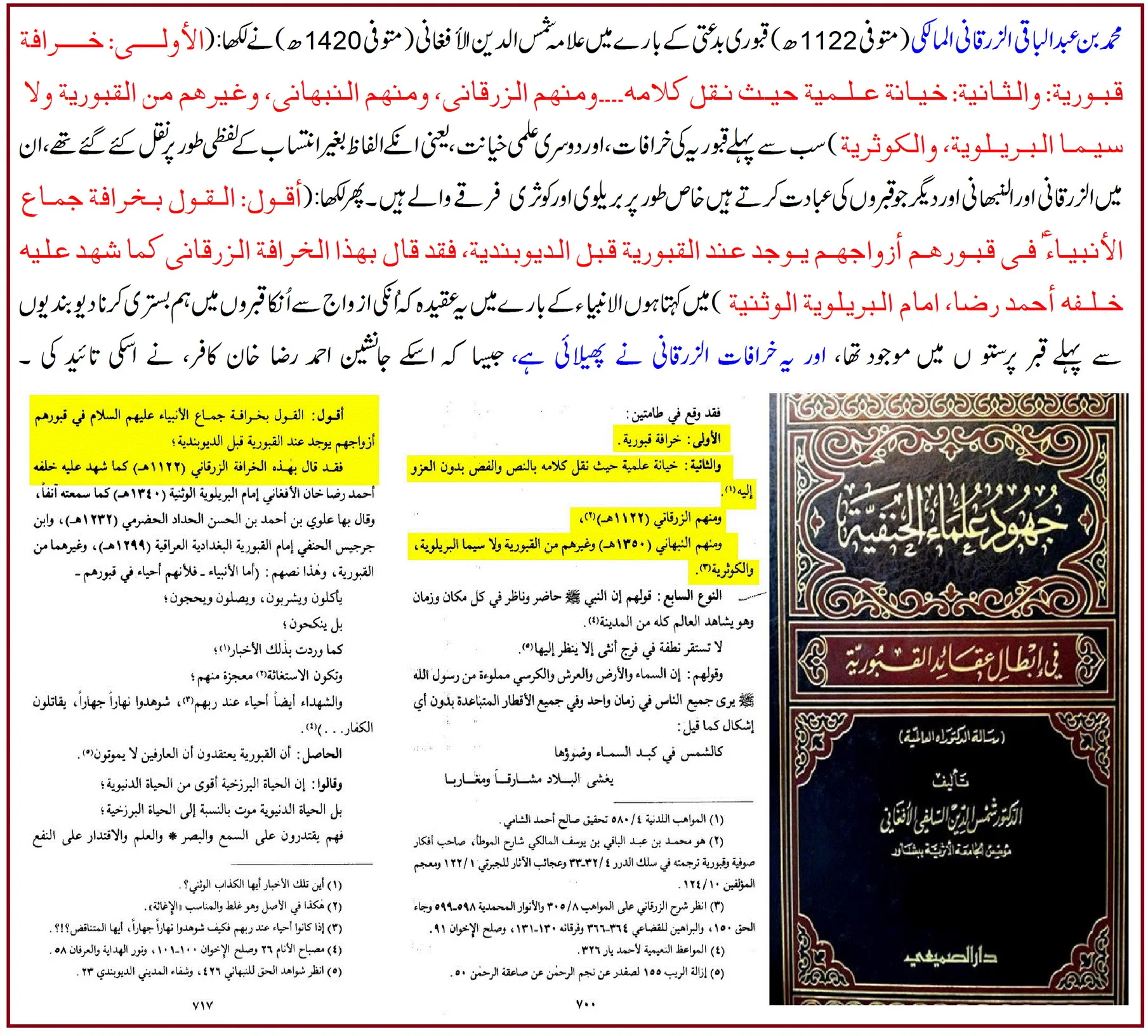
Allama Shams al-Din al-Afghani wrote:
فقد وقع في طامتين:
الأولى: خرافة قبورية.
والثانية: خيانة علمية حيث نقل كلامه بالنص والفص بدون العزو إليه.
ومنهم الزرقاني (1122 هـ) ، ومنهم النبهاني (1350 هـ) وغيرهم من القبورية ولا سيما البريلوية، والكوثرية.
Translation:
Thus, he fell into two great calamities: first, grave superstition. Second, scholarly dishonesty; because he quoted someone's words verbatim but did not mention the source. Among these people are Zarqani (1122 AH), Nabhani (1350 AH), and other superstitious people, especially Barelvis and Kautharis.
Reference: Al-Kitab: Juhud Ulama al-Hanafiyyah fi Ibtal Aqaid al-Qaburiyyah
Author: Abu Abdullah Shams al-Din ibn Muhammad ibn Ashraf ibn Qaysar al-Afghani (d. 1420 AH)
Author: Abu Abdullah Shams al-Din ibn Muhammad ibn Ashraf ibn Qaysar al-Afghani (d. 1420 AH)
Brief Explanation:
Two major objections have been raised against Zarqani in this narration: one is the promotion of grave-worshipping beliefs, and the other is a breach of scholarly integrity. This excerpt is important in the formation of the discussed material because it is presented as a direct critique of Zarqani's methodology.
❸ Another transmitted superstitious statement related to the Prophets, peace be upon them, in the graves
Allama Shams al-Din al-Afghani (may Allah have mercy on him) further wrote:
أقول: القول بخرافة جماع الأنبياء عليهم السلام في قبورهم أزواجهم يوجد عند القبورية قبل الديوبندية؛ فقد قال بهذه الخرافة الزرقاني (1122هـ) ، كما شهد عليه خلفه أحمد رضا خان الأفغاني إمام البريلوية الوثنية (1340هـ) كما سمعته آنفا،
Translation:
I say that the superstition of the Prophets, peace be upon them, having conjugal relations with their wives in their graves existed among the grave-worshippers before the Deobandis; accordingly, Zarqani (1122 AH) also adopted this superstition, as did Ahmad Raza Khan who came after him, as has been mentioned above.
Reference: Al-Kitab: Juhud Ulama al-Hanafiyyah fi Ibtal Aqaid al-Qaburiyyah
Author: Abu Abdullah Shams al-Din ibn Muhammad ibn Ashraf ibn Qaysar al-Afghani (d. 1420 AH)
Author: Abu Abdullah Shams al-Din ibn Muhammad ibn Ashraf ibn Qaysar al-Afghani (d. 1420 AH)
Brief Explanation:
This excerpt intensifies the overall criticism mentioned in the material about Zarqani. It gives the impression that some of Zarqani's views were not limited to the issue of visiting graves, but he also held concepts that critics considered superstitions.
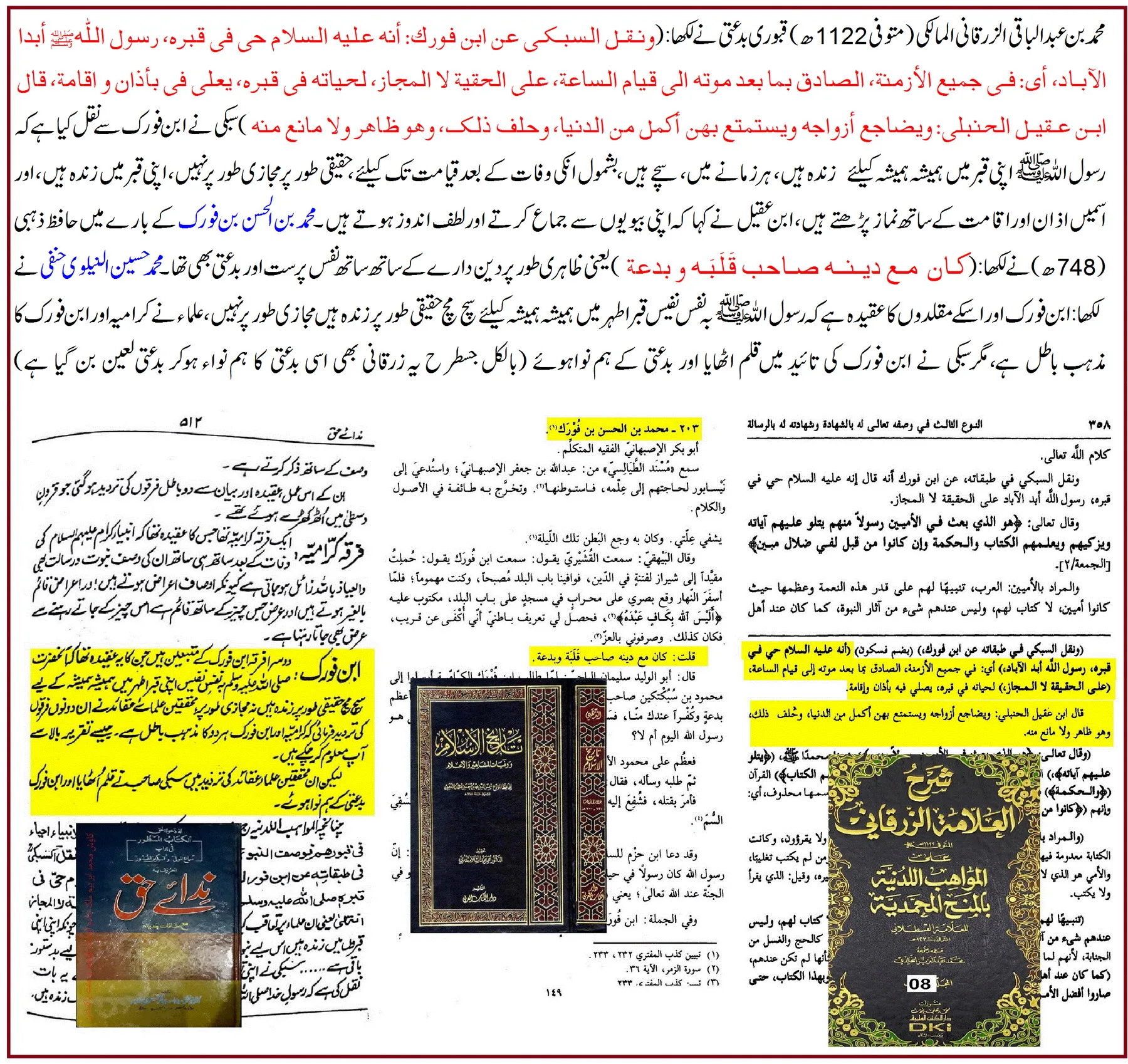
❹ Zarqani's Own Statement: With Reference to Ibn Furak
Muhammad bin Abdul Baqi Al-Zarqani wrote:
ونقل السبكي في طبقاته عن ابن فورك "بضم فسكون" "أنه عليه السلام حي في قبره، رسول الله أبد الآباد" أي: في جميع الأزمنة، الصادق بما بعد موته إلى قيام الساعة، "على الحقيقة لا المجاز"، لحياته في قبره، يصلي فيه بأذان وإقامة.
قال ابن عقيل الحنبلي: ويضاجع أزواجه ويستمتع بهن أكمل من الدنيا. وحلف ذلك، وهو ظاهر ولا مانع منه.
Translation:
And Subki, in his classes, quoted Ibn Furak that the Prophet, peace be upon him, is alive in his grave forever, that is, in all times, and truly alive after his death until the Day of Resurrection, not metaphorically; he prays in his grave with the call to prayer and the establishment of prayer. Ibn Aqil Al-Hanbali said: He has intimacy with his wives and enjoys them, and indeed this is more perfect than this world, and an oath has been sworn on it, and apparently, there is nothing to prevent it.
Reference: Al-Kitab: Sharh al-Zarqani 'ala al-Mawahib al-Ladunniyyah bil-Minh al-Muhammadiyyah
Author: Abu Abdullah Muhammad ibn Abdul Baqi ibn Yusuf ibn Ahmad ibn Shihab al-Din ibn Muhammad al-Zarqani al-Maliki
Author: Abu Abdullah Muhammad ibn Abdul Baqi ibn Yusuf ibn Ahmad ibn Shihab al-Din ibn Muhammad al-Zarqani al-Maliki
Brief Explanation:
This excerpt is presented to clarify Zarqani's intellectual background. According to the author of the discussed material, this passage highlights those beliefs of Zarqani which he describes as exaggeration and superstitions.
❺ Hafiz al-Dhahabi’s Criticism of Muhammad ibn al-Hasan ibn Furak
Hafiz al-Dhahabi wrote about Muhammad ibn al-Hasan ibn Furak:
203- محمد بْن الحَسَن بْن فُورك.
أبو بَكْر الإصبهانيّ الفقيه المتكلَّم.
قلت: كَانَ مَعَ دينه صاحب قَلَبَه وبدعة.
Translation:
203. Muhammad ibn al-Hasan ibn Furak, Abu Bakr al-Isfahani, was a jurist and theologian. I (al-Dhahabi) say: Despite his piety, he had inclinations of the heart and was an innovator.
Reference: Al-Kitab: Tarikh al-Islam wa Wafayat al-Mashahir wal-A'lam
Brief Explanation:
This excerpt is brought because some of Zarqani’s narrations are attributed to Ibn Furak as an intellectual source, and then by showing criticism on this very source, the entire chain of reasoning is weakened.
❻ Commentary of Muhammad ibn al-Husayn al-Nilawi
Muhammad ibn al-Husayn al-Nilawi wrote:
Ibn Furak and his followers believe that the Messenger of Allah, peace be upon him, is truly and literally alive in the pure grave forever, not metaphorically. The scholars have refuted the false doctrine of the Karamiya and Ibn Furak, but Subki took up the pen in support of Ibn Furak and became an accomplice of the innovators.
Reference: Reference: As quoted in the provided text
Brief Explanation:
This passage also strengthens the same argumentative framework that portrays Zarqani's position as connected to a line of thought that the authors have labeled as innovative.
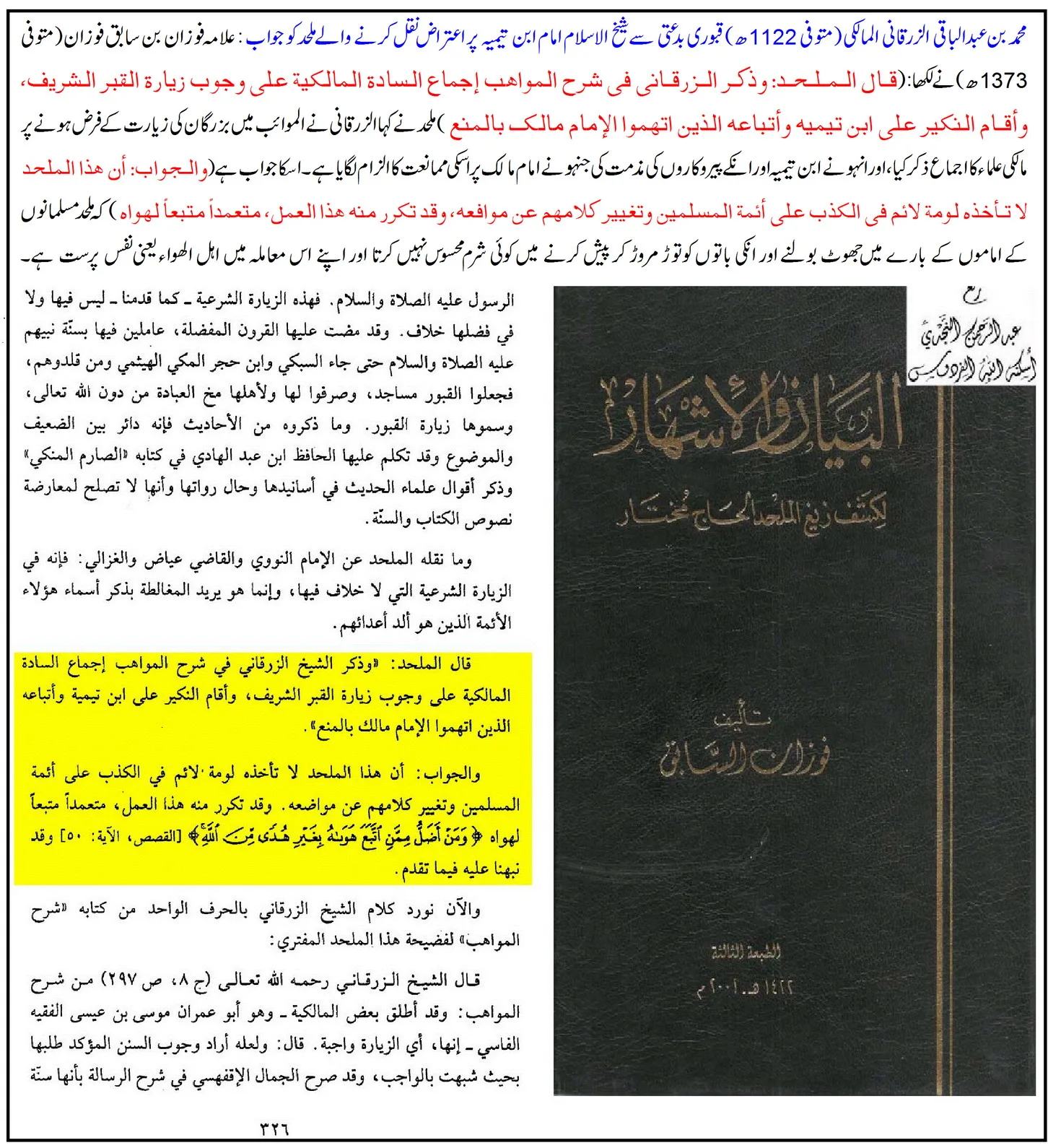
❼ Response of Fawzan bin Sabiq Fawzan (may Allah preserve him) to the objection regarding Zarqani
Allama Fawzan bin Sabiq Fawzan (may Allah preserve him) wrote:
قال الملحد: "وذكر الشيخ الزرقاني في شرح المواهب إجماع السادة المالكية على وجوب زيارة القبر الشريف، وأقام النكير على ابن تيمية وأتباعه الذين اتهموا الإمام مالك بالمنع".
والجواب: أن هذا الملحد لا تأخذه لومة لائم في الكذب على أئمة المسلمين وتغيير كلامهم عن مواضعه. وقد تكرر منه هذا العمل، متعمداً متبعاً لهواه {وَمَنْ أَضَلُّ مِمَّنِ اتَّبَعَ هَوَاهُ بِغَيْرِ هُدىً مِنَ اللَّهِ} [القصص، الآية:50] وقد نبهنا عليه فيما تقدم.
Translation:
The atheist said: Sheikh Zarqani mentioned in Sharh al-Mawahib that the Maliki Sayyids have a consensus on the obligation of visiting the noble grave, and he severely criticized Ibn Taymiyyah and his followers who accused Imam Malik of prohibition. The response to this is that this atheist does not care about blaming Muslims' imams with lies and distorting their words from their original context. He has done this repeatedly, deliberately, following his own desires, and Allah Almighty said: "And who is more astray than one who follows his own desire without guidance from Allah?"
Reference: Al-Kitab: Al-Bayan wal-Ishhar li Kashf Zigh al-Mulhid al-Hajj Mukhtar
Author: Fawzan bin Sabiq bin Fawzan (d. 1373 AH)
Author: Fawzan bin Sabiq bin Fawzan (d. 1373 AH)
Brief Explanation:
Here, a severe refutation is made against the person who argued using Zarqani's words. The purpose of the provided material is to show that some later scholars did not consider Zarqani's statement reliable and described the argument based on it as distortion and falsehood.
❽ The Original Text of Imam Ibn Taymiyyah (may Allah have mercy on him)
Sheikh al-Islam Imam Ibn Taymiyyah (may Allah have mercy on him) wrote:
وَلَا يَدْعُو هُنَاكَ مُسْتَقْبِلَ الْحُجْرَةِ فَإِنَّ هَذَا كُلَّهُ مَنْهِيٌّ عَنْهُ بِاتِّفَاقِ الْأَئِمَّةِ. وَمَالِكٍ مِنْ أَعْظَمِ الْأَئِمَّةِ كَرَاهِيَةً لِذَلِكَ. وَالْحِكَايَةُ الْمَرْوِيَّةُ عَنْهُ أَنَّهُ أَمَرَ الْمَنْصُورَ أَنْ يَسْتَقْبِلَ الْحُجْرَةَ وَقْتَ الدُّعَاءِ كَذِبٌ عَلَى مَالِكٍ.
Translation:
And one should not face the chamber while making supplication, because this is unanimously forbidden by the Imams, and Imam Malik (may Allah have mercy on him) is among the Imams who disliked this matter the most. And the narration attributed to him that he ordered Mansur to face the chamber during supplication is a lie upon Imam Malik (may Allah have mercy on him).
Reference: Al-Kitab: Majmoo' al-Fatawa
Author: Taqi al-Din Abu al-Abbas Ahmad ibn Abd al-Halim ibn Taymiyyah al-Harrani (died: 728 AH)
Author: Taqi al-Din Abu al-Abbas Ahmad ibn Abd al-Halim ibn Taymiyyah al-Harrani (died: 728 AH)
Brief Explanation:
This is the original text on which the entire objection is based. Imam Ibn Taymiyyah (may Allah have mercy on him) clearly declared a certain attributed narration as a lie, and it was on this that Al-Zurqani harshly criticized him.
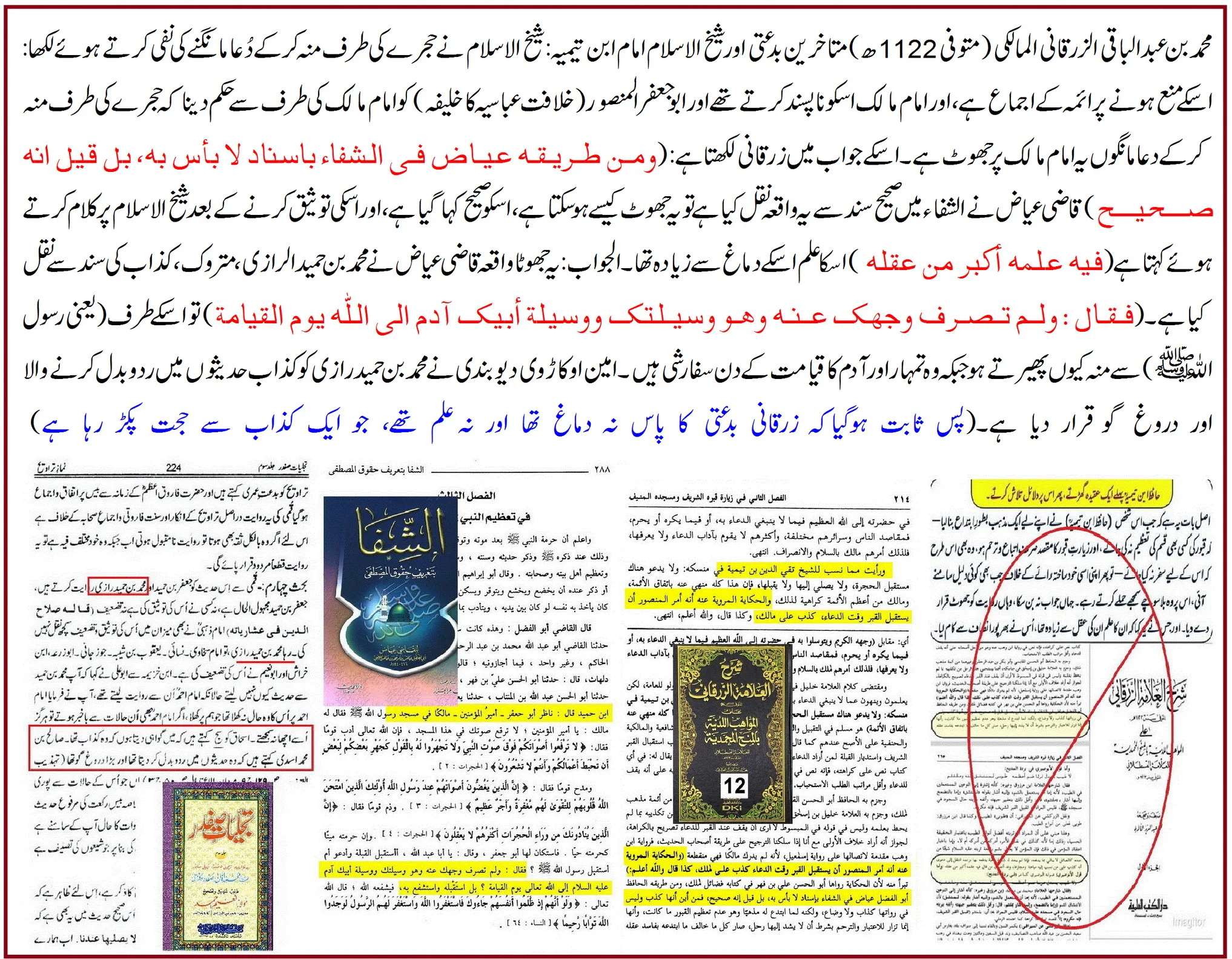
❾ Al-Zurqani’s Response: Claiming the Narration is Authentic
Muhammad ibn Abd al-Baqi al-Zurqani wrote in response:
ومن طريقه الحافظ أبو الفضل عياض في الشفاء بإسنادٍ لا بأس به، بل قيل: إنه صحيح، فمن أين أنها كذب, وليس في رواتها كذّاب ولا وضَّاع، ولكنه لما ابتدع له مذهبًا وهو عدم تعظيم القبور ما كانت، وأنها إنما تزار للاعتبار والترحّم, بشرط أن لا يشد إليها رحل، صار كل ما خالف ما ابتدعه بفاسد عقله ---- وقد أنصف من قال فيه: علمه أكبر من عقله.
Translation:
And in the same way, Hafiz Abu al-Fadl Iyad has narrated it in Ash-Shifa with a chain of transmission that has no flaw; rather, it is said to be authentic. So how can it be false when none of its narrators are liars or fabricators? But since he adopted a doctrine that forbids the veneration of graves and permits visiting them only for admonition and compassion, he rejected whatever contradicted it with his corrupt intellect... And whoever said that his knowledge was greater than his intellect was just.
Reference: Al-Kitab: Sharh az-Zarqani 'ala al-Mawahib al-Ladunniyyah bil-Minh al-Muhammadiyyah
Author: Abu Abdullah Muhammad ibn Abdul Baqi ibn Yusuf ibn Ahmad ibn Shihab ad-Din ibn Muhammad az-Zarqani al-Maliki (d. 1122 AH)
Author: Abu Abdullah Muhammad ibn Abdul Baqi ibn Yusuf ibn Ahmad ibn Shihab ad-Din ibn Muhammad az-Zarqani al-Maliki (d. 1122 AH)
Brief Explanation:
The central point of az-Zarqani’s argument is that Qadi Iyad transmitted this narration with a chain of transmission that he at least considered acceptable. Therefore, the core scholarly discussion now revolves around examining this chain of transmission.
❿ The Narrated Story of Qadi Iyad
Qadi Iyad narrated:
قال أبو حميد: نَاظَرَ أَبُو جَعْفَرٍ أَمِيرُ الْمُؤْمِنِينَ مَالِكًا فِي مَسْجِدِ رَسُولِ اللَّهِ صَلَّى اللَّهُ عَلَيْهِ وَسَلَّمَ فَقَالَ لَهُ مَالِكٌ: يَا أَمِيرَ الْمُؤْمِنِينَ لَا تَرْفَعْ صَوْتَكَ فِي هَذَا الْمَسْجِدِ ... أَسْتَقْبِلُ الْقِبْلَةَ وَأَدْعُو أَمْ أَسْتَقْبِلُ رَسُولَ اللَّهِ صَلَّى اللَّهُ عَلَيْهِ وَسَلَّمَ؟ فَقَالَ: وَلِمَ تَصْرِفُ وَجْهَكَ عَنْهُ وَهُوَ وَسِيلَتُكَ وَوَسِيلَةُ أَبِيكَ آدَمَ عَلَيْهِ السَّلَامُ إِلَى اللَّهِ تَعَالَى يَوْمَ الْقِيَامَةِ!! بَلِ اسْتَقْبِلْهُ.
Translation:
Abu Humaid said: The Commander of the Faithful Abu Ja'far debated Imam Malik in the Prophet Muhammad’s ﷺ mosque. Imam Malik said to him: O Commander of the Faithful! Do not raise your voice in this mosque... Then Abu Ja'far asked: Should I pray facing the Qiblah or facing the Prophet Muhammad ﷺ? Imam Malik replied: Why do you turn your face away from him, while he is your intercessor as well as the intercessor of your father Adam عليه السلام on the Day of Judgment before Allah Almighty! Rather, face him.
Reference: Al-Kitab: Ash-Shifa bi Ta’rif Huquq al-Mustafa
Author: Iyad ibn Musa ibn Iyad ibn Amrun al-Yahsubi al-Sabti, Abu al-Fadl (d. 544 AH)
Author: Iyad ibn Musa ibn Iyad ibn Amrun al-Yahsubi al-Sabti, Abu al-Fadl (d. 544 AH)
Brief Explanation:
This is the original story which Imam Ibn Taymiyyah declared false, and Zarqani defended it. Therefore, the decisive stage now is the investigation of the narrators of the chain.
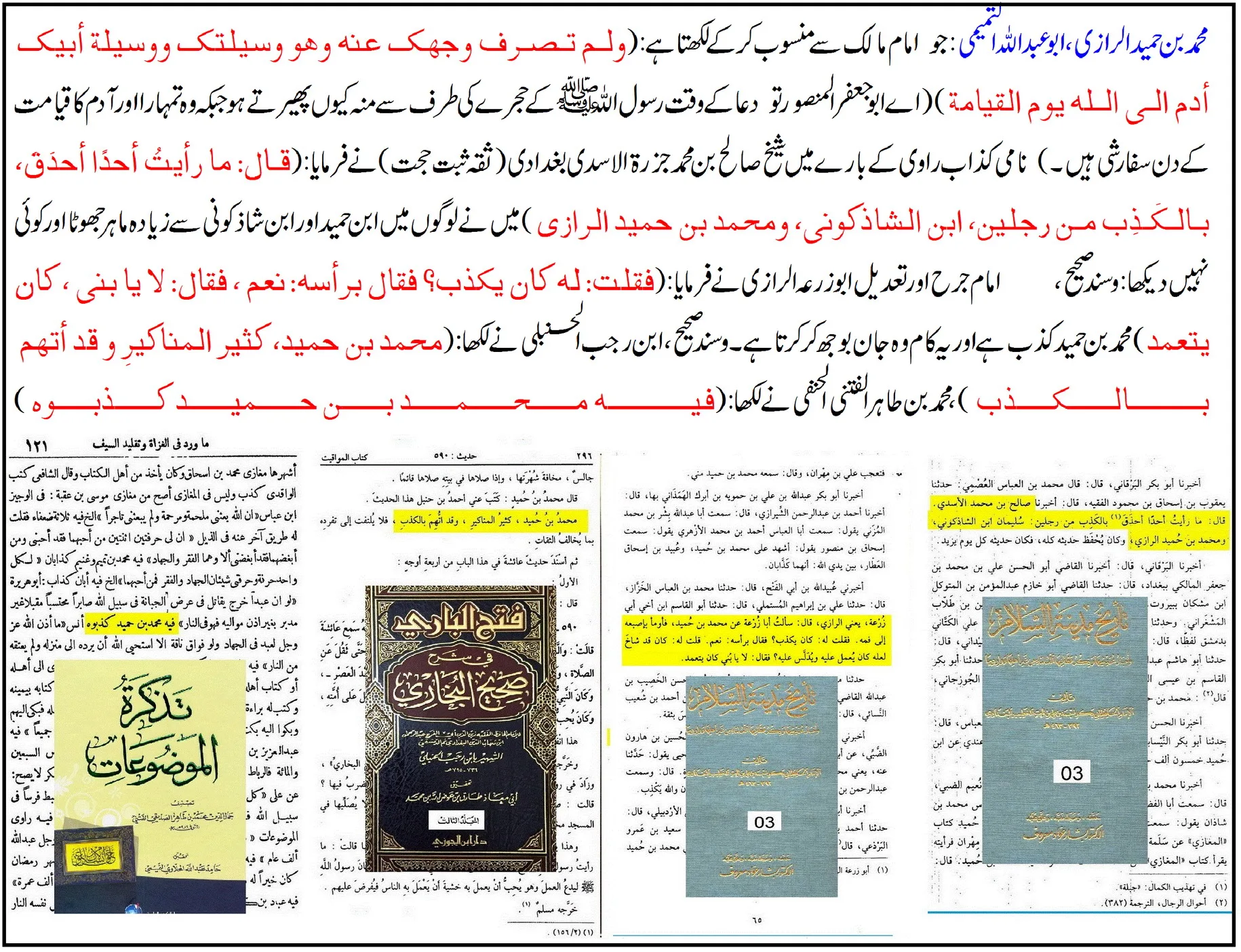
⓫ The Original Scholarly Objection Regarding Muhammad ibn Humayd al-Razi
The decisive point in this entire discussion is the chain of narration, and this is precisely where Zarqani's defense weakens. The chain on which the incident quoted by Qadi Iyad is based includes the name of Muhammad bin Hamid al-Razi. Complete information regarding the weakness of this narrator can be found in our research article. When a narration is based on a narrator who has been severely criticized by hadith scholars, merely stating that this narration is transmitted through a “harmless chain” or that “none of its narrators are liars or fabricators” does not hold up on the scholarly scale. The authenticity of a narration depends on the condition of its transmitters, not on the confidence of a later defender.
This is the reason why Imam Ibn Taymiyyah (may Allah have mercy on him) declared this narration to be false against Imam Malik (may Allah have mercy on him). His ruling was not based on an emotional reaction, but rather on the principle that accepting such an attribution requires a strong, clear, and reliable chain of transmission, whereas in this case the opposite was true. When the chain itself contains a narrator whose narration is questionable, then attributing this narration to a venerable Imam like Imam Malik becomes contrary to scholarly integrity.
Zarqani’s weakness here is twofold. On one hand, he defends this narration; on the other hand, based on this defense, he attacks the intellect and methodology of Imam Ibn Taymiyyah (may Allah have mercy on him). However, the fundamental principle was that first the chain of transmission should be critically examined, and then objections to Imam Ibn Taymiyyah’s ruling should be raised. But when the original foundation itself is weak, the entire structure built upon it becomes unstable. This is the real scholarly objection at this point.
Reference: References: Al-Shifa bi Ta‘rif Huquq al-Mustafa, Sharh al-Zarqani ‘ala al-Mawahib al-Ladunniyyah bil-Manah al-Muhammadiyyah, Majmu‘ al-Fatawa
Brief Explanation:
At this point, the original dispute is about the authenticity of the narration even before the issue of visiting graves. If Muhammad bin Humaid Al-Razi is present in the chain, then Zarqani's claim that none of its narrators are liars or fabricators itself becomes questionable. Therefore, instead of criticizing Imam Ibn Taymiyyah, it was necessary first to respond to the chain of this narration.
⓬ Summary of the Argument
Now the conclusion of the entire discussion is very clear:
❶ Shaykh al-Islam Imam Ibn Taymiyyah declared a narration attributed to Imam Malik to be false, and his ruling was not merely based on opinion or inclination but on the weak foundation of the attribution.
❷ Zarqani defended this narration by claiming that Qadi Iyad transmitted it from a chain in which there was no liar or fabricator, and it was even called authentic; then, on this basis, he spoke harshly against Imam Ibn Taymiyyah.
❸ But when in the chain of this very narration, the presence of a severely criticized narrator like Muhammad bin Humaid al-Razi comes to light, Zarqani's entire defense loses its original foundation. Then to claim that the narration is flawless remains academically unacceptable.
❹ After that, the issue is no longer just a jurisprudential disagreement, but it becomes a question whether, based on a weak and questionable narration, such a statement can be attributed to Imam Malik (RA), and then upon its denial, an Imam like Ibn Taymiyyah (RA) can be criticized? The answer to this is negative.
❺ Therefore, the correct position is that Imam Ibn Taymiyyah's (RA) denial is closer to the principles of Hadith and the principles of attribution, while Zarqani's defense is based on a narration whose chain itself is highly disputed. When the foundation is weak, the attack based on that foundation also remains weak.
Conclusion
The conclusion is that the severe criticism Zarquani directed at Sheikh al-Islam Imam Ibn Taymiyyah was in defense of a narration for which there is no strong scholarly basis. Imam Ibn Taymiyyah called the statement attributed to Imam Malik false, and in light of sanad verification, his decision not only seems understandable but also principled. In contrast, Zarquani, by supporting a narration based on weak grounds, not only claimed its authenticity but also attacked the intellect and understanding of Imam Ibn Taymiyyah, which itself reveals the weakness of his argument.
The clear point is that when there is a narrator in the chain of transmission of a hadith who has been severely criticized, it is not scholarly justice to use that hadith as evidence to object to the Imams of the religion. Therefore, in this entire discussion, the position of Imam Ibn Taymiyyah (may Allah have mercy on him) holds weight, not the criticism of Zarqani. Accordingly, Zarqani's criticism is actually an unbalanced harshness made in defense of a weak narration, whereas scholarly integrity required first acknowledging the weakness of the chain, and then passing judgment on anyone.