


This excerpt is taken from Sheikh Irshad Ullah Maan's book The Search for Truth.
In the previous writing, we discussed those Hanafi fiqh issues that were contradictory to the Quran and Sunnah. Now we will discuss those Hanafi fiqh issues that are in accordance with the Quran and Sunnah.
This chapter contains those issues which are according to the Quran and authentic Hadith and are recorded in Hanafi fiqh books. Their number exceeds six hundred; for brevity, only a few are mentioned here.
[1] Everything is present in the Book and Sunnah.
Reference: (Muqaddama Alamgiri:117/1)
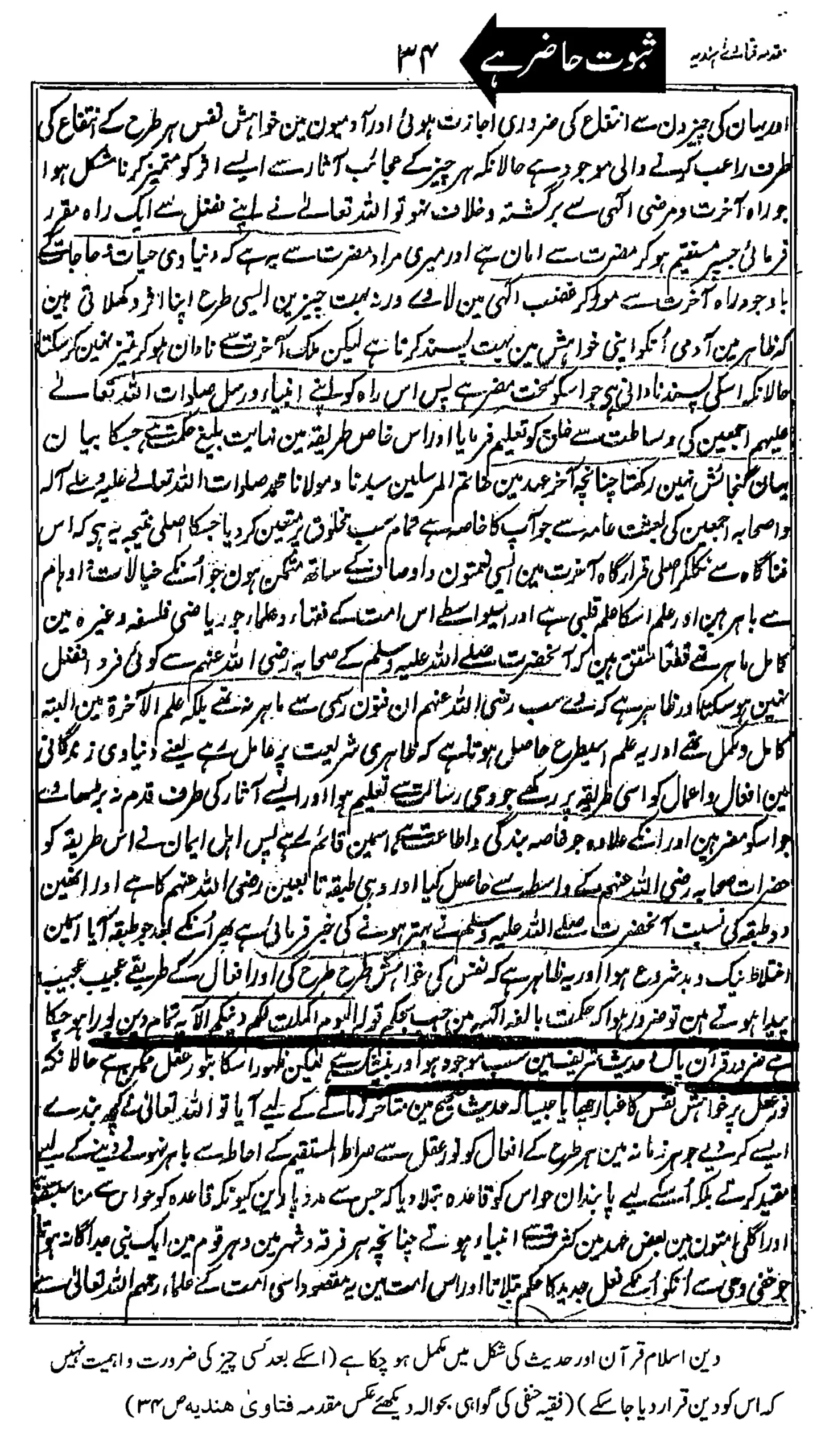
[2] [اَلْیَوْمَ اَکْمَلْتُ لَکُمْ دِیْنَکُمْ]
Reference: Al-Ma'idah:3
The religion has been completed in the Quran and Hadith.
Reference: (Muqaddama Alamgiri:32/1)
[3] Acting in accordance with the Book and Sunnah and avoiding fanaticism, falsehood, and deviation, and this does not mean that whoever says "I am Hanafi" will be forgiven.
Reference: (Durmukhtar:40/1)
[4] Do not write in the fatwa what the scholars of religion and jurists say about this issue, rather write like this: How do you know the command of Allah and His Messenger in this incident?
Reference: (Muqaddama Alamgiri:14/1)
[5] The statement of Sayyiduna Ibn Abbas (may Allah be pleased with them) will not be considered valid if it contradicts the Book and Sunnah.
Reference: (Durr Mukhtar:709/2)
[6] Hadith is the revelation of the unseen.
Reference: (Muqaddama Hidayah:110/1)
[7] Hadith is authoritative.
Reference: (Durr Mukhtar:45/1)
[8] Hadith is also definitive, because wiping over the sock is from the hadith; denying it without hesitation is disbelief.
Reference: (Hidayah:201/1)
[9] One who rejects hadith is misguided.
Reference: (Muqaddama Hidayah:30/1)
[10] Whatever contradicts the Prophet Muhammad ﷺ even to the extent of a hair, abandon it.
Reference: (Malabad:10)
[11] Love for the Prophet ﷺ is not merely by saying it with the tongue but through following him.
Reference: (Sharh Waqayah:97)
[12] Hadith takes precedence over the statement of the Imam.
Reference: (Hidayah:502/1)
[13] It is forbidden to use fabricated hadith as evidence and also forbidden to act upon it.
Reference: (Durr Mukhtar:73/1 - Muqaddama Hidayah:116/1)
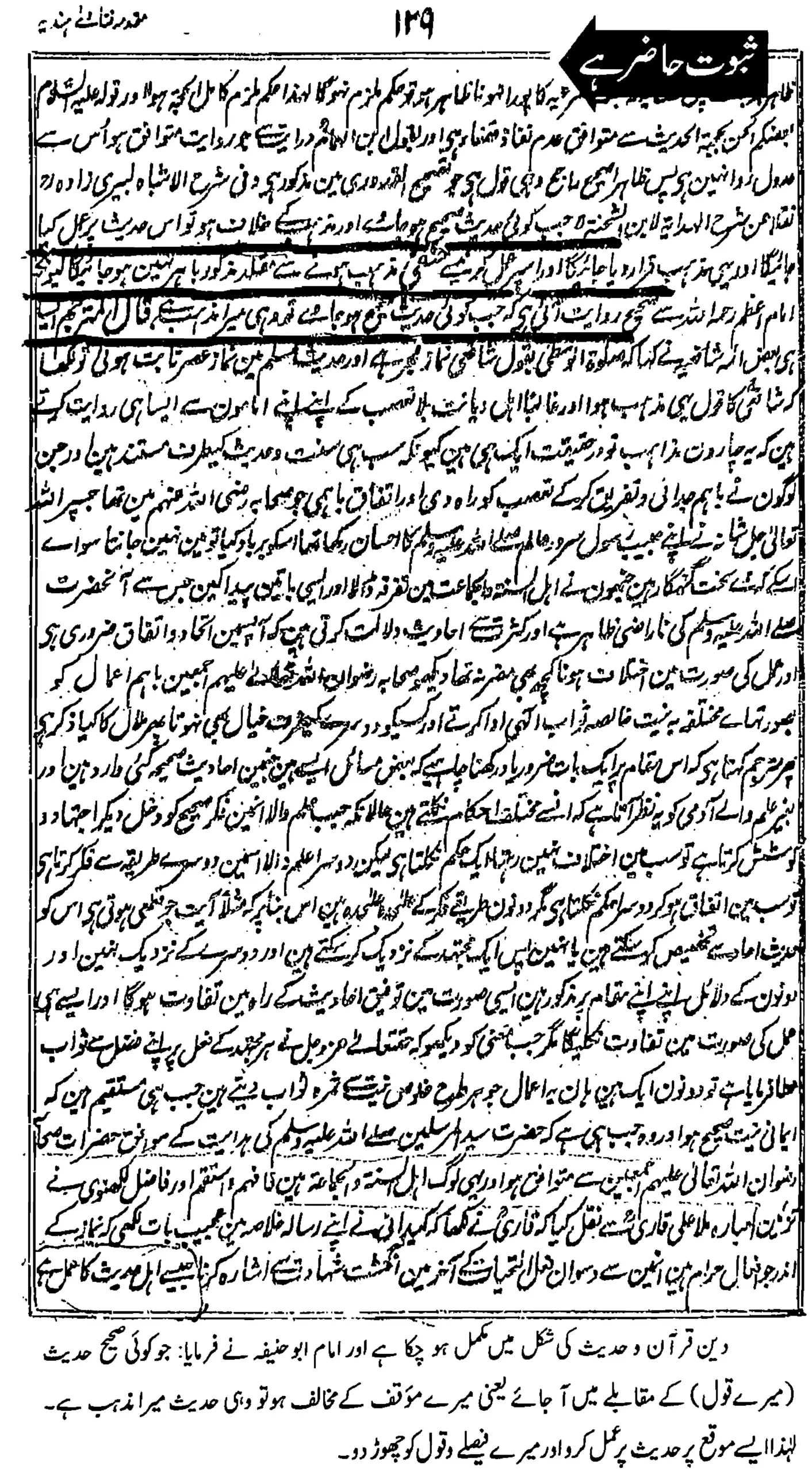
[14] He said: When an authentic hadith is found, that is my creed.
Reference: (Muqaddama Alamgiri:129/1)
[15] He said: Leave my statement before the hadith.
Reference: (Sharh Waqayah:10)
[16] It is agreed that after the Quran, Bukhari is followed by Muslim.
Reference: (Muqaddimah Hidayah:113/1)
The hadith present in both Bukhari and Muslim is called Muttafaqun Alayh. This hadith is the most authoritative. Then the hadith found only in Sahih Bukhari, followed by those found only in Sahih Muslim.
Reference: (Muqaddimah Hidayah:115/1-Sharh Waqayah:5)
[17] The first category includes Bukhari, Muslim, and Muwatta Imam Malik. The second category includes Tirmidhi, Nasa'i, and Abu Dawood. Their status is lower than Bukhari and Muslim. The third category includes Musnad Shafi'i, Musannaf Abdul Razzaq, Musannaf Ibn Abi Shaybah, Sunan Ibn Majah, Dar Qutni, Sahih Ibn Hibban, Mustadrak Hakim, books of Bayhaqi, books of Tahawi, books of Tabrani. The hadiths in these books are not reliable without criticism. The fourth category includes the remaining hadith books.
Reference: (Muqaddimah Hidayah:114/1, 115)
It is surprising that the author of Hidayah did not mention the Hanafi fiqh books anywhere in this classification. Perhaps these books were not worthy of being placed in any category.[18] The primary sources for fiqh are the Quran and Sunnah.
Reference: (Muqaddimah Alamgiri:26/1)
[19] The author of Hidayah had less engagement with hadith.
Reference: (Muqaddimah Alamgiri:140/1)
[20] Due to its brevity, Durr-e-Mukhtar is not suitable for issuing fatwas.
Reference: (Muqaddimah Hidayah:107)
[21] The hadiths in fiqh cannot be fully trusted (unless verified from the books of hadith), although there are fabricated hadiths in fiqh as well.
Reference: (Muqaddimah Hidayah:107/1)
[22] For this reason, some senior scholars have rejected every statement and action that was not present in the early period.
Reference: (Muqaddimah Alamgiri:30/1)
[23] To consider Abu Bakr (RA) and Umar (RA) as the best, to love Uthman (RA) and Ali (RA), to perform masah on the muezzin’s head. (Abu Hanifa)
Reference: (Durr Mukhtar:144/1)
[24] The four Imams were not followers (muqallid) of each other.
Reference: (Durr Mukhtar:43/1)
[25] Taqlid has caused harm.
Reference: (Durr Mukhtar:62/1-Hidayah:14/1)
[26] [فَسۡـَٔلُوۡۤا اَہۡلَ الذِّکۡرِ اِنۡ کُنۡتُمۡ لَا تَعۡلَمُوۡنَ]
Reference: An-Nahl:43
means to seek the ruling from the Quran and Hadith, not to accept the words of people blindly.
Reference: (Muqaddimah Alamgiri:14/1)
[27] The Jews and Christians used to obey their clerics and ascetics, therefore Allah declared them as polytheists. The believers were commanded not to ask about the sayings of people but to ask what Allah and His Messenger have commanded.
Reference: (Alamgiri:14/1)
[28],[29] Definition of the people of innovation (Ahl-e-Bid'ah) is those who, in religion whether in principles or branches, introduce something new without any Shariah evidence; they are also called Ahl-e-Hawa.
Reference: (Alamgiri:1/196, 197)
[30],[31] Ahl-e-Hawa are those who oppose the Sunnah.
Reference: (Durr-e-Mukhtar:317/3)
[32] Verse: [مَا کَانَ لِلنَّبِیِّ وَ الَّذِیۡنَ اٰمَنُوۡۤا اَنۡ یَّسۡتَغۡفِرُوۡا]
Reference: At-Tawbah:113
and verse: [اِنَّکَ لَا تَہۡدِیۡ]
Reference: Al-Qasas:56
are in favor of Abu Talib.
Reference: (Hidayah:29/1 - Sharh Waqayah:146/1)
Reference: (Fiqh Akbar) For this, see Ahmad Raza Sahib's Quranic translation with Tafsir
.[33] Except for the Prophets and the Ashra Mubashra, the saints who possess miracles and the pure scholars cannot be said with certainty to be in Paradise.
Reference: (Muqaddimah Hidayah:28/1)
[34] Knowledge of the unseen belongs only to Allah Almighty and no creation has it.
Reference: (Durr-e-Mukhtar:25/1 - Hidayah:59/1)
[35] For disbelief in beliefs and actions, see previous chapters.
[36] Salaf-e-Saliheen specifically refers to the Companions and generally to the Companions and the Followers (Tabi'in).
Reference: (Muqaddimah Alamgiri:92/1)
[37] A miracle is that which is upon the hand of a Prophet, a karamah (miraculous gift) is that which is upon the hand of a pious person, and istidraj (gradual punishment) is that which is upon the hand of a sinner.
Reference: (Durr-e-Mukhtar:269/1)
[38] The master of masters, Abdul Qadir Jilani, was Hanbali.
Reference: (Hidayah:573/1, 690)
[39] Niyyah (intention) is the resolve of the heart, not the utterance of the tongue.
Reference: (Durr-e-Mukhtar:46/1 - Hidayah:29 - Durr-e-Mukhtar:69/1)
[40] Making intention with the tongue is an innovation.
Reference: (Darmukhtar:61/1-Hidayah:26/1)
[41] In wiping the head, the hand should move from front to back and from back to front.
Reference: (Hidayah:29/1-Darmukhtar:69/1)
[42] Wiping the neck is an innovation.
Reference: (Hidayah:20/1, 21)
[43] Wiping over thick socks is permissible.
Reference: (Darmukhtar, Alamgiri, Sharh Waqayah:60/1-Qaduri:69/1)
[44] The issue of "dah dar dah" (pouring water repeatedly) is not in the original school of thought.
Reference: (Alamgiri:1/103-Muqaddimah Hidayah:100/1)
[45] The time for Zuhr lasts until one "Mithl" (a certain length). (According to the two Imams) There is also a narration from Imam Abu Hanifa. This is also the school of thought of Zafar, Imam Shafi'i, Imam Malik, and Imam Ahmad.
Reference: (Darmukhtar, Kanz, Alamgiri:10/1, Hidayah:1/329, Sharh Waqayah:73)
[46] The time for Asr begins from one "Mithl". (School of the two Imams)
Reference: (Darmukhtar:182/1, Hidayah:329/1)
[47] According to authentic hadith, the words of Adhan are repeated twice and the Takbirs once each.
Reference: (Sharh Waqayah:79/1)
[48] When the face is towards the Kaaba, it is not permissible to make the intention of the Kaaba.
Reference: (Munya:66)
[49] In obligatory prayer, making intention of the number of Rak'ahs is not obligatory.
Reference: (Sharh Waqayah:82)
[50] Standing (Qiyam) is obligatory.
Reference: (Sharh Waqayah:83/1, Qaduri:101/1)
[51] The hadith about placing the hands below the navel is weak according to the consensus of the Imams and Muhaddithin.
Reference: (Hidayah:449/1, 450)
[52] Mirza Mazhar Jan-e-Janan Mujaddidi Hanafi preferred the hadith of placing the hand on the chest due to its strong evidence and he himself used to place his hand on the chest.
Reference: (Hidayah: 450/1)
[53] [لا صلٰوة الا بفاتحة الکتاب] This hadith is narrated with an authentic chain in the six authentic books, Ibn Hibban, Sunan Dar Qutni, etc.
Reference: (Hidayah:464/1)
[54] Ibn Humam, after declaring the narrator of the hadith with [ثقلت القرآن] as trustworthy, said that from this hadith it is understood that in audible prayer the follower should recite Al-Fatiha behind the Imam.
Reference: (Hidayah:1/549, 550, 555)
[55] The hadiths against reciting Al-Fatiha behind the Imam are weak.
Reference: (Sharh Waqayah:98-99)
[56] It is recommended for the follower to recite Al-Fatiha behind the Imam, as a precaution. (Muhammad, may Allah have mercy on him)
Reference: (Hidayah:550/1)
[57] The hadiths about raising the hands are stronger compared to those about abandoning raising the hands.
Reference: (Hidayah:499/1)
[58] The truth is that raising the hands is established from the Messenger of Allah ﷺ.
Reference: (Hidayah:496/1)
[59] Most jurists and hadith scholars consider raising the hands as an established Sunnah.
Reference: (Malabid:43)
[60] Isam ibn Yusuf, a student of Imam Abu Hanifa, used to raise his hands.
Reference: (Alamgiri: 54/1)
[61] Amir Katib al-‘Ameed was a biased Hanafi who, upon seeing the raising of hands (Raf‘ al-Yadain), would issue a fatwa declaring the prayer invalid. Fazil Lucknawi refuted this by saying that there are many authentic narrations about raising the hands, but none are reported from Imam Abu Hanifa.
Reference: (Muqaddimah Alamgiri:87/1)
[62] It is correct to pray with the head uncovered as a sign of humility.
Reference: (Durmukhtar:337/1, Alamgiri:169/1, Hidayah:655/1)
[63] Prayer is disliked in seven places: bathhouse, road, place where camels sit, cemetery, place where filth is thrown, Kamila (a type of tree), etc.
Reference: (Durmukhtar:192/1)
[64] Four rak‘ahs before ‘Isha are recommended, not Sunnah.
Reference: (Hidayah:696/1)
[65] Shortening the prayer (Qasr) is permissible for a distance of up to three miles.
Reference: (Sharh Waqayah:132)
[66] It is disliked for one to lead the prayer (Imamat) for wages.
Reference: (Durmukhtar:293/1)
[67] Appointing a Hafiz (memorizer of Quran) for payment is disliked.
Reference: (Hidayah:725/1)
[68] It is disliked for an innovator (Bid‘ati) to lead the prayer.
Reference: (Durmukhtar:292, Sharh Waqayah:101/1)
[69] The Imam should command the followers to stay close to each other and close the gaps between them.
Reference: (Durmukhtar:296/1, Sharh Waqayah:103/1)
[70] Leaving space in the row is equivalent to missing out on reward.
Reference: (Durmukhtar:296/1)
[71] Witr is even one rak‘ah, and there is consensus among Muslims on this.
Reference: (Hidayah:1/675, 676)
[72] The prostration of forgetfulness (Sajdat al-Sahw) is performed after turning the salutations on both sides, and it is also permissible before the salutations.
Reference: (Durr-e-Mukhtar: 381/1, Hidayah: 750/1)
[73] One who turns only one salutation in Sajdat al-Sahw is an innovator.
Reference: (Hidayah: 750/1)
[74] One who denies prayer is a disbeliever; according to Imam Abu Hanifa, it is obligatory to always imprison a non-practicing person.
According to Imam Shafi'i, such a person should be killed. According to Imam Shafi'i and Imam Ahmad, one who abandons a single prayer is a disbeliever.
Reference: (Durr-e-Mukhtar: 180/1, Hidayah: 324/1 - Malabad:14)
[75] One may pray Sunnah after the Fajr obligatory prayer.
Reference: (Hidayah: 694/1)
[76] In التحیات, make a fist and raise the index finger.
Reference: (Hidayah: 502/1 - Sharh Waqayah)
[77] There is no harm in sitting for rest.
Reference: (Durr-e-Mukhtar: 259/1)
[78] After praying the Sunnah of Fajr, lie on the right side.
Reference: (Durr-e-Mukhtar: 55/1 - Hidayah: 694/1)
[79] It is better not to pray the precautionary Zuhr prayer.
Reference: (Durr-e-Mukhtar: 412/1)
[80] Whoever starts the Fajr or Maghrib prayer alone and then the Takbir is said, should break the prayer even if he has prayed one Rak'ah.
Reference: (Sharh Waqayah: 123 - Hidayah: 28/1 - Kanz:159)
[81] It is an authentic Hadith that after the Iqamah, no prayer other than the obligatory one is valid.
Reference: (Hidayah: 694/1)
[82] It is disliked to recite Sunnah prayers in congregation, and two rak'ahs before Maghrib are established. The prayer of Tahiyyat al-Masjid should be read before sitting, and it is recommended to pray two rak'ahs after ablution except during disliked times.
Reference: (Dar Mukhtar: 1/352 to 356)
[83] One can perform Qadha (make-up) prayers after Fajr and Asr prayers.
Reference: (Hidayah: 367/1)
[84] The hadith about twenty rak'ahs in Taraweeh is weak.
Reference: (Hidayah: 722/1 - Dar Mukhtar: 367/1 - Sharh Waqayah: 121)
[85] The hadith about eight rak'ahs in Taraweeh is authentic.
Reference: (Sharh Waqayah: 121)
[86] Taraweeh with Witr of eleven rak'ahs is established by authentic hadith.
Reference: (Hidayah: 722/1 - Sharh Waqayah: 122)
[87] Taraweeh with Witr of eleven rak'ahs is the Sunnah of the Messenger of Allah ﷺ and not the Sunnah of the Rightly Guided Caliphs.
Reference: (Ibid)
[88] It is permissible to pray Nafl at the time of Zawal on Friday.
Reference: (Dar Mukhtar: 427/1, Sharh Waqayah)
[89] It is established that Abu Bakr رضي الله عنه delivered the Khutbah before Zawal.
Reference: (Sharh Waqayah)
[90] On Friday, there was one Adhan during the time of the Messenger of Allah ﷺ, Abu Bakr رضي الله عنه, and Umar رضي الله عنه, and the second Adhan started during the time of Uthman رضي الله عنه.
Reference: (Dar Mukhtar: 1/424 - Hidayah)
[91] Upon hearing the name of the Messenger of Allah ﷺ from the Khateeb, one should recite Durood upon him in their heart.
Reference: (Dar Mukhtar: 1/424)
[92] During the sermon, neither speech nor saying SubhanAllah is allowed; all this is forbidden for the listener.
Reference: (Darmukhtar: 1/424)
[93] It is Sunnah to say Takbeer aloud in the two Eids, both on the way and at the Eidgah.
Reference: (Darmukhtar, Hidayah)
[94] The hadith of twelve Takbeers in the Eid prayers is authentic.
Reference: (Hidayah: 1/850 - Sharh Waqayah:138)
[95] Shaking hands after Eid is disliked; this is the practice of the Rafidah. Embracing after Eid is also baseless and disliked.
Reference: (Darmukhtar: 1/430)
[96] Reciting the Quran on graves is disliked and an innovation.
Reference: (Alamgiri: 9/81 - Hidayah: 4/314)
[97] A solid grave should not be made.
Reference: (Darmukhtar: 1/468, 469 - Kanz:192)
[98] Building a structure on the grave for decoration is forbidden.
Reference: (Darmukhtar: 1/469)
[99] Building tall houses and lighting lamps on the graves of the Awliya Allah is an innovation and forbidden.
Reference: (Hidayah: 4/315 - Darmukhtar: 4/270 - Malabad:78)
[100] Prostrating, circumambulating, seeking wishes, and offering vows at the graves of Prophets and Awliya are forbidden and constitute disbelief.
Reference: (Malabad:82)
[101] Giving the Adhan at the grave is an innovation.
Reference: (Behishti Gohar:126)
[102] Kissing the grave is not permissible as it is a custom of the Christians.
Reference: (Darmukhtar: 4/270)
[103] Mourning for more than three days is forbidden.
Reference: (Malabad:80)
[104] Eating food from the house of the bereaved is forbidden.
Reference: (Hidayah: 1/925)
[105] Spreading carpets or similar items on the ground at the time of death is a bad practice.
Reference: (Fatawa Alamgiri: 1/265 - Hidayah: 1/923)
[106] Apart from visiting the grave and praying for the owner of the grave, nothing else is established from the Sunnah.
Reference: (Alamgiri: 1/264)
[107] The third day, the tenth day, and the fortieth day are highly reprehensible and innovations.
Reference: (Bahishti Zewar: 89/6)
[108] Reciting Fatiha as a customary practice is an innovation.
Reference: (Bahishti Zewar: Part 6, p. 80)
[109] One should not fast on a doubtful day.
Reference: (Durr Mukhtar: 553/1 - Sharh Waqaya: 167/1)
[110] Fasting on a doubtful day is makruh tahrimi (prohibited) and resembles the practices of the People of the Book.
Reference: (Durr Mukhtar: 553/1)
[111] Whoever makes Allah and the Messenger ﷺ witnesses in marriage, the marriage is not valid; rather, he is a disbeliever.
Reference: (Durr Mukhtar: 14/2 - Malabad: 139)
[112] According to some, three divorces given in one sitting count as one divorce.
Reference: (Sharh Waqaya: 34/2)
[113] The judge should grant separation to the wife of a missing person after four years; this was the decision of Umar (RA), Ali (RA), and Uthman (RA), and there is consensus of the Companions on this.
Reference: (Hidayah: 736/2)
[114] If the name of anyone other than Allah was invoked over the animal, even if at the time of slaughter بسم اللہ اللہ اکبر it was said, the slaughter is forbidden.
Reference: (Durr Mukhtar: 195/4)
[115] The cow of Syed Ahmed Kabir, the goat of Sheikh Sado, and the rooster of Ujala Shah are forbidden.
Reference: (Darmukhtar: 196/3, Sharh Waqaya: 49/4)
[116] Slaughtering in the name of the Prophet or a saint is forbidden.
Reference: (Sharh Waqaya:46/4)
[117] Sacrifice on behalf of a deceased person is permissible.
Reference: (Darmukhtar, Bahishti Zewar)
[118] Abu Hanifa (may Allah have mercy on him) considered the horse forbidden; before his death, he retracted this.
Reference: (Darmukhtar:191/4)
[119] The testimony of one who abandons Friday prayer is not accepted; those who do not pay Zakat, those who consume orphan's wealth, a singing woman, one who listens to melodies, an intoxicated person, a player of dice, a pimp, a procurer, a pigeon player, a cock player, a chess player, an usurer, one who speaks ill of the Companions — the testimony of all these is not accepted.
Reference: (Hidayah: 3/402 - Darmukhtar:3/ 326 to 333 - Alamgiri: 5/272)
[120] If there is an issue contrary to the Quranic text, the Qazi should invalidate it; and if there is an issue contrary to the Hadith text, the Qazi should invalidate it.
Reference: (Darmukhtar:2/ 709-710)
[121] Knowledge of melodies is forbidden.
Reference: (Darmukhtar:1/25 - Malabad:125)
[122] Listening to the sound of the flute, bansuri, and other similar instruments is forbidden.
Reference: (Darmukhtar:3/ 222 - Hidayah:4/ 246 - Malabad:126)
[123] The first singer is Satan.
Reference: (Darmukhtar:4/ 222 - Hidayah: 4/246)
[124] Singing breeds hypocrisy.
Reference: (Darmukhtar: 4/ 222 - Hidayah:4/ 246)
[125] Singing is forbidden and listening to it is a sin, similarly Qawwali.
Reference: (Alamgiri:9/83 - Hidayah:3/316)
[126] Singing, Qawwali, and dancing performed by the Sufi people of our time are forbidden.
Reference: (Alamgiri:9/84 - Hidayah:4/316)
[127] In this era, women playing the drum is disliked according to Imam Abu Yusuf, may Allah have mercy on him.
Reference: (Alamgiri:9/84)
[128] If there is dancing and singing at a Walimah invitation near the dining table, everyone should leave.
Reference: (Durr Mukhtar:4/221 - Hidayah:4/245 - Sharh Waqayah:4/55 - Kanz:379 - Malabad:125)
[129] If one becomes aware of dancing and singing before going, then one should not go there.
Reference: (Durr Mukhtar:4/221 - Hidayah:4/245)
[130] Listening to and reciting poetry with melody at a Milad (birth celebration) is forbidden.
Reference: (Hidayah:4/247)
[131] Listening to the Quran with melody and singing is sinful, and both the reciter and the listener are sinners.
Reference: (Hidayah:4/246)
[132] Using the Quran for divination is forbidden.
Reference: (Muqaddimah Hidayah:1/57)
[133] Talismans and amulets are forbidden.
Reference: (Durr Mukhtar:1/25)
[134] Selling amulets is not permissible.
Reference: (Hidayah:4/313)
[135] If the amulet is in the Quran, Hadith, or Arabic language and is not considered a real effect, then it is permissible; if its meaning is not known, then it is not permissible. If the names of angels, saints, or creatures of the Throne are on it, then it is better to avoid it.
Reference: (Durr Mukhtar:1/103)
[136] If the Quran falls down, weighing grains on it is not a Shariah ruling.
Reference: (Bihishti Zewar:10/79)
[137] If the Quran is placed at a high place, stretching feet towards it is not disliked.
Reference: (Durr-e-Mukhtar:1/344)
[138] If the Mushaf (Quran) becomes worn out, it should be buried.
Reference: (Durr-e-Mukhtar:1/102)
[139] If the Quran is kept at a distance, stretching feet towards it is not disliked.
Reference: (Durr-e-Mukhtar:1/344)
[140] Abdullah bin Umar (may Allah be pleased with them) used to teach the supplication of seeking refuge to his children and would write it and put it around the neck of the young child.
Reference: (Hidayah:4/323)
[141] It is disliked to complete the Quran in one day, and out of respect for the Quran, it should not be completed in less than three days.
Reference: (Alamgiri:9/21)
[142] Reading the Quran in less than three days is disliked.
Reference: (Sharh Waqayah:102)
[143] Reading a poet's verse that mentions immorality, wine, and similar matters is disliked.
Reference: (Hidayah:4/316)
[144] Learning Greek wisdom (philosophy), sand divination, astrology, magic, and fortune-telling is forbidden.
Reference: (Durr-e-Mukhtar:1/25)
[145] Learning logic is forbidden (except for responding to opponents).
Reference: (Durr-e-Mukhtar:1/25)
[146] Alchemy is forbidden.
Reference: (Durr-e-Mukhtar:1/25)
[147] Dressing a child in silk cloth and jewelry is forbidden.
Reference: (Durr-e-Mukhtar:1/343)
[148] Lamenting, beating oneself, and tearing clothes are forbidden.
Reference: (Malabad:80)
[149] Bowing at the time of greeting (Salam) is disliked; there is a prohibition in its hadith.
Reference: (Hidayah:4/320)
[150] Bowing before a Sultan or the like is forbidden as it resembles the practice of Magians.
Reference: (Alamgiri:9/112). (Hidayah:4/320)
[151] There is consensus on shaking hands with the right hand.
Reference: (Hidayah:4/320)
[152] Shaking hands with one hand is established by most authentic narrations.
Reference: (Hidayah:4/320)
[153] It is not permissible to shake hands with a woman during allegiance (Bay'ah).
Reference: (Hidayah:4/267)
[154] Kissing one's own hand when meeting a friend, as ignorant people do, is unanimously disliked.
Reference: (Alamgiri:9/113)
[155] Licking the fingers and the ring is Sunnah.
Reference: (Durr-e-Mukhtar:4/216)
[156] Eating with an uncovered head is not objectionable.
Reference: (Durr-e-Mukhtar:4/216)
[157] Playing chess is forbidden, and Ganjifa and Chausar are also forbidden.
Reference: (Hidayah:4/318)
[158] Pigeon flying and cockfighting are forbidden.
Reference: (Sharh Waqayah:4/64 - Malabad:129)
[159] Wrestling for gaining strength and Jihad is permissible, but for mere play it is disliked.
Reference: (Sharh Waqayah:4/64)
[160] Bathing naked is permissible if there is privacy, whether standing or sitting, whether the bathroom has a roof or not.
Reference: (Bahishti Zewar:1/44)
[161] Dry semen is purified by rubbing it off.
Reference: (Bahishti Zewar:2/51)
[162] Giving the call to prayer (Adhan) during plague, cholera, etc., is foolishness.
Reference: (Hidayah:4/375)
[163] It is correct to give the Fajr call to prayer from midnight.
Reference: (Sharh Waqayah:78)
[164] It is not permissible to take wages for giving the call to prayer (Adhan) and Iqamah, nor for teaching jurisprudence and other acts of worship. (Abu Hanifa)
Reference: (Durr Mukhtar:2/38 - Hidayah:1/573 - Sharh Waqayah:2/20)
[165] It is disliked for backbiters to lead the prayer.
Reference: (Sharh Waqayah:1/10)
[166] The original ruling for everything is permissibility.
Reference: (Durr Mukhtar:1/60)
[167] There is no evidence for the prohibition of tobacco, but it is better to abstain from it.
Reference: (Muqaddimah Alamgiri:1/126)
[168] The saliva of a cat is not disliked.
Reference: (Abu Yusuf, may Allah have mercy on him - Hidayah:1/158)
[169] If a young man drinks the milk of his wife, she does not become unlawful for him.
Reference: (Bahishti Zewar:4/14)
[170] Women should observe hijab from eunuchs.
Reference: (Durr Mukhtar:4/234)
[171] If the one who sneezes says __ARABIC_8, the listener should say ARABIC_9__, even if ten times.
Reference: (Durr Mukhtar:1/401)
[172] Among the ten natural things is to grow a beard and trim the mustache.
Reference: (Hidayah:1/71)
[173] Trimming the mustache is Sunnah.
Reference: (Durr Mukhtar:4/262)
[174] Shaving or cutting the beard is forbidden; it is a custom of disbelievers and fire-worshippers, and resembles women.
Reference: (Durr Mukhtar:4/262)
[175] It is forbidden to cut the beard less than a fist, and it is Sunnah to grow it.
Reference: (Malabad:130)
[176] If someone shaves the beard intentionally or by mistake, if the entire beard is shaved, full blood money (diyat) is to be paid, and if half is shaved, half the blood money is to be taken.
Reference: (Alamgiri:9/333)
(It must be taken so that barbers may be given a lesson)
[177] Shaving some parts of the head and leaving others is disliked.
Reference: (Hidayah:4/325)
[178] Sideburns grown on the forehead are not permissible.
Reference: (Bahishti Gohar:109)
[179] Wearing an izar (lower garment) from mid-calf to the ankles is permissible; below the ankles is forbidden.
Reference: (Malabad:110)
[180] Asking for supplication through the right of a wali (saint) is disliked, because the creation has no right over Allah.
Reference: (Darmukhtar:4/255 - Alamgiri:9/23 - Hidayah:4/357)
[181] Shariah rulings cannot be based on dreams.
Reference: (Darmukhtar:1/472)
[182] A unilateral condition is valid.
Reference: (Darmukhtar:4/515)
[183] Criticizing a dead innovator is correct so that others may refrain from innovation.
Reference: (Darmukhtar:1/407)
[184] Backbiting openly sinful and disbelieving persons is permissible.
Reference: (Darmukhtar:4/263)
[185] The claim that trees sleep at night is false.
Reference: (Bahishti Zewar:10/89)
[186] One who considers bhang (cannabis) lawful is an atheist and innovator; his killing is permissible.
Reference: (Darmukhtar:4/298)
[187] Whoever vows to have a molud recited, or to place a cloth on a shrine, or to offer to Abdul Haq, or to the cow of Syed Kabir, or to embrace in a mosque, or to fill Allah Mian's niche, or to fast on the eleventh day of the great Pir, or to fast for Mola Mushkil Kusha, or to perform the ritual of As Bibi's Kunda, there is no need to fulfill it; rather, all these are nonsense and superstitions, and fasting for these is shirk.
Reference: (Bihishti Zewar:3/37)
[188] The molud as commonly practiced is an innovation (bid'ah).
Reference: (Bihishti Zewar:6/61)
[189] The custom of بسم اللہ is baseless and futile.
Reference: (Bihishti Zewar:6/15)
[190] The halwa of Shab-e-Barat and other rituals, as well as the rituals of Muharram, are all innovations (bid'ah).
Reference: (Bihishti Zewar:6/68)
[191] Swearing by anyone other than Allah is not a valid oath but is shirk.
Reference: (Bihishti Zewar:3/38)
[192] Vowing to anyone other than Allah is shirk, and consuming that which is associated with such vows is forbidden (haram).
Reference: (Bihishti Zewar:3/37)
The conclusion of the previous two discussions is that in Hanafi jurisprudence, falsehood (i.e., self-invented issues) has been included in the right (divine guidance, i.e., the Quran and Hadith). This is a dangerous matter. It requires investigation and caution. Be sure to study the book Haqiqat al-Fiqh for research, which is written by Hafiz Muhammad Yusuf Sahib Jiapuri and was written in 1340 Hijri. It is now 1424 Hijri, and to this day, no Hanafi Barelvi or Hanafi Deobandi has been able to respond to this book, even though 84 years have passed.

