


This excerpt is taken from Sheikh Irshad Ullah Maan's book The Search for Truth.
The plight of Hanafi Fiqh is evident to all. As you observed in the previous chapter. The status of the Messenger of Allah ﷺ and His greatness are clear and apparent. As repeatedly mentioned in Naeem Muradabadi's Tafsir, that you ﷺ are the closest servant and Messenger of Allah. And you ﷺ are the best among creation. Then what justification is there for following Imam Abu Hanifa, when it is written in this Tafsir: Considering a wali (saint) superior to a Nabi (Prophet) is extremely dangerous.
Reference: (Al-Kahf: p178)
You know what the consequence of this duality will be on the Day of Judgment. On the Day of Judgment, people will be called by the names of the Imams they obeyed. Obviously, the Hanafis will be called by the name of Imam Abu Hanifa. And those who are believers and obey the Messenger of Allah ﷺ will be called by the name of the Messenger of Allah ﷺ.
Reference: (See: Tafsir Muradabadi, Bani Israel:71, p159), (Al-Mu’min:32, p71)
Since the majority of our countrymen are Hanafi brothers, we will discuss only Hanafi jurisprudence in this book, so that the matter becomes completely clear. The list of authentic Hanafi jurisprudence books currently available has already been provided. After carefully studying these books, one comes to the conclusion that two types of issues are recorded in these jurisprudence books:
[1] Those issues which are completely against the Quran, Hadith, and ethics and civilization.
[2] Those issues which are in accordance with the Quran and Hadith.
First, the issues from these jurisprudence books are recorded which are completely against the Quran, Hadith, and ethics and civilization.
Part One:
This includes those issues from Hanafi jurisprudence books which are against Shariah; there are more than six hundred such issues, but for the sake of brevity, fewer are recorded here. It should be noted that all these are Hanafi jurisprudence books which are accepted by both Barelvis and Deobandis because both consider Imam Abu Hanifa as their great Imam.
[1] The Messenger of Allah ﷺ said: Abu Hanifa is the lamp of my Ummah.
Reference: (Darmukhtar:31/1)
◈ The famous Hanafi scholar Mulla Ali Qari wrote in his book Mawaḍiʿāt Kabīr that this hadith is unanimously considered fabricated by the Muhaddithin.
[2] Imam Abu Hanifa saw Allah Almighty in a dream one hundred times.
Reference: (Darmukhtar:29/1)
◈ And it is written in
Reference: Fatawa Qazi Khan Volume 4
that whoever says he has seen Allah Almighty in a dream is equal to a person who worships idols.[3] In his last Hajj, the Imam obtained permission from the servants of the Kaaba to enter inside for one night. In one rak'ah, he completed half of the Quran on one leg, then performed ruku and sujood, then stood up for the second rak'ah, and completed the remaining half of the Quran on the other leg.
Reference: (Darmukhtar:30/1)
◈ The noble hadith states that the Quran should not be completed in less than three days.
Reference: Bukhari, Book of the Virtues of the Quran, Chapter on How Quickly the Quran is Recited: 5054 (and Hanafi Fiqh)
[4] The honorable father of Imam Sahib, Sabet, may Allah have mercy on him, took his son Imam Abu Hanifa to Sayyiduna Ali, may Allah be pleased with him, and had him pray.
Reference: (Dar Mukhtar:36/1)
◈ It is established that Sayyiduna Ali, may Allah be pleased with him, passed away in the 40th Hijri year and Imam Abu Hanifa was born in the 80th Hijri year, but this is an example of the author's knowledge of history and the authenticity of narration.
[5] Imam Abu Yusuf was a judge; some have described him as very slow.
Reference: (Muqaddimah Fatawa Alamgiri:53/1)
◈ It should be remembered that Imam Abu Yusuf is a famous Imam of the Hanafis.
[6] The Mu'tazila (Shi'a) are Hanafis in branches.
Reference: (Dar Mukhtar:108/1)
A Sunni's marriage with a Mu'tazili is not valid because they are disbelievers.
Reference: (Dar Mukhtar:22/2)
◈ This requires consideration.
[7] May the curse of our Lord be upon the person as numerous as the particles of sand who rejects the statement of Abu Hanifa, that is, does not accept it.
Reference: (Dar Mukhtar:36/1)
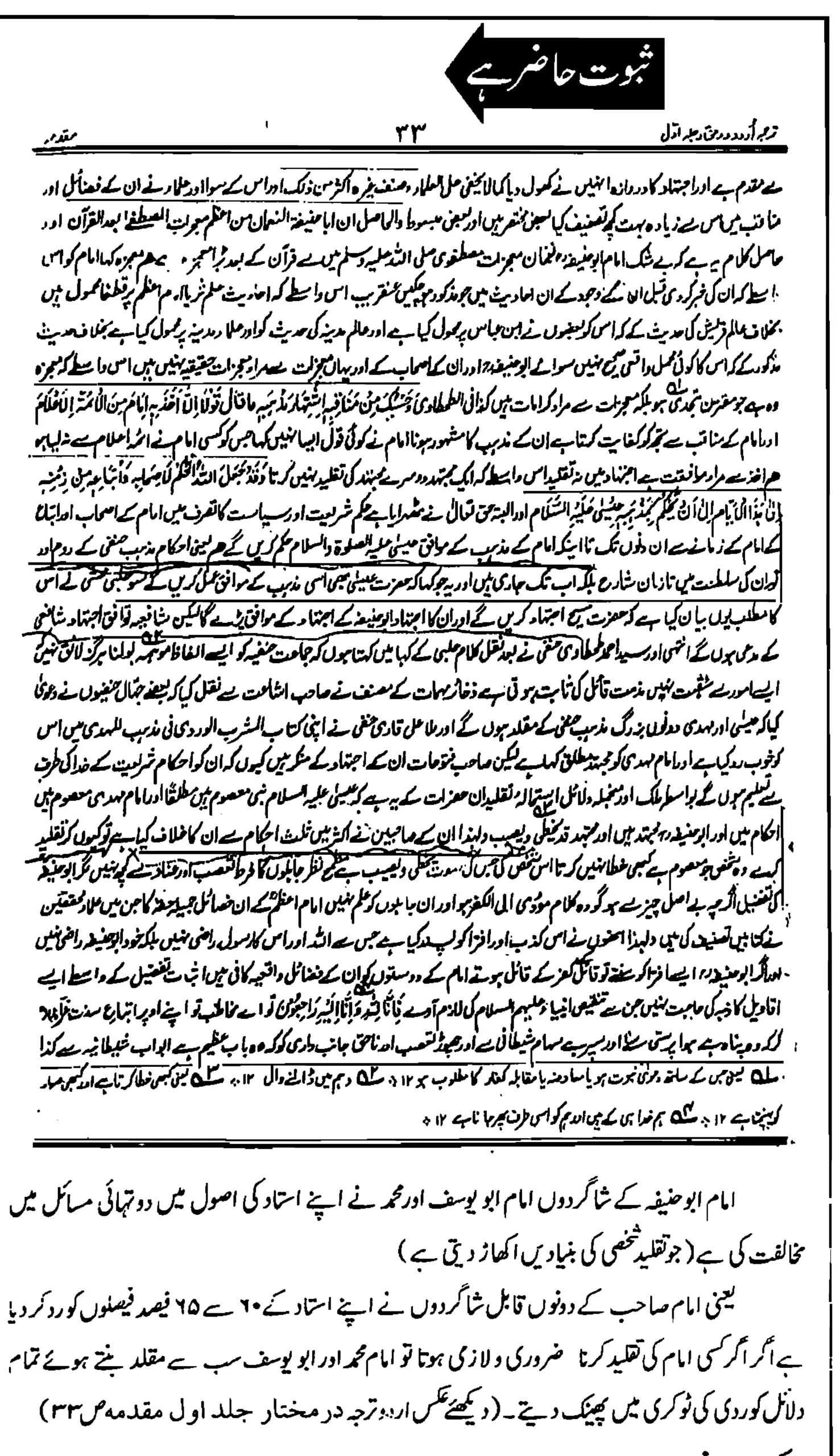
The Sahibs, meaning the students of Imam Abu Hanifa, Imam Muhammad and Abu Yusuf, have opposed Imam Abu Hanifa in more than two-thirds of the issues.
Reference: (Dar Mukhtar:1p33)
◈ It is a matter worth considering. Then why get angry at others who differ with Imam Abu Hanifa, when even his own students differed with him so much?
[8] Imam Abu Hanifa never made a statement that is not supported by evidence from the Quran and Hadith.
Reference: (Sharh Waqaya:11/1)
◈ The truth of this matter is being examined in this chapter.
[9] If the statement of Imam Abu Hanifa and his companions contradicts an authentic Hadith, then the statement of their Imams will be followed, not the Hadith.
Reference: (Muqaddimah Hidayah:110/1)
◈ What an injustice!! This is completely against the Quran and Hadith. Were the Hanafi Imams divinely inspired?
Reference: (An-Nisa: 65,80)
[10] If someone seeking a fatwa asks about the opinion of Shafi'i Rahimahullah on an issue, the Mufti replies by stating the opinion of Abu Hanifa Rahimahullah.
Reference: (Durr Mukhtar:272/4)
◈ This is also a demand of honesty.
[11] Our religion is the truth and the other’s religion is error.
Reference: (Durr Mukhtar:1p26)
◈ All these miracles are of Taqlid (imitation); the truth and falsehood will be revealed in this very chapter.
[12] Even if the Mufti has erred, the common people must follow him.
Reference: (Sharh Waqayah:13)
◈ What is the evidence?
[13] There is consensus among the public that the companions are not to be followed in imitation against the Imams.
Reference: (Sharh Waqayah:13)
◈ It is against the Quran.
Reference: (An-Nisa:115), (Al-Baqarah:137)
[14] A Mujtahid cannot follow another Mujtahid; rather, it is forbidden for him.
Reference: (Durr Mukhtar:33/1), (Muqaddimah Alamgiri:47/1)
◈ If it is forbidden, then it is forbidden for everyone, and if imitation is praiseworthy, then it is for everyone.
[15] Learning Fiqh is superior to learning the rest of the Quran.
Reference: (Durr Mukhtar:19/1), (Alamgiri:129/9)
[16] Studying Fiqh is superior to reading the entire Quran.
Reference: (Alamgiri:129/9 also)
[17] The book Durr Mukhtar was compiled by the permission of the Prophet.
Reference: (Durr Mukhtar:11/1)
◈ It is written that due to its brevity, Durr Mukhtar is not suitable for issuing fatwas.
Reference: (Muqaddimah Hidayah:107/1)
[18] The name of the teacher of the author of Durr Mukhtar was Abdul Nabi.
Reference: (Durr Mukhtar:13/1)
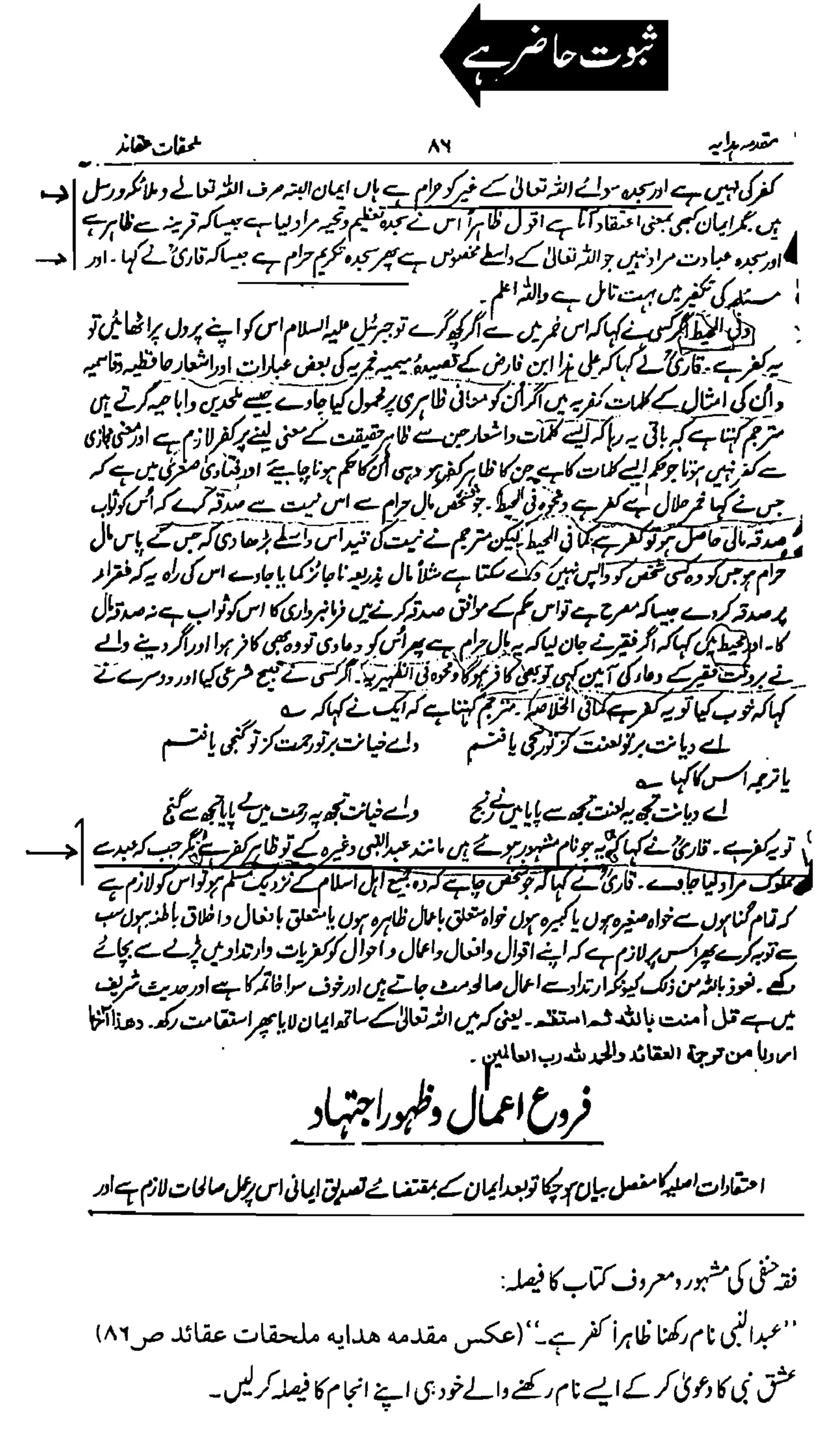
◈ Naming someone Abdul Nabi and the like is apparently disbelief.
Reference: (Muqaddimah Hidayah:86/1)
[19] The faith of the people of the heavens and the earth neither increases nor decreases.
Reference: (Muqaddimah Hidayah:21/1)
◈ This is against many verses of the Quran, and see:
Reference: Bukhari, Book of Faith, Chapter: The Prophet’s Saying ﷺ Islam is Built on Five
[20] A believer is equal in faith and monotheism.
Reference: (Muqaddimah Hidayah:21/1)
◈ معاذ اللہ! How can the faith and monotheism of the Prophets and the lowest level believers be equal?
[21] One who considers it permissible to insult the people of the Qiblah, the Companions (may Allah be pleased with them all), is not a disbeliever.
Reference: (Durr Mukhtar:292/1)
◈ This is a call for justice.
[22] Those who deny the attribute and vision of Allah are not disbelievers.
Reference: (Durr Mukhtar:292/1)
◈ If not them, then who else would be disbelievers?
[23] According to Sahih, one who denies a famous hadith is not a disbeliever.
Reference: (Durr Mukhtar:592/2)
[24] Performing wudu in a disorderly manner (washing feet first, then mouth, then gargling, etc.) is permissible.
Reference: (Hidayah:1/32, 33)
◈ What happened to the method of the Messenger of Allah ﷺ?
[25] If there is fly secretion on the limbs of wudu and water does not reach beneath it, the wudu is valid.
Reference: (Alamgiri:5/1)
[26] If one forgets to wash a limb in wudu but washes the left foot, the wudu is valid.
Reference: (Hidayah:66/1)
[27] It is recommended to recite Surah ،،إنا أنزلنا،، after wudu.
Reference: (Durr Mukhtar:74/1)
[28] Prayer performed without intention through wudu will be valid.
Reference: (Durr Mukhtar:61/1), (Munya:22)
◈ The basis of deeds is intentions
Reference: (Bukhari:54)
— what happened to this famous hadith?[29] Water from soaked dates (Nabeedh-e-Tamr) that has become sweet is permissible for ablution.
Reference: (Alamgiri:32/1)
[30] Using miswak while lying down increases phlegm, holding the miswak in a fist causes hemorrhoids, sucking on the miswak causes blindness, not rinsing after using miswak causes Satan to use the miswak, keeping the miswak longer than a palm causes Satan to ride it, and keeping the miswak unused causes fear of madness. ....
Reference: (Darmukhtar:65/1, 66)
[31] Touching your own or someone else's private parts does not break ablution.
Reference: (Alamgiri:18/1)
[32] Having intercourse with a living or dead animal or a young girl does not break ablution.
Reference: (Alamgiri:22/1), (Darmukhtar:1/95, 96)
◈ Shame does not come to you, however.
[33] If semen is discharged without desire due to lifting a heavy load, Ghusl is not obligatory.
Reference: (Darmukhtar:91/1)
[34] If semen separates from desire, then one holds the remembrance (zikr), and after holding it, semen is discharged without desire, Ghusl is not obligatory. (Abu Yusuf)
Reference: (Darmukhtar:92/1), (Alamgiri:20/1), (Sharh Waqaya:33/1)
[35] If semen is discharged without desire, Ghusl is not obligatory. (Abu Yusuf)
Reference: (Darmukhtar:93/1)
[36] If one has intercourse with an animal, a dead person, or an underage girl and there is no ejaculation, then Ghusl is not obligatory.
Reference: (Durr-e-Mukhtar:95/1, Al-Amiri:22/1, Hidayah:87/1)
[37] If one inserts the mention of an animal into the private parts (front or back), Ghusl is not obligatory.
Reference: (Durr-e-Mukhtar:95/1)
[38] If one has intercourse with a virgin and her virginity remains intact, Ghusl is not obligatory.
Reference: (Durr-e-Mukhtar:96/1)
◈ Is this possible?
[39] After the days of menstruation are completed, intercourse without Ghusl is permissible.
Reference: (Statement of Abu Hanifa. Hidayah:88/1, Sharh Waqayah:65, Quduri:74)
◈ It is against the Quran and Hadith.
Reference: (Al-Baqarah:122), (Al-Sunan al-Kubra by Bayhaqi:462/1)
[40] After forty days of postpartum bleeding, intercourse without Ghusl is permissible.
Reference: (Sharh Waqayah:65)
[41] If a man's urine or impurity falls into a pool, it remains pure.
Reference: (Durr-e-Mukhtar:108/1)
And if grape syrup is filled in such a pool and urine falls into it, it remains pure.
Reference: (Hidayah:139/1, 140)
If a dog dies in such a pool, ablution is permissible on the other side of it.
Reference: (Bahishti Zewar:47/1)
[42] If a dog falls into the pool and dies, and if it settles at the bottom, ablution is permissible.
Reference: (Durr-e-Mukhtar:112/1)
[43] If the hair of all animals except the pig falls into the water, the water remains pure.
Reference: (Durr-e-Mukhtar:118/1)
[44] Thin impurity (human urine) is excused up to the depth of the palm.
Reference: (Darmukhtar:167/1-Alamgiri:71/1-Hidayah:288/1)
If the urine of animals whose meat is halal soaks less than a quarter of the cloth, it is excused.
Reference: (Darmukhtar Vol.1, p.168-Alamgiri 71/1-Sharh Waqayah:69-Kanz:25)
[45] Thick impurity, i.e., feces, semen, pre-ejaculate, if it soaks 3.5 Masha of cloth, the cloth is considered pure.
Reference: (Alamgiri:71/1-Qaduri:182)
[46] If hundreds of urine splashes fall equal to the tip of a needle, it is pure.
Reference: (Alamgiri:71/1-Darmukhtar:169/1)
[47] Drinking urine and blood and eating carrion is permissible for the sick by the advice of a skilled physician.
Reference: (Darmukhtar:249/4-Sharh Waqayah:62/4)
[48] Wheat that has swollen in urine, if soaked and dried three times, is pure.
Reference: (Darmukhtar:172/1)
[49] A cloth soaked with impurity, if licked until the effect of impurity is removed, it is pure.
Reference: (Hidayah:278/1-Alamgiri:70/1)
[50] The limb on which impurity has fallen becomes pure after licking three times.
Reference: (Alamgiri:70/1)
◈ If the mouth becomes impure, it is excused.
[51] If impurity falls on a knife, it becomes pure by licking.
Reference: (Alamgiri:70/1-Hidayah:282/1)
[52] If the forefinger or nipple becomes impure, it becomes pure by licking.
Reference: (Darmukhtar:164/1)
[53] Impure milk becomes pure by boiling three times.
Reference: (Darmukhtar:172/1)
[54] Impure honey becomes pure after boiling three times. Similarly, impure oil, milk, and dates become pure after boiling three times. Likewise, meat broth containing impurity becomes pure after boiling three times.
Reference: (Also)
[55] It is permissible to use a forbidden substance as medicine if there is certainty of cure.
Reference: (Hidayah:139/1)
[56] Meat cooked in alcohol becomes pure after boiling three times and drying.
Reference: (Durr-e-Mukhtar:172/1)
[57] Wheat cooked in alcohol becomes pure after boiling and drying several times.
Reference: (Durr-e-Mukhtar:172/1)
[58] If bread is baked from dough kneaded with alcohol, it becomes pure if enough vinegar is added to remove the effect of alcohol.
Reference: (Durr-e-Mukhtar:172/1)
[59] If pork falls into salt and becomes salted, it is pure.
Reference: (Durr-e-Mukhtar:170)
[60] The dog is not najis al-‘ayn (intrinsically impure), and selling dogs is permissible.
Reference: (Durr-e-Mukhtar:119,118)
[61] If a dog puts its mouth into an earthenware pot, it becomes pure after washing three times.
Reference: (Bahishti Zewar:1/51)
◈ The hadith commands washing seven times.
[62] There is no objection to making kohl from dog hair.
Reference: (Hidayah:1/292)
[63] The bone, hair, and muscles of a dog are pure, and the skin of a dog can be used for making a prayer mat.
Reference: (Darmukhtar:119/1, 118-Hidayah:1/135)
Except for the skin of a pig, the skin of every animal becomes pure through tanning.
Reference: (Darmukhtar:1/117)
The skin of a pig also becomes pure through tanning.
Reference: (Munya:4)
Human skin becomes pure through tanning. The skin of a dog and a bat also becomes pure through tanning.
Reference: (Darmukhtar:1/117)
[64] If a forbidden animal other than a pig is slaughtered with Bismillah, then all its parts, fat, and meat are pure.
Reference: (Hidayah:174/4, 173)
[65] Except for the pig, the hair of all is pure.
Reference: (Darmukhtar:1/118)
[66] The fat and milk of a dead animal are pure.
Reference: (Darmukhtar:1/118)
[67] Order is not a condition in Tayammum.
Reference: (Sharh Waqayah:1/54)
[68] Tayammum with mud is permissible.
Reference: (Hidayah:1/179)
Reference: [فَتَیَمَّمُوۡا صَعِیۡدًا طَیِّبًا](An-Nisa:43)
What happened to this ruling?[69] If there is dust on the back of a pig or dog, Tayammum is permissible. (Abu Hanifa)
Reference: (Hidayah:182/1)
[70] Adhan in Persian or any other language is permissible if people understand that the Adhan has been called.
Reference: (Darmukhtar:247/1-Hidayah:449/1)
[71] It is permissible to start the prayer in a language other than Arabic. Instead of __ARABIC_3, saying ARABIC_4__ is permissible. Instead of __ARABIC_5, saying ARABIC_6__ is permissible. Instead of __ARABIC_7, saying ARABIC_8__ is permissible. It is also permissible to read the translation of اللہ اکبر in Persian. All the remembrances (adhkar) of prayer, the sermon, and praise etc. are correct in every language.
Reference: (Durr-e-Mukhtar, Alamgiri)
All adhkar except recitation are permissible in a language other than Arabic even if one does not know Arabic. (Opinion of Abu Hanifa)
Reference: (Durr-e-Mukhtar:247/1 - Hidayah: 449/1)
[72] All the adhkar of prayer and the sermon etc. are correct in every language.
Reference: (Durr-e-Mukhtar:246/1 - Hidayah:446/1)
[73] A woman should fold her hands on her chest.
Reference: (Durr-e-Mukhtar, Alamgiri - Hidayah:451/1 - Sharh Waqayah:84/1)
[74] If the Imam starts the recitation, the follower should recite __ARABIC_10.
Reference: (Alamgiri:141/1)
◈ Now what happened to the ruling of the verse: ARABIC_11__
Reference: Al-A'raf:204
?[75] One who denies بسم اللہ is not a disbeliever.
Reference: (Durr-e-Mukhtar:251/1)
◈ Although this is the Quran.
Reference: (An-Naml:30)
[76] Reciting Durood (salutations on the Prophet) is not obligatory according to us.
Reference: (Hidayah - Sharh Waqayah:96)
[77] If one intentionally emits a sound (hadath) at the time of Salam, the prayer is not invalidated, and there is no need to turn the Salam again.
Reference: (Durr-e-Mukhtar - Hidayah:620 - Sharh Waqayah:104)
[78] If one intentionally laughs loudly at the time of Salam, the prayer is not broken.
Reference: (Hidayah:620/1)
[79] If the Imam talks after the Tashahhud or leaves the mosque, the prayer is valid.
Reference: (Sharh Waqayah:105)
[80] It is permissible for a person in a state of janabah or a dog to cover their mouth and pray.
Reference: (Darmukhtar:119/1)
[81] If impurity is on the place of urination or the anus, even if abundant, the prayer is valid.
Reference: (Darmukhtar:173/1)
[82] Calling a dog or cat or driving a donkey does not invalidate the prayer.
Reference: (Darmukhtar:322/1-Hidayah:623/1)
[83] If the Imam's recitation is pleasing to the follower, and the follower cries out asking why not, or says yes or indeed, the prayer is not invalidated.
Reference: (Darmukhtar:325/1)
[84] Turning the face away from the Qiblah during prayer, even if turned completely around, does not invalidate the prayer.
Reference: (Darmukhtar:330/1)
[85] If a man is praying and a woman kisses him, the prayer is not invalidated; however, if the praying man kisses the woman, the prayer will be invalidated. ....
Reference: (Darmukhtar:30/1, 329-Alamgiri:164/1)
[86] According to Hanafi jurisprudence, a rare example of the prayer of the Hanafi followers is found in
Reference: Kitab Hayat al-Hayawan al-Kubra, published in Egypt (214/2)
, which states that King Sultan Mahmud, may Allah have mercy on him, followed the school of Imam Abu Hanifa, may Allah have mercy on him, and was eager for the knowledge of Hadith. He used to listen to Hadith from the elders and inquire about them. He often found the Hadith to be in accordance with the Shafi'i school. He gathered the jurists and demanded from them a preference of one school over the other. They all agreed that two rak'ahs of prayer should be performed in accordance with both schools. Therefore, by reflecting on this prayer, one should adopt the school that seems better. When Qaffal Marwazi began to pray, he performed ablution with all its conditions, properly wore his clothes and faced the Qibla, and performed the pillars, obligatory and Sunnah acts, and etiquettes of prayer to perfection. He prayed in such a manner that, according to Imam Shafi'i, may Allah have mercy on him, was not correct. Then he performed two more rak'ahs in a way that was permissible according to Imam Abu Hanifa, may Allah have mercy on him. He wore tanned dog skin, which he soiled with a quarter impurity, and performed ablution with date wine (nabidh). Since it was the hot season, flies and mosquitoes gathered on him, and he performed ablution unintentionally and in reverse order, meaning he washed the left foot first, then the right foot, then wiped a quarter of the head in reverse, then washed the face in reverse, then rinsed the nose three times, gargled three times, and then washed the hands. When he entered the prayer, instead of saying the Takbir, he said in Persian [God is Great]. Then during recitation, instead of [مُدْھَآمَّتٰان], he said in Persian "green leaf". Instead of prostration, he pecked like a bird, and at the end, in the Tashahhud, he farted and left the prayer without saying Salam, saying, "O King! This is the prayer of Imam Abu Hanifa." The king said that if this was not the prayer of Abu Hanifa, he would kill him, because no pious person would consider such a prayer permissible. Therefore, the Hanafis denied that Imam Abu Hanifa, may Allah have mercy on him, prayed in this way (as they do now). Then Qaffal Marwazi requested the books of the Hanafi school. The king sent for them and called a Christian scholar and ordered him to read the books of the Shafi'i and Hanafi schools. The prayer of Imam Abu Hanifa, may Allah have mercy on him, was found exactly as Qaffal Marwazi had demonstrated. The king then abandoned the school of Imam Abu Hanifa, may Allah have mercy on him, and adopted the school of Imam Shafi'i, may Allah have mercy on him.O my respected Hanafis! If you also want to find reassurance and satisfaction regarding the prayer of Qafal Marwazi, then carefully review
Reference: the issues referenced above at numbers 63, 44, 29, 71, 77,
and after that, if you wish, you may reject the school of Sultan Mahmud, otherwise at least confirm it.[87] Sequence in the actions of prayer is not obligatory.
Reference: (Hidayah:619/1)
[88] Whoever wants to pray Sunnah before Fajr, his method is to first pray Sunnah after the obligatory, then break it, and then pray Sunnah after the obligatory.
Reference: (Alamgiri: 334/10 - Hidayah:932/3)
[89] The one deserving of leading the prayer is the one whose wife is better.
Reference: (Durr-e-Mukhtar:290/1)
[90] Congregational prayer for women is makruh tahrimi (prohibited) and an innovation.
Reference: (Hidayah:1/574)
◈ It is against the Hadith.
Reference: Sunan ad-Daraqutni: Hadith 1071, its chain is Hasan Lidhatihi, [Sunan Abi Dawood, Book of Prayer, Chapter on Women Leading Prayer:592], [Sahih Ibn Khuzaymah: 1676], [Al-Muntaqi Ibn al-Jarood: 333]
[91] Recitation prostration (Sajdat al-Tilawah) can be done even from bowing (Ruku).
Reference: (Durr-e-Mukhtar:398/1)
[92] Do not recite Durood in Qunoot.
Reference: (Alamgiri:177/1)
◈ This position is against the Hadith.
Reference: Ibn Khuzaymah: Hadith 1100, its chain is Sahih, [Fadl as-Salah 'ala an-Nabi by Qadi Ismail:107]
[93] It is permissible to give expiation (Kaffarah) for a missed prayer.
Reference: (Durr-e-Mukhtar:378/1)
[94] The method of expiation for missed prayers is to give two seers of wheat to a poor person, then ask for it back as a gift, and do this daily until the expiation for all missed prayers is completed.
Reference: (Alamgiri:337/10-Hidayah:934/4, 935)
[95] Do not recite Qunoot in any prayer except Witr.
Reference: (Hidayah:1/p685)
◈ It is written later that reciting Qunoot in Fajr prayer is established from the four Rightly Guided Caliphs and most of the Companions, may Allah be pleased with them.
Reference: (Hidayah:683/1)
Both opinions are worth considering.[96] One of the conditions of Jumu'ah is that it should be in a city where the Shariah boundaries are established.
Reference: (Durr al-Mukhtar-Alamgiri-Hidayah:821/1-Sharh Waqayah:134/1)
◈ This condition is missing worldwide, therefore Jumu'ah is invalid.
[97] Another condition of Jumu'ah is the presence of a king or his deputy.
Reference: (Hidayah:823/1-Sharh Waqayah:139/1)
◈ This is also missing in many places.
[98] It is permissible to deliver the Jumu'ah sermon while sitting.
Reference: (Hidayah:1/p72-Quduri:145/1)
◈ This is against the Quran.
Reference: (Al-Jumu'ah:11)
[99] On the day of Jumu'ah, souls gather together.
Reference: (Durr al-Mukhtar:427/1)
It is merely baseless. In Albazaziya, it is stated that our scholars say that whoever says that the souls of the spiritual guides are present and also teach or have knowledge, such a person will be declared an unbeliever, meaning he will become a disbeliever.
Reference: (Aks-o-Tarjuma Bahr al-Raiq Sharh Kanz al-Daqa'iq Ibn Najim: 124/5)
[100] The conditions that apply to Friday prayer are also obligatory for the two Eids.
Reference: (Sharh Waqaya:173/1-Kanz)
[101] Saying the Takbeerat of Eid al-Adha aloud is an innovation.
Reference: (Hidayah:846/1-Dar Mukhtar)
Reference: In Hidayah and Sharh Waqaya (139/1) it is stated that saying the Takbeer aloud in the two Eids, this is the Sunnah (on the way and in the Eidgah).
[102] If Zakat is given to someone under the name of a gift, but the intention in the heart is made for Zakat, then the Zakat will be fulfilled.
[102] If Zakat is given to someone under the name of a gift, but the intention in the heart is made for Zakat, then the Zakat will be fulfilled.
Reference: (Bahishti Zewar:24/3)
[103] The trick to avoid paying Zakat is that the person who has wealth equal to the Nisab gives one Dirham as charity before a year passes or gives some Dirhams as a gift to his children so that the wealth becomes less than the Nisab, then Zakat will not be obligatory. (Abu Yusuf)
Reference: (Dar Mukhtar: 505/1-Alamgiri:334/10-Hidayah:932/4)
[104] A person who wants to receive Zakat from his debt can do so by giving Zakat to a needy relative and then recovering it from him as debt. If he does not give, then he can take it by force.
Reference: (Durr-e-Mukhtar-Alamgiri:336/10-Hidayah:933/4)
[105] The second method is to tell the debtor to appoint my servant as his agent so that he collects Zakat from me and then returns it to me as debt.
Reference: (Alamgiri:336/10-Hidayah:933/4)
[106] A person who wants to spend Zakat on the construction of a mosque can do so by giving Zakat to someone who then spends it on the mosque.
Reference: (Durr-e-Mukhtar:487/1)
[107] Keep the fast on the doubtful day secretly, so that the public does not know. It is unanimously better to fast on the doubtful day with the intention of a voluntary fast.
Reference: (Durr-e-Mukhtar:553/1)
◈ It is not better but rather against the Hadith; whoever does this is disobedient to the Messenger of Allah ﷺ.
Reference: Sunan Tirmidhi, Book of Fasting, Chapter on the Dislike of Fasting on the Doubtful Day:686, Abu Dawood, Book of Fasting, Chapter on the Dislike of Fasting on the Doubtful Day:2334, Nasa'i, Book of Fasting, Fasting on the Doubtful Day:2190
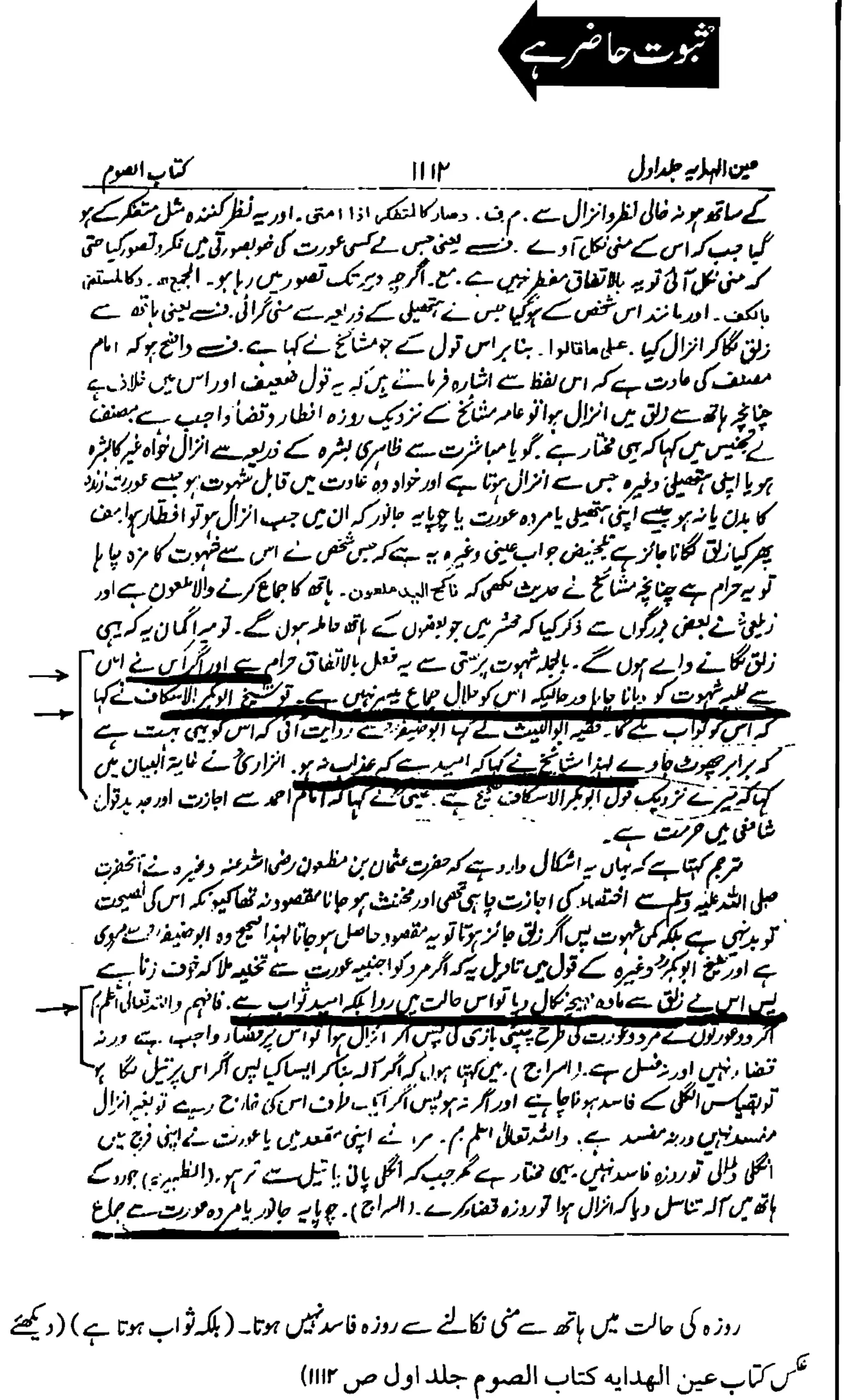
[108] Extracting semen by hand does not invalidate the fast.
Reference: (Durr-e-Mukhtar:564/1-Hidayah:1112/1)
[109]If one withdraws semen by masturbation out of fear of committing adultery, it is expected that there will be no sin.
Reference: (Durr-e-Mukhtar:564/1-Hidayah:1112/1)
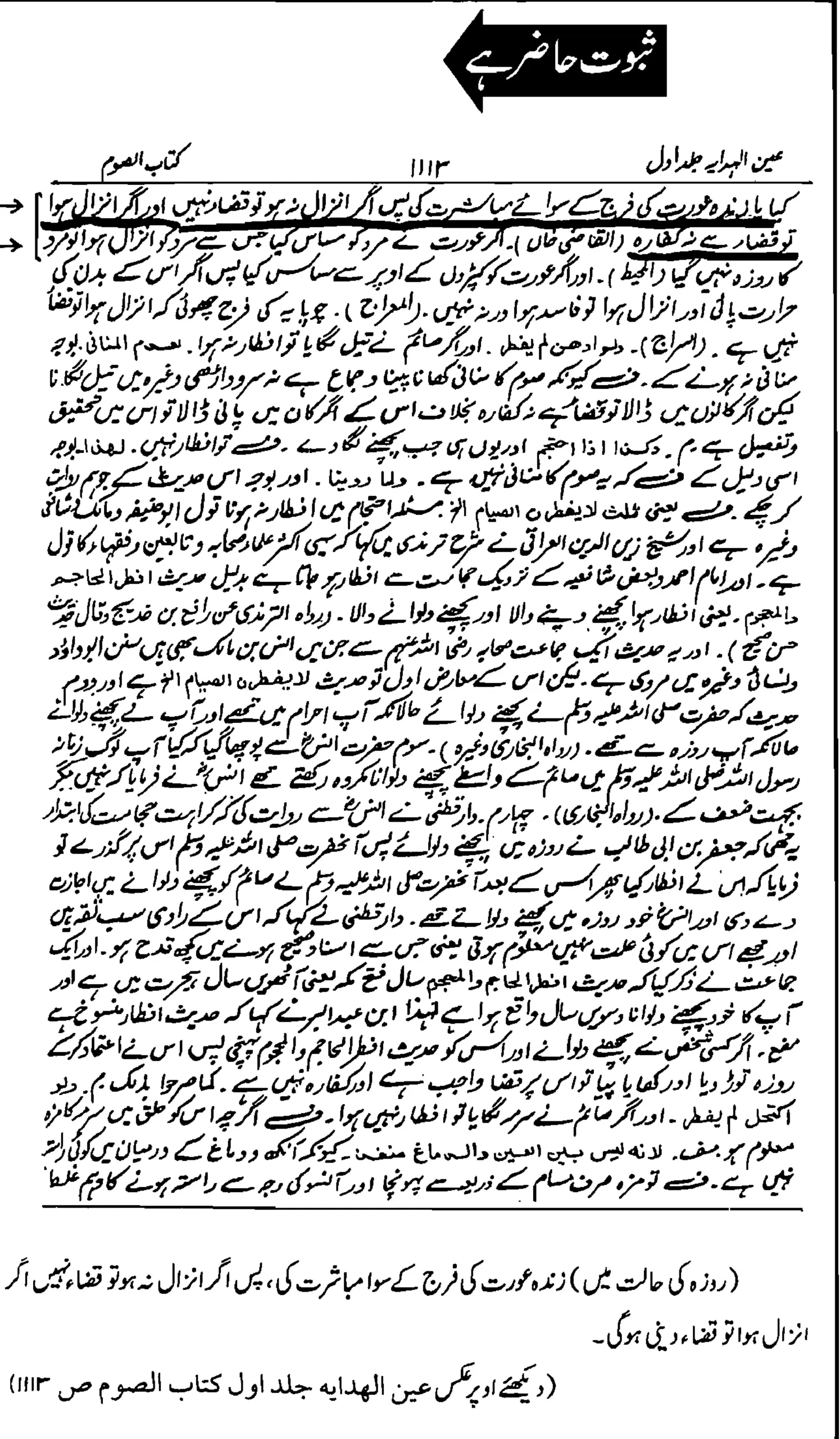
[110]If one touches the private parts of an animal or kisses its mouth and ejaculation occurs, the fast is not broken.
Reference: (Durr-e-Mukhtar:564/1-Alamgiri:19/2-Hidayah:1116/1)
[111]If intercourse is done with a dead woman, the fast is not broken.
Reference: (Durr-e-Mukhtar:567/1)
[112]If a woman is touched over her clothes and ejaculation occurs, and no heat is felt, the fast is not broken.
Reference: (Alamgiri:19/2)
[113]If intercourse is done in the thigh or other places and ejaculation occurs, there is no expiation for the fast.
Reference: (Al-Quduri:189)
[114]If semen comes out due to kissing during fasting, there is no expiation.
Reference: (Al-Quduri:189)
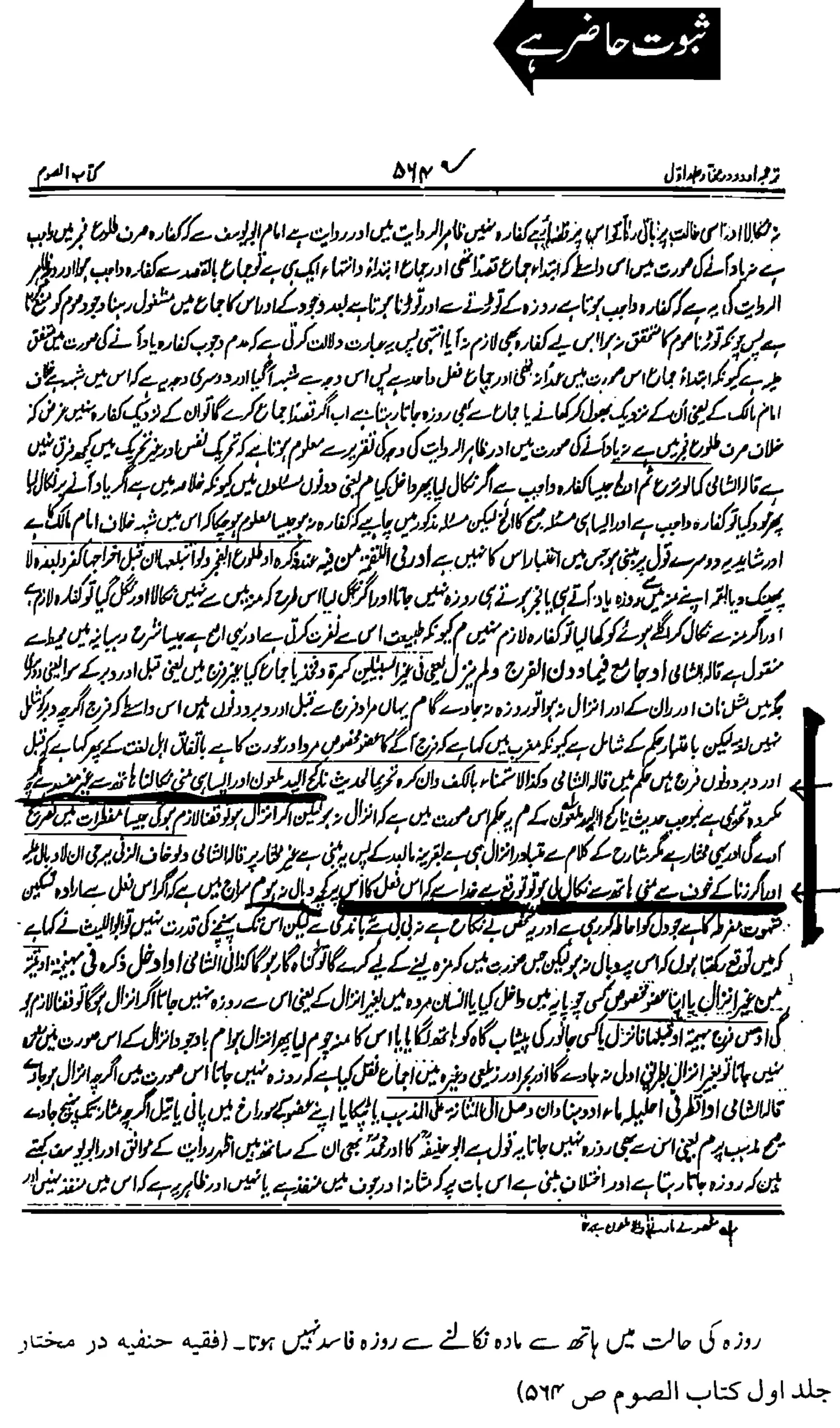
[115]Medina is not a sacred sanctuary (Haram).
Reference: (Durr-e-Mukhtar:676/1)
◈This is completely against the Hadith.
Reference: Muslim, Book of Hajj, Chapter on the virtue of Medina... etc: 1360], [Abu Dawood, Book of Manasik, Chapter on the prohibition of Medina:2034
[116]If a man's hand touches his daughter or a woman's hand touches her son while waking them up at night, the husband and wife become unlawful to each other.
Reference: (Durr-e-Mukhtar:18/2-Alamgiri:140/2)
[117]Looking at one's daughter's private parts with desire becomes unlawful.
Reference: (Durr-e-Mukhtar:19/2-Alamgiri:139/2)
[118] If a woman presents false witnesses claiming that she has married a certain man and the judge accepts it, then it is permissible for the man to have intercourse with her. (Abu Hanifa)
Reference: (Durr al-Mukhtar:26/2 - Al-Amiri:155/2)
[119] Similarly, if a man falsely claims to a woman and obtains a degree (certificate), then it is permissible for the man to have intercourse with that woman. (Abu Hanifa)
Reference: (Al-Amiri:155/2)
[120] A temporary marriage (Nikah Mut'ah) will be contracted when its duration is so long that a person cannot live until the end of that period. (Abu Hanifa)
Reference: (Al-Amiri:155/2)
[121] Mut'ah is valid. (Imam Zafar)
Reference: (Sharh Waqayah:11/2)
[122] According to Imam Abu Hanifa, may Allah have mercy on him, breastfeeding (Rada'ah) lasts two and a half years.
Reference: (Durr al-Mukhtar:88/2 - Sharh Waqayah:31/2 - Quduri:410)
It is against the explicit text of the Qur'an.
Reference: (Al-Baqarah:233)
[123] If the man is at the western end and the woman is at the eastern end, at such a distance that there is a year's journey between them, and somehow their marriage is contracted, if after the date of marriage the woman gives birth within six months, then this child will be considered legitimate, not illegitimate, rather the child will be regarded as the honor of that man.
Reference: (Durr al-Mukhtar:268/2, 269)
◈ Refuge with Allah.
[124] If a man gives his wife a revocable divorce, and a boy is born within less than two years, then the boy is of the same husband and is not illegitimate.
Reference: (Bihishti Zewar:29/4)
[125] If the marriage contract is done but the bride has not been sent to the husband's house, and a boy is born, then the boy is of the husband and is not illegitimate.
Reference: (Bihishti Zewar:30/4)
[126] If the husband is abroad and years have passed, and a boy is born here, then the boy is of the husband and is not illegitimate.
Reference: (Bihishti Zewar:60/4)
[127] If a woman who is permanently forbidden (mother, sister, daughter, maternal aunt, paternal aunt, etc.) is married and treated as lawful, then there is no Hudood punishment. (Abu Hanifa)
Reference: (Durr Mukhtar:472/2 - Al-Amgiri:3/464 - Hidayah:2/264 - Sharh Waqayah:2/95 - Kanz:411 - Quduri:495)
[[Note that in the Quran these women have been declared forbidden.
Reference: (An-Nisa:22, 23)
][128] Even if one knowingly marries a Mahram (permanently forbidden woman), there is no Hudood punishment. (Abu Hanifa)
Reference: (Durr Mukhtar:472/2)
[129] If a woman is taken on lease (by paying expenses) and commits adultery, there is no Hudood punishment.
Reference: (Durr Mukhtar:474/2 - Al-Amgiri:3/465)
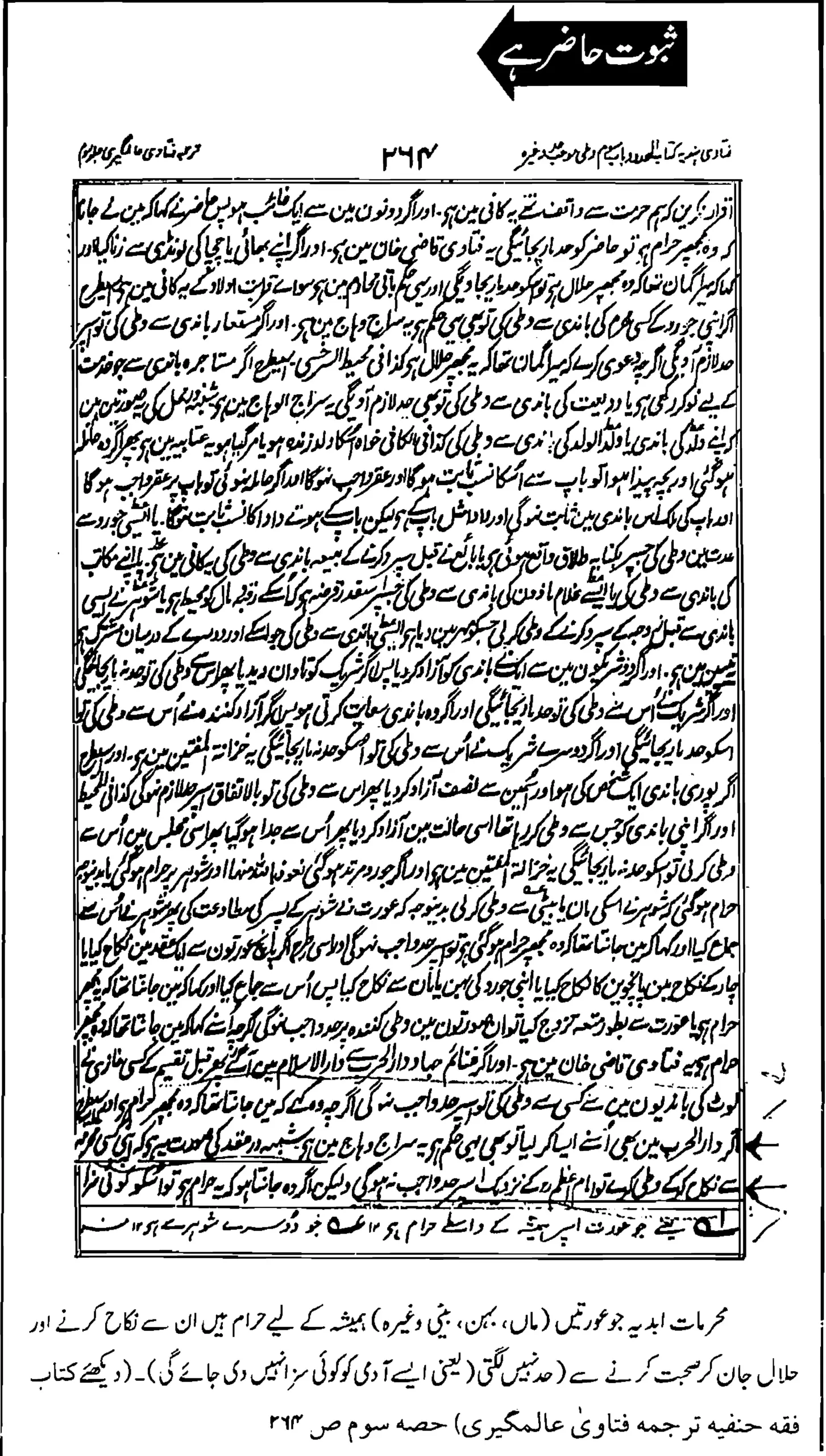
◈ Why wouldn’t adulterers be happy.
[130] If a Caliph, Imam, or King commits adultery, there is no Hudood punishment.
Reference: (Durr Mukhtar:476/2 - Al-Amgiri:3/270 - Hidayah:2/463 - Sharh Waqayah:2/96 - Kanz:411)
◈ Our challenge is to prove this from Quran and Hadith.
[131] There is no Hudood punishment for intercourse with an animal.
Reference: (Durr Mukhtar:472/2 - Al-Amgiri:3/468 - Hidayah:2/545 - Sharh Waqayah:2/95, 96)
◈ The hadith states that this person and the animal should be killed.
Reference: Tirmidhi, Book of Hudood, Chapter on Whoever Has Sexual Intercourse with an Animal: 1455
[132] There is no hudood punishment for a shroud thief.
Reference: (Durmukhtar: 2/517 - Al-Amgiri: 3/316)
[133] If someone steals milk or meat, there is no hudood; if someone steals wood, grass, fruit, or standing crops, steals the mosque door, steals the Quran, steals someone's child, loots property, or steals from the royal treasury, there is no hudood punishment.
Reference: (Sharh Waqayah: 2/101 to 103)
It is completely against the Quran and Hadith.
[134] The wife of a missing person should wait ninety years.
Reference: (Al-Amgiri: 3/511, 510 - Hidayah: 2/936 - Sharh Waqayah: 2/122 - Kanz: 460)
Use reason, is this possible?
[135] It is permissible to slaughter with fire.
Reference: (Durmukhtar: 184/4)
[136] Reciting بسم اللہ، اللہ اکبر is disliked.
Reference: (Durmukhtar: 188/4 - Al-Amgiri)
◈ It is against the hadith.
Reference: Muslim, Book of Sacrifices, Chapter on the Recommendation of Preferring the Morning Sacrifice... etc.: 1966
[137] Animals that are given alcohol and then slaughtered immediately are halal.
Reference: (Durmukhtar: 217/4 - Hidayah: 303/4)
[138] A crow that eats both carrion and grains is halal. (Abu Hanifa)
Reference: (Al-Amgiri: 439/8 - Durmukhtar: 193/4)
[139] Eating bull meat is disliked.
Reference: (Hidayah: 181/4)
◈ It is against the authentic hadith of Bukhari.
Reference: Bukhari, Book of Food, Chapter: The Prophet ﷺ did not eat until he named it so he would know what it was: 5391, 5537
[140] Sacrifice of a usurped animal is permissible.
Reference: (Sharh Waqayah:53/4)
[141] Sacrifice in the village before Eid al-Adha and after the morning prayer is valid.
Reference: (Kanz:328/2 - Bahishti Zewar:28/3)
◈ Contrary to Hadith.
Reference: Bukhari, Book of Sacrifice, Chapter: Whoever slaughtered before the prayer should repeat it: 5561
[142] Socks made from pig hair are permissible.
Reference: (Hidayah:322/4)
[143] Using a dog's bone for medicine is permissible.
Reference: (Alamgiri:88/9 - Hidayah:322/4)
[144] If land is usurped and a mosque is built on it, there is no fear.
Reference: (Alamgiri:26/9)
[145] Abu Yusuf prepared a type of grape wine for Caliph Harun al-Rashid, this wine was called Abiyusfi.
Reference: (Durr Mukhtar:3/290, Alamgiri:9/181)
[146] Wine made from wheat, barley, honey, and millet is halal.
Reference: (Hidayah:4/435)
◈ Contrary to Hadith.
Reference: Abu Dawood, Book of Drinks, Chapter: Prohibition of Wine: 3669, Muslim, Book of Drinks, Chapter: Prohibition of Wine and Explanation... etc.: 1980
[147] Wine made from dates and Munqi is halal.
Reference: (Qaduri:508)
[148] Whoever drinks nine cups of wine and does not become intoxicated, but becomes intoxicated after the tenth cup, then this tenth cup is haram, but the previous nine are not.
Reference: (Durr Mukhtar:4/294)
This is against the Quran.
Reference: (Al-Ma'idah:90)
[149] Except for alcohol, drinking other intoxicants is not forbidden as long as there is no intoxication.
Reference: (Hidayah:2/566)
[150] The research is that cannabis is permissible.
Reference: (Hidayah:2/567)
◈ It is against the Hadith because whatever causes intoxication is forbidden according to the Hadith.
Regarding trickery in Hanafi Fiqh, we have mentioned some points on previous pages, and now we will explain the tricks of Imam Abu Hanifa’s teacher, Ibrahim al-Nakha'i:
[1] When you go to sleep, tell the servant that if anyone asks for permission to enter the house, say that he is not here, meaning that where you are standing, you are not standing there.
Reference: (Alamgiri:10/405-Hidayah:3/943)
[2] If someone wants to meet you and you do not want to meet him, then mount a pillow or something and tell the servant to say that you have mounted.
Reference: (Ibid)
[3] If someone asks to borrow something from you and you do not want to give it, then place your hand on the ground and say that it is not here.
Reference: (Ibid)
This is a clear violation of the Quran.
Reference: (Al-Ma'un:7)
The Hanafi jurisprudential books are not actually written by Imam Abu Hanifa himself; rather, they were compiled by later people several centuries afterward. Can it be claimed that all the statements and opinions attributed to him in these books are authentic?
The books of the Hanafis and the books of Hadith are available and circulated worldwide and are accessible almost everywhere. If someone loves the Messenger of Allah ﷺ and the noble Companions, may Allah be pleased with them, and their actions are acceptable, then every issue of Hanafi jurisprudence should be examined in light of the books of Hadith, and this task needs to be done very quickly. If there is truly any spark of faith, work should begin today so that the status of Hanafi jurisprudence becomes clear and the public also comes to know whether the abhorrent issues in Hanafi jurisprudence are based on the conduct of the Messenger of Allah ﷺ and the Companions or not. For example, the permissibility of paying a prostitute, the permissibility of intercourse with a woman after falsely claiming a degree, the absence of any punishment for bestiality, and even no punishment for dishonoring eternal prohibitions (such as mother, sister), etc. For these issues, one should refer to Sharh Waqaya, Hidayah, and Fatawa Alamgiri, etc. As for the senior Hanafi jurists like Imam Abu Hanifa, Qadi Abu Yusuf, etc., the works of theirs that currently exist in the world are probably not even accepted by the Hanafis themselves, as has been mentioned earlier.
In short, the Muslims changed the taste of their mouths by taking garlic and onion instead of Manna and Salwa (i.e., the Quran and Hadith). Manna and Salwa were taken away from them, and they were left only with garlic and onion. For references, see:
Reference: (Al-Baqarah:61, 42, 79), (Al-An'am:153), (Az-Zukhruf:43)
[1] And keep your clothes clean.
Reference: (Al-Muddathir:4)
And in Fiqh it is written that if a small amount of severe impurity, i.e., feces, semen, or urine equal to 3.5 Masha (a unit) falls on the clothes, it is still permissible to pray with them.
Reference: (Qaduri: p.75 - Al-Amgiri Vol.1 p.71)
[2] Faith of the people of the heavens and the earth neither increases nor decreases.
Reference: (Muqaddimah Ain al-Hidayah: Vol.1 p.21)
Commentary:
This is against the Quran. The faith of every believer increases or decreases according to their levels of deeds and beliefs. As clearly stated in the following places in the Holy Quran:
Reference: (Aali Imran: 173, At-Tawbah:124, Al-Kahf:13, Maryam:76, Al-Ahzab:22, Muhammad:17, Al-Fath:4)
There are numerous narrations on this issue in the books of Hadith. In short, this issue is completely against the Quran and Hadith.[3] Those who deny the attributes and vision of Allah are not disbelievers.
Reference: (Darmukhtar: Vol 1, p. 292)
Commentary:
Whoever denies the attributes of Allah denies the entire Quran, so who then would be the disbelievers?
[4] According to the authentic view, one who denies a famous hadith is not a disbeliever.
Reference: (Darmukhtar: Vol 2, p. 592)
Commentary:
Denying an authentic hadith means at least denying 31 verses of the Quran which command obedience to the Prophet ﷺ.
For example
Reference: (An-Nisa: 115, 80, 64 to 70, 13, 14, 56)
so who then would be the disbelievers?[5] One who denies بسم اللہ is not a disbeliever.
Reference: (Darmukhtar: Vol 1, p. 251)
Commentary:
بسم اللہ الرحمن الرحیم is a verse of the Quran
Reference: (An-Naml: 30)
Denying even one verse of the Quran is disbelief.[6] According to Imam Abu Hanifa, breastfeeding (a mother nursing a child) lasts two and a half years.
Reference: (Darmukhtar: Vol 2, p. 88; Quduri p. 410; Sharh Waqaya: Vol 2, p. 31)
Commentary:
This is against the explicit text of the Quran.
Reference: (Al-Baqarah: 233)
[7] If a man marries and lives with women who are permanently forbidden (mother, sister, daughter, maternal aunt, paternal aunt, etc.) thinking it lawful, there is no hadd punishment.
Reference: (Darmukhtar: Vol 2, p. 472; Alamgiri: Vol 3, p. 264; Ain al-Hidayah: Vol 2, p. 457; Sharh Waqaya: Vol 2, pp. 95-96; Kanz: p. 411; Quduri: p. 495)
Commentary:
It should be remembered that Muharram is permanently forbidden for women in the Quran.
Reference: (An-Nisa:23)
And the Quran is authoritative. Denying the Quranic text makes one a disbeliever. And there is a hadith narrated from Bara bin Azib رضي الله عنه who said that my maternal uncle Abu Hurairah رضي الله عنه passed by me with a mark on him. I asked where he was going, he said that the Messenger of Allah ﷺ has sent me to a man who has married his father's wife. The command of the Messenger of Allah ﷺ is that I should behead him and bring (his wealth).
Reference: (Tirmidhi and Abu Dawood, An-Nasa'i, Ibn Majah and Darimi) cited in Kitab al-Zafar al-Mubeen p. 203
[8] If a caliph, imam, or king commits adultery, there is no punishment.
Reference: (Durr al-Mukhtar: Vol. 2 p. 476 - Al-Amgiri: Vol. 3 p. 470 - Sharh Waqi'ah: p. 96 - Kanz: p. 411 - Ayn al-Hidayah: Vol. 2 p. 463)
Commentary:
It is completely against the Quran.
Reference: (An-Nur:24)
[9] Extracting semen by hand during fasting does not invalidate the fast. If one masturbates out of fear of committing adultery and ejaculates, it is expected that there will be no sin. If one touches the private parts of an animal, kisses its mouth, and ejaculates, the fast is not invalidated. If intercourse is done with a menstruating woman or a mentally ill woman, there is no expiation for the fast.
Reference: (Durr-e-Mukhtar: Vol 1 pp. 564 to 598)
Whoever masturbates out of fear of adultery during fasting and ejaculates, there is hope for reward.
Reference: (Ain al-Hidayah: Vol 3 p. 272)
Commentary:
Allah Almighty said in
Reference: Al-Baqarah 2:183
: O you who believe! Fasting has been prescribed for you as it was prescribed for those before you, so that you may become pious. And how does Hanafi jurisprudence show Muslims the path of piety in the above matters? (May Allah protect us)[10] If one looks at the Quranic recitation during prayer, the prayer will be invalidated.
Reference: (Ain al-Hidayah: Vol 1 p. 640)
But if during prayer one looks at the private parts of the related woman with desire, the prayer will not be invalidated.
Reference: (Ain al-Hidayah: Vol 1 p. 650)
Commentary:
Oh, how well you have respected the Quran, O Hanafis!
[11] Following the statement of the Imam and his companions is obligatory, not the hadith.
Reference: (Introduction to Ain al-Hidayah: Vol 1, p.110)
Commentary:
Hadith refers to the sayings of the Messenger of Allah ﷺ. The Messenger of Allah ﷺ is the Messenger of Allah. We have recited his word, and Allah has made obedience to him obligatory in the Quran, and revelation used to come to him. Whereas Imam Abu Hanifa and his companions are not mentioned in the Quran and Hadith. Have you recited the word of Imam Abu Hanifa and his companions? Has Allah and His Messenger ﷺ made obedience to them obligatory? Were they recipients of revelation? Remember, Taqlid (imitation) began in the fourth century Hijri. Before that, the Companions and all Muslims acted only upon the Quran and Hadith.
Allah Almighty said: [فَاسۡتَمۡسِکۡ بِالَّذِیۡۤ اُوۡحِیَ اِلَیۡکَ ۚ اِنَّکَ عَلٰی صِرَاطٍ مُّسۡتَقِیۡمٍ] "Hold firmly to that which has been revealed to you. Indeed, you are on a straight path."
Reference: (Az-Zukhruf: 43)
And that is the Quran and Hadith. Also see:
Reference: (At-Tawbah: 31), (Ash-Shura: 21)
[12] Allah Almighty says in the Holy Quran, translation: O you who have believed! The polytheists are unclean, so let them not approach the Sacred Mosque after this year.
Reference: (At-Tawbah: 28)
And the Sadat Hanafi say: translation: There is no harm for the people of responsibility to enter the Sacred Mosque.
Reference: (Ain al-Hidayah: Vol 4, p.311)
[13] O you who have believed! Retaliation (life for life) is prescribed for you in the case of the slain.
Reference: (Al-Baqarah: 178)
But the Sadat Hanafi explain that if a person gives poison to someone and he dies, whether it was forced into his mouth or he was made to drink it, even to the extent that he was compelled to drink or drank voluntarily without compulsion and then died, in all these cases, retaliation will not be taken from the one who gave or administered the poison; however, his 'aqilah (tribe) is responsible for paying the blood money.
Reference: (Alamgiri: Vol 9, p.300)
[14] The Quran says Translation: So if anyone transgresses against you, then transgress against him in the same way that he transgressed against you.
Reference: (Al-Baqarah:194)
And Fiqh says that Qisas (retribution) will only be taken with the sword.
Reference: (Ain al-Hidayah: Vol 4 p619 - Alamgiri: Vol 9 p297)
[15] The Imam, during his last Hajj, obtained permission from the servants of the Kaaba to enter one night. And Allah said: We have forgiven you and those who follow you among the people of your religion until the Day of Judgment.
Reference: (Durr-e-Mukhtar: Vol 1 p30)
And it is written throughout the Quran that whoever obeys Allah and His Messenger, Allah will forgive him, and that the religion was completed during the life of the Holy Prophet ﷺ. The Imam Sahib was born after that, in 80 AH, and many issues of Hanafi Fiqh are against the Quran and authentic Hadith, therefore the above claim is completely against the Quran and Hadith, and Imam Abu Hanifa is not mentioned anywhere in the completed religion.[16] In jurisprudence, it is stated that Jesus (peace be upon him) will descend and rule according to the school of Imam Abu Hanifa.
Reference: (Durr al-Mukhtar: Vol 1, p.33)
Comment:
The same as mentioned in the above number means that Jesus (peace be upon him) will follow Imam Abu Hanifa, which is completely wrong. Was revelation sent to Imam Abu Hanifa?
[17] In jurisprudence, Mahmood bin Umar was a Mu'tazili. Nasir bin Abdul Sattar was a Mu'tazili Hanafi. Mukhtar bin Mahmood was a Mu'tazili Hanafi. Imam Zahidi was Mu'tazili and in branches Hanafi.
Reference: (Muqaddama Alamgiri: pp.76 to 84 - Durr al-Mukhtar: Vol 1, p.95)
Comment:
This is the reason that Hanafi jurisprudence speaks against the Quran and Hadith, and many issues in jurisprudence resemble those of the Shia, which is entirely against the Quran. See the chapter related to Shia.
[18] The two Sahibain, meaning the students of Imam Abu Hanifa, Imam Muhammad and Abu Yusuf, have opposed Imam Abu Hanifa in more than two-thirds of the issues.
Reference: (Durr al-Mukhtar: Vol 1, p.33, Muqaddama Ain al-Hidaya: p.92)
Imam Abu Hanifa has no statement of the kind that lacks evidence from the Quran and Hadith.
Reference: (Sharh Waqaya: p.11)
Comment:
If there is no statement of Imam Abu Hanifa that lacks evidence from the Quran and Hadith, then why did Imam Muhammad and Imam Abu Yusuf, the students of Imam Sahib, act against Imam Abu Hanifa in more than two-thirds of the issues? Whereas the Quran says that there is no contradiction in the words of Allah.
Reference: (An-Nisa:82)
[19] Fiqh says that our religion is the truth. Others' religion is falsehood.
Reference: (Durr-e-Mukhtar: Vol 1, p26; Vol 4, p272)
Comment:
When Fiqh contradicts the Quran and Hadith, then how can the Hanafi religion be the truth? The truth is what is in Allah’s Quran and the sayings of the Prophet ﷺ.
[20] It is a consensus among the common people that imitation should not be done of the Imams against the Companions.
Reference: (Sharh Waqayah: p113)
Comment:
At first, in number 16 above, Jesus (peace be upon him) was made a follower of Imam Abu Hanifa, now the status of the Companions is being lowered below Imam Abu Hanifa. These statements are against the Quran. See
Reference: (Al-Baqarah:137), (An-Nisa:115)
In these two verses, Allah has commanded to follow the way of the Companions.
[21] Learning jurisprudence is better than learning the rest of the Quran. Studying jurisprudence from the entire Quran is preferable.
Reference: (Alamgiri: Vol 9, p129 - Dar Mukhtar: Vol 1, p19)
Commentary:
No commentary is needed; the entire Quran was revealed for recitation, understanding, and acting upon it.
[22] The book Dar Mukhtar was compiled with the permission of the Prophet.
Reference: (Dar Mukhtar: Vol 1, p11)
In a dream, the Prophet ﷺ placed his tongue in the mouth of the author of the text, after which the compilation of this text began.
Reference: (Dar Mukhtar: Vol 1, p12)
Commentary:
This means that even after the completion of the religion by the Prophet ﷺ, he permitted the author of Dar Mukhtar to write the book. Tell me, what greater slander could be made against the Prophet ﷺ than this? And the condition of Dar Mukhtar will become clear to you from the book Haqiqat al-Fiqh. Dar Mukhtar: contains more than 240 issues that are against the Quran and Hadith, civilization, and ethics.
[23] The chains of narration in Dar Mukhtar reach Allah through the Prophet ﷺ.
Reference: (Dar Mukhtar: Vol 1, p13)
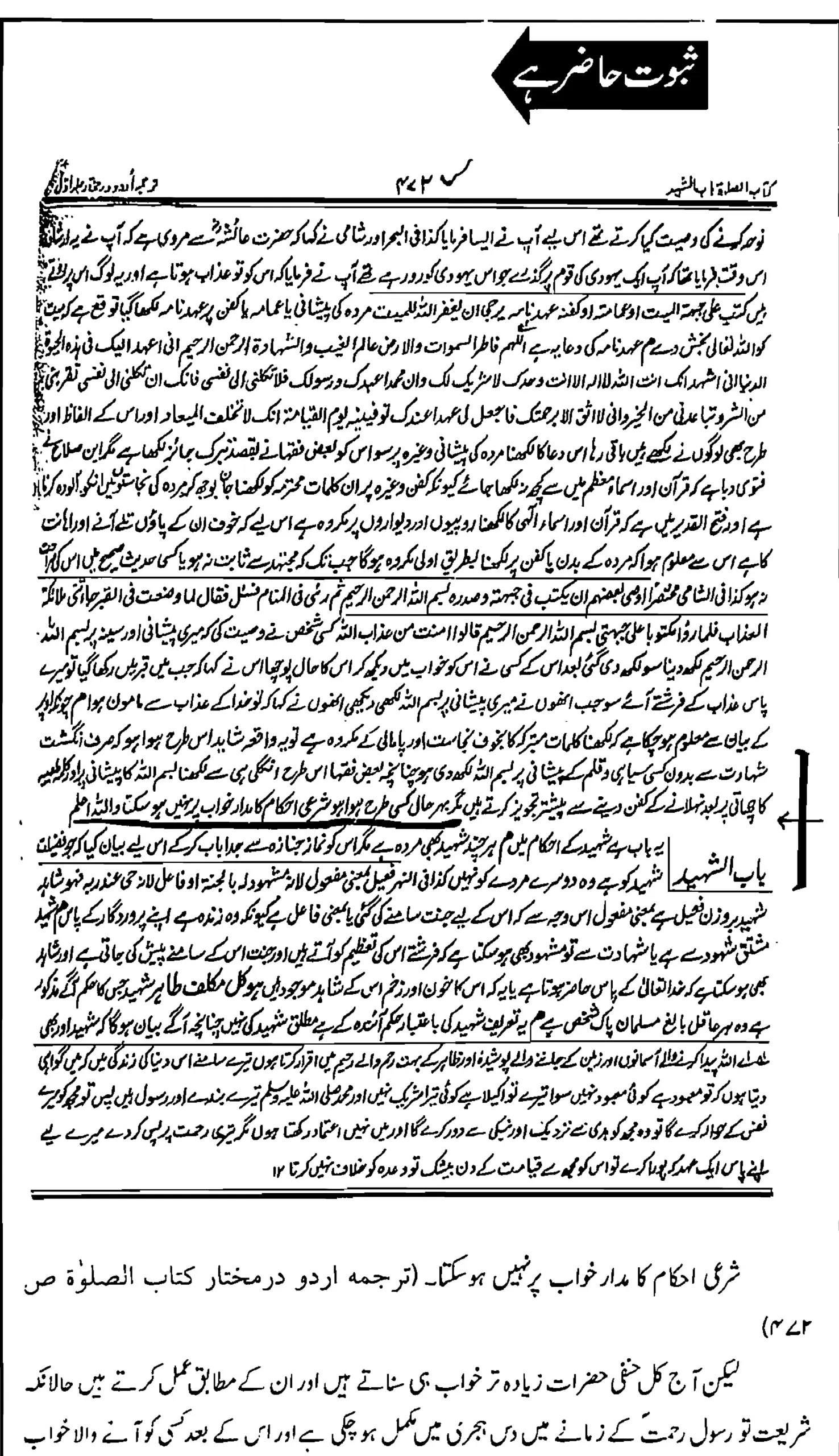
Commentary:
The revelation to the Messenger of Allah ﷺ came through Jibril, and here a completely different chain of narration is being presented. It is clear from this that this claim is outright false and against the Quran. Another important point is that the chain of narration for any jurisprudential issue does not reach Imam Sahib. You can check all the books of jurisprudence.
[24] Those who consider it permissible to insult the Qiblah companions are not disbelievers.
Reference: (Durr al-Mukhtar: Vol. 1, p. 292)
Comment:
It is against the text of the Quran.
Reference: (An-Nisa 115, Al-Baqarah 137, Al-Fath 29, especially 18 to 20)
[25] Five issues
Reference: (Ain al-Hidayah: Vol. 8, pp. 750 to 752)
are mentioned, in which the excuses for not paying Zakat are explained.Comment:
Allah Almighty repeatedly states in the Quran that Zakat is a fundamental necessity of the Muslim society. By explaining excuses for not paying Zakat in jurisprudence, encouragement is being given to avoid paying Zakat, which is completely against the intent of the Quran.
[26] The practice of "Launda Bazi" (male prostitution) will also exist in Paradise, but this is weak.
Reference: (Durr al-Mukhtar: Vol. 2, p. 474)
Comment:
It should be remembered that the Quran states that the people of Lot were afflicted with divine punishment because of this sin.
Reference: (Al-Hijr: 57 to 76)
(The condition of Hanafi jurisprudence is pitiable)[27] Except for wine, all things that are forbidden to drink, their sale is permissible (Abu Hanifa). It is permissible for a grape syrup maker to sell it.
Reference: (Alamgiri: Vol. 4 p. 396 - Fatawa Alamgiri: Vol. 9 p. 191)
It is permissible to slaughter a dog and a donkey and sell their meat.
Reference: (Fatawa Alamgiri: Vol. 4 p. 394)
Commentary:
This is against the Quranic text in which Allah Almighty said to help one another in righteousness and piety, and do not help one another in sin and transgression.
Reference: (Al-Ma'idah: 2)
[28] If a person leaves wine for a Muslim, it is not disliked, but if it is left for a non-Muslim, it is disliked.
Reference: (Alamgiri: Vol. 9 p. 119)
Commentary:
The same point is being made in 27.
[29] In Tayammum (dry ablution), order is not a condition.
Reference: (Sharh Waqayah: Vol. 1 p. 54)
Tayammum is permissible on a clean, smooth stone even if it is washed.
Reference: (Bahishti Zewar: Vol. 1 p. 4)
Tayammum is permissible with mud. If there is dust on the back of a pig or dog, Tayammum is permissible.
Reference: (Ain al-Hidayah: Vol. 1 p. 182 - Durmukhtar: Vol. 1 p. 428 - Alamgiri: Vol. 1 p. 40)
Commentary:
It is against the Quranic text in which Allah Almighty has said to perform Tayammum with pure soil.
Reference: (An-Nisa:43)
[30] It is permissible to deliver the Friday sermon while sitting.
Reference: (Ain al-Hidayah: Vol. 2, p. 533)
Comment:
It is against the Quranic text.
Reference: (Al-Jumu'ah:11)
and also against the authentic hadith of Sahih Muslim.[31] The name of the author of Dur al-Mukhtar's teacher was Abdul Nabi.
Reference: (Dur al-Mukhtar: Vol. 1, p. 13)
Comment:
It is against the Quranic text.
Reference: (Aal Imran:80,79)
and it is written in
Reference: (Introduction to Ain al-Hidayah: Vol. 1, p. 86)
that naming someone Abdul Nabi etc. is evidently disbelief.
Those issues of Hanafi fiqh which are against authentic hadiths. The number of such issues is more than two hundred which are against authentic hadiths. For brevity, we advise you to study two books in this regard: (1) Al-Zafar al-Mubeen (Authored by) Maulana Muhammad Abul Hasan Sialkoti (2) Haqiqat al-Fiqh (Authored by) Maulana Muhammad Yusuf Jiapuri.
Both these books can be found at Maktabah Dar al-Iblagh, Ghazni Street, Urdu Bazaar, Lahore. Their phone number is 7361428-042.
Note: Remember, all these are Hanafi fiqh books whose references have been given in this article.

