

Compiled by: Abu Hamza Salafi
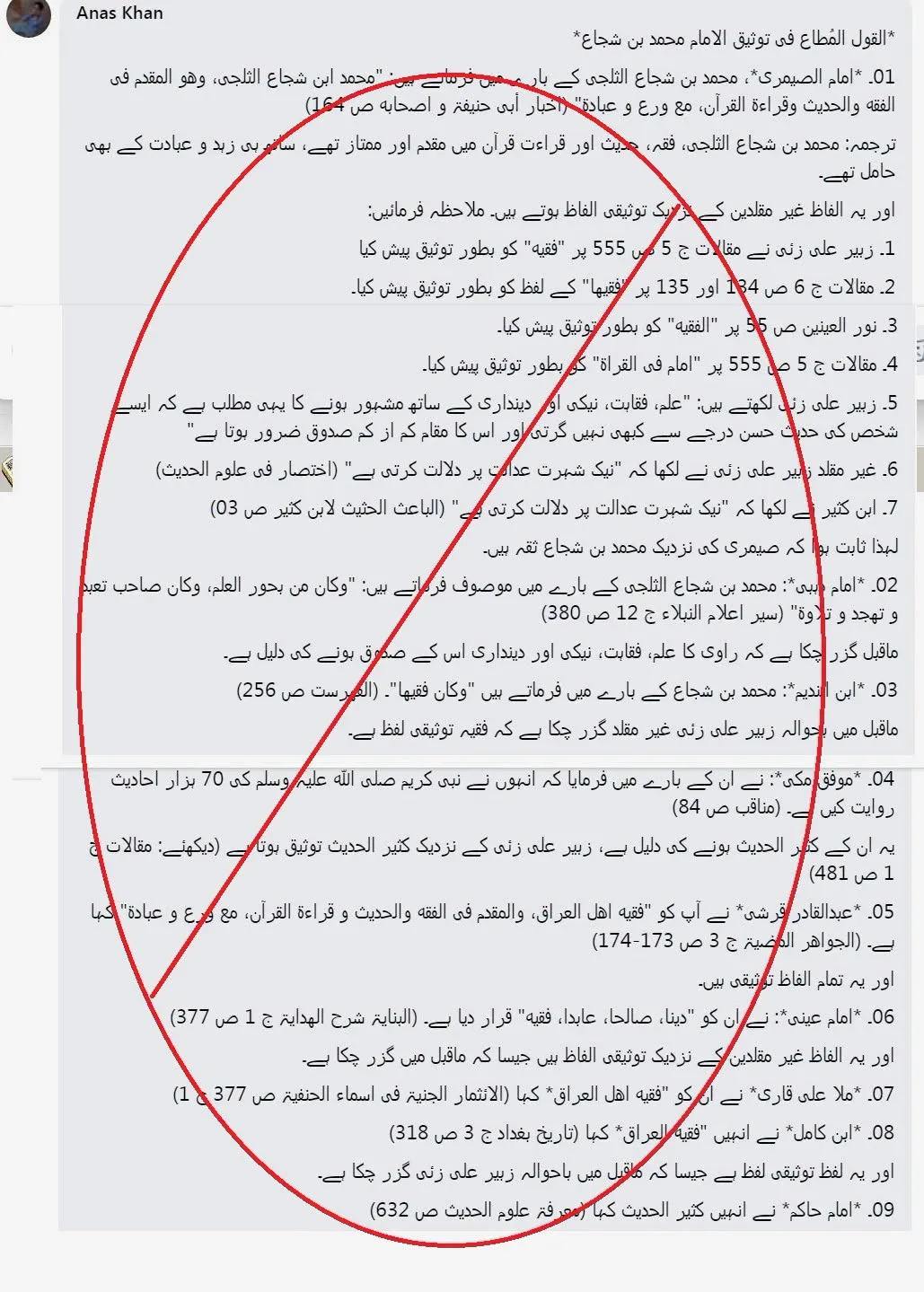
In the science of Hadith, the reliability of a narrator and the acceptability of his narration are determined according to the principles established by the Imams of Jarh and Ta'dil. In this context, sometimes seeing the word «الفقیہ» alongside a narrator's name is mistakenly taken as evidence of his authentication and trustworthiness in Hadith, whereas merely being a jurist and being reliable and precise in narrating Hadith are two distinct qualities. A person may have knowledge of jurisprudential issues and Shariah rulings but may be weak in memorizing Hadith, preserving narrations, or maintaining chains of transmission. Many such individuals are mentioned in the books of Rijal who were called jurists, judges, or muftis, but the Muhaddithin have criticized their narrations. Conversely, there are many jurists who have been accepted as trustworthy, memorizing, and reliable Imams in Hadith. The purpose of the present article is to clarify from the statements of the Imams of Jarh and Ta'dil that «الفقیہ» itself is not a definitive and explicit term of authentication in Hadith but indicates a person's juristic status. To accept the narration of a jurist, it is necessary to examine his integrity, truthfulness, precision, and the overall statements of the Muhaddithin.
Is the term «Al-Faqih» considered as a certification in Jarh and Ta'dil?
In the Arabic language, «Al-Faqih» refers to a person who possesses knowledge of jurisprudence and Shariah rulings.
However, in the science of Rijal, a person being a Faqih does not necessarily guarantee that he is trustworthy and has a strong memory in the narration of Hadith.
To understand this distinction, it is necessary to clarify the meanings of three terms:
① Al-Faqih: A person who possesses knowledge of jurisprudence and Shariah rulings.
② Al-Thiqah: A narrator who possesses the qualities of integrity and precision required for acceptance of narration.
③ Al-Dha'if: A narrator whose narration does not fulfill the required conditions for acceptance, whether due to weakness in memory and precision or for some other reason.
Thus, «Al-Faqih» is a description of a person's scholarly expertise, whereas «Al-Thiqah» is an explicit term for his trustworthiness in Hadith narration.
This principle is clarified by the following statements of the Imams of Jarh and Ta'dil.
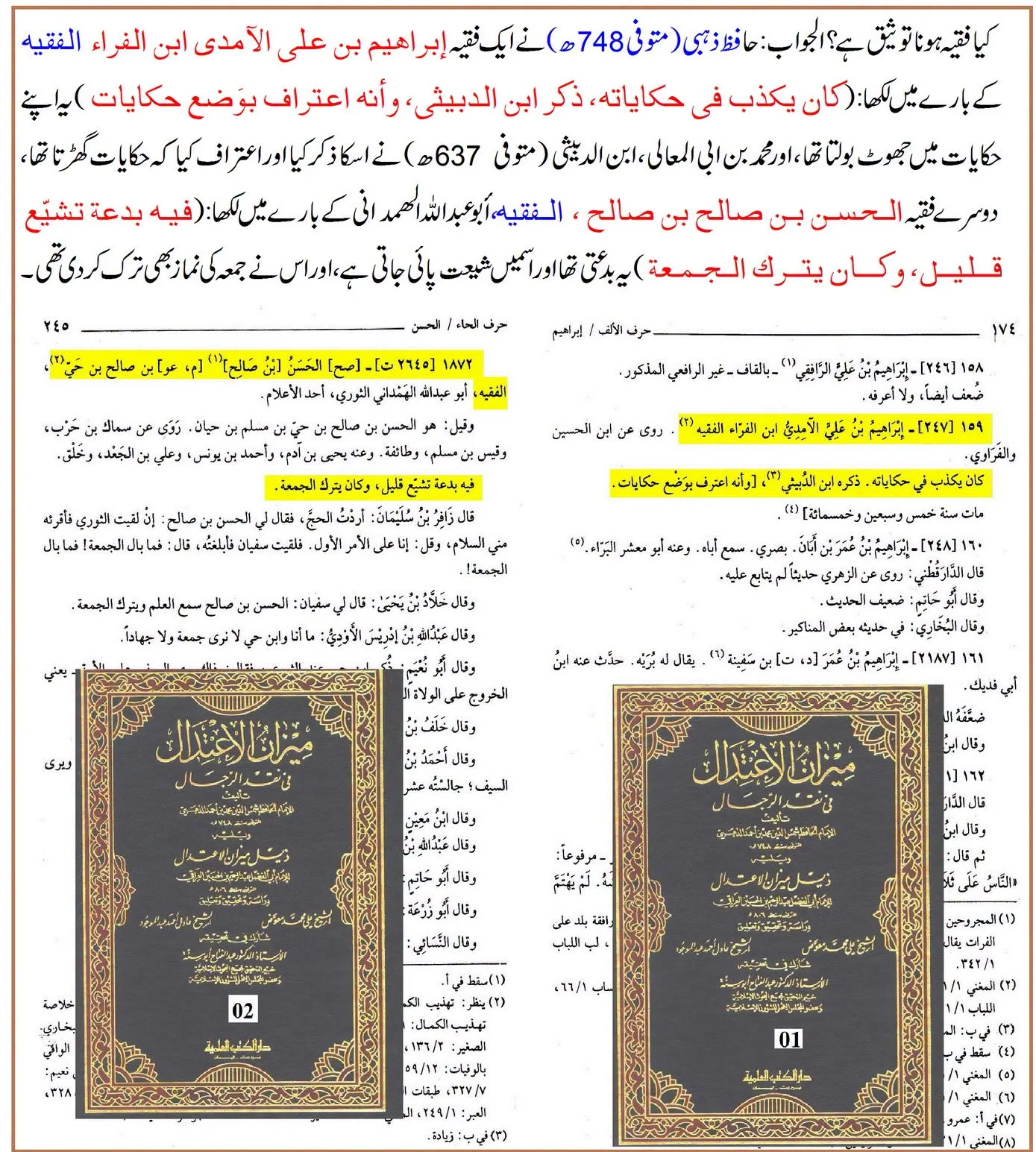
① Hafiz Zahabi's Statement Regarding Ibrahim bin Ali Al-Amidi Al-Faqih
Hafiz Shams al-Din Zahabi, may Allah have mercy on him (died 748 AH), mentioned Ibrahim bin Ali Al-Amidi, known as Ibn al-Fara’, the jurist, and wrote:
159 - إبراهيم بن علي الآمدي ابن الفراء الفقيه.
روى عن ابن الحصين والفراوي.
كان يكذب في حكاياته.
ذكره ابن الدبيثي، وأنه اعترف بوضع حكايات.
Translation:
Ibrahim bin Ali Al-Amidi, Ibn al-Fara’, was a jurist. He narrated from Ibn al-Husayn and Farawi.
He lied in the stories he narrated.
Ibn Dibaithi, may Allah have mercy on him, mentioned him and stated that he himself admitted to fabricating stories.
Reference: Al-Kitab: Mizan al-I'tidal fi Naqd al-Rijal
Reference: Author: Shams al-Din Abu Abdullah Muhammad bin Ahmad bin Uthman bin Qaymaz al-Dhahabi (died 748 AH)
Reference: Translation Number: 159
Explanation:
Hafiz Zahabi, may Allah have mercy on him, used the term "Al-Faqih" (the jurist) with Ibrahim bin Ali Al-Amidi’s name, yet he explicitly stated that he lied in his narrations.
This indicates that calling someone a jurist does not mean that every narration or statement of theirs is trustworthy.
However, here the criticism specifically relates to the narrations he has reported, so from this statement alone, the accusation of fabricating Prophetic hadith cannot be proven without additional evidence.
② Hafiz Zahbi's Statement Regarding Hasan bin Salih bin Hayy Al-Faqih
Hafiz Zahbi, may Allah have mercy on him, wrote about Imam Hasan bin Salih bin Hayy, may Allah have mercy on him:
1869 -[صح] الحسن بن صالح [م، عو] بن صالح بن حى، الفقيه، أبو عبد الله الهمداني الثوري، أحد الاعلام.
فيه بدعة تشيع قليل، وكان يترك الجمعة.
Translation:
Hasan bin Salih bin Hayy, Abu Abdullah al-Hamdani al-Thawri, was a jurist and one of the distinguished scholars.
He had some inclination towards Shi'ism and used to abandon the Friday prayer.
Reference: Book: Mizan al-I'tidal fi Naqd al-Rijal
Reference: Author: Shams al-Din Abu Abdullah Muhammad bin Ahmad bin Uthman bin Qaymaz al-Dhahabi (d. 748 AH)
Reference: Entry Number: 1869
Explanation:
In this statement, Hafiz Zahbi, may Allah have mercy on him, described Hasan bin Salih as "the jurist" and "one of the notable figures," while also mentioning some of his doctrinal or practical issues.
However, an important point is that many hadith scholars have also declared Hasan bin Salih, may Allah have mercy on him, trustworthy and reliable.
Therefore, this example does not prove that he was weak in hadith narration, rather it becomes clear that the jurisprudential status, hadith reliability, and a person's specific doctrinal or practical tendencies are separate matters.
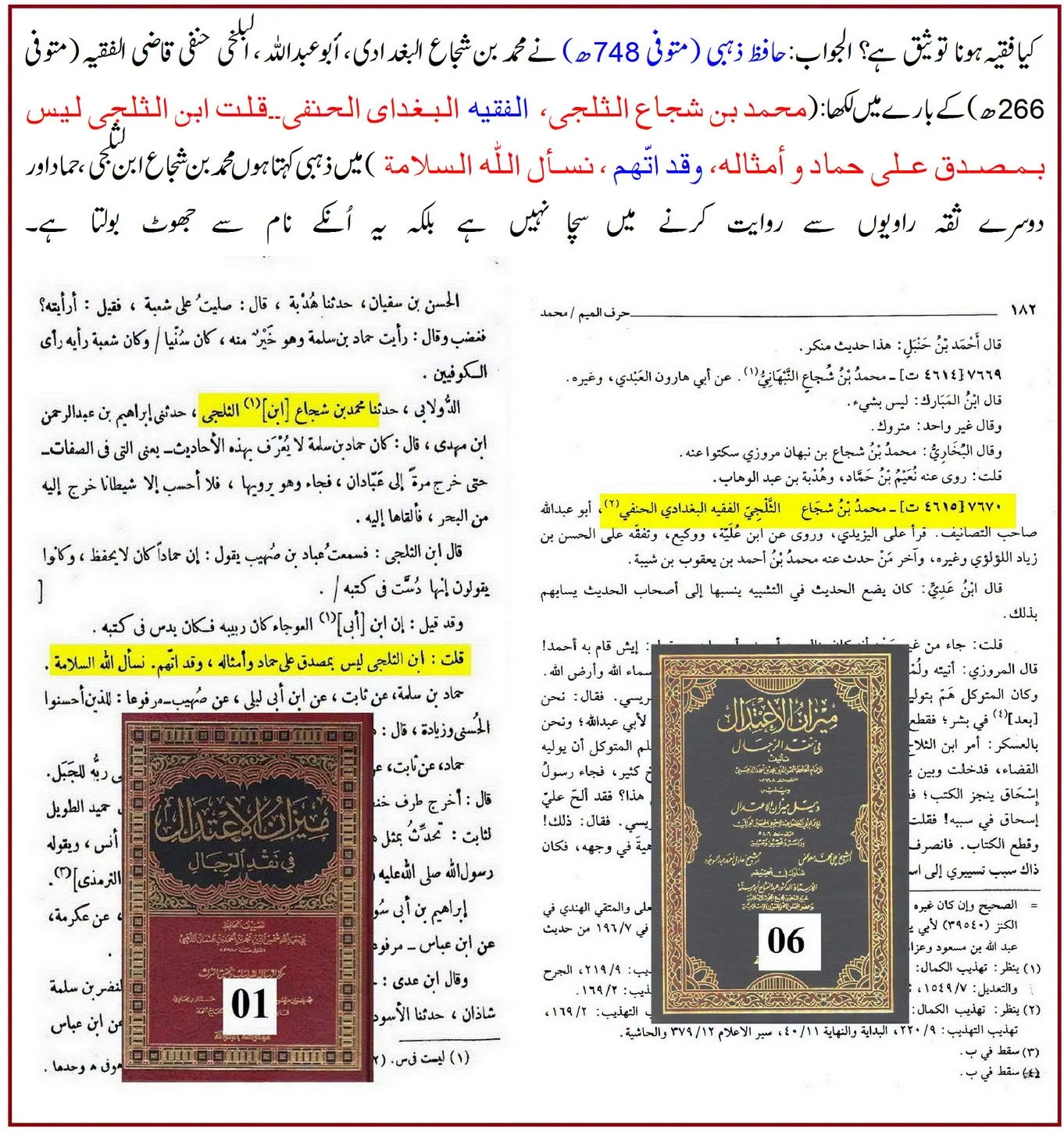
③ Hafiz Zahbi's Criticism Regarding Muhammad bin Shuja Thalji the Jurist
Hafiz Zahbi, may Allah have mercy on him, wrote about Muhammad bin Shuja Thalji:
الدولابي، حدثنا محمد بن شجاع [ابن] الثلجى، حدثني إبراهيم بن عبد الرحمن ابن مهدي، قال: … قلت: ابن الثلجى ليس بمصدق على حماد وأمثاله، وقد اتهم. نسأل الله السلامة.
Translation:
Hafiz Zahbi, may Allah have mercy on him, says: The narrations transmitted from Ibn Thalji, Hammad, and others like them are not reliable, and accusations have also been made against him. We ask Allah for safety.
Reference: Book: Mizan al-I'tidal fi Naqd al-Rijal
Reference: Author: Shams al-Din Abu Abdullah Muhammad bin Ahmad bin Uthman bin Qaymaz al-Dhahabi (died: 748 AH)
Hafiz Zahbi, may Allah have mercy on him, introduced him in another book as follows:
وفيها محمد بن شجاع بن الثلجي فقيه العراق شيخ الحنفية. …
وصنف واشتغل، وهو متروك الحديث،
Translation:
In the same year, mention is found of Muhammad bin Shuja bin Thalji, who was a jurist of Iraq and a Sheikh of the Hanafi school.
He participated in writing and scholarly pursuits, but in hadith narration he was considered abandoned.
Reference: Book: Al-Ibar fi Khabar man Ghabar
Reference: Author: Shams al-Din Abu Abdullah Muhammad ibn Ahmad ibn Uthman ibn Qaymaz al-Dhahabi (died: 748 AH)
Explanation:
In this example, Hafiz Dhahabi, may Allah have mercy on him, referred to Muhammad ibn Shuja' Thalji as "Faqih al-Iraq" and "Sheikh al-Hanafiya," but he also transmitted criticism regarding his hadith narration.
This makes it clear that a person's expertise in jurisprudence or scholarly leadership in a particular jurisprudential school does not by itself guarantee their reliability in hadith.
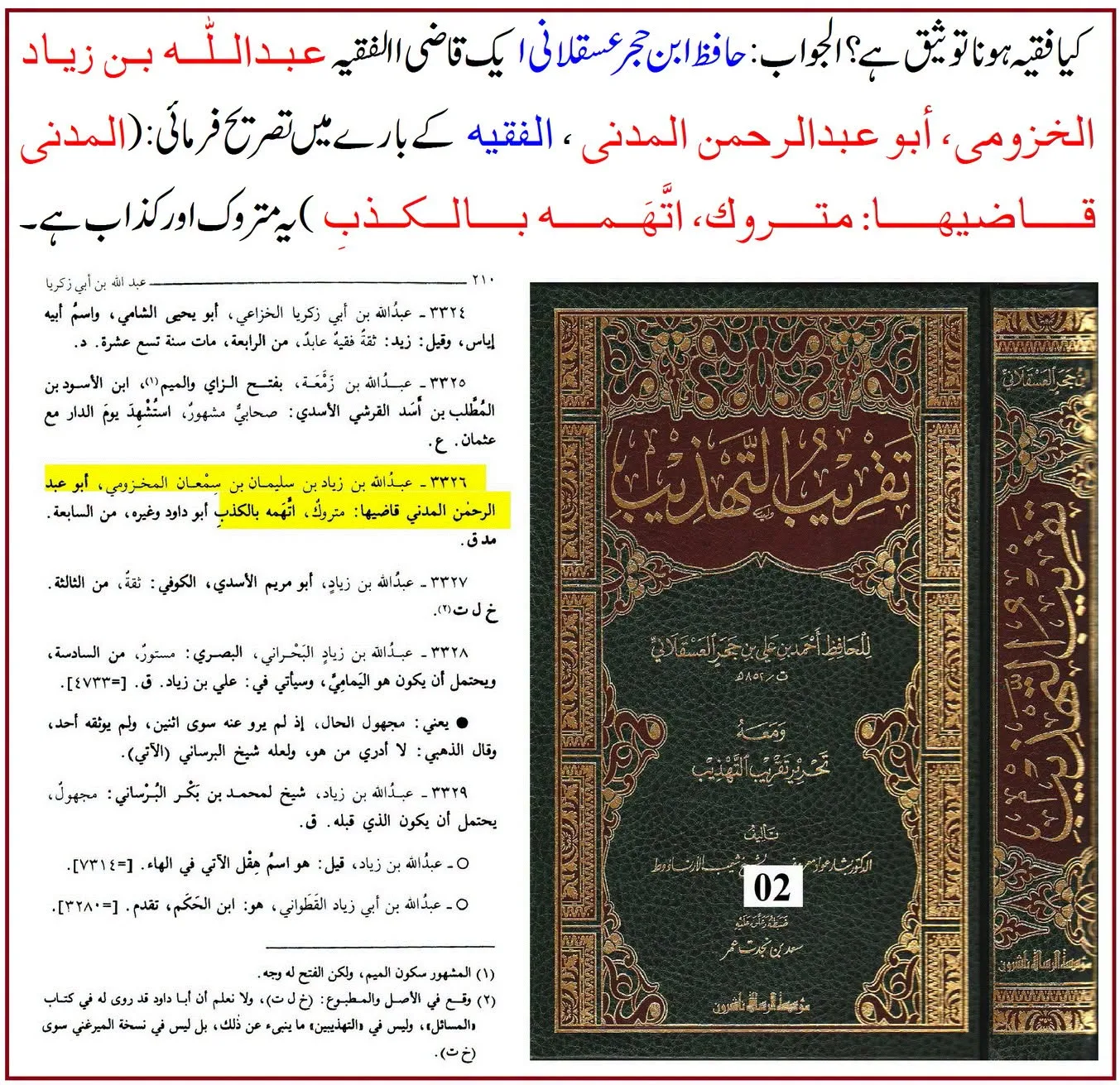
④ Hafiz Ibn Hajar's ruling regarding Abdullah ibn Ziyad ibn Samaan
Hafiz Ibn Hajar al-Asqalani, may Allah have mercy on him (died 852 AH), wrote about Abdullah ibn Ziyad ibn Samaan al-Madani:
3326 - عبدُ الله بن زياد بن سليمان بن سِمْعان المخزومي، أبو عبد الرحمن المدني قاضيها: متروكٌ، اتَّهَمه بالكذب أبو داود وغيره، من السابعة. مد ق.
Translation:
Abdullah ibn Ziyad ibn Sulaiman ibn Samaan al-Makhzumi, Abu Abdulrahman al-Madani, was a judge of Medina.
He is a weak narrator of hadith. Imam Abu Dawood and other muhaddithin accused him of lying. He belongs to the seventh tier.
Reference: Book: Tahrir Taqreeb al-Tahdheeb by Hafiz Ahmad ibn Ali ibn Hajar al-Asqalani
Reference: Authors: Dr. Bashar Awwad Ma'ruf, Sheikh Shu'ayb al-Arna'oot
Reference: Translation number: 3326
Explanation:
This passage mentions Abdullah bin Ziyad bin Samaan as the judge of Medina, but despite this, Hafiz Ibn Hajar, may Allah have mercy on him, declared him unreliable and accused him of lying.
Here, the difference between "unreliable" and "accused of lying" should also be noted. Not every narrator accused of lying has direct and conclusive proof of falsehood of the same degree.
This example clarifies that being a judge or a scholar of jurisprudence is not a permanent authentication in the narration of Hadith.
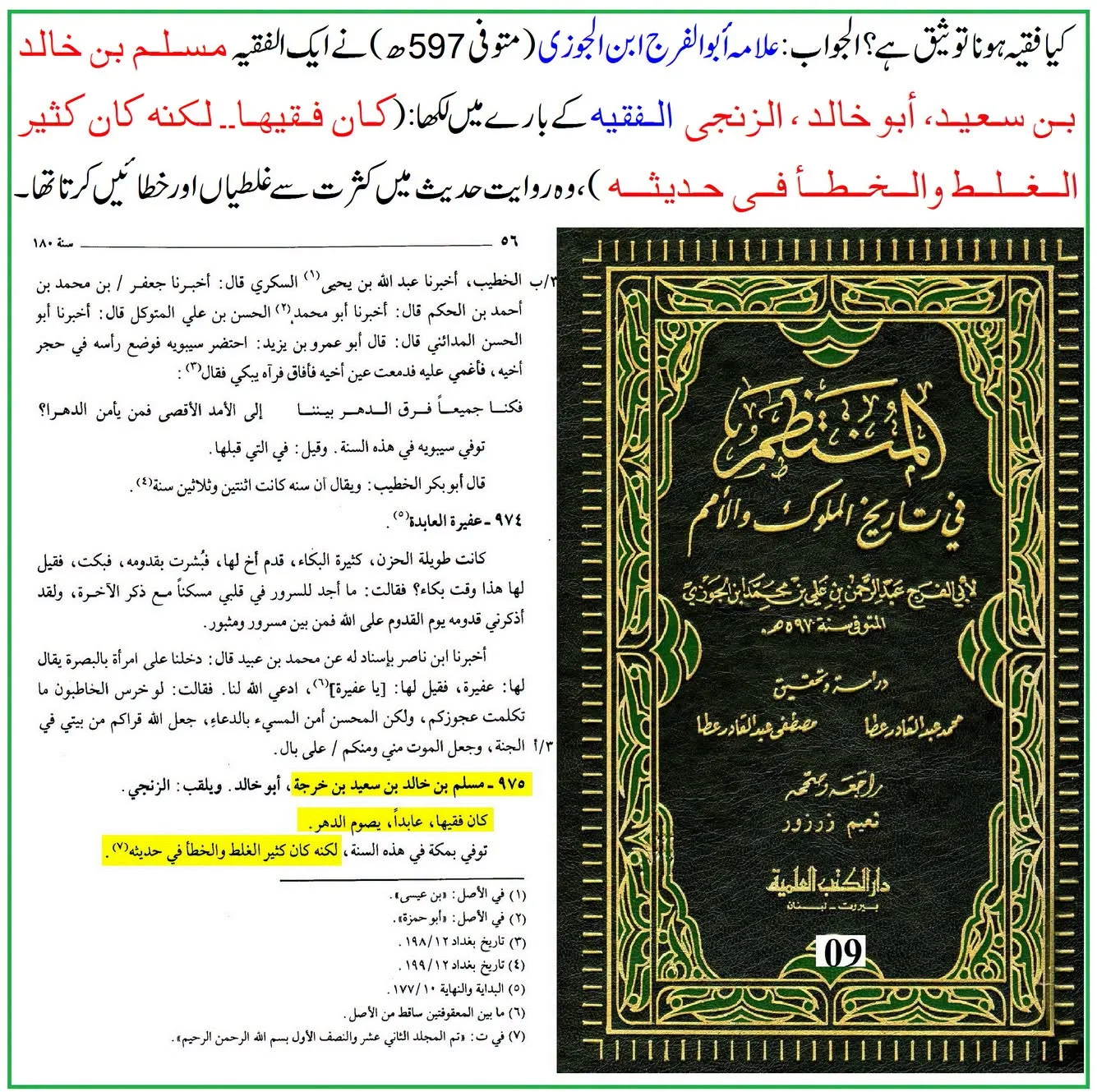
⑤ Statement of Ibn al-Jawzi about Muslim bin Khalid al-Zanji al-Faqih
The scholar Abu al-Faraj Ibn al-Jawzi, may Allah have mercy on him (died 597 AH), wrote about Muslim bin Khalid al-Zanji:
975- مسلم بن خالد بن سعيد بن خرجة، أبو خَالِد. ويلقب: الزنجي.
كان فقيها، عابدا، يصوم الدهر.
توفي بمكة في هذه السنة، لكنه كان كثير الغلط والخطأ في حديثه.
Translation:
Muslim bin Khalid bin Saeed bin Khurjah, Abu Khalid, who was called Zanji.
He was a jurist, worshipper, and a person who fasted continuously.
He died that same year in Makkah al-Mukarramah, but there were many mistakes and errors in his narration of Hadith.
Reference: Al-Kitab: Al-Muntazam fi Tarikh al-Umam wal-Muluk
Reference: Author: Jamal al-Din Abu al-Faraj Abdul Rahman bin Ali bin Muhammad al-Jawzi (died 597 AH)
Reference: Translation number: 975
Explanation:
In this passage, three qualities of Muslim bin Khalid Zanji are mentioned: jurisprudence, worship, and frequent fasting.
Despite this, Ibn al-Jawzi, may Allah have mercy on him, pointed out his frequent mistakes in the narration of the hadith.
From this, an important principle emerges that worship, piety, and jurisprudential expertise are valuable qualities in their own right, but the standard for accuracy and memorization in hadith is different.
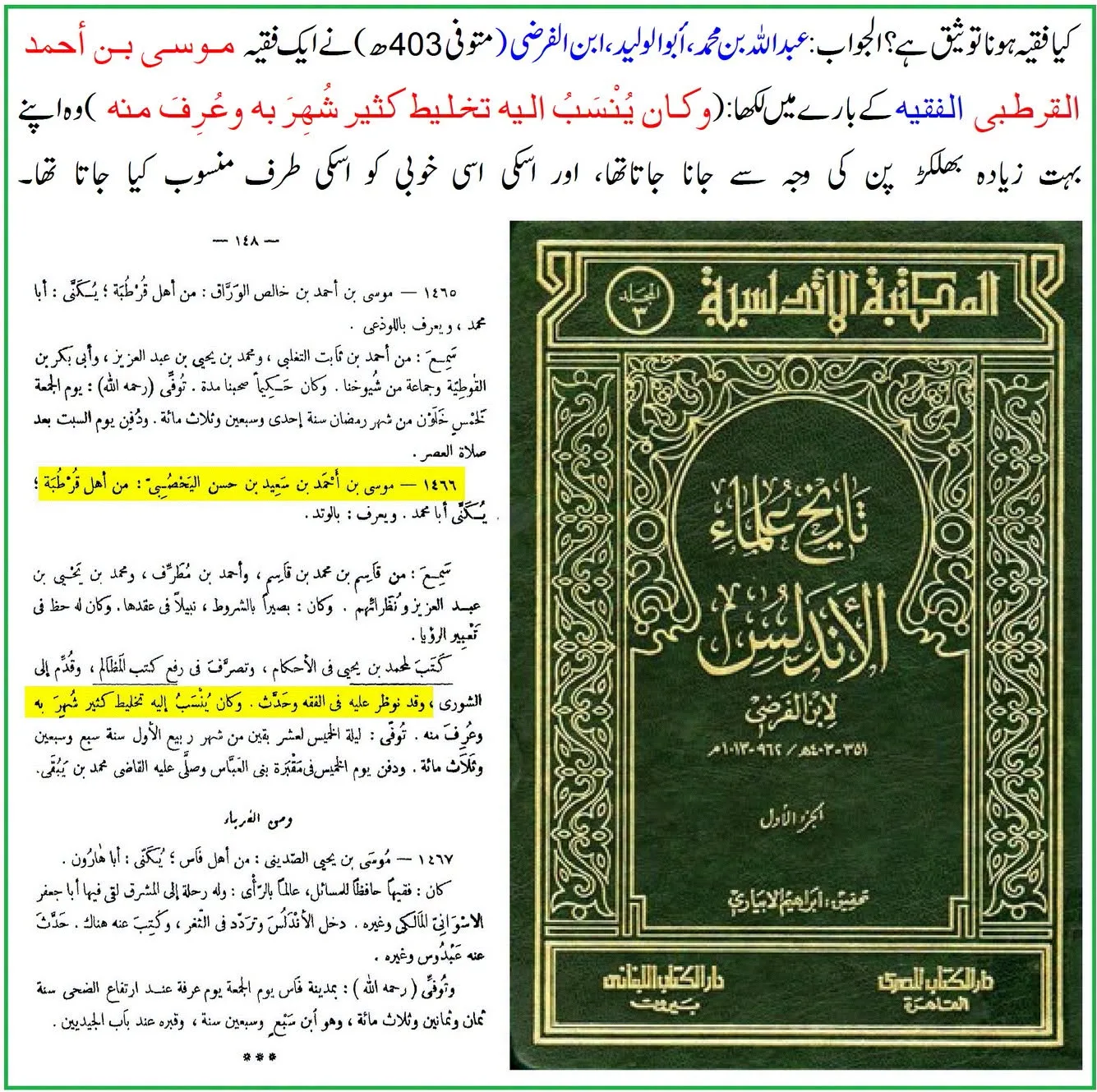
⑥ Ibn al-Furadi's clarification regarding Musa bin Ahmad al-Qurtubi al-Faqih
Imam Abu al-Walid Ibn al-Furadi, may Allah have mercy on him (died 403 AH), wrote about Musa bin Ahmad al-Qurtubi:
1466 - موسى بن أحْمَد بن سَعِيد بن حسن اليَحْصُبِيّ: من أهل قُرْطُبَة؛ يُكَنَّى: أبا محمد. ويعرف: بالوتد.
وكان يُنْسَبُ إليه تخليط كثير شُهِرَ به وعُرِفَ منه.
Translation:
Musa bin Ahmad bin Saeed bin Hasan Yahsubi was a resident of Cordoba. His kunya was Abu Muhammad and he was known by the name "al-Watad."
He was attributed with a great deal of confusion and mixing up, and he was famous and recognized for this characteristic.
Reference: Al-Kitab: Tarikh Ulama al-Andalus
Reference: Author: Abdullah bin Muhammad bin Yusuf bin Nasr al-Azdi, Abu al-Walid, known as Ibn al-Furadi (died 403 AH)
Reference: Translation number: 1466
Explanation:
Ibn al-Furadi, may Allah have mercy on him, mentioned the frequent confusion of Musa bin Ahmad.
"Takhleet" means creating confusion or mixing up in matters or statements; however, its precise context is determined based on the circumstances.
In this statement, there is no absolute negation of any other attribute regarding them, rather it specifically points out the abundance of "Takhleet."
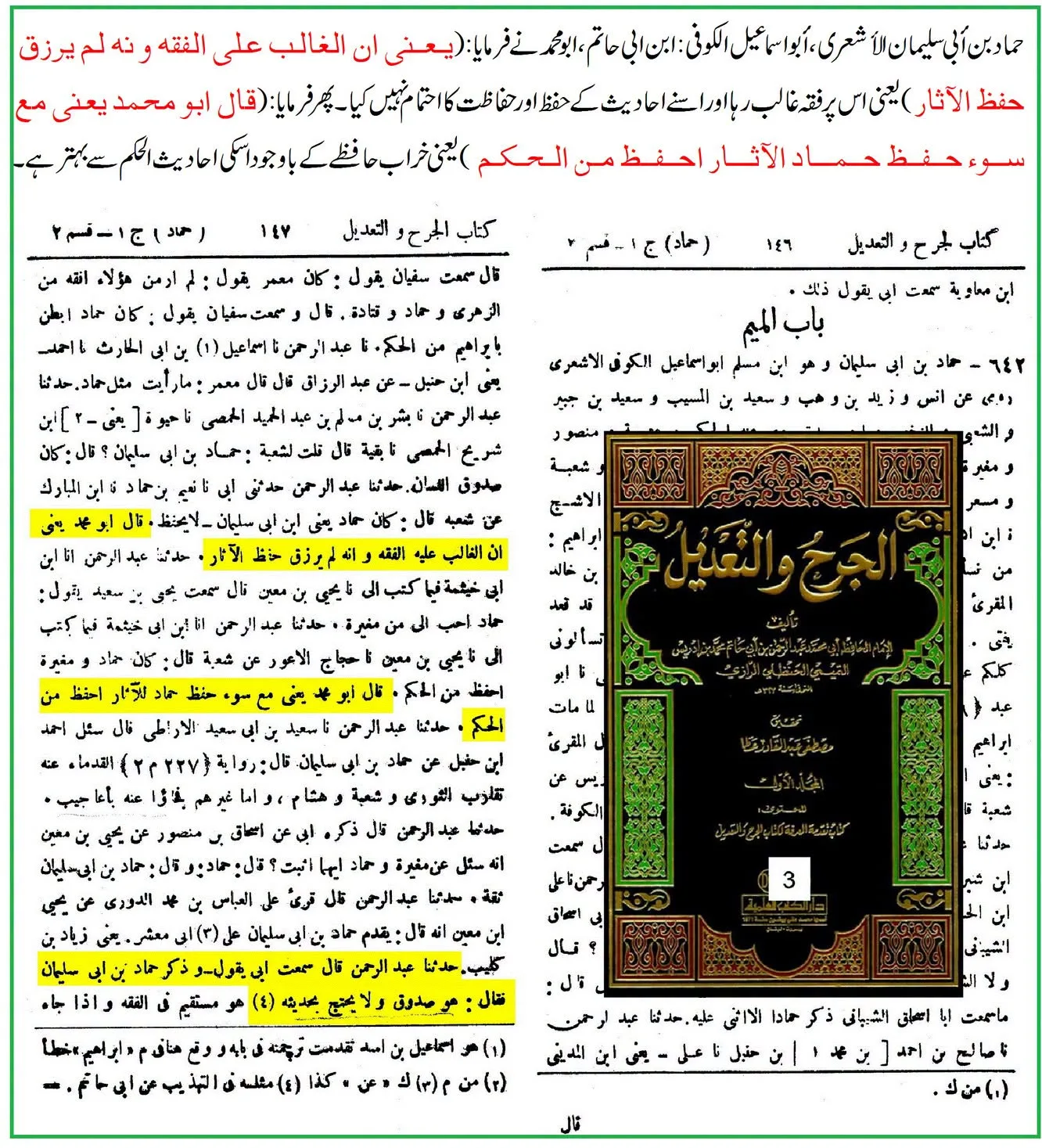
⑦ Statement of Ibn Abi Hatim about Hammad bin Abi Sulayman Al-Faqih
Imam Ibn Abi Hatim Razi, may Allah have mercy on him (died 327 AH), narrated about Hammad bin Abi Sulayman, may Allah have mercy on him:
642 - حماد بن أبي سليمان وهو ابن مسلم … قال أبو محمد يعني أن الغالب عليه الفقه وأنه لم يرزق حفظ الآثار. قال أبو محمد يعني مع سوء حفظ حماد للآثار أحفظ من الحكم.
Translation:
Hammad bin Abi Sulayman, whose original name was Hammad bin Muslim.
Abu Muhammad Ibn Abi Hatim, may Allah have mercy on him, says: This means that knowledge of jurisprudence (fiqh) was predominant in him, but he did not attain that proficiency in memorizing the traditions (athar).
Then he says: This means that despite weakness in memorizing the traditions, Hammad was more of a memorizer of rulings than of the traditions.
Reference: Al-Kitab: Al-Jarh wa al-Ta'dil
Reference: Author: Abu Muhammad Abdul Rahman bin Muhammad bin Idris Ibn Abi Hatim Al-Razi (died: 327 AH)
Reference: Translation number: 642
Explanation:
This statement of Imam Ibn Abi Hatim, may Allah have mercy on him, holds special importance in the matter under discussion.
It is clarified here that Hammad ibn Abi Sulayman, may Allah have mercy on him, was dominant in the knowledge of jurisprudence, but there was criticism regarding his preservation of narrations.
From this, it is understood that a person's level of expertise in jurisprudence and their memory of hadith can be different.
However, this does not necessitate the absolute rejection of all narrations of Hammad ibn Abi Sulayman, may Allah have mercy on him, rather it is necessary to look at all the statements of the Imams of Jarh and Ta'dil regarding him.
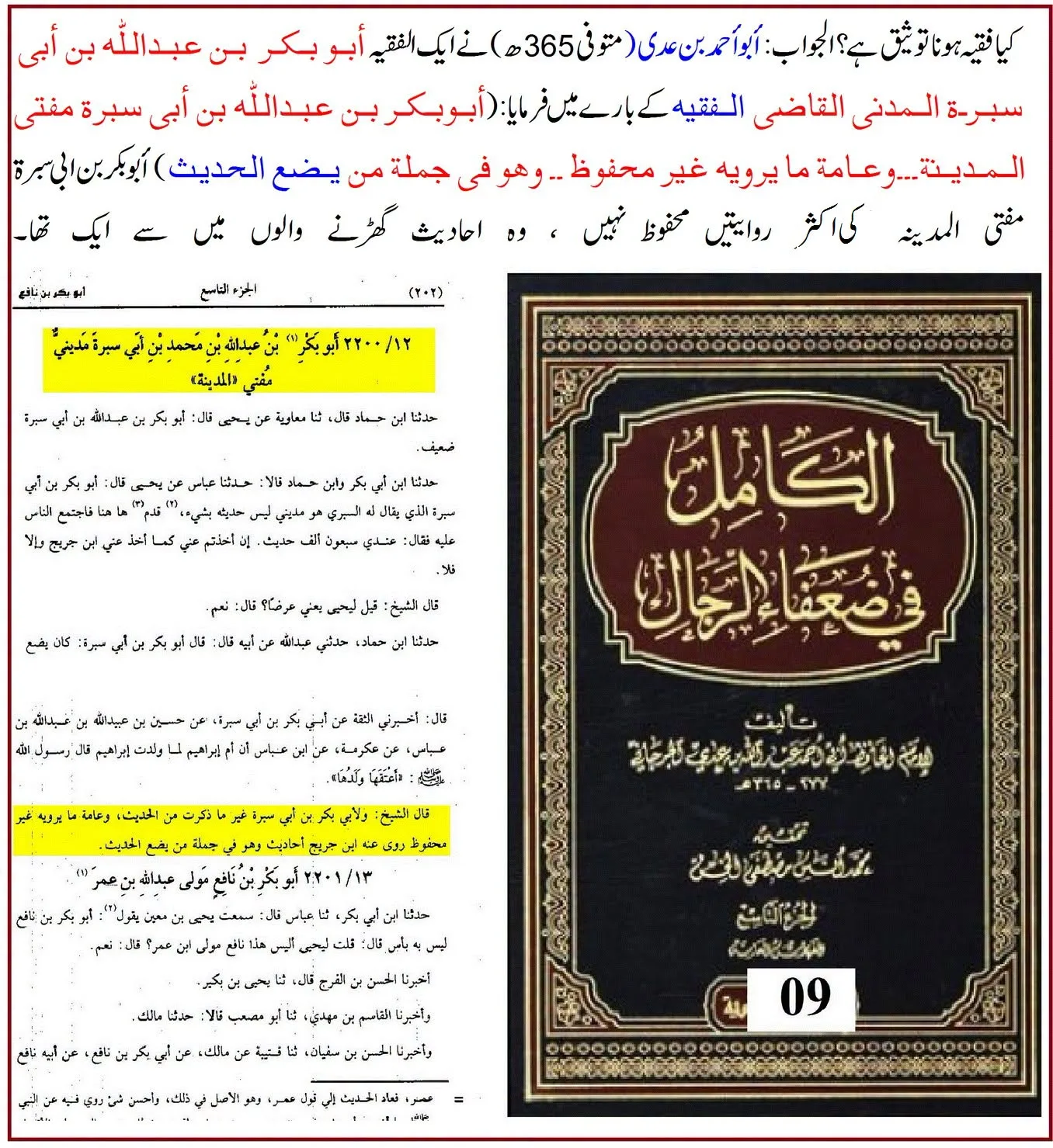
⑧ The statement of Ibn Adi about Abu Bakr ibn Abi Subrah, the Mufti of Madinah
Imam Abu Ahmad Ibn Adi Jurjani, may Allah have mercy on him (died 365 AH), wrote about Abu Bakr ibn Abi Subrah:
2200- أبو بكر بْنِ عَبد اللَّهِ بْنِ مُحَمد بن أبي سبرة مديني مفتي المدينة.
قَالَ الشيخ (أبو أحمد بن عدي): ولأبي بكر بن أبي سَبْرَةَ غَيْرُ مَا ذَكَرْتُ مِنَ الحديث وعامة ما يرويه غير محفوظ روى عنه بن جُرَيج أَحَادِيثَ، وَهو فِي جُمْلَةِ مَنْ يَضَعُ الْحَدِيثَ.
Translation:
Abu Bakr ibn Abdullah ibn Muhammad ibn Abi Subrah was from Madinah and was the Mufti of Madinah.
Imam Ibn Adi, may Allah have mercy on him, says: Besides these hadiths, Abu Bakr ibn Abi Subrah has other narrations which I have mentioned, but most of his narrations are not reliable.
Ibn Jurayj also narrated hadiths from him, and he is among those people who fabricated hadiths.
Reference: Book: Al-Kamil fi Du'afa' al-Rijal
Reference: Author: Abu Ahmad Abdullah ibn Uday al-Jurjani (died 365 AH)
Reference: Translation Number: 2200
Explanation:
Imam Ibn Uday, may Allah have mercy on him, mentioned Abu Bakr ibn Abi Sabrah with the title "Mufti of Medina," but at the same time declared most of his narrations as unreliable and counted him among those who fabricated hadith.
From this example, it becomes clear that a person's status as a mufti is not proof of reliability in narration.
Here, the title "Mufti of Medina" is directly different from the word "Faqih," but both relate to jurisprudential status and scholarly position, not to hadith authentication in itself.
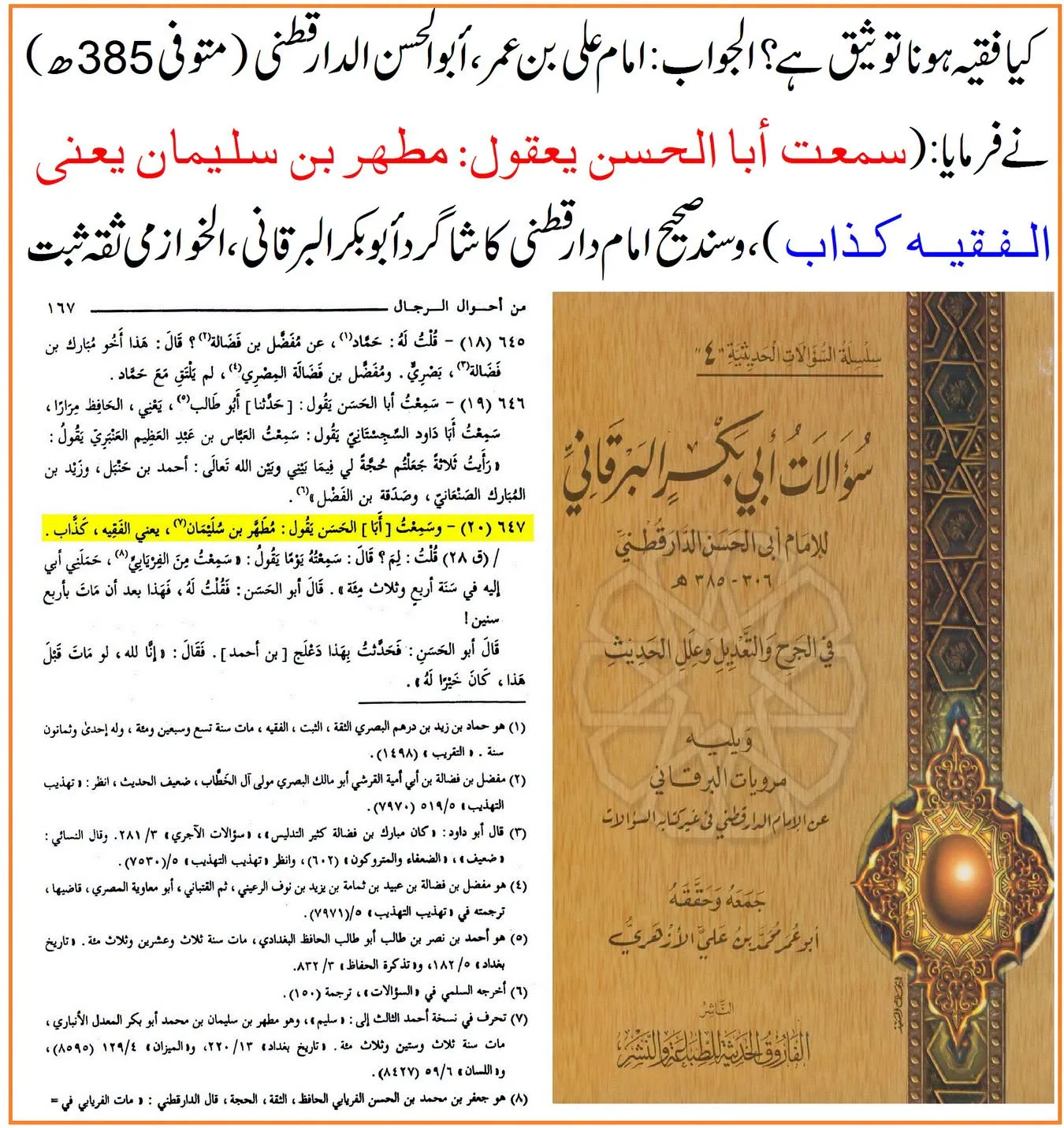
⑨ The ruling of Imam Darqutni regarding Mutahhar ibn Sulayman al-Faqih
Imam Abu al-Hasan Darqutni, may Allah have mercy on him (died 385 AH), said about Mutahhar ibn Sulayman:
16 - وسمعت أبا الحسن يقول: مطهر بن سليمان - يعنى الفقيه - كذاب.
Translation:
Abu Bakr al-Barqani, may Allah have mercy on him, narrates: I heard Imam Abu al-Hasan Darqutni, may Allah have mercy on him, say that Mutahhar ibn Sulayman, the person known by the name of Faqih, is a liar.
Reference: Book: Questions of Abu Bakr al-Barqani to al-Darqutni on Criticism and Praise
Reference: Author: Ahmad ibn Muhammad ibn Ahmad ibn Ghalib, Abu Bakr known as Al-Barqani (died: 425 AH)
Reference: Hadith Number: 16
Explanation:
In this narration, Imam Al-Daraqutni, may Allah have mercy on him, used the title "Al-Faqih" for Muthahir ibn Sulayman but still declared him a "liar."
This example is a very clear proof regarding the issue under discussion that the word "Al-Faqih" by itself is not a certification, because the same person can have both the attribute of jurisprudence and severe criticism in hadith.
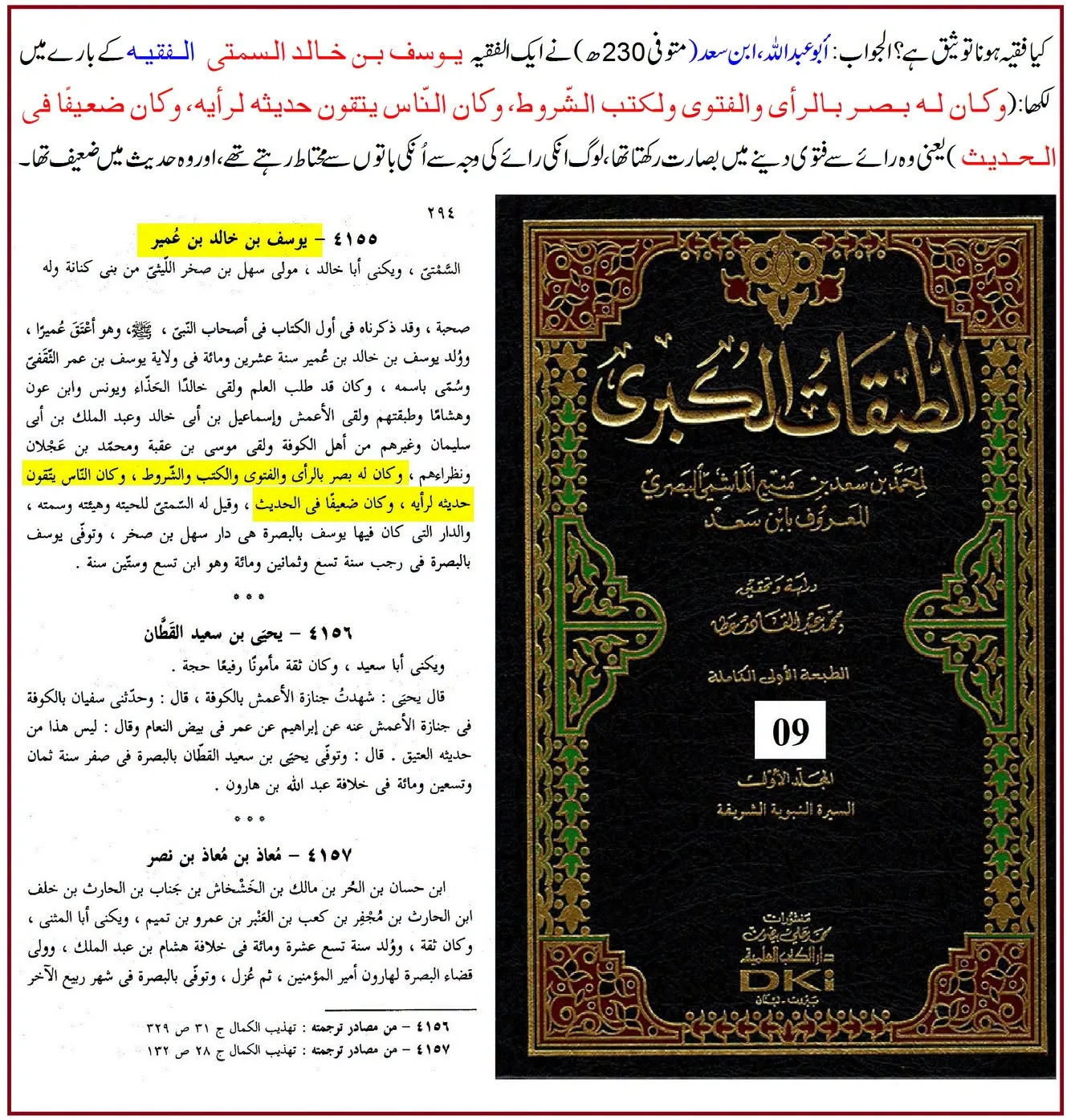
⑩ Imam Ibn Sa'd's Criticism Regarding Yusuf ibn Khalid Al-Samti Al-Faqih
Imam Muhammad ibn Sa'd, may Allah have mercy on him (died 230 AH), wrote about Yusuf ibn Khalid Al-Samti:
3327- يوسف بن خالد … وكان له بصر بالرأي والفتوى والكتب والشروط. وكان الناس يتقون حديثه لرأيه. وكان ضعيفًا في الحديث.
Translation:
Yusuf ibn Khalid had insight in opinion, fatwa, books, and conditions.
People were cautious about his hadith because of his opinions, and he was weak in narrating hadith.
Reference: Book: Al-Tabaqat Al-Kubra
Reference: Author: Abu Abdullah Muhammad ibn Sa'd ibn Mani' Al-Hashimi Al-Wala'i, Al-Basri, Al-Baghdadi known as Ibn Sa'd (died: 230 AH)
Reference: Translation Number: 3327
Explanation:
In this statement of Imam Ibn Sa'd, may Allah have mercy on him, the jurisprudential insight and the weakness in hadith of Yusuf ibn Khalid are mentioned separately.
It is possible that a person is skilled in jurisprudential opinions, fatwas, and legal matters, but weak in the narration of Hadith.
Therefore, acknowledging a person's jurisprudential competence does not negate their weakness in Hadith.
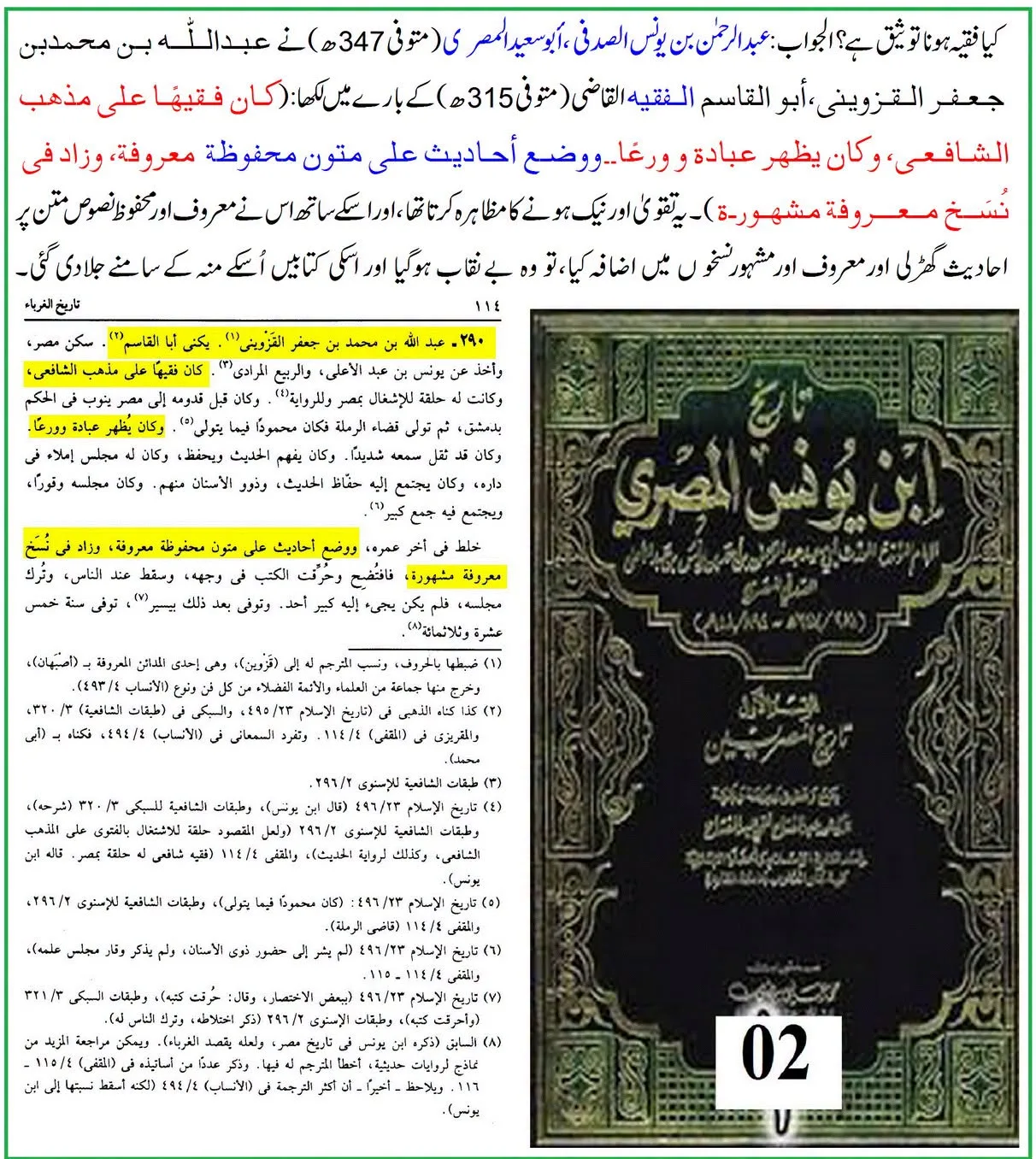
⑪ Ibn Yunus al-Masri's Criticism Regarding Abdullah bin Muhammad al-Qazwini al-Faqih al-Qadi
Imam Abdul Rahman bin Ahmad bin Yunus al-Masri, may Allah have mercy on him (died 347 AH), wrote about Abdullah bin Muhammad bin Ja'far al-Qazwini:
290- عبد الله بن محمد بن جعفر القزوينى … وكان يظهر عبادة وورعا … ووضع أحاديث على متون محفوظة معروفة، وزاد فى نسخ معروفة مشهورة، فافتضح وحرّقت الكتب فى وجهه،
Translation:
Abdullah bin Muhammad bin Ja'far al-Qazwini used to display worship and piety.
He fabricated hadiths on well-known and authenticated texts and made additions to famous and well-known manuscripts, until his matter became apparent and books were burned in front of him.
Reference: Book: Tarikh Ibn Yunus al-Masri
Reference: Author: Abdul Rahman bin Ahmad bin Yunus al-Sudafi, Abu Saeed (died 347 AH)
Reference: Translation Number: 290
Explanation:
This passage mentions a person who, despite being described as worshipful and pious, is criticized for fabricating hadiths and making additions to well-known manuscripts.
From this, the principle becomes clear that apparent worship and scholarly status cannot be made the absolute criterion of truthfulness and accuracy in the tradition of Hadith.
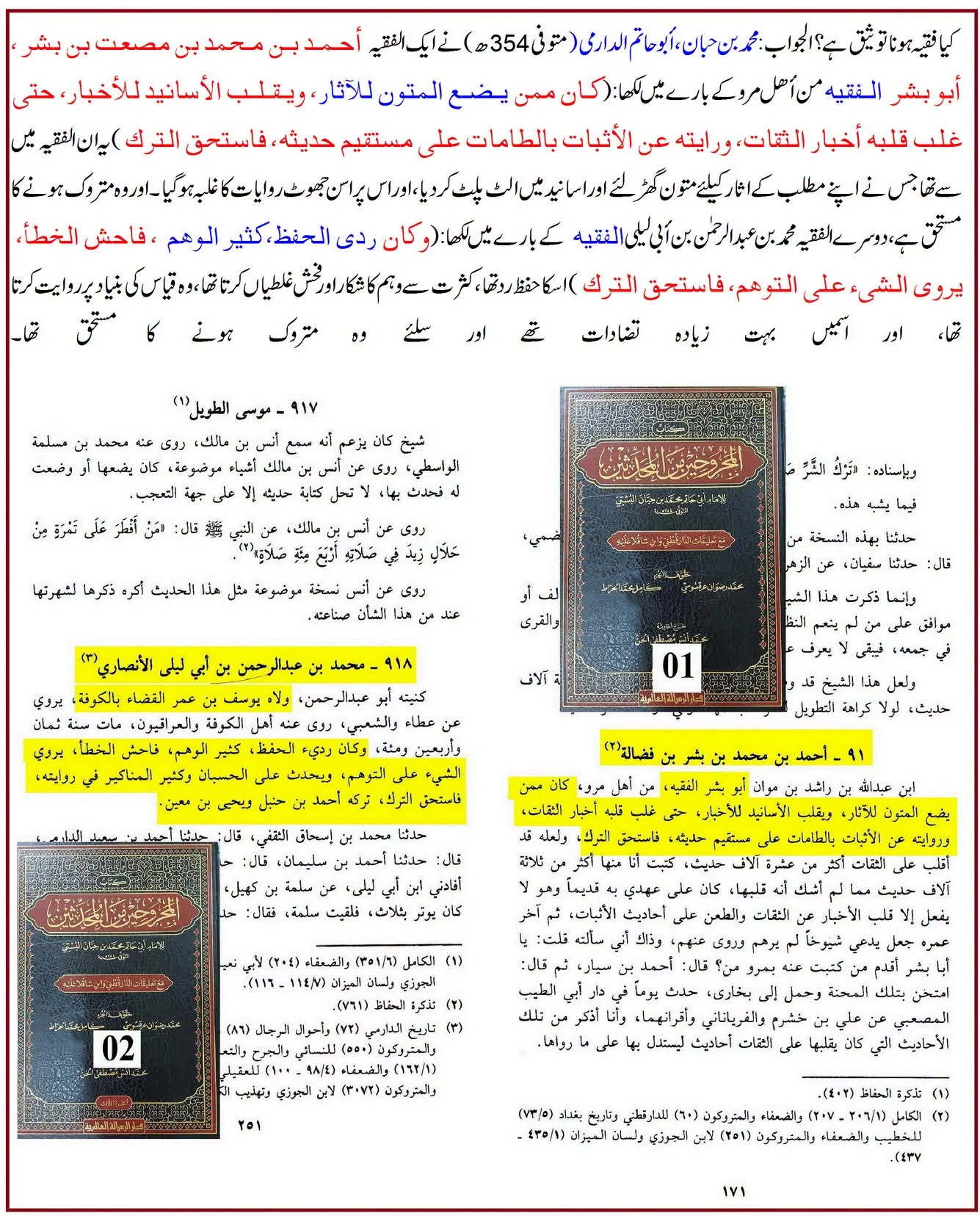
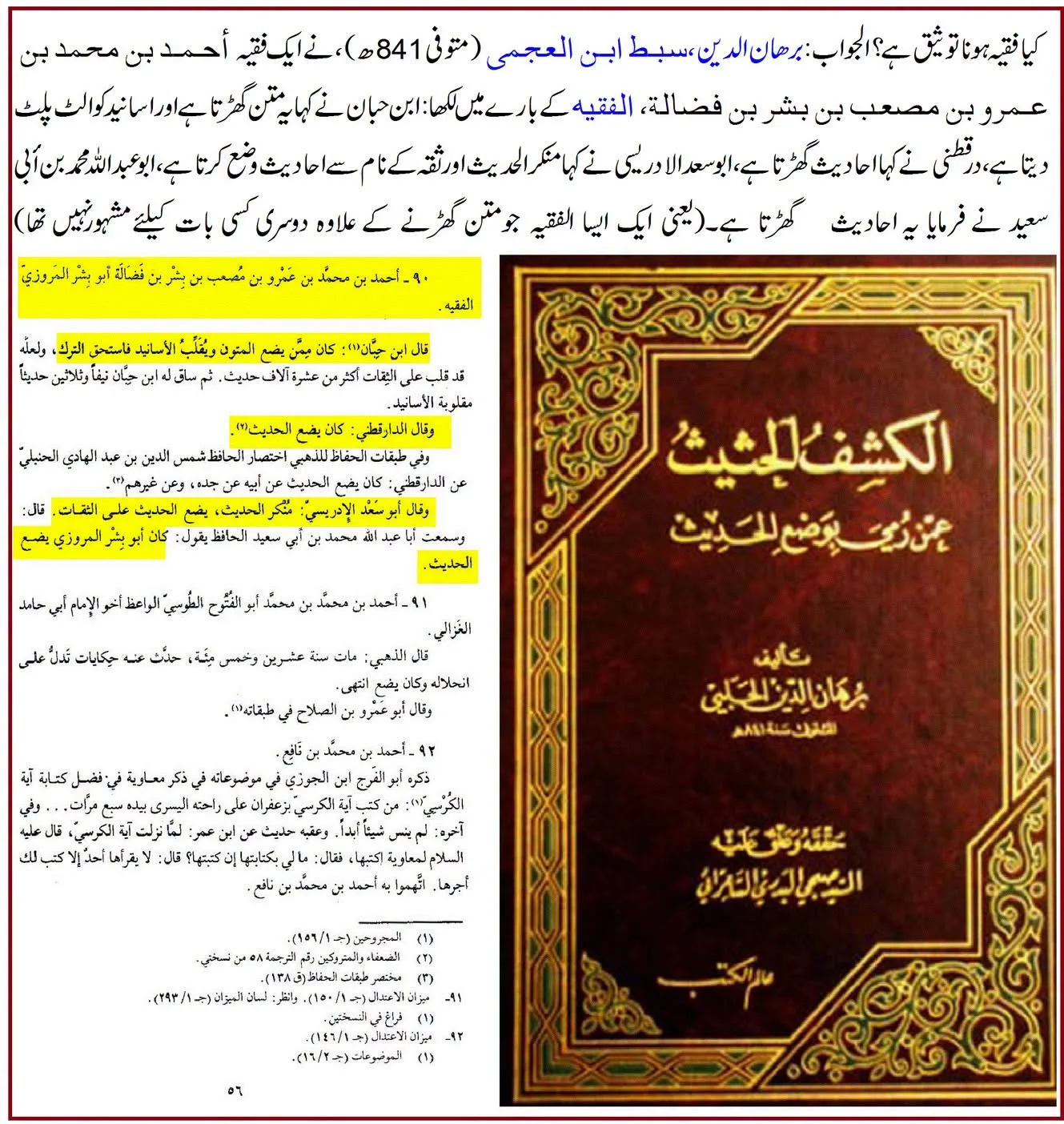
⑫ Imam Ibn Hibban's Criticism Regarding Ahmad bin Muhammad bin Mus'ab al-Marwazi al-Faqih
Imam Ibn Hibban al-Busti, may Allah have mercy on him (died 354 AH), wrote about Ahmad bin Muhammad bin Mus'ab al-Marwazi:
90 - أَحْمَد بْن مُحَمَّد بْن مُصْعَب بْن بشر بْن فضَالة بْن عَبْد اللَّهِ بْن رَاشد بْن موان أَبُو بشر الْفَقِيه من أهل مرو
كَانَ مِمَّن يضع الْمُتُون للآثار ويقلب الْأَسَانِيد للْأَخْبَار حَتَّى غلب قلبه أَخْبَار الثقات
Translation:
Ahmad bin Muhammad bin Mus'ab bin Bishr, Abu Bishr al-Faqih, was a resident of Marw.
He was among those who fabricated texts for the sake of traditions and altered the chains of narration, to the extent that changes in his chains prevailed even over narrations transmitted by trustworthy narrators.
Reference: Al-Kitab: Al-Majruhin min al-Muhaddithin wal-Du'afa wal-Matrukin
Reference: Author: Muhammad bin Hibban bin Ahmad bin Hibban bin Mu'adh bin Ma'bad, al-Tamimi, Abu Hatim, al-Busti (died: 354 AH)
Reference: Translation Number: 90
Explanation:
Imam Ibn Hibban, may Allah have mercy on him, clearly wrote "al-Faqih" with the name of Ahmad bin Muhammad bin Mus'ab, yet despite this, he severely criticized him for fabricating texts and altering chains of narration.
This example clarifies that merely the title «Al-Faqih» does not guarantee the integrity or accuracy of a narrator.
⑬ Criticism of Ahmad bin Muhammad Marwazi by Imam Darqatni and other Muhaddithin
Allama Subt Ibn Al-Ajmi, may Allah have mercy on him (died 841 AH), also narrated criticism from several Imams regarding Ahmad bin Muhammad Marwazi:
90 - أَحْمد بن مُحَمَّد بن عَمْرو بن مُصعب بن بشر بن فضَالة أَبُو بشر الْمروزِي الْفَقِيه …
قَالَ بن حبَان كَانَ مِمَّن يضع الْمُتُون ويقلب الْأَسَانِيد فَاسْتحقَّ التّرْك … وَقَالَ الدَّارَقُطْنِيّ كَانَ يضع الحَدِيث وَفِي طَبَقَات الْحفاظ للذهبي اخْتِصَار الْحَافِظ شمس الدّين بن عبد الْهَادِي الْحَنْبَلِيّ عَن الدَّارَقُطْنِيّ كَانَ يضع الحَدِيث عَن أَبِيه عَن جده وَعَن غَيرهم وَقَالَ أَبُو سعد الإدريسي مُنكر الحَدِيث يضع الحَدِيث على الثِّقَات قَالَ وَسمعت أَبَا عبد الله مُحَمَّد بن أبي سعيد الْحَافِظ يَقُول كَانَ أَبُو بشر الْمروزِي يضع الحَدِيث
Translation:
Regarding Ahmad bin Muhammad bin Amr bin Mus'ab, Abu Bishr Al-Marwazi Al-Faqih, Imam Ibn Hibban, may Allah have mercy on him, said that he fabricated texts and altered chains of narration, therefore his narrations deserved to be abandoned.
Imam Darqatni, may Allah have mercy on him, said that he fabricated hadiths.
Similarly, it has been reported about him that he fabricated hadiths in the names of his father, grandfather, and other people.
Imam Abu Sa'd Idrisi, may Allah have mercy on him, declared him a denier of hadith and said that he fabricated hadiths in the names of trustworthy narrators.
Imam Abu Abdullah Muhammad bin Abi Sa'id Hafiz, may Allah have mercy on him, also said that Abu Bishr Al-Marwazi used to fabricate hadiths.
Reference: Al-Kitab: Al-Kashf Al-Hatith 'Anman Rumi Bi Wad' Al-Hadith
Reference: Author: Burhan al-Din al-Halabi Abu al-Wafa Ibrahim ibn Muhammad ibn Khalil al-Tarabulsi al-Shafi'i Sabt ibn al-Ajmi (died: 841 AH)
Reference: Translation number: 90
Explanation:
Here, multiple hadith scholars' criticisms regarding the same narrator have been mentioned.
Despite the use of the title "al-Faqih" for this person, hadith scholars accused him of fabricating hadiths and altering chains of narration.
This indicates that in the books of Rijal, the scholarly titles recorded alongside the narrator's name and the judgments of the Imams regarding his narration hold separate statuses.
⑭ Imam Ibn Hibban's criticism regarding Muhammad ibn Abd al-Rahman ibn Abi Layla al-Faqih
Imam Ibn Hibban, may Allah have mercy on him, wrote about Muhammad ibn Abd al-Rahman ibn Abi Layla al-Ansari al-Faqih:
921 - مُحَمَّد بن عبد الرَّحْمَن بن أبي ليلى الْأنْصَارِيّ الْفَقِيه كنيته أَبُو عبد الرَّحْمَن … كَانَ رَدِيء الْحِفْظ كثير الْوَهم فَاحش الْخَطَأ يروي الشَّيْء على التَّوَهُّم وَيحدث على الحسبان فَكثر الْمَنَاكِير فِي رِوَايَته فَاسْتحقَّ التّرْك
Translation:
Muhammad ibn Abd al-Rahman ibn Abi Layla al-Ansari al-Faqih, whose kunya was Abu Abd al-Rahman.
His memory was weak, he was frequently afflicted by doubt and made very big mistakes. Sometimes he would narrate traditions based on doubt and would transmit hadiths merely by conjecture. Because of this, many of his narrations contained rejected hadiths, and he was deemed deserving of abandonment in narration.
Reference: Al-Kitab: Al-Majruhin min al-Muhaddithin wal-Du'afa wal-Matrukin
Reference: Author: Muhammad ibn Hibban ibn Ahmad ibn Hibban ibn Mu'adh ibn Ma'bad, al-Tamimi, Abu Hatim, al-Busti (died 354 AH)
Reference: Translation number: 921
Explanation:
Muhammad ibn Abdul Rahman ibn Abi Layla was a well-known jurist, but Imam Ibn Hibban, may Allah have mercy on him, severely criticized his memorization and precision in narrating hadith.
From this, it is understood that a person can be distinguished in jurisprudence yet weak in preserving hadith narrations.
Here, the criticism specifically relates to memorization, doubt, and frequent mistakes, not merely to jurisprudential inclination.
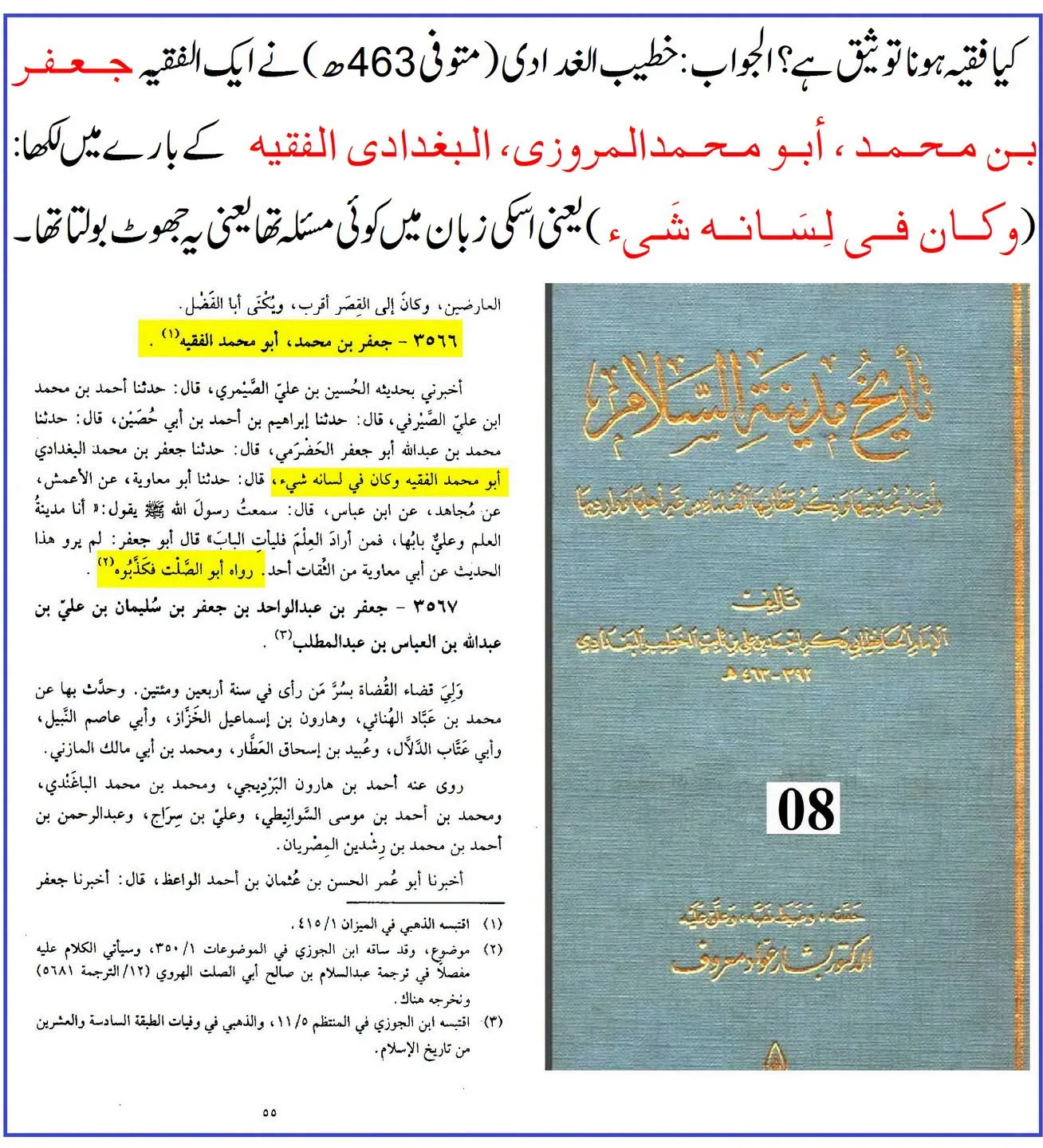
⑮ Statement of Khateeb Baghdadi regarding Ja'far ibn Muhammad al-Faqih
Hafiz Khateeb Baghdadi, may Allah have mercy on him (died 463 AH), wrote regarding Ja'far ibn Muhammad al-Faqih:
3566- جعفر بن مُحَمَّد أَبُو مُحَمَّد الفقيه … أَبُو مُحَمَّدٍ الْفَقِيهُ، وَكَانَ فِي لِسَانِهِ شَيْءٌ،
رَوَاهُ أَبُو الصَّلْتِ فَكَذَّبُوهُ
Translation:
It has been mentioned about Ja'far ibn Muhammad Abu Muhammad al-Faqih that he had some problem with his tongue.
And a narration was narrated by Abu al-Salt, but people declared it false.
Reference: Al-Kitab: Tarikh Baghdad
Reference: Author: Abu Bakr Ahmad ibn Ali ibn Thabit ibn Ahmad ibn Mahdi al-Khatib al-Baghdadi (died 463 AH)
Reference: Translation number: 3566
Explanation:
It is necessary to understand two things separately in this statement.
The first phrase "وَكَانَ فِي لِسَانِهِ شَيْءٌ" means that he had some problem with his tongue or speech. This sentence alone does not prove the accusation of lying.
The second phrase "رَوَاهُ أَبُو الصَّلْتِ فَكَذَّبُوهُ" mentions that the narration narrated by Abu al-Salt was rejected, not necessarily that Ja'far ibn Muhammad was declared a liar.
Therefore, it is not correct to prove Ja'far ibn Muhammad al-Faqih as a liar or weak just from these transmitted words. Further relevant criticism is required for that.
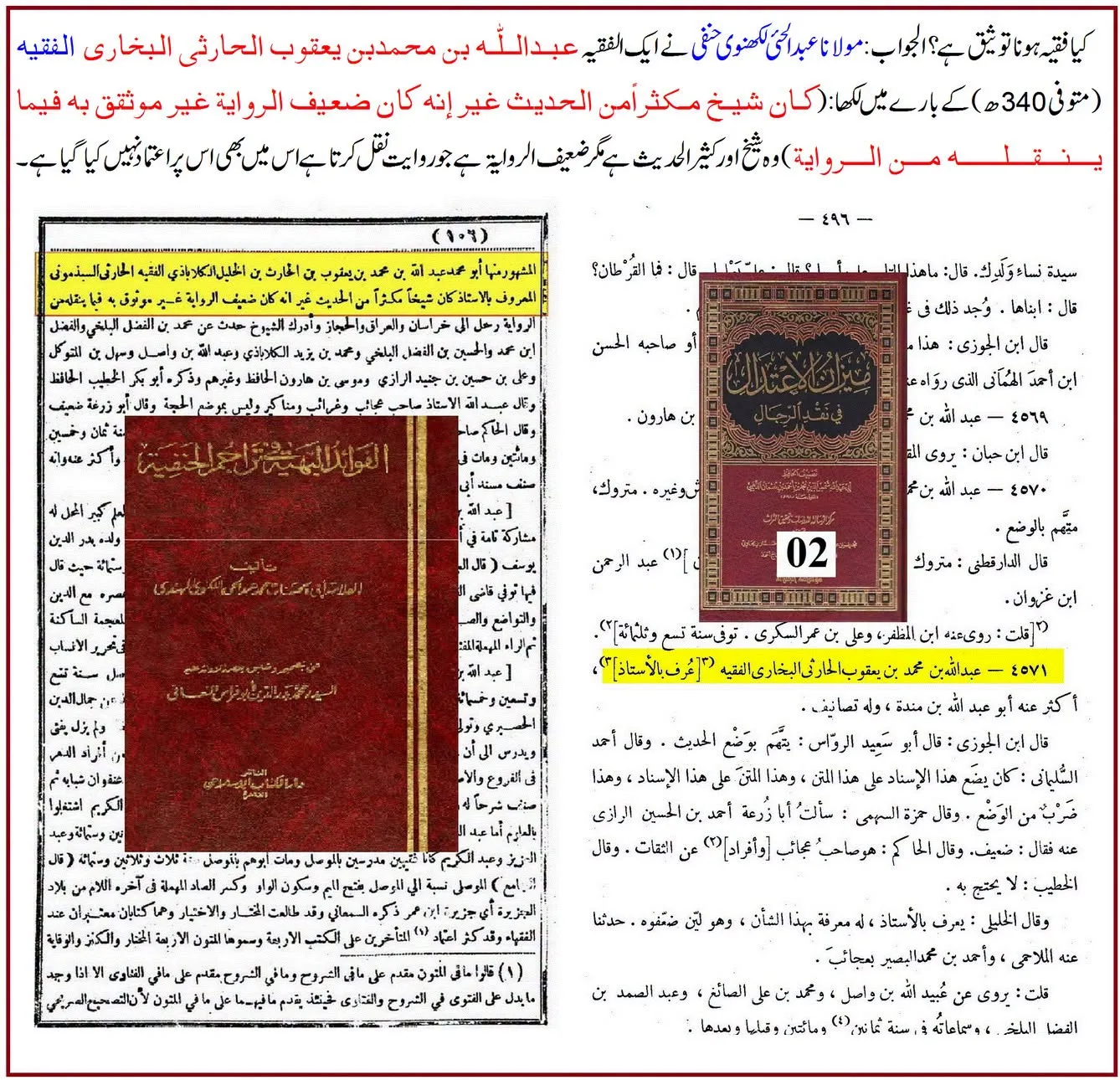
⑯ The statement of Allama Lakhnawi about Abdullah ibn Muhammad Harithi al-Faqih
Allama Abdul Hayy Lakhnawi Hanafi, may Allah have mercy on him (died 1304 AH), wrote about Abdullah ibn Muhammad ibn Ya'qub Harithi al-Bukhari al-Faqih:
أبو محمد عبد الله بن محمد بن يعقوب بن الحارث بن الخليل الكلاباذي الفقيه الحارثي السبذمونى المعروف بالأستاذ كان شيخاً مكثراً من الحديث غير أنه كان ضعيف الرواية غير موثوق به فيما ينقله من الرواية
Translation:
Abu Muhammad Abdullah bin Muhammad bin Yaqub bin Harith bin Khalil Kalabadhi Al-Faqih Harithi Sabzamuni, who was known by the title Ustad (Teacher).
He was a Sheikh who narrated many hadiths, but he was weak in narration, and the hadiths transmitted by him were not considered reliable.
Reference: Al-Kitab: Al-Fawaid Al-Bahiyah fi Tarajim Al-Hanafiyah, along with Al-Ta'liqaat Al-Sunniyah
Reference: Author: Abu Al-Hasanat Muhammad Abdul Hayy Al-Lakhnawi Al-Hanafi (died 1304 AH)
Explanation:
Allama Abdul Hayy Lakhnawi, may Allah have mercy on him, used the title "Al-Faqih" for Abdullah bin Muhammad, but at the same time declared him weak in narration and unreliable in hadith transmission.
The importance of this example is that a Hanafi scholar himself has clarified the difference between being a jurist (Faqih) and being reliable in hadith narration.
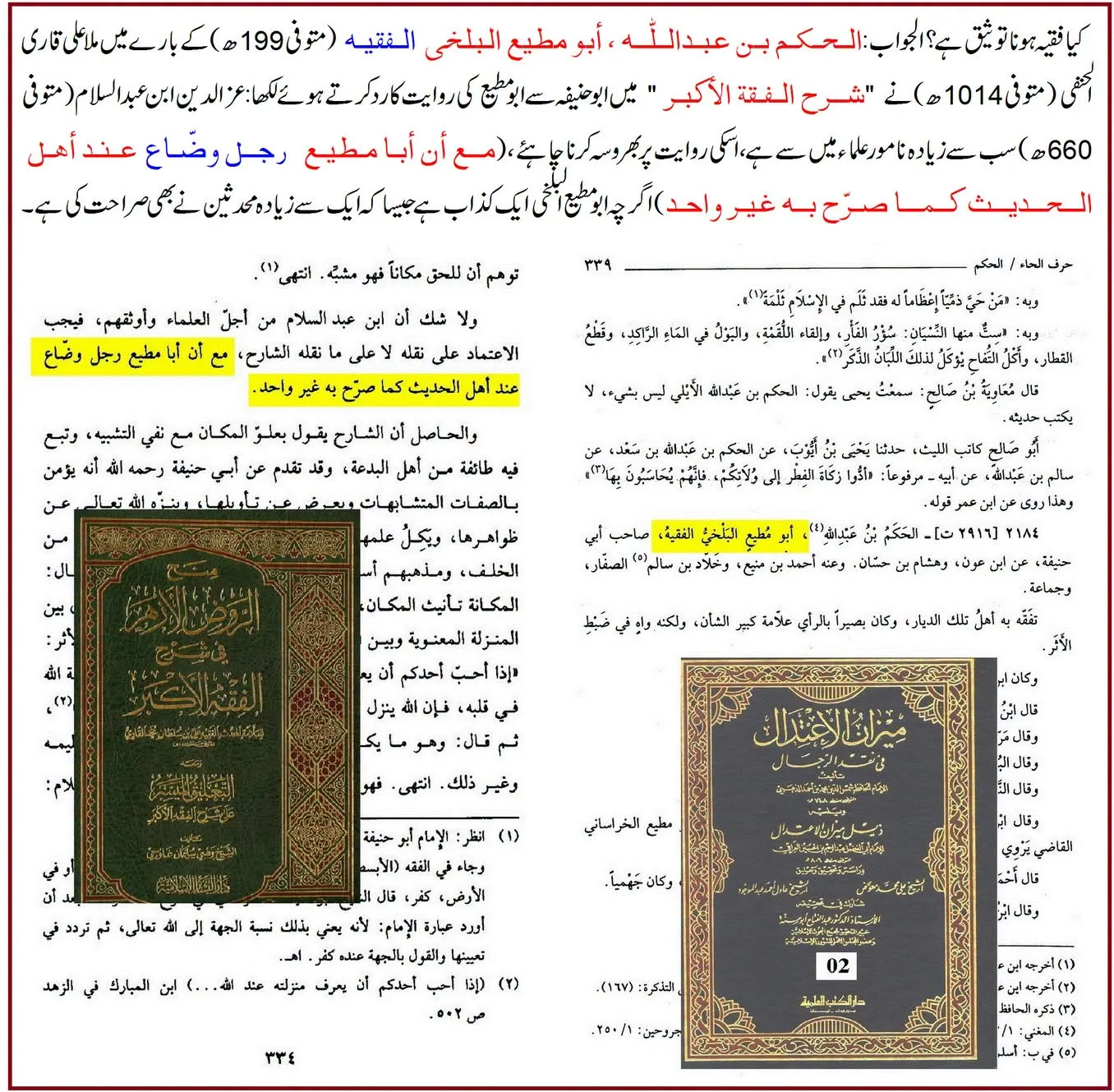
⑰ Clarification by Mulla Ali Qari regarding Abu Muti' Balkhi Al-Faqih
Mulla Ali Qari, Hanafi, may Allah have mercy on him (died 1014 AH), wrote regarding Abu Muti' Balkhi:
ولا شك أن ابن عبد السلام من أجلّ العلماء وأوثقهم فيجب الاعتماد على نقله لا على ما نقله الشارح مع أن أبا مطيع رجل وضّاع عند أهل الحديث، كما صرّح به غير واحد.
There is no doubt that Ibn Abdus Salam is among the most respected and highly reliable scholars, and therefore his narration should be trusted, not the narration that the commentator has quoted.
Moreover, Abu Muti' is considered by the Ahl al-Hadith to be a fabricator of hadith, as more than one muhaddith has explicitly stated.
Reference: Al-Kitab: Sharh al-Fiqh al-Akbar
Reference: Author: Ali bin (Sultan) Muhammad, Abu al-Hasan Nur al-Din al-Mulla al-Harawi al-Qari (d. 1014 AH)
Explanation:
Mulla Ali Qari, may Allah have mercy on him, at this point quoted the severe criticism of the muhaddithin regarding Abu Muti' Balkhi and preferred the narration of Ibn Abdus Salam over his narration.
What is noteworthy here is that Abu Muti' Balkhi was a juristic personality, yet despite this, Mulla Ali Qari did not trust his narration in hadith.
This makes it clear that the juristic identity of a narrator is not sufficient for his authentication in hadith.
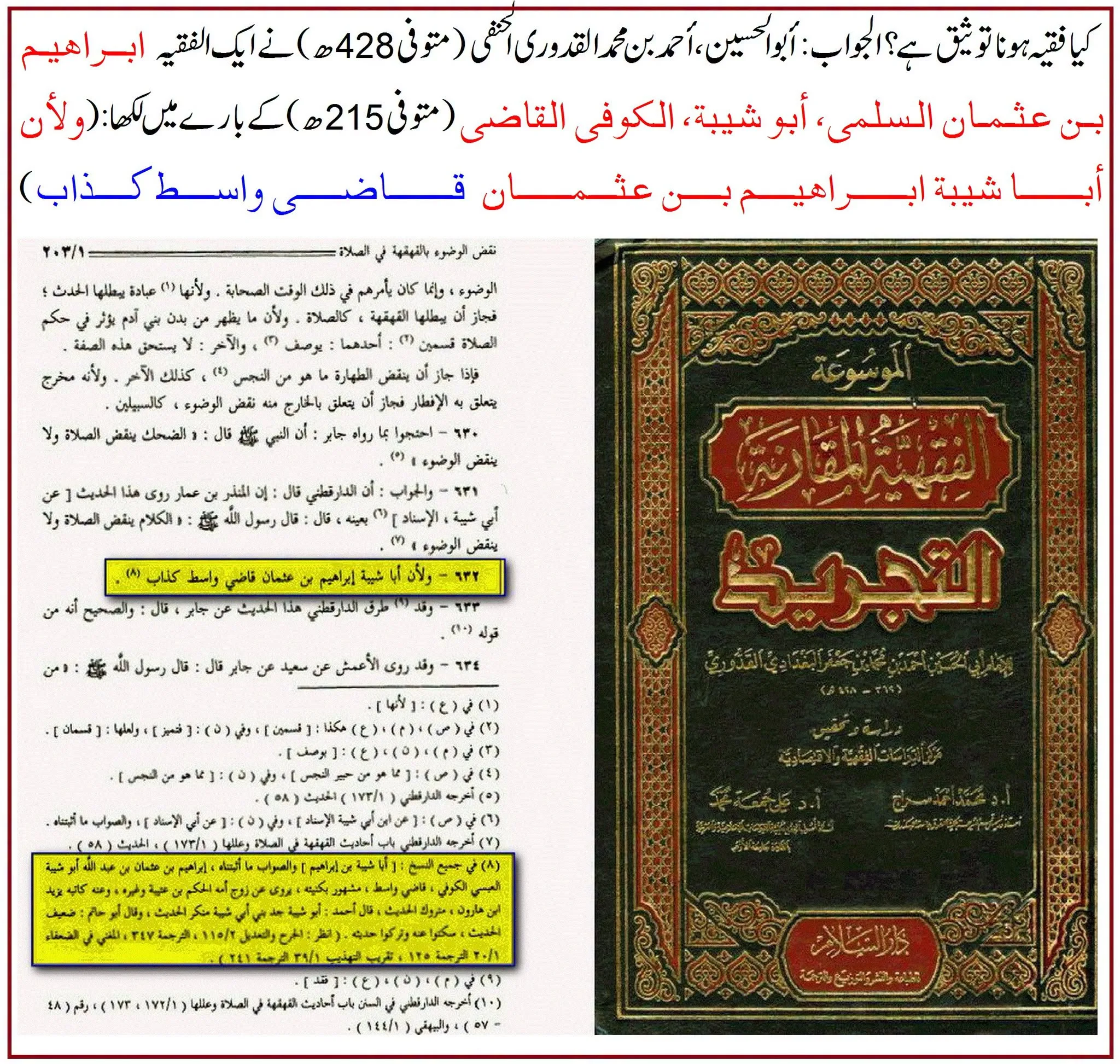
⑱ The statement of Imam Quduri regarding Ibrahim bin Uthman Qadi Wasit
Imam Abu al-Husayn Qaduri Hanafi, may Allah have mercy on him (died 428 AH), wrote about Ibrahim bin Uthman, Qadi Wasit:
632 - ولأن أبا شيبة إبراهيم بن عثمان قاضي واسط كذاب.
Translation:
Because Abu Shaybah Ibrahim bin Uthman, Qadi Wasit, is a liar.
Reference: Al-Kitab: At-Tajreed
Reference: Author: Abu al-Husayn Ahmad bin Muhammad bin Ja'far al-Baghdadi al-Qadduri (362 - 428 AH)
Reference: Reference number: 632
Explanation:
Imam Qaduri, may Allah have mercy on him, mentioned Ibrahim bin Uthman as a Qadi but still declared him a liar.
This example also makes it clear that a person's position as a Qadi is not necessarily proof of his trustworthiness in hadith.
However, here the attribute "Qadi" has been mentioned, not the word "Faqih." Therefore, this narration relates to the difference between a scholarly or judicial position and the trustworthiness of narration.
When is the hadith of a Faqih acceptable? Principle of Hafiz Ibn Rajab
After the above examples, it is necessary to understand the fundamental principle regarding what matters the muhaddithin (hadith scholars) consider important for accepting the narration of a Faqih.
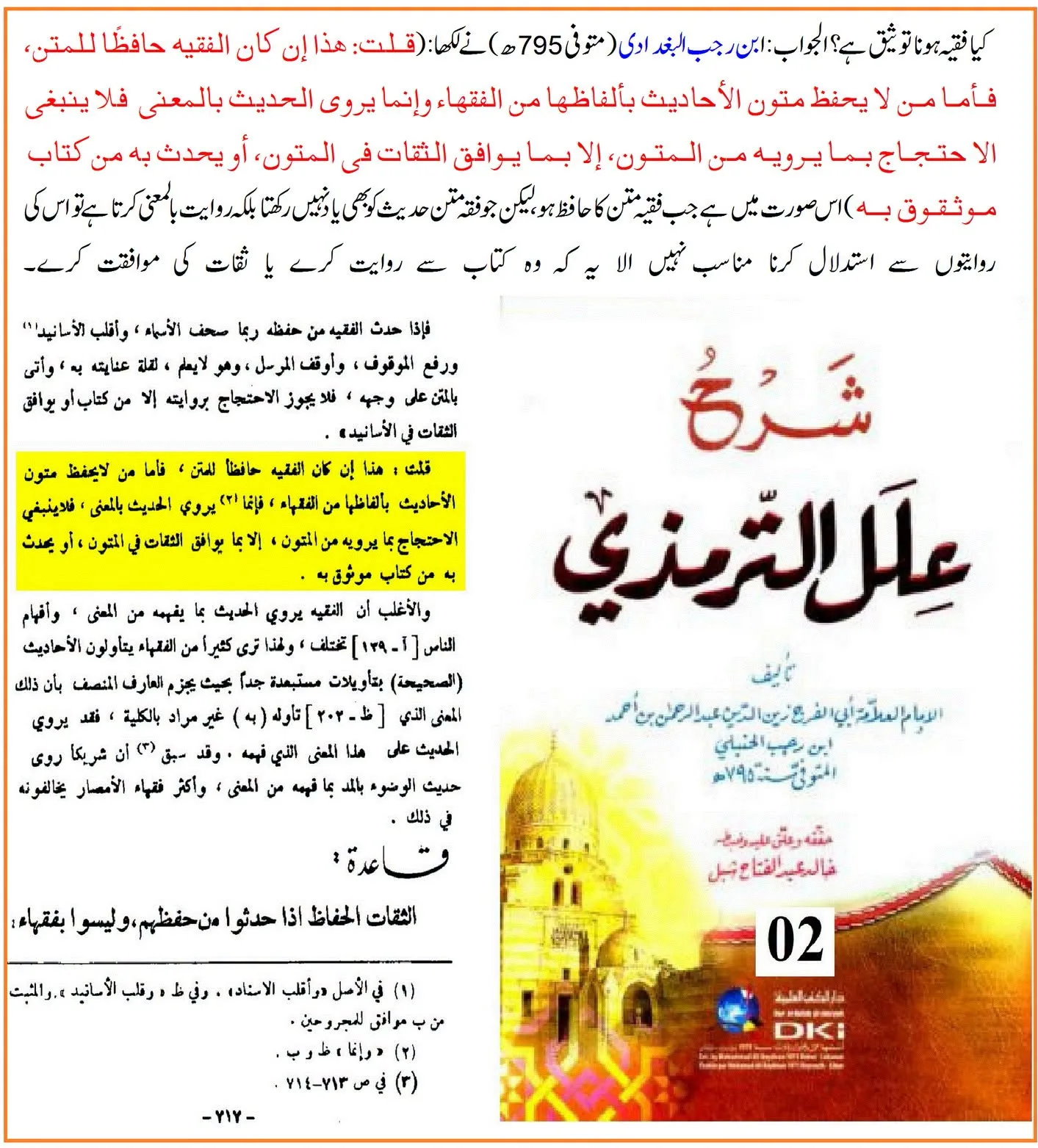
Hafiz Ibn Rajab Hanbali, may Allah have mercy on him (died 795 AH), gave a very important clarification in this regard:
قلت: هذا إن كان الفقيه حافظاً للمتن، فأما من لا يحفظ متون الأحاديث بألفاظها من الفقهاء، وإنما يروي الحديث بالمعنى فلا ينبغي الاحتجاج بما يرويه من المتون، إلا بما يوافق الثقات في المتون، أو يحدث به من كتاب موثوق به.
Translation:
I (Ibn Rajab) say: This ruling applies when the jurist is one who preserves the text of the hadith.
However, those jurists who do not preserve the texts of the hadith in their original words, but rather narrate the hadith in terms of its meaning, their narrated texts should not be used as evidence until their narration corresponds to the texts of trustworthy narrators or they narrate from a reliable book.
Reference: Al-Kitab: Sharh 'Ilal al-Tirmidhi
Reference: Author: Zain al-Din Abdul Rahman bin Ahmad bin Rajab bin al-Hasan, al-Salami, al-Baghdadi, then al-Dimashqi, Hanbali (died: 795 AH)
Explanation:
The statement of Hafiz Ibn Rajab, may Allah have mercy on him, holds fundamental importance in the issue under discussion.
He clarified regarding the narration of jurists that merely being a jurist does not mean every narration should be accepted; rather, it is also necessary to examine to what extent the narrator preserves the original words of the hadith.
Especially when a jurist narrates with meaning and does not preserve the exact words of the hadith, it is necessary to compare his narration with the narrations of trustworthy narrators.
From this, three principles emerge:
① The jurist's memorization of the text and accuracy of narration will be examined.
② If his narration aligns with that of trustworthy narrators, it strengthens the acceptance of that narration.
③ Even when narrating from a reliable book, the trustworthiness of the book and the method of narration will be assessed.
However, the statement of Hafiz Ibn Rajab, may Allah have mercy on him, pertains specifically to jurists with weak memorization in certain cases. It does not imply an absolute rejection of every narration with meaning or the narrations of all jurists.
Difference between Hadith Jurists and Jurists of Reason
In terms of jurisprudential methodologies, the terms Hadith Jurists and Jurists of Reason are well-known among scholars.
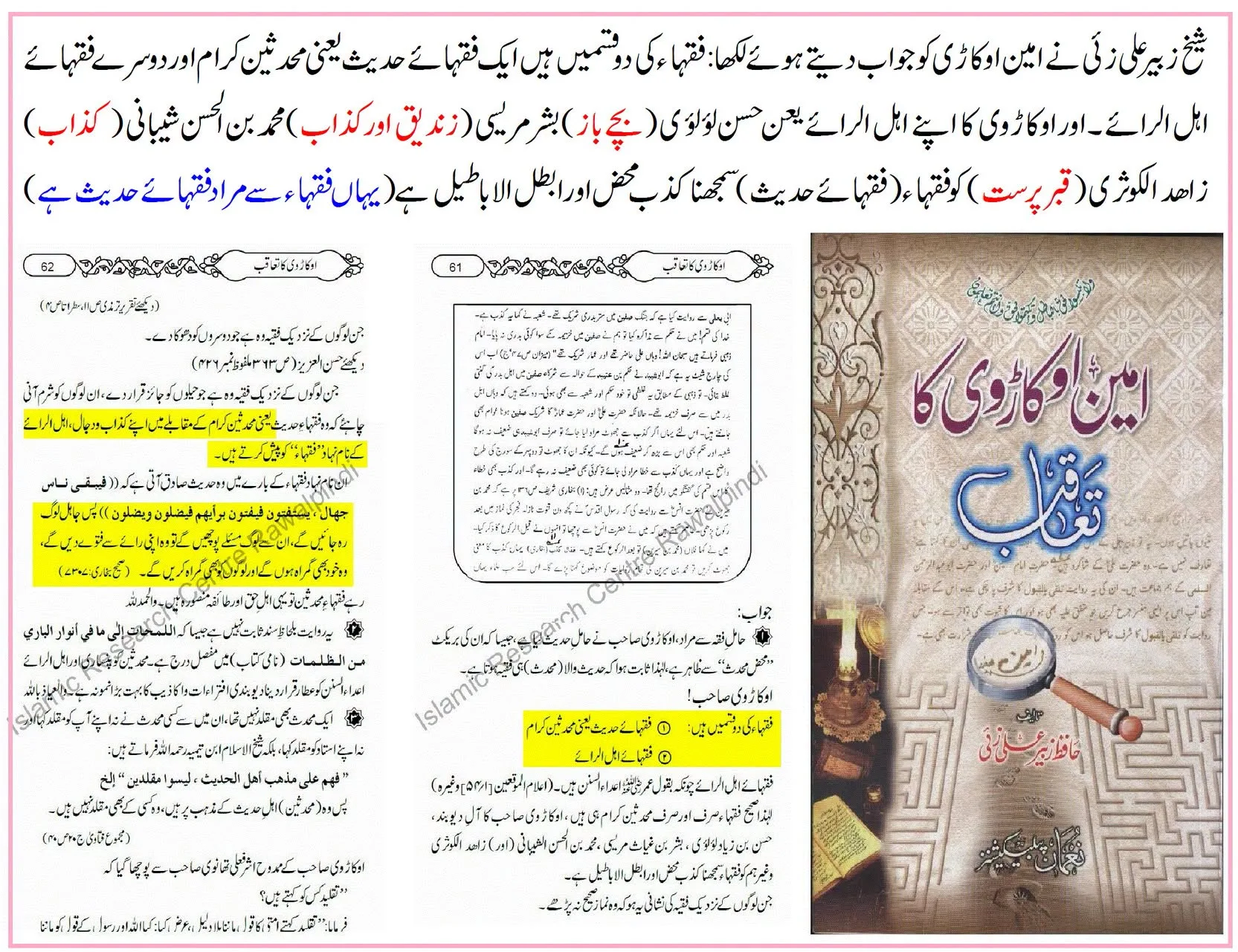
Sheikh Zubair Ali Zai, may Allah have mercy on him, has explained this division under two headings in his book "Ameen Okaraavi ka Taaqub":
① Hadith Jurists
This refers to those scholars who hold a prominent position in the narration of Hadith and traditions, their understanding, and the derivation of rulings from them.
The jurisprudential insight of Imam Bukhari, Imam Muslim, and other leading Muhaddithin in this regard is well known.
② Jurists of Ahl al-Ra'y
This refers to those jurists whose jurisprudential reasoning prominently involved opinion, analogy, and principles of Ijtihad.
However, it is very important to understand that being a jurist of Ahl al-Ra'y and being weak or a liar in the narration of Hadith are not the same thing.
A person cannot be declared a liar solely on the basis of belonging to Ahl al-Ra'y; rather, a consistent critique and evaluation of his narration is required.
Similarly, every person counted among the jurists of Hadith does not become trustworthy solely on that basis.
The term "Al-Faqih" and the fundamental difference in the authentication of a narrator
From the statements of the aforementioned Imams of Jarh wa Ta'dil, it becomes clear that there is a fundamental difference between the term "Al-Faqih" and the authentication of a narrator in Hadith.
"Al-Faqih" indicates a person's jurisprudential expertise, knowledge of Shariah rulings, or scholarly status in that field.
In contrast, terms like "Al-Thiqa," "Thabat," and "Saduq" are used in the narration of Hadith to describe the narrator's reliability, although scholars recognize distinctions in their degrees and meanings.
Therefore, having "Al-Faqih" written alongside a person's name does not necessarily prove the following:
① That he is trustworthy in Hadith narration.
② That his memory is strong and his retention complete.
③ That all his narrations are authentic and acceptable.
④ That all persons who narrate from him are reliable.
⑤ That his narrated Hadiths are free from defects, anomalies, and other flaws.
However, the term "Al-Faqih" itself is not a criticism. If a jurist has been declared trustworthy, a memorizer, or reliable by the Imams of Hadith, then that endorsement remains valid.
Hence, instead of relying solely on a title regarding a narrator, one should examine the collective statements of the Imams.
Important conclusions derived from the statements of the Imams of Jarh and Ta'dil
The following scholarly conclusions emerge from all the aforementioned evidence:
First: The term «الفقیہ» is a description of a person's jurisprudential knowledge, but merely this word does not establish their authentication in hadith narration.
Second: Despite using jurisprudential identification for individuals like Ibrahim bin Ali Al-Amidi and Muhammad bin Shuja' Thalji, Hafiz Dhahabi (may Allah have mercy on him) has transmitted criticism regarding them.
Third: Imam Ibn Sa'd (may Allah have mercy on him) acknowledged the expertise of Yusuf bin Khalid Samti in opinion and fatwa but declared him weak in hadith.
Fourth: Imam Ibn Adi (may Allah have mercy on him) mentioned Abu Bakr bin Abi Sabrah as the Mufti of Medina, but considered most of his narrations unreliable and transmitted criticism of hadith fabrication against him.
Fifth: Imam Ibn Hibban (may Allah have mercy on him) mentioned some jurists about whom there are criticisms of fabricating texts, altering chains of narration, weak memory, and excessive conjecture.
Sixth: Imam Darqatni, may Allah have mercy on him, explicitly declared Mutahhar bin Suleiman Al-Faqih a liar. This is a clear example that the title of a jurist and reliability in narrating Hadith are two separate matters.
Seventh: Allama Abdul Hay Lakhnawi Hanafi, may Allah have mercy on him, and Mulla Ali Qari Hanafi, may Allah have mercy on him, also reported weakness or severe criticism regarding the narrations of some juristic personalities.
Eighth: Hafiz Ibn Rajab, may Allah have mercy on him, clarified that in the narration of a jurist, the importance lies in his accuracy of the text, conformity with trustworthy narrators, and narrating from authentic books.
Ninth: Every jurist who has criticism regarding a specific doctrinal issue, innovation, or practical conduct is not necessarily weak in Hadith. Imam Hasan bin Salih, may Allah have mercy on him, is an important example of understanding this distinction, as his reliability is also transmitted from many Imams.
Tenth: Similarly, it is not correct to label every weak jurist as a liar or fabricator. Weakness in memorization, abundance of mistakes, abandoning Hadith, accusation of lying, and fabrication of Hadith are different types of criticisms, whose ruling will depend on their actual status.
Summary and Conclusion
From the aforementioned statements of the Imams of Jarh and Ta'dil, the principle becomes clear that the presence of the word "Al-Faqih" alongside a narrator's name is not, by itself, sufficient for the authentication of his hadith.
In the books of Rijal, there are numerous individuals mentioned who were known for their jurisprudential expertise, scholarly positions, or roles in issuing fatwas and judiciary, but weaknesses in their hadith narration have also been noted.
Some are criticized for frequent mistakes and poor memory, some have been reported to narrate rejected traditions, while others have been accused of serious charges such as lying or fabricating hadith.
On the other hand, there are many jurists whom the Imams of Hadith have declared trustworthy, memorizing, and reliable. Therefore, it is neither correct to consider jurisprudential status and hadith reliability as the same thing, nor is it proper to establish an inevitable contradiction between them.
The correct scholarly methodology is to collect all relevant statements of the Imams of Jarh and Ta'dil regarding the narrator, assess his memorization and discipline, truthfulness and integrity, and the quality of his narration, and then make a judgment about his narration in the light of the principles of Hadith.
The conclusion is that "Al-Faqih" is a description of jurisprudential expertise; it is not a definitive term of authentication in Hadith narration. Therefore, merely being a jurist is not sufficient to establish the reliability of a narrator; rather, the authentication by trustworthy Imams and the examination of his narration according to the principles of Jarh and Ta'dil are necessary.
And Allah Almighty knows best.