
Compiled by: Abu Hamzah Salafi
Some contemporaries and later writers have raised the following objections against Shaykh al-Islam Imām Ibn Taymiyyah رحمه الله (d. 728 AH):
① He declared himself to be an Ashʿarī.
② He believed the Qur’an to be eternal and denied letters and sound.
③ In the issue of Istiwāʾ, he adopted tafwīḍ (i.e., claimed that the meaning is unknown).
Based on these objections, the impression is created that Imām Ibn Taymiyyah recanted his original creed or deviated from the methodology of Ahl al-Sunnah. However, these claims do not stand up to scholarly scrutiny and are riddled with distortion and negligence.
✿ Source of the Objection
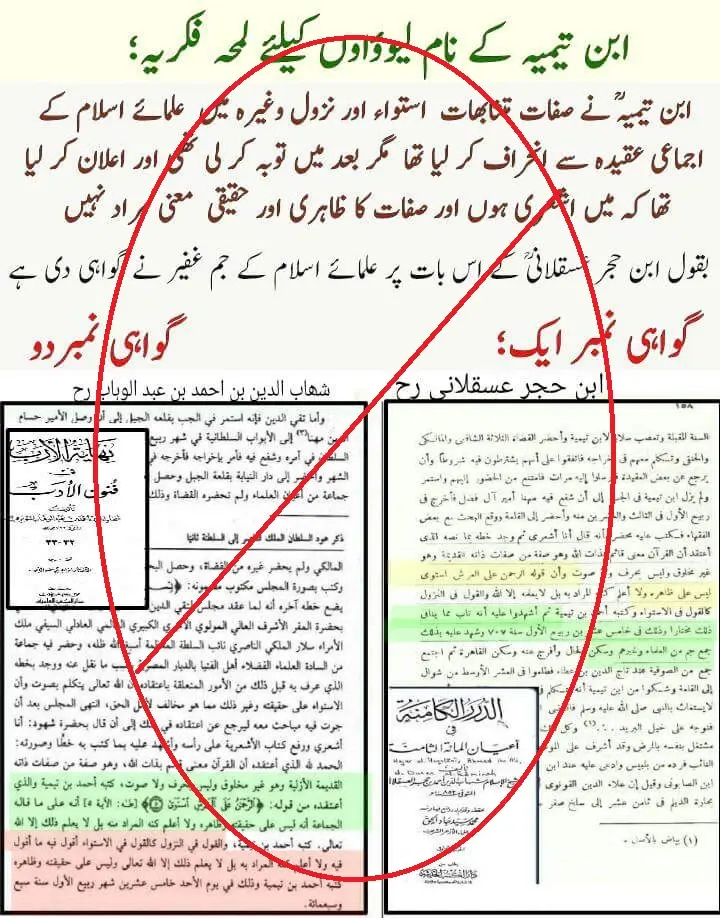
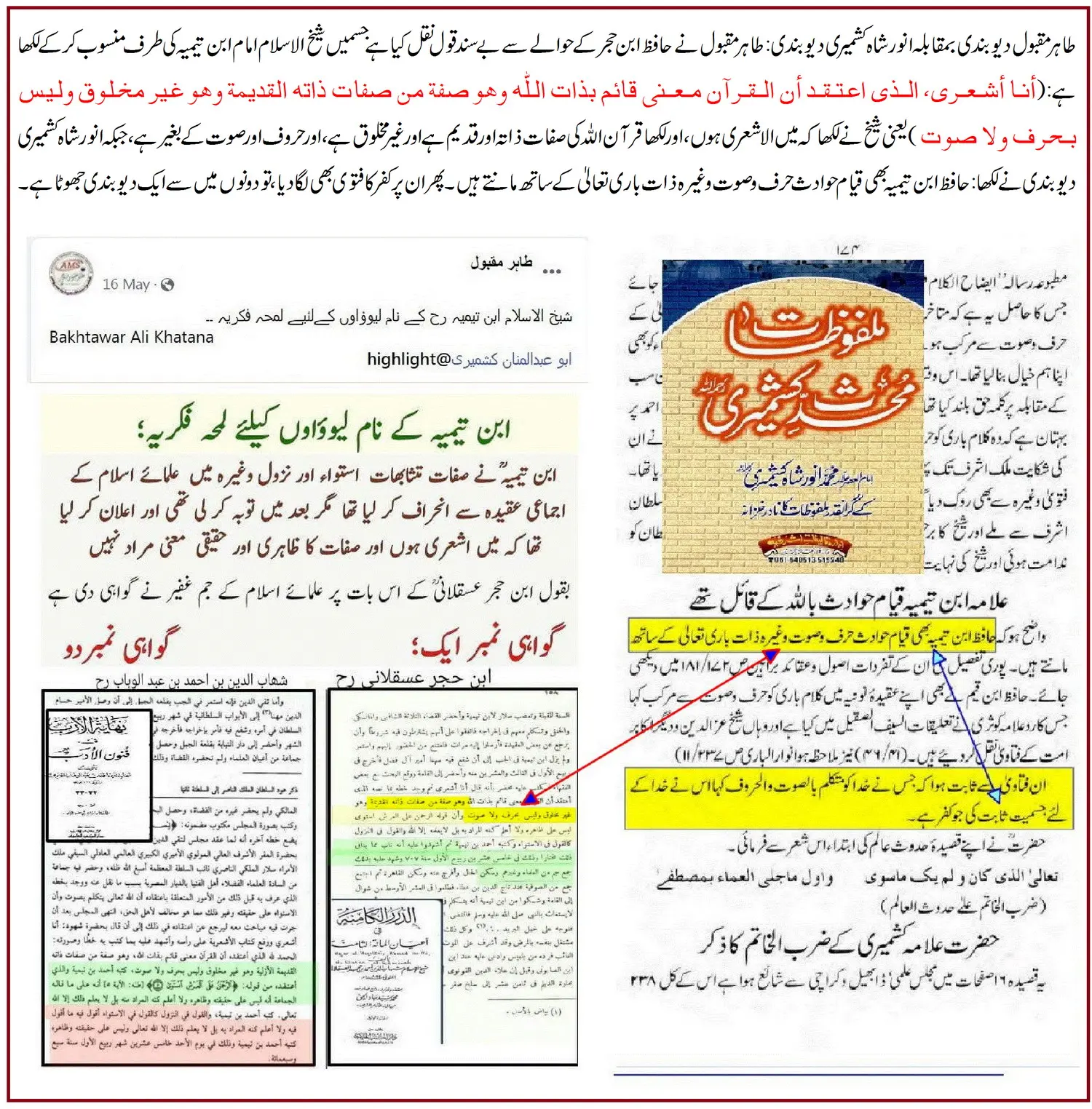
Ṭāhir Maqbūl Deobandī quoted a passage in a Facebook post from al-Durar al-Kāminah fī Aʿyān al-Mi’ah al-Thāminah by Ḥāfiẓ Ibn Ḥajar al-ʿAsqalānī رحمه الله, in which the following words are attributed to Imām Ibn Taymiyyah:
النص:
فَكتب عليه محضر بأنه قال أنا أشعري، ثم وجد خطه بما نصه: الذي اعتقد أن القرآن معنى قائم بذات الله وهو صفة من صفات ذاته القديمة، وهو غير مخلوق وليس بحرف ولا صوت، وأن قوله {الرحمن على العرش استوى} ليس على ظاهره، ولا أعلم كنه المراد به، بل لا يعلمه إلا الله.
 Translation:
“A statement was written against Ibn Taymiyyah that he said: ‘I am an Ashʿarī.’ Then it was found in his own handwriting that he wrote: ‘I believe that the Qur’an is a meaning subsisting in the Essence of Allah, and it is one of His eternal attributes; it is uncreated and is neither letters nor sound. And the saying of Allah, {The Most Merciful rose over the Throne}, is not upon its apparent meaning, and I do not know its true intent; rather, only Allah knows it.’”
✿ Brief Response
This passage is outwardly attributed to Imām Ibn Taymiyyah, and from it the following impressions are drawn:
① That he affiliated himself with the Ashʿarīs.
② That he regarded the Qur’an as merely an eternal meaning without letters and sound.
③ That regarding Istiwāʾ, he denied its apparent meaning and consigned its meaning entirely to Allah.
However, research establishes that this passage:
✔ Is not authentically transmitted.
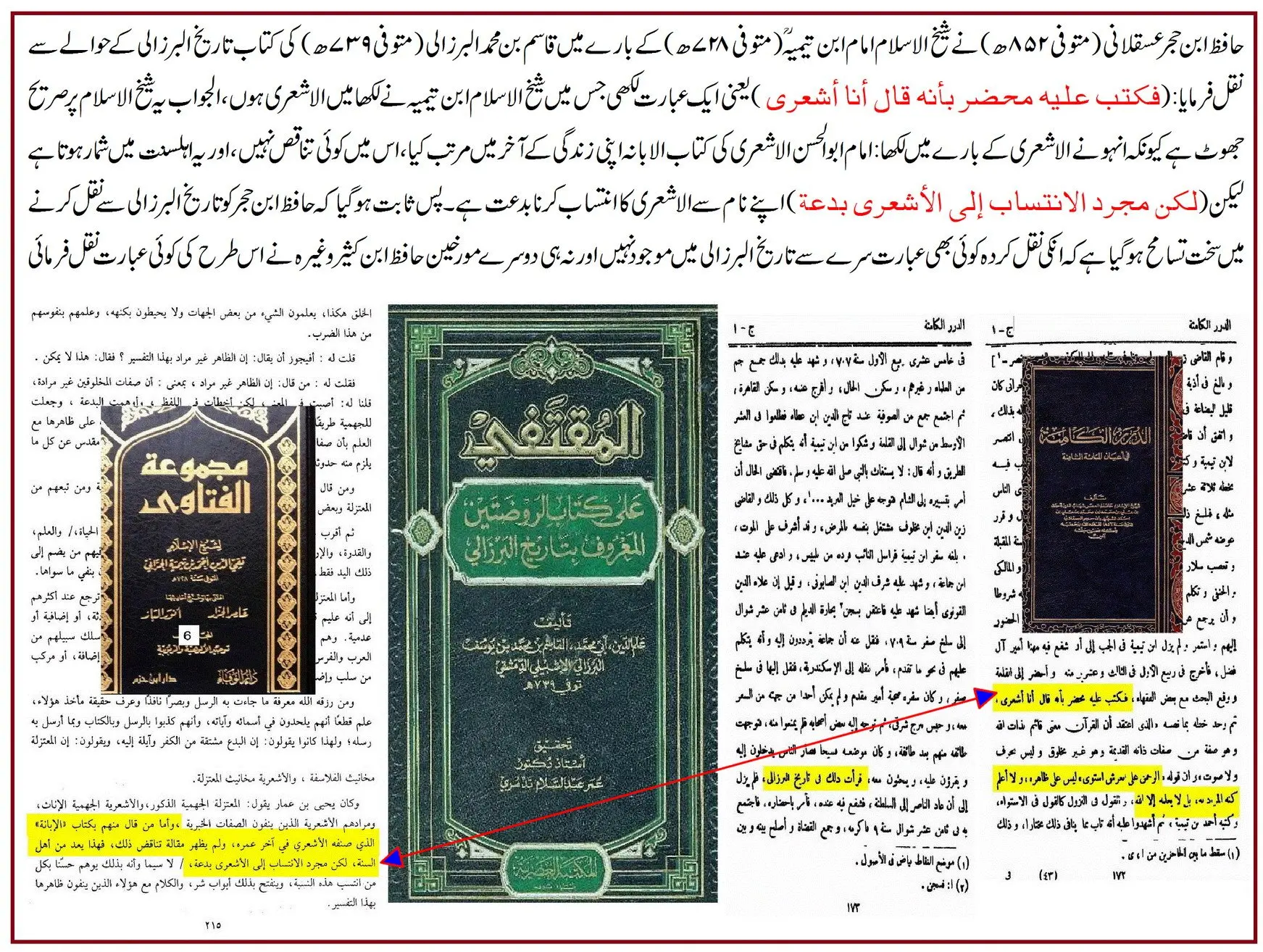
✔ Is not found in Tārīkh al-Barzālī, the original source.
✔ Directly contradicts the explicit statements of Imām Ibn Taymiyyah himself and the testimonies of his students (Ibn ʿAbd al-Hādī, Ibn al-Qayyim, and others).
✿ Objection 1: Imām Ibn Taymiyyah said “أنا أشعري”
According to Ṭāhir Maqbūl Deobandī, Ḥāfiẓ Ibn Ḥajar reported in al-Durar al-Kāminah that at the time of his release from imprisonment, a statement was written in which Ibn Taymiyyah said: “I am an Ashʿarī.”
◈ Response
This attribution is unsourced and disconnected:
✔ As mentioned earlier, this statement does not exist in the original source (Tārīkh al-Barzālī).
✔ There is therefore no proof that Imām Ibn Taymiyyah ever uttered these words.
Clear verdict of Imām Ibn Taymiyyah:
النص:
فهذا يعد من أهل السنة؛ لكن مجرد الانتساب إلى الأشعري بدعة.
Translation:
“Such a person may be counted among Ahl al-Sunnah; however, merely affiliating oneself with Ashʿarī is an innovation.”
 This clearly proves that Ibn Taymiyyah never described himself as an Ashʿarī; rather, he explicitly stated that adopting the label ‘Ashʿarī’ itself is an innovation.
Important Clarification
Imām Ibn Taymiyyah did mention that some Ashʿarīs fall within Ahl al-Sunnah due to their agreement with them in many matters of truth. However, he consistently refuted the core Ashʿarī doctrines, such as denying letters and sound in the speech of Allah and interpreting the divine attributes.
✿ Conclusion
Attributing the statement “I am an Ashʿarī” to Imām Ibn Taymiyyah is incorrect and baseless. His own writings clearly establish that he regarded mere Ashʿarī affiliation as an innovation.
✿ Objection 2: Ibn Taymiyyah believed the Qur’an to be eternal and denied letters and sound
Opponents claim that Ibn Taymiyyah wrote:
“الذي اعتقد أن القرآن معنى قائم بذات الله… وليس بحرف ولا صوت”
Translation:
“I believe that the Qur’an is a meaning subsisting in the Essence of Allah… uncreated, but without letters and sound.”
◈ Response
This statement directly contradicts Ibn Taymiyyah’s well-known creed.
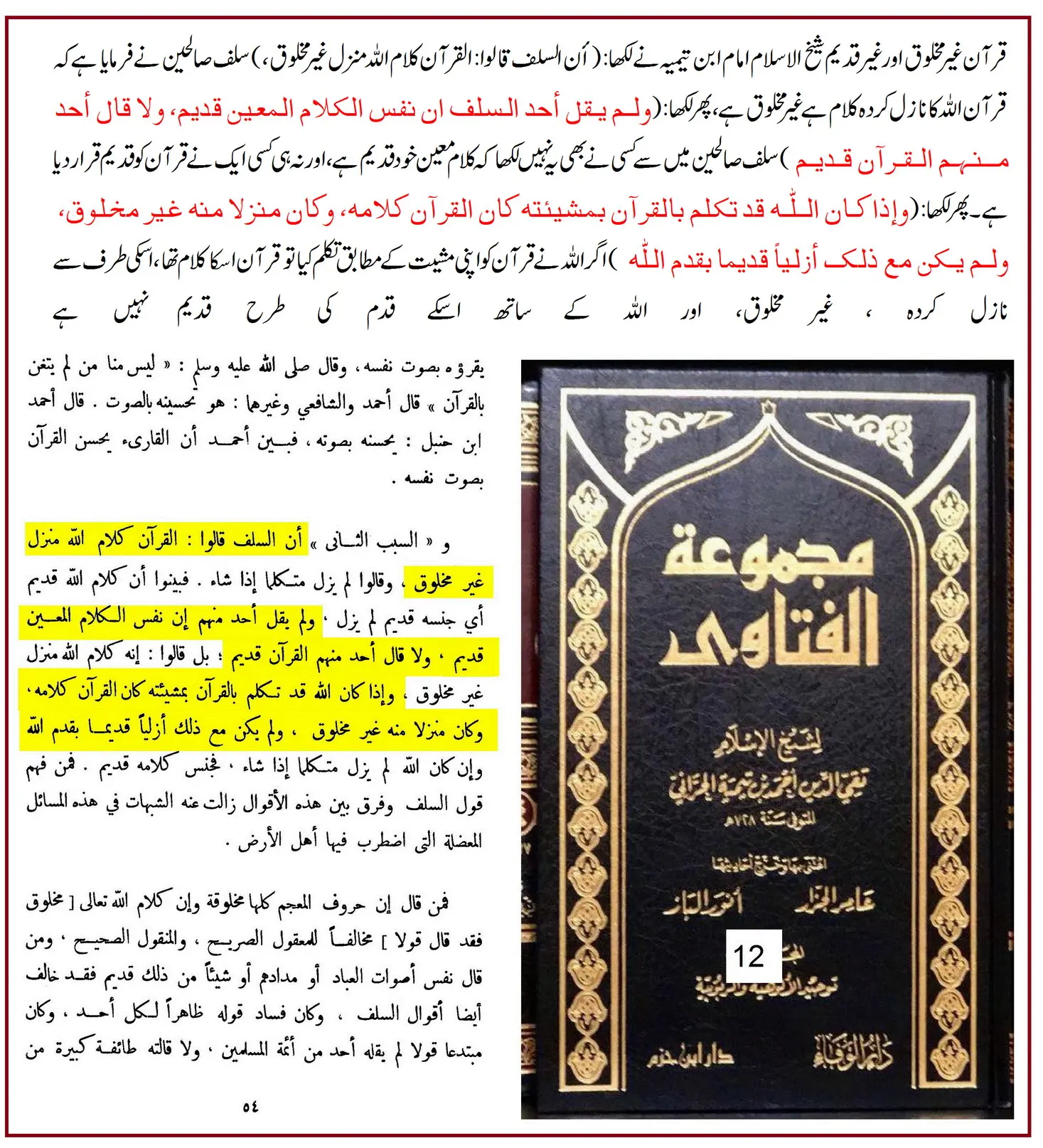
His explicit statements:
النص:
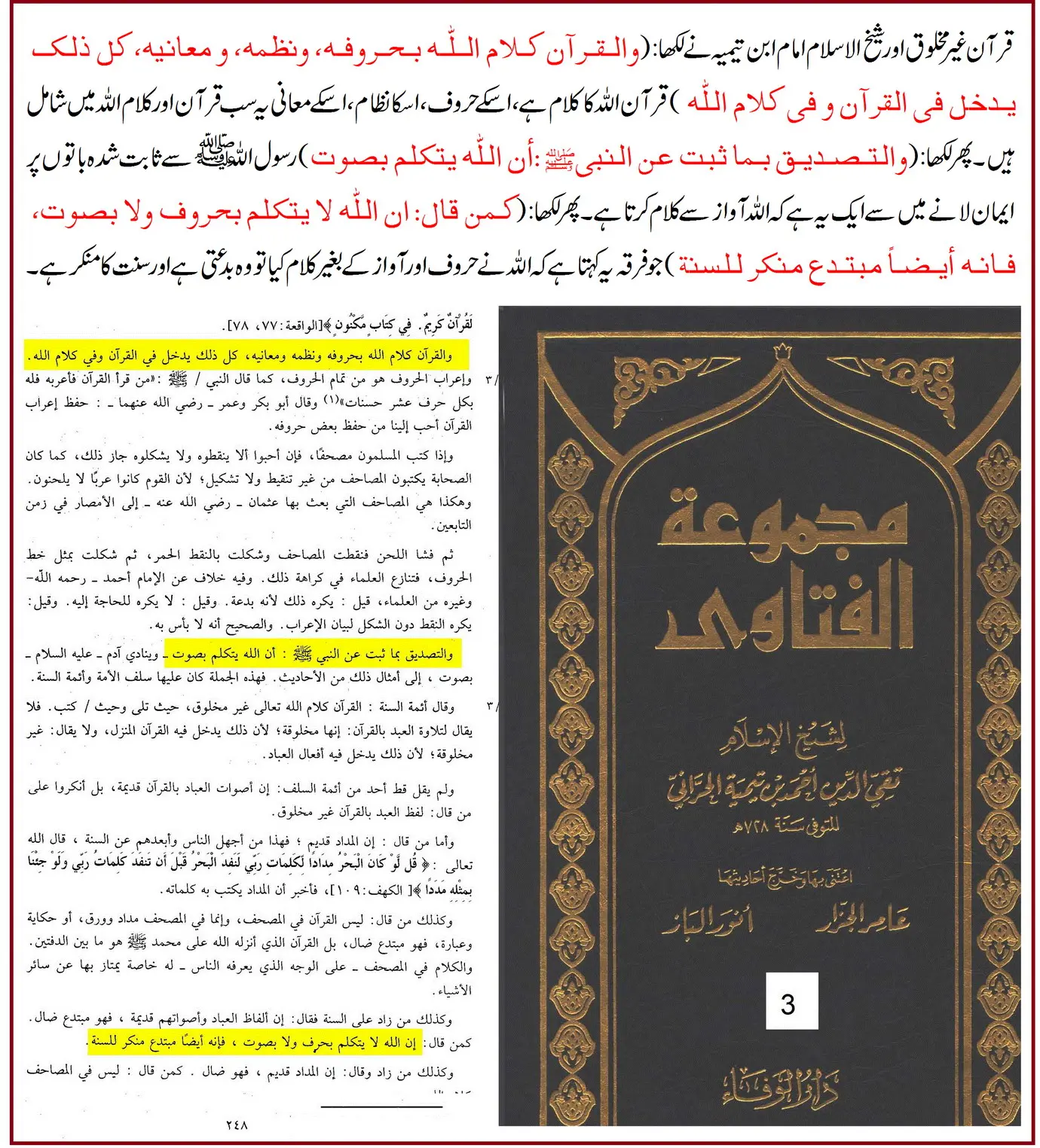
والقرآن كلام الله بحروفه ونظمه ومعانيه، كل ذلك يدخل في القرآن وفي كلام الله.
Translation:
“The Qur’an is the speech of Allah with its letters, its structure, and its meanings; all of this is included in the Qur’an and in the speech of Allah.”
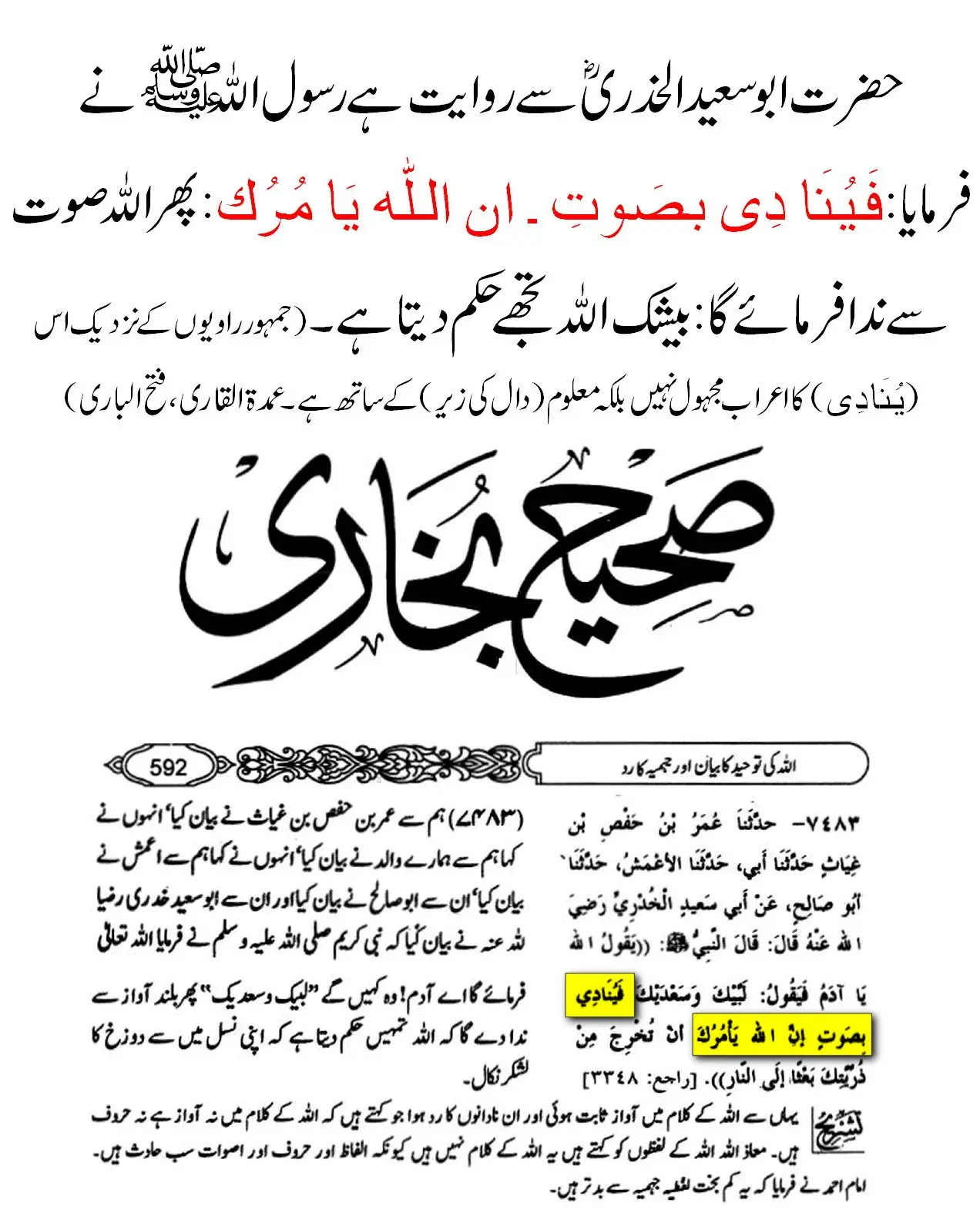
النص:
والتصديق بما ثبت عن النبي ﷺ أن الله يتكلم بصوت، وينادي آدم بصوت.
Translation:
“We affirm what is authentically reported from the Prophet ﷺ that Allah speaks with a voice and called Adam with a voice.”
النص:
كمن قال: إن الله لا يتكلم بحرف ولا بصوت، فإنه مبتدع منكر للسنة.
Translation:
“Whoever says that Allah does not speak with letters and sound is an innovator and a denier of the Sunnah.”
Refutation of saying the Qur’an is eternal:
النص:
ولم يقل أحد من السلف إن القرآن قديم، وإنما قالوا: القرآن كلام الله منزل غير مخلوق.
Translation:
“None of the Salaf ever said that the Qur’an is eternal; rather, they said: the Qur’an is the speech of Allah, revealed and uncreated.”
✿ Conclusion
Imām Ibn Taymiyyah consistently held that:
✔ The Qur’an is the speech of Allah.
✔ It consists of letters and sound.
✔ The claim that it is ‘eternal without letters and sound’ is a Jahmī–Ashʿarī innovation.
Thus, attributing this belief to him is a blatant lie.
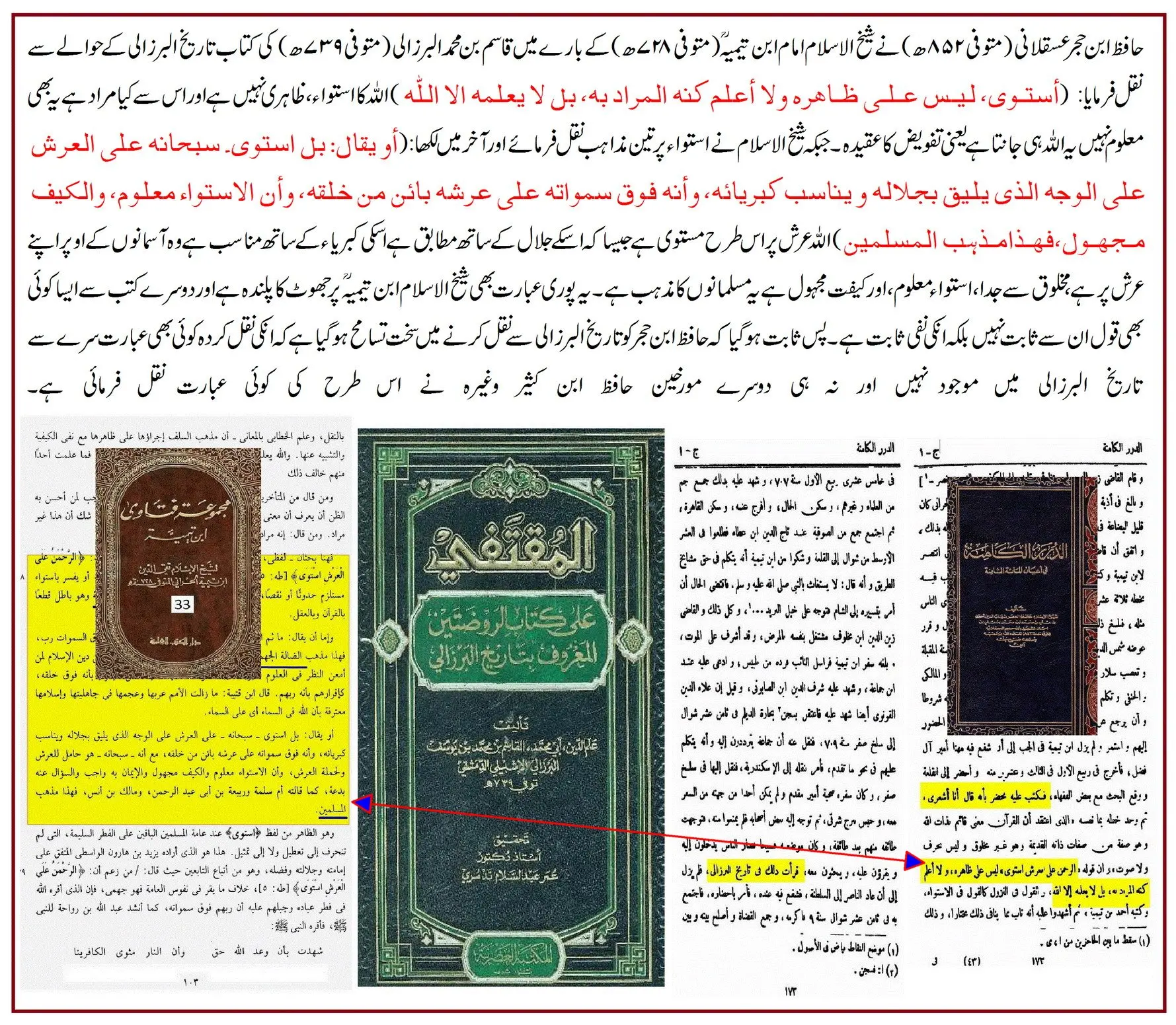
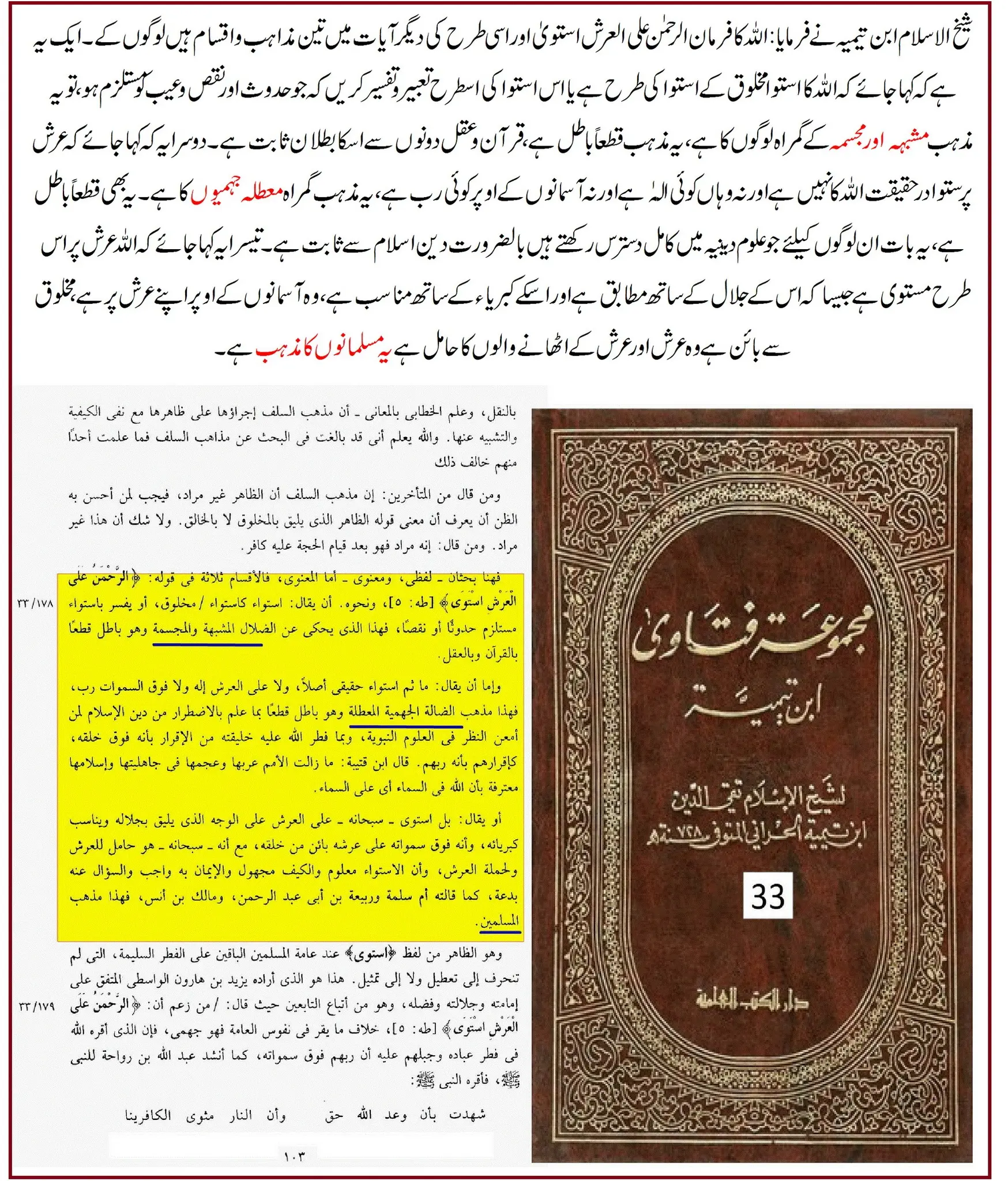
✿ Objection 3: Ibn Taymiyyah adopted tafwīḍ (of meaning) in Istiwāʾ
Opponents cite the statement:
“{الرَّحْمَنُ عَلَى الْعَرْشِ اسْتَوَى} ليس على ظاهره…”
Translation:
“The verse {The Most Merciful rose over the Throne} is not upon its apparent meaning, and its true intent is known only to Allah.”
◈ Response
This attribution is false and unfounded.
Testimony of Ibn ʿAbd al-Hādī (d. 744 AH):
النص:
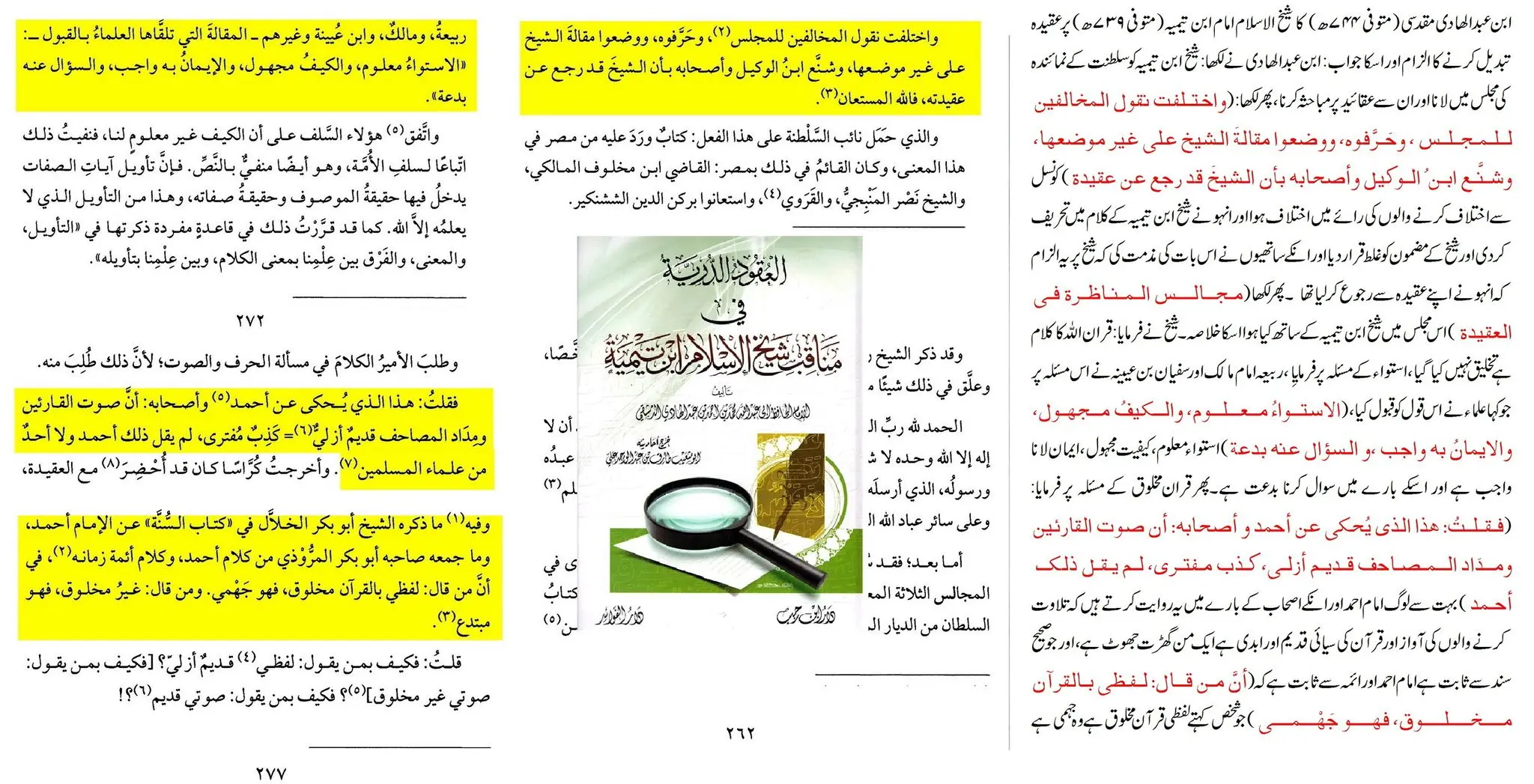
واختلفت نقول المخالفين للمجلس، وحرفوا مقالة الشيخ على غير موضعها، وشنعوا بأنه رجع عن عقيدته، فالله المستعان.
Translation:
“The opponents differed in transmitting what occurred in the gathering, distorted the Shaykh’s statements from their proper context, and spread the claim that he recanted his creed. Allah is the One whose help is sought.”
Ibn Taymiyyah’s clear stance (the way of Imām Mālik):
النص:
الاستواء معلوم، والكيف مجهول، والإيمان به واجب، والسؤال عنه بدعة.
Translation:
“Istiwaʾ is known, its modality is unknown, belief in it is obligatory, and questioning it is an innovation.”
Meaning: the linguistic meaning of Istiwāʾ is known, while how Allah rose over the Throne is beyond human comprehension.
✿ Conclusion
Imām Ibn Taymiyyah never held tafwīḍ al-maʿnā. His position was identical to that of Imām Mālik and the Salaf: meaning known, modality unknown.
✿ Final Summary and Verdict
After thorough analysis, the following becomes unequivocally clear:
① The claim “I am an Ashʿarī” has no authentic basis.
② Ibn Taymiyyah firmly affirmed that the Qur’an is Allah’s speech with letters and sound, uncreated but not eternal like Allah’s Essence.
③ He never adopted tafwīḍ of meaning in Istiwāʾ.
④ His student Ibn ʿAbd al-Hādī confirmed that opponents distorted his words.
⑤ The contradictory accusations of his opponents expose their falsehood and propaganda.
✿ Final Conclusion
Imām Ibn Taymiyyah رحمه الله remained firmly upon the creed of the Salaf:
✔ The Qur’an is the speech of Allah, uncreated, with letters and sound.
✔ Istiwāʾ is known in meaning, unknown in modality.
All allegations of recantation, Ashʿarism, or deviation are fabrications of the people of innovation.
Therefore, the objections raised against Imām Ibn Taymiyyah are false, baseless, and contrary to established scholarly evidence.
Some contemporaries and later writers have raised the following objections against Shaykh al-Islam Imām Ibn Taymiyyah رحمه الله (d. 728 AH):
① He declared himself to be an Ashʿarī.
② He believed the Qur’an to be eternal and denied letters and sound.
③ In the issue of Istiwāʾ, he adopted tafwīḍ (i.e., claimed that the meaning is unknown).
Based on these objections, the impression is created that Imām Ibn Taymiyyah recanted his original creed or deviated from the methodology of Ahl al-Sunnah. However, these claims do not stand up to scholarly scrutiny and are riddled with distortion and negligence.
✿ Source of the Objection
Ṭāhir Maqbūl Deobandī quoted a passage in a Facebook post from al-Durar al-Kāminah fī Aʿyān al-Mi’ah al-Thāminah by Ḥāfiẓ Ibn Ḥajar al-ʿAsqalānī رحمه الله, in which the following words are attributed to Imām Ibn Taymiyyah:
النص:
فَكتب عليه محضر بأنه قال أنا أشعري، ثم وجد خطه بما نصه: الذي اعتقد أن القرآن معنى قائم بذات الله وهو صفة من صفات ذاته القديمة، وهو غير مخلوق وليس بحرف ولا صوت، وأن قوله {الرحمن على العرش استوى} ليس على ظاهره، ولا أعلم كنه المراد به، بل لا يعلمه إلا الله.
Reference: al-Durar al-Kāminah – Ibn Ḥajar
Translation:“A statement was written against Ibn Taymiyyah that he said: ‘I am an Ashʿarī.’ Then it was found in his own handwriting that he wrote: ‘I believe that the Qur’an is a meaning subsisting in the Essence of Allah, and it is one of His eternal attributes; it is uncreated and is neither letters nor sound. And the saying of Allah, {The Most Merciful rose over the Throne}, is not upon its apparent meaning, and I do not know its true intent; rather, only Allah knows it.’”
✿ Brief Response
This passage is outwardly attributed to Imām Ibn Taymiyyah, and from it the following impressions are drawn:
① That he affiliated himself with the Ashʿarīs.
② That he regarded the Qur’an as merely an eternal meaning without letters and sound.
③ That regarding Istiwāʾ, he denied its apparent meaning and consigned its meaning entirely to Allah.
However, research establishes that this passage:
✔ Is not authentically transmitted.
✔ Is not found in Tārīkh al-Barzālī, the original source.
✔ Directly contradicts the explicit statements of Imām Ibn Taymiyyah himself and the testimonies of his students (Ibn ʿAbd al-Hādī, Ibn al-Qayyim, and others).
✿ Objection 1: Imām Ibn Taymiyyah said “أنا أشعري”
According to Ṭāhir Maqbūl Deobandī, Ḥāfiẓ Ibn Ḥajar reported in al-Durar al-Kāminah that at the time of his release from imprisonment, a statement was written in which Ibn Taymiyyah said: “I am an Ashʿarī.”
◈ Response
This attribution is unsourced and disconnected:
✔ As mentioned earlier, this statement does not exist in the original source (Tārīkh al-Barzālī).
✔ There is therefore no proof that Imām Ibn Taymiyyah ever uttered these words.
Clear verdict of Imām Ibn Taymiyyah:
النص:
فهذا يعد من أهل السنة؛ لكن مجرد الانتساب إلى الأشعري بدعة.
Reference: Majmūʿ al-Fatāwā 6/359
Translation:“Such a person may be counted among Ahl al-Sunnah; however, merely affiliating oneself with Ashʿarī is an innovation.”
This clearly proves that Ibn Taymiyyah never described himself as an Ashʿarī; rather, he explicitly stated that adopting the label ‘Ashʿarī’ itself is an innovation.Important Clarification
Imām Ibn Taymiyyah did mention that some Ashʿarīs fall within Ahl al-Sunnah due to their agreement with them in many matters of truth. However, he consistently refuted the core Ashʿarī doctrines, such as denying letters and sound in the speech of Allah and interpreting the divine attributes.
✿ Conclusion
Attributing the statement “I am an Ashʿarī” to Imām Ibn Taymiyyah is incorrect and baseless. His own writings clearly establish that he regarded mere Ashʿarī affiliation as an innovation.
✿ Objection 2: Ibn Taymiyyah believed the Qur’an to be eternal and denied letters and sound
Opponents claim that Ibn Taymiyyah wrote:
“الذي اعتقد أن القرآن معنى قائم بذات الله… وليس بحرف ولا صوت”
Translation:“I believe that the Qur’an is a meaning subsisting in the Essence of Allah… uncreated, but without letters and sound.”
◈ Response
This statement directly contradicts Ibn Taymiyyah’s well-known creed.
His explicit statements:
النص:
والقرآن كلام الله بحروفه ونظمه ومعانيه، كل ذلك يدخل في القرآن وفي كلام الله.
Reference: Majmūʿ al-Fatāwā 12/559
Translation:“The Qur’an is the speech of Allah with its letters, its structure, and its meanings; all of this is included in the Qur’an and in the speech of Allah.”
النص:
والتصديق بما ثبت عن النبي ﷺ أن الله يتكلم بصوت، وينادي آدم بصوت.
Reference: Majmūʿ al-Fatāwā 6/527
Translation:“We affirm what is authentically reported from the Prophet ﷺ that Allah speaks with a voice and called Adam with a voice.”
النص:
كمن قال: إن الله لا يتكلم بحرف ولا بصوت، فإنه مبتدع منكر للسنة.
Reference: Majmūʿ al-Fatāwā 12/560
Translation:“Whoever says that Allah does not speak with letters and sound is an innovator and a denier of the Sunnah.”
Refutation of saying the Qur’an is eternal:
النص:
ولم يقل أحد من السلف إن القرآن قديم، وإنما قالوا: القرآن كلام الله منزل غير مخلوق.
Reference: Majmūʿ al-Fatāwā 12/566
Translation:“None of the Salaf ever said that the Qur’an is eternal; rather, they said: the Qur’an is the speech of Allah, revealed and uncreated.”
✿ Conclusion
Imām Ibn Taymiyyah consistently held that:
✔ The Qur’an is the speech of Allah.
✔ It consists of letters and sound.
✔ The claim that it is ‘eternal without letters and sound’ is a Jahmī–Ashʿarī innovation.
Thus, attributing this belief to him is a blatant lie.
✿ Objection 3: Ibn Taymiyyah adopted tafwīḍ (of meaning) in Istiwāʾ
Opponents cite the statement:
“{الرَّحْمَنُ عَلَى الْعَرْشِ اسْتَوَى} ليس على ظاهره…”
Translation:“The verse {The Most Merciful rose over the Throne} is not upon its apparent meaning, and its true intent is known only to Allah.”
◈ Response
This attribution is false and unfounded.
Testimony of Ibn ʿAbd al-Hādī (d. 744 AH):
النص:
واختلفت نقول المخالفين للمجلس، وحرفوا مقالة الشيخ على غير موضعها، وشنعوا بأنه رجع عن عقيدته، فالله المستعان.
Reference: al-ʿUqūd al-Durriyyah – Ibn ʿAbd al-Hādī
Translation:“The opponents differed in transmitting what occurred in the gathering, distorted the Shaykh’s statements from their proper context, and spread the claim that he recanted his creed. Allah is the One whose help is sought.”
Ibn Taymiyyah’s clear stance (the way of Imām Mālik):
النص:
الاستواء معلوم، والكيف مجهول، والإيمان به واجب، والسؤال عنه بدعة.
Reference: al-ʿUqūd al-Durriyyah
Translation:“Istiwaʾ is known, its modality is unknown, belief in it is obligatory, and questioning it is an innovation.”
Meaning: the linguistic meaning of Istiwāʾ is known, while how Allah rose over the Throne is beyond human comprehension.✿ Conclusion
Imām Ibn Taymiyyah never held tafwīḍ al-maʿnā. His position was identical to that of Imām Mālik and the Salaf: meaning known, modality unknown.
✿ Final Summary and Verdict
After thorough analysis, the following becomes unequivocally clear:
① The claim “I am an Ashʿarī” has no authentic basis.
② Ibn Taymiyyah firmly affirmed that the Qur’an is Allah’s speech with letters and sound, uncreated but not eternal like Allah’s Essence.
③ He never adopted tafwīḍ of meaning in Istiwāʾ.
④ His student Ibn ʿAbd al-Hādī confirmed that opponents distorted his words.
⑤ The contradictory accusations of his opponents expose their falsehood and propaganda.
✿ Final Conclusion
Imām Ibn Taymiyyah رحمه الله remained firmly upon the creed of the Salaf:
✔ The Qur’an is the speech of Allah, uncreated, with letters and sound.
✔ Istiwāʾ is known in meaning, unknown in modality.
All allegations of recantation, Ashʿarism, or deviation are fabrications of the people of innovation.
Therefore, the objections raised against Imām Ibn Taymiyyah are false, baseless, and contrary to established scholarly evidence.