
❖ Compiled by: Abu Hamzah Salafi
The purpose of this article is to address a well-known objection raised regarding Ṣaḥīḥ al-Bukhārī, based on scholarly methodology. The objection revolves around a narration in which Imām al-Bukhārī mentioned "Ibn ʿUmar" as the narrator, while some scholars argue that "Ibn ʿAbbās" is more authentic in this context. From this, critics hastily conclude that (naʿūdhu billāh) Ṣaḥīḥ al-Bukhārī contains “grievous errors” and that trusting its greatness is a form of “extremism.”
This article demonstrates the following points:
◈ There exists a variant reading between “Ibn ʿUmar” and “Ibn ʿAbbās” in this narration, and some scholars have classified it as a scribal or manuscript error.
◈ This variation does not diminish the overall authenticity or uniqueness of Ṣaḥīḥ al-Bukhārī, as it does not affect the core meaning of the ḥadīth or violate the principles of scholarly acceptance.
◈ Both extremism and unjust criticism are extremes; the correct method is to interpret scholarly statements within the framework of uṣūl al-ḥadīth and their proper context.
Critics assert that Ṣaḥīḥ al-Bukhārī records a ḥadīth with the chain “ʿan Ibn ʿUmar”, while other sources narrate the same matn and isnād as “ʿan Ibn ʿAbbās”. Some scholars have labeled “Ibn ʿAbbās” as the more accurate version (aṣwab or maḥfūẓ).
Arabic Text:
حَدَّثَنَا مُحَمَّدُ بْنُ كَثِيرٍ، أَخْبَرَنَا إِسْرَائِيلُ، أَخْبَرَنَا عُثْمَانُ بْنُ المُغِيرَةِ، عَنْ مُجَاهِدٍ، عَنِ ابْنِ عُمَرَ رَضِيَ اللَّهُ عَنْهُمَا، قَالَ: قَالَ النَّبِيُّ صَلَّى اللهُ عَلَيْهِ وَسَلَّمَ:
«رَأَيْتُ عِيسَى وَمُوسَى وَإِبْرَاهِيمَ، فَأَمَّا عِيسَى فَأَحْمَرُ جَعْدٌ عَرِيضُ الصَّدْرِ، وَأَمَّا مُوسَى، فَآدَمُ جَسِيمٌ سَبْطٌ كَأَنَّهُ مِنْ رِجَالِ الزُّطِّ»
Translation:
Narrated by Muḥammad ibn Kathīr from Isrā'īl, from ʿUthmān ibn al-Mughīrah, from Mujāhid, from Ibn ʿUmar رضي الله عنهما: The Prophet ﷺ said:
“I saw ʿĪsā, Mūsā, and Ibrāhīm (peace be upon them). ʿĪsā was reddish, curly-haired, broad-chested, and Mūsā was wheat-colored, well-built, with straight hair, as if he were from the men of the Zutt (a known people).”
Source: Ṣaḥīḥ al-Bukhārī, Ḥadīth: 3438
Arabic Text:
... عَنْ مُجَاهِدٍ، عَنِ ابْنِ عَبَّاسٍ، قَالَ: قَالَ رَسُولُ اللَّهِ ﷺ: «رَأَيْتُ مُوسَى وَعِيسَى وَإِبْرَاهِيمَ ...»
... أَخْرَجَهُ الْبُخَارِيُّ ... فَقَالَ: عَنِ ابْنِ عُمَرَ، وَالصَّوَابُ عَنِ ابْنِ عَبَّاسٍ. رَوَاهُ جَمَاعَةٌ، عَنْ إِسْرَائِيلَ
Translation:
Mujāhid narrated from Ibn ʿAbbās that the Messenger of Allah ﷺ said: “I saw Mūsā, ʿĪsā, and Ibrāhīm (peace be upon them)...”
Ibn Mandah commented: “al-Bukhārī narrated it from Muḥammad ibn Kathīr and said: ʿan Ibn ʿUmar, but the correct version is ʿan Ibn ʿAbbās, as it was narrated by a group from Isrāʾīl.”
Source: Kitāb al-Īmān by Ibn Mandah, Ḥadīth: 726
Arabic Excerpts:
قال أبو علي الجياني … قال: والمحفوظ فيه عن مجاهد عن ابن عباس.
قال أبو مسعود: أخطأ البخاري في قوله "عن ابن عمر"، وإنما رواه محمد بن كثير عن إسرائيل بهذا الإسناد عن ابن عباس …
ويؤيد أنه من سبق القلم.
Summary Translation:
Abū ʿAlī al-Jiyānī noted that the preserved version is “from Mujāhid from Ibn ʿAbbās.”
Abū Masʿūd stated that Bukhārī erred in writing “ʿan Ibn ʿUmar”, and Muḥammad ibn Kathīr narrated it from Isrāʾīl as “ʿan Ibn ʿAbbās” – supported by multiple other narrators.
Ibn Ḥajar concluded that this supports the likelihood of a scribal slip (sabaq al-qalam).
At most, this issue highlights:
• A difference in identifying the companion: “Ibn ʿUmar” vs. “Ibn ʿAbbās”
• Some scholars found the version of Ibn ʿAbbās more reliable
• Ibn Ḥajar suggested it may have been a scribal error
However, branding it a fāḥish ghalaṭ (grievous error) to undermine Ṣaḥīḥ al-Bukhārī’s credibility is not a balanced or academic approach, as the variance neither changes the fundamental meaning of the ḥadīth nor invalidates the narration.
It is true that no book besides the Qur’ān is infallible. Even among Ahl al-Sunnah, discussions on narrations, manuscripts, and isnād variations exist across all ḥadīth collections – including the Ṣiḥāḥ Sittah. However, this does not justify dismissing Ṣaḥīḥ al-Bukhārī or equating it to ordinary compilations. Its distinctiveness is proven by:
• Rigorous selection process
• Precise isnād chains
• Mass scholarly acceptance
Discussing minor variations does not undermine this overall status.
It is incorrect to assume that a shorter isnād (ʿāliyy) is always superior to a longer one (nāzil). Preference in ʿilm al-ḥadīth is based on several factors, such as:
① Strength of memory
② Number of corroborating narrations
③ Agreement with other trustworthy narrators
④ Overall preservation and accuracy
Thus, Ibn Mandah preferred the “Ibn ʿAbbās” version based on multiple narrators from Isrā’īl – not simply due to isnād length.
From the above, the following points are evident:
① In Ḥadīth 3438 of Ṣaḥīḥ al-Bukhārī, the isnād reads “ʿan Ibn ʿUmar,” while Ibn Mandah records it as “ʿan Ibn ʿAbbās” and calls it the correct version.
② Ibn Ḥajar documented scholarly opinions and suggested a possible scribal error in his Hady al-Sārī.
③ This minor variation does not compromise the authority or status of Ṣaḥīḥ al-Bukhārī, as it falls under isnād comparison and manuscript differences.
④ The correct methodology is to avoid both exaggeration and undue criticism. Issues should be analyzed through the lens of evidences, chains, and scholarly principles, just as the aʾimmah of ḥadīth have done.
The purpose of this article is to address a well-known objection raised regarding Ṣaḥīḥ al-Bukhārī, based on scholarly methodology. The objection revolves around a narration in which Imām al-Bukhārī mentioned "Ibn ʿUmar" as the narrator, while some scholars argue that "Ibn ʿAbbās" is more authentic in this context. From this, critics hastily conclude that (naʿūdhu billāh) Ṣaḥīḥ al-Bukhārī contains “grievous errors” and that trusting its greatness is a form of “extremism.”
This article demonstrates the following points:
◈ There exists a variant reading between “Ibn ʿUmar” and “Ibn ʿAbbās” in this narration, and some scholars have classified it as a scribal or manuscript error.
◈ This variation does not diminish the overall authenticity or uniqueness of Ṣaḥīḥ al-Bukhārī, as it does not affect the core meaning of the ḥadīth or violate the principles of scholarly acceptance.
◈ Both extremism and unjust criticism are extremes; the correct method is to interpret scholarly statements within the framework of uṣūl al-ḥadīth and their proper context.
✦ The Core Objection: “Ibn ʿUmar” in Bukhārī vs. “Ibn ʿAbbās” in Other Sources
Critics assert that Ṣaḥīḥ al-Bukhārī records a ḥadīth with the chain “ʿan Ibn ʿUmar”, while other sources narrate the same matn and isnād as “ʿan Ibn ʿAbbās”. Some scholars have labeled “Ibn ʿAbbās” as the more accurate version (aṣwab or maḥfūẓ).
❖ Scholarly Evidence and Analysis
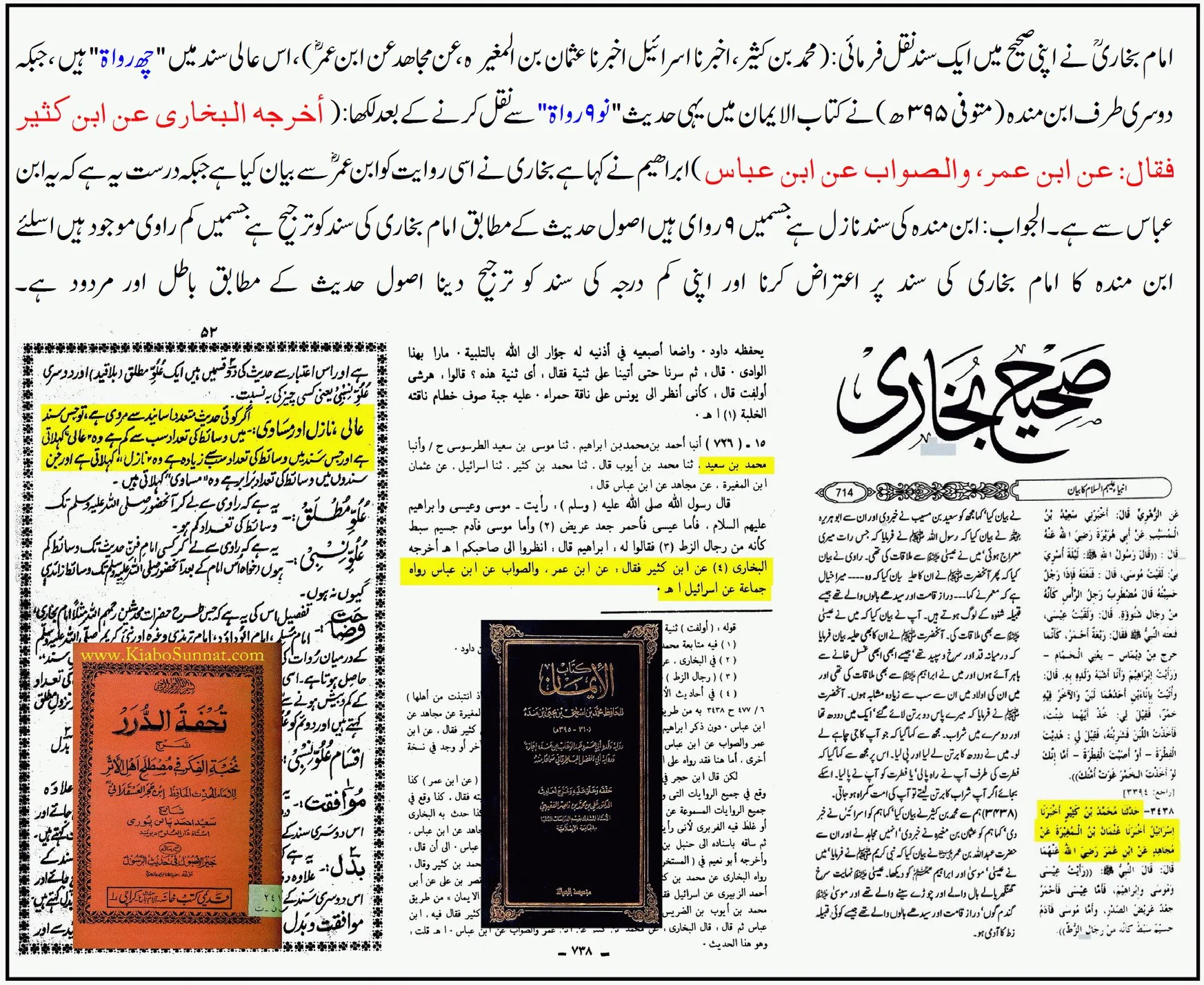
① Narration in
Arabic Text:
حَدَّثَنَا مُحَمَّدُ بْنُ كَثِيرٍ، أَخْبَرَنَا إِسْرَائِيلُ، أَخْبَرَنَا عُثْمَانُ بْنُ المُغِيرَةِ، عَنْ مُجَاهِدٍ، عَنِ ابْنِ عُمَرَ رَضِيَ اللَّهُ عَنْهُمَا، قَالَ: قَالَ النَّبِيُّ صَلَّى اللهُ عَلَيْهِ وَسَلَّمَ:
«رَأَيْتُ عِيسَى وَمُوسَى وَإِبْرَاهِيمَ، فَأَمَّا عِيسَى فَأَحْمَرُ جَعْدٌ عَرِيضُ الصَّدْرِ، وَأَمَّا مُوسَى، فَآدَمُ جَسِيمٌ سَبْطٌ كَأَنَّهُ مِنْ رِجَالِ الزُّطِّ»
Translation:
Narrated by Muḥammad ibn Kathīr from Isrā'īl, from ʿUthmān ibn al-Mughīrah, from Mujāhid, from Ibn ʿUmar رضي الله عنهما: The Prophet ﷺ said:
“I saw ʿĪsā, Mūsā, and Ibrāhīm (peace be upon them). ʿĪsā was reddish, curly-haired, broad-chested, and Mūsā was wheat-colored, well-built, with straight hair, as if he were from the men of the Zutt (a known people).”
Source: Ṣaḥīḥ al-Bukhārī, Ḥadīth: 3438
② Ibn Mandah’s Report with “ʿan Ibn ʿAbbās” and His Explicit Correction
Arabic Text:
... عَنْ مُجَاهِدٍ، عَنِ ابْنِ عَبَّاسٍ، قَالَ: قَالَ رَسُولُ اللَّهِ ﷺ: «رَأَيْتُ مُوسَى وَعِيسَى وَإِبْرَاهِيمَ ...»
... أَخْرَجَهُ الْبُخَارِيُّ ... فَقَالَ: عَنِ ابْنِ عُمَرَ، وَالصَّوَابُ عَنِ ابْنِ عَبَّاسٍ. رَوَاهُ جَمَاعَةٌ، عَنْ إِسْرَائِيلَ
Translation:
Mujāhid narrated from Ibn ʿAbbās that the Messenger of Allah ﷺ said: “I saw Mūsā, ʿĪsā, and Ibrāhīm (peace be upon them)...”
Ibn Mandah commented: “al-Bukhārī narrated it from Muḥammad ibn Kathīr and said: ʿan Ibn ʿUmar, but the correct version is ʿan Ibn ʿAbbās, as it was narrated by a group from Isrāʾīl.”
Source: Kitāb al-Īmān by Ibn Mandah, Ḥadīth: 726
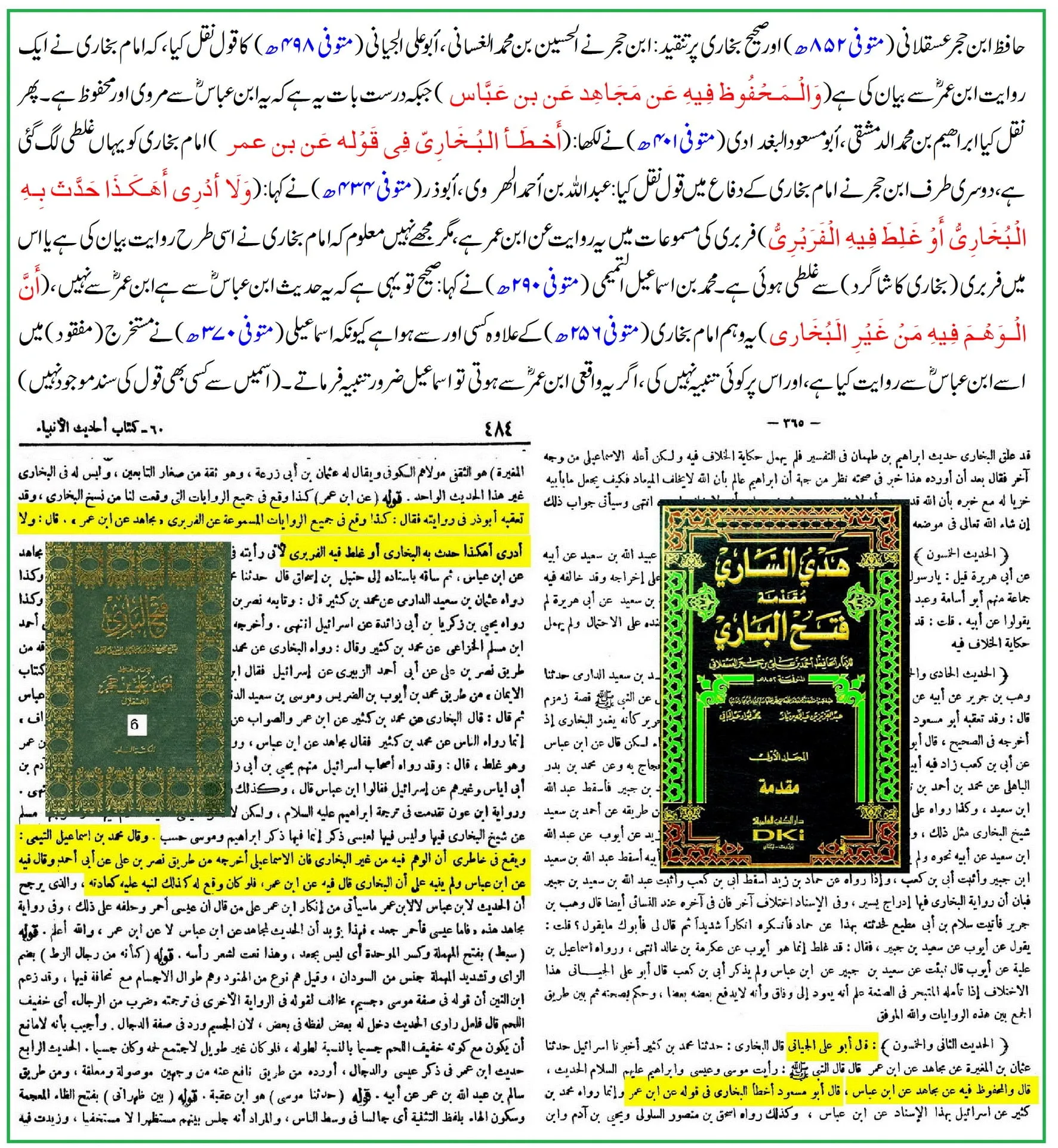
③ Ibn Ḥajar al-ʿAsqalānī: Assessment in
Arabic Excerpts:
قال أبو علي الجياني … قال: والمحفوظ فيه عن مجاهد عن ابن عباس.
قال أبو مسعود: أخطأ البخاري في قوله "عن ابن عمر"، وإنما رواه محمد بن كثير عن إسرائيل بهذا الإسناد عن ابن عباس …
ويؤيد أنه من سبق القلم.
Summary Translation:
Abū ʿAlī al-Jiyānī noted that the preserved version is “from Mujāhid from Ibn ʿAbbās.”
Abū Masʿūd stated that Bukhārī erred in writing “ʿan Ibn ʿUmar”, and Muḥammad ibn Kathīr narrated it from Isrāʾīl as “ʿan Ibn ʿAbbās” – supported by multiple other narrators.
Ibn Ḥajar concluded that this supports the likelihood of a scribal slip (sabaq al-qalam).
✦ Refuting the False Conclusions
① Calling It a “Grievous Error” Is Unacademic
At most, this issue highlights:
• A difference in identifying the companion: “Ibn ʿUmar” vs. “Ibn ʿAbbās”
• Some scholars found the version of Ibn ʿAbbās more reliable
• Ibn Ḥajar suggested it may have been a scribal error
However, branding it a fāḥish ghalaṭ (grievous error) to undermine Ṣaḥīḥ al-Bukhārī’s credibility is not a balanced or academic approach, as the variance neither changes the fundamental meaning of the ḥadīth nor invalidates the narration.
② Difference Between Veneration and Exaggeration
It is true that no book besides the Qur’ān is infallible. Even among Ahl al-Sunnah, discussions on narrations, manuscripts, and isnād variations exist across all ḥadīth collections – including the Ṣiḥāḥ Sittah. However, this does not justify dismissing Ṣaḥīḥ al-Bukhārī or equating it to ordinary compilations. Its distinctiveness is proven by:
• Rigorous selection process
• Precise isnād chains
• Mass scholarly acceptance
Discussing minor variations does not undermine this overall status.
✦ Important Principle: Quantity of Narrators Does Not Automatically Determine Preference
It is incorrect to assume that a shorter isnād (ʿāliyy) is always superior to a longer one (nāzil). Preference in ʿilm al-ḥadīth is based on several factors, such as:
① Strength of memory
② Number of corroborating narrations
③ Agreement with other trustworthy narrators
④ Overall preservation and accuracy
Thus, Ibn Mandah preferred the “Ibn ʿAbbās” version based on multiple narrators from Isrā’īl – not simply due to isnād length.
❖ Conclusion
From the above, the following points are evident:
① In Ḥadīth 3438 of Ṣaḥīḥ al-Bukhārī, the isnād reads “ʿan Ibn ʿUmar,” while Ibn Mandah records it as “ʿan Ibn ʿAbbās” and calls it the correct version.
② Ibn Ḥajar documented scholarly opinions and suggested a possible scribal error in his Hady al-Sārī.
③ This minor variation does not compromise the authority or status of Ṣaḥīḥ al-Bukhārī, as it falls under isnād comparison and manuscript differences.
④ The correct methodology is to avoid both exaggeration and undue criticism. Issues should be analyzed through the lens of evidences, chains, and scholarly principles, just as the aʾimmah of ḥadīth have done.

