Compiled by: Abu Hamza Salafi
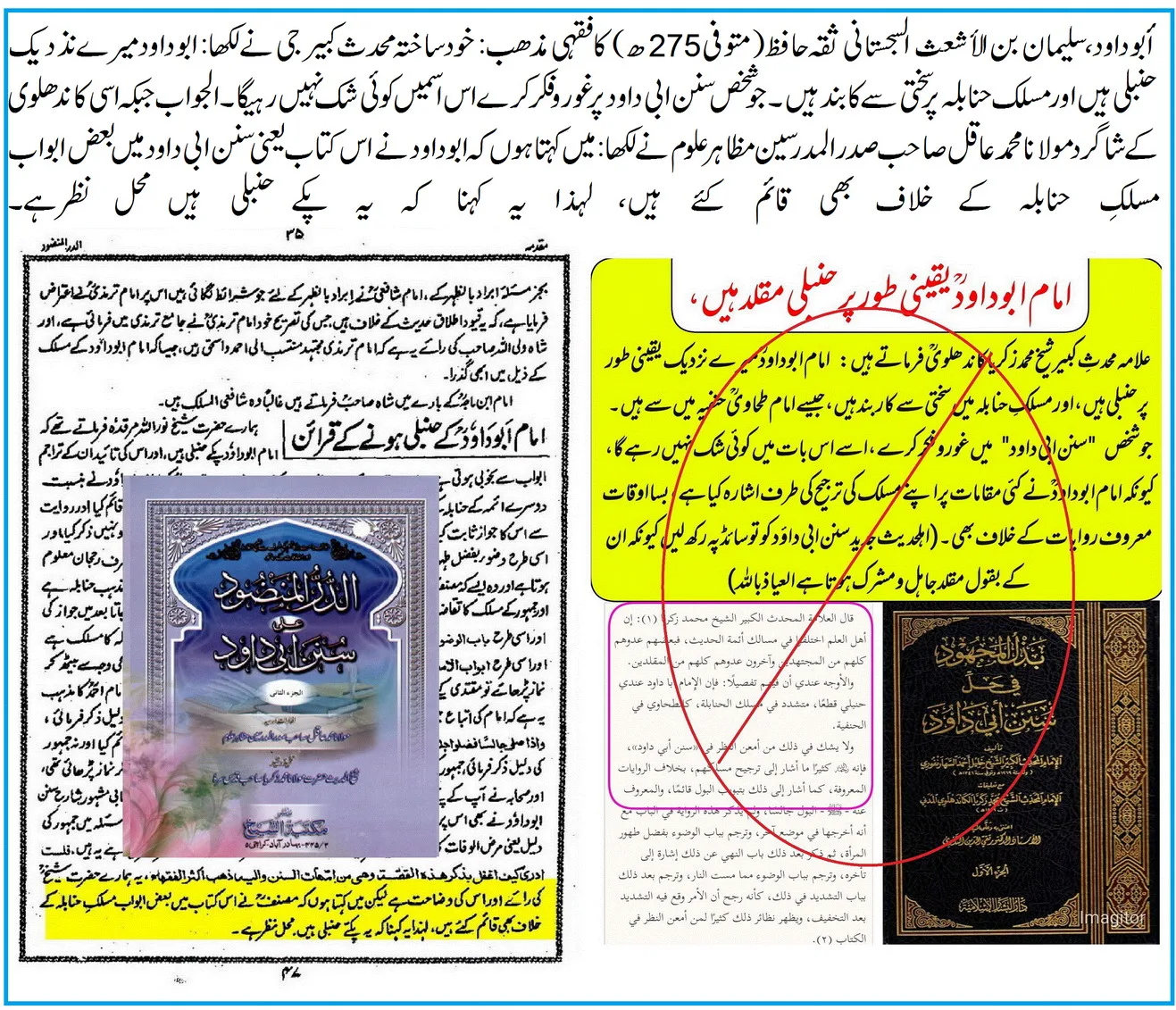
Regarding Imam Ahl al-Hadith, the author of Sunan, Abu Dawood Sulaiman ibn al-Ash'ath al-Sijistani (may Allah have mercy on him), some followers claim that he was "certainly Hanbali" and strictly adhered to the Hanbali school of thought. This claim is generally based on the impression of a later Hanafi scholar that Imam Abu Dawood (may Allah have mercy on him) indicated preference for the Hanbali school throughout his
Reference: Sunan
. But the real question is: does mere frequent agreement with an imam, or attending his gatherings, or asking him questions, prove personal imitation? Or, according to the majority of hadith scholars and researchers, was Imam Abu Dawood (may Allah have mercy on him) himself a man of insight, a jurist, and among the mujtahids? The purpose of this article is to clarify that calling Imam Abu Dawood (may Allah have mercy on him) a "Hanbali follower" is an unfounded claim, while the statements of hadith scholars, jurists, and researchers prove the opposite—that he was an imam who adhered to the methodology of Ahl al-Hadith, was a jurist, and possessed the rank of ijtihad, not a rigid follower of any one person.What is the original claim?
Some objectors have quoted this phrase:
فإن الإِمام أبا داود عندي حنبلي قطعًا، متشدد في مسلك الحنابلة، كالطحاوي في الحنفية. ولا يشك في ذلك من أمعن النظر في «سنن أبي داود»، فإنه رحمه الله كثيرًا ما أشار إلى ترجيح مسلكهم، بخلاف الروايات المعروفة
Translation:
In my view, Imam Abu Dawood is certainly Hanbali, and strictly adherent to the Hanbali school, just as Imam Tahawi is Hanafi. Whoever studies Sunan Abi Dawood deeply will have no doubt about this, because Imam Abu Dawood, may Allah have mercy on him, has indicated the preference of his school at many places, sometimes even against well-known narrations.
Reference: Al-Kitab: Bazl al-Majhood fi Hall Sunan Abi Dawood
Brief explanation:
This is an impression and inference, not a unanimously agreed historical or biographical fact. Therefore, it is necessary to present this claim before the statements of the scholars of the field, rather than accepting the mere claim as a verdict.
❶ The Statement of Hafiz al-Dhahabi (may Allah have mercy on him)
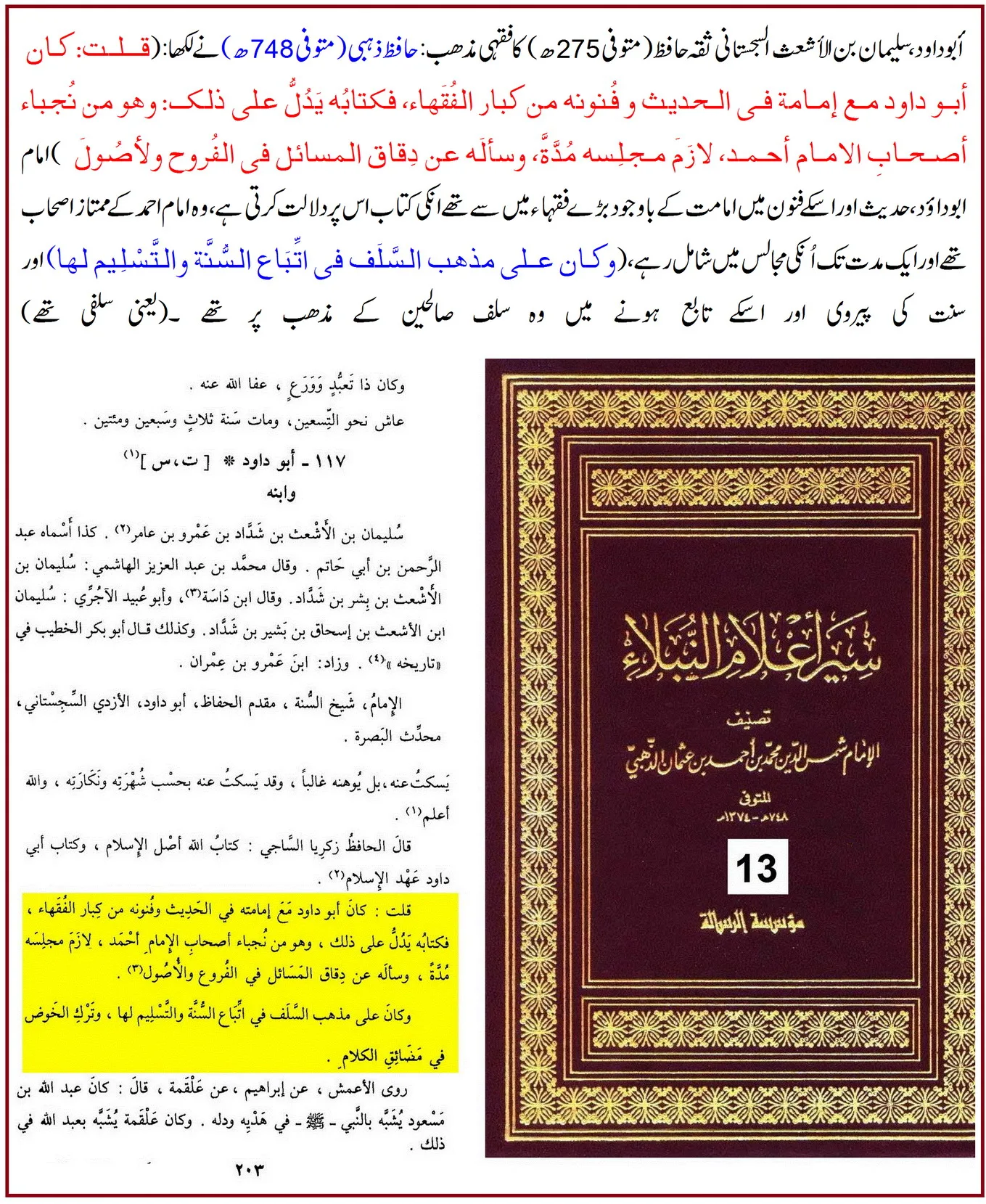
Hafiz al-Dhahabi (may Allah have mercy on him) wrote:
قلت: كان أبو داود مع إمامته في الحديث وفنونه من كبار الفقهاء، فكتابه يدل على ذلك، وهو من نجباء أصحاب الإمام أحمد، لازم مجلسه مدة، وسأله عن دقائق المسائل في الفروع والأصول، وكان على مذهب السلف في اتباع السنة والتسليم لها
Translation:
I say: Imam Abu Dawood, despite his leadership in hadith and its sciences, was among the great jurists, and his book indicates this. He was among the distinguished companions of Imam Ahmad, attended his gatherings for a long time, and asked him detailed questions on the intricate issues of branches and principles. He adhered to the Sunnah and followed the creed of the Salaf in humbling himself before it.
Reference: Al-Kitab: Siyar A'lam al-Nubala
Author: Shams al-Din al-Dhahabi (d. 748 AH)
Author: Shams al-Din al-Dhahabi (d. 748 AH)
Brief Explanation:
Hafiz Dhahabi clarified two points: first, that Imam Abu Dawood was "one of the great jurists," and second, that he was "on the creed of the Salaf." The companionship and benefit from Imam Ahmad are one thing, but Dhahabi did not call him a "Hanbali follower" but rather a Salafi in methodology and a jurist Imam.
❷ Testimony of Tahir al-Jaza’iri
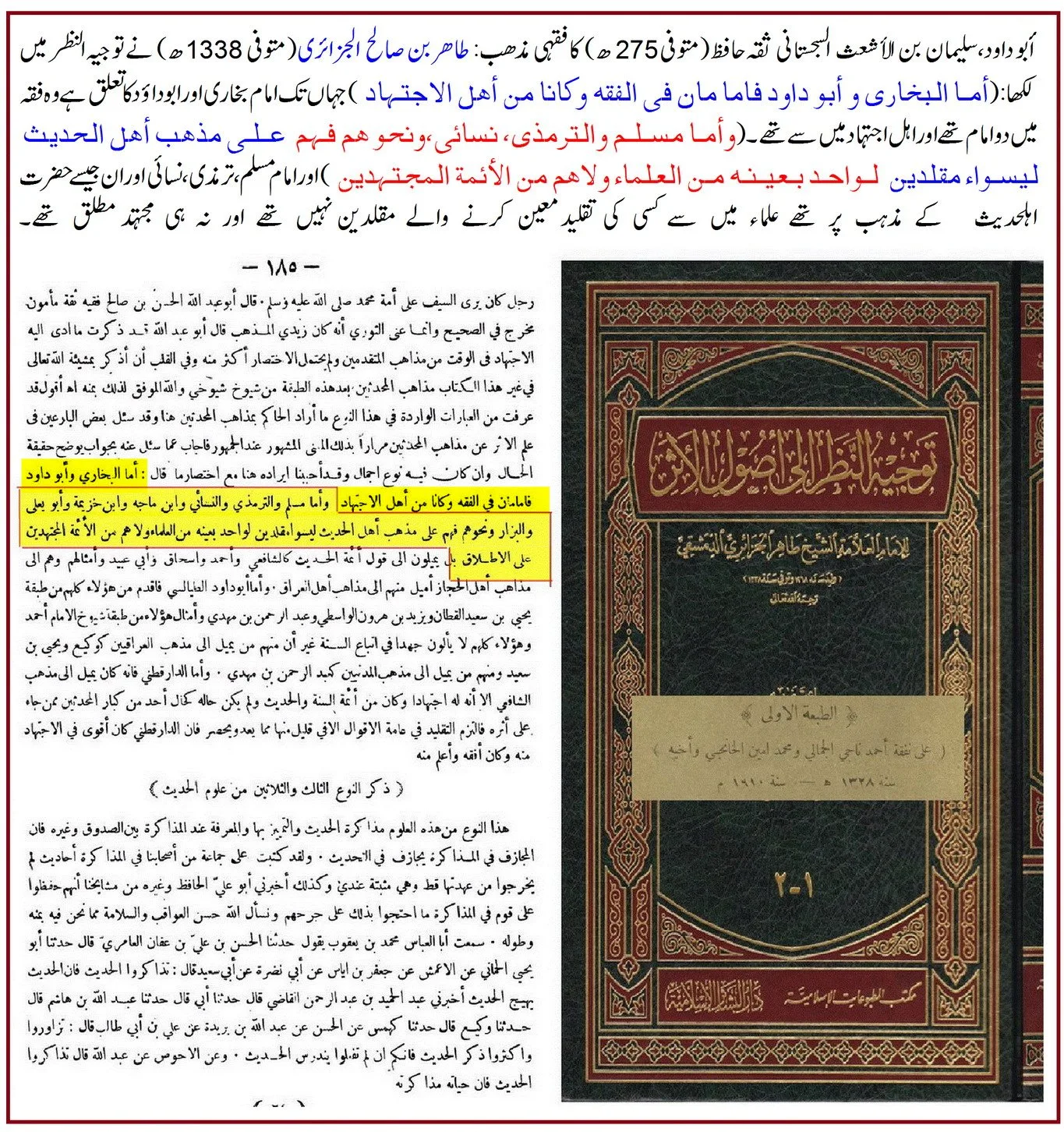
Allama Tahir al-Jaza’iri wrote:
قال أما البخاري وأبو داود فإمامان في الفقه وكانا من أهل الاجتهاد، وأما مسلم والترمذي والنسائي وابن ماجة وابن خزيمة وأبو يعلى والبزار ونحوهم فهم على مذهب أهل الحديث ليسوا مقلدين لواحد بعينه من العلماء ولا هم من الأئمة المجتهدين على الإطلاق
Translation:
As far as Imam Bukhari and Abu Dawood are concerned, both were jurists and among the people of Ijtihad. Muslim, Tirmidhi, Nasa'i, Ibn Majah, Ibn Khuzaymah, Abu Ya'la, Bazzar, and others like them followed the creed of Ahl al-Hadith; they were not followers (muqallid) of any specific scholar, nor were they absolute mujtahids.
Reference: Al-Kitab: Tawjeeh al-Nazar ila Usool al-Athar
Author: Tahir bin Saleh al-Jazairi (d. 1338 AH)
Author: Tahir bin Saleh al-Jazairi (d. 1338 AH)
Brief Explanation:
This passage is very important on this issue because it explicitly refers to Imam Abu Dawood (may Allah be pleased with him) as "Ahl al-Ijtihad." When a researcher calls him a mujtahid, how can it be correct to label him a blind follower (jamid muqallid)?
❸ The Verdict of Shaykh al-Islam Ibn Taymiyyah (may Allah have mercy on him)
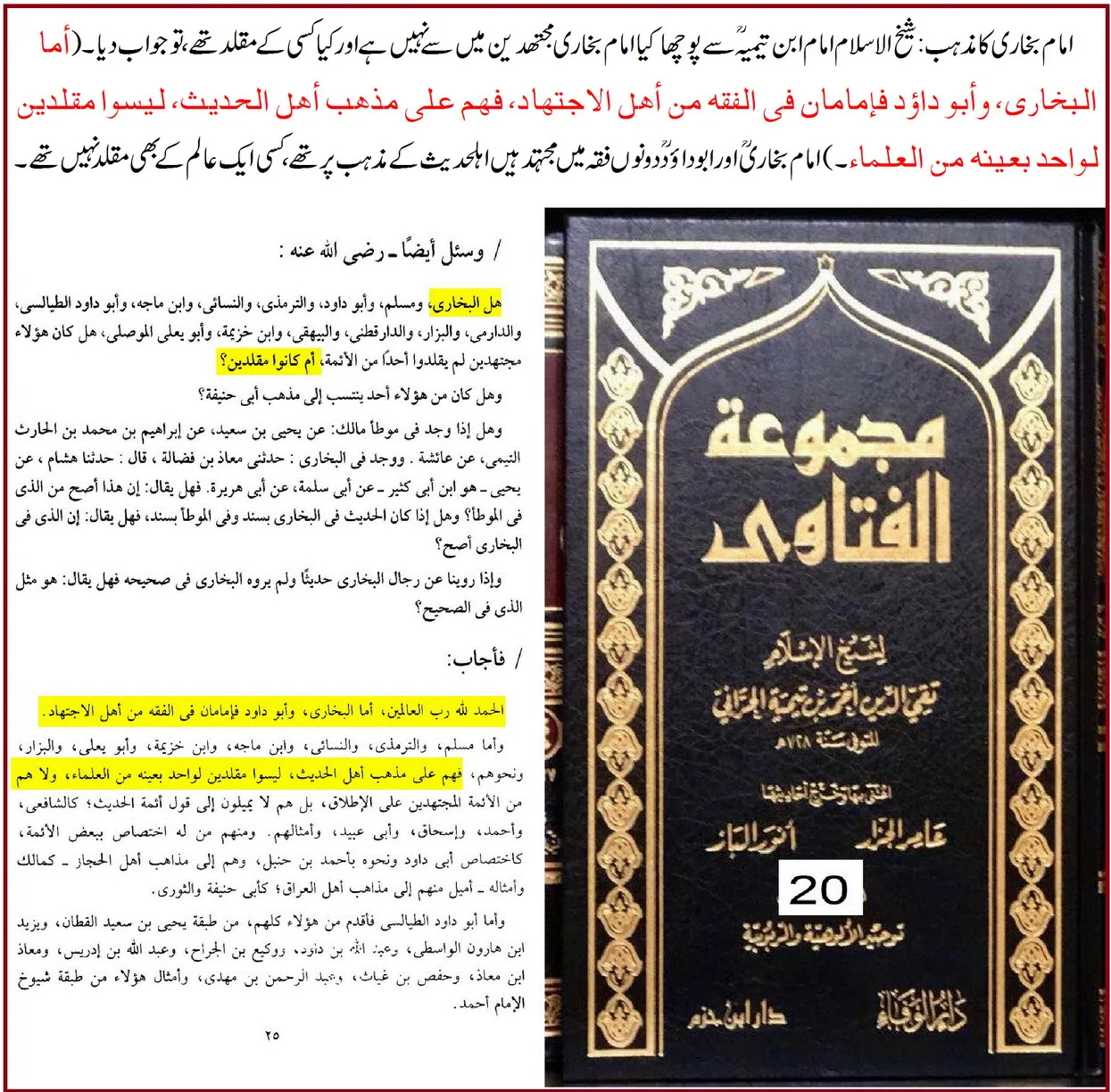
Shaykh al-Islam Ibn Taymiyyah (may Allah have mercy on him) was asked whether Bukhari, Muslim, Abu Dawood, etc. were followers (muqallid). He replied:
أما البخاري وأبو داود فإمامان في الفقه من أهل الاجتهاد، وأما مسلم والترمذي والنسائي وابن ماجه وابن خزيمة وأبو يعلى والبزار ونحوهم فهم على مذهب أهل الحديث ليسوا مقلدين لواحد بعينه من العلماء ولا هم من الأئمة المجتهدين على الإطلاق
Translation:
As far as Imam Bukhari and Abu Dawood are concerned, both of them were among the Imams in jurisprudence and the people of Ijtihad. Muslim, Tirmidhi, Nasa'i, Ibn Majah, Ibn Khuzaymah, Abu Ya'la, Bazzar, and others like them followed the creed of Ahl al-Hadith; they were not followers of any one scholar, nor were they absolute Mujtahids.
Reference: Al-Kitab: Majmoo' al-Fatawa
Author: Ahmad ibn Abdul Halim Ibn Taymiyyah (d. 728 AH)
Author: Ahmad ibn Abdul Halim Ibn Taymiyyah (d. 728 AH)
Brief Explanation:
After this statement, the issue is almost concluded. Ibn Taymiyyah clearly stated in direct response to the question that Imam Abu Dawood was a Mujtahid, not a mere follower of any one scholar.
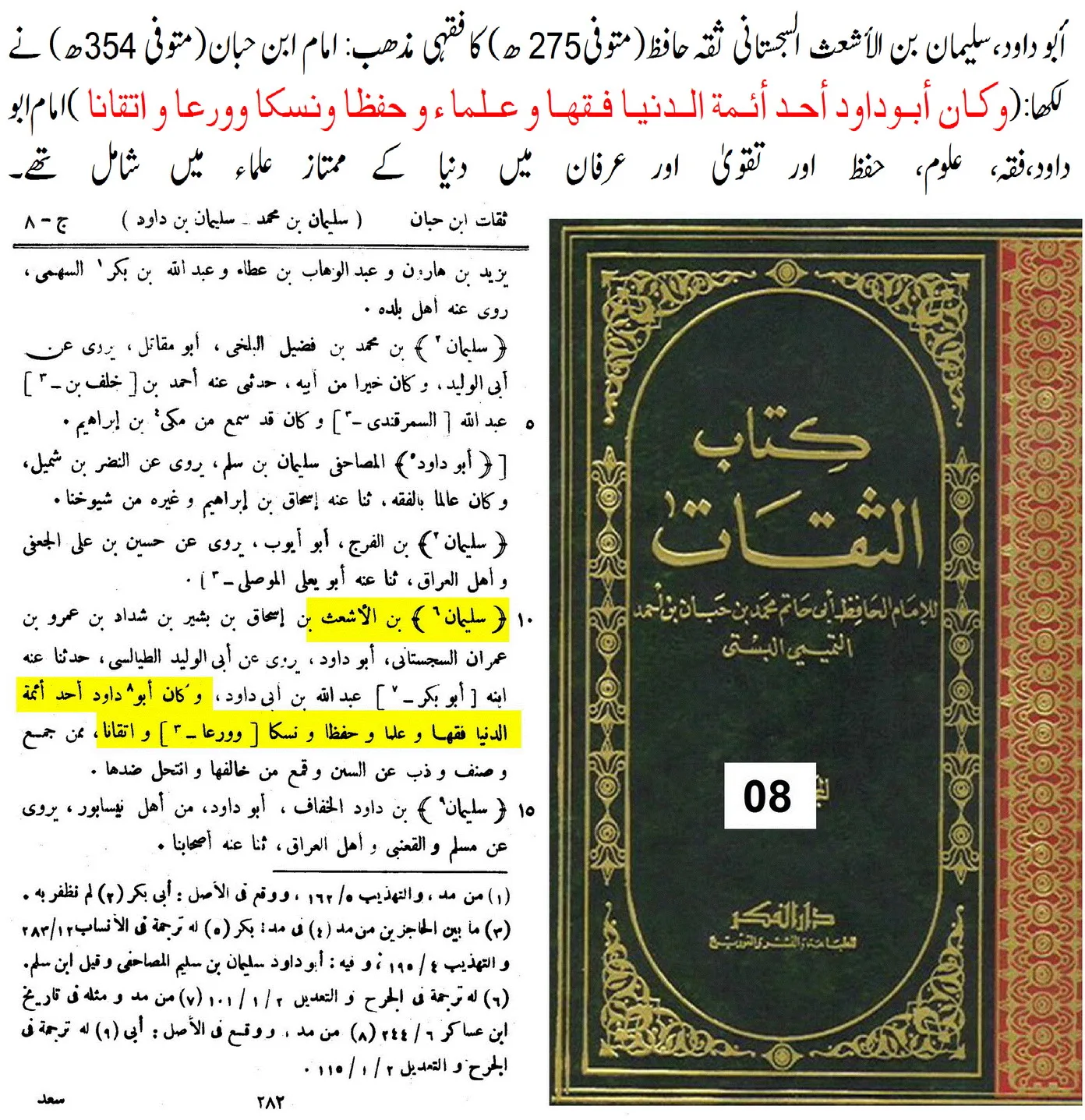
❹ Authentication by Imam Ibn Hibban
Imam Ibn Hibban wrote:
وكان أبو داود أحد أئمة الدنيا فقها وعلما وحفظا ونسكا وورعا وإتقانا
Translation:
Imam Abu Dawood was among the Imams of the world in terms of jurisprudence, knowledge, memorization, worship, piety, and precision.
Reference: Al-Kitab: Al-Thiqat
Author: Ibn Hibban (d. 354 AH)
Author: Ibn Hibban (d. 354 AH)
Brief Explanation:
If a person is "one of the Imams of the world" in jurisprudence, then calling him merely a follower of someone else diminishes his true status.
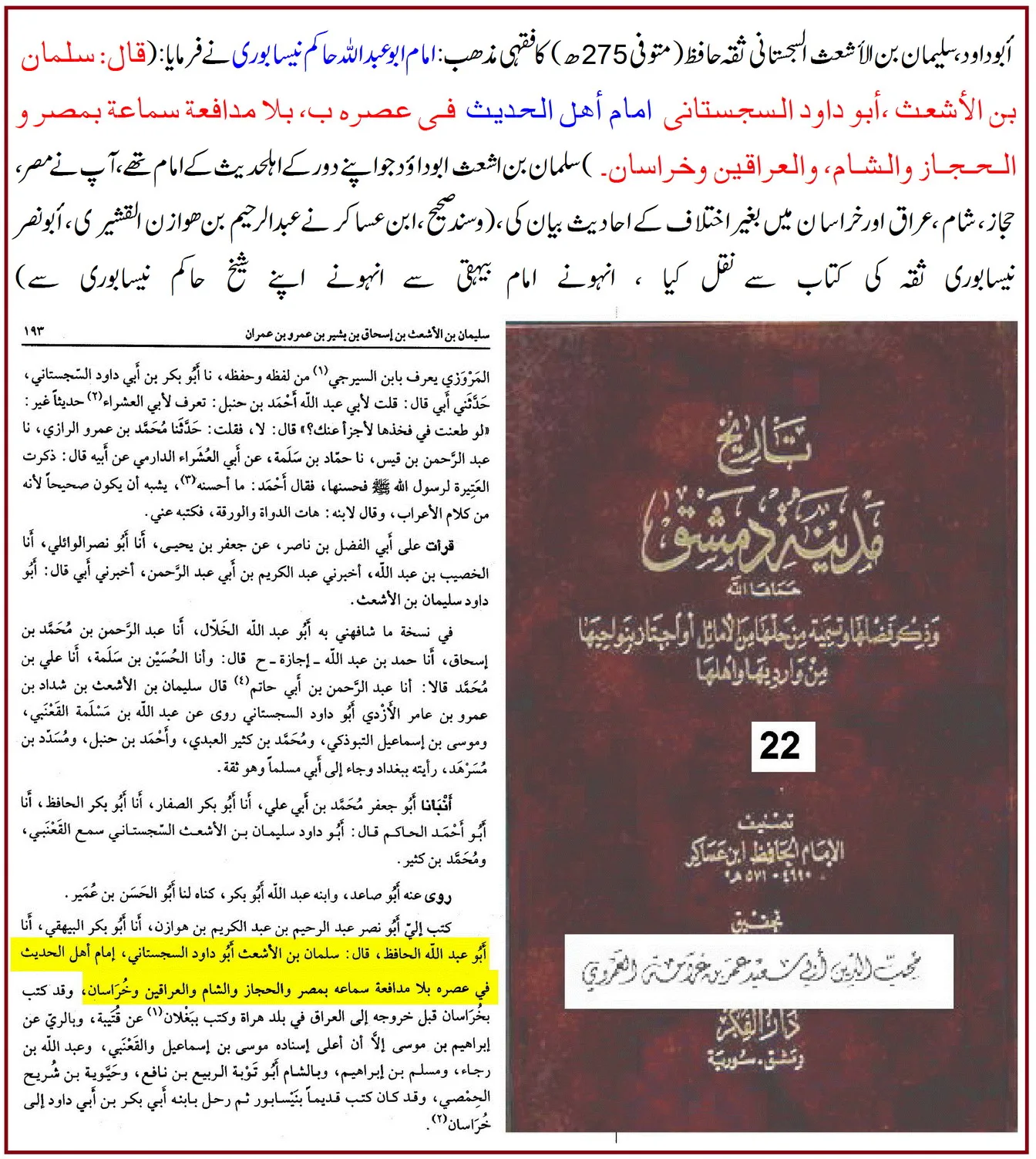
❺ Imam Hakim's Description: Imam of Ahl al-Hadith
Imam Hakim Nishapuri said:
سلمان بن الأشعث أبو داود السجستاني إمام أهل الحديث في عصره بلا مدافعة
Translation:
Sulaiman bin Al-Ash'ath Abu Dawood Sajistani was undoubtedly the Imam of Ahl al-Hadith in his time.
Reference: Al-Kitab: Tarikh Dimashq
Author: Ibn Asakir, quoting Al-Hakim
Author: Ibn Asakir, quoting Al-Hakim
Brief Explanation:
Imam Hakim (may Allah have mercy on him) called him "Imam of Ahl al-Hadith." If he had been a rigid follower of any particular jurisprudential school, his comprehensive imamate would not have been described in this manner.
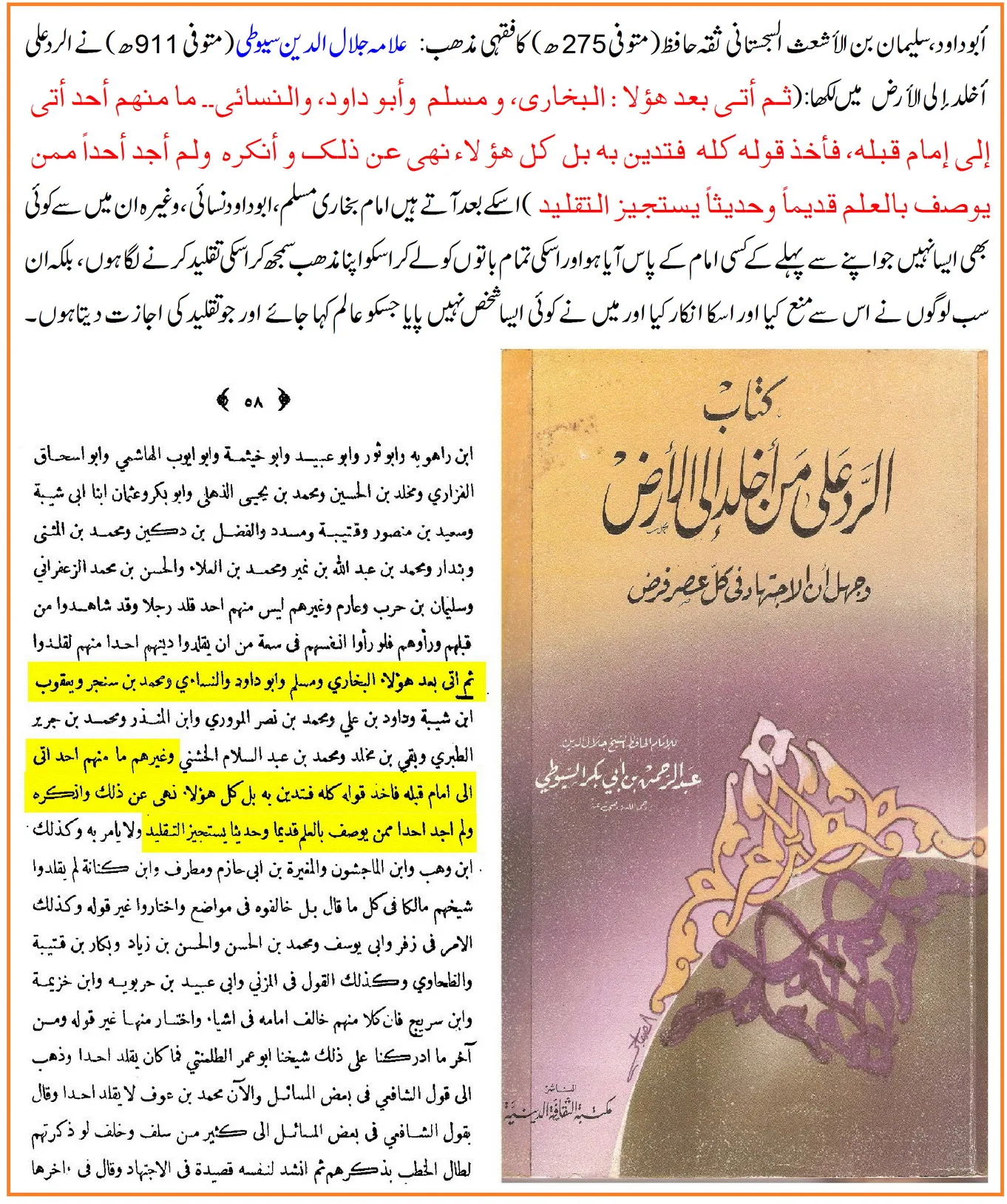
❻ Clarification by Allama Suyuti (may Allah have mercy on him)
Allama Suyuti (may Allah have mercy on him) wrote:
ثم أتى بعد هؤلاء: البخاري، ومسلم، وأبو داود، والنسائي، وغيرهم. ما منهم أحد أتى إلى إمام قبله، فأخذ قوله كله فتدين به، بل كل هؤلاء نهى عن ذلك وأنكره
Translation:
Then after him came Bukhari, Muslim, Abu Dawood, Nasa'i, and other Imams. None of them was such that he would go to any Imam before him, take all his statements, and base his religion solely on him; rather, all of them forbade this and rejected it.
Reference: Al-Kitab: Al-Radd 'ala Man Akhlada ila al-Ard
Author: Jalal al-Din al-Suyuti (died 911 AH)
Author: Jalal al-Din al-Suyuti (died 911 AH)
Brief Explanation:
This passage is very clear in the chapter of personal adherence (taqlid). Suyuti (may Allah have mercy on him) included Imam Abu Dawood (may Allah have mercy on him) among those Imams who did not take all the opinions of a single Imam and become bound by them.
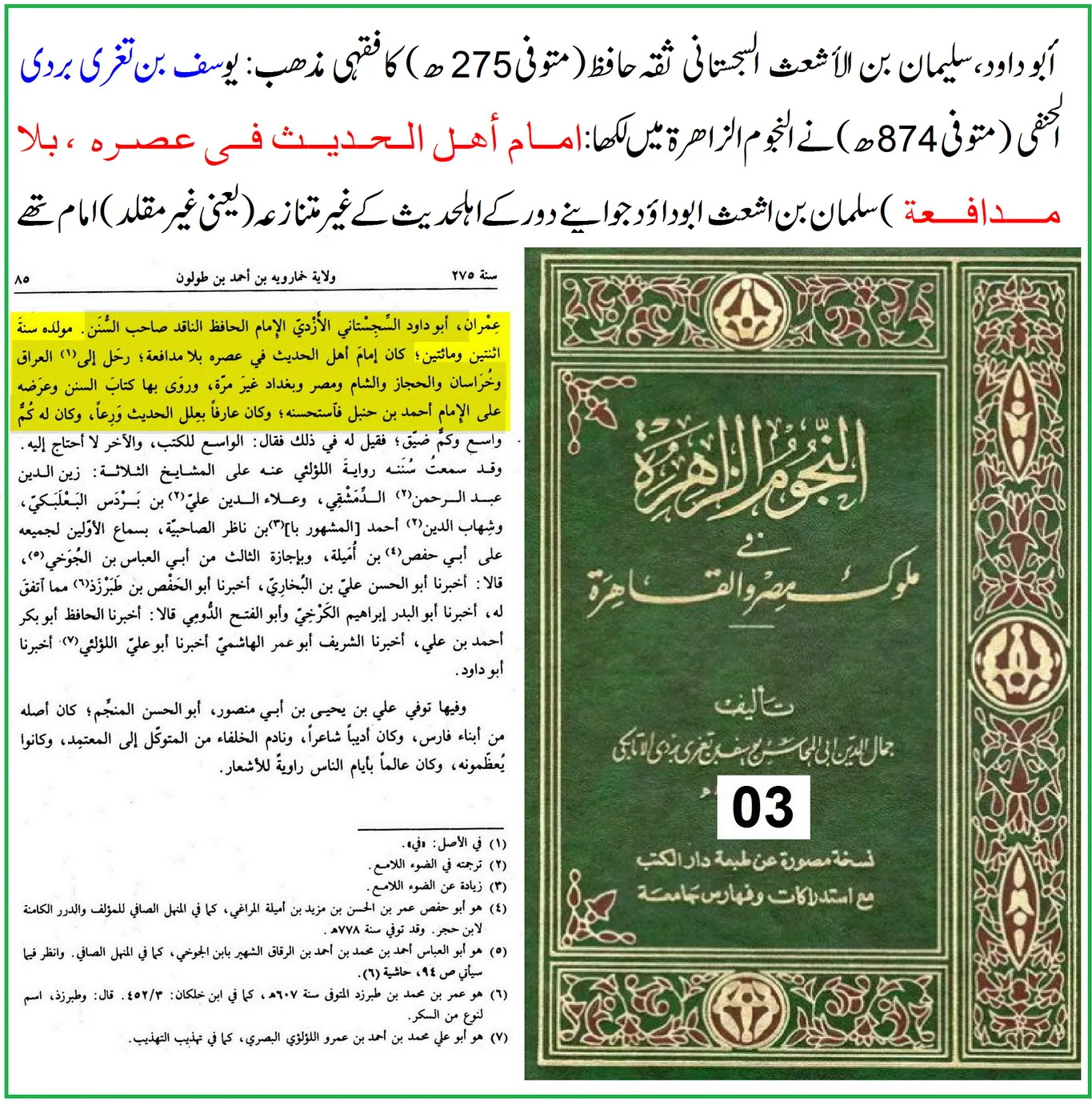
❼ Testimony of Ibn Taghri Bardi (may Allah have mercy on him)
Yusuf bin Taghri Bardi (may Allah have mercy on him) wrote:
وفيها توفى سليمان بن الأشعث ... الإمام الحافظ الناقد صاحب السنن ... كان إمام أهل الحديث في عصره بلا مدافعة
Translation:
In the same year, Sulaiman bin Al-Ash'ath, Abu Dawood Sijistani, the Imam, Hafiz, critic, and author of Sunan passed away... He was undoubtedly the Imam of Ahl al-Hadith in his time.
Reference: Al-Kitab: Al-Nujoom Al-Zahira fi Mulook Misr wal-Qahira
Author: Yusuf bin Taghri Bardi Al-Hanafi (d. 874 AH)
Author: Yusuf bin Taghri Bardi Al-Hanafi (d. 874 AH)
Brief Explanation:
Here too, his attribution is towards the Imamate of "Ahl al-Hadith," not towards blind imitation. This is the approach of the majority of biographers and muhaddithin.
❽ What does Zahid Al-Kawthari's statement also prove?
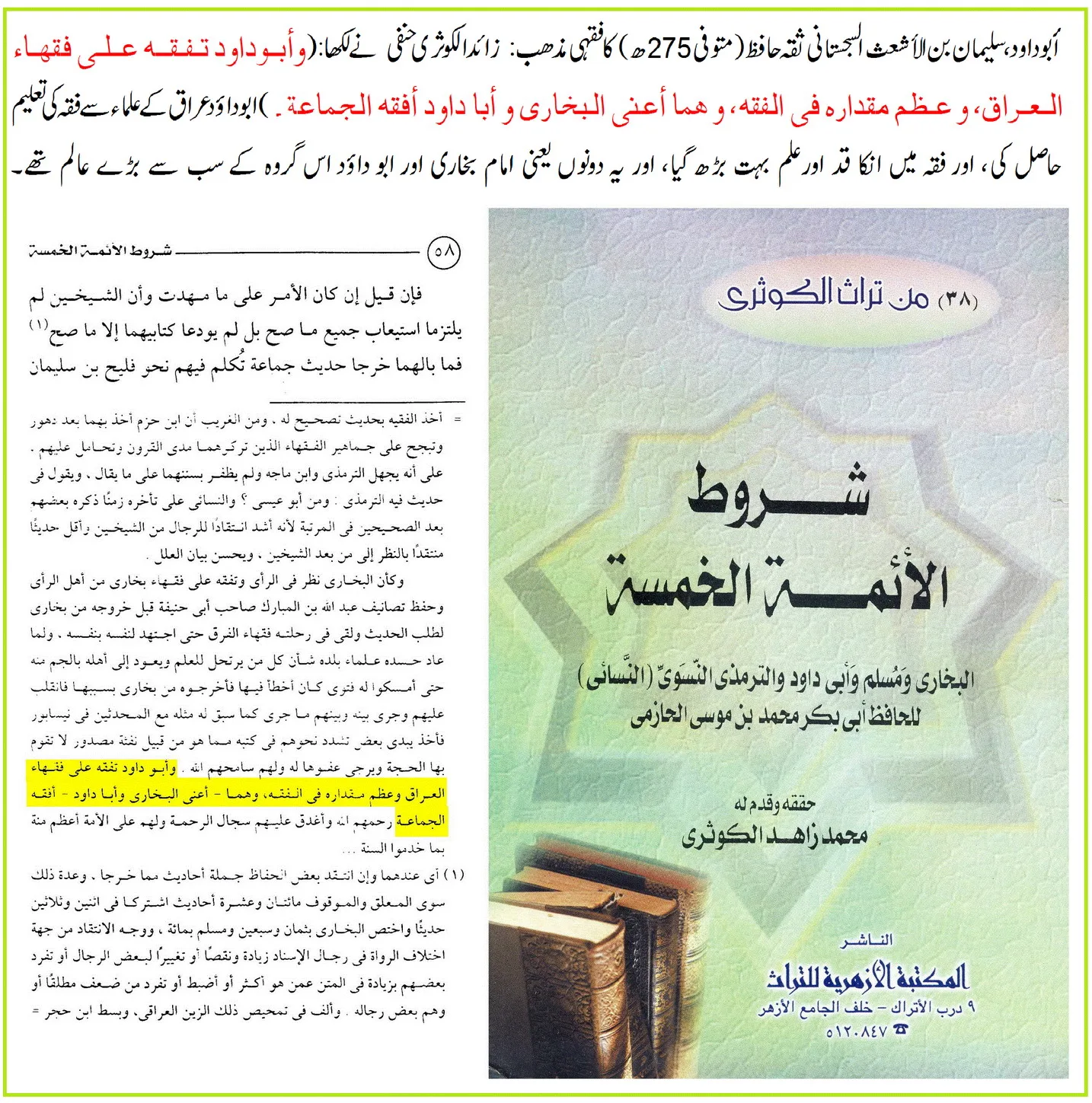
Zahid Al-Kawthari wrote:
وأبو داود تفقه على فقهاء العراق، وعظم مقداره في الفقه، وهما أعني البخاري وأبا داود أفقه الجماعة
Translation:
Imam Abu Dawood learned fiqh from the jurists of Iraq, and his status in fiqh became very high, and Bukhari and Abu Dawood were the most prominent jurists in that group.
Reference: Al-Kitab: Shuroot Al-A'immah Al-Khamsah
Brief Explanation:
Although this statement also indicates his greatness in fiqh. Learning fiqh and benefiting from great jurists is one thing, but it does not necessarily imply personal taqlid (imitation). Even Al-Kawthari's narration establishes Imam Abu Dawood as "the most learned of the group" (أفقه الجماعة).
❾ Shabbir Ahmad Usmani's Clarification
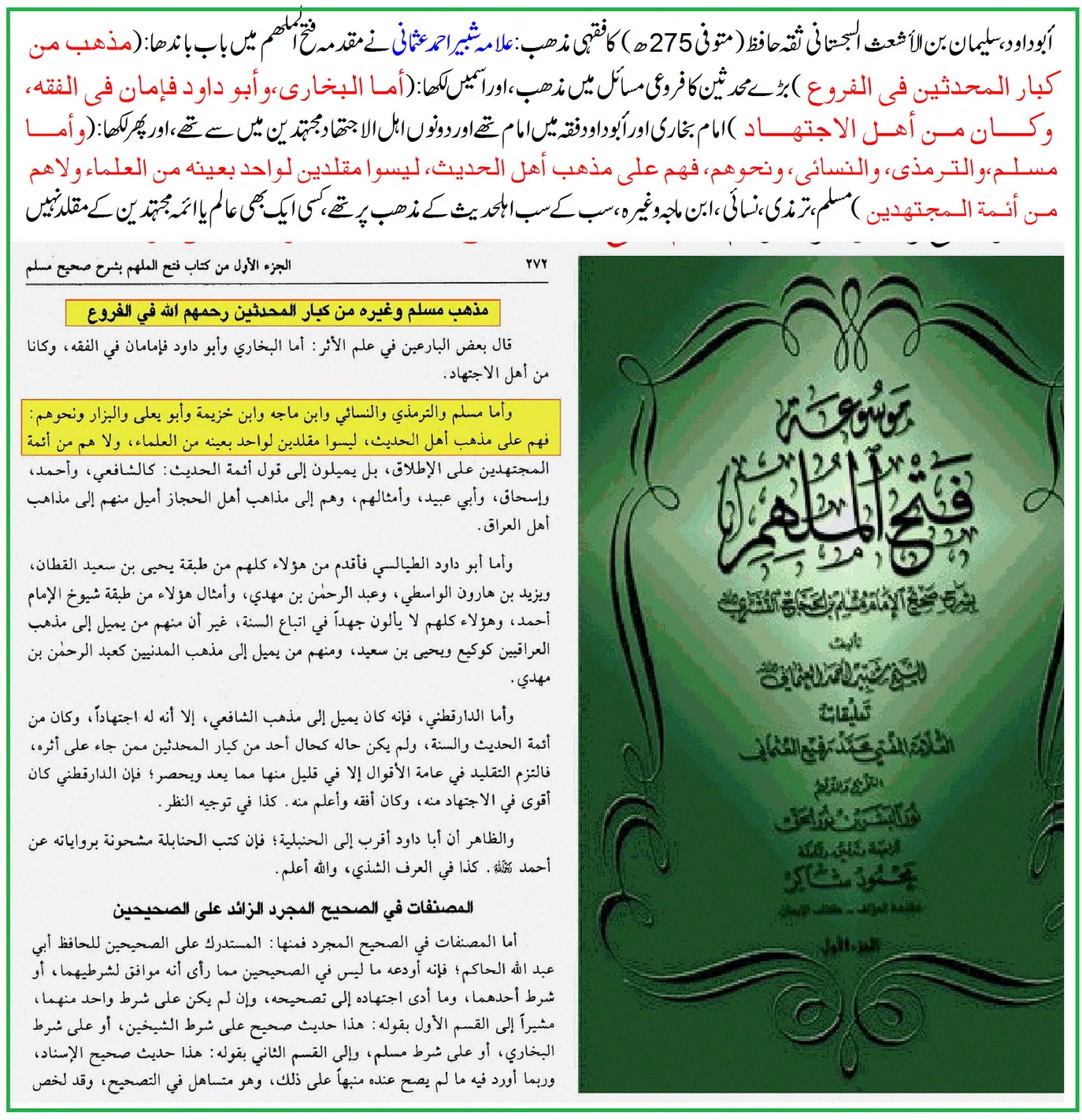
Shabbir Ahmad Usmani wrote:
أما البخاري وأبو داود فإمامان في الفقه، وكانا من أهل الاجتهاد
Translation:
As far as Imam Bukhari and Abu Dawood are concerned, both were authorities in jurisprudence and among the people of Ijtihad.
Reference: Al-Kitab: Encyclopedia of Fath al-Mulhim with Explanation of Sahih al-Imam Muslim
Brief Explanation:
This is also important because here a Hanafi scholar himself has called Imam Abu Dawood (may Allah be pleased with him) a “person attributed to Ijtihad.” Therefore, the accusation of personal Taqlid (blind following) against him is contrary to some fair scholars from his own circle.
The Correct Explanation of Imam Abu Dawood (may Allah be pleased with him) and “Attributed Mujtahid”
❿ The Statement of Shah Waliullah Dehlawi (may Allah have mercy on him)
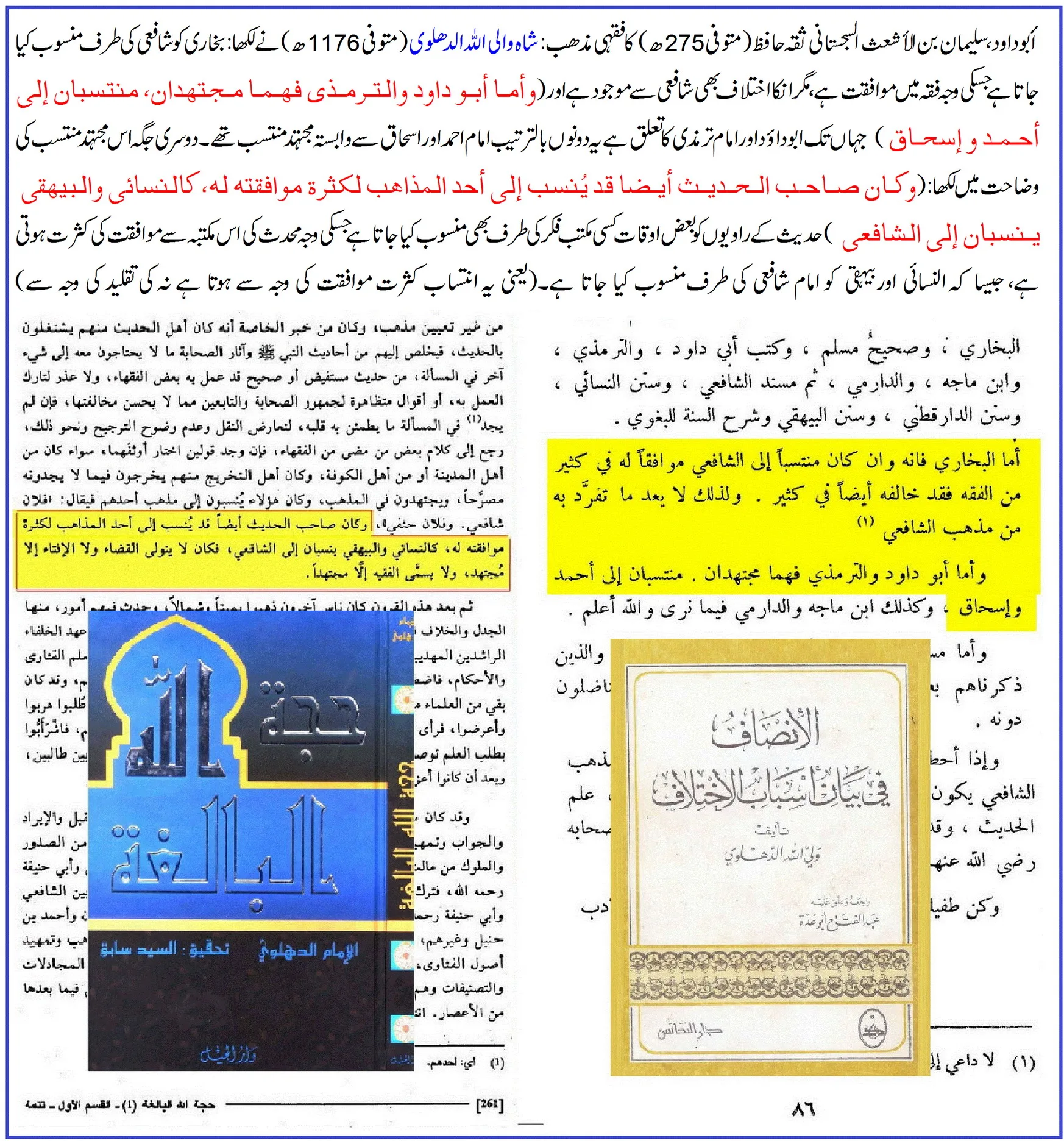
Shah Waliullah Dehlawi (may Allah have mercy on him) wrote:
وأما أبو داود والترمذي فهما مجتهدان منتسبان إلى أحمد وإسحاق
Translation:
And as far as Abu Dawood and Tirmidhi are concerned, both were Mujtahids attributed respectively to Imam Ahmad and Imam Ishaq.
Reference: Al-Kitab: Al-Insaf fi Bayan Asbab al-Ikhtilaf
Author: Shah Waliullah Dehlawi (died: 1176 AH)
Author: Shah Waliullah Dehlawi (died: 1176 AH)
Brief Explanation:
Some people here misunderstand “attributed” to mean “follower,” whereas Shah Waliullah (may Allah have mercy on him) himself clarified its meaning elsewhere.
⓫ What does “Attributed” mean?
Shah Waliullah Dehlawi (may Allah have mercy on him) himself wrote:
كان صاحب الحديث أيضا قد ينسب إلى أحد المذاهب لكثرة موافقته له، كالنسائي والبيهقي ينسبان إلى الشافعي
Translation:
Sometimes a hadith scholar among the Ahl al-Hadith is attributed to a particular madhhab because he frequently agrees with it, such as An-Nasa'i and Al-Bayhaqi being attributed to the Shafi'i madhhab.
Reference: Al-Kitab: Hujjatullah al-Baligha
Author: Shah Waliullah ad-Dihlawi (d. 1176 AH)
Author: Shah Waliullah ad-Dihlawi (d. 1176 AH)
Brief Explanation:
Here the matter becomes very clear. "Attribution" does not mean "taqlid" (imitation), but rather frequent agreement. By the same principle, if Imam Abu Dawood is ever attributed to Imam Ahmad, it does not mean at all that he was a follower of the Hanbali madhhab.
⓬ Abu Muslim al-Laithi al-Bukhari’s Historical Statement
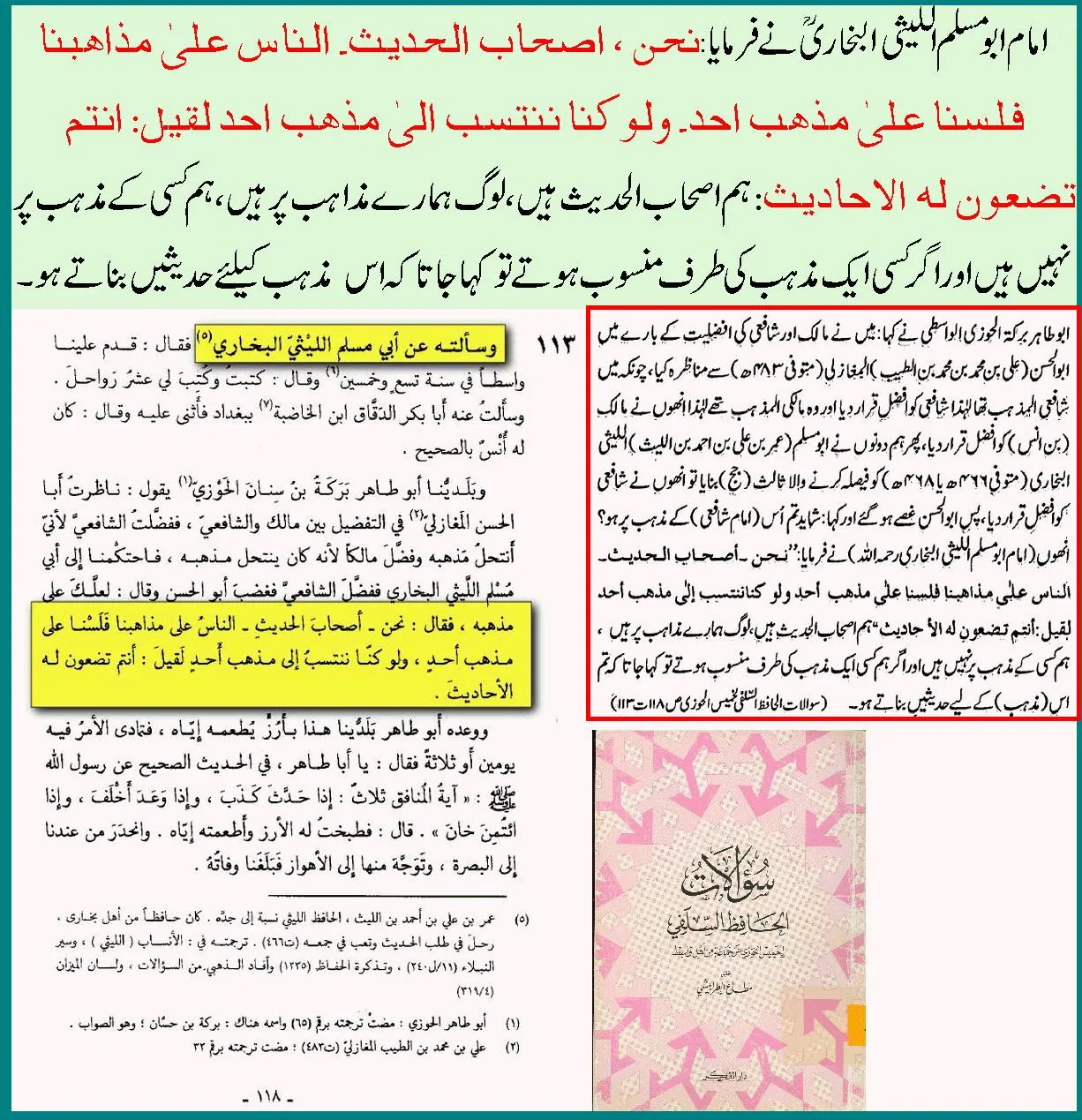
Abu Muslim al-Laithi al-Bukhari said:
نحن أصحاب الحديث الناس على مذاهبنا فلسنا على مذهب أحد ولو كنا ننتسب إلى مذهب أحد لقيل أنتم تضعون له الأحاديث
Translation:
We are the people of hadith; people follow our madhhabs, but we do not follow any one madhhab. And if we were attributed to any one madhhab, it would be said that you fabricate hadiths for it.
Reference: Al-Kitab: Questions of Al-Hafiz al-Salafi to Khamis al-Hawzi about a group from Ahl Wasit
Brief Explanation:
This is a very important statement for understanding the methodology of Ahl al-Hadith. For them, the fundamental basis is evidence, narration, understanding of the Salaf, and Ijtihad, not the absolute adherence to the sayings of one person. Imam Abu Dawood (رضي الله عنه) should also be understood according to this methodology.
Summary of the Discussion
Several points become completely clear from the above clarifications:
❶ Imam Abu Dawood (رضي الله عنه) has been counted among the jurists, Imams, and men of Ijtihad by the majority of hadith scholars and researchers.
❷ His closeness to Imam Ahmad (رضي الله عنه), attendance in his gatherings, or frequent agreement does not prove personal imitation.
❸ There is a difference between being "affiliated" and being a "follower"; affiliation sometimes occurs merely due to frequent agreement.
❹ The statements of Ibn Taymiyyah (رحمه الله), Tahir al-Jaza’iri (رحمه الله), Shabbir Ahmad Usmani, Shah Waliullah Dehlawi (رحمه الله), and other scholars clearly indicate that Imam Abu Dawood (رضي الله عنه) was not a rigid follower of any one scholar.
❺ Therefore, saying "Imam Abu Dawood was certainly a Hanbali follower" is not a scholarly expression but an unfounded generalization.
Conclusion
The conclusion is that the accusation of Imam Ahl al-Hadith Abu Dawood Sulaiman bin al-Ash'ath al-Sijistaniؒ being a "Hanbali follower" is against the statements of the majority of hadith scholars, jurists, and researchers. The scholars have counted him among the jurists, critics, imams, men of insight, and those qualified for ijtihad. Benefiting from Imam Ahmadؒ, sitting in his assembly, or agreeing with him on some issues does not constitute personal imitation. This is why researchers have attributed to him the methodology of Ahl al-Hadith, jurisprudential insight, and ijtihadi status, not rigid Hanbalism.
Therefore, the fair and scholarly position is to place Imam Abu Dawoodؒ at his true status: he was both an Imam of Hadith and a jurist, and belonged to that group of Ahl al-Sunnah known for following evidence and Sunnah, not for unquestioning imitation of any one person. Hence, explicitly accusing him of being a Hanbali follower is against scholarly integrity and far from historical reality.