


This excerpt is taken from Sheikh Irshad Ullah Maan's book In Search of Truth.
It should be remembered that the traits which were bad for the Jews, Christians, and the polytheists of Mecca will also be bad if they appear in the claimants of Islam today. The purpose of informing about the conditions of these nations in the Quran and Hadith is actually to avoid their bad traits and habits because the purpose of the Quran's revelation is not only to narrate the history of those nations and individuals but to derive lessons and advice from historical events. It should be remembered that they understood the meaning of لا الہ الا اللہ, so they did not recite the Kalima, meaning they were not ready to abandon the worship of others besides Allah, and nowadays some Kalima reciters have recited the Kalima but have not understood its meaning, meaning that despite reciting the Kalima, they are still worshipping others besides Allah.
In this chapter, we will discuss the polytheists of Mecca in the light of the Quran, so that we can understand their beliefs and avoid their incorrect beliefs. It should be noted that the Messenger of Allah ﷺ fought wars against them because of their incorrect beliefs, i.e., polytheism, even though they believed in Allah Almighty. The very first point is that besides mentioning the polytheists of Mecca and places, the Quran refers to them in the following locations.
Reference: Surah Al-An'am and Surah Yunus (complete), Al-Anfal (32 to 35), An-Nahl (20, 21, 35, 55), Surah Bani Isra'il (17), Al-Ankabut (61, 63, 65, 66), Al-Mu’minun (84 to 89), Luqman (25, 31, 32), Az-Zumar (38) and Az-Zukhruf (9 to 15, 87), all Makkan Surahs.
Wherever the polytheists of Mecca are mentioned in the Holy Quran, their beliefs are also described. Here we will mention a few:
[1] First point:
The polytheists of Mecca believed in Allah, prayed in their own way, and performed Hajj. But all this was not according to the method prescribed by Allah; rather, there was considerable corruption in it. For example:
Reference: (Al-An'am:130 to 140), (Yunus:15 to 23, 31, 32), (Al-Anfal:32 to 35)
and they used to say that we follow the religion of Ibrahim. Allah Almighty said you are polytheists, your religion has no connection with that of Ibrahim, the Quran bears witness to this.
Reference: (See Tafsir Muradabadi Al-An'am: 161), (An-Nahl:120 to 123)
[2] Second point:
They would dedicate some of their livestock and crops for the cause of Allah and some for other than Allah, therefore Allah called them polytheists.
Reference: Surah Al-An'am 1 to 140)
mentions the ignorant beliefs of the polytheists of Mecca.1 to 140)
[3] Third point:
When these people were caught in trouble on land or at sea, they would call upon only Allah, leaving aside others, as is repeatedly mentioned in the Quran.
Reference: (Yunus:18 to 23), (Bani Isra'il:67 to 69), (Al-Ankabut:61 to 66), (Ar-Rum:33, 34), (Al-An'am:40, 41, 63 to 66), (Az-Zumar:1 to 15, 49), (An-Nahl:53 to 55, 20, 21, 25 to 32)
Reference: See: For all these verses (Ahmad Raza Khan Sahib's translation with Tafsir Muradabadi).
And the remarkable thing is that at these places, Ahmad Raza Sahib has also translated "to call upon" except in one place. The conclusion of this discussion is that the behavior of some of today's Kalima reciters is more dangerous than the polytheists of Makkah; it is as follows:
[1] The polytheists of Makkah used to call upon others besides Allah during times of ease. And in times of distress, they would call only upon the pure Allah, leaving everyone else aside. (For references see:
Reference: (Yunus:18 to 23), (Al-Ankabut:61 to 66), (Ar-Rum:33, 34), (Al-An'am:40, 41, 63, 64), (Luqman:25 to 32) (Translation by Ahmad Raza Khan Sahib and Tafseer Muradabadi)
But some of today's Kalima reciters are seen calling upon others besides Allah even in times of distress, meaning they have gone a few steps ahead of those Arabs.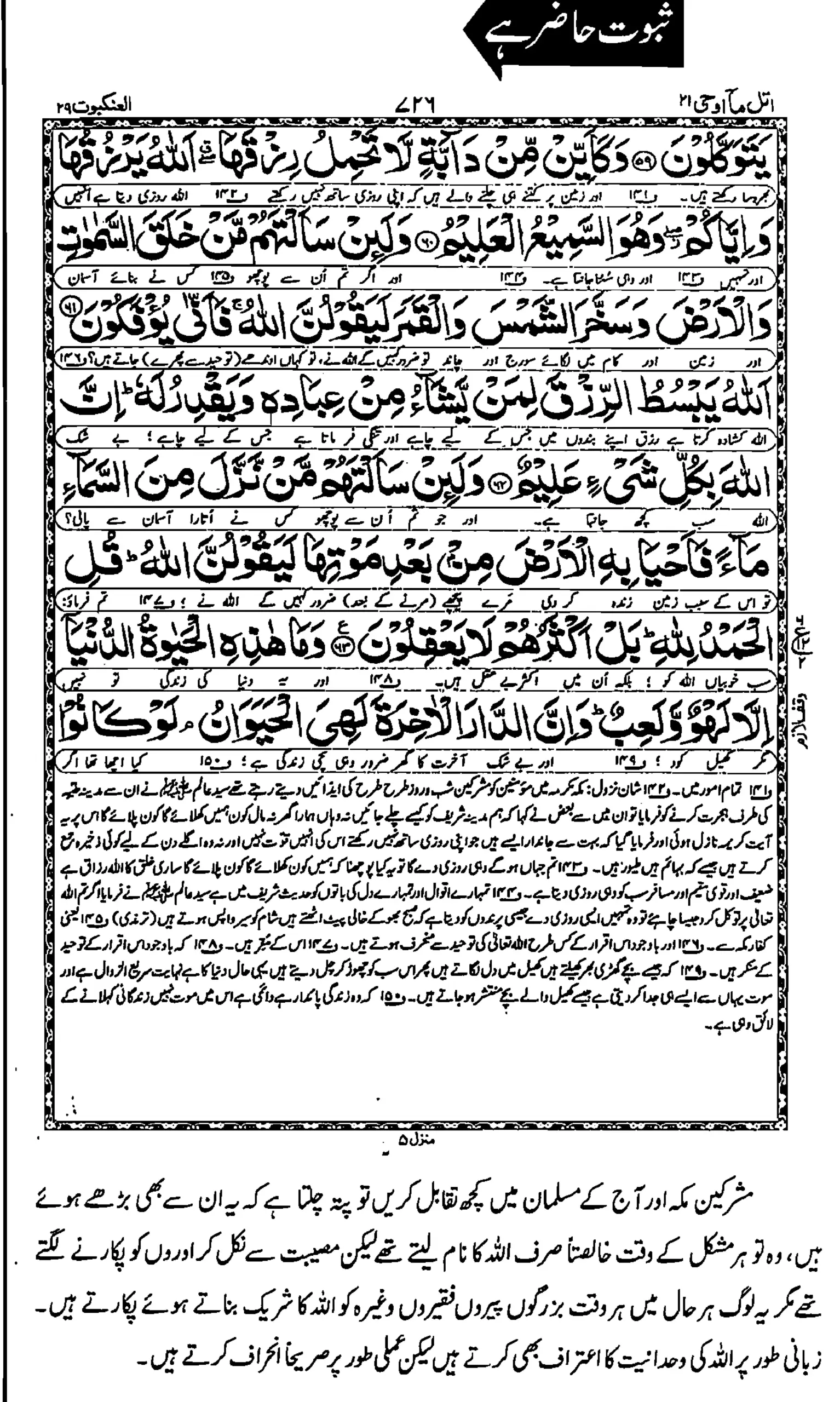
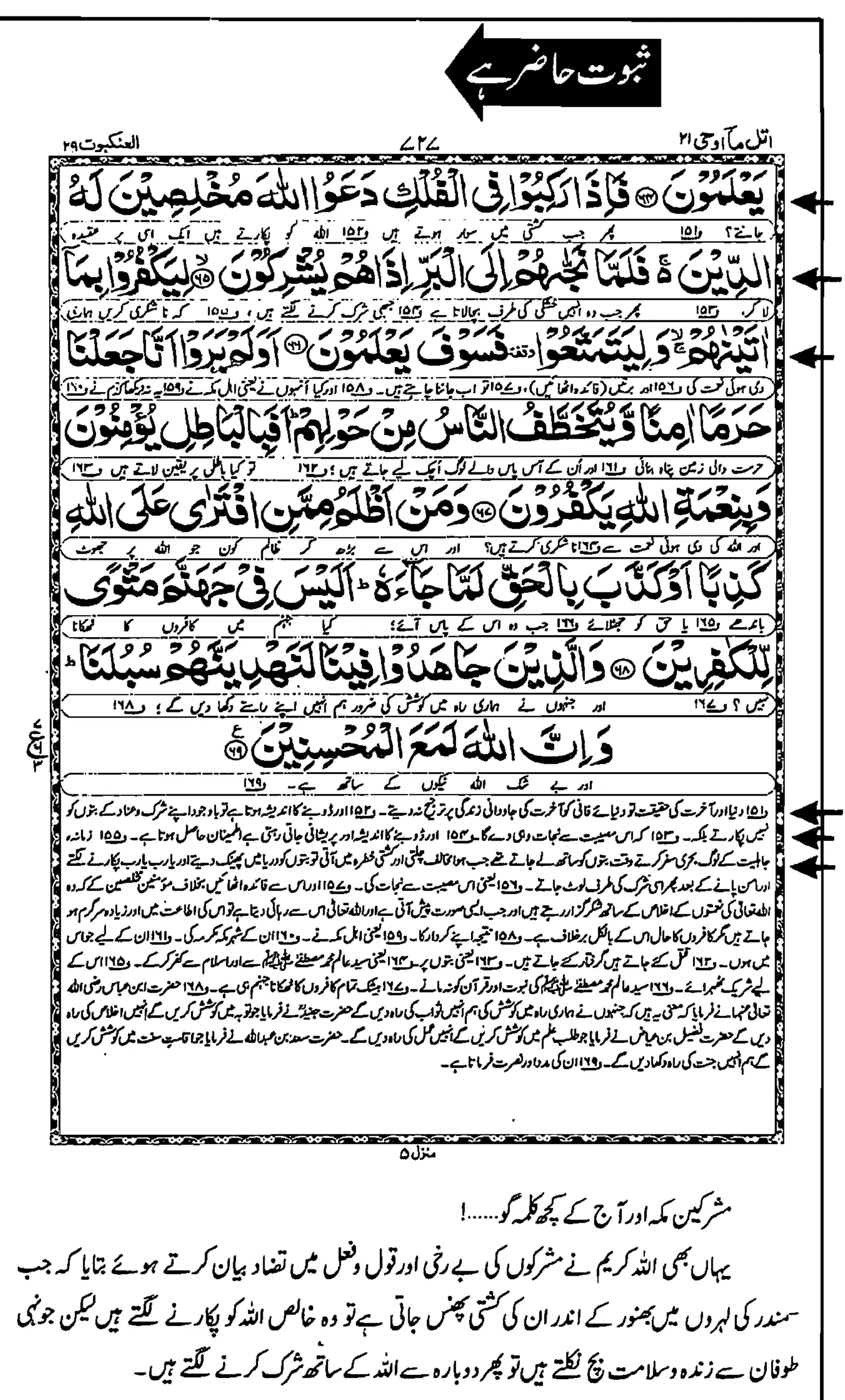
[2] Nowadays, these people are also seen spending wealth in the name of others besides Allah.
[3] The Arabs used to call others besides Allah as intercessors before Allah and worship them
Reference: (Az-Zumar:3), (Yunus:18)
but nowadays these people directly call their partners as Giver, Bestower, Reliever of difficulties, Granter of needs, and Ghaus-e-Azam, meaning they have gone beyond the Arabs.[4] Fourth point:
Here we want to mention the Talbiyah of the polytheists of Makkah during Hajj, so that their incorrect belief becomes clear. Abdullah bin Abbas (may Allah be pleased with them) said that the polytheists of Makkah used to say: [لبيك لا شريك لك] (We are present, You have no partner) but the Messenger of Allah ﷺ would say: "May you be ruined, stop here, stop here" (meaning do not say further), and they would continue saying after that, "But He has a partner, O Allah! He is its owner," while He owns nothing. In short, they kept saying this and circumambulating the House of Allah.
Reference: Muslim, Book of Hajj, Chapter on Talbiyah and its description and timing: 22/1185
This shows that the polytheists of Mecca did not consider their partners equal to Allah, but rather recognized Allah as the owner of everything and did not consider their partners as owners of anything. However, calling upon them and considering them as intercessors and advocates was enough for them to be regarded as polytheists in the sight of Allah and to be thrown into Hell forever, just as people nowadays go to graves and say.
Now we want to quote some excerpts from the third volume of Mufti Ahmad Yar Khan, a famous Hanafi Barelvi scholar's translation of Mishkat with commentary, so that the standard of their monotheism can be assessed.
[1] It is stated: The Messenger of Allah ﷺ said that the prayer of the fish prophet when he prayed to his Lord from inside the belly of the fish is: There is no deity except You; exalted are You. Indeed, I have been of the wrongdoers. Any Muslim person will supplicate this in need, and it will be accepted.
Reference: Tirmidhi, Book of Supplications, Chapter on the Supplication of Dhu al-Nun: 3505
In his tafsir, Ahmad Yar states: The scholars say that the belly of this fish is superior to the Great Throne because it was the place of manifestation for a prophet for some days. When the belly of the fish became superior to the Great Throne, then the pure womb of Amina, in which the Chief of the Prophets manifested for nine months, is far superior to the Throne.
Reference: (Mishkat:3/334 by Ahmad Yar Gujarati)
Consider yourself whether this is not the extreme of exaggeration, that Allah Almighty is on the Throne as repeatedly mentioned in the Quran, and these people have declared the womb of the Prophet Muhammad’s ﷺ mother to be far superior to Allah’s Great Throne. Then what is the meaning of shirk?
Q:
Reference: On page (301) of the same book
, a hadith is narrated stating that in the light of this hadith, all needs should be asked from one’s Lord, even the shoelace and salt. And on page
Reference: (142)
of the same book, it is written that from the Prophet Muhammad ﷺ, one asks for wealth, deeds, perfection, the pleasure of the Lord and Paradise, refuge from Hell, and the completion of faith—everything is asked. So if there are two givers, then where is the concept of Tawheed (Oneness of God)?In the Quran and Hadith, it is stated that supplication (dua) is worship, and worship of anyone other than Allah is shirk (polytheism): [الدعاء هو العبادة] meaning: supplication is worship.
Reference: Tirmidhi, Book of Supplications, Chapter: 3372, 2969, 3247], [Abu Dawood, Book of Witr, Chapter of Supplication: 1479], [See Ahmad Raza Khan Sahib’s translation with Tafsir under Surah Al-Mu’min, Ayah (60)]
[1] Some Kalima-reciting brothers believe that the Messenger of Allah ﷺ is present and observing, whereas the Holy Quran has stated repeatedly that Allah Almighty is on the Throne but, based on His knowledge, He sees and hears everything, meaning He is present and observing. To consider the Messenger of Allah ﷺ as present and observing is to equate him with Allah Almighty, and Allah Almighty has declared equating others with Allah as disbelief and polytheism, and He said: There is none equal to Allah Almighty.
Reference: (Al-Baqarah:22,165), (Al-An'am:1,150), (Ibrahim:30), (Ash-Shu'ara:98), (Saba:33), (Maryam:65), (Az-Zumar:8), (Ha Mim As-Sajda:9)
The entire matter has been discussed in detail in the debate on Tawhid in Knowledge and Shirk in Knowledge; please refer there.[2] Some Kalima-reciting brothers believe that the Messenger of Allah ﷺ is not present and observing everywhere, but he is alive in body and soul in his pure grave. And if anyone recites Durood Sharif near his pure grave or makes a request, then he ﷺ hears it. The refutation of this belief has also been presented in Tawhid in Knowledge and Shirk in Knowledge.
[3] The Quran and Hadith mention the passing away of the Prophet ﷺ.
Reference: Sahih Bukhari (Book of Funerals: 1241, 1242)
contains detailed accounts of the Prophet ﷺ falling ill, passing away, and being buried. It is also written that when the Prophet ﷺ passed away, Sayyiduna Umar رضي الله عنه said: Whoever says that the Messenger of Allah ﷺ has died, I will cut off his head with a sword. Later, Sayyiduna Abu Bakr رضي الله عنه came to the gathering of the Companions رضي الله عنهم and gave a sermon, citing Quranic verses, and said: Allah Almighty has made the Messenger of Allah ﷺ taste death once; you will not taste death a second time. He said: The Prophet ﷺ has passed away, and all the Companions agreed that the Messenger of Allah ﷺ had passed away. The Rightly Guided Caliphs faced many difficulties, but none of the Rightly Guided Caliphs went to the pure grave of the Prophet ﷺ during times of hardship to communicate with him ﷺ. All these matters have been mentioned in this book, and it has also been explained that the hadith stating that if salutations (Durood Sharif) are recited near the pure grave of the Prophet ﷺ, he ﷺ hears it, has already been explained earlier in this book as a fabricated hadith, i.e., it is false.The reality is that your ﷺ pure body is in your blessed grave in Madinah Munawwarah, and your ﷺ blessed soul is at the highest place in Paradise, beneath the Throne. A few moments before your ﷺ blessed soul was taken, you ﷺ prayed: [اللٰهم بالرفیق الأعلٰی] "O Allah! Take me to the highest companions, that is, the Prophets and the angels." And it has also been proven from the authentic narration of Sahih Bukhari in this book that the Messenger of Allah ﷺ did not know at that time what his Ummah was doing.
Reference: Bukhari, Book of Softening Hearts, Chapter on the Basin: 6586

