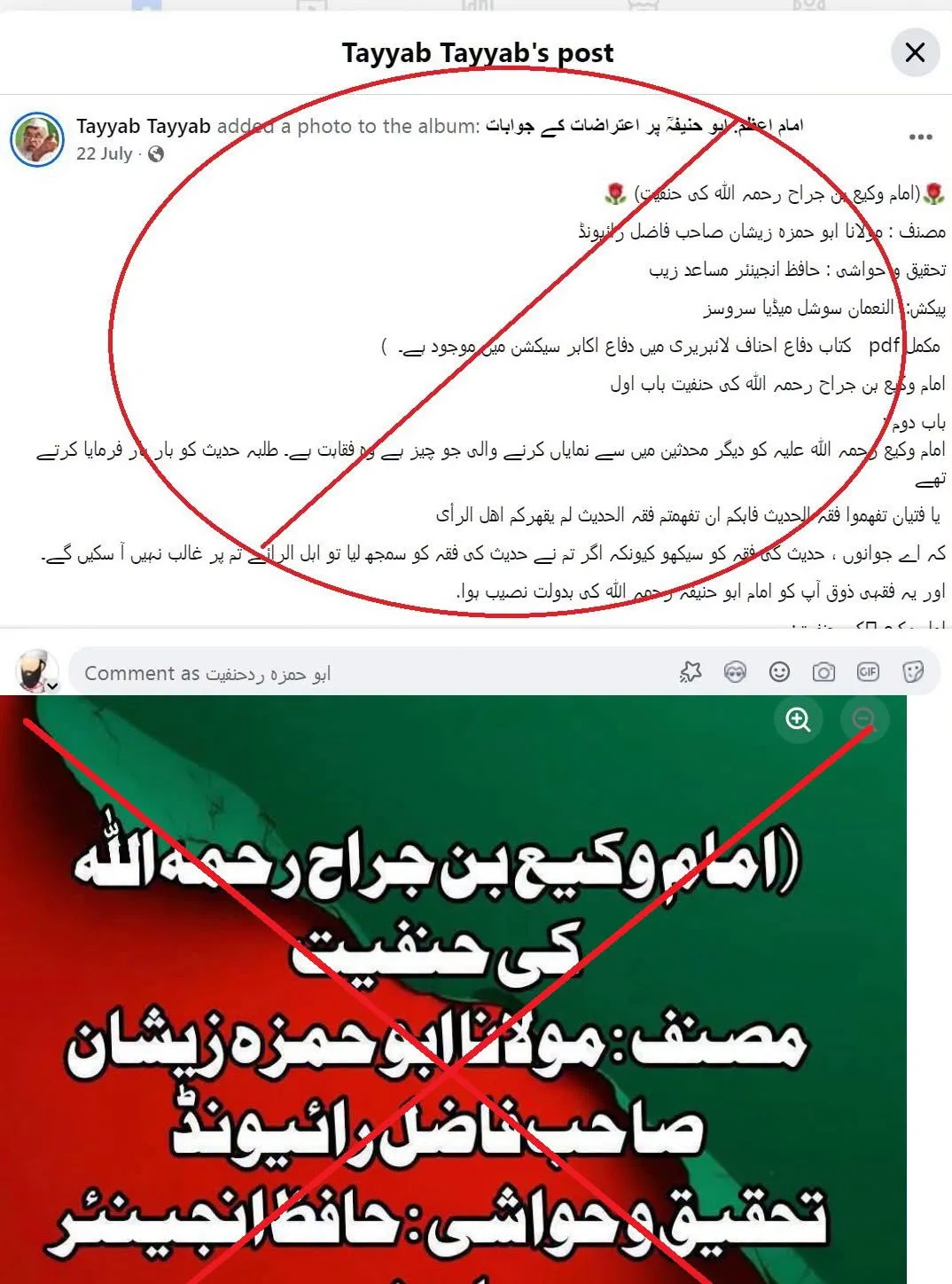

Compiled by: Abu Hamza Salafi
Imam Waki' ibn al-Jarrah, may Allah have mercy on him (died 196 AH), was a distinguished muhaddith, hafiz of hadith, and faqih of the second century Hijri. His scholarly status, expertise in hadith, and jurisprudential insight have been acknowledged by the leading muhaddithin. However, the question has been debated among scholars whether Imam Waki', may Allah have mercy on him, followed the jurisprudential opinions of his contemporary Imam Abu Hanifa, may Allah have mercy on him (died 150 AH), and issued fatwas accordingly, or whether he had his own independent jurisprudential methodology. Some historical narrations mention that Imam Waki', may Allah have mercy on him, issued fatwas based on the sayings of Imam Abu Hanifa, while on the other hand, many of his jurisprudential and theological statements have been transmitted which differ from the views attributed to Imam Abu Hanifa or the well-known Hanafi positions. The purpose of the present article is to examine both types of narrations, present the original Arabic sayings of the imams with Urdu translations and book references, and clarify the scholarly and jurisprudential status of Imam Waki', may Allah have mercy on him. These evidences reveal his scholarly independence and his adherence to the methodology of Ahl al-Hadith in many issues; however, agreeing or differing on a single jurisprudential issue should not be taken as a definitive judgment about his entire scholarly personality.
① Narration transmitted from Imam Yahya bin Ma'in, may Allah have mercy on him
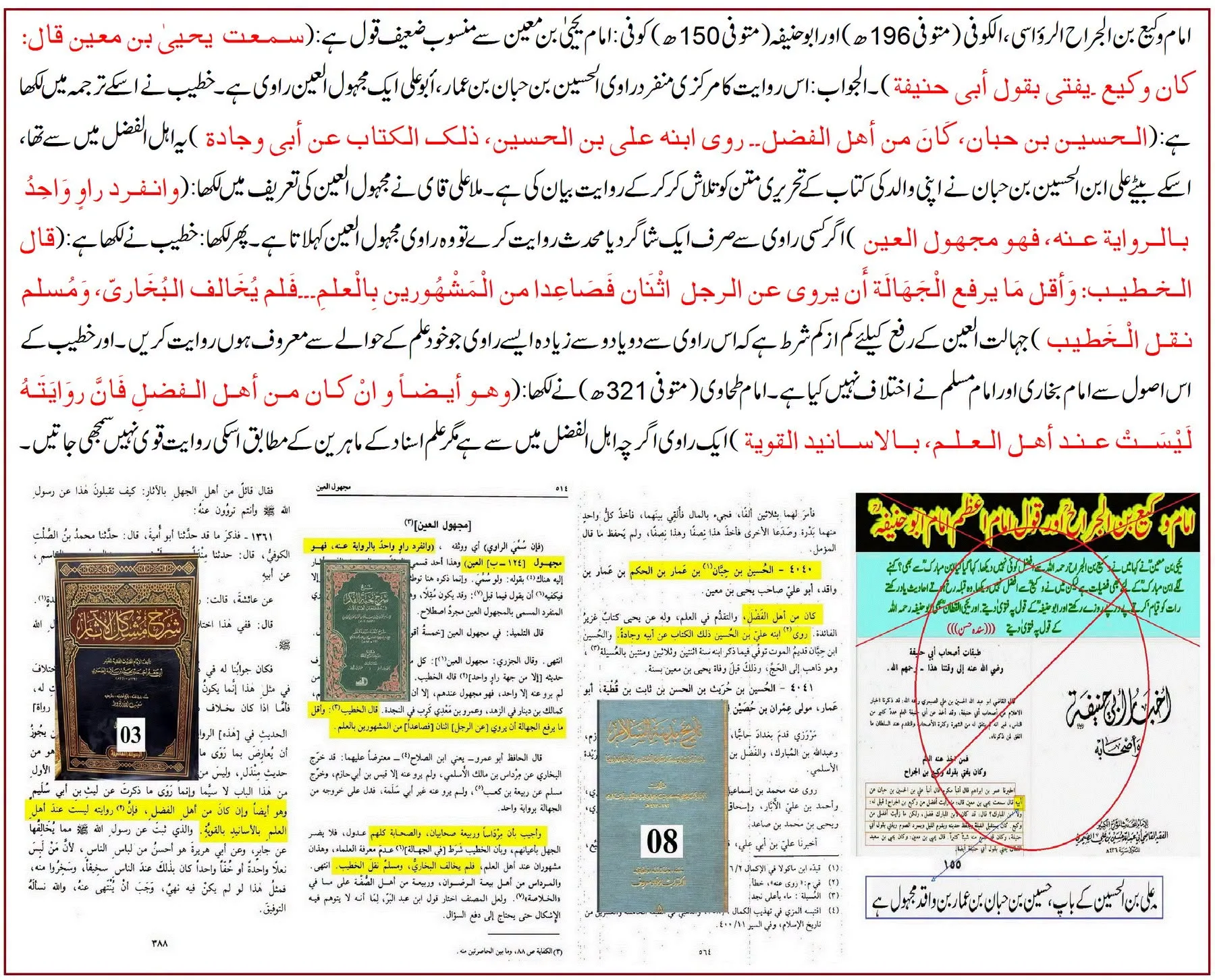
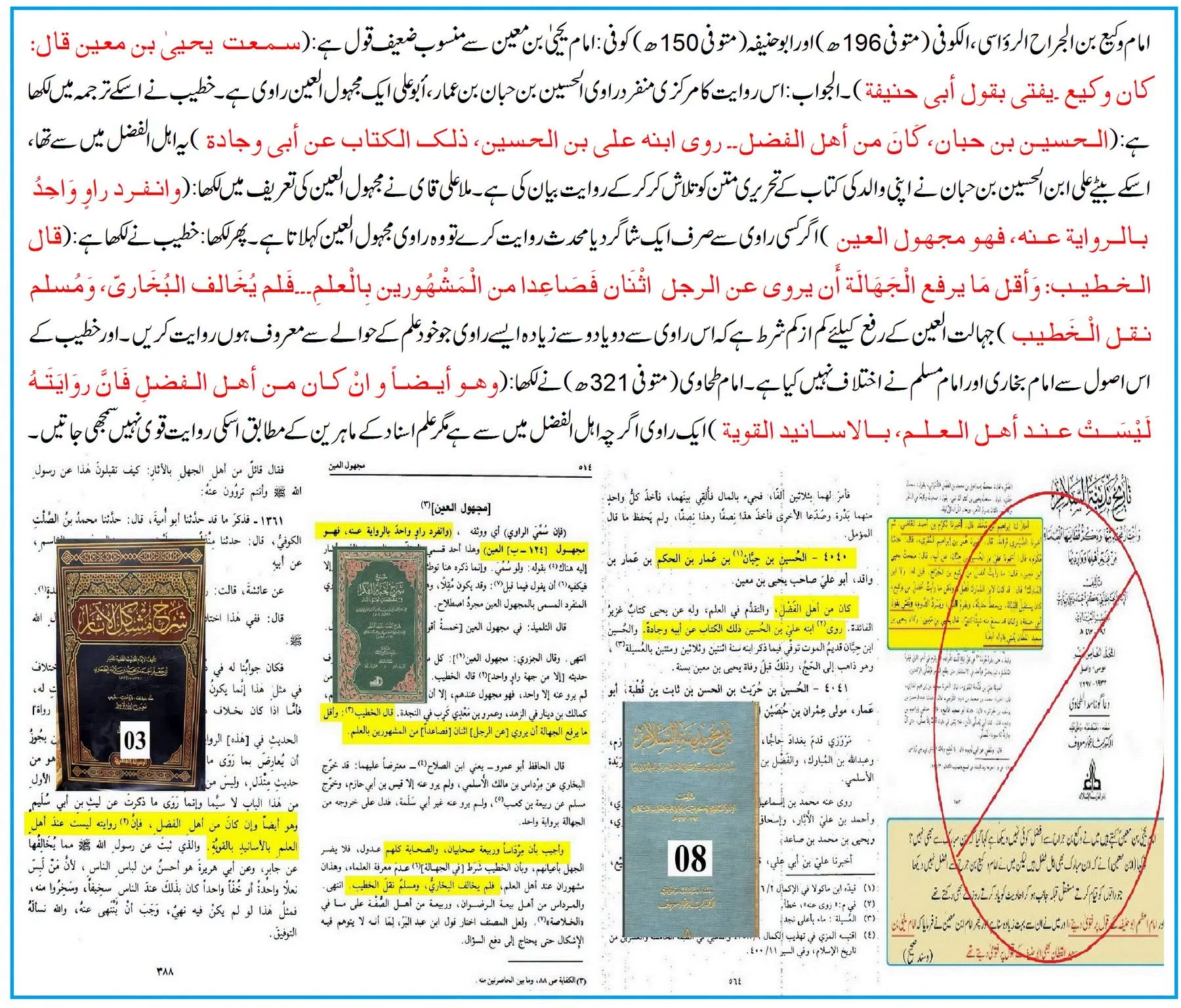
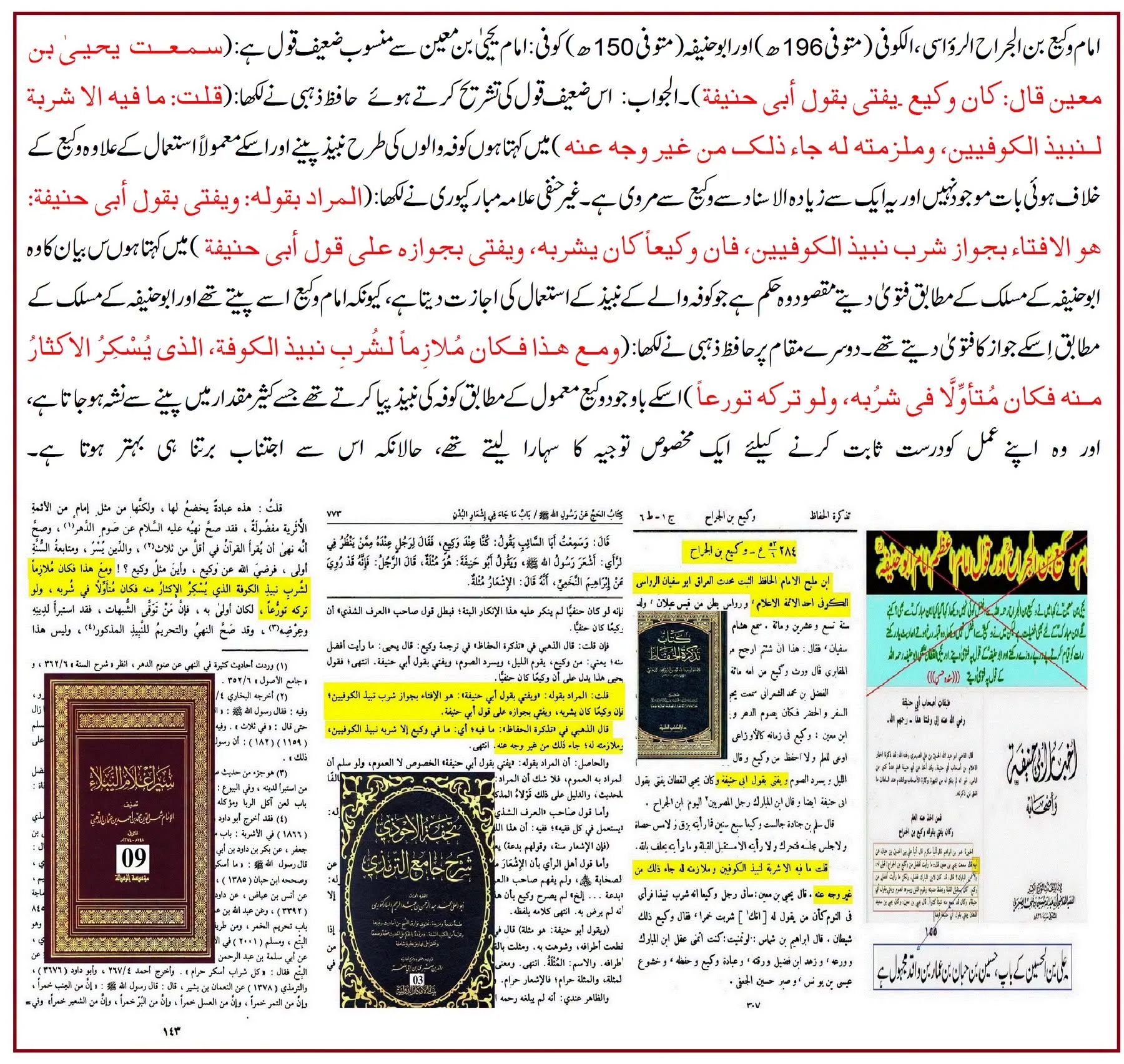
Hafiz Ibn Abdul Barr Al-Qurtubi, may Allah have mercy on him (died 463 AH), has narrated a statement from Imam Yahya bin Ma'in, may Allah have mercy on him, regarding Imam Waki‘:
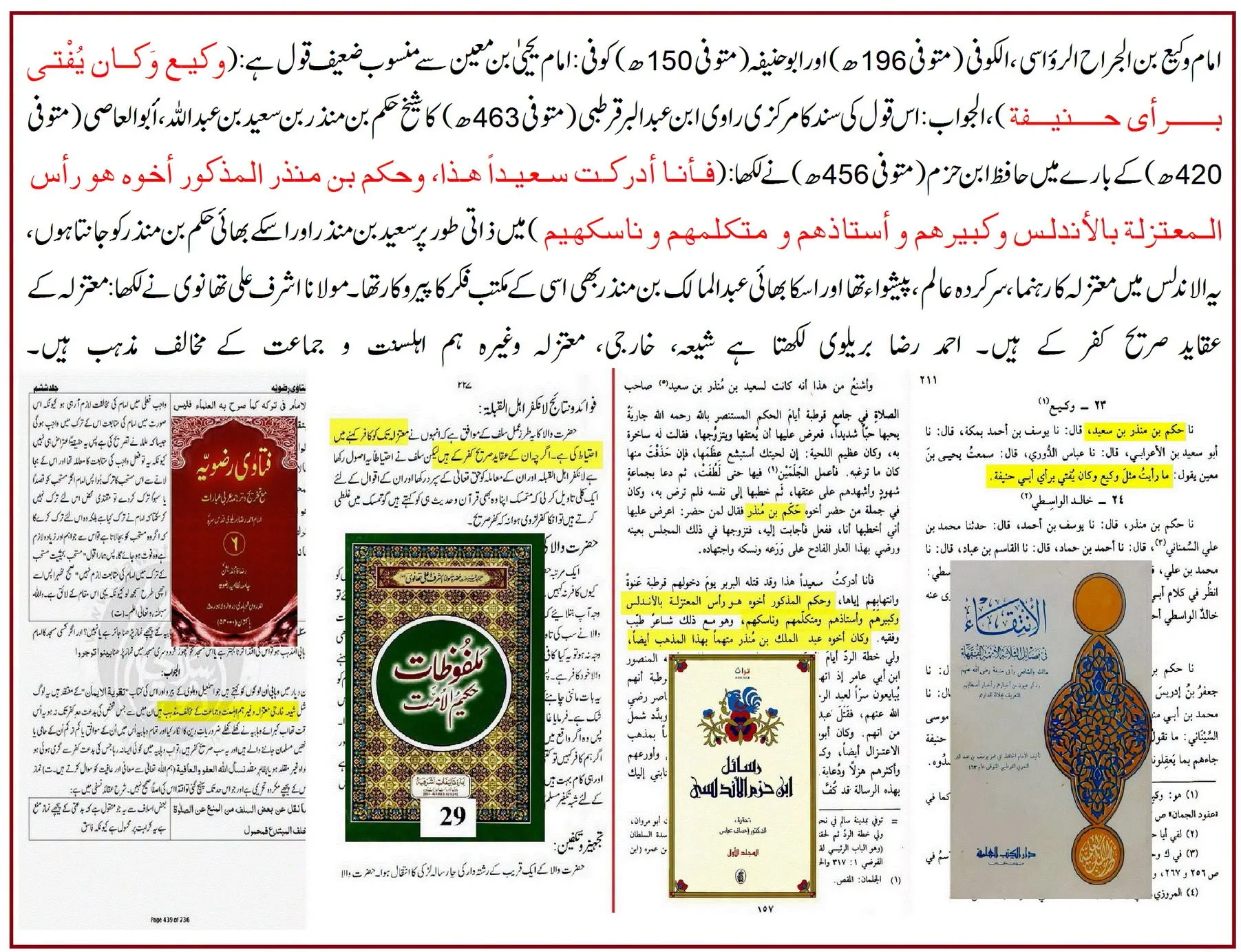
وَكِيعٌ … نَا حَكَمُ بْنُ مُنْذِرِ بْنِ سَعِيدٍ قَالَ نَا يُوسُفُ بْنُ أَحْمَدَ بِمَكَّةَ قَالَ نَا أَبُو سَعِيدِ بْنُ الأَعْرَابِيِّ قَالَ نَا عَبَّاسٌ الدُّورِيُّ قَالَ سَمِعْتُ يَحْيَى بْنَ مَعِينٍ يَقُولُ مَا رَأَيْتُ مِثْلَ وَكِيعٍ وَكَانَ يُفْتى برأى ابى حنيفَة
Translation:
Abbas Duri, may Allah have mercy on him, states that I heard Imam Yahya bin Ma'in, may Allah have mercy on him, say: I have not seen anyone like Waki‘, and he used to give fatwas according to the opinion of Abu Hanifa.
Reference: Al-Kitab: Al-Intiqa fi Fada'il al-Thalatha al-A'immah al-Fuqaha Malik, Al-Shafi'i, wa Abu Hanifa Radi Allahu Anhum
Reference: Author: Abu Umar Yusuf bin Abdullah bin Muhammad bin Abdul Barr Al-Qurtubi (died 463 AH)
Explanation:
This narration contains praise from Imam Yahya bin Ma'in, may Allah have mercy on him, regarding the scholarly status of Imam Waki‘ and attributes to him the practice of giving fatwas based on the opinion of Imam Abu Hanifa.
However, it is not necessary to conclude from this narration that Imam Waki‘ was a follower of Imam Abu Hanifa in every issue. Issuing a fatwa based on multiple statements of an Imam and adhering to all his ijtihads are two different matters.
② Statement of Hafiz Ibn Hazm regarding Hukm bin Mundhir
The name of Hukm bin Mundhir bin Saeed appears in one chain of narration of the mentioned hadith.
Hafiz Ibn Hazm al-Andalusi, may Allah have mercy on him (died 456 AH), wrote about Hukm bin Mundhir:
وكان في جملة من حضر أخوه حكم بن منذر …
فأنا أدركت سعيداً هذا …، وحكم المذكور أخوه هو رأس المعتزلة بالأندلس وكبيرهم وأستاذهم ومتكلمهم وناسكهم، وهو مع ذلك شاعر طيب وفقيه. وكان أخوه عبد الملك بن منذر متهماً بهذا المذهب أيضاً،
Translation:
Among those people was his brother Hukm bin Mundhir as well.
I have personally met this Saeed. His mentioned brother Hukm bin Mundhir was the leader of the Mu‘tazila in Andalusia, their great scholar, teacher, theologian, and worshipper. Along with that, he was also an excellent poet and jurist. His brother Abd al-Malik bin Mundhir was also accused of belonging to the same sect.
Reference: Al-Kitab: Rasa'il Ibn Hazm al-Andalusi
Reference: Author: Abu Muhammad Ali bin Ahmad bin Saeed bin Hazm al-Andalusi al-Qurtubi al-Zahiri (died 456 AH)
Explanation:
Hafiz Ibn Hazm, may Allah have mercy on him, has explicitly stated that Hukm bin Mundhir belonged to the Mu'tazili sect. However, a narrator's affiliation with the Mu'tazili or any other theological school by itself is not evidence that he is a liar or fabricator of hadith.
Therefore, the judgment on the narration of Hukm bin Mundhir should be based on his accuracy, truthfulness, continuity of the chain, and other principles of narration. It is not sufficient to declare a narration fabricated solely on the basis of sectarian affiliation.
③ Narration about Imam Waki' in Tarikh Baghdad
Hafiz Khateeb Baghdadi, may Allah have mercy on him (died 463 AH), also narrated from Imam Yahya bin Ma'in regarding Imam Waki':
أجاز لنا إبراهيم ابن مخلد، قَالَ: أَخْبَرَنَا مكرم بن أَحْمَد الْقَاضِي، ثم قَالَ: أَخْبَرَنَا الصيمري، قراءة قَالَ: أَخْبَرَنَا عُمَر بن إبراهيم المقرئ، قَالَ: حَدَّثَنَا مكرم، قَالَ: أَخْبَرَنَا علي بن الحسين بن حبان، عن أبيه، قال: سمعت يحيى بن معين، قال: …، ويفتي بقول أبي حنيفة،
Translation:
Ali bin Husain bin Hibban narrates from his father that he heard Imam Yahya bin Ma'in, may Allah have mercy on him, say about Imam Waki' that he used to issue fatwas according to the opinion of Imam Abu Hanifa.
Reference: Al-Kitab: Tarikh Baghdad
Reference: Author: Abu Bakr Ahmad bin Ali bin Thabit bin Ahmad bin Mahdi Al-Khateeb Al-Baghdadi (died 463 AH)
Explanation:
This narration is also attributed to Imam Yahya bin Ma'in, may Allah have mercy on him. However, the method of narration from Husayn bin Hibban and his son Ali bin Husayn in its chain is worthy of investigation.
The main question in this regard is: What was the scholarly status of Husayn bin Hibban, and how was the narration transmitted from him?
④ Introduction to Husayn bin Hibban and the narration through Wajada
Hafiz Khateeb Baghdadi, may Allah have mercy on him, writes about Husayn bin Hibban:
4040- الْحُسَيْن بن حبان بن عمار بن الحكم بن عمار بن واقد أَبُو عَلِيّ صاحب يَحْيَى بن معين كَانَ من أهل الفضل، والتقدم فِي العلم، وله عَنْ يَحْيَى كتاب غزير الفائدة.
روى ابنه عَلِيّ بن الْحُسَيْن ذلك الكتاب عَنْ أَبِيهِ وجادة.
والحسين بن حبان قديم الموت توفي فيما ذكر ابنه سنة اثنتين وثلاثين ومائتين بالعسيلة، وهو ذاهب إِلَى الحج، وذلك قبل وفاة يَحْيَى بن معين بسنة.
Translation:
Husayn bin Hibban bin Ammar, Abu Ali, was a student of Imam Yahya bin Ma'in. He was among those distinguished in virtue and knowledge. He possessed a very beneficial and knowledge-filled book related to Imam Yahya bin Ma'in.
His son Ali bin Husayn narrated this book from his father through the method of Wajada.
According to his son's statement, Husayn bin Hibban passed away in 232 AH while he was going for Hajj. This was one year before the death of Imam Yahya bin Ma'in.
Reference: Al-Kitab: Tarikh Baghdad
Reference: Author: Abu Bakr Ahmad ibn Ali ibn Thabit ibn Ahmad ibn Mahdi al-Khatib al-Baghdadi (died: 463 AH)
Reference: Translation Number: 4040
Explanation:
Two points in this statement deserve special attention.
First, that Al-Khatib Al-Baghdadi, may Allah have mercy on him, has distinguished Husayn ibn Hibban among the people of virtue and knowledge.
Second, that his son narrated his father's book according to the method of "Wajada," meaning he transmitted from a written manuscript.
This method is different from direct hearing (sama‘) and requires further investigation for the acceptance of the narration.
However, from this statement alone, a definitive judgment cannot be made that Husayn ibn Hibban is Majhool al-‘Ayn (unknown in identity) or that all his narrations are unreliable.
⑤ Principle of Hadith Scholars Regarding Majhool al-‘Ayn
Mulla Ali al-Qari Hanafi, may Allah have mercy on him (died 1014 AH), wrote regarding the narrator who is Majhool al-‘Ayn:
( [مَجْهُول الْعين] )
(فَإِن سمي الرَّاوِي) أَي وَوَثَّقَهُ،
(وانفراد راو وَاحِد بالرواية عَنهُ، فَهُوَ مَجْهُول [124 - ب] الْعين)
Translation:
If the name of a narrator is known, but only one person narrates from him, then he is called Majhool al-‘Ayn, provided that ignorance is not removed by reliable authentication.
Reference: Book: Sharh Nukhbat al-Fikr fi Mustalahat Ahl al-Athar
Reference: Author: Ali bin (Sultan) Muhammad, Abu al-Hasan Nur al-Din al-Mulla al-Harawi al-Qari (died: 1014 AH)
At the same place, the principle of Al-Khatib al-Baghdadi, may Allah have mercy on him, is also quoted:
قَالَ الْخَطِيب: وَأَقل مَا يرفع الْجَهَالَة أَن يروي [عَن الرجل] اثْنَان [فَصَاعِدا] من الْمَشْهُورين بِالْعلمِ.
Translation:
Al-Khatib al-Baghdadi, may Allah have mercy on him, says: To remove the ignorance of the narrator, at least two or more persons who are known for their knowledge should narrate from him.
Reference: Book: Sharh Nukhbat al-Fikr fi Mustalahat Ahl al-Athar
Reference: Author: Ali bin (Sultan) Muhammad, Abu al-Hasan Nur al-Din al-Mulla al-Harawi al-Qari (died: 1014 AH)
Explanation:
These statements explain the principle of identifying the unknown narrator and removing his ignorance.
However, to apply this ruling to a specific narrator, it is necessary to review all his students, reliable authentications, and the collective statements of the muhaddithin.
⑥ Being a Person of Virtue and the Difference in the Authenticity of Narration
Imam Abu Ja'far Tahawi, may Allah have mercy on him (died 321 AH), said about a narrator:
… وَهُوَ أَيْضًا وَإِنْ كَانَ مِنْ أَهْلِ الْفَضْلِ فَإِنَّ رِوَايَتَهُ لَيْسَتْ عِنْدَ أَهْلِ الْعِلْمِ بِالْأَسَانِيدِ الْقَوِيَّةِ ,
Translation:
Although he is among the people of virtue, according to the experts in the science of isnad, his narrations are not considered strong.
Reference: Book: Sharh Mushkil al-Athar
Reference: Author: Abu Ja'far Ahmad ibn Muhammad ibn Salamah ibn Abd al-Malik ibn Salamah al-Azdi al-Hijri al-Misri, known as al-Tahawi (died: 321 AH)
Explanation:
From Imam Tahawi's statement, a fundamental principle is understood that a narrator's virtue and his strength in narration are two distinct qualities.
Therefore, mentioning a narrator's piety or scholarly excellence is not necessarily proof of the authenticity of all his narrations; rather, hadith scholars also consider his memorization, precision, and method of narration.
Scholars' Clarifications Regarding Imam Waki's Narration About Imam Abu Hanifa Giving a Fatwa on a Statement
⑦ Statement of Hafiz Dhahabi, may Allah have mercy on him
Hafiz Shams al-Din Dhahabi, may Allah have mercy on him (died 748 AH), also narrated the mention of Imam Waki's circumstances regarding Imam Abu Hanifa giving a fatwa on a statement.
At the same place, while explaining another issue related to them, he said:
ويفتي بقول أبي حنيفة … قلت: ما فيه إلا شربه لنبيذ الكوفيين وملازمته له جاء ذلك من غير وجه عنه.
Translation:
And he used to give fatwas according to Abu Hanifa's statement.
I (Al-Dhahabi) say: Regarding them, apart from drinking Nabidh in Kufa and making its use customary, there is nothing objectionable found, and the act of drinking Nabidh is transmitted from them through multiple chains of narration.
Reference: Al-Kitab: Tadhkirat al-Huffaz
Reference: Author: Shams al-Din Abu Abdullah Muhammad ibn Ahmad ibn Uthman ibn Qaymaz al-Dhahabi (died 748 AH)
Explanation:
Hafiz Al-Dhahabi, may Allah have mercy on him, mentioned the use of Nabidh in relation to Imam Waki'. However, it is not correct to draw a definitive conclusion from this comment alone that all narrations about Imam Waki' issuing fatwas based on Imam Abu Hanifa's opinion were limited only to the issue of Nabidh.
Further evidence is required for this limitation.
⑧ Explanation by Hafiz Mubarakpuri, may Allah have mercy on him
Hafiz Muhammad Abdul Rahman Mubarakpuri, may Allah have mercy on him (died 1353 AH), wrote clarifying the aforementioned statement:
قُلْتُ الْمُرَادُ بِقَوْلِهِ وَيُفْتِي بِقَوْلِ أَبِي حَنِيفَةَ هُوَ الْإِفْتَاءُ بِجَوَازِ شُرْبِ نَبِيذِ الْكُوفِيِّينَ فَإِنَّ وَكِيعًا كَانَ يَشْرَبُهُ وَيُفْتِي بِجَوَازِهِ عَلَى قَوْلِ أَبِي حَنِيفَةَ
Translation:
I say: By the statement that Imam Waki' used to issue fatwas according to Abu Hanifa's opinion, the intended meaning is the fatwa permitting the drinking of Nabidh by the people of Kufa, because Imam Waki' used to drink it and issued a fatwa of its permissibility according to the opinion of Imam Abu Hanifa.
Reference: Book: Tuhfat al-Ahwadhi bi Sharh Jami' al-Tirmidhi
Reference: Author: Abu al-Ala Muhammad Abdul Rahman bin Abdul Rahim al-Mubarakpuri (died: 1353 AH)
Explanation:
Hafiz Mubarakpuri, may Allah have mercy on him, gave a specific interpretation of the mentioned attribution that it was related to the issue of Nabidh.
This is his scholarly explanation; however, it should not be considered definitive proof that Imam Waki' did not agree with Imam Abu Hanifa on any other issue.
Hafiz Dhahabi, may Allah have mercy on him, wrote elsewhere about Imam Waki':
وَمَعَ هَذَا فَكَانَ مُلاَزِماً لِشُرْبِ نَبِيذِ الكُوْفَةِ الَّذِي يُسكِرُ الإِكثَارُ مِنْهُ، فَكَانَ مُتَأَوِّلاً فِي شُرْبِهِ، وَلَوْ تَرَكَهُ تَوَرُّعاً، لَكَانَ أَوْلَى بِهِ
Translation:
Nevertheless, Imam Waki' was accustomed to drinking such Nabidh in Kufa, the large quantity of which would cause intoxication. He had a jurisprudential interpretation regarding its use, but it would have been better for him to avoid it out of caution.
Reference: Book: Siyar A'lam al-Nubala
Reference: Author: Shams al-Din Abu Abdullah Muhammad bin Ahmad bin Uthman bin Qaymaz al-Dhahabi (died: 748 AH)
Explanation:
Hafiz Zahbi, may Allah have mercy on him, acknowledged the scholarly status of Imam Waki' while also critiquing this action of his. This is an example of the well-known methodology of the Muhaddithin that while recognizing the knowledge and virtue of a great Imam, one can also academically critique his ijtihadi errors.
Jurisprudential and Creed Differences Between Imam Waki' ibn al-Jarrah and Imam Abu Hanifa
The following narrations make it clear that Imam Waki', may Allah have mercy on him, held independent opinions on several issues, and in some instances, his views differed from those of Imam Abu Hanifa or the well-known Hanafi position.
① The Issue of the Increase and Decrease of Faith
Imam Waki' ibn al-Jarrah, may Allah have mercy on him, said regarding faith:
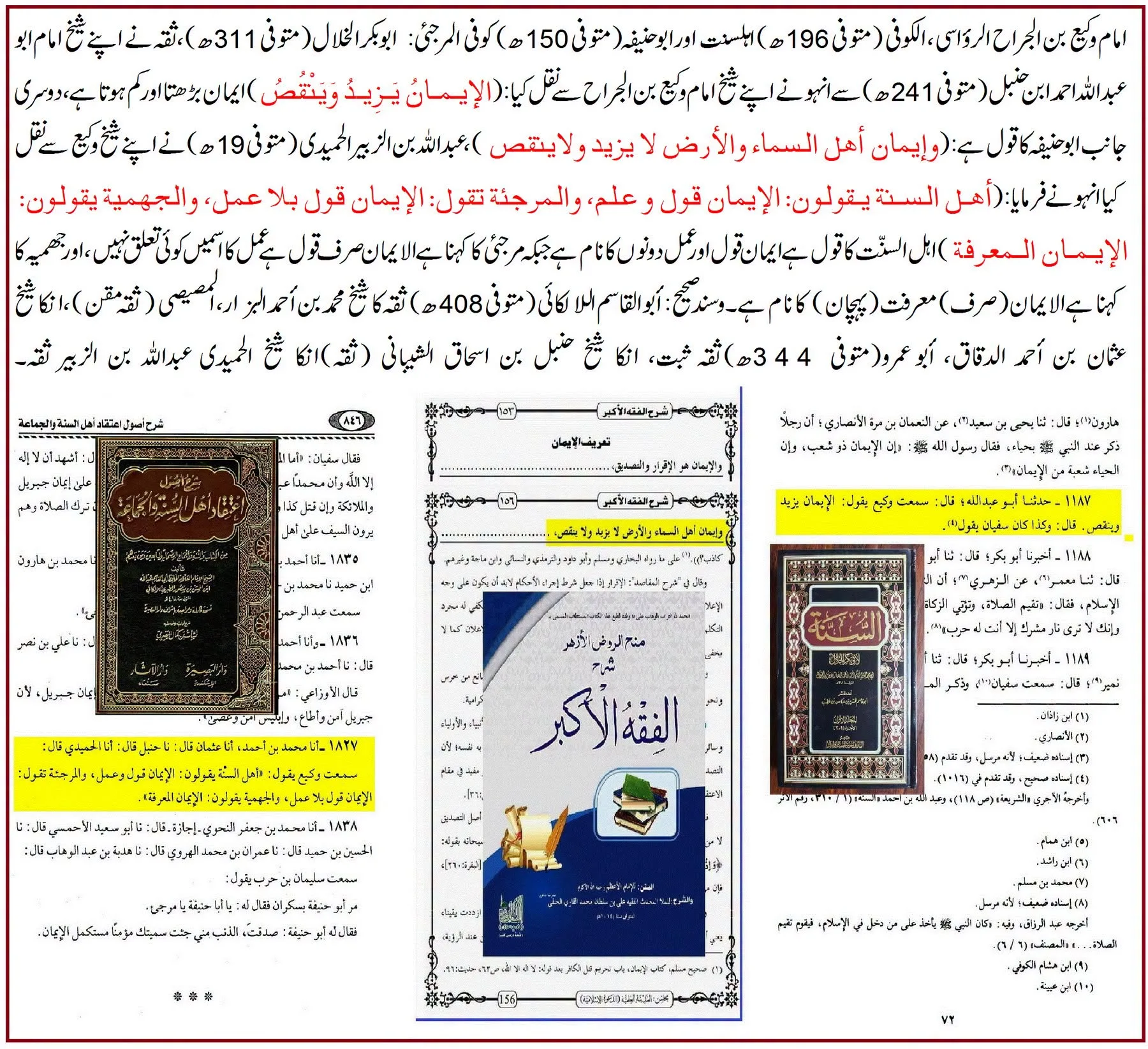
1187 - حَدَّثَنَا أَبُو عَبْدِ اللَّهِ، قَالَ: سَمِعْتُ وَكِيعًا، يَقُولُ: «الْإِيمَانُ يَزِيدُ وَيَنْقُصُ. قَالَ: وَكَذَا كَانَ سُفْيَانُ يَقُولُ»
Translation:
Imam Waki', may Allah have mercy on him, says: Faith increases and decreases, and Imam Sufyan al-Thawri, may Allah have mercy on him, also used to say the same.
Reference: Al-Kitab: Al-Sunnah
Reference: Author: Abu Bakr Ahmad ibn Muhammad ibn Harun ibn Yazid al-Khallal al-Baghdadi al-Hanbali (died: 311 AH)
Reference: Narration Number: 1187
On the other hand, in the book attributed to Imam Abu Hanifa, may Allah have mercy on him, "Al-Fiqh al-Akbar," it is written:
تَعْرِيف الْإِيمَان
وَالْإِيمَان هُوَ الْإِقْرَار والتصديق وإيمان أهل السَّمَاء وَالْأَرْض لَا يزِيد وَلَا ينقص
Translation:
Faith is the name of declaration and affirmation, and the faith of the inhabitants of the heavens and the earth neither increases nor decreases.
Reference: Al-Kitab: Al-Fiqh Al-Akbar
Reference: Author: Attributed to Abu Hanifa An-Nu'man ibn Thabit (died: 150 AH)
Reference: Printed with the simplified explanation on the two fiqhs, Al-Absimplest and Al-Akbar, attributed to Abu Hanifa, authored by Muhammad ibn Abdul Rahman Al-Khamis
Explanation:
There is a clear verbal difference regarding the increase and decrease of faith in these two statements. Imam Waki' (may Allah have mercy on him) explicitly stated the increase and decrease in faith, whereas the attributed book "Al-Fiqh Al-Akbar" denies it.
However, it is also necessary to consider the attribution of this book and the terminological differences of various schools in the definition of faith.
Another statement of Imam Waki' (may Allah have mercy on him) in this regard is also very important.
Imam Lalakai (may Allah have mercy on him) narrated:
1837 - أنا مُحَمَّدُ بْنُ أَحْمَدَ، أنا عُثْمَانُ، قَالَ: نا حَنْبَلٌ، قَالَ: نا الْحُمَيْدِيُّ، قَالَ: سَمِعْتُ وَكِيعًا، يَقُولُ: «أَهْلُ السُّنَّةِ يَقُولُونَ: الْإِيمَانُ قَوْلٌ وَعَمَلٌ، وَالْمُرْجِئَةُ تَقُولُ: الْإِيمَانُ قَوْلٌ بِلَا عَمَلٍ، وَالْجَهْمِيَّةُ يَقُولُونَ: الْإِيمَانُ الْمَعْرِفَةُ»
Translation:
Imam Waki' (may Allah have mercy on him) says: The Ahl al-Sunnah say that faith is the name of both speech and action, while the Murji'ah say that faith is only the name of speech, and action is not part of it. And the Jahmiyyah say that faith is only the name of knowledge, that is, recognition.
Reference: Al-Kitab: Sharh Usool I'tiqad Ahl as-Sunnah wal-Jama'ah
Reference: Author: Abu al-Qasim Hibatullah ibn al-Hasan ibn Mansur al-Tabari al-Razi al-Lalkai (died: 418 AH)
Reference: Hadith Number: 1837
Explanation:
The statement of Imam Waki' may Allah have mercy on him clarifies his methodology regarding the belief of faith. According to him, faith is not merely verbal acknowledgment or inner knowledge, but both speech and action are included in it.
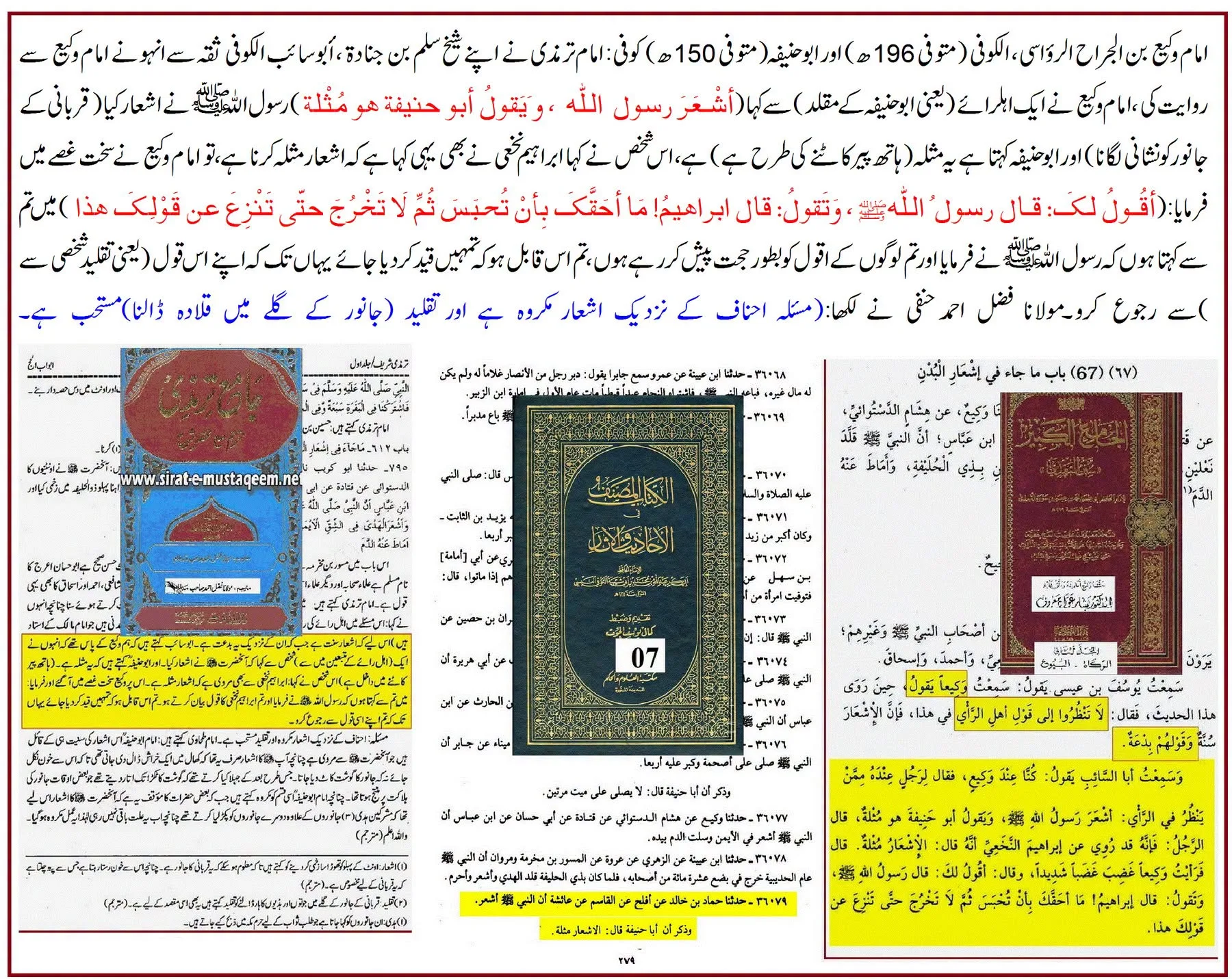
② The Issue of Marking the Sacrificial Animal
Marking refers to identifying the sacrificial animal for Hajj, especially camels, in a specific way so that it is known that this animal is designated for sacrifice.
Imam Waki' ibn al-Jarrah may Allah have mercy on him said regarding marking:
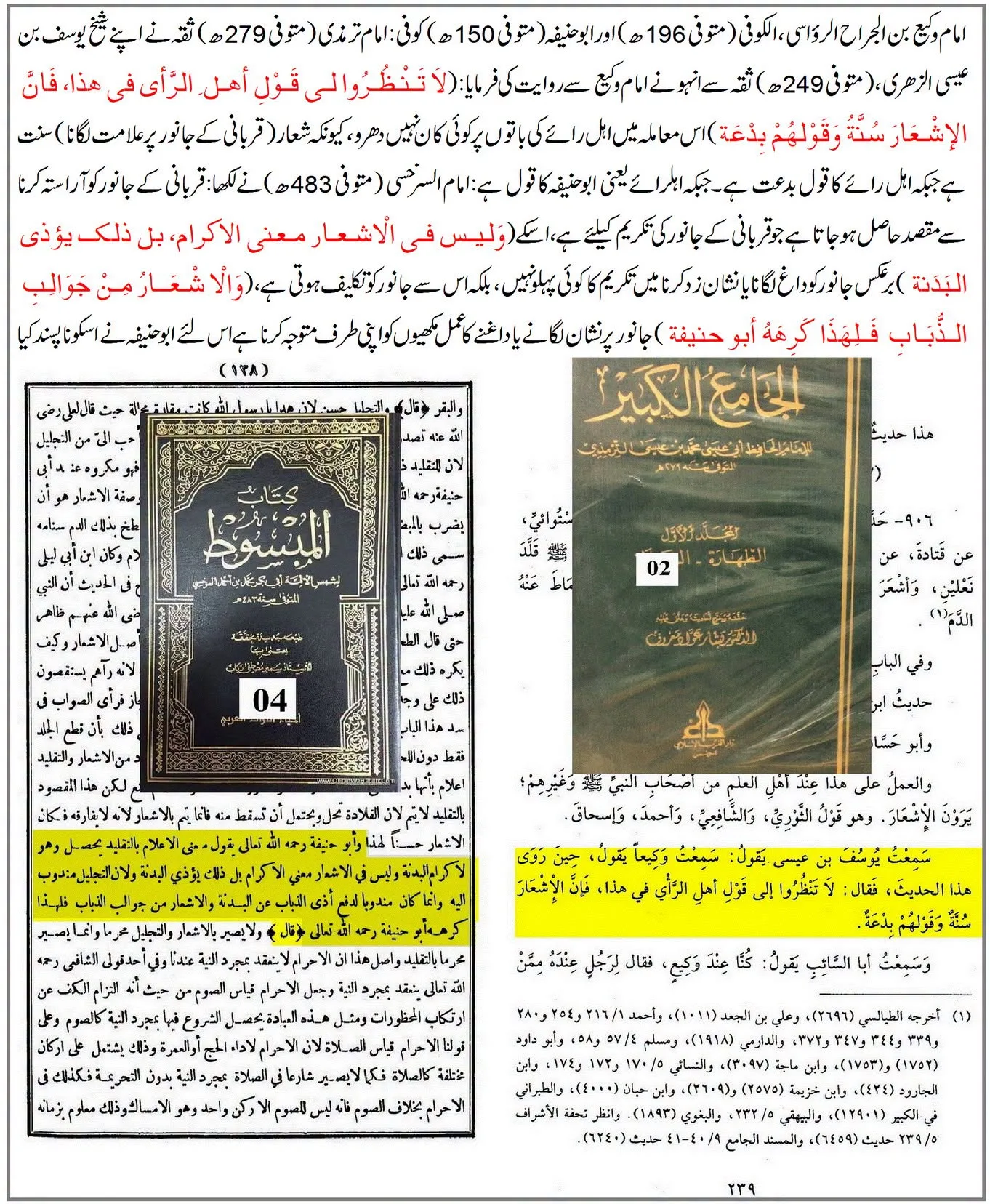
سَمِعْتُ يُوسُفَ بْنَ عِيسَى يَقُولُ: سَمِعْتُ وَكِيعًا يَقُولُ حِينَ رَوَى هَذَا الحَدِيثَ، فَقَالَ: «لَا تَنْظُرُوا إِلَى قَوْلِ أَهْلِ الرَّأْيِ فِي هَذَا، فَإِنَّ الإِشْعَارَ سُنَّةٌ، وَقَوْلُهُمْ بِدْعَةٌ»
Translation:
Yusuf ibn Isa may Allah have mercy on him narrates that he heard Imam Waki' may Allah have mercy on him say while narrating this hadith: Do not pay attention to the opinion of the people of reasoning in this matter, because marking is Sunnah and their opinion against it is an innovation.
Reference: Book: Sunan al-Tirmidhi
Reference: Author: Muhammad ibn Isa ibn Sawrah ibn Musa ibn al-Dhahak al-Tirmidhi, Abu Isa (died: 279 AH)
Reference: Hadith Number: 906
On the other hand, Imam Sarkhasi Hanafi, may Allah have mercy on him (died 483 AH), while stating the position of Imam Abu Hanifa, wrote:
وَأَبُو حَنِيفَةَ - رَحِمَهُ اللَّهُ تَعَالَى - يَقُولُ مَعْنَى الْإِعْلَامِ بِالتَّقْلِيدِ يَحْصُلُ وَهُوَ لِإِكْرَامِ الْبَدَنَةِ، وَلَيْسَ فِي الْإِشْعَارِ مَعْنَى الْإِكْرَامِ بَلْ ذَلِكَ يُؤْذِي الْبَدَنَةَ، وَلِأَنَّ التَّجْلِيلَ مَنْدُوبٌ إلَيْهِ، وَإِنَّمَا كَانَ مَنْدُوبًا لِدَفْعِ أَذَى الذُّبَابِ عَنْ الْبَدَنَةِ،
وَالْإِشْعَارُ مِنْ جَوَالِبِ الذُّبَابِ فَلِهَذَا كَرِهَهُ أَبُو حَنِيفَةَ - رَحِمَهُ اللَّهُ تَعَالَى -
Translation:
Imam Abu Hanifa, may Allah have mercy on him, says that putting a collar on the sacrificial animal achieves the purpose of marking it, and it also honors the animal. Whereas the poems have no aspect of honoring; rather, they cause discomfort to the animal.
Similarly, it is recommended to cover the animal with cloth because it prevents flies and others from troubling it, whereas the poems attract flies towards it. For this reason, Imam Abu Hanifa, may Allah have mercy on him, declared the poems to be disliked.
Reference: Al-Kitab: Al-Mabsut
Reference: Author: Muhammad ibn Ahmad ibn Abi Sahl Shams al-A’immah al-Sarkhasi (died 483 AH)
Explanation:
This is a clear jurisprudential difference between Imam Waki’ and Imam Abu Hanifa, may Allah have mercy on them both.
Imam Waki’ considers the poems to be Sunnah, whereas the dislike of them is transmitted from Imam Abu Hanifa.
In this disagreement, the angle of argument of both gentlemen is different, but it is clear from the words of Imam Waki' that he considered the established hadith as the fundamental proof in this matter.
③ The issue of a single worshipper praying behind the row
It is narrated from Imam Waki' bin Al-Jarrah, may Allah have mercy on him:
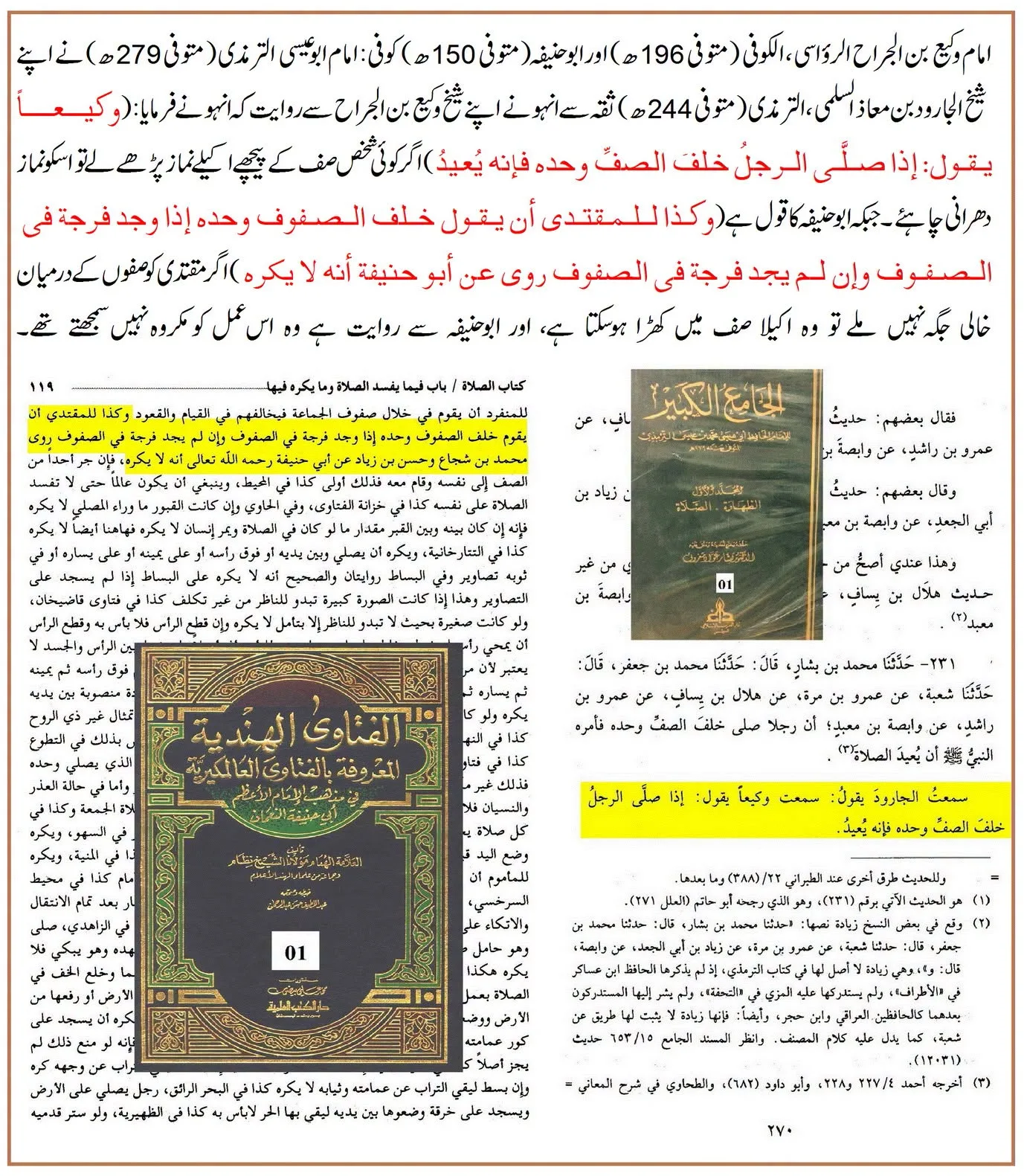
سَمِعْت الجَارُودَ يَقُولُ: سَمِعْتُ وَكِيعًا، يَقُولُ: «إِذَا صَلَّى الرَّجُلُ خَلْفَ الصَّفِّ وَحْدَهُ فَإِنَّهُ يُعِيدُ»
Translation:
Jarood, may Allah have mercy on him, states that he heard Imam Waki', may Allah have mercy on him, say: If a person prays alone behind the row, he must repeat the prayer.
Reference: Book: Sunan At-Tirmidhi
Reference: Author: Muhammad ibn Isa ibn Sawrah ibn Musa ibn Ad-Dahhak At-Tirmidhi, Abu Isa (died: 279 AH)
On the other hand, in the famous Hanafi fiqh book "Al-Fatawa Al-Hindiyya" it is stated:
وَكَذَا لِلْمُقْتَدِي أَنْ يَقُومَ خَلْفَ الصُّفُوفِ وَحْدَهُ إذَا وَجَدَ فُرْجَةً فِي الصُّفُوفِ وَإِنْ لَمْ يَجِدْ فُرْجَةً فِي الصُّفُوفِ رَوَى مُحَمَّدُ بْنُ شُجَاعٍ وَحَسَنُ بْنُ زِيَادٍ عَنْ أَبِي حَنِيفَةَ - رَحِمَهُ اللَّهُ تَعَالَى - أَنَّهُ لَا يُكْرَهُ
Translation:
The case of a follower standing alone behind the rows is also under discussion. If there is space in the rows, it has a separate ruling, but when there is no empty space in the row, Muhammad bin Shuja' and Hasan bin Ziyad have narrated from Imam Abu Hanifa, may Allah have mercy on him, that in such a case standing alone is not disliked.
Reference: Book: Al-Fatawa Al-Hindiyya
Reference: Author: Committee of Scholars headed by Nizamuddin Al-Balkhi
Explanation:
From Imam Waki' رحمه الله, a narration is transmitted regarding repeating the prayer when praying alone at the back of the row, while in Hanafi jurisprudence, there is detailed discussion on this issue depending on various situations and whether there is space in the row or not.
This shows a difference in the jurisprudential ruling between the two.
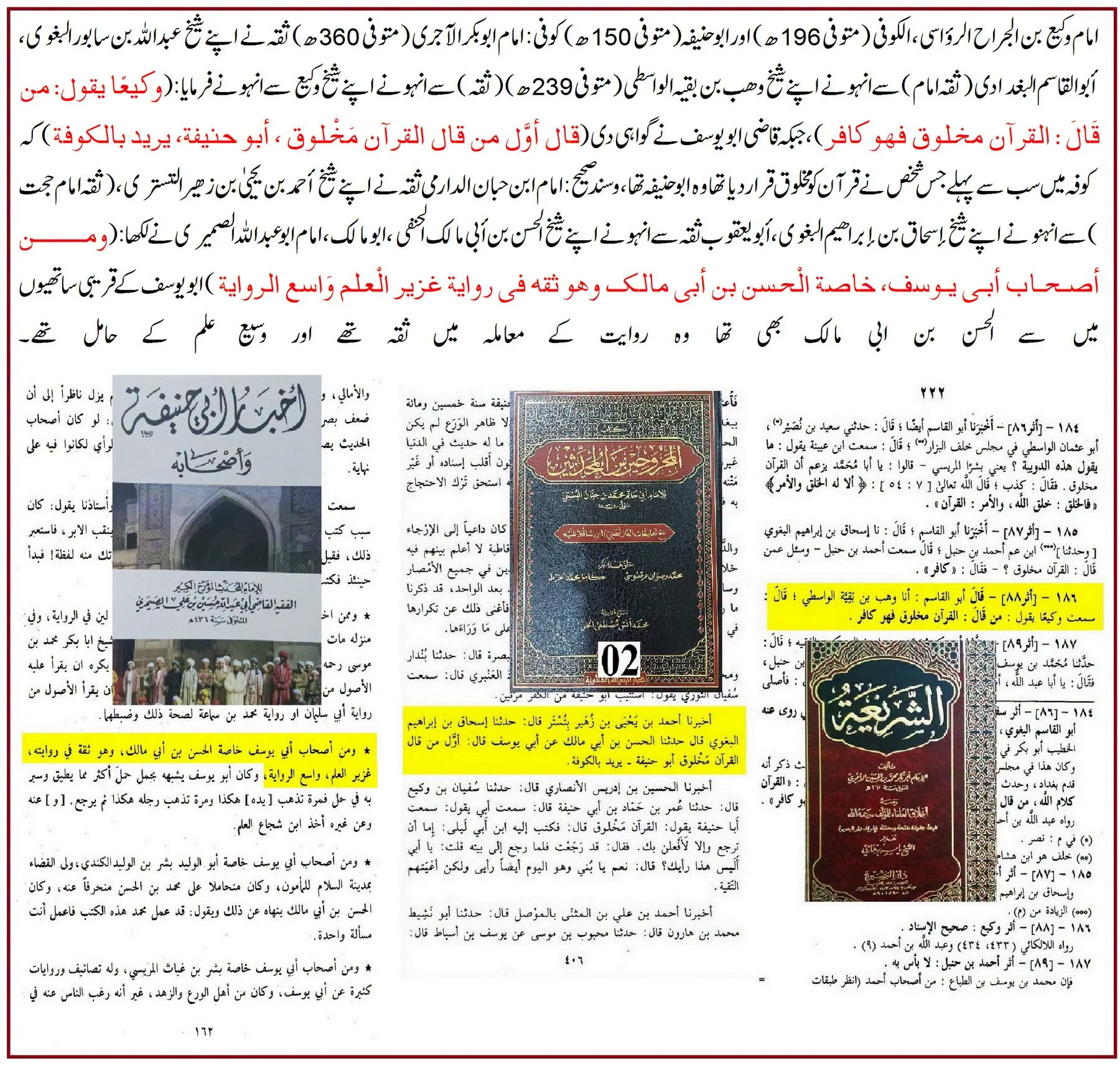
④ The Issue of the Quran Being the Word of Allah
A strong denial of the belief in the createdness of the Quran is transmitted from Imam Waki' bin al-Jarrah رحمه الله.
Imam Ajri رحمه الله narrated:
قَالَ أَبُو الْقَاسِمِ: أنا وَهْبُ بْنُ بَقِيَّةَ الْوَاسِطِيُّ قَالَ: سَمِعْتُ وَكِيعًا يَقُولُ: مَنْ قَالَ: الْقُرْآنُ مَخْلُوقٌ فَهُوَ كَافِرٌ
Translation:
Wahb bin Baqiyah Al-Wasiti رحمه الله states that I heard Imam Waki' رحمه الله say: Whoever says that the Quran is created, he is a disbeliever.
Reference: Al-Kitab: Ash-Shari'ah
Reference: Author: Abu Bakr Muhammad bin Al-Husayn bin Abdullah Al-Ajri Al-Baghdadi (d. 360 AH)
Explanation:
From this narration, Imam Waki' رحمه الله's strict stance regarding the belief in the createdness of the Quran becomes clear. This is his transmitted doctrinal ruling, not a permanent judicial or legal decision about a specific person.
On the other hand, there is a different attribution in a narration regarding Imam Abu Hanifah رحمه الله.
Imam Ibn Hibban, may Allah have mercy on him (died 354 AH), narrated:
أَخْبَرَنَا أَحْمَدُ بْنُ يَحْيَى بْنِ زُهَيْرٍ بِتُسْتَرَ قَالَ حَدَّثَنَا إِسْحَاقُ بْنُ إِبْرَاهِيمَ الْبَغَوِيّ
قَالَ حَدَّثَنَا الْحَسَنُ بْنُ أَبِي مَالِكٍ عَنْ أَبِي يُوسُفَ قَالَ أَوَّلُ مَنْ قَالَ الْقُرْآنُ مَخْلُوقٌ أَبُو حَنِيفَةَ يُرِيدُ بِالْكُوفَةِ
Translation:
Hasan bin Abi Malik narrates from Qadi Abu Yusuf, may Allah have mercy on him, that he said: The first person in Kufa to call the Quran created was Abu Hanifa.
Reference: Book: Al-Kitab: Al-Majruhin min Al-Muhaddithin wal-Du'afaa wal-Matrukin
Reference: Author: Muhammad bin Hibban bin Ahmad bin Hibban bin Mu'adh bin Ma'bad Al-Tamimi Al-Busti (died 354 AH)
Explanation:
This attribution is present in Imam Ibn Hibban's book, but attributing the belief of the createdness of the Quran to Imam Abu Hanifa, may Allah have mercy on him, is a matter of scholarly disagreement and research.
On the contrary, it is narrated from Imam Abdullah bin Mubarak, may Allah have mercy on him:
والله ما مات أبو حنيفة وهو يقول بخلق القرآن ولا يدين الله به
Translation:
By Allah! Abu Hanifa did not die in a state that he called the Quran created or considered this belief as his religion.
Reference: Book: Sharh Usool I'tiqad Ahl al-Sunnah wal-Jama'ah
Reference: Author: Abu al-Qasim Hibatullah bin al-Hasan bin Mansur al-Tabari al-Razi al-Lalkai (died 418 AH)
Similarly, another statement from Imam Abdullah bin Mubarak, may Allah have mercy on him, is also narrated:
ذكر جهم في مجلس أبي حنيفة فقال ما يقول قالوا يقول القرآن مخلوق فقال كبرت كلمة تخرج من أفواههم إن يقولون إلا كذبا
Reference: (Al-Kahf: 5)
Translation:
When the topic of Jahm came up in the gathering of Imam Abu Hanifa, may Allah have mercy on him, he asked: What does he say? People informed him that he calls the Quran created. Upon this, Imam Abu Hanifa, may Allah have mercy on him, said: How great a statement is this that comes from their mouths; they are uttering complete falsehood.
Reference: Al-Kitab: Sharh Usool I'tiqad Ahl al-Sunnah wal-Jama'ah
Reference: Author: Abu al-Qasim Hibatullah ibn al-Hasan ibn Mansur al-Tabari al-Razi al-Lalkai (died 418 AH)
Explanation:
From these conflicting historical narrations, it becomes clear that a thorough isnad (chain of transmission) investigation is necessary regarding the attribution of the belief in the createdness of the Quran to Imam Abu Hanifa, may Allah have mercy on him.
Therefore, Imam Waki', may Allah have mercy on him, denying the createdness of the Quran by itself cannot be taken as conclusive proof of an established doctrinal disagreement with Imam Abu Hanifa, until the authenticity of the statement attributed to Imam Abu Hanifa is confirmed.
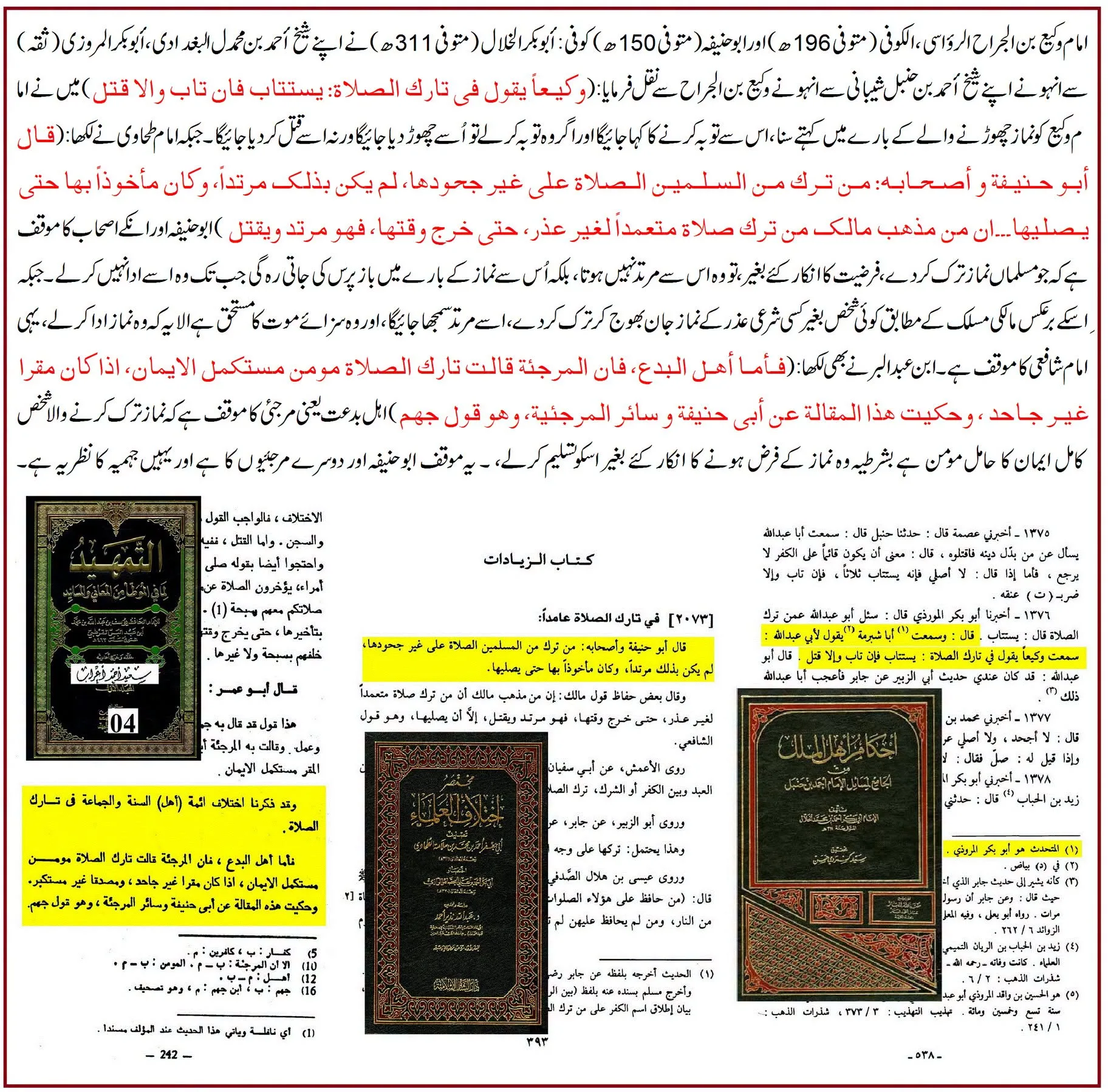
⑤ Disagreement Regarding the Ruling on One Who Abandons Prayer
A strict jurisprudential opinion regarding one who abandons prayer has been transmitted from Imam Waki' ibn al-Jarrah, may Allah have mercy on him.
Imam Khilal, may Allah have mercy on him, narrated:
1383 - أَخْبَرَنَا أبو بكر المروذي، قَالَ: سئل أبو عبد الله عمن ترك الصلاة؟ قَالَ: يستتاب.
قَالَ: وسمعت أبا شبرمة يقول لأبي عبد الله: سمعت وكيعا يقول فِي تارك الصلاة: يستتاب؛ فإن تاب، وإلا قتل.
Translation:
Abu Bakr Marwazi, may Allah have mercy on him, narrates that when Imam Ahmad ibn Hanbal, may Allah have mercy on him, was asked about one who abandons prayer, he said: He should be asked to repent.
Then it was narrated that Imam Waki', may Allah have mercy on him, said regarding one who abandons prayer: He should be asked to repent; if he repents, it is better, otherwise he should be killed.
Reference: Al-Kitab: Ahkam Ahl al-Milal wa al-Ridda min al-Jami' li-Masa'il al-Imam Ahmad ibn Hanbal
Reference: Author: Abu Bakr Ahmad ibn Muhammad ibn Harun ibn Yazid al-Khallal al-Baghdadi al-Hanbali (died 311 AH)
Reference: Hadith Number: 1383
Explanation:
This is a historical jurisprudential position attributed to Imam Waki', may Allah have mercy on him. Such jurisprudential rulings are discussed in the context of state judicial authority in jurisprudential books and cannot be understood as permission to enforce punishment on an individual.
On the other hand, the position of Imam Abu Hanifa, may Allah have mercy on him, has been narrated by Imam Tahawi, may Allah have mercy on him, as follows:
2073 - فِي تَارِك الصَّلَاة عَامِدًا
قَالَ أَبُو حنيفَة وَأَصْحَابه من ترك من الْمُسلمين الصَّلَاة على غير جحودها لم يكن بذلك مُرْتَدا وَكَانَ مأخوذا بهَا حَتَّى يُصليهَا
وَقَالَ بعض حفاظ قَول مَالك إِن من مَذْهَب مَالك أَن من ترك صَلَاة مُتَعَمدا لغير عذر حَتَّى خرج وَقتهَا فَهُوَ مُرْتَد وَيقتل إِلَّا أَن يُصليهَا وَهُوَ قَول الشَّافِعِي
Translation:
According to Imam Abu Hanifa, may Allah have mercy on him, and his companions, if a Muslim does not deny the obligation of prayer but abandons it, he does not become an apostate merely by this act; however, he will be obligated to perform the prayer.
Some Hafiz scholars have narrated the position of Imam Malik, may Allah have mercy on him, that a person who deliberately abandons prayer without excuse until its time passes will be considered an apostate, and a strict Shariah ruling will be imposed on him until he performs the prayer. A similar jurisprudential ruling has also been narrated from Imam Shafi'i, may Allah have mercy on him.
Reference: Al-Kitab: Mukhtasar Ikhtilaf al-Ulama
Reference: Author: Abu Ja'far Ahmad ibn Muhammad ibn Salamah ibn Abd al-Malik ibn Salamah al-Azdi al-Hijri al-Misri known as al-Tahawi (died: 321 AH)
Reference: Issue Number: 2073
Explanation:
In this issue, a difference in jurisprudential rulings appears between Imam Waki' and Imam Abu Hanifa, may Allah have mercy on them.
However, it is also necessary to understand the mutual differences between the killing of a person who abandons prayer, apostasy, and discretionary punishment. A jurist's advocacy for a severe punishment on a person who abandons prayer does not necessarily prove that he considers him a disbeliever in every case.
Hafiz Ibn Abdul Barr, may Allah have mercy on him, mentioned a statement of the Murji'ah in this chapter and wrote:
أَئِمَّةِ (أَهْلِ) السُّنَّةِ وَالْجَمَاعَةِ فِي تَارِكِ الصَّلَاةِ فَأَمَّا أَهْلُ الْبِدَعِ فَإِنَّ الْمُرْجِئَةَ قَالَتْ تارك الصلاة مؤمن مُسْتَكْمِلُ الْإِيمَانِ إِذَا كَانَ مُقِرًّا غَيْرَ جَاحِدٍ وَمُصَدِّقًا غَيْرَ مُسْتَكْبِرٍ وَحُكِيَتْ هَذِهِ الْمَقَالَةُ عَنْ أَبِي حَنِيفَةَ وَسَائِرِ الْمُرْجِئَةِ وَهُوَ قَوْلُ جَهْمٍ
Translation:
Among the innovators, the Murji'ah say that a person who abandons prayer is a believer with complete faith, provided that he acknowledges the obligation of prayer, does not deny it, affirms it, and does not reject it out of arrogance.
This statement has also been attributed to Imam Abu Hanifa and other Murji'ah, and the same statement has been transmitted from Jahm as well.
Reference: Al-Kitab: At-Tamhid Lima Fi Al-Muwatta Min Al-Ma'ani Wal-Asanid
Reference: Author: Abu Umar Yusuf bin Abdullah bin Muhammad bin Abdul Barr Al-Qurtubi (died: 463 AH)
Clarification:
The words of Hafiz Ibn Abdul Barr, may Allah have mercy on him, «وَحُكِيَتْ هَذِهِ الْمَقَالَةُ» are noteworthy, meaning that this statement has been attributed or narrated.
Therefore, it is not correct to categorically attribute every kind of Murji'i interpretation to Imam Abu Hanifa, may Allah have mercy on him, based solely on this statement without investigation.
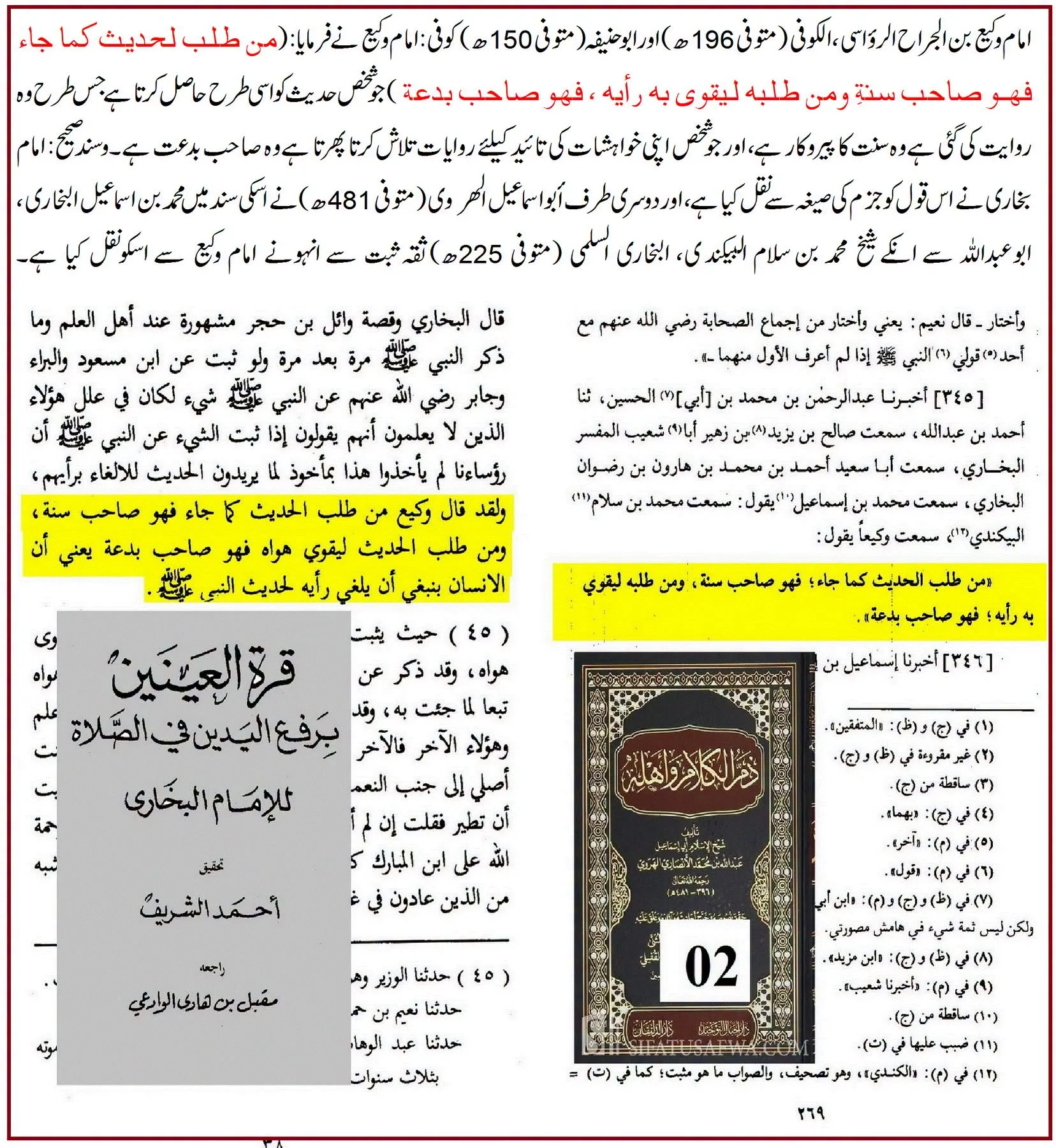
⑥ Prohibition of Subjecting Hadith to Personal Opinion
Imam Waki' bin Al-Jarrah, may Allah have mercy on him, stated a very important principle regarding hadith:
سَمِعْتُ مُحَمَّدَ بْنَ إِسْمَاعِيلَ يَقُولُ سَمِعْتُ مُحَمَّدَ بْنَ سَلَّامٍ الْبَيَكِنْدِيَّ سَمِعْتُ وَكِيعًا يَقُولُ مَنْ طَلَبَ الْحَدِيثَ كَمَا جَاءَ فَهُوَ صَاحِبُ سُنَّةٍ وَمَنْ طَلَبَهُ لِيُقَوِّيَ بِهِ رَأْيَهُ فَهُوَ صَاحِبُ بِدْعَةٍ
Translation:
Imam Waki', may Allah have mercy on him, says: The person who acquires hadith exactly as it has been transmitted is a follower of the Sunnah, and the person who seeks hadith only to strengthen his own opinion is an innovator.
Reference: Al-Kitab: Dhamm al-Kalam wa Ahluhu
Reference: Author: Abu Ismail Abdullah bin Muhammad bin Ali Al-Ansari Al-Harawi (died 481 AH)
Explanation:
In this statement of Imam Waki', may Allah have mercy on him, his fundamental approach to the science of hadith becomes apparent.
According to him, hadith should be considered the primary evidence rather than being used merely to support a pre-established opinion.
However, this statement is of a fundamental nature and is not a refutation of any particular jurist; its teaching holds equal importance for all scholars.
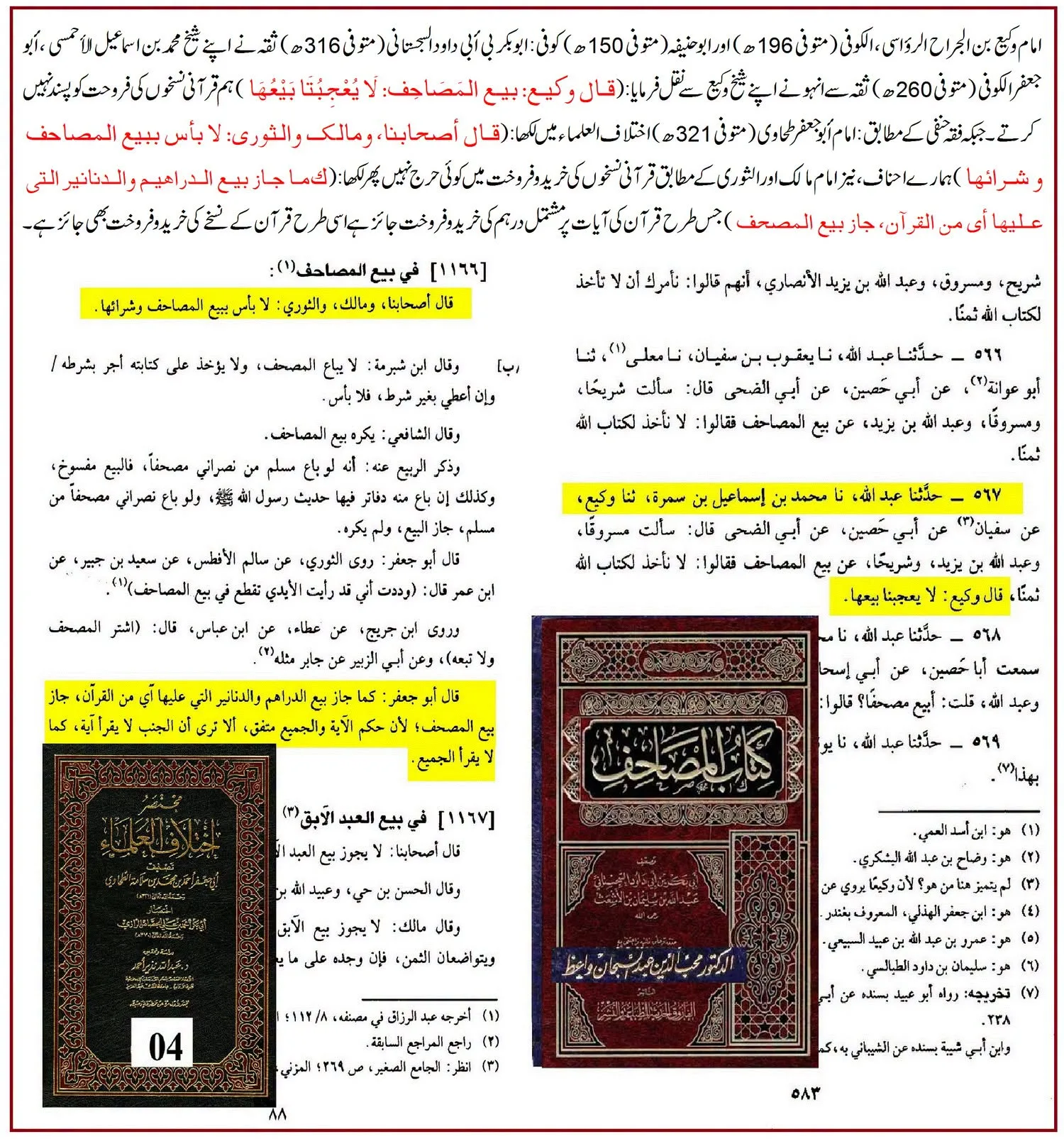
⑦ The Issue of Buying and Selling Copies of the Holy Quran
A jurisprudential statement regarding the buying and selling of Mushafs has also been narrated from Imam Waki' (may Allah have mercy on him).
Imam Ibn Abi Dawood (may Allah have mercy on him) narrated:
حَدَّثَنَا مُحَمَّدُ بْنُ إِسْمَاعِيلَ بْنِ سَمُرَةَ، حَدَّثَنَا وَكِيعٌ، عَنْ سُفْيَانَ، عَنْ أَبِي حَصِينٍ، عَنْ أَبِي الضُّحَى قَالَ: سَأَلْتُ مَسْرُوقًا، وَعَبْدَ اللَّهِ بْنَ زَيْدٍ وَشُرَيْحًا عَنْ بَيْعِ الْمَصَاحِفِ، فَقَالُوا: «لَا نَأْخُذُ لِكِتَابِ اللَّهِ تَعَالَى ثَمَنًا» قَالَ وَكِيعٌ: «لَا يُعْجِبُنَا بَيْعُهَا»
Translation:
Abu adh-Dhahha (may Allah have mercy on him) states: I asked Masruq, Abdullah bin Zaid, and Shuraih (may Allah have mercy on them) about the buying and selling of copies of the Holy Quran, and they said: We do not take a price for the Book of Allah.
Imam Waki' (may Allah have mercy on him) said: We do not approve of their buying and selling.
Reference: Al-Kitab: Kitab al-Musahif
Reference: Author: Abu Bakr ibn Abi Dawood, Abdullah ibn Sulaiman ibn al-Ash'ath al-Azdi al-Sijistani (died 316 AH)
On the other hand, Imam Tahawi Hanafi (may Allah have mercy on him) wrote:
1166 - فِي بيع الْمَصَاحِف
قَالَ أَصْحَابنَا وَمَالك وَالثَّوْري لَا بَأْس بِبيع الْمَصَاحِف وشرائها
Translation:
According to our companions, Imam Malik, and Imam Sufyan ath-Thawri (may Allah have mercy on them), there is no harm in buying and selling copies of the Holy Quran.
Reference: Al-Kitab: Mukhtasar Ikhtilaf al-Ulama
Reference: Author: Abu Ja'far Ahmad ibn Muhammad ibn Salamah ibn Abd al-Malik ibn Salamah al-Azdi al-Hijri al-Misri, known as at-Tahawi (died 321 AH)
Reference: Issue Number: 1166
Imam Tahawi (may Allah have mercy on him) further states:
قَالَ أَبُو جَعْفَر كَمَا جَازَ بيع الدَّرَاهِم وَالدَّنَانِير الَّتِي عَلَيْهَا آي من الْقُرْآن جَازَ بيع الْمُصحف لِأَن حكم الْآيَة والجميع مُتَّفق أَلا ترى أَن الْجنب لَا يقْرَأ آيَة كَمَا لَا يقْرَأ الْجَمِيع
Translation:
Imam Abu Ja'far Tahawi, may Allah have mercy on him, says: Just as the buying and selling of dirhams and dinars on which a verse of the Quran is written is permissible, similarly, the buying and selling of the Mushaf is also permissible, because in this regard the ruling of one verse and the entire Quran is the same. Do you not see that a janabi (one in a state of major impurity) cannot recite the entire Quran, and similarly, the ruling for him regarding reciting one verse is the same.
Reference: Al-Kitab: Mukhtasar Ikhtilaf al-Ulama
Reference: Author: Abu Ja'far Ahmad ibn Muhammad ibn Salamah ibn Abd al-Malik ibn Salamah al-Azdi al-Hijri al-Masri, known as Tahawi (died 321 AH)
Explanation:
In this issue, Imam Waki' may Allah have mercy on him, disliked the buying and selling of Mushafs, whereas in Hanafi jurisprudence, the position of permissibility exists.
An important point here is that Imam Tahawi also counted Imam Sufyan al-Thawri, may Allah have mercy on him, among those who held the view of permissibility.
From this, it is understood that Imam Waki', may Allah have mercy on him, differed not only from Imam Abu Hanifa but also from his teacher Imam Sufyan al-Thawri, may Allah have mercy on him, in some issues.
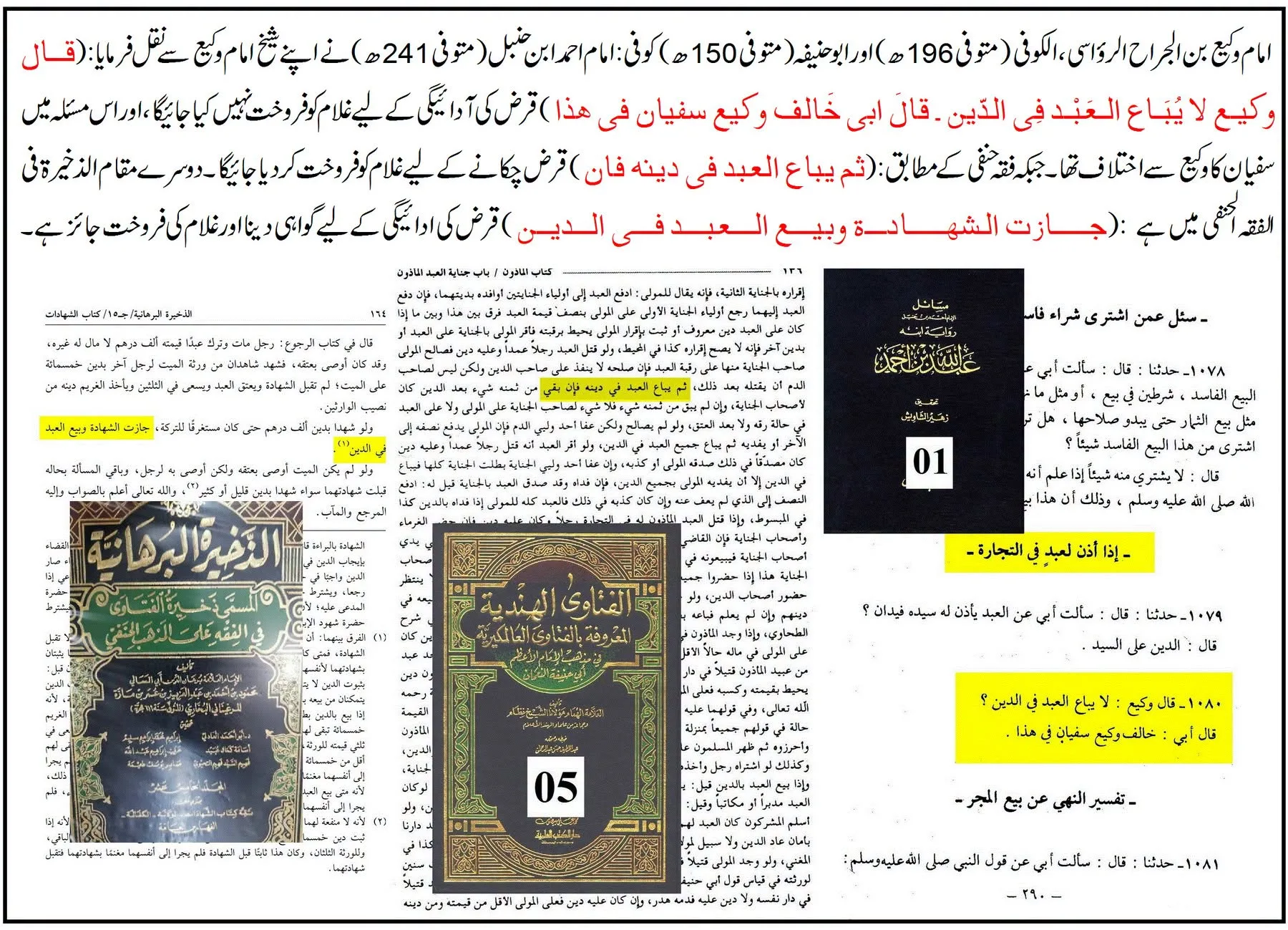
⑧ The Issue of Selling a Slave to Repay a Debt
It is narrated from Imam Waki' bin Al-Jarrah, may Allah have mercy on him:
1080 - قَالَ وَكِيع لَا يُبَاع العَبْد فِي الدّين
قَالَ أَبِي خَالف وَكِيع سُفْيَان فِي هَذَا
Translation:
Imam Waki', may Allah have mercy on him, says: A slave should not be sold to repay a debt.
Imam Ahmad bin Hanbal, may Allah have mercy on him, says: In this issue, Imam Waki' opposed Imam Sufyan Thawri, may Allah have mercy on him.
Reference: Book: Masa'il Ahmad bin Hanbal narrated by his son Abdullah
Reference: Author: Abu Abdullah Ahmad bin Muhammad bin Hanbal bin Hilal bin Asad Al-Shaybani (died 241 AH)
Reference: Issue number: 1080
On the other hand, in the Hanafi fiqh book "Al-Fatawa Al-Hindiyya" it is stated:
وَلَكِنْ لَيْسَ لِصَاحِبِ الدَّمِ أَنْ يَقْتُلَهُ بَعْدَ ذَلِكَ ثُمَّ يُبَاعُ الْعَبْدُ فِي دَيْنِهِ فَإِنْ بَقِيَ مِنْ ثَمَنِهِ شَيْءٌ بَعْدَ الدَّيْنِ كَانَ لِأَصْحَابِ الْجِنَايَةِ
Translation:
However, after that, the rightful owner will not have the authority to kill that slave. Then the slave will be sold to repay his debt, and if after repaying the debt some amount remains from his price, it will be given to the rightful heirs of the crime.
Reference: Book: Al-Fatawa Al-Hindiyya
Reference: Author: Committee of Scholars headed by Nizam al-Din al-Balkhi
Similarly, in another Hanafi fiqh book it is stated:
جازت الشهادة وبيع العبد في الدين
Translation:
Testifying and selling a slave to repay a debt is permissible.
Reference: Al-Kitab: Al-Dhakirah Al-Burhaniyyah, titled Dhakirat Al-Fatawa fi Al-Fiqh ala Al-Madhhab Al-Hanafi
Reference: Author: Burhan al-Din Abu al-Ma'ali Mahmoud ibn Ahmad ibn Abdul Aziz ibn Mazah al-Bukhari al-Hanafi (died: 616 AH)
Reference: Volume: 15
Explanation:
In this issue, the position of Imam Waki' (may Allah have mercy on him) appears to differ from the ruling transmitted in Hanafi jurisprudence.
However, various conditions and rights related to the sale of a slave are discussed in jurisprudential books. Therefore, before applying all these statements to a single specific case, it is necessary to examine their complete context.
The particular importance of this issue is that Imam Ahmad (may Allah have mercy on him) explicitly stated the difference of opinion between Imam Waki' and Imam Sufyan al-Thawri.
This supports the jurisprudential independence of Imam Waki' (may Allah have mercy on him).
Scholarly critique of the methodology of the people of opinion in the statements of Imam Waki' ibn Al-Jarrah
From several statements of Imam Waki' (may Allah have mercy on him), it is evident that he gave special importance to the issue of jurisprudential knowledge of hadith, reasoning from the texts of Shariah, and relying solely on opinion in contrast to hadith.
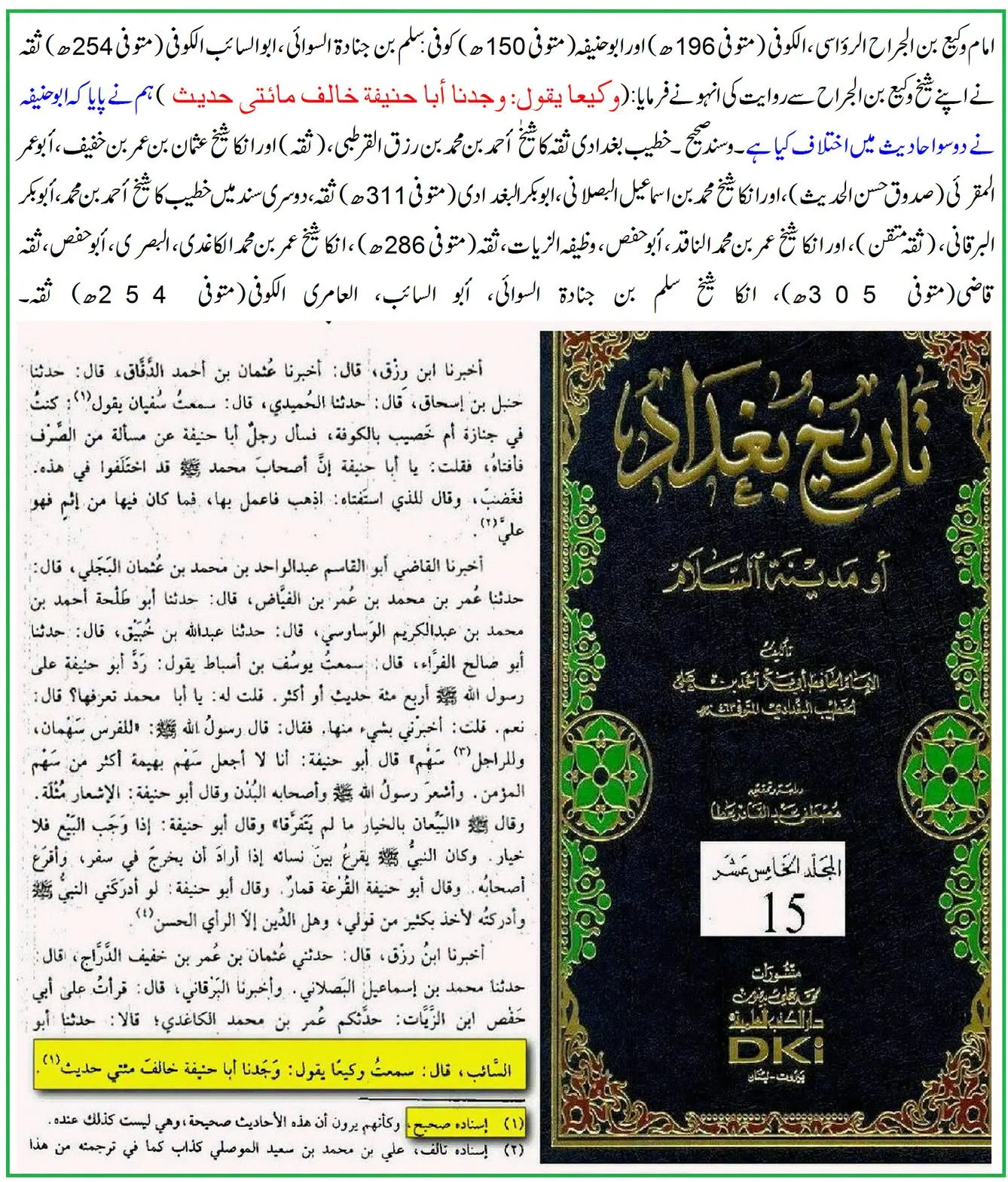
① The reported statement about Imam Abu Hanifa opposing two hundred hadiths
Hafiz Khateeb Baghdadi (may Allah have mercy on him) has narrated a statement from Imam Waki':
أَخْبَرَنَا ابن رزق، قَالَ: حَدَّثَنِي عثمان بن عُمَر بن خفيف الدراج، قَالَ: حَدَّثَنَا مُحَمَّد بن إِسْمَاعِيل البصلاني،
وأَخْبَرَنَا الْبَرْقَانِيّ، قال: قرأت على أبي حفص ابن الزيات: حدثكم عُمَر بن مُحَمَّد الكاغدي، قالا: حَدَّثَنَا أَبُو السائب، قال: سمعت وكيعا، يقول: وجدنا أبا حنيفة خالف مائتي حديث
Translation:
Abu Al-Saib narrates that I heard Imam Waki' (may Allah have mercy on him) say: We found that Abu Hanifa opposed two hundred hadiths.
Reference: Al-Kitab: Tarikh Baghdad
Reference: Author: Abu Bakr Ahmad bin Ali bin Thabit bin Ahmad bin Mahdi Al-Khateeb Al-Baghdadi (died 463 AH)
Explanation:
This is a critical statement attributed to Imam Waki' in which an objection is raised against Imam Abu Hanifa's jurisprudential reasoning.
However, there are two separate aspects to this statement.
One is to verify the attribution of this phrase to Imam Waki' through isnadic investigation.
Secondly, the two hundred hadiths whose contradiction has been mentioned should be identified, their meanings examined, and the relevant jurisprudential arguments of Imam Abu Hanifa reviewed.
The mere transmission of this statement does not prove that in all those two hundred instances there was indeed a contradiction with authentic and explicit hadiths.
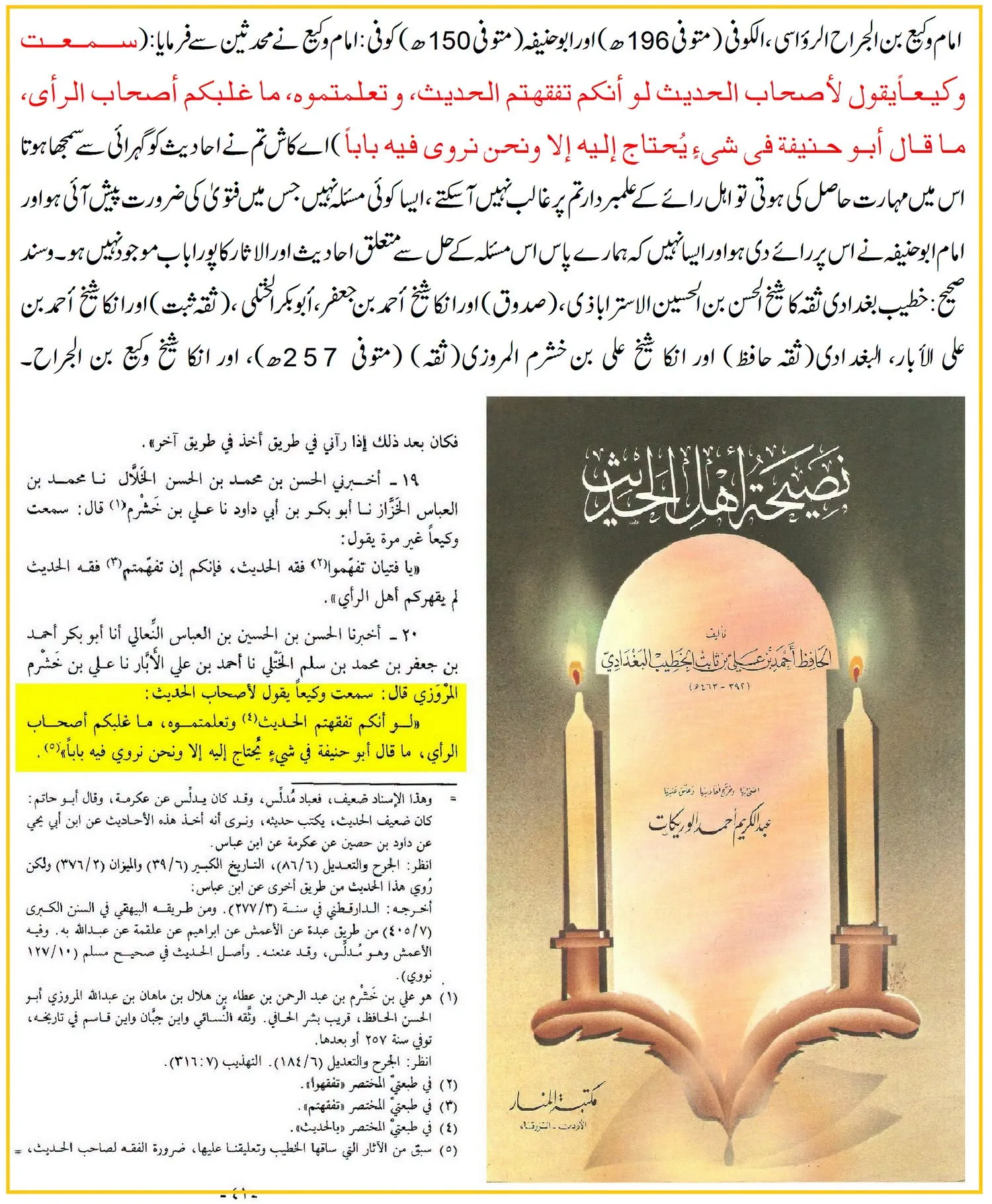
② Encouragement for Ahl al-Hadith to acquire the jurisprudence of hadith
Hafiz Khateeb Baghdadi, may Allah have mercy on him, has narrated a very important statement of Imam Waki' bin al-Jarrah, may Allah have mercy on him:
20 - أَخْبَرَنَا الْحَسَنُ بْنُ الْحُسَيْنِ بْنِ الْعَبَّاسِ النِّعَالِيُّ أَنا أَبُو بَكْرٍ أَحْمَدُ بْنِ جَعْفَرِ بْنِ مُحَمَّدِ بْنِ سَلْمٍ الْخُتَّلِيُّ نَا أَحْمَدُ بْنُ عَلِيٍّ الْأَبَّارُ نَا عَلِيُّ بْنُ خَشْرَمٍ الْمَرْوَزِيُّ قَالَ سَمِعْتُ وَكِيعًا يَقُولُ لِأَصْحَابِ الْحَدِيثِ
لَوْ أَنَّكُمْ تَفَقَّهْتُمُ الْحَدِيثَ وَتَعَلَّمْتُمُوهُ مَا غَلَبَكُمْ أَصْحَابُ الرَّأْيِ
مَا قَالَ أَبُو حَنِيفَةَ فِي شَيْءٍ يُحْتَاجُ إِلَيْهِ إِلَّا وَنَحْنُ نَرْوِي فِيهِ بَابًا
Translation:
Imam Waki', may Allah have mercy on him, used to say to the Ahl al-Hadith: If you acquire the jurisprudence of hadith and learn it well, the people of opinion (Ahl al-Ra'y) would not be able to overpower you.
Abu Hanifa did not give an opinion on any issue that people needed, except that we have a dedicated chapter of hadiths related to that issue.
Reference: Al-Kitab: Nasihat Ahl al-Hadith
Reference: Author: Abu Bakr Ahmad bin Ali bin Thabit bin Ahmad bin Mahdi al-Khatib al-Baghdadi (d. 463 AH)
Reference: Hadith Number: 20
Explanation:
This statement of Imam Waki' (may Allah have mercy on him) reveals an important aspect of his scholarly methodology.
He encouraged the Ahl al-Hadith not to be content with merely memorizing narrations but to acquire jurisprudential understanding from them.
According to him, the hadiths contain a vast scholarly resource for solving jurisprudential issues; therefore, the Ahl al-Hadith should develop the ability to derive rulings from them.
This statement confirms that Imam Waki' (may Allah have mercy on him) gave fundamental importance to hadith in jurisprudential reasoning and also had scholarly differences with the methodology of the Ahl al-Ra'y.
However, this does not necessarily mean that he rejected every jurisprudential opinion of Imam Abu Hanifa (may Allah have mercy on him).
③ Imam Waki's reaction to presenting a jurist's opinion against the Prophetic hadith
Imam Tirmidhi (may Allah have mercy on him) narrated an incident regarding Imam Waki' bin Al-Jarrah (may Allah have mercy on him) on the issue of poetry:
وَسَمِعْتُ أَبَا السَّائِبِ يَقُولُ: «كُنَّا عِنْدَ وَكِيعٍ، فَقَالَ لِرَجُلٍ عِنْدَهُ مِمَّنْ يَنْظُرُ فِي الرَّأْيِ: أَشْعَرَ رَسُولُ اللَّهِ صَلَّى اللَّهُ عَلَيْهِ وَسَلَّمَ، وَيَقُولُ أَبُو حَنِيفَةَ هُوَ مُثْلَةٌ؟ قَالَ الرَّجُلُ: فَإِنَّهُ قَدْ رُوِيَ عَنْ إِبْرَاهِيمَ النَّخَعِيِّ أَنَّهُ قَالَ: الإِشْعَارُ مُثْلَةٌ، قَالَ: فَرَأَيْتُ وَكِيعًا غَضِبَ غَضَبًا شَدِيدًا، وَقَالَ: أَقُولُ لَكَ قَالَ رَسُولُ اللَّهِ صَلَّى اللَّهُ عَلَيْهِ وَسَلَّمَ وَتَقُولُ قَالَ إِبْرَاهِيمُ، مَا أَحَقَّكَ بِأَنْ تُحْبَسَ، ثُمَّ لَا تَخْرُجَ حَتَّى تَنْزِعَ عَنْ قَوْلِكَ هَذَا»
Abu al-Saib, may Allah have mercy on him, narrates: We were with Imam Waki' may Allah have mercy on him, when he said to a person present among the people of opinion:
The Messenger of Allah, peace and blessings be upon him, pronounced the sacrificial animal as "Ish'ar" (marked it), while Abu Hanifa says it is "Muthalla" (slaughtered by cutting the throat)?
This person replied: It has also been narrated from Ibrahim al-Nakha'i, may Allah have mercy on him, that he considered "Ish'ar" as "Muthalla."
Abu al-Saib says: I saw that Imam Waki', may Allah have mercy on him, became very angry and said:
I am presenting to you the command of the Messenger of Allah, peace and blessings be upon him, and you respond with the statement of Ibrahim al-Nakha'i!
You deserve to be imprisoned and not released until you retract this statement.
Reference: Al-Kitab: Sunan al-Tirmidhi
Reference: Al-Mu'allif: Muhammad ibn Isa ibn Sawrah ibn Musa ibn al-Dhahak al-Tirmidhi, Abu Isa (died 279 AH)
Reference: Hadith Number: 906
Reference: Chapter: What has been narrated about marking the sacrificial animal
Explanation:
This incident is very important for understanding the hadith and jurisprudential methodology of Imam Waki' ibn al-Jarrah, may Allah have mercy on him.
He considered the practice of the Prophet Muhammad, peace be upon him, as the fundamental proof regarding the issue of poetry and strongly objected to the transmitted statements of Imam Abu Hanifa and Imam Ibrahim Nakha'i, may Allah have mercy on them, presented in opposition.
From this incident, it is evident that Imam Waki' may Allah have mercy on him, held a clear disagreement with the opinion of Imam Abu Hanifa on this matter.
However, his harsh language in this incident should be understood within the context of this historical and scholarly debate. One should not derive a general principle from this for the permissibility of such style of discourse or any legal punishment in all jurisprudential disagreements.
Important Conclusions Regarding the Jurisprudential Independence of Imam Waki' bin Al-Jarrah
A comprehensive study of the above statements and reports reveals some important conclusions.
First: Imam Waki' bin Al-Jarrah, may Allah have mercy on him, was a prominent muhaddith, memorizer of hadith, and jurist of his time. His scholarly status cannot be limited merely to that of a jurist subordinate to another imam.
Second: A fatwa has been attributed to Imam Abu Hanifa regarding Imam Waki's statement through Imam Yahya bin Ma'in, may Allah have mercy on him. It is not correct to ignore this; however, it is not necessary to prove adherence to Imam Abu Hanifa in every issue from this.
Third: In matters such as poetry, praying alone behind the row, buying and selling Mushafs, and some other jurisprudential issues, Imam Waki's statements differ from the well-known stance of Hanafi jurisprudence.
Fourth: Regarding the increase and decrease of faith, Imam Waki, may Allah have mercy on him, adopted the well-known view of Ahl al-Sunnah that faith is the name of speech and action, and it can increase and decrease.
Fifth: Imam Waki, may Allah have mercy on him, differed from his teacher Imam Sufyan al-Thawri, may Allah have mercy on him, in some issues, a clear example of which is the issue of selling a slave to repay a debt, as stated by Imam Ahmad bin Hanbal, may Allah have mercy on him.
Sixth: Imam Waki' رحمه الله's scholarly methodology was based on understanding hadith, acquiring the jurisprudence of hadith, and giving fundamental importance to reasoning from texts. In many of his statements, there is encouragement for the people of hadith to develop jurisprudential expertise.
Seventh: Some critical statements about Imam Abu Hanifa رحمه الله have also been transmitted from Imam Waki', but to determine their correct meaning, it is necessary to examine their chain of transmission, context, and related jurisprudential evidence.
Eighth: There are conflicting historical reports regarding attributing doctrinal statements such as "Creation of the Quran" to Imam Abu Hanifa رحمه الله. Therefore, before making such attributions definitive proof either for or against him, thorough research is essential.
Summary and Conclusion
From the transmitted statements and works of Imam Waki' ibn al-Jarrah رحمه الله, it becomes evident that he was a distinguished imam of hadith and jurisprudence, possessing his own scholarly insight and jurisprudential priorities.
There are numerous statements attributed to him in which he disagreed with the well-known jurisprudential stance of Imam Abu Hanifa, may Allah have mercy on him. Especially regarding the issue of poetry, his position is very clear, where he strongly objected to the opinion of the people of reasoning based on the Prophetic Hadith.
Similarly, in some matters, Imam Waki‘’s disagreement with his teacher Imam Sufyan al-Thawri also confirms that he did not adhere to the opinion of a single jurist in every issue.
On the other hand, in the narration of Imam Yahya ibn Ma'in, there is mention of Imam Waki‘’ giving a fatwa based on the opinion of Imam Abu Hanifa. Instead of denying this testimony, it should be understood in conjunction with Imam Waki‘’s other jurisprudential opinions.
Therefore, in light of all the evidence, the more cautious conclusion is that Imam Waki‘’ ibn al-Jarrah, may Allah have mercy on him, was a scholar and a hadith expert with consistent jurisprudential insight. In some issues, he could agree with Imam Abu Hanifa, and in many other issues, he differed from him.
The conclusion is that it is not correct to consider Imam Waki' as a follower or bound by Imam Abu Hanifa in every issue, given the transmitted jurisprudential differences between them. However, the claim that every fatwa of his was against Imam Abu Hanifa is also not provable. The correct way to understand his scholarly personality is to examine his statements individually in the light of evidence.
And Allah Almighty knows best.