


Written by: Maqbool Ahmad Salfi
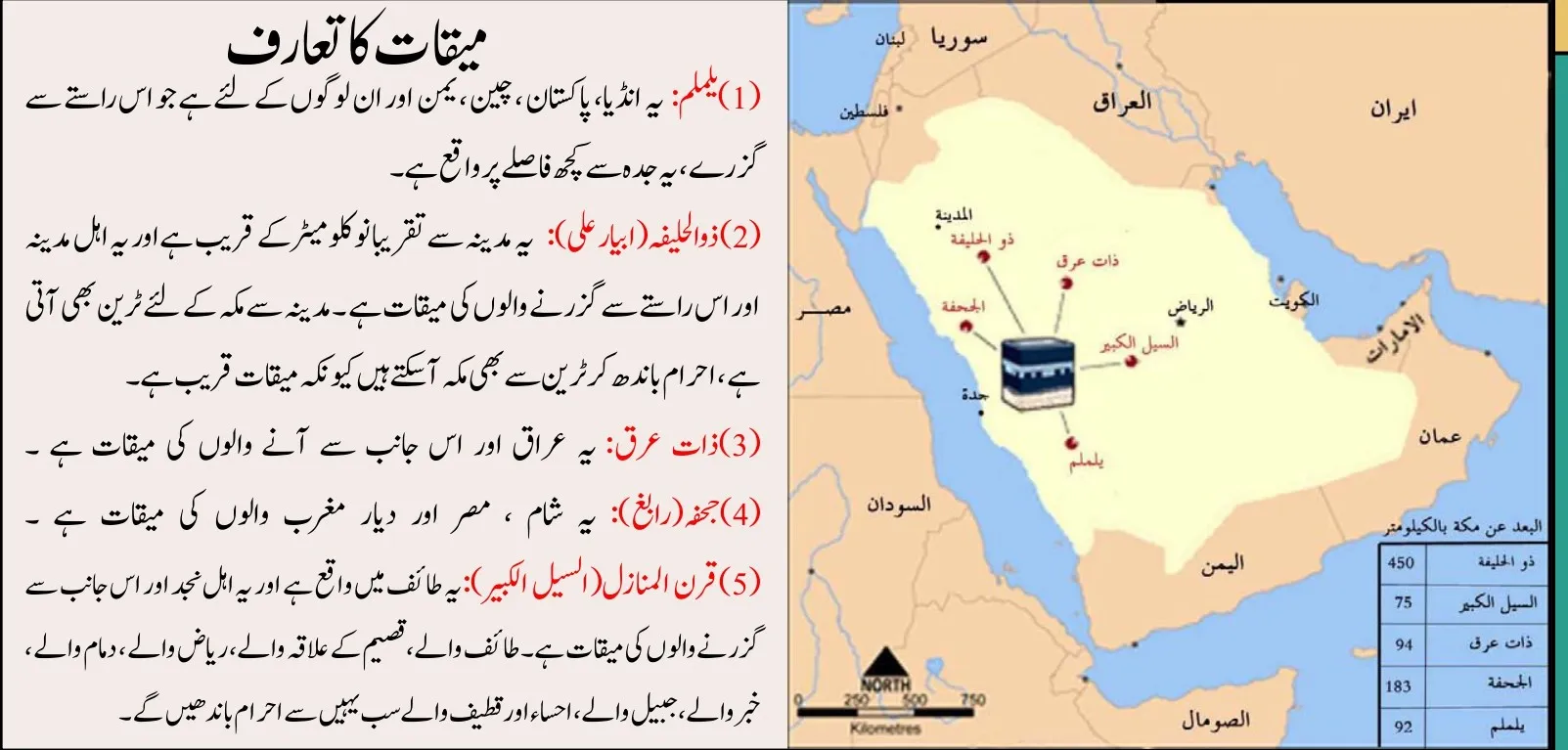
(1) Yalamlam:
This is for India, Pakistan, China, Yemen, and those who pass through this route; it is located a short distance from Jeddah.
(2) Dhu al-Hulayfah (Abyar Ali):
This is about nine kilometers from Madinah and is the Miqat for the people of Madinah and those passing through this route. There is also a train from Madinah to Makkah; one can enter Ihram and travel by train to Makkah because the Miqat is nearby.
(3) Dhat Irq:
This is the Miqat for Iraq and those coming from that direction.
(4) Juhfah (Rabigh):
This is the Miqat for people from Syria, Egypt, and the western lands.
(5) Qarn al-Manazil (Al-Sail Al-Kabir):
This is located in Taif and is the Miqat for the people of Najd and those passing from that side. People from Taif, Qassim region, Riyadh, Dammam, Khobar, Jubail, Ahsa, and Qatif will all enter Ihram from here.

What is called Ihram?
The intention for Hajj and Umrah is called Ihram.
Both men and women have the same Ihram, only the clothing of Ihram differs. Understand this from the Hadith of the Prophet.
عن عبد الله بن عمر رضي الله عنه، قال: قام رجل، فقال: يا رسول الله،" ماذا تامرنا ان نلبس من الثياب في الإحرام؟ فقال النبي صلى الله عليه وسلم: لا تلبسوا القميص، ولا السراويلات، ولا العمائم، ولا البرانس، إلا ان يكون احد ليست له نعلان فليلبس الخفين، وليقطع اسفل من الكعبين، ولا تلبسوا شيئا مسه زعفران، ولا الورس، ولا تنتقب المراة المحرمة، ولا تلبس القفازين
Reference: (Sahih al-Bukhari: 1838)
Translation:
Abdullah bin Umar (RA) narrated that a person stood up and asked, O Messenger of Allah! What clothes are allowed to be worn in the state of Ihram? The Noble Prophet (PBUH) said: Do not wear a shirt, nor trousers, nor a turban, nor a stitched garment. If someone does not have sandals, he may cut socks below the ankles and wear them. Likewise, do not wear any clothing that has saffron or perfume on it. Women in the state of Ihram should not cover their faces with a veil nor wear gloves.
Men's Ihram Clothing:
Two unstitched sheets and sandals (stitched clothing is prohibited)
Women's Ihram Clothing:
Any type of lawful clothing except for a veil and gloves
Clarification of Misunderstanding
عن عائشة قالت: كان الركبان يمرون بنا ونحن مع رسول الله صلى الله عليه وسلم محرمات، فإذا حاذوا بنا سدلت إحداناجلبابها من رأسها إلى وجهها، فإذا جاوزونا كشفناه.
Reference: (Abu Dawood: 1833)
Note: In the chain of narration of this hadith, Yazid bin Abi Ziyad is a weak narrator, therefore this hadith is weak in its chain of narration. However, due to the presence of supporting evidence in this chapter, it reaches the level of Hasan. Regarding Arwa al-Ghalil, I mentioned that Asma bint Abi Bakr narrates that we women used to cover our faces from men while in the state of Ihram, and Fatimah bint Mundhir (RA) narrates that we women used to veil our faces while in the state of Ihram.

Prohibitions of Ihram
① Cutting hair
② Cutting nails
③ Men wearing stitched clothes
④ Applying perfume
⑤ Men covering their heads
⑥ For women, wearing gloves, burqa, and niqab
⑦ Clinging to the wife with desire
⑧ Contracting a marriage
⑨ Sexual intercourse
⑩ Hunting
Note: Watches, rings, wallets, bags, umbrellas, etc., and women can use adornments such as earrings and jewelry, but they must hide them from non-mahram men.

Pillars of Hajj
(1) Ihram (intention for Hajj)
(2) Staying in the plain of Arafat
(3) Performing Tawaf al-Ifadah
(4) Sa’i between Safa and Marwah
Obligations of Hajj
(1) Wearing Ihram from the Miqat
(2) Staying in Arafat until sunset
(3) Spending the night of Eid in Muzdalifah
(4) Spending the nights of the days of Tashreeq (12th, 11th, 13th of Dhu al-Hijjah) in Mina
(5) Throwing pebbles at the Jamarat
(6) Shaving or cutting the hair
(7) Performing Tawaf al-Wada (Farewell Tawaf) (not required for women in menstruation or postnatal bleeding).
Rulings of Pillars, Obligations, and Prohibitions
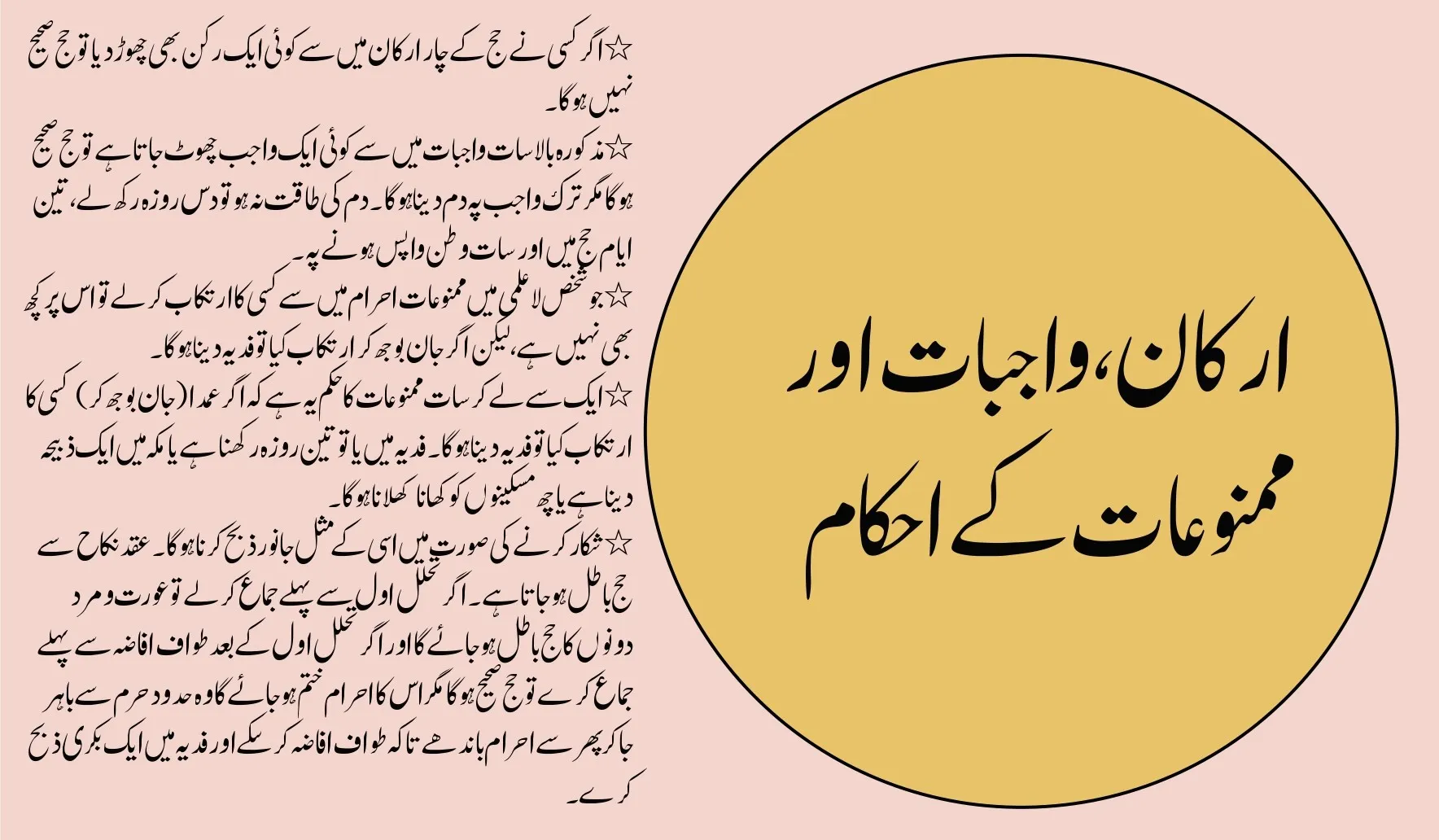
If someone omits even one of the four pillars of Hajj, the Hajj will not be valid.
If any one of the seven obligations mentioned above is omitted, the Hajj will still be valid, but a penalty (dam) must be given for neglecting the obligation. If one is unable to pay the penalty, they should fast for ten days: three days during Hajj and seven days after returning home.
If a person unknowingly commits any of the prohibitions of Ihram, there are no additional pillars or obligations on them, but if done intentionally, a penalty (fidyah) must be paid.
The ruling on the prohibitions from one to seven is that if someone deliberately violates them, they must pay a penalty. The penalty is either to fast for three days, or to offer one sacrifice in Mecca, or to feed six poor people.
In the case of hunting, an animal of the same kind must be slaughtered. Marriage invalidates Hajj. If intercourse occurs before the first act, the Hajj of both the man and the woman will be invalid. However, if intercourse occurs after the first acts but before the Tawaf al-Ifadah, the Hajj will be valid but the Ihram will be broken. They must leave the sacred boundaries, enter Ihram again, perform Tawaf al-Ifadah, and offer a penalty of slaughtering one goat.
Hajj:
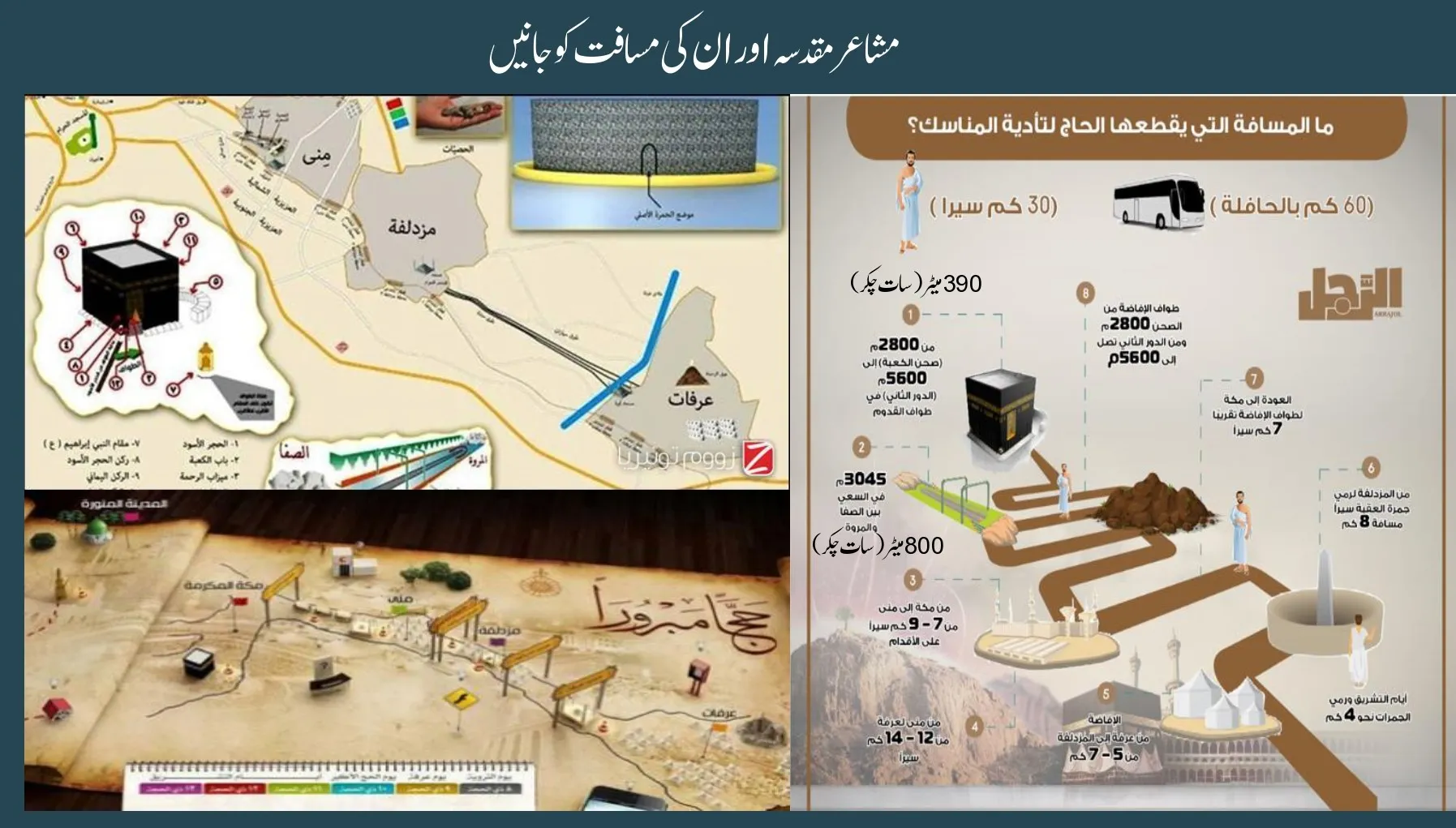
It is an obligation and a pillar of Islam.
Virtue:
It cleanses from sins (like being born anew from the mother's womb) and leads to Paradise.
Three types of Hajj:
Ifrad, Qiran, and Tamattu

(1) Miqat (the place from where Ihram is donned)
Ihram is the intention to enter Hajj or Umrah, not the clothing.
Upon reaching the Miqat, perform Ghusl (ritual bath) and apply perfume only on the body parts; if bathing is harmful to health, then skip the Ghusl.
A menstruating woman should also perform Ghusl and then wear the Ihram.
Cutting unnecessary hair and nails is not related to Ihram; if there is a need to cut them, then cut, otherwise leave them.
Wear the Ihram garment; due to the prohibition of wearing stitched clothes at the Miqat, you can wear the Ihram garment from any place before the Miqat, but the intention must be made at the Miqat.
Choose one of the three types of Hajj (Ifrad, Qiran, Tamattu) and make the intention accordingly. Hajj Tamattu is preferable.
Intention for Ifrad: لبیک حجا, intention for Qiran: لبيك عمرة و حجا, and intention for Tamattu: لبيك عمرة.
From the Miqat to the Haram, keep reciting the Talbiyah. The Talbiyah is:
لبيك اللهم لبيك لبيك لا شريك لك لبيك إن الحمد والنعمة لك والملك لا شريك لك
Women should recite the Talbiyah softly.

(2) Masjid al-Haram (Makkah Mukarramah)
Mutamatti':
Perform Tawaf and Sa'i for Umrah, then shorten the hair and become halal.
Qarin:
Perform Tawaf al-Qudum (this is recommended) and perform Sa'i for Hajj and Umrah.
Mufrid:
Perform the arrival Tawaf (this is recommended) and perform the Sa’i of Hajj.
Those in Qarin and Mufrid Ihram will remain in Ihram and on the 10th of Dhul-Hijjah, after stoning the Jamaraat and shaving or trimming, they will be permissible (halal), but the wife will only be permissible after performing Tawaf al-Ifadah (and if Sa’i is required, then after performing Sa’i).
There is no specific supplication for Tawaf; whoever wishes may supplicate during the seven circuits, however, between the Yemeni Corner and the Black Stone, recite this supplication:
ربنا آتنا في الدُّنْيَا حَسَنَةً وَفِي الآخِرَةِ حَسَنَةً وَقِنَا عَذَابَ النَّارِ
On Safa and Marwah, recite this supplication three times on each circuit:
لَا إِلَهَ إِلَّا اللَّهُ وَحْدَهُ لَا شَرِيكَ لَهُ لَهُ الْمُلْكُ وَلَهُ الْحَمْدُ يُحْيِي وَيُمِيتُ وَهُوَ عَلَى كُلِّ شَيْءٍ قَدِيرٌ لَا إِلَهَ إِلَّا اللَّهُ وَحْدَهُ لَا شَرِيكَ لَهُ أَنْجَزَ وَعْدَهُ وَنَصَرَ عَبْدَهُ وَهَزَمَ الْأَحْزَابَ وَحْدَهُ -
(3) Mina (Yawm al-Tarwiyah)
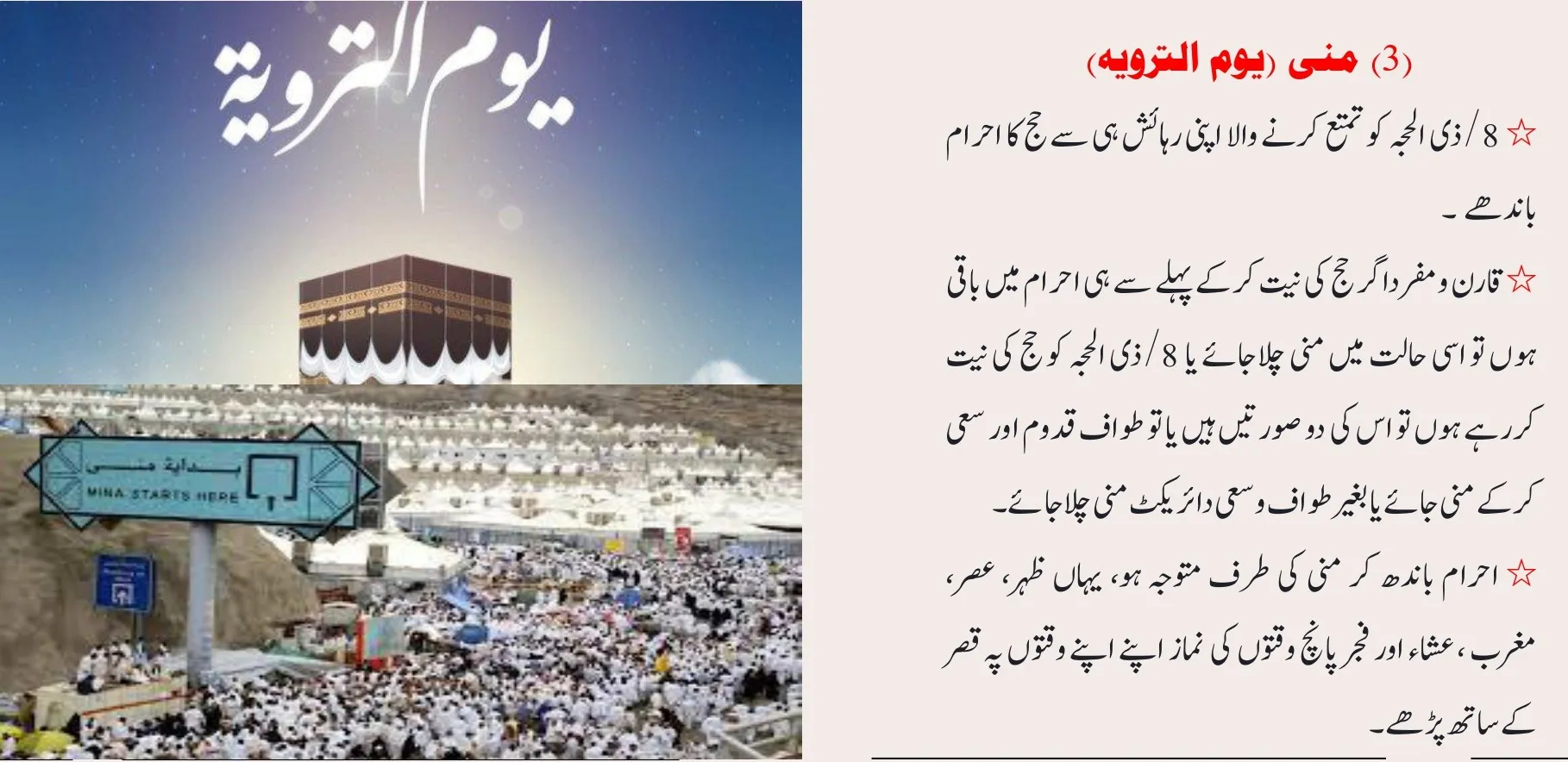
On the 8th of Dhul-Hijjah, the one performing Tamattu’ should enter Ihram for Hajj from his place of residence.
If one is in Qarin or Mufrid Ihram and intends Hajj and is already in Ihram, then he should proceed to Mina in that state, or if intending Hajj on the 8th of Dhul-Hijjah, there are two options: either perform Tawaf al-Qudum and Sa’i and then go to Mina, or go directly to Mina without Tawaf and Sa’i.
After wearing Ihram, proceed towards Mina. Here, the five prayers of Zuhr, Asr, Maghrib, Isha, and Fajr should be performed at their respective times with Qasr.
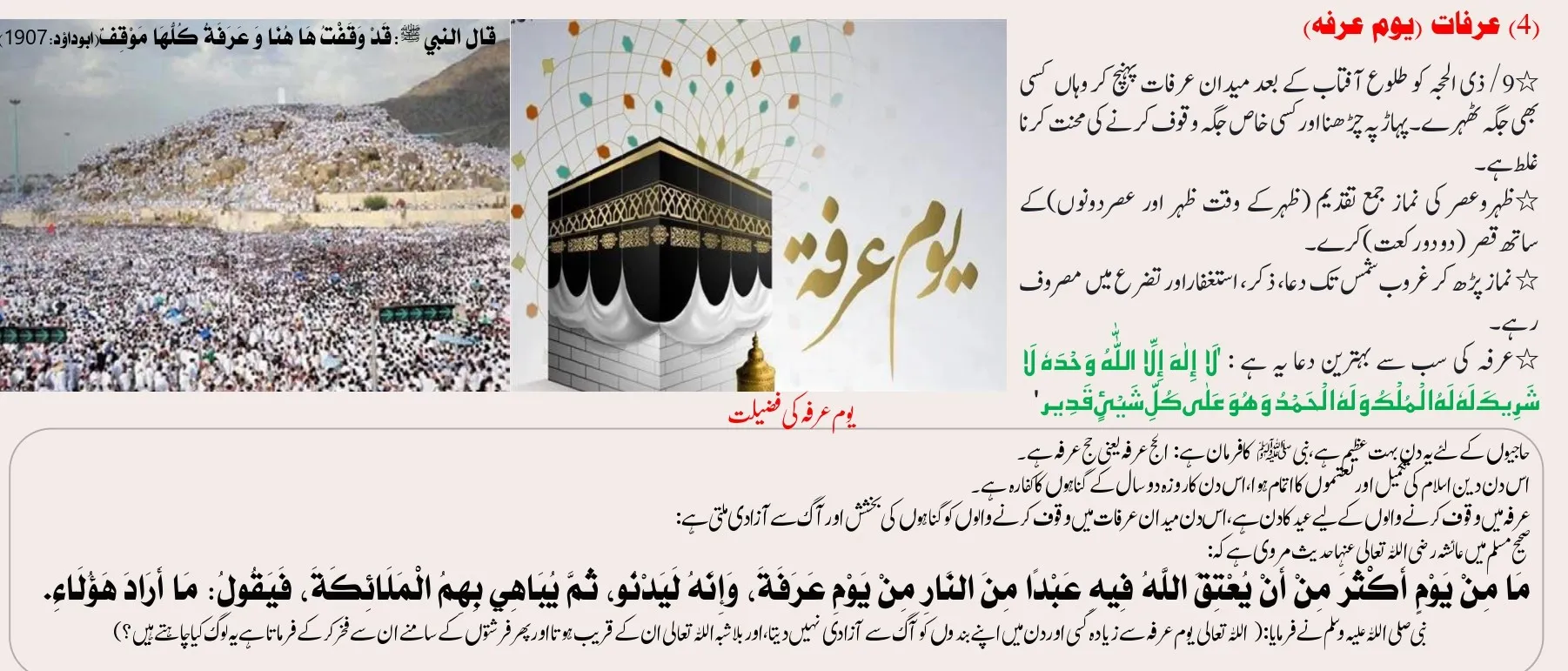
(4) Arafat (Day of Arafah)
On the 9th of Dhu al-Hijjah, after sunrise, reach the plain of Arafat and stay there anywhere. Climbing the mountain and making an effort to stand at a specific place is incorrect.
Perform the combined and advanced Zuhr and Asr prayers (both at Zuhr time) with Qasr (two rak'ahs each).
After praying, remain engaged in supplication, remembrance, seeking forgiveness, and humility until sunset. The best supplication of Arafah is:
لَا إِلَهَ إِلَّا اللَّهُ وَحْدَهُ لَا شَرِيكَ لَهُ لَهُ الْمُلْكُ وَلَهُ الْحَمْدُ وَهُوَ عَلَى كُلِّ شَيْءٍ قَدِيرٌ
Virtue of the Day of Arafah
This day is very great for the pilgrims. The Prophet (peace be upon him) said:
الحج عرفہ یعنی حج عرفہ ہے۔
On this day, the religion of Islam was completed and blessings were perfected. Fasting on this day is an expiation for the sins of two years.
The day of Eid is for those who stand in Arafah; on this day, those who stand in the plain of Arafat are forgiven their sins and freed from the fire: In Sahih Muslim, a narration from Aisha (may Allah be pleased with her) is reported:
مَا مِنْ يَوْمِ أَكْثرَ مِنْ أَنْ يُعْتِق اللهُ فِيهِ عَبْدًا مِنَ النَّارِ مِنْ يَوْمِ عَرَفَةَ ، وَإِنَّهُ لَيَدْنو، ثُمَّ يُبَاهِي بِهِمُ الْمَلَائِكَةَ، فَيَقُولُ: مَا أَرَادَ هَوْلَاءِ.
The Prophet (peace be upon him) said:
(Allah does not free His servants from the fire on any other day more than the Day of Arafah, and indeed Allah is closer to them and then boasts about them before the angels, saying: What do these people want?)
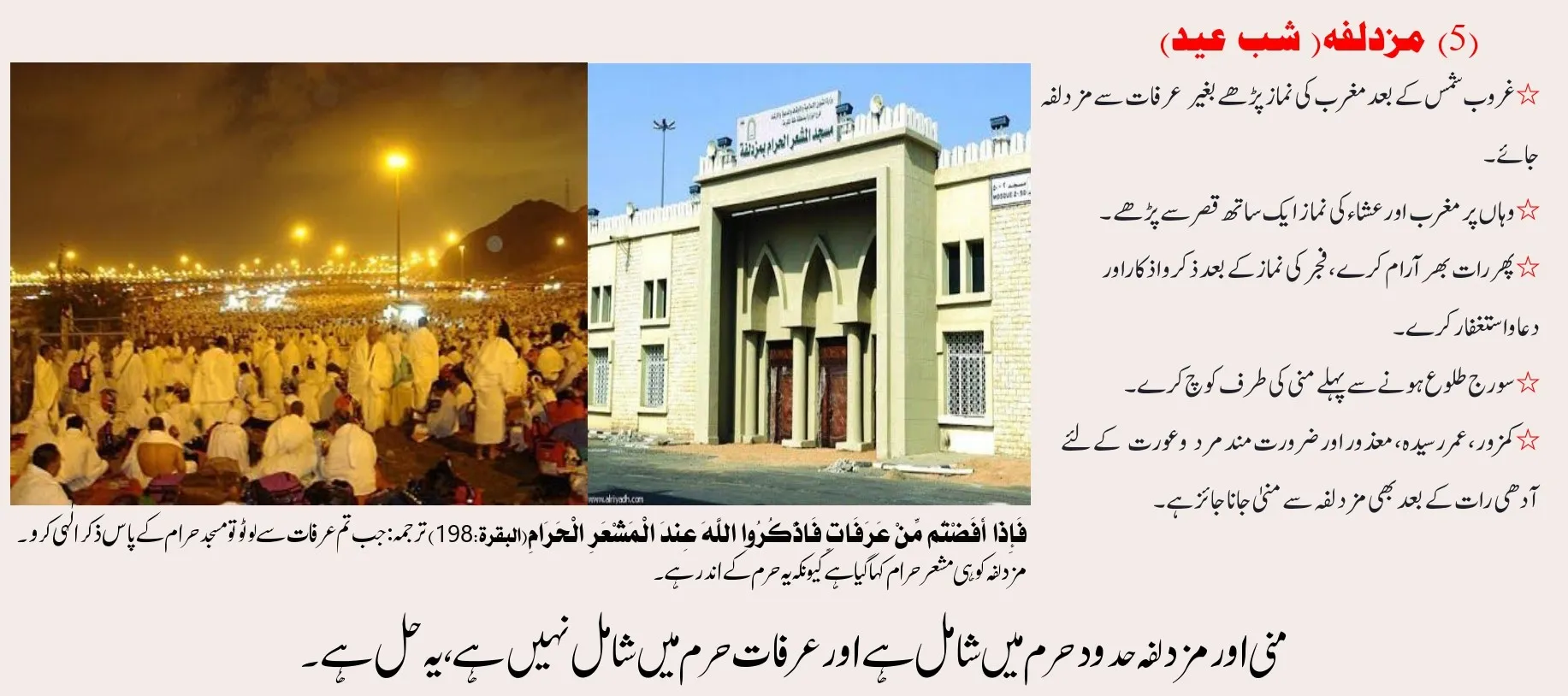
(5) Muzdalifah (Night of Eid)
After sunset, without praying Maghrib, go from Arafat to Muzdalifah.
There, pray Maghrib and Isha together with shortening the prayer.
Then rest throughout the night, and after Fajr prayer, engage in remembrance, supplications, and seeking forgiveness.
Depart towards Mina before sunrise.
For the weak, elderly, disabled, and needy men and women, it is permissible to go from Muzdalifah to Mina even after midnight.
فَإِذا أَفضتُم مَنْ عَرَفَاتِ فَاذْكَرُوا اللهَ عِندَ المشعر الحرام
Reference: (Al-Baqarah: 198)
Translation:
When you return from Arafat, perform the remembrance of Allah near Masjid al-Haram.
Muzdalifah is also called Mash'ar al-Haram because it is inside the Haram.
Mina and Muzdalifah are included within the boundaries of the Haram, but Arafat is not included in the Haram; this is the ruling.

(6) Yawm al-Nahr (Day of Sacrifice)
On the 10th of Dhu al-Hijjah, after Fajr, go to Mina and first throw seven pebbles at the same Jamrah (the one adjacent to Makkah) with Takbeer.
Pebbles can be picked from the path or from Mina or Muzdalifah; their size should be about the size of a chickpea, and they do not need to be washed.
The one performing Hajj Tamattu' and Qiran must offer a sacrifice.
By stoning the Jamrah and shaving or cutting the hair (or by performing these two acts or two other acts), one attains the first release (tahlul awwal), which removes all restrictions except those related to the wife. When one performs another act such as Tawaf or Sa'i, one attains the second release (tahlul thani) on the Day of Sacrifice through any three acts, which means complete permissibility, including permissibility of the wife.
If he has collected the amount for sacrifice, then without delay, he should shave his hair with a razor or cut the hair short from the entire head with scissors.
Tamattu, Qiran, and Ifrad all should perform the Tawaf of Hajj (Afadah).
The one performing Tamattu should perform Sa’i; Qiran and Ifrad should also perform Sa’i if they have not done Sa’i with Tawaf al-Qudum.
For the one performing Tamattu, today's acts in order are Rami (stoning), sacrifice, shaving/cutting hair, Tawaf, and Sa’i. If any of these acts are done earlier or later, there is no harm; that is, this order is not obligatory.
The Holy Prophet Muhammad (peace be upon him) said:
إن أعظم الأيام عند الله تبارك وتعالى يوم النحر ثم يوم القرح
Reference: (Sahih Abi Dawood: 1765)
Translation:
The greatest day in the sight of Allah, the Blessed and Exalted, is the Day of Nahr (sacrifice), then the Day of Qarr.
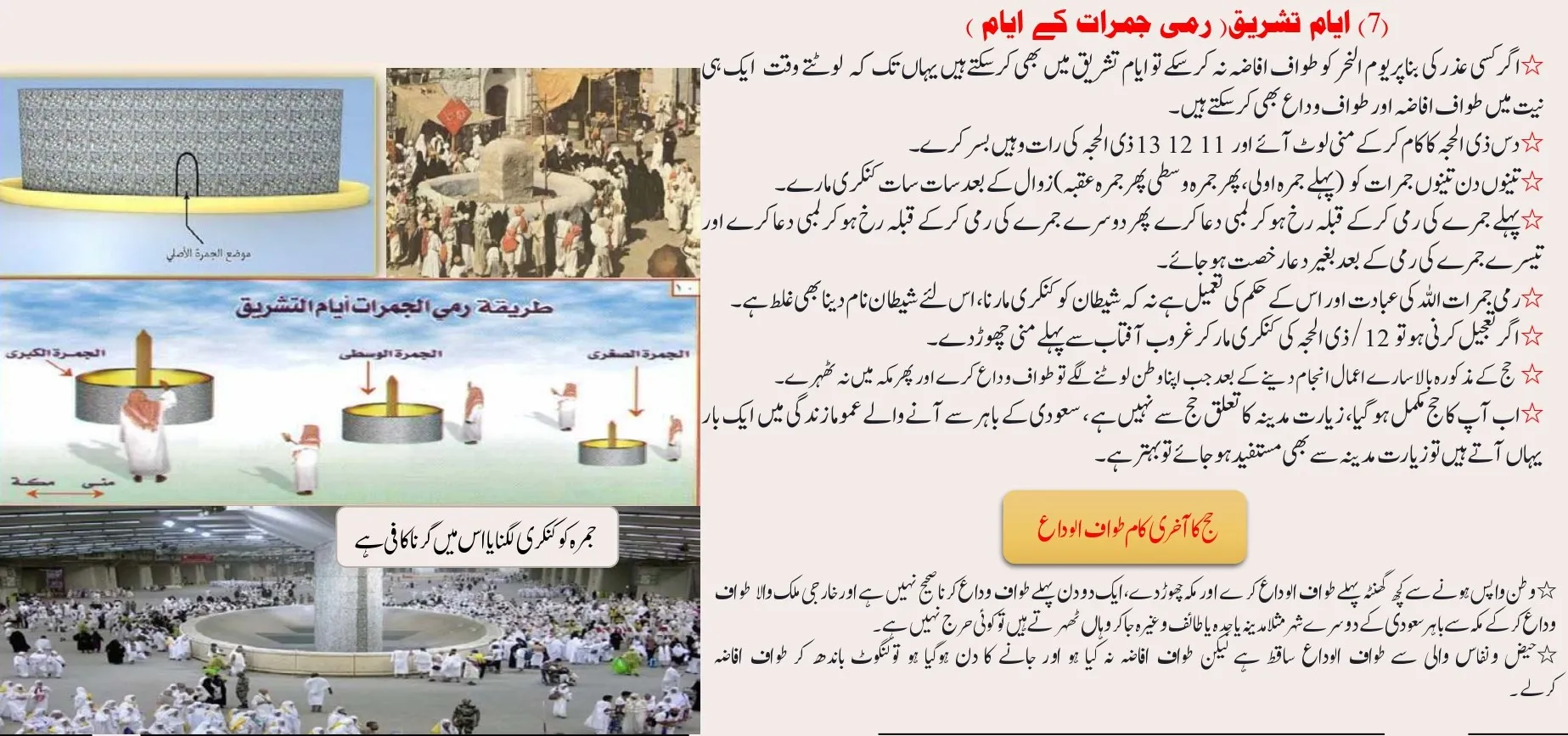
(7) Days of Tashreeq (Days of Stoning the Jamarat)
If someone, due to an excuse, could not perform Tawaf al-Afada on the Day of Nahr, they can perform it during the Days of Tashreeq. Even at the time of leaving, they can perform Tawaf al-Afada and Tawaf al-Wida with one intention.
After performing the rituals of the 10th of Dhu al-Hijjah, return to Mina and spend the nights of the 11th, 12th, and 13th of Dhu al-Hijjah there.
On all three days, after noon, throw seven pebbles at each of the three Jamaraat (first the Jamrah of the beginning, then the middle Jamrah, and finally the Jamrah of Aqabah).
After throwing pebbles at the first Jamrah, face the Qiblah and make a long supplication; then after the second Jamrah, face the Qiblah and make a long supplication; and after the third Jamrah, depart without making a supplication.
Stoning the Jamaraat is an act of worship of Allah and obedience to His command, not throwing pebbles at Satan, so calling it "Satan" is also incorrect. If one wishes to hasten, they may throw pebbles on the 12th of Dhu al-Hijjah and leave Mina before sunset.
After completing all the above-mentioned rituals of Hajj, when you are about to return to your homeland, perform the Farewell Tawaf and then do not stay in Makkah.
Now your Hajj is complete. Visiting Madinah is not part of Hajj; generally, those coming from outside Saudi Arabia visit here once in their lifetime, so it is better to also benefit from visiting Madinah.
The Last Ritual of Hajj: Farewell Tawaf
One should perform the Farewell Tawaf a few hours before returning to their homeland and then leave Mecca. Performing the Farewell Tawaf one or two days earlier is not correct. If a person from a foreign country performs the Farewell Tawaf and then goes outside Mecca to another city in Saudi Arabia, such as Medina, Jeddah, or Taif, and stays there, there is no harm in that.
For a woman who is menstruating or experiencing postnatal bleeding, the Farewell Tawaf is not obligatory. However, if she has not performed Tawaf al-Ifadah and the day of departure has arrived, she should wear a loincloth and perform Tawaf al-Ifadah.

Three Messages of Hajj for the Pilgrims of the House of Allah and Muslims
It is known that the intention of pilgrimage is only to travel to three mosques; traveling to visit any other place is not permitted. Whoever Allah calls to visit His House and perform Hajj is very fortunate. Be thankful to Allah that He has made you among the fortunate ones. The House of Allah is the first house on earth and the Qibla of the Muslims. One prayer offered here is equivalent to the reward of one hundred thousand prayers, which is approximately equal to 55 years of worship. Here are Zamzam and many other sacred sites. Then, with Allah's help, you will also benefit from visiting Madinah Munawwarah. One prayer in the Prophet's Mosque is equivalent to the reward of one thousand prayers, which is approximately equal to 6 months of worship. In this context, there are three messages for you.
① During Hajj, you see that the pilgrims of the House of Allah worship their Lord everywhere and ask only from Him. Even at the blessed grave of the greatest Prophet of the universe, Muhammad ﷺ, no one asks from him but only from Allah Almighty. If anyone behaves wrongly there, they are immediately stopped. From this, all Muslims including the pilgrim learn the lesson that worship only one Allah, call upon Him, and do not associate anyone with Him.
② The entire Hajj is performed to please Allah; this is called sincerity (Ikhlas). From this, we learn that whatever action we perform, we should do it with sincerity.
③ One message from Hajj is also that we should live according to the Sunnah and act according to the Sunnah, just as we did in Hajj. You saw that the Maghrib prayer is not performed in Arafat after the sun has set; this is because our Prophet did so. This same method should be adopted in all matters of religion, meaning that whatever the command of the Messenger is, that should be followed.
These three messages are actually the criteria for the acceptance of all deeds including Hajj. How do you know whether your Hajj has been accepted or not?
You can know from these three points.
First point:
Did you perform Hajj with the belief in Tawheed (Oneness of Allah)?
Second point:
Did you perform Hajj with sincerity?
Third point:
Did you perform Hajj according to the Sunnah?
If the answer is affirmative, then hope that Allah has accepted your Hajj, and if the answer is negative, then understand that your Hajj has not been accepted.
Abdullah Amr bin Al-As رضي الله عنه says that the Prophet Muhammad صلی اللہ علیہ وسلم said:
The best supplication is the supplication of the Day of Arafah, and what I have said so far (as remembrance) and what other prophets before me have said, among all, this is the best supplication:
’’(لا الہ الا الله وحده لا شریک له له الملك وله الحمد و هو علی کل شیء قدیر)‘‘
There is no true deity except Allah, the One; He has no partner. To Him belongs the dominion of the entire universe, all praise is for Him, and He is capable of everything.

