


This excerpt is taken from the book "Haji ke Shab o Roz" by Sheikh Abu Abdullah Khalid bin Abdullah Al-Nasir, whose translation, research, and annotations were written by Sheikh Zubair Ali Zai, may Allah have mercy on him.
الحمد لله حمدا كثيرا طيبا مباركا فيه كما يحب ربنا ويرضى وصلى الله وسلم على نبينا وآله وصحبه وعلى من بسنته اهتدى ، أما بعد:
My Muslim brother! Know that (in the sight of Allah) deeds are accepted only with two conditions:
➊ Sincerity for the sake of Allah (pure intention)
➋ Following the Messenger of Allah, peace be upon him
Allah the Exalted says:
﴿فَمَن كَانَ يَرْجُو لِقَاءَ رَبِّهِ فَلْيَعْمَلْ عَمَلًا صَالِحًا وَلَا يُشْرِكْ بِعِبَادَةِ رَبِّهِ أَحَدًا﴾
So whoever hopes for the meeting with his Lord, let him do righteous work and not associate anyone in the worship of his Lord.
Reference: (18-Al-Kahf:110)
The Messenger of Allah, peace be upon him, said: ”إنما الأعمال بالنيات وإنما لكل امرئ ما نوى“
Actions are judged by intentions, and every person will get what he intended.
Reference: (Sahih Bukhari and Sahih Muslim: 1907)
Our beloved Prophet, peace be upon him, said:
”من عمل عملا ليس عليه أمرنا فهو رد“
Whoever does an action that is not in accordance with our command (and practice), that action is rejected.
Reference: (Sahih Muslim: 1718)
He, peace be upon him, said: ”تركت فيكم أمرين ما إن تمسكتم بهما لن تضلوا بعدي أبدا: كتاب الله وسنتي“
I am leaving among you two things; as long as you hold firmly to them, you will never be misguided: (they are) the Book of Allah and my Sunnah.
Reference: (Mutadrik al-Hakim: 93/1, Al-Sunan al-Kubra by Al-Bayhaqi: 114/10, and Hasan Hadith)
After this, my Hajj brothers! Praise and thank Allah who, by His help, granted you the ability to perform Hajj and made the paths to the sacred places of Makkah easy for you.
In the sight of Allah, Makkah is the best place; develop full awareness of this in your heart and mind.
◈Accepted Hajj
The Messenger of Allah, peace and blessings be upon him, said: ”والحج المبرور ليس له جزاء إلا الجنة“
And the reward of an accepted Hajj (a Hajj in which no sin is committed) is nothing but Paradise.
Reference: (Agreed upon: Sahih Bukhari: 1773, Sahih Muslim: 1349)
O my Hajj brothers!
May Allah grant you the ability to perform all kinds of good deeds. Do you want to make your Hajj an accepted Hajj? If the answer is yes, then practically answer these two questions:
① How will your Hajj be according to the Sunnah of the Noble Prophet, peace and blessings be upon him?
② How will you ensure that your Hajj is accepted and not wasted? You might be surprised by what I am saying!
It is stated that we have seen many such pilgrims who, despite having donned the Ihram, do not take care that they are performing an act of worship in which Allah has made it obligatory for them to abstain from all forbidden acts.
These people do not even try to learn the Sunnah of the Noble Prophet, peace and blessings be upon him, with correct and authentic evidence. You see that these people have not changed even a little from their previous wrong behavior before their Hajj. This is practical evidence that if their Hajj is not accepted (by Allah), then it is also incomplete. [It remains deficient.] (This text is taken from the book "Hujjat al-Nabi صلى الله عليه وسلم" by Muhaddith al-Albani, may Allah have mercy on him.
Reference: (p. 5)
) And Allah is the refuge.◈A Few Important Points
There are many such matters whose knowledge and practice are essential for you (and all of us).
✔First: Monotheism
”لبيك لا شريك لك لبيك“ O Allah! I am present, You have no partner, I am present.
O my Hajj brother!
You have come saying the declaration of the oneness of Allah (Tawheed), so know that the meaning of this declaration should be clear in your words and actions. Whether these matters relate to the heart or the body, may Allah grant you (and us) the ability to do so.
It is obligatory upon you to fully and appropriately honor your Creator and firmly establish this concept in your heart. Perform all acts of worship solely for Allah.
Worship of the heart: such as love, fear, hope, reliance, and turning to Him, etc.
Verbal worship: such as remembrance (dhikr), supplication (dua), seeking help (isti'anah), and seeking assistance (istighatha).
Physical worship: such as bowing (ruku), prostration (sujood), and circumambulation (tawaf), etc.
Financial worship: such as sacrifice (dhabh), vows (nazar), and charity (sadaqah), etc.
Sheikh Saleh Al-Fawzan says:
"Whoever denies the worship of Allah is arrogant (and disbeliever). Whoever worships others along with Allah is a polytheist. Whoever worships Allah in a way that deviates from the Book and Sunnah is an innovator. And whoever worships Allah alone according to the evidences of the Book and Sunnah is a believer and monotheist."
The command of Allah the Exalted is:
﴿قُلْ إِنَّ صَلَاتِي وَنُسُكِي وَمَحْيَايَ وَمَمَاتِي لِلَّهِ رَبِّ الْعَالَمِينَ ۔ لَا شَرِيكَ لَهُ ۖ وَبِذَٰلِكَ أُمِرْتُ وَأَنَا أَوَّلُ الْمُسْلِمِينَ ۔﴾
Say, "Indeed, my prayer, my sacrifice, my living and my dying are for Allah, Lord of the worlds. He has no partner. And this I have been commanded, and I am the first [among you] of the Muslims."
Reference: (6-Al-An'am:162, 163)
So, when Allah intends good for someone, He opens the door of humility, meekness, and neediness about Himself in that person's heart.
(Hafiz) Ibn al-Qayyim, may Allah have mercy on him, says:
"The closest door to reaching Allah is that a person considers himself poor (and extremely weak). He should not consider any state, status, cause, or means for himself. He should seek nearness to Allah only through the door of poverty. The mere meaning of poverty is that poverty and need have shattered his heart into pieces."
Reference: (Sahih: Al-Kalim al-Tayyib by Ibn al-Qayyim, p. 17)
Remember that honoring Allah means that a person honors His commands and prohibitions (acts upon every command with faith and refrains from every forbidden thing).
Regarding Hajj, the command of Allah the Exalted is:
﴿الْحَجُّ أَشْهُرٌ مَّعْلُومَاتٌ ۚ فَمَن فَرَضَ فِيهِنَّ الْحَجَّ فَلَا رَفَثَ وَلَا فُسُوقَ وَلَا جِدَالَ فِي الْحَجِّ ۗ وَمَا تَفْعَلُوا مِنْ خَيْرٍ يَعْلَمْهُ اللَّهُ ۗ وَتَزَوَّدُوا فَإِنَّ خَيْرَ الزَّادِ التَّقْوَىٰ ۚ وَاتَّقُونِ يَا أُولِي الْأَلْبَابِ﴾
The Hajj months are well known (Shawwal, Dhu al-Qi'dah, and Dhu al-Hijjah). So whoever intends to perform Hajj therein, let there be no obscenity, nor wickedness, nor dispute during the Hajj. And whatever good you do, Allah knows it. And take provision, but indeed, the best provision is fear of Allah. And fear Me, O you of understanding.
Reference: (2-Al-Baqarah:197)
Allah has forbidden you (and us in Hajj) from three things:
① Al-Rafath (which means sexual intercourse and also indecent obscene words and actions)
② Al-Fisq (all kinds of sin and disobedience)
③ Dispute
Then He commanded you to have piety (taqwa). Strive hard to avoid what Allah has forbidden and perform well what He has commanded. If you do this, you are a fortunate person.
Know that it is obligatory upon you to perform all acts of Hajj solely for the honor, greatness, love, humility, and feeling of neediness before Allah, the Lord of the worlds.
✔Second: Standing in Prayer
Allah Almighty said: ﴿وَمَا أُمِرُوا إِلَّا لِيَعْبُدُوا اللَّهَ مُخْلِصِينَ لَهُ الدِّينَ حُنَفَاءَ وَيُقِيمُوا الصَّلَاةَ وَيُؤْتُوا الزَّكَاةَ ۚ وَذَٰلِكَ دِينُ الْقَيِّمَةِ﴾
And they were commanded to be united as one (monotheists) and to worship only one Allah sincerely, establish prayer, and pay zakat, and this is the established religion.
Reference: (98-Al-Bayyina:5)
The command of Allah Almighty is: ﴿قُل لِّعِبَادِيَ الَّذِينَ آمَنُوا يُقِيمُوا الصَّلَاةَ﴾
Say to My servants who have believed that they should establish prayer.
Reference: (14-Ibrahim:31)
After the testimony of La ilaha illallah and Muhammadur Rasulullah (peace be upon him), prayer is the second most important pillar of Islam. It is the famous sign of monotheism, the difference between Islam and disbelief, and the pillar of the religion. On the Day of Judgment, the first account to be taken from people will be regarding prayer.
A person's zakat, fasting, Hajj, good deeds, and charity will not be accepted until he has fully observed the conditions, pillars, obligations (and Sunnahs) of the five prayers and performed them at their correct times.
Allah Almighty says: ﴿وَمَا مَنَعَهُمْ أَن تُقْبَلَ مِنْهُمْ نَفَقَاتُهُمْ إِلَّا أَنَّهُمْ كَفَرُوا بِاللَّهِ وَبِرَسُولِهِ وَلَا يَأْتُونَ الصَّلَاةَ إِلَّا وَهُمْ كُسَالَىٰ وَلَا يُنفِقُونَ إِلَّا وَهُمْ كَارِهُونَ﴾
And the charity of those who disbelieve is not accepted because they disbelieved in Allah and His Messenger. They come to prayer lazily and spend wealth unwillingly.
Reference: (9-At-Tawba:54)
The Prophet (peace be upon him) said:
”بين الرجل وبين الكفر والشرك ترك الصلاة“
The difference between a person and disbelief and polytheism is abandoning prayer.
Reference: (Sahih Muslim: 82 Nahw al-Ma'ani)
It is obligatory (fard) upon every Muslim man and woman to guard the five prayers and learn the prayer of the Noble Prophet (peace be upon him) because the Prophet (peace be upon him) commanded: ”صلوا كما رأيتموني أصلي“
Pray as you have seen me praying. (To see the manner of prayer, refer to Sheikh Allama Muhammad Nasiruddin al-Albani’s book "Sifat Salat an-Nabi (peace be upon him) min at-Takbeer ila at-Tasleem Ka'annaka Taraa-ha" / Khalid bin Abdullah an-Nasser
[There are also some observations on Sheikh Albani’s book]
For the method: For prayer and detailed explanation, see my book "Sahih Namaz Nabawi" Alhamdulillah / Zubair Ali Zai)
Reference: (Sahih Bukhari: 631)
In prayer, one should make every effort to have presence of heart (to have the fear of Allah present in the heart) and complete humility. Allah Almighty says: ﴿قَدْ أَفْلَحَ الْمُؤْمِنُونَ. الَّذِينَ هُمْ فِي صَلَاتِهِمْ خَاشِعُونَ .﴾
Indeed, the believers have succeeded, who are humble in their prayers.
Reference: (23-Al-Mu’minun:1,2)
Reflect on the blessed statement of the Prophet (peace be upon him):
”يا بلال أرحنا بالصلاة“
O Bilal! Bring us comfort and ease in prayer.
Reference: (Abu Dawood: 4985 and Ahmad: 364/5 and it is an authentic hadith)
The Prophet (peace be upon him) said:
”جعلت قرة عيني فى الصلاة“
The coolness of my eyes is in prayer.
Reference: (An-Nasa’i: 61/7, 62 hadith 3392 and its chain is Hasan and Ahmad: 285/3)
The Prophet (peace be upon him) said: ”إن العبد ليصلي الصلاة وما يكتب له منها إلا عشرها ، تسعها ، ثمنها ، سبعها ، سدسها ، خمسها ، ربعها ، ثلثها ، نصفها“
Indeed, a servant prays but he only receives a tenth, ninth, eighth, seventh, sixth, fifth, fourth, third, and half of the reward of the prayer.
Reference: Abu Dawood (796) and Ahmad (321/4) and the wording is his and it is a Hasan hadith
The righteous predecessors and former scholars used to adhere to the Sunnah, especially prayer, as a criterion for acquiring knowledge (choosing a teacher).
Ibrahim an-Nakha’i (may Allah have mercy on him) (a Tabi’i Saghir) said:
"When the people of the next generation came to learn knowledge from a man, they would observe his prayer and his adherence to Sunnah. They would also observe his condition, and then after being satisfied, they would acquire knowledge from him."
Reference: Ad-Darimi (112/1, 113 hadith 426, 427)
Its chain is weak; Mughirah bin Muqsim is a narrator who fabricates. Abu al-Aliyyah (a Tabi’i, may Allah have mercy on him) said:
"When we came to learn knowledge from a man, we would observe his prayer. If he prayed well, we would sit with him (to learn) and say: This man will be good in other matters as well as in prayer. And if he prayed incorrectly, we would leave and say: This person will be worse in other matters."
Reference: Ad-Darimi (113/1 hadith 429)
Its chain is weak; Abu Ja’far ar-Razi’s narration from Rabi’ bin Anas is shaky (weak). See
Reference: Ath-Thiqat by Ibn Hibban (228/4)
✔Third: Pure (and Halal) Sustenance
Among the things on which wealth is spent, the best is to spend wealth to reach the Beloved (Allah) and on the things beloved (to dear Allah). Why not, the Pure, Self-Sufficient, Praiseworthy Allah has promised us that if we spend wealth for Him, He will bless our sustenance.
Allah Almighty said: ﴿وَمَا أَنفَقْتُم مِّن شَيْءٍ فَهُوَ يُخْلِفُهُ ۖ وَهُوَ خَيْرُ الرَّازِقِينَ﴾
And whatever you spend in the way of Allah, He will replace it; and He is the best of providers.
Reference: (34-Saba:39)
Spending wealth on visiting Masjid al-Haram (the Kaaba) and taking out time from one’s precious moments is an extremely virtuous act. Masjid al-Haram is the first house (of worship) appointed for people. Compared to other mosques, one prayer in Masjid al-Haram is equivalent to one hundred thousand prayers.
Reference: (Ibn Majah 1404 with authentic chain, Ahmad 343/3, 397 with authentic chain)
Attaining the honor of performing Tawaf is following Allah’s command:﴿وَلْيَطَّوَّفُوا بِالْبَيْتِ الْعَتِيقِ﴾
And circumambulate the Ancient House (the Kaaba).
Reference: (22-Al-Hajj:29)
But remember, this spending of wealth is conditional upon earning it lawfully.
The Prophet (peace be upon him) said: ”إن الله طيب لا يقبل إلا طيبا“
Allah is pure and accepts only that which is pure.
Reference: (Muslim: 1015/65)
Allah has commanded the believers the same as He commanded the messengers.
Allah’s command is: ﴿يَا أَيُّهَا الرُّسُلُ كُلُوا مِنَ الطَّيِّبَاتِ وَاعْمَلُوا صَالِحًا ۖ إِنِّي بِمَا تَعْمَلُونَ عَلِيمٌ﴾
O Messenger! Eat from the pure things and do righteous deeds. Indeed, I am aware of what you do.
Reference: (23-Al-Mu’minun:51)
Allah Almighty said: ﴿يَا أَيُّهَا الَّذِينَ آمَنُوا كُلُوا مِن طَيِّبَاتِ مَا رَزَقْنَاكُمْ وَاشْكُرُوا لِلَّهِ إِن كُنتُمْ إِيَّاهُ تَعْبُدُونَ﴾
O you who have believed! Eat from the good things We have provided for you and be grateful to Allah if it is Him you worship.
Reference: (2-Al-Baqarah:172)
Then the Prophet (peace be upon him) mentioned a man who is on a long journey with dusty, disheveled hair. He raises his hands to the sky saying, “O my Lord, O my Lord,” but his food is unlawful, his drink is unlawful, his clothing is unlawful, and he has been nourished on unlawful things, so how will his supplication be accepted? (Narrated by Muslim,
Reference: Hadith: 1015
)The meaning of Hadith: ”إن الله طيب ... إلخ“ is that Allah Almighty is free from all defects and faults; He accepts only those deeds which are pure, free from corrupting elements such as showing off, ostentation, arrogance, and all kinds of polytheism.
He accepts only that charity which is from lawful and pure wealth. He also accepts only pure words among speech. In the Tashahhud Hadith it is mentioned: ”التحيات لله والصلوات والطيبات ... الخ“ All gifts, prayers, and pure things are for Allah alone.
The meaning (and concept) of Tayyibat is that indeed Allah Almighty is pure in His essence, attributes, actions, and words. Only pure words and deeds are worthy of acceptance in His court. (Avoid impure words and deeds and perform only pure and clean words and actions)
✔Fourth: Good Morals
My Muslim brother! Know that treating pilgrims (and all people) with kindness and good manners, giving them water, showing hospitality, and not troubling them holds great reward with Allah, Glorified and Exalted is He.
Allah Almighty says: ﴿وَاخْفِضْ جَنَاحَكَ لِلْمُؤْمِنِينَ﴾
And be humble to the believers.
Reference: (15-Al-Hijr:88)
It is agreed upon in a hadith that (the Messenger of Allah, peace and blessings be upon him, said

”إن من خياركم أحسنكم أخلاقا“
The best among you are those who have the best manners.
Reference: (Al-Bukhari: 3559 and Muslim: 2321)
The Messenger of Allah, peace and blessings be upon him, said:
”أحب الناس إلى الله تعالى أنفعهم للناس ، وأحب الأعمال إلى الله عز وجل سرور تدخله على مسلم ، أو تكشف عنه كربة ، أو تقضي عنه دينا ، أو تطرد عنه جوعا ، ولأن أمشي مع أخي المسلم فى حاجة أحب إلى من أن أعتكف فى هذا المسجد - مسجد المدينة - شهرا ، ومن كف غضبه ستر الله قلبه عورته ، ومن كظم غيظا ولو شاء أن يمضيه أمضاه ملأ الله قلبه رضا يوم القيامة ، ومن مشى مع أخيه المسلم فى حاجته حتى يثبتها له أثبت الله تعالى قدمه يوم تزل الأقدام وإن سوء الخلق ليفسد العمل كما يفسد الخل العسل“
The most beloved people to Allah are those who benefit others. The most beloved deeds to Allah, the Mighty and Majestic, are that you make your brother happy, or relieve his distress, or pay off his debt, or satisfy his hunger. Walking to help your Muslim brother in need is more beloved to me than performing i'tikaf in this mosque, the Prophet's Mosque, for a month. Whoever restrains his anger, Allah will cover his shame. Whoever restrains his anger despite having the power to act on it, Allah will fill his heart with satisfaction on the Day of Resurrection. Whoever goes to fulfill the need of his Muslim brother, Allah will keep him steadfast on the Day when all feet slip (on the Day of Judgment). Indeed, bad manners spoil deeds just as vinegar spoils honey.
Reference: Qada' al-Hawaij by Ibn al-Dunya: 39, and Al-Albani said: This chain is Hasan (good) Sayyid (906)
[This chain is weak; its narrator Bakr is considered weak by most hadith scholars / Translator]
✔Fifth: Patience and Accountability
(During Hajj, one should exhibit complete patience. Some people keep arguing over places to pray and in the bathrooms, which is wrong behavior. Similarly, knocking on bathroom doors and clapping to use the bathroom or to get a way is extreme impatience, so it should be completely avoided.)
My Haji brother! Remember the hadith of the Prophet Muhammad ﷺ about Hajj and Umrah in which it is stated: ”جهاد لا قتال فيه“ meaning Hajj is a form of jihad in which there is no fighting.
Reference: (Ibn Majah: 3901, Ahmad: 165/6, and this hadith is authentic)
Indeed, Hajj is a school of morals and purification of hearts, leading to the highest ranks. It is a practical test of patience and good character.
If you become ill or tired while performing Hajj rituals, or lose something dear to you, or hear distressing news, or sometimes do good but are treated badly, or face calamity and hardship, or your wealth is stolen or lost due to your negligence or lack thereof, then know that all this is a test from Allah Almighty.
Allah wants to test your patience, steadfastness, truthfulness, or whatever wisdom He deems appropriate.
Therefore, listen to these advices:
First: Be patient, be patient! And say frequently, "What has happened has happened according to Allah’s decree and will. Remember never to say, 'If I had done this, it would have happened like this.'" إنا لله وإنا إليه راجعون Recite it often.
Remember Allah’s statement: ﴿وَلَنَبْلُوَنَّكُم بِشَيْءٍ مِّنَ الْخَوْفِ وَالْجُوعِ وَنَقْصٍ مِّنَ الْأَمْوَالِ وَالْأَنفُسِ وَالثَّمَرَاتِ ۗ وَبَشِّرِ الصَّابِرِينَ. الَّذِينَ إِذَا أَصَابَتْهُم مُّصِيبَةٌ قَالُوا إِنَّا لِلَّهِ وَإِنَّا إِلَيْهِ رَاجِعُونَ. أُولَٰئِكَ عَلَيْهِمْ صَلَوَاتٌ مِّن رَّبِّهِمْ وَرَحْمَةٌ ۖ وَأُولَٰئِكَ هُمُ الْمُهْتَدُونَ.﴾
And We will surely test you with fear and hunger and a loss of wealth, lives, and fruits, but give good tidings to the patient, who, when disaster strikes them, say
Mawaqeet: Plural of Miqat. The temporal and spatial limit and time for worship is called Miqat. The temporal Miqat for Hajj is three months: Shawwal, Dhu al-Qi'dah, and Dhu al-Hijjah.
The temporal Miqat for Umrah is the entire year; one can perform Umrah at any time.
(Temporal Miqat: The legally prescribed time and period for performing worship)
(Spatial Miqat: The legally prescribed place for performing worship)
Mawaqeet Makaniyah are those places which the Prophet Muhammad ﷺ designated so that the one performing Hajj or Umrah puts on Ihram (and makes the intention for Hajj or Umrah) from there.
It is not permissible for the one intending Hajj or Umrah to pass these places without Ihram. Whoever passes from here without Ihram (with the intention of Hajj or Umrah) must return here and put on Ihram; otherwise, a dam (a goat) becomes obligatory on him, which he must slaughter (or have slaughtered) and distribute among the poor and needy of the Haram of Makkah.
It is narrated from Ibn Abbas رضي الله عنهما:
“Indeed, the Prophet ﷺ designated Dhu al-Hulayfah for the people of Madinah, Juhfah for the people of Sham, Qarn al-Manazil for the people of Najd, and Yalamlam for the Yemenis (as Miqat places for Hajj and Umrah). And he said: These are the places for these people and other people coming from outside (for Hajj and Umrah), provided they pass from here with the intention of Hajj and Umrah. Those who live inside these Mawaqeet (towards Makkah) will put on Ihram from their homes, and the people of Makkah will put on Ihram from Makkah itself.”
Reference: (Al-Bukhari: 1524 and Muslim: 1181)
It is narrated from Sayyida Aisha رضي الله عنها: “Indeed, the Prophet ﷺ designated Dhat 'Irq as the Miqat for the people of Iraq.”
Reference: (Abu Dawood: 1739)
If the one intending Hajj or Umrah reaches the Miqat, it is obligatory for him to put on Ihram from there. He will remove all the clothes he is wearing (in a private place) and wear the two (white) sheets of Ihram, wearing one sheet as an izar (waist wrapper) and draping the other sheet over the shoulders, then openly start saying Talbiyah.
A woman will make the intention for Hajj and Umrah while wearing her own clothes and saying Talbiyah (she will not wear the white sheets of Ihram).
Two recommended acts for men and women at the Miqat are:
① To perform Ghusl (ritual bath) before Ihram (and intention).
② To apply perfume before Ihram (and intention).
(Women may apply perfume that is visible but not smellable so that men are not tempted.)
For men, it is recommended that both sheets of Ihram be clean and transparent white cloth. Women should wear permissible and simple clothes without adornment (and display).
When you reach the Miqat during the months of Hajj: Shawwal, Dhu al-Qi'dah, and Dhu al-Hijjah with the intention of performing Hajj, you have three options: either perform Hajj Tamattu, or Hajj Ifrad, or Hajj Qiran. Among these three types, Hajj Tamattu is the most virtuous. It is obligatory upon you to make the intention of one of these three types of Hajj.
① Tamattu: This is the most virtuous. From the Miqat, say ”لبيك عمرة“ and make the intention for Umrah. After performing Umrah, exit Ihram and wear your clothes. The things that were prohibited during Ihram (due to Ihram) are now permissible for you.
Reference: (See p. 18
) Now, until the days of Hajj, you are in a state of Halal without Ihram. Except that some pilgrims repeatedly perform Umrah by going to Masjid Aisha, but this practice is not established from the Salaf al-Salih. See the book of Sheikh Al-Faqih Muhammad bin Salih Al-Uthaymeen, may Allah have mercy on him, "Ash-Sharh Al-Mumti' 'ala Zad Al-Mustaq"
Reference: (Vol. 7, p. 377)
(Translator) if you need to perform Umrah again.On the 8th of Dhu al-Hijjah (the day of Tarwiyah), make the intention of Hajj (Hajj Tamattu) and enter Ihram and perform all the acts clearly explained in this book. Remember that sacrifice (Qurbani) is obligatory upon you (this sacrifice is not as a penalty but as a gratitude). Alhamdulillah (Translator).
② Ifrad: From the Miqat, say ”لبيك حجا“ and enter Ihram only for Hajj (Hajj Ifrad). (The people of Makkah will enter Ihram for Hajj Ifrad from their homes. The residents of Makkah who did not perform Umrah during the months of Hajj will enter Ihram for Hajj Ifrad from their houses and dwellings.)
Upon reaching Makkah, it is recommended for you to perform Tawaf al-Qudum. It is obligatory upon you to remain in the state of Ihram until the day of sacrifice (10th of Dhu al-Hijjah). On the 8th of Dhu al-Hijjah (Yawm al-Tarwiyah), perform all the acts clearly explained in this book.
Reference: (See p. 48)
Remember that sacrifice is not obligatory upon you.⋆ According to some scholars, Hajj Ifrad is superior to Hajj Tamattu. See Ash-Sharh Al-Mumti'
Reference: (7/87)
.③ Qiran: From the Miqat, enter Ihram for both Hajj and Umrah together. Then say ”لبيك حجا وعمرة“. Upon reaching Makkah, it is recommended for you to perform Tawaf al-Qudum.
On the 8th of Dhu al-Hijjah, perform all the acts clearly explained in this book. Know that sacrifice is obligatory upon you. (Sacrifice is not obligatory upon the people of Makkah.)
(Remember) it is obligatory upon you to remain in the state of Ihram until the day of sacrifice.
Note: For those performing Hajj Qiran and Hajj Ifrad, performing one Sa'i between Safa and Marwah is obligatory. They can perform it before Tawaf al-Qudum or after with Tawaf al-Ziyarah.
If they perform Sa'i with Tawaf al-Qudum, they should not shave their head at the end of Sa'i. They will remain in the state of Ihram until stoning the Jamrah Aqaba on the 10th of Dhu al-Hijjah.
The Holy Prophet Muhammad (peace be upon him) used to say the following words in Talbiyah:
(a) ”لبيك اللهم لبيك، لبيك لا شريك لك لبيك، إن الحمد والنعمة لك والملك لا شريك لك“
(b) The Prophet (peace be upon him) also said these words in Talbiyah: ”لبيك إله الحق“
(c) The Companions (may Allah be pleased with them all) performing Hajj and Umrah along with the Holy Prophet (peace be upon him) used to add the following words: ”لبيك ذا المعارج، لبيك ذا الفواضل“
(d) Ibn Umar (may Allah be pleased with both of them) used to add the following words (as Ijtihad):
”لبيك وسعديك والخير بيديك والرغباء إليك والعمل“
The meaning of ”لبيك اللهم لبيك“ is that (O Allah) I accept every command of Yours, I am always steadfast in obeying You. The one who says Talbiyah should say it loudly because the Prophet (peace be upon him) said:
”أتاني جبريل فأمرني أن أمر أصحابي ومن معي أن يرفعوا أصواتهم بالتلبية“
When Jibreel (peace be upon him) came to me, I was commanded to instruct my Companions and those who are with me to say Talbiyah loudly.
Reference: Abu Dawood: (1814) and its chain is authentic
The saying of the Prophet (peace be upon him) is: ”أفضل الحج العج والثج“
The best Hajj is: Hajj and Thajj.
(This means the best Hajj is the one in which Talbiyah is said loudly and the blood of sacrifice is shed)
Reference: At-Tirmidhi (827) Nahw al-Ma'ni and its chain is weak hadith, weak evidences see As-Sahihah Laalbani (1500) and Anwar As-Sahifah by the translator (d. 727) also see p. 75 translator
Aj: means saying Talbiyah loudly. During Hajj with the Holy Prophet (peace be upon him), the Companions (may Allah be pleased with them all) used to say Talbiyah so loudly that their voices would get stuck in their throats.
Thajj: means the shedding of the blood of sacrificial animals.
The Messenger of Allah (peace be upon him) said: ”ما من ملب يلبي إلا لبى ما عن يمينه وعن شماله من شجر وحجر حتى تنقطع الأرض من هاهنا وهاهنا يعني عن يمينه وعن شماله“
The person who says Talbiyah, every tree and every stone from the ends of the earth on his right and left also says Talbiyah.
This hadith is Hasan, it has been narrated by Tirmidhi
Reference: (828)
, Ibn Majah
Reference: (2921)
, and Ibn Khuzaymah
Reference: (2634 and the wording is his)
.◈The Best Person Among Those Performing Hajj and Umrah
Ibn al-Qayyim, may Allah have mercy on him, says: "Regarding the benefit of the remembrance of Allah, benefit number 56: Among those who do good deeds, the person who remembers Allah the most is the best. Among those who fast, the fasting person who remembers Allah the most is the best. Among those who give charity, the person who remembers Allah the most is the best. Among the pilgrims, the person who remembers Allah the most is superior to all other pilgrims, and the same applies to other acts of worship."
Reference: (Al-Wabil al-Sayyib, p. 141)
The Messenger of Allah, peace and blessings be upon him, said: ”إنما جعل الطواف بالبيت ، وفي الصفا والمروة ورمي الجمار لإقامة ذكر الله“
Circumambulating the Kaaba, performing Sa’i between Safa and Marwah, and throwing stones at the Jamarat—all these acts are prescribed to establish the remembrance of Allah.
This has been narrated by Abu Dawood
Reference: (1888)
and Tirmidhi
Reference: (902)
. Imam Turmadi said: "Hasan Sahih," meaning this hadith is good and authentic.There are three types of prohibited acts during Ihram.
Reference: See Abdullah Al-Tayyar's book Al-Hajj (p.72)
First category: The following acts are forbidden for both men and women (in the state of Ihram):
① Shaving or deliberately removing hair from the head or any part of the body. (If hair from the head or beard falls out due to itching during Ihram, there is no sin and no expiation is required.)
② Trimming the nails of hands and feet.
③ Applying perfume on the body or on the Ihram clothes after wearing Ihram.
④ Having sexual intercourse with one's wife or performing acts that invite intercourse, such as contracting marriage, looking lustfully, or kissing, etc.
⑤ Hunting (halal animals).
(It is permissible to kill harmful animals during Ihram) /Translator
⑥ Wearing gloves.
Second category: The following things are forbidden only for men, not for women:
① Wearing stitched clothes such as undershirts (underwear, pajamas), trousers, etc. ⋆ According to Allama Ibn Uthaymeen (may Allah have mercy on him), it is permissible if the two pieces of the Ihram cloth are stitched together. See Ash-Sharh Al-Mumti’
Reference: (128/7)
Note: According to some jurists, it is permissible to cover the face with a handkerchief or similar during sleep in the state of Ihram. See Ash-Sharh Al-Mumti’
Reference: (165/7)
② Covering the head with any attached item (such as a cap, handkerchief, etc.).
Third category: The following acts are forbidden for women (in the state of Ihram):
① Wearing a niqab, which is also called burqa in Arabic.
(It is forbidden for women to wear gloves and cover the face with a niqab after passing the Miqat.)
A woman may cover her hands with cloth, etc. If there are non-mahram men nearby, it is obligatory for her to cover her face and both palms because this is prescribed for the woman.
Reference: At-Tahqiq Wal Idhah p. 32
Note: Translator's note: According to the hadith scholar Al-Albani (may Allah have mercy on him), it is not obligatory for a woman to cover her face and both palms. And Allah knows best.
First: It is necessary for a woman to leave the house for Hajj or similar journeys accompanied by her mahram. For evidence, see Sahih Bukhari (
Reference: 5465
Hadith of Ibn Abbas, may Allah be pleased with them both).Second: During the journey of Hajj, if a woman gets her menstruation or gives birth on the way, she will continue her journey; she will not stop and wait to become pure. In the state of menstruation or postpartum bleeding (nifas), when she reaches the Miqat, she will make the intention of Hajj or Umrah like other pure women. It is recommended for her to perform cleanliness and take a bath along with other necessities because purity is not a condition for the intention of Ihram.
It is mentioned in Sahih Muslim that when Asma bint Umais, may Allah be pleased with her, gave birth at the place of Dhu al-Hulayfah during the Hajj journey, she asked the Messenger of Allah, peace and blessings be upon him, about the matter. He said:
”اغتسلي واستثفري بثوب وأحرمي“
"So take a bath, cover your private parts with a cloth, and assume Ihram (make the intention of Ihram)."
Reference: (Sahih Muslim: 218/147 and Darussalam: 2950)
From the above details, the following points are established:
(a) She will make the intention of Ihram from the Miqat like other women and will avoid the prohibited acts during Ihram. Even if she is not in a state of purity, she will still go to Makkah.
(b) She will remove the niqab (face veil) and gloves.
(c) She is permitted to wear whatever clothing she wishes without displaying adornment. As will be mentioned later, there is no restriction on any particular color for her. Therefore, it is not permissible for a menstruating woman to perform Tawaf of the Kaaba without being pure and without bathing after menstruation or postpartum bleeding.
Third: If by the day of Arafat she is not pure from menstruation or postpartum bleeding and she has already made the intention of Umrah for Hajj al-Tamattu’, then she will make the intention of Hajj and combine the Umrah into the Hajj, becoming a Qiran pilgrim. She will perform all the rituals of Hajj except that she will not perform Tawaf of the Kaaba without being pure and without bathing.
When our mother Aisha, may Allah be pleased with her, had her menstruation during the days of Hajj, the Prophet, peace and blessings be upon him, said to her:
”افعلي ما يفعل الحاج غير أن لا تطوفي بالبيت حتى تطهري“
"Perform all the acts that a pilgrim performs except do not perform Tawaf of the Kaaba before becoming pure."
Reference: (Sahih Bukhari: 1650, Sahih Muslim: 121/120 and Darussalam: 2919)
When she becomes pure, she will perform Tawaf of the Kaaba once (seven circuits) and Sa’i between Safa and Marwah once (seven circuits). This is sufficient for her Hajj and Umrah (she does not need to perform separate Tawaf and Sa’i for Hajj and Umrah).
Note: The Hajj of young children and girls who have not reached puberty is valid, but this does not fulfill their obligatory Hajj (the obligation of Hajj is not lifted from them; they will have to perform the obligatory Hajj again after reaching puberty).
Their guardians (head of family, father, mother, brother, etc.) should perform on their behalf those acts of Hajj which the children cannot perform themselves, such as throwing pebbles at the Jamarat, etc. If the children are very young and cannot say Labbaik, then their guardian will say Labbaik on their behalf, and the children will perform those acts of Hajj which they are able to do themselves.
Here, Haram refers to the area designated as Haram in Shariah, as opposed to Hil (non-Haram). That is, the part of Makkah (and Madinah) which is declared Haram by Shariah.
These rulings are taken from Sheikh Abdullah Al-Bassam’s book "Neel Al-Maarib fi Tahdheeb Sharh Umdat al-Talib" with some differences.
(Now, a few characteristics and rulings of the Haram of Makkah are presented to you.)
First: The Haram has great virtue, and scholars unanimously agree that worship in the Haram is far more virtuous than in other places which are not Haram.
Second: Just as many times the reward is granted for good deeds in Masjid al-Haram, similarly many times the reward is granted in the Haram. This is the view of a group of scholars and is the prevalent opinion.
Third: The severity and punishment of sins in the Haram are greater (compared to other areas).
Allah the Exalted says: ﴿وَمَن يُرِدْ فِيهِ بِإِلْحَادٍ بِظُلْمٍ نُّذِقْهُ مِنْ عَذَابٍ أَلِيمٍ﴾
And whoever intends a deed therein of deviation or wrongdoing - We will make him taste a painful punishment.
Reference: (22-Al-Hajj:25)
Fourth: There is consensus among scholars that hunting in the Haram is forbidden both in the state of Ihram and outside of Ihram (state of Halal).
Fifth: Except for اذخر (a type of grass), cutting green trees and grass in the Haram is forbidden.
The scholars, by analogy (Qiyas) on the permissibility of killing harmful animals (Qiyas is permissible if it does not contradict the Book, Sunnah, consensus, and the practices of the pious predecessors. It is remembered that false and corrupt Qiyas is rejected in all cases, وما علينا إلا البلاغ/ Translator), have declared cutting thorny trees and thorny grass permissible.
Similarly, if people plant trees, grass, vegetables, etc. with their own hands, then cutting them is not forbidden.
Sixth: The entry of disbelievers into the Haram is forbidden. Allah the Exalted says:
﴿يَا أَيُّهَا الَّذِينَ آمَنُوا إِنَّمَا الْمُشْرِكُونَ نَجَسٌ فَلَا يَقْرَبُوا الْمَسْجِدَ الْحَرَامَ﴾
O you who have believed, indeed the polytheists are unclean, so let them not approach al-Masjid al-Haram near.
Reference: (9-At-Tawbah:28)
◈ Description of the Entry into Mecca
When a person comes to Makkah to perform Hajj and Umrah, two things are mandatory before Tawaf:
① He must enter into Ihram from the place where Ihram is obligatory (Miqat, etc.).
According to Allama Ibn Uthaymeen (may Allah have mercy on him), the people of Makkah should go outside the Haram and enter into Ihram to perform Umrah. He considers weak the opinion that the people of Makkah can enter into Ihram for Umrah from their homes. See Ash-Sharh Al-Mumti‘
Reference: (52,51/71)
② He must be completely free from minor and major ritual impurity (if not ablution, then perform ablution; if in a state of major impurity, then perform ghusl).
It is narrated from Sayyida Aisha (may Allah be pleased with her) that when the Prophet Muhammad (peace be upon him) came to Makkah, the first thing he did was to perform ablution and then circumambulate the Ka‘bah.
Reference: (Sahih al-Bukhari: 1641, Sahih Muslim: 1235)
Four Sunnah acts are recommended for entering Makkah:
① Performing ghusl: It is narrated from Nafi‘ (a Tabi‘i, may Allah have mercy on him) that when Ibn Umar (may Allah be pleased with them) approached the Haram, they would stop saying Talbiyah, spend the night in the valley of Dhu Tuwa, then perform the morning prayer and ghusl. They narrated that the Prophet Muhammad (peace be upon him) used to do the same.
Reference: (Muttafaqun ‘alayh, al-Bukhari: 1553, Muslim: 1259)
② Entering through the gate of Banu Shaybah (in the Masjid al-Haram).
③ When entering Masjid al-Haram, first place the right foot inside and recite this supplication:
”بسم الله اللهم صل على محمد ،(ابن السنی: 88 وسنده ضعيف) اللهم افتح لي أبواب رحمتك“
Reference: (Sahih Muslim: 13)
(I begin in the name of Allah, O Allah send blessings upon Muhammad (peace be upon him), O Allah! Open for me the doors of Your mercy.)
Or recite the following supplication:
”أعوذ بالله العظيم وبوجهه الكريم وسلطانه القديم من الشيطان الرجيم“
I seek refuge in the magnificent Allah and His noble countenance against the accursed Satan. He is Allah, whose dominion is eternal (and everlasting).
Reference: (Abu Dawood: 466, and its chain is authentic)
④ When seeing the Ka‘bah, raise the hands and supplicate whatever one wishes; note that there is no specific prescribed supplication for this.
From Sayyiduna Umar (may Allah be pleased with him), this supplication is established:
”اللهم أنت السلام ومنك السلام ، فحينا ربنا بالسلام“
O Allah! You are peace and from You comes peace, O our Lord! Grant us peace. It is good for a person to supplicate this.
Reference: Al-Bayhaqi 73/5 and Ibn Abi Shaybah 97/4, H15752, this narration is not established in terms of chain / Translator
● Tawaf
Eating (dates, etc.) and drinking water during Tawaf is permissible. See Al-Sharh Al-Mumti'
Reference: (260/7)
. When a person enters Masjid al-Haram, he should face the Kaaba directly, cover his shoulder with the Ihram cloth, and start Tawaf from the __ARABIC_N__ (Black Stone). Two Sunnah acts are prescribed in Tawaf al-Qudum (the first Tawaf of Hajj or Umrah performer):
① He should perform Idtiba' (in seven circuits), meaning he should expose his right shoulder and cover his left shoulder with the Ihram cloth.
② In the first three circuits, he should perform Ramal, i.e., walk briskly. If there is no crowd, he should touch and kiss the __ARABIC_N__ (a wide red-brown mark is placed on the ground as a sign facing the Black Stone; it is not necessary to stand on it at the start of Tawaf. Whenever a person comes near it, he can indicate and start Tawaf. It is only necessary to face the Black Stone with the whole body and indicate). He should start Tawaf by touching and kissing it. If due to crowding it is not possible to touch or kiss, he should point towards the __ARABIC_N__ with his (right) hand while saying __ARABIC_N__. Then, keeping the Kaaba on his left side, he should make seven circuits outside the Hatim.
There is no specific supplication prescribed for each circuit. One may recite any supplication they wish. One should ask Allah for goodness in this world and the Hereafter. It is narrated that __ARABIC_N__, meaning: Tears are shed here.
Reference: Ibn Majah: 2945 and its chain is weak
. Whenever passing by the __ARABIC_N__, if possible, one should touch it and kiss it. If that is difficult, touch it and kiss one's own hand, or kiss one's stick (etc.) after touching it. If even this is difficult, then pass by while pointing towards the __ARABIC_N__ and saying Takbir. Note that kissing the hand while pointing from a distance is not correct.
All these practices have reached us from the Prophet Muhammad ﷺ with authentic chains of narration. Whichever is easier should be followed (it is obligatory to completely avoid causing inconvenience to others).
For the Yemeni Corner (Rukn Yamani), only touching it is Sunnah; Takbir is not to be said here. If touching is not possible, one should not point towards the Yemeni Corner like the ignorant.
(Kissing the Yemeni Corner is not established at all.)
The Prophet ﷺ only used to touch the Black Stone and the Yemeni Corner. When the seven circuits are completed, the Tawaf is complete. (Saying Allahu Akbar on the last circuit is not established.)
Reference: See Al-Sharh Al-Mumti' (352/7)
If there is doubt about the number of circuits, one should choose the lesser number and complete the remaining deficiency. (If there is doubt between six and seven, complete six fully and then perform the seventh circuit.)
● Prayers for Tawaf
While standing in front of the Black Stone, performing Istilam (touching and pointing) ”بسم الله والله أكبر“
I begin in the name of Allah, and Allah is the Greatest. Abu Dawood
Reference: (Masa'il al-Imam Ahmad, p. 102
) and Bayhaqi
Reference: (79/5)
have narrated with an authentic chain from Sayyiduna Abdullah bin Umar (may Allah be pleased with them). One should say these words. These words are established from Abdullah bin Umar (may Allah be pleased with them). One should have full understanding of the meaning of these great words.
There is great virtue in performing Istilam (touching or pointing) of the Black Stone.
The Prophet (peace be upon him) said about the Black Stone:
”ليبعثن الله الحجر يوم القيامة وله عينان يبصر بهما ولسان ينطق به ويشهد على من استلمه بحق“
Allah Almighty will resurrect the Black Stone on the Day of Judgment with two eyes to see and a tongue to speak. Whoever has performed Istilam of the Black Stone with truthfulness will testify about it.
This has been narrated by Imam Ahmad
Reference: (291/1, 371)
and Imam Tirmidhi
Reference: 961
has declared it Hasan (good). The Prophet (peace be upon him) said:
”مسح الحجر الأسود والركن اليماني يحطان الخطايا حطا“
Touching the Black Stone and the Yemeni Corner causes many sins to fall away.
This has been narrated by Tirmidhi
Reference: (959 Nahw al-Ma'ani)
as Hasan and Ibn Hibban
Reference: (Mawarid: 1003)
as Sahih.
Reference: (Warāh al-Nasa'i 221/5, Hadith 2922, chain Hasan)
The Black Stone is kissed out of reverence for Allah Almighty and in following the Sunnah of the Prophet (peace be upon him).
When Sayyiduna Umar bin al-Khattab (may Allah be pleased with him) kissed the Black Stone, he said:
”إني لأعلم أنك حجر ، لا تضر ولا تنفع ولو لا أني رأيت النبى صلى الله عليه وسلم يقبلك ما قبلتك“
Indeed, I know that you are a stone; you neither benefit nor harm. If I had not seen the Prophet (peace be upon him) kissing you, I would never have kissed you.
Reference: (Sahih al-Bukhari: 1597, 1605, 1610; Sahih Muslim: 1270)
Then he would recite this supplication: ”اللهم إيمانا بك وتصديقا بكتابك ووفاء بعهدك واتباعا لسنة نبيك محمد صلى الله عليه وسلم“
O Allah! I believe in You, I affirm Your truth, I fulfill my promise to You, and I follow the Sunnah of Your Prophet (Sayyiduna) Muhammad (peace be upon him).
Bayhaqi
Reference: 79/5
has narrated this, but its chain is very weak due to Harith al-A'war, and the chain up to Harith is also weak (translator). It is narrated that Sayyiduna Ali (may Allah be pleased with him) used to recite this (previous) supplication at the beginning of Tawaf. Then between the Yemeni Corner and the Black Stone, recite this supplication: ”ربنا آتنا فى الدنيا حسنة وفي الآخرة حسنة وقنا عذاب النار“
O our Lord! Grant us good in this world and good in the Hereafter, and save us from the punishment of the Fire.
This has been narrated by
Reference: (Ahmad: 411/3 and Abu Dawood: 1829, chain Hasan)
and Ibn Khuzaymah
Reference: (215/4, Hadith 2721, and he mistakenly considered it weak)
. During Tawaf, one can remember Allah, recite the Holy Quran, and make any (good) supplication they wish. Ibn al-Qayyim (may Allah have mercy on him) states that Abdul Rahman bin Awf or Saad bin Abi Waqqas (may Allah be pleased with them) used to recite only this supplication during Tawaf:
” رب قني شح نفسي ، رب قني شح نفسي “
O Allah! Protect me from the stinginess of my soul, O Allah! Protect me from the stinginess of my soul. It was asked why he only recited this supplication? He replied: When I am saved from the stinginess of my soul, then indeed I have succeeded.
Reference: Al-Wabil al-Sayyib, p. 86, second edition p. 52 and Tafsir Ibn Jarir al-Tabari 29/28 from Abdul Rahman bin Awf (may Allah be pleased with him), chain Hasan, narration of Sufyan al-Thawri based on hearing if narrated from him by Baychi al-Qattan
Allah Almighty says:
﴿وَمَن يُوقَ شُحَّ نَفْسِهِ فَأُولَٰئِكَ هُمُ الْمُفْلِحُونَ ﴾
And whoever is saved from the stinginess of his soul - it is those who will be the successful.
Reference: (Al-Hashr: 9, At-Taghabun: 16)
There is a hadith narrated about Tawaf of the Black Stone and the Yemeni Corner.
It is narrated from Ibn Umar (may Allah be pleased with them) that he heard the Messenger of Allah (peace be upon him) say:
إن مسحهما كفارة للخطايا .. من طاف بهذا البيت أسبوعا فأحصاه كان كعتق رقبة .. لا يضع قدما ولا يرفع أخرى إلا حط الله عنه بها خطيئة وكتب له بها حسنة
Indeed, touching the Black Stone and the Yemeni Corner is an expiation for sins. Whoever circumambulates the House seven times counting, it is as if he has freed a slave. Every step a person takes or lifts, Allah forgives a sin for it and writes a good deed in his record.
It was narrated by Tirmidhi
Reference: (959)
who said: This hadith is Hasan. [ وهو حديث حسن]◈Praying behind Maqam Ibrahim and drinking Zamzam water
When the seventh circuit is completed, cover your right shoulder and go to Maqam Ibrahim and recite this verse: ﴿وَاتَّخِذُوا مِن مَّقَامِ إِبْرَاهِيمَ مُصَلًّى﴾
And make the place of Maqam Ibrahim a place of prayer.
Reference: (2-Al-Baqarah:125)
Then, if possible, pray two rak'ahs behind Maqam Ibrahim, so that you are between it and the Kaaba, even if you are far away. Make every effort to ensure that the pilgrims are not disturbed in any way.
If due to crowding (rush) you cannot do this, then pray two rak'ahs in any suitable place inside Masjid al-Haram. In the first rak'ah, after Surah Al-Fatiha, it is recommended to recite ”قل يا أيها الكافرون“, and in the second rak'ah, after Al-Fatiha, ”قل هو الله أحد“.
Do not make these rak'ahs long and do not cause inconvenience to the Muslims. After this, it is recommended to go to Zamzam, drink water, and pour it over your head because the Messenger of Allah, peace and blessings be upon him, did so. The Prophet, peace and blessings be upon him, said about Zamzam water:
”طعام طعم وشفاء سقم“
It is the food for the hungry and a cure for the sick.
Reference: (Al-Bayhaqi 147/5 with authentic chain and also has a witness in Al-Mu'jam Al-Kabir by Al-Tabarani 98/11, Hadith 1116 with a good chain)
Then, if possible, go to the Black Stone, say Takbir, and touch it because the Messenger of Allah, peace and blessings be upon him, did so. After drinking or not drinking Zamzam water, one should immediately start Sa'i.
◈The Sa'i of Safa and Marwah
After that, go towards Safa. Upon reaching Safa, recite this verse:
﴿إِنَّ الصَّفَا وَالْمَرْوَةَ مِن شَعَائِرِ اللَّهِ ۖ فَمَنْ حَجَّ الْبَيْتَ أَوِ اعْتَمَرَ فَلَا جُنَاحَ عَلَيْهِ أَن يَطَّوَّفَ بِهِمَا ۚ وَمَن تَطَوَّعَ خَيْرًا فَإِنَّ اللَّهَ شَاكِرٌ عَلِيمٌ﴾
Indeed, Safa and Marwah are among the symbols of Allah. So whoever performs Hajj or Umrah, there is no blame upon him for walking between them. And whoever volunteers good - then indeed, Allah is appreciative and Knowing.
Reference: (2-Al-Baqarah:158)
Recite this verse only at the beginning of the Sa’i, and then say ”نبدأ بما بدأ الله به“ "With whose name Allah began, we begin with it."
Reference: (Malik in Al-Muwatta 372/1, Hadith 746, with authentic chain; An-Nasa’i 5/239, Hadith 2973, 2972)
while starting from Safa, climb up until the Holy Kaaba becomes visible to you.Face the Kaaba, raise both hands like one who is praying, and declare the Oneness and Greatness of Allah with the following words:
”الله أكبر الله أكبر، الله أكبر لا إله إلا الله وحده لا شريك له ، له الملك وله الحمد ، يحيي ويميت ، وهو على كل شيء قدير ، لا إله إلا الله وحده ، أنجز وعده ونصر عبده وهزم الأحزاب وحده“
Allah is the Greatest, Allah is the Greatest, Allah is the Greatest. There is no deity (true God) except Allah; He is One, He has no partner. His is the dominion, and His are the praises. He is the One who gives life and causes death, and He is capable of all things. There is no true deity except Allah; He is alone. He fulfilled His promise to His servant (Muhammad, peace be upon him), helped His servant, and alone defeated all the parties of disbelief.
Reference: (Muslim 1218)
Recite these words three times and in between them supplicate as you wish. Then descend and, while going towards Marwah, perform Sa’i between Safa and Marwah. The Messenger of Allah (peace be upon him) said: ”اسعوا فإن الله كتب عليكم السعي“ "Perform Sa’i, indeed Allah has made Sa’i obligatory upon you."
Reference: Ahmad (421/6) and Al-Baghawi in Sharh As-Sunnah (140/7, 141 Hadith 1921), and it is a Hasan (good) hadith. See my book "Adwaa’ Al-Masaabeeh fi Tahqeeq Mishkat Al-Masaabeeh" (2582)
Alhamdulillah / Translator⋆ During Sa’i, one should remain humble before Allah and busy in supplication. When reaching the green-tubed markers, run quickly between the two green markers. Remember that this running during Sa’i is specifically for men (women will walk calmly).
It is narrated that the Prophet (peace be upon him) performed Sa’i with such intensity that his waistcloth would wrap around him.
Then proceed to climb Marwah and, just as you did on Safa facing the Qiblah with Takbeer, Tawheed, and supplications, do the same here. This completes one circuit.
Then return towards Safa, walk at a normal pace where you had walked before, and perform Sa’i where you had done so previously. This completes the second circuit. If during Sa’i you recite ”رب اغفر وارحم إنك أنت الأعز الأكرم“ ("O my Lord! Forgive and have mercy, indeed You are the Most Generous, Most Merciful.") there is no harm, as this supplication is also established from Abdullah ibn Umar and Abdullah ibn Mas’ud (may Allah be pleased with them).
Reference: (Bayhaqi 95/5, strong chain from Ibn Mas’ud, may Allah be pleased with him)
Then go to Marwah, thus completing seven circuits. The last circuit will be completed at Marwah.
When the seventh circuit is completed at Marwah, shave (or trim) your head; Umrah is complete. The things that were forbidden due to Ihram are now permissible.
The Messenger of Allah (peace be upon him) said: "اللهم ارحم المحلقين“ O Allah! Have mercy on those who shave their heads." The people said: "O Messenger of Allah! And those who shorten (their hair)?" He said: "”اللهم ارحم المحلقين“ O Allah! Have mercy on those who shave their heads." The people said: "O Messenger of Allah! And those who shorten (their hair)?" He (peace be upon him) said: "”والمقصرين“ And have mercy on those who shorten (their hair) as well."
Reference: (Bukhari: 1727, Muslim: 1301)
◈Pillars of Umrah
① Ihram
② Tawaf
③ Sa’i
◈Obligations of Umrah
① To enter into Ihram outside the Haram (or from the Miqat)
② Shaving the head or cutting the hair (Qasr)
A person performing Tamattu’ can perform Umrah on behalf of another person. See Al-Sharh Al-Mumti’ ‘ala Zad Al-Mustaqni’, by Sheikh Al-Allamah Muhammad bin Salih Al-Uthaymeen, may Allah have mercy on him
Reference: (379/7)
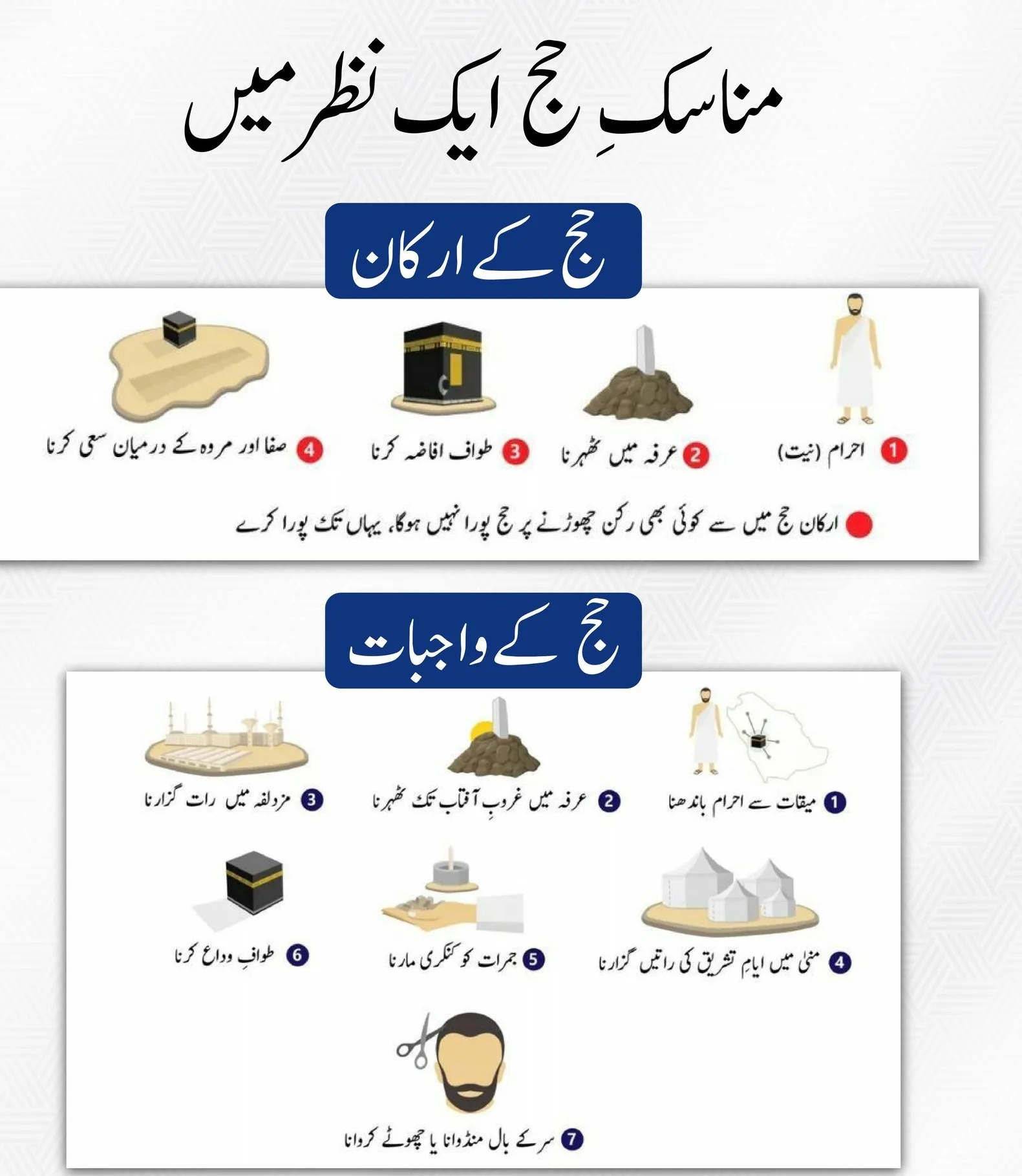
◈Pillars of Hajj
① Ihram
② Tawaf Al-Ifadah (Tawaf Al-Ziyarah)
③ Staying at Arafat
④ Sa’i between Safa and Marwah
◈Obligations of Hajj
① Wearing Ihram from Miqat (or Hal or one's home)
② For those arriving during the day, staying in Arafat until sunset
③ Spending the night in Muzdalifah until the dawn light; women and weak people may leave Muzdalifah (valley) after midnight.
④ Spending the nights of the Days of Tashreeq (10th, 11th) in Mina.
⑤ Throwing pebbles at the Jamrah and Jamarat during the Days of Tashreeq.
⑥ Shaving or trimming the hair.
⑦ Farewell Tawaf
Important Note: On the following pages, some symbols have been used to differentiate between Rukn, Wajib, and Sunnah, detailed as follows:
⋆ ⋆ ⋆ Three stars indicate that the phrase mentions a Rukn.
⋆ ⋆ Two stars indicate something Wajib.
⋆ One star indicates Sunnah.
Please consider this carefully. Remember that if a Rukn is missed, then the Hajj will not be valid. And if any of the Wajibat are missed, then a Dam (sacrifice) becomes obligatory. That is, it will be necessary to slaughter a goat and distribute it among the poor in the Haram.
On the eighth of Dhu al-Hijjah, the pilgrim will perform the following actions:
⋆ For the one performing Tamattu‘ (the one who performs Umrah followed by Hajj), it is recommended before donning the Ihram and making the intention for Hajj to take a bath and clean thoroughly, trim the nails, trim the mustache, and wear two white sheets—one as a waist wrapper and the other as an upper garment. A woman may wear whatever clothing she wishes but should not wear gloves or a face veil (niqab or burqa).
Those performing Qiran and Ifrad have already donned the Ihram, so they will not trim their nails, etc., like the one performing Tamattu‘.
⋆ After sunrise, on this day, make the intention for Hajj by donning the Ihram from the place where you are staying (in Makkah). ⋆ ⋆ Then say ”لبيك حجا“ "O Allah! I am present with the call of Hajj." This is called the Talbiyah of Hajj.
⋆ If you fear that for some reason you might be unable to perform Hajj, then while saying the Talbiyah, make your Hajj conditional by reciting the following words:
”فإن حبسني حابس فمحلي حيث حبستني“ "So if something prevents me, then the place where I am stopped is the place for me to remove my Ihram."
If there is no fear (or apprehension), do not recite these words because the Prophet ﷺ did not make his Hajj conditional by reciting these words.
⋆ ⋆ After making the intention for Hajj, it is obligatory to avoid all prohibited acts during Ihram.
See Mahzurat al-Ihram (Prohibited acts during Ihram)
Reference: p33
⋆ Then recite the following Talbiyah (call):
”لبيك اللهم لبيك، لبيك لا شريك لك لبيك ، إن الحمد والنعمة لك والملك لا شريك لك“
"O Allah, I am present, I am present, You have no partner, indeed all praise, all blessings, and sovereignty belong to You alone, You have no partner."
This Talbiyah will continue until the stoning of Jamarat al-Aqaba on the tenth of Dhu al-Hijjah.
Then, saying Talbiyah, you will go to Mina, where you will shorten the Zuhr and Asr prayers and the Maghrib and Isha prayers at their respective times; you will not combine them.
All pilgrims, whether residents of Makkah or coming from outside, will shorten their prayers.
⋆ The Prophet ﷺ did not pray the other Sunnah prayers during travel except the two Sunnah of Fajr and Witr.
⋆ It is necessary to adhere to the remembrance and supplications after prayers, the morning and evening remembrances, and the remembrances before sleeping, as established from the Prophet ﷺ.
⋆ Then spend this night in Mina.
◈Mistakes of People on the Eighth (8th) Day of Dhu al-Hijjah
① Many pilgrims come to perform Hajj and, following others, perform the rituals of Hajj without consulting the scholars about the issues of Hajj. It is as if they are saying through their actions: I saw people doing this, so I did it too, although this is a great ignorance. Such a person is not excused in his mistake, because Allah Almighty says:
﴿فَاسْأَلُوا أَهْلَ الذِّكْرِ إِن كُنتُمْ لَا تَعْلَمُونَ﴾
If you do not know, ask those who possess knowledge.
Reference: (16-An-Nahl:43)
② Many pilgrims keep their right shoulder uncovered from the 8th of Dhu al-Hijjah until the end of Hajj, although this is incorrect; uncovering the right shoulder is Sunnah only during the first Tawaf (Tawaf al-Qudum).
③ Some women think that there is a specific color, such as green, prescribed for Ihram. However, this belief is based on ignorance and error. Avoiding ornamental and showy clothes, a woman should make the intention of Ihram in her usual lawful clothes; however, wearing gloves and a face veil is prohibited.
④ Some pilgrims shave or trim their beards before Ihram (less than a fistful), and some keep their izar (and shalwar) hanging below the ankles. Such actions, which are against the Shariah, reduce the reward of Hajj.
⑤ Some pilgrims believe in not spending the night in Mina on the 8th of Dhu al-Hijjah and instead go to Arafat on the same day. This act is against the Sunnah.
⑥ Many pilgrims keep asking Allah for supplications whose meanings and implications they do not know because they come across many unauthentic books of supplications and remembrances. The Sunnah is to ask Allah only for those supplications that are proven from the Book and Sunnah, whose meanings are known, and from which one hopes for acceptance by Allah.
⑦ For a Muslim, making intention with the tongue is not Sunnah because the place of intention is the heart (not the tongue). However, when a person intends to perform Hajj or Umrah, it is Sunnah for him to say the words ”لبيك عمرة“ or ”اللهم لبيك عمرة“ and similarly ”لبيك حجا“ or ”اللهم لبيك حجا“ aloud after donning the Ihram; this practice is proven from the Prophet ﷺ. There is no Sunnah to make intention verbally in prayer, Tawaf, etc. Therefore, one should never say, "I intend to pray in such and such a way," or "I intend to perform Tawaf in such and such a way." Making intention verbally is an innovation, and doing this loudly is a very bad and grave sin.
Reference: See At-Tahqiq Walā Idhāh p. 15
⋆ When you have performed the Fajr prayer (in Mina) and the sun has risen, proceed towards Arafat while loudly saying Labbaik and Takbeer.
”الله أكبر لا إله إلا الله والله أكبر الله أكبر ولله الحمد“
⋆ Fasting on this day is disliked because the Prophet ﷺ did not fast on this day. When a cup of milk was brought to the Prophet ﷺ, he drank it in front of the people.
⋆ It is Sunnah that if possible, you stay in Nimrah (a valley adjacent to Arafat) until the Zuhr Adhan.
⋆ Here (in Masjid Nimrah) there will be a sermon, after which two Rak'ahs each of Zuhr and Asr will be offered together with Jam' Taqdeem, with one Adhan and two Iqamahs. (You should also pray in this manner.) There are no Nafl prayers before, between, or after these two prayers.
⋆ ⋆ Or you may enter Arafat. Make sure carefully that you have entered the boundaries of Arafat because the valley of Arnah is not within Arafat. (Remember that a large part of Masjid Nimrah is not inside Arafat.)
⋆ Prepare yourself for the remembrance of Allah, supplicating earnestly and with heartfelt humility.
For some supplications and remembrances see
Reference: pp. 71 to 74
.⋆ Arafat is entirely the standing place (Mawqif) for Hajj.
If possible, stand under the rocks of Jabal Rahmah. It is preferable if Jabal Rahmah and the Qiblah (Ka'bah) are in front of you. ⋆ Climbing the mountain is not Sunnah. Ignorant people keep climbing Jabal Rahmah.
⋆ Face the Qiblah, raise your hands, and supplicate with humility and concentration until sunset. Do not spend this time in heedlessness, joking, or sleeping; seek safety only from Allah.
⋆ Recite ”لا إله إلا الله وحده لا شريك له ، له الملك وله الحمد ، وهو على كل شيء قدير“ abundantly, and also keep reciting Talbiyah (Labbaik) and sending blessings upon the Prophet ﷺ.
For the power of supplication see
Reference: p. 67
.⋆ ⋆ Do not leave the plain of Arafat before the sun sets.
(Leaving Arafat before sunset is forbidden because it is against Sunnah and is among the customs of ignorance. According to the majority, whoever leaves Arafat before sunset must pay Fidya Dam, which should be distributed among the poor of the Haram of Makkah.)
⋆ The Messenger of Allah ﷺ said: ”ما رئي الشيطان يوما هو فيه أصغر ولا أدحر ولا أحقر ولا أغيظ منه فى يوم عرفة وما ذاك إلا لما رأى من تنزل الرحمة وتجاوز الله عن الذنوب العظام ...“
Except for the day of Arafat, the devil has never been seen so small, humiliated, despised, and angry. The reason is that he sees mercy descending and Allah forgiving the great sins of His servants. This has been narrated by Imam Malik in Al-Muwatta.
Reference: Al-Muwatta 422/1 973, its chain is weak, no Risalah, and the hadith is very weak according to Al-Hakim; see Shu'ab al-Iman by Al-Bayhaqi 4070. This narration is weak.
⋆ ⋆ After sunset, proceed gently and calmly from Arafat towards Muzdalifah. If you find an open space, walking a little faster there is Sunnah.
⋆ ⋆ It is Sunnah to shorten the prayers in Muzdalifah, offering three Rak'ahs of Maghrib and two Rak'ahs of Isha. Do not offer any Nafl prayers before or after these, only Witr.
If you fear that due to crowds or other reasons you will not reach Muzdalifah before midnight, it is necessary to pray both prayers on the way. It is very important to pray at their proper times.
⋆ ⋆ Then sleep in Muzdalifah until morning. For weak people and women, it is permissible to leave Muzdalifah for Mina after midnight. It is better that they depart after midnight.
◈ Nine (9) Mistakes People Make on the Day of Dhu al-Hijjah
① Some pilgrims stay outside the boundaries of Arafat; whoever does this and does not enter Arafat by the morning of the day of sacrifice (the next day), their Hajj will be invalid. They must complete this ongoing Hajj, and if it is a mandatory Hajj, they must perform Hajj again the following year.
② Some pilgrims fast on this day. (This is a wrong act)
③ Some people unnecessarily make an effort to go near Jabal Rahmah and try to climb it.
④ Some people waste time on the day of Arafat by engaging in laughter, frivolous talk, and sleep (etc.). These people miss out on supplication and remembrance.
⑤ It should also be noted that some pilgrims keep taking pictures (photos) to make souvenirs, and they call them souvenir pictures. This is a reprehensible (extremely bad) act.
⑥ Many pilgrims run fast and drive vehicles quickly while returning from Arafat, even though it is known that the Messenger of Allah ﷺ commanded at this place ”السكينة السكينة“ meaning "Take rest, take rest."
Reference: See Sahih Muslim 1272
⑦ Some people do not face the Qibla while praying in Muzdalifah.
⋆ ⋆ Except for women and weak men, it is necessary for all pilgrims to perform the morning prayer in Muzdalifah. Women and weak men are permitted to leave Muzdalifah for Mina after the moon has disappeared.
⋆ After completing the morning prayer and the subsequent remembrance and supplications, one should face the Qibla and praise Allah. Takbirs and the declaration of "La ilaha illallah" should be recited, and prayers should be made until there is ample daylight (as much as possible).
⋆ Then, saying "Labbaik" calmly, one should depart towards Mina before sunrise.
⋆ When you reach the valley of "Mahsar" between Muzdalifah and Mina, walk briskly if possible.
⋆ Wherever you see pebbles in Muzdalifah or Mina, pick up seven pebbles and, while saying Takbir and Labbaik, continue walking towards Jamarat al-Aqaba.
Allama Ibn Uthaymeen (may Allah have mercy on him), citing a hadith from Ibn Majah
Reference: (3029 with authentic chain)
and Sunan an-Nasa'i
Reference: (268/5, Hadith 3095)
, wrote that pebbles should be taken from near Jamarat al-Aqaba. See Ash-Sharh al-Mumti'
Reference: (317/7)
. It is permissible to throw the pebbles again at the Jamarat that have already been hit.
Reference: (Ash-Sharh al-Mumti' 323/7)
. Washing the pebbles is an innovation (bid'ah).
Reference: (ibid. 7/318)
/ TranslatorThen perform the following:
⋆ ⋆ Throw seven pebbles one by one at Jamarat al-Aqaba.
According to Allama Ibn Uthaymeen (may Allah have mercy on him), it is permissible for women and the weak to throw pebbles before sunrise. See
Reference: Ash-Sharh al-Mumti' (327/7)
/ TranslatorSay "Allahu Akbar" with each pebble thrown.
Stop saying Labbaik near Jamarat al-Aqaba.
⋆ ⋆ Sacrifice your offering and, if possible, eat its meat yourself and also distribute it among the poor and needy. Remember that sacrifice is obligatory for those performing Tamattu' and Qiran. It is not obligatory for those performing Ifrad.
At the time of slaughtering (and when slaughtering camels), recite ”بسم الله والله أكبر، اللهم هذا منك ولك اللهم تقبل مني“, meaning: "In the name of Allah, Allah is the Greatest. O Allah, this is from You and for You. O Allah, accept my sacrifice."
⋆ ⋆ Then shave your entire head or shorten all the hair. Shaving the head is preferable. Start from the right side. Women should cut a few fingers' length of their hair. This completes your first release (Tahallul Awwal). You may remove your Ihram and wear your clothes and apply perfume, if available.
Except for intercourse with your wife, all other prohibitions of Ihram are now lifted (this is called Tahallul Awwal).
Tawaf al-Ifadah (Tawaf al-Ziyarah) and if Sa'i is obligatory on you, you cannot have intercourse with your wife before completing these two rites. If a man has intercourse with his wife after throwing pebbles at Jamarat al-Aqaba, his Hajj is valid but he must offer a penalty (dam).
⋆ ⋆ ⋆ After that, go to Makkah and perform Tawaf of the Ka'bah without running or brisk walking (Raml), and pray the two Rak'ahs of Tawaf.
⋆ ⋆ ⋆ Then perform Sa'i. Sa'i is obligatory for those performing Tamattu'. Similarly, if those performing Qiran or Ifrad did not perform Sa'i during Tawaf al-Qudum, it becomes obligatory for them to perform Sa'i now.
This completes the second release (Tahallul Thani) (now intercourse with your wife is permissible).
⋆ If some of these actions (such as throwing pebbles, shaving the head, sacrificing) occur out of order, there is no harm.
Reference: For evidence see Sahih al-Bukhari: 1721-1732 and Sahih Muslim: 1307
⋆ Then drink Zamzam water and, if possible, perform the Zuhr prayer in Makkah (at the Ka'bah).
⋆ Then it is obligatory to spend the remaining nights in Mina.
Warning: On this day, do not forget to repeatedly say ”الله أكبر لا إله إلا الله والله أكبر الله أكبر ولله الحمد“ after every prayer. Remember that many ways of saying Takbir are established from the practices of the Salaf.
◈Ten (10) Mistakes People Make on the Day of Dhu al-Hijjah
① Some pilgrims offer the morning prayer in Muzdalifah before its prescribed time, which is a grave mistake and a violation of Allah’s limits because praying before the time is forbidden.
② Some pilgrims are lazy in stoning the Jamrah Aqabah and throw stones from a distance, which sometimes do not even fall into the basin.
③ Some pilgrims think that by throwing stones they are hitting Satan; this is ignorance and error because stoning is following the Sunnah of the Prophet ﷺ and establishing the remembrance of Allah, as mentioned in authentic hadith.
④ Many pilgrims shave their beards after stoning (by going to the barber). This forbidden act carries double sin in Hajj.
⑤ Some people avoid performing nawafil (voluntary prayers), giving charity, greeting Muslims, smiling, and pleasing each other on this day, even though it is Eid. On this day, Allah completed His religion and perfected His favor upon the Muslims (therefore, it is a day of joy and abundant good deeds).
⑥ Some pilgrims do not observe the Shariah conditions for the sacrificial animals (and keep slaughtering all kinds of animals, even if their slaughter is Shariah-wise prohibited).
The fatwas of the Saudi Arabia’s (Official Fatwa Committee) "Permanent Committee" state:
The essential conditions for the sacrifice of Eid al-Adha are also mandatory for the sacrifice of Hajj. Clearly, the sacrifice of a blind animal, a clearly sick animal, a lame animal, and an extremely old weak animal is not permissible. The minimum age for a goat is six months (it is proven from an authentic hadith in Sahih Muslim
Reference: (1963)
that the sacrificial animal should be musinnah (two-toed)), one year for a sheep, two years for a cow, and five years for a camel. Sacrificing an animal younger than this age is not permissible whether it is Eid al-Adha or the sacrifice of Hajj.
Reference: (Number: 2897 in 1400/3/12 AH)
⑦ Some slaughterers (and butchers) are not praying. Such sacrifice is not accepted by Allah but is considered "unlawful slaughter" (ذبیحہ خبیثہ).
(There are four conditions in Shariah for slaughter and sacrifice; see Sheikh Saleh Al-Fawzan’s book "Al-Dhakah Al-Shar’iyyah wa Ahkamaha").
The Sunnah is that you slaughter with your own hand. Allah’s command is ﴿فصل لربك وانحر﴾ "Pray to your Lord and sacrifice."
Reference: (Surah Al-Kawthar:2)
⑧ It is not permissible to slaughter the sacrifice outside the boundaries of the Haram, for example in Arafat, Jeddah, etc., even if the meat is later distributed inside the Haram. Whoever does this must offer another sacrifice within the Haram boundaries, whether he was ignorant or knowledgeable at the time of slaughter outside the Haram. Then he may distribute the meat of that sacrifice.
⑨ The days for sacrifice are limited, i.e., Eid and the following three days; one should not exceed these days. (Sacrifice should be done within the days of sacrifice. The preferred opinion is that there are three days for sacrifice: Eid al-Adha and the two days following it,
Reference: see Muwatta Imam Malik 487/2 Hadith 1071
from Abdullah bin Umar, may Allah be pleased with them both, with an authentic chain).Warning: If a person performing Tamattu’ Hajj is not able to afford the sacrifice, it is obligatory for him to fast ten days. Three of these fasts should be during the days of Hajj, i.e., from 1st Dhu al-Hijjah to 13th Dhu al-Hijjah. According to Allama Ibn Uthaymeen, such a person may fast before leaving for Hajj (at his home) from 1st Dhu al-Hijjah onward.
Reference: See Ash-Sharh Al-Mumti’ 92/7
⋆ ⋆ It is obligatory to stay (reside) in Mina on this night.
⋆ ⋆ During the stay in Mina, observe all five prayers in congregation.
(Make every effort to get a place in the first row. During these days, listen carefully to the lessons of the scholars. This is a great opportunity for you, as scholars from different countries come and meet each other during this season.)
⋆ Remember that these days are called the Days of Tashreeq.
The Messenger of Allah, peace be upon him, said:
”أيام التشريق أيام أكل وشرب وذكر الله“
The Days of Tashreeq are days for eating, drinking, and remembering Allah.
Reference: (Sahih Muslim: 1141)
On these days, it is Sunnah to say Takbir abundantly after the prayers. In any case, keep saying Takbirs while walking on the roads and in the markets.
⋆ After Zuhr (i.e., after midday), one should throw pebbles at all three Jamarat. You can pick twenty-one (21) pebbles from any place in Mina.
⋆ ⋆ First, throw seven pebbles at the small Jamrah (Jamarah Sughra), then seven pebbles at the middle Jamrah (Jamarah Wusta), and finally seven pebbles at the large Jamrah (Jamarah Aqaba).
Throw the seven pebbles one by one, saying Allahu Akbar each time you throw a pebble.
⋆ The Sunnah for throwing pebbles at Jamarah Sughra and Jamarah Wusta is to face the Qiblah and throw the pebbles at the Jamrah from the front, then move a little forward away from the crowd, face the Qiblah, and make a long supplication. Abdullah bin Umar, may Allah be pleased with them both, used to supplicate after throwing pebbles at both Jamarat for as long as it takes to recite Surah Al-Baqarah.
Reference: See Fath al-Bari 584/3 Hadith 1753, and Ibn Abi Shaybah, modern edition 283/3 Hadith 14340 with strong chain
⋆ When throwing pebbles at Jamarah Aqaba, keep the Ka'bah on your left and Mina on your right, then throw the pebbles and leave without staying for supplication because the Messenger of Allah, peace be upon him, did not stay here for supplication.
Benefit: For a healthy person, it is not permissible to appoint a representative (Wakil) to throw the pebbles. Whoever has the strength to throw the pebbles must do it himself. However, if for some reason he is unable to throw the pebbles himself, whether day or night, then appointing a representative for throwing the pebbles is permissible.
⋆ ⋆ Then spend the night in Mina.
◈Eleven (11) Mistakes People Make on the Days of Dhu al-Hijjah
① It is wrong to throw pebbles before the time of stoning. Whoever throws pebbles before the time of stoning, a dam (sacrifice) is obligatory on him, unless he throws pebbles again after the time of stoning, then no dam (etc.) is required on him.
② A common mistake is that many people do the opposite, i.e., they first throw pebbles at Jamarat al-Aqaba, then at Jamarat al-Wusta, and then at Jamarat al-Sughra. Whoever does this must throw the pebbles again in the correct order. In this case, only the pebbles thrown at Jamarat al-Sughra will be counted (and the other two will be wasted).
③ Some people try very hard to hit the pillar installed in the pool exactly, even though this pillar is made solely as a symbol for throwing pebbles.
④ Throwing all the pebbles at once will count as only one pebble. (It is necessary that the pebbles be thrown one by one.)
⑤ Throwing pebbles from a distance and not being sure whether they have fallen into the pool is wrong. Know that if the pebbles fall into the pool and then fall out, there is no harm.
⑥ Some people waste time on useless things, whereas Allah the Exalted says:
﴿فَإِذَا قَضَيْتُم مَّنَاسِكَكُمْ فَاذْكُرُوا اللَّهَ كَذِكْرِكُمْ آبَاءَكُمْ أَوْ أَشَدَّ ذِكْرًا ۗ فَمِنَ النَّاسِ مَن يَقُولُ رَبَّنَا آتِنَا فِي الدُّنْيَا وَمَا لَهُ فِي الْآخِرَةِ مِنْ خَلَاقٍ﴾
When you have completed your rites, remember Allah like your remembrance of your forefathers or with even greater remembrance. Among the people are those who say: O Allah! Give us in this world (much), such a person will have no share in the Hereafter.
Reference: (2-Al-Baqarah:200)
⋆ ⋆ On this day, it is obligatory for you to spend the night in Mina.
⋆ Spend this time in good deeds, remembrance of Allah, and kindness towards creatures.
⋆ ⋆ After Zuhr, throw pebbles at the three Jamarat, just as you did on the 11th of Dhu al-Hijjah. First at Jamarat al-Sughra, then Jamarat al-Wusta, and then Jamarat al-Kubra.
⋆ After throwing pebbles at Jamarat al-Sughra and Jamarat al-Wusta, pause for supplication.
⋆ After throwing pebbles, if you wish to leave Mina and travel, it is permissible.
⋆ ⋆ If you intend to leave Mina today, depart before sunset (if a person stays in Mina until evening without attempting to leave, it becomes obligatory for him to spend the night in Mina and only depart after throwing the pebbles the next day.
Reference: See Muwatta Imam Malik (407/1), Al-Sunan al-Kubra by Al-Bayhaqi (152/5), and Al-Sharh al-Mumti’ (361/7)
. If due to some excuse he is late in attempting to leave, then it is not obligatory for him to stay in Mina.) And if you intend to travel from Mecca, perform the Farewell Tawaf.⋆ It is preferable for the pilgrim to spend one more night in Mina and depart after throwing the pebbles after Zuhr the next day.
Allah the Exalted says: ﴿فَمَن تَعَجَّلَ فِي يَوْمَيْنِ فَلَا إِثْمَ عَلَيْهِ وَمَن تَأَخَّرَ فَلَا إِثْمَ عَلَيْهِ ۚ لِمَنِ اتَّقَىٰ﴾
Whoever returns within two days, there is no sin upon him; and whoever returns on the third day, there is no sin upon him. This is for him who fears Allah.
Reference: (2-Al-Baqarah:203)
The Messenger of Allah (peace and blessings be upon him) departed on the third day, and there is also reward for throwing the pebbles on the third day.
⋆ During the days of Tashreeq, if possible, perform all prayers in the Mosque of Al-Khaif in Mina, because seventy Prophets have prayed in this mosque. See Sheikh Muhammad Nasiruddin al-Albani’s book "Manasik al-Hajj wal-Umrah"
Reference: (127/41)
⋆ ⋆ Spend the night of 12th Dhu al-Hijjah in Mina.
⋆ ⋆ After Zuhr, throw pebbles at all three Jamarat in the same manner as done on the previous two days.
⋆ ⋆ When you wish to leave Makkah and return to your home, perform the Farewell Tawaf; it is not obligatory for menstruating women and women who have recently given birth to perform the Farewell Tawaf.
With this, the rituals of Hajj are completed. والله الحمد والمنه
[Praise be to Allah, the translation is complete, 12th Dhu al-Hijjah 1425 AH at Mina, Makkah al-Mukarramah / Z Zubair Ali Zai]
Mistakes of People on 12th and 13th Dhu al-Hijjah
① Some people leave their staying places at the Hajj sites (such as Mina, Arafat, and Muzdalifah) dirty and uncovered, without any regard for cleanliness. This behavior is completely against Islamic etiquette.
② Some people return from Mina on the 11th of Dhu al-Hijjah without any valid excuse, whereas it is better to spend one more night and then on the 13th of Dhu al-Hijjah throw pebbles at the Jamarat and return.
Allah the Exalted says: ﴿فَمَن تَعَجَّلَ فِي يَوْمَيْنِ فَلَا إِثْمَ عَلَيْهِ وَمَن تَأَخَّرَ فَلَا إِثْمَ عَلَيْهِ ۚ لِمَنِ اتَّقَىٰ﴾
So whoever hastens to leave on the second day (12th of Dhu al-Hijjah), there is no sin upon him; and whoever delays (until the 13th of Dhu al-Hijjah), there is no sin upon him - for him who fears Allah.
Reference: (Surah Al-Baqarah: 203)
This verse and the practice of the Messenger of Allah (peace be upon him) are evidence that returning on the 13th of Dhu al-Hijjah is preferable. The Prophet (peace be upon him) said: ”خذوا عني مناسككم“ Take the method of Hajj from me.
③ Some pilgrims think that the Hajj of the Prophet’s Mosque or its completion is related to Hajj, so they consider visiting the Prophet’s Mosque obligatory and definitely go to Madinah Munawwarah. The correct understanding is that visiting the Prophet’s Mosque is a Sunnah whether during Hajj or throughout the year, and this visit has no relation to the completion of Hajj. One prayer in the Prophet’s Mosque is equal to a thousand prayers. Therefore, the purpose of the journey should be to pray here. After prayer, it is recommended to visit the graves of the Messenger of Allah (peace be upon him) and his two companions: Abu Bakr and Umar (may Allah be pleased with them). It is recommended to send salutations and blessings here. After that, it is recommended to go to the Quba Mosque to pray. Then visiting Baqi’ al-Gharqad (the cemetery) is recommended, where the graves of the Companions (may Allah be pleased with them) are located; it is recommended to send salutations and pray for the deceased there. Then go to Uhud to visit the graves of the martyrs and pray for them.
Remember that seeking help from the deceased (whether Prophets or martyrs) and calling upon them for help is major shirk (polytheism), and all good deeds are nullified by it.
❀Ways to Earn Rewards
Allah Almighty says: ﴿وَالَّذِينَ آمَنُوا أَشَدُّ حُبًّا لِّلَّهِ﴾
And the believers love Allah the most.
Reference: (2-Al-Baqarah:165)
● Try to follow all the Sunnahs of the Prophet Muhammad (peace be upon him) that are proven from the hadiths.
● Greet everyone you meet (in Makkah or Madinah), whether you know them or not, with "As-Salamu Alaikum" and approach them with a smiling face.
● Feeding and serving the pilgrims and doing good to them is a rewarding act.
● If a pilgrim causes you any trouble, be patient and do not respond harshly.
● Helping the weak and advising the ignorant person with wisdom and the best admonition is a great virtue.
● Distributing the best scholarly and beneficial books and cassettes.
● Praying for all Muslims around the world.
● Wishing well for everyone and advising them by enjoining good and forbidding evil.
● Avoid criticizing and backbiting people with an open heart.
Especially, one should not curse the preachers and Muslim rulers (who enforce Islam), but rather pray for their well-being, health, and success in this world and the Hereafter.
● When you act gently, you will receive Allah’s mercy. The Prophet Muhammad (peace be upon him) said: ”رحم الله رجلا سمحا إذا باع وإذا اشترىٰ وإذا اقتضى“ Allah has mercy on the person who is gentle when buying, selling, and deciding.
Reference: (Al-Bukhari: 2076)
❀Our Need: Prayer to Allah
Allah Almighty said: ﴿وَقَالَ رَبُّكُمُ ادْعُونِي أَسْتَجِبْ لَكُمْ ۚ إِنَّ الَّذِينَ يَسْتَكْبِرُونَ عَنْ عِبَادَتِي سَيَدْخُلُونَ جَهَنَّمَ دَاخِرِينَ﴾
And your Lord says, "Call upon Me; I will respond to you. Indeed, those who disdain My worship (du'a) will enter Hell humiliated."
Reference: (40-Ghafir:60)
And He said: ﴿ وَإِذَا سَأَلَكَ عِبَادِي عَنِّي فَإِنِّي قَرِيبٌ ۖ أُجِيبُ دَعْوَةَ الدَّاعِ إِذَا دَعَانِ﴾
And when My servants ask you concerning Me, indeed I am near. I respond to the invocation of the supplicant when he calls upon Me.
Reference: (2-Al-Baqarah:186)
The command of Allah Almighty is: ﴿أَمَّن يُجِيبُ الْمُضْطَرَّ إِذَا دَعَاهُ وَيَكْشِفُ السُّوءَ﴾
Is there any deity besides Allah who responds to the desperate one when he calls upon Him and removes adversity?
Reference: (27-An-Naml:62)
The Messenger of Allah (peace be upon him) said: ”إن ربكم حي كريم يستحيي من عبده إذا رفع يديه إليه أن يردهما صفرا“
Indeed, your Lord is shy and merciful; when a servant raises his hands to Him, He is shy to return them empty.
Reference: (Hasan, narrated by Tirmidhi: 3556, and he said: Hasan Ghareeb, Abu Dawood: 1488, Ibn Majah: 3865, see Al-Misbah 2244 / Translator)
The Prophet (peace be upon him) said: ”إنه من لم يسأل الله تعالىٰ يغضب عليه“
Indeed, whoever does not ask Allah, Allah becomes angry with him.
Reference: (At-Tirmidhi (3373) and Ibn Majah (3827) and it is a Hasan hadith / Translator)
The Prophet (peace be upon him) said: ”الدعاء هو العبادة“
Du'a (supplication) itself is worship.
Reference: (Abu Dawood (1479) and Tirmidhi (2969) and he said: Hasan Sahih, Sahih Ibn Hibban (Mawarid: 2396), Al-Hakim (490/1, 491) and Al-Dhahabi agreed and it is a Sahih hadith)
The Noble Prophet (peace be upon him) said to Abdullah bin Abbas (may Allah be pleased with them):
”يا غلام: إني أعلمك كلمات: احفظ الله يحفظك، احفظ الله تجده تجاهك، إذا سألت فاسأل الله وإذا استعنت فاستعن بالله، واعلم أن الأمة لو اجتمعت على أن ينفعوك بشيء لم ينفعوك إلا بشيء قد كتبه الله لك وإن اجتمعوا على أن يضروك بشيء لم يضروك إلا بشيء قد كتبه الله عليك، رفعت الأقلام وجفت الصحف“
O boy! I will teach you some things: Remember Allah and He will remember you. Remember Allah and you will find Him in front of you. When you ask, ask only Allah, and when you seek help, seek help only from Allah. And know that if all people gather to benefit you, they will not benefit you except with what Allah has written for you. And if all people gather to harm you, they will not harm you except with what Allah has written against you. The pens have been lifted and the pages have dried.
Reference: (Ahmad (293/1) and Tirmidhi (2516) and the wording, and he said: This is a Hasan Sahih hadith)
It is narrated from (Sayyiduna) Umar (may Allah be pleased with him) that he said: I do not worry about acceptance, but I worry about du'a, because if du'a is made with great humility and insistence, it is accepted.
(I do not know any chain of narration for this statement.)
Therefore, we present to you some etiquettes of du'a so that certainty and conviction of acceptance of du'a may be attained.
The Prophet (peace be upon him) said:
”ادعوا الله وأنتم موقنون بالإجابة واعلموا أن الله لا يستجيب دعاء من قلب غافل لاه“
Call upon Allah in a state where you are certain of the acceptance of your du'a, and know that Allah does not accept the du'a of a heedless and careless heart.
Reference: At-Tirmidhi (3479) and its chain is weak for Salih Al-Mari and it has a weak supporting chain with Ahmad (177/2) and it was mentioned by Shaykh Al-Albani, may Allah have mercy on him, in Sahihah (594)!!
(This narration is weak with all its chains.)◈ Etiquettes of Supplication
① Supplicate to Allah using His beautiful names (Asma' al-Husna).
Allah the Exalted says: ﴿وَلِلَّهِ الْأَسْمَاءُ الْحُسْنَىٰ فَادْعُوهُ بِهَا﴾
And to Allah belong the best names, so call upon Him by them.
Reference: (Surah Al-A'raf: 180)
② Begin with praise and glorification of Allah and sending blessings upon the Prophet Muhammad ﷺ.
③ Supplicate to Allah with sincerity and truthfulness.
④ Be humble and earnest in supplication, and do not insist on immediate acceptance.
⑤ Repeat the supplication three times.
⑥ Ensure that your food, drink, and clothing are lawful (halal).
⑦ Face the Qiblah and raise both hands while supplicating.
⑧ If possible, perform ablution (wudu) before supplicating.
⑨ Supplicate in a low and soft voice.
⑩ Do not supplicate with forced or rhymed (poetic) supplications.
⑪ Do not exceed limits in supplication and do not supplicate for sins or severing ties of kinship.
⑫ Supplicate only to Allah.
My Haji brothers! Among people, some only verbally declare "La ilaha illallah" and "Muhammadur Rasulullah" and consider themselves at a high level of piety, while in reality, they are far from it. Their words and actions contradict their verbal claims. These people commit shirk in worship by asking for help from others besides Allah. The polytheists have no proof for their shirk. Due to their shirk, Allah becomes displeased with them and distances Himself from them. Some people call upon the Prophet Muhammad ﷺ in times of distress, and some call upon Ali Hasan, Husayn (may Allah be pleased with them), Badawi, Jilani, Abatir (and in Pakistan, the one known as Ghore Shah ka Wan wali Sarkar!!), etc., even though all of these are creatures and not owners of benefit or harm.
These supplicators have gone astray from the straight path; they have committed shirk with Allah, the Lord of the worlds.
Reference: (See the book Fiqh al-Du'a by Sheikh Mustafa al-Adawi al-Masri)
Allah says: ﴿وَمَنْ أَضَلُّ مِمَّن يَدْعُو مِن دُونِ اللَّهِ مَن لَّا يَسْتَجِيبُ لَهُ إِلَىٰ يَوْمِ الْقِيَامَةِ وَهُمْ عَن دُعَائِهِمْ غَافِلُونَ.وَإِذَا حُشِرَ النَّاسُ كَانُوا لَهُمْ أَعْدَاءً وَكَانُوا بِعِبَادَتِهِمْ كَافِرِينَ.﴾
And who is more astray than one who calls upon those who will not respond to him until the Day of Resurrection and who are unaware of their supplication? And when the people are gathered on the Day of Resurrection, those (they called upon) will disown them, and they will disown their worship.
Reference: (46-Al-Ahqaf: 5-6)
Supplicate only to Allah and avoid shirk. All praise is for Allah who says: ﴿ادْعُونِي أَسْتَجِبْ لَكُمْ﴾ Call upon Me; I will respond to you.
Reference: (40-Ghafir: 60)
⑬ Supplicate to Allah with a present heart and sincere turning to Him.
⑭ Supplicate with the supplications proven from the Prophet ﷺ that contain the great names of Allah.
◈Some Remembrances and Supplications
The Prophet ﷺ said:
”أفضل ما قلت أنا والنبيون عشية عرفة: لا إله إلا الله وحده لا شريك له، له الملك وله الحمد، وهو علىٰ كل شيء قدير“
The best supplication on the day of Arafat in the last part of the day is لا اله الا الله وحده لا شريك له له الملك وله الحمد وهو على كل شيء قدير which I and the Prophets have asked for.
(Malik in Al-Muwatta
Reference: (422/1 Nahw al-Ma'ani)
and Al-Albani mentioned it in Al-Sahihah
Reference: (1503)
This hadith is weak with all its chains / Translator)⋆ In an authentic hadith, it is mentioned that the Prophet ﷺ said:
”أحب الكلام إلى الله أربع: سبحان الله والحمد لله ولا إله إلا الله والله أكبر“
The best words in the sight of Allah are four سبحان الله والحمد لله ولا اله الا الله and الله اكبر.
Reference: (Muslim: 2137)
⋆ The Prophet ﷺ said:
”كلمتان خفيفتان على اللسان ثقيلتان فى الميزان حبيبتان إلى الرحمن: سبحان الله وبحمده سبحان الله العظيم“
Two words are light on the tongue but heavy on the scale (on the Day of Judgment). They are beloved to the Most Merciful: "SubhanAllahi wa bihamdihi, SubhanAllahi al-‘Azim."
Reference: (Bukhari: 7563 and Muslim: 2694)
The Messenger of Allah ﷺ used to recite the following supplication at times of distress:
”لا إله إلا الله العظيم الحليم لا إله إلا الله رب العرش العظيم، لا إله إلا الله رب السماوات ورب الأرض ورب العرش العظيم“
There is no deity except Allah, the Great, the Forbearing. There is no deity except Allah, the Lord of the Great Throne. There is no deity except Allah, the Lord of the heavens, the earth, and the Great Throne.
Reference: (Bukhari: 6345 and Muslim: 2730)
⋆ The Prophet ﷺ also used to say the following supplication:
”اللهم أصلح لي ديني الذى هو عصمة أمري، وأصلح لي دنياي التى فيها معاشي وأصلح لي آخرتي التى فيها معادي واجعل الحياة زيادة لي فى كل خير واجعل الموت راحة لي من كل شر“
O Allah! Keep my religion firm, and protect all my affairs. O Allah! Make my worldly life good, in which I live, and make my Hereafter good, in which I will live again. O Allah! Make my life a cause for increasing my good deeds and make my death a means of protection from every calamity.
Reference: (Muslim: 2720)
⋆ The Prophet ﷺ said:
”اللهم إني أسألك الهدى والتقى والعفاف والغنى“
O Allah! I ask You for guidance, piety, chastity, and self-sufficiency (contentment).
Reference: (Muslim: 2721)
⋆ ”اللهم إني أعوذ بك من زوال نعمتك وتحول عافيتك وفجأة نقمتك وجميع سخطك“ O Allah! I seek refuge in You from the decline of Your favor, the loss of well-being, sudden punishment, and all forms of Your wrath.
Reference: (Muslim: 2739)
⋆ It is narrated from Aisha (RA) that the Messenger of Allah ﷺ instructed her to say the following supplication:
”اللهم إني أسألك من الخير كله عاجله وآجله، ما علمت منه وما لم أعلم وأسألك الجنة وما قرب إليها من قول أو عمل، وأسألك من خير ما سألك عبدك ورسولك محمد صلى الله عليه وسلم وأعوذ بك من شر ما استعاذ بك منه عبدك ورسولك محمد صلى الله عليه وسلم وأسألك ما قضيت لي من أمر أن تجعل عاقبته رشدا“
O Allah! I ask You for all good, whether immediate or delayed, that which I know or do not know. I ask You for Paradise, and I ask You for every word or deed that brings me closer to Paradise. I ask You for what Your servant and Messenger Muhammad ﷺ asked You for, and I seek refuge in You from what Your servant and Messenger Muhammad ﷺ sought refuge from. O Allah! Make the outcome of what You have decreed for me good.
Reference: (Ibn Majah: 3846 and Ibn Hibban: 2413 and Ahmad: 134/6 and its chains are Hasan)
Note: (Men should use masculine form.)
Keep frequently seeking forgiveness, sincerely repenting and turning to Allah. Ask Allah for the good of this world and the Hereafter. Send abundant blessings upon the Messenger of Allah ﷺ.
The most frequent supplication of the Prophet ﷺ was:
”اللهم آتنا فى الدنيا حسنة وفي الآخرة حسنة وقنا عذاب النار“
O Allah! Make our worldly life good and our Hereafter good, and save us from the punishment of the Fire. (Agreed upon)
Reference: (Bukhari: 6389, 4522 and Muslim: 2690)
Hafiz Ibn Kathir (may Allah have mercy on him) says:
In this supplication, every good of the world is gathered and every evil is removed. Because the good of the world includes every worldly desire such as well-being, a good home, a righteous wife, abundant provision, beneficial knowledge, good deeds, a good mount, and general acceptance, as the hadith commentators and exegetes have explained. There is no contradiction among these blessings. They all are included in the good of the world. As for the good of the Hereafter, its highest degree is entering Paradise and being saved from the hardships of the Day of Judgment. Likewise, easy reckoning and other excellent matters of the Hereafter are included.
Reference: See Tafsir Ibn Kathir 243/1, 244
⋆ For other supplications, see Sheikh Abdul Aziz bin Baz’s book "Al-Tahqiq wal-Iydah"
Reference: (pp. 47-51)
◈ Conclusion
We ask Allah to accept our and your good deeds, and we ask Allah the same supplication that our father Ibrahim and his son Ismail (peace be upon them) asked: ﴿رَبَّنَا تَقَبَّلْ مِنَّا ۖ إِنَّكَ أَنتَ السَّمِيعُ الْعَلِيمُ﴾
O Allah! Accept our supplication. Indeed, You are the Hearing, the Knowing.
Reference: (2-Al-Baqarah:127)
O my dear brother! Along with this, I narrate to you a hadith of the Noble Messenger ﷺ:
”إن الله لا ينظر إلى أجسامكم ولا إلى صوركم ولكن ينظر إلى قلوبكم وأعمالكم“
Indeed, Allah does not look at your bodies or your appearances, but He looks at your hearts and your deeds.
Reference: (Muslim:33/2564, 34 Nahw al-Ma'ani)
Note from the translator: Washing shrouds with Zamzam water is not established from the Salaf as-Salih. Also see Al-Sharh al-Mumti’
Reference: (348/7)
❀ Do not forget to give the following gifts to your loved ones
⋆ Zamzam water (and) Miswak
⋆ Some useful books such as:
①كيف اهتديت إلى التوحيد والطريق المستقيم
and العقيدة الاسلامية / تصنيف شيخ محمد جميل زينو
② ”أربعون نصيحة لإصلاح البيوت“ للشيخ محمد المنجد
③ Sifat Salat al-Nabi ﷺ by Allama Muhammad Nasiruddin al-Albani, may Allah have mercy on him (Note that I have some observations on this book, some hadiths have been authenticated or weakened, and there are errors in fiqh derivations by Sheikh Albani, may Allah have mercy on him / Zubair Ali Zaee)
④ أذكار طرفي النهار by Sheikh Bakr bin Abdullah Abu Zaid
Reference: (Khalid bin Abdullah al-Nasser)
In this chapter, the translator (Sheikh Zubair Ali Zaee, may Allah have mercy on him) presents some necessary and beneficial issues with references:
① Ibrahim Nakha'i (a Tabi'i) states that when people intended to enter Ihram, they used to perform Ghusl (ritual bath).
Reference: (Musannaf Ibn Abi Shaybah, modern edition 407/3, Hadith 5597, and its chain is Hasan)
During the days of turmoil (and war), Sayyiduna Abdullah bin Umar (may Allah be pleased with them) did not perform Ghusl but still declared Talbiyah.
Reference: (Ibn Abi Shaybah, Hadith 5598, and its chain is Sahih)
It is understood that performing Ghusl is preferable, but it is permissible to enter Ihram without Ghusl due to some excuse.
② Qasim (bin Muhammad bin Abi Bakr) states that it is permissible to wear a Hemyan (a pouch or belt for silver coins) during Ihram.
Reference: (Ibn Abi Shaybah 393/3, Hadith 15448, and its chain is Sahih)
Mujahid (a Tabi'i) also considered it permissible.
Reference: (Also: 15453, chain Sahih)
③ Tawus (a Tabi'i), when sleeping in Ihram, used to cover his face up to the hair with cloth.
Reference: (Ibn Abi Shaybah 273/3, Hadith 14244, chain Sahih)
Sayyiduna Uthman (may Allah be pleased with him) covered his face during Ihram.
Reference: (Malik in Al-Muwatta 327/1, Hadith 730, chain Sahih; Ibn Abi Shaybah: 14241, chain Sahih)
Mujahid says one may cover the face due to the blowing wind.
Reference: (Also: 4246, chain Sahih)
Ibrahim Nakha'i also considered it permissible.
Reference: (Also: 14238, chain Sahih)
Sayyiduna Abdullah bin Umar (may Allah be pleased with them) said that one should not cover the face from the chin to the head.
Reference: (Malik 327/1, Hadith 731, chain Sahih)
It is understood that covering the face is permissible in case of necessity, but it is better not to cover the face. And Allah knows best.
④ Sayyiduna Abdullah bin Umar (may Allah be pleased with them) said that the one entering Ihram may apply kohl to the eyes provided it has no fragrance.
Reference: (Ibn Abi Shaybah 335/3, Hadith 14850, chain Sahih)
⑤ Ata bin Abi Rabah held that the one in Ihram may scratch his head if itchy.
Reference: (Ibn Abi Shaybah 344/3, Hadith 4948, chain Sahih)
⑥ Sayyiduna Abdullah bin Abbas (may Allah be pleased with them) said that if a nail is half cut during Ihram, it may be cut and discarded.
Reference: (Ibn Abi Shaybah 129/3, Hadith 12752, chain Hasan)
Saeed bin Jubair also agreed with cutting nails.
Reference: (Also: 12755, chain Hasan)
⑦ According to Ibrahim Nakha'i and Mujahid, if there is toothache during Ihram, one may extract the tooth. Their narrator Mansur (bin Al-Mu'tamir) said that there is no prohibition (such as ruqyah) on the one who extracts a tooth due to illness.
Reference: (Ibn Abi Shaybah 131/3, Hadith 12767, chain Sahih)
⑧ Sayyiduna Abdullah bin Umar (may Allah be pleased with them) said there is no harm in using a miswak during Ihram.
Reference: (Ibn Abi Shaybah 130/3, Hadith 12761, chain Sahih)
That is, miswak is permissible.
This is also the view of Ata bin Abi Rabah.
Reference: (Also: 12764, chain Sahih)
⑨ Sayyiduna Abdullah bin Abbas (may Allah be pleased with them) and Ata bin Abi Rabah considered it permissible to look in a mirror during Ihram.
Reference: (Ibn Abi Shaybah 137/3, Hadith 12843 and 12842, chain Sahih)
Qasim bin Muhammad considered it disliked (makruh).
Reference: (Also: 138/3, Hadith 12845, chain Sahih)
That is, looking in a mirror during Ihram is permissible but disliked. It is better to avoid it. And Allah knows best.
⑩ Saeed bin Jubair used to narrate hadiths and give fatwas to his companions during Tawaf.
Reference: (Ibn Abi Shaybah 135/1, Hadith 12814, chain Sahih)
That is, making du'as, necessary speech, and answering questions during Tawaf is permissible.
After completing Tawaf, one may recite the Qur'an extensively. And Allah knows best.
⑪ Urwah bin Az-Zubair held that during Ihram, one may pour water on the head but should not rub the head with hands, only pass the hands over it.
Reference: (Ibn Abi Shaybah 143/3, Hadith 12904, chain Sahih)
⑫ Muhammad bin Sirin said that if a person kisses his wife during Ihram, he must offer a dam (sacrifice a goat).
Reference: (Ibn Abi Shaybah 136/3, Hadith 12827, chain Sahih)
This is also the view of Imam Zahri.
Reference: (Also: 12823, chain Sahih)
Ata said that he should seek forgiveness.
Reference: (Also: 12826, chain Sahih)
⑬ Sayyiduna Abdullah bin Umar (may Allah be pleased with them) said that smelling perfume during Ihram is disliked.
Reference: (Ibn Abi Shaybah 307/3, Hadith 14604, wording: "It was disliked to smell the perfume of the one in Ihram," chain Sahih)
⑭ Mujahid considered that for those coming from outside Makkah, performing voluntary Tawaf is better than voluntary prayer.
Reference: (Ibn Abi Shaybah 353/3, 354, Hadith 15040, chain Sahih)
This is also the view of Ata bin Abi Rabah.
Reference: (Musannaf Abd al-Razzaq 70/5, Hadith 9027, chain Sahih)
⑮ Ibrahim Nakha'i said that people preferred not to leave Makkah without completing the entire Qur'an recitation.
Reference: (Ibn Abi Shaybah 368/3, Hadith 15182, chain Sahih)
⑯ Sayyida Aisha (may Allah be pleased with her), when in Makkah and intending to perform Umrah, would go to Juhfa (a place outside Makkah) to enter Ihram for Umrah.
Reference: (Ibn Abi Shaybah 146/3, Hadith 12939, chain Sahih)
Sayyiduna Abdullah bin Umar and Sayyiduna Abdullah bin Az-Zubair (may Allah be pleased with them) would go from Makkah to Dhu al-Hulayfah (near Madinah) to enter Ihram for Umrah and then return to Makkah without entering Madinah.
Reference: (Ibn Abi Shaybah 146/3, Hadith 12940, chain Sahih)
It is understood that performing Umrah from Taneem is not preferable.
⑰ Sayyiduna Umar (may Allah be pleased with him) said: Whoever performs Umrah during the months of Hajj and then returns, he is not a Mutamatti' (one who performs Hajj Tamattu').
Reference: (Ibn Abi Shaybah 152/3, Hadith 13004, chain Hasan)
This is also the view of Abu Bakr bin Abi Shaybah.
Reference: (Also: 13003)
That is, such a person may perform Hajj Ifrad or Hajj Qiran, and if he wants to perform Hajj Tamattu', he must perform Umrah again.
⑱ Amir al-Sha'bi (a Tabi'i) considered Umrah in Ramadan as Hajj Asghar (the lesser Hajj).
Reference: (Ibn Abi Shaybah 155/3, Hadith 13027, chain Sahih)
⑲ Ibrahim Nakha'i said that people used to perform only one Umrah in a year.
Reference: (Ibn Abi Shaybah 127/3, Hadith 12729, chain Hasan)
Muhammad bin Sirin also held that only one Umrah should be performed in a year.
Reference: (Also: 12727, chain Sahih)
Although these views are weak, those who perform Umrah from Taneem (Masjid Aisha) are refuted by these views.
⑳ The summary and meaning of a statement of Tawus is that if a person does not say the word Hajj or Umrah while entering Ihram, it does not matter; the intention in the heart is sufficient.
Reference: (Ibn Abi Shaybah 334/3, Hadith 14837, chain Sahih)
This is also the view of Ata bin Abi Rabah and Ibrahim Nakha'i.
Reference: (Also: 14841, chain Sahih; 14843, chain Hasan)
㉑ Sayyiduna Abdullah bin Abbas (may Allah be pleased with them) said that Hajj is the name for: Al-Aj (raising the Talbiyah loudly) and Ath-Thaj (shedding the blood of sacrifice).
Reference: (Ibn Abi Shaybah 354/3, Hadith 15045, chain Sahih)
㉒ If a person mistakenly performs fourteen circuits (instead of seven) during Sa'i, according to one view of Ata bin Abi Rabah, his Sa'i is valid.
Reference: (Ibn Abi Shaybah 386/3, Hadith 15374, chain Sahih)
This is the preferred view.
㉓ According to Hasan Basri, if a person performs six circuits during Tawaf (missing the seventh), he should perform another Tawaf.
Reference: (Ibn Abi Shaybah 426/3, Hadith 15789, chain Sahih)
㉔ Qasim bin Muhammad used to take pebbles from Muzdalifah (the valley) for stoning the Jamarat.
Reference: (Ibn Abi Shaybah 196/3, Hadith 14355, chain Sahih)
㉕ Qasim bin Muhammad used to wash the pebbles.
Reference: (Ibn Abi Shaybah 379/2, Hadith 15298, chain Sahih)
But Ata bin Abi Rabah and Zahri held that pebbles should not be washed.
Reference: (Also: 15300, chain Sahih; 15297, chain Sahih)
This is the preferred view. However, if the pebbles are dirty, it is permissible to wash them or discard them and pick up clean pebbles.
㉖ If a person throws six or five pebbles instead of seven at the Jamarat and leaves, according to Hukm bin Utaybah and Hammad bin Abi Sulayman (two scholars), he must offer a dam (sacrifice a goat).
Reference: (Ibn Abi Shaybah 194/3, Hadith 13437, chain Sahih)
㉗ Qasim bin Muhammad used to throw pebbles from the side where it was easiest to do so.
Reference: (Muwatta Imam Malik 407/1, Hadith 944, chain Sahih)
He also gave this ruling.
Reference: (Ibn Abi Shaybah 192/3, Hadith 13418, chain Sahih)
㉘ Sayyiduna Abdullah bin Abi Awfa (may Allah be pleased with him) and Saeed bin Jubair (may Allah have mercy on him) called the day of sacrifice the "Hajj al-Akbar" (the greater Hajj).
Reference: (Ibn Abi Shaybah 360/3, Hadith 15102, chain Sahih)
Among the common people, it is popular that if Hajj falls on a Friday, it is called Hajj Akbar. I do not know any evidence for this view. And Allah knows best.
㉙ When Sayyiduna Abdullah bin Umar (may Allah be pleased with them) climbed Safa (hill), he would face the Qiblah and say "Allahu Akbar" three times loudly and then supplicate for a long time. ”لا إله إلا الله وحده لا شريك له له الملك وله الحمد وهو علىٰ كل شيء قدير“
Reference: (Ibn Abi Shaybah 415/3, Hadith 156567, chain Sahih)
Qasim bin Muhammad said there is no specific prescribed du'a for Safa and Marwah; one may supplicate with any good du'a.
Reference: (Ibn Abi Shaybah 297/3, Hadith 14496, chain Sahih)
㉚ Saeed bin Jubair, during Tawaf, would face the Black Stone, raise both hands, and say Takbir, while Ata bin Abi Rabah said to say Takbir without raising both hands.
Reference: (Ibn Abi Shaybah 167/3, Hadith 13155, chain Sahih)
㉛ Aswad bin Yazid (a Tabi'i) entered Ihram from Kufa.
Reference: (Ibn Abi Shaybah 122/3, Hadith 12682, chain Sahih)
It is understood that entering Ihram from Islamabad Airport (etc.) is permissible.
㉜ Abu Qulabah (a Tabi'i), when meeting a person who had performed Umrah, would say: ”بر العمل بر العمل "May your deeds be good, may your deeds be good."
Reference: (Ibn Abi Shaybah 428/3, Hadith 15807, chain Sahih)
It is understood that congratulating those who perform Hajj and Umrah is permissible.
㉝ Sayyiduna Abdullah bin Umar (may Allah be pleased with them) said that if a person cannot leave Mina before sunset on the second day of stoning the Jamarat, he should stay in Mina until the next day after Zuhr, then stone the Jamarat and return.
Reference: (Ibn Abi Shaybah 134/3, Hadith 12805, chain Sahih)
㉞ Muhammad bin Sirin said that among the people, after the Prophet Muhammad (peace be upon him), Sayyiduna Abu Bakr and Sayyiduna Umar (may Allah be pleased with them), the greatest scholar of Hajj was Sayyiduna Uthman bin Affan (may Allah be pleased with him), and after him, Sayyiduna Abdullah bin Umar (may Allah be pleased with them).
Reference: (Ibn Abi Shaybah 414/3, Hadith 15671, chain Sahih)
According to Abu Ja'far (Muhammad bin Ali al-Baqir), during the time of the Tabi'in, the greatest scholar of Hajj was Ata bin Abi Rabah.
Reference: (Also: 15673, chain Sahih)
㉟ The summary of a statement of Sayyiduna Anas bin Malik (may Allah be pleased with him) is that the one who goes for Hajj should not say "I am a Haji," but rather say "I am a traveler."
Reference: (Ibn Abi Shaybah 256/3, Hadith 14077, chain Sahih)
㊱ The summary of a statement of Sayyiduna Abdullah bin Amr bin Al-As (may Allah be pleased with them) is that just as doing good deeds in the Haram (Makkah) is greatly rewarded, similarly, committing sins there is greatly punished, meaning the punishment for sins is greater.
Reference: (Musannaf Abd al-Razzaq 28/5, Hadith 8870, chain Sahih)
And Allah knows best.㊲ Sayyida Aisha (may Allah be pleased with her) used to carry Zamzam water with her (to Madinah) and narrated that the Prophet Muhammad (peace be upon him) also used to carry Zamzam water with him.
Reference: (Sunan At-Tirmidhi: 963, chain Sahih; he said: This is a Hasan Gharib hadith)
㊳ On the day of sacrifice (10th Dhu al-Hijjah), the Prophet Muhammad (peace be upon him) said to the Companions (may Allah be pleased with them):
”إن هذا يوم رخص لكم إذا أنتم رميتم الجمرة أن تحلوا يعني من كل ما حرمتم منه إلا النساء، فإذا أمسيتم قبل أن تطوفوا هذا البيت صرتم حرما كهيئتكم قبل أن ترموا الجمرة حتى تطوفوا به“
On this day, you are permitted that if you stone the Jamarat, all restrictions of Ihram and Hajj are lifted except intercourse with your wives (which remains prohibited in this state).
If sunset occurs before you perform Tawaf of the Ka'bah (Tawaf al-Ziyarah), the restrictions of Ihram will return until you perform Tawaf al-Ziyarah, meaning you must enter Ihram again before Tawaf al-Ziyarah.
Reference: (Sunan Abi Dawood: 1999, chain Hasan; authenticated by Ibn Khuzaymah: 2958)
This is an important issue; remember it well.
㊴ The three types of Hajj (Ifrad, Qiran, and Tamattu') are established from the Prophet Muhammad (peace be upon him). None of these types is abrogated or invalid.
The Prophet (peace be upon him) said: ”والذي نفسي بيده، ليهلن ابن مريم بفحص الروحاء حاجا أو معتمرا أو لابيا بهما“
By the One in Whose hand is my soul, indeed (Jesus) son of Mary will come performing Hajj Ifrad or Hajj Tamattu' or Hajj Qiran, coming from the valley of Rihas towards the House of Allah.
Reference: (Sahih Muslim: 252/216, Darussalam: 3030; Al-Sunan al-Kubra by Al-Bayhaqi 2/5)
From this hadith, it is understood that Hajj Ifrad will remain until the Day of Judgment and is not abrogated; therefore, calling it abrogated is wrong and false. Ibn Hazm Zahiri's strange criticism of this authentic hadith is invalid.
Sayyiduna Amir al-Mu'minin Ali bin Abi Talib (may Allah be pleased with him) said to Sayyiduna Amir al-Mu'minin Umar bin Al-Khattab (may Allah be pleased with him):
”من أفرد بالحج فحسن ومن تمتع فقد أخذ بكتاب الله وسنة نبيه صلى الله عليه وسلم“
Whoever performs Hajj Ifrad, it is good, and whoever performs Hajj Tamattu' has followed both the Qur'an and the Sunnah of the Prophet Muhammad (peace be upon him).
Reference: (Al-Sunan al-Kubra by Al-Bayhaqi 21/5, chain Sahih)
㊵ Fatimah bint Al-Mundhir (a Tabi'iyyah, wife of Hisham bin Urwah) said:
”كنا نخمر وجوهنا ونحن محرمات، ونحن مع أسماء بنت أبى بكر الصديق“
We (women) used to cover our faces from men during Ihram, and with us was Asma bint Abu Bakr Siddiq (may Allah be pleased with her).
Reference: (Muwatta Imam Malik 328/1, Hadith 734, chain Sahih)
It is understood that it is better for women to cover their faces from non-mahram men even during Ihram.
㊶ Sayyiduna Abdullah bin Abbas (may Allah be pleased with them) said:
من نسي من نسكه شيئا أو تركه فليهرق دما
Whoever forgets or omits any obligatory act of Hajj or Umrah, he must offer a dam, meaning he must sacrifice a goat and distribute it among the poor in the Haram.
Reference: (Al-Sunan al-Kubra by Al-Bayhaqi 30/5, chain Sahih; Malik in Al-Muwatta 419/1, Hadith 968, chain Sahih)
It is understood that due to deficiency, addition, or change in the order of obligatory acts of Hajj, offering a dam (sacrificing a goat) becomes obligatory.
وما علينا إلا البلاغ
(15 Rabi' al-Thani 1426 AH)
Some Consensus Issues:
Now, from the book "Al-Ijma'" by Imam Abu Bakr Muhammad bin Ibrahim bin Al-Munthir Al-Nisaburi, may Allah have mercy on him (died 318 AH), a translation and explanation of the consensus issues related to Hajj is presented:
◈ Book of Hajj
1/135: It is agreed upon that a man can prevent his wife from going for a voluntary Hajj.
2/136: It is agreed upon that Hajj is obligatory only once in a lifetime. However, if a person vows to perform another Hajj, fulfilling that vow becomes obligatory (fard).
3/137: The authentic hadiths from the Prophet ﷺ regarding the timings of Hajj are established, and the consensus follows them.
4/138: It is agreed upon that if a person assumes Ihram before the Miqat, he is considered in the state of Ihram.
5/139: It is agreed upon that assuming Ihram without performing Ghusl (ritual bath) is permissible.
6/140: It is agreed upon that Ghusl is not obligatory for Ihram. Only Hasan al-Basri and Ata (bin Abi Rabah) differ (this is not a consensus but a difference).
7/141: It is agreed upon that if a person intends to say the Talbiyah for Hajj but mistakenly says the Talbiyah for Umrah, or vice versa, the intention of the heart is accepted; verbal intention is not considered here.
8/142: It is agreed upon that performing Hajj with the intention of Hajj during the months of Hajj (Shawwal, Dhu al-Qi'dah, Dhu al-Hijjah) fulfills the obligation of Hajj.
9/143: It is agreed upon that in the state of Ihram, sexual intercourse, hunting, applying perfume, wearing clothes other than Ihram garments (for men), cutting hair, and trimming nails are prohibited acts.
10/144: Applying kohl (eyeliner) in the state of Ihram is permissible.
11/145: It is agreed upon that if a person has sexual intercourse before reaching Arafat during Hajj, he must offer a sacrifice (a camel) and perform Hajj again the following year; only Ata and Qatada oppose this (thus, the claim of consensus is invalid).
12/146: It is agreed upon that shaving, cutting, pulling out, or destroying hair in any way during Ihram is prohibited.
13/147: It is agreed upon that shaving the head is permissible due to illness (excuse).
14/148: It is agreed upon that a fidya (expiation) is obligatory on the one who shaves the head.
15/149: It is agreed upon that trimming nails is prohibited for the one in Ihram.
16/150: It is agreed upon that if a nail breaks or becomes damaged, it is permissible to cut it.
17/151: It is agreed upon that men in Ihram are prohibited from wearing shirts, turbans, trousers, socks, and caps.
18/152: It is agreed upon that women in Ihram can wear shirts, undergarments (hameez), trousers, dupattas, and socks.
19/153: It is agreed upon that covering the head is prohibited for the one in Ihram.
20/154: It is agreed upon that wearing saffron or yellow perfumed clothes in Ihram is prohibited.
21/155: It is agreed upon that except for some exceptions in clothing, all things prohibited for men in Ihram are also prohibited for women.
22/156: It is agreed upon that if a person in Ihram intentionally hunts, he must offer a penalty (dam), except for a Mujahid; they say if the issue is by mistake or intentionally hunting, the expiation must be paid. If intentionally killing, there is no penalty. Imam Ibn al-Mundhir said: This statement contradicts the verse.
23/157: It is agreed upon that killing an animal while in Ihram necessitates slaughtering a goat.
24/158: It is agreed upon that killing a pigeon in the Haram requires slaughtering a goat. In this matter, Nu'man (Imam Abu Hanifa) is unique; he says its price must be paid.
25/159: It is agreed upon that hunting sea animals, eating fish, selling, and buying them in Ihram is permissible.
26/160: It is agreed upon that killing animals mentioned in authentic hadiths is permissible, but Ibrahim al-Nakha'i alone says killing rats is not permissible.
27/161: It is agreed upon that killing harmful beasts is permissible, and no fidya is required.
28/162: It is agreed upon that killing wolves in Ihram is permissible.
29/163: It is agreed upon that performing Ghusl Janabat (ritual bath after sexual impurity) in Ihram is permissible; only Imam Malik says pouring water on the head in Ihram is disliked.
30/164: It is agreed upon that using a miswak (tooth-stick) in Ihram is permissible.
31/165: It is agreed upon that eating oil, ghee, and fat in Ihram is permissible.
32/166: It is agreed upon that applying oil on the entire body except the head in Ihram is permissible.
33/167: It is agreed upon that a person in Ihram can enter the bathhouse. Only Imam Malik says there is a fidya for this impurity.
34/168: It is agreed upon that prostrating on the Black Stone ((وأجمعوا من حيث أخر الجمار من جمع أجزأه )) is permissible. Only Imam Malik calls it an innovation.
35/169: It is agreed upon that women are not required to run (raml) during Tawaf and between Safa and Marwah; they should walk calmly.
36/170: It is agreed upon that drinking water during Tawaf is permissible.
37/171: It is agreed upon that if a person doubts the number of Tawaf circuits, he should rely on certainty and disregard doubt.
38/172: It is agreed upon that if a person completes some of the seven circuits of Tawaf and stops for prayer, he can resume and complete the remaining circuits later from where he stopped, except Hasan al-Basri who says he should perform Tawaf again.
39/173: It is agreed upon that a person who completes seven circuits of Tawaf and prays two rak'ahs, his prayer is valid.
40/174: It is agreed upon that it is permissible to have a sick person perform Tawaf. Only Ata says the sick person should pay someone else to perform Tawaf on his behalf.
41/175: It is agreed upon that even small children should be made to perform Tawaf.
42/176: It is agreed upon that performing Tawaf outside the Masjid al-Haram is not permissible.
43/177: It is agreed upon that performing Tawaf outside the Saqayah (Zamzam area) is permissible.
44/178: It is agreed upon that the two rak'ahs after Tawaf can be prayed anywhere; only Imam Malik says these two rak'ahs are only permissible at the Hijr.
45/179: It is agreed upon that the hadith of the Prophet ﷺ establishes that praying behind Maqam Ibrahim after Tawaf is correct.
46/180: It is agreed upon that starting Sa'i from Safa and ending at Marwah is Sunnah.
47/181: It is agreed upon that performing Sa'i between Safa and Marwah without ablution is permissible; only Hasan al-Basri says if one remembers before becoming lawful, he should perform Tawaf again (he considers ablution necessary for this).
48/182: It is agreed upon that a person who comes from outside during the months of Hajj, performs Umrah, and stays until Hajj, his Hajj is Hajj al-Tamattu'; if he has money, he will offer sacrifice; otherwise, he will fast ten days.
49/183: It is agreed upon that a person who enters Makkah with the intention of Umrah during the months of Hajj can change his intention to Hajj before becoming lawful (intention can be changed).
50/184: It is agreed upon that a person who spends the night in Mina and reaches Arafat on the day of Arafat has no obligation (nothing is required).
51/185: It is agreed upon that pilgrims can stay anywhere they wish in Mina.
52/186: It is agreed upon that on the day of Arafat, the Imam will combine Dhuhr and Asr prayers in Arafat, and similarly, individuals will also combine these prayers.
53/187: It is agreed upon that staying in Arafat is obligatory; whoever does not reach Arafat, his Hajj is invalid.
54/188: It is agreed upon that whoever reaches Arafat at any time on the day of Arafat or the following night has completed Hajj; only Imam Malik says he will perform Hajj again next year.
55/189: It is agreed upon that if a person reaches Arafat without ablution, his Hajj is valid and no expiation is required.
56/190: It is agreed upon that pilgrims will combine Maghrib and Isha prayers in Muzdalifah.
57/191: It is agreed upon that no voluntary or Sunnah prayers are to be performed during the combined prayers.
58/192: It is agreed upon that collecting pebbles from Muzdalifah and Mina is permissible.
59/193: It is agreed upon that the Prophet ﷺ threw pebbles at Jamarat al-Aqaba after sunrise on the day of sacrifice.
60/194: It is agreed upon that on the day of sacrifice, only Jamarat al-Aqaba is stoned.
61/195: It is agreed upon that it is permissible to throw pebbles at Jamarat al-Aqaba either before or after sunrise on the day of sacrifice; this act is considered fulfilled.
62/196: It is agreed upon that no matter how the pebbles are thrown, if they reach the basin, the act is valid.
63/197: It is agreed upon that throwing pebbles at the Jamarat after the sun's zenith during the days of Tashreeq is valid.
64/198: It is agreed upon that a bald person will have his head shaved with a razor.
65/199: It is agreed upon that women will not shave their heads.
66/200: It is agreed upon that the obligatory (fard) Tawaf is only Tawaf al-Ifadah, i.e., Tawaf al-Ziyarah.
67/201: It is agreed upon that a person who delays Tawaf al-Ziyarah and performs it during the days of Tashreeq has fulfilled the obligation and no expiation is required for the delay.
68/202: It is agreed upon that if a child cannot throw pebbles himself, another person will throw pebbles on his behalf.
69/203: It is agreed upon that cutting hair instead of shaving is also permissible; only Hasan al-Basri says shaving the head is obligatory.
70/204: It is agreed upon that a person who goes to Mina outside the days of Hajj will not shorten his prayers.
71/205: It is agreed upon that a person who leaves Mina after throwing pebbles on the second day and returns to his homeland outside the Haram will throw pebbles after the sun's zenith on the next day before leaving; only Hasan al-Basri and Ibrahim al-Nakha'i oppose this.
72/206: It is agreed upon that if a person has sexual intercourse before Tawaf and Sa'i, his Hajj becomes invalid.
73/207: It is agreed upon that a person who intends Umrah outside the Haram must assume Ihram.
74/208: It is agreed upon that if a person loses hope of reaching Makkah, he can exit Ihram; if he does not exit Ihram and is relieved from hardship, he will perform Umrah or Hajj in that state.
75/209: It is agreed upon that if Hajj is obligatory on a person and he is capable of performing it himself, he must perform it himself; no one else can perform Hajj on his behalf.
76/210: It is agreed upon that men can perform Hajj on behalf of women and women on behalf of men; only Hasan bin Salih considers this disliked.
77/211: It is agreed upon that Hajj is not obligatory on children.
78/212: It is agreed upon that if a mad person or child performs Hajj and later the mad person recovers and the child reaches maturity, they must perform Hajj again.
79/213: It is agreed upon that the expiations for children will be paid from their wealth.
80/214: It is agreed upon that hunting in the Haram is prohibited whether the hunter is in Ihram or not.
81/215: It is agreed upon that cutting trees in the Haram is prohibited.
82/216: It is agreed upon that it is permissible to cut plants grown by people themselves, such as vegetables, grains, and fragrant grass, in the Haram.
Reference: End (Kitab al-Ijma' pp. 48 to 57)

