


This excerpt is taken from the book Masnoon Hajj o Umrah published by Maktaba Darussalam Research Center.
Those performing Hajj Tamattu should, after offering the Fajr prayer on the 8th of Dhu al-Hijjah, assume Ihram from their residence with the intention of Hajj and start reciting Talbiyah while heading towards Mina. Meanwhile, those performing Hajj Qiran or Hajj Ifrad, who have donned Ihram at the Miqat, should also recite Talbiyah when departing for Mina on the 8th of Dhu al-Hijjah.
Time for Departure to Mina:
There is no fixed time for going to Mina. However, one should reach Mina before the Dhuhr prayer.
Reference: Sahih Muslim, Al-Hajj, Hadith: 1218
Staying in Mina and Offering Prayers:
Offer the Dhuhr, Asr, Maghrib, Isha, and Fajr prayers in Mina at their respective times. Also, shorten the Dhuhr, Asr, and Isha prayers; this is the Sunnah of the Prophet Muhammad ﷺ. However, unlike in Muzdalifah and Arafat, the prayers will not be combined here; each prayer should be offered at its prescribed time.
Reference: Sahih Muslim, Al-Hajj, Hadith: 1218
Remember!
It is obligatory for all pilgrims to shorten the Zuhr, Asr, and Isha prayers, whether they reside in Makkah or outside. During the Farewell Pilgrimage, the Prophet ﷺ made all pilgrims pray the shortened prayer without exception and did not order the people of Makkah to perform the full prayer.
Reference: Sahih Muslim, Salat, Hadith: 696
On the contrary, during the conquest of Makkah, the Prophet ﷺ himself prayed the shortened prayer and told the people of Makkah to pray the full prayer because we are travelers.
Reference: Sunan Abi Dawood, Salat al-Safar, Hadith: 1229
Time to Depart for Arafat
On the 9th of Dhu al-Hijjah, one should depart towards the plain of Arafat after sunrise.
Reference: Sahih Muslim, Hajj, Hadith: 1218
Note: A separate walking path has been made for those going from Makkah to Mina and from Mina to Arafat, which is called طَرِيقُ الْمُشَاةِ. Along this path, the Saudi government has arranged cold water at various points.
Issue: Is it preferable to go from Mina to Arafat by vehicle or on foot?
Some people, despite having the convenience of riding, consider the hardship of walking as a means of earning reward and therefore walk on foot. Remember that the Prophet ﷺ traveled this journey on a mount because it is quite a long journey, and upon reaching there, one has to engage in worship and recitation of dhikr and adhkar. A person who goes on foot will never be able to perform the dhikr with full alertness and enthusiasm. Therefore, from both perspectives, riding is preferable and recommended. The majority of scholars also hold this view.
Reference: Al-Da'eef by Al-Albani, Hadith: 495
Practice on the way:
While going from Mina to Arafat: تکبیر:الله اكبر...... تہلیل: لا إِلَهَ إِلَّا الله.... and تلبيه لَبَّيْكَ اللَّهُمَّ لَبَّيْكَ are Sunnah to recite. After the 9th of Dhu al-Hijjah, the Takbeerat of Eid can also be recited from time to time.
Reference: Sahih Muslim, Hajj, Hadith: 1285, 1284
Sunnah practice:
Before entering the plain of Arafat, the Prophet ﷺ rested at Dadi Nimrah [there is now a mosque by this name]. After sunset, he delivered a sermon here, then at the time of Dhuhr, he combined and shortened the Dhuhr and Asr prayers. He did not offer any voluntary prayers in between. After that, he entered the plain of Arafat.
Reference: Sahih Muslim, Hajj, Hadith: 1218
In light of this hadith, pilgrims should stay in Masjid Namirah instead of setting up tents in the plain of Arafat. If there is no space in the mosque, then stay somewhere nearby. Listen to the Hajj sermon here and perform the Zuhr and Asr prayers [in Jam' Taqdeem] in congregation. Afterwards, stand in the plain of Arafat.
Important Issues Regarding Standing at Arafat:
① It is Sunnah to perform Zuhr and Asr prayers in the plain of Arafat by combining and shortening them (Jam' Taqdeem). Performing the full prayers separately is against Sunnah.
② Standing (wuquf) in the plain of Arafat is a fundamental pillar of Hajj. If a person performs all other rites of Hajj but does not stand in the plain of Arafat, then his Hajj will not be valid.
③ If a person arrives late at Arafat and stands even for a short while at any time before Fajr on the night between the 9th and 10th of Dhu al-Hijjah, his Hajj will be valid.
Reference: Sunan an-Nasa'i, Manasik al-Hajj, Hadith: 3019
④ There is no specific designated place for standing (wuquf) in the plain of Arafat. The Holy Prophet ﷺ stood near Jabal al-Rahmah and said: I have stood here, while the entire Arafat is the place of standing [wuquf].
Reference: Sahih Muslim, Hajj, Hadith:1219
Therefore, climbing Jabal al-Rahmah and considering the supplication made there as more important are all fabricated matters.
⑤ A part of Masjid Namirah is in the plain of Arafat, and most of it is outside its boundaries, as indicated by the boards placed on both sides. Therefore, pilgrims should proceed beyond Masjid Namirah immediately after the Hajj sermon and prayers to stand in the plain of Arafat; otherwise, standing outside the boundaries of Arafat will invalidate and nullify the Hajj.
⑥ Some people consider merely standing as the only Sunnah of wuquf, which is baseless and only causes hardship for oneself.
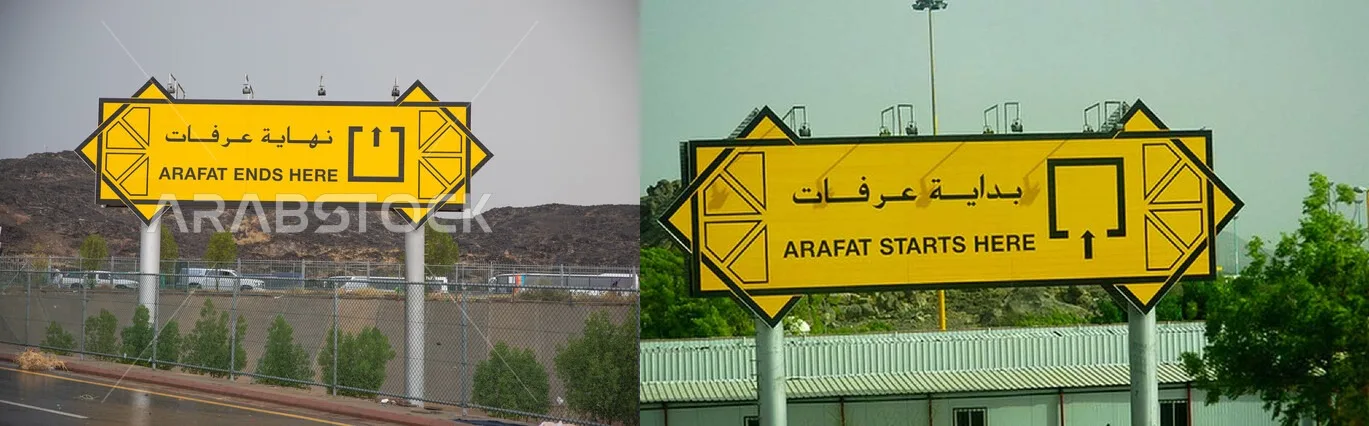
⑦ Large yellow boards are placed all around the plain of Arafat indicating its boundaries.
Making abundant supplications in the plain of Arafat:
The Day of Arafah [9th Dhu al-Hijjah] and the plain of Arafat is the best day and place for the acceptance of supplications. The best supplication of this day, which was made by all the Prophets, peace be upon them, besides the Prophet ﷺ, is:
[لَا إِلَهَ إِلَّا اللهُ وَحْدَهُ لَا شَرِيكَ لَهُ لَهُ الْمُلْكُ وَلَهُ الْحَمْدُ وَهُوَ عَلَى كُلِّ شَيْءٍ قَدِيرٌ]
There is no deity [worthy of worship] except Allah. He is alone. He has no partner. To Him belongs the sovereignty and all praise, and He is over all things competent.
Reference: Jami` at-Tirmidhi, Supplications, Hadith: 3585
The Day of Arafah, a day of deliverance from the fire of Hell:
It is narrated from Hazrat Aisha, may Allah be pleased with her, that the Prophet ﷺ said: There is no other day besides Arafah on which Allah frees as many servants from the fire [of Hell]. On that day, Allah is very close to His servants. He boasts about them before the angels and asks the angels what these people want? Meaning, despite their worldly needs, they seek only His forgiveness and pleasure.
Reference: Sahih Muslim, Hajj, Hadith: 1348
Issue:
In the plain of Arafat, one should face the Qiblah and raise hands to make supplications.
Reference: Sunan an-Nasa'i, Hajj, Hadith: 3014
Remember!
After finishing the prayers, instead of wandering around, sleeping, or engaging in idle talk until sunset, this time should be spent in remembrances and supplications. These moments and opportunities do not come repeatedly, so one should try to make the most of them.
The term Hajj Akbar:
It is commonly believed among many people that if the day of Friday coincides with Hajj, i.e., the Day of Arafah, then this Hajj is Hajj Akbar, and its reward is greater. This statement is without evidence. In the Holy Quran, the day of 9th Dhu al-Hijjah [Day of Arafah] is called يوم الحج الاكبر
Reference: At-Tawbah: 3
, regardless of which day of the week it falls on.Departure from Arafat to Muzdalifah:
◈ After sunset, one should depart from Arafat to Muzdalifah without performing the Maghrib prayer. This is the Sunnah practice.
Reference: Sahih Muslim, Hajj, Hadith: 1218
◈ On the way, calmness, seriousness, and dignity should be maintained.
Reference: Sahih Muslim, Hajj, Hadith: 1218
◈ One should also continue reciting the Talbiyah because the Prophet ﷺ kept reciting the Talbiyah from the 10th of Dhu al-Hijjah until stoning the Jamrah Aqabah.
Reference: Sahih al-Bukhari, Hajj, Hadith: 1544, 1543
Combining the prayers in Muzdalifah:
Upon reaching Muzdalifah, stay wherever space is available. First, perform the Maghrib prayer by calling the Adhan and Iqamah. Afterwards, perform the Isha prayer in shortened form [two Rak'ahs] with the second Iqamah. On this occasion, the Prophet ﷺ did not perform Sunnah, Nawafil, or Witr prayers; rather, he prayed Isha and then slept, and did not perform Tahajjud at night because he slept until Fajr had risen.
Reference: Sahih Muslim, Hajj, Hadith: 1218
Note:
Some people are allocated tents in one place, either in Mina or Muzdalifah. When the nights of Mina come, the Saudi Scholars Committee has issued a fatwa that the tents in Muzdalifah will be considered under the ruling of Mina, meaning the people of Muzdalifah will stay in their tents and will not go to Mina because now all the tents are connected and adjacent to each other, so all are under the same ruling. When the night of Muzdalifah comes, those tents are truly in Muzdalifah. By analogy, the same issue applies to the nights in Mina as well.
Reference: Permanent Committee for Islamic Research and Fatwas, Fatwa No: 10884
Fajr Prayer and Supplication After It:
In Muzdalifah, the Prophet ﷺ offered the Fajr prayer slightly earlier than usual after the true dawn.
Reference: Sahih al-Bukhari, Hajj, Hadith: 1682
After the Fajr prayer, one should stand facing the Qibla near Mash'ar al-Haram [a hill in Muzdalifah] and make abundant supplications.
Reference: Sahih Muslim, Hajj, Hadith: 1218
Explanation:
Like Arafat and Mina, Muzdalifah also has markers all around that indicate its beginning and ending boundaries. Within it, supplications can be made at any place after the night vigil and Fajr prayer.
Issue:
The person who prays Fajr in Muzdalifah has a valid stay (wuquf) in Muzdalifah.
Reference: Jami' at-Tirmidhi, Hajj, Hadith: 889
For the weak and sick who leave Muzdalifah at night for Mina:
Weak, sick, children, and those of large build who stay in Muzdalifah until the moon sets and then leave for Mina in the latter part of the night are permitted to do so.
Reference: Sahih al-Bukhari, Hajj, Hadith: 1679, Sahih Muslim, Hajj, Hadith: 1290
Notes:
① It is Sunnah to take pebbles from Mina for stoning the Jamarat.
Reference: Sunan an-Nasa'i, Manasik al-Hajj, Hadith: 3060
If a person takes pebbles from Muzdalifah, there is no harm, but pebbles that have already been used for stoning should not be taken.② Some people collect pebbles from Muzdalifah and then wash them with water. This is a fabricated act.
③ The pebbles should be about the size of chickpeas or slightly larger.
Reference: Sahih Muslim, Al-Hajj, Hadith: 1299
Departure from Muzdalifah to Mina:
After offering the Fajr prayer in Muzdalifah, supplicating at Mash'ar al-Haram, and after it becomes sufficiently light, one should depart towards Mina before sunrise. This is the Sunnah.
Reference: Sahih Muslim, Al-Hajj, Hadith: 1218
Talbiyah on the way:
While coming towards Mina, keep reciting the Talbiyah.
Reference: Sahih al-Bukhari, Al-Hajj, Hadith: 1685
Etiquettes of Wadi al-Mash'ar:
Between Muzdalifah and Mina is Wadi al-Mash'ar, where Abraha and his army, including elephants, were destroyed by small birds pelting stones. Pass through this valley quickly.
Reference: Muslim, Al-Hajj, Hadith: 1218
On the tenth of Dhu al-Hijjah [Day of Sacrifice], four important tasks are performed in order:
From sunrise until noon, seven pebbles are thrown at Jamrah Aqabah [also called Jamrah Kubra]; this is obligatory because the Prophet ﷺ said while throwing pebbles: Learn the rulings of Hajj from me.
Reference: Sahih Muslim, Hajj, Hadith: 1297
Issue:
Stop reciting Talbiyah before throwing the pebbles because the Prophet ﷺ did so.
Reference: Sahih al-Bukhari, Hajj, Hadith: 1687,1686
Method of throwing pebbles:
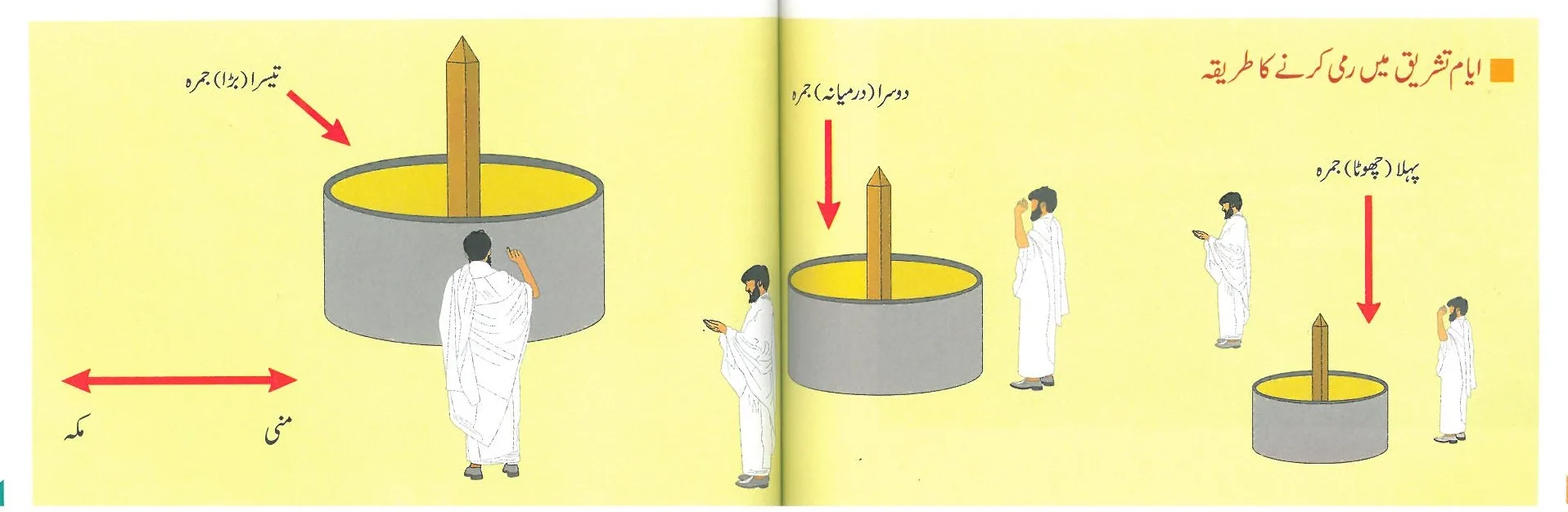
◈ The person throwing the pebbles should stand in a place where Makkah is on his left and Mina on his right, that is, standing to the south of the Jamrah. But if this is not possible, pebbles can be thrown from any side.
Reference: Sahih al-Bukhari, Hajj, Hadith: 1748
◈ Each pebble should be thrown while saying Allahu Akbar.
Reference: Sahih al-Bukhari, Hajj, Hadith: 1750
◈ All seven pebbles should be thrown one by one.
Reference: Sahih al-Bukhari, Hajj, Hadith: 1750
◈ If a person throws all seven pebbles at once, it will count as one. He must throw the remaining six pebbles one by one.
◈ Do not stop here for supplication after throwing pebbles because the Prophet ﷺ did not supplicate after throwing pebbles at Jamarat al-Aqaba.
Reference: Sahih al-Bukhari, Hajj, Hadith: 1751
Warning:
① The Saudi government has built very spacious four-story bridges over the Jamarat. The pillars of Jamarat have been raised through the bridges, and now there is a facility to throw pebbles from above them as well.
② Pebbles are thrown at the Jamarat following the Sunnah, so at this occasion, thinking that we are throwing pebbles at Satan, it is wrong to curse verbally, throw shoes, or engage in inappropriate talk.
Proxy in Throwing Pebbles:
Someone else can throw pebbles on behalf of the weak, elderly, children, and women with valid excuses. The method is to first throw seven pebbles on one’s own behalf, then intend for the other person and throw on their behalf. Even if the person throwing the pebbles is not a pilgrim, they can throw on behalf of someone else.
Delay in Throwing Pebbles:
If one is unable to throw pebbles at Jamarat al-Aqaba until the last day but does so afterwards, there is no harm.
Reference: Sahih al-Bukhari, Hajj, Hadith: 1723
The second act on the 10th of Dhu al-Hijjah is to perform the sacrifice. Sacrifice is obligatory for those performing Hajj al-Qiran and Hajj al-Tamattu. If the Qarin and Mutamatti do not have the means for sacrifice, they should fast three days during the days of Hajj and seven days after returning home. However, sacrifice is not obligatory for those performing Hajj al-Ifrad. If they wish, they may perform a voluntary sacrifice.
Reference: Al-Baqarah: 196, Sahih al-Bukhari, Hajj, Hadith: 1691
It is better for such a pilgrim to fast these three days before the 9th of Dhu al-Hijjah; otherwise, it is necessary to fast during the days of Tashreeq [11th, 12th, 13th of Dhu al-Hijjah] after the 10th of Dhu al-Hijjah because the Prophet ﷺ did not fast on the 9th of Dhu al-Hijjah [Day of Arafah] during Hajj.
Reference: Sahih al-Bukhari, Hadith: 1989
The 10th of Dhu al-Hijjah is the day of Eid, and after the days of Tashreeq, the days of Hajj end anyway. Perhaps this is why it is established from some of the Companions, may Allah be pleased with them, that they fasted on these days.
Reference: Sahih al-Bukhari, As-Sawm, Hadith: 1999, 1996] [والله أعلم]
Rules and Issues of Sacrifice
① It is permissible to offer sacrifice anywhere in Mina or Mecca [within the boundaries of the Haram].
Reference: Sunan Abi Dawood, Hajj, Hadith: 1937
Warning:
If for any reason someone is required to offer a dam (sacrifice as expiation), this dam must also be given within the boundaries of the Haram. However, the person who offers the dam cannot eat the meat of the sacrificial animal; it is only the right of the poor people there.
② If for some reason one cannot offer sacrifice on the 10th of Dhu al-Hijjah, then they can offer sacrifice at any time until sunset of the days of Tashreeq, i.e., the 11th, 12th, and 13th of Dhu al-Hijjah.
Reference: Al-Sunan al-Kubra by Al-Bayhaqi: 395/9
③ According to one's ability, if a person wishes to offer more than one sacrifice, this is also the Sunnah of the Messenger of Allah ﷺ.
Reference: Sahih al-Bukhari, Hajj, Hadith: 1712
④ The sacrificial animal can be slaughtered by someone else as well. The Prophet ﷺ himself slaughtered camels and also instructed Sayyiduna Ali رضي الله عنه to do so for some.
Reference: Sahih Muslim, Hajj, Hadith: 1218
⑤ The conditions for the sacrifice of Hajj are the same as those for the sacrifice of Eid al-Adha.
⑥ It is Sunnah to eat the meat of the animal sacrificed by oneself.
Reference: Sahih Muslim, Hajj, Hadith: 1218
Note:
Nowadays, there is also an arrangement to deposit the sacrifice amount in a bank or at a designated counter, under which the bank itself buys the animal and performs the slaughter on behalf of the person. However, the facility is also available for those who want to perform their own sacrifice; they can go to the slaughterhouse, buy an animal of their choice, and perform the sacrifice themselves. Since earlier much of the sacrificial meat used to go to waste, the Saudi government has arranged through this scheme to preserve the meat and deliver it to the needy. Therefore, depositing the amount in this manner is also permissible.
⑦ The person who wants to slaughter his own animal should say بِسْمِ اللهِ وَاللهُ أَكْبَر while slaughtering.
Reference: Sahih al-Bukhari, Al-Adahi, Hadith: 5558
⑧ Seven people can share one camel or cow.
The third act on the 10th of Dhu al-Hijjah is to shave or cut the hair. The rulings related to haircut are the same as those mentioned earlier.
End of Ihram restrictions:
After sacrifice and shaving, all restrictions of Ihram have now ended. Only the prohibition of intercourse with the wife remains in effect. Pilgrims may remove their Ihram. This is also called minor release (tahlul asghar).
The fourth and final act is Tawaf al-Ziyarah. It is also called Tawaf al-Afadah. This Tawaf is an essential pillar of Hajj. In this Tawaf, there is no need for Ihram, Iztiba’, or Ramal. However, being in a state of ablution, kissing or touching or gesturing towards the Black Stone, and reciting dhikr and supplications are the same issues that have been mentioned earlier. If the pilgrims are unable to perform this Tawaf on this day due to any excuse, they may perform it at any time during the days of Tashreeq.
However, according to some scholars, considering
Reference: Sunan Abi Dawood, Hadith: 1999
, if Tawaf al-Afadah is not performed by sunset, the restrictions of Ihram will be reimposed until the pilgrim performs Tawaf al-Afadah.
Reference: Manasik al-Hajj wal-Umrah by Al-Albani, may Allah have mercy on him
But Sheikh Uthaymeen and Ibn Baz, etc., have declared this hadith weak from various perspectives. Therefore, if the Tawaf al-Ifadah is performed before sunset, it is better; however, if due to a valid excuse it cannot be done, then it should be done afterward, and perhaps due to the excuse, the person will be considered excused before Allah. And knowledge is with Allah.
What should a woman do if she does not become pure by the 10th of Dhu al-Hijjah?
When there were no restrictions on traveling to and from Hijaz, as there are now, where return dates are fixed and a woman cannot separate from her caravan or group alone, the caravan would stop, and when the woman became pure, she would perform Tawaf al-Ifadah, and then the caravan would depart for the return journey. Now the situation has completely changed; no one has control over the return, and generally, even a one-day delay is not possible. What should a woman do now?
The jurists have proposed various solutions for this, but all have difficulties, while the woman's excuse is such that it is not within her control. The Shariah has provided ease in cases of involuntary excuses and has not put the person with the excuse in hardship, just as a patient is given ease according to the nature of their illness. Even the distressed and helpless are permitted to eat carrion to save their lives. And Allah Almighty has declared in the Holy Quran: [وَ مَا جَعَلَ عَلَیۡکُمۡ فِی الدِّیۡنِ مِنۡ حَرَجٍ]
And Allah has not placed upon you in the religion any difficulty.
Reference: Al-Hajj:78
[لَا یُکَلِّفُ اللّٰہُ نَفۡسًا اِلَّا وُسۡعَہَا]
Allah does not burden a soul beyond that it can bear.
Reference: Al-Baqarah:286
[یُرِیۡدُ اللّٰہُ بِکُمُ الۡیُسۡرَ وَ لَا یُرِیۡدُ بِکُمُ الۡعُسۡرَ]
Allah intends for you ease and does not intend for you hardship.
Reference: Al-Baqarah:185
There are countless other such arguments. When Allah Almighty provides an optional ease to the person with an excuse, then how can it be permissible to put a menstruating woman, whose excuse is also natural and involuntary, in difficulty! Therefore, Sheikh al-Islam Imam Ibn Taymiyyah and his student Rashid Hafiz Ibn al-Qayyim, may Allah have mercy on them both, have discussed this issue in great detail and have declared all the solutions proposed by the jurists to be against the spirit of Shariah. They themselves have proposed this solution that a menstruating woman, like a woman with istihadah, should wear a proper loincloth, etc., and perform the Tawaf al-Ifadah in that state, and there is no need for any ruqyah or similar acts.
Reference: Majmoo' al-Fatawa: 26/241,176], [I'lam al-Muwaqqi'in by Ibn al-Qayyim
Contemporary Saudi scholars have also agreed with the opinion of Imam Ibn Taymiyyah, issuing the same fatwa that a menstruating woman [due to the current difficulties of travel] should tie a cloth around herself and perform the Tawaf al-Ifadah because it is impossible for her to stay in Makkah separated from the caravan until she becomes pure. It is also extremely difficult for her to return to her country and come again next year for Hajj or to remain in the state of Ihram in her country waiting for Tawaf al-Ifadah.
Reference: Fatawa Arkan al-Islam by Sheikh Uthaymeen: 1/429,428], [Fatawa Islamiyyah: Collection of Fatwas of Saudi Scholars: 2/318,317
Published by DarussalamNote:
If someone, for any reason, could not perform Tawaf al-Ziyarah even when the last day of Hajj has arrived, they are permitted to perform one Tawaf with the intention of both Tawaf al-Wada and Tawaf al-Ziyarah, so that one Tawaf suffices for both. If they have not yet performed the Sa’i of Hajj, they should perform the Sa’i of Hajj along with it.
Reference: Manasik al-Hajj wal-Umrah, pp. 36,32
After the Tawaf of Ziyarah, all restrictions of Ihram end, even the restriction of intimacy with the wife is lifted. This is also called Tahallul Akbar.
Reference: Sunan Abi Dawood Al-Manasik, Hadith: 1999
◈ If it is difficult to perform Tawaf on the lower Mataf due to the crowd, one can also perform Tawaf on the second floor or the roof.
Sa’i of Hajj:
After the Tawaf of Ziyarah, Sa’i of Hajj is also obligatory for those performing Hajj Tamattu’. Those performing Hajj Qiran and Hajj Ifrad who did not perform Sa’i at the time of Tawaf al-Qudum must perform it now; otherwise, it is not obligatory for them.
The same rules and issues apply to this Sa’i as have been explained before, except that there is no need for shaving or cutting hair afterward.
Notes:
① The Messenger of Allah ﷺ performed the mentioned acts on the 10th day in the same order; if this order can be maintained, it is better, but if there is any advancement or delay among them, there is no dam (animal sacrifice) or fidya (expiation). For example: if someone performed the sacrifice before stoning the Jamrah Aqabah, or had a haircut before the sacrifice, or performed Tawaf al-Ifadah [Ziyarat] and Sa’i before the haircut, there is no harm.
Reference: Sahih al-Bukhari, Hajj, Hadith: 1722
② Some people consider dam (animal sacrifice) necessary for any advancement or delay in these matters; this is an exaggeration. Because the Messenger of Allah ﷺ said to those who advanced or delayed these acts: There is no harm. There is no harm.
Reference: Sahih al-Bukhari, Hajj, Hadith: 1722
Return from Makkah to Mina:
After performing Tawaf al-Ziyarah and Sa’i, the pilgrims should return to Mina and spend the night in Mina.
Days of Tashreeq:
The 13th, 12th, and 11th of Dhu al-Hijjah are called the days of Tashreeq. It is obligatory to spend the nights of these three days in Mina. Only those performing essential services are permitted to spend the nights of Mina in Mecca or its surroundings. Permission can be granted, which can be decided by a trustworthy religious scholar. [
Reference: Sahih al-Bukhari, Hajj, Hadith: 1745
Performance of Prayers:
Pilgrims who are near the Mosque of Khayf in Mina or have access to it should perform their prayers in congregation and shorten them (Qasr) in the Mosque of Khayf. Those who find it difficult to reach the mosque should arrange to perform congregational prayers with Qasr in their tents.
Stoning of the Jamarat:
During these three days, every day after sunset, all three Jamarat [the first Jamrah, the middle Jamrah, and the last Jamrah] should be stoned with pebbles.
Reference: Sahih al-Bukhari, Hajj, Hadith: 1746], [Sunan Abi Dawood, Manasik, Hadith: 1973
Method of Stoning during the Days of Tashreeq:
The first Jamrah, which is the first Jamrah from the direction of Mina, should be stoned first [it is also called Jamrat al-Dunya and Jamrat al-Sughra], then the middle Jamrah, and lastly the Jamrat al-Aqaba should be stoned.
Reference: Sahih al-Bukhari, Hajj, Hadith: 1751
First, throw seven pebbles at each of the two Jamras, saying Allahu Akbar with each pebble. Then step aside and make dua. But after throwing pebbles at the third Jamra, stop there and do not make dua.
Reference: Sahih al-Bukhari, Hajj, Hadith: 1753
Throw pebbles at all three Jamras in such a way that Makkah is on the left and Mina on the right. If this is difficult, then pebbles can be thrown from any side.
Remembrance of Allah during the Days of Mina:
During these days, remember Allah abundantly. The Prophet ﷺ said: The days of Tashreeq are days for eating, drinking, and [abundant] remembrance of Allah.
Reference: Sahih Muslim, Hajj, Hadith: 1141
Tawaf of the Kaaba during the Days of Tashreeq:
It is also established to perform [nafl] Tawaf of the Kaaba in Makkah during these days.
Reference: Sahih al-Bukhari, Hajj, before Hadith: 1732], [Al-Sunan al-Kubra by Al-Bayhaqi: 146/5
Permission to Return on 12th Dhu al-Hijjah:
It is Sunnah to spend all three days of Tashreeq in Mina, as the Prophet ﷺ did.
Reference: Sunan Abi Dawood, Manasik, Hadith: 1973
If a person wishes to return on the 12th of Dhu al-Hijjah, then it is permissible according to Shariah. The Holy Quran states:
[فَمَنۡ تَعَجَّلَ فِیۡ یَوۡمَیۡنِ فَلَاۤ اِثۡمَ عَلَیۡہِ وَ مَنۡ تَاَخَّرَ فَلَاۤ اِثۡمَ عَلَیۡہِ لِمَنِ اتَّقٰی]
Whoever hastens to leave [the semen] within two days, there is no sin upon him. And whoever delays, there is also no sin upon him unless he is one who fears Allah.
Reference: Al-Baqarah:203
This permission is also proven from the hadith.
Reference: Al-Sunan al-Kubra by Al-Bayhaqi:152/5
However, the one who returns on the 12th of Dhu al-Hijjah should only perform the stoning on that day and leave the limits of semen before sunset. If the sun sets before leaving the limits of semen, then it will be necessary to spend the night in semen and perform the stoning on the 13th day.
Reference: Al-Sunan al-Kubra by Al-Bayhaqi:152/5, Muwatta Imam Malik, Hajj, from Ibn Umar, stopped narration
If due to traffic congestion he is unable to leave the semen until the sun sets, there is no harm. It is not necessary for him to spend the night in semen.
Farewell Tawaf:
After completing Hajj, before departing from Makkah al-Mukarramah, performing the farewell Tawaf is obligatory.
Reference: Sahih Muslim, Hajj, Hadith: 1327
For the pilgrim, the very last act before departing from Makkah Mukarramah is to perform the Farewell Tawaf; however, a woman who is menstruating is not required to perform the Farewell Tawaf, provided that she has already performed the Tawaf al-Ziyarah.
Reference: Sahih al-Bukhari, Hajj, Hadith: 1757, 1755
Note:
Some people step backward when leaving Masjid al-Haram. This practice is not established from the Prophet ﷺ or the righteous companions, may Allah be pleased with them.
◈ When exiting Masjid al-Haram, step out with the left foot first and recite this supplication: اللَّهُمَّ إِنِّي أَسْأَلُكَ مِنْ فَضْلِكَ
O Allah! Indeed, I ask You for Your bounty.
Reference: Sahih Muslim, Salat al-Musafirin, Hadith: 713

