

✍ Compiled By: Abu Hamzah Salafi
This article is about affirming Allah Almighty’s attribute of being Above (جهتِ فَوْق), and it is a refutation of those Jahmī doubts which derive the creed of personal indwelling (حلولِ ذاتی) from the Qur’anic verse: ﴿فَأَيْنَمَا تُوَلُّوا فَثَمَّ وَجْهُ اللَّهِ﴾. The opponents claim that Allah is personally present in every direction, and that being above the Throne implies limitation. In response, we will clarify—through the statements and texts of the Salaf al-Ṣāliḥīn, the noble Companions, and the leading Imams of ḥadīth—that Allah Almighty, with His Essence, is above the Throne in the direction of above, while with His knowledge and power He encompasses everything. This is the creed of Ahl al-Sunnah wa al-Jamāʿah.
❖ This verse does not indicate personal indwelling (حلولِ ذاتی). Rather, it indicates encompassment by knowledge and power—just as Allah said:
﴿أَلَا إِنَّهُ بِكُلِّ شَيْءٍ مُّحِيطٌ﴾
Meaning: “Indeed, Allah encompasses everything with His knowledge and power.”
❖ The mutawātir texts of the Qur’an and Sunnah, the narrations of the Companions, and the statements of the Imams all indicate that Allah Almighty is above the Throne with His Essence, in the direction of above, and that through His knowledge He encompasses everything.
«مَا بَيْنَ سَمَاءِ الدُّنْيَا وَالَّتِي تَلِيهَا مَسِيرَةُ خَمْسِمِائَةِ عَامٍ… وَالْعَرْشُ فَوْقَ السَّمَاءِ، وَاللَّهُ تَبَارَكَ وَتَعَالَى فَوْقَ الْعَرْشِ، وَهُوَ يَعْلَمُ مَا أَنْتُمْ عَلَيْهِ».
Reference:
✔ Ibn Khuzaymah (thiqah, ḥujjah)
✔ Baḥr ibn Naṣr (thiqah)
✔ Asad ibn Mūsā (thiqah)
✔ Ḥammād ibn Salamah (thiqah, ʿābid)
✔ ʿĀṣim ibn Bahdalah (ṣadūq)
✔ Zirr ibn Ḥubaysh (thiqah)
① “وَاللَّهُ فَوْقَ الْعَرْشِ” → Allah is above the Throne with His Essence.
② “وَهُوَ يَعْلَمُ مَا أَنْتُمْ عَلَيْهِ” → He encompasses everything with His knowledge and power.
Thus, the Jahmiyyah claim that affirming “above” necessitates limitation is entirely false, because the texts themselves combine essential highness and encompassing knowledge.
قَالَ: «بِأَنَّهُ فَوْقَ الْعَرْشِ، فَوْقَ السَّمَاءِ السَّابِعَةِ عَلَى الْعَرْشِ، بَائِنٌ مِنْ خَلْقِهِ».
قُلْتُ: بِحَدٍّ؟
قَالَ: «فَبِأَيِّ شَيْءٍ؟»
Reference:
❖ Along with this, Ibn al-Mubārak clarified that expressing “limit” in a created sense is incorrect—meaning: Allah’s highness is affirmed, but without asking how, and without imposing created boundaries.
قَالَ: «نَعَمْ؛ لَا يَخْلُو شَيْءٌ مِنْ عِلْمِهِ».
Reference:
✔ Allah is above the Throne with His Essence.
✔ He is distinct from creation.
✔ Yet His knowledge and power encompass everywhere.
❖ This invalidates the Jahmiyyah doubt that “being on the Throne limits Allah.” Rather, His Essence is above the Throne, and His knowledge and power encompass every atom of creation.
فَهُوَ فَوْقَ السَّمَاوَاتِ وَفَوْقَ الْعَرْشِ بِذَاتِهِ، مُتَخَلِّصًا مِنْ خَلْقِهِ، بَائِنًا مِنْهُمْ، عِلْمُهُ فِي خَلْقِهِ لَا يَخْرُجُونَ مِنْ عِلْمِهِ.
Reference:
«مَنْ لَمْ يُقِرَّ بِأَنَّ اللَّهَ تَعَالَى عَلَى عَرْشِهِ قَدِ اسْتَوَى فَوْقَ سَبْعِ سَمَاوَاتِهِ فَهُوَ كَافِرٌ بِرَبِّهِ».
Reference:
Reference:
ثُمَّ قَالَ: فَاللَّهُ تَبَارَكَ وَتَعَالَى فَوْقَ عَرْشِهِ، فَوْقَ سَمَاوَاتِهِ، بَائِنٌ مِنْ خَلْقِهِ، فَمَنْ لَمْ يَعْرِفْهُ بِذَلِكَ لَمْ يَعْرِفْ إِلَهَهُ الَّذِي يَعْبُدُ.
Reference:
«أَدْرَكْنَا الْعُلَمَاءَ فِي جَمِيعِ الْأَمْصَارِ … فَكَانَ مِنْ مَذْهَبِهِمْ أَنَّ اللَّهَ عَزَّ وَجَلَّ عَلَى عَرْشِهِ، بَائِنٌ مِنْ خَلْقِهِ، كَمَا وَصَفَ نَفْسَهُ فِي كِتَابِهِ».
Reference:
Reference:
ثُمَّ مَعْنَى قَوْلِهِ فِي الْكِتَابِ: (مَنْ فِي السَّمَاءِ) مَنْ فَوْقَ السَّمَاءِ عَلَى الْعَرْشِ، كَمَا قَالَ: (الرَّحْمَنُ عَلَى الْعَرْشِ اسْتَوَى). وَكُلُّ مَا عَلَا فَهُوَ سَمَاءٌ، وَالْعَرْشُ أَعْلَى السَّمَاوَاتِ، فَهُوَ عَلَى الْعَرْشِ، سُبْحَانَهُ وَتَعَالَى، كَمَا أَخْبَرَ بِلَا كَيْفٍ، بَائِنٌ مِنْ خَلْقِهِ، غَيْرُ مُمَاسٍّ لِخَلْقِهِ: (لَيْسَ كَمِثْلِهِ شَيْءٌ).
Reference:
Reference:
Reference:
Reference:
«باب استواء الله على عرشه فوق السماء السابعة بائنا من خلقه من الكتاب والسنة. … وفي أخبار شتى أن الله في السماء السابعة على العرش بنفسه، وهو ينظر كيف يعملون، وعلمه وقدرته واستماعه ونظره ورحمته في كل مكان».
Reference:
Reference:
Reference:
Reference:
Reference:
Reference:
Reference:
Reference:
✔ In Maʿālim al-Sunan (Sharḥ Sunan Abī Dāwūd), refuting the Jahmiyyah and Muʿtazilah, he wrote:
«ومن باب الرد على الجهمية والمعتزلة … ليعلم أن الموصوف بعلو الشأن وجلالة القدر وارتفاع عرشه»
Meaning: affirming the loftiness of Allah’s Throne and His exalted status.
✔ In Sha’n al-Duʿā’, while explaining the verse ﴿الرَّحْمَنُ عَلَى الْعَرْشِ اسْتَوَى﴾ he said:
«فنحن نؤمن بما أنزل، ونقول كما قال، ولا نكيفه، ولا نحده، ولا نتأوله كما فعلته نفاة الصفات»
Meaning: We believe in it, we do not describe its “how,” we do not set limits, and we do not reinterpret it like the negators of attributes.
✔ In the same book, regarding “al-ʿAliyy”, he wrote:
«العلي: هو العالي القاهر … وقد يكون ذلك من العلو الذي هو مصدر: علا يعلو فهو عال، كقوله: الرحمن على العرش استوى»
«ولا تحيط به الجهات»
Further, his other positions show he strongly opposed the corrupt beliefs of the Sufis (such as Ibn ʿArabī). Ibn ʿĀbidīn al-Shāmī نقل:
«سمعت أن الفقيه العالم عز الدين بن عبد السلام كان يطعن في ابن عربي ويقول هو زنديق»
And al-Dhahabī نقل from him:
«ما رأيت في كتب الإسلام في العلم مثل المحلى لابن حزم والمغني لابن قدامة»
Imām Ibn Abī al-ʿIzz al-Ḥanafī (d. 792H) explained:
«محيط بكل شيء وفوقه: مراده أن الله لا يحويه شيء، ولا يحيط به شيء كما يكون لغيره من المخلوقات، وأنه العلي عن كل شيء»
﴿فَأَيْنَمَا تُوَلُّوا فَثَمَّ وَجْهُ اللَّهِ﴾
proves Allah being personally present in every direction, and that the belief of “above the Throne” implies limitation.
Ahl al-Sunnah wa al-Jamāʿah clarified—through the Qur’an, Sunnah, narrations of the Companions, and the statements of the Imams—that:
① Allah is above the Throne with His Essence, in the direction of above.
② He is distinct (بائن) from His creation.
③ Yet His knowledge and power encompass everything everywhere.
Imām Ibn Masʿūd, Ibn al-Mubārak, Imām Aḥmad, Ibn Abī Shaybah, Ibn Khuzaymah, Ibn Baṭṭah, al-Dārimī, Abū Ḥātim, Abū Zurʿah, al-Muzanī, al-Shāfiʿī, Ibn Rushd, al-Sijzī, al-Aṣbahānī, al-Harawī, al-Juwaynī, al-ʿUmrānī, ʿAbd al-Ghanī al-Maqdisī, al-Qurṭubī, al-Taftāzānī, Ibn Taymiyyah, and Ibn al-Qayyim—all stated this creed.
And the statements of al-Khaṭṭābī, ʿIzz al-Dīn ibn ʿAbd al-Salām, and al-Ṭaḥāwī—presented by opponents as negating direction—are actually about negating encompassment and restricting definition, not negating fawqiyyah.
Allah Almighty is above the Throne, distinct from His creation, and He encompasses everything with His knowledge.
This article is about affirming Allah Almighty’s attribute of being Above (جهتِ فَوْق), and it is a refutation of those Jahmī doubts which derive the creed of personal indwelling (حلولِ ذاتی) from the Qur’anic verse: ﴿فَأَيْنَمَا تُوَلُّوا فَثَمَّ وَجْهُ اللَّهِ﴾. The opponents claim that Allah is personally present in every direction, and that being above the Throne implies limitation. In response, we will clarify—through the statements and texts of the Salaf al-Ṣāliḥīn, the noble Companions, and the leading Imams of ḥadīth—that Allah Almighty, with His Essence, is above the Throne in the direction of above, while with His knowledge and power He encompasses everything. This is the creed of Ahl al-Sunnah wa al-Jamāʿah.
◈ The Opponents’ Doubt
The people of Jahm and the mutakallimīn argue from this verse of the Qur’an:Arabic Text:
﴿وَلِلَّهِ الْمَشْرِقُ وَالْمَغْرِبُ فَأَيْنَمَا تُوَلُّوا فَثَمَّ وَجْهُ اللَّهِ﴾
Reference: Al-Baqarah: 115
Translation:
“And to Allah belong the East and the West; so wherever you turn, there is the Face of Allah.”Claim:
According to them, the clear meaning of this verse is that Allah is personally present in every direction, and that He has encompassed all creation; therefore, saying that Allah is above the Throne in the direction of above is equivalent to believing that He is confined to a limited place. For this reason, they mock Ahl al-Sunnah by calling them “mujassimah” and a “registered sect,” and they raise the question: Should the Qur’an be followed, or the anthropomorphic beliefs of Ahl al-Ḥadīth?✔ Research-Based Answer
According to Ahl al-Sunnah wa al-Jamāʿah:❖ This verse does not indicate personal indwelling (حلولِ ذاتی). Rather, it indicates encompassment by knowledge and power—just as Allah said:
﴿أَلَا إِنَّهُ بِكُلِّ شَيْءٍ مُّحِيطٌ﴾
Reference: Fuṣṣilat: 54
Meaning: “Indeed, Allah encompasses everything with His knowledge and power.”
❖ The mutawātir texts of the Qur’an and Sunnah, the narrations of the Companions, and the statements of the Imams all indicate that Allah Almighty is above the Throne with His Essence, in the direction of above, and that through His knowledge He encompasses everything.
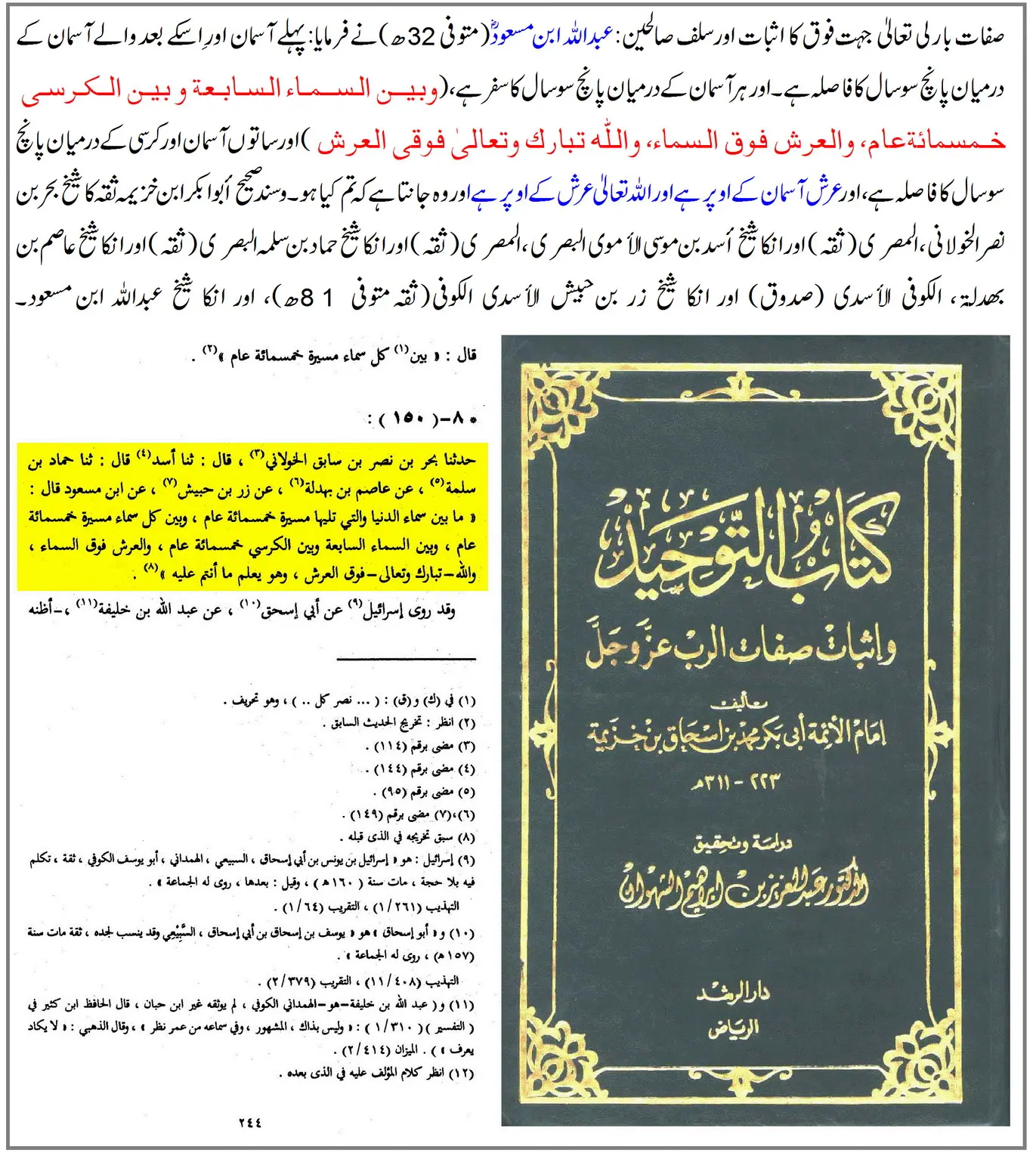
① Evidence One: The Report of Ibn Masʿūd رضي الله عنه
Arabic Text:
حَدَّثَنَا بَحْرُ بْنُ نَصْرٍ الْخَوْلَانِيُّ، قَالَ: ثنا أَسَدٌ، قَالَ: ثنا حَمَّادُ بْنُ سَلَمَةَ، عَنْ عَاصِمِ بْنِ بَهْدَلَةَ، عَنْ زِرِّ بْنِ حُبَيْشٍ، عَنِ ابْنِ مَسْعُودٍ، قَالَ:«مَا بَيْنَ سَمَاءِ الدُّنْيَا وَالَّتِي تَلِيهَا مَسِيرَةُ خَمْسِمِائَةِ عَامٍ… وَالْعَرْشُ فَوْقَ السَّمَاءِ، وَاللَّهُ تَبَارَكَ وَتَعَالَى فَوْقَ الْعَرْشِ، وَهُوَ يَعْلَمُ مَا أَنْتُمْ عَلَيْهِ».
Translation:
Ibn Masʿūd رضي الله عنه said: “Between each two heavens is a distance of five hundred years… and between the seventh heaven and the Kursī is a distance of five hundred years; and the Throne is above the heaven; and Allah, Blessed and Exalted, is above the Throne; and He knows what you are doing.”Reference:
Reference: Kitāb al-Tawḥīd wa Ithbāt Ṣifāt al-Rabb, Ibn Khuzaymah (311H)
Chain Status
All narrators of this report are trustworthy:✔ Ibn Khuzaymah (thiqah, ḥujjah)
✔ Baḥr ibn Naṣr (thiqah)
✔ Asad ibn Mūsā (thiqah)
✔ Ḥammād ibn Salamah (thiqah, ʿābid)
✔ ʿĀṣim ibn Bahdalah (ṣadūq)
✔ Zirr ibn Ḥubaysh (thiqah)
Principled Inference
This narration clarifies two realities:① “وَاللَّهُ فَوْقَ الْعَرْشِ” → Allah is above the Throne with His Essence.
② “وَهُوَ يَعْلَمُ مَا أَنْتُمْ عَلَيْهِ” → He encompasses everything with His knowledge and power.
Thus, the Jahmiyyah claim that affirming “above” necessitates limitation is entirely false, because the texts themselves combine essential highness and encompassing knowledge.
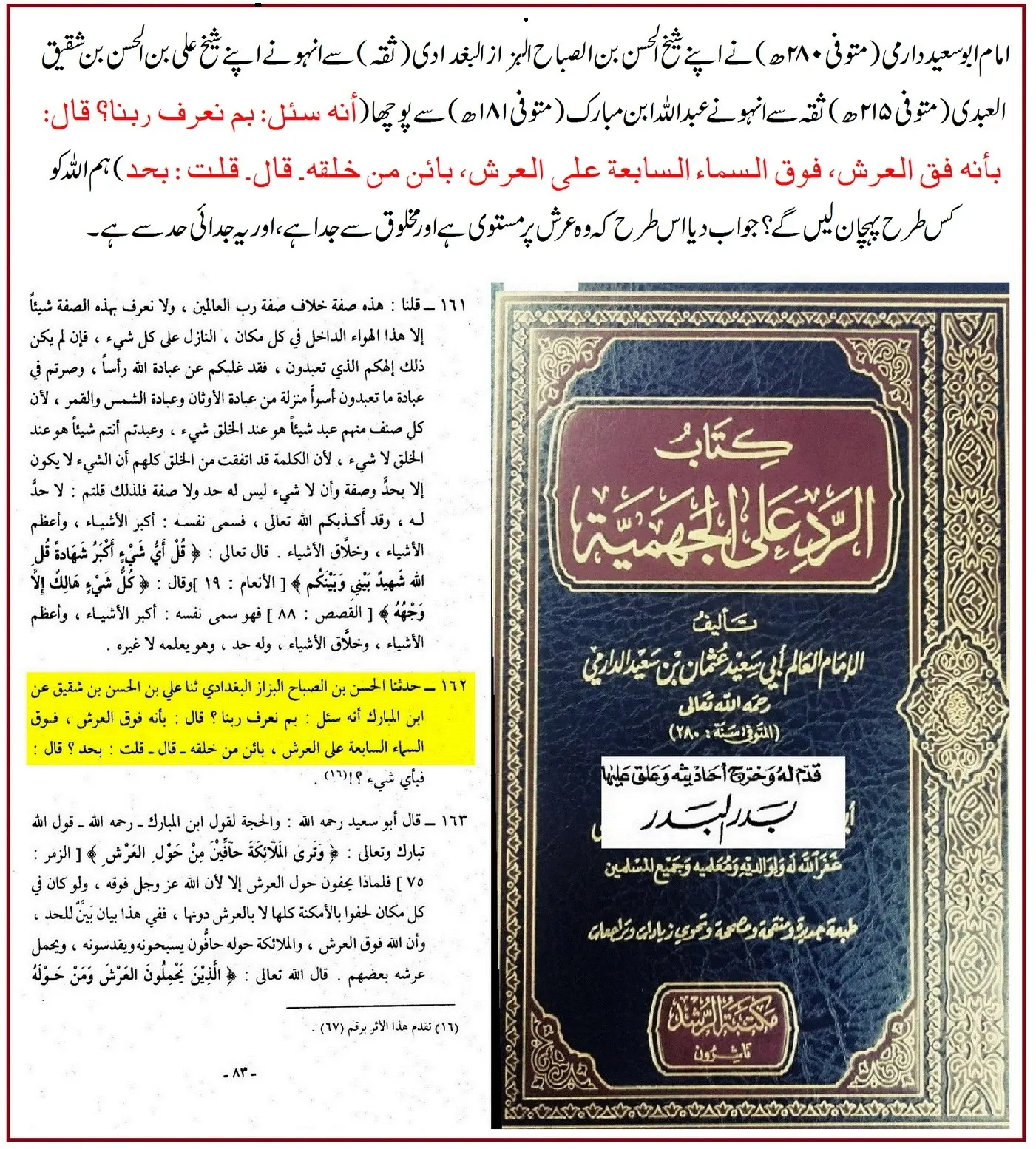
② Evidence Two: The Statement of Imām ʿAbdullāh ibn al-Mubārak (d. 181H)
Arabic Text:
حَدَّثَنَا الْحَسَنُ بْنُ الصَّبَّاحِ الْبَزَّارُ، ثنا عَلِيُّ بْنُ الْحَسَنِ بْنِ شَقِيقٍ، عَنِ ابْنِ الْمُبَارَكِ، أَنَّهُ سُئِلَ: بِمَ نَعْرِفُ رَبَّنَا؟قَالَ: «بِأَنَّهُ فَوْقَ الْعَرْشِ، فَوْقَ السَّمَاءِ السَّابِعَةِ عَلَى الْعَرْشِ، بَائِنٌ مِنْ خَلْقِهِ».
قُلْتُ: بِحَدٍّ؟
قَالَ: «فَبِأَيِّ شَيْءٍ؟»
Translation:
Ibn al-Mubārak was asked: How do we recognize our Lord? He said: “By (knowing) that He is above the Throne—above the seventh heaven, upon the Throne—distinct from His creation.” I said: With a limit? He replied: “Then with what (thing) (would that be)?”Reference:
Reference: al-Radd ʿalā al-Jahmiyyah, al-Dārimī, p. 162
Comment
❖ The phrases “فَوْقَ الْعَرْشِ” and “بَائِنٌ مِنْ خَلْقِهِ” are explicit proofs of the creed of Ahl al-Sunnah.❖ Along with this, Ibn al-Mubārak clarified that expressing “limit” in a created sense is incorrect—meaning: Allah’s highness is affirmed, but without asking how, and without imposing created boundaries.
③ Evidence Three: The Statement of Imām Aḥmad ibn Ḥanbal (d. 241H)
Arabic Text:
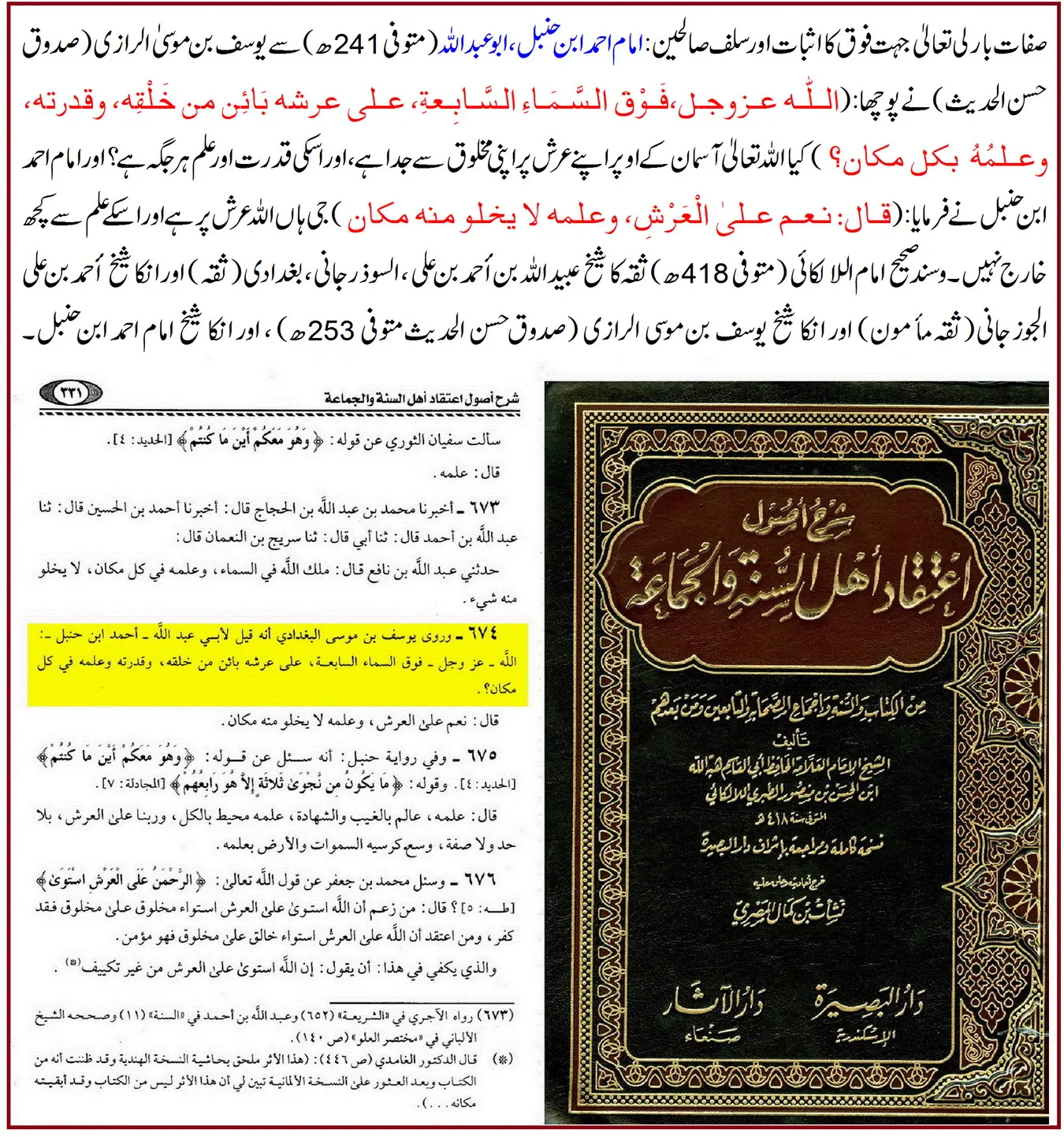
قِيلَ لِأَبِي (أحمد بن حنبل): رَبُّنَا تَبَارَكَ وَتَعَالَى فَوْقَ السَّمَاءِ السَّابِعَةِ عَلَى عَرْشِهِ، بَائِنٌ مِنْ خَلْقِهِ، وَقُدْرَتُهُ وَعِلْمُهُ بِكُلِّ مَكَانٍ؟قَالَ: «نَعَمْ؛ لَا يَخْلُو شَيْءٌ مِنْ عِلْمِهِ».
Translation:
Imām Aḥmad رحمه الله was asked: Is our Lord above the seventh heaven upon His Throne, distinct from His creation, while His power and knowledge are in every place? He replied: “Yes; nothing is devoid of His knowledge.”Reference:
Reference: Sharḥ Uṣūl Iʿtiqād Ahl al-Sunnah, al-Lālakā’ī, no. 807
Comment
❖ In one sentence, Imām Aḥmad clarified the creed of Ahl al-Sunnah:✔ Allah is above the Throne with His Essence.
✔ He is distinct from creation.
✔ Yet His knowledge and power encompass everywhere.
❖ This invalidates the Jahmiyyah doubt that “being on the Throne limits Allah.” Rather, His Essence is above the Throne, and His knowledge and power encompass every atom of creation.
④ Evidence Four: Imām Muḥammad ibn ʿUthmān Ibn Abī Shaybah (d. 297H)
Arabic Text:
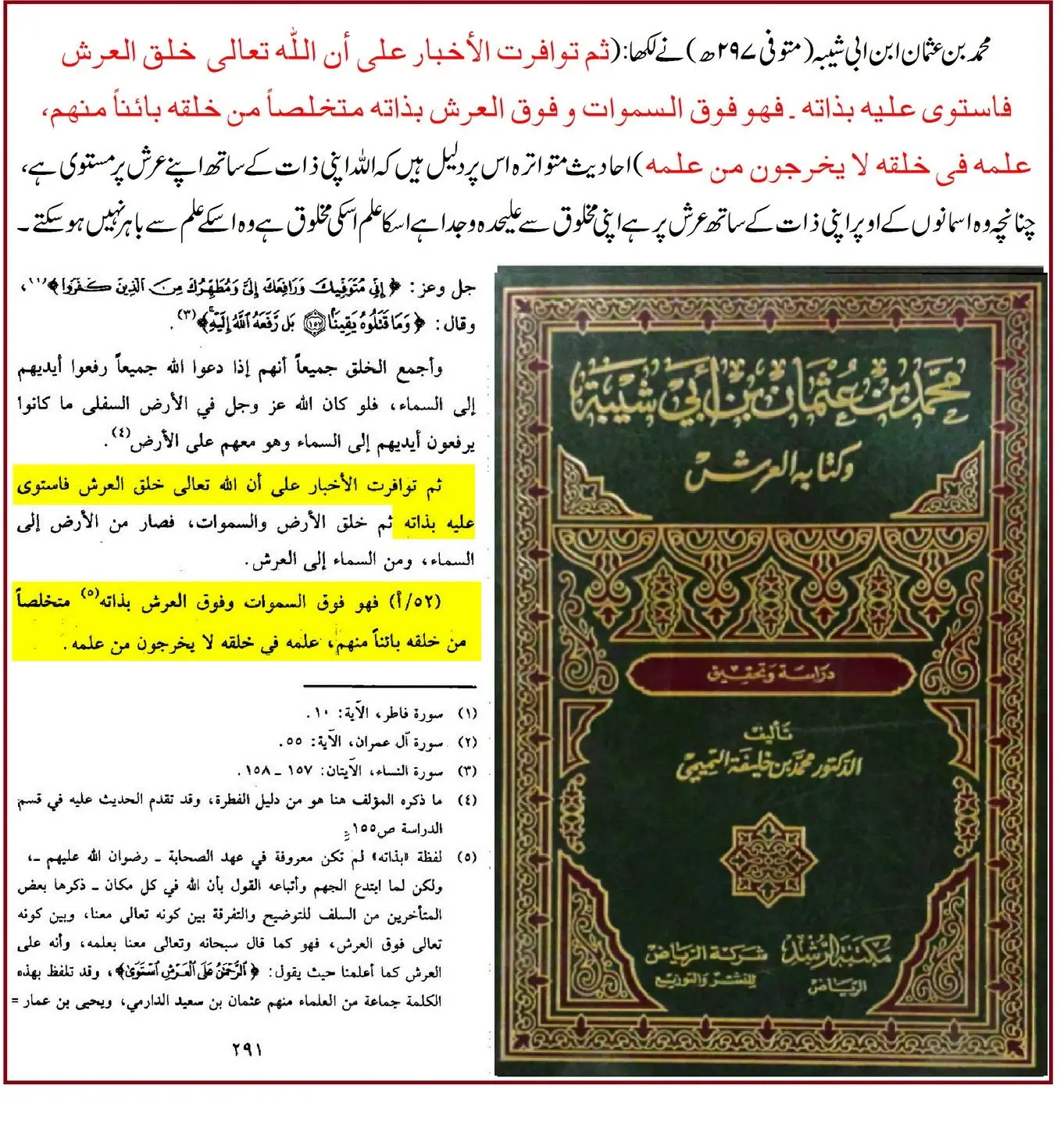
ثُمَّ تَوَافَرَتِ الْأَخْبَارُ عَلَى أَنَّ اللَّهَ تَعَالَى خَلَقَ الْعَرْشَ فَاسْتَوَى عَلَيْهِ بِذَاتِهِ، ثُمَّ خَلَقَ الْأَرْضَ وَالسَّمَاوَاتِ، فَصَارَ مِنَ الْأَرْضِ إِلَى السَّمَاءِ، وَمِنَ السَّمَاءِ إِلَى الْعَرْشِ.فَهُوَ فَوْقَ السَّمَاوَاتِ وَفَوْقَ الْعَرْشِ بِذَاتِهِ، مُتَخَلِّصًا مِنْ خَلْقِهِ، بَائِنًا مِنْهُمْ، عِلْمُهُ فِي خَلْقِهِ لَا يَخْرُجُونَ مِنْ عِلْمِهِ.
Translation:
Imām Ibn Abī Shaybah said: “Reports have become abundant that Allah Almighty created the Throne and then rose over it with His Essence. Then He created the earth and the heavens… Thus He is above the heavens and above the Throne with His Essence—separate from His creation, distinct from them—while His knowledge is within His creation; they cannot escape His knowledge.”Reference:
Reference: Kitāb al-ʿArsh, Ibn Abī Shaybah, p. 52/A
⑤ Evidence Five: Imām Abū Bakr Muḥammad ibn Isḥāq Ibn Khuzaymah (d. 311H)
Arabic Text:
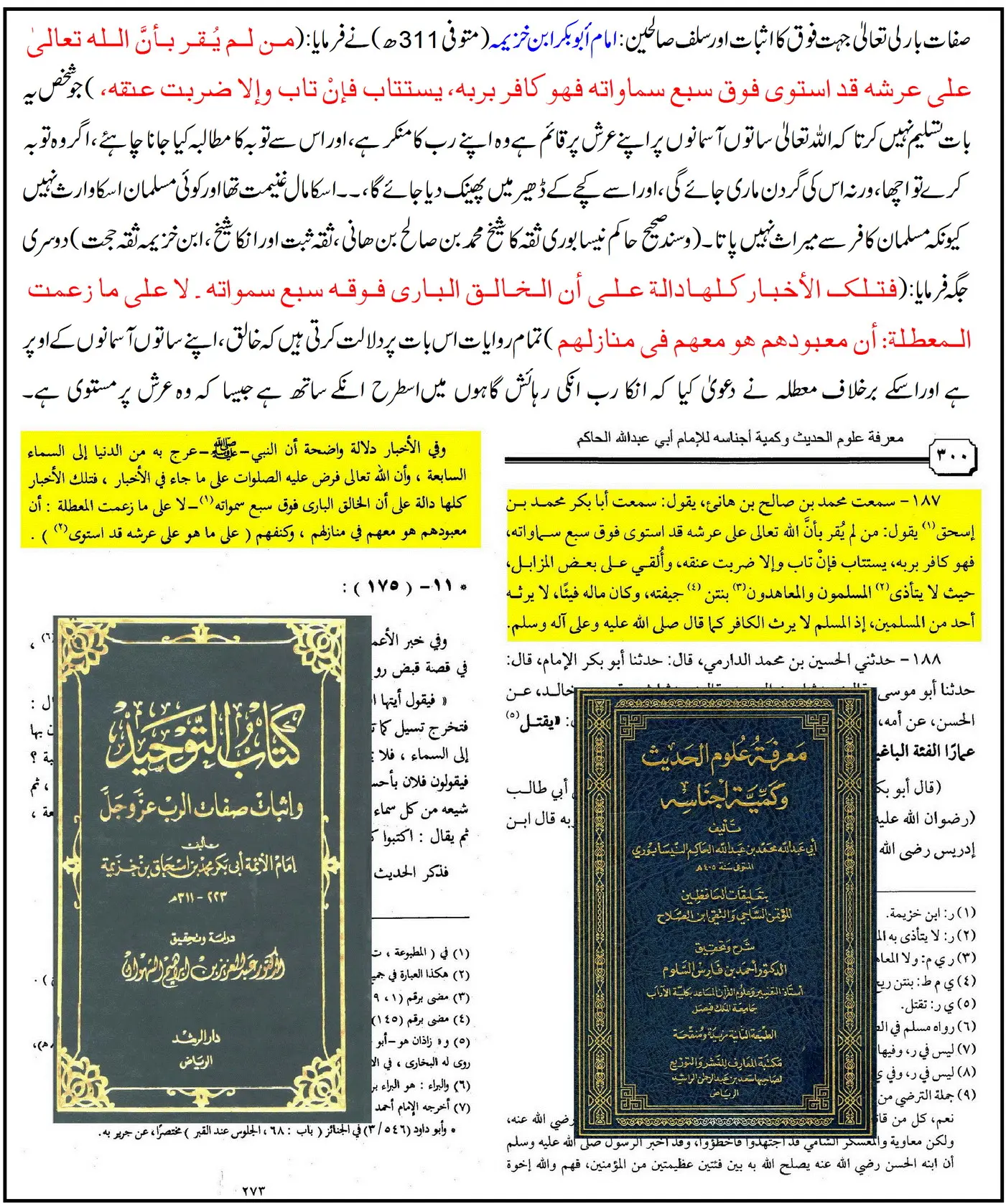
سَمِعْتُ أَبَا بَكْرِ مُحَمَّدَ بْنَ إِسْحَاقَ بْنِ خُزَيْمَةَ يَقُولُ:«مَنْ لَمْ يُقِرَّ بِأَنَّ اللَّهَ تَعَالَى عَلَى عَرْشِهِ قَدِ اسْتَوَى فَوْقَ سَبْعِ سَمَاوَاتِهِ فَهُوَ كَافِرٌ بِرَبِّهِ».
Translation:
Imām Ibn Khuzaymah رحمه الله said: “Whoever does not affirm that Allah Almighty has risen over His Throne above His seven heavens is a disbeliever in his Lord.”Reference:
Reference: Maʿrifat ʿUlūm al-Ḥadīth, al-Ḥākim, vol. 1, p. 84
⑥ Evidence Six: Imām Ibn Baṭṭah al-ʿUkbarī (d. 387H)
Arabic Text:
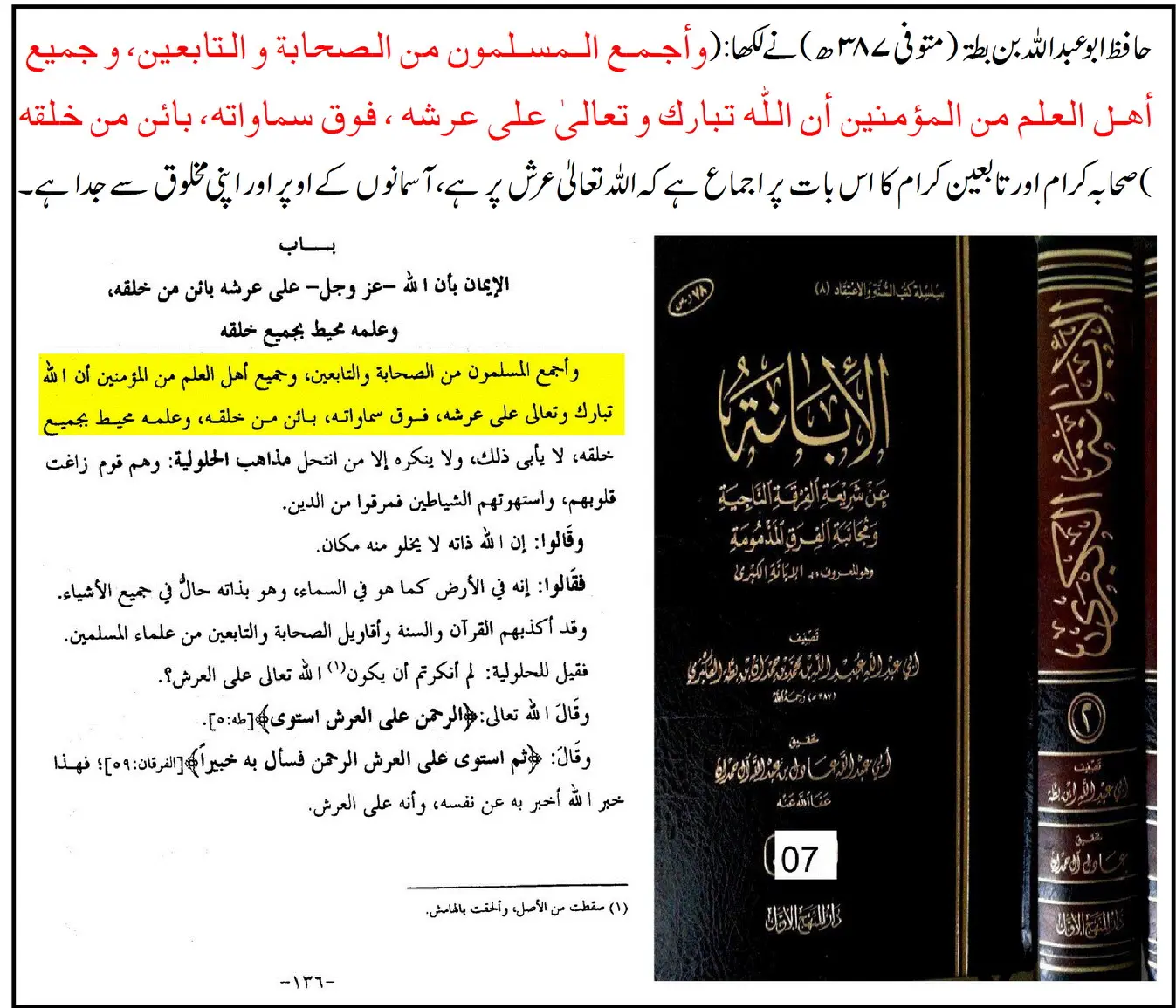
وَأَجْمَعَ الْمُسْلِمُونَ مِنَ الصَّحَابَةِ وَالتَّابِعِينَ وَجَمِيعِ أَهْلِ الْعِلْمِ أَنَّ اللَّهَ تَبَارَكَ وَتَعَالَى عَلَى عَرْشِهِ، فَوْقَ سَمَاوَاتِهِ، بَائِنٌ مِنْ خَلْقِهِ، وَعِلْمُهُ مُحِيطٌ بِجَمِيعِ خَلْقِهِ.Translation:
Imām Ibn Baṭṭah رحمه الله said: “The Muslims—from the Companions, the Tābiʿīn, and all the people of knowledge—are unanimously agreed that Allah, Blessed and Exalted, is upon His Throne, above His heavens, distinct from His creation, and His knowledge encompasses all His creation.”Reference:
Reference: al-Ibānah ʿan Sharīʿat al-Firqah al-Nājiyah, vol. 7, p. 138
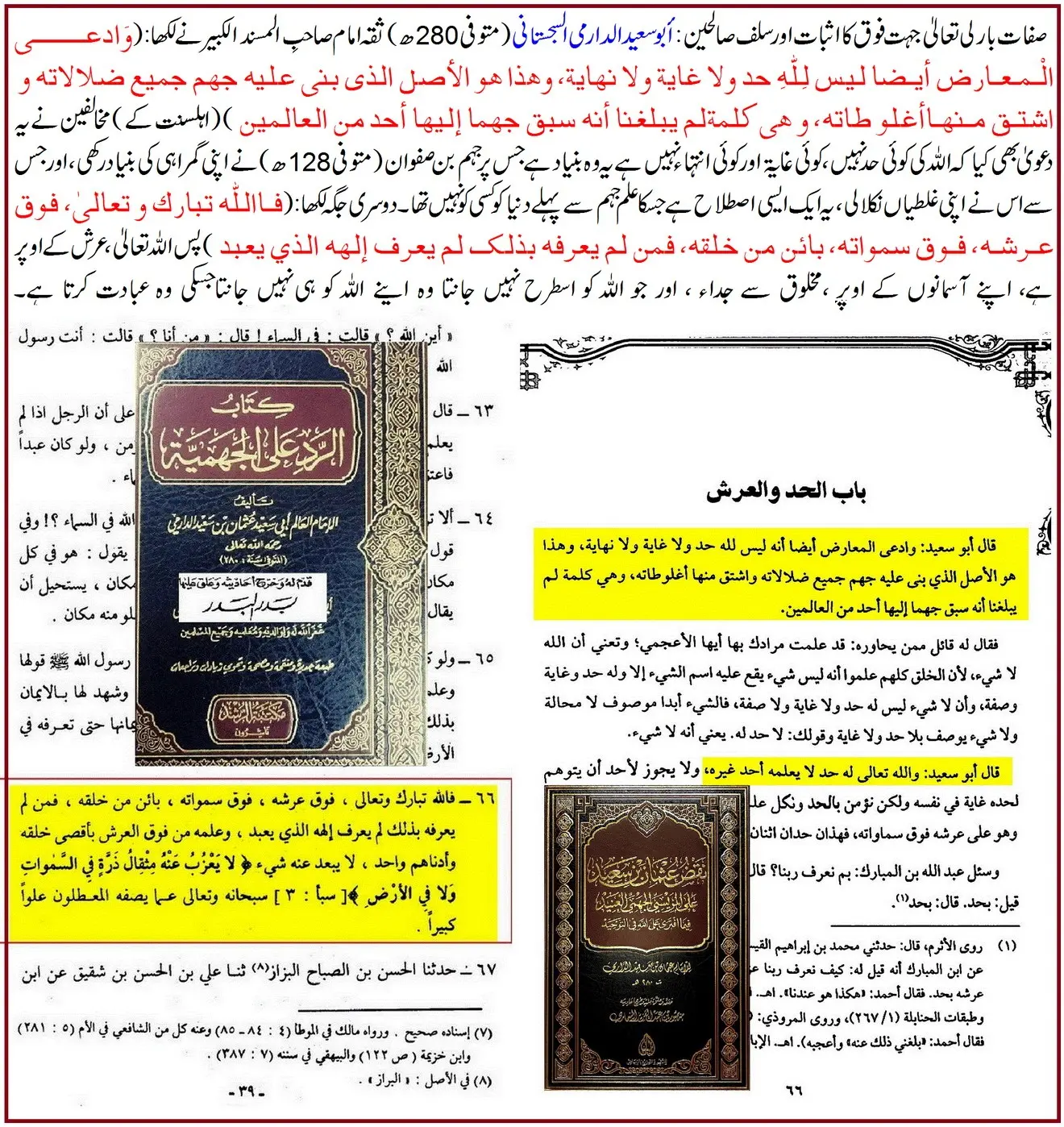
⑦ Evidence Seven: Imām Abū Saʿīd ʿUthmān ibn Saʿīd al-Dārimī (d. 280H)
Arabic Text:
قَالَ أَبُو سَعِيدٍ: وَادَّعَى الْمُعَارِضُ أَيْضًا أَنَّهُ لَيْسَ لِلَّهِ حَدٌّ وَلَا غَايَةٌ وَلَا نِهَايَةٌ. وَهَذَا هُوَ الْأَصْلُ الَّذِي بَنَى عَلَيْهِ جَهْمٌ ضَلَالَاتِهِ. …ثُمَّ قَالَ: فَاللَّهُ تَبَارَكَ وَتَعَالَى فَوْقَ عَرْشِهِ، فَوْقَ سَمَاوَاتِهِ، بَائِنٌ مِنْ خَلْقِهِ، فَمَنْ لَمْ يَعْرِفْهُ بِذَلِكَ لَمْ يَعْرِفْ إِلَهَهُ الَّذِي يَعْبُدُ.
Translation:
Imām al-Dārimī said: “The opponent also claims that Allah has no limit, no endpoint, and no finality—and this is the foundation upon which Jahm built his misguidances… Then he said: Allah, Blessed and Exalted, is above His Throne, above His heavens, distinct from His creation. Whoever does not recognize Him in this manner has not recognized the deity whom he worships.”Reference:
Reference: al-Radd ʿalā al-Jahmiyyah, al-Dārimī, p. 66
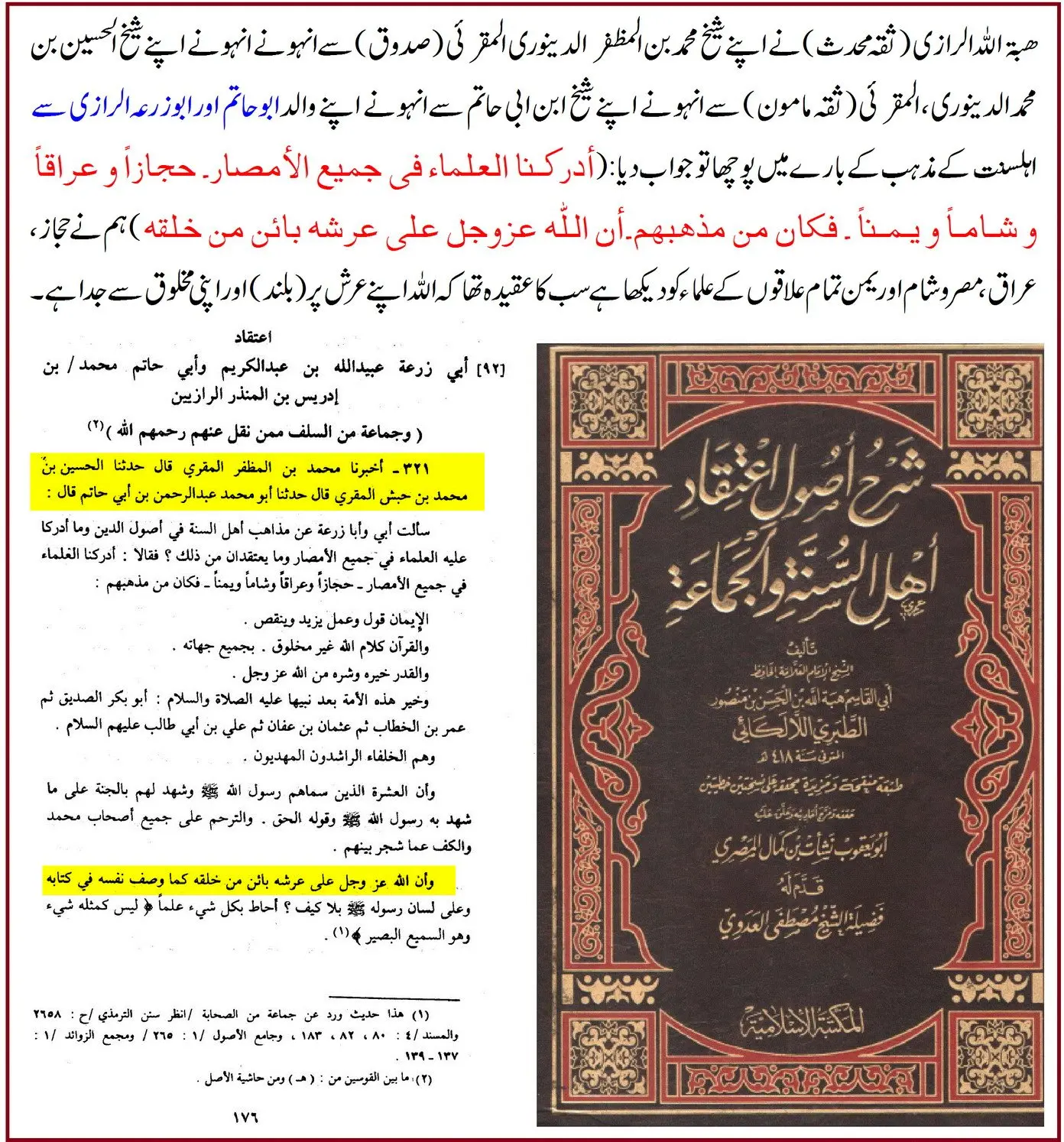
⑧ Evidence Eight: Imām Abū Ḥātim al-Rāzī (d. 275H) & Imām Abū Zurʿah al-Rāzī (d. 264H)
Arabic Text:
قَالَ عَبْدُ الرَّحْمَنِ بْنُ أَبِي حَاتِمٍ: سَأَلْتُ أَبِي وَأَبَا زُرْعَةَ عَنْ مَذَاهِبِ أَهْلِ السُّنَّةِ فِي أُصُولِ الدِّينِ … فَقَالَا:«أَدْرَكْنَا الْعُلَمَاءَ فِي جَمِيعِ الْأَمْصَارِ … فَكَانَ مِنْ مَذْهَبِهِمْ أَنَّ اللَّهَ عَزَّ وَجَلَّ عَلَى عَرْشِهِ، بَائِنٌ مِنْ خَلْقِهِ، كَمَا وَصَفَ نَفْسَهُ فِي كِتَابِهِ».
Translation:
ʿAbd al-Raḥmān ibn Abī Ḥātim said: I asked my father (Abū Ḥātim) and Abū Zurʿah about the beliefs of Ahl al-Sunnah in the fundamentals of religion… They said: “We found the scholars in all lands… and from their creed was that Allah, Mighty and Majestic, is upon His Throne, distinct from His creation, just as He described Himself in His Book.”Reference:
Reference: Sharḥ Uṣūl Iʿtiqād Ahl al-Sunnah, al-Lālakā’ī, no. 321
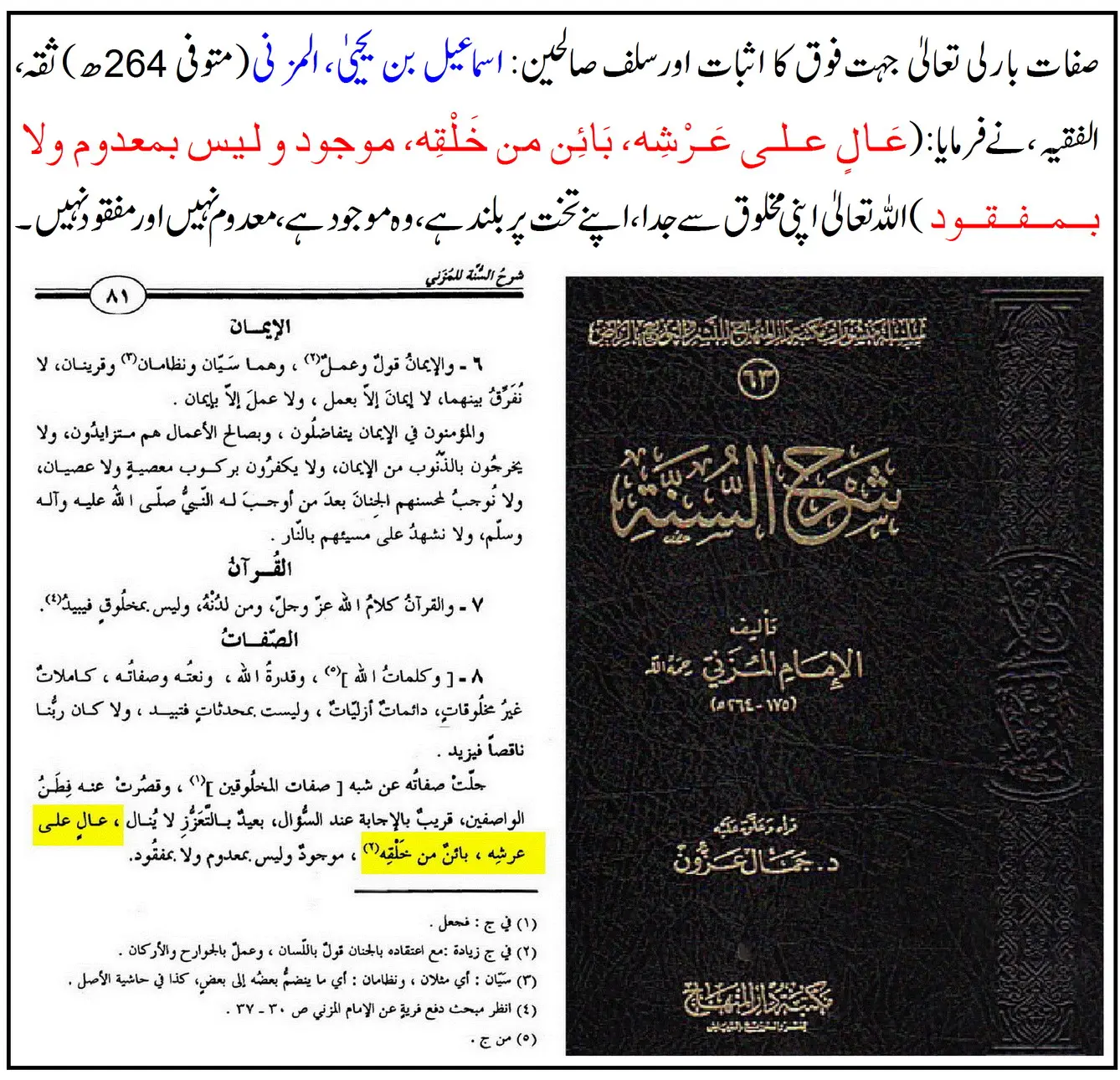
⑨ Evidence Nine: Imām Ismāʿīl ibn Yaḥyā al-Muzanī (d. 264H)
Arabic Text:
عَالٍ عَلَى عَرْشِهِ بَائِنٌ مِنْ خَلْقِهِ، مَوْجُودٌ وَلَيْسَ بِمَعْدُومٍ وَلَا بِمَفْقُودٍ.Translation:
Imām al-Muzanī رحمه الله said: “Allah is high above His Throne, distinct from His creation; He exists—neither nonexistent nor missing.”Reference:
Reference: Sharḥ al-Sunnah, al-Muzanī, p. 8
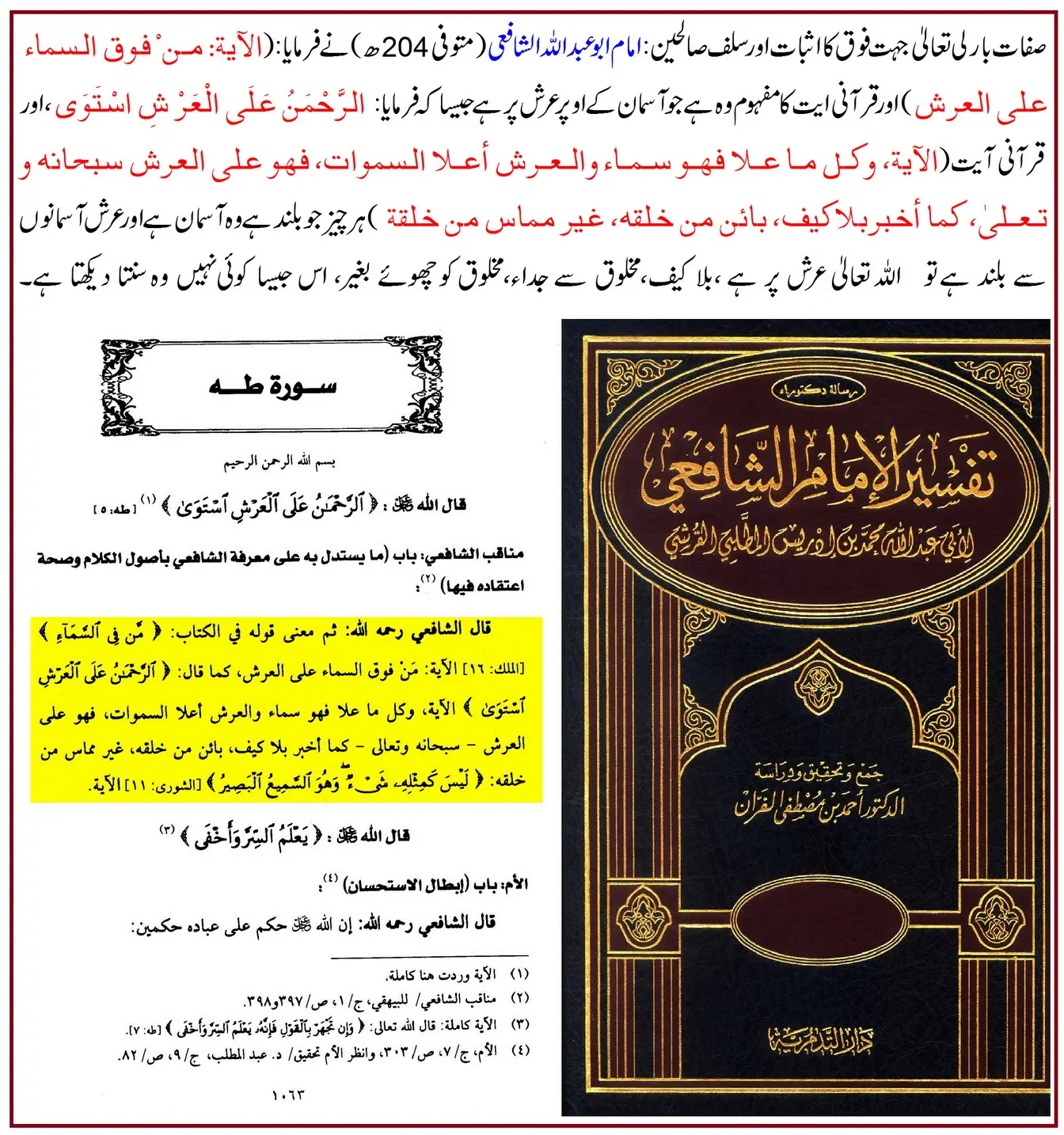
⑩ Evidence Ten: Imām Muḥammad ibn Idrīs al-Shāfiʿī (d. 204H)
Arabic Text:
قَالَ الشَّافِعِيُّ رَحِمَهُ اللَّهُ:ثُمَّ مَعْنَى قَوْلِهِ فِي الْكِتَابِ: (مَنْ فِي السَّمَاءِ) مَنْ فَوْقَ السَّمَاءِ عَلَى الْعَرْشِ، كَمَا قَالَ: (الرَّحْمَنُ عَلَى الْعَرْشِ اسْتَوَى). وَكُلُّ مَا عَلَا فَهُوَ سَمَاءٌ، وَالْعَرْشُ أَعْلَى السَّمَاوَاتِ، فَهُوَ عَلَى الْعَرْشِ، سُبْحَانَهُ وَتَعَالَى، كَمَا أَخْبَرَ بِلَا كَيْفٍ، بَائِنٌ مِنْ خَلْقِهِ، غَيْرُ مُمَاسٍّ لِخَلْقِهِ: (لَيْسَ كَمِثْلِهِ شَيْءٌ).
Translation:
Imām al-Shāfiʿī رحمه الله said: “The meaning of His statement in the Book: (مَنْ فِي السَّمَاءِ) is: the One who is above the heaven upon the Throne—just as He said: ﴿الرَّحْمَنُ عَلَى الْعَرْشِ اسْتَوَى﴾. Everything that is elevated is called ‘sky,’ and the Throne is above the heavens; therefore He is upon the Throne—Glorified and Exalted—just as He informed, without (asking) how; distinct from His creation, without contacting His creation: ﴿لَيْسَ كَمِثْلِهِ شَيْءٌ﴾.”Reference:
Reference: Tafsīr al-Imām al-Shāfiʿī, vol. 2, p. 13
⑪ Evidence Eleven: Imām Ibn Rushd al-Qurṭubī (d. 595H)
Arabic Text:
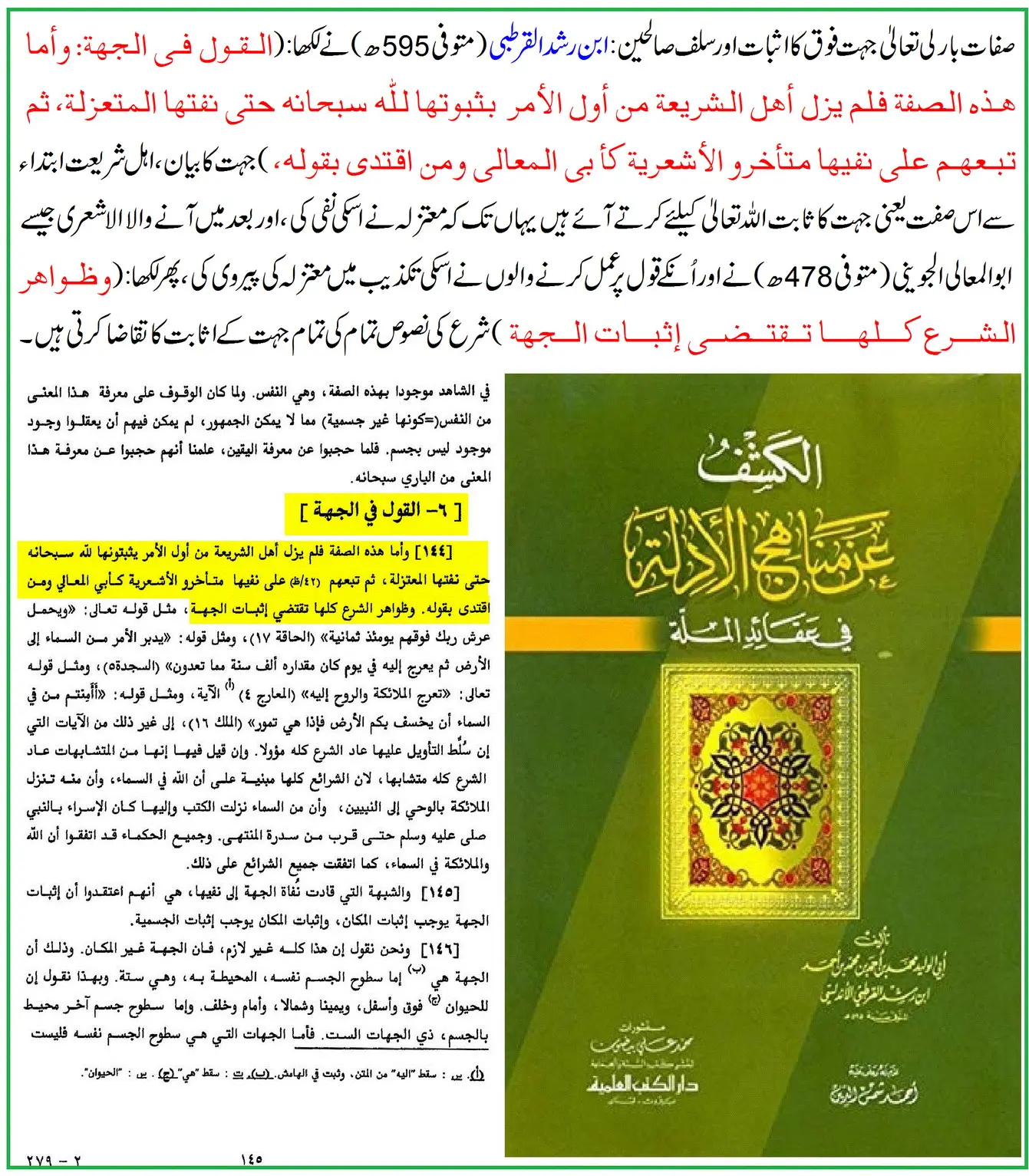
أما هَذِه الصّفة (الجهة) فَلَمْ يَزَل أهل الشريعة من أول الْأَمر بثبوتها لله سُبْحَانَهُ حَتَّى نفتها المعتزلة، ثم تبعهم على نَفْيها متأخرو الأشاعرة كأبي المعالي الجويني. وظواهر الشرع كلها تقتضي إثبات الجهة.Translation:
Imām Ibn Rushd رحمه الله said: “As for this attribute (direction), the people of the Sharīʿah continued from the earliest times affirming it for Allah, Glorified is He, until the Muʿtazilah denied it; then the later Ashʿarīs, such as Abū al-Maʿālī al-Juwaynī, followed them in denying it. Yet all the apparent texts of the Sharīʿah require affirming direction.”Reference:
Reference: al-Kashf ʿan Manāhij al-Adillah fī ʿAqā’id al-Millah, p. 186
⑫ Evidence Twelve: Imām ʿUbaydullāh ibn Saʿīd al-Sijzī (d. 444H)
Arabic Text:
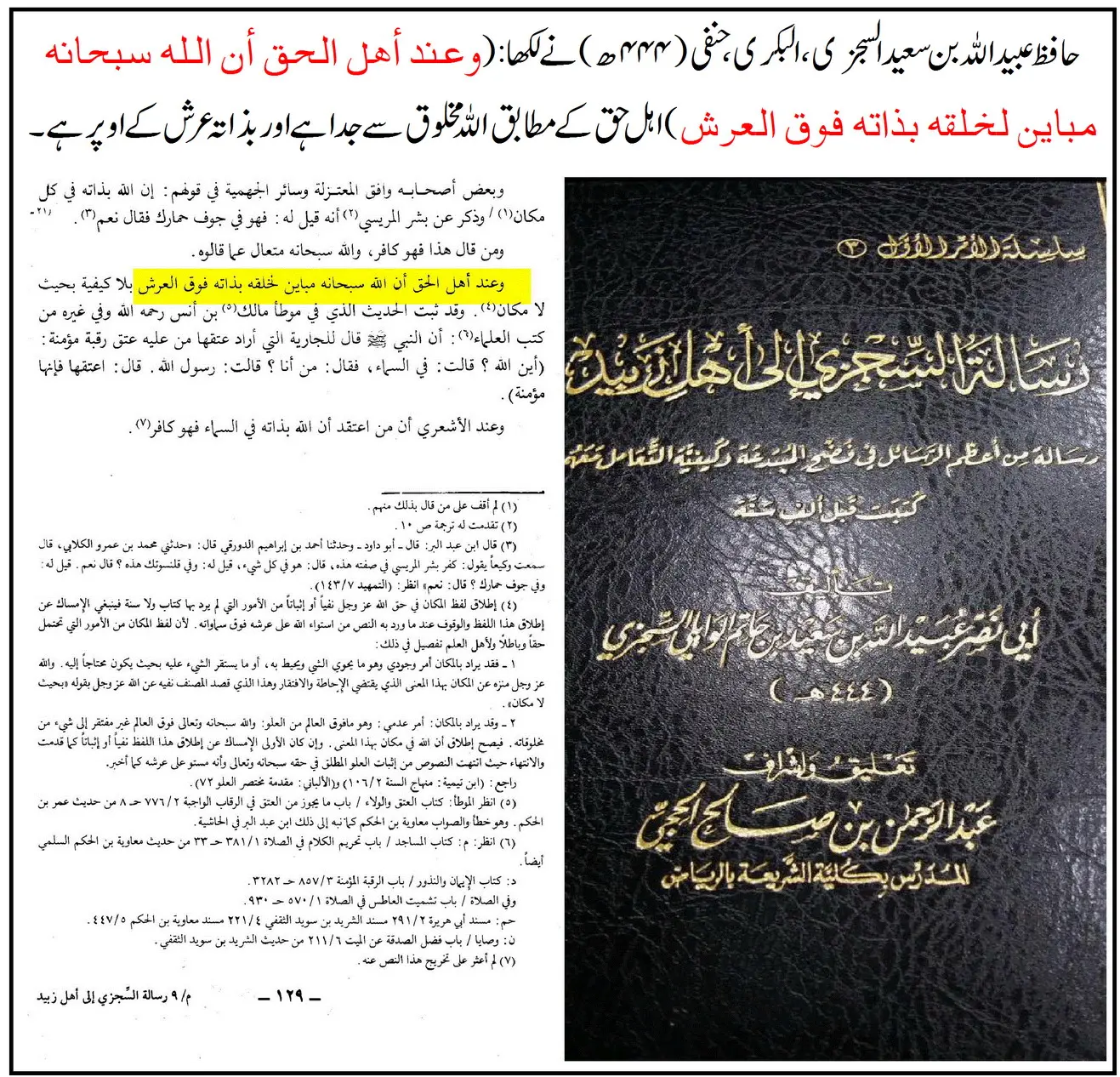
وعند أهل الحق أن الله سبحانه مباين لخلقه بذاته فوق العرش بلا كيفية بحيث لا مكان.Translation:
Imām al-Sijzī رحمه الله said: “According to the people of truth, Allah—Glorified is He—is distinct from His creation with His Essence, above the Throne, without (asking) how, in such a manner that He is not dependent upon a place.”Reference:
Reference: Risālat al-Sijzī ilā Ahl Zabīd, p. 107
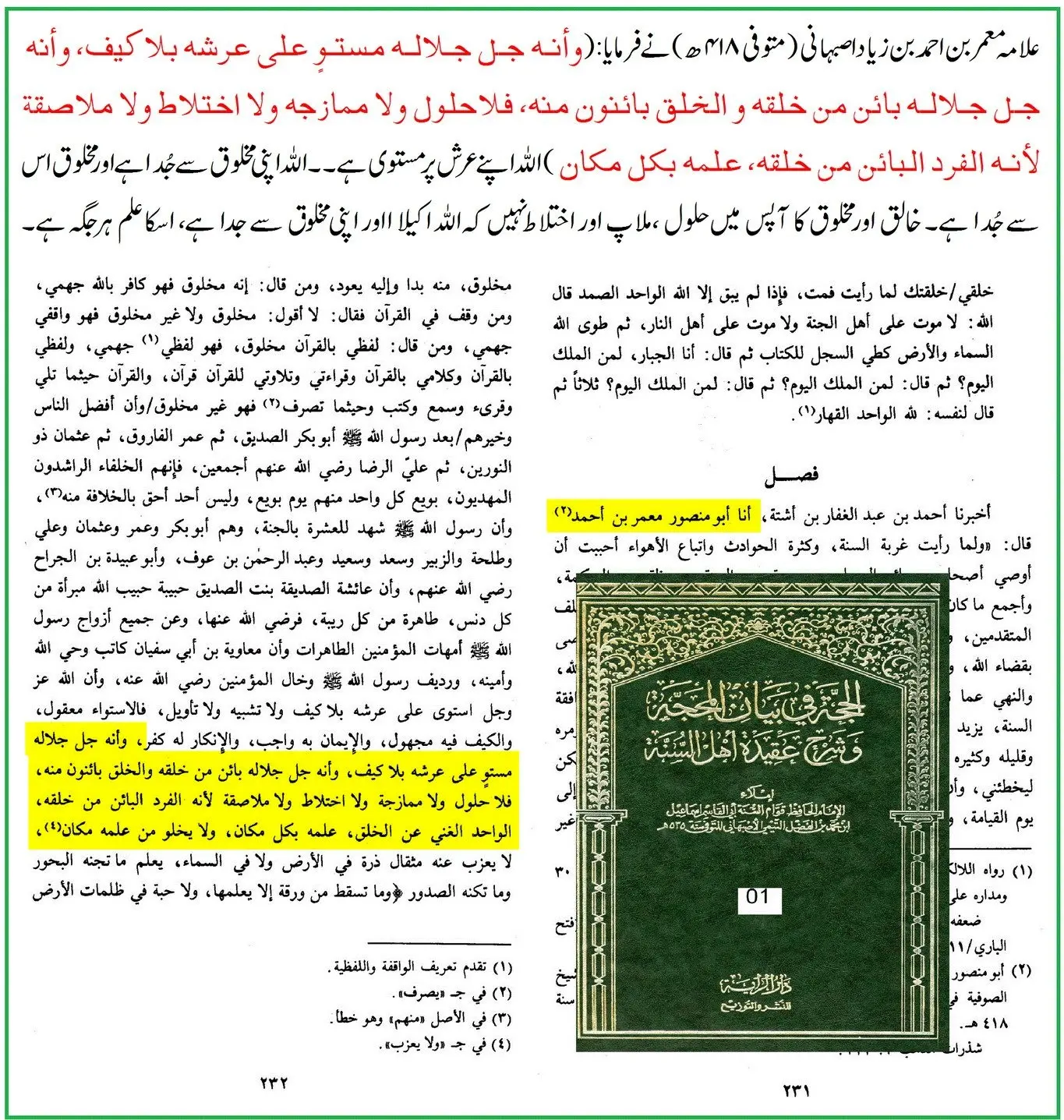
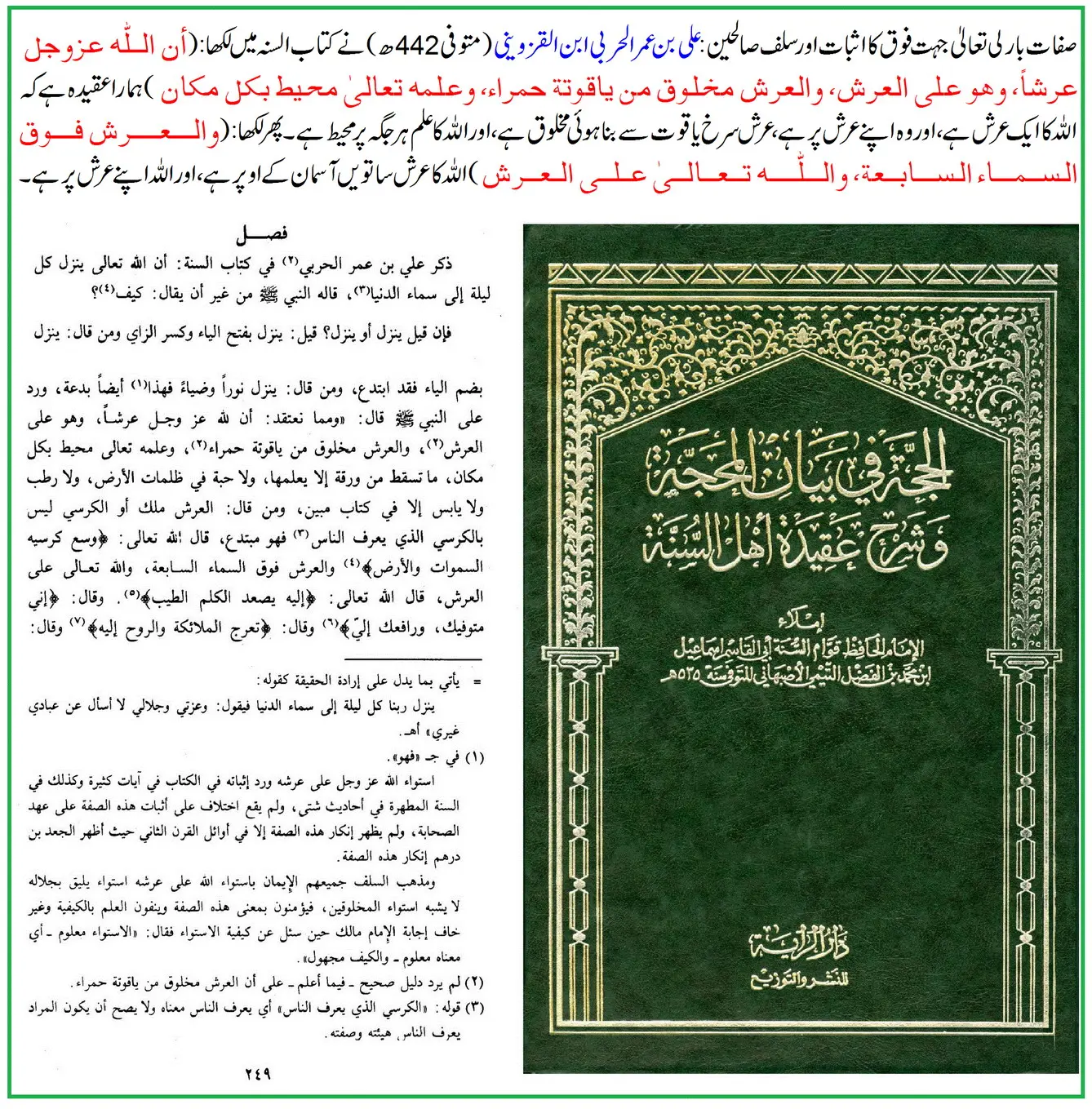
⑬ Evidence Thirteen: Imām Maʿmar ibn Aḥmad al-Aṣbahānī (d. 418H)
(narrated by Qiwām al-Sunnah al-Aṣbahānī, d. 535H)Arabic Text:
وَأَنَّ اللَّهَ عَزَّ وَجَلَّ اسْتَوَى عَلَى عَرْشِهِ بِلا كَيْفٍ وَلَا تَشْبِيهٍ وَلَا تَأْوِيلٍ، فَالِاسْتِوَاءُ مَعْقُولٌ، وَالْكَيْفُ فِيهِ مَجْهُولٌ، وَالْإِيمَانُ بِهِ وَاجِبٌ، وَالإِنْكَارُ لَهُ كُفْرٌ. وَأَنَّهُ جَلَّ جَلَالُهُ مُسْتَوٍ عَلَى عَرْشِهِ بِلَا كَيْفٍ، وَأَنَّهُ جَلَّ جَلَالُهُ بَائِنٌ مِنْ خَلْقِهِ، وَالْخَلْقُ بَائِنُونَ مِنْهُ، فَلَا حُلُولَ وَلَا مُمَازَجَةَ.Translation:
Imām Maʿmar al-Aṣbahānī said: “Allah, Mighty and Majestic, rose over His Throne without (asking) how, without resemblance, and without reinterpretation. The meaning of isti wā’ is understood, but its ‘how’ is unknown. Belief in it is obligatory, and denying it is disbelief. He—Majestic is His Glory—is upon His Throne without (asking) how, and He is distinct from His creation; and creation is distinct from Him. Therefore, there is neither indwelling nor intermixing.”Reference:
Reference: al-Ḥujjah fī Bayān al-Maḥajjah, vol. 2, p. 111
⑭ Evidence Fourteen: Imām Abū Ismāʿīl al-Anṣārī al-Harawī (d. 481H)
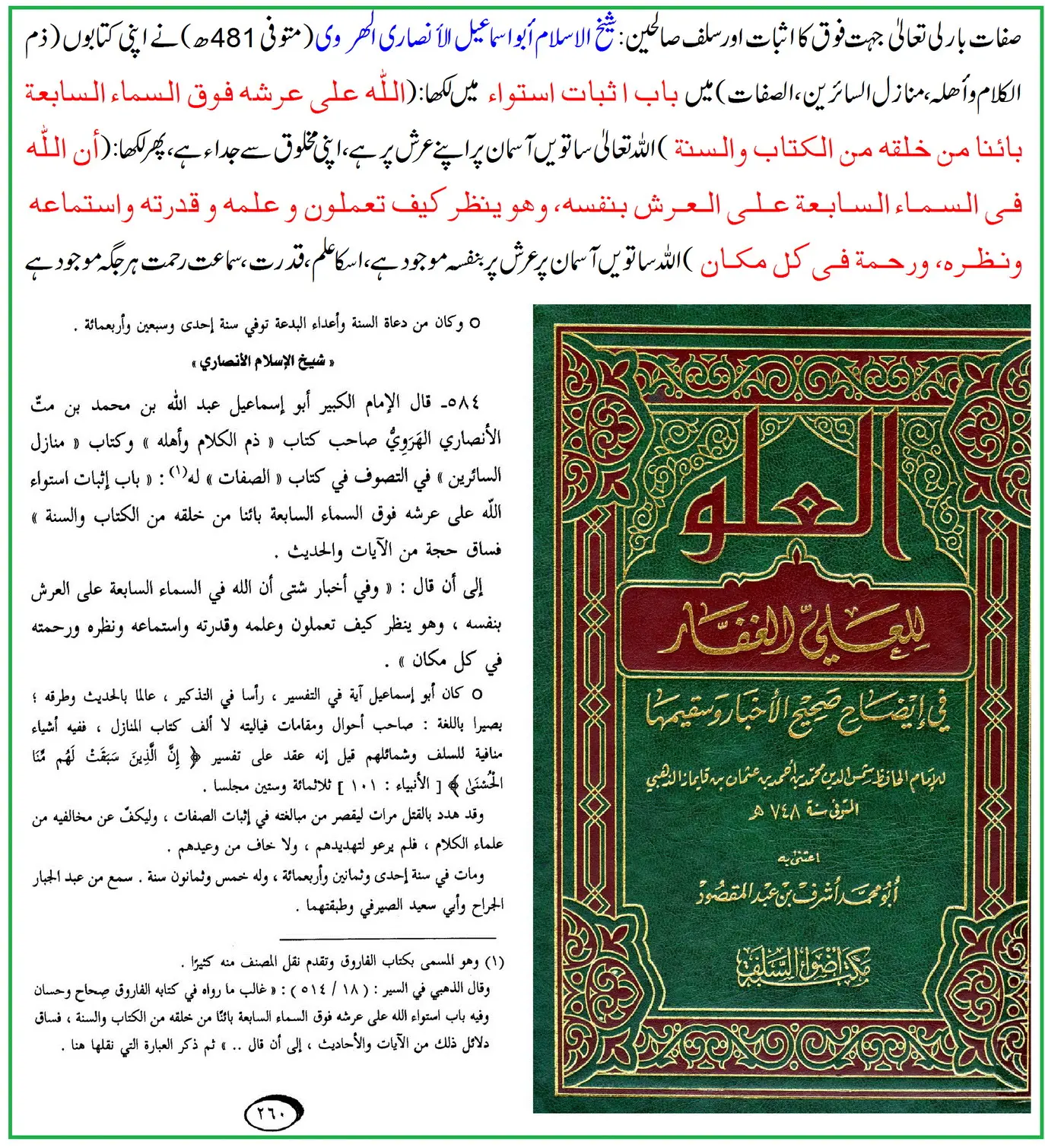
Arabic Text:
قال الإمام الكبير أبو إسماعيل الهروي في كتاب الصفات:«باب استواء الله على عرشه فوق السماء السابعة بائنا من خلقه من الكتاب والسنة. … وفي أخبار شتى أن الله في السماء السابعة على العرش بنفسه، وهو ينظر كيف يعملون، وعلمه وقدرته واستماعه ونظره ورحمته في كل مكان».
Translation:
Imām Abū Ismāʿīl al-Harawī رحمه الله said: “Chapter: Allah’s rising over His Throne above the seventh heaven, distinct from His creation—proven from the Book and Sunnah… And in various reports it is mentioned that Allah is in the seventh heaven upon the Throne with His Essence; He observes how they act; and His knowledge, power, hearing, seeing, and mercy are in every place.”Reference:
Reference: Mukhtaṣar al-ʿUluww, al-Dhahabī, p. 339
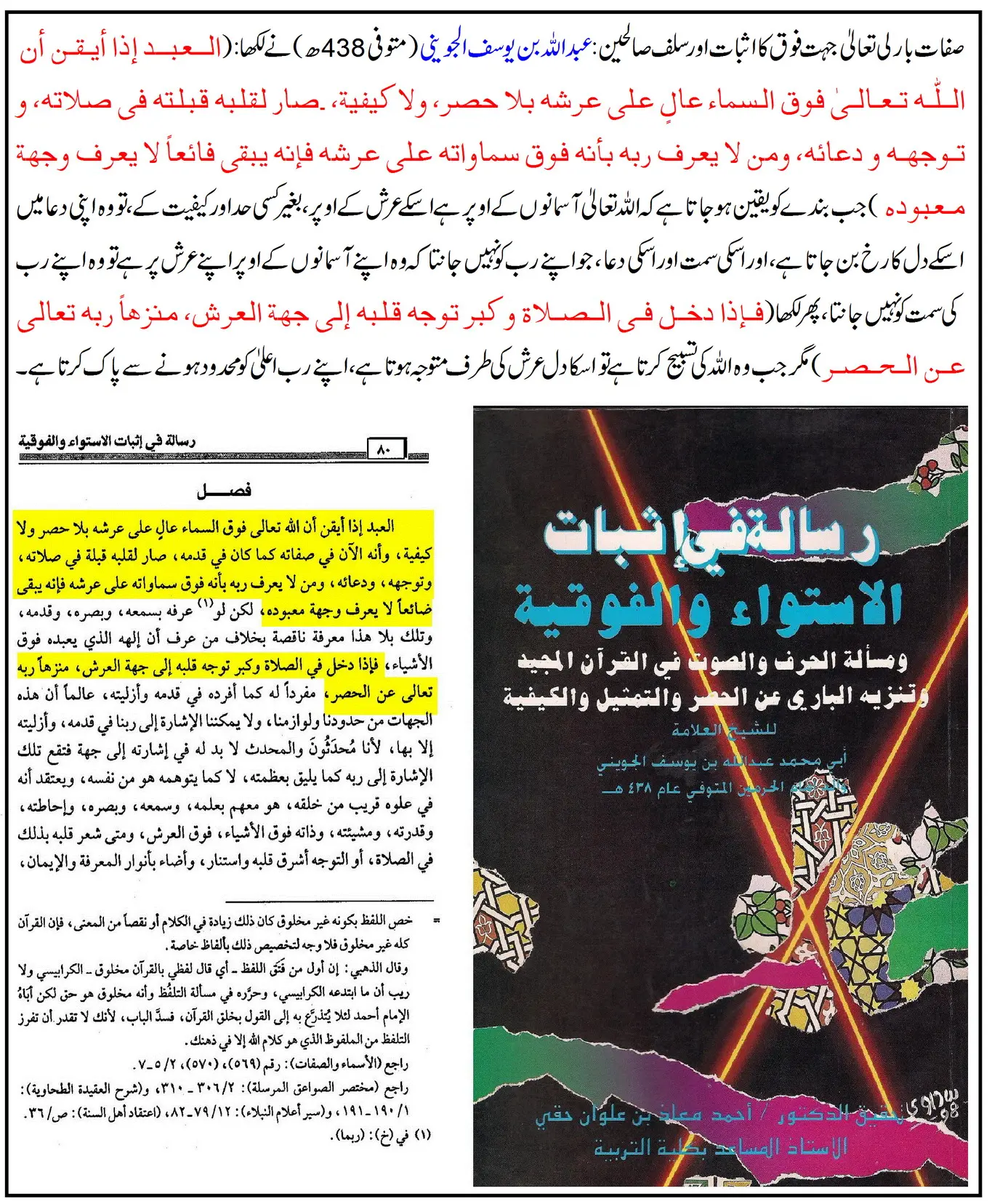
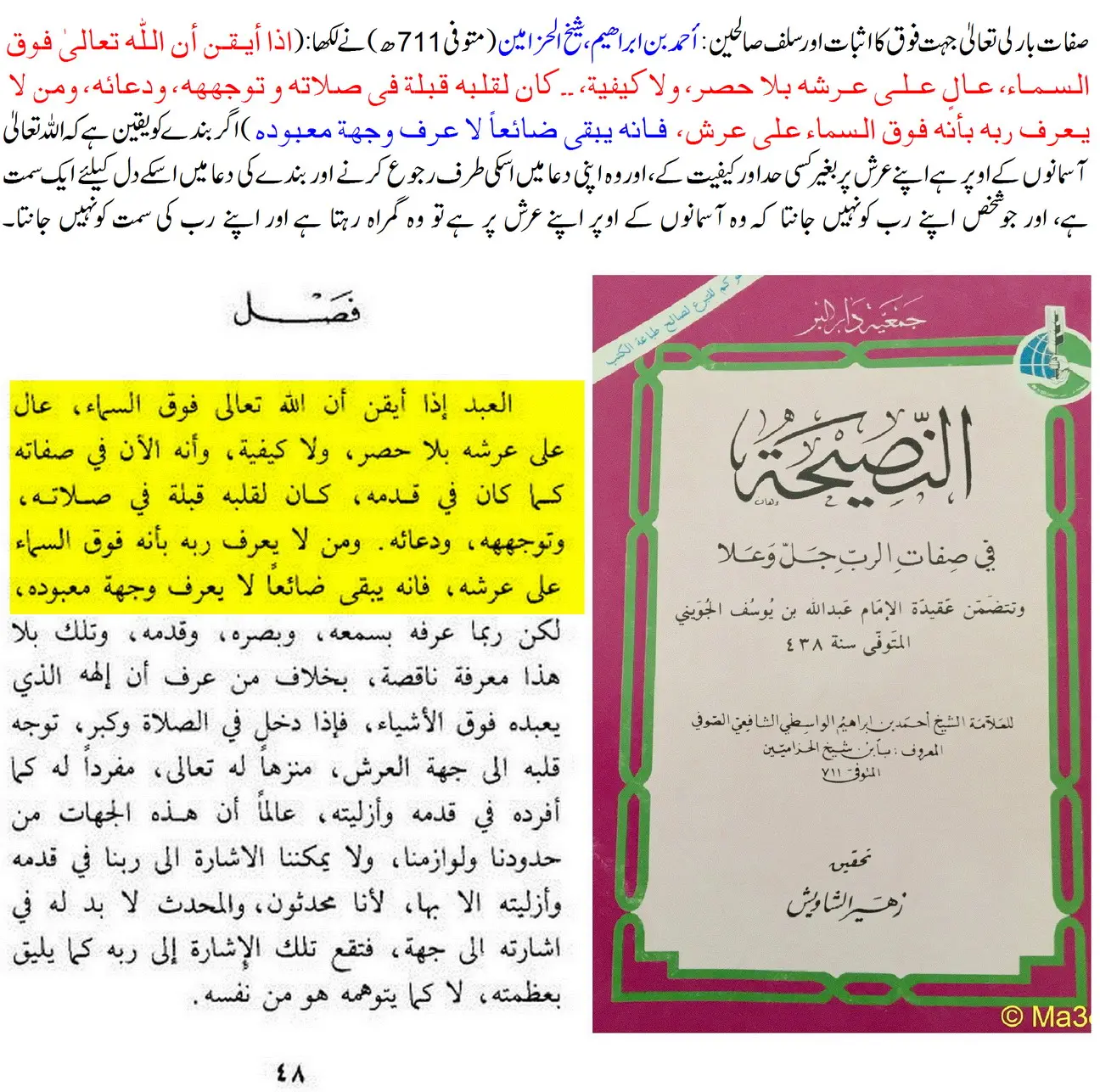
⑮ Evidence Fifteen: Imām ʿAbdullāh ibn Yūsuf al-Juwaynī (Abū Muḥammad) (d. 438H)
Arabic Text:
العَبْدُ إِذَا أَيْقَنَ أَنَّ اللَّهَ تَعَالَى فَوْقَ السَّمَاءِ، عَالٍ عَلَى عَرْشِهِ بِلاَ حَصْرٍ وَلاَ كَيْفِيَّةٍ … وَمَنْ لاَ يَعْرِفْ رَبَّهُ بِأَنَّهُ فَوْقَ سَمَاوَاتِهِ عَلَى عَرْشِهِ فَإِنَّهُ يَبْقَى ضَائِعاً لاَ يَعْرِفُ وَجْهَةَ مَعْبُودِهِ».Translation:
Imām Abū Muḥammad al-Juwaynī رحمه الله said: “When a servant becomes certain that Allah Almighty is above the heaven—high upon His Throne without confinement and without (asking) how… and whoever does not recognize his Lord as being above His heavens upon His Throne remains lost and does not recognize the direction of his object of worship.”Reference:
Reference: Risālah fī Ithbāt al-Isti wā’ wa al-Fawqiyyah, p. 15
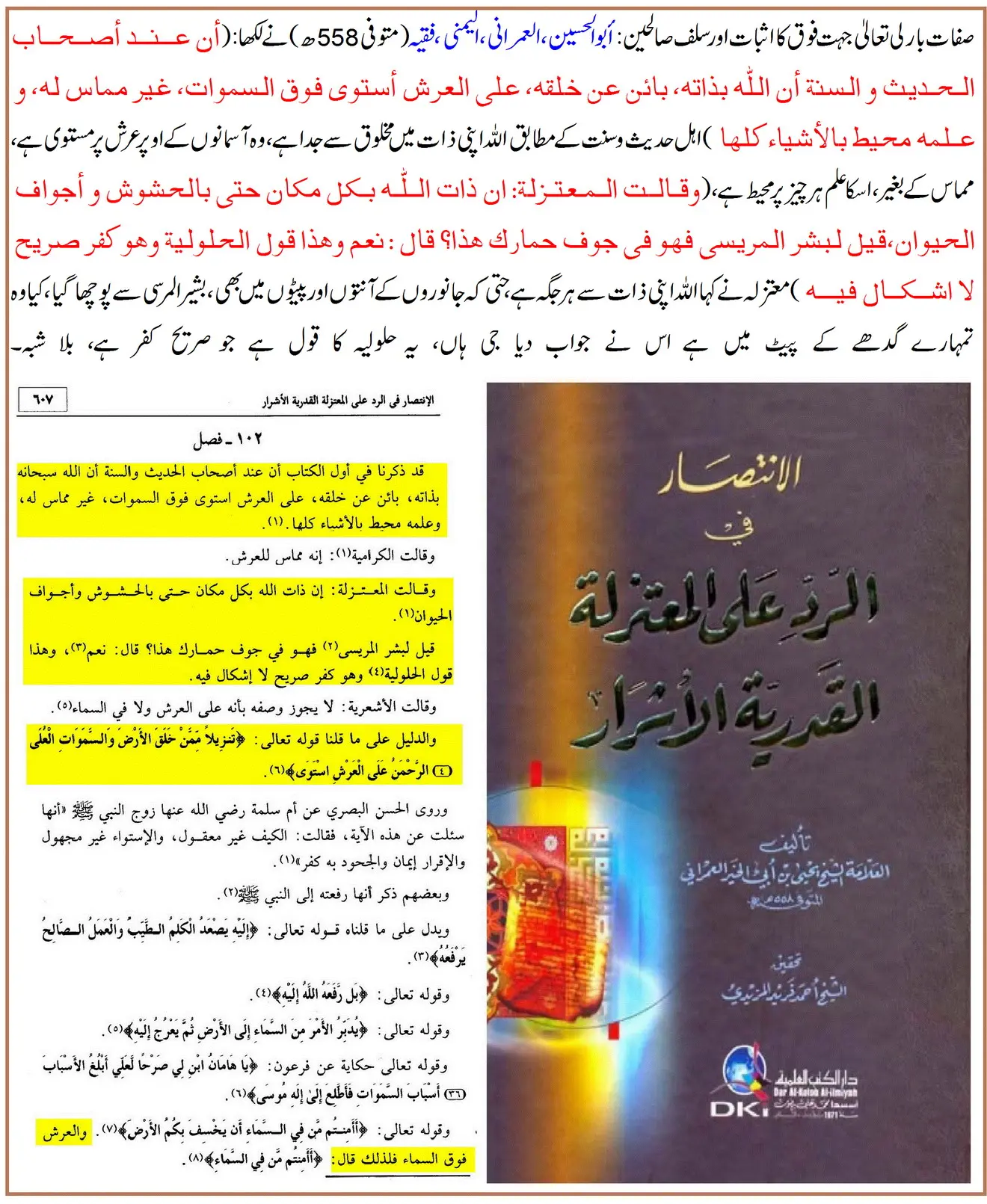
⑯ Evidence Sixteen: Imām Abū al-Ḥusayn al-ʿUmrānī al-Yamanī (d. 558H)
Arabic Text:
عند أصحاب الحديث والسنة أن الله سبحانه بذاته بائن عن خلقه، على العرش استوى فوق السموات، غير مماس له، وعلمه محيط بالأشياء كلها.Translation:
Imām al-ʿUmrānī رحمه الله said: “According to the people of ḥadīth and Sunnah, Allah—Glorified is He—is distinct from His creation with His Essence; He rose over the Throne above the heavens, without contacting it, and His knowledge encompasses all things.”Reference:
Reference: al-Intiṣār fī al-Radd ʿalā al-Muʿtazilah, p. 102
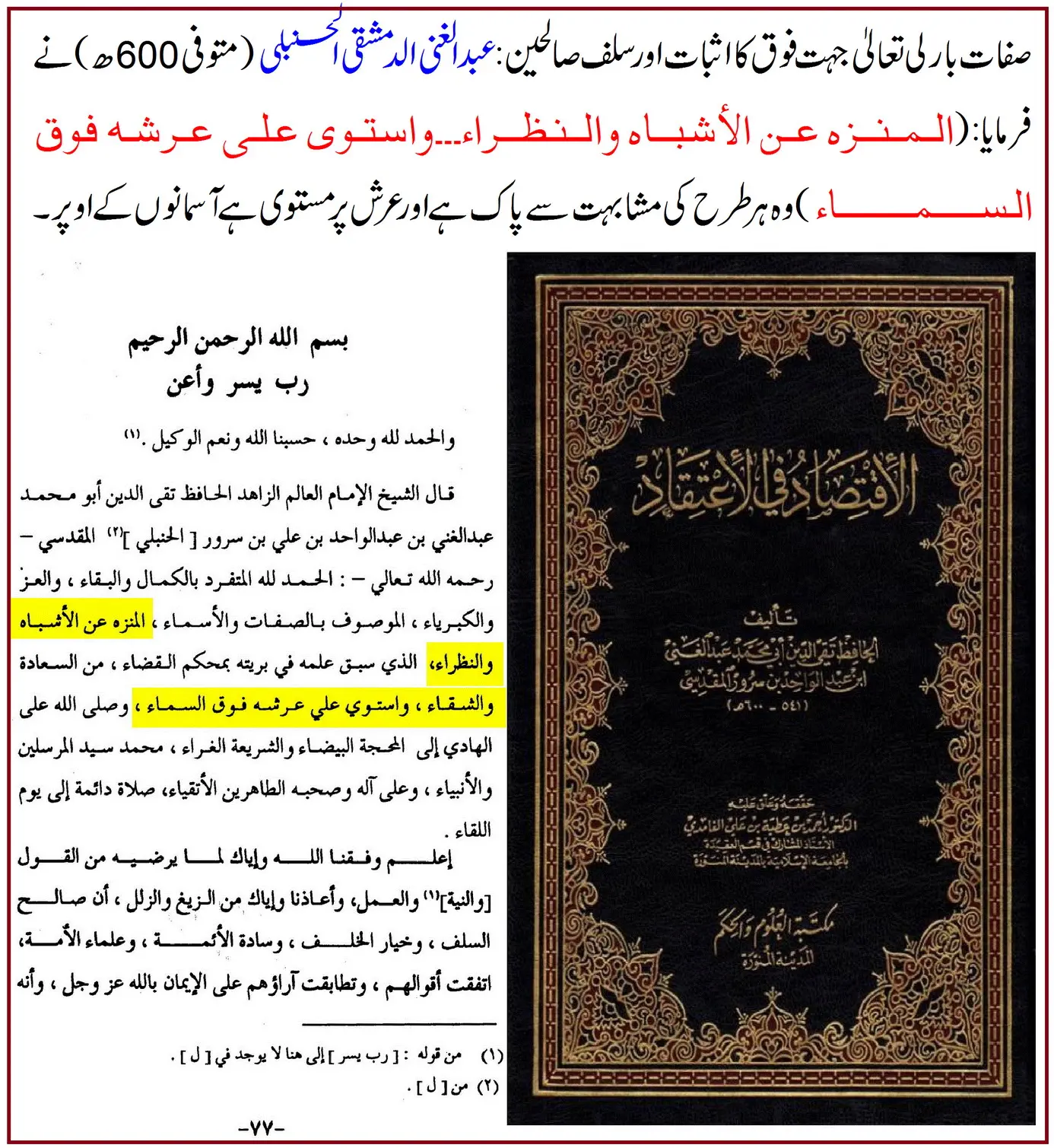
⑰ Evidence Seventeen: Imām ʿAbd al-Ghanī al-Maqdisī al-Ḥanbalī (d. 600H)
Arabic Text:
المنزه عن الأشباه والنظراء، … واستوى على عرشه فوق السماء.Translation:
Imām ʿAbd al-Ghanī al-Maqdisī رحمه الله said: “(Allah is) free from likenesses and equals… and He rose over His Throne above the heaven.”Reference:
Reference: al-Iqtiṣād fī al-Iʿtiqād, p. 27
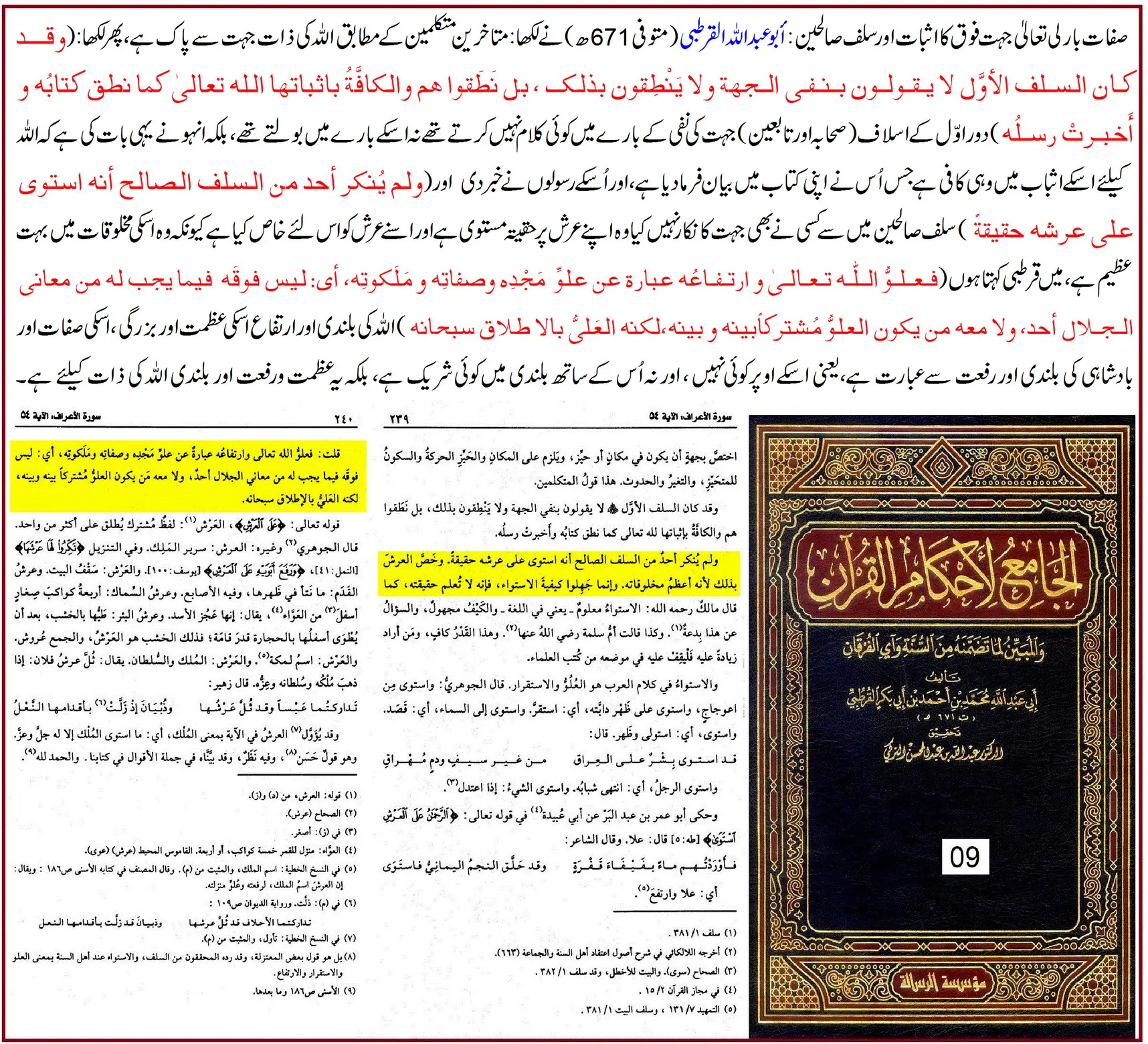
⑱ Evidence Eighteen: Imām Abū ʿAbdullāh al-Qurṭubī (d. 671H)
Arabic Text:
وَقَدْ كَانَ السَّلَفُ الْأَوَّلُ رَضِيَ اللَّهُ عَنْهُمْ لَا يَقُولُونَ بِنَفْيِ الْجِهَةِ وَلَا يَنْطِقُونَ بِذَلِكَ، بَلْ نَطَقُوا هُمْ وَالْكَافَّةُ بِإِثْبَاتِهَا لِلَّهِ تَعَالَى كَمَا نَطَقَ كِتَابُهُ وَأَخْبَرَتْ رُسُلُهُ، وَلَمْ يُنْكِرْ أَحَدٌ مِنَ السَّلَفِ أَنَّهُ اسْتَوَى عَلَى عَرْشِهِ حَقِيقَةً.Translation:
Imām al-Qurṭubī said: “The early Salaf—may Allah be pleased with them—did not speak of denying direction, nor did they utter such a thing. Rather, they and the people at large affirmed it for Allah Almighty, as His Book spoke and His Messengers informed. And none of the Salaf denied that He truly rose over His Throne.”Reference:
Reference: al-Jāmiʿ li Aḥkām al-Qur’ān (Tafsīr al-Qurṭubī), Sūrah Ṭā-Hā: 5
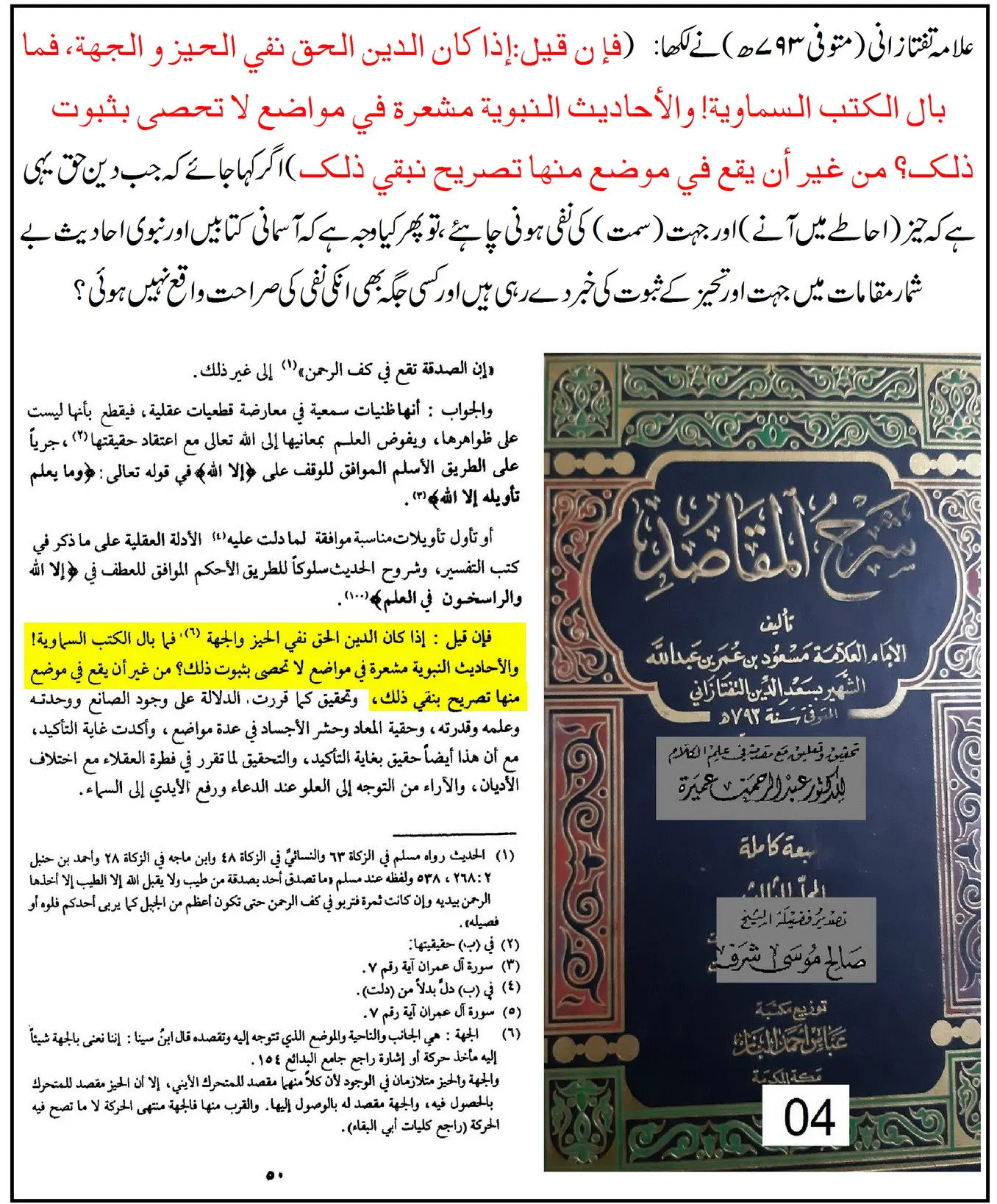
⑲ Evidence Nineteen: Imām Saʿd al-Dīn al-Taftāzānī (d. 793H)
Arabic Text:
قِيلَ إِذَا كَانَ الدِّينُ الْحَقُّ نَفْيَ الْحَيِّزِ وَالْجِهَةِ، فَمَا بَالُ الْكُتُبِ السَّمَاوِيَّةِ وَالْأَحَادِيثِ النَّبَوِيَّةِ مُشْعِرَةٌ فِي مَوَاضِعَ لَا تُحْصَى بِثُبُوتِ ذَلِكَ؟Translation:
Al-Taftāzānī said: “If the true religion is to negate space and direction for Allah, then why is it that the heavenly books and prophetic ḥadīths, in countless places, indicate the affirmation of that?”Reference:
Reference: Sharḥ al-Maqāṣid fī ʿIlm al-Kalām, vol. 2, p. 32
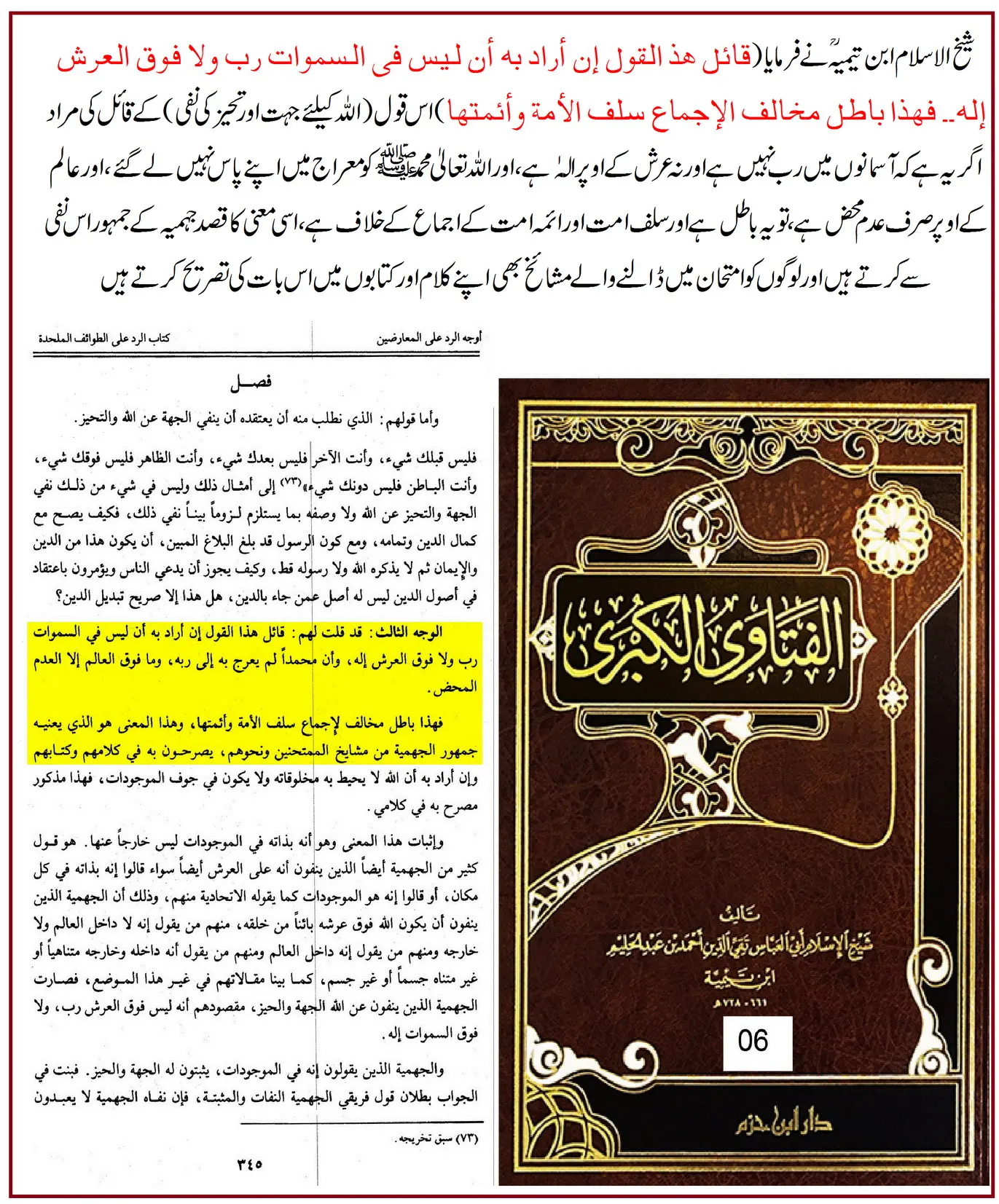
⑳ Evidence Twenty: Imām Ibn Taymiyyah (d. 728H)
Arabic Text:
فَهَذَا بَاطِلٌ مُخَالِفٌ لِإِجْمَاعِ سَلَفِ الْأُمَّةِ، فَإِنَّ السَّلَفَ أَجْمَعُوا عَلَى أَنَّ اللَّهَ فَوْقَ سَمَاوَاتِهِ عَلَى عَرْشِهِ، بَائِنٌ مِنْ خَلْقِهِ.Translation:
Shaykh al-Islām Ibn Taymiyyah said: “This statement (that Allah has no direction) is false and contrary to the consensus of the Salaf of the Ummah, for the Salaf unanimously agreed that Allah is above His heavens upon His Throne, distinct from His creation.”Reference:
Reference: al-Fatāwā al-Kubrā, vol. 6, p. 584
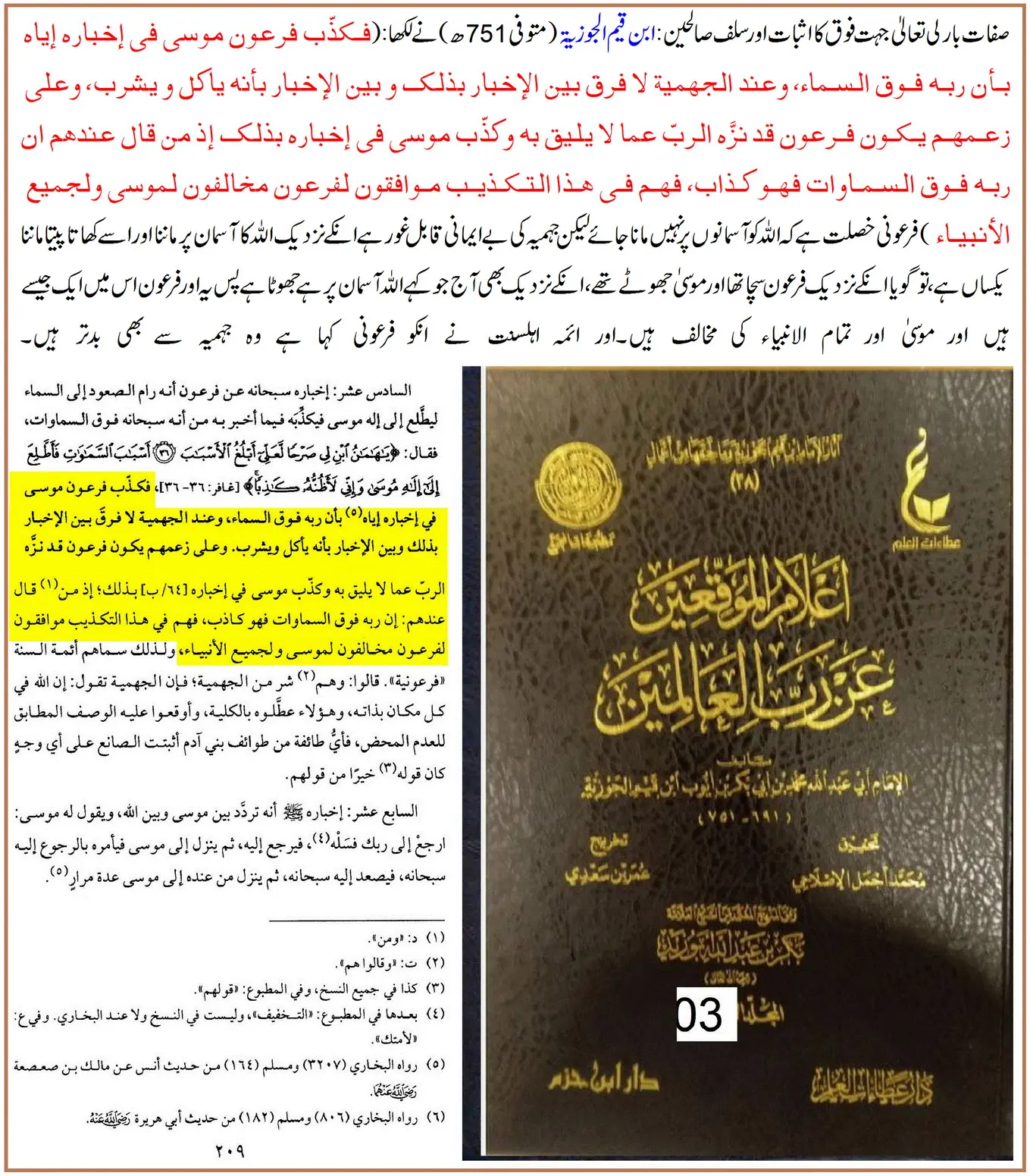
㉑ Evidence Twenty-One: Imām Ibn al-Qayyim (d. 751H)
Arabic Text:
فَعَلَى زَعْمِهِمْ يَكُونُ فِرْعَوْنُ قَدْ نَزَّهَ الرَّبَّ عَمَّا لَا يَلِيقُ بِهِ وَكَذَّبَ مُوسَى فِي إِخْبَارِهِ، إِذْ مَنْ قَالَ: إِنَّ رَبَّهُ فَوْقَ السَّمَاوَاتِ فَهُوَ كَاذِبٌ! فَهُمْ فِي هَذَا التَّكْذِيبِ مُوَافِقُونَ لِفِرْعَوْنَ مُخَالِفُونَ لِمُوسَى وَجَمِيعِ الْأَنْبِيَاءِ.Translation:
Ibn al-Qayyim رحمه الله said: “According to their claim, Firʿawn would have declared the Lord free from what is unbefitting and would have declared Mūsā a liar in his informing (that his Lord is above the heavens)—for whoever says: ‘My Lord is above the heavens’ would be lying! Thus, in this denial they agree with Firʿawn and oppose Mūsā and all the Prophets.”Reference:
Reference: Iʿlām al-Muwaqqiʿīn, vol. 4, p. 251
Refuting Jahmiyyah Proofs for Negating the Direction of Above
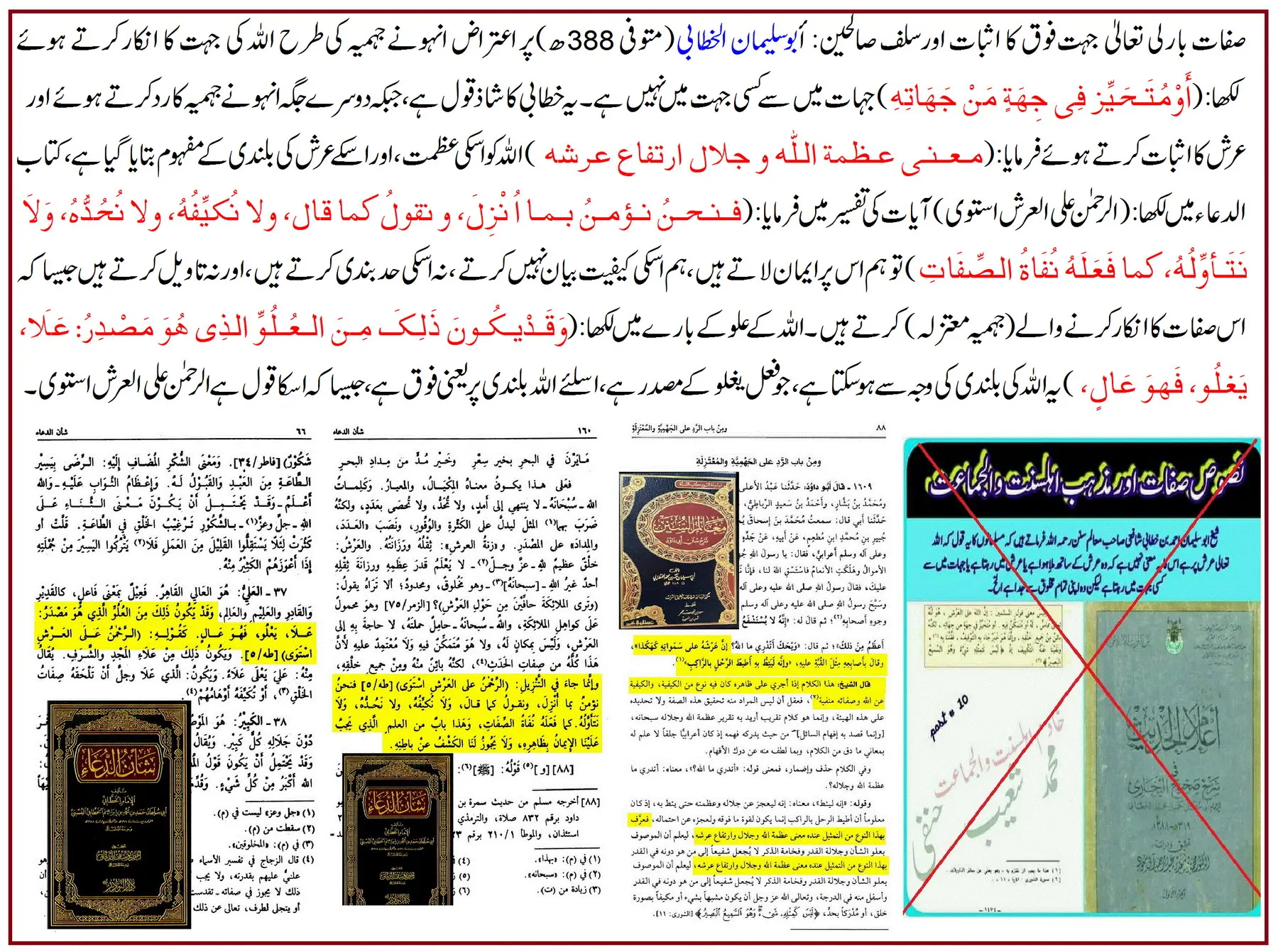
◈ Doubt One: Imām Abū Sulaymān al-Khaṭṭābī (d. 388H)
The Jahmiyyah present this phrase:Arabic Phrase:
«أو متحيز في جهة من جهاته»
Reference: Iʿlām al-Ḥadīth, al-Khaṭṭābī
Translation:
“Or (that He is) confined in one of the directions.”Answer:
This phrase is odd and unclear, and it is presented after being cut off from its context. In other places, Imām al-Khaṭṭābī clearly affirms highness and isti wā’ over the Throne:✔ In Maʿālim al-Sunan (Sharḥ Sunan Abī Dāwūd), refuting the Jahmiyyah and Muʿtazilah, he wrote:
«ومن باب الرد على الجهمية والمعتزلة … ليعلم أن الموصوف بعلو الشأن وجلالة القدر وارتفاع عرشه»
Reference: Maʿālim al-Sunan, vol. 4, p. 285
Meaning: affirming the loftiness of Allah’s Throne and His exalted status.
✔ In Sha’n al-Duʿā’, while explaining the verse ﴿الرَّحْمَنُ عَلَى الْعَرْشِ اسْتَوَى﴾ he said:
«فنحن نؤمن بما أنزل، ونقول كما قال، ولا نكيفه، ولا نحده، ولا نتأوله كما فعلته نفاة الصفات»
Reference: Sha’n al-Duʿā’, p. 37
Meaning: We believe in it, we do not describe its “how,” we do not set limits, and we do not reinterpret it like the negators of attributes.
✔ In the same book, regarding “al-ʿAliyy”, he wrote:
«العلي: هو العالي القاهر … وقد يكون ذلك من العلو الذي هو مصدر: علا يعلو فهو عال، كقوله: الرحمن على العرش استوى»
Reference: Sha’n al-Duʿā’, p. 37
Conclusion:
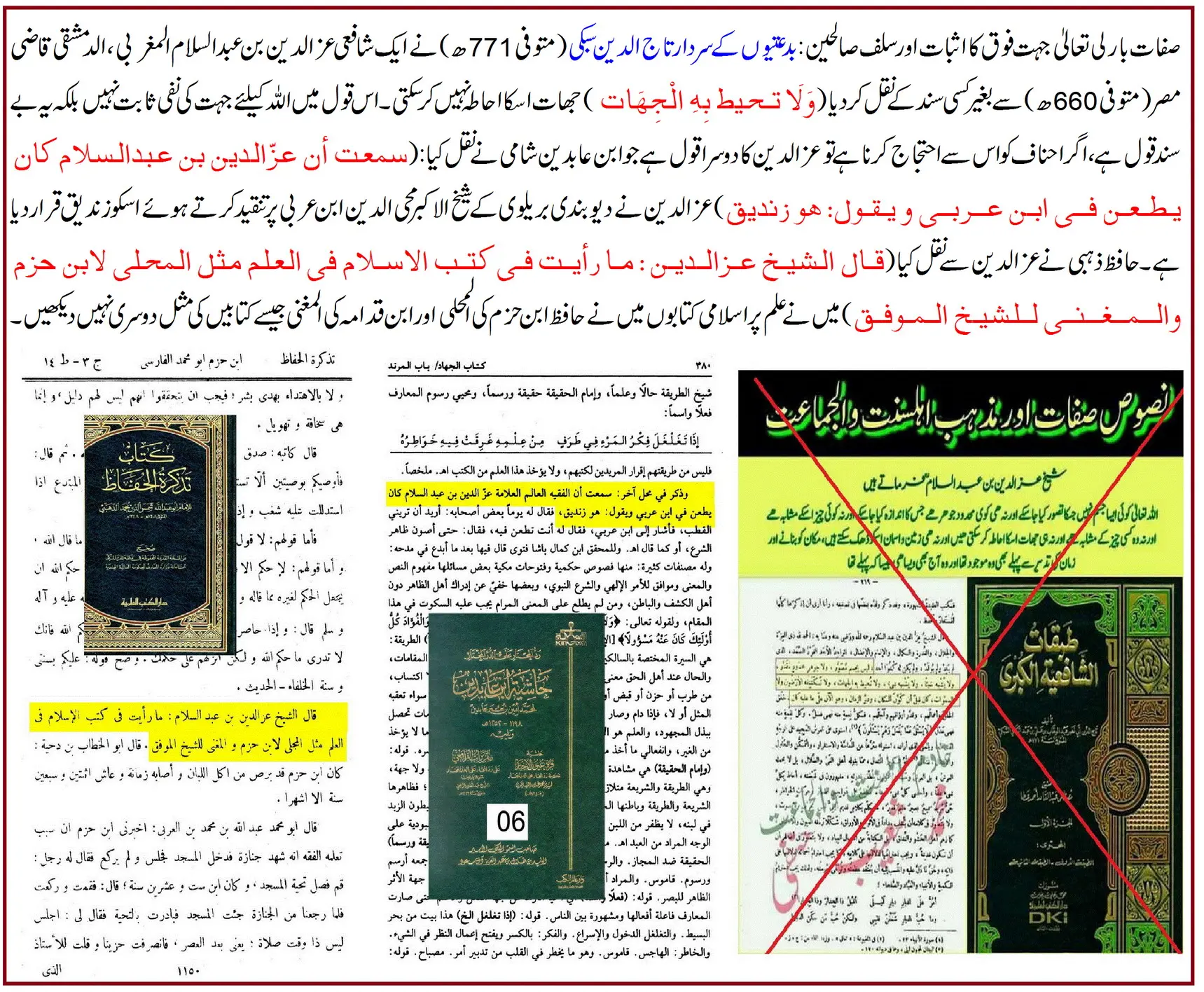
Imām al-Khaṭṭābī intended negation of how-ness and restricting definition, not negation of highness and fawqiyyah.◈ Doubt Two: Imām ʿIzz al-Dīn ibn ʿAbd al-Salām (d. 660H)
They cite from Tāj al-Dīn al-Subkī (d. 771H):«ولا تحيط به الجهات»
Reference: Ṭabaqāt al-Shāfiʿiyyah al-Kubrā
Translation:
“Directions cannot encompass Allah.”Answer:
This statement is transmitted without a chain and is ambiguous. Its meaning is that Allah is not encompassed by created directions, and this is not a negation of highness.Further, his other positions show he strongly opposed the corrupt beliefs of the Sufis (such as Ibn ʿArabī). Ibn ʿĀbidīn al-Shāmī نقل:
«سمعت أن الفقيه العالم عز الدين بن عبد السلام كان يطعن في ابن عربي ويقول هو زنديق»
Reference: Radd al-Muḥtār, vol. 2, p. 263
And al-Dhahabī نقل from him:
«ما رأيت في كتب الإسلام في العلم مثل المحلى لابن حزم والمغني لابن قدامة»
Reference: Tadhkirat al-Ḥuffāẓ, vol. 4, p. 1477
Conclusion:
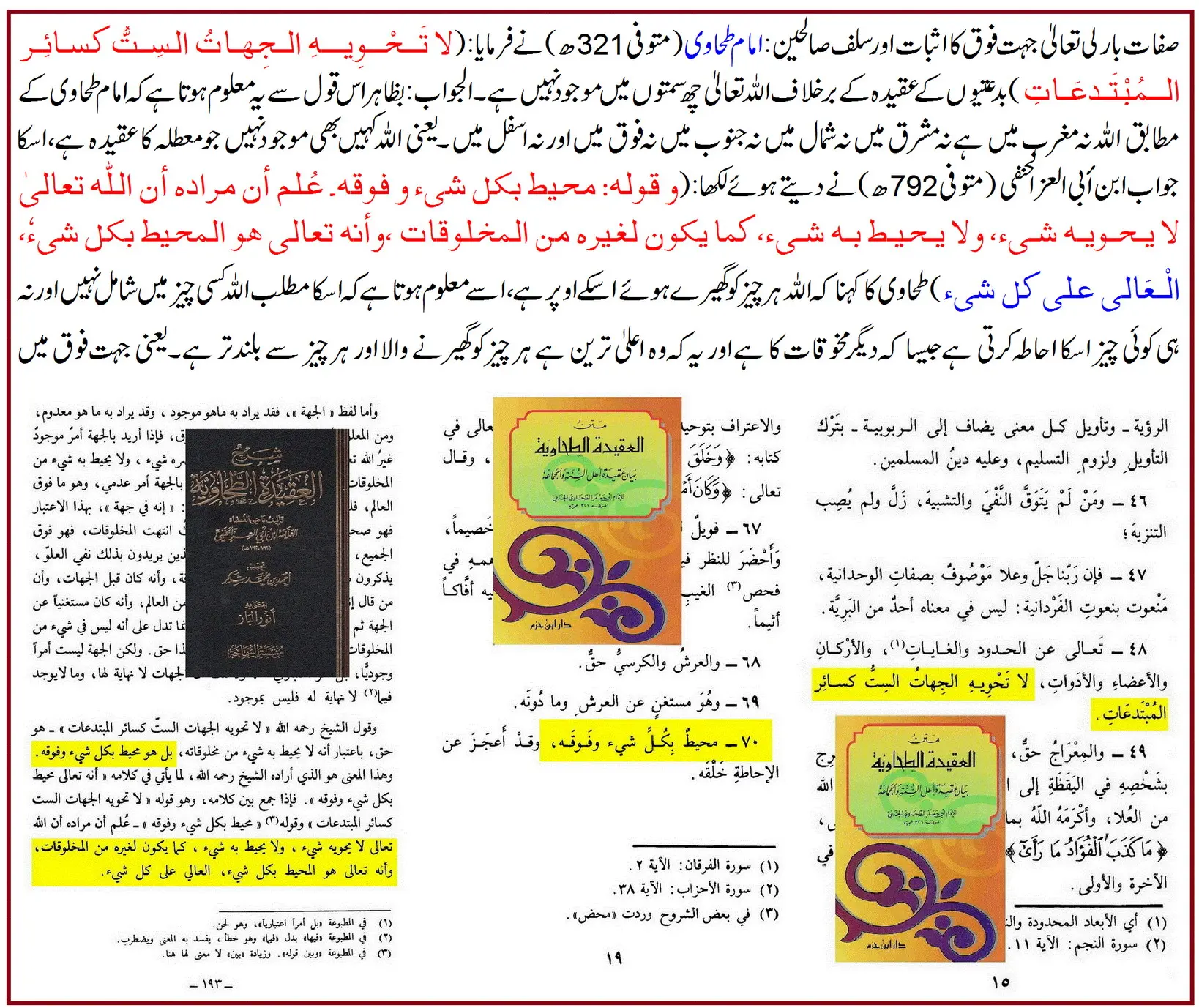
Thus, his ambiguous phrase cannot be used as a proof for negating fawqiyyah. Rather, it means Allah is not confined like creation.◈ Doubt Three: Imām Abū Jaʿfar al-Ṭaḥāwī (d. 321H)
In al-ʿAqīdah al-Ṭaḥāwiyyah, he said:Arabic Text:
«وتعالى عن الحدود والغايات والأركان والأعضاء والأدوات، لا تحويه الجهات الست كسائر المبتدعات»
Reference: al-ʿAqīdah al-Ṭaḥāwiyyah, paragraph 38
Translation:
“Allah is exalted above limits, ends, pillars, limbs, and instruments; and the six directions do not contain Him as they contain created things.”Answer:
Although it may seem like negation of highness, he himself clarifies later:Arabic Text:
«والعرش والكرسي حق، وهو مستغن عن العرش وما دونه، محيط بكل شيء وفوقه، وقد أعجز عن الإحاطة خلقه»
Reference: al-ʿAqīdah al-Ṭaḥāwiyyah, paragraphs 49–51
Translation:
“The Throne and the Kursī are true. Allah is independent of the Throne and whatever is beneath it. He encompasses everything and is above it, and He has rendered His creation incapable of encompassing Him.”Imām Ibn Abī al-ʿIzz al-Ḥanafī (d. 792H) explained:
«محيط بكل شيء وفوقه: مراده أن الله لا يحويه شيء، ولا يحيط به شيء كما يكون لغيره من المخلوقات، وأنه العلي عن كل شيء»
Reference: Sharḥ al-ʿAqīdah al-Ṭaḥāwiyyah, p. 312
Conclusion:
Al-Ṭaḥāwī did not mean that Allah is not above the Throne; rather, he meant Allah is not encompassed by created directions. He is “above everything”, and His highness in the direction of above is affirmed as per the consensus of the Salaf.✔ Complete Summary and Final Conclusion
The Jahmiyyah and mutakallimīn claim that the verse:﴿فَأَيْنَمَا تُوَلُّوا فَثَمَّ وَجْهُ اللَّهِ﴾
proves Allah being personally present in every direction, and that the belief of “above the Throne” implies limitation.
Ahl al-Sunnah wa al-Jamāʿah clarified—through the Qur’an, Sunnah, narrations of the Companions, and the statements of the Imams—that:
① Allah is above the Throne with His Essence, in the direction of above.
② He is distinct (بائن) from His creation.
③ Yet His knowledge and power encompass everything everywhere.
Imām Ibn Masʿūd, Ibn al-Mubārak, Imām Aḥmad, Ibn Abī Shaybah, Ibn Khuzaymah, Ibn Baṭṭah, al-Dārimī, Abū Ḥātim, Abū Zurʿah, al-Muzanī, al-Shāfiʿī, Ibn Rushd, al-Sijzī, al-Aṣbahānī, al-Harawī, al-Juwaynī, al-ʿUmrānī, ʿAbd al-Ghanī al-Maqdisī, al-Qurṭubī, al-Taftāzānī, Ibn Taymiyyah, and Ibn al-Qayyim—all stated this creed.
And the statements of al-Khaṭṭābī, ʿIzz al-Dīn ibn ʿAbd al-Salām, and al-Ṭaḥāwī—presented by opponents as negating direction—are actually about negating encompassment and restricting definition, not negating fawqiyyah.
 The Creed of Ahl al-Sunnah in One Sentence
Allah Almighty is above the Throne, distinct from His creation, and He encompasses everything with His knowledge.
