Compiled by: Abu Hamza Salafi
Hafiz Ibn Hazm Al-Andalusi, may Allah have mercy on him, (أبو محمد علي بن أحمد بن سعيد بن حزم الأندلسي القرطبي الظاهري، المتوفى: ٤٥٦ھ) is among those great scholars about whom later centuries' hadith scholars, jurists, and historians have openly expressed their admiration for his scholarly, hadith, and jurisprudential greatness and leadership, although some of his ijtihadi issues have also been critiqued. The purpose of this article is to clarify that Ibn Hazm’s personality is regarded by the majority of hadith scholars as holding the status of "al-Imam, al-Allamah, al-Hafiz, al-Faqih, al-Mujtahid," and therefore, it is not a fair approach to categorically reject his fatwas or scholarly statements; rather, the method of the imams of hadith is that, like any great mujtahid, both correct and incorrect ijtihads were issued by Ibn Hazm, but there is abundant material from scholars affirming his integrity, memorization, jurisprudence, and leadership in hadith. In the following lines, we present the endorsements of the majority of hadith scholars and jurists regarding Ibn Hazm.
The full name of Ibn Hazm is:
أبو محمد علي بن أحمد بن سعيد بن حزم الأندلسي القرطبي الظاهري (المتوفى: ٤٥٦هـ)
You held a distinguished position among the great scholars of Andalusia (Spain). Numerous Imams simultaneously described you as "Imam, Allama, Hafiz, Faqih, Mujtahid," a great memorizer of Hadith, an authority in jurisprudence with the ability of Ijtihad, an expert in history, literature, logic, philosophy, and other disciplines, and a scholar who derived rulings directly from the Book and Sunnah. Many Imams have stated that in your time, there was no equal to you in Andalusia in terms of the comprehensiveness of Islamic sciences, and you left behind numerous works in various fields, among which "Al-Muhalla" and "Al-Fasl fi al-Milal wa al-Ahwa' wa al-Nihal" are especially famous.
➊ Hafiz Shams al-Din al-Dhahabi (Tadhkirat al-Huffaz)
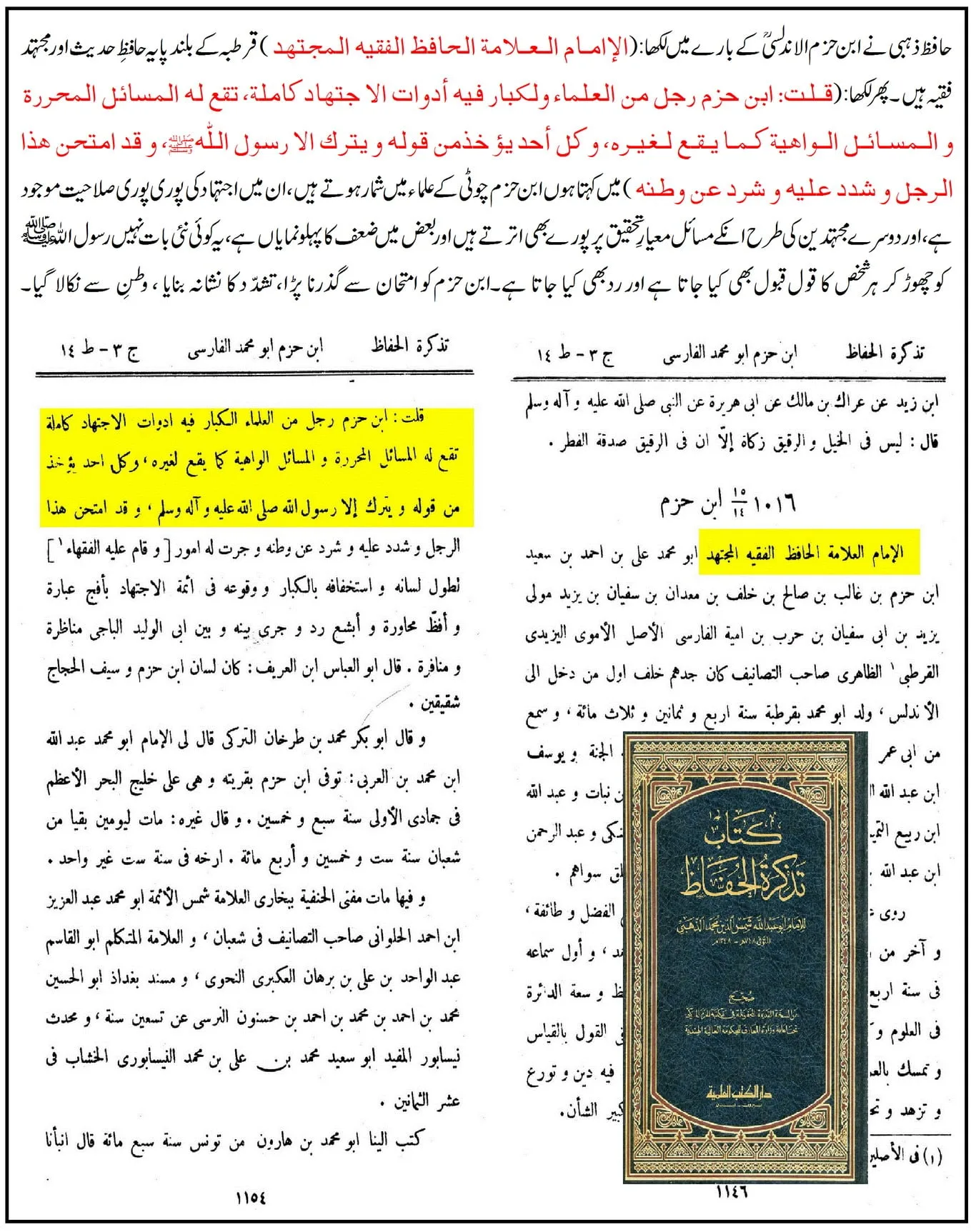
Hafiz al-Dhahabi writes about Ibn Hazm:
ابن حزم الإمام العلامة الحافظ الفقيه المجتهد
قلت: ابن حزم رجل من العلماء الكبار فيه أدوات الاجتهاد كاملة, تقع له المسائل المحررة والمسائل الواهية كما يقع لغيره, وكل أحد يؤخذ من قوله ويترك إلا رسول الله, صلى الله عليه وآله وسلم. وقد امتحن هذا الرجل وشدد عليه وشرد عن وطنه
Ibn Hazm is an imam, scholar, hafiz, jurist, and mujtahid. I (Al-Dhahabi) say: Ibn Hazm is among the great scholars, possessing complete capability for ijtihad. Like other mujtahids, some well-researched and some weak issues have emerged from him, as happens with others, and except for the Messenger of Allah ﷺ, the statements of every person are accepted and rejected. This man of knowledge faced trials, was treated harshly, and was expelled from his homeland.
Reference: Al-Kitab: Tadhkirat al-Huffaz
Brief Explanation:
Here Hafiz Al-Dhahabi clearly describes Ibn Hazm as "al-Imam, al-‘Allamah, al-Hafiz, al-Faqih, al-Mujtahid" and also states the principle that even the greatest mujtahid can err in some issues, but this does not diminish his scholarly leadership.
➋ Hafiz Al-Dhahabi’s Personal Affection and Acknowledgment of Excellence (Siyar A‘lam al-Nubala’)
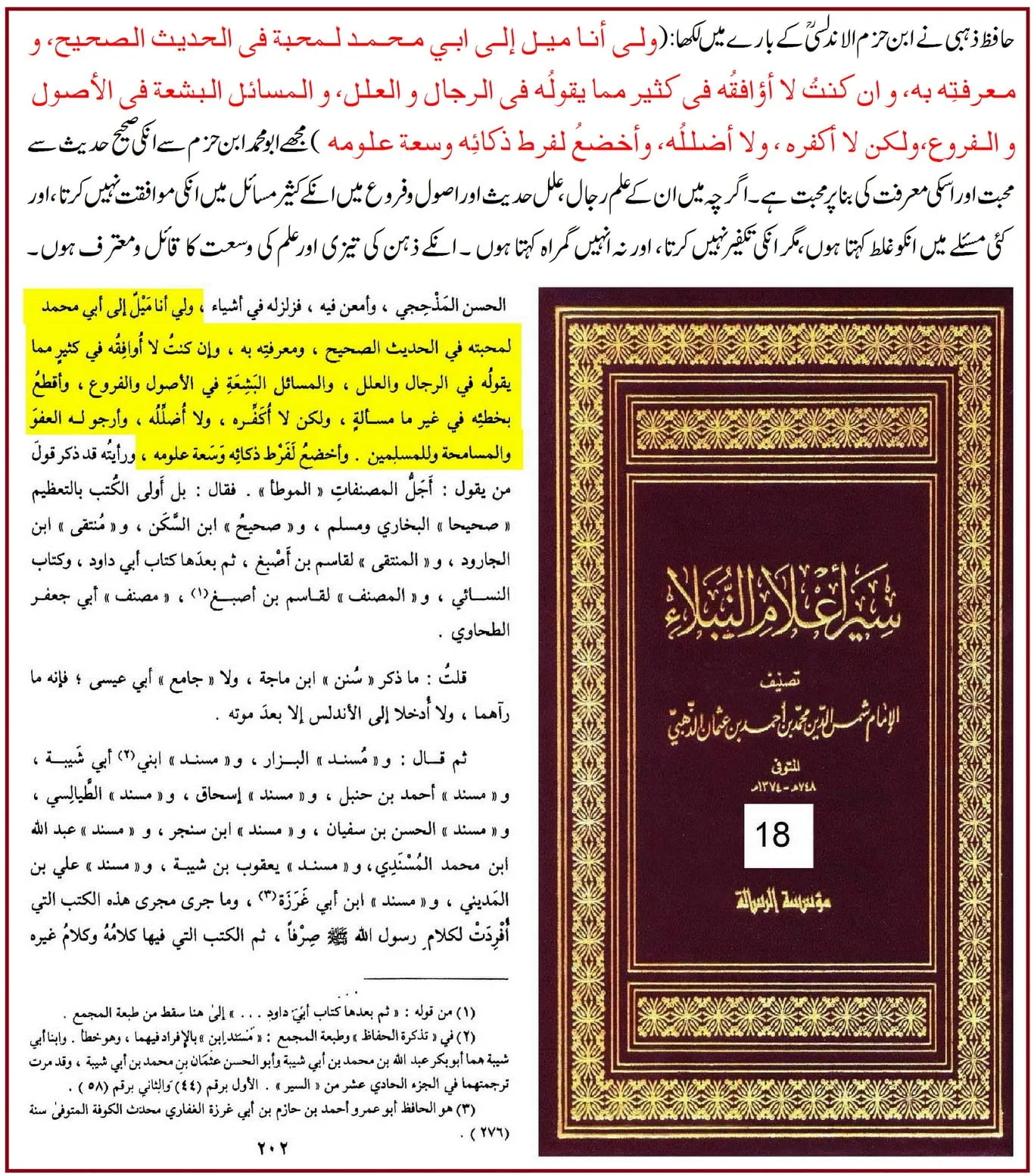
Hafiz Al-Dhahabi describes his personal view about Ibn Hazm in "Siyar A‘lam al-Nubala’" as follows:
وَلِي أَنَا مَيْلٌ إِلَى أَبِي مُحَمَّدٍ لمَحَبَّته فِي الحَدِيْثِ الصَّحِيْح، وَمَعْرِفَتِهِ بِهِ، وَإِنْ كُنْتُ لاَ أُوَافِقُهُ فِي كَثِيْرٍ مِمَّا يَقولُهُ فِي الرِّجَالِ وَالعلل، وَالمَسَائِل البَشِعَةِ فِي الأُصُوْلِ وَالفروع، وَأَقطعُ بخطئِهِ فِي غَيْرِ مَا مَسْأَلَةٍ، وَلَكِن لاَ أُكَفِّره، وَلاَ أُضَلِّلُهُ، وَأَرْجُو لَهُ العفوَ وَالمُسَامحَة وَللمُسْلِمِيْنَ. وَأَخضعُ لِفَرْطِ ذكَائِهِ وَسَعَة علُوْمِهِ
Urdu Translation:
I have an inclination and love for Abu Muhammad (Ibn Hazm) due to his love for authentic Hadith and his expertise in this knowledge, although I do not agree with him on many issues related to narrators, the defects of Hadith, and the principles and branches of jurisprudence, and I am certain of his errors in many matters; but I neither declare him an unbeliever nor call him misguided, rather I hope for forgiveness and pardon for him and all Muslims, and I bow before his extraordinary intellect and the vastness of his knowledge.
Reference: Al-Kitab: Siyar A'lam al-Nubala
Explanation:
This passage clarifies that even according to a great Hadith critic (Zahabi, may Allah have mercy on him), Ibn Hazm is an imam worthy of love and respect in terms of scholarly eminence and Hadith knowledge, although scholarly critique of his ijtihadi errors remains valid.
➌ Imam Humaydi (Juzwat al-Muqtasib)
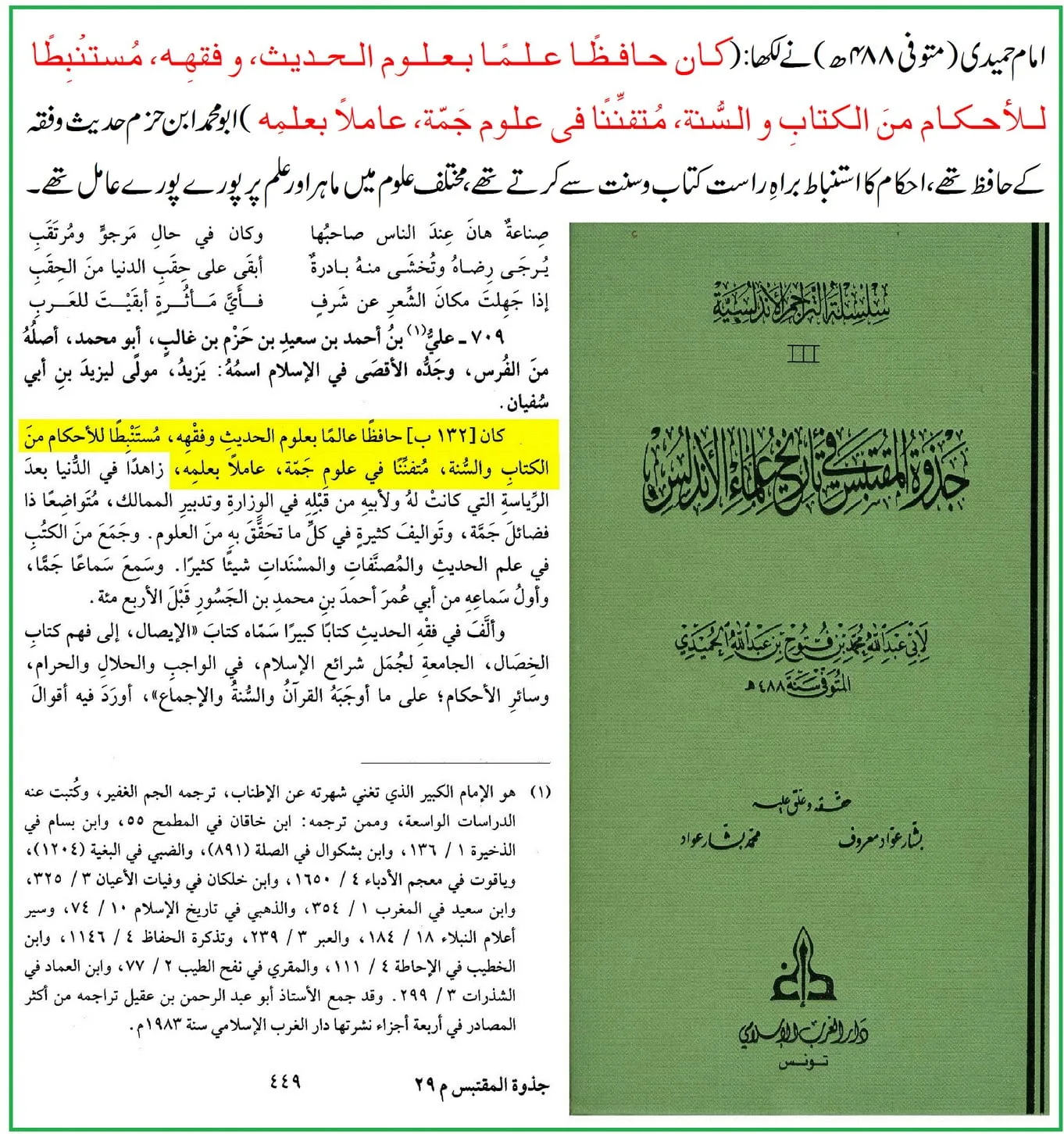
Imam Humaydi (died 488 AH) says about Ibn Hazm:
قال الحميدي: كان أبو محمد حافظًا للحديث وفقهه, مستنبطًا للأحكام من الكتاب والسنة, متفننًا في علوم جمة, عاملًا بعلمه ما رأينا مثله فيما اجتمع له من الذكاء وسرعة الحفظ وكرم النفس والتدين.
Hamidi says: Abu Muhammad Ibn Hazm was a memorizer of hadith and its jurisprudential discussions, and he derived rulings directly from the Book and Sunnah. He was an expert in many sciences and practiced what he knew. We have not seen anyone in whom intelligence, sharp memory, high tolerance, and piety were combined in such a way.
Reference: Al-Kitab: Jazwat al-Muqtasib fi Dhikr Wulat al-Andalus
Explanation:
This testimony clearly indicates that Ibn Hazm (may Allah be pleased with him) was a "memorizer of hadith, jurist, mujtahid, and practitioner of knowledge," and that his personality was not limited to theories but was connected with practice.
➍ Abu al-Hasan al-Shantrini’s report on Abu Marwan ibn Hayyan’s opinion
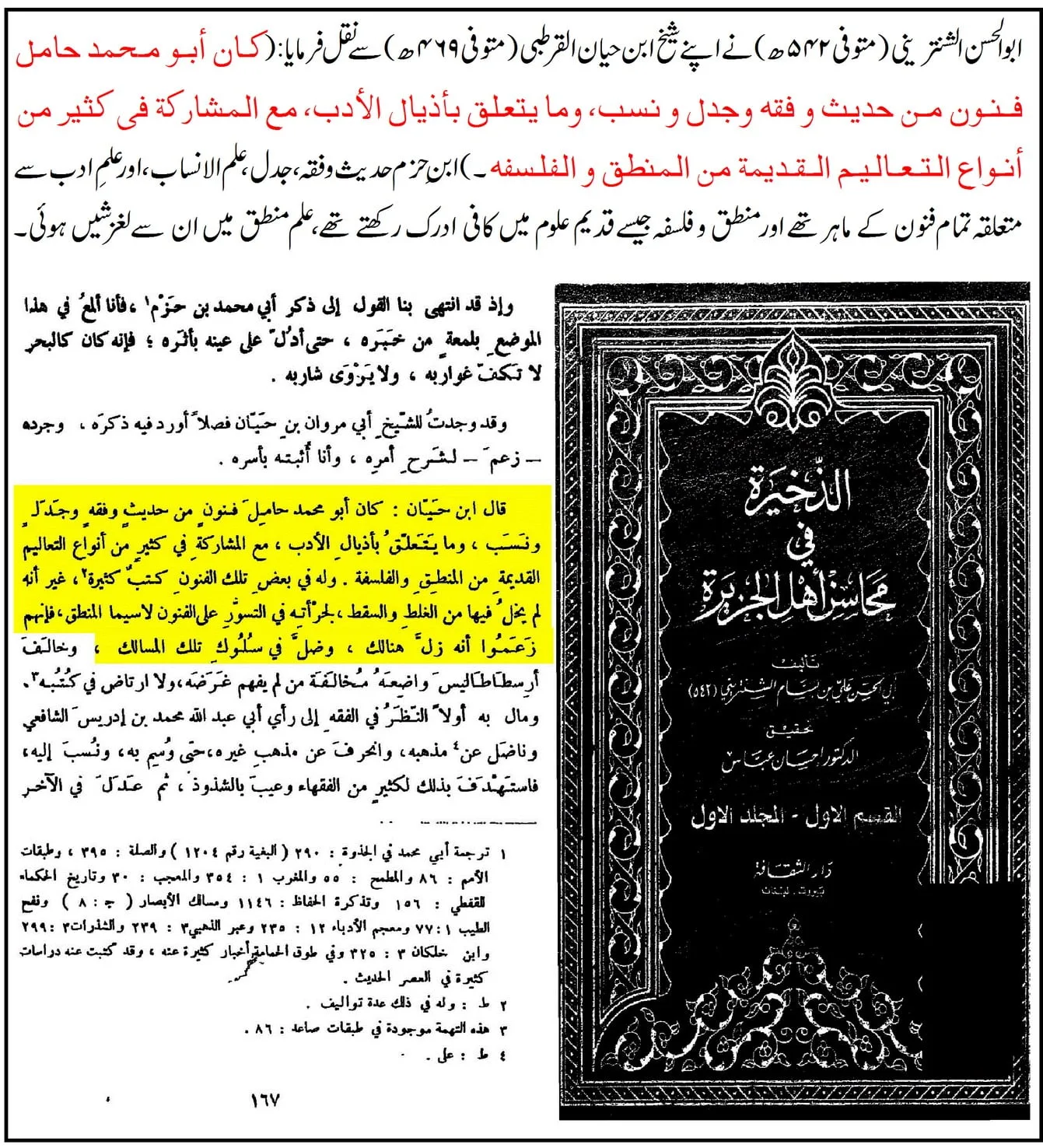
Abu al-Hasan al-Shantrini narrates the statement of Abu Marwan ibn Hayyan through his teacher Abu Hayyan al-Qurtubi:
قال أبو مروان بن حيان: كان ابن حزم حامل فنون, من حديث وفقه وجدل ونسب وما يتعلق بأذيال الأدب مع المشاركة في أنواع التعاليم القديمة, من المنطق والفلسفة, وله كتب كثيرة لم يخل فيها من غلط لجرأته في التسور على الفنون لا سيما المنطق, فإنهم زعموا أنه زل هنالك وضل في سلوك المسالك وخالف أرسطو واضعه مخالفة من لم يفهم
Abu Marwan bin Hayyan says: Ibn Hazm was a master of many disciplines; he was an expert in Hadith, Fiqh, dialectics (debate), genealogy, and literary sciences, and he also had a share in ancient teachings such as logic and philosophy. He authored many books which, due to his scholarly boldness and engagement in multiple fields, are not free from errors, especially in logic; experts say that he slipped there and opposed the founder of logic, Aristotle, in a manner that seemed like the opposition of someone who did not fully understand him.
Reference: Al-Kitab: Al-Dhakheera fi Mahasin Ahl al-Jazeera
Explanation:
This passage combines two points: (1) Ibn Hazm’s expertise in multiple disciplines and breadth of knowledge, (2) acknowledgment of some slips in philosophical and logical discussions. This is exactly the balance that the scholars of criticism adopt regarding a great Mujtahid.
➎ Hafiz Ibn Hajar al-Asqalani (Lisan al-Mizan)
Hafiz Ibn Hajar introduces Ibn Hazm as follows:
[٥٣١] "على" بن أحمد بن سعيد بن حزم بن غالب بن صالح بن خلف بن معدان بن سفيان بن يزيد الفارسي أبو محمد القرطبي اللبلي بفتح اللام وسكون الموحدة ثم لام الفقيه الحافظ الظاهري صاحب التصانيف ---- وكان واسع الحفظ جدا إلا أنه لثقة حافظت كان يهجم كالقول في التعديل والتخريج وتبين أسماء الراوة فيقع له من ذلك أوهام شنيعة
Urdu Translation:
(531) Ali bin Ahmad bin Saeed bin Hazm bin Ghalib bin Saleh bin Khalaf bin Ma'dan bin Sufyan bin Yazid al-Farsi, Abu Muhammad al-Qurtubi al-Labli, was a jurist, memorizer, Zahiri, and author of numerous works. His memory was very vast, but due to his reliance on his memory, he would quickly make statements regarding the modification, extraction, and clarification of the names of narrators, which sometimes led to some severe misconceptions on his part.
Reference: Al-Kitab: Lisan al-Mizan
Author: Abu al-Fadl Ahmad bin Ali bin Muhammad bin Ahmad bin Hajar al-Asqalani (d. 852 AH)
Author: Abu al-Fadl Ahmad bin Ali bin Muhammad bin Ahmad bin Hajar al-Asqalani (d. 852 AH)
Explanation:
Ibn Hajar (may Allah have mercy on him) on one hand described Ibn Hazm (may Allah have mercy on him) as "the jurist, memorizer, Zahiri, author of many works" and emphasized his vast memorization, and on the other hand, from the perspective of criticism, he clarified that due to reliance on memory, some misconceptions also occurred. This is the methodology of the hadith scholars that they present scholarly criticism along with authentication.
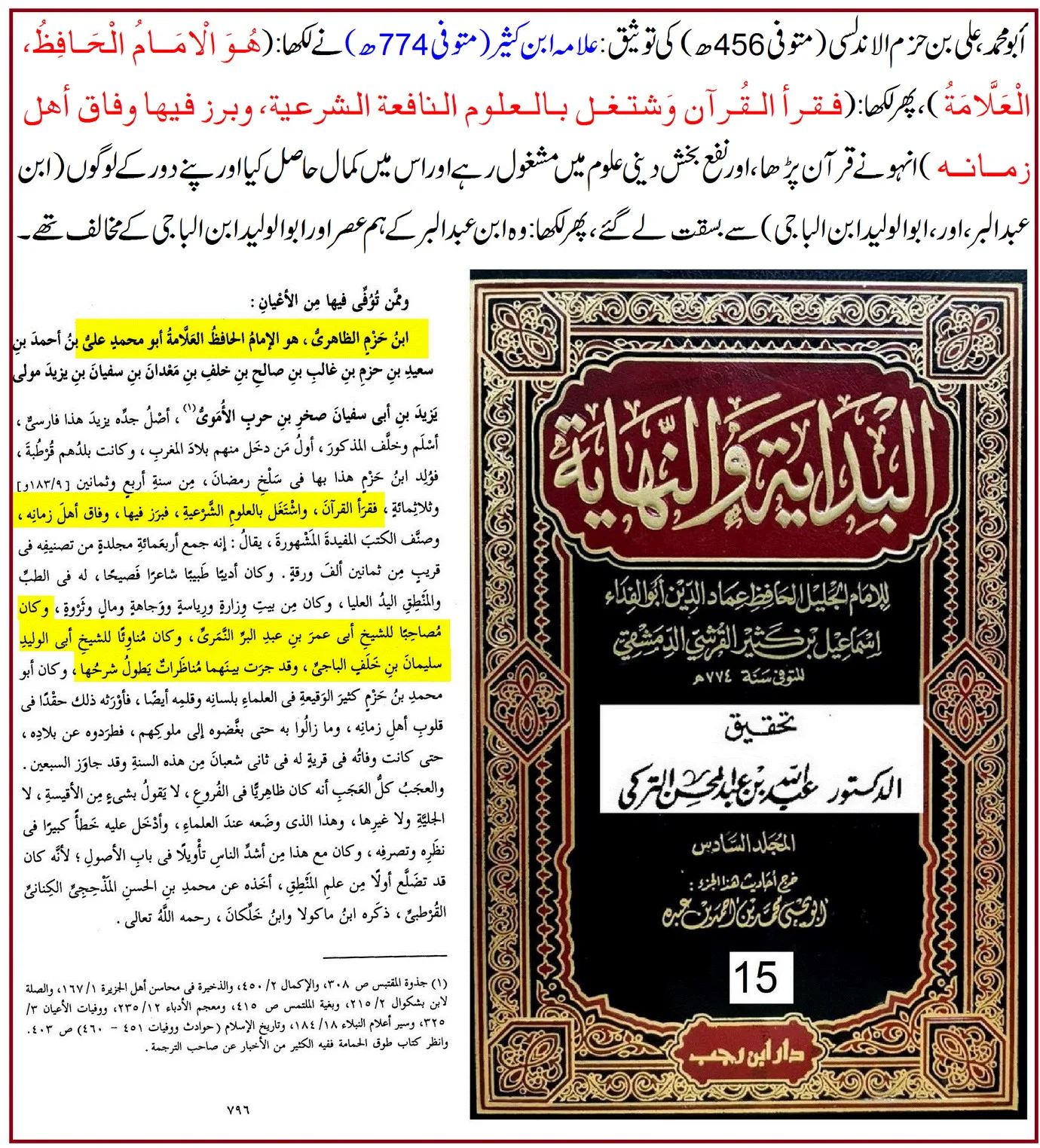
➏ Allama Ibn Kathir (al-Bidaya wa al-Nihaya)
Allama Ibn Kathir (may Allah have mercy on him) writes:
ابْنُ حَزْمٍ الظَّاهِرِيُّ
هُوَ الْإِمَامُ الْحَافِظُ الْعَلَّامَةُ، أَبُو مُحَمَّدٍ عَلِيُّ بْنُ أَحْمَدَ بْنِ سَعِيدِ بْنِ حَزْمِ ----- فَقَرَأَ الْقُرْآنَ وَاشْتَغَلَ بالعلوم النافعة الشرعية، وبرز فيها وفاق أهل زمانه، ------ وَكَانَ مُصَاحِبًا لِلشَّيْخِ أَبِي عُمَرَ بْنِ عَبْدِ الْبَرِّ النَّمِرِيِّ،
Urdu Translation:
Ibn Hazm Zahiri: He is the Imam, Hafiz, and scholar Abu Muhammad Ali bin Ahmad bin Saeed bin Hazm... He recited the Quran and was engaged in religious sciences, surpassing the scholars of his time in these sciences... and he was a companion and contemporary of Sheikh Abu Umar Ibn Abdul Barr Al-Namri.
Reference: Al-Kitab: Al-Bidaya wa al-Nihaya
Author: Abu al-Fida Ismail bin Umar bin Kathir Al-Qurashi Al-Dimashqi (died: 774 AH)
Author: Abu al-Fida Ismail bin Umar bin Kathir Al-Qurashi Al-Dimashqi (died: 774 AH)
Explanation:
Ibn Kathir acknowledged Ibn Hazm's scholarly leadership by calling him "the Imam, the Hafiz, the scholar" and stated that he was a contemporary and peer of the great imams of his time, such as Ibn Abdul Barr.
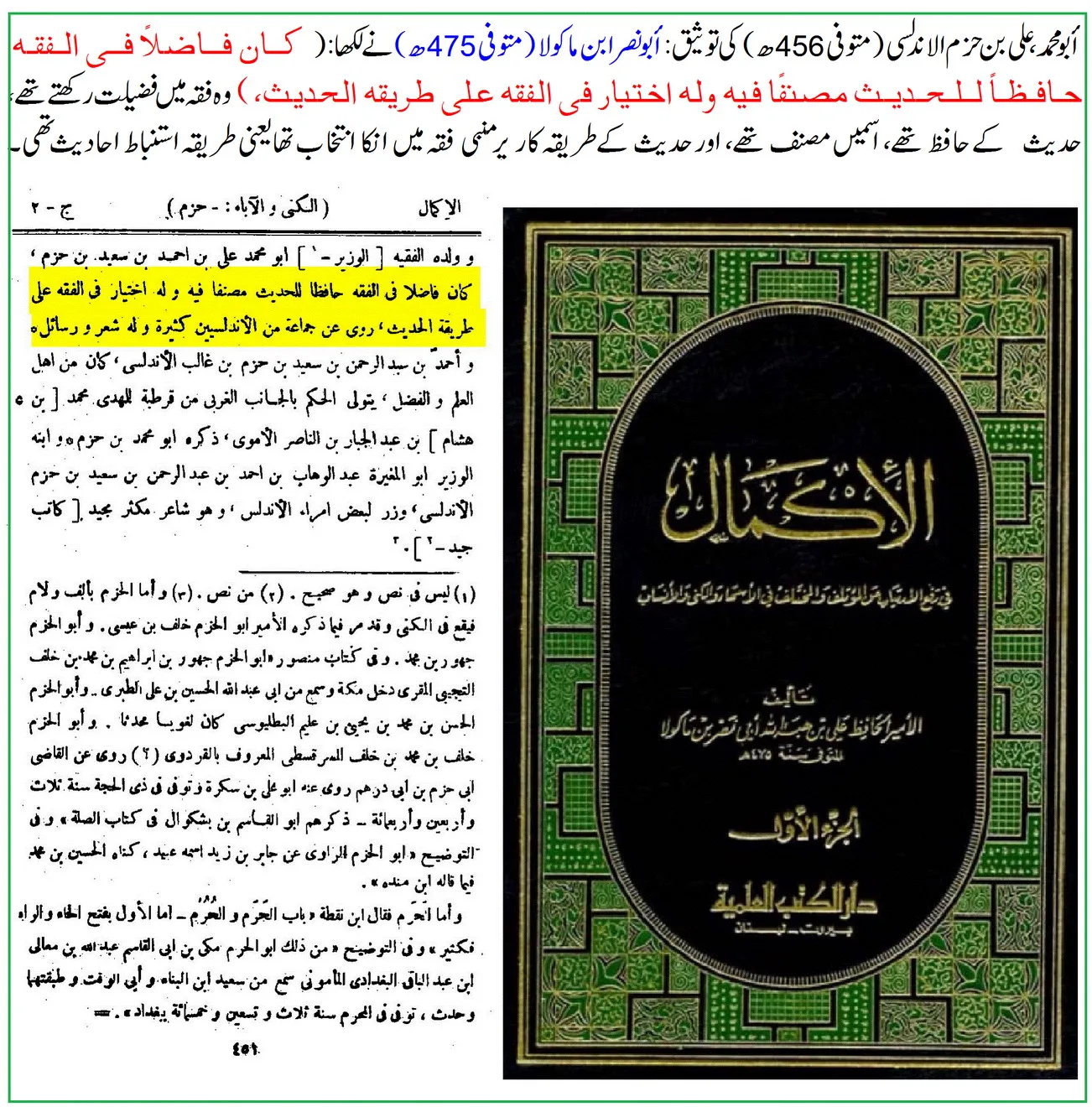
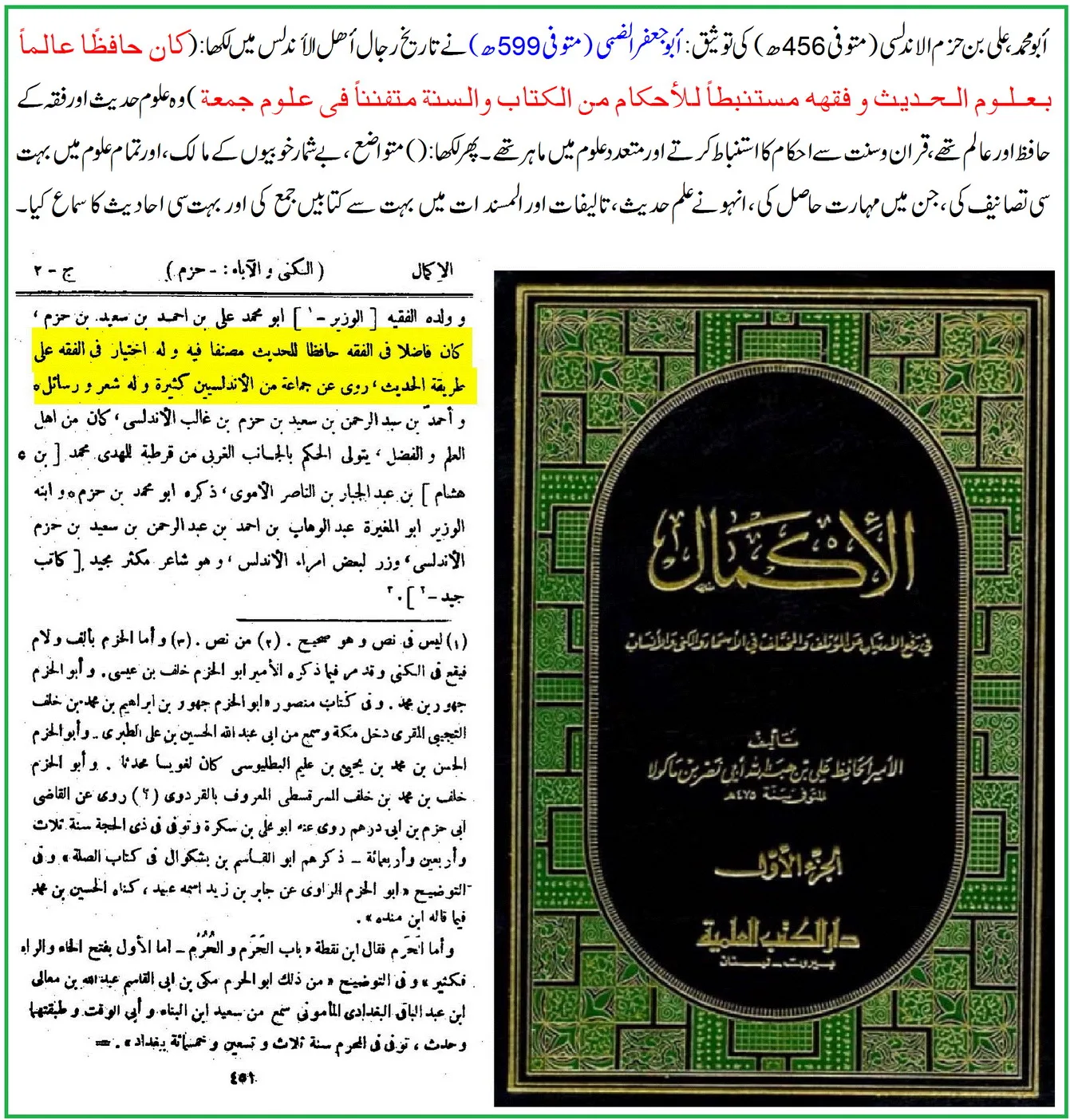
➐ Abu Nasr Ibn Makula (Al-Ikmal)
Abu Nasr Ibn Makula writes:
أبو محمد علي بن أحمد بن سعيد بن حزم، كان فاضلًا في الفقه حافظًا للحديث مصنفًا فيه وله اختيار في الفقه على طريقة الحديث، روى عن جماعة من الأندلسيين كثيرة وله شعر ورسائل،
Urdu Translation:
Abu Muhammad Ali bin Ahmad bin Saeed bin Hazm was proficient in jurisprudence, a memorizer of hadith, and an author in this field. His methodology in jurisprudence was according to the way of hadith. He narrated from many scholars of Andalusia, and he also composed poetry and treatises.
Reference: Book: Al-Ikmal fi Raf' al-Irtiyab 'an al-Mutalif wal-Mukhtalif fi al-Asma' wal-Kuna wal-Ansab
Author: Sa'd al-Mulk, Abu Nasr Ali ibn Hibatullah ibn Ja'far ibn Makula (d. 475 AH)
Author: Sa'd al-Mulk, Abu Nasr Ali ibn Hibatullah ibn Ja'far ibn Makula (d. 475 AH)
Explanation:
This testimony especially emphasizes that Ibn Hazm's jurisprudence was based on "Fiqh al-Hadith," meaning he derived rulings directly from the texts and hadiths, which is the prominent methodology of the Ahl al-Hadith.
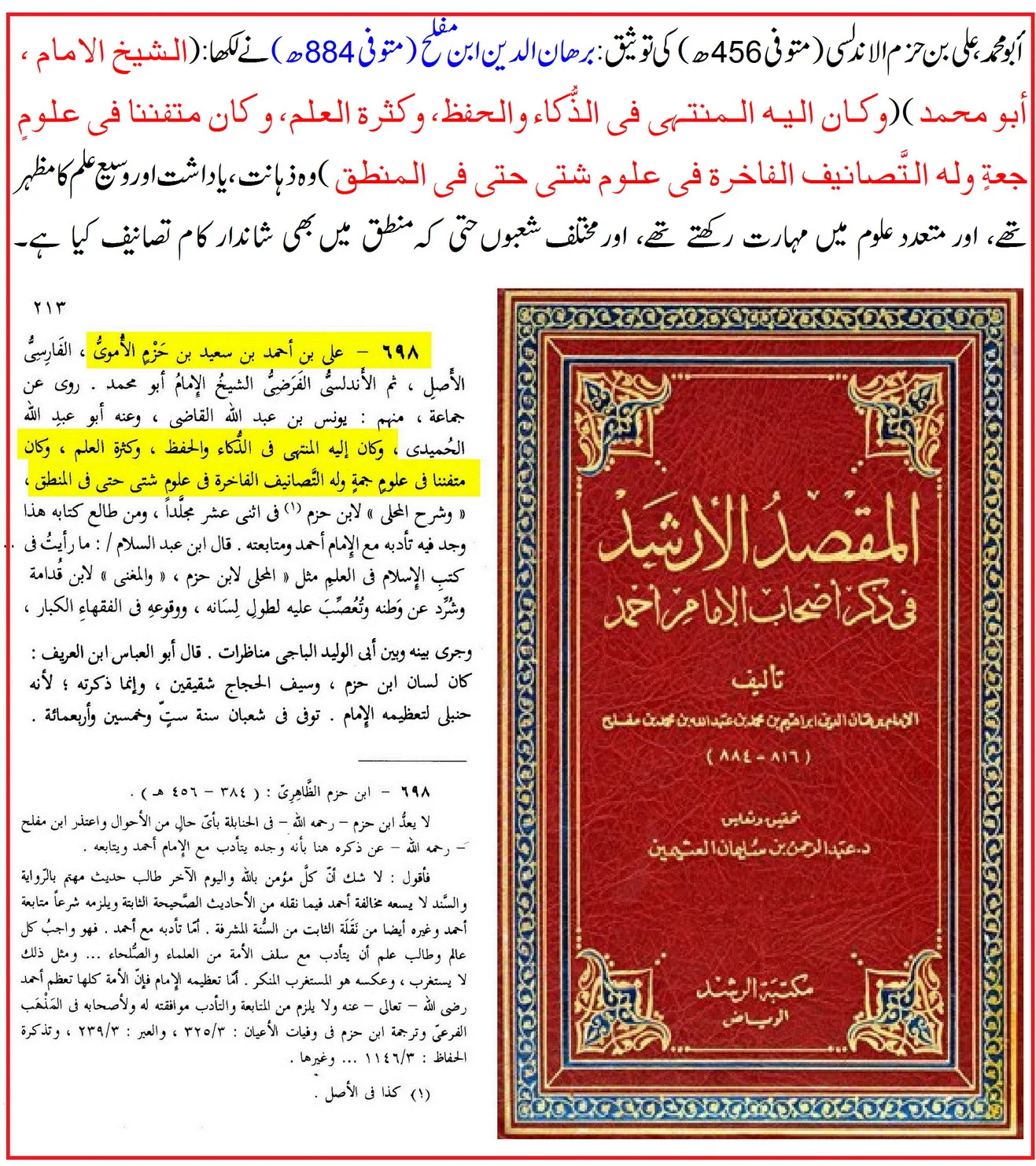
➑ Burhan al-Din Ibn Muflih (Al-Maqsad al-Arshad)
Burhan al-Din Ibn Muflih writes:
٦٩٨ - عَليّ بن أَحْمد بن سعيد بن حزم الْأمَوِي الْفَارِسِي الأَصْل ثمَّ الأندلسي الفرضي الشَّيْخ الإِمَام أَبُو مُحَمَّد ---- روى عَن جمَاعَة مِنْهُم يُونُس بن عبد الله القَاضِي وَعنهُ أَبُو عبد الله الْحميدِي --- وَكَانَ إِلَيْهِ الْمُنْتَهى فِي الذكاء وَالْحِفْظ وَكَثْرَة الْعلم وَكَانَ متفننا فِي عُلُوم جمة وَله التصانيف الفاخرة فِي عُلُوم شَتَّى حَتَّى فِي الْمنطق
Urdu Translation:
Ali ibn Ahmad ibn Sa'id ibn Hazm Umayyad, originally Persian, then Andalusian, a jurist (expert in the science of inheritance), Sheikh al-Imam Abu Muhammad... He narrated from many people, among whom was Yunus ibn Abdullah al-Qadi, and from him Abu Abdullah Humaydi narrated... He was extremely intelligent, had a strong memory, and abundant knowledge, was an expert in multiple sciences, and had excellent writings in various sciences including logic.
Reference: Book: Al-Maqsad al-Arshad fi Dhikr Ashab al-Imam Ahmad
Author: Burhan al-Din Ibrahim ibn Muhammad ibn Abdullah ibn Muflih (d. 884 AH)
Author: Burhan al-Din Ibrahim ibn Muhammad ibn Abdullah ibn Muflih (d. 884 AH)
Explanation:
Ibn Muflih (may Allah have mercy on him) described Ibn Hazm (may Allah have mercy on him) as "the Sheikh Imam," extremely intelligent, possessing a strong memory, knowledgeable in many sciences, and proficient in various fields, which is a clear indication of his comprehensive knowledge.
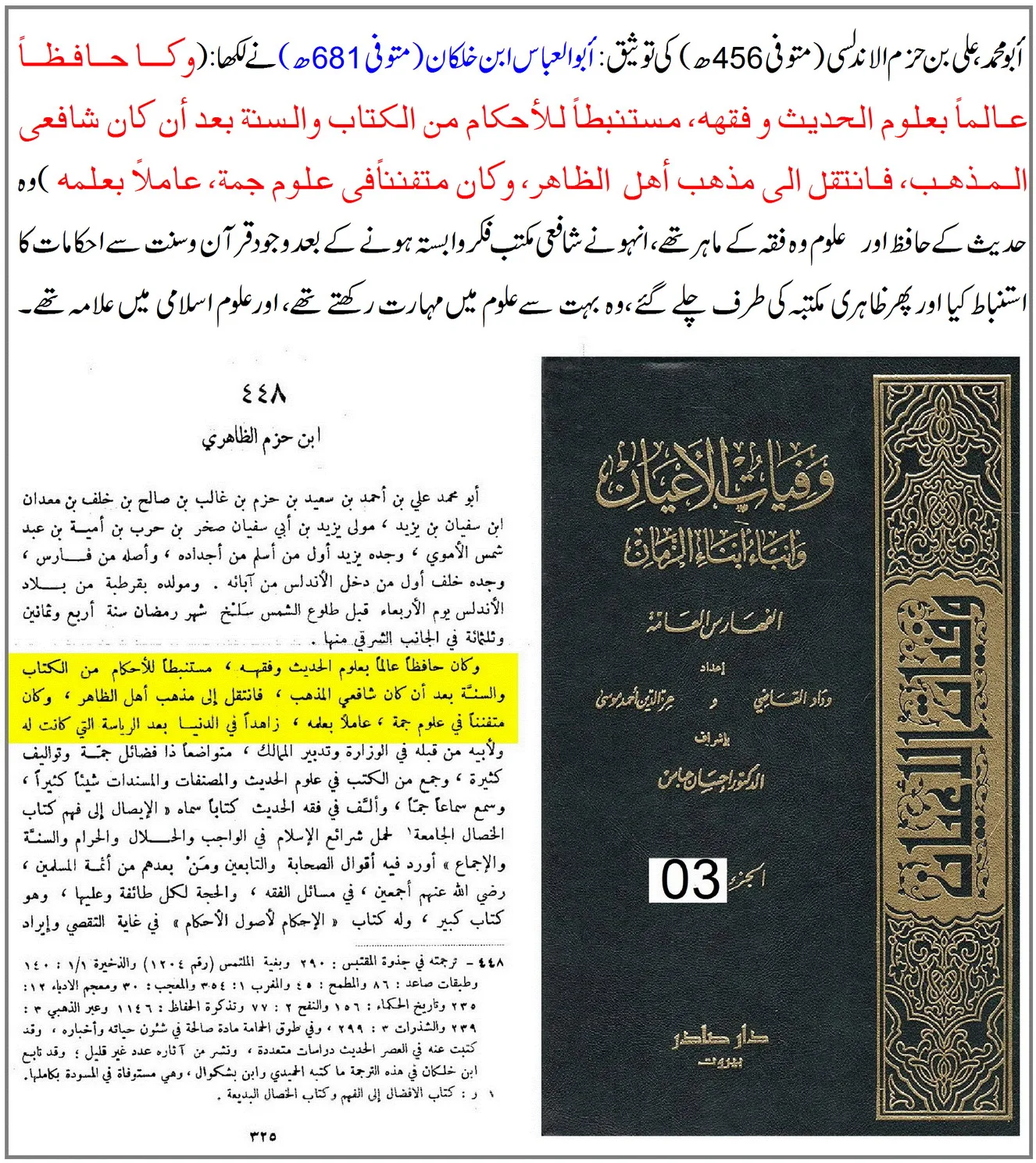
➒ Abu al-Abbas Ibn Khallikan (Wafayat al-A'yan)
Ibn Khallikan (may Allah have mercy on him) writes:
ابن حزم الظاهري
أبو محمد علي بن أحمد بن سعيد بن حزم ---- وكان حافظاً عالماً بعلوم الحديث وفقهه، مستنبطاً للأحكام من الكتاب والسنة بعد أن كان شافعي المذهب، فانتقل إلى مذهب أهل الظاهر، وكان متفنناً في علوم جمة، عاملاً بعلمه،
Urdu Translation:
Ibn Hazm al-Zahiri, Abu Muhammad Ali ibn Ahmad ibn Saeed ibn Hazm... He was a memorizer and scholar of hadith and its jurisprudential discussions, deriving rulings from the Book and Sunnah. Initially, he followed the Shafi'i school of thought, then he shifted to the Zahiri school. He was an expert in many sciences and practiced what he knew.
Reference: Al-Kitab: Wafayat al-A'yan wa Anba' Abna' al-Zaman
Author: Abu al-Abbas Shams al-Din Ahmad ibn Muhammad ibn Ibrahim ibn Khallikan (died 681 AH)
Author: Abu al-Abbas Shams al-Din Ahmad ibn Muhammad ibn Ibrahim ibn Khallikan (died 681 AH)
Explanation:
Here, Ibn Khallikan clarified that Ibn Hazm's jurisprudential foundation was directly based on the Book and Sunnah, and his Zahiri school affiliation also reflects this textual adherence, not merely literalism for the sake of literalism.
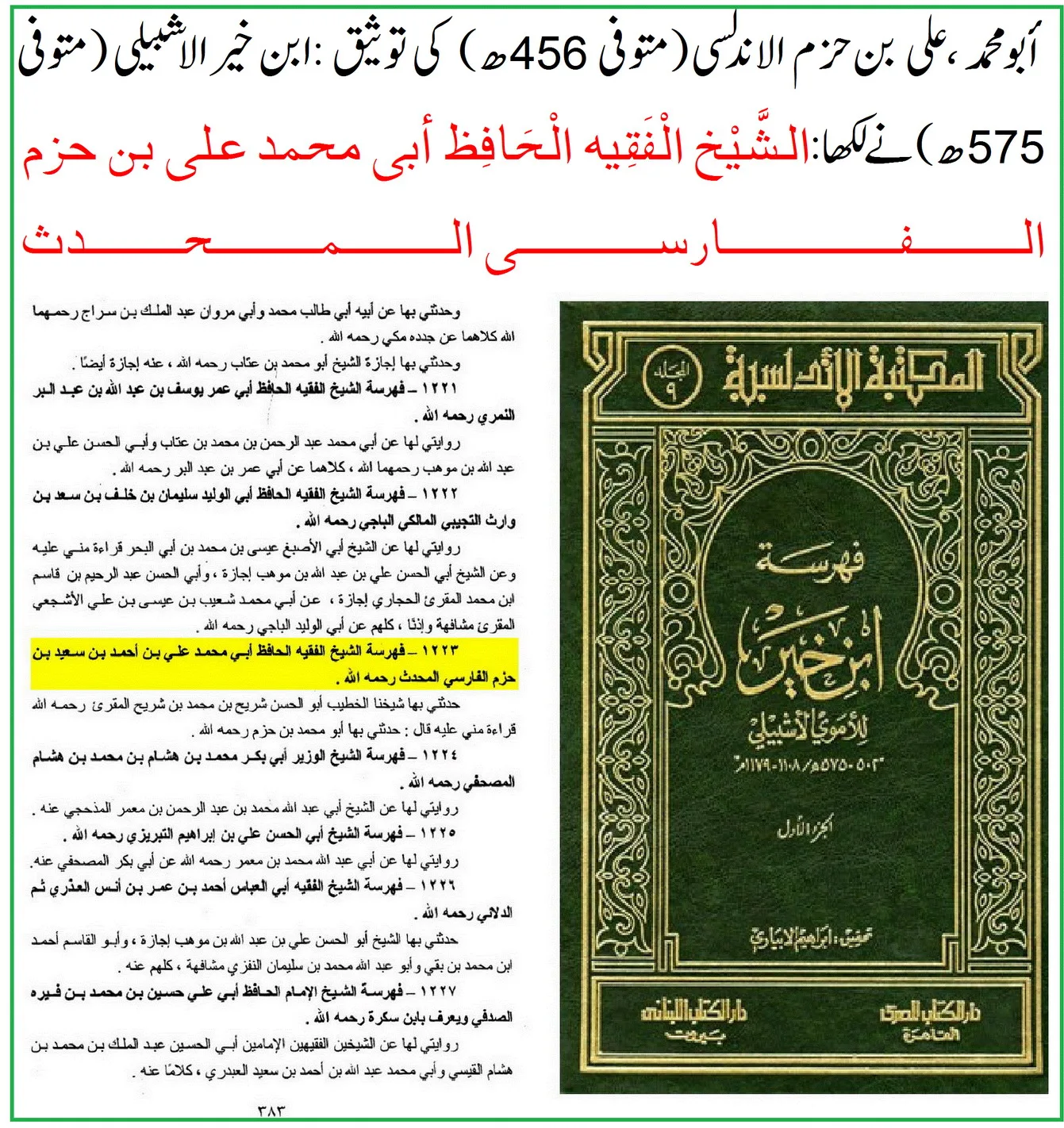
➓ Ibn Khayr al-Ashbili (Fihrist Ibn Khayr)
Ibn Khayr al-Ashbili writes:
١٢٢٣ - فهرسة الشَّيخ الْفَقِيه الْحَافِظ أبي مُحَمَّد عَليّ بن أَحْمد بن سعيد بن حزم الْفَارِسِي الْمُحدث رَحمَه الله
Urdu Translation:
This is the list of Sheikh Faqih, Hafiz, Muhaddith Abu Muhammad Ali bin Ahmad bin Saeed bin Hazm Al-Farsi, may Allah have mercy on him.
Reference: Al-Kitab: Fihrisat Ibn Khayr Al-Ishbili
Author: Abu Bakr Muhammad bin Khayr bin Umar Al-Umwi Al-Ishbili (died: 575 AH)
Author: Abu Bakr Muhammad bin Khayr bin Umar Al-Umwi Al-Ishbili (died: 575 AH)
Explanation:
This brief introduction also reflects Ibn Hazm’s scholarly status with the words "Al-Sheikh Al-Faqih Al-Hafiz Al-Muhaddith."
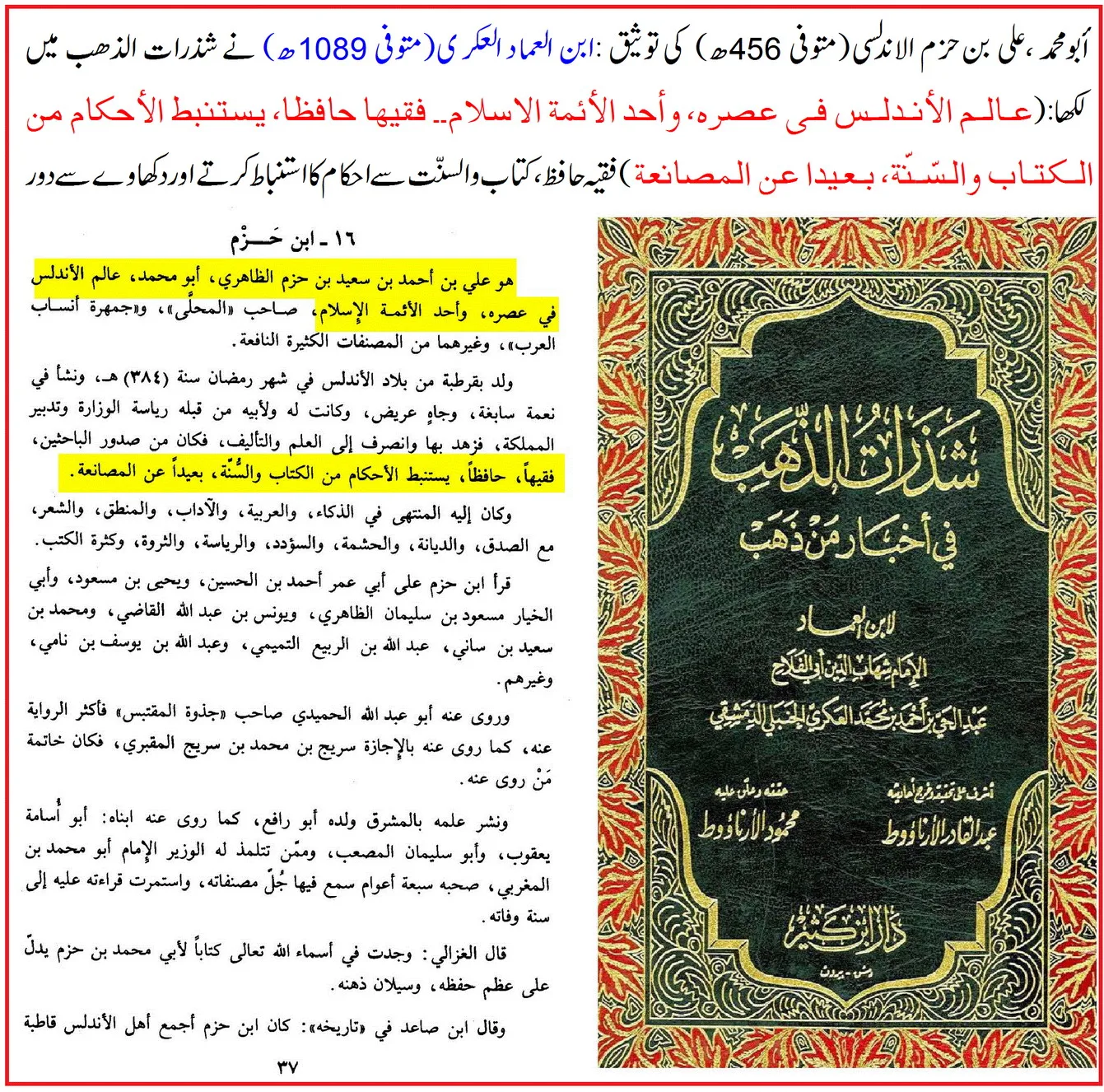
⑪ Ibn Al-Imad Al-Hanbali (Shadharat Al-Dhahab)
Ibn Al-Imad Al-Akri Al-Hanbali writes:
هو علي بن أحمد بن سعيد بن حزم الظاهري، أبو محمد، عالم الأندلس في عصره، وأحد الأئمة الإسلام، -----، فقيها، حافظا، يستنبط الأحكام من الكتاب والسّنّة، بعيدا عن المصانعة.
Urdu Translation:
This is Ali bin Ahmad bin Saeed bin Hazm Al-Zahiri Abu Muhammad, who was the greatest scholar of Andalusia in his time and among the Imams of Islam. A jurist, Hafiz, one who derived rulings from the Book and Sunnah, and was free from flattery and affectation.
Reference: Al-Kitab: Shadharat Al-Dhahab fi Akhbar man Dhahab
Author: Abdul Hayy bin Ahmad bin Muhammad Ibn Al-Imad Al-Akri Al-Hanbali, Abu Al-Falah (died: 1089 AH)
Author: Abdul Hayy bin Ahmad bin Muhammad Ibn Al-Imad Al-Akri Al-Hanbali, Abu Al-Falah (died: 1089 AH)
Explanation:
This passage describes Ibn Hazm as "the scholar of Andalusia in his era" and "one of the Imams of Islam," which is a great testimony to his religious leadership.
⑫ Abu Ja'far Al-Dhubbi (Bughiyat Al-Multamis)
Abu Ja'far Al-Dhubbi writes:
١٢٠٥- علي بن أحمد بن سعيد بن حزم بن غالب أبو محمد
أصله من الفرس وجده الأقصى في الإسلام اسمه يزيد مولى ليزيد بن أبي سفيان
كان حافظاً عالماً بعلوم الحديث وفقهه مستنبطاً للأحكام من الكتاب والسنة متفنناً في علوم جمة، عاملاً بعلمه زاهداً في الدنيا بعد الرئاسة التي كانت له ولأبيه من قبله في الوزارة وتدبير المماليك، متواضعاً ذا فضائل جمة وتواليف كثيرة في كل ما تحقق به من العلوم، وجمع من الكتب في علم الحديث والمصنفات والمسندات شيئاً كثيراً وسمع سماعاً جماً،
Ali bin Ahmad bin Saeed bin Hazm bin Ghalib Abu Muhammad... His original lineage was from Persia, and in Islam, his highest ancestor was named Yazid, who was a freed slave of Yazid bin Abi Sufyan. He was a memorizer and scholar of the sciences of Hadith and Fiqh, deriving rulings from the Book and Sunnah, expert in many sciences and one who practiced his knowledge, ascetic towards the world, although he and his father initially held high positions in ministry and the administration of mamluks. Later, he turned away from the world, was very humble, possessed countless virtues, and wrote many compositions in all the sciences he researched. In the knowledge of Hadith, compilations, and Musnads, he collected many books and heard countless hadiths.
Reference: Al-Kitab: Bughiyat al-Multamis fi Tarikh Rijal Ahl al-Andalus
Author: Ahmad bin Yahya bin Ahmad bin Umayrah, Abu Ja'far al-Dhubi (d. 599 AH)
Author: Ahmad bin Yahya bin Ahmad bin Umayrah, Abu Ja'far al-Dhubi (d. 599 AH)
Explanation:
This testimony vividly describes Ibn Hazm’s asceticism and worship, humility, practice according to knowledge, prolific writings, and efforts to collect hadith resources.
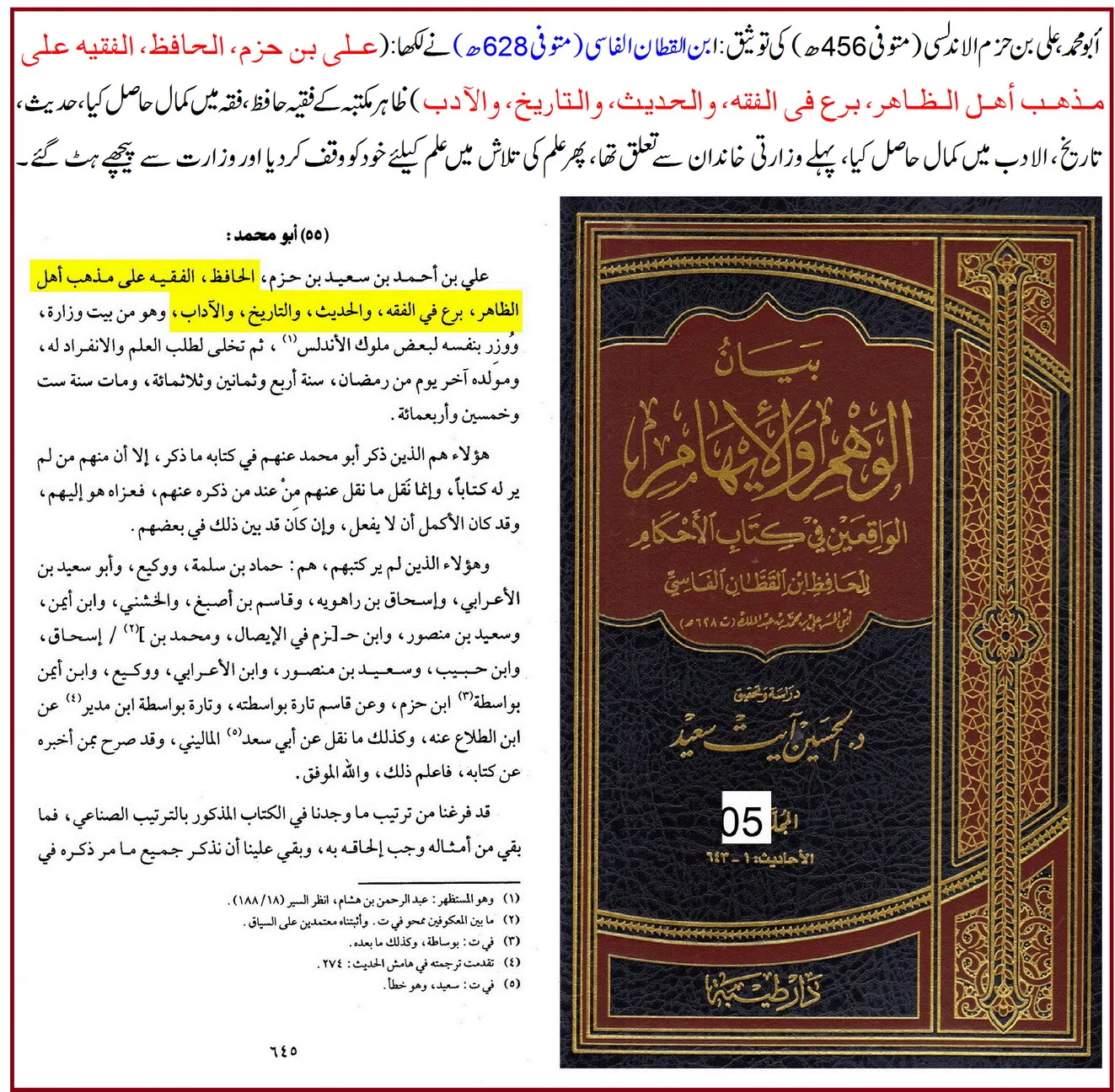
⑬ Ibn al-Qattan al-Fasi (Bayan al-Wahm wa al-Ilham)
Ibn al-Qattan al-Fasi writes:
(٥٥) أَبُو مُحَمَّد:
عَليّ بن أَحْمد بن سعيد بن حزم، الْحَافِظ، الْفَقِيه على مَذْهَب أهل الظَّاهِر،
برع فِي الْفِقْه، والْحَدِيث، والتاريخ، والآداب، وَهُوَ من بَيت وزارة، ووزر بِنَفسِهِ لبَعض مُلُوك الأندلس، ثمَّ تخلى لطلب الْعلم والانفراد لَهُ، ومولده آخر يَوْم من رَمَضَان، سنة أَربع وثماني وثلاثمائة، وَمَات سنة سِتّ وَخمسين وَأَرْبَعمِائَة.
Urdu Translation:
(55) Abu Muhammad Ali ibn Ahmad ibn Saeed ibn Hazm was a Hafiz and jurist of the Zahiri school. He was an expert in jurisprudence, hadith, history, and literature. He belonged to a ministerial family and himself served as a minister to some kings of Andalusia, but he left the ministry for the pursuit of knowledge and dedication to it. He was born on the last day of Ramadan in the year 384 AH and passed away in 456 AH.
Reference: Al-Kitab: Bayan al-Wahm wa al-Ilham fi Kitab al-Ahkam
Author: Ali ibn Muhammad ibn Abd al-Malik al-Kattami al-Himyari al-Fasi, Abu al-Hasan Ibn al-Qattan (d. 628 AH)
Author: Ali ibn Muhammad ibn Abd al-Malik al-Kattami al-Himyari al-Fasi, Abu al-Hasan Ibn al-Qattan (d. 628 AH)
Explanation:
This passage provides Ibn Hazm’s expertise in jurisprudence, hadith, and history along with important historical details of his life, and it indicates that he abandoned worldly office to devote himself to knowledge.
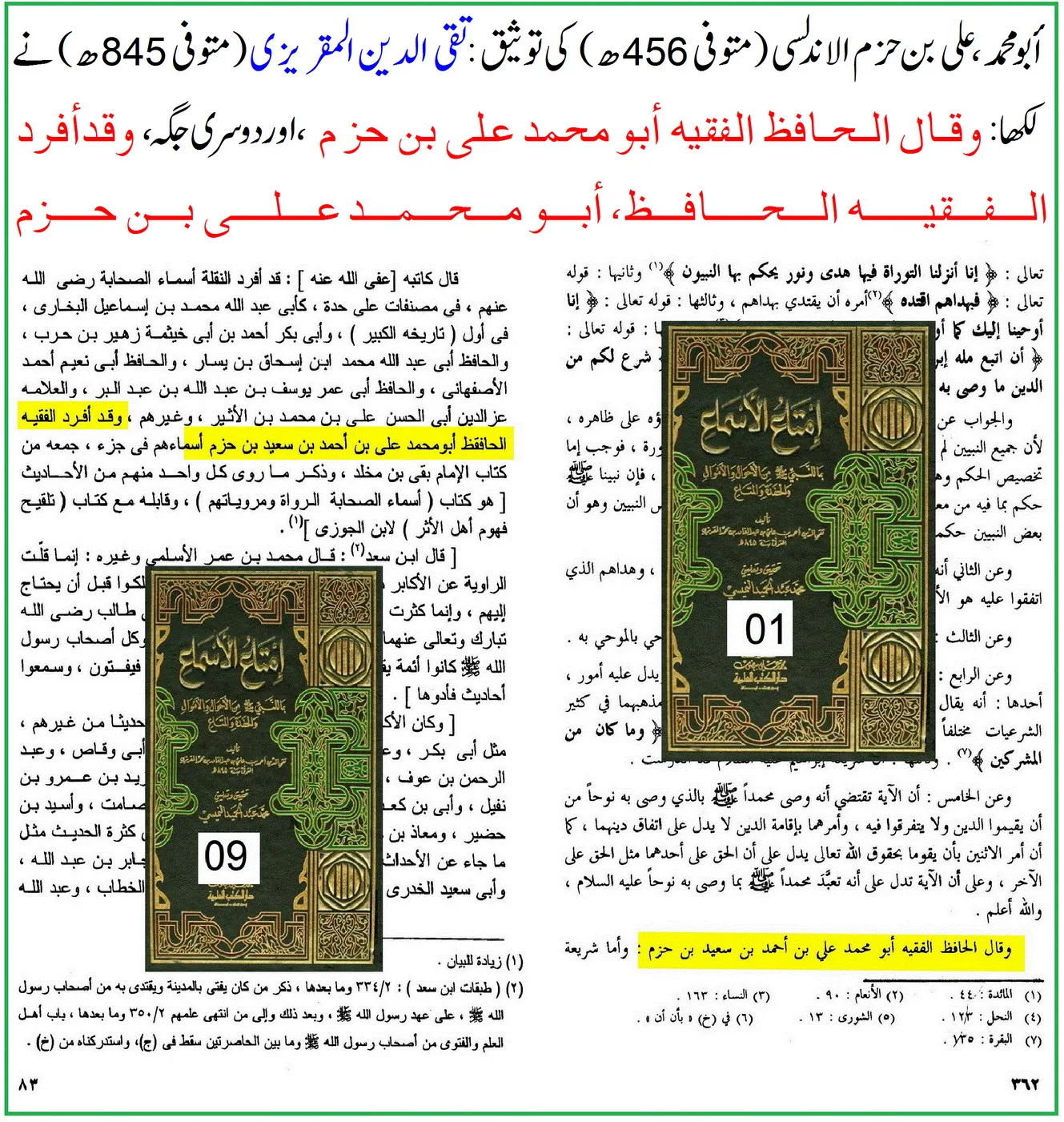
⑭ Taqi al-Din al-Maqrizi (Imta’ al-Asma’)
Taqi al-Din al-Maqrizi writes:
وقال الحافظ الفقيه أبو محمد علي بن أحمد بن سعيد بن حزم: وأما شريعة
وقد أفرد الفقيه الحافظ أبو محمد على بن أحمد بن سعيد بن حزم أسماءهم في جزء
Urdu Translation (Summary):
Hafiz Faqih Abu Muhammad Ali bin Ahmad bin Saeed bin Hazm said: "As far as the Shariah is concerned..." And he (Ibn Hazm), being a Hafiz and Faqih, compiled their names into a single section.
Reference: Al-Kitab: Imta' al-Asma' bima lil-Nabi min al-Ahwal wal-Amwal wal-Hufadah wal-Mata'
Author: Ahmad bin Ali bin Abdul Qadir, Abu al-Abbas al-Husseini al-Ubaidi, Taqi al-Din al-Maqrizi (d. 845 AH)
Author: Ahmad bin Ali bin Abdul Qadir, Abu al-Abbas al-Husseini al-Ubaidi, Taqi al-Din al-Maqrizi (d. 845 AH)
Explanation:
Here, al-Maqrizi acknowledges Ibn Hazm's scholarly status by calling him "Al-Hafiz al-Faqih" and points out that he compiled the names and narrations related to the Prophet Muhammad ﷺ into a dedicated treatise.
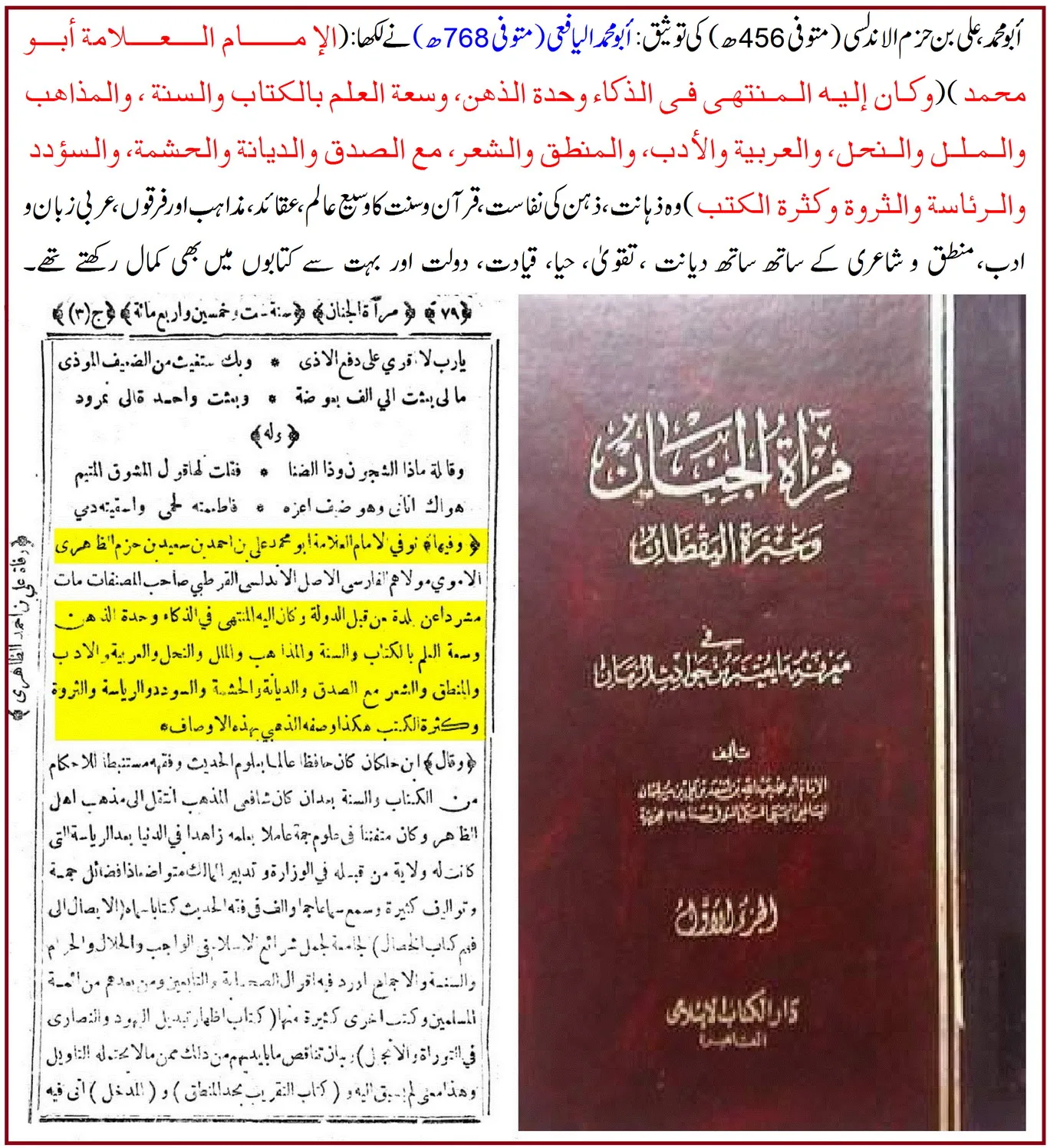
⑮ Abu Muhammad al-Yafi'i (Mir'at al-Jinan)
Abu Muhammad al-Yafi'i writes:
وفيها توفي الإمام العلامة أبو محمد علي بن أحمد بن سعيد بن حزم الظاهري الأموي مولاهم،
وكان إليه المنتهى في الذكاء وحدة الذهن، وسعة العلم بالكتاب والسنة، والمذاهب والملل والنحل، والعربية والأدب، والمنطق والشعر، مع الصدق والديانة والحشمة، والسؤدد والرئاسة والثروة وكثرة الكتب
Urdu Translation:
In the same year, Imam, Allama Abu Muhammad Ali bin Ahmad bin Saeed bin Hazm Zahiri Umayyad Mawlaham passed away. He was trusted to the utmost in intelligence, sharpness of mind, knowledge of the Book and Sunnah, sects, nations and creeds, Arabic language and literature, logic, and poetry. He was also distinguished in truthfulness, honesty, dignity, leadership, wealth, and the abundance of books.
Reference: Al-Kitab: Miraat al-Jinan wa Ibrah al-Yaqzan fi Ma'rifat ma Yu'tabar min Hawadith al-Zaman
Author: Abu Muhammad Afif al-Din Abdullah bin As'ad al-Yafi (died: 768 AH)
Author: Abu Muhammad Afif al-Din Abdullah bin As'ad al-Yafi (died: 768 AH)
Explanation:
This testimony highlights not only Ibn Hazm’s scholarly comprehensiveness but also his moral qualities (truthfulness, honesty, dignity) and social status (nobility, leadership, wealth).
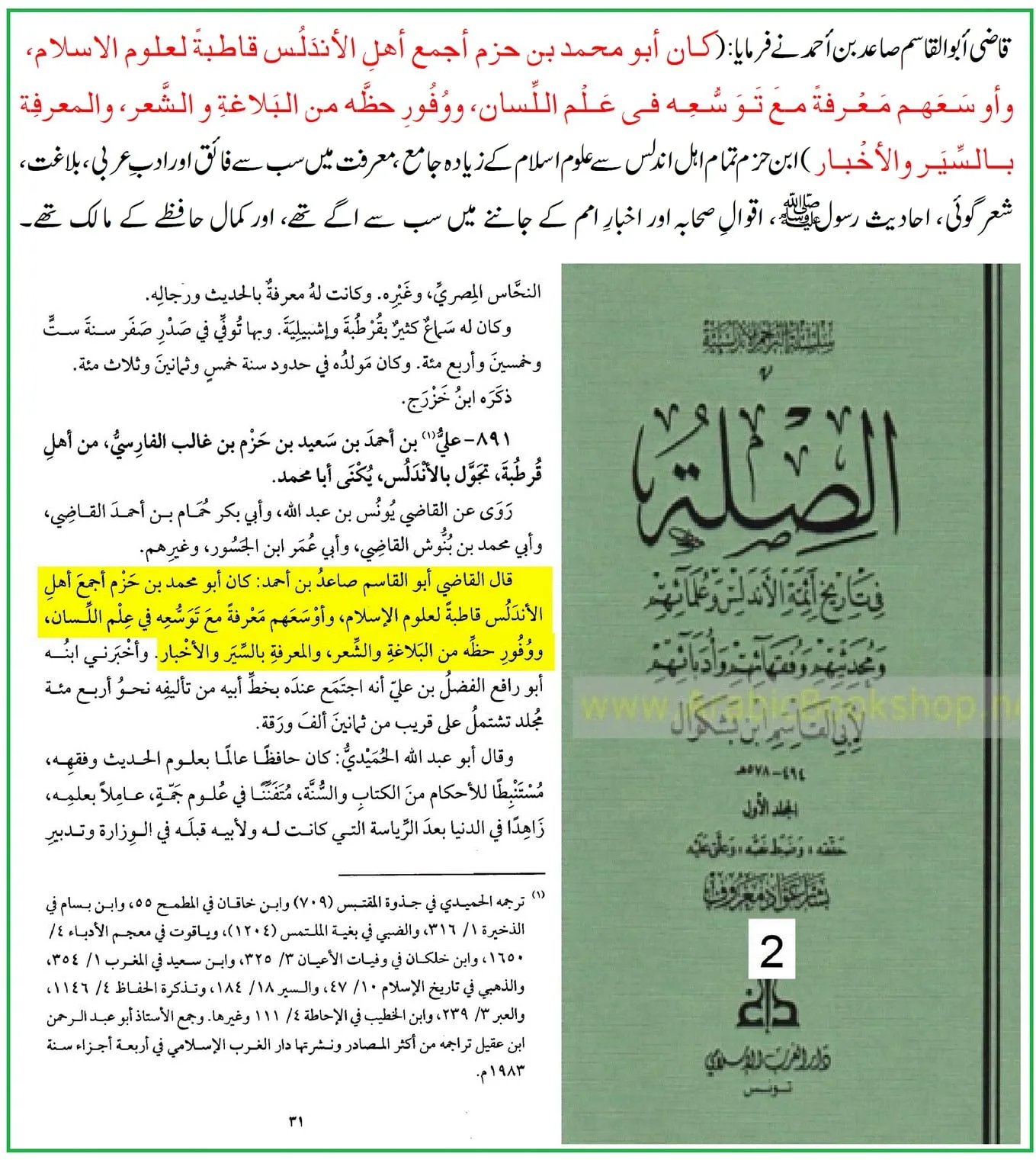
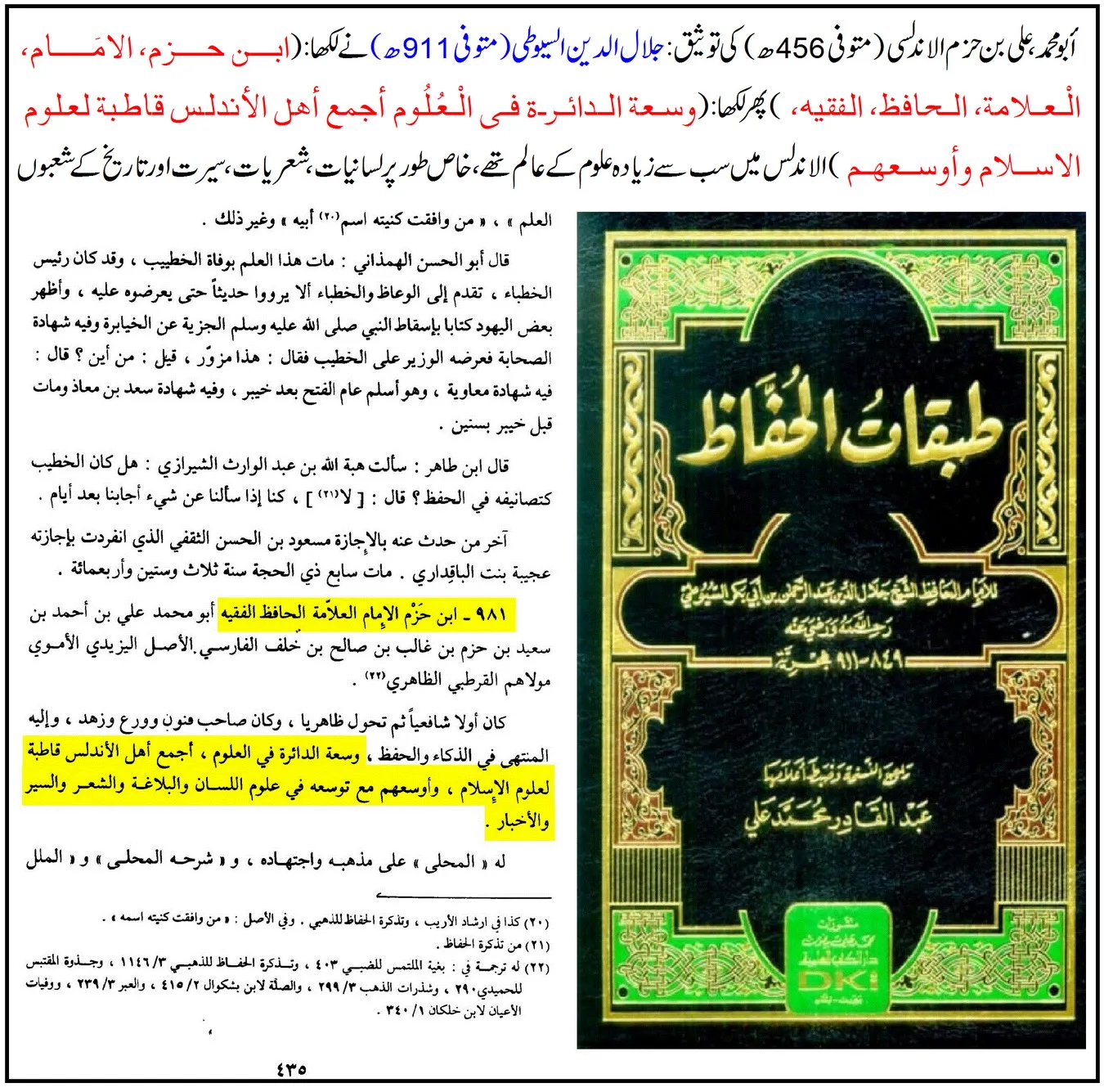
⑯ Jalal al-Din al-Suyuti (Tabaqat al-Huffaz)
Jalal al-Din al-Suyuti writes:
٩٨١ - ابْن حزم الإِمَام الْعَلامَة الْحَافِظ الْفَقِيه أَبُو مُحَمَّد عَليّ بن أَحْمد بن سعيد بن حزم ----- وسعة الدائرة فِي الْعُلُوم أجمع أهل الأندلس قاطبة لعلوم الْإِسْلَام وأوسعهم مَعَ توسعه فِي عُلُوم اللِّسَان والبلاغة وَالشعر وَالسير وَالْأَخْبَار
لَهُ الْمحلى على مذْهبه واجتهاده وَشَرحه الْمحلى والملل
Urdu Translation:
(981) Ibn Hazm is an Imam, a scholar, a Hafiz, a jurist, Abu Muhammad Ali bin Ahmad bin Saeed bin Hazm... In terms of the breadth of knowledge, he was unanimously the most knowledgeable in Islamic sciences in Al-Andalus, and along with that, he also possessed the most extensive knowledge in language, rhetoric, poetry, biography, and history. His book "Al-Muhalla" is based on his madhhab and ijtihad, and the commentary on "Al-Milal" and others is also his composition.
Reference: Al-Kitab: Tabaqat al-Huffaz
Author: Abdul Rahman bin Abi Bakr, Jalal al-Din al-Suyuti (died: 911 AH)
Author: Abdul Rahman bin Abi Bakr, Jalal al-Din al-Suyuti (died: 911 AH)
Explanation:
The acknowledgment by a later Hafiz of Hadith like Al-Suyuti that Ibn Hazm was the most knowledgeable scholar of Islamic sciences in Al-Andalus indicates a consensus regarding his scholarly leadership.
Conclusion and Summary
From all the above narrations and testimonies, the following points are clearly established:
1. Hafiz Ibn Hazm Al-Andalusi is regarded by the majority of hadith scholars, jurists, and historians as a scholar of the rank "Al-Imam, Al-Allama, Al-Hafiz, Al-Faqih, Al-Mujtahid"; that is, he is not merely an ordinary author or an obscure jurist but is counted among the Imams of Islam.
2. Almost every major juristic and historical Imam (such as Al-Dhahabi, Ibn Hajar, Ibn Kathir, contemporaries and students of Ibn Abd al-Barr, Ibn Muflih, Ibn Khallikan, Ibn al-Imad, Al-Suyuti, etc.) has explicitly testified to his memorization, jurisprudence, ijtihad, hadith knowledge, scholarly comprehensiveness, asceticism and piety, and prolific authorship, although some have also mentioned certain ijtihadi errors and some slips in specific disciplines (especially logic).
3. The methodology of the scholars is to perform "authentication with criticism" regarding any major Mujtahid; that is, they accept the fundamental justice, integrity, and leadership while pointing out differences and errors in partial matters. The Imams adopted the same approach with Ibn Hazm, which clearly means that, in principle, he is a trustworthy, reliable, and credible Imam.
4. Therefore, presenting the statements and fatwas of Ibn Hazm (may Allah have mercy on him) as evidence in scholarly discussions, or reasoning from his hadith and jurisprudential opinions, is exactly in accordance with the methodology of the scholars, provided that his ijtihadi opinions are weighed and accepted or rejected along with the views and evidences of other Imams; just as is done with the statements of other Mujtahids (Imam Malik, Shafi'i, Ahmad, Abu Hanifa, Awza'i, Laith, etc.).
5. In summary, the general campaign of denial or discrediting the personality of Hafiz Ibn Hazm (may Allah have mercy on him) is contrary to the transmitted statements of the majority of Muhaddithin and Faqihs. The Imams of Hadith have recognized him as an Imam, Hafiz, Faqih, and Mujtahid, so the correct way to differ with him is to refute his specific ijtihads with evidence, not to cast doubt on his entire scholarly personality. This is the methodology of the people of justice and knowledge.