


This excerpt is taken from the book Masnoon Hajj o Umrah published by Maktaba Darussalam Research Center.
Respected pilgrims! Before studying the issues of Hajj, it is very necessary to clarify the related terminology. Most of the terms are in Arabic. Therefore, for the Urdu-speaking audience, their correct pronunciation and meanings are presented here:
Hajj:
Performing specific rituals in specific days by assuming Ihram from the Miqat and visiting Makkah Mukarramah. It is one of the five pillars of Islam and is obligatory once in a lifetime on every person who is capable.
Hajji:
One who performs Hajj; its plural is Hujjaj.
Umrah:
Performing specific rituals at any time of the year by assuming Ihram from the Miqat and visiting the Holy Kaaba.
Mu'tamir:
One who performs Umrah; its plural is Mu'tamireen.
Ihram Clothing:
The specific clothing worn for performing Hajj and Umrah, i.e., two sheets for men.
Miqat:
The place from where the Ihram for Hajj and Umrah is assumed. There are five such places: یَلَمْلَم، ذُو الْحُلَيْفَه، جُحْفَهِ، ذَاتُ عِرْق اور قَرْنُ الْمَنَازِل.
Talbiyah of Ihram:
The specific words that are loudly recited at the Miqat while putting on Ihram.
Putting on Ihram:
The one performing Hajj or Umrah, when passing through the Miqat (or its equivalent place), loudly recites the Talbiyah in their specific attire and expresses their presence before Allah, which is called putting on Ihram.
Muhrim:
The one who puts on Ihram, that is, the one who enters the restrictions of Ihram.
Hajj Qiran:
A type of Hajj in which the pilgrim performs Umrah and then Hajj consecutively with a single Ihram [intention], meaning there is no permissible break between the two. Such a pilgrim is called Qarin.
Hajj Tamattu:
A type of Hajj in which the pilgrim performs Umrah, then exits Ihram, meaning it becomes permissible, and then during the days of Hajj, puts on Ihram [intention and attire] again. Such a pilgrim is called Mutamatti, meaning one who benefits by exiting Ihram.
Hajj Ifrad:
A type of Hajj in which the pilgrim only puts on the Ihram [intention] for Hajj. Such a pilgrim is called Mufrid.
Ash-hur al-Hajj:
The months of Hajj, in which the Ihram for Hajj is put on, that is, Shawwal, Dhu al-Qi'dah, and the first nine days of Dhu al-Hijjah.
Ayyam al-Hajj:
The specific days on which the rituals of Hajj are performed, i.e., from 8th Dhu al-Hijjah to 13th Dhu al-Hijjah.
Places of Hajj:
The sacred places where the acts of Hajj are performed: Makkah, Mina, Wadi 'Urana, the plain of Arafat, and Muzdalifah.
Hajj Badal:
Performing the obligation of Hajj on behalf of a disabled or deceased person, provided that the pilgrim has already performed his own Hajj.
Hajj Mabroor:
Hajj performed solely for the pleasure of Allah, with lawful earnings, according to the Sunnah, which is completely free from sins, quarrels, and obscene speech.
Mahram:
A male relative of a woman with whom marriage is permanently forbidden, such as: father, grandfather, and son, etc.
Ghair Mahram:
A man with whom a woman's marriage is legally permissible, whether related or not, such as: brother-in-law, husband's brother, maternal uncle, paternal uncle, etc.
Muqami:
A person who resides in an area between the Miqat and the Holy Kaaba.
Afaqi:
A person who does not reside between the Miqat and the Holy Kaaba, but comes from outside to the Miqat, enters into Ihram, and then goes to Makkah for Hajj and Umrah.
Haram Maki:
A limited, sacred, and respected area around the Kaaba in which cutting wild trees or grass and hunting is prohibited.
Haram Madani:
A limited area around the Prophet's Mosque which is as sacred and respected as the Haram of Makkah.
Talbiyah Tauheed:
The following words are called Talbiyah Tauheed:
لَبَّيْكَ اللَّهُمَّ لَبَّيْكَ، لَبَّيْكَ لَا شَرِيكَ لَكَ لَبَّيْكَ، إِنَّ الْحَمْدَ، وَالنِّعْمَةَ لَكَ وَالْمُلْكَ، لَا شَرِيكَ لَكَ
Takbeer:
To declare the greatness of Allah, i.e., saying Allahu Akbar.
Tahmeed:
To praise Allah, i.e., saying الْحَمْدُ لِلَّهِ.
Tahleel:
Reciting لا اله الا اللہ.
Tasbeeh:
To declare the purity of Allah, i.e., saying سُبْحَانَ اللہ.
Note: The Takbeerat of Eid include Takbeer, Tahleel, and Tahmeed all together.
Yalamlam [Sa'diyah]:
A coastal place south of the Kaaba which is the Miqat for those coming from Yemen, China, Bangladesh, Afghanistan, India, and Pakistan. It is located 92 kilometers from Makkah Mukarramah.
Dhul-Hulayfah:
The Miqat for those coming from Madinah Munawwarah and its adjoining areas. Its current name is Abar Ali; it is closer to Madinah and approximately four and a half hundred kilometers from Makkah Mukarramah.
Juhfah:
Sham, the Miqat for those coming from Turkey and Egypt. This settlement no longer exists, but people now assume Ihram from a place nearby called Rabigh. It is located 187 kilometers northwest of Mecca.
Dhatu’l-Iraq:
The Miqat for those coming from Iraq and similar regions. This settlement no longer exists, but people now assume Ihram from a nearby place called Al-Dharibah, also known as Khuraybat. It is located 94 kilometers northeast of Mecca.
Qarn al-Manazil:
The Miqat for the people of Najd and Arafat. This settlement no longer exists, but people now assume Ihram from a nearby place called Al-Sail, which is 94 kilometers from Mecca.
Taneem or Masjid Aisha:
If coming from Madinah Munawwarah, the boundary of the Haram of Makkah begins from here. This place is located approximately 7 kilometers from the Holy Kaaba. This is the place where, by the command of the Prophet ﷺ, Hazrat Aisha رضي الله عنهما assumed Ihram for Umrah. Now there is a beautiful mosque at this place, called "Masjid Aisha." It should be noted that this place is not a Miqat.
Ji'ranah:
If coming from Al-Mustawfirah, the boundary of the Haram of Makkah starts from here. This place is approximately 23 kilometers away from the Holy Kaaba. This location is also not a Miqat.
Makkah Al-Mukarramah:
The most sacred city for Muslims in which the Holy Kaaba is located.
Masjid al-Haram:
In Makkah Al-Mukarramah, the Holy Kaaba and the surrounding constructed area where offering one prayer is superior to one hundred thousand prayers.
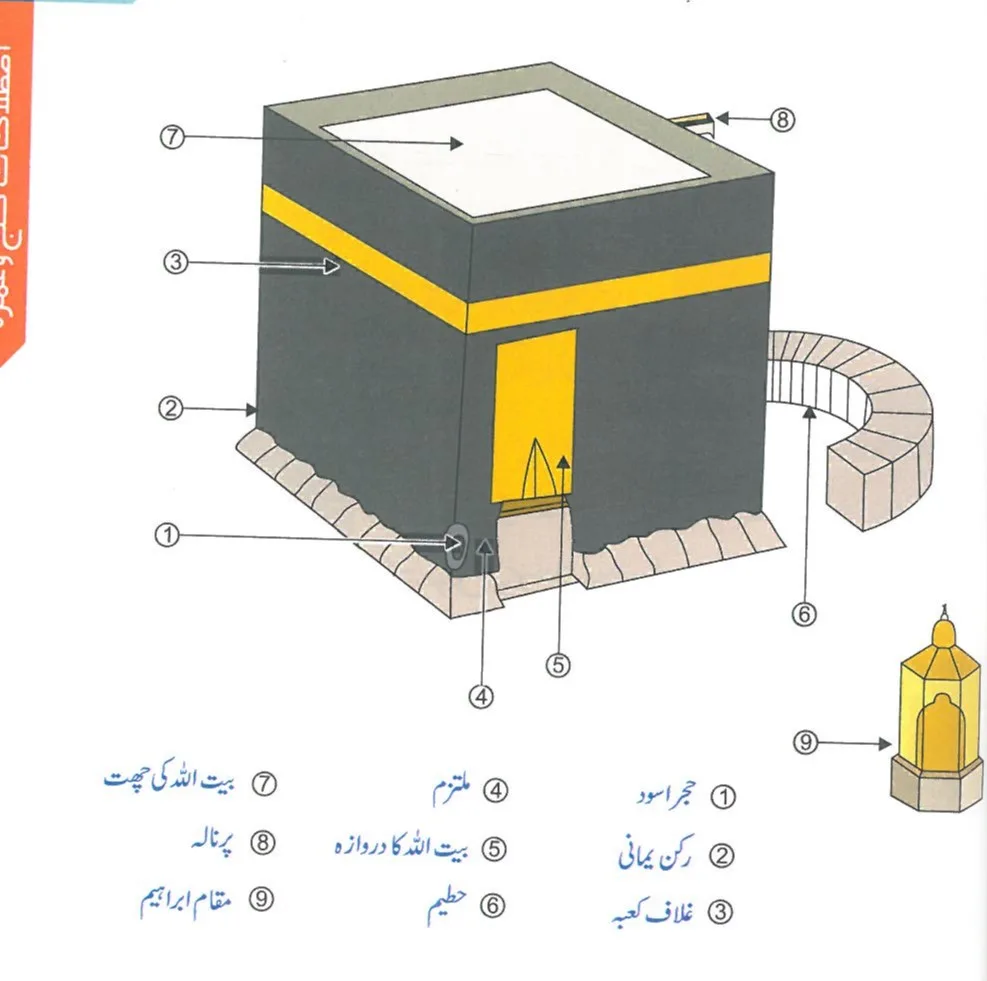
Bayt Allah:
The very first house built on the face of the earth for the worship of Allah Almighty, called Bayt Allah in Arabic and Khana Kaaba in Persian. This is the Qibla of Muslims towards which they face while praying.
Hajr al-Aswad:
The black stone which is installed on the southeast corner of the Kaaba, on the left side of the door, facing outward. The Tawaf begins and ends in front of this stone.
Arkan Bayt Allah:
Meaning the corners of the Kaaba; if you start Tawaf from the corner with the Hajr al-Aswad, then in order these corners come: Rukn Iraqi, Rukn Shami, and Rukn Yamani.
Rukn Iraqi:
The northeastern corner of the Kaaba which is towards Iraq.
Rukn Shami:
The northwestern corner of the Kaaba which is towards Syria.
Rukn Yamani:
The southwestern corner of the Kaaba towards Yemen. It is Sunnah to touch it only with the hand during Tawaf if possible. Therefore, the covering of the Kaaba is lifted from its lower part. However, kissing it, touching it and then kissing the hand, or gesturing towards it while passing by are all actions against Sunnah.
Hateem:
The northern part of the Kaaba between the Rukn Iraqi and Rukn Shami, which the people of Makkah could not build during the pre-Islamic era due to lack of sufficient funds. Around this part, a small semicircular wall has been drawn so that people perform Tawaf outside it because it is part of the Kaaba. It is also called Hijr. Whoever offers Nafl prayers inside it, it is as if they have offered Nafl prayers inside the Kaaba.
Mizab Kaaba:
The drain of the Kaaba, whose water falls into the Hatim, but there is no virtue in standing under it to bathe during rain.
Multazam:
Meaning the place to cling to. The wall of the Kaaba between the door and the Black Stone is called Multazam because it is Sunnah to cling to it and pray with humility and submission.
Maqam Ibrahim:
The stone preserved in a glass and golden grille in front of the door of the Kaaba, on which Prophet Ibrahim (peace be upon him) stood while constructing the Kaaba. By Allah’s power, the marks of his feet are still present on this stone.
Mataf:
The empty space left around the Kaaba for performing Tawaf.
Zamzam:
Healing and nutritious, extremely blessed water that comes from a well located between the Black Stone and Maqam Ibrahim. This well flowed solely by the command of Allah when the little Ismail was tormented by thirst at this desolate mountainous place, and his mother became hopeless in search of water. Now this well is in the basement under the Mataf so that it does not obstruct the Tawaf, however, water is available throughout the mosque at all times.
Tawaf:
Circumambulating seven times around the Holy Kaaba with the intention of reward, then offering two Rak'ahs prayer at Maqam Ibrahim.
The following types of Tawaf are:
① Nafl Tawaf
② Tawaf Qudoom or Tawaf Tahiyyah
③ Tawaf Ifadah or Tawaf Ziyarat
④ Tawaf Widaa
① Nafl Tawaf:
This can be performed at any time in normal clothes without wearing Ihram. It should be noted that performing Tawaf by anyone other than during Hajj or Umrah is not proven from Sunnah.
② Tawaf Qudoom:
The first Tawaf performed by the pilgrim upon arriving in Makkah after wearing Ihram from the Miqat is called Tawaf Qudoom.
Idtiba':
During Tawaf al-Qudum, the Ihram cloth is passed from the right armpit to the left shoulder, leaving the right shoulder bare. This rule is only for men.
Ramal:
In the first three circuits of Tawaf al-Qudum, take small steps and walk briskly while shaking the shoulders. This rule is also only for men.
③ Tawaf al-Ifadah:
The Tawaf performed on the 10th of Dhu al-Hijjah, the day of Eid al-Adha. It is also called Tawaf Ziyarah. It is a pillar of Hajj.
Tawaf al-Wada:
The last Tawaf performed before departing from Makkah after completing the rites of Hajj.
Istilam:
Kissing the Black Stone, touching it with the hand or a stick, or pointing towards it with one hand. These four forms are collectively called Istilam.
Safa and Marwah:
The names of two hills. Safa is located southeast of the Kaaba and Marwah to the northeast. Now only the marks of these hills remain.
Sa’i between Safa and Marwah:
Walking seven circuits between Safa and Marwah. One circuit from Safa to Marwah and the second circuit from Marwah back to Safa. The first circuit starts from Safa and the seventh circuit ends at Marwah. This circumambulation is commonly known as Sa'i.
Sa'i:
Walking briskly or running slightly at the place called Batn al-Wadi between Safa and Marwah is technically called Sa'i, and this is only for men.
Milein Akhdarain:
The green tubes installed on both sides in the middle of the valley, visible during the circumambulation of Safa and Marwah. Their purpose is to ensure that Sa'i is performed only between them, and the remaining circuits are completed at a normal pace.
Mas'i:
The place where Sa'i is performed.
Qasr:
Cutting the entire head hair evenly with scissors or a machine.
Halq:
Shaving the entire head hair with a razor.
Mina:
A valley located five kilometers east of the Holy Kaaba where pilgrims stay on the 8th of Dhu al-Hijjah and from the 10th to the 13th of Dhu al-Hijjah.
Yawm al-Tarwiyah:
8 Dhu al-Hijjah, the first day of the days of Hajj when the pilgrims depart for Mina and begin the Hajj. Tarwiyah means to quench thirst. On this day, before departing for Mina, the pilgrims would thoroughly water their camels and animals.
Tariq al-Mashaa:
A special pedestrian route from Mecca to Mina, part of which consists of beautiful, airy mountain tunnels, while the rest of the route has roofs built here and there to protect from the heat. There is also a pedestrian route from Mina to Muzdalifah towards Arafat.
Yawm Arafah:
9 Dhu al-Hijjah, the second day of the days of Hajj when the pilgrims travel from Mina to Arafah.
Jama’ Taqdeem:
Performing the later prayer along with the earlier prayer at the time of the earlier prayer, such as combining Dhuhr and Asr on the day of Arafah.
Jama’ Ta’khir:
Performing the earlier prayer along with the later prayer at the time of the later prayer, such as combining Maghrib and Isha together on the night of Muzdalifah.
Wadi Nimrah:
A valley near the plain of Arafat where if a pilgrim arrives before noon on the 9th of Dhu al-Hijjah, it is Sunnah to stay until noon.
Wadi Urna:
A valley between the plain of Arafat and Nimrah where the Prophet ﷺ delivered the Hajj sermon before the standing at Arafah, then combined and shortened the Zuhr and Asr prayers at the time of Zuhr.
Arafah or Arafat:
A vast valley approximately 20 kilometers from the Holy Kaaba, outside the boundaries of the Haram, where standing (staying) on the 9th of Dhu al-Hijjah is an essential pillar of Hajj.
Masjid Nimrah:
A very large and beautiful mosque, about one-third of which (the part with the mihrab) is in Wadi Nimrah and Wadi Urna, while the remaining two-thirds is in Arafat. Now, the Hajj sermon and the combined and shortened Zuhr and Asr prayers are performed in this mosque.
Jabal al-Rahmah:
A hill located in the plain of Arafat beside which the Prophet ﷺ stood and supplicated. However, reaching and climbing this hill is unnecessary; standing can be done anywhere in the entire plain of Arafat.
Muzdalifah:
The name of a valley between Mina and Arafat.
Laylat al-Muzdalifah:
The night between the 9th and 10th of Dhu al-Hijjah, which is spent sleeping in Muzdalifah as part of Hajj.
Masjid Mash'ar al-Haram:
The mosque in the valley of Muzdalifah.
Mash'ar al-Haram:
A hill located in Muzdalifah where, after the Fajr prayer on the 10th of Dhu al-Hijjah until dawn spreads, pilgrims face the Qibla and engage in the remembrance of Allah and supplications.
Yawm al-Nahr:
The 10th of Dhu al-Hijjah, i.e., the third day of Hajj, during which the pilgrim performs the following: 1: Departure from Muzdalifah to Mina before sunrise; 2: Stoning of Jamrat al-Aqaba after sunrise; 3: Sacrifice; 4: Haircut; 5: Removal of Ihram; 6: Tawaf al-Ifadah; 7: Sa'i between Safa and Marwah; and returning to Mina to spend the night.
Wadi Muhassir:
A small valley on the way from Muzdalifah to Mina on the 10th of Dhu al-Hijjah, where Allah destroyed the army of Abraha through the birds called Ababil. It is commanded to cross it quickly.
Masjid Khayf:
A beautiful mosque in the valley of Mina, where many Prophets, peace be upon them, have offered prayers.
Jamarat:
The plural of جَمْرَةٌ is جمرات, which means "pillar." Commonly, they are called Satan, but calling them Satan is not correct. These are three pillars built at short distances from each other, which have now been elevated further by passing through very large bridges.
People throw pebbles at them from below and above the bridges. All three jamarat are near Masjid Khif.
Rami:
Throwing, hitting any jamrah with seven pebbles, and saying Allahu Akbar on each pebble is called Rami.
Al-Jamrah Al-Ula:
It is also called Jamrah Sughra and Jamrah Dunya, meaning the very first, smallest, and nearest jamrah, because when coming from Masjid Khif towards the jamarat, this is the first one encountered. Also, except for the 10th of Dhu al-Hijjah, it is the first jamrah to be stoned on the remaining days.
Al-Jamrah Al-Wusta:
The middle jamrah, located between the other two jamarat.
Jamrah Al-Kubra:
This is also called Jamrah Aqabah, meaning the largest and the last Jamrah. If coming from Masjid Khif, it is the last one, and if reaching Mina from Makkah via the Tareeq al-Mushah, it is the first one. On the 10th of Dhu al-Hijjah, only this Jamrah is stoned, while on the other days, all three are stoned in the mentioned order. Also, after stoning the other two Jamrah, one steps aside to make dua, but it is Sunnah not to make dua after stoning this one.
Hadi:
The sacrificial animal that a person performing Hajj or Umrah slaughters in Makkah.
Note: Difference between Hadi and Adhiyah: Hadi is the sacrifice obligatory on those performing Hajj Tamattu’ and Hajj Qiran. It can only be slaughtered within the boundaries of the Haram. Whereas Adhiyah is the sacrifice that every capable person offers on the occasion of Eid al-Adha; it can be slaughtered anywhere. However, it will never suffice for the pilgrim.
Qiladah:
Hanging a shoe or some other item around the neck of the Hadi [sacrificial] animal.
Poetry:
If it is a camel, then a small cut is made on the right side of its hump and the blood that comes out is applied on its hump; this is called poetry. This was done so that no one would harm the animal, and if it gets lost, it would be sent towards the Haram of Makkah.
Mahsar:
A person who puts on Ihram for Hajj or Umrah from the Miqat, but then encounters some obstacle [fear or illness] on the way and is unable to perform Hajj or Umrah.
Conditional Talbiyah:
When putting on Ihram at the Miqat, at the end of the Talbiyah say: Allahumma mahli haythu habastani, "O Allah! My place of being lawful [removal of Ihram] will be wherever You stop me." In this case, if the pilgrim or Umrah performer, for any reason, after putting on Ihram, is unable to complete Hajj or Umrah, then no fidyah (compensation) will be required from him.
Dam al-Ihsar:
If a person in Ihram did not say the conditional Talbiyah while assuming Ihram in Muharram and faces an obstacle before reaching Makkah, he should send one animal with someone else to the Haram. If he cannot send it, he will slaughter the animal at the place of the obstacle. This sacrifice is called Dam al-Ihsar.
Fidya:
The penalty or fine that a person performing Hajj or Umrah faces due to breaking some restrictions of Ihram or disruption in certain acts of Hajj is called Fidya in terminology.
Dam:
Literally means blood. The sacrifice given as Fidya is called Dam. And this will only be slaughtered within the boundaries of the Haram and distributed among the poor of that area.
Badnah:
A large sacrificial animal, but the term is mostly applied to a camel.
Ayam al-Mina:
The four days of sacrifice, i.e., the 10th, 11th, 12th, and until the afternoon of the 13th of Dhu al-Hijjah. Since people spend the days of sacrifice in Mina, they are called Ayam al-Mina.
Manhar:
Meaning the sacrificial altar. According to the issue, the sacrifices of Hadi or Fidya can be slaughtered anywhere within the boundaries of the Haram. In this regard, the entire Haram is a sacrificial altar, but nowadays a sacrificial altar has been established in Mina, which is called مَنْحَر or الْمَسَالِحُ. Now all Fidya and Qurbani animals are slaughtered there, and if a person wishes to perform his sacrifice with his own hands, this facility is also available there.
Tafath:
Cleaning and grooming. This refers to body cleanliness and hair cutting, for example: cutting or shaving the entire head hair, cleaning the hair from the armpits and below the navel, trimming the mustache, cutting nails, etc. Therefore, on the 10th of Dhu al-Hijjah, attention should be paid to these matters in body cleanliness.
Hilat or Halal Hona:
To end the restrictions of Ihram.
Tawaf-e-Ifadah:
Performing Tawaf of the Kaaba on the 10th of Dhu al-Hijjah.
Yawm al-Ru'us:
11th of Dhu al-Hijjah, that is, the fourth day of the days of Hajj. When the pilgrim reaches Mina...
After the decline, he throws stones at all three Jamarat. The remaining time is spent in Dhikr, recitation, supplication, and prayers. Ru'us is the plural of Ra's, which means "heads." Until that day, people used to divide the meat of their sacrifice into three parts: one for eating, one for distribution, and one for storage. However, the "heads" remained. Due to their abundance, that day was named Yawm al-Ru'us (Day of the Heads).
Ayyam al-Tashreeq:
The 11th, 12th, and 13th of Dhu al-Hijjah are called Ayyam al-Tashreeq. Tashreeq means "to put something in the sun." On these days, people would put the meat of their sacrifices in the sun so that it would dry and become suitable for storage.
Layali Mina:
Meaning the nights of Mina. This refers to the nights from the 10th to the 13th of Dhu al-Hijjah. It is necessary to spend them in Mina.
Yawm al-Nufr al-Awwal:
12 Dhu al-Hijjah, that is the first day of departure and the fifth day of the days of Hajj. On this day, the pilgrim will do the same things that he performed on 11 Dhu al-Hijjah. It is called "the first day of departure" because if the pilgrim wishes, after noon, having completed the stoning of the Jamarat, he can leave the boundaries of Mina before sunset. But if the sun sets while still inside the boundaries of Mina, then he must stay in Mina until the stoning on 13 Dhu al-Hijjah.
Yawm al-Nufur al-Thani:
13 Dhu al-Hijjah, that is the second day of departure and the sixth and final day of the days of Hajj. On this day, after noon, having completed the stoning of the Jamarat, the pilgrim can leave Mina at any time.
At-Tahallul al-Awwal:
On the tenth day, when the pilgrim throws pebbles and becomes halal, all the restrictions of Ihram except those related to the wife are lifted; this is also called the minor release (Tahallul Asghar).
At-Tahallul ath-Thani:
When the pilgrim completes the Tawaf of Hajj, that is, the Tawaf of Ziyarat, then his wife also becomes lawful for him; this is also called Tahallul Akbar.
Jabal Noor:
A mountain near Mecca where the Cave of Hira is located, where the first revelation was sent down to the Prophet Muhammad ﷺ.
Jabal Thawr:
A mountain near Mecca where the Cave of Thawr is located. During the migration, the Prophet Muhammad ﷺ along with Abu Bakr Siddiq (may Allah be pleased with him) took refuge there for three days.
Explanation: It should be noted that historically, visiting these places is permissible, but their visitation is not part of the rituals of Hajj and Umrah. Similarly, considering their visitation as a cause of reward, performing Nawafil (voluntary prayers) there, and sitting there to recite Dhikr and long supplications are all self-invented acts.
Jannat al-Mu'alla:
Al-Mu'alla is the ancient cemetery of Makkah Mukarramah.
Masjid Nabawi:
The mosque in Madinah Munawwarah which was built by the Holy Prophet ﷺ and the Companions, a prayer performed in it is superior to a thousand prayers performed in other mosques.
Rauḍah min Riyāḍ al-Jannah:
The place in Masjid al-Nabawi located between the house of the Prophet ﷺ and the pulpit. Nowadays, a light green carpet is spread to distinguish this place from others, and a separate doorway has been made for entry. According to the Prophetic tradition, this place is "a garden from the gardens of Paradise."
Suffah: The platform near Masjid al-Nabawi where the needy Companions, may Allah be pleased with them, stayed to seek knowledge and were called Ashab al-Suffah. Behind the Rawdah of the Prophet ﷺ, the mark of this platform still exists today and it is now included within Masjid al-Nabawi.
Rawdah of the Prophet ﷺ:
The house of Umm al-Mu'minin Aisha Siddiqah رضي اللہ عنہما, where the Messenger of Allah ﷺ passed away and was buried. This place, surrounded by multiple protective walls, is called the Roza "Rasool." It also contains the graves of Abu Bakr and Umar رضي اللہ عنہما alongside the Prophet ﷺ. Each grave is also marked on the grille outside.
Baqqi al-Gharqad:
The ancient cemetery of Madinah Munawwarah where many companions and female companions رضي اللہ عنہم are buried. It is commonly known as Al-Baqi. It is currently almost adjacent to Masjid al-Nabawi.
Masjid Quba:
The first mosque built after the Hijrah, located about eight to ten kilometers from Masjid al-Nabawi. It was built by the Prophet ﷺ and the noble companions رضي اللہ عنہم themselves. The Prophet ﷺ said about it that whoever leaves his house in a state of ablution and prays two rak'ahs in Masjid Quba, Allah Almighty will grant him the reward of one Umrah.
Masjid Qiblatain:
That is, the mosque with two Qiblas is located about four kilometers from Masjid an-Nabawi. In it, prayers were being offered facing "Bait al-Maqdis" when a companion, who had just prayed Asr with the Prophet ﷺ, informed about the change of Qibla. The worshippers turned towards the Kaaba in the middle of the prayer, which is why it is called Masjid al-Qiblatain. Even today, there is a prayer mat mark on the wall in the direction opposite to the Kaaba.
Sab'ah Masajid:
The place where a trench was dug for the defense of Madinah Munawwarah during the Battle of the Trench. The Turks built seven small mosques at short intervals corresponding to different tents, which are called Sab'ah Masajid. This place is now included within the city of Madinah Munawwarah.
Uhud:
A mountain near Madinah Munawwarah at whose foothills the Battle of Uhud was fought. There is also the cemetery of the martyrs of Uhud.

