


This excerpt is taken from the book Masnoon Hajj o Umrah published by Maktaba Darussalam Research Center.
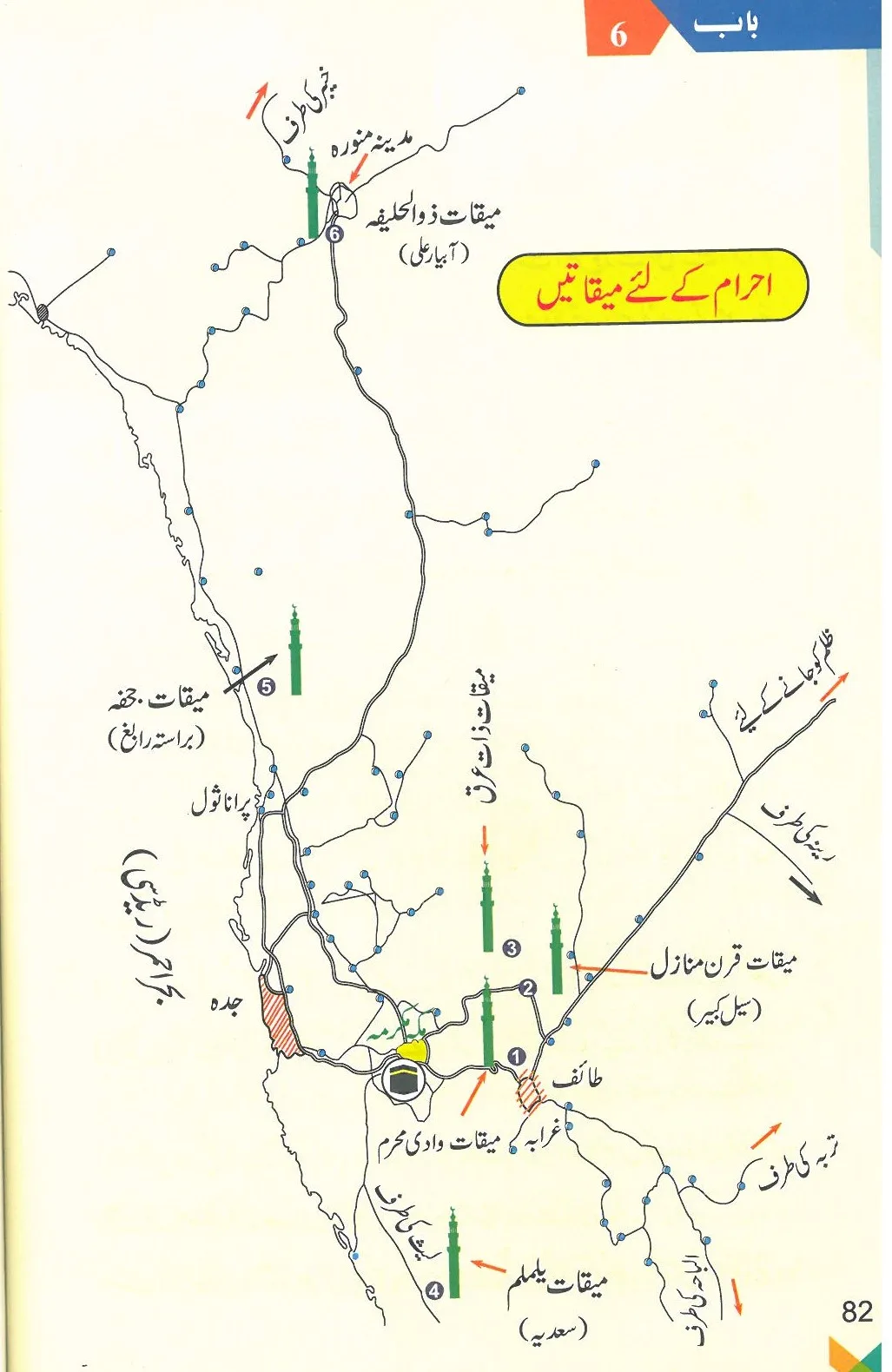
The place and time for putting on Ihram for Hajj and Umrah is called Miqat. The places for putting on Ihram vary according to different directions:
Yalamlam:
For pilgrims coming from Pakistan, Bangladesh, India, and adjoining areas, the Miqat is Yalamlam. Also, the Miqat for the people of Yemen is the same.
Dhul-Hulayfah:
For the people of Madinah and adjoining areas, the Miqat is Dhul-Hulayfah, whose new name is Bi’r Ali or Abar Ali.
Juhfah:
For the people of Sham (Greater Syria) and Egypt, etc., the Miqat is Juhfah.
Dhat al-Iraq:
The Miqat for the people of Iraq is Dhat al-Iraq.
Qarn al-Manazil:
For the people of Najd, the Miqat is Qarn al-Manazil or Sayl Kabir.
Those who reside between these places and Makkah (locals), for example, those living in Ji’rana and Usfan, etc., will put on Ihram from their place of residence, and similarly, the people of Makkah will put on Ihram from Makkah itself.
But the people of Makkah will have to come outside the boundaries of the Haram to don the Ihram for Umrah, for example, Arafat or Masjid Aisha, etc.
Important Clarification:
Nowadays, most travel for Hajj and Umrah is by air, so it is appropriate to wear the Ihram garment at the airport at the time of departure. However, the Talbiyah for Hajj or Umrah will begin upon passing the Miqat. When the Miqat boundaries start, an official announcement is made on the airplane. Some people wear Ihram after reaching Jeddah, which is incorrect.
Reference: Sheikh Uthaymeen
Issue: Even if there is no air travel, it is permissible to wear the Ihram garment before the Miqat, but the intention (Niyyah) must be made while passing the Miqat or its equivalent.
Ihram:
Just as a worshiper enters the prayer with Takbeer-e-Tahrima, and after Takbeer-e-Tahrima certain restrictions are imposed on him, similarly, the one performing Hajj or Umrah enters into Hajj and Umrah after Ihram. And certain restrictions are imposed on him as well.
Performing Ghusl before Ihram:
It is recommended [preferred] for the one who is putting on the Ihram for Hajj or Umrah to perform Ghusl first, as it is proven from the Prophet ﷺ.
Reference: Jami' at-Tirmidhi, Hajj, Hadith: 830
However, it should be clear that postponing complete cleanliness [cleaning the hair under the navel and armpits] until that time and considering this delay as Sunnah is not correct.
Issue: If the pilgrim or Umrah performer is unable to perform Ghusl due to illness or any other reason, he can put on Ihram without Ghusl, and there will be no disruption in his Hajj or Umrah.
Apply perfume on the body.
Reference: Sahih al-Bukhari, Hajj, Hadith: 1539
Issue: Using perfume on clothes while putting on Ihram is absolutely prohibited.
Women should also perform Ghusl before putting on Ihram, and women who are in the state of menstruation or postpartum bleeding should also perform Ghusl before putting on Ihram.
Reference: Sahih Muslim, Hajj, Hadith: 1209
Performing Ghusl when putting on Ihram is obligatory for men, not for women; however, it is a recommended [better] act. Nevertheless, for women, Ghusl is necessary in two cases.
◈ If a woman gives birth while on the way to Hajj or Umrah, it is necessary for her to perform Ghusl (ritual purification). During the Prophet’s ﷺ Hajj journey, when Hazrat Abu Bakr’s (RA) wife, the respected Hazrat Asma bint Umais, gave birth to Muhammad bin Abi Bakr, the Prophet ﷺ ordered that she be given Ghusl and then put on Ihram. This incident occurred after leaving Madinah at the place called Shajrah [Dhul-Hulaifah].
Reference: Sahih Muslim, Hajj, Hadith: 1210,1209
◈ If a woman becomes menstruating, the same ruling applies: she should perform Ghusl and complete all the rituals of Hajj except for the Tawaf of the Kaaba. After she becomes pure, she should also perform Tawaf. This situation occurred during the Hajj journey with Hazrat Aisha (RA), and the Prophet ﷺ instructed her to perform Ghusl and complete all the Hajj rituals except Tawaf.
Men’s Ihram:
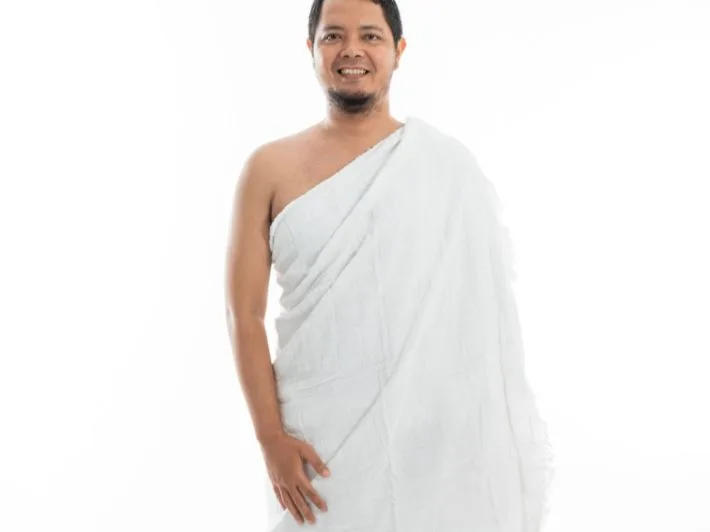
Two clean sheets for men [preferably white] are the clothing of Ihram. One is to be tied as a waistcloth and the other to be draped over the upper body, but the head and face remain uncovered. Any type of footwear can be worn, but the ankles must remain uncovered.
Reference: Sahih al-Bukhari, Hajj, Hadith:1545,1542
Issue:
The Ihram clothing does not have to be new and unused. Rather, old and used clothing can also be used. It is just a garment, and it can be used as many times as one wishes.
Issue:
There is no harm in wearing a watch, ring, glasses, or a belt with a wallet, etc.
Women’s Ihram:
There is no specific Ihram for women. They can adopt whatever clothes they are wearing as their Ihram, but they should neither wear gloves nor a face veil.
Reference: Sunan Abi Dawood, Manasik, Hadith:1825
It should be noted that a face veil refers to a cloth tailored to fit the face, and wearing it during Ihram is prohibited. However, this does not mean that a woman should not observe hijab.
The wives of the Prophet ﷺ, the Mothers of the Believers, said: When people passed by, each of us would hang our veil. From this, it is understood that women in Ihram should observe modesty by covering themselves with a large veil besides the niqab, keep things simple, and lower their gaze. Because the pure wives of the Prophet ﷺ used to do the same.
Reference: Sunan Abi Dawood, Al-Manasik, Hadith: 1833
Now, since there is an immense crowd of men at all Hajj sites, and there is no place where men are not present, it is necessary for a woman in the state of Ihram to cover her face everywhere. There is no need for any hardship in this; she should cover her face in whichever way she can—whether with a large veil, a scarf, or any other method. Keeping the face uncovered is absolutely not permissible except in front of mahram men. There is no disagreement on this. In the presence of non-mahram men, it is unanimously agreed that covering the face is necessary. And Allah knows best.
Some people, from the very beginning of Ihram, perform "Idtiba'" [right shoulder bare] and continue to pray in this state. This is completely wrong because it is prohibited to keep the shoulders uncovered during prayer.
Reference: Sahih al-Bukhari, Salat, Hadith: 359
Also, Idtiba' from the Prophet ﷺ is only established during the Tawaf al-Qudum (arrival circumambulation).
Reference: Jami' at-Tirmidhi, Hajj, Hadith: 859
[Note: During prayer, it is forbidden to keep the right shoulder bare in Idtiba'. Keep both shoulders covered during prayer.]
◈ There is no evidence for offering two rak'ahs of Nafl after wearing Ihram.
◈ Some women tie something like a fan on both sides of the head or wear a sunshade hat and then put a veil over it so that the veil cloth does not touch the face; this is merely an affectation.
◈ Some people have been seen getting movies made and pictures taken after wearing Ihram. This is completely impermissible, forbidden, and against the etiquette of Hajj. There is a danger that due to showing off, they may be deprived of the reward of Hajj.
The one performing Umrah and Hajj Tamattu' should say these words when departing from the Miqat:
[اللَّهُمَّ لَبَّيْكَ عُمْرَةً]
O Allah! I am present before You for Umrah.
The one performing Hajj Qiran should say these words:
[اللَّهُمَّ لَبَّيْكَ حَجًّا وَ عُمْرَةً]
O Allah! I am present before You for Hajj and Umrah.
The one performing Hajj Ifrad should say these words:
[اللَّهُمَّ لَبَّيْكَ حَجًّا]
O Allah! I am present before You for Hajj.
Similarly, the one performing Hajj Tamattu‘ [8] when entering Ihram for Hajj in Dhu al-Hijjah should also say the words of Hajj Ifrad.
Issue:
If a person has entered Ihram for Hajj Ifrad or Hajj Qiran from the Miqat, but after reaching Makkah his intention changes and he converts Ifrad or Qiran into Tamattu‘, there is no harm and no dam (sacrifice) or fidyah (expiation) is required. However, the one performing Hajj Qiran who has brought a sacrificial animal with him cannot convert it into Hajj Tamattu‘.
Reference: Sahih al-Bukhari, Al-Hajj, Hadith:1638], [Sahih Muslim, Al-Hajj, Hadith:1211]
Entering Ihram with a condition:
A sick person is somewhat healthy when putting on Ihram at Miqat, but if he fears that his condition may worsen, or relapse, or any other excuse may arise that would prevent him from reaching the Haram, then after saying the previously mentioned words, he should also say these words:
[اللَّهُمَّ مَحِلِّي حَيْثُ حَبَسْتَنِي]
O Allah! My place of release is wherever You stop me.
Reference: Sahih al-Bukhari, Marriage, Hadith: 5089
Issue:
The benefit of this condition is that if due to an obstacle he has to remove the Ihram, he will not have to pay a penalty. And if his Hajj is voluntary, he will not have to make it up either.
Reference: Manasik al-Hajj wal-Umrah by Imam al-Albani, p. 15
But if he has not tied the conditional Ihram and if it is within his ability to offer a sacrifice in case of an obstacle, then he should send his sacrifice to the Haram with someone so that it is slaughtered there, then approximately after its slaughter, he should exit Ihram, and if he cannot send the sacrifice, then he should slaughter the sacrifice at the place of the obstacle itself and after shaving, exit Ihram, and if he is not able to afford the sacrifice, then he should fast for ten days [like Hajj Tamattu'].
Reference: Sahih al-Bukhari, Al-Muhassir, Hadith:1810,1807], [Adwa' al-Bayan, p:85,83
Words of Talbiyah:
The one performing Hajj or Umrah should start the Talbiyah from the Miqat after tying the Ihram. The words of Talbiyah are:
لَبَّيْكَ اللَّهُمَّ لَبَّيْكَ ، لَبَّيْكَ لَا شَرِيكَ لَكَ لَبَّيْكَ ، إِنَّ الْحَمْدَ وَالنِّعْمَةَ لَكَ وَالْمُلْكَ ، لَا شَرِيكَ لَكَ
Here I am, O Allah! Here I am. Here I am repeatedly. You have no partner. Here I am again. Surely all praise and blessings are Yours alone, and all sovereignty too. You have no partner.
Reference: Sahih al-Bukhari, Al-Hajj, Hadith:1549
◈ These words of Talbiyah are also established from the Prophet ﷺ: [لَبَّيْكَ إِلَهَ الْحَقِّ]
O True God! Here I am.
Reference: Sunan an-Nasa'i, Manasik al-Hajj, Hadith:2753
When a person performing Umrah enters Masjid al-Haram and begins Tawaf, he should stop saying Talbiyah.
Reference: Jami' at-Tirmidhi, Hajj, Hadith: 919
Whereas a person performing Hajj will stop saying Talbiyah before stoning the Jamrah on the 10th of Dhu al-Hijjah.
Reference: Sahih al-Bukhari, Hajj, Hadith: 1685
After wearing Ihram, certain restrictions are imposed on the person performing Hajj or Umrah:
For Men:
Wearing stitched clothes, turban, cap, or scarf, wearing socks, applying perfume, cutting the hair of the head, and by analogy, the majority of scholars have also prohibited removing hair from other parts of the body. Similarly, cutting nails is also prohibited.
Reference: Sheikh Uthaymeen, may Allah have mercy on him
Sexual intercourse with the wife, marrying, conducting a marriage, or sending a marriage proposal, hunting or assisting in hunting.For Women:
Applying perfume, cutting hair and nails, wearing gloves, wearing a niqab [stitched cloth covering the face], hunting or assisting in hunting, intercourse with the husband, marrying, conducting a marriage, or sending a marriage proposal.
If a person dies in the state of Ihram, no perfume should be applied to him, nor should his head be covered, and he should be shrouded in the sheets of Ihram.
Reference: Sunan an-Nasa'i, Manasik al-Hajj, Hadith: 2856
Permissible matters in Ihram:
◈ The one performing Hajj or Umrah can bathe with unscented soap and shampoo while in the state of Ihram.
◈ He can apply kohl or medicine for the treatment of the eyes.
◈ He can let blood out from any part of the body for treatment.
◈ He can apply oil that does not have any fragrance.
◈ He can seek treatment for any kind of illness.
◈ He can scratch his body.
◈ He can use an umbrella.
◈ He can carry weight on his head.
◈ He can wash or change the sheets of Ihram.
◈ He can hunt sea creatures.
◈ He can kill snakes, scorpions, crows, eagles, and biting dogs.

