
Compiled by: Abu Hamzah Salafi
This article presents a research-based analysis of a narration which some objectors associate with Yawm al-Ghadir (18th Dhul-Hijjah) and, on that basis, conclude that the Verse of the Completion of the Religion (﴿اليوم أكملت لكم دينكم﴾) was revealed on that very day—thus claiming that “Yawm al-Ghadir is the day on which the religion was completed.”
Our objective is to clarify the following points:
① According to the definitive and well-known narration of Ṣaḥīḥ al-Bukhārī and Ṣaḥīḥ Muslim, the Verse of Completion was revealed on Friday, in the plain of ʿArafāt.
② The narration presented by al-Khaṭīb al-Baghdādī is weak both in its chain (sanad) and in its text (matn).
③ Among its narrators are individuals about whom the scholars of ḥadīth criticism have spoken regarding leniency, weakness, and excessive errors; therefore, such a major claim cannot be established through it.
“Am I not the guardian (walī) of the believers?”
They replied: “Yes, O Messenger of Allah.”
He said: “Whoever has me as his mawlā, then ʿAlī is his mawlā.”
Then ʿUmar ibn al-Khaṭṭāb رضي الله عنه said: “Congratulations, O son of Abū Ṭālib! Today you have become my mawlā and the mawlā of every Muslim.”
Thereupon Allah revealed: {اليوم أكملت لكم دينكم}.
And whoever fasts on the 27th of Rajab, sixty months of fasting will be recorded for him, and this is the first day on which Jibrīl عليه السلام descended upon Muḥammad ﷺ with the message.
 Tārīkh Baghdād – al-Khaṭīb al-Baghdādī, vol. 8, p. 284, Dār al-Kutub al-ʿIlmiyyah, Beirut.
✦ (A) A specific virtue for fasting on 18th Dhul-Hijjah (reward of sixty months).
✦ (B) The revelation of the Verse of Completion of the Religion on Yawm al-Ghadir.
The second claim is the core issue of dispute.
Arabic Text:
“This verse was revealed on a Friday, and we were with the Messenger of Allah ﷺ at ʿArafāt.”
Brief Explanation:
Once the time and place of revelation are firmly established through the Ṣaḥīḥayn, it is incorrect to oppose them with a solitary narration from Tārīkh Baghdād that carries questionable authenticity.
 During the days of Ḥajj, Yawm ʿArafah falls on 9 Dhul-Hijjah, whereas Ghadir Khumm (18 Dhul-Hijjah) occurred during the return journey.
If the verse had already been revealed at ʿArafāt, attributing its revelation nine days later to Ghadir is historically inconsistent.
Brief Explanation:
This contradiction further casts doubt on the text of the narration, as it conflicts with well-established and widely transmitted reports.
✦ Fasting on 18 Dhul-Hijjah = sixty months
✦ Fasting on 27 Rajab = sixty months
✦ Declaring 27 Rajab as the first day of revelation
Brief Explanation:
According to the scholars of ḥadīth, texts that assign extraordinary rewards to specific dates, especially when combined in a single narration and supported by weak chains, are often signs of fabricated or unreliable virtue reports.
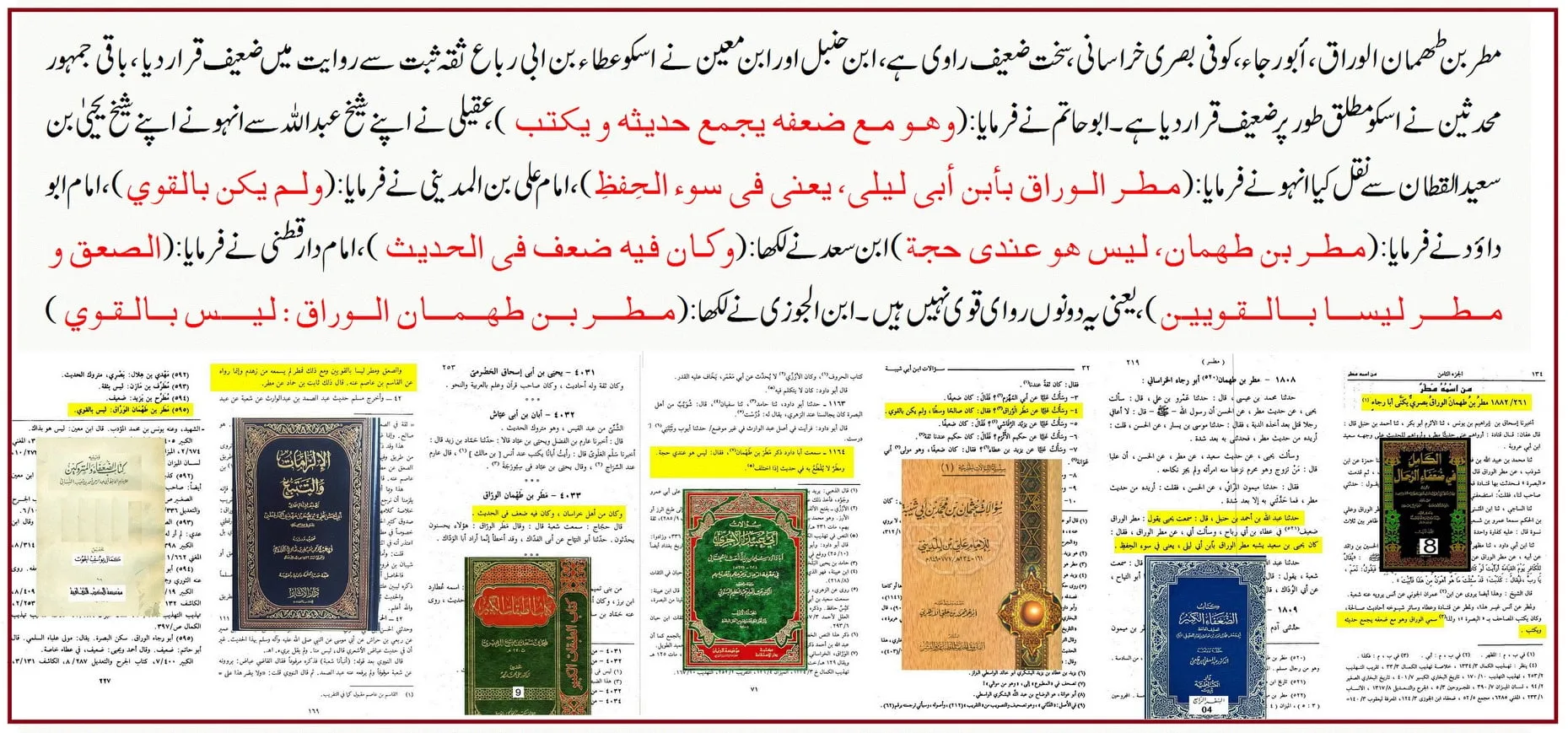
 Maṭar ibn Ṭahmān al-Warrāq is severely weak.
Claims that he is only weak in narrations from ʿAṭāʾ are incorrect. The majority of critics declared him weak in general:
✔ Abū Ḥātim: Weak
✔ Yaḥyā ibn Saʿīd al-Qaṭṭān: Poor memory
✔ ʿAlī al-Madīnī: “Not strong”
✔ Abū Dāwūd: Not a proof
✔ Ibn Saʿd: Weak
✔ al-Dāraquṭnī: Weak
✔ Ibn al-Jawzī: Not strong
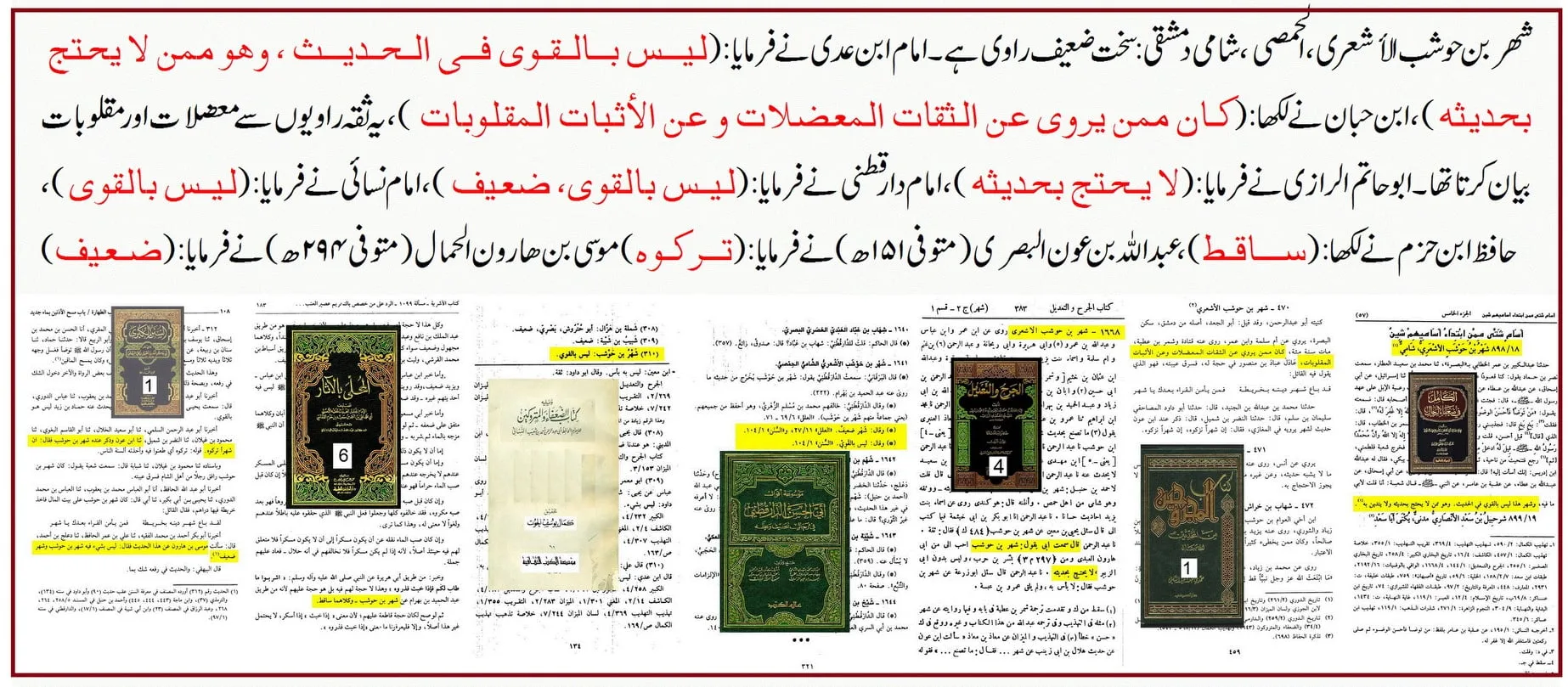
Shahr ibn Ḥawshab has been severely criticized:
✔ Ibn ʿAdī: His ḥadīth is not relied upon
✔ Ibn Ḥibbān: Narrated inverted and problematic reports
✔ Abū Ḥātim: Not to be used as proof
✔ al-Dāraquṭnī: Weak
✔ al-Nasāʾī: Weak
✔ Ibn Ḥazm: Rejected
✔ ʿAbdullāh ibn ʿAwn: Abandoned
✔ Mūsā ibn Hārūn: Weak
Thus, the chain further collapses due to this narrator.
Brief Explanation:
✔ A narrator’s presence in Ṣaḥīḥ Muslim does not mean all of his narrations are accepted.
✔ The Imams of ḥadīth narrate from some individuals only in specific contexts, from certain shaykhs, or with supporting evidence.
✔ When a text contradicts the Ṣaḥīḥayn and the chain contains weakness, it cannot be authenticated merely by such claims.
Presenting a solitary, weak narration from Tārīkh Baghdād against the Ṣaḥīḥayn does not meet scholarly standards.
According to the clear and authentic narrations of the Ṣaḥīḥayn, the verse was revealed on Friday, at ʿArafāt.
Moreover, the discussed narration:
✔ Contradicts authentic reports
✔ Contains narrators criticized for weakness and errors
✔ Displays an unusual and suspicious textual structure
Therefore, the claim that “the religion was completed specifically on Yawm al-Ghadir” cannot be established on sound scholarly grounds through this narration.
This article presents a research-based analysis of a narration which some objectors associate with Yawm al-Ghadir (18th Dhul-Hijjah) and, on that basis, conclude that the Verse of the Completion of the Religion (﴿اليوم أكملت لكم دينكم﴾) was revealed on that very day—thus claiming that “Yawm al-Ghadir is the day on which the religion was completed.”
Our objective is to clarify the following points:
① According to the definitive and well-known narration of Ṣaḥīḥ al-Bukhārī and Ṣaḥīḥ Muslim, the Verse of Completion was revealed on Friday, in the plain of ʿArafāt.
② The narration presented by al-Khaṭīb al-Baghdādī is weak both in its chain (sanad) and in its text (matn).
③ Among its narrators are individuals about whom the scholars of ḥadīth criticism have spoken regarding leniency, weakness, and excessive errors; therefore, such a major claim cannot be established through it.
Text of the Narration and the Claim of the Objector
① Narration of al-Khaṭīb al-Baghdādī (Tārīkh Baghdād)
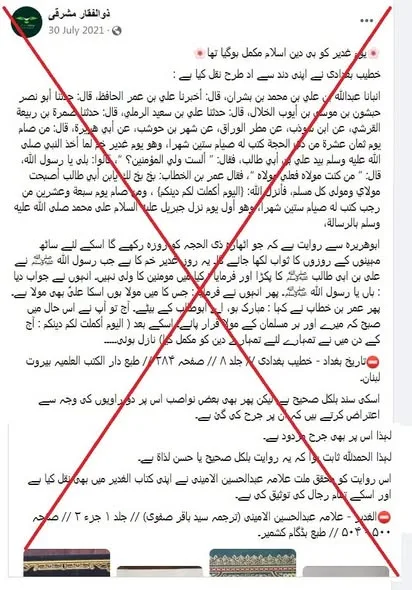
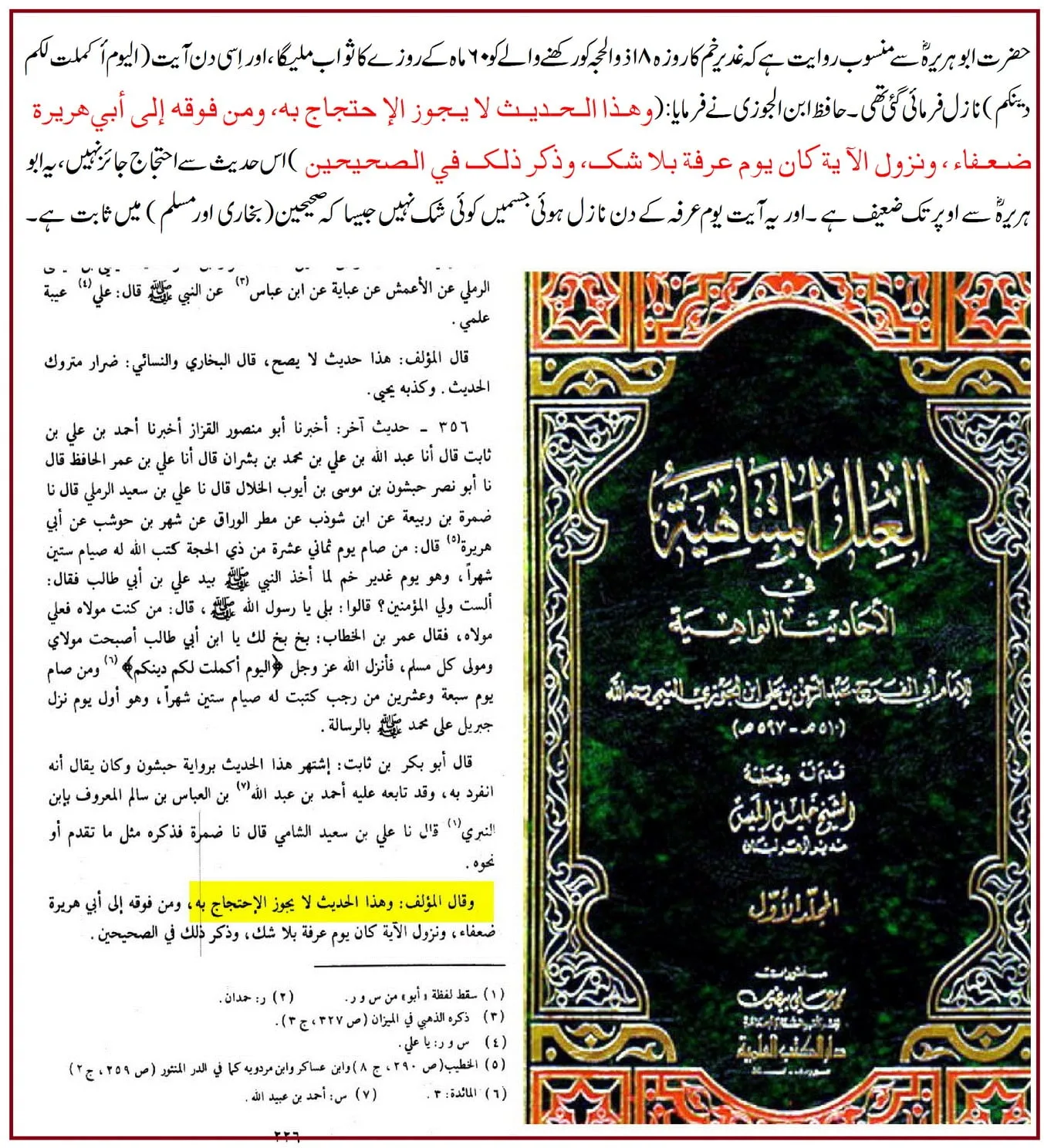
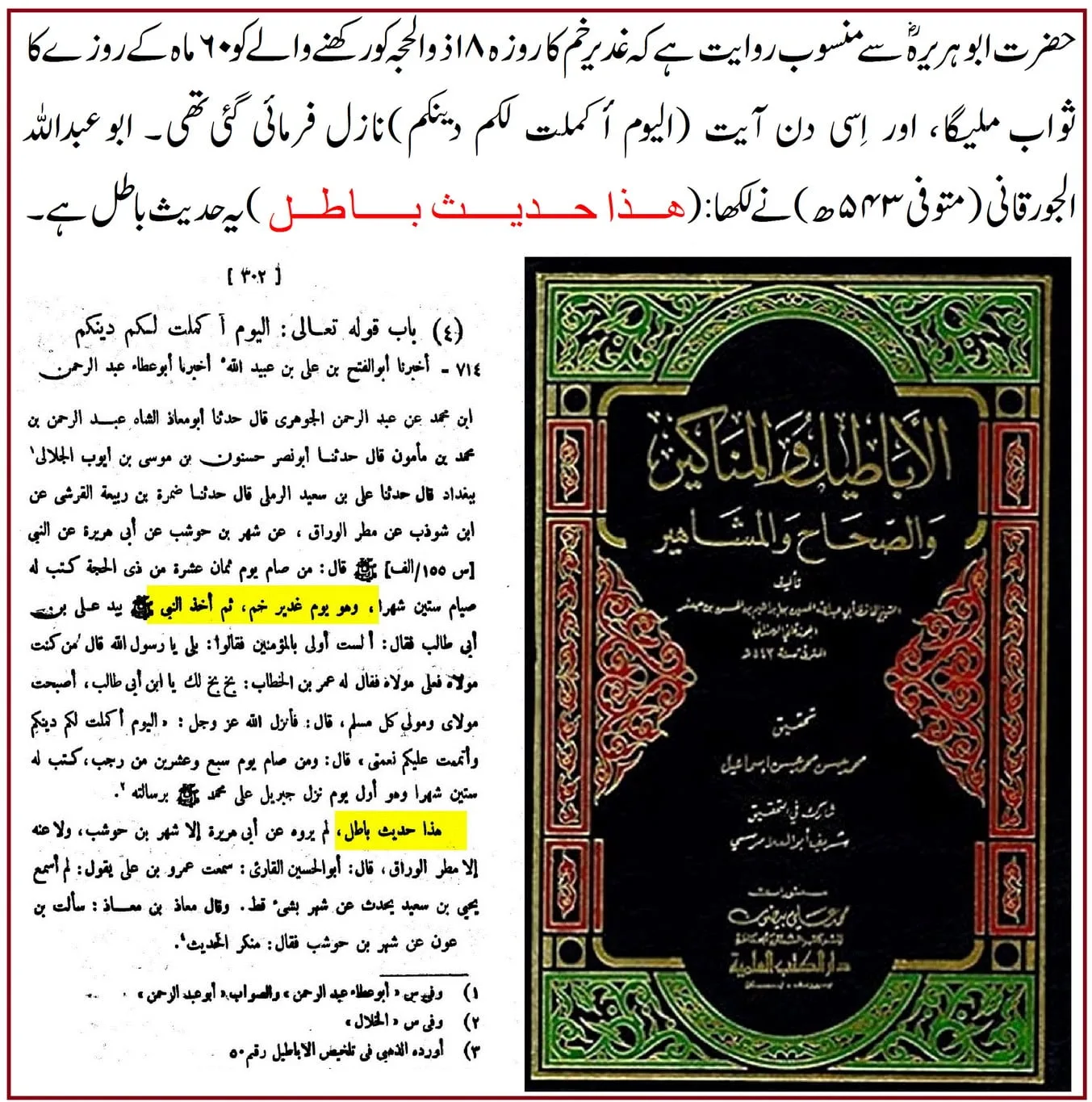
Arabic Text:أنبأنا عبد الله بن علي بن محمد بن بشران، قال: أخبرنا علي بن عمر الحافظ، قال: حدثنا أبو نصر حبشون بن موسى بن أيوب الخلال، قال: حدثنا علي بن سعيد الرملي، قال: حدثنا ضمرة بن ربيعة القرشي، عن ابن شوذب، عن مطر الوراق، عن شهر بن حوشب، عن أبي هريرة، قال:
من صام يوم ثمان عشرة من ذي الحجة كتب له صيام ستين شهرا، وهو يوم غدير خم لما أخذ النبي صلى الله عليه وسلم بيد علي بن أبي طالب، فقال: «ألست ولي المؤمنين؟» قالوا: بلى يا رسول الله، قال: «من كنت مولاه فعلي مولاه»، فقال عمر بن الخطاب: بخ بخ لك يا ابن أبي طالب أصبحت مولاي ومولى كل مسلم، فأنزل الله: {اليوم أكملت لكم دينكم}،
ومن صام يوم سبعة وعشرين من رجب كتب له صيام ستين شهرا، وهو أول يوم نزل جبريل عليه السلام على محمد صلى الله عليه وسلم بالرسالة.
Translation:
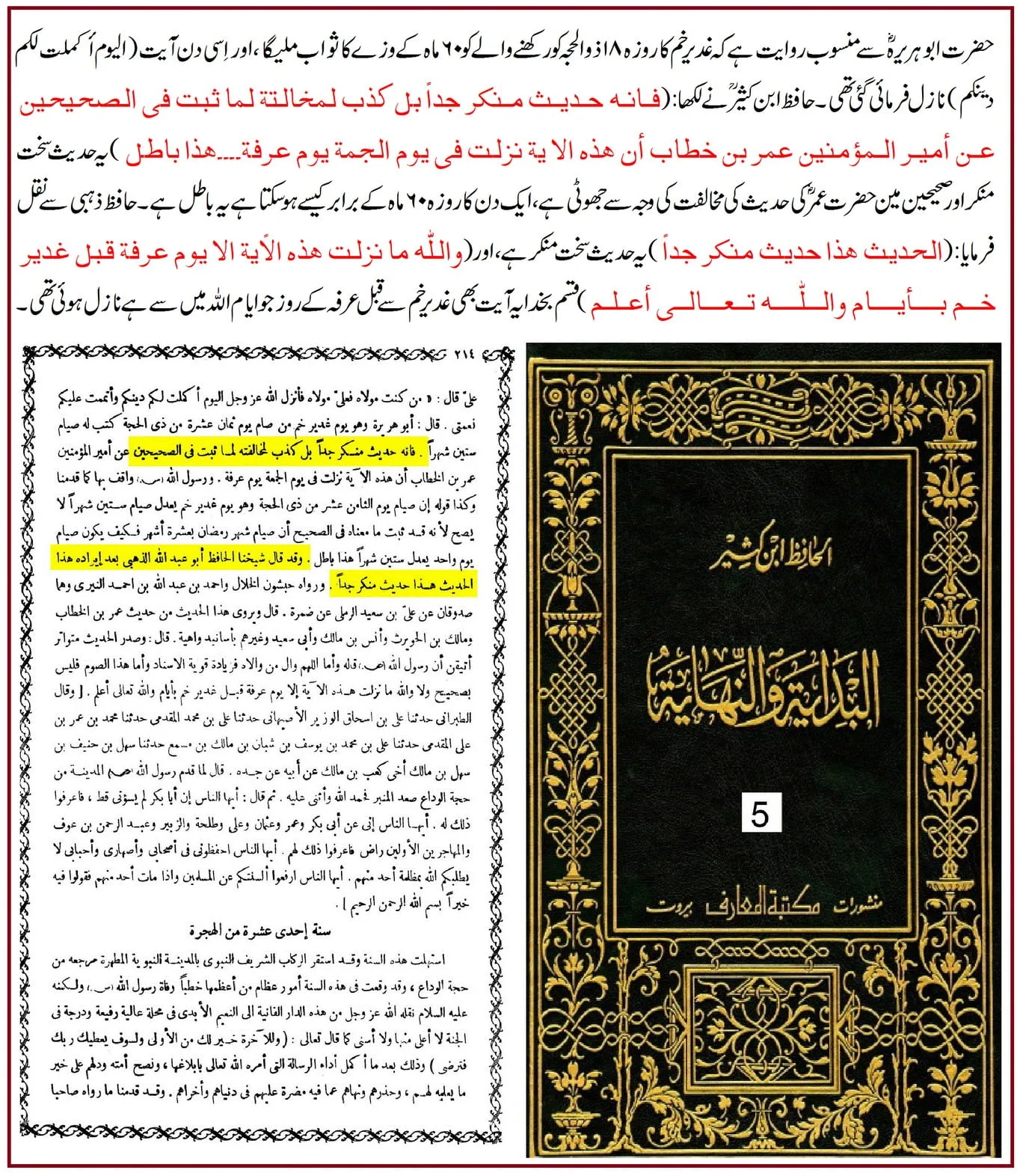
Abū Hurayrah رضي الله عنه narrated that whoever fasts on the 18th of Dhul-Hijjah, sixty months of fasting will be recorded for him. This is the day of Ghadir Khumm, when the Prophet ﷺ took the hand of ʿAlī ibn Abī Ṭālib رضي الله عنه and said:“Am I not the guardian (walī) of the believers?”
They replied: “Yes, O Messenger of Allah.”
He said: “Whoever has me as his mawlā, then ʿAlī is his mawlā.”
Then ʿUmar ibn al-Khaṭṭāb رضي الله عنه said: “Congratulations, O son of Abū Ṭālib! Today you have become my mawlā and the mawlā of every Muslim.”
Thereupon Allah revealed: {اليوم أكملت لكم دينكم}.
And whoever fasts on the 27th of Rajab, sixty months of fasting will be recorded for him, and this is the first day on which Jibrīl عليه السلام descended upon Muḥammad ﷺ with the message.
Tārīkh Baghdād – al-Khaṭīb al-Baghdādī, vol. 8, p. 284, Dār al-Kutub al-ʿIlmiyyah, Beirut.Brief Clarification
This narration makes two major claims:✦ (A) A specific virtue for fasting on 18th Dhul-Hijjah (reward of sixty months).
✦ (B) The revelation of the Verse of Completion of the Religion on Yawm al-Ghadir.
The second claim is the core issue of dispute.
Research-Based Response: Why This Narration Is Not Authoritative
② Contradiction with the Definitive Narration of the Ṣaḥīḥayn: Revelation at ʿArafāt (Friday)
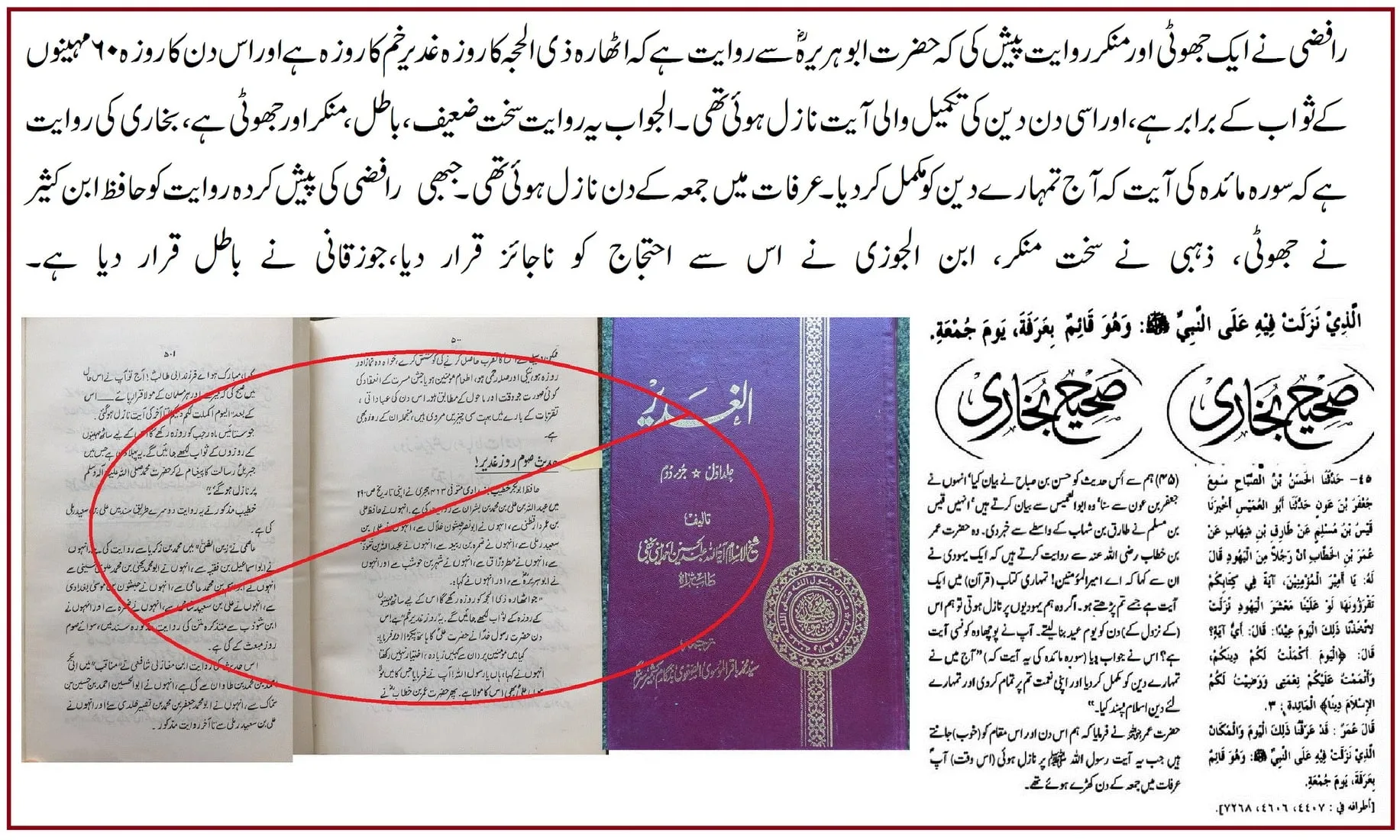
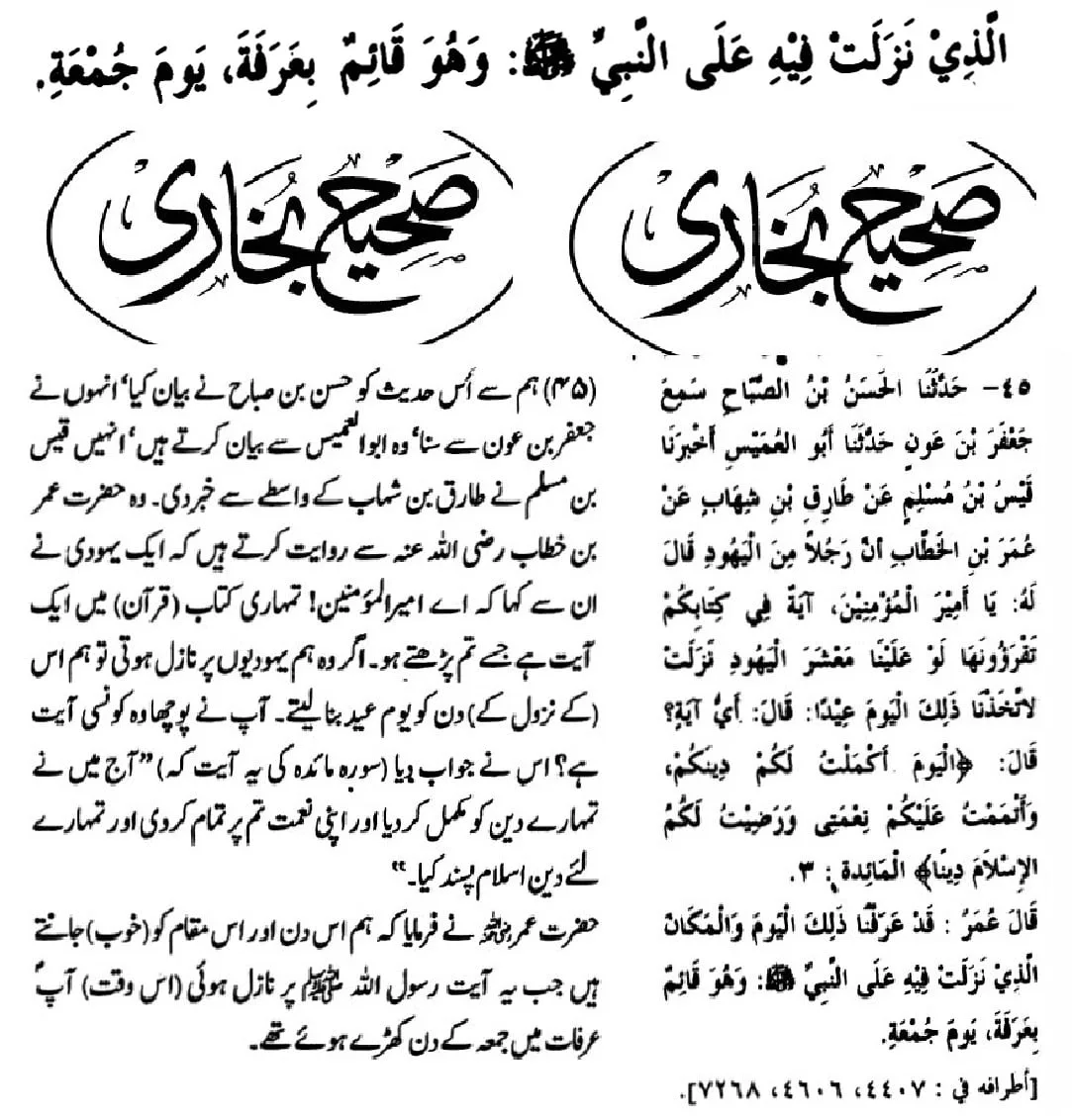
The well-known narration in Ṣaḥīḥ al-Bukhārī and Ṣaḥīḥ Muslim clearly states that the Verse of Completion was revealed on Friday, in the plain of ʿArafāt, and ʿUmar رضي الله عنه explicitly identified both the time and place.Arabic Text:
Translation:نزلت هذه الآية يوم الجمعة ونحن مع رسول الله صلى الله عليه وسلم بعرفة
“This verse was revealed on a Friday, and we were with the Messenger of Allah ﷺ at ʿArafāt.”
Reference: Ṣaḥīḥ al-Bukhārī: Book of Tafsīr, Sūrat al-Mā’idah
Reference: Ṣaḥīḥ Muslim: Book of Tafsīr / Virtues of Friday and the Revelation at ʿArafāt
Brief Explanation:
Once the time and place of revelation are firmly established through the Ṣaḥīḥayn, it is incorrect to oppose them with a solitary narration from Tārīkh Baghdād that carries questionable authenticity.
③ Chronological and Contextual Contradiction: ʿArafāt (9 Dhul-Hijjah) vs Ghadir (18 Dhul-Hijjah)
During the days of Ḥajj, Yawm ʿArafah falls on 9 Dhul-Hijjah, whereas Ghadir Khumm (18 Dhul-Hijjah) occurred during the return journey.If the verse had already been revealed at ʿArafāt, attributing its revelation nine days later to Ghadir is historically inconsistent.
Brief Explanation:
This contradiction further casts doubt on the text of the narration, as it conflicts with well-established and widely transmitted reports.
④ Unusual Structure of the Text: Multiple Days and Exaggerated Rewards
This narration combines:✦ Fasting on 18 Dhul-Hijjah = sixty months
✦ Fasting on 27 Rajab = sixty months
✦ Declaring 27 Rajab as the first day of revelation
Brief Explanation:
According to the scholars of ḥadīth, texts that assign extraordinary rewards to specific dates, especially when combined in a single narration and supported by weak chains, are often signs of fabricated or unreliable virtue reports.
⑤ Al-Khaṭīb al-Baghdādī’s Shaykh: Majhūl al-ʿAyn
ʿAbdullāh ibn ʿAlī ibn Muḥammad ibn Bishrān is majhūl al-ʿayn, as only al-Khaṭīb narrates from him. The condition for removing jahālah al-ʿayn is that at least two trustworthy narrators report from a person, which is not the case here.⑥ Second Narrator: ʿAlī ibn Saʿīd al-Ramlī – Majhūl al-Ḥāl
ʿAlī ibn Saʿīd ibn Qutaybah al-Ramlī is unknown in status (majhūl al-ḥāl). It is unclear on what basis some have considered him reliable.⑦ Third Narrator: Maṭar al-Warrāq – Severely Weak
Maṭar ibn Ṭahmān al-Warrāq is severely weak.Claims that he is only weak in narrations from ʿAṭāʾ are incorrect. The majority of critics declared him weak in general:
✔ Abū Ḥātim: Weak
✔ Yaḥyā ibn Saʿīd al-Qaṭṭān: Poor memory
✔ ʿAlī al-Madīnī: “Not strong”
✔ Abū Dāwūd: Not a proof
✔ Ibn Saʿd: Weak
✔ al-Dāraquṭnī: Weak
✔ Ibn al-Jawzī: Not strong
⑧ Fourth Narrator: Shahr ibn Ḥawshab al-Ashʿarī – Heavily Criticized
Shahr ibn Ḥawshab has been severely criticized:✔ Ibn ʿAdī: His ḥadīth is not relied upon
✔ Ibn Ḥibbān: Narrated inverted and problematic reports
✔ Abū Ḥātim: Not to be used as proof
✔ al-Dāraquṭnī: Weak
✔ al-Nasāʾī: Weak
✔ Ibn Ḥazm: Rejected
✔ ʿAbdullāh ibn ʿAwn: Abandoned
✔ Mūsā ibn Hārūn: Weak
Thus, the chain further collapses due to this narrator.
⑨ Being a Narrator in Ṣaḥīḥ Muslim Does Not Authenticate Every Narration
A common fallacy is the claim: “Maṭar al-Warrāq and Shahr ibn Ḥawshab are narrators in Ṣaḥīḥ Muslim, therefore this narration is authentic.”Brief Explanation:
✔ A narrator’s presence in Ṣaḥīḥ Muslim does not mean all of his narrations are accepted.
✔ The Imams of ḥadīth narrate from some individuals only in specific contexts, from certain shaykhs, or with supporting evidence.
✔ When a text contradicts the Ṣaḥīḥayn and the chain contains weakness, it cannot be authenticated merely by such claims.
⑩ Principle: Major Doctrinal or Interpretive Claims Are Not Proven Through Weak Chains
The time and place of the revelation of the Verse of Completion is a major exegetical and historical issue established through authentic and widely accepted narrations.Presenting a solitary, weak narration from Tārīkh Baghdād against the Ṣaḥīḥayn does not meet scholarly standards.
Conclusion
The narration cited from Tārīkh Baghdād does not prove that the Verse of Completion of the Religion was revealed on Yawm al-Ghadir (18 Dhul-Hijjah).According to the clear and authentic narrations of the Ṣaḥīḥayn, the verse was revealed on Friday, at ʿArafāt.
Moreover, the discussed narration:
✔ Contradicts authentic reports
✔ Contains narrators criticized for weakness and errors
✔ Displays an unusual and suspicious textual structure
Therefore, the claim that “the religion was completed specifically on Yawm al-Ghadir” cannot be established on sound scholarly grounds through this narration.
