

✍ Compiled by: Abu Hamzah Salafi
Respected readers! Islam is a complete code of life, which teaches only the worship of Allah Almighty and servitude to Him alone. From the teachings of the Noble Prophet ﷺ and the clear texts of the Noble Qur’an, we receive explicit guidance that worship is exclusively for Allah, and that kissing the graves of any prophet, saint, or elder out of veneration, or prostrating upon them, is not established in the Sharīʿah.
❖ In this article, we will present a research-based review of a post put forward by a Barelvi slanderer (Muftari Hashthati).
❖ He attempts to prove—through the Qur’an and Hadith—the permissibility of kissing the hands and feet at graves and of the elders of religion.
❖ We will quote each of his objections along with the original text, then refute them with Sharʿī proofs and the statements of the Hadith scholars.
❖ Every proof will be cited with the complete Arabic text, its Urdu translation, and its reference—so that the truth becomes clear.
① Arabic Text:
﴿وَادْخُلُوا الْبَابَ سُجَّدًا وَقُوۡلُوۡا حِطَّةٌ﴾
(Sūrah al-Baqarah, Verse 58)
② Translation:
“O Children of Israel! Enter this gate while prostrating and say: ‘Relieve (us) / forgive (us).’”
Barelvi’s Argument:
This verse shows that since Bayt al-Maqdis is the resting place of the Prophets عليهم السلام, Banū Isrā’īl were commanded to prostrate there. This also indicates that repentance is accepted more quickly in sacred places.
❖ Firstly, the mentioned verse states that Banū Isrā’īl were to enter the gate while prostrating—however, this does not mean that they were to prostrate to a grave or to the resting place of the Prophets. The purpose in the verse is only to show humility and submission before Allah Almighty, as the exegetes have clearly stated.
❖ Secondly, at the time of this incident, no Prophet was buried in Bayt al-Maqdis. Therefore, saying that “this command was for honoring the graves of the Prophets” is sheer falsehood and a lie.
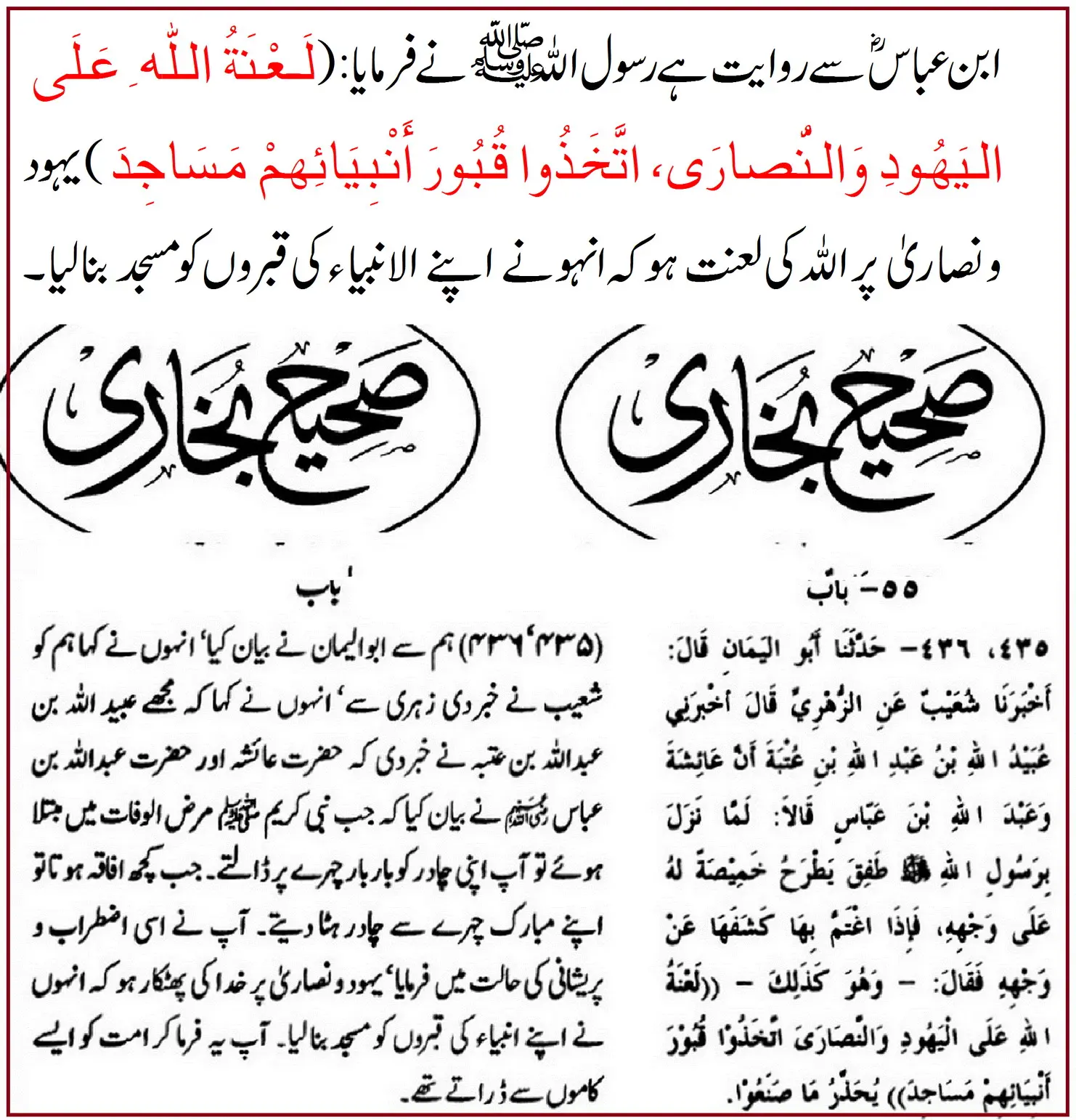
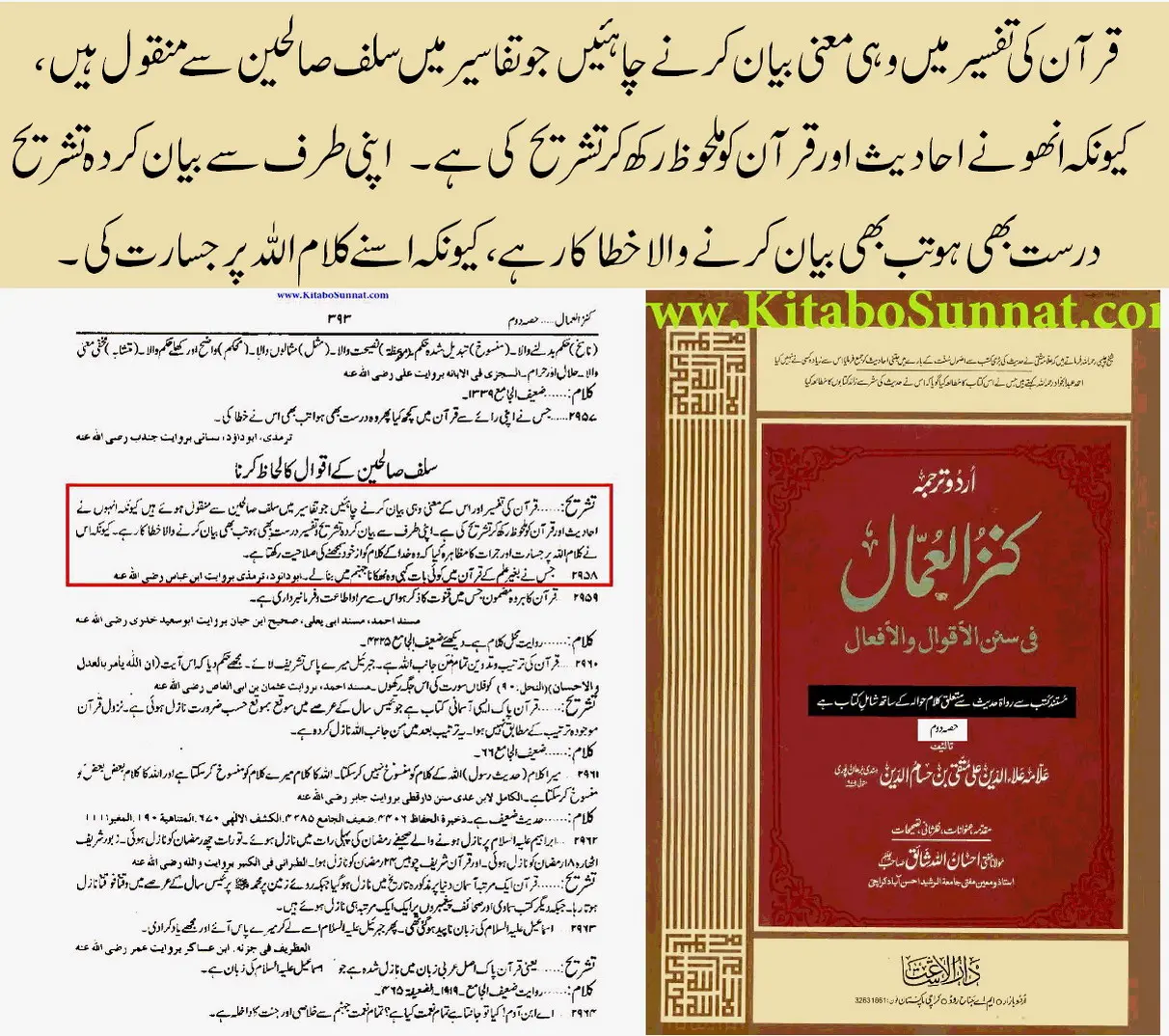
❖ Such baseless deductions are speaking about the Qur’an from one’s own side—whereas the Messenger of Allah ﷺ issued a severe warning:
① Hadith:
حَدَّثَنَا مَحْمُودُ بْنُ غَيْلَانَ قَالَ: حَدَّثَنَا بِشْرُ بْنُ السَّرِيِّ قَالَ: حَدَّثَنَا سُفْيَانُ، عَنْ عَبْدِ الأَعْلَى، عَنْ سَعِيدِ بْنِ جُبَيْرٍ، عَنْ ابْنِ عَبَّاسٍ قَالَ: قَالَ رَسُولُ اللَّهِ صَلَّى اللهُ عَلَيْهِ وَسَلَّمَ:
«مَنْ قَالَ فِي القُرْآنِ بِغَيْرِ عِلْمٍ فَلْيَتَبَوَّأْ مَقْعَدَهُ مِنَ النَّارِ»
② Translation:
It is narrated from Ibn ʿAbbās رضي الله عنهما that the Messenger of Allah ﷺ said: “Whoever speaks about the Qur’an without knowledge, let him take his seat in the Fire.”
③ Reference:
❖ This Hadith shows that explaining the Qur’an without proof is ḥarām and a cause of Hell. Therefore, the Barelvi slanderer’s claim that “Banū Isrā’īl prostrated to the graves of the Prophets” is a pure lie and fabrication. There is no such explicit statement in the Qur’an.
❖ Hadith (Mishkāt, Chapter: Major Sins and Signs of Hypocrisy):
Narrated from Ṣafwān bin ʿAssāl رضي الله عنه:
"فَأَتَيَاهُ فَسَأَلاَهُ عَنْ آيَةِ الْمَحْوِ، فَقَالَ: نَعَمْ، عَلَيْكُمْ بِكِتَابِ اللَّهِ عَزَّ وَجَلَّ، فَتَعَلَّمُوهُ وَعَلِّمُوهُ، فَأَتَيَاهُ فَقَبَّلَا يَدَيْهِ وَرِجْلَيْهِ.”
Translation:
A Jew said to his companion: “Come, let us go to this Prophet.” His companion said: “Do not say Prophet.” Then they both came to the Noble Prophet ﷺ and asked him about the verse of “al-maḥw.” He ﷺ said: “Yes! It is incumbent upon you to hold firmly to the Book of Allah—learn it and teach it.” Then both of them (the Jews) kissed his hands and feet.
Reference:
① ʿAllāmah Badr al-Dīn al-ʿAynī al-Ḥanafī wrote:
"إسناده منكر، فيه عبد الله بن سلمة، وقد تكلّم فيه الأئمة.”
Translation: Its chain is munkar; in it is ʿAbdullāh bin Salamah, and the Imams have spoken against him.
Reference:
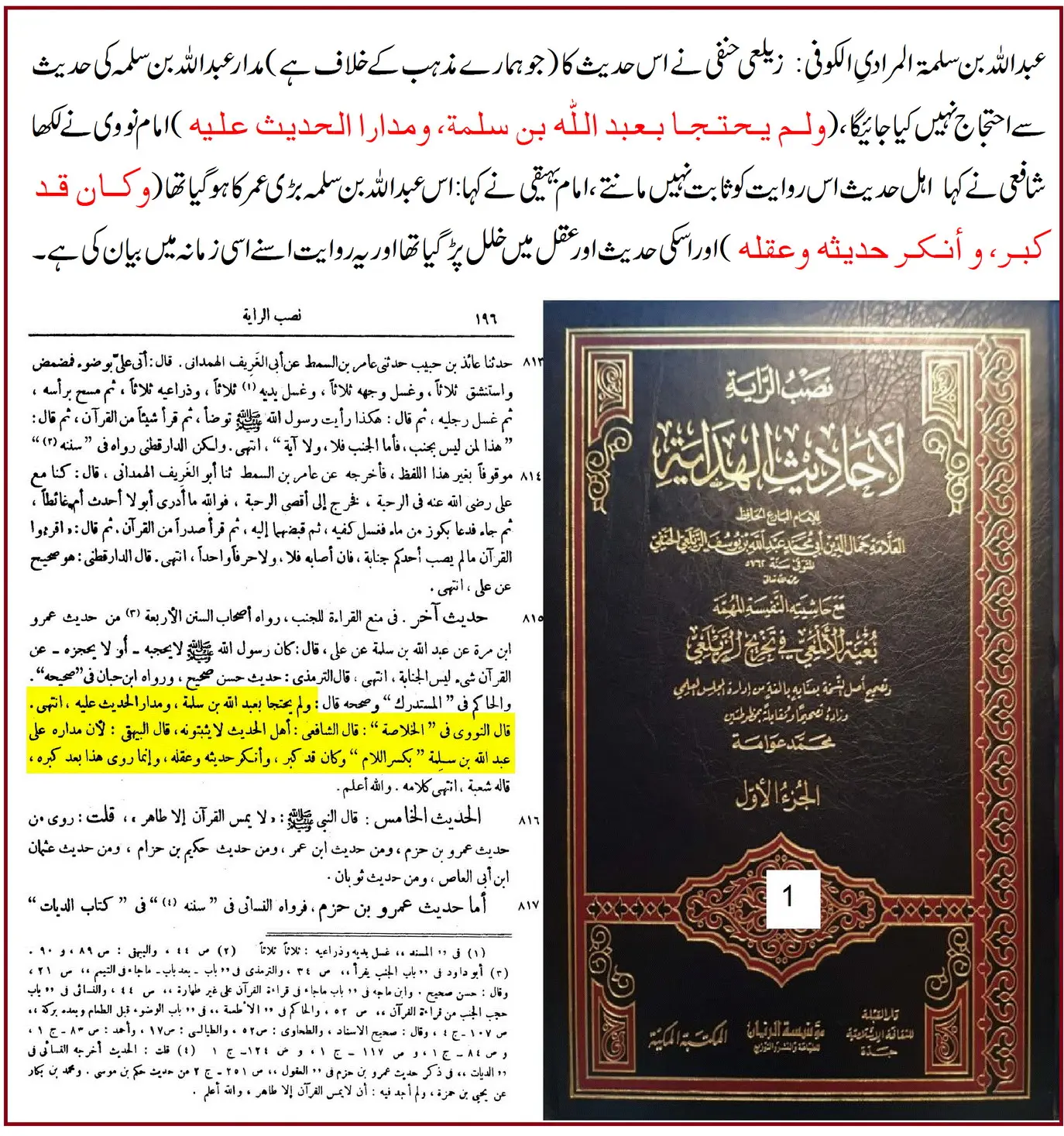
② al-Zaylaʿī al-Ḥanafī said:
"إن مدار هذا الحديث على عبد الله بن سلمة المرادي الكوفي، وقد قال البيهقي: لما كبر ساء حفظه، فكان يحدث بالشيء فيغلط فيه.”
Translation: This entire narration revolves around ʿAbdullāh bin Salamah al-Murādī al-Kūfī. Imām al-Bayhaqī said: when he grew old, his memory deteriorated, so he would narrate something and err in it.
Reference:
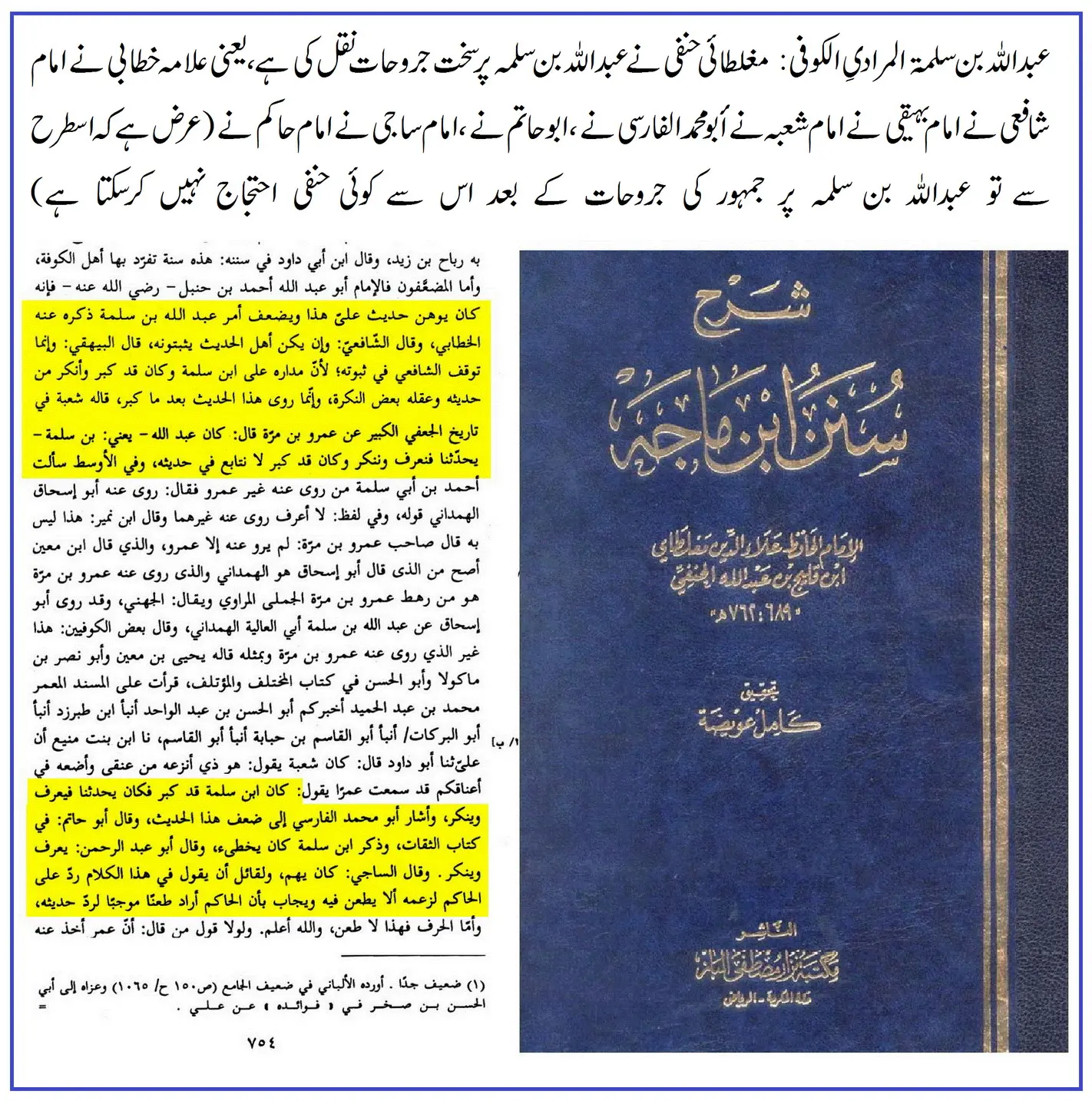
③ Mughlṭāyī al-Ḥanafī also نقل (reported) severe criticism regarding him:
Imām al-Khaṭṭābī said: “Weak.”
Imām al-Shāfiʿī declared him unreliable.
Imām al-Bayhaqī said: "كان كثير الوهم" (he committed many errors).
Imām Shuʿbah, Abū Muḥammad al-Fārisī, Abū Ḥātim, Imām al-Sājī, and Imām al-Ḥākim all declared him weak.
Reference:
❖ Hence, when the majority of Hadith scholars judged this narrator’s report to be munkar and weak, the Barelvis’ use of it to prove their innovation is against their own principles.
❖ Hadith (Mishkāt, Chapter: What is said when one is present at death):
ʿĀ’ishah رضي الله عنها said:
① Arabic Text:
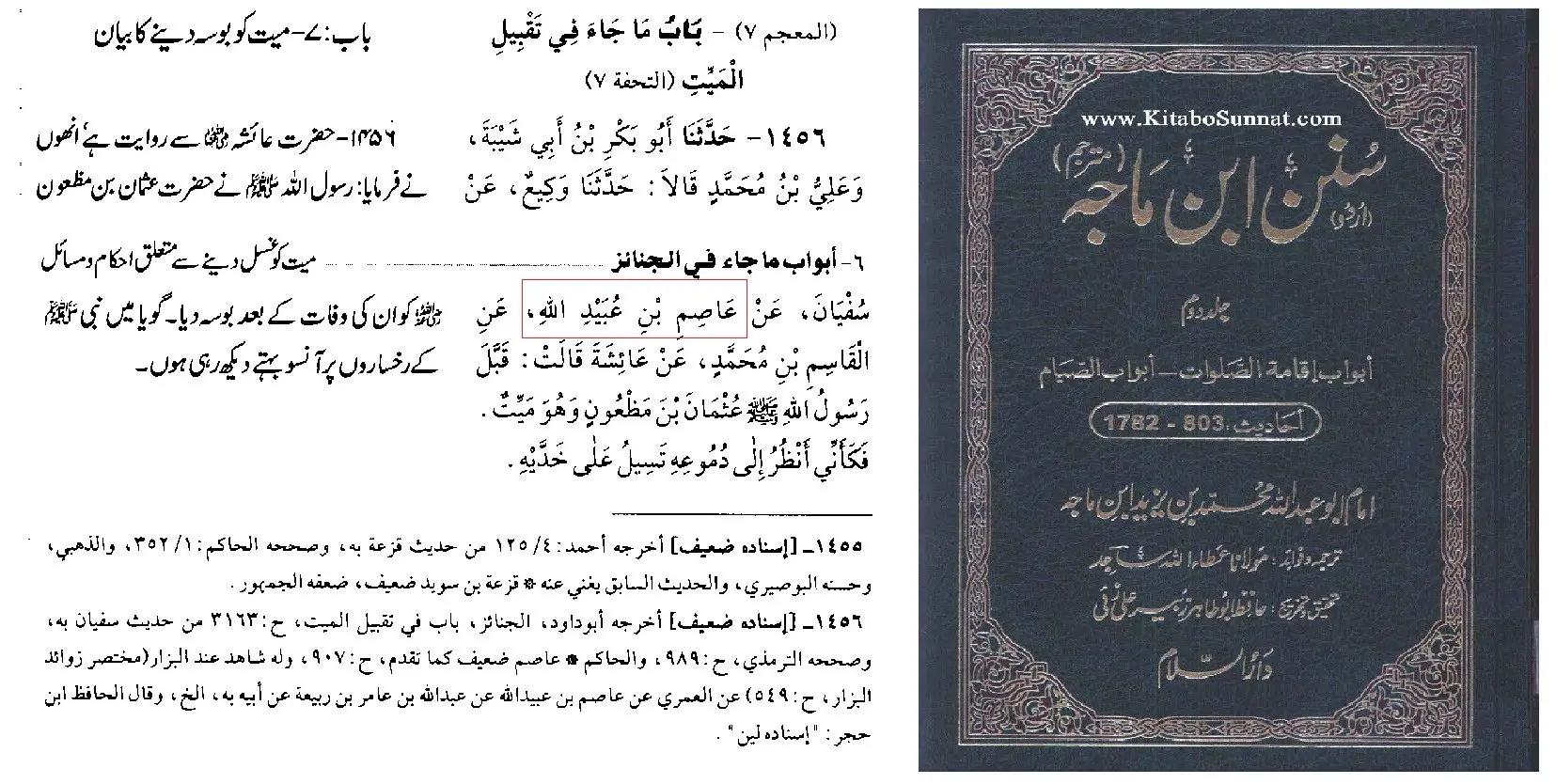
1456 – حَدَّثَنَا أَبُو بَكْرِ بْنُ أَبِي شَيْبَةَ، وَعَلِيُّ بْنُ مُحَمَّدٍ، قَالَا: حَدَّثَنَا وَكِيعٌ، عَنْ سُفْيَانَ، عَنْ عَاصِمِ بْنِ عُبَيْدِ اللَّهِ، عَنِ الْقَاسِمِ بْنِ مُحَمَّدٍ، عَنْ عَائِشَةَ، قَالَتْ:
«قَبَّلَ رَسُولُ اللَّهِ صَلَّى اللهُ عَلَيْهِ وَسَلَّمَ عُثْمَانَ بْنَ مَظْعُونٍ وَهُوَ مَيِّتٌ، فَكَأَنِّي أَنْظُرُ إِلَى دُمُوعِهِ تَسِيلُ عَلَى خَدَّيْهِ»
② Translation:
ʿĀ’ishah رضي الله عنها said: The Messenger of Allah ﷺ kissed ʿUthmān bin Maẓʿūn رضي الله عنه while he had passed away, and it is as though I can see his tears flowing on his cheeks.
③ Reference:
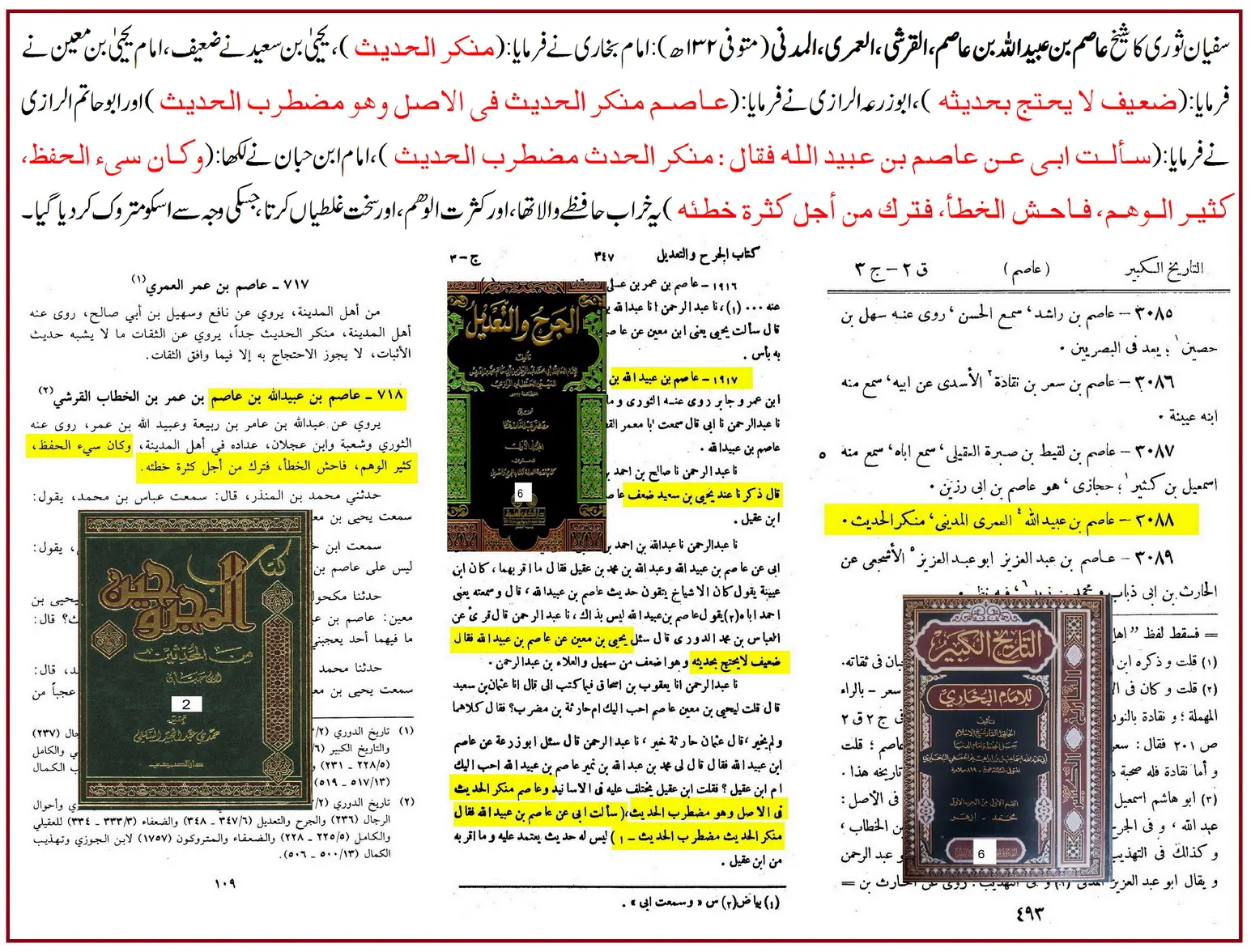
① Imām al-Bukhārī رحمه الله:
"عاصم بن عبيد الله العمري المدني، منكر الحديث.”
Translation: ʿĀṣim bin ʿUbaydullāh al-ʿUmarī al-Madanī is munkar al-ḥadīth.
Reference:
② Imām Abū Zurʿah al-Rāzī رحمه الله:
"منكر الحديث في الأصل، وهو مضطرب الحديث.”
Translation: He is originally munkar al-ḥadīth and his narration is اضطراب (inconsistent).
Reference:
③ Imām Abū Ḥātim al-Rāzī رحمه الله:
"منكر الحديث مضطرب الحديث.”
Translation: This narrator is munkar al-ḥadīth and muḍṭarib al-ḥadīth.
Reference:
④ Imām Ibn Ḥibbān رحمه الله:
"سييء الحفظ، كثير الوهم، فاحش الخطأ، فترك من أجل كثرة خطئه.”
Translation: He had poor memory, committed many errors, made gross mistakes, and was abandoned due to the abundance of his mistakes.
Reference:
❖ Thus this narration rests upon ʿĀṣim bin ʿUbaydullāh—who is weak and abandoned. From such a report, neither a Sharʿī ruling can be established nor can any innovative practice (like kissing the dead or graves) be proven.
❖ Text (al-Shifā’):
“On the pulpit from which the Prophet ﷺ used to deliver sermons, ʿAbdullāh bin ʿUmar رضي الله عنه would place his hand and then place it upon his face (meaning: he would kiss it).”
And he cites:
أَخْبَرَنَا مُحَمَّدُ بْنُ إِسْمَاعِيلَ بْنُ أَبِي فُدَيْكٍ قَالَ: أَخْبَرَنِي ابْنُ أَبِي ذِئْبٍ عَنْ حَمْزَةَ بْنِ أَبِي جَعْفَرٍ عَنْ إِبْرَاهِيمَ بْنِ عَبْدِ الرَّحْمَنِ بْنِ عَبْدِ القاري أنه أنظر إلى ابن عمر. وَضَعَ يَدَهُ عَلَى مَقْعَدِ النَّبِيِّ – صَلَّى اللَّهُ عَلَيْهِ وَسَلَّمَ – مِنَ الْمِنْبَرِ ثُمَّ وَضَعَهَا عَلَى وَجْهِهِ.”
Reference:
Translation:
Ibrāhīm bin ʿAbd al-Raḥmān bin ʿAbd al-Qārī stated that he saw ʿAbdullāh bin ʿUmar رضي الله عنه place his hand on the seat of the Prophet ﷺ on the pulpit, then place it on his face.
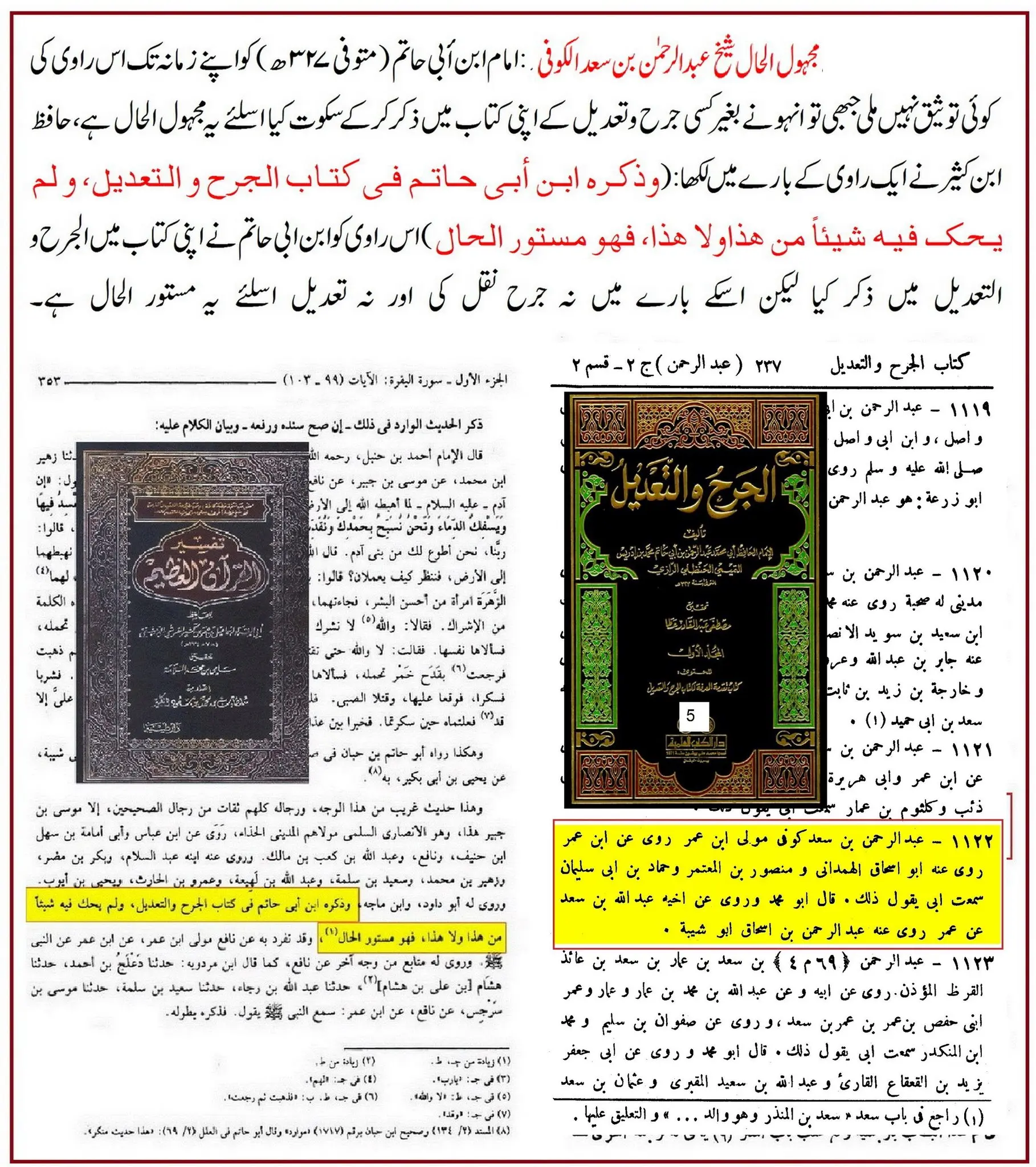
❖ First narrator: Ḥamzah bin Abī Jaʿfar
❖ Second narrator: Ibrāhīm bin ʿAbd al-Raḥmān bin ʿAbd al-Qārī
According to Hadith scholars, both are majhūl al-ḥāl, and a narration established through a majhūl narrator is not fit for argument.
Furthermore, even if this act were proven, it is only an individual action of Ibn ʿUmar رضي الله عنه. No endorsement from the Prophet ﷺ is transmitted for it, nor was it the general practice of the Companions رضي الله عنهم. Rather, contrary to this, the Messenger of Allah ﷺ forbade his Ummah from bowing, touching, or kissing graves, as previously mentioned.
Therefore, this report does not prove permissibility of kissing graves or the pulpit out of veneration. Instead, this evidence itself weakens the Barelvi stance.
❖ Text:
“It is narrated from Imām Aḥmad bin Ḥanbal رحمه الله that someone asked him about kissing the Noble Grave of the Prophet ﷺ or the pulpit; he replied that there is no harm in it.”
① This statement is only transmitted from Imām Aḥmad’s son ʿAbdullāh, whereas Imām Aḥmad’s other son Qāḍī Abū al-Faḍl Ṣāliḥ—and two reliable students of Imām Aḥmad, Muḥammad Abū Bakr al-Athram and Isḥāq al-Marwazī—transmitted the opposite view. Meaning: the permissibility of kissing the pulpit or grave is not established from Imām Aḥmad; rather, its negation is established.
② Therefore, this narration is marjūḥ and unreliable.
❖ Further clarification from Ahl al-Sunnah researchers:
If a statement is weak in chain or shādh and contrary to the majority, it is not a proof—especially when other students or scholars transmit the opposite from the same Imām. Hence, permissibility of kissing the grave or pulpit is not proven from Imām Aḥmad, and this Barelvi argument is utterly false.
❖ Text (al-Shifā’):
“It is narrated from Ibn Abī al-Ṣayf al-Yamānī—one of the Shāfiʿī scholars of Makkah—that kissing the pages of the Qur’an and Hadith, and the graves of the pious, is permissible.”
Reference:
Translation:
Ibn Abī al-Ṣayf al-Yamānī says: kissing the pages of the Qur’an and Hadith, and kissing the graves of the righteous, is permissible.
❖ ʿAllāmah al-Samhūdī رحمه الله also نقل (quoted) this statement and then refuted it.
① Original Text:
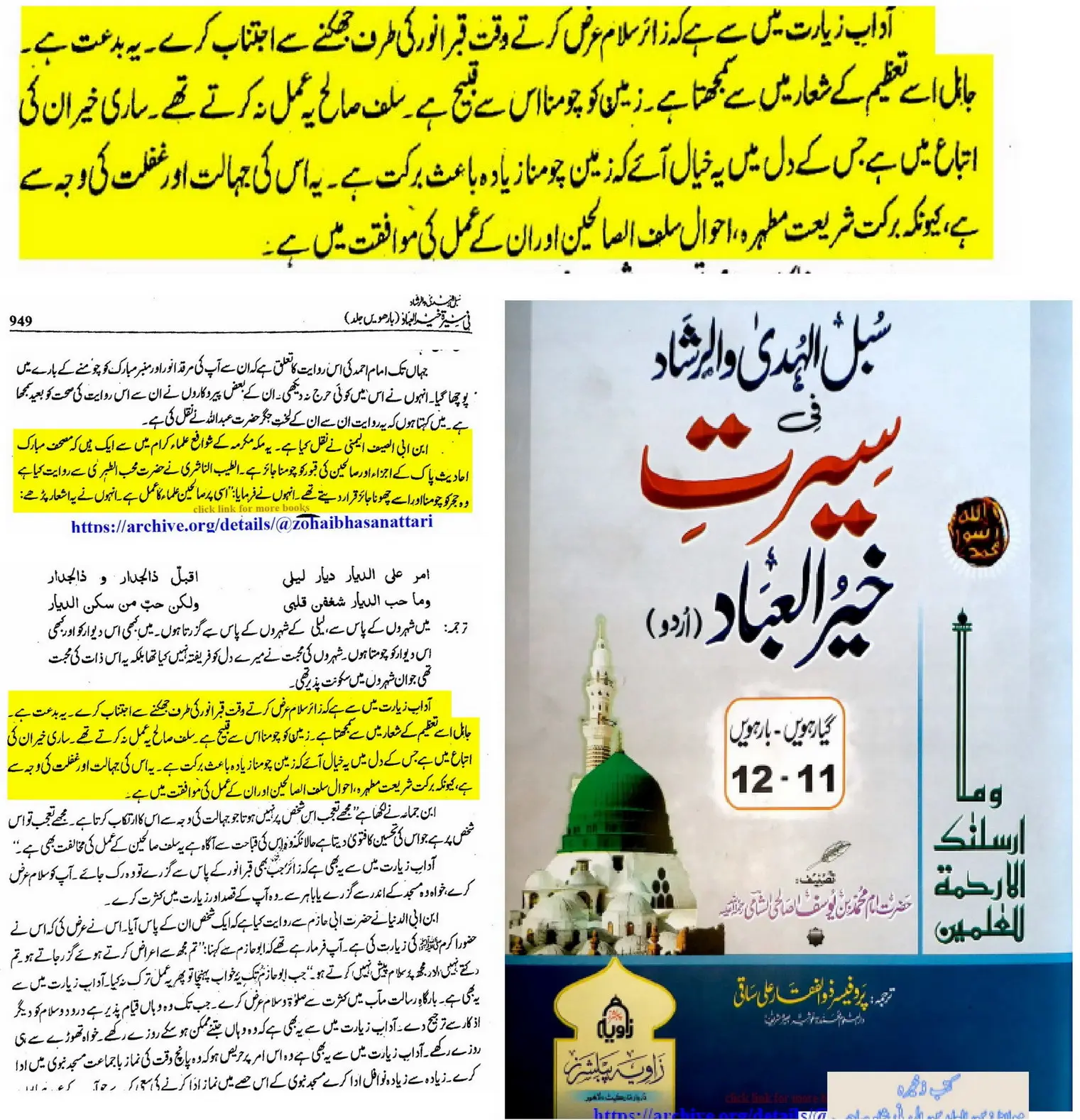
وَنَقَلَ عَنْ ابْنِ أَبِي الصَّيْفِ اليَمَانِيِّ أَحَدِ عُلَمَاءِ مَكَّةَ مِنَ الشَّافِعِيَّةِ جَوَازَ تَقْبِيلِ الْمُصْحَفِ وَأَجْزَاءِ الْحَدِيثِ وَقُبُورِ الصَّالِحِينَ.
وَنَقَلَ الطَّيِّبُ النَّاشِرِيُّ عَنِ الْمُحِبِّ الطَّبَرِيِّ أَنَّهُ يَجُوزُ تَقْبِيلُ الْقَبْرِ وَمَسُّهُ.
② Translation:
ʿAllāmah al-Samhūdī رحمه الله said: “It has been نقل (reported) from Ibn Abī al-Ṣayf al-Yamānī—one of the Shāfiʿī scholars of Makkah—the permissibility of kissing the Muṣḥaf, the parts/pages of Hadith, and the graves of the righteous. And al-Ṭayyib al-Nāshirī نقل (reported) from al-Muḥibb al-Ṭabarī that he considered kissing the grave and touching it permissible.”
③ Reference:
② Arabic Text:
قال ابن جماعة: قال بعض العلماء: إنه من البدع، ويظن من لا علم له أنه من شعار التعظيم، وأقبح منه تقبيل الأرض للقبر، ومن خطر بباله أن تقبيل الأرض أبلغ في البركة فهو من جهالته وغفلته؛ لأن البركة إنما هي فيما وافق الشرع وأقوال السلف وعملهم.
Translation:
Imām Ibn Jamāʿah said: “Some scholars said that bowing before the grave is among innovations, and whoever has no knowledge assumes it is a sign of reverence—this is his ignorance. Worse than that is kissing the ground of the grave. Whoever thinks that kissing the earth is greater in blessing is in ignorance and heedlessness, because blessing is only in that which accords with the Sharīʿah and the statements and practice of the Salaf.”
Reference:
❖ This clearly shows that even Shāfiʿī and Ḥanafī scholars declared such actions innovations and resemblance to Jews and Christians. Therefore, the Barelvi argument is not only unacceptable, but even his own referenced authorities are against him.
❖ Text (Imām Jalāl al-Dīn al-Suyūṭī رحمه الله):
"استنبط بعض العارفين من تقبيل الحجر الأسود تقبيل قبور الصالحین”
Translation:
“Some mystics inferred from kissing the Black Stone that kissing the graves of the righteous is also permissible.”
① Original Text:
وَذَكَرَ السُّيُوطِيّ فِي التوشيح على الجامع الصغير أَنَّهُ اسْتَنْبَطَ بَعْضُ الْعُلَمَاءِ الْعَارِفِينَ مِنْ تَقْبِيلِ الْحَجَرِ الْأَسْوَدِ تَقْبِيلَ قُبُورِ الصَّالِحِينَ. انتهى.
أقول: في الاستنباط المذكور مع صحة النهي عما يشعر بتعظيم القبور توقف ظاهر، ولو سلم فينبغي لمن يقتدي به أن لا يفعل نحو تقبيل قبور الأولياء في حضور الجهال الذين لا يميزون بين التعظيم والتبرك، والله أعلم.
② Translation:
Imām Jalāl al-Dīn al-Suyūṭī mentioned in al-Tawshīḥ ʿalā al-Jāmiʿ al-Ṣaghīr that some scholars and mystics inferred from kissing the Black Stone that the graves of the righteous may also be kissed.
Imām Ibn Ḥajar al-Haytamī رحمه الله said regarding this: “There is clear hesitation in this inference, due to the authentic prohibition of what indicates reverence of graves. Even if one were to accept it, then the one who follows it should not do things like kissing the graves of saints in the presence of ignorant people who do not distinguish between veneration and seeking blessings. And Allah knows best.”
Reference:
① Statement of al-Suyūṭī رحمه الله:
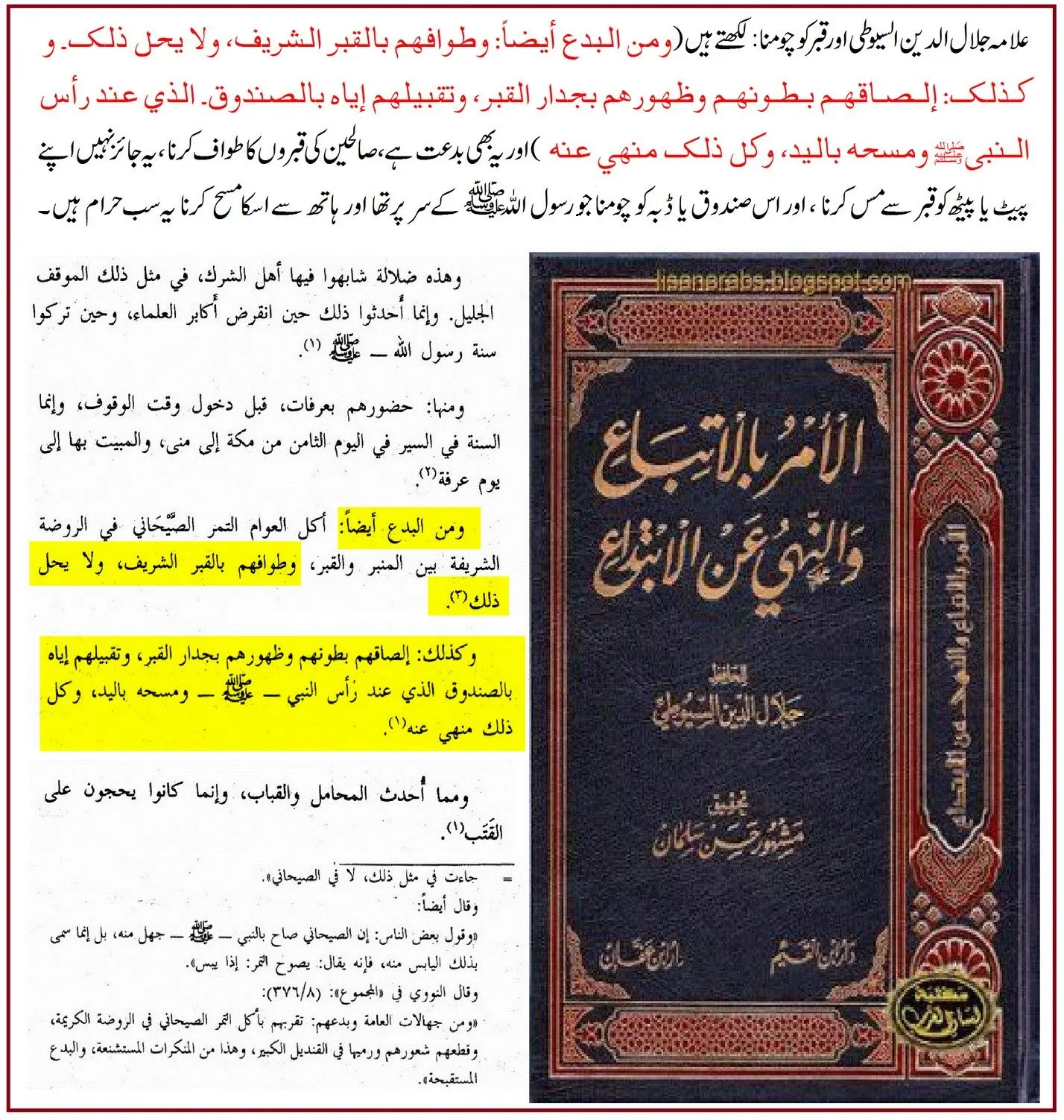
وقال السيوطيُّ الشافعيُّ (ت: 911هـ):
"ومِنَ البِدَع أيضًا: أكل العوام التمر الصيحاني في الروضة الشريفة بين المنبر والقبر، وطوافُهم بالقبرِ الشريف، ولا يحلُّ ذلك، وكذلك إلصاقُهم بُطونَهم وظُهورَهم بجدارِ القَبر، وتقبيلُهم إيَّاه بالصُّندوق الذي عند رأسِ النبيِّ صلَّى اللهُ عليهِ وَسَلَّمَ، ومسْحُه باليد؛ وكل ذلك مَنهيٌّ عنه.”
Translation:
Imām al-Suyūṭī al-Shāfiʿī رحمه الله said: “Among the innovations is that common people eat al-ṣayḥānī dates in the Rawḍah Sharīfah between the pulpit and the grave, or make ṭawāf of the noble grave—this is not permissible. Likewise, pressing their bellies or backs against the grave’s wall, kissing it—along with the صندوق (structure) near the Prophet’s ﷺ head—and wiping it with the hand; all of that is forbidden.”
Reference:
❖ Thus, the correct understanding of al-Suyūṭī’s words is that he rejected and prohibited the practice of kissing graves. Therefore, the Barelvi argument is not only weak—it turns against them as evidence.
❖ Report (Musnad Aḥmad):
Dāwūd bin Abī Ṣāliḥ said: One day Marwān came and saw a man placing his face on the grave of the Messenger ﷺ. Marwān asked: “Do you know what you are doing?” The man turned and it was Abū Ayyūb al-Anṣārī رضي الله عنه. He said: “Yes! I have come to the Messenger of Allah ﷺ; I have not come to a stone…” etc.
① Arabic Text:
23585 – حَدَّثَنَا عَبْدُ الْمَلِكِ بْنُ عَمْرٍو، حَدَّثَنَا كَثِيرُ بْنُ زَيْدٍ، عَنْ دَاوُدَ بْنِ أَبِي صَالِحٍ، قَالَ:
أَقْبَلَ مَرْوَانُ يَوْمًا فَوَجَدَ رَجُلًا وَاضِعًا وَجْهَهُ عَلَى الْقَبْرِ، فَقَالَ: أَتَدْرِي مَا تَصْنَعُ؟ فَأَقْبَلَ عَلَيْهِ فَإِذَا هُوَ أَبُو أَيُّوبَ، فَقَالَ: نَعَمْ، جِئْتُ رَسُولَ اللهِ صَلَّى اللهُ عَلَيْهِ وَسَلَّمَ وَلَمْ آتِ الْحَجَرَ، سَمِعْتُ رَسُولَ اللهِ صَلَّى اللهُ عَلَيْهِ وَسَلَّمَ يَقُولُ:
"لَا تَبْكُوا عَلَى الدِّينِ إِذَا وَلِيَهُ أَهْلُهُ، وَلَكِنْ ابْكُوا عَلَيْهِ إِذَا وَلِيَهُ غَيْرُ أَهْلِهِ”.
② Translation:
Dāwūd bin Abī Ṣāliḥ said: “One day Marwān came and found a man placing his face on the grave. Marwān said: ‘Do you know what you are doing?’ The man turned and it was Abū Ayyūb al-Anṣārī رضي الله عنه. He said: ‘Yes! I have come to the Messenger of Allah ﷺ; I have not come to a stone. I heard the Messenger of Allah ﷺ say: Do not weep over the religion when its affairs are in the hands of its people; rather, weep over it when its affairs are in the hands of those unfit for it.’”
③ Reference:
① Kathīr bin Zayd al-Aslamī — declared weak.
"الرتبة: ضعیف، لا يحتج به.”
Reference:
② Dāwūd bin Abī Ṣāliḥ — an unknown narrator (majhūl).
③ Shaykh al-Albānī رحمه الله ruled it weak: "ضعيف الإسناد.”
Reference:
❖ Therefore, using it to prove placing the face on graves or kissing them is entirely invalid.
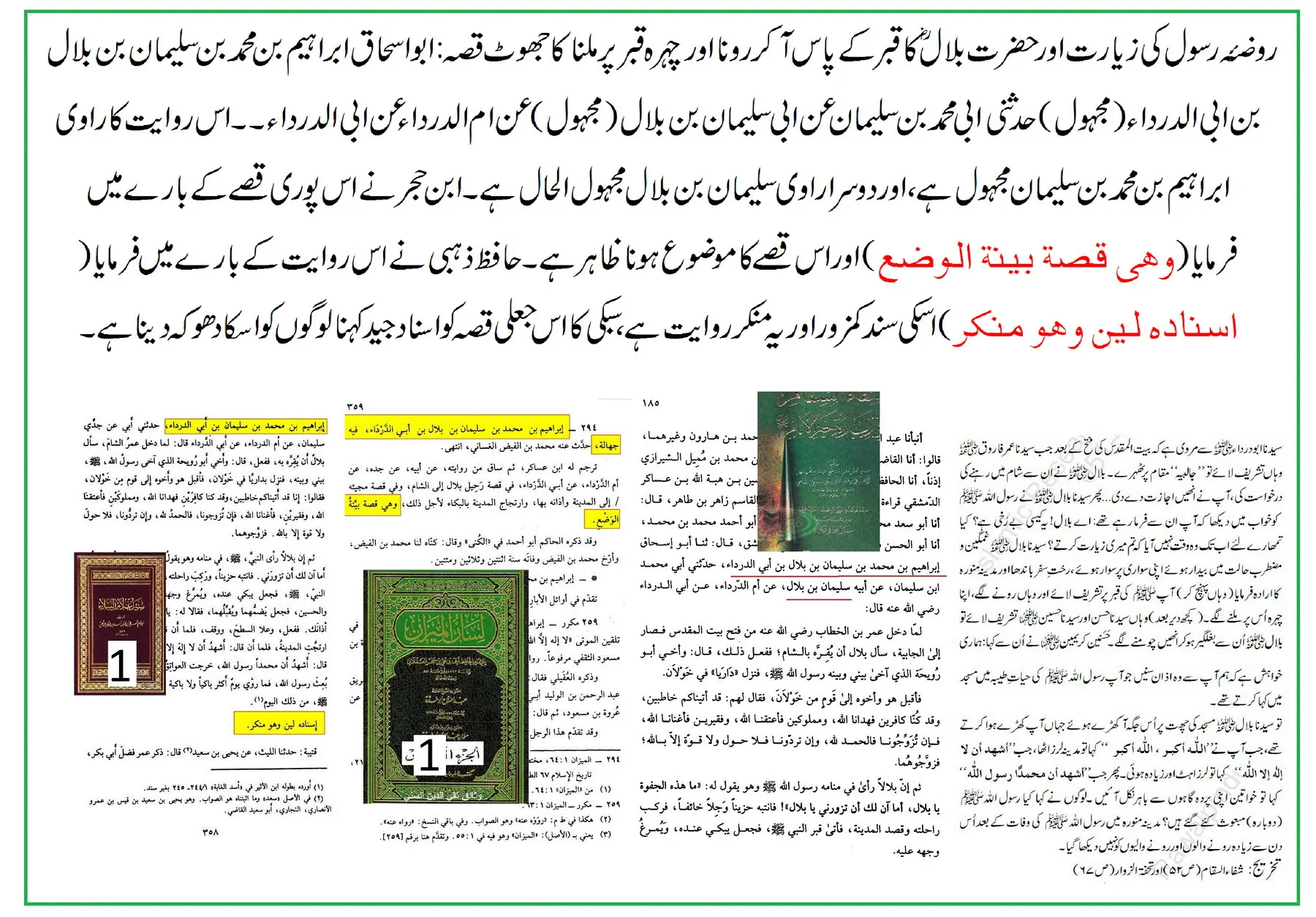
❖ “Imām al-Dhahabī رحمه الله mentioned the famous report of Bilāl al-Ḥabashī رضي الله عنه in which he rubbed his face on the noble grave and kissed it.”
Reference:
❖ Imām al-Dhahabī رحمه الله himself said about it:
"إِسْنَادُهُ لَيِّنٌ، وَهُوَ مُنْكَرٌ.”
Translation: “Its chain is weak, and it is munkar.”
Reference:
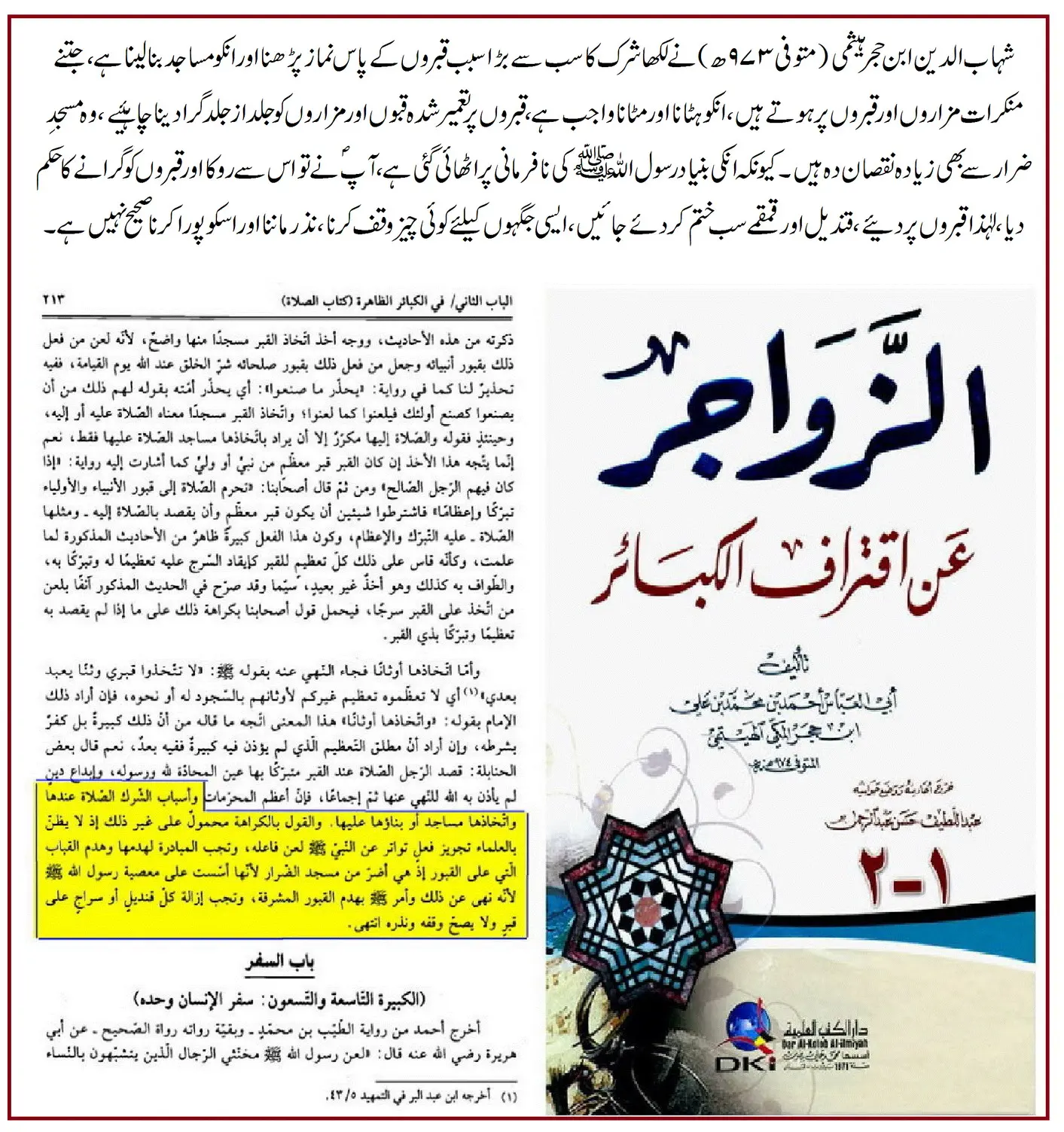
❖ Ḥāfiẓ Ibn Ḥajar رحمه الله declared it clearly fabricated:
"… وهي قصة بينة الوضع.”
Translation: “It is a story clearly fabricated.”
Reference:
(Arabic quotation as in the text)
Reference:
Translation:
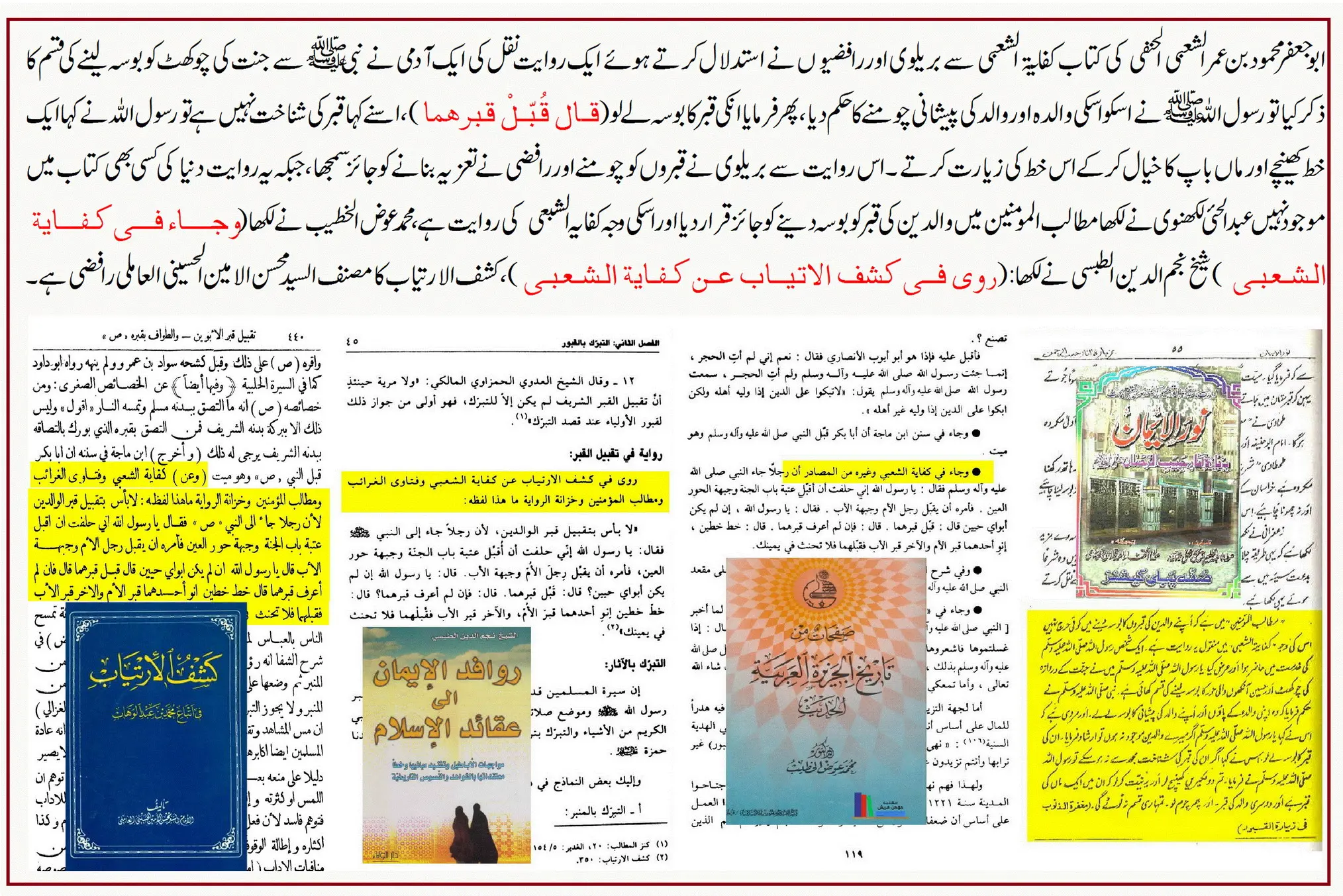
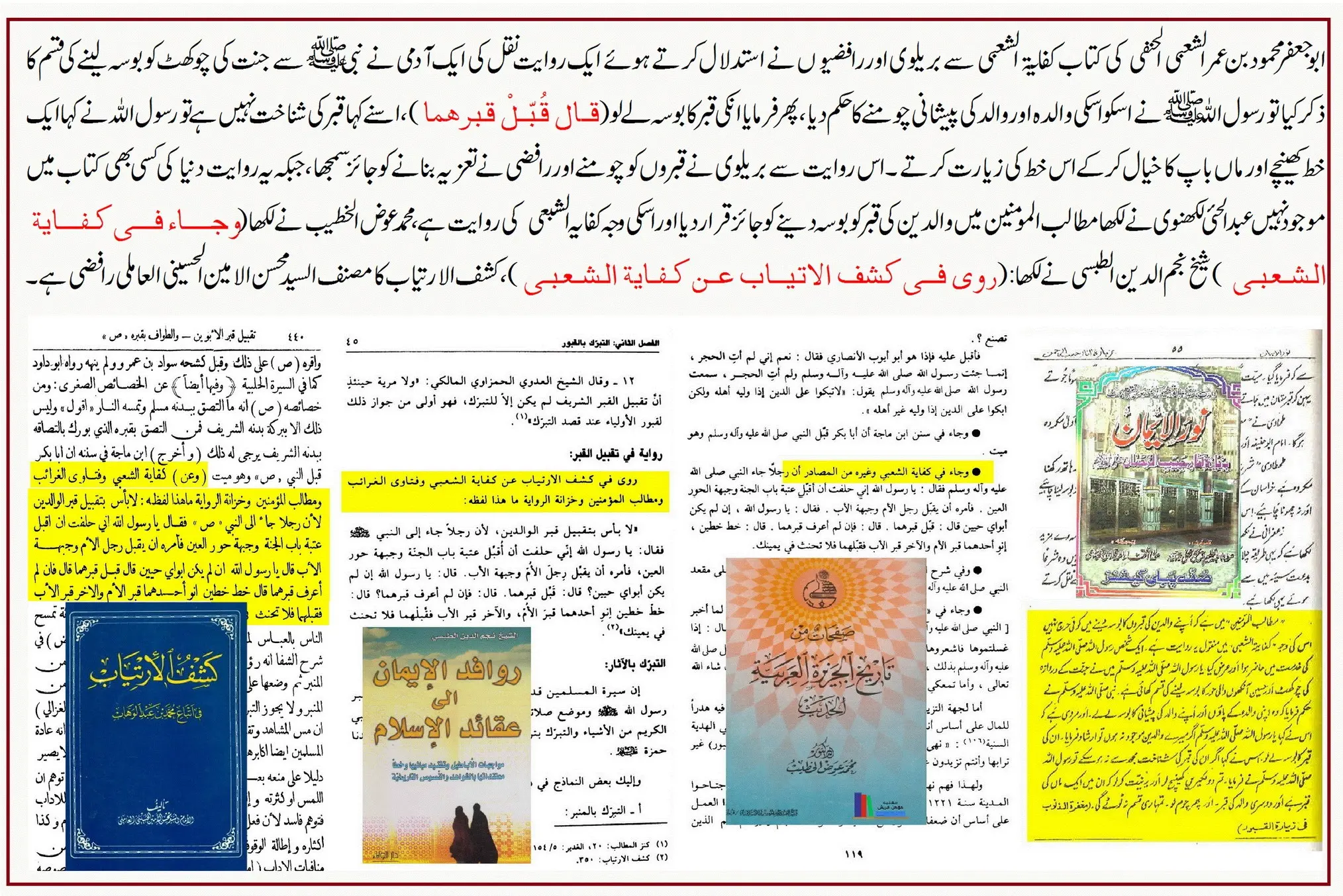
“It is in Maṭālib al-Mu’minīn: there is no harm in kissing the graves of one’s parents… (and the story about drawing two lines if the graves are unknown)….”
❖ It has been attributed inconsistently—sometimes to Maṭālib al-Mu’minīn, sometimes to Kifāyat al-Shaʿbī, and sometimes to an unknown Rāfiḍī book Kashf al-Irtiyāb. But when the available manuscripts of Kifāyat al-Shaʿbī were examined, no trace of this narration was found.
❖ Additionally, the author of Kifāyat al-Shaʿbī, Abū Jaʿfar Maḥmūd bin ʿUmar al-Shaʿbī al-Ḥanafī, has been declared unreliable—even by Ḥanafī researchers.
ʿAllāmah ʿAbd al-ʿAzīz Muḥaddith Dehlawī and Mawlānā ʿAbd al-Ḥayy Lakhnawī both stated explicitly that Kifāyat al-Shaʿbī is not reliable.
❖ Hence, this is a baseless proof built on invalid sources—presenting it to establish innovation in religion is nothing but deceit and falsehood.
(quoted passage)
Reference:
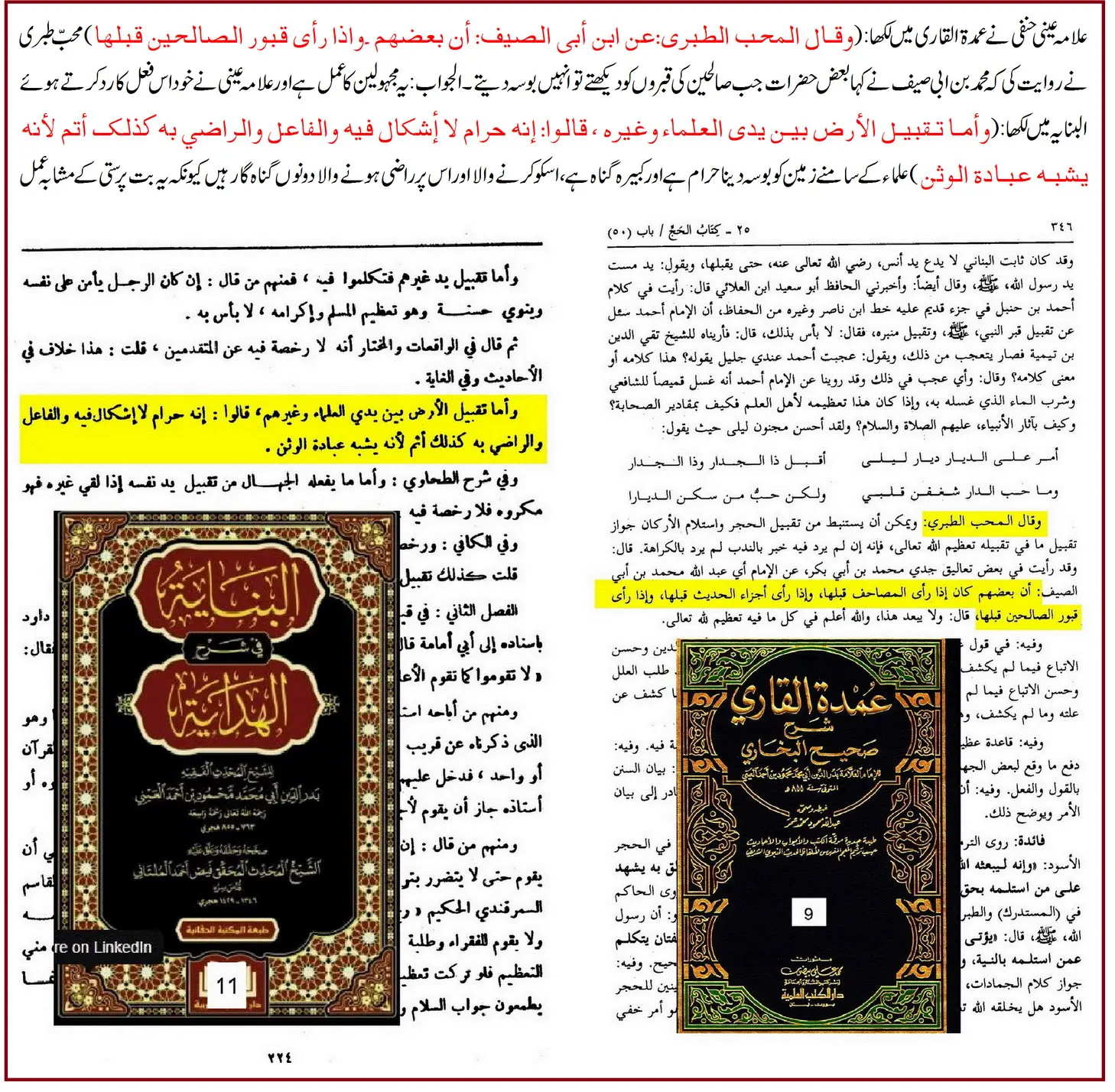
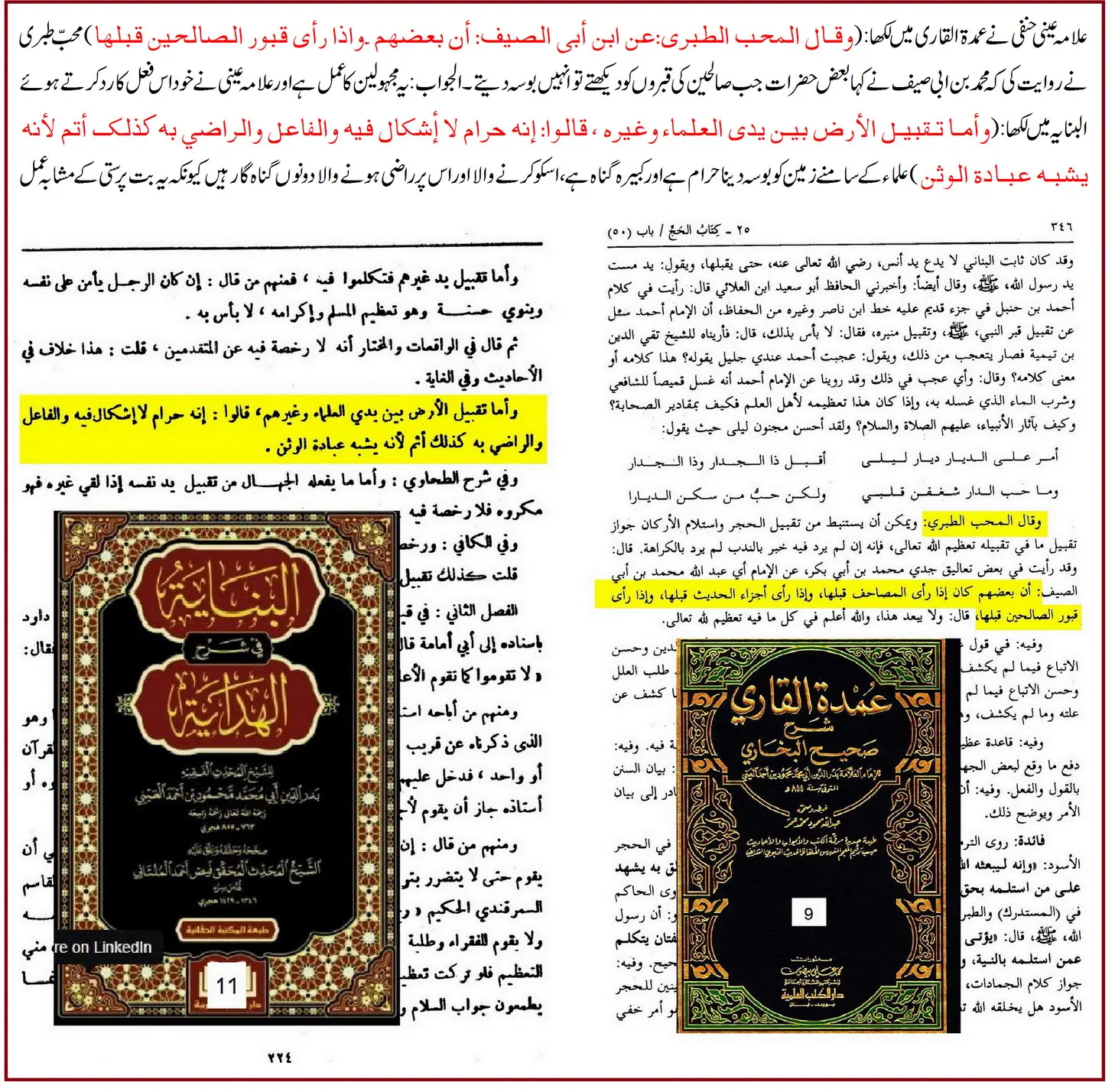
❖ Moreover, ʿAllāmah Badr al-Dīn al-ʿAynī al-Ḥanafī explicitly wrote that kissing the ground before scholars or others is ḥarām and resembles idol-worship:
① Text:
"وأما تقبيل الأرض بين يدي العلماء وغيرهم، قالوا: إنه حرام لا إشكال فيه، والفاعل والراضي به آثم؛ لأنه يشبه عبادة الوثن.”
Translation:
“As for kissing the ground in front of scholars or others, they said: it is ḥarām with no doubt; the doer and the one pleased with it are sinful, because it resembles the worship of idols.”
Reference:
❖ Therefore, if ground-kissing resembles idol-worship, then kissing graves is even more impermissible and an innovation.
❖ Hadith:
"عن عمر رضی اللہ عنه أنه جاء إلى الحجر الأسود فقبله وقال: إني أعلم أنك حجر لا تضر ولا تنفع، ولولا أني رأيت النبي صلى الله عليه وسلم يقبلك ما قبلتك.”
Reference:
Translation:
ʿUmar رضي الله عنه came to the Black Stone, kissed it, and said: “I know you are a stone; you do not benefit nor harm. Had I not seen the Prophet ﷺ kiss you, I would not have kissed you.”
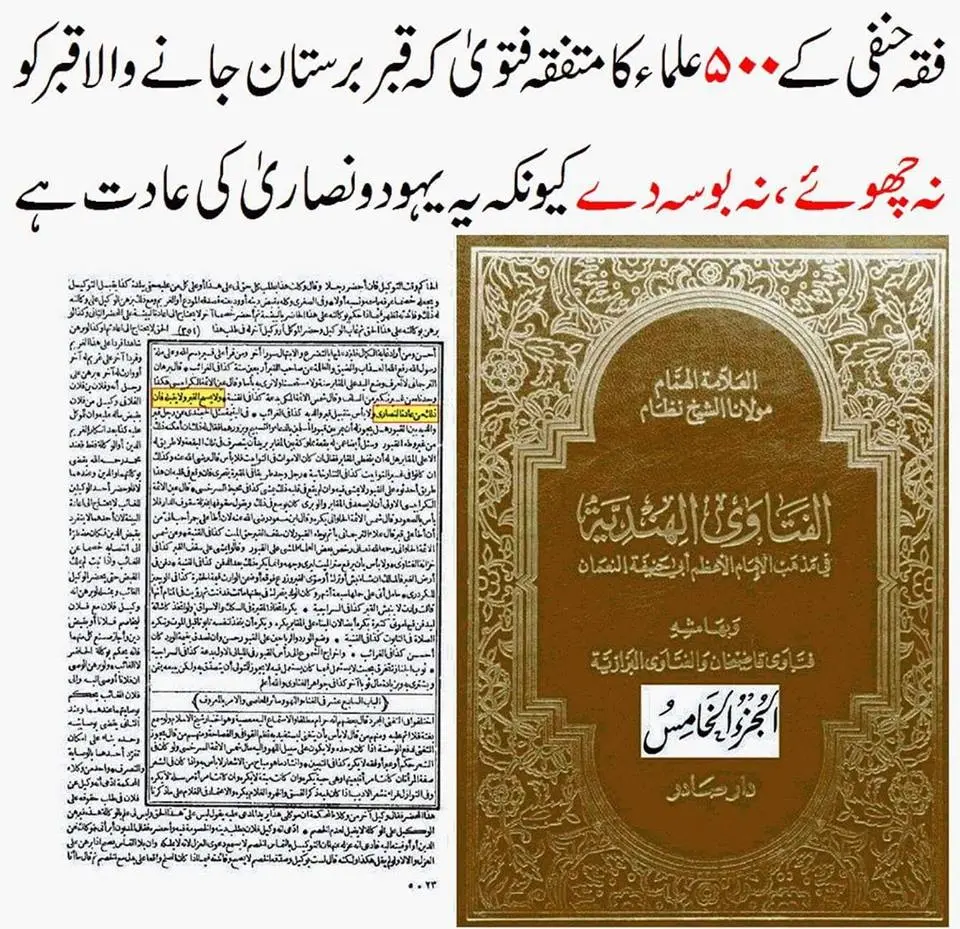
❖ Furthermore, Ḥanafī jurists explicitly stated that touching or kissing graves is impermissible:
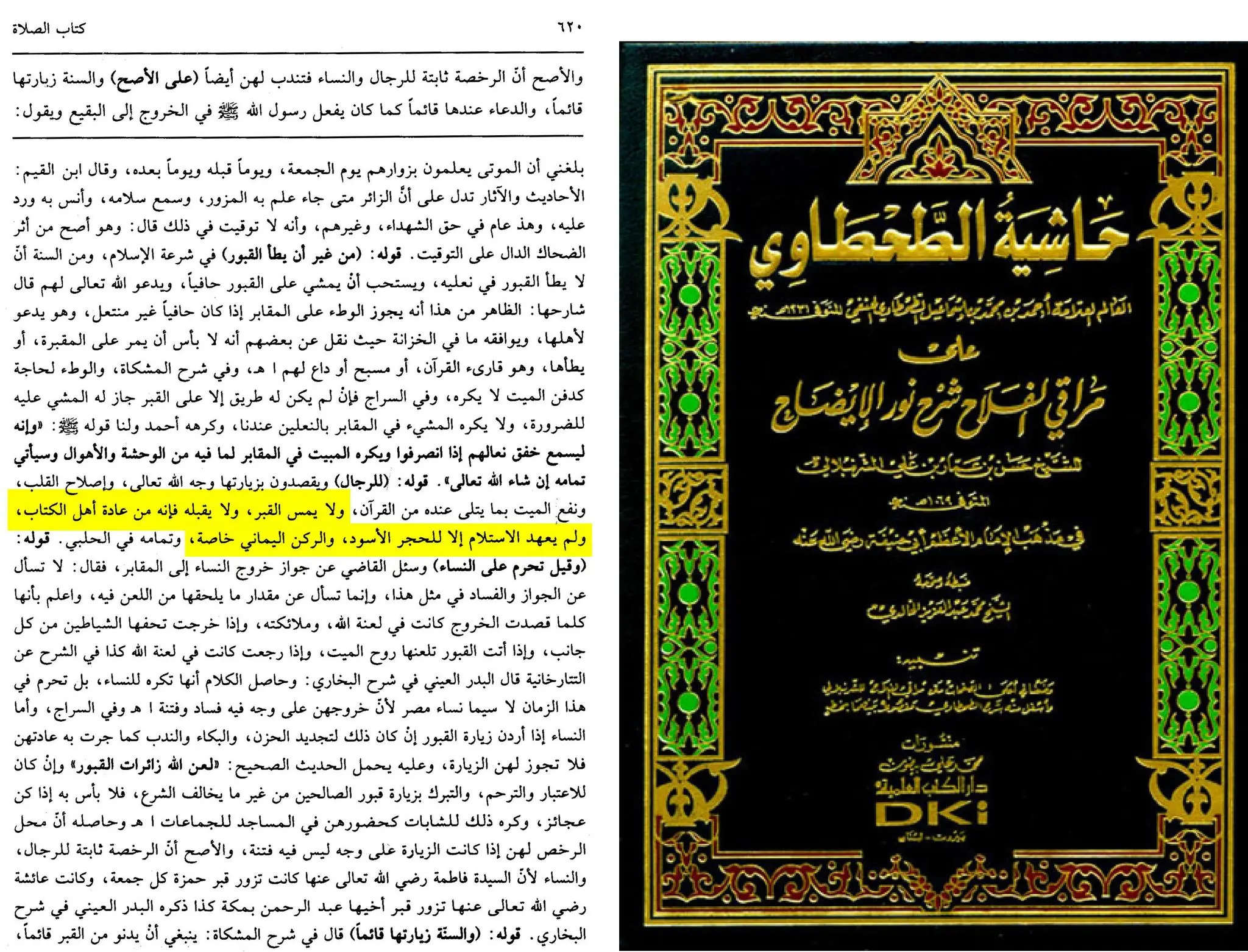
① al-Ṭaḥṭāwī al-Ḥanafī:
"ولا يمس القبر ولا يقبله فإنه من عادة أهل الكتاب، ولم يعهد الاستلام إلا للحجر الأسود والركن اليماني خاصة.”
Translation: “The grave should neither be touched nor kissed, for that is from the customs of the People of the Book. And istillām is only known for the Black Stone and the Yemeni Corner specifically.”
Reference:
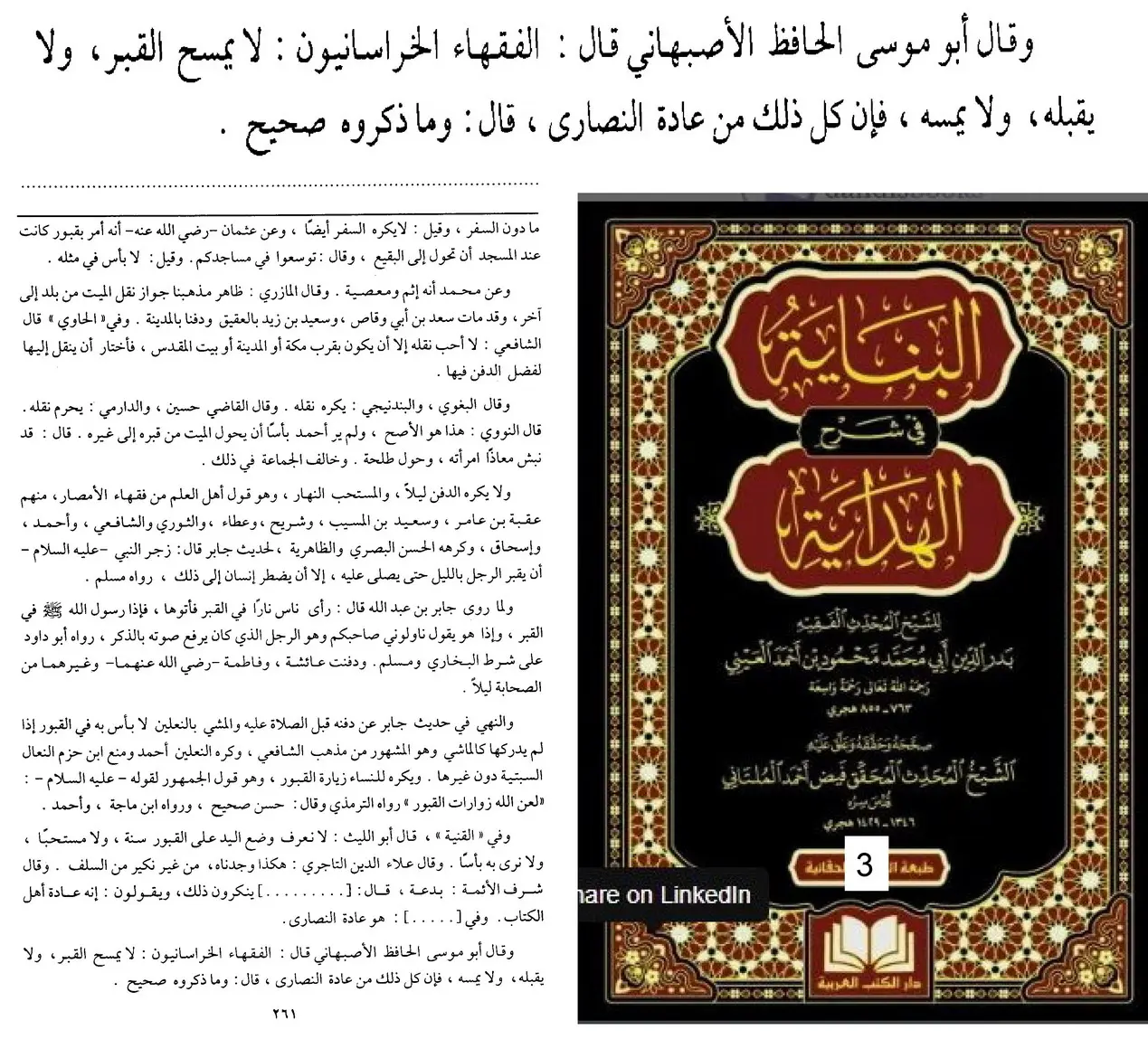
② al-ʿAynī al-Ḥanafī:
"قال الفقهاء الخراسانيون: لا يمسح القبر، ولا يقبله، فإن كل ذلك من عادة النصارى، قال: وما ذكروه صحيح.”
Translation: “The jurists of Khurāsān said: the grave should not be wiped nor kissed, for all of that is from the customs of the Christians; and what they mentioned is correct.”
Reference:
❖ Thus, kissing the Black Stone is not evidence for kissing graves—rather, the matter is contrary to it.
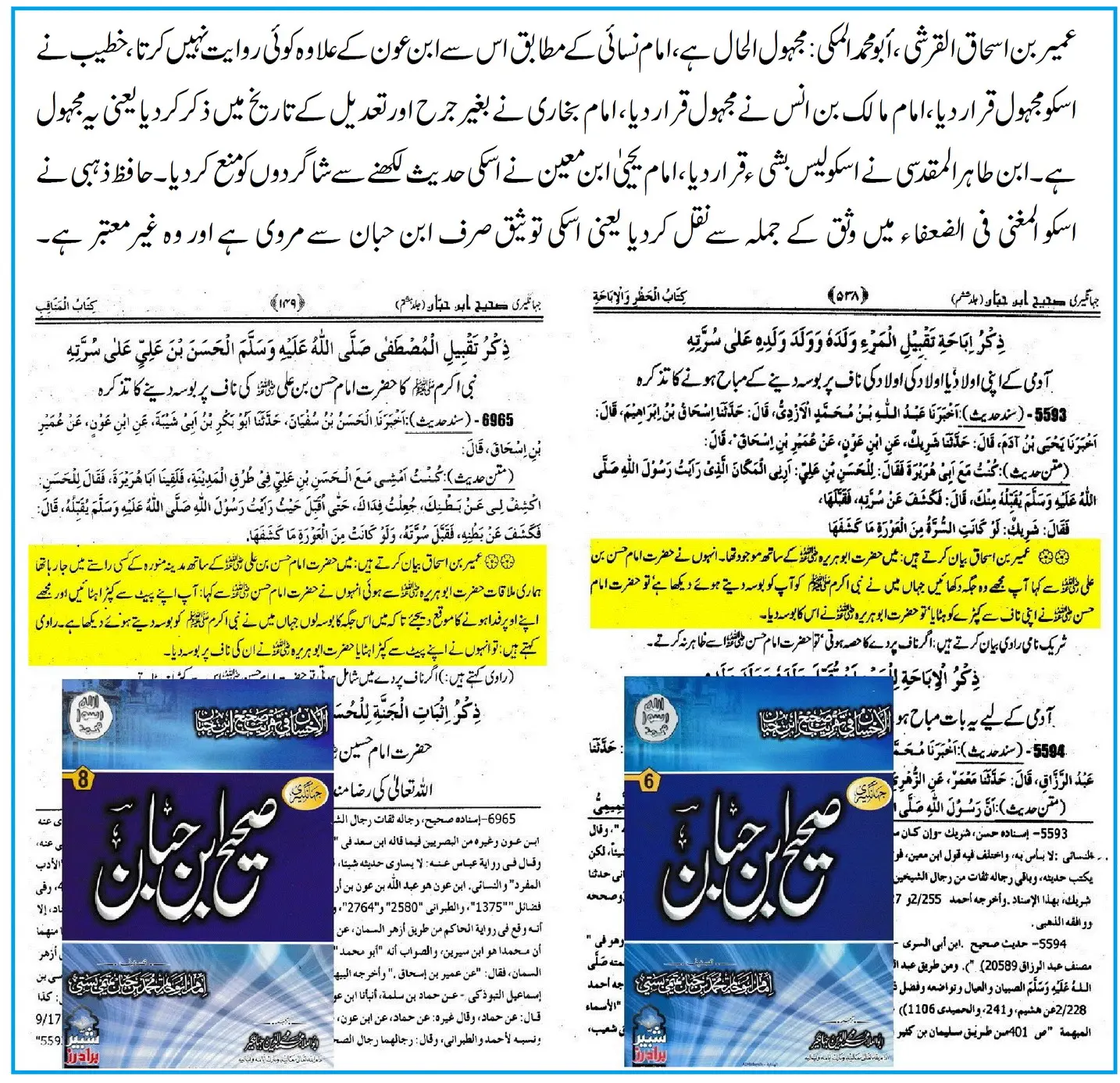
❖ “Abū Hurayrah رضي الله عنه used to kiss the navel of Imām Ḥasan رضي الله عنه.”
(Arabic text as quoted)
Translation:
Abū Hurayrah رضي الله عنه asked Imām Ḥasan رضي الله عنه to uncover the place the Messenger of Allah ﷺ had kissed—his navel—so he kissed it to seek blessing through the آثار and progeny of the Prophet ﷺ.
Criticisms of Hadith scholars:
① Ibn Ḥajar: “Maqbūl” (accepted only in corroboration; not proof alone)
② Ibn Maʿīn: "لا يساوي شيئا"
③ Ibn al-Jawzī: “Weak”
④ al-ʿUqaylī: "حديث لا يتابع عليه"
⑤ al-Khaṭīb al-Baghdādī: "مجهول عند أصحاب الحديث"
Reference:
❖ Therefore, this report is not fit for argument.
❖ “Thābit al-Bunānī رحمه الله would not release the hand of Anas bin Mālik رضي الله عنه until he kissed it…”
(Arabic text as quoted)
Reference:
Translation:
Jamīlah, the servant of Anas, said: whenever Thābit came, Anas would ask for perfume to apply to his hand, for Thābit would not be satisfied until he kissed his hand and said: “You touched the hand of the Messenger of Allah ﷺ.”
① It contains ʿAbdullāh bin al-Muthannā al-Anṣārī—about whom Ibn Ḥajar said:
"صدوق كثير الغلط”
Translation: “Truthful, but makes many mistakes.”
Reference:
② The narrator Jamīlah (servant of Anas) is unknown. al-Haythamī said:
"جميلة هذه لم أر من ترجمها.”
Translation: “I have not seen anyone who wrote her biography.”
Reference:
❖ Hence, this report cannot be used to establish a Sharʿī ruling.
❖ “Ibn ʿUmar رضي الله عنه narrated… then we came to the Prophet ﷺ and kissed his hands.”
(Arabic text as quoted)
Reference:
Translation:
Ibn ʿUmar رضي الله عنه said: “We were on an expedition… then we came to the Messenger of Allah ﷺ and kissed his hand.”
(criticisms as listed)
❖ Therefore, it is not proof.
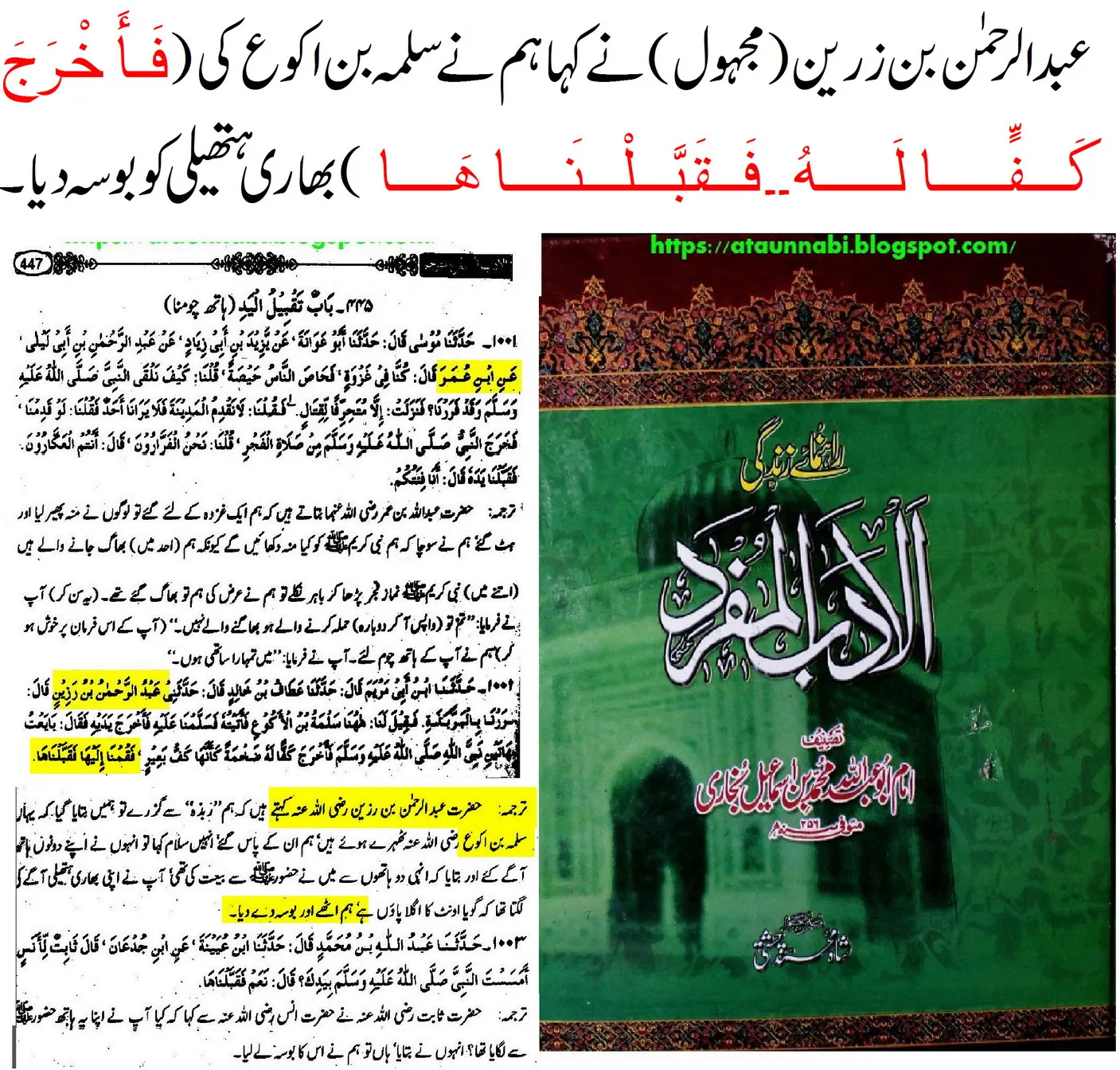
❖ “ʿAbd al-Raḥmān bin Razīn said… we kissed the hands of Salamah bin al-Akwaʿ رضي الله عنه.”
(Arabic text as quoted)
Reference:
Translation:
“We visited Salamah bin al-Akwaʿ رضي الله عنه… he showed his hands and said: with these hands I pledged to the Prophet ﷺ… so we kissed them.”
(criticisms as listed)
❖ Therefore, it is not proof.
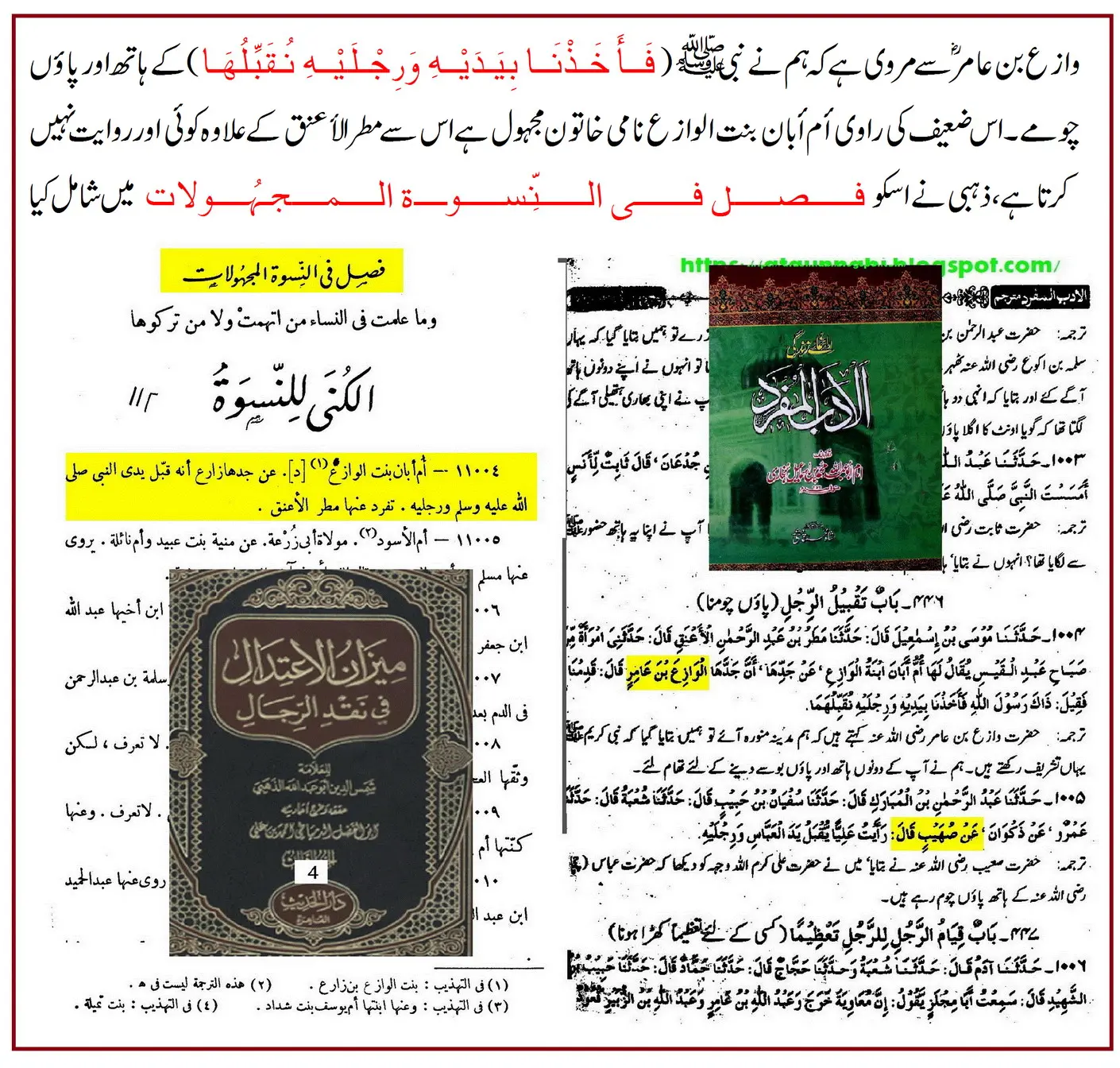
❖ “Wāziʿ bin ʿĀmir رضي الله عنه said… we took the Prophet’s ﷺ hands and feet and kissed them.”
(Arabic text as quoted)
Reference:
Translation:
“We arrived and it was said: this is the Messenger of Allah ﷺ. So we took his hands and feet and kissed them.”
❖ Therefore, it is not proof.
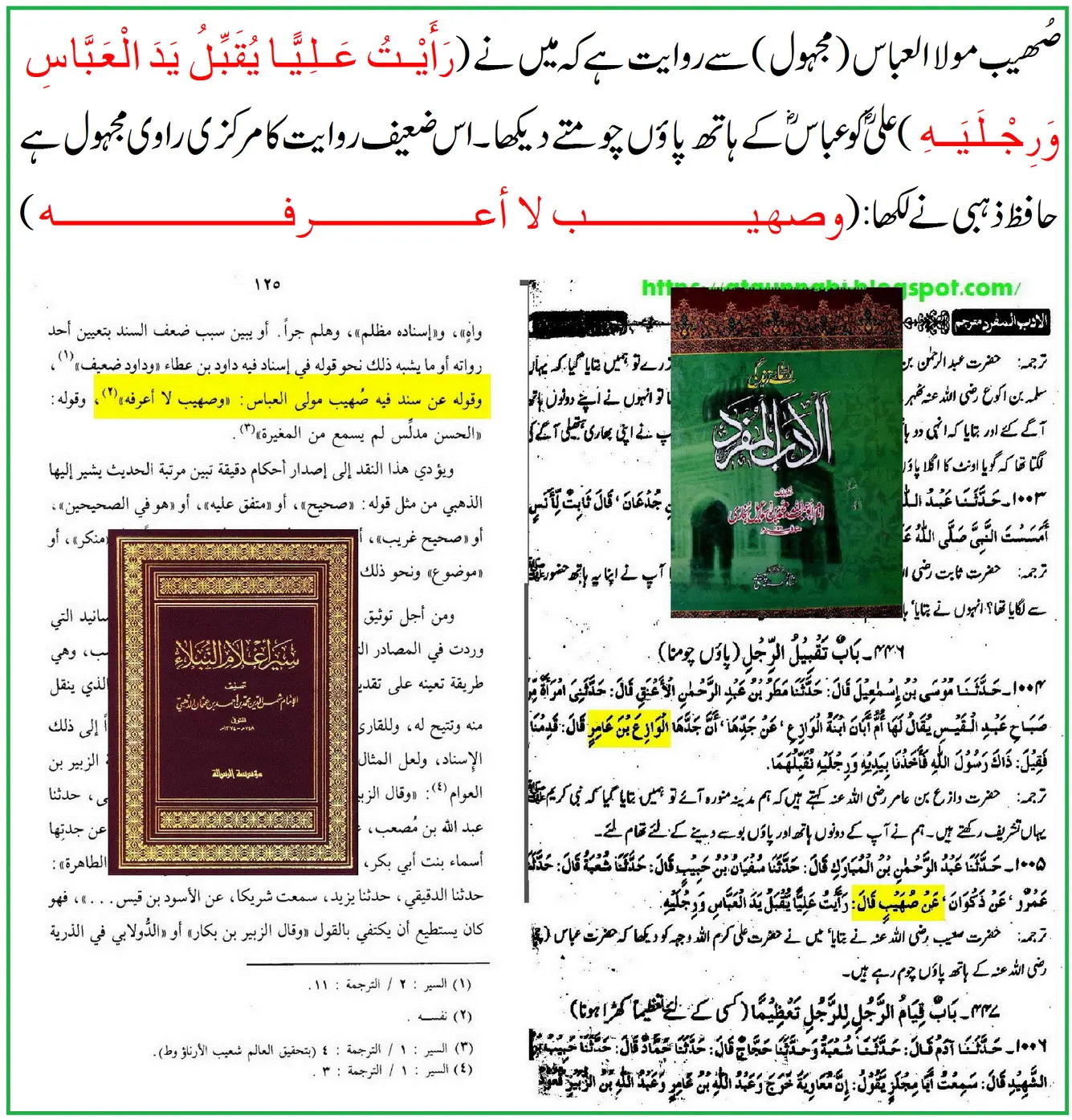
❖ “Ṣuhayb رضي الله عنه said: I saw ʿAlī رضي الله عنه kissing the hands and feet of al-ʿAbbās رضي الله عنه.”
(Arabic text as quoted)
Reference:
Translation:
“I saw ʿAlī رضي الله عنه kissing the hand and the feet of al-ʿAbbās رضي الله عنه.”
Shaykh al-Albānī: "ضعيف الإسناد موقوف.”
Shuʿayb al-Arna’ūṭ: “Its narrators are trustworthy except this Ṣuhayb, for he is not known.”
❖ Hence, it is not proof.
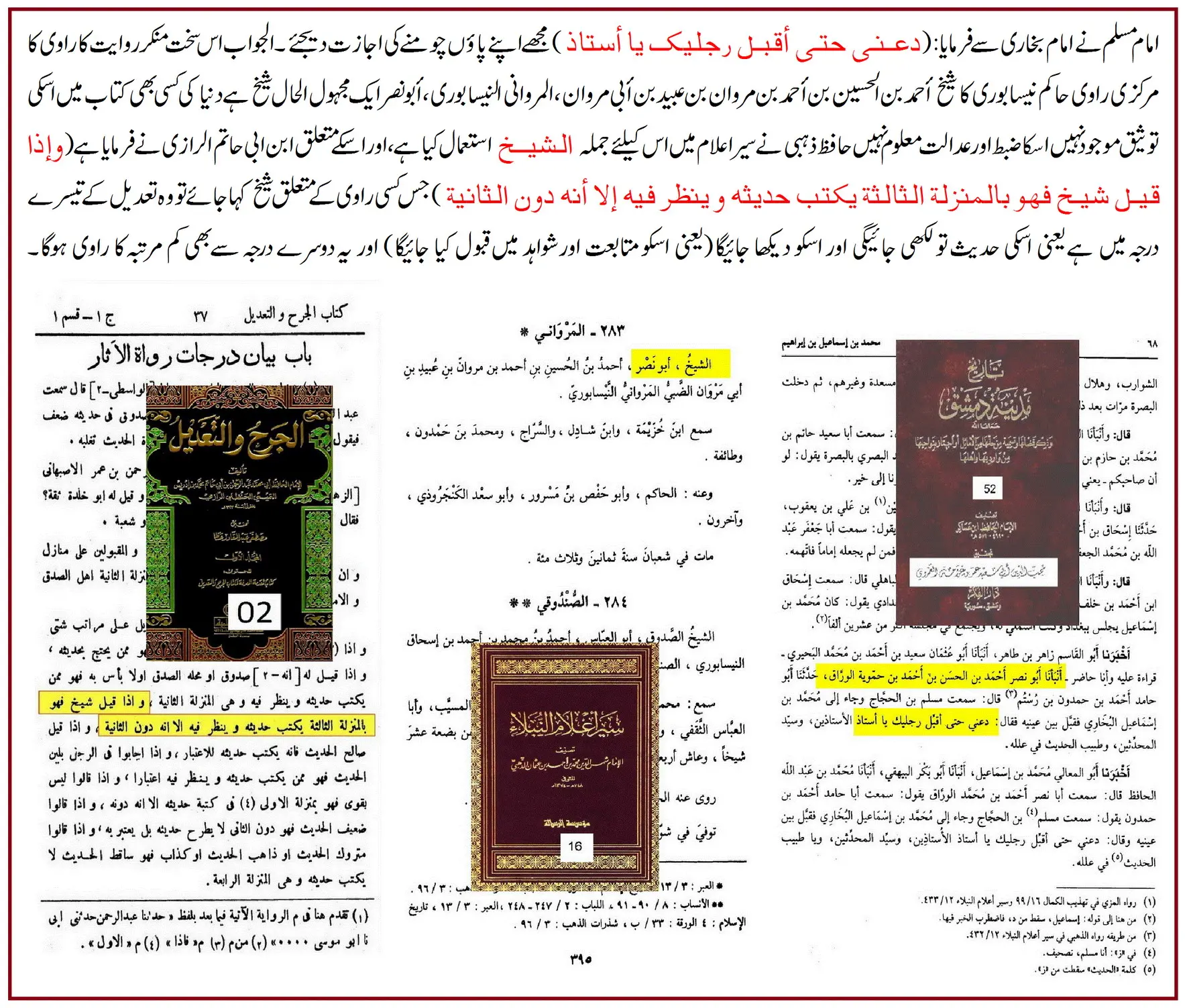
❖ “This was also the belief of Imām Muslim—he sought permission to kiss Imām al-Bukhārī’s feet.”
(Arabic report as quoted)
Reference:
Translation:
Imām Muslim came to Muḥammad bin Ismāʿīl al-Bukhārī, kissed between his eyes, and said: “Let me kiss your feet…”
Ibn Abī Ḥātim explained that when a narrator is described merely as “Shaykh,” it is a low grade of approval and is not used for proof.
Reference:
❖ Hence, this incident is not proven and cannot be used as a Sharʿī proof.
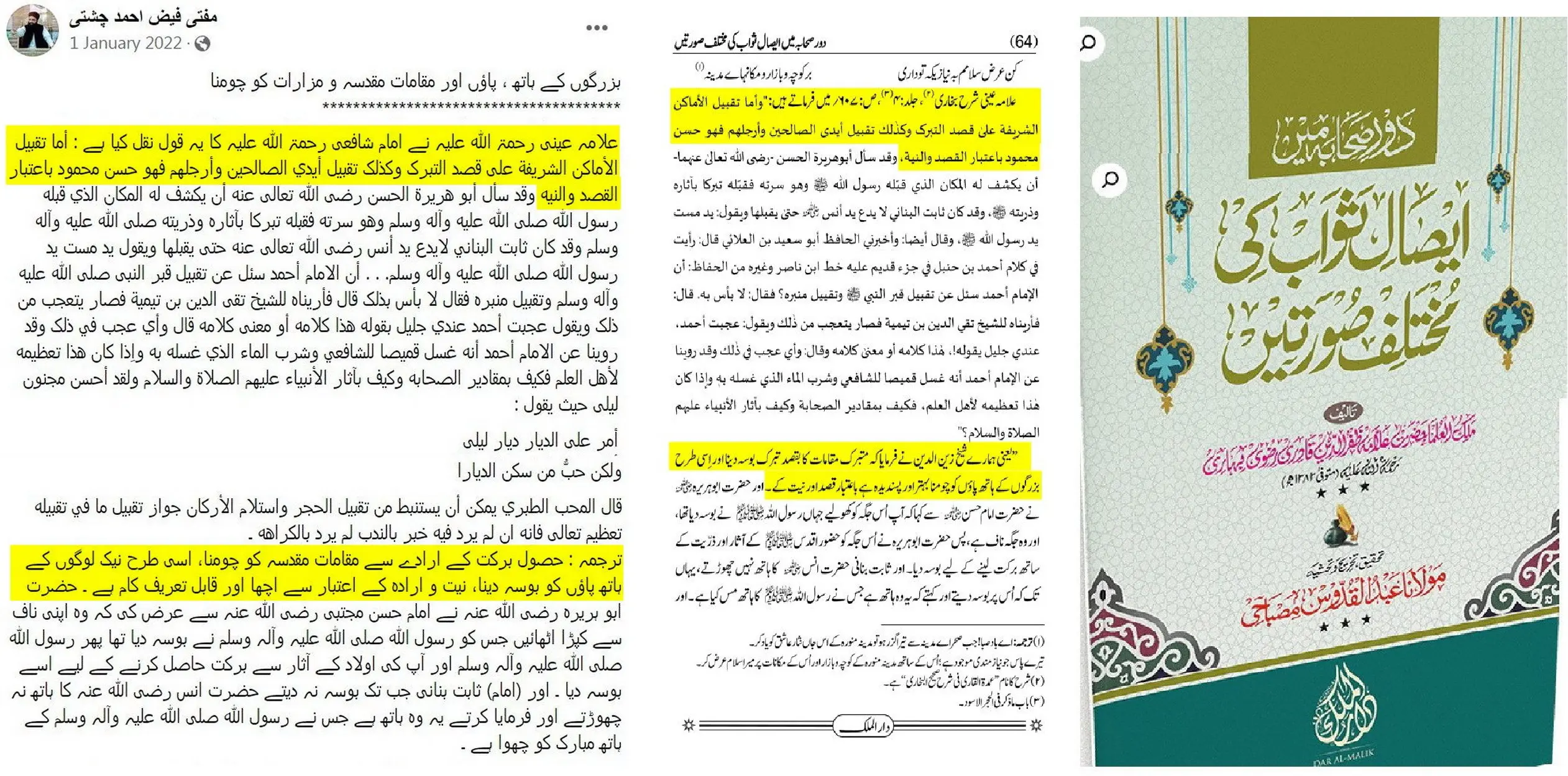
❖ “Imām al-Shāfiʿī رحمه الله said: kissing sacred places for blessings and kissing the hands and feet of the righteous is permissible.”
But the cited quotation is:
"وَقَالَ شَيْخُنَا زَيْنُ الدِّينِ: وَأَمَّا تَقْبِيلُ الْأَمَاكِنِ الشَّرِيفَةِ عَلَى قَصْدِ التَّبَرُّكِ، وَكَذَلِكَ تَقْبِيلُ أَيْدِي الصَّالِحِينَ وَأَرْجُلِهِمْ، فَهُوَ حَسَنٌ مَحْمُودٌ بِاعْتِبَارِ الْقَصْدِ وَالنِّيَّةِ.”
Reference:
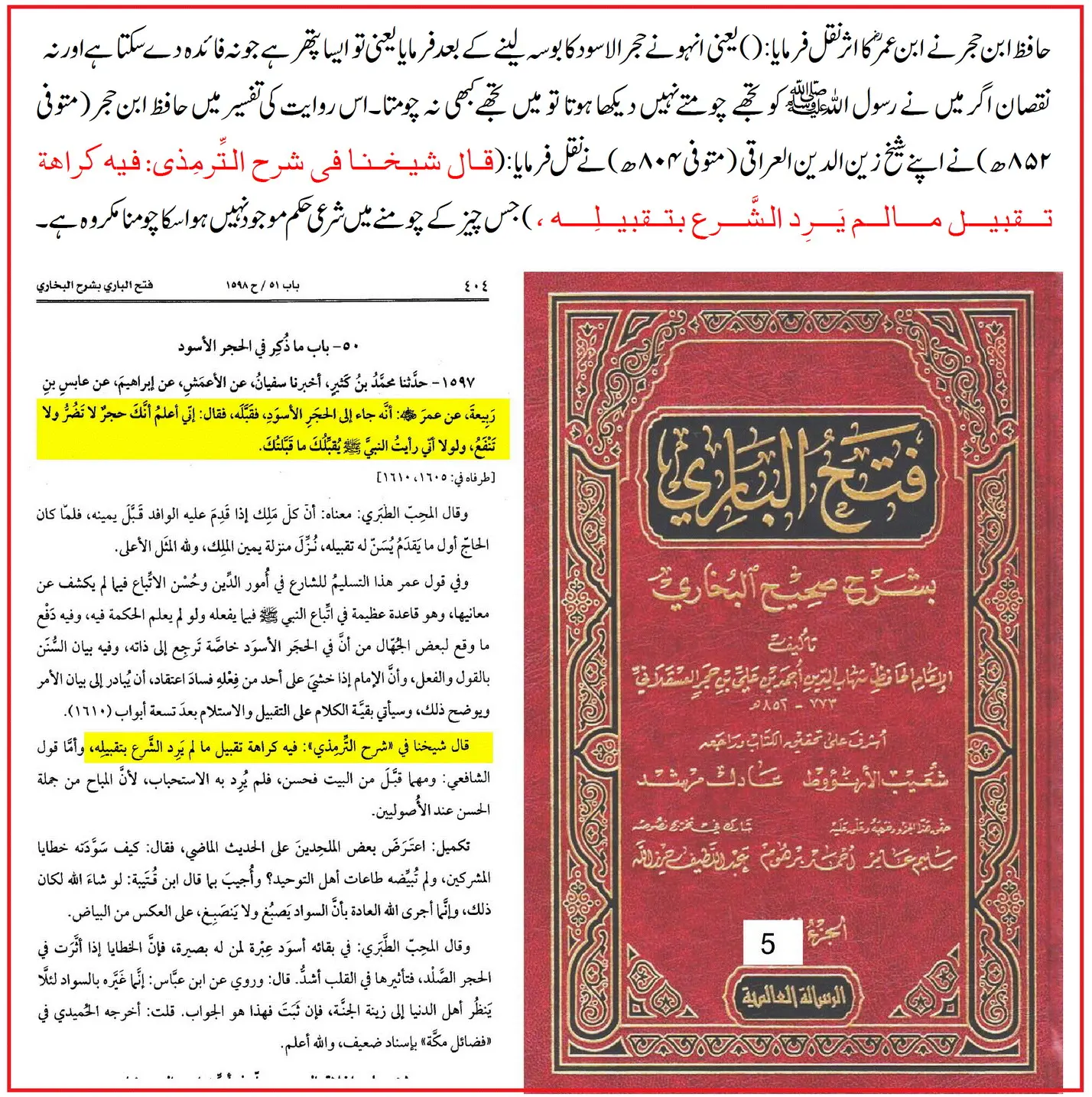
❖ Moreover, Ḥāfiẓ Ibn Ḥajar al-ʿAsqalānī رحمه الله (student of Zayn al-Dīn al-ʿIrāqī) refuted his teacher’s statement and said:
"قال شيخنا – يعني زين الدين العراقي – في شرح الترمذي: فيه كراهة تقبيل ما لم يرد الشرع بتقبيله.”
Translation: “Our Shaykh—meaning Zayn al-Dīn al-ʿIrāqī—said in Sharḥ al-Tirmidhī: there is dislike (karāhah) in kissing that which the Sharīʿah has not legislated to be kissed.”
Reference:
❖ Therefore, the claim that Imām al-Shāfiʿī permitted kissing graves or hands and feet is a false attribution.
◈ Most narrations contain unknown narrators, or are munkar or fabricated.
◈ Some statements are merely weak reports or the opinions of unreliable individuals.
◈ In many places, false attributions were made to major Imams.
❖ Conclusion: Kissing graves, hands and feet, or sacred places as an act of veneration is not established in the Sharīʿah. Rather, it is an innovation and resembles the practices of the Jews and Christians.









Respected readers! Islam is a complete code of life, which teaches only the worship of Allah Almighty and servitude to Him alone. From the teachings of the Noble Prophet ﷺ and the clear texts of the Noble Qur’an, we receive explicit guidance that worship is exclusively for Allah, and that kissing the graves of any prophet, saint, or elder out of veneration, or prostrating upon them, is not established in the Sharīʿah.
❖ In this article, we will present a research-based review of a post put forward by a Barelvi slanderer (Muftari Hashthati).
❖ He attempts to prove—through the Qur’an and Hadith—the permissibility of kissing the hands and feet at graves and of the elders of religion.
❖ We will quote each of his objections along with the original text, then refute them with Sharʿī proofs and the statements of the Hadith scholars.
❖ Every proof will be cited with the complete Arabic text, its Urdu translation, and its reference—so that the truth becomes clear.
Original Objection (Barelvi Proof 01)
The Barelvi slanderer presents a verse of the Qur’an:① Arabic Text:
﴿وَادْخُلُوا الْبَابَ سُجَّدًا وَقُوۡلُوۡا حِطَّةٌ﴾
(Sūrah al-Baqarah, Verse 58)
② Translation:
“O Children of Israel! Enter this gate while prostrating and say: ‘Relieve (us) / forgive (us).’”
Barelvi’s Argument:
This verse shows that since Bayt al-Maqdis is the resting place of the Prophets عليهم السلام, Banū Isrā’īl were commanded to prostrate there. This also indicates that repentance is accepted more quickly in sacred places.
Answer 01
This argument is completely false and is tantamount to fabricating a lie against the Noble Qur’an. Its clarification is as follows:❖ Firstly, the mentioned verse states that Banū Isrā’īl were to enter the gate while prostrating—however, this does not mean that they were to prostrate to a grave or to the resting place of the Prophets. The purpose in the verse is only to show humility and submission before Allah Almighty, as the exegetes have clearly stated.
❖ Secondly, at the time of this incident, no Prophet was buried in Bayt al-Maqdis. Therefore, saying that “this command was for honoring the graves of the Prophets” is sheer falsehood and a lie.
❖ Such baseless deductions are speaking about the Qur’an from one’s own side—whereas the Messenger of Allah ﷺ issued a severe warning:
① Hadith:
حَدَّثَنَا مَحْمُودُ بْنُ غَيْلَانَ قَالَ: حَدَّثَنَا بِشْرُ بْنُ السَّرِيِّ قَالَ: حَدَّثَنَا سُفْيَانُ، عَنْ عَبْدِ الأَعْلَى، عَنْ سَعِيدِ بْنِ جُبَيْرٍ، عَنْ ابْنِ عَبَّاسٍ قَالَ: قَالَ رَسُولُ اللَّهِ صَلَّى اللهُ عَلَيْهِ وَسَلَّمَ:
«مَنْ قَالَ فِي القُرْآنِ بِغَيْرِ عِلْمٍ فَلْيَتَبَوَّأْ مَقْعَدَهُ مِنَ النَّارِ»
② Translation:
It is narrated from Ibn ʿAbbās رضي الله عنهما that the Messenger of Allah ﷺ said: “Whoever speaks about the Qur’an without knowledge, let him take his seat in the Fire.”
③ Reference:
Reference: Sunan al-Tirmidhī: 2950
(He said: Ḥadīth Ḥasan)❖ This Hadith shows that explaining the Qur’an without proof is ḥarām and a cause of Hell. Therefore, the Barelvi slanderer’s claim that “Banū Isrā’īl prostrated to the graves of the Prophets” is a pure lie and fabrication. There is no such explicit statement in the Qur’an.
Original Objection (Barelvi Proof 02)
The Barelvi slanderer presents another proof:❖ Hadith (Mishkāt, Chapter: Major Sins and Signs of Hypocrisy):
Narrated from Ṣafwān bin ʿAssāl رضي الله عنه:
"فَأَتَيَاهُ فَسَأَلاَهُ عَنْ آيَةِ الْمَحْوِ، فَقَالَ: نَعَمْ، عَلَيْكُمْ بِكِتَابِ اللَّهِ عَزَّ وَجَلَّ، فَتَعَلَّمُوهُ وَعَلِّمُوهُ، فَأَتَيَاهُ فَقَبَّلَا يَدَيْهِ وَرِجْلَيْهِ.”
Translation:
A Jew said to his companion: “Come, let us go to this Prophet.” His companion said: “Do not say Prophet.” Then they both came to the Noble Prophet ﷺ and asked him about the verse of “al-maḥw.” He ﷺ said: “Yes! It is incumbent upon you to hold firmly to the Book of Allah—learn it and teach it.” Then both of them (the Jews) kissed his hands and feet.
Reference:
Reference: Sunan al-Tirmidhī: 2733
— and
Reference: Mishkāt al-Maṣābīḥ: باب الكبائر وعلامات النفاق
(p. 770)Research-Based Answer (Answer 02)
This narration is not acceptable as evidence due to its chain. In its chain is a narrator: ʿAbdullāh bin Salamah al-Murādī—against whom even reliable Ḥanafī Hadith scholars have issued severe criticism. Therefore, the Barelvis’ use of this report contradicts their own principles.① ʿAllāmah Badr al-Dīn al-ʿAynī al-Ḥanafī wrote:
"إسناده منكر، فيه عبد الله بن سلمة، وقد تكلّم فيه الأئمة.”
Translation: Its chain is munkar; in it is ʿAbdullāh bin Salamah, and the Imams have spoken against him.
Reference:
Reference: Sharḥ Sunan Abī Dāwūd (al-ʿAynī), نقلًا عن al-Nasā’ī and al-Mundhirī
② al-Zaylaʿī al-Ḥanafī said:
"إن مدار هذا الحديث على عبد الله بن سلمة المرادي الكوفي، وقد قال البيهقي: لما كبر ساء حفظه، فكان يحدث بالشيء فيغلط فيه.”
Translation: This entire narration revolves around ʿAbdullāh bin Salamah al-Murādī al-Kūfī. Imām al-Bayhaqī said: when he grew old, his memory deteriorated, so he would narrate something and err in it.
Reference:
Reference: Naṣb al-Rāyah (al-Zaylaʿī)
③ Mughlṭāyī al-Ḥanafī also نقل (reported) severe criticism regarding him:
Imām al-Khaṭṭābī said: “Weak.”
Imām al-Shāfiʿī declared him unreliable.
Imām al-Bayhaqī said: "كان كثير الوهم" (he committed many errors).
Imām Shuʿbah, Abū Muḥammad al-Fārisī, Abū Ḥātim, Imām al-Sājī, and Imām al-Ḥākim all declared him weak.
Reference:
Reference: Mughlṭāyī, Sharḥ Sunan Abī Dāwūd
❖ Hence, when the majority of Hadith scholars judged this narrator’s report to be munkar and weak, the Barelvis’ use of it to prove their innovation is against their own principles.
Original Objection (Barelvi Proof 03)
The Barelvi slanderer presents another narration:❖ Hadith (Mishkāt, Chapter: What is said when one is present at death):
ʿĀ’ishah رضي الله عنها said:
① Arabic Text:
1456 – حَدَّثَنَا أَبُو بَكْرِ بْنُ أَبِي شَيْبَةَ، وَعَلِيُّ بْنُ مُحَمَّدٍ، قَالَا: حَدَّثَنَا وَكِيعٌ، عَنْ سُفْيَانَ، عَنْ عَاصِمِ بْنِ عُبَيْدِ اللَّهِ، عَنِ الْقَاسِمِ بْنِ مُحَمَّدٍ، عَنْ عَائِشَةَ، قَالَتْ:
«قَبَّلَ رَسُولُ اللَّهِ صَلَّى اللهُ عَلَيْهِ وَسَلَّمَ عُثْمَانَ بْنَ مَظْعُونٍ وَهُوَ مَيِّتٌ، فَكَأَنِّي أَنْظُرُ إِلَى دُمُوعِهِ تَسِيلُ عَلَى خَدَّيْهِ»
② Translation:
ʿĀ’ishah رضي الله عنها said: The Messenger of Allah ﷺ kissed ʿUthmān bin Maẓʿūn رضي الله عنه while he had passed away, and it is as though I can see his tears flowing on his cheeks.
③ Reference:
Reference: Sunan Ibn Mājah: 1456
— also:
Reference: Musnad Aḥmad 6/43
,
Reference: al-Mustadrak (al-Ḥākim) 3/209 (ḥadīth 4848)
,
Reference: Sunan Abī Dāwūd 3163
Research-Based Answer (Answer 03)
In this narration’s chain is a narrator named ʿĀṣim bin ʿUbaydullāh—who is severely weak and munkar al-ḥadīth. Multiple criticisms exist from Hadith scholars:① Imām al-Bukhārī رحمه الله:
"عاصم بن عبيد الله العمري المدني، منكر الحديث.”
Translation: ʿĀṣim bin ʿUbaydullāh al-ʿUmarī al-Madanī is munkar al-ḥadīth.
Reference:
Reference: al-Tārīkh al-Kabīr (al-Bukhārī): 3088
② Imām Abū Zurʿah al-Rāzī رحمه الله:
"منكر الحديث في الأصل، وهو مضطرب الحديث.”
Translation: He is originally munkar al-ḥadīth and his narration is اضطراب (inconsistent).
Reference:
Reference: al-Jarḥ wa al-Taʿdīl (Ibn Abī Ḥātim): 1917
③ Imām Abū Ḥātim al-Rāzī رحمه الله:
"منكر الحديث مضطرب الحديث.”
Translation: This narrator is munkar al-ḥadīth and muḍṭarib al-ḥadīth.
Reference:
Reference: al-Jarḥ wa al-Taʿdīl (Ibn Abī Ḥātim): 1917
④ Imām Ibn Ḥibbān رحمه الله:
"سييء الحفظ، كثير الوهم، فاحش الخطأ، فترك من أجل كثرة خطئه.”
Translation: He had poor memory, committed many errors, made gross mistakes, and was abandoned due to the abundance of his mistakes.
Reference:
Reference: al-Majrūḥīn (Ibn Ḥibbān): 722
❖ Thus this narration rests upon ʿĀṣim bin ʿUbaydullāh—who is weak and abandoned. From such a report, neither a Sharʿī ruling can be established nor can any innovative practice (like kissing the dead or graves) be proven.
Original Objection (Barelvi Proof 04)
The Barelvi slanderer quoted:❖ Text (al-Shifā’):
“On the pulpit from which the Prophet ﷺ used to deliver sermons, ʿAbdullāh bin ʿUmar رضي الله عنه would place his hand and then place it upon his face (meaning: he would kiss it).”
And he cites:
أَخْبَرَنَا مُحَمَّدُ بْنُ إِسْمَاعِيلَ بْنُ أَبِي فُدَيْكٍ قَالَ: أَخْبَرَنِي ابْنُ أَبِي ذِئْبٍ عَنْ حَمْزَةَ بْنِ أَبِي جَعْفَرٍ عَنْ إِبْرَاهِيمَ بْنِ عَبْدِ الرَّحْمَنِ بْنِ عَبْدِ القاري أنه أنظر إلى ابن عمر. وَضَعَ يَدَهُ عَلَى مَقْعَدِ النَّبِيِّ – صَلَّى اللَّهُ عَلَيْهِ وَسَلَّمَ – مِنَ الْمِنْبَرِ ثُمَّ وَضَعَهَا عَلَى وَجْهِهِ.”
Reference:
Reference: al-Ṭabaqāt al-Kubrā (Ibn Saʿd)
Translation:
Ibrāhīm bin ʿAbd al-Raḥmān bin ʿAbd al-Qārī stated that he saw ʿAbdullāh bin ʿUmar رضي الله عنه place his hand on the seat of the Prophet ﷺ on the pulpit, then place it on his face.
Research-Based Answer (Answer 04)
This report is weak in chain because it contains two unknown narrators:❖ First narrator: Ḥamzah bin Abī Jaʿfar
❖ Second narrator: Ibrāhīm bin ʿAbd al-Raḥmān bin ʿAbd al-Qārī
According to Hadith scholars, both are majhūl al-ḥāl, and a narration established through a majhūl narrator is not fit for argument.
Furthermore, even if this act were proven, it is only an individual action of Ibn ʿUmar رضي الله عنه. No endorsement from the Prophet ﷺ is transmitted for it, nor was it the general practice of the Companions رضي الله عنهم. Rather, contrary to this, the Messenger of Allah ﷺ forbade his Ummah from bowing, touching, or kissing graves, as previously mentioned.
Therefore, this report does not prove permissibility of kissing graves or the pulpit out of veneration. Instead, this evidence itself weakens the Barelvi stance.
Original Objection (Barelvi Proof 05)
The Barelvi slanderer wrote:❖ Text:
“It is narrated from Imām Aḥmad bin Ḥanbal رحمه الله that someone asked him about kissing the Noble Grave of the Prophet ﷺ or the pulpit; he replied that there is no harm in it.”
Research-Based Answer (Answer 05)
❖ This statement attributed to Imām Aḥmad رحمه الله is, in reality, a shādh and unreliable report, whose detailed discussion is mentioned in this article. The researchers and Hadith scholars have clarified:① This statement is only transmitted from Imām Aḥmad’s son ʿAbdullāh, whereas Imām Aḥmad’s other son Qāḍī Abū al-Faḍl Ṣāliḥ—and two reliable students of Imām Aḥmad, Muḥammad Abū Bakr al-Athram and Isḥāq al-Marwazī—transmitted the opposite view. Meaning: the permissibility of kissing the pulpit or grave is not established from Imām Aḥmad; rather, its negation is established.
② Therefore, this narration is marjūḥ and unreliable.
❖ Further clarification from Ahl al-Sunnah researchers:
If a statement is weak in chain or shādh and contrary to the majority, it is not a proof—especially when other students or scholars transmit the opposite from the same Imām. Hence, permissibility of kissing the grave or pulpit is not proven from Imām Aḥmad, and this Barelvi argument is utterly false.
Original Objection (Barelvi Proof 06)
The Barelvi slanderer wrote:❖ Text (al-Shifā’):
“It is narrated from Ibn Abī al-Ṣayf al-Yamānī—one of the Shāfiʿī scholars of Makkah—that kissing the pages of the Qur’an and Hadith, and the graves of the pious, is permissible.”
Reference:
Reference: al-Shifā’: 2/70
Translation:
Ibn Abī al-Ṣayf al-Yamānī says: kissing the pages of the Qur’an and Hadith, and kissing the graves of the righteous, is permissible.
Research-Based Answer (Answer 06)
❖ This statement is completely without chain, and is transmitted with ṣīghah al-tamrīḍ (i.e., without clear attribution).❖ ʿAllāmah al-Samhūdī رحمه الله also نقل (quoted) this statement and then refuted it.
① Original Text:
وَنَقَلَ عَنْ ابْنِ أَبِي الصَّيْفِ اليَمَانِيِّ أَحَدِ عُلَمَاءِ مَكَّةَ مِنَ الشَّافِعِيَّةِ جَوَازَ تَقْبِيلِ الْمُصْحَفِ وَأَجْزَاءِ الْحَدِيثِ وَقُبُورِ الصَّالِحِينَ.
وَنَقَلَ الطَّيِّبُ النَّاشِرِيُّ عَنِ الْمُحِبِّ الطَّبَرِيِّ أَنَّهُ يَجُوزُ تَقْبِيلُ الْقَبْرِ وَمَسُّهُ.
② Translation:
ʿAllāmah al-Samhūdī رحمه الله said: “It has been نقل (reported) from Ibn Abī al-Ṣayf al-Yamānī—one of the Shāfiʿī scholars of Makkah—the permissibility of kissing the Muṣḥaf, the parts/pages of Hadith, and the graves of the righteous. And al-Ṭayyib al-Nāshirī نقل (reported) from al-Muḥibb al-Ṭabarī that he considered kissing the grave and touching it permissible.”
③ Reference:
Reference: Wafā’ al-Wafā’ bi Akhbār Dār al-Muṣṭafā (al-Samhūdī)
Further Clarification
❖ al-Samhūdī رحمه الله, after quoting these statements, immediately refuted them and said that kissing graves or bowing in veneration is actually an innovation and resembles the Jews and Christians.② Arabic Text:
قال ابن جماعة: قال بعض العلماء: إنه من البدع، ويظن من لا علم له أنه من شعار التعظيم، وأقبح منه تقبيل الأرض للقبر، ومن خطر بباله أن تقبيل الأرض أبلغ في البركة فهو من جهالته وغفلته؛ لأن البركة إنما هي فيما وافق الشرع وأقوال السلف وعملهم.
Translation:
Imām Ibn Jamāʿah said: “Some scholars said that bowing before the grave is among innovations, and whoever has no knowledge assumes it is a sign of reverence—this is his ignorance. Worse than that is kissing the ground of the grave. Whoever thinks that kissing the earth is greater in blessing is in ignorance and heedlessness, because blessing is only in that which accords with the Sharīʿah and the statements and practice of the Salaf.”
Reference:
Reference: Wafā’ al-Wafā’ (al-Samhūdī)
❖ This clearly shows that even Shāfiʿī and Ḥanafī scholars declared such actions innovations and resemblance to Jews and Christians. Therefore, the Barelvi argument is not only unacceptable, but even his own referenced authorities are against him.
Original Objection (Barelvi Proof 07)
The Barelvi slanderer quoted:❖ Text (Imām Jalāl al-Dīn al-Suyūṭī رحمه الله):
"استنبط بعض العارفين من تقبيل الحجر الأسود تقبيل قبور الصالحین”
Translation:
“Some mystics inferred from kissing the Black Stone that kissing the graves of the righteous is also permissible.”
Research-Based Answer (Answer 07)
First, we present the original quotation and the scholars’ commentary:① Original Text:
وَذَكَرَ السُّيُوطِيّ فِي التوشيح على الجامع الصغير أَنَّهُ اسْتَنْبَطَ بَعْضُ الْعُلَمَاءِ الْعَارِفِينَ مِنْ تَقْبِيلِ الْحَجَرِ الْأَسْوَدِ تَقْبِيلَ قُبُورِ الصَّالِحِينَ. انتهى.
أقول: في الاستنباط المذكور مع صحة النهي عما يشعر بتعظيم القبور توقف ظاهر، ولو سلم فينبغي لمن يقتدي به أن لا يفعل نحو تقبيل قبور الأولياء في حضور الجهال الذين لا يميزون بين التعظيم والتبرك، والله أعلم.
② Translation:
Imām Jalāl al-Dīn al-Suyūṭī mentioned in al-Tawshīḥ ʿalā al-Jāmiʿ al-Ṣaghīr that some scholars and mystics inferred from kissing the Black Stone that the graves of the righteous may also be kissed.
Imām Ibn Ḥajar al-Haytamī رحمه الله said regarding this: “There is clear hesitation in this inference, due to the authentic prohibition of what indicates reverence of graves. Even if one were to accept it, then the one who follows it should not do things like kissing the graves of saints in the presence of ignorant people who do not distinguish between veneration and seeking blessings. And Allah knows best.”
Reference:
Reference: Tuḥfat al-Muḥtāj fī Sharḥ al-Minhāj (Ibn Ḥajar al-Haytamī)
Further Clarification
❖ The Barelvis used al-Suyūṭī’s mention as proof, but the reality is that al-Suyūṭī himself declared kissing graves to be impermissible and an innovation.① Statement of al-Suyūṭī رحمه الله:
وقال السيوطيُّ الشافعيُّ (ت: 911هـ):
"ومِنَ البِدَع أيضًا: أكل العوام التمر الصيحاني في الروضة الشريفة بين المنبر والقبر، وطوافُهم بالقبرِ الشريف، ولا يحلُّ ذلك، وكذلك إلصاقُهم بُطونَهم وظُهورَهم بجدارِ القَبر، وتقبيلُهم إيَّاه بالصُّندوق الذي عند رأسِ النبيِّ صلَّى اللهُ عليهِ وَسَلَّمَ، ومسْحُه باليد؛ وكل ذلك مَنهيٌّ عنه.”
Translation:
Imām al-Suyūṭī al-Shāfiʿī رحمه الله said: “Among the innovations is that common people eat al-ṣayḥānī dates in the Rawḍah Sharīfah between the pulpit and the grave, or make ṭawāf of the noble grave—this is not permissible. Likewise, pressing their bellies or backs against the grave’s wall, kissing it—along with the صندوق (structure) near the Prophet’s ﷺ head—and wiping it with the hand; all of that is forbidden.”
Reference:
Reference: al-Amr bi al-Ittibāʿ wa al-Nahy ʿan al-Ibtidāʿ (al-Suyūṭī)
❖ Thus, the correct understanding of al-Suyūṭī’s words is that he rejected and prohibited the practice of kissing graves. Therefore, the Barelvi argument is not only weak—it turns against them as evidence.
Original Objection (Barelvi Proof 08)
The Barelvi slanderer cited:❖ Report (Musnad Aḥmad):
Dāwūd bin Abī Ṣāliḥ said: One day Marwān came and saw a man placing his face on the grave of the Messenger ﷺ. Marwān asked: “Do you know what you are doing?” The man turned and it was Abū Ayyūb al-Anṣārī رضي الله عنه. He said: “Yes! I have come to the Messenger of Allah ﷺ; I have not come to a stone…” etc.
① Arabic Text:
23585 – حَدَّثَنَا عَبْدُ الْمَلِكِ بْنُ عَمْرٍو، حَدَّثَنَا كَثِيرُ بْنُ زَيْدٍ، عَنْ دَاوُدَ بْنِ أَبِي صَالِحٍ، قَالَ:
أَقْبَلَ مَرْوَانُ يَوْمًا فَوَجَدَ رَجُلًا وَاضِعًا وَجْهَهُ عَلَى الْقَبْرِ، فَقَالَ: أَتَدْرِي مَا تَصْنَعُ؟ فَأَقْبَلَ عَلَيْهِ فَإِذَا هُوَ أَبُو أَيُّوبَ، فَقَالَ: نَعَمْ، جِئْتُ رَسُولَ اللهِ صَلَّى اللهُ عَلَيْهِ وَسَلَّمَ وَلَمْ آتِ الْحَجَرَ، سَمِعْتُ رَسُولَ اللهِ صَلَّى اللهُ عَلَيْهِ وَسَلَّمَ يَقُولُ:
"لَا تَبْكُوا عَلَى الدِّينِ إِذَا وَلِيَهُ أَهْلُهُ، وَلَكِنْ ابْكُوا عَلَيْهِ إِذَا وَلِيَهُ غَيْرُ أَهْلِهِ”.
② Translation:
Dāwūd bin Abī Ṣāliḥ said: “One day Marwān came and found a man placing his face on the grave. Marwān said: ‘Do you know what you are doing?’ The man turned and it was Abū Ayyūb al-Anṣārī رضي الله عنه. He said: ‘Yes! I have come to the Messenger of Allah ﷺ; I have not come to a stone. I heard the Messenger of Allah ﷺ say: Do not weep over the religion when its affairs are in the hands of its people; rather, weep over it when its affairs are in the hands of those unfit for it.’”
③ Reference:
Reference: Musnad Aḥmad: 23585
(5/422)Research-Based Answer (Answer 08)
❖ This narration is severely weak because its chain contains narrators who have been strongly criticized:① Kathīr bin Zayd al-Aslamī — declared weak.
"الرتبة: ضعیف، لا يحتج به.”
Reference:
Reference: al-Abāṭīl wa al-Manākīr… (al-Jawraqānī)
② Dāwūd bin Abī Ṣāliḥ — an unknown narrator (majhūl).
③ Shaykh al-Albānī رحمه الله ruled it weak: "ضعيف الإسناد.”
Reference:
Reference: Silsilat al-Aḥādīth al-Ḍaʿīfah (al-Albānī)
❖ Therefore, using it to prove placing the face on graves or kissing them is entirely invalid.
Original Objection (Barelvi Proof 09)
The Barelvi slanderer said:❖ “Imām al-Dhahabī رحمه الله mentioned the famous report of Bilāl al-Ḥabashī رضي الله عنه in which he rubbed his face on the noble grave and kissed it.”
Reference:
Reference: Siyar Aʿlām al-Nubalā’: 1/358
Research-Based Answer (Answer 09)
This report is fabricated and unreliable because its chain includes unknown and weak narrators.❖ Imām al-Dhahabī رحمه الله himself said about it:
"إِسْنَادُهُ لَيِّنٌ، وَهُوَ مُنْكَرٌ.”
Translation: “Its chain is weak, and it is munkar.”
Reference:
Reference: Siyar Aʿlām al-Nubalā’: 1/358
❖ Ḥāfiẓ Ibn Ḥajar رحمه الله declared it clearly fabricated:
"… وهي قصة بينة الوضع.”
Translation: “It is a story clearly fabricated.”
Reference:
Reference: Lisān al-Mīzān (Ibn Ḥajar): 2/320
Original Objection (Barelvi Proof 10)
The Barelvi slanderer quoted ʿAllāmah ʿAbd al-Ḥakīm Lakhnawī:(Arabic quotation as in the text)
Reference:
Reference: Nūr al-Īmān (Lucknow print), Ḥāshiyah Sharḥ al-Ilyās 2/303
Translation:
“It is in Maṭālib al-Mu’minīn: there is no harm in kissing the graves of one’s parents… (and the story about drawing two lines if the graves are unknown)….”
Research-Based Answer (Answer 10)
❖ This narration is completely fabricated. No reliable chain for it exists in any authentic Hadith or recognized fiqh book.❖ It has been attributed inconsistently—sometimes to Maṭālib al-Mu’minīn, sometimes to Kifāyat al-Shaʿbī, and sometimes to an unknown Rāfiḍī book Kashf al-Irtiyāb. But when the available manuscripts of Kifāyat al-Shaʿbī were examined, no trace of this narration was found.
❖ Additionally, the author of Kifāyat al-Shaʿbī, Abū Jaʿfar Maḥmūd bin ʿUmar al-Shaʿbī al-Ḥanafī, has been declared unreliable—even by Ḥanafī researchers.
ʿAllāmah ʿAbd al-ʿAzīz Muḥaddith Dehlawī and Mawlānā ʿAbd al-Ḥayy Lakhnawī both stated explicitly that Kifāyat al-Shaʿbī is not reliable.
❖ Hence, this is a baseless proof built on invalid sources—presenting it to establish innovation in religion is nothing but deceit and falsehood.
Original Objection (Barelvi Proof 11)
The Barelvi slanderer said (via ʿUmdat al-Qārī):(quoted passage)
Reference:
Reference: ʿUmdat al-Qārī Sharḥ Ṣaḥīḥ al-Bukhārī: 9/241
Research-Based Answer (Answer 11)
❖ This is not a valid proof, as these are merely statements and actions of unknown individuals—neither established from the Qur’an and Sunnah nor from the Companions رضي الله عنهم.❖ Moreover, ʿAllāmah Badr al-Dīn al-ʿAynī al-Ḥanafī explicitly wrote that kissing the ground before scholars or others is ḥarām and resembles idol-worship:
① Text:
"وأما تقبيل الأرض بين يدي العلماء وغيرهم، قالوا: إنه حرام لا إشكال فيه، والفاعل والراضي به آثم؛ لأنه يشبه عبادة الوثن.”
Translation:
“As for kissing the ground in front of scholars or others, they said: it is ḥarām with no doubt; the doer and the one pleased with it are sinful, because it resembles the worship of idols.”
Reference:
Reference: al-Bināyah Sharḥ al-Hidāyah (al-ʿAynī)
❖ Therefore, if ground-kissing resembles idol-worship, then kissing graves is even more impermissible and an innovation.
Original Objection (Barelvi Proof 12)
The Barelvi slanderer cited:❖ Hadith:
"عن عمر رضی اللہ عنه أنه جاء إلى الحجر الأسود فقبله وقال: إني أعلم أنك حجر لا تضر ولا تنفع، ولولا أني رأيت النبي صلى الله عليه وسلم يقبلك ما قبلتك.”
Reference:
Reference: Ṣaḥīḥ al-Bukhārī: 1520
Translation:
ʿUmar رضي الله عنه came to the Black Stone, kissed it, and said: “I know you are a stone; you do not benefit nor harm. Had I not seen the Prophet ﷺ kiss you, I would not have kissed you.”
Research-Based Answer (Answer 12)
❖ This inference is entirely wrong, because ʿUmar رضي الله عنه himself clarified in the Hadith that this kiss is only due to following the Messenger ﷺ—there is no independent effect or power in the stone itself.❖ Furthermore, Ḥanafī jurists explicitly stated that touching or kissing graves is impermissible:
① al-Ṭaḥṭāwī al-Ḥanafī:
"ولا يمس القبر ولا يقبله فإنه من عادة أهل الكتاب، ولم يعهد الاستلام إلا للحجر الأسود والركن اليماني خاصة.”
Translation: “The grave should neither be touched nor kissed, for that is from the customs of the People of the Book. And istillām is only known for the Black Stone and the Yemeni Corner specifically.”
Reference:
Reference: Ḥāshiyat al-Ṭaḥṭāwī ʿalā Marāqī al-Falāḥ
② al-ʿAynī al-Ḥanafī:
"قال الفقهاء الخراسانيون: لا يمسح القبر، ولا يقبله، فإن كل ذلك من عادة النصارى، قال: وما ذكروه صحيح.”
Translation: “The jurists of Khurāsān said: the grave should not be wiped nor kissed, for all of that is from the customs of the Christians; and what they mentioned is correct.”
Reference:
Reference: al-Bināyah Sharḥ al-Hidāyah (al-ʿAynī)
❖ Thus, kissing the Black Stone is not evidence for kissing graves—rather, the matter is contrary to it.
Original Objection (Barelvi Proof 13)
The Barelvi slanderer said:❖ “Abū Hurayrah رضي الله عنه used to kiss the navel of Imām Ḥasan رضي الله عنه.”
(Arabic text as quoted)
Translation:
Abū Hurayrah رضي الله عنه asked Imām Ḥasan رضي الله عنه to uncover the place the Messenger of Allah ﷺ had kissed—his navel—so he kissed it to seek blessing through the آثار and progeny of the Prophet ﷺ.
Research-Based Answer (Answer 13)
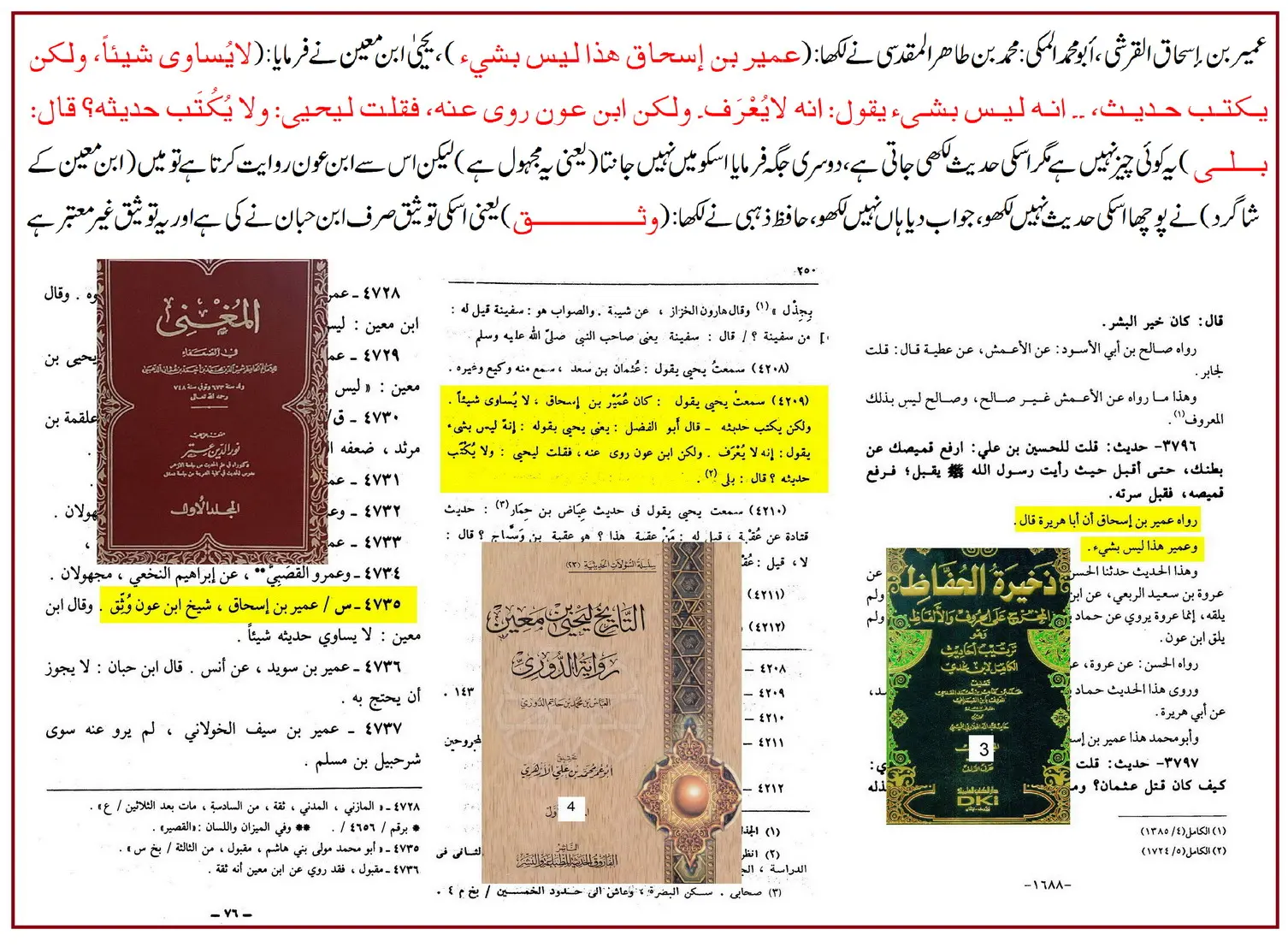
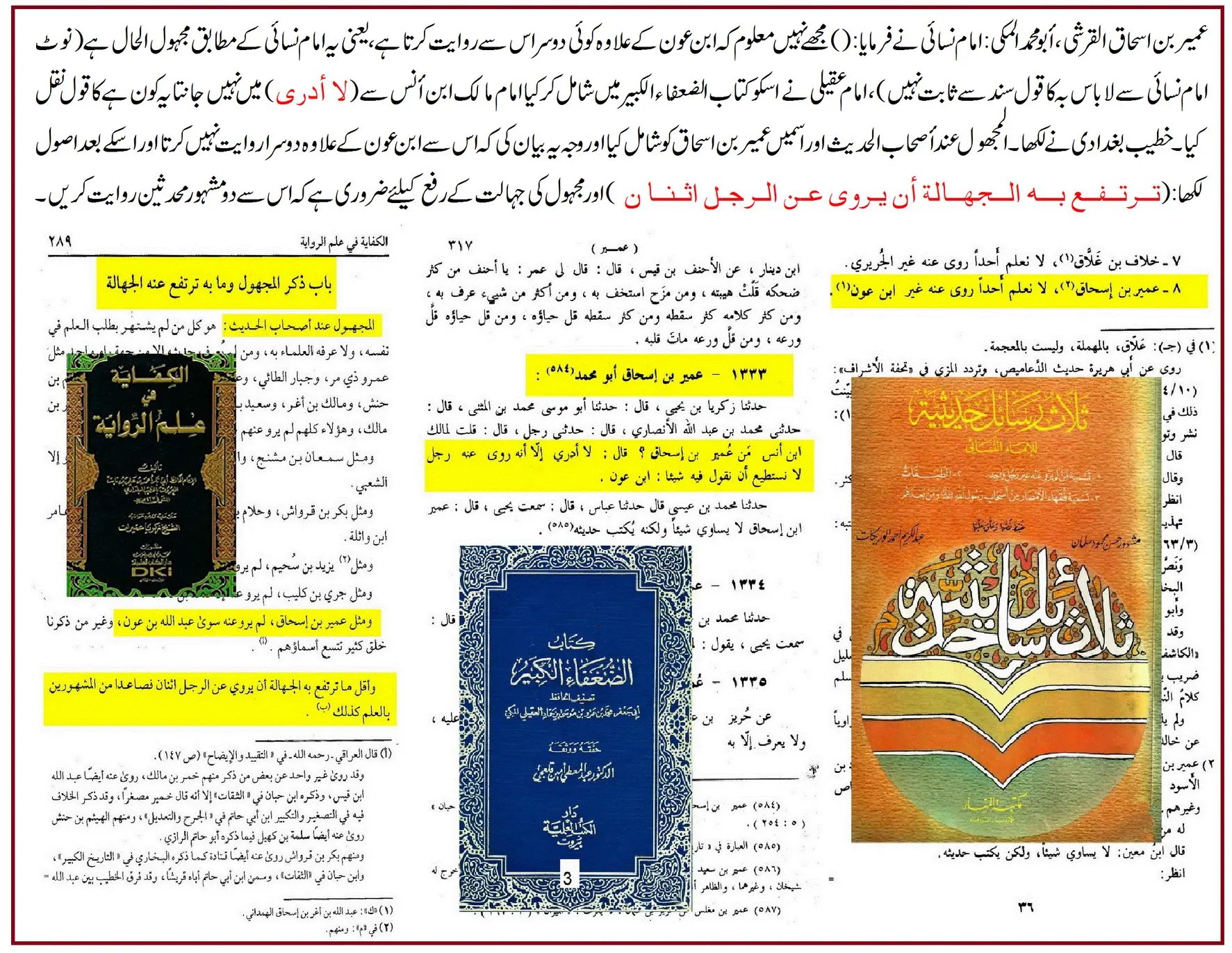
This narration is severely weak. In its chain is ʿUmayr bin Isḥāq, who is unknown.Criticisms of Hadith scholars:
① Ibn Ḥajar: “Maqbūl” (accepted only in corroboration; not proof alone)
② Ibn Maʿīn: "لا يساوي شيئا"
③ Ibn al-Jawzī: “Weak”
④ al-ʿUqaylī: "حديث لا يتابع عليه"
⑤ al-Khaṭīb al-Baghdādī: "مجهول عند أصحاب الحديث"
Reference:
Reference: al-Kifāyah fī ʿIlm al-Riwāyah (al-Khaṭīb al-Baghdādī)
❖ Therefore, this report is not fit for argument.
Original Objection (Barelvi Proof 14)
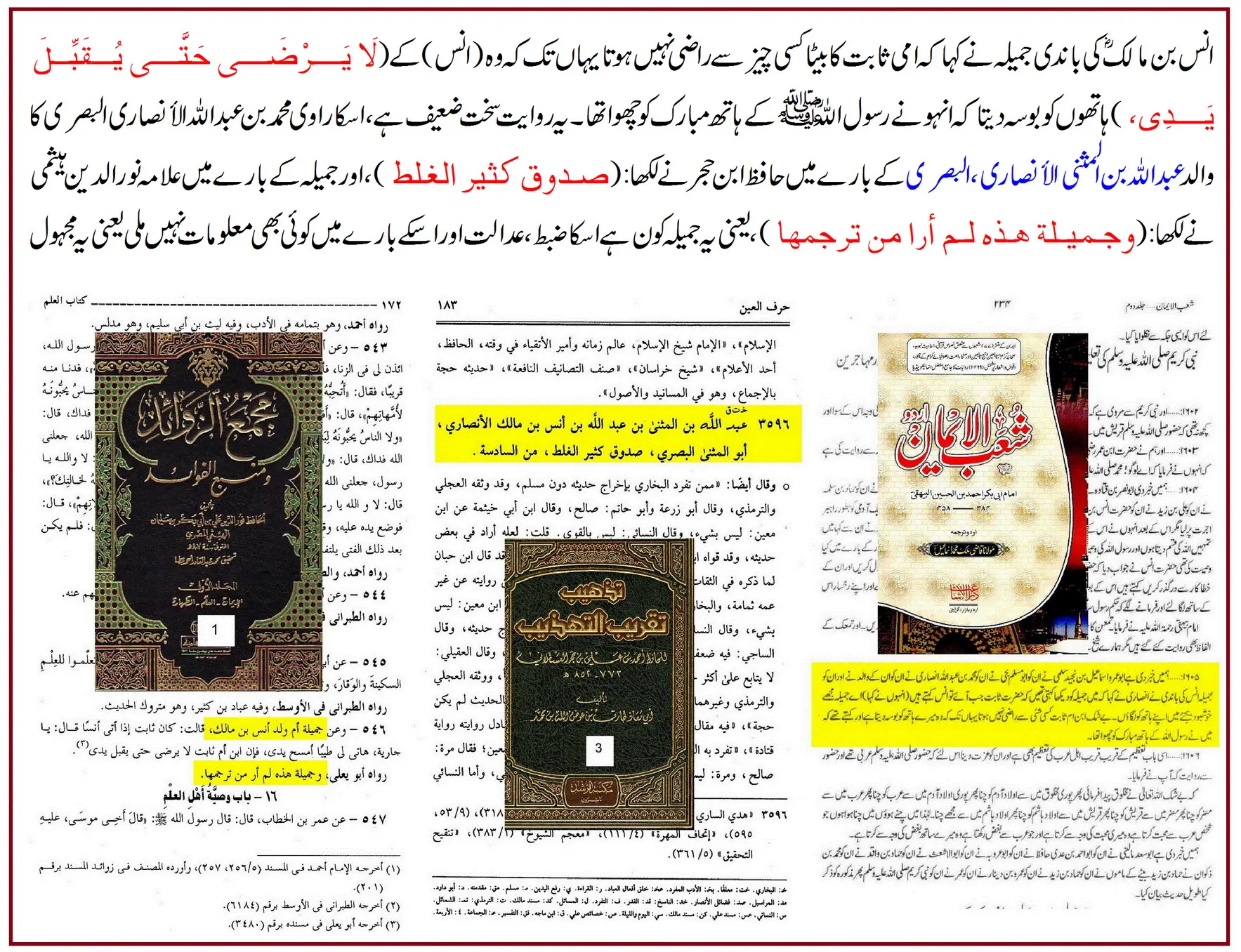
The Barelvi slanderer said:❖ “Thābit al-Bunānī رحمه الله would not release the hand of Anas bin Mālik رضي الله عنه until he kissed it…”
(Arabic text as quoted)
Reference:
Reference: Shuʿab al-Īmān (al-Bayhaqī): 1492
Translation:
Jamīlah, the servant of Anas, said: whenever Thābit came, Anas would ask for perfume to apply to his hand, for Thābit would not be satisfied until he kissed his hand and said: “You touched the hand of the Messenger of Allah ﷺ.”
Research-Based Answer (Answer 14)
This narration is weak.① It contains ʿAbdullāh bin al-Muthannā al-Anṣārī—about whom Ibn Ḥajar said:
"صدوق كثير الغلط”
Translation: “Truthful, but makes many mistakes.”
Reference:
Reference: Taqrīb al-Tahdhīb
② The narrator Jamīlah (servant of Anas) is unknown. al-Haythamī said:
"جميلة هذه لم أر من ترجمها.”
Translation: “I have not seen anyone who wrote her biography.”
Reference:
Reference: Majmaʿ al-Zawā’id: 546
❖ Hence, this report cannot be used to establish a Sharʿī ruling.
Original Objection (Barelvi Proof 15)
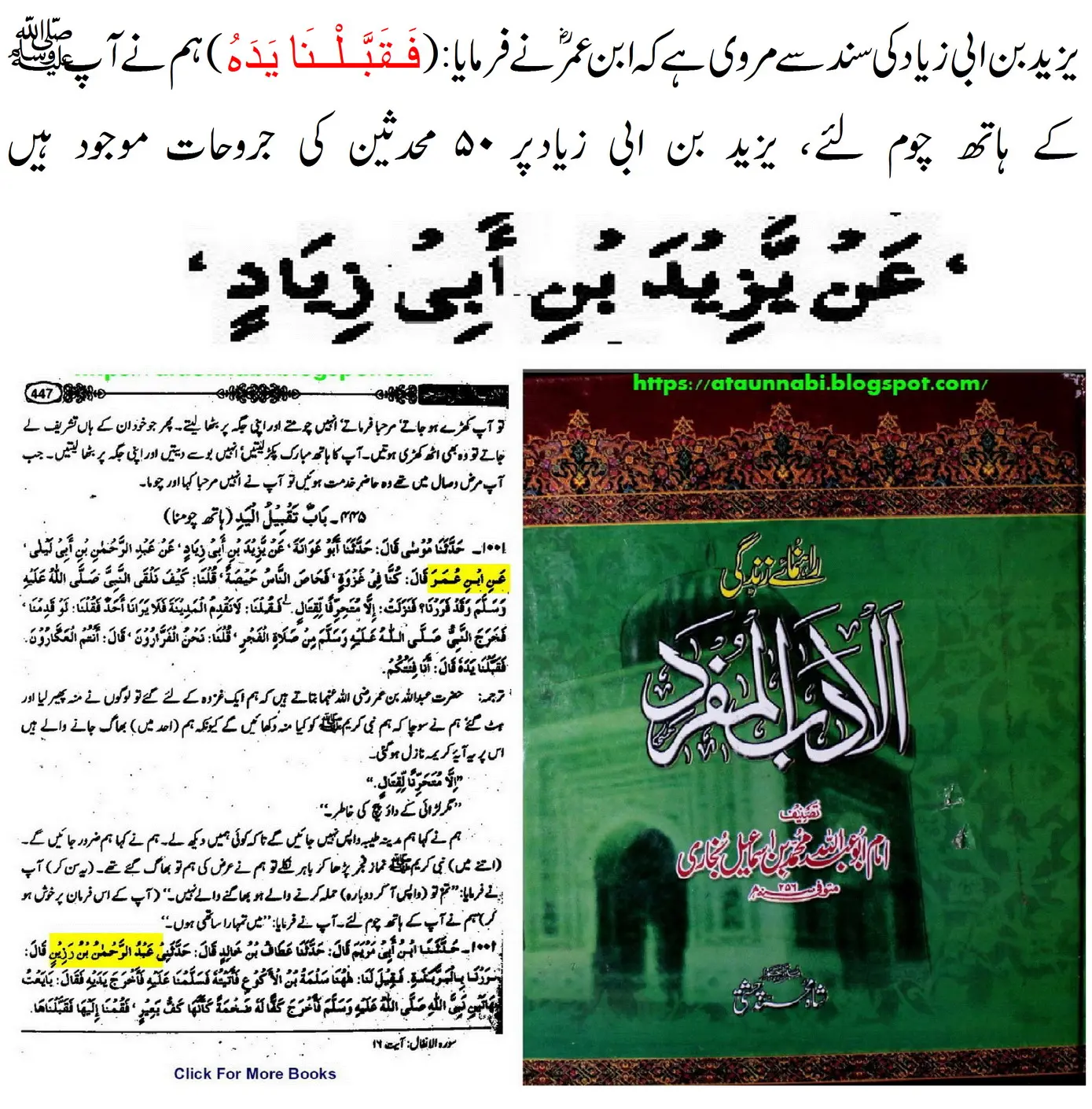
The Barelvi slanderer said:❖ “Ibn ʿUmar رضي الله عنه narrated… then we came to the Prophet ﷺ and kissed his hands.”
(Arabic text as quoted)
Reference:
Reference: al-Adab al-Mufrad (al-Bukhārī): 972
Translation:
Ibn ʿUmar رضي الله عنه said: “We were on an expedition… then we came to the Messenger of Allah ﷺ and kissed his hand.”
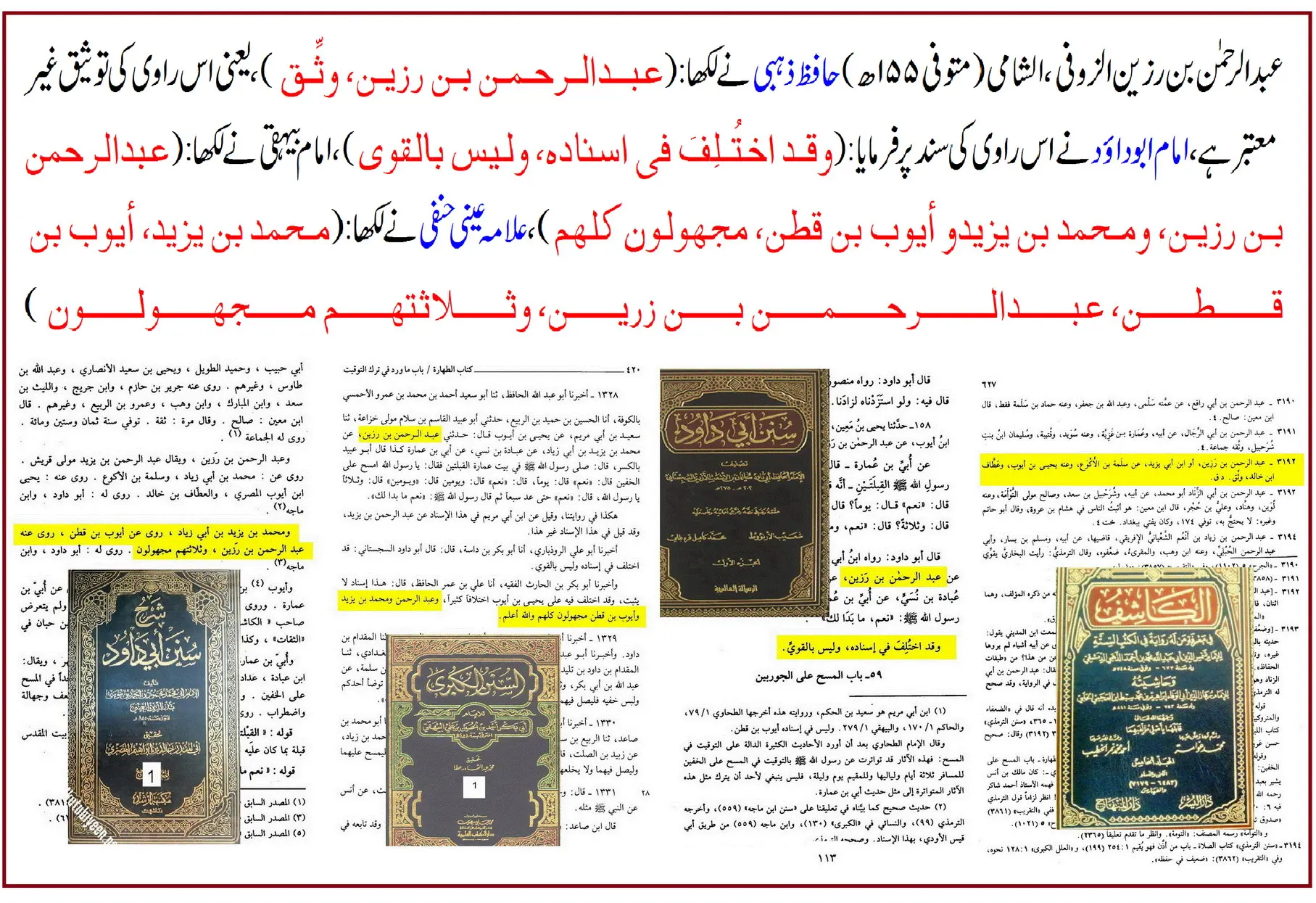
Research-Based Answer (Answer 15)
In its chain is Yazīd bin Abī Ziyād, who is severely weak.(criticisms as listed)
❖ Therefore, it is not proof.
Original Objection (Barelvi Proof 16)
The Barelvi slanderer said:❖ “ʿAbd al-Raḥmān bin Razīn said… we kissed the hands of Salamah bin al-Akwaʿ رضي الله عنه.”
(Arabic text as quoted)
Reference:
Reference: al-Adab al-Mufrad (al-Bukhārī): 973
Translation:
“We visited Salamah bin al-Akwaʿ رضي الله عنه… he showed his hands and said: with these hands I pledged to the Prophet ﷺ… so we kissed them.”
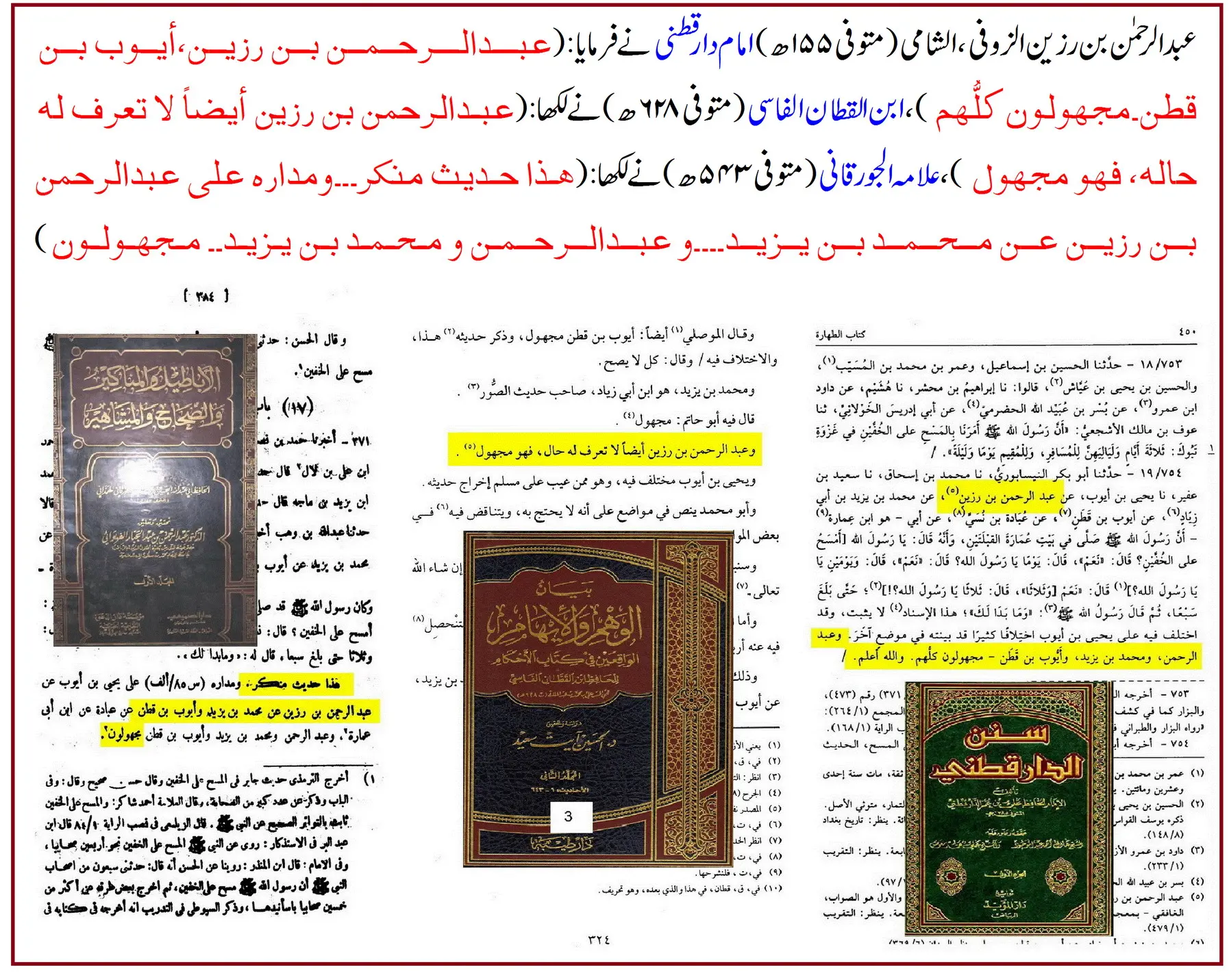
Research-Based Answer (Answer 16)
Its chain is weak because ʿAbd al-Raḥmān bin Razīn is unknown.(criticisms as listed)
❖ Therefore, it is not proof.
Original Objection (Barelvi Proof 17)
The Barelvi slanderer said:❖ “Wāziʿ bin ʿĀmir رضي الله عنه said… we took the Prophet’s ﷺ hands and feet and kissed them.”
(Arabic text as quoted)
Reference:
Reference: al-Adab al-Mufrad (al-Bukhārī): 975
Translation:
“We arrived and it was said: this is the Messenger of Allah ﷺ. So we took his hands and feet and kissed them.”
Research-Based Answer (Answer 17)
This narration is weak because the narrator Umm Abān bint al-Wāziʿ is unknown. Shaykh al-Albānī said: "ضعيف الإسناد.”❖ Therefore, it is not proof.
Original Objection (Barelvi Proof 18)
The Barelvi slanderer said:❖ “Ṣuhayb رضي الله عنه said: I saw ʿAlī رضي الله عنه kissing the hands and feet of al-ʿAbbās رضي الله عنه.”
(Arabic text as quoted)
Reference:
Reference: al-Adab al-Mufrad (al-Bukhārī): 976
Translation:
“I saw ʿAlī رضي الله عنه kissing the hand and the feet of al-ʿAbbās رضي الله عنه.”
Research-Based Answer (Answer 18)
It is weak because the narrator Ṣuhayb is unknown.Shaykh al-Albānī: "ضعيف الإسناد موقوف.”
Shuʿayb al-Arna’ūṭ: “Its narrators are trustworthy except this Ṣuhayb, for he is not known.”
❖ Hence, it is not proof.
Original Objection (Barelvi Proof 19)
The Barelvi slanderer said:❖ “This was also the belief of Imām Muslim—he sought permission to kiss Imām al-Bukhārī’s feet.”
(Arabic report as quoted)
Reference:
Reference: Tārīkh Dimashq (Ibn ʿAsākir)
Translation:
Imām Muslim came to Muḥammad bin Ismāʿīl al-Bukhārī, kissed between his eyes, and said: “Let me kiss your feet…”
Research-Based Answer (Answer 19)
This report is not reliably established due to a narrator in its chain: Abū Naṣr Aḥmad bin al-Ḥasan bin Ḥamūyah al-Warrāq—unknown.Ibn Abī Ḥātim explained that when a narrator is described merely as “Shaykh,” it is a low grade of approval and is not used for proof.
Reference:
Reference: al-Jarḥ wa al-Taʿdīl (Ibn Abī Ḥātim)
❖ Hence, this incident is not proven and cannot be used as a Sharʿī proof.
Original Objection (Barelvi Proof 20)
The Barelvi slanderer said:❖ “Imām al-Shāfiʿī رحمه الله said: kissing sacred places for blessings and kissing the hands and feet of the righteous is permissible.”
But the cited quotation is:
"وَقَالَ شَيْخُنَا زَيْنُ الدِّينِ: وَأَمَّا تَقْبِيلُ الْأَمَاكِنِ الشَّرِيفَةِ عَلَى قَصْدِ التَّبَرُّكِ، وَكَذَلِكَ تَقْبِيلُ أَيْدِي الصَّالِحِينَ وَأَرْجُلِهِمْ، فَهُوَ حَسَنٌ مَحْمُودٌ بِاعْتِبَارِ الْقَصْدِ وَالنِّيَّةِ.”
Reference:
Reference: ʿUmdat al-Qārī Sharḥ Ṣaḥīḥ al-Bukhārī
Research-Based Answer (Answer 20)
❖ In reality, this is not a statement of Imām al-Shāfiʿī رحمه الله. Rather, it is from Imām Zayn al-Dīn al-ʿIrāqī رحمه الله (d. 804 AH), and it was نقل (quoted) by al-ʿAynī al-Ḥanafī.❖ Moreover, Ḥāfiẓ Ibn Ḥajar al-ʿAsqalānī رحمه الله (student of Zayn al-Dīn al-ʿIrāqī) refuted his teacher’s statement and said:
"قال شيخنا – يعني زين الدين العراقي – في شرح الترمذي: فيه كراهة تقبيل ما لم يرد الشرع بتقبيله.”
Translation: “Our Shaykh—meaning Zayn al-Dīn al-ʿIrāqī—said in Sharḥ al-Tirmidhī: there is dislike (karāhah) in kissing that which the Sharīʿah has not legislated to be kissed.”
Reference:
Reference: Fatḥ al-Bārī (Ibn Ḥajar): 3/463
❖ Therefore, the claim that Imām al-Shāfiʿī permitted kissing graves or hands and feet is a false attribution.
Summary and Conclusion
❖ The Barelvi slanderer mentioned a total of 20 proofs, but research clarified that:◈ Most narrations contain unknown narrators, or are munkar or fabricated.
◈ Some statements are merely weak reports or the opinions of unreliable individuals.
◈ In many places, false attributions were made to major Imams.
❖ Conclusion: Kissing graves, hands and feet, or sacred places as an act of veneration is not established in the Sharīʿah. Rather, it is an innovation and resembles the practices of the Jews and Christians.

