Compiled by: Abu Hamza Salafi
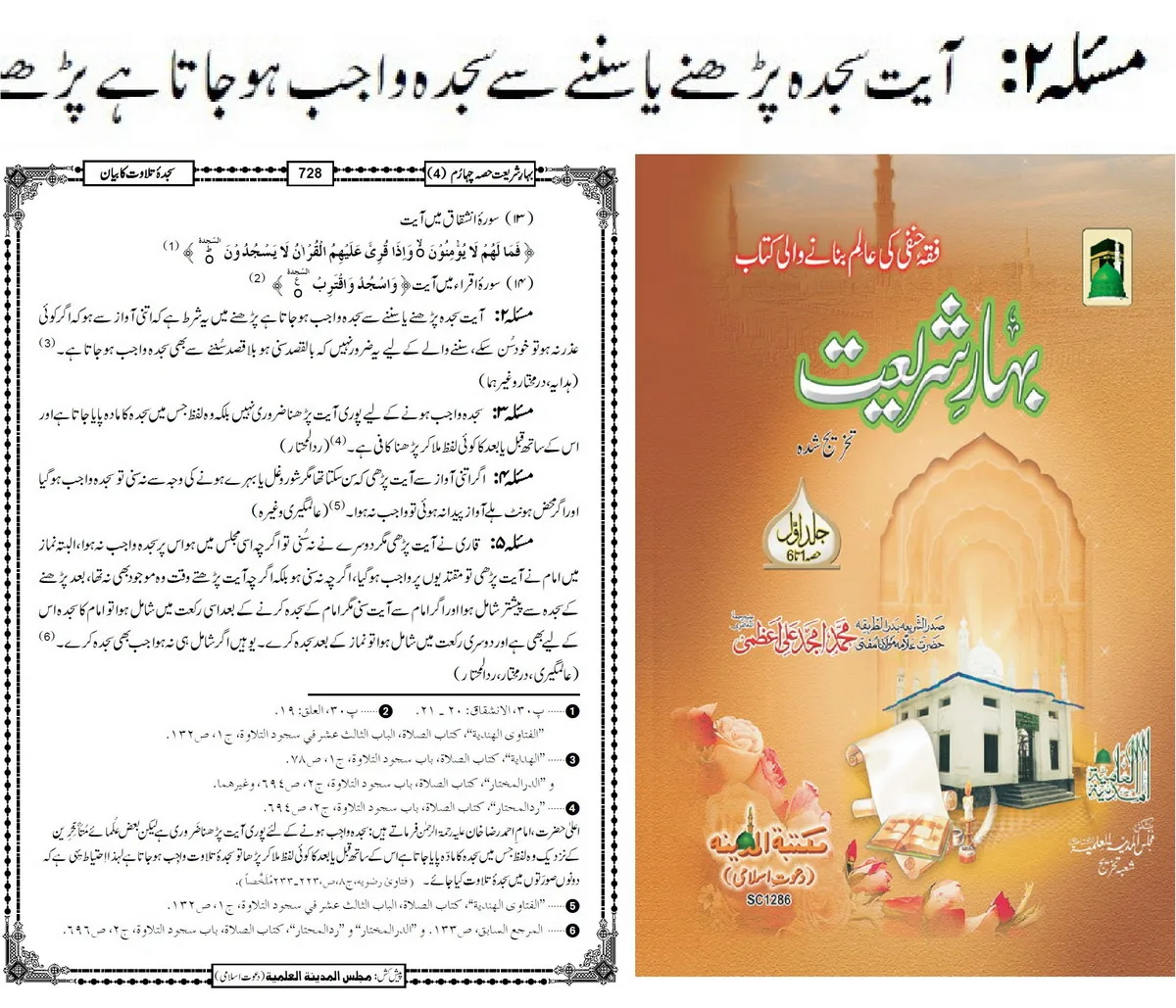
The fundamental difference among jurists regarding Sajdah Tilawat is whether it is wajib (obligatory) or a confirmed Sunnah. According to the vast majority (jumhur) of the companions of the Prophet, the Tabi‘in, and the Imams of Hadith and Fiqh from the early centuries, Sajdah Tilawat is Sunnah, not obligatory or wajib, whereas in Hanafi Fiqh it is considered wajib. The purpose of this article is to clarify that according to the majority of Muhaddithin and jurists, Sajdah Tilawat is legally prescribed and a recommended act, but not performing it does not incur a sin. There are continuous evidences from the Qur’an, Hadith, the practices of the companions, and the statements of the Imams supporting this, while the Hanafi position is a unique and weak opinion.
Background and the Main Discussion
Sajdah Tilawat refers to the prostration performed upon reciting or hearing specific verses of prostration in the Holy Quran. According to the consensus of the majority of hadith scholars and the companions and followers, this prostration is a Sunnah and recommended act of worship, and there is no blame for neglecting it. The Hanafi school has classified it as "Wajib," placing it somewhat below the level of Fard but above a general Sunnah. Below, first the practices of the companions and followers are presented, then the texts of the four Imams and hadith scholars, and finally a summary and conclusion will be mentioned.
① The practice and clarification of Sayyiduna Umar ibn al-Khattab (RA) (Sahih Bukhari)
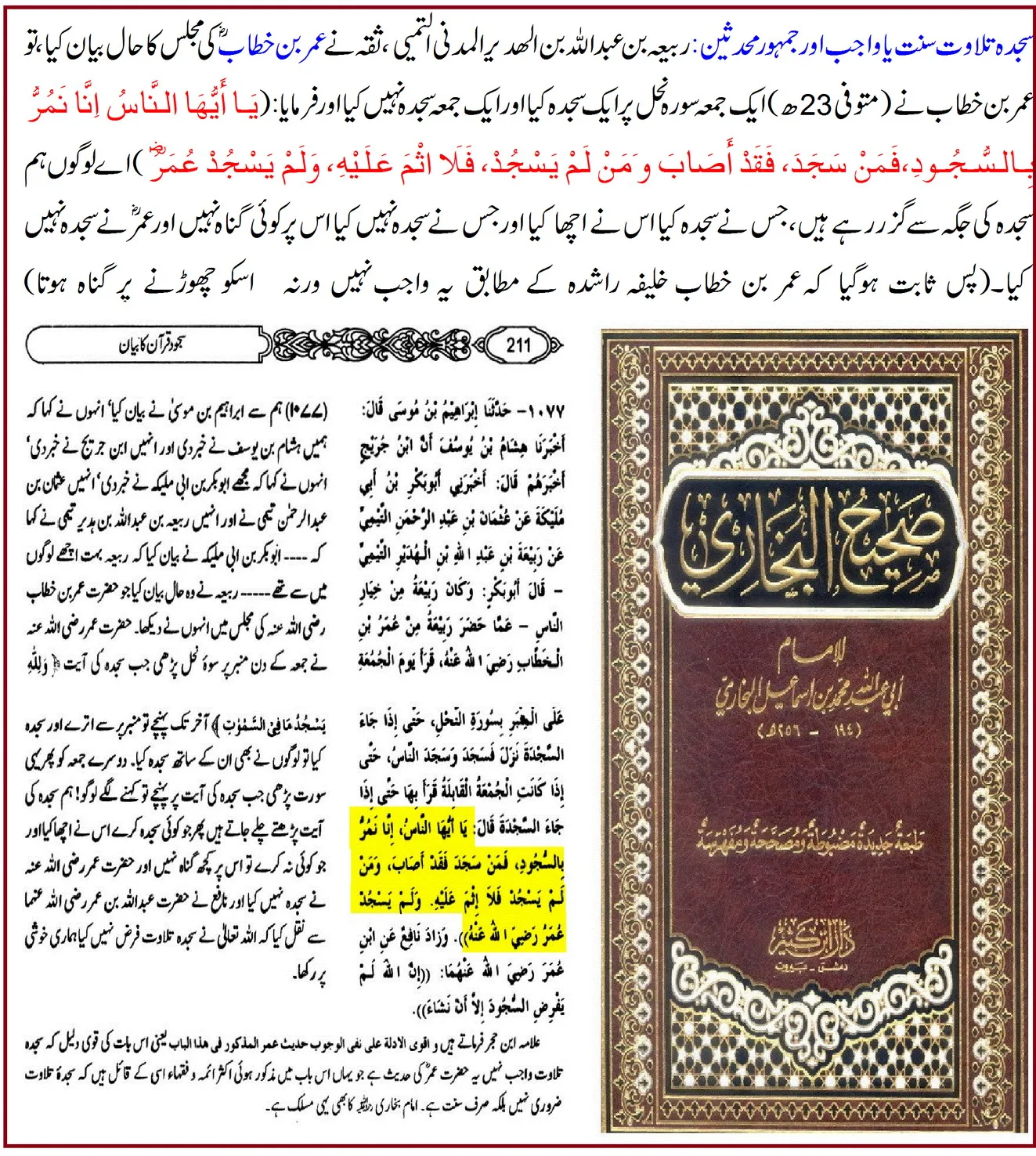
1077- حَدَّثَنَا إِبْرَاهِيمُ بْنُ مُوسَى، قَالَ: أَخْبَرَنَا هِشَامُ بْنُ يُوسُفَ، أَنَّ ابْنَ جُرَيْجٍ أَخْبَرَهُمْ، قَالَ: أَخْبَرَنِي أَبُو بَكْرِ بْنُ أَبِي مُلَيْكَةَ، عَنْ عُثْمَانَ بْنِ عَبْدِ الرَّحْمَنِ التَّيْمِيِّ، عَنْ رَبِيعَةَ بْنِ عَبْدِ اللَّهِ بْنِ الهُدَيْرِ التَّيْمِيِّ، قَالَ أَبُو بَكْرٍ: وَكَانَ رَبِيعَةُ مِنْ خِيَارِ النَّاسِ، عَمَّا حَضَرَ رَبِيعَةُ مِنْ عُمَرَ بْنِ الخَطَّابِ رَضِيَ اللَّهُ عَنْهُ، قَرَأَ يَوْمَ الجُمُعَةِ عَلَى المِنْبَرِ بِسُورَةِ النَّحْلِ حَتَّى إِذَا جَاءَ السَّجْدَةَ نَزَلَ، فَسَجَدَ وَسَجَدَ النَّاسُ حَتَّى إِذَا كَانَتِ الجُمُعَةُ القَابِلَةُ قَرَأَ بِهَا، حَتَّى إِذَا جَاءَ السَّجْدَةَ، قَالَ: «يَا أَيُّهَا النَّاسُ إِنَّا نَمُرُّ بِالسُّجُودِ، فَمَنْ سَجَدَ، فَقَدْ أَصَابَ وَمَنْ لَمْ يَسْجُدْ، فَلاَ إِثْمَ عَلَيْهِ وَلَمْ يَسْجُدْ عُمَرُ رَضِيَ اللَّهُ عَنْهُ»
Translation:
It is narrated from Rabi'ah bin Abdullah Taymi, may Allah have mercy on him, that he was in the assembly of Umar bin Al-Khattab, may Allah be pleased with him. On a Friday, he recited Surah An-Nahl from the pulpit. When he reached the verse with prostration, he came down from the pulpit and prostrated, and the people also prostrated. The next Friday, he recited the same Surah again, and when the verse of prostration came, he said: "O people! We are passing by the verse of prostration, so whoever prostrated has done well, and whoever did not prostrate, there is no sin upon him," and on that day Umar, may Allah be pleased with him, did not prostrate himself.
Reference: Al-Kitab: Sahih al-Bukhari
Jurisprudential Summary:
The announcement of Sayyiduna Umar, may Allah be pleased with him, in a large gathering of people that "there is no sin on the one who does not prostrate" is a clear proof that prostration of recitation is not obligatory; otherwise, he would not have negated sin nor refrained from it himself.
② Clarification of Sayyiduna Abdullah bin Umar, may Allah be pleased with him: "Prostration has not been made obligatory upon us except if we wish"
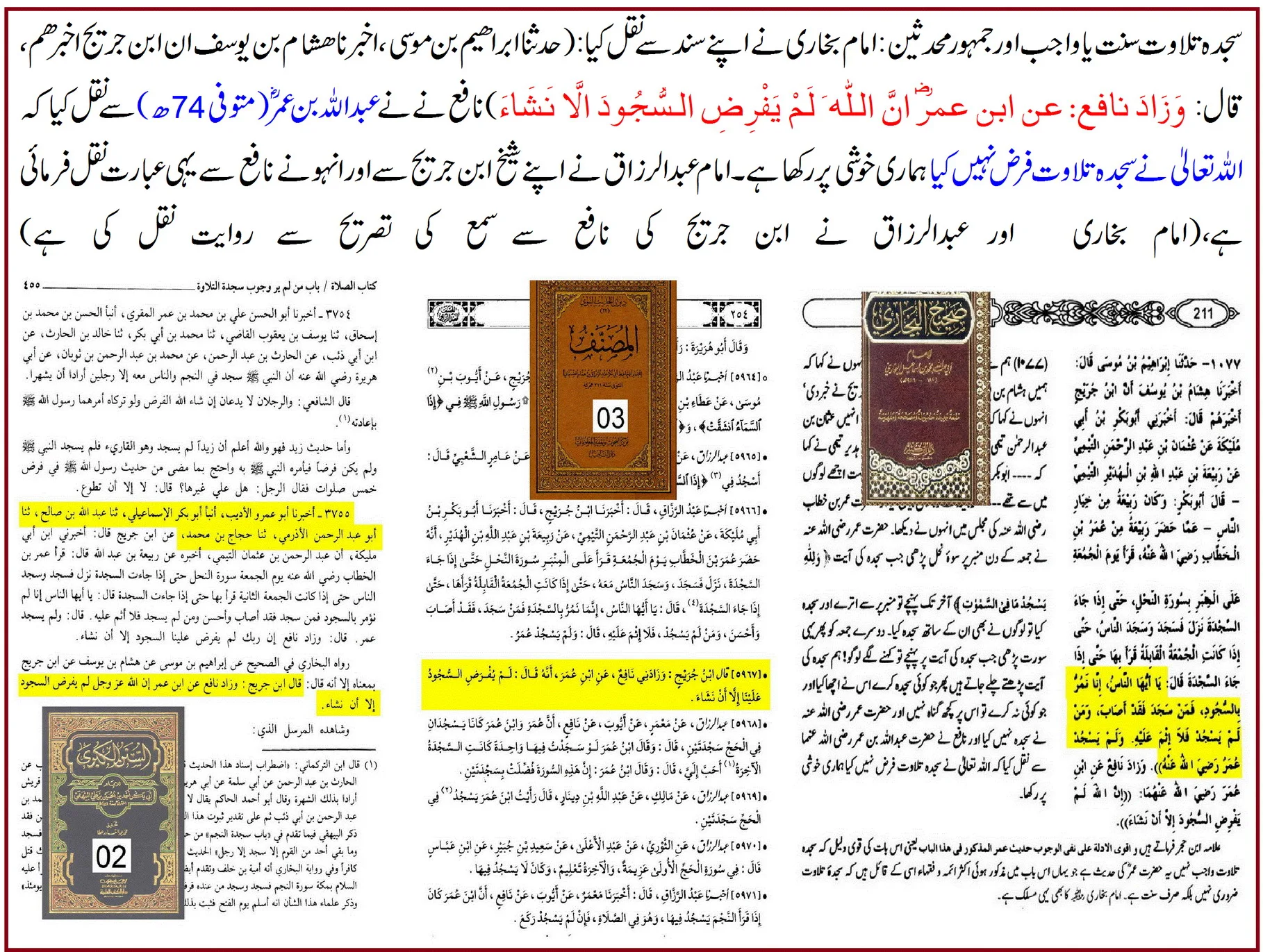
1077 - حَدَّثَنَا إِبْرَاهِيمُ بْنُ مُوسَى، قَالَ: أَخْبَرَنَا هِشَامُ بْنُ يُوسُفَ، أَنَّ ابْنَ جُرَيْجٍ أَخْبَرَهُمْ، قَالَ: أَخْبَرَنِي----- وَزَادَ نَافِعٌ، عَنِ ابْنِ عُمَرَ رَضِيَ اللَّهُ عَنْهُمَا، «إِنَّ اللَّهَ لَمْ يَفْرِضِ السُّجُودَ إِلَّا أَنْ نَشَاءَ»
Translation:
Nafi' (may Allah have mercy on him) says that Ibn Umar (may Allah be pleased with them both) said: "Allah Almighty has not made the prostration (of recitation) obligatory upon us, except if we ourselves wish to do it."
5889 - عَبْدُ الرَّزَّاقِ، قَالَ: أَخْبَرَنَا ابْنُ جُرَيْجٍ قَالَ:--- قَالَ ابْنُ جُرَيْجٍ: وَزَادَنِي نَافِعٌ، عَنِ ابْنِ عُمَرَ أَنَّهُ قَالَ: «لَمْ يُفْرَضِ السُّجُودُ عَلَيْنَا إِلَّا أَنْ نَشَاءُ»
Translation:
Abdur Razzaq says: Ibn Jurayj said, Nafi' told me from Ibn Umar (may Allah be pleased with them both) that he said: "The prostration is not obligatory upon us, except if we wish (to do it)."
Reference: Al-Kitab: Al-Musannaf
Author: Abu Bakr Abd al-Razzaq ibn Hammam ibn Nafi' al-Himyari al-Yamani al-San'ani (died: 211 AH)
Author: Abu Bakr Abd al-Razzaq ibn Hammam ibn Nafi' al-Himyari al-Yamani al-San'ani (died: 211 AH)
Jurisprudential Summary:
The clear statement of the jurist companion Ibn Umar (may Allah be pleased with him) that "it is not obligatory upon us" is explicit that the prostration of recitation does not reach the level of obligation but is dependent on choice, meaning it is a Sunnah and recommended act.
③ Statement of Imam Ata ibn Abi Rabah (may Allah have mercy on him) (a Tabi'i jurist)
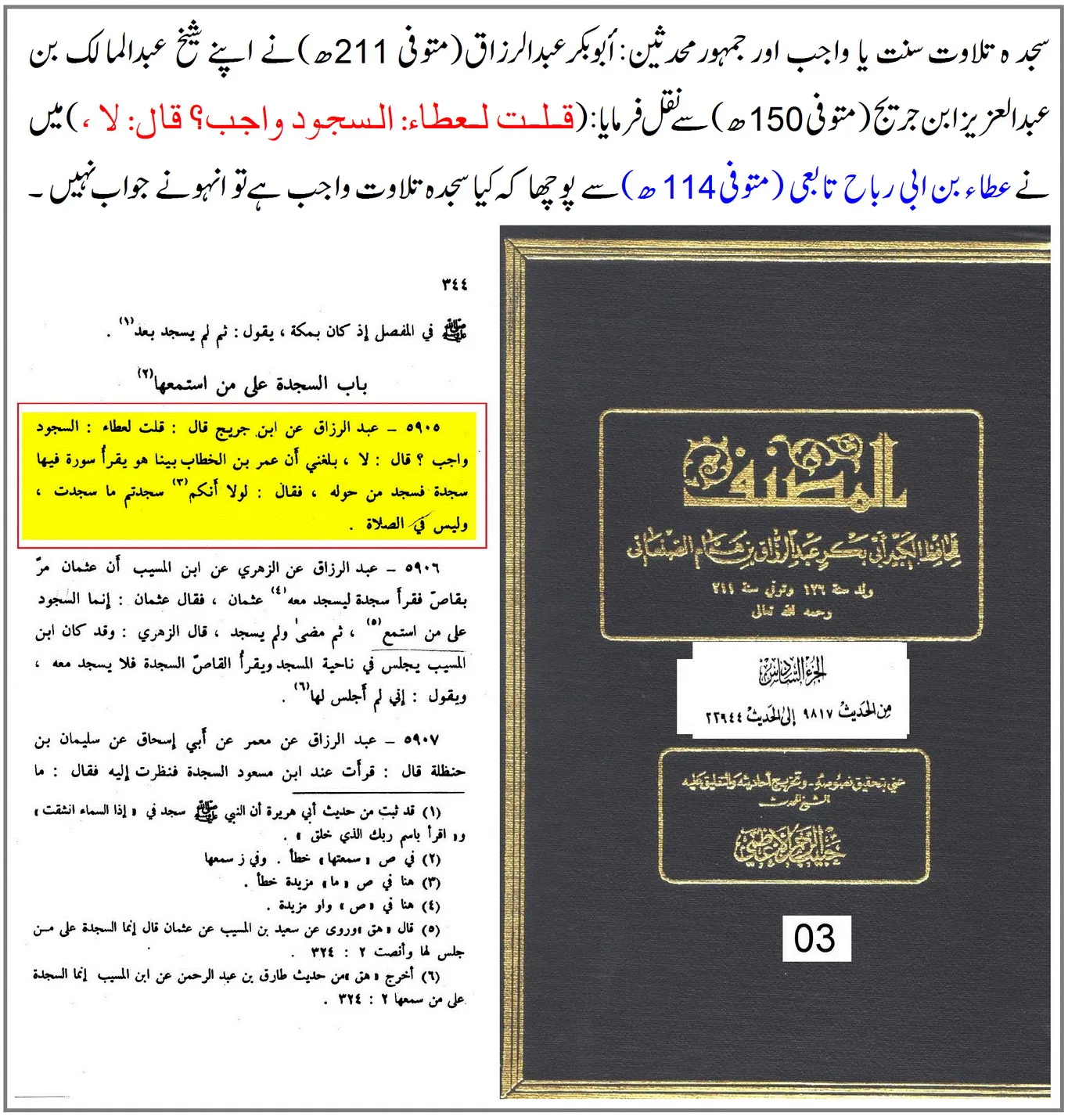
5905 - عَنِ ابْنِ جُرَيْجٍ قَالَ: قُلْتُ لِعَطَاءٍ: السُّجُودُ وَاجِبٌ؟ قَالَ: لَا،
Translation:
Ibn Jurayj (may Allah have mercy on him) narrates: I asked Ata (ibn Abi Rabah): Is this prostration obligatory? He said: "No."
Reference: Al-Kitab: Al-Musannaf
Author: Abu Bakr Abd al-Razzaq ibn Hammam ibn Nafi' al-Himyari al-Yamani al-San'ani (died: 211 AH)
Author: Abu Bakr Abd al-Razzaq ibn Hammam ibn Nafi' al-Himyari al-Yamani al-San'ani (died: 211 AH)
Jurisprudential Summary:
The follower Imam Ata ibn Abi Rabah (died 211 AH) was among the great jurists of Makkah. His clear answer "No" confirms that considering the prostration of recitation (Sajdat al-Tilawah) as obligatory is against the well-known methodology of the Salaf.
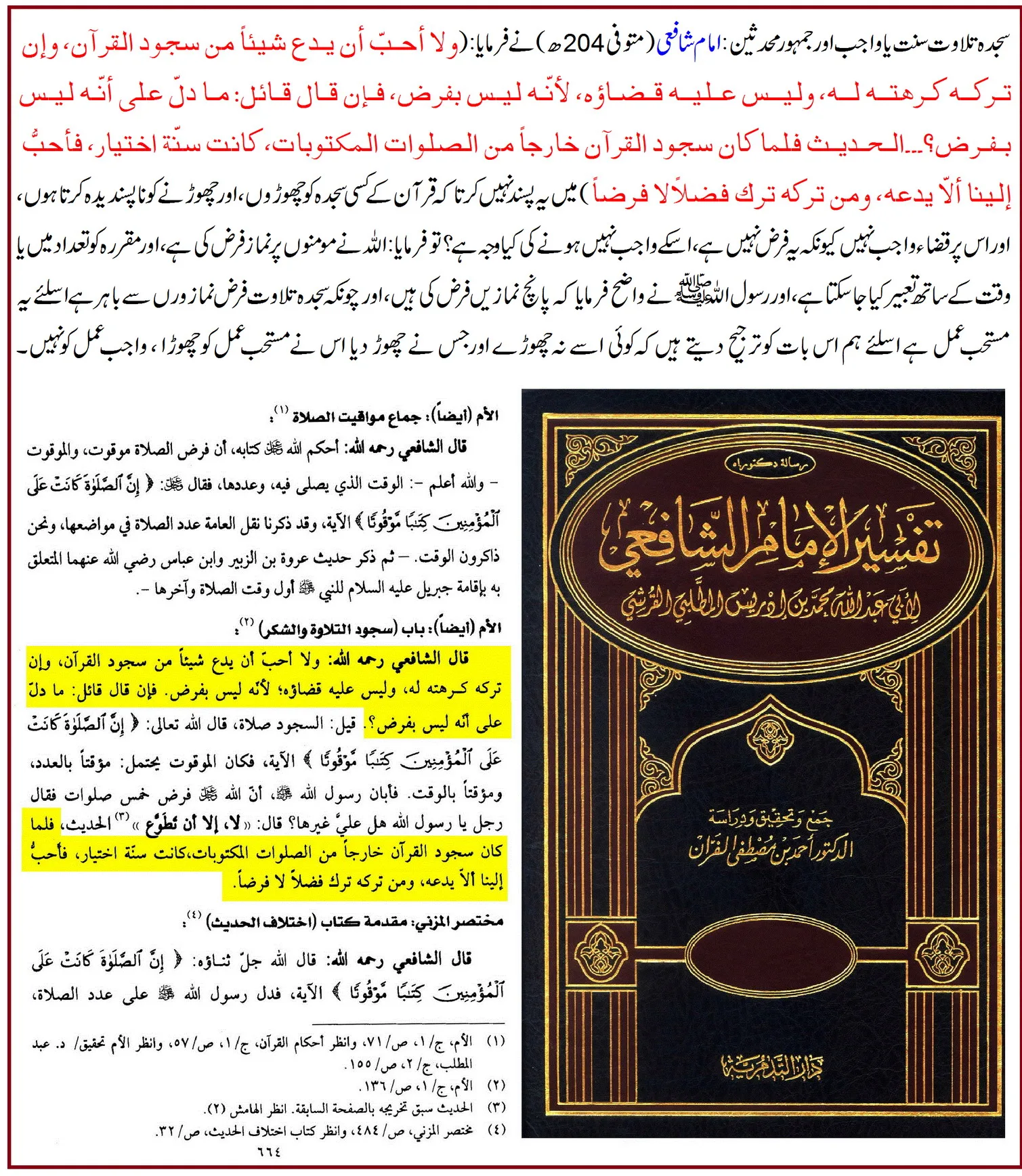
④ Imam Shafi'i's Detailed Principled Argument
قال الشَّافِعِي رحمه الله: ولا أحبُّ أن يدع شيئاً من سجود القرآن، وإن تركه كرهته له، وليس عليه قضاؤه؛ لأنَّه ليس بفرض.
فإن قال قائل: ما دلَّ على أنه ليس بفرض؟
قيل: السجود صلاة، قال اللَّه تعالى:
(إِنَّ الصَّلَاةَ كَانَتْ عَلَى الْمُؤْمِنِينَ كِتَابًا مَوْقُوتًا) الآية.
فكان الموقوت يحتمل: مؤقتاً بالعدد، ومؤقتاً بالوقت.
فأبان رسول الله - صلى الله عليه وسلم - أن اللَّه - عز وجل - فرض خمس صلوات فقال رجل يا رسول اللَّه هل على غيرها؟
قال: " لا، إلا أن تطَوَّع" الحديث.
فلما كان سجود القرآن خارجاً من الصلوات المكتوبات، كانت سُنَّة اختيار، فأحبُّ إلينا ألَّا يدعه، ومن تركه ترك فضلاً لا فرضاً.
Translation (Summary):
Imam Shafi'i, may Allah have mercy on him, says: "I do not like that any prostration of the Quran be left out; if someone leaves it out, I dislike it, but making it obligatory to make up is not necessary; because it is not obligatory. If someone asks what is the evidence that it is not obligatory, it will be said: Prostration is essentially a form of prayer, and Allah Almighty has said: 'Indeed, prayer has been decreed upon the believers a decree of specified times,' and the Messenger of Allah ﷺ clearly stated that Allah has only made five prayers obligatory, and further said: 'No, except that you perform voluntary prayers.' Since the prostration of recitation occurs outside the obligatory prayers, it is therefore a voluntary Sunnah. In our view, it is better not to leave it out, and whoever leaves it out is not abandoning an obligation but rather a virtue."
Reference: Book: Tafsir Imam Al-Shafi'i
Author: Al-Shafi'i Abu Abdullah Muhammad ibn Idris (died: 204 AH)
Author: Al-Shafi'i Abu Abdullah Muhammad ibn Idris (died: 204 AH)
Fiqh Summary:
Imam Al-Shafi'i, may Allah have mercy on him, proved from the text of the Hadith that the obligatory prostrations are only those of the five daily prayers. When the prostration of recitation (Sajdat al-Tilawah) is outside of these, it is not obligatory, but rather a confirmed Sunnah and a "virtue," the neglect of which is not sinful but results in the loss of reward.
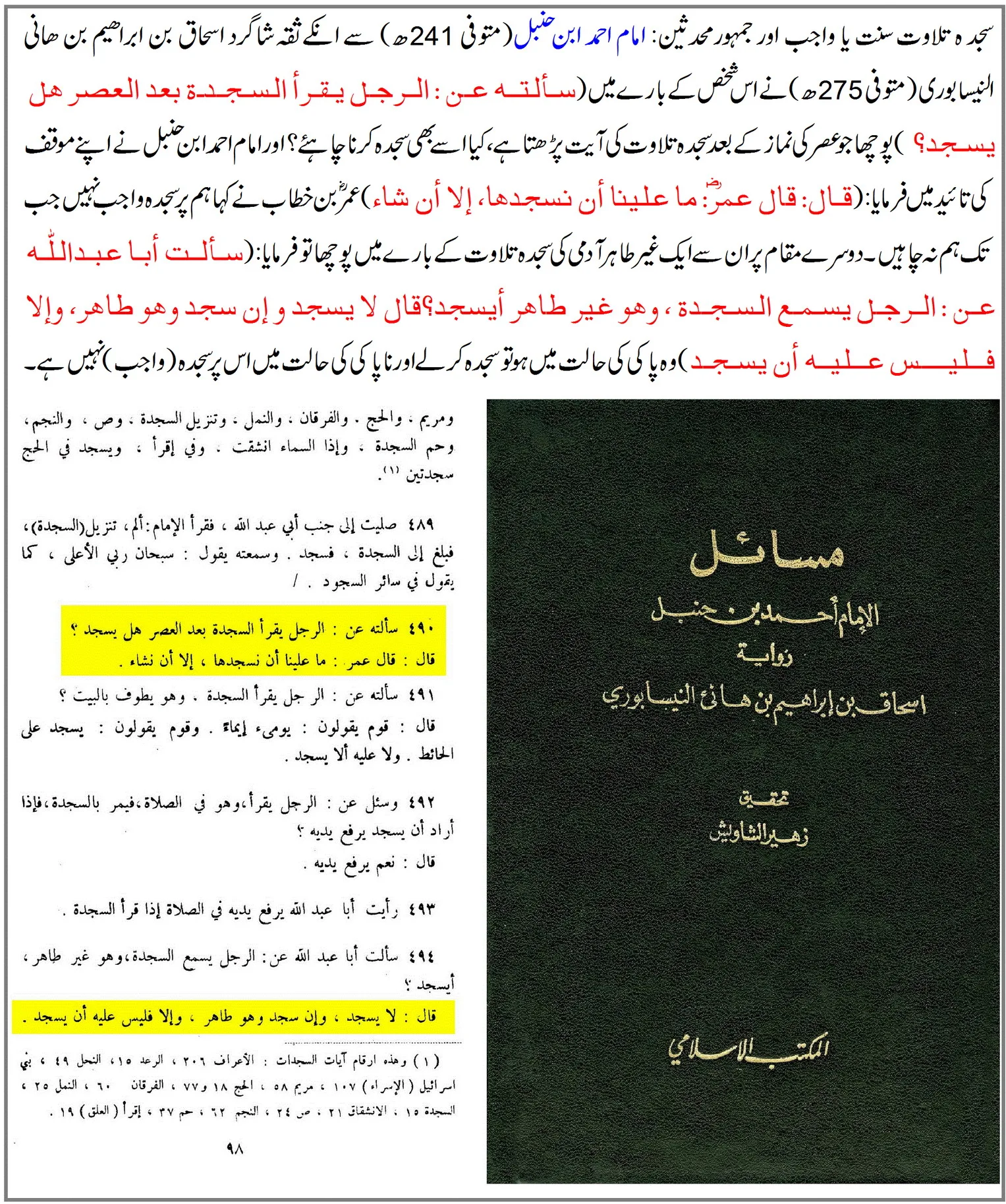
⑤ Fatwas transmitted from Imam Ahmad ibn Hanbal, may Allah have mercy on him (Masail Ibn Hani)
① Question about the prostration of recitation after Asr:
490:- سألته عن الرجل يقرأ السجدة بعد العصر هل يسجد؟
قال: قال عمر: ما علينا أن نسجدها، إلا أن نشاء
Translation:
Ishaq ibn Ibrahim ibn Hani says: I asked Imam Ahmad that if a person recites a verse requiring prostration after Asr prayer, should he perform the prostration?
He replied by quoting the statement of Sayyiduna Umar, may Allah be pleased with him: "It is not obligatory upon us to perform this prostration unless we wish to do so."
② Prostration of recitation by a person without ablution:
٤۹٣ - رأيت أبا عبد الله يرفع يديه في الصلاة إذا قرأ السجدة.
٤۹٤ - سألت أبا عبد الله عن الرجل يسمع السجدة، وهو غير طاهر، أيسجد؟
قال: لا يسجد، وإن سجد وهو طاهر، وإلا فليس عليه أن يسجد.
Translation:
The narrator says: "I saw Abu Abdullah (Imam Ahmad) reciting the verse of prostration in prayer and raising his hands (with the intention of prostration of recitation)."
And I asked Imam Ahmad about a person who hears the verse of prostration and is not in a state of ablution, should he prostrate?
He said: "He should not prostrate. And if he is in a state of purity, then he should prostrate, otherwise prostration is not obligatory on him."
Reference: Al-Kitab: Masa'il Ibn Hani by Imam Ahmad
Jurisprudential Summary:
Imam Ahmad, may Allah have mercy on him, citing the statement of Umar, may Allah be pleased with him, and saying "falyas'al 'alayhi an yasjud" (it is not obligatory on him to prostrate) for the listener who is not in ablution, both guide towards the reality that prostration of recitation is not obligatory; otherwise, he would have commanded obligation or mentioned making up the prostration even for one without ablution.
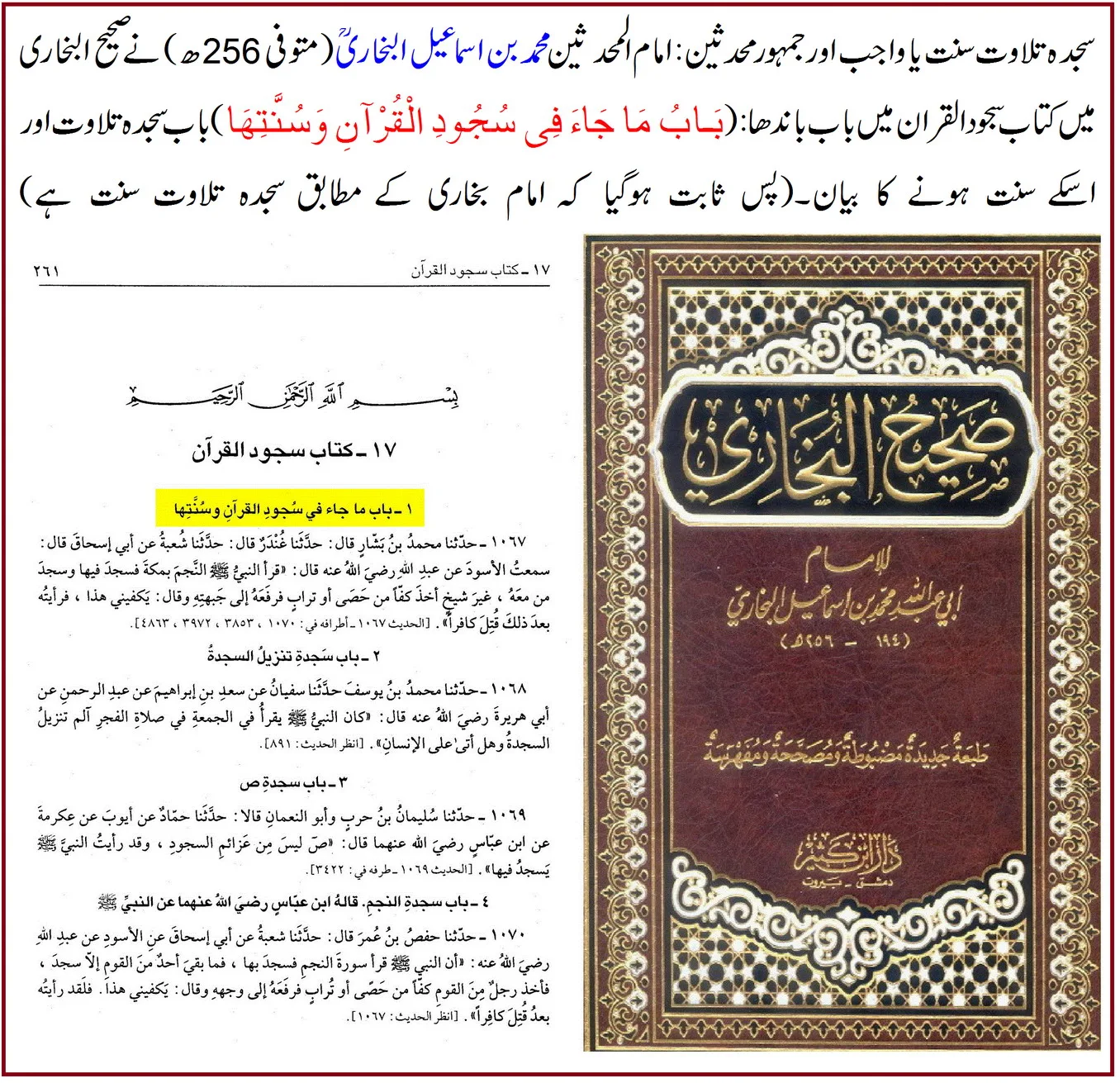
⑥ Chapter of Imam Bukhari, may Allah have mercy on him: “Prostrations of the Quran and their Sunnah”
مَا جَاءَ فِي سُجُودِ القُرْآنِ وَسُنَّتِهَا
Translation (Chapter Title):
"Explanation of the prostrations of the Quran and their Sunnah"
Then the hadith:
1067 - حَدَّثَنَا مُحَمَّدُ بْنُ بَشَّارٍ، قَالَ: حَدَّثَنَا غُنْدَرٌ، قَالَ: حَدَّثَنَا شُعْبَةُ، عَنْ أَبِي إِسْحَاقَ، قَالَ: سَمِعْتُ الأَسْوَدَ، عَنْ عَبْدِ اللَّهِ رَضِيَ اللَّهُ عَنْهُ، قَالَ: " قَرَأَ النَّبِيُّ صَلَّى اللهُ عَلَيْهِ وَسَلَّمَ النَّجْمَ بِمَكَّةَ فَسَجَدَ فِيهَا وَسَجَدَ مَنْ مَعَهُ غَيْرَ شَيْخٍ أَخَذَ كَفًّا مِنْ حَصًى - أَوْ تُرَابٍ - فَرَفَعَهُ إِلَى جَبْهَتِهِ، وَقَالَ: يَكْفِينِي هَذَا "، فَرَأَيْتُهُ بَعْدَ ذَلِكَ قُتِلَ كَافِرًا
Translation:
It is narrated from Abdullah bin Masood, may Allah be pleased with him, that the Prophet Muhammad ﷺ recited Surah An-Najm in Makkah, then he prostrated, and all the people present with him also prostrated, except for an old man who gathered pebbles or soil in his hand and raised it to his forehead, saying: "This is sufficient for me." Later, I saw him killed while still in disbelief.
Reference: Al-Kitab: Sahih al-Bukhari
Jurisprudential Summary:
Imam Bukhari, may Allah have mercy on him, by mentioning "its Sunnah" in the chapter title, has declared the prostration of recitation as Sunnah. If it were obligatory or fard, he would have mentioned that in the title. The action of the Prophet ﷺ in the hadith indicates permissibility, not obligation.
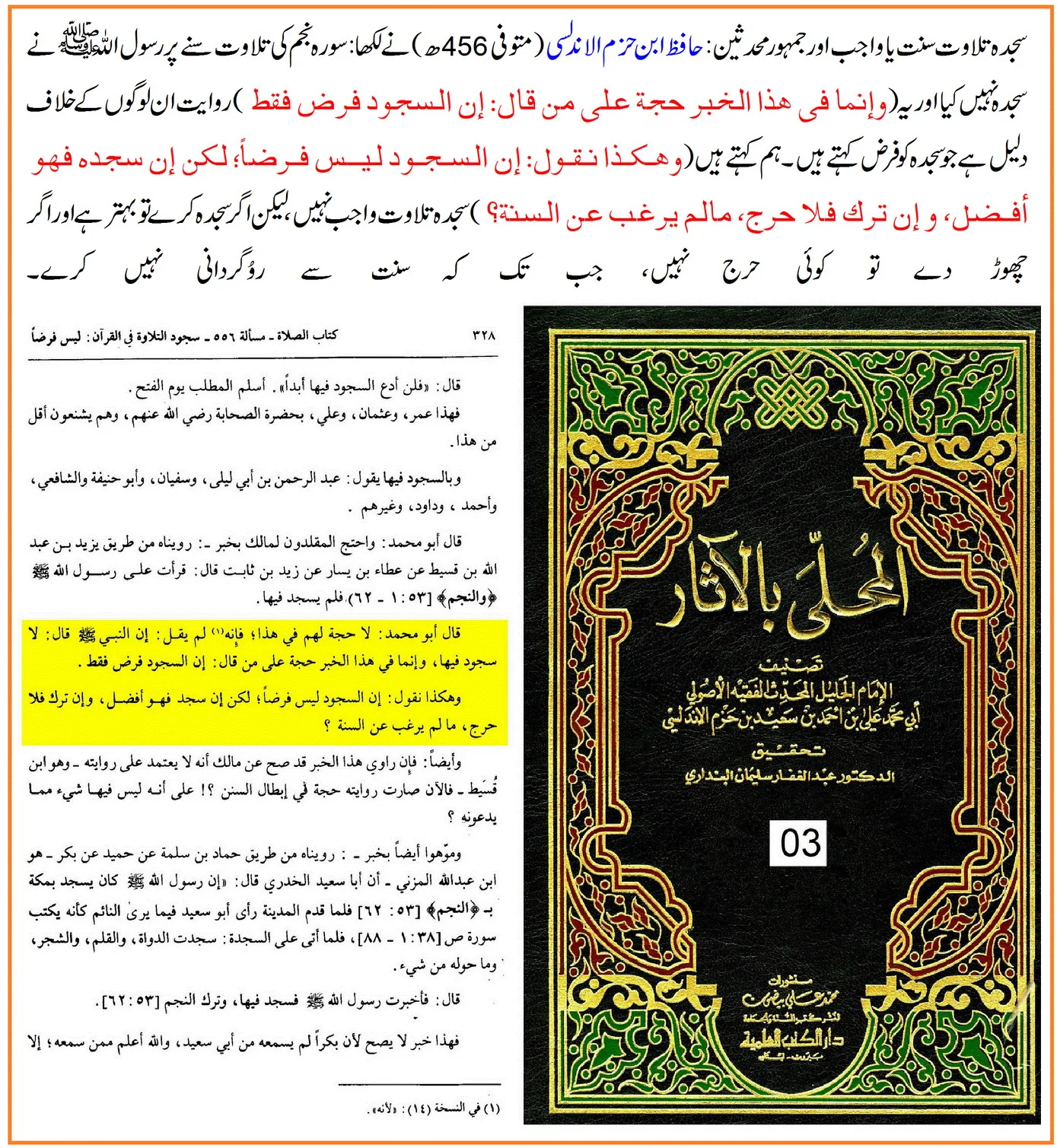
⑦ Position of Imam Ibn Hazm al-Andalusi, may Allah have mercy on him
قَالَ أَبُو مُحَمَّدٍ: ----- «زَيْدِ بْنِ ثَابِتٍ قَالَ: قَرَأْتُ عَلَى رَسُولِ اللَّهِ - صَلَّى اللَّهُ عَلَيْهِ وَسَلَّمَ - وَالنَّجْمِ فَلَمْ يَسْجُدْ فِيهَا» .
قَالَ أَبُو مُحَمَّدٍ: لَا حُجَّةَ لَهُمْ فِي هَذَا، فَإِنَّهُ لَمْ يَقُلْ: إنَّ النَّبِيَّ - صَلَّى اللَّهُ عَلَيْهِ وَسَلَّمَ - قَالَ: لَا سُجُودَ فِيهَا، وَإِنَّمَا فِي هَذَا الْخَبَرِ حُجَّةٌ عَلَى مَنْ قَالَ: إنَّ السُّجُودَ فَرْضٌ فَقَطْ.
وَهَكَذَا نَقُولُ: إنَّ السُّجُودَ لَيْسَ فَرْضًا، لَكِنْ إنْ سَجَدَ فَهُوَ أَفْضَلُ، وَإِنْ تَرَكَ فَلَا حَرَجَ، مَا لَمْ يَرْغَبْ عَنْ السُّنَّةِ؟
Translation (Summary):
Abu Muhammad Ibn Hazm writes: There is a hadith from Zaid bin Thabit رضي الله عنه that "I recited Surah An-Najm to the Prophet ﷺ, but he did not prostrate in it." Ibn Hazm says: This is no proof for those who say that there is no prostration at all in it, because Zaid did not say that the Prophet ﷺ said there is no prostration here, rather this report is evidence against those who consider the prostration only obligatory. We also say that the prostration is not obligatory, but if one performs it, it is better, and if one leaves it, there is no harm, as long as there is no intention to abandon the Sunnah.
Reference: Al-Kitab: Al-Muhalla bil-Athar
Author: Abu Muhammad Ali bin Ahmad bin Saeed bin Hazm Al-Andalusi Al-Qurtubi Al-Zahiri (died: 456 AH)
Author: Abu Muhammad Ali bin Ahmad bin Saeed bin Hazm Al-Andalusi Al-Qurtubi Al-Zahiri (died: 456 AH)
Fiqh Summary:
Ibn Hazm is apparently a strict fundamentalist, yet he clearly states that the prostration of recitation is "not obligatory" but rather a preferred and recommended act, and there is "no harm" in leaving it, which explicitly proves the non-obligation.
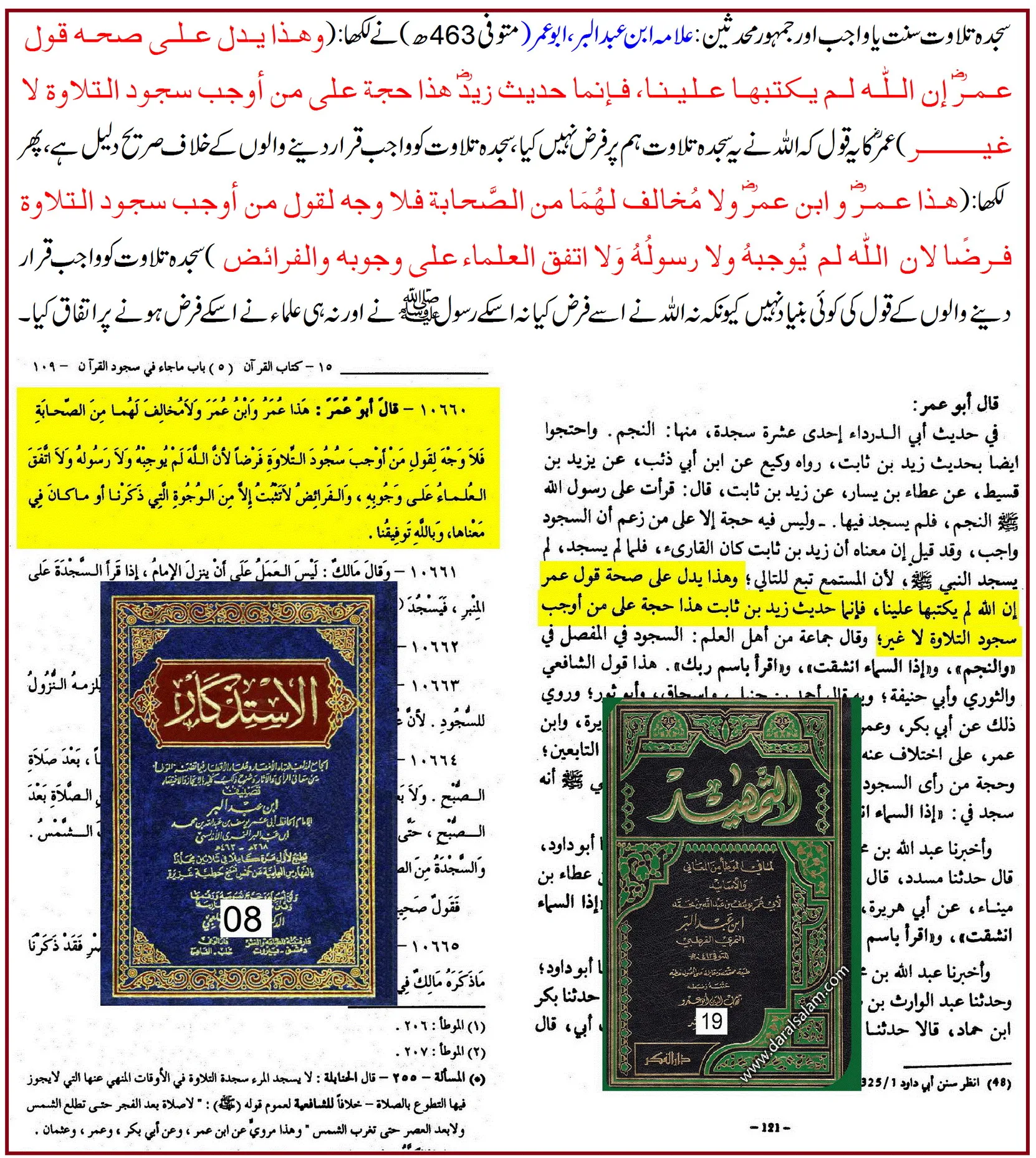
⑧ Imam Ibn Abdul Barr Abu Umar رحمه الله’s Argument and the Consensus of the Companions
وَهَذَا يَدُلُّ عَلَى صِحَّةِ قَوْلِ عُمَرَ إِنَّ اللَّهَ لَمْ يَكْتُبْهَا عَلَيْنَا فَإِنَّمَا حَدِيثُ زَيْدِ بْنِ ثَابِتٍ هَذَا حُجَّةٌ عَلَى مَنْ أَوْجَبَ سُجُودَ التلاوة لا غير
Translation:
"This (hadith) indicates the authenticity of the statement of Umar, may Allah be pleased with him, that Allah Almighty has not made prostration obligatory upon us, and this hadith of Zaid bin Thabit is only an argument against those who say that prostration of recitation is obligatory, nothing more."
Reference: Al-Kitab: At-Tamhid Lima Fi Al-Muwatta Min Al-Ma'ani Wal-Asanid
Author: Abu Umar Yusuf bin Abdullah bin Muhammad bin Abdul Barr An-Namri Al-Qurtubi (died: 463 AH)
Author: Abu Umar Yusuf bin Abdullah bin Muhammad bin Abdul Barr An-Namri Al-Qurtubi (died: 463 AH)
He further states:
قَالَ أَبُو عُمَرَ هَذَا عُمَرُ وبن عُمَرَ وَلَا مُخَالِفَ لَهُمَا مِنَ الصَّحَابَةِ فَلَا وَجْهَ لِقَوْلِ مَنْ أَوْجَبَ سُجُودَ التِّلَاوَةِ فَرْضًا لِأَنَّ اللَّهَ لَمْ يُوجِبْهُ وَلَا رَسُولُهُ وَلَا اتَّفَقَ الْعُلَمَاءُ عَلَى وُجُوبِهِ وَالْفَرَائِضُ لَا تَثْبُتُ إِلَّا مِنَ الْوُجُوهِ الَّتِي ذَكَرْنَا أَوْ مَا كَانَ فِي مَعْنَاهَا وَبِاللَّهِ تَوْفِيقُنَا
Summary translation:
Abu Umar Ibn Abdul Barr says: "This is the view of Umar and Ibn Umar (may Allah be pleased with them), and none of the Companions opposed these two. Therefore, those who say that prostration of recitation is obligatory have no basis for their claim, because neither Allah made it obligatory, nor the Messenger, nor have the scholars agreed upon its obligation, and obligations are only established by strong evidence."
Reference: Al-Kitab: Al-Istidhkar
Author: Abu Umar Yusuf bin Abdullah bin Muhammad bin Abdul Barr An-Namri Al-Qurtubi (died: 463 AH)
Author: Abu Umar Yusuf bin Abdullah bin Muhammad bin Abdul Barr An-Namri Al-Qurtubi (died: 463 AH)
Fiqh Summary:
According to Ibn Abdul Barr, there is a practical consensus among the Companions on the effects of Umar and Ibn Umar, may Allah be pleased with them, therefore the statement about the obligation of Sajdah Tilawah is not based on any reliable principle.
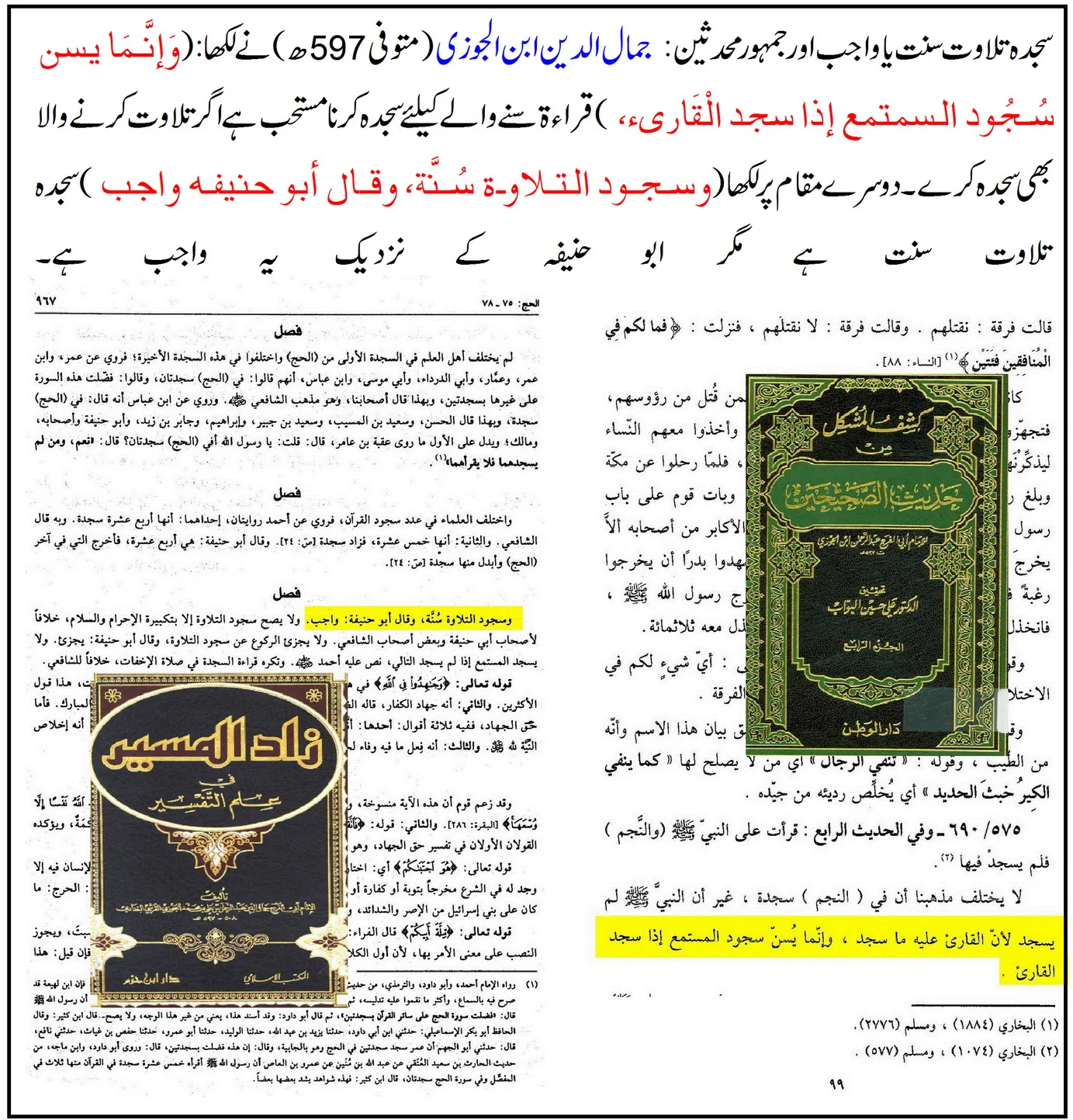
⑨ Statement of Imam Jamal al-Din Ibn al-Jawzi, may Allah have mercy on him
يسْجد لِأَن الْقَارئ عَلَيْهِ مَا سجد، وَإِنَّمَا يسن سُجُود المستمع إِذا سجد الْقَارئ.
Translation (summary):
"(The listener) will perform Sajdah, because the reciter performed Sajdah, and in fact, for the listener, Sajdah is Sunnah only when the reciter performs Sajdah."
Reference: Book: Kashf al-Mushkil min Hadith al-Sahihayn
Author: Jamal al-Din Abu al-Faraj Abd al-Rahman ibn Ali ibn Muhammad al-Jawzi (died 597 AH)
Author: Jamal al-Din Abu al-Faraj Abd al-Rahman ibn Ali ibn Muhammad al-Jawzi (died 597 AH)
At another place he writes:
مَسَائِلُ سُجُودِ التِّلَاوَةِ
مَسْأَلَةٌ سُجُودُ التِّلَاوَةِ سُنَّةٌ وَقَالَ أَبُو حَنِيفَةَ وَاجِبٌ
Translation:
"Among the issues of Sajdah Tilawah: Sajdah Tilawah is Sunnah, and Abu Hanifa considered it obligatory."
Reference: Book: Al-Tahqiq fi Ahadith al-Khilaf
Author: Jamal al-Din Abu al-Faraj Abd al-Rahman ibn Ali ibn Muhammad al-Jawzi (died 597 AH)
Author: Jamal al-Din Abu al-Faraj Abd al-Rahman ibn Ali ibn Muhammad al-Jawzi (died 597 AH)
Jurisprudential Summary:
Ibn al-Jawzi clearly states that Sajdah Tilawah is Sunnah, and mentions the Hanafi position separately as a unique opinion, which clearly shows the division between the majority and the minority.
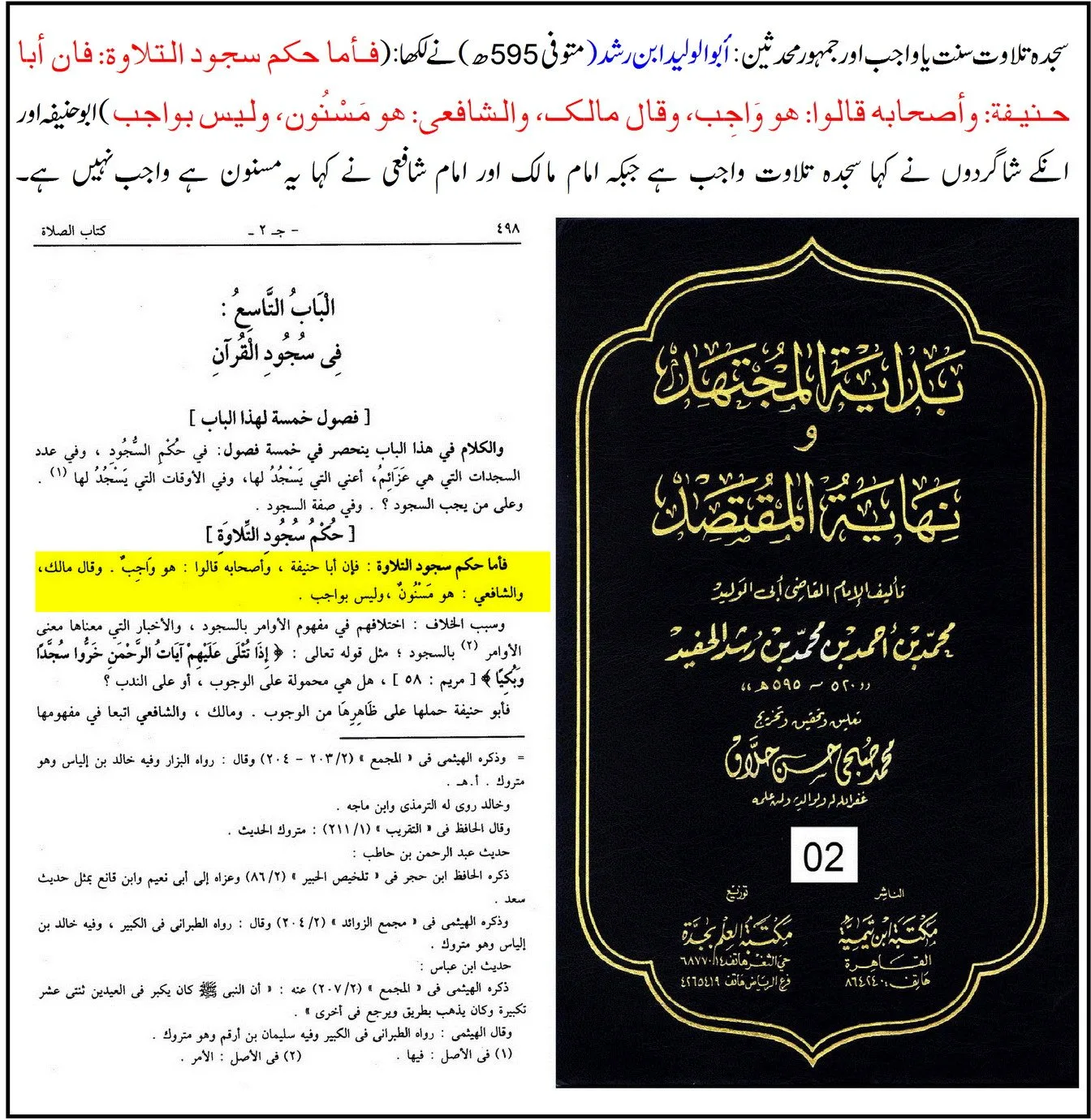
⑩ Qadi Abu al-Walid Ibn Rushd, may Allah have mercy on him (Bidayat al-Mujtahid)
فَأَمَّا حُكْمُ سُجُودِ التِّلَاوَةِ: فَإِنَّ أَبَا حَنِيفَةَ وَأَصْحَابَهُ قَالُوا: هُوَ وَاجِبٌ، وَقَالَ مَالِكٌ وَالشَّافِعِيُّ: هُوَ مَسْنُونٌ وَلَيْسَ بِوَاجِبٍ.---------------
Translation:
"As far as the ruling on the prostration of recitation is concerned, Abu Hanifa and his companions said that it is obligatory, while Imam Malik and Imam Shafi'i said that it is Sunnah and not obligatory."
Reference: Al-Kitab: Bidayat al-Mujtahid wa Nihayat al-Muqtasid
Author: Abu al-Walid Muhammad ibn Ahmad ibn Muhammad ibn Ahmad ibn Rushd al-Qurtubi (d. 595 AH)
Author: Abu al-Walid Muhammad ibn Ahmad ibn Muhammad ibn Ahmad ibn Rushd al-Qurtubi (d. 595 AH)
Jurisprudential Summary:
Ibn Rushd summarized the difference of opinion clearly, stating that according to both Imam Malik and Imam Shafi'i, the prostration of recitation is "Sunnah, not obligatory," whereas the obligation is attributed only to the Hanafi school.
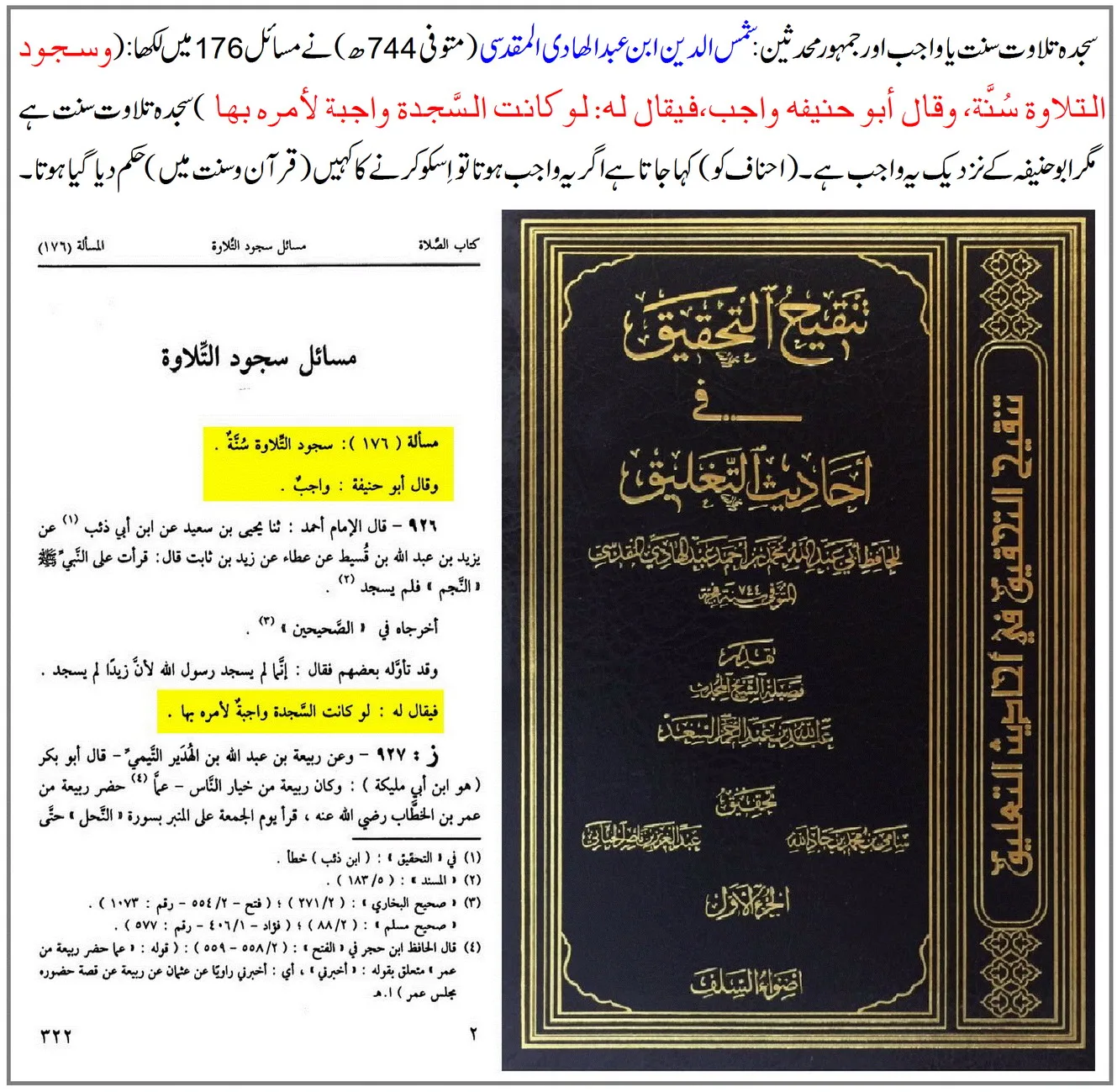
⑪ Hafiz Ibn Abdulhadi al-Maqdisi, may Allah have mercy on him (Tanzeeh al-Tahqiq)
مسائل سجود التِّلاوة
مسألة (176) : سجود التِّلاوة سُنَّةٌ.
وقال أبو حنيفة: واجبٌ.
فيقال له: لو كانت السَّجدة واجبةٌ لأمره بها.
Translation:
"Matters of prostration of recitation: Issue (176): The prostration of recitation is Sunnah, and Abu Hanifa considered it obligatory. So it will be said (to the Hanafis): If this prostration were obligatory, then the Legislator would have given an explicit ruling on it."
Reference: Al-Kitab: Tanqih al-Tahqiq fi Ahadith al-Ta'liq
Author: Shams al-Din Muhammad ibn Ahmad ibn Abdulhadi al-Hanbali (d. 744 AH)
Author: Shams al-Din Muhammad ibn Ahmad ibn Abdulhadi al-Hanbali (d. 744 AH)
Jurisprudential Summary:
Ibn Abdulhadi, may Allah have mercy on him, states a fundamental point that an explicit command is required for obligation, whereas there is no such clear ruling regarding the prostration of recitation, therefore it will be called Sunnah, not Wajib.
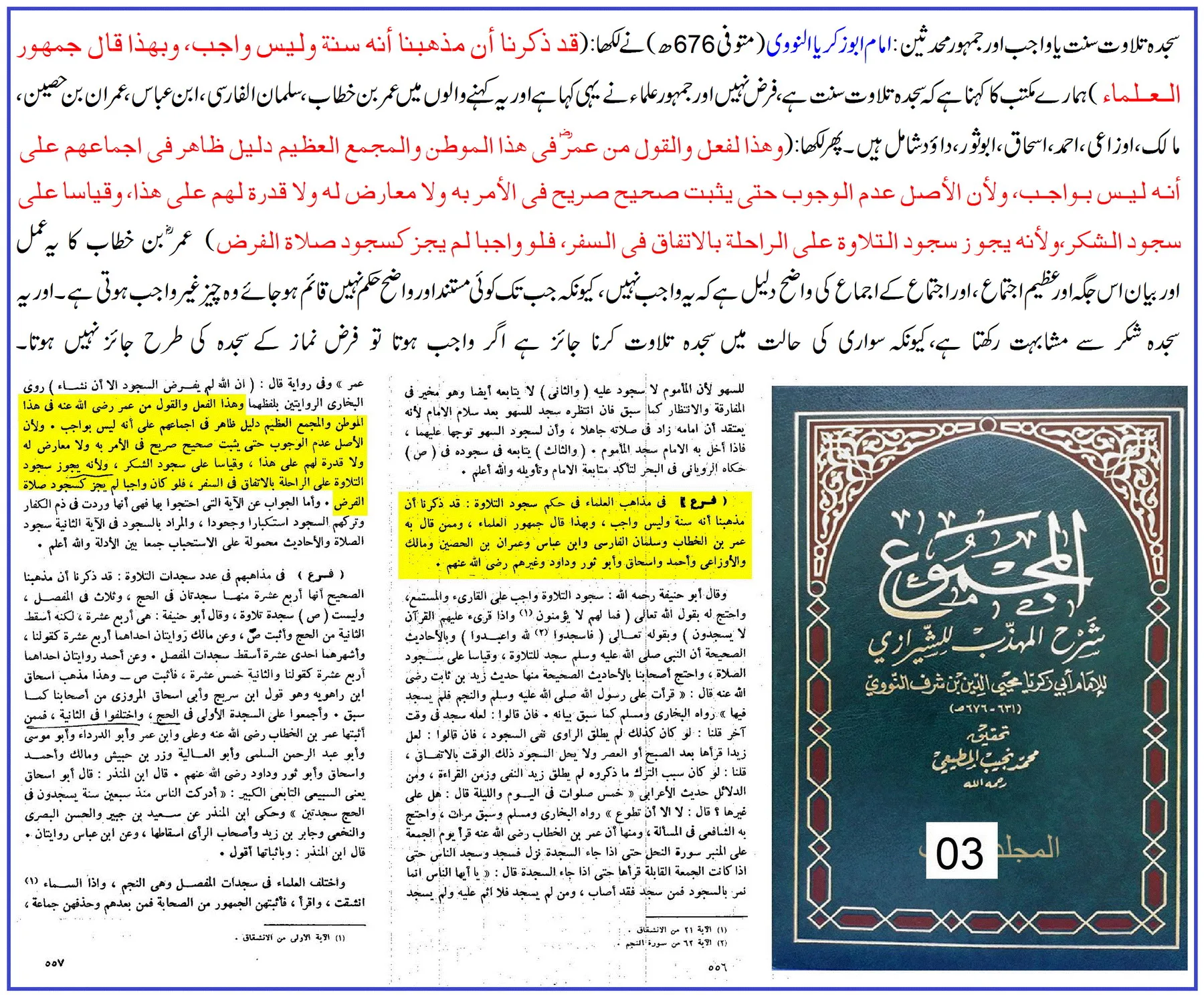
⑫ Imam Nawawi, may Allah have mercy on him: The clear position and evidence of the majority
فِي مَذَاهِبِ الْعُلَمَاءِ فِي حُكْمِ سُجُودِ التِّلَاوَةِ:
قَدْ ذَكَرْنَا أن مذهبنا انه سنة وليس بواجب وَبِهَذَا قَالَ جُمْهُورُ الْعُلَمَاءِ وَمِمَّنْ قَالَ بِهِ عُمَرُ بْنُ الْخَطَّابِ وَسَلْمَانُ الْفَارِسِيُّ وَابْنُ عَبَّاسٍ وعمران بن الحصين ومالك والاوزاعي واحمد واسحق وابو ثور وداود وَغَيْرِهِمْ رَضِيَ اللَّهُ عَنْهُمْ
Translation (summary):
"Regarding the ruling of the prostration of recitation according to the scholars' schools: We have mentioned that our (Shafi'i) school holds that it is Sunnah, not obligatory, and this is the opinion of the majority of scholars. Among its adherents are Umar ibn al-Khattab, Salman al-Farsi, Ibn Abbas, Imran ibn Husain, Malik, Awza'i, Ahmad, Ishaq, Abu Thawr, Dawud, and others, may Allah be pleased with them."
Reference: Al-Kitab: Al-Majmu' Sharh al-Muhadhdhab
Author: Abu Zakariya Muhyiddin Yahya ibn Sharaf al-Nawawi (d. 676 AH)
Author: Abu Zakariya Muhyiddin Yahya ibn Sharaf al-Nawawi (d. 676 AH)
He further states:
وَهَذَا الْفِعْلُ وَالْقَوْلُ مِنْ عُمَرَ رَضِيَ اللَّهُ عَنْهُ فِي هَذَا الْمَوْطِنِ وَالْمَجْمَعُ الْعَظِيمُ دَلِيلٌ ظَاهِرٌ فِي إجْمَاعِهِمْ عَلَى أَنَّهُ لَيْسَ بِوَاجِبٍ
وَلِأَنَّ الْأَصْلَ عَدَمُ الْوُجُوبِ حَتَّى يَثْبُتَ صَحِيحٌ صَرِيحٌ فِي الْأَمْرِ بِهِ وَلَا مُعَارِضَ لَهُ وَلَا قُدْرَةَ لَهُمْ عَلَى هَذَا
وَقِيَاسًا عَلَى سُجُودِ الشُّكْرِ
وَلِأَنَّهُ يَجُوزُ سُجُودُ التِّلَاوَةِ عَلَى الرَّاحِلَةِ بِالِاتِّفَاقِ فِي السَّفَرِ
فَلَوْ كَانَ وَاجِبًا لَمْ يَجُزْ كَسُجُودِ صَلَاةِ الْفَرْضِ
Translation (Summary):
"At this occasion, the statement and action of Umar, may Allah be pleased with him, and the silence of the great gathering (the Companions) is clear evidence that they all agreed that the prostration of recitation (Sajdat al-Tilawah) is not obligatory. Because the original ruling is non-obligation, unless a correct, explicit command is established which has no contradiction, and they did not have anything like that. Also, this prostration is analogized to the prostration of gratitude, and for this reason as well, since it is unanimously permissible to perform the prostration of recitation while riding during travel, if it were obligatory, it would not be permissible on a mount like the prostrations of the obligatory prayer."
Reference: Al-Kitab: Al-Majmu' Sharh al-Muhadhdhab
Author: Abu Zakariya Muhyiddin al-Nawawi (d. 676 AH)
Author: Abu Zakariya Muhyiddin al-Nawawi (d. 676 AH)
Fiqh Summary:
Imam Nawawi, may Allah have mercy on him, not only mentions the consensus of the majority but also reasons from the fundamental principle "The original ruling is non-obligation," and as practical evidence, he considers the permissibility of prostration on a mount during travel as testimony to non-obligation.
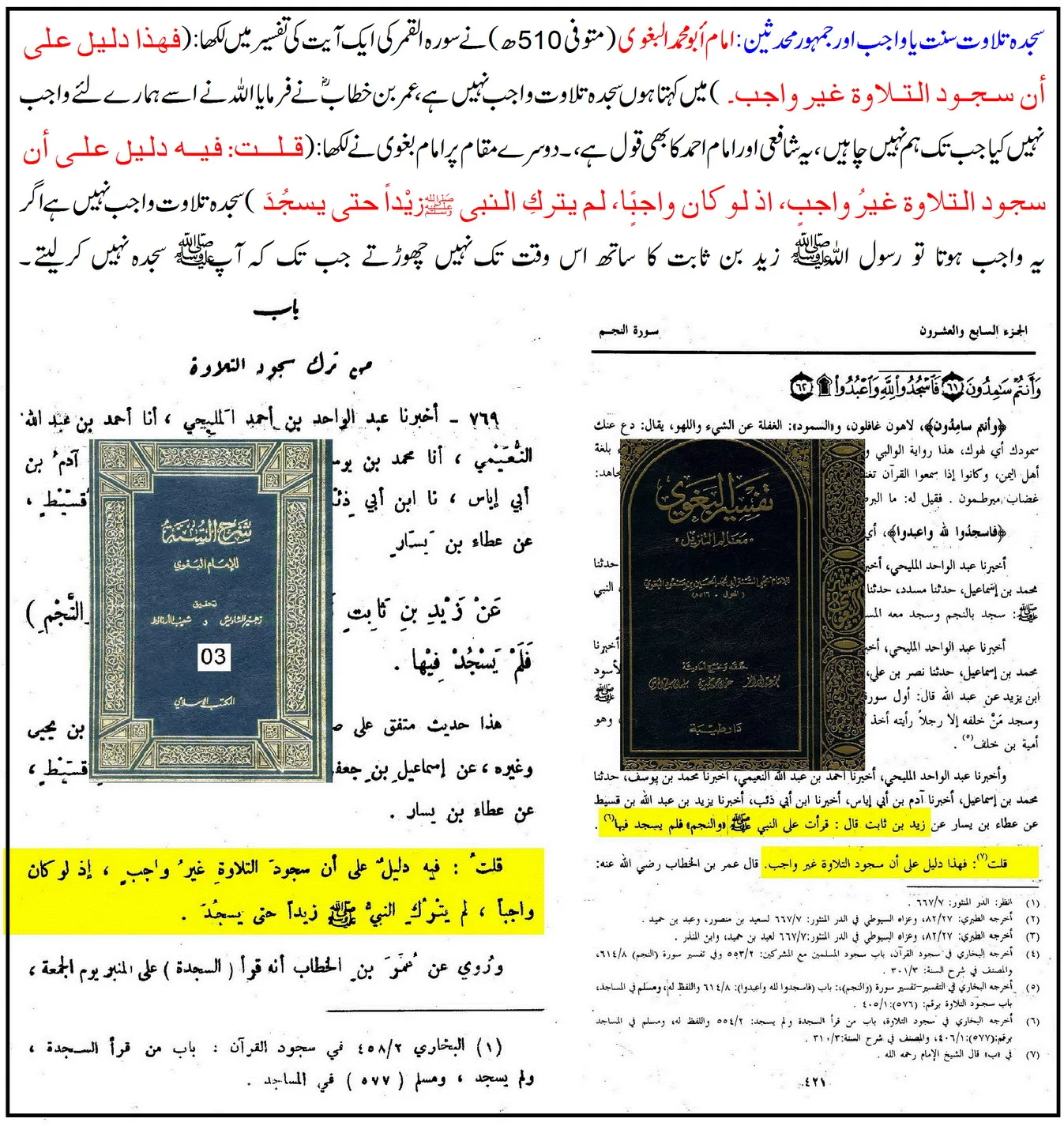
⑬ Imam Abu Muhammad al-Baghawi, may Allah have mercy on him (Tafsir and Sharh al-Sunnah)
قُلْتُ (7) : فَهَذَا دَلِيلٌ عَلَى أَنْ سُجُودَ التِّلَاوَةِ غَيْرُ وَاجِبٍ. قَالَ عُمَرُ بْنُ الْخَطَّابِ رَضِيَ اللَّهُ عَنْهُ: أَنَّ اللَّهَ لَمْ يَكْتُبْهَا عَلَيْنَا إِلَّا أَنْ نَشَاءَ.
Translation:
"I say: This is evidence that the prostration of recitation (Sajdat al-Tilawah) is not obligatory, and Umar ibn al-Khattab (may Allah be pleased with him) said: Allah has not made it obligatory upon us, except if we ourselves wish to do it."
Reference: Al-Kitab: Ma'alim al-Tanzeel fi Tafseer al-Qur'an = Tafseer al-Baghawi
Author: Muhyi al-Sunnah, Abu Muhammad al-Husayn ibn Mas'ud al-Baghawi (d. 510 AH)
Author: Muhyi al-Sunnah, Abu Muhammad al-Husayn ibn Mas'ud al-Baghawi (d. 510 AH)
Elsewhere they write:
769:- قُلْتُ: فِيهِ دَلِيلٌ عَلَى أَنَّ سُجُودَ التِّلاوَةِ غَيْرُ وَاجِبٍ، إِذْ لَوْ كَانَ وَاجِبًا، لَمْ يَتْرُكِ النَّبِيُّ صَلَّى اللهُ عَلَيْهِ وَسَلَّمَ زَيْدًا حَتَّى يَسْجُدَ.
Translation:
"I say: This is evidence that the prostration of recitation is not obligatory, because if it were obligatory, the Prophet ﷺ would not have left Zaid (ibn Thabit) until he performed the prostration."
Reference: Al-Kitab: Sharh al-Sunnah
Author: Muhyi al-Sunnah, Abu Muhammad al-Husayn ibn Mas'ud al-Baghawi al-Shafi'i (d. 516 AH)
Author: Muhyi al-Sunnah, Abu Muhammad al-Husayn ibn Mas'ud al-Baghawi al-Shafi'i (d. 516 AH)
Juristic Summary:
Imam Baghawi clarifies in both texts that neither did the Prophet ﷺ reject nor blame the omission of the prostration of recitation, which contradicts the abandonment of an obligatory act; therefore, it is merely Sunnah and recommended.
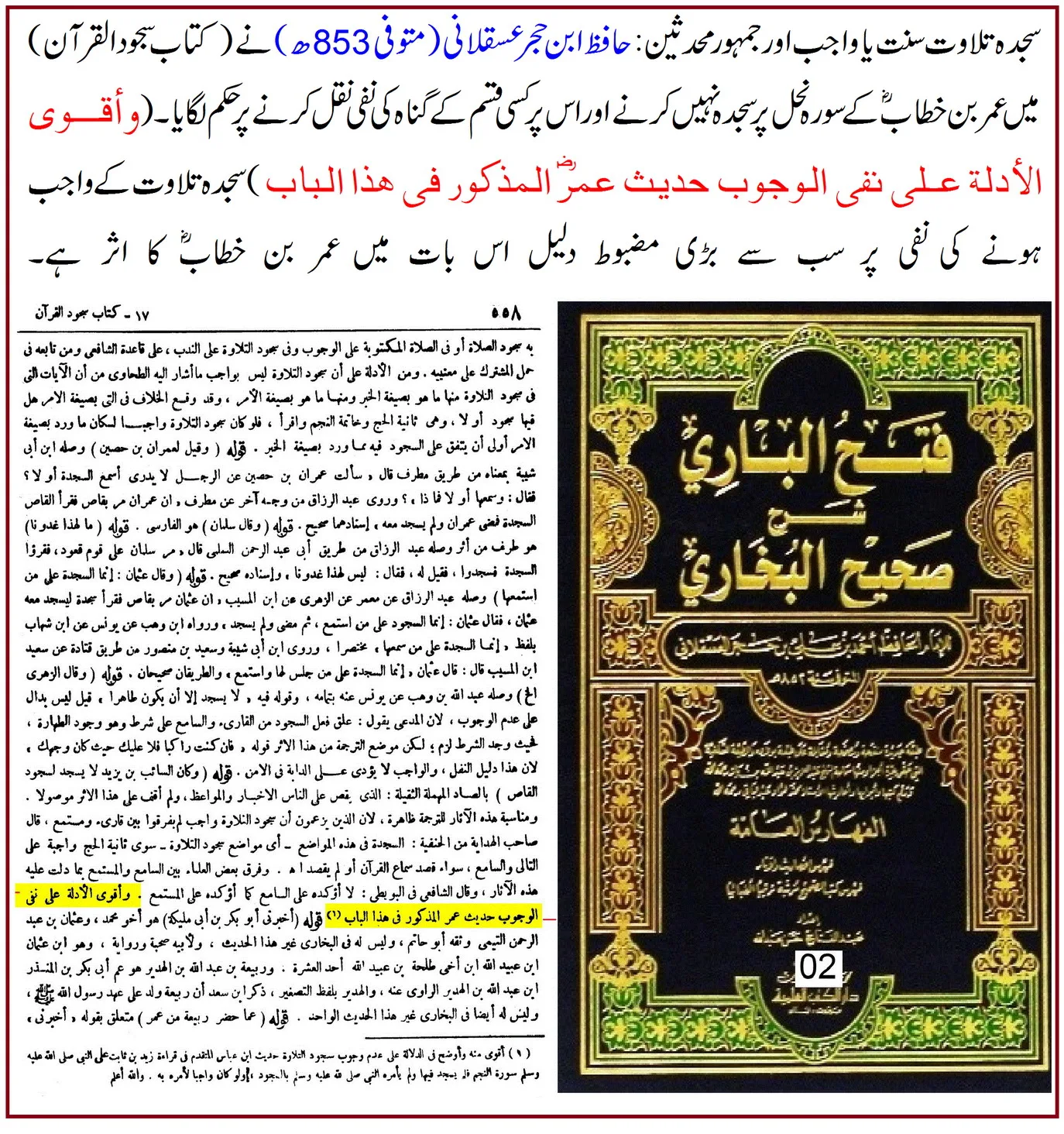
⑭ Hafiz Ibn Hajar al-Asqalani, may Allah have mercy on him (Fath al-Bari)
1077 - حَدَّثَنَا--- «يَا أَيُّهَا النَّاسُ إِنَّا نَمُرُّ بِالسُّجُودِ، فَمَنْ سَجَدَ، فَقَدْ أَصَابَ وَمَنْ لَمْ يَسْجُدْ، فَلاَ إِثْمَ عَلَيْهِ وَلَمْ يَسْجُدْ عُمَرُ رَضِيَ اللَّهُ عَنْهُ»
---
وَأَقْوَى الْأَدِلَّةِ عَلَى نَفْيِ الْوُجُوبِ حَدِيثُ عُمَرَ الْمَذْكُورُ فِي هَذَا الْبَاب
Translation:
"And the strongest evidence for the negation of the obligation of the prostration is the hadith of Umar (may Allah be pleased with him) mentioned in this chapter."
Reference: Book: Fath al-Bari Sharh Sahih al-Bukhari
Author: Ahmad ibn Ali ibn Hajar Abu al-Fadl al-Asqalani al-Shafi'i
Author: Ahmad ibn Ali ibn Hajar Abu al-Fadl al-Asqalani al-Shafi'i
Fiqh Summary:
A hadith scholar and commentator like Hafiz Ibn Hajar explicitly states that the strongest evidence for the non-obligatory nature of the prostration of recitation is this very hadith of Sayyiduna Umar (may Allah be pleased with him), in which it is said regarding omission, "there is no sin upon him."
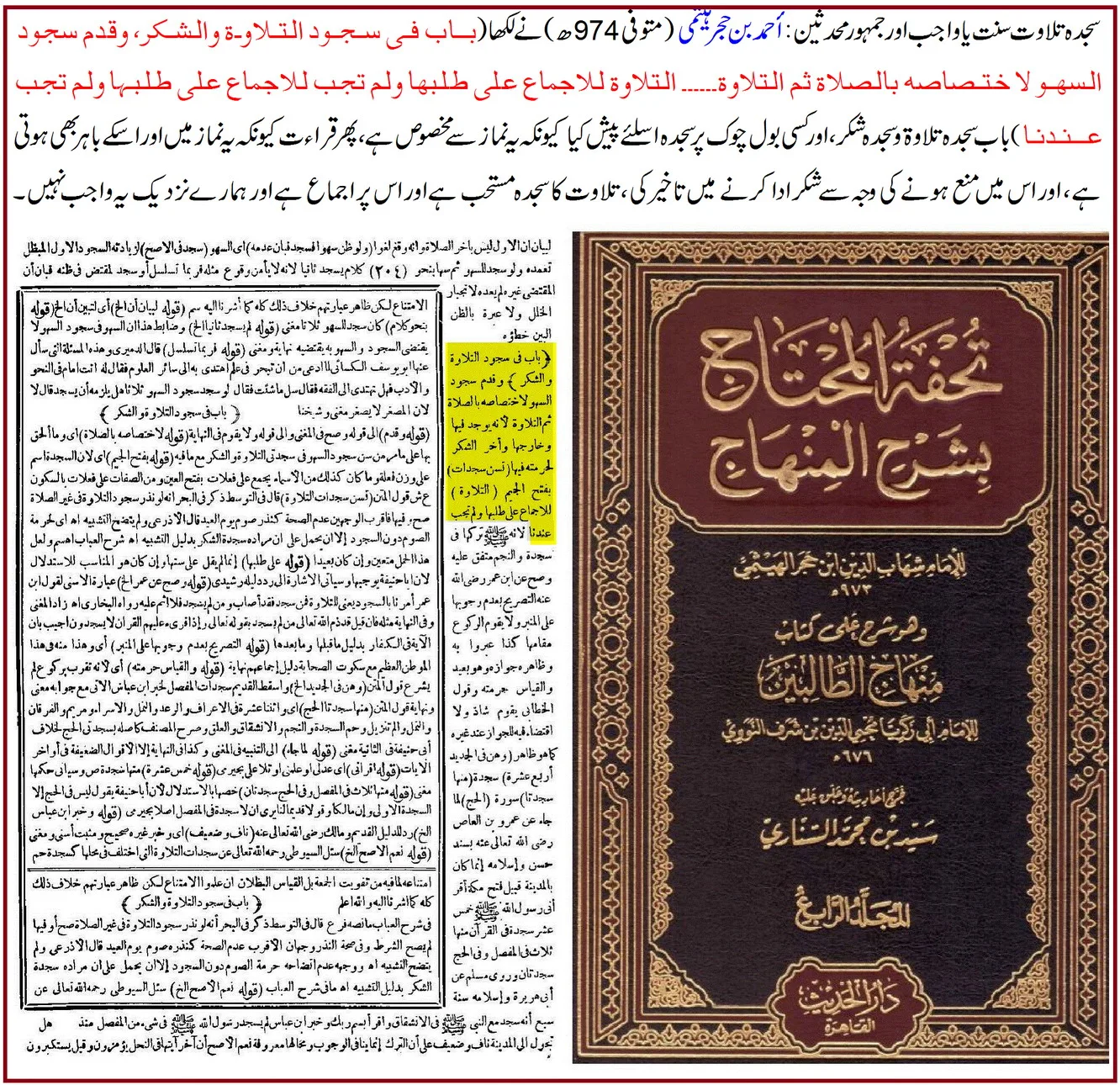
⑮ Allama Ahmad ibn Hajar Haytami Shafi'i, may Allah have mercy on him
(بَابُ فِي سُجُودِ التِّلَاوَةِ وَالشُّكْرِ) وَقَدَّمَ سُجُودَ السَّهْوِ لِاخْتِصَاصِهِ بِالصَّلَاةِ ثُمَّ التِّلَاوَةِ؛ لِأَنَّهُ يُوجَدُ فِيهَا وَخَارِجَهَا وَأَخَّرَ الشُّكْرَ لِحُرْمَتِهِ فِيهَا (تُسَنُّ سَجَدَاتُ) بِفَتْحِ الْجِيمِ (التِّلَاوَةِ) لِلْإِجْمَاعِ عَلَى طَلَبِهَا وَلَمْ تَجِبْ عِنْدَنَا؛
Translation (Summary):
"Chapter: On the prostration of recitation and the prostration of gratitude. He gave precedence to the prostration of forgetfulness due to its specific connection with prayer, then the prostration of recitation, because it occurs both inside and outside of prayer, and he delayed the prostration of gratitude because it is prohibited in prayer. (The phrase) 'Tasn sujudat al-tilawah' means the prostrations of recitation are Sunnah; there is consensus on their recommendation (mustahabb), and in our view, they are not obligatory."
Reference: Book: Tuhfat al-Muhtaj fi Sharh al-Minhaj
Author: Ahmad ibn Muhammad ibn Ali ibn Hajar al-Haytami
Author: Ahmad ibn Muhammad ibn Ali ibn Hajar al-Haytami
Fiqh Summary:
Ibn Hajar Haytami is a later major jurist of the Shafi'i school; he explicitly counts the "Tasn Sajadāt al-Tilāwah" (prostrations of recitation) as Sunnah and clarifies that, in our view, it is not obligatory, although there is consensus on its recommendation and desirability.
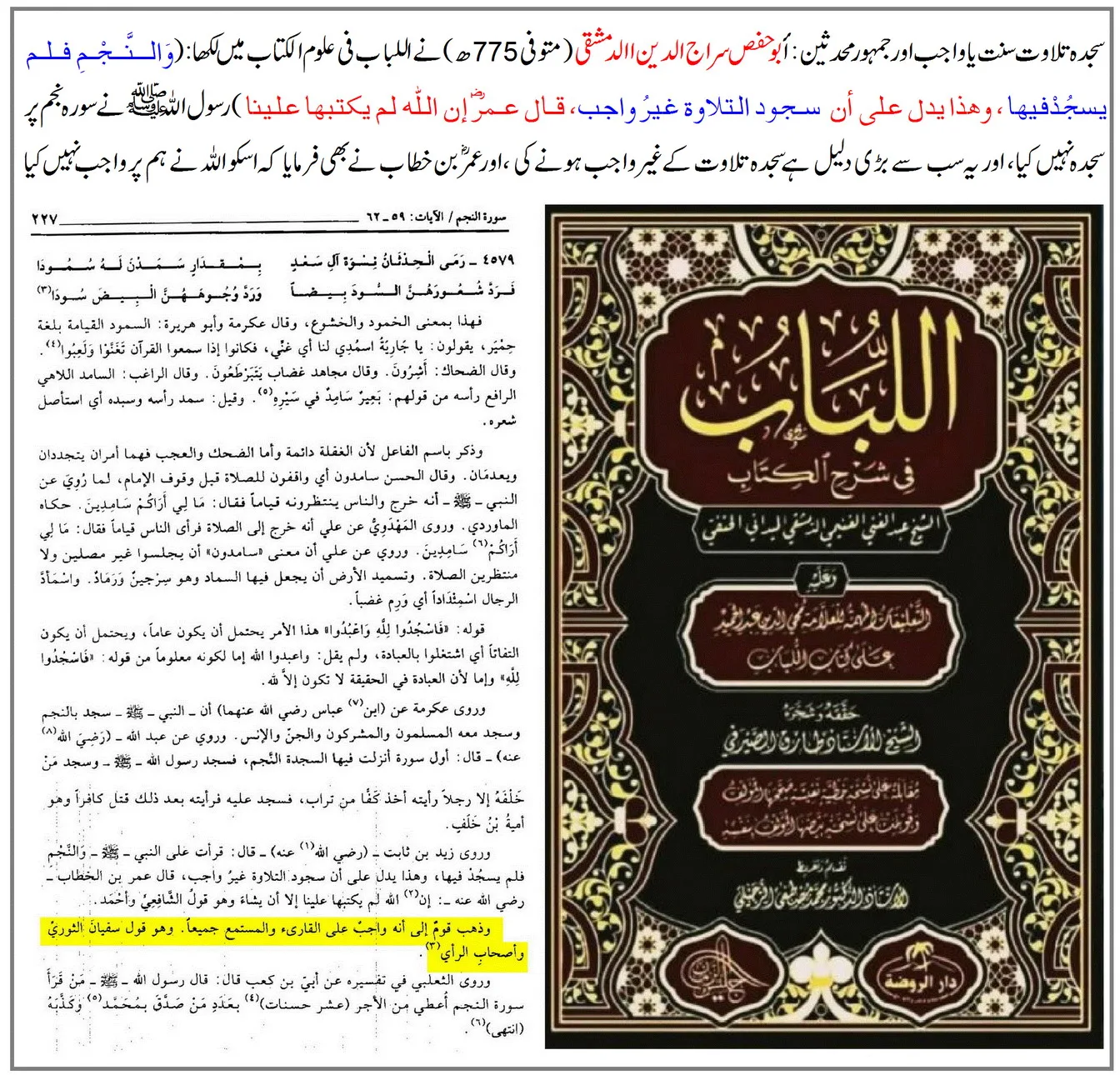
⑯ Abu Hafs Siraj al-Din Ibn Adel al-Dimashqi, may Allah have mercy on him
وروى زيد بن ثابت - (رَضِيَ اللَّهُ عَنْه) - قال: قرأت على النبي - صَلَّى اللَّهُ عَلَيْهِ وَسَلَّم َ - وَالنَّجْمِ فلم يسجُدْ فيها، وهذا يدل على أن سجود التلاوة غيرُ واجب، قال عمر بن الخطاب - رَضِيَ اللَّهُ عَنْه -: إن الله لم يكتبها علينا إلا أن يشاءَ وهو قولُ الشَّافِعِيِّ وأحْمَد.
Translation (Summary):
Zayd ibn Thabit, may Allah be pleased with him, narrates that "I recited Surah An-Najm to the Prophet ﷺ, and he did not prostrate in it," and this indicates that the prostration of recitation is not obligatory. Umar ibn al-Khattab, may Allah be pleased with him, said: "Allah did not make it obligatory upon us, except if we ourselves wish," and this is also the view of al-Shafi'i and Ahmad.
Reference: Al-Kitab: Al-Lubab fi Ulum al-Kitab
Author: Abu Hafs Siraj al-Din Umar ibn Ali ibn Adel al-Hanbali al-Dimashqi al-Numani (died: 775 AH)
Author: Abu Hafs Siraj al-Din Umar ibn Ali ibn Adel al-Hanbali al-Dimashqi al-Numani (died: 775 AH)
Jurisprudential Summary:
Ibn Adel combined the narration of Zayd ibn Thabit and the statement of Umar, may Allah be pleased with him, and concluded that the prostration of recitation is "not obligatory," and he also strengthened this view by attributing it to the school of Imam al-Shafi'i and Ahmad.
⑰ Imam Muhammad bin Ismail al-San'ani, may Allah have mercy on him (Sabil al-Salam)
Muhammad bin Ismail al-San'ani (died 1182 AH) wrote:
[مَشْرُوعِيَّةُ سُجُودِ التِّلَاوَةِ]
وَالْحَدِيثُ دَلِيلٌ عَلَى مَشْرُوعِيَّةِ سُجُودِ التِّلَاوَةِ وَقَدْ أَجْمَعَ عَلَى ذَلِكَ الْعُلَمَاءُ، وَإِنَّمَا اخْتَلَفُوا فِي الْوُجُوبِ وَفِي مَوَاضِعِ السُّجُودِ؛ فَالْجُمْهُورُ أَنَّهُ سُنَّةٌ، وَقَالَ أَبُو حَنِيفَةَ: وَاجِبٌ غَيْرُ فَرْضٍ، ثُمَّ هُوَ سُنَّةٌ فِي حَقِّ التَّالِي وَالْمُسْتَمِعِ إنْ سَجَدَ التَّالِي، وَقِيلَ: وَإِنْ لَمْ يَسْجُدْ.
Translation:
"(Chapter) The Legitimacy of the Prostration of Recitation: This hadith is evidence for the permissibility of the prostration of recitation, and the scholars are unanimous on this. The only difference is whether it is obligatory or not, and regarding the places of prostration. The majority's opinion is that it is Sunnah, and Abu Hanifa said: it is wajib but not fard; then (according to him) it is Sunnah for both the reciter and the listener if the reciter performs the prostration, and some have said that even if he does not perform the prostration, it is still Sunnah."
Reference: Al-Kitab: Sabil al-Salam
Author: Muhammad bin Ismail bin Salah bin Muhammad al-Hasani, al-Kahlani then al-San'ani, Abu Ibrahim, Izz al-Din, known as al-Aslaf al-Amir (died: 1182 AH)
Author: Muhammad bin Ismail bin Salah bin Muhammad al-Hasani, al-Kahlani then al-San'ani, Abu Ibrahim, Izz al-Din, known as al-Aslaf al-Amir (died: 1182 AH)
Explanatory Summary:
Imam San'ani clarified three points:
1. Prostration of recitation is "Mashroo" (legitimate), meaning it is an established act of worship, and there is consensus on its original permissibility.
2. The difference is only regarding its obligation or non-obligation, and the majority consider it Sunnah.
3. Abu Hanifa's opinion of "Wajib but not Fard" is mentioned as a unique view, which clarifies the boundary between the majority and the Hanafi school.
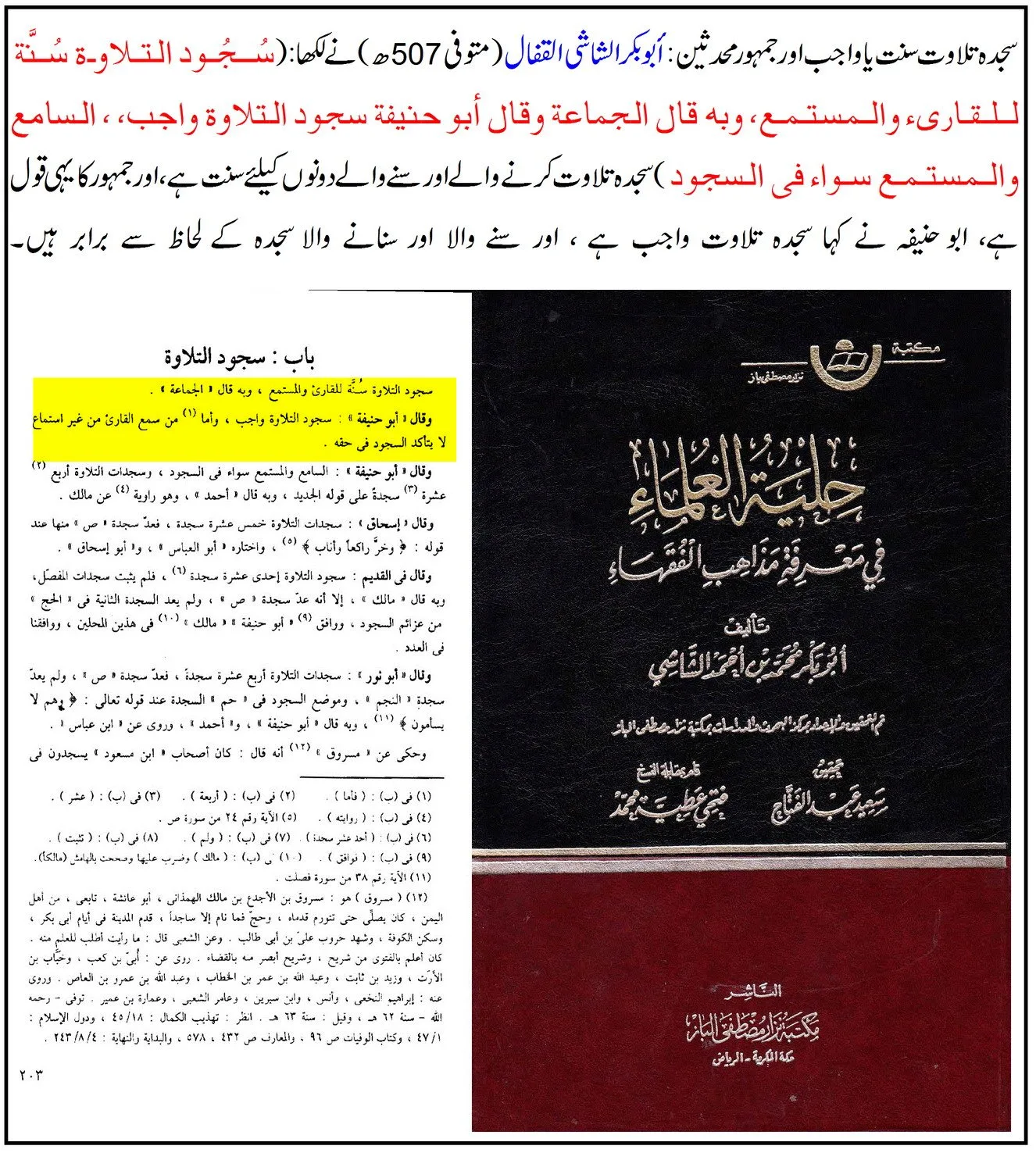
⑱ Imam Abu Bakr Al-Shashi Al-Qaffal Al-Shafi'i, may Allah have mercy on him
- صَلَّى اللَّهُ عَلَيْهِ وَسَلَّم َ - بَاب سُجُود التِّلَاوَة
سُجُود التِّلَاوَة سنة للقارىء والمستمع وَبِه قَالَ الْجَمَاعَة
وَقَالَ أَبُو حنيفَة سُجُود التِّلَاوَة وَاجِب فَأَما من سمع القارىء من غير اسْتِمَاع لَا يتَأَكَّد السُّجُود فِي حَقه
وَقَالَ ابو حنيفَة السَّامع والمستمع سَوَاء فِي السُّجُود
Translation (Summary):
"Chapter: Prostration of Recitation: Prostration of recitation is Sunnah for both the reciter and the listener, and the majority (of scholars) have adopted this view. Abu Hanifa said that prostration of recitation is Wajib (obligatory). However, for one who merely hears without the intention of listening (istima'), there is no emphasized prostration in his favor. According to Abu Hanifa, both the listener and the hearer are equal in the ruling of prostration."
Reference: Al-Kitab: Hilyat al-Ulama fi Ma'rifat Madhahib al-Fuqaha
Author: Muhammad ibn Ahmad ibn al-Husayn ibn Umar, Abu Bakr al-Shashi al-Qaffal al-Farqi, titled Fakhr al-Islam, al-Mustazhari al-Shafi'i (died 507 AH)
Author: Muhammad ibn Ahmad ibn al-Husayn ibn Umar, Abu Bakr al-Shashi al-Qaffal al-Farqi, titled Fakhr al-Islam, al-Mustazhari al-Shafi'i (died 507 AH)
Fiqhi Summary:
Qafal Shafi'i declared the opinion of "Al-Jama'ah," meaning the group of scholars, as "Sunnah," and mentioned the Hanafi opinion of obligation as a separate and rare view, which clarifies the difference between the majority and the minority.
Overall Analysis of the Majority's Arguments
1. Explicit statements of the Companions, especially Sayyiduna Umar and Ibn Umar, may Allah be pleased with them:
– ‘‘فمن لم يسجد فلا إثم عليه’’
– ‘‘لم يفرض السجود علينا إلا أن نشاء’’
They clearly negate "no sin in abandoning prostration" and "non-obligation." If prostration were obligatory, negating sin would not be possible.
2. The Prophet Muhammad ﷺ sometimes performing prostration and sometimes not (especially regarding Surah An-Najm):
If prostration of recitation were obligatory in all cases, the Prophet ﷺ himself would never have left it and would not have permitted the Companions to abandon it.
3. Clear differing views of the four Imams and earlier jurists:
– Malik, Shafi'i, Ahmad, and their companions, as well as many hadith scholars, consider prostration of recitation as Sunnah.
– The opinion of obligation is only transmitted from Abu Hanifa and some of his companions, which the majority have considered weak in the scale of evidence.
4. Fundamental Principle: "The original rule is the absence of obligation until a clear, authentic, and unopposed evidence is established."
Imam Nawawi, Ibn Abdul Barr, Ibn Abdul Hadi, and others applied this principle and stated that there is no conclusive evidence at all that proves obligation.
5. Practice of the Companions and Silent Consensus:
The announcement of Sayyiduna Umar (may Allah be pleased with him) in a large gathering and no denial from any companion, followed by the agreement of the Tabi‘in and Imams on the same stance, points towards practical consensus that the prostration of recitation is a Sunnah and recommended act of worship, not obligatory.
Conclusion and Summary of the Discussion
1. The prostration of recitation (Sajdah Tilawat) is an established and prescribed act of worship according to the Quran and Sunnah, and there is consensus among all scholars regarding its original permissibility and legitimacy.
2. The majority of hadith scholars, companions, followers, and imams (Malik, Shafi'i, Ahmad, Awza'i, Ishaq, Abu Thawr, Dawood, etc.) consider Sajdah Tilawat to be a confirmed Sunnah and recommended; one who abandons it is not sinful but is deprived of great reward and virtue.
3. The Hanafi view of "Wajib but not Fard" is a unique and less preferred opinion, against which the explicit evidence from the companions and the majority's principled and practical proofs are stronger and clearer. As Hafiz Ibn Hajar also stated, the strongest evidence against the obligation of Sajdah is the hadith of Umar (may Allah be pleased with him).
4. The cautious and preferable method is that a Muslim should perform Sajdah upon the verses of prostration in the Quran, as this is the Prophetic Sunnah and the practice of the companions. However, if due to some excuse, place, or condition one cannot perform the prostration, they should not consider themselves sinful, because according to the texts and the majority's clarifications, this act is not obligatory but rather Sunnah and recommended.
In this way, by placing the prostration of recitation at its true position in Shariah, that is, as a "confirmed Sunnah," neither its recommendation is diminished nor is it elevated to the level of an obligation, imposing such a restriction on people for which there is no necessary evidence from the Book, Sunnah, and consensus of the Companions.