Compiled by: Abu Hamza Salafi
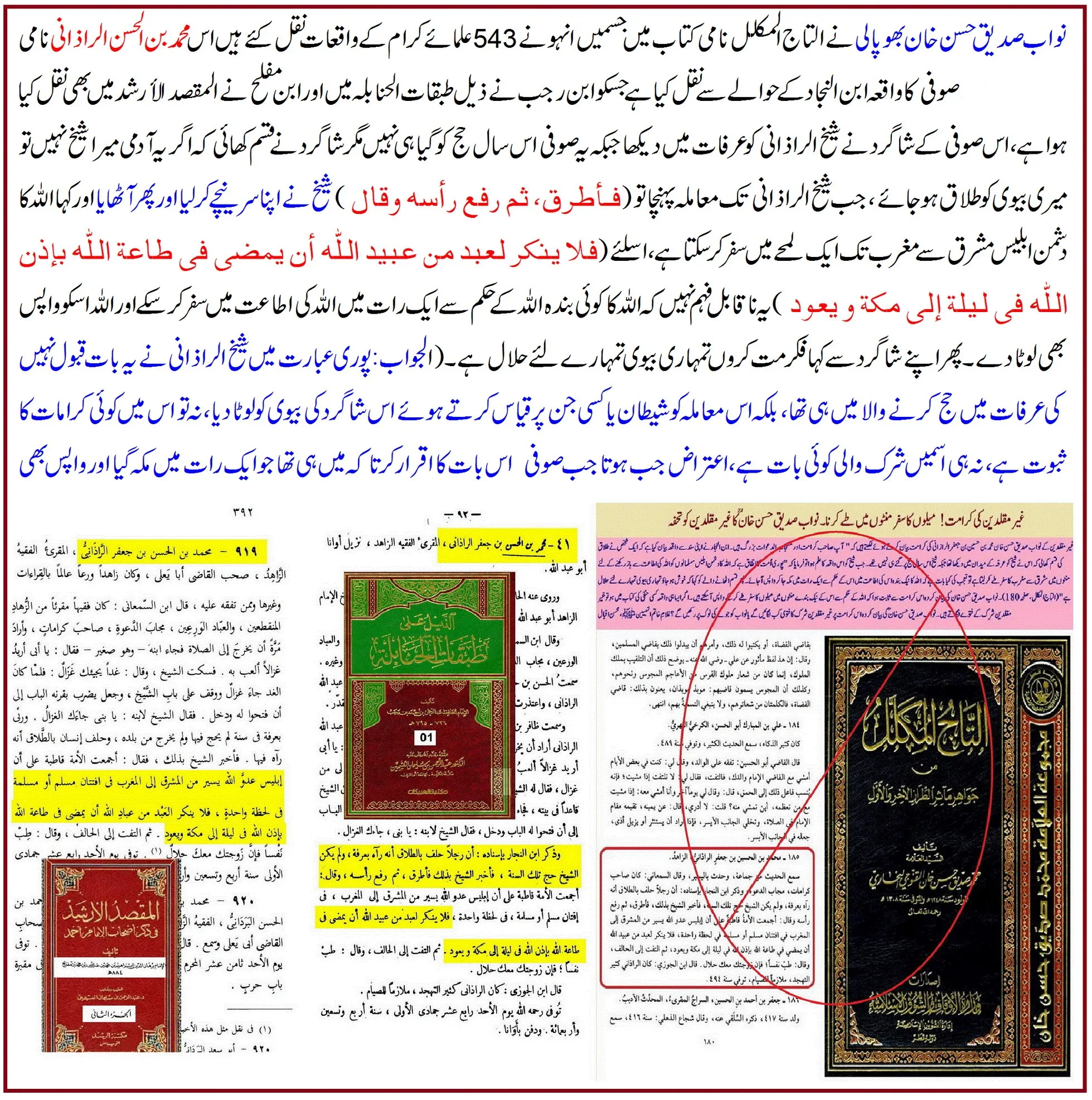
Some people have tried to create the impression that Nawab Sadiq Hasan Khan Bhopali (may Allah have mercy on him), a well-known scholar of Ahl al-Hadith, was also a believer in those unproven and exaggerated miracles which he himself used to refute in others, by quoting an incident from his book
Reference: Al-Taj Al-Mukallal
. The purpose of this article is to clarify that Nawab Sahib (may Allah have mercy on him) mentioned a historical incident as a narrator; he neither adopted it as a belief, nor does it prove any polytheistic or false doctrine, nor does it affect his own clear, explicit, and strong monotheistic beliefs. Furthermore, the incident used as evidence is of an unsupported nature, and among the Muhaddithin, merely narrating an incident, especially without endorsement, does not serve as proof of the narrator’s belief. Therefore, a scholarly analysis of this entire objection is necessary so that the difference between narration, belief, and endorsement is clearly understood.❶ What is the argument of the Deobandi objector?
The summary of the objection is that Nawab Sadiq Hassan Khan (may Allah have mercy on him) narrated an incident about a Sheikh, Muhammad bin Al-Hussain bin Jaafar Al-Radhani, in which a person claimed that he saw his Sheikh in Arafat, although apparently he had not performed Hajj that year. Then a response from the Sheikh was narrated, and from this, an attempt was made to conclude that for this Mujaddid of the Ahl al-Hadith, it is established that the friends of Allah can travel long distances in moments; therefore, why do others reject such incidents?
Brief explanation:
This objection apparently rests on one incident, but in reality, it is based on three assumptions:
First: Nawab Sahib’s (may Allah have mercy on him) mere narration means it is his own belief.
Second: The incident itself is proven and authoritative.
Third: The incident proves exactly what the objector wants to prove.
These three premises are under consideration, and this is the central point of the entire discussion.
❷ The true status of the incident: It is a narration, not a belief
At this point, the very first thing to understand is that the incident mentioned by Nawab Sadiq Hasan Khanؒ regarding Muhammad bin al-Husayn bin Ja'far al-Radhani was not his own invention; rather, it had already been narrated by earlier historians and biographical writers. The text clarifies that Ibn Muflih mentioned this incident in
Reference: Al-Maqsad al-Arshad fi Dhikr Ashab al-Imam Ahmad
and Ibn Rajab also mentioned it in
Reference: Zil Tabaqat al-Hanabila
, but no strong, continuous chain of narration was presented for it.Brief explanation:
This point is fundamental. When an incident is narrated as history or biography and neither the narrator corrects it, nor is it used as evidence, nor is it included in the principles of belief, then merely narrating the incident does not necessarily imply the narrator’s belief in it.
❸ What did Sheikh Muhammad bin al-Husayn al-Radhani say?
According to the text, when this matter reached the Sheikh, he said:
فلا ينكر لعبد من عبيد الله أن يمضي في طاعة الله بإذن الله في ليلة إلى مكة ويعود
Translation:
So it is neither impossible nor deniable that a servant of Allah, by Allah’s permission, could go to Mecca and return in one night.
Reference: Reference: Incident narrated from Muhammad bin Al-Husayn bin Ja'far Al-Radhani as found in the books of Tabaqat and Tiraajim
Brief Explanation:
Two things are very important here. First, this statement is made as a possibility, not as a definite claim. Second, the Sheikh never said that “the person present in Arafat was me” or “I was present in two places simultaneously.” He only gave a possible answer to resolve the issue of the student’s oath and the resulting problem of divorce. This statement neither invalidates the unity of place, nor proves the claim of being in two places at once, nor implies polytheism, nor control over the universe.
❹ What was the real purpose of this incident?
From the context of the incident, it is clear that a person hastily and carelessly took an oath of divorce. When the matter was presented before the Sheikh, he first paused, then gave a response that contained possibility and an escape rather than a definitive claim, so that a household would not be destroyed due to a baseless oath.
Brief Explanation:
The real issue here was not to "prove a miracle" but to "resolve the issue of the oath and divorce." The objector ignored the jurisprudential and judicial context of the incident and turned it into conclusive evidence in the realm of belief and miracles, whereas the incident itself does not bear that weight.
❺ Did the Sheikh make an extraordinary claim about himself?
No. Nowhere in the incident does it say that the Sheikh explicitly stated, "I was in Arafat," or "I was present in two places at the same time." On the contrary, his response is metaphorical and hypothetical in nature. He gave the example of Iblis's swiftness and said that for a servant of Allah, by Allah's command, the possibility of an extraordinary event is not impossible.
Brief explanation:
There is a difference between possibility and occurrence. The acknowledgment of a specific occurrence is only established when the Sheikh explicitly clarifies about his own self. When such clarity is absent, the entire argument of the objector remains based on conjecture.
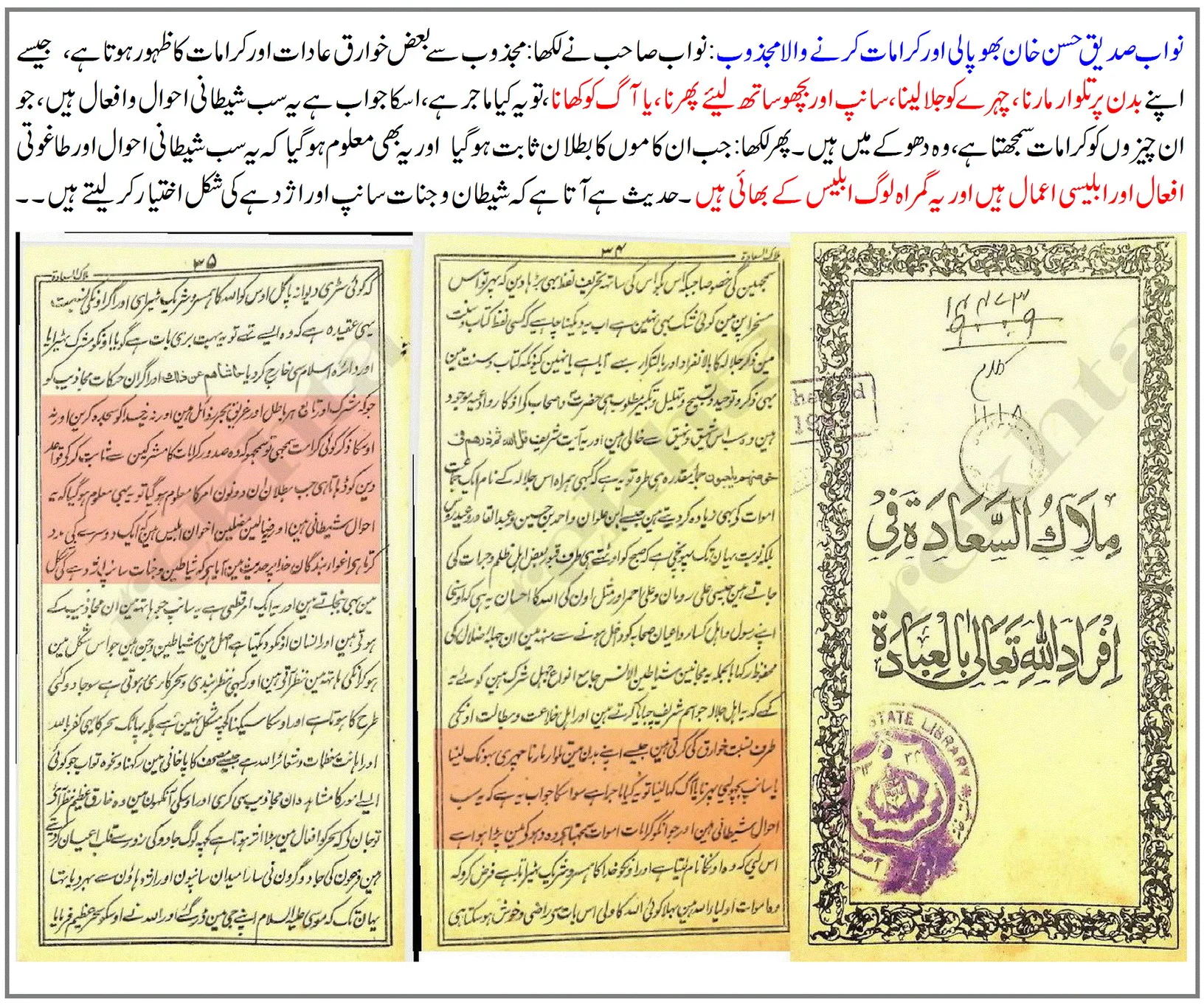
❻ Nawab Sahib's rebuttal to those who consider the miracles of Majzoob as karamat
Nawab Siddiq Hasan Khan, in his treatise
Reference: Malaak al-Sa'adah fi Ifrad Allah Ta'ala bil 'Ibadah
, clarified regarding some miracles attributed to Majzoob that:Striking one's body with a sword, burning the face with fire, keeping snakes and scorpions nearby, eating fire — these are not true miracles but satanic states and actions, and whoever considers them miracles is deceived.
Brief Explanation:
This passage clearly reveals Nawab Sahib’s methodology. He does not consider every extraordinary event a miracle, but rather distinguishes clearly between miracles and satanic states. Therefore, accusing him of considering every strange incident as a saint’s miracle is against his explicit belief.
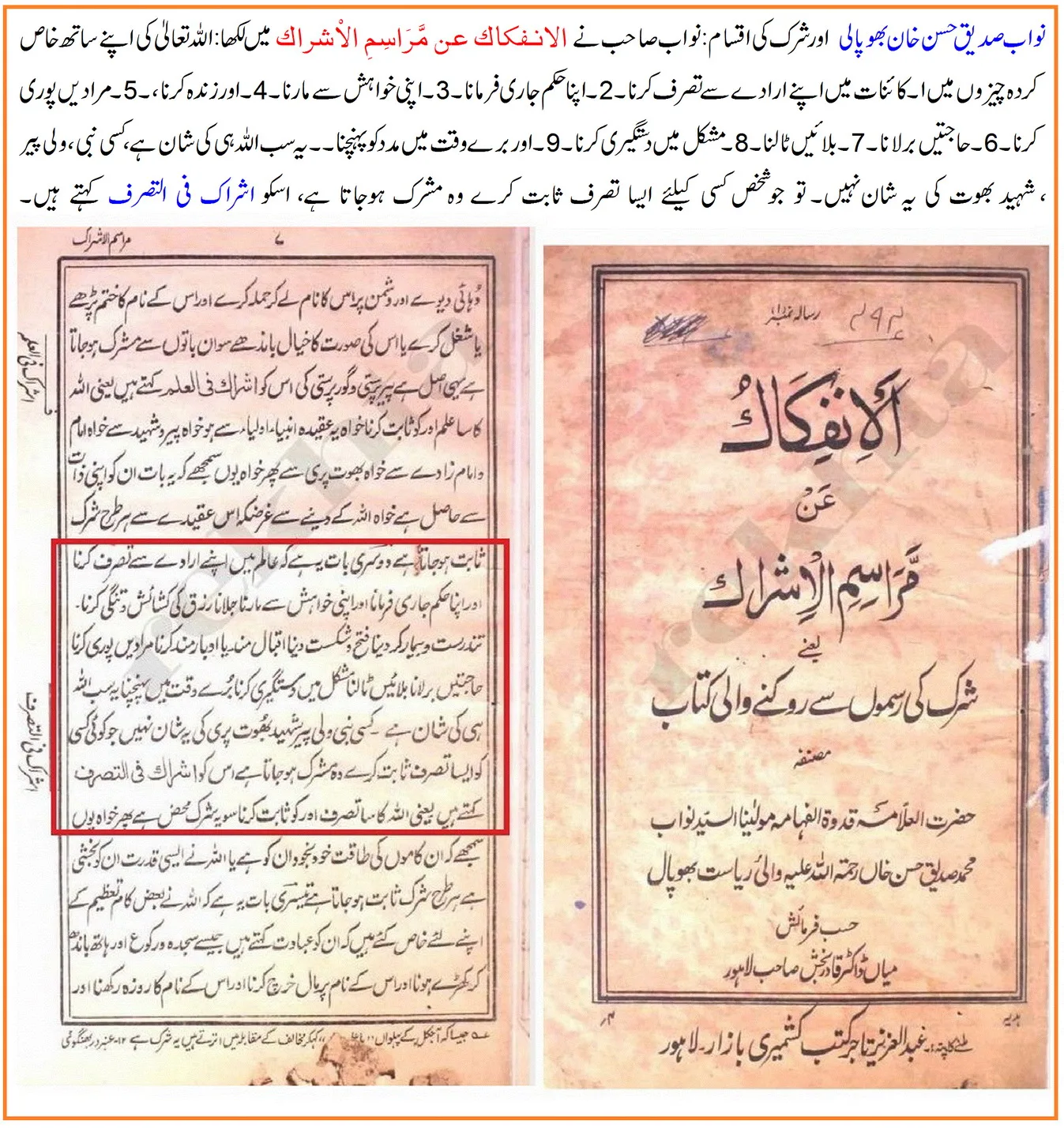
❼ Nawab Sahib’s Explicit Statement on Declaring Cosmic Control as Shirk
Nawab Siddiq Hasan Khan Sahib wrote in
Reference: Al-Infikāk ‘an Marāsim al-Ishrāk
that permanent control over the universe, authority over life and death, fulfilling desires, granting needs, averting calamities, helping in difficulties, and providing assistance in bad times — all these are exclusive attributes of Allah Almighty, and attributing these qualities to any prophet, saint, pir, martyr, or anyone else is shirk.Brief Explanation:
This excerpt is decisive. Because if Nawab Sahib’s own belief is that attributing Allah’s special attributes and constant actions to creation is shirk (polytheism), then it is highly unjust to label him with a shirk belief merely by quoting an unsupported historical incident.
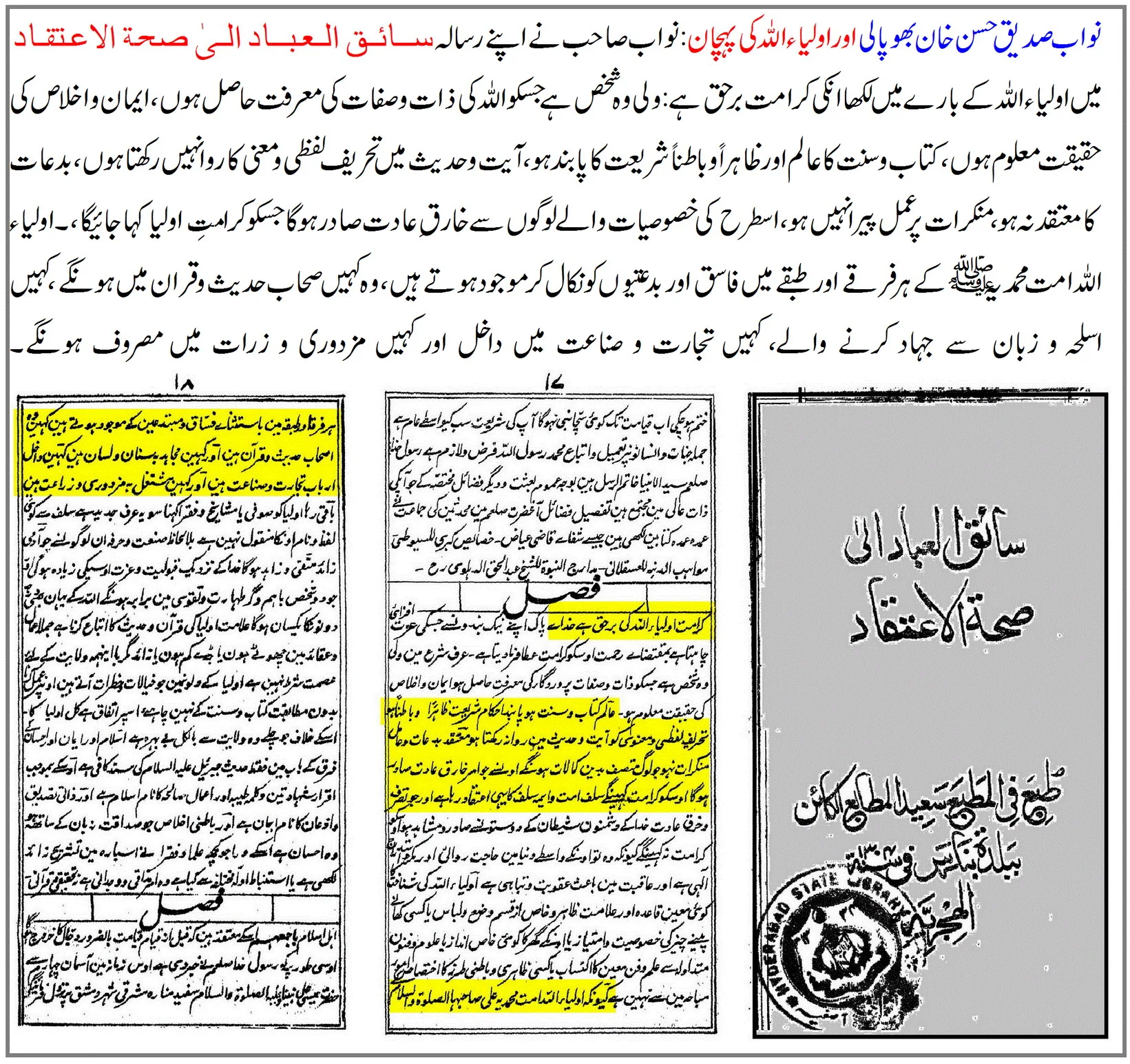
❽ Nawab Sahib’s Balanced Principle Regarding the Saints of Allah and Karamat
Nawab Sahib, in
Reference: Sā’iq al-‘Ibād ilā Ṣiḥḥat al-I‘tiqād
, while describing the attributes of the saints of Allah, clarified that a Wali (saint) is one who has knowledge of Allah, is characterized by faith and sincerity, is a scholar of the Book and Sunnah, adheres to Shariah both outwardly and inwardly, avoids verbal and conceptual distortion, does not believe in innovations, and does not act upon reprehensible deeds. If extraordinary occurrences (Kharq al-‘Ādat) happen through such people, then it should be called a karamat (miracle).Brief Explanation:
From this passage, it is clear that Nawab Sahib does not deny the karamat of the saints, but accepts it with strong Shariah conditions. Therefore, for him, not every strange event is a karamat, nor is every narrated incident a proof; rather, the real criterion is adherence to Tawhid, Sunnah, and Shariah.
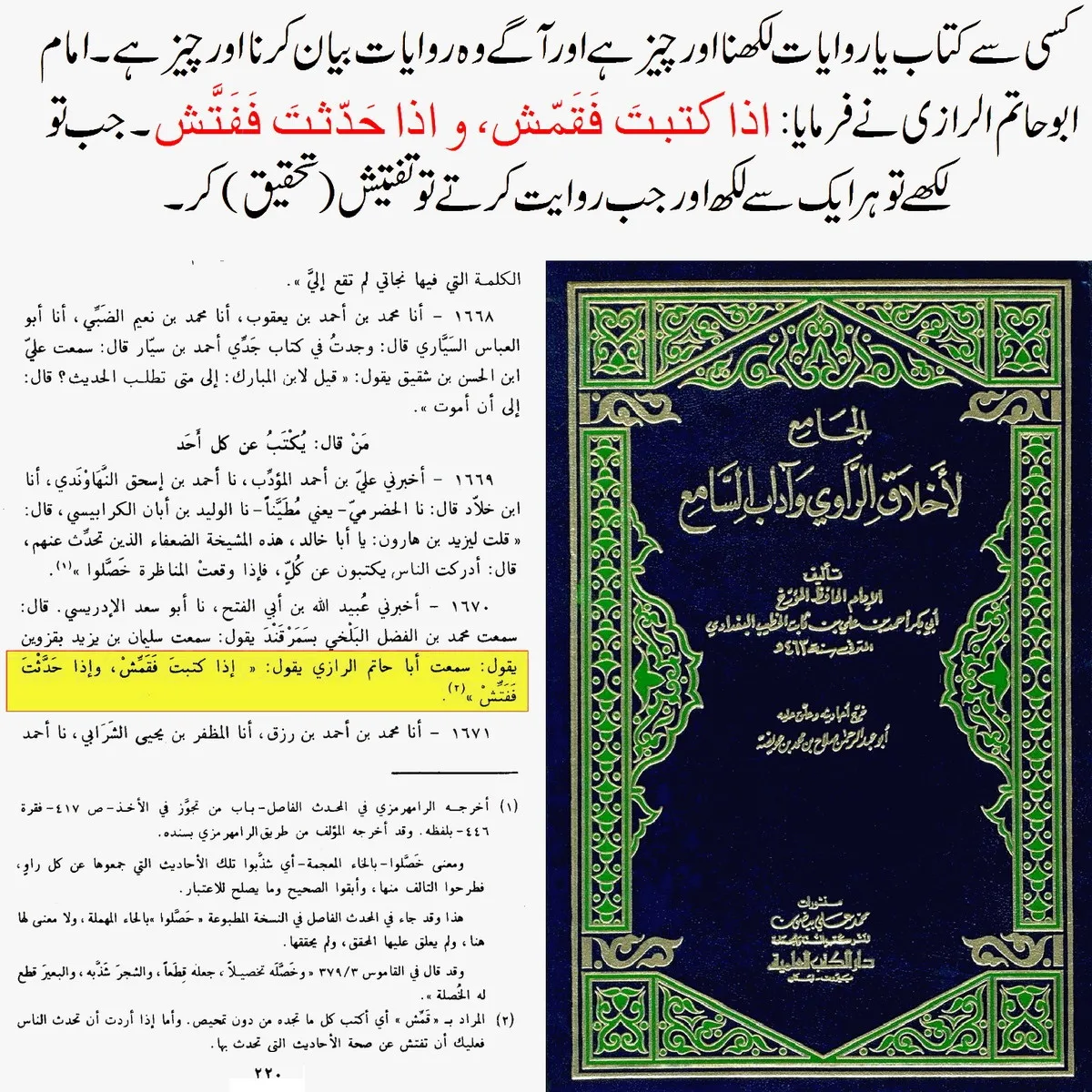
❾ Principle of Imam Abu Hatim Raziؒ
Imam Abu Hatim Raziؒ said:
إِذَا كَتَبْتَ فَقَمِّشْ وَإِذَا حَدَّثْتَ فَفَتِّشْ
Translation:
When you write, collect material from various places, and when you narrate, verify thoroughly.
Reference: Book: Al-Kitab: Al-Jami' li Akhlaq al-Rawi wa Adab al-Sami'
Author: Al-Khatib al-Baghdadi (d. 463 AH)
Author: Al-Khatib al-Baghdadi (d. 463 AH)
Brief Explanation:
This principle is very important. Collecting material and the place of argumentation are two different things. If a scholar transmits historical, biographical, or anecdotal material in a book, it does not mean that he believes every transmitted statement or considers it an unquestionable proof without investigation.
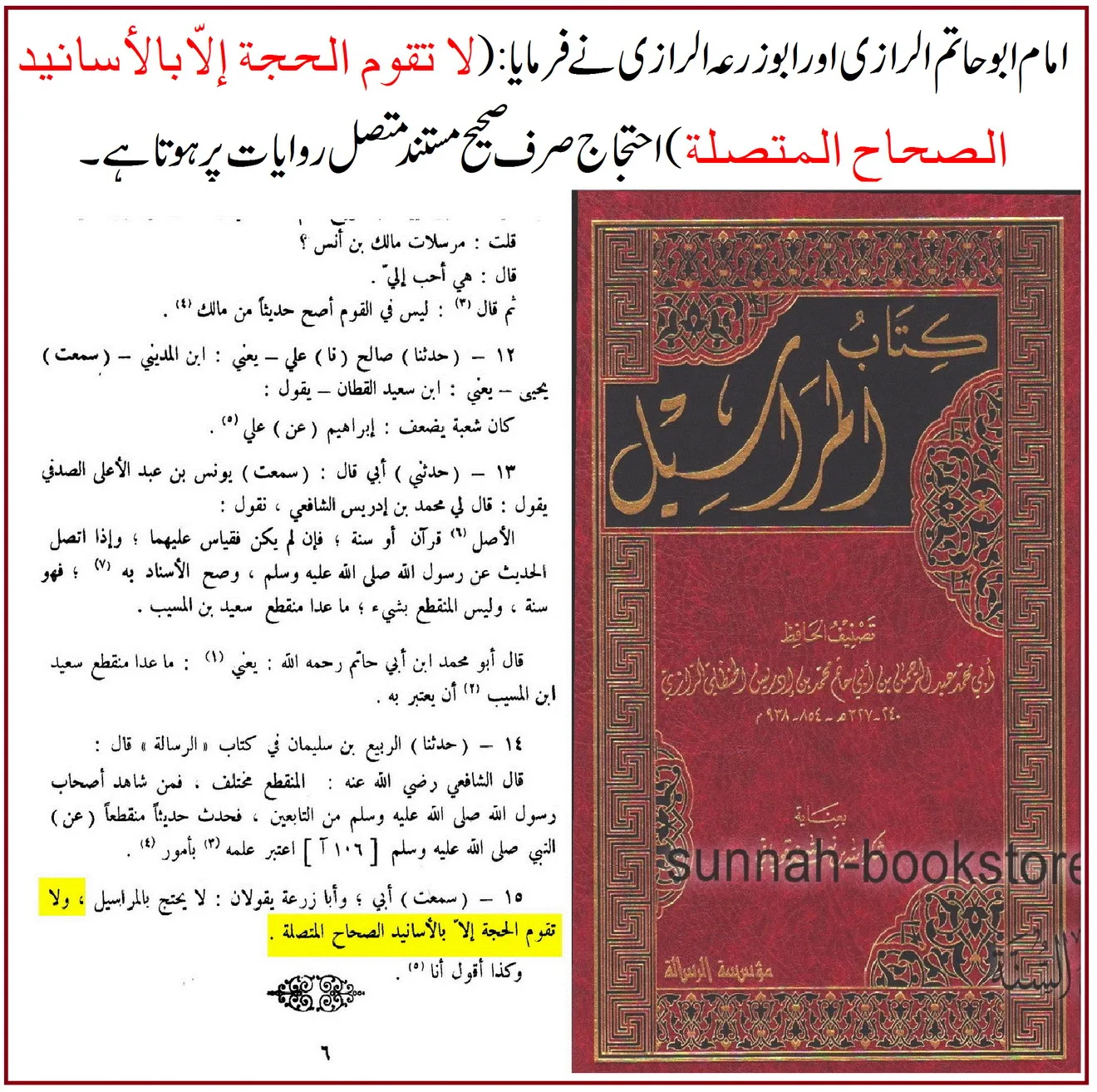
❿ Principle of Argumentation of Imam Abu Hatim and Abu Zur'ahؒ
Ibn Abi Hatimؒ narrated from his father and Abu Zur'ahؒ:
لَا يُحْتَجُّ بِالْمَرَاسِيلِ وَلَا تَقُومُ الْحُجَّةُ إِلَّا بِالْأَسَانِيدِ الصِّحَاحِ الْمُتَّصِلَةِ
Translation:
Mursal narrations are not used as proof, and proof is established only through authentic, connected chains of transmission.
Reference: Book: Al-Marasel
Author: Ibn Abi Hatim al-Razi (d. 327 AH)
Author: Ibn Abi Hatim al-Razi (d. 327 AH)
Brief Explanation:
When a proof cannot be established without a sound connected chain of narration, then the incident related to Muhammad bin al-Husayn al-Radhani, which is of an unsound nature, automatically falls below the level of argument. Therefore, deriving a belief from it or accusing Nawab Sahib (may Allah have mercy on him) is against the principles of the scholars of hadith.
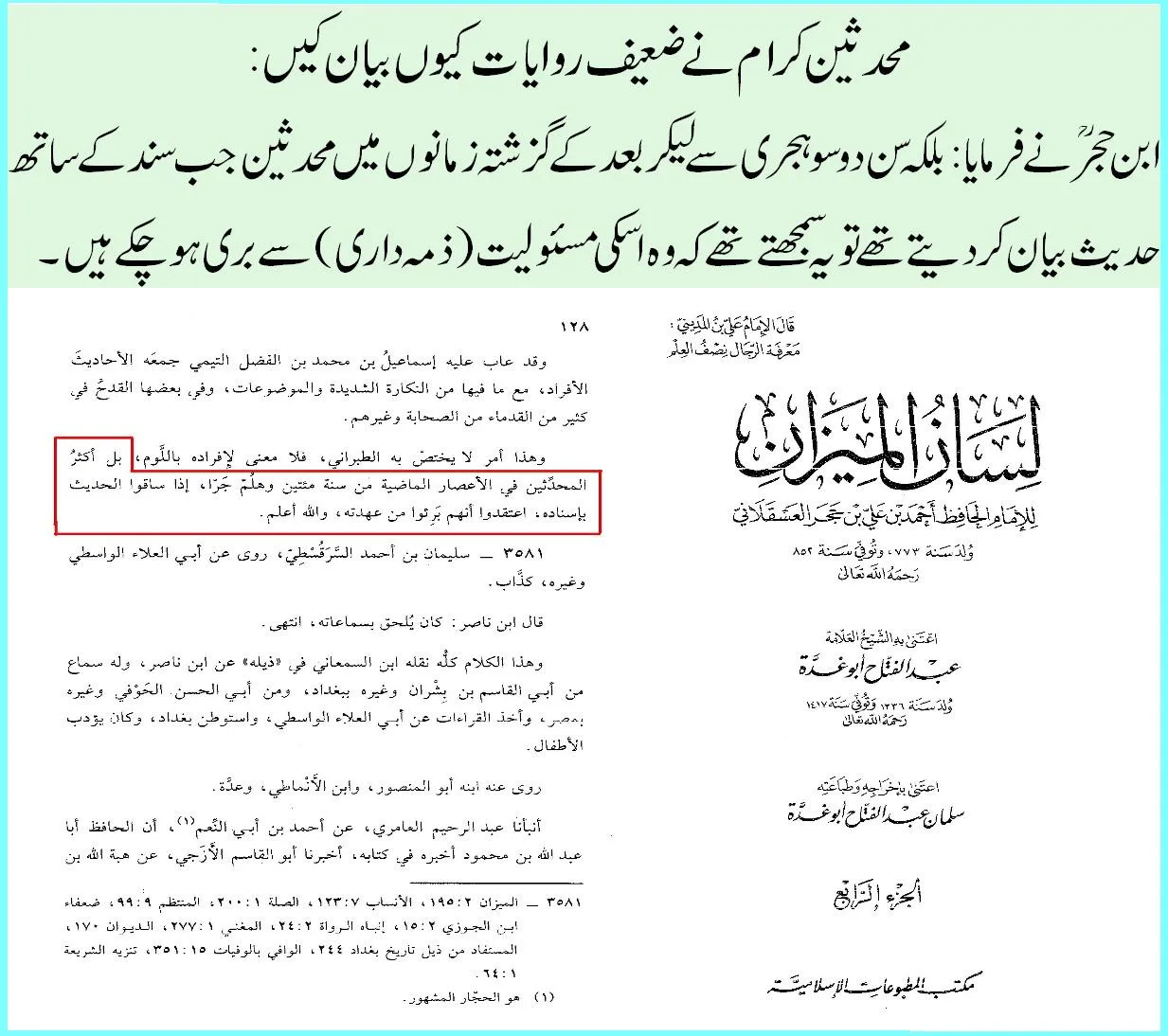
⓫ Hafiz Ibn Hajar’s Warning
Hafiz Ibn Hajar said:
بل أكثر المحدثين في الإعصار الماضية من سنة مائتين وهلم جرا إذا ساقوا الحديث بإسناده اعتقدوا أنهم برؤا من عهدته والله أعلم
Translation:
Rather, in the periods after 200 AH, the method of most hadith scholars was that when they transmitted a hadith with its chain of narration, they considered themselves absolved of responsibility for it.
Reference: Book: Lisan al-Mizan
Author: Abu al-Fadl Ahmad ibn Ali ibn Hajar al-Asqalani (d. 852 AH)
Author: Abu al-Fadl Ahmad ibn Ali ibn Hajar al-Asqalani (d. 852 AH)
Brief Explanation:
From this, it is understood that the role of the transmitter is sometimes merely to transmit faithfully. Therefore, it is not correct to impose the personal belief of the transmitter merely from the mention of a narration, especially when his own established beliefs are contrary to it.
⓬ Even from Liars, Only Writing and Collecting Material is Exemplified
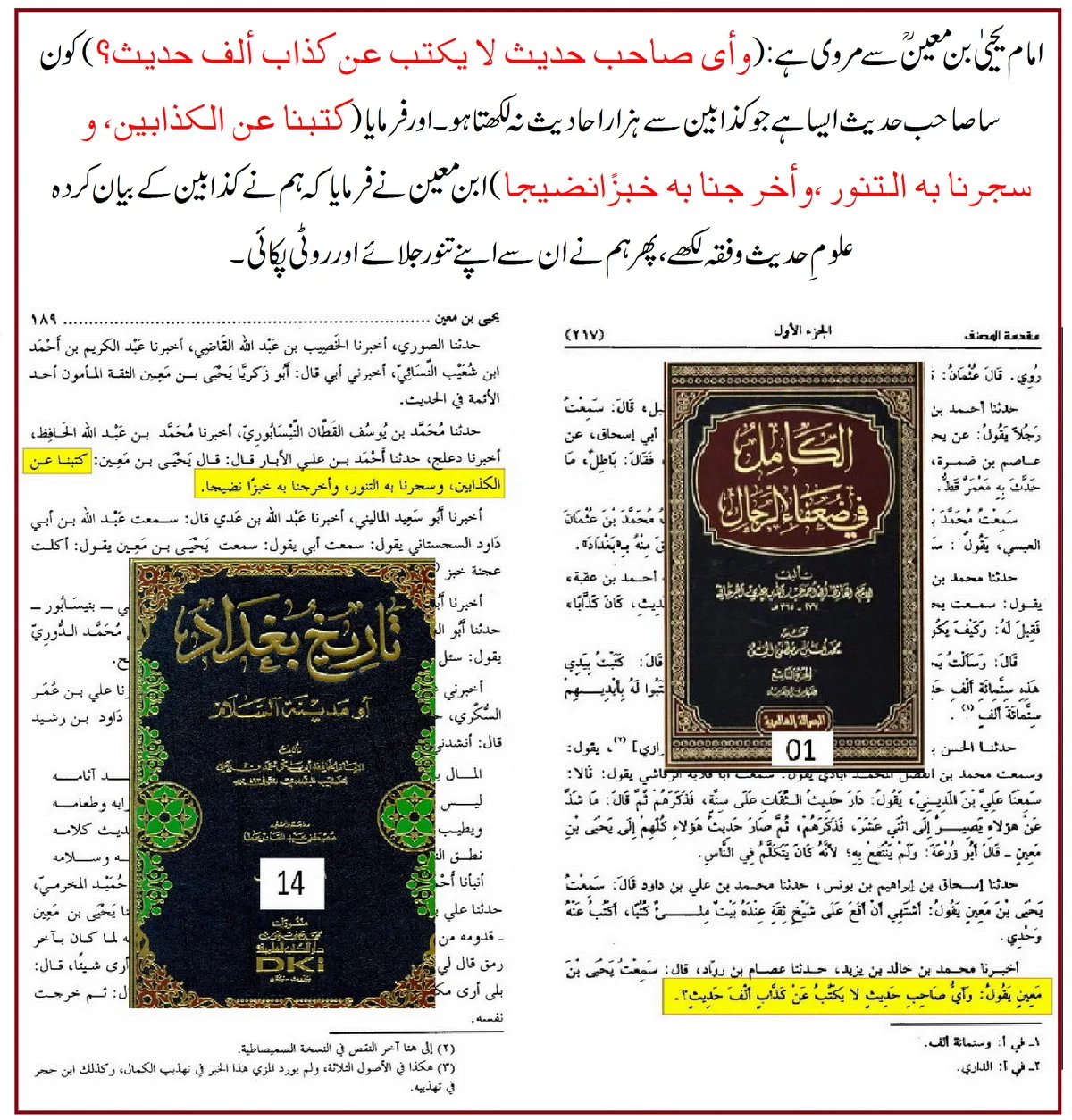
It is narrated from Imam Yahya ibn Ma'in (may Allah have mercy on him):
وأي صاحب حديث لا يكتب عن كذاب ألف حديث؟
Translation:
Which narrator of hadith is there who has not recorded a thousand hadiths from a liar?
And elsewhere it is stated:
كتبنا عن الكذابين، وسجرنا به التنور
Translation:
We have also recorded narrations from liars, then we burned them in the oven.
Reference: References: Al-Kamil fi Dhu'afa al-Rijal, Tarikh Baghdad
Brief Explanation:
The purpose of these statements is that there is a vast difference between "recording" and "using it as proof." The hadith scholars wrote a lot for the purpose of collecting material, but they only used narrations as evidence after thorough scrutiny. The same principle applies here.
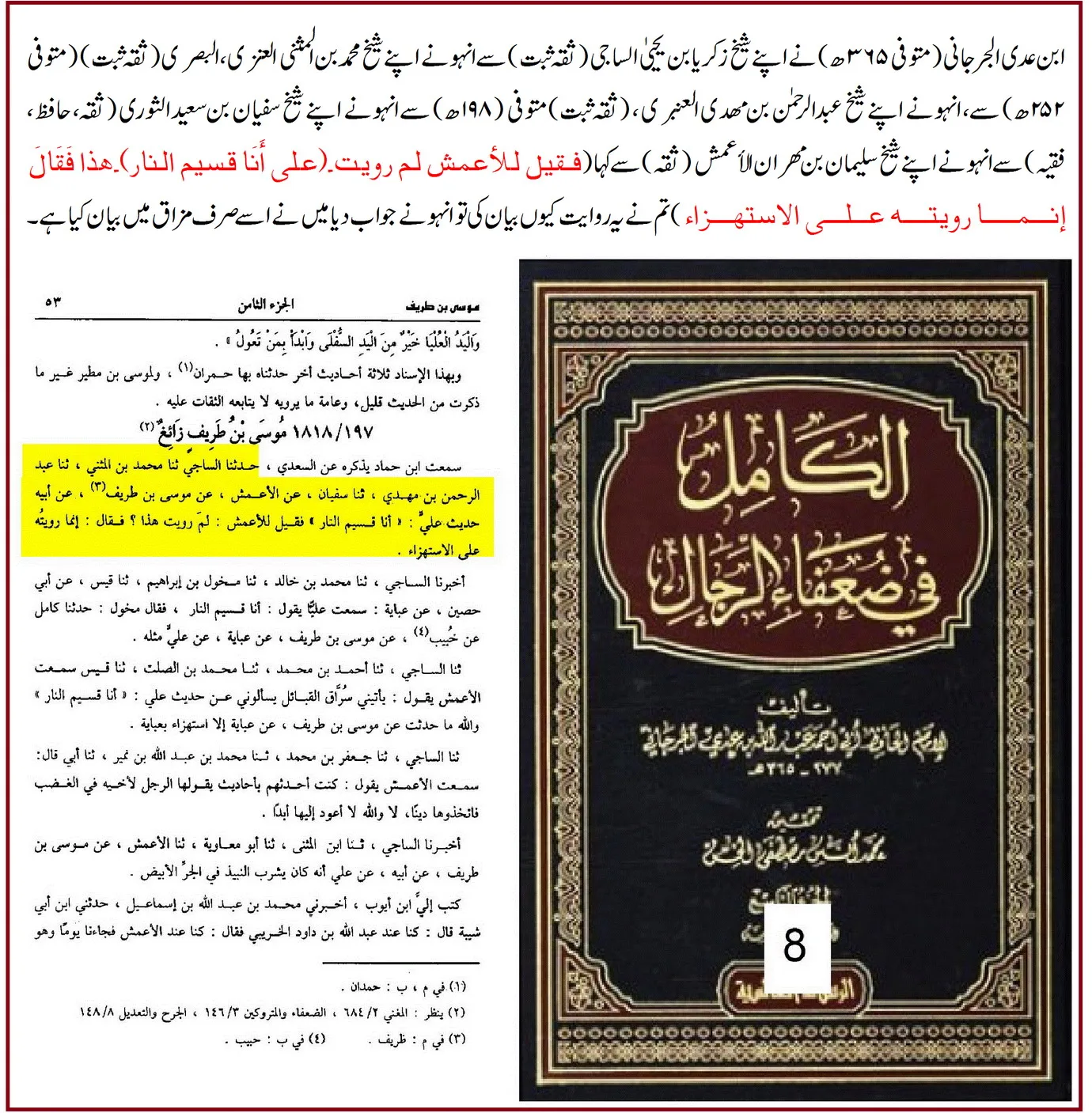
⓭ Imam A'mash's (may Allah have mercy on him) narration of a fabricated hadith as a form of mockery
Sufyan al-Thawri (may Allah have mercy on him) asked A'mash (may Allah have mercy on him) about a fabricated and false narration, to which A'mash replied:
إنما رويته على الاستهزاء
Translation:
I narrated it only as a form of mockery.
Reference: Al-Kitab: Al-Kamil fi Dhu'afa al-Rijal
Author: Ibn 'Adi (died 365 AH)
Author: Ibn 'Adi (died 365 AH)
Brief Explanation:
This example further clarifies that every transmitted statement is not necessarily the transmitter's belief. Sometimes scholars mention a false statement merely to transmit, warn, or refute it. Therefore, confusing transmission with belief is against scholarly integrity.
⓮ Fundamental Flaws in This Argument
There are a few fundamental flaws in this entire objection:
First: An unsupported incident was taken as evidence for a belief.
Second: No distinction was made between the transmitter and the one who holds the belief.
Third: Nawab Siddiq Hasan Khan’s explicit monotheistic beliefs were ignored, and an attempt was made to pass judgment on him based on a single anecdote.
Fourth: The probabilistic, judicial, and contextual aspects of the incident were ignored, and the conclusion was drawn that was intended to be proven beforehand.
Brief Explanation:
Scholarly fairness would have been to first examine Nawab Sahib’s own established belief, then look at the chain of transmission and implication of the narrated incident, and finally make a decision. Here, the matter was reversed: first the accusation was established, then an attempt was made to support it with an unsupported anecdote.
Summary of the Discussion
From the above details, a few points become completely clear:
❶ Nawab Siddiq Hasan Khan cited an incident from Muhammad bin al-Husayn al-Radhani as a narration; he neither made it part of his own belief nor established any permanent legal or theological principle from it.
❷ There is no explicit claim in this incident that the Sheikh was present in two places at the same time; rather, at most, it is a possible and exculpatory explanation.
❸ It is clearly established from the writings of Nawab Siddiq Hasan Khanؒ that he considered attributing cosmic control, fulfilling needs, permanent support, and divine attributes to anyone other than Allah as shirk (polytheism).
❹ According to the principles of the Muhaddithin, merely narrating an unsound (weak) incident does not serve as evidence of the narrator's belief, nor does such a narration establish proof.
❺ Therefore, objecting to Nawab Siddiq Hasan Khanؒ based on this incident, or using it to support heretical and extremist beliefs, is neither scholarly nor methodologically correct.
Conclusion
The conclusion is that the objection raised against Nawab Sadiq Hasan Khan Bhopaliؒ is merely a transmitted, unsupported, and unsubstantiated claim, whereas Nawab Sahibؒ's own consistent, clear, and explicit beliefs completely refute this objection. He himself, in his writings, rejected satanic miracles and polytheistic acts, and accepted the miracles of the saints of Allah within the strong framework of Shariah, Tawheed, and adherence to the Sunnah. To accuse such a person, based on a single anecdote, of believing in excessive miracles is utterly unjust.
The correct point is that Nawab Sahibؒ here is merely a transmitter, not a claimant; and mere transmission does not necessitate belief. Moreover, when the incident itself is weak in chain and, according to the principles of the hadith scholars, it is not valid to use it as evidence, then attacking Nawab Sahibؒ's belief on this basis is against scholarly integrity and deviates from the methodology of the hadith scholars. Therefore, this objection neither serves as a valid argument against Nawab Siddiq Hasan Khanؒ's belief, nor does it confirm any innovation or extremist notion.